|
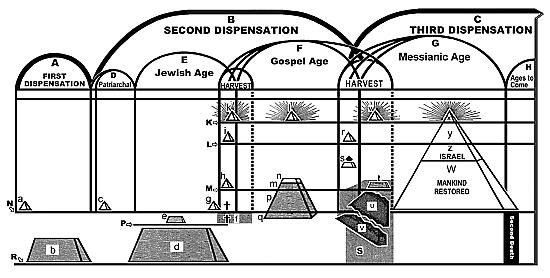
The Chart of the Ages In the Beginning Where there is no vision, the people perish.—Proverbs 29:18 In 1877 Nelson H. Barbour published Three Worlds and the
Harvest of this World. Nine years later Charles T. Russell published The Divine Plan of the Ages which contained a fold-out chart similar to the one on page 34 of this issue. A chapter within that book explained how the chart’s features were to be understood. The chart became popular among the Bible Students to help explain God’s plan to others; it is still used that way today. In this issue we explore the major time divisions shown by the semi-circles. Space precludes an examination of the horizontal levels and most of the chart’s details. However, every element of the chart is identified on page 34 along with Scriptures that apply to that feature. The first article concerns the “world that was.” It begins with the expulsion of Adam and Eve from the Garden of Eden and ends with the destruction of that world in the flood of Noah’s day. The Bible says little about that world. The next three articles concern the Patriarchal, Jewish, and Gospel ages, the three main time divisions within the “world that now is.” These are followed by an analysis of the Millennial or Messianic age, the first in the “world to come.” During that age Christ’s kingdom will be established and blessings will flow to the entire world. The transition from the Jewish to the Gospel age, and from the Gospel to the Messianic age are both described as times of harvest. These harvests are sufficiently important that another article is devoted to the details of both. We end with a verse-by-verse examination of Habakkuk chapter 2 which contains the text that has always appeared on the chart: “Write the vision, and make it plain upon tables, that he may run that readeth it” (verse 2). We trust that those who see the chart for the first time and those who have “grown up” with it will enjoy this look at one of the most popular visual aids ever employed within the Bible Student movement. |