|
Poems and Short Features
A
World Subject to Angels
Several
scriptures seem to throw light on God’s dealings during that first
dispensation, and we think give a further and clearer insight into his plan and
purpose as a whole. The thought suggested by these is, that the first world
(the dispensation before the flood) was under the supervision and special
ministration of the angels; that these were man’s governors and overseers
commissioned to communicate God’s will and to rule over the fallen and
degenerating race, which, because of sin, needed this government.
That
angels were the rulers of that epoch is not only indicated by all references to
that period, but may be reasonably inferred from the Apostle’s remark when
contrasting the present dispensation with the past and the future. He endeavors
to show both the righteousness and the enduring character of the future
rulership of the world, saying, “The world to come hath he not put in
subjection to the angels.” No, it is put under the control of Jesus and his
joint-heirs, and hence it shall not only be more righteous than the present
rule of Satan, but it shall be more successful than was the previous rule by
the angels.—See Heb. 2:2,5.
—Reprints,
p. 1677
|
The
Glorious Day
The night is spent, the morning ray
Comes ush’ring in the glorious day,
The promised time of rest.
Hark! ’tis the trumpet sounding clear;
Its joyful notes burst on the ear,
Proclaiming
tidings blest.
The harvest of the earth is ripe;
The dead who sleep in Christ awake
In
likeness of their Lord.
To life immortal they arise,
Inheritors of Paradise,
Where
death finds no abode.
Stupendous scene! Those men of old,
Prophets who have the story told
Of
this transcendent day;
The patriarchs, apostles, too,
Who lived and died with this in view,
In
glorious array.
Now entered into their reward,
Those faithful servants of the Lord
Have
not served him in vain;
A band of heaven’s royalty,
In glory and in majesty,
O’er
all the earth they reign.
—Hymns
of Dawn, #289
|
|
|
A
Cup of Cold Water
The
Lord of the Harvest walked forth one day,
Where the fields were white with the
ripening wheat,
Where those He had sent in the early morn
Were reaping the grain in the noonday
heat.
He had chosen a place for every one,
And bidden them work till the day was done.
Apart
from the others, with troubled voice,
Spake one who had gathered no golden
grain:
“The Master hath given no work to me,
And my coming hither hath been in
vain;
The reapers with gladness and song will come,
But no sheaves will be mine in the harvest home.”
He
heard the complaint, and He called her name:
“Dear child, why standest thou idle
here?
Go fill the cup from the hillside stream,
And bring it to those who are toiling
near;
I will bless thy labor, and it shall be
Kept in remembrance as done for Me.”
’Twas
a little service, but grateful hearts
Thanked God for the water so cold and
clear;
And some who were fainting with thirst and heat,
Went forth with new strength to the
work so dear;
And many a weary soul looked up,
Revived and cheered by the little cup.
—Poems of
Dawn, pp. 161, 162
|
|
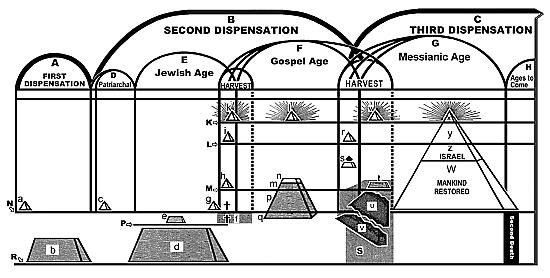
The
Chart of the Ages
Upon the inside of this number you will find a copy of the Chart of the Ages, such as we once had mounted upon rollers, the supply of which has for some time been exhausted, preventing us from filling many applications received. We take this method of placing it in the hands of all our readers
We trust that it may have a two-fold effect: first, that you may be blessed by a fresh examination of the chart and its lessons. … Secondly, we hope that being quickened and refreshed by a clear view of our Father’s plan, you may be stimulated as well as enabled, to explain the plan to others, illustrating it by the chart. Thus, no matter how simply you tell it, you can preach the “good tidings of great joy which shall be to all people.” The chart will not only interest and hold the attention of your thoughtful neighbor, but will make the truth the more easy of comprehension. Thus many can let their light so shine as to honor their Heavenly Father, as well as to bless and refresh their neighbors and friends.
—Reprints, p. 868
|
|