|
Today In Prophecy
Religion in the Last Day “And they, continuing daily with one accord in the temple, and breaking bread from house to house, did eat their meat with gladness and singleness of heart, Praising God, and having favour with all the people. And the Lord added to the church daily such as should be saved” (Acts 2:46-47). At Christianity’s inception, Gentile Christians worshipped alongside Jewish believers in an informal association. Their main objective was to spread the good news of Jesus, “That the Gentiles should be fellowheirs, and of the same body, and partakers of his promise in Christ by the gospel” (Ephesians 3:6). The Roman emperor Constantine in 312 AD attributed his final victory over the Western empire to the God of Christianity. In the Edict of Milan he mandated the toleration of all religions in the empire and codified Christian beliefs and practices into law. Constantine gave land and money to the Church, granted tax exemptions for its property, gave political status to priests. By the sixth century, land gifts had made the Catholic Church the largest landowner in the West. Increased political standing in the Empire seduced church teachers to adopt the ways and dress of the royal household; church organization mimicked that of the Empire; church teachers in politically important cities became authoritarian. Zeal for the simple message of salvation for all in a future millennium gave way to concern for preservation and power in the world today. The Changing Face of Christianity
During the past decade, organized Church relevance has shown significant decline while its message has become considerably mixed with non- Christian teaching: • A National Public Radio report issued in October says that U.S. Hispanics are leaving the Catholic Church in increasing numbers • During the October global occupy movement, a high-profile branch of the Church of England, the official State religion, was being cast as stooge of the System • Claremont Lincoln University in California, a creation of the much older United Methodist-affiliated Claremont School of Theology founded in 1885, recently partnered with Southern California’s Academy of Jewish Religion and the Islamic Center of Southern California to offer master’s degrees in divinity, rabbinic studies and Muslim counseling. • The Lutheran Church in San Francisco offers “guided meditations” by a high priestess of the pagan fertility goddess Isis. • Pope Benedict XVI joined Buddhist monks, Islamic scholars, Yoruba leaders and a handful of agnostics in making a communal call for peace. Benedict welcomed some 300 leaders representing a rainbow of faiths as well as Buddhist monks from mainland China The Decline of Organized Religion According to research by the Barna group, the youngest adults those 18-23 — are clearly rejecting traditional Christian teaching and all organized faiths — almost half do not identify themselves with any particular religion. Another Barna group survey shows less than one percent of that group even hold a Biblical world view. The survey defined “a Biblical world view” as believing that: (1) absolute moral truth exists; (2) the Bible is completely accurate in all of the principles it teaches; (3) Satan is considered to be a real being or force, not merely symbolic; (4) a person cannot earn their way into heaven by trying to be good or by doing good works; (5) Jesus Christ lived a sinless life on earth; (6) God is the all-knowing, all-powerful creator of the world who still rules the universe today. In Brazil, a traditional Catholic stronghold, the Catholic share of the population hit its lowest level — 68 percent — since census figures tracked religion beginning in 1872. Jehovah Not Seeking to Convert the World Jesus predicted that many who would call themselves Christians would not be recognized as such: “Many will say to me in that day, Lord, Lord, have we not prophesied in thy name? and in thy name have cast out devils? and in thy name done many wonderful works? And then will I profess unto them, I never knew you: depart from me, ye that work iniquity” (Matthew 7:22, 23). Since Jesus’ death and resurrection, God has been searching for people and for a specific purpose. Jesus calls this group a little flock. “Fear not, little flock; for it is your Father’s good pleasure to give you the kingdom” (Luke 12:32). This call to a little flock has existed throughout all eras of Church history and has been made available to all segments of the human race. Those who respond are designated in scripture by the Greek word ekklesia, “called out ones” (1 Corinthians 1:2). They are resurrected to a spiritual nature (John 3:1-5) and appear with our returned Lord when he establishes his Kingdom for the blessing of all mankind (1 John 3:2). Paul notes the primary work of the collective church is in the millennial Kingdom, “Do ye not know that the saints shall judge the world? and if the world shall be judged by you, are ye unworthy to judge the smallest matters?”(1 Corinthians 6:2). Those who follow the terms of Jesus’ call today will reign with him during his Kingdom, during the time that the benefits of Jesus’ sacrificial death are bestowed upon the entire world of mankind. “And if children, then heirs; heirs of God, and joint-heirs with Christ; if so be that we suffer with him, that we may be also glorified together” (Romans 8:17). “And I saw thrones, and they sat upon them, and judgment was given unto them: and I saw the souls of them that were beheaded for the witness of Jesus, and for the word of God, and which had not worshipped the beast, neither his image, neither had received his mark upon their foreheads, or in their hands; and they lived and reigned with Christ a thousand years” (Revelation 20:4). During the harvest of this age, those desiring to be part of this work are urged to withdraw from sectarian organizations: “And I heard another voice from heaven, saying, Come out of her, my people, that ye be not partakers of her sins, and that ye receive not of her plagues” (Revelation 18:4). Those that obey the admonition to come out are justly rewarded by an intimate relationship with Jehovah God. “He that dwelleth in the secret place of the most High shall abide under the shadow of the Almighty” (Psalm 91:1). This condition of entire consecration as a follower of Jesus results in the ability to find stability despite the crumbling religious world of today: “I will say of the LORD, He is my refuge and my fortress: my God; in him will I trust” (Psalm 91:2). |
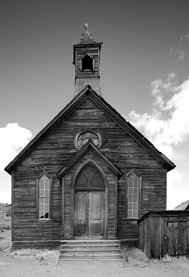 The evolvement of
Christianity has resulted in an establishment today that bears little likeness
to those early believers in the book of Acts. Consider its position today: it is
one of approximately 40 organized religions and faith groups, according to
global consultants ReligiousTolerance.org. The Encyclopedia of American
Religions lists about 1,200 denominations in North America alone. World
Christian Encyclopedia: A Comparative Survey of Churches and Religions of the
World identifies almost 34,000 separate organized groups of Christians
worldwide.