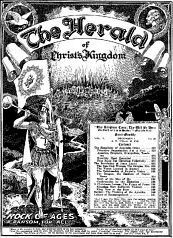
THE HERALD
of Christ's Kingdom
VOL. I. December 1, 1918 No. 1
Table of Contents
THIS JOURNAL AND ITS SACRED MISSION
TO US THE SCRIPTURES CLEARLY TEACH
The Herald Editorial Committee:
PASTORAL BIBLE INSTITUTE
THE ST. LOUIS CONVENTION, DECEMBER 6-8
"INQUIRE FOR THE OLD PATHS"
"THAT HE MAY
ESTABLISH YOUR HEARTS"
THE BRIDEGROOM'S DOVE
A HOLY CONVOCATION AT PROVIDENCE, R. I.
A CHRISTMAS LESSON: THE BIRTH OF JESUS
FAITH'S VICTORIES
NEW YORK CHURCH MEMORIAL SERVICE
VOL. I. December 15, 1918 No. 2
Table of Contents
CLIPPINGS AND ITEMS OF INTEREST
"YEARLY RECKONINGS -- SPIRITUAL ACCOUNTS"
ECHOES FROM THE ST. LOUIS CONVENTION
YOUR` "'GOOD'' HOPES" 1919
HERALD SUBSCRIPTIONS
FREE LITERATURE FOR THE PUBLIC
OUR MOTTO FOR 1919
PHARAOH OPPRESSES ISRAEL
MOSES THE LEADER OF ISRAEL
LETTERS OF GENERAL INTEREST
VOL. I. December 1, 1918 No. 1
THIS JOURNAL
AND ITS SACRED MISSION
THIS JOURNAL is one of the prime factors or instruments in the
system of Bible Instruction, or "Seminary Extension," now being presented in all
parts of the civilized world by the PASTORAL BIBLE INSTITUTE, chartered A.D. 1918, for the
Promotion of Christian Knowledge. It not only serves as a class room where Bible Students
may meet in the study of the divine Word, but also as a channel of communication through
which they may be reached with announcements of the Institutes Conventions and of the
coming of its traveling representatives, and refreshed with reports of its Conventions.
Our treatment of the International Sunday School Lessons is specially for the older Bible
Students and teachers. By some this feature is considered indispensable.
This Journal stands firmly for the defense of the only true
foundation of the Christian's hope now being so generally repudiated,-- Redemption through
the precious blood of "the man Christ Jesus who gave himself a ransom [a corresponding price, a substitute] for
all." (1 Pet. 1:19; 1 Tim. 2:6.) Building up on this sure foundation the gold, silver
and precious stones (1 Cor. 3:11-15; 2 Pet. 1:5-11) of the Word of God, its further
mission is to-- "Make all see what is the fellowship of the mystery which...has been
hid in God,...to the intent that now might be made known by the Church the manifold wisdom
of God"-- "which in other ages was not made known unto the sons of men as it is
now revealed."-- Eph. 3:5-9,10.
It stands free from all parties, sects and creeds of men, while it
seeks more and more to bring its every utterance into fullest subjection to the will of
God in Christ, as expressed in the Holy Scriptures. It is thus free to declare boldly
whatsoever the Lord hath spoken;-- according to the divine wisdom granted unto us, to
understand. Its attitude is not dogmatical, but confident; for we know whereof we affirm,
treading with implicit faith upon the sure promises of God. It is held as a trust, to be
used only in his service; hence our decisions relative to what may and what may not appear
in its columns must be according to our judgment of his good pleasure, the teaching of his
Word, for the upbuilding of his people in grace and knowledge. And we not only invite but
urge our readers to prove all its utterances by the infallible Word to which reference is
constantly made, to facilitate such testing.
That the Church is "the Temple of the Living God"--
peculiarly "His workmanship;" that its construction has been in progress
throughout the Gospel age-- ever since Christ became the world's Redeemer and the chief
corner stone of his Temple, through which, when finished, God's blessing shall come
"to all people," and they find access to him.-- 1 Cor. 3:16,17; Eph. 2:20-22;
Gen. 28:14; Gal. 3:29.
That meantime the chiseling, shaping and polishing of consecrated
believers in Christ's atonement for sin, progresses; and when the last of these
"living stones," "elect and precious," shall have been made ready, the
great Master Workman will bring all together in the First Resurrection; and the Temple
shall be filled with his glory, and be the meeting place between God and men throughout
the Millennium.-- Rev. 15:5-8.
That the Basis of Hope, for the Church and the World, lies in the
fact that "Jesus Christ, by the grace of God, tasted death for every man,"
"a ransom for all," and will be "the true light which lighteth every man
that cometh into the world," "in due time."-- Heb. 2:9; John 1:9; 2 Tim.
2:5,6.
That the Hope of the Church is that she may be like her Lord,
"see him as he is," be "partaker of the divine nature," and share his
glory as his joint-heir.-- I John 3:2; John 17:24; Rom. 8:17; 2 Pet. 1:4.
That the present mission of the Church is the perfecting of the
saints for the future work of service; to develop in herself every grace; to be God's
witness to the world; and to prepare to be kings and priests in the next age.-- Eph. 4:12;
Matt. 24:14; Rev. 1:6; 20:6.
That the hope for the World lies in the blessings of knowledge and
opportunity to be brought to all by Christ's Millennial Kingdom-- the restitution of all
that was lost in Adam, to all the willing and obedient, at the hands of their Redeemer and
his glorified Church-- when all the willfully wicked will be destroyed.-- Acts 3:19-23;
Isa. 35.
We affirm the pre-existence of
Jesus as the mighty Word(Logos-spokesman), "the beginning of the creation of
God," "the first born of every creature," the active agent of the Heavenly
Father, Jehovah, in all the work of creation. Without Him was not anything made that was
made." – Rev. 3:14, Col. 1:15; John 1:3.
We affirm that the Word (Logos)
was made flesh-- became the Babe of Bethlehem-- thus becoming the Man Jesus, "holy
harmless, undefiled, separate from sinners." As we affirm the humanity of Jesus, we
equally affirm the Divinity of Christ-- "God also hath highly exalted him, and given
Him a name which is above every name."-- Heb. 7:26; Phil. 2:9.
We acknowledge that the
personality of the Holy Spirit is the Father and the Son; that the Holy Spirit proceeds
from both, and is manifested in all who receive the begetting of the Holy Spirit and
thereby become sons of God.-- John 1:13; 1 Pet. 1:3.
We affirm the resurrection of
Christ-- that He was put to death in flesh, but quickened in Spirit. We deny that He was
raised in the flesh, and challenge any statement to that effect as being unscriptural.-- 1
Pet. 3:18; 2 Cor. 3:17; 1 Cor. 15:8; Acts 26:13-15.
PASTORAL BIBLE INSTITUTE
262
FULTON STREET BROOKLYN, N. Y. U.S.A.
SONG OF SOLOMON 2:14
Whom think'st thou, meaneth He?
Say, O my soul! canst thou presume
He thus addresseth thee?
Yes, 'tis the Bridegroom's voice of love,
Calling thee, O my soul! His Dove!
"The Dove is gentle, mild
and meek:
Deserve I, then, the name?
I look within in vain to seek
Aught which can give a claim:
Yet, made so by redeeming love,
My soul, thou art the Bridegroom's Dove!
"Methinks,
my soul, that thou mayst see,
In this endearing word,
Reasons why Jesus likens thee
To this defenseless bird;
Reasons which show the Bridegroom's love
To His poor, helpless, timid Dove!
"The
Dove hath neither claw nor sting,
Nor weapon for the fight;
She owes her safety to her wing,
Her victory to flight.
A shelter hath the Bridegroom's love
Provided for His helpless Dove!
"As
the poor Dove, before the Hawk
Quick to her refuge flies,
So need I, in my daily walk,
The wings which faith supplies
To bear me where the Bridegroom's love
Places beyond all harm His Dove I
"My
soul, of native power bereft,
To Calvary repairs:
Immanuel is the rocky cleft,
The secret of the stairs!
Since placed there by the Bridegroom's love,
hat evil can befall His Dove?
"My
soul, now hid within a rock
(The 'Rock of Ages' called),
Amid the universal shock
Is fearless, unappalled,
A cleft therein, prepared by love,
In safety hides the Bridegroom's Dove!
"0 happy Dove! thus weak
thus safe;
Do I resemble her?
Then to my soul, O Lord I vouchsafe
A dove-like character.
Pure, harmless, gentle, full of love,
Make me in spirit, Lord, a Dove!"
NOVEMBER 8-10, 1918
Welcome, In the Name of the
Lord
"My
God shall supply all your need according to His riches in glory by Christ Jesus."
Philippians 4:19.
"Trust in the Lord with all thine heart; and
lean not unto thine own understanding. In all thy ways acknowledge Him, and He shall
direct thy paths." Proverbs 3:5, 6.
T HE
General Convention held at Providence, R. I., November 8-10, proved to be one of the most,
if not the most blessed occasion that the Lord's
people have, experienced in several Years. About three hundred of the friends assembled at
this time for fellowship, worship and praise. The gathering being made up principally from
the following States: Massachusetts, Rhode Island, Connecticut, Maine, Vermont,
Pennsylvania, Virginia, New York and New Jersey. Thus constituting a very good
representation of the Lord's people in general.
As the friends met in this city they were
reminded of certain interesting historical features in connection with the location. It
was recalled that early in the seventeenth century Roger Williams, together with a few
associates, founded a settlement to which he gave the name of Providence; doubtless out of
grateful remembrance of God's providence over him and his associates in their distress.
Driven apart from the Massachusetts colony by religious persecution they fled to the
wilderness where they could exercise their religious liberty and worship the Lord in the
beauty of holiness according to the dictates of their own conscience.
It was therefore a pleasant thought that
now, nearly three hundred years later, faithful followers of Christ were once more
assembling to worship the same Lord and Master in a city that deserves special distinction
in the roll of honor, because of the devotion to the spirit of Christ, and the ardent love
of liberty, on the part of those who founded the City of Providence.
The earnest zeal and loving spirit of
devotion on the part of the dear friends of the Providence Class, in making such ample and
complete arrangements for the comfort of all, was clearly noted and greatly appreciated by
all. All of the sessions of the Convention save one, were held in "Andrews Assembly
Rooms," an ideal meeting place. At the rear of the speakers' platform a magnificent
chart of the Divine Plan of the Ages was suspended while above this the words,
"Welcome in the name of the Lord" appeared, painted in large letters. To the
right and left of the chart were to be seen the Convention texts, as printed at the head
of this article.
After the opening services Friday morning,
a letter of welcome addressed to the Convention, by Brother R. E. Streeter on behalf of
the Providence Class, was read by Brother I. I. Margeson, Chairman. Following this, the
proceedings of the Convention, with few exceptions, were carried out according to the
regular program. The discourses were all of an encouraging nature, spiritually ennobling
and uplifting in their general influence. As the different speakers, each in his own
characteristic way, reviewed the wondrous plan of salvation, revealing more and more of
"the breadth and length and depth and height" of the love of the Heavenly Father
through Christ our Lord; and as they in the spirit of love and meekness, admonished and
encouraged all to renewed efforts in the "Narrow Way," traversed by their
Redeemer, the Convention hall seemed filled with the presence of the King Himself.
Forgotten
for the time were the things of this world and its affairs; the sufferings, trials and
perplexities of the daily life, all seemed to fade away before the glories and the
splendors of the heavenly things so clearly presented.
Throughout
the sessions of the Convention many expressions of joy and thanksgiving, and hymns of
worship and praise ascended to Him from whom all blessings flow. Many earnest prayers were
offered in behalf of the Lord's people far and near, known and unknown to us, that in this
stormy time of trial and perplexity, all might experience the needed supplies of grace and
strength wherewith to battle on in the cause of truth and righteousness.
Even the business session on Saturday
afternoon was no exception along this line of peace, harmony and love, for the brethren
were so filled with the Holy Spirit, of the Lord, that this feature of the Convention
turned out to be a veritable "love feast." Not a single discordant note was
heard throughout the session, while nearly all participated in the joyous proceedings., It
seemed that the dear friends were vying with one another to see which could show forth the
largest amount of consideration and brotherly kindness.
Just previous to the regular business
session in the afternoon a special meeting of the Elders and Deacons, about forty in
number, representing several Ecclesias, was convened for the purpose of informally
considering what would seem to be wise to recommend to the General Convention, in the
afternoon. At this session of the representative brethren, several interesting
discussions, in which a number took part, were opened up. Matters were considered pro and
con, in the spirit of meekness and love. The advisability of forming a simple business
arrangement with which to conduct the affairs of the Church and to provide for the issuing
of a regular journal, were the principal features debated upon. An informal vote was taken
which was unanimously in favor of proceeding with the work of forming an organization to
conduct the various branches of the ministry.
In the opening of the business session in
the afternoon special prayer was offered for divine blessings and guidance during the
conference. The Chairman, Brother I. I. Margeson, in his remarks stated that it seemed
wise that this Convention should have a business session, that the Lord's people were
anxiously looking in the direction of some more organized effort to herald the message of
the great King.
The minutes of the
business session of the Associated Bible Students' Convention, held at Asbury Park, July
26-29, 1918, were then read and approved.
A motion was carried that the Committee's
Secretary render a report to the Convention then in session, outlining the Committee's
activities in the service of the Lord and the Truth.
The
Secretary stated that he was very glad to report that the Committee had been laboring
together most harmoniously during the last three months; that several meetings of the
Committee had been held, during which thirty to forty motions and resolutions had been
unanimously passed, that at no time was there disagreement or a divided vote.
The Brother reported that the Committee had
earnestly endeavored to carry out the wishes and instructions given at the previous Asbury
Park Convention more than three months previous. He reminded the friends that as the time
did not seem ripe for the general organizing of the work at Asbury Park, the Convention at
that time authorized the Committee to publish for the purpose of setting forth
exchanges from the different Ecclesias and to contain matters of general and profitable
interest to the friends, including announcements of Conventions, etc. Three issues of
the bulletin had been mailed. The friends were reminded of the fact that certain
limitations had been placed upon the bulletin regarding the omission of Bible teaching,
doctrinal matter, etc.; and for this reason the bulletin had not contained as many
letters and other profitable matter as the Committee wished might be printed.
It was explained that the Committee had not
specially urged or invited the friends in general to express themselves with regard to
starting a publication and organizing the work for the reason that earlier in the year,
about March 1, a circular letter of considerable length had very widely circulated in
which the friends had been asked to state what 'Seemed to them to be the Lord's leading
with regard to these matters, and that a very large majority had emphatically declared
themselves as in favor of organizing some substantial ministry in behalf of the Lord's
faithful people, and that these friends were still anxiously looking forward to the
realization of their expectations along these lines.
The Brother said further that the bulletin
did not seem to the Committee to be a satisfactory arrangement, nor to the friends in
general; that while it, to a certain extent, satisfied the need of the friends, it was
very manifest from the communications received, that the friends wished something more
substantial in the way of a regular periodical in which the Truth in general might freely
published.
As to advancing the Pilgrim work, reference
was made to how the recent widespread epidemic, necessitating the closing down of meeting
places, had prevented very much development along this line. However, since the ban on
meetings had now been lifted in many places, the friends were requesting Pilgrim visits
and the way was opening up for increased activity in this direction. It was set forth that
the Committee had in mind sending forth several traveling Pilgrims as soon as
circumstances permitted. One extensive trip had been taken by Brother Rockwell covering
territory as far as the middle West, (luring which a good number of Classes have been
visited and excellent meetings held. Report of this trip had already appeared in the
October Bulletin.
The
Secretary also made encouraging report as to Conventions. There seems to be a general
desire among the friends to assemble together for mutual fellowship and, encouragement;
the latest request having come from St. Louis to hold a Convention there December 6-8. The
Committee had accepted the invitation and the prospects were that this Convention would be
well attended, as the location is central and easily accessible to the friends throughout
the West.
As to the financial status of the Committee
reference financial report contained in the August was made to the Bulletin. Brother L.
Greiner, the Committee's Treasurer', not being able to attend tile Convention, report to
date was not available.
At the conclusion of this report a motion
was carried that it be approved and accepted with thanks.
Following this the Chairman reviewed the
discussions which had arisen during the informal meeting of the Elders and Deacons, and
referred particularly to the matter around which seemed to gather special consideration -
that of bringing before the Convention the two recommendations of the Committee which had
been placed on the table at the Asbury Park Convention, July 26-29, 1918. These
recommendations read as follows:
No. 5. "That the Committee be
authorized to issue the long looked for periodical."
No. 6.
"That the Committee be authorized to form a non-profit corporation; the members of
the Committee to be constituted Trustees of the same. This corporation to be similar in
form to the Watch Tower Bible and Tract Society, such as are known in New York as
'Membership Corporations.'"
The Chairman then related how these
recommendations had been discussed from every point of view and that an informal vote
indicated the brethren were practically of one mind, that the time was most opportune to
take up these recommendations and consider them afresh.
By a unanimous vote, the Committee's
recommendations No. 5 and No. 6, tabled at the Asbury Park Convention, were lifted and
acted upon separately; the matter of forming an organization being considered first, and
the advisability of issuing a regular journal discussed afterward. Both recommendations
were unanimously adopted, after a loving and harmonious discussion. All present agreed
that it was an ideal business session, an enjoyable time for all.
Thus the Committee, composed of seven brethren
appointed by a representative gathering of the Lord's people Park convention, held July
26-29, 1918, were empowered by this representative body convened at Providence to
organize and incorporate under the laws of the State of NewYork and to issue a religious
journal devoted to the interests of the "Present Truth," the service of the
brethren, and to the honor and praise of the great God, our Heavenly Father.
The Committee as at present constituted is
compose of the following: Brothers J. D. Wright, I. I. Margeson, P. L. Greiner, F. H.
McGee, H. C. Rockwell, E. J. Pritchard I. F. Hoskins.
The Convention further authorized
the Committee appoint five brethren to be constituted an editorial staff for the editing
of the new journal; and that with the first appearance of the paper, the bulletin,
authorized at Asbury Park, should be discontinued.
A resolution was adopted instructing the
Committee further-to arrange for the publication of literature for free distribution for
use as volunteer matter, etc., the same to be compiled from the writings of our former
Pastor.
The Pastoral work was brought to the
attention of the Convention, and the Committee was instructed to revive this branch of the
service as far as possible, and to proceed with all of the arrangements necessary to carry
it forward, it being understood of course that the Committee would be enabled to advance
this branch of the ministry as well as the others, only as the friends may cooperate with
heart and hand and as the means will be provided.
A further consideration involving much
kindly discussion was the selection of an appropriate name foe the new institution
authorized to be formed. A number of titles were proposed after which it was suggested
that those who wished might forward their choice of a name, in writing to the Secretary,
for the Committee's consideration.
The final action taken at the business
session was the adoption of the following resolution:
"Resolved, that this Convention
expresses its confidence in and love for the Committee and desires it to "Speak unto the children of Israel that they go
forward."
It is here noted that the action of the
Convention at this business meeting, authorizing the reorganization of the work, was
considered most significant, coming as it did at almost the identical hour when peace was
being declared, and the nations of the earth were laying. down their arms at the
conclusion of the world's greatest war; for in less than twelve hours after the closing of
the Convention the whole world seemed to awaken and to rise in one long and fervent
hosanna of praise and thanksgiving for peace, finally declared. It seemed as though all
the peoples were giving expression -to the joyous sentiments which filled the hearts of
those who were privileged to attend this peaceful Convention at Providence.
The closing day of the Convention, Sunday,
Nov. 10th, was one which will long be remembered by those who shared in the spiritual joys
and fellowship of that time. From the opening exercises to the close of the love feast
there was a continuous outpouring of all that was required to make it a season of special
communion with the Heavenly Father, and with those who are prospective Kings and Priests
unto God. The latter part of the day's Manna text, "Rejoiceth in the Truth," (1
Corinthians 13:6), aptly expresses the main sentiment and spirit which controlled the
sessions throughout, and which, indeed, was the key-note of the entire Convention.
The various speakers re-echoed the
sentiments of the hearts of all, by exhorting to. renewed devotion to the Lord and the
service of the Truth; and above all, admonished that perseverance in the development of,
fortitude and strength of Christian character is all important and necessary to the
attainment of a place in the Kingdom of -Heaven. All seemed to rejoice in the prospect
that the Church may once more be honored with privileges in the Lord's work this side of
the veil.
The
different lines of endeavor are to be resumed as the way opens up, and advanced all along
the line. The words of our dear Pastor, after detailing the future mission of the
Church, "Let us be ready," were particularly
applicable as expressing the convictions of the friends relative to the service which may
yet be the privilege of the Lord's people to accomplish.
The "love feast" in the close of
the day was an occasion of bidding Godspeed to one another on the way to the heavenly
city, where the Great Convention-the general assembly of the "First born ones"
will be held. With fervent hand clasps and with words of love and encouragement, the
desire was expressed that all might be found faithful and have the glorious privilege of
attending that last and final gathering of the saints, beyond the " veil" in the
"Holy of Holies," in the presence of the Heavenly Father, our dear Redeemer, and
all the holy angels.
A CHRISTMAS LESSON:
THE BIRTH OF JESUS
-LUKE
2:8-20.-- DECEMBER 22.--
Golden Text.-- "There is born to you this day in
the city of David a Savior, which is Christ the Lord."-- Luke 2:11.
CHRISTMAS
(or Christ's festival) by general usage is celebrated on December 25th; and since its
commemoration is not enjoined in the Scriptures, but is merely a voluntary commemoration
of a great fact rather than of a particular date, we do well to celebrate it decorously
at the usual time; notwithstanding the fact that we disagree with the date, and hold,
according to the evidences, that our Lord was born about October 1st, and that December
25th, nine months previous, was probably the date of the annunciation. Luke 1:30, 31.
Our subject does not take us back to the
beginning of God's creation when Christ as a spirit being became "the first born of
every creature;"-- the Word that was with God in the beginning of creation, and by
whom all things were made, and without whom not one thing was made. (John 1:1-3, 10.) Our
Master at that time was "the beginning
and the ending, the first and the last," of Jehovah's direct creation: all subsequent
creations being by and through Him as Jehovah's honored agent. (Revelation 1:11; 3:14;
Colossians 1:15; John 1:1-3.) We come to the time when He who was rich for our sakes
became poor (2 Corinthians 8:9) and left the glory which He had with the Father
"before the world was." (John 17:5.) Then, without dying, our Master underwent a
change of nature and "humbled Himself," "was made flesh" (Philippians
2:8; John 1:14), "took upon Himself
the form of a servant" and was
"found in fashion as a man;" "a little lower than the angels;" and
then still further He humbled Himself even unto death, and yet more even unto the shameful
death of the cross-as a culprit, as a sinner. (Hebrews 2:9, 16; Phillipians 2:6-9.) This
lesson, appropriate to the season, calls our attention to the birth of "the man
Christ Jesus."
Our confidence in Jesus that He was the
sent of God, the Redeemer, the Messiah, the Deliverer of His people, rests not merely upon
the testimony of the Apostles in the New Testament records, wonderful and convincing as
these testimonies are: they gain nine-tenths of their weight and importance from the fact
that they evidence the fulfillment of promises, types and prophesies given by the Lord
with more or less explicitness from time to, time throughout the preceding 4,000 years. He
who does not discern something, at least, of the divine plan of the ages in connection
with our Savior, His birth, His three and one-half years' ministry, His sacrificial death,
His resurrection, His ascension, etc., fails to get the real strength of the divine
revelation, designed by the Lord to be the firm foundation for, His people's confidence in
Him and in all the glorious things which He has promised He would yet accomplish through
this great Savior'
Note the original promise of the Savior
shortly after sin had wounded our first parents and brought them under divine sentence.
(Genesis 3:15.) Note the promise made to Abraham respecting Messiah that He should be of
his posterity. (Genesis 22-:18.) Notice the same to Jacob. (Genesis 28:14.) To David. (2
Samuel 7:12-16.) Through Isaiah the Prophet, His coming and His greatness are foretold.
(Isaiah 9:6, 7; 11 :1-9.) Daniel, the Prophet, also refers to the importance of His work
of making an end of sin and bringing in everlasting righteousness, and thus sealing the
visions and prophecies which the Lord had just given respecting Him and the favor to come
through Him. (Daniel 9:24.) We recall also how He was typified in Isaac, who was not only
the heir of the promises made to Abraham, but who was also in a figure put to death and
received again from the dead. We remember also the types and figures of the Mosaic
arrangement, and how Moses himself was declared to be like unto the greater One to come
after him.
Had the hopes of Israel been merely
concoctions to deceive the people, we may be sure that the deceiver would have been
careful to have marked out some remarkable line of parentage for the coming Messiah; free
from blights, scandals, etc.; but this was not done; instead, the weaknesses of the flesh
amongst our Lord's progenitors are fearlessly noted. Judah, the son of Jacob, the head of
the tribe from which our Lord sprang, was not above reproach and his general character was
faithfully portrayed; his son, Phares, through whom our Lord's lineage runs, was born of
an unlawful union, Rahab, the harlot of Jericho, a foreigner who became an Israelite
indeed, was amongst our Lord's progenitors; so was Ruth, the Moabitess, another foreigner
adopted as an Israelite. The line even through David is compromised by coming through
Bathsheba, the widow of Uriah, the Hittite. The New Testament writers are similarly candid
and make no hesitation in recording the genealogy. All of this is in full accord with the
scriptural presentation of the matter; namely, that our Lord's virtue, His sinlessness,
His separateness from sinners, was not through the flesh, not through His mother, but
through His Father, God.
According to the flesh, Jesus Christ took
hold of the seed of Abraham, as the Apostle explains; but as we have already seen, through
various circumstances He was indirectly related also to the outside world. All of this is
interesting to us, but nothing to be compared to our still greater interest in the fact
that our Lord Jesus, although born a Jew under the Law, and redeeming those who were under
the Law, did more than this, in that His death as planned by the Father and accepted by
Himself was a propitiation "for the sins of the whole world." He died for Adam
and on account of his sin, and thus purchased from condemnation not only Adam, but his
entire posterity involved through his transgression; hence, as the Apostle points out,
"He is able to save (deliver) unto the uttermost all who come unto God through
Him." (Hebrews 7:25.) Not only so, but our Lord's circumstances of birth and early
experiences in compartive poverty as a working man, impress us with the thought that He is
indeed able to sympathize with mankind in every station of life; having passed from the
glory of the Father to the lowest condition of humanity and back again, He is surely able
to appreciate and to sympathize with all conditions and classes.
GOOD TIDINGS OF GREAT JOY
The narrative of our lesson is so simple as
to require few comments; our chief interest centers in the message which our Heavenly
Father sent us through the angels at the time they announced the birth of Jesus:
"Fear not"-- the angel understood well that through sin and degradation a
fearful apprehension comes over man when he finds himself in contact with spirit beings;
he is apprehensive of certain further condemnation or punishment; his acquaintance with
man in influence, authority and power, leads him to dread the still greater authority and
power of the Almighty, lest it should be injurious to him. Only the true Christian, having
the eyes of his understanding opened to appreciate the length and breadth and height and
depth of the love of God, can have that perfect love toward the Heavenly Father which is
built upon an intimate knowledge of His Word, and which casteth out all fear. We are
reminded of the Prophet's words respecting the Lord's people of today, "Their fear
toward me is taught by the precept of men." (Isaiah 29:13.) The Lord would have His
people free from this fear, though not free from a proper reverence toward Him.
The message continues, "I bring you
good tidings of great joy which shall be to all people." How slow the Lord's people
have been to believe this message and to accept the Savior at His full worth!. How prone
they seem to be to suppose first of all that He was to be a Savior merely for the Jews; or
secondly, a Savior merely for a Special elect class; or thirdly, a Savior only for those
who under present darkness, ignorance, prejudice, superstition and devilish influences,
manifest a special love for righteousness! But how broad is the statement -- great joy--
for all people! Our faith is not broader than the positive declaration of the Scriptures,
when we hold firmly that our God graciously has arranged that every member of our poor
fallen race shall yet be blessed with a clear understanding not only of his own weaknesses
and imperfections through the fall, but also by a clear understanding of the great
redemption price paid by the Savior, and a share in the glorious opportunities thus
secured to return, if he will, back to full harmony with God and to full blessings and
everlasting life.
The angels did not declare that our 'Lord
came to bring universal and everlasting salvation to all people; but they did declare that
the good message of joy, of privilege, love, hope, shall extend to all people. The
explanation of this is that a Savior had been born-- a deliverer of the weak, the
helpless, the dying, able to succor to the utmost all who would come to the Father through
Him; able to open the blind eyes and to unstop the -deaf ears that all may come to an
appreciation of the goodness of God shining toward them in the face of the Lord Jesus.
The
word Savior, otherwise rendered Deliverer, signifies in the Syriac language, literally
Life-giver. What a wonderful thought is conveyed by that word 1 What is it that our poor,
dying race needs? It needs deliverance from the sentence of death, and then it needs
deliverance from death itself, into life complete and abundant. and everlasting., Our Lord
has already become our deliverer in the sense that He has bought us with His precious
blood, that He has settled our account with Justice. As a result of this work already
done, since the Church which is the Body of Christ has followed in the footsteps of our
Lord and has about "filled up that which is behind of the afflictions of
Christ," (Colossians 1:24), very shortly 'now, under the sounding of the Seventh
Trumpet, the mystery of God will be finished-completed -and atonement for the sins 'of the
world shall be proclaimed with a full emancipation proclamation to all people. Good
tidings of great joy it will surely be! full of gracious opportunities for enlightenment,
restitution and obedience, and for a full' return to all that was lost by father Adam,
including life in perfect degree-lasting life.
No wonder after this message had been
delivered, the Lord permitted an angel host to serenade the proclamation, and incidentally
to prophesy also of the grand results yet to flow from the great work of redemption, which
was then only beginning in the birth of the Redeemer 1 Properly the anthem begins with
praise to Him that sitteth upon the Throne, to Him who devised the great and Wonderful
plan of redemption and who sent His Son, our willing Redeemer; glory to Him in the
highest-in the highest strain of heart and voice, with fullest appreciation of Him as a
Savior! Next came the consequences on earth; namely, peace. Not such a peace as men might
patch up between themselves and, between nations and parties, and that under present
conditions would be sure very soon to be scattered to the winds; but a peace with God, a
peace which comes from a restoration to the race of the divine good will. It was because
divine justice could not spare the guilty, that the sentence of death, the
"curse," has borne down upon Our race for now six thousand years. Under that
divine sentence of death the dying race has become impoverished, not only physically but
mentally and morally, and selfishness has become the rule, and, in its wake have come all
our selfish' ambitions and pride and strife and vainglory and money love which have caused
so much of the trouble that mankind has experienced.
But now, glory to God in the highest!
because peace has been established upon a firm foundation-the lifting of the curse through
the payment of our penalty by the Lord's own arrangement! As soon as the Body of Christ
has suffered with the Head, the great antitypical day of atonement will be complete, and
peace between God and man will be established, will be renewed, and as a consequence the
Redeemer shall take to Himself His great power and reign for the purpose of blessing and
uplifting those whom He purchased with His own precious blood. In their interest it will
be necessary that the great peace shall be introduced by the breaking in pieces of present
institutions with the iron rod of the new Kingdom, as the vessels of a potter they shall
be crushed as henceforth useless; that in their stead may come the grander and perfect
institutions of the Lord's Kingdom. He will wound to heal, to bless, to bring in peace on
the basis of everlasting righteousness; for ultimately He will destroy all those who,
after being brought to a knowledge of the Truth, will still love unrighteousness and tend
to the corruption of the earth. He will destroy them, not in anger but in justice, in
love, that an everlasting peace in full accord with that which is in Heaven may prevail
upon earth.
Wherever the story of God's redeeming love
has gone, even though confused by various falsities, it has carried in ore or less of
blessing with it; even to neglectful hearers and not doers of the Word, it has brought
blessing; and still more blessing to others who hear partly and obey partly; but its
greatest blessing has been to the little flock, the royal priesthood who, entering into
the spirit of the divine arrangement, have realized themselves justified through faith in
the precious blood, and in harmony with the invitation of the Lord have gone forward,
presenting themselves living sacrifices that they might have fellowship with Christ in the
sufferings of this present time, and also., by and by, in the, Kingdom glories that shall
follow. It is this class chiefly that is now rejoicing .in' a still fuller opening up of
the divine Word so long beclouded by the falsities coming down from the dark ages; it is
this class chiefly that is now rejoicing in the discernment of the length's and breadths
and heights and depths of the divine love and of the divine plan which has purchased the
whole world and will eventually recover from present degradation all who under the
favorable conditions of the Millennial Kingdom Will develop the character which God
demands of all who shall have eternal life-- a love of righteousness and hatred of
iniquity.
FAITH'S VICTORIES
-HEBREWS
11:8-22-- DECEMBER 29--
Golden Text.-- "This is the victory that
overcometh the world, even our faith."-- 1 John 5:4.
REFLECTING upon the lessons to be drawn
from the experiences of those living in a former age, even the most superficial reader
must observe that the chief characteristics exemplified in the lives of the Patriarchs
were that of their great faith in and loyalty to God. This faith, St. Paul forcibly brings
to our attention in the 11th chapter of the epistle to the Hebrews, cited at the head of
this lesson.
Evidently God was seeking for and approving
and encouraging and testing those of His people who exercised special faith in Him-to the
extent of obedience, to the extent of their ability. Nor should this surprise us: what
other quality could God seek in any member of the fallen race? Surely He could not seek
for perfection; for His own Word declares explicitly that "There is none righteous,
no not one." (Romans 3:10.) As He sought not the perfect in mind or morals or
features, we ask ourselves what quality would especially commend any member of the race to
the Lord, and our answer is, in harmony with the lessons of his word that "God
seeketh such to worship Him as worship Him in spirit and in truth"-- in honesty, in
sincerity. Such worship would be impossible except as it had a basis of faith; as it is
written, "He that cometh unto God must believe that He is, and that He is the
rewarder of those who diligently seek Him;" and again, "Without faith it is
impossible to please God." (Hebrews 11:6.) True, the Apostle writes that love is the
principal thing, but the Apostle is writing to those who already have been approved in
their faith. In another sense of the word faith is the principal thing because it is the
basis and only condition upon which any other of God's favors are now obtainable.
ABRAHAM BELIEVED GOD
Abraham-what did he do?
What great exploits? How is it written? Abraham believed God and it was counted unto him
for righteousness." (Romans 4:3.) According to this, faith will hide a multitude of
defects. Our respect for Abraham's faith rises higher and higher, as we behold the various
manifestations of His confidence in God, and his obedience to the divine command. We say
to ourselves, even as new creatures and partakers of spiritual favors, 0 that we might
have in fullest measure this abounding faith, this willing obedience, this trust, resting
securely in God, this assurance that He is able to accomplish all that He has promised,
even though the accomplishment of it should make necessary a resurrection from the dead!*
For the Apostle assures us that Abraham philosophized upon this matter-respecting the fact
that Isaac was his legitimate heir, and had been so acknowledged of the Lord, saying
"In Isaac shall thy seed be called." He could see no other way that God's word
could be true; yet so strong was his faith that he trusted that the Lord was able to raise
his son from the dead in order to fulfill the promise.-Hebrews 11:19.
This is exactly the kind of faith that the Lord desires to find in the spiritual' seed
of Abraham, the Gospel Church-- a faith that will trust Him even where it cannot trace
Him; a faith which recognizes His perfect wisdom, perfect love and perfect power. It is
not a faith, however, that is a spontaneous growth, under present fallen conditions. It
requires years for its development. Abraham had not this degree of faith when first he
entered the land of Canaan as a pilgrim. It would have been vain for him to. have pleaded
great faith in the Lord and to have said, The Lord is as able to bless me and to use me in
Chaldea, Babylonia, as in any other place; and since what He seeks is to know my faith, He
can just as well see that I have it here. Some who class themselves as spiritual Israel,
seem to reason after this manner, but they make a great mistake. It is true that the Lord
looks upon the heart, and that it is our faith, and not our imperfect works, which
commends us to Him, but -He assures us that if we have the faith it will speedily manifest
itself in works; and that if we have the faith and fail to act in harmony with it, to the
extent of our ability, the faith will die out. Perfect works are not demanded of us
because we are imperfect through the fall; but any who would maintain a justified standing
before the Lord, through faith, must manifest works in harmony with their faith to the
extent of ability, for faith without works is dead-has lost all its vitality, all its
virtue, all its life. It is thenceforth dead, worthless.-James 2:17.
Justification is a free gift, "not of works, lest any man should boast"-- it
is God's gift through Christ, based -upon the ransom. But as it is accounted unto us only
for the purpose of permitting us to go on-to sanctification-- to self-sacrifice, such
results or works must be forthcoming, or it will prove that we have received "the
grace of God in vain." -- Ephesians 2:9; 2 Corinthians 6:1.
After Abraham had thus proven himself obedient, showing his faith by his obedience, the
Lord revealed His purpose to him much more specifically than at first, saying, "Unto
thy seed will I give this land." This promise must have seemed quite improbable at
that time, for the land was already peopled with strong nations, whose posterity would
undoubtedly increase greatly, while Abram, on the contrary, had as yet no child. There was
room for doubt in Abram's mind, but there was also room for faith. His faith accepted the
promise, and he ratified it by building there an altar, on which we presume he offered
sacrifices to the Lord, typical of the great sacrifice of Christ, through the efficacy of
which all of God's promises will be fulfilled.
ISAAC, THE PEACEFUL
What was there in Isaac's experiences in life to mark him as one of the Lord's? Isaac
did nothing great, nothing wonderful. He founded no colleges, he built no churches, he
organized no great relief funds, etc., etc., praiseworthy as those things may be; but he
had the approval of God because he also believed God. Doubtless it was his faith in God
that caused him to be the great lover of peace that he was. And well may God's people
today observe the lesson of peace exemplified in the life of Isaac. Blessed are those who
are peaceable and who are peacemakers-blessed of God. They may not always prosper as well
in outward and temporal matters, but they surely will be prosperous in their hearts, in
their heart experiences, in their relationship to the Lord; they surely will make the
better progress in the fruits and graces of the Spirit, and be the better fitted and
prepared for the glorious opportunities soon to some, when, as the antitypical Isaac,
associated as members of the Prince of Peace, they shall engage in the work of uplifting
and refreshing and blessing all mankind. True, there are times when "backbone"
is necessary, when principle is involved, and when: retreat would be absolutely wrong; but
undoubtedly we can often yield, and, as Isaac did, in so doing may find a provision of the
Lord for our prosperity. Had the requirement of Abimelech (Gen. 26:16-20) been that Isaac
should renounce the worship of the true God we can readily see that the principle involved
would have hindered Isaac from yielding; and so with us, we are to note carefully and
stand by everything involving principle.
JACOB CHOSE THE LORD
What wonderful things did Jacob do to give him a place of such prominence in the
history of God's people, and to make him worthy to be the father of, the nation of Israel?
There is no record of any very wonderful works on the part of Jacob, aside from the fact
that he had a wonderful faith in God. He believed in the Oath-bound, Covenant made to his
grandfather Abraham -it saturated and filled his entire life. Everything in his entire
course from first to last was shaped in accordance with that faith. It was Jacob's faith
and trust in God's providence that led him to seek the better part, that he might be
intimately connected with the fulfillment of the great Abrahamic promise. The Lord did not
reprove Jacob's earnest coveting of the heavenly promise-which led him, first of all, to
the self-denial of giving up his own dinner for its procurement; and, secondly, his
willingness to desert all of his earthly interests in his father's house, and to become a
pilgrim and a stranger in the world, forsaking all things for this divine promise.
God attested His appreciation of such a character by specially appearing to Jacob, and
granting him a vision, in which He talked to him and confirmed to him the original promise
made to Abraham and renewed to Isaac, saying, "I am the Lord, the God of Abraham thy
father, and the God of Isaac; the land whereon thou liest to thee will I give it and to
thy seed; . . . and in thee and in thy seed shall all the families of the earth be
blessed." Any man who receives such unqualified divine approval and blessing we shall
most surely hold in high esteem, and shall commend to all of the spiritual seed of Israel
today that they emulate the spirit of Jacob-that they be ready at all times to exchange
the pottage of earthly advantage, and to become pilgrims and strangers; outcasts from home
and property, and from all earthly things, for the sake of being inheritors of the same
heavenly promises-- joint-heirs with Jesus Christ our Lord.
Indeed, only to this class will the divine blessings come. Our earthly neighbors and
friends may speak slightingly of us, may charge us with ambitious designs, when they learn
that we are seeking a heavenly Kingdom, and joint-heirship with our Lord. They may charge
that this is selfishness on our part. But the Lord makes no such charges. He tells us that
He is pleased to see us so appreciative of the heavenly promises that we will be ready and
glad to give up to others, to yield our earthly rights in any and every particular; if by
any means we may win Christ and be found in Him, and be sharers in His Kingdom.
Thus concerning faithful Jacob we are assured by St. Paul that God counted his faith to
him also for righteousness, and his name has come down to us amongst others who had the
grand testimony that they pleased God and are ultimately to have a share in the great work
of God as a reward.
JOSEPH, THE FAITHFUL
Joseph accomplished more than his forebears as respects great and useful work in the
world; in the line of God's providences he not only saved the nation of Israel, his
father's house, but also the nation of Egypt from the famine which otherwise might have
destroyed them all. But Joseph is not brought specially to our attention in the Scriptures
because of this great deed. Rather the Scriptures lay as much emphasis upon some of the
smaller transactions of his life, and recite all of his affairs as evidences of his faith
in God. Without that faith Joseph would not have been anything. It was his faith that kept
him in good courage and of restful heart even in the midst of trying circumstances and
conditions; it was his faith and loyalty to the one in whom he believed that kept him from
the hour of temptation while a member of Potiphar's household; it was his faith that
triumphed in the prison and gave him opportunities for comforting and assisting others,
and learning himself to sympathize with those in distress. It was his faith which prompted
him to have that relationship with God which brought to him the interpretation of dreams
and the exaltation to power and influence. It was his faith still that enabled him to use
those opportunities without losing his head, that showed him to have the spirit of a sound
mind.
Amongst the most pronounced demonstrations of Joseph's trust in God was his faithful
endurance of indignities, malicious treatment and persecution from his immediate brethren.
And are there not good lessons in -Joseph's experiences for all who are hoping to be heirs
of the spiritual features of this same Abrahamic Covenant - joint-heirs with Jesus Christ
our Lord? (Galatians. 3:29.) We are to remember that the All-mighty is All-wise as well as
All-powerful, and that He can select many ways to accomplish His purpose. Joseph's
experiences illustrate God's wisdom, by which -He is able, not only to circumvent the
machinations of evil men, but also to use their evil deeds to serve His purposes to carry
out His. designs, and to bless those whom He is leading. Would that all of God's
consecrated people, spiritual Israelites, indeed, might obtain a great impetus to faith
from this lesson, and henceforth rely more strongly and fully than ever upon the Lord and
the power of His might. What a peace, what a joy, what a comfort, it brings to be able, by
faith to realize that the Lord is at the helm in respect to all of our interests and
affairs, temporal and spiritual!
The promise is sure, and the privileges of inheriting is ours; but in order that we may
be prepared for that service and its responsibilities it is needful that we should learn
lessons of humility, patience, faith, endurance. Our Lord,, the head of this "Seed of
Abraham," endured such contradiction of sinners, and trials and testings, and learned
obedience to the Father's will even unto death although He was perfect, holy, harmless,
undefiled, separate from sinners. Much more does it seem necessary that we who are called
to be "members of His body" should pass through severe testings and trials, to
be fitted and prepared for the glory that shall follow necessitating great faith as in
Joseph's case.
It was his faithful obedience that brought him divine favor, and divine favor was the
secret of Joseph's success, as it has been the secret of the success of all who have
attained true greatness in the world. In previous ages true success was more or less
identified with earthly prosperity, riches and power; but during this Gospel Age-the
spirit dispensation-true success and divine favor stand related to spiritual prosperity,
attainments and usefulness, as exemplified in our Lord Jesus, in the Apostles, and in the
less prominent servants of the Cross from their day until now. - The principle is the
same, though the mode of operation is different. Adversity is ,still the school in which
the chief lessons in character building are to be learned-in which the correct ideals of
life are to formed, and ultimately to be crytalized into fixed character.
DEARLY BELOVED BRETHREN:
We enjoyed so rich a blessing at the Lord's hand in our recent memorial service in
respect to our late Pastor, that we believe a brief report of the same may be of interest
to you.
Friends from several nearby classes joined with us in this meeting on the evening of
October 31st-- the second anniversary of our Pastor's death. About 150 were present.
The program arranged included several short addresses by brethren who formerly lived at
Bethel and had been closely associated with our Pastor in the Harvest work. As they
recalled various incidents in the life of our dear Pastor we were reminded again and again
of his noble Christian character and full devotion to the Lord and the Truth. In reviewing
the years which have elapsed since his death we were impressed with the foresight
evidenced by our Brother in his writings, and gave thanks for this God-given wisdom and
his faithful ministry, which-, under the Lord's blessing, had such a large part in
preparing us for the tests and trials experienced since he left us. But while thankful for
the grace which has enabled us to stand loyal to the Truth and the principles of the
Lord's Word, we were also reminded of the continuing and probably increasing severity and
subtlety of the tests which doubtless await us, and the need for earnest attention to the
putting on and keeping on of the armor, which we are assured will enable us to stand in
this evil day and render service meanwhile to the Truth and the brethren.
Following the addresses about an hour was devoted to general testimonies, and these
were indeed inspiring. Thankfulness to the Lord for the Truth received through our Pastor
was expressed by almost everyone who took part, and the memory of his faithful service
brought grateful tears to the eyes of more than one.
This season of fellowship served as a forcible reminder of our dear Pastor's devoted
life, and inspired in us love and zeal, to press on toward that glorious day when we hope
to hear the Master's "Well done," watching and praying, meanwhile, lest we enter
into temptation.
Our hearts go out in love and sympathy of purpose and hope to all those who ire the
Lord's brethren. We are glad to frequently remember you at the throne of heavenly grace'
praying for you the Father's guidance and blessing during the remaining days of your
pilgrimage, and finally an abundant entrance into the Kingdom of our Lord and Savior,
Jesus Christ. We feel sure we are likewise in the minds and hearts of the Lord's dear
people, and we much appreciate their loving interest and petitions on cur behalf.
With very much love to you all,
The Herald of Christ's Kingdom
VOL. I. December 15, 1918
No. 2
Published by
PASTORAL BIBLE INSTITUTE
262
FULTON STREET BROOKLYN, N. Y. U.S.A.
The friends may assist us by sending in from time to time, such
clippings and articles from newspapers and magazines as may have a bearing upon the trend
of events in the world, which stand related to the interests of the Lord's people and the
fulfillment of prophecy. We may not always print what is sent to us, but will have on hand
a supply from which the selection may be made.
PUBLIC LECTURES
The present indications are favorable as pointing to a revival of
this effective form of service. A number of Classes of Associated Bible Students are
obtaining good results by this means. Our suggestions in relationship to these public
meetings are that well-known halls or theaters should be secured wherever possible, and
the lectures well advertised in newspapers. Additionally, by means of announcement cards,
and by special invitations.
The Lecturers provided by this Institute are prepared to serve both
the interested and the public, as may be desired. In making application for the services
of these brethren, it should be specified as to the form of service desired. When public
meetings have been arranged for, full particulars are desired at this office that we may
be the better prepared to co-operate with the Classes in their endeavors to witness to the
Truth in a public manner.
"YEARLY RECKONINGS --
SPIRITUAL ACCOUNTS"
"Many, O Lord my God, are thy wonderful works which thou has
done, and thy thoughts which are to usward: they can not be reckoned up in order unto
thee; if I would declare and speak of them, they are more than can be numbered."--
Psalm 40:5.
BUSINESS men are at great expense to secure accuracy in their
accounts. Millions of dollars are spent every year in details of book keeping, an
important part of which is to enable proprietors to know definitely upon –which
items of their business there is a profit, and upon which there is a loss-to the intent
that the profitable branches may be increased, and the unprofitable ones corrected. This
is admittedly a wise procedure.
If the case be such with those who are seeking temporal wealth and its honors, how much
more careful accounting should be attempted in connection with spiritual matters! The
Lord's people are not merely seeking for wealth, which will last for a few years, and
their must be parted with-at the tomb, if not sooner; they are seeking for the riches
which perish not, and which thieves do-riot break into and steal. More than this,. with
the heavenly riches they are assuredly seeking also heavenly honors and glories-even
joint-heirship with the King of kings and Lord of lords, in the Millennial Kingdom, and in
the glorious opportunities which it will bring in, connection with the promised blessing
of all the families of the earth.
The general settlement day with the world is at the close of the old year, and the
beginning of a new one, and with the Church this is an equally appropriate occasion, for
us to review accounts-to sum up our efforts and experiences of the past year. Lei us see
-how our spiritual accounts stand for the year past. Let us note whether or not the year's
experiences have brought us nearer to the Lord, or have in any measure separated as from
the warmth of His Love and fellowship, and from fellowship with fellow members of His
body. Every year should find us nearer to the Lord, not only in the purposes of our
hearts, but in the conduct of our lives nearer to the perfect standard. We should be
making progress, growing in all the graces of the spirit, and growing also in our
knowledge and appreciation of the Lord and of His wonderful plan.
We trust that each reader, as he takes a conscientious view of the situation, whichever
way he feels that the balance stands (favorable or unfavorable, as compared with a year
ago), can nevertheless thank God that by His grace we are what we are, and where we
are-still His with hearts striving for things of the spirit, and not for things of the
flesh. If any have slipped to some extent backward, let such thank the Lord that matters
are not worse than they are, that they have not wholly I let go of His hand, and
relinquished their share in the exceeding great and precious promises of His Word. Let
them thank God that this day of reckoning and reviewing of accounts finds them desirous of
being on the Lord's side, and. making a better record during the year before us. Let us
look together at our text and see if we cannot join heartily with the Prophet in the
sentiment expressed.
He divides the subject into two parts. (1) Thankfulness to God
for His wonderful work of grace already done or accomplished; and (2) for His thoughts,
His plans, His purposes, toward us, which are not yet accomplished, and which we have
grasped by His promises, with our arms of faith.
Looking back at the things that God already has done for us, we see that the Prophet
has defined some of these, saying, "He brought me up also out of an horrible pit, and
out of the miry clay, and set my feet upon a rock, and established my goings." (Psalm
40:2.) If we can apply this heartily to ourselves, what a cause it is for thankfulness. As
we look about us, and see the whole world lying in the Wicked One, without God and having
no real hope-merely vague impressions-- and when we look back and see how the Lord has
delivered us from the horrible pit of condemnation and sin, how he has had mercy upon us
and delivered us, and established our feet of faith upon the rock foundation, Christ and
His redemptive work, well may we give thanks, and tell His mercies all abroad. Looking
back we may see that happy day that fixed our choice upon our Savior and our God, as being
the time from which our goings have been established-- our courage no longer vacillating.
It was there that we obtained a fixed purpose, a ballast which has prevented us from being
upset when tossed, hither and thither, by the varying winds of philosophy and human
speculation. Praise God for this which He already has done for us! No wonder, as the
Prophet proceeds to say, we realize that "He has put a new song into our mouth, even
praise unto our God." The new song is not one of doubt or of fear, nor concerning
anguish of sinners; but a song of God's Justice and Mercy and Love -reasonable and
harmonious in its every cadence. Thank God! It has brought a new life to us; a new
pleasure in life, as well as new aspirations, and new hopes for others as well as for
ourselves. We can never thank the Lord enough for the blessings which we have already
received at His hands, for the things which He has already done for Us.
And yet the things that we already enjoy of the Lord's favor we are assured are but a
foretaste of the blessings yet in reservation for them that love Him-blessings which eye
hath not seen, nor the ear heard, neither hath entered into the heart of man to see or
appreciate, but which God hath lovingly declared, and which we grasp by faith, seeing
through a glass only obscurely, as et, the glory, honor and immortality promised to the
faithful. What we now have are not realities so much as promises and hopes. Present
experiences being but the beginning of our comfort, we agree with the Prophet, that the
number of God's favors cannot be reckoned, computed. We are exceedingly His debtors; we
can never discharge the obligation. But then we are His children; He is pleased to give us
these things, and His request in return is that we shall act toward Him in such a manner
as will betoken our gratitude, and that we are indeed His offspring, begotten of His
spirit.
Let us proceed in our calculation of present assets, id in our balancing of the year;
and let us not be content simply with generalities in the balance. Let us retrospectively
scrutinize the privileges and mercies enjoyed during the year, and the use we made of them
and lie blessings derived. Let us carefully note which feature of our daily course have
been most helpful to as, and which have to any extent retarded our spiritual progress,
hindered our fellowship with the Lord, prevented our running with patience or with best
results the race set before us in the Gospel. These items will necessarily vary with each
individual-for no -two are alike in temperament or environment. Each in his counting
should weigh the advantages derived from fellowship and communion with the Lord in prayer;
and should determine whether or not this feature of his spiritual interests could be
advantageously expanded during the beginning year.
Each should consider, also not merely how, much time he had spent in talking to the Lord, but also how much time he had
spent in listening to the Lord's voice-- in
searching the Scriptures;, in seeking to know the Divine mind, the Divine plan as it
pertains to himself individually and to the Church and to the world. Included in this
matter of listening to the Lord's voice, he should reckon the helps to Bible Study
provided by the Lord through the brethren, the members of the family, the members of the
one body of Christ; remembering the statement of the Apostle, that God Himself had set the
various members' in the body as it hath pleased Him; and that He set these members for the
very purpose of blessing one another, edifying the Church, building it up in the most holy
faith. True, we are to consider that the Apostles were set first, foremost, and hence,
that their teachings are paramount; and that all other teachings are to -be submitted to
the test of harmony with the testimonies of the Apostles and Prophets.
If any, on reckoning up, shall find that they have not made such good progress, as they
had hoped, or perhaps apparently less progress in the Narrow Way, than some others about
them, let them consider to what extent this failure to progress was due to a failure to use the divinely appointed means for
growth in grace and knowledge
and love; namely the Word and the brotherhood. If the progress has not been so great as
could be hoped, let another point be examined: see whether or not you have been as active
as was possible in serving the Truth. Consider that you have consecrated your entire life
to the Lord, and that by His direction it is to be laid down, sacrificed. yielded up in
the interest of His brethren, the Church. Consider, count, reckon, whether or not you
have been faithful in this matter of laying down your life during the past
year-faithful in serving the Church, the body of Christ, to the best of your ability.
Remember that it is a part of the Lord's provision, that He who watereth shall himself be
watered, that he who serves the Truth to others, may appropriate to himself the more
abundantly at the Lord's table of grace and truth.
EXAMPLES OF PROPER COUNTING, VALUATION, ETC.
In our counting let us take some hints and suggestions from the inspired apostles; let
us note how they counted matters and things-Which matters they set down to the profit
account, and which to the logs account. Hearken to the Apostle Paul's words: "Neither
count I my (earthly) life dear (precious, valuable) unto me." (Acts 20:24.) Again,
"I count all things (earthly) but loss for the excellency of the knowledge of Christ
Jesus my Lord." (Philippians 3:8.) Saint Paul's estimation was not merely that the
future glories were worthy of some loss. in the present time, but that - even the
knowledge of Christ (including the, knowledge of God's grace toward us through Him, and
the knowledge and consequent opportunities of running the race for the great prize)-, was
alone worth the price; he estimated that the loss of all things, in order to obtain this knowledge (and its opportunities), would be a great
bargain. Let us thank God if we have this good asset-- a knowledge of Christ -a knowledge
of His character, and a deep appreciation of it, a knowledge of the Plan which centers in
Him, no matter what it has cost us of earthly good; if we have this knowledge, if to us He
is precious, We are rich today, thank God! The same Apostle proceeds to say that already
he had suffered the loss of all things and did "count
them but dung," that he might "win Christ, and be found in Him"-- a
member of His body.
A further suggestion as to how to count is found in the Apostle James' words,
"Count it all joy, when ye fall into divers temptations, knowing that the trial of
your faith worketh patience," etc. (James 1:2.) no doubt, as each looks back a year,
we see that there were numerous snares and temptations in our pathway. Over some, no
doubt, we gained victories, 'readily; others perhaps we conquered with a severer struggle;
and still others perhaps were only partial victories-they were partially reverses,
partially victories for our enemies.
What did these temptations bring us? What has been their value? One value, as the
Apostle suggests, is the lesson of forbearance. They proved to us that we are still in the
schooling time, in the testing time; to demonstrate our loyalty to the Lord, and our
worthiness, through His merit, to a share in His Kingdom. All wish frequently, no doubt,
that the testings were all over, and that we were accepted to a place amongst the
overcomers; but patience and faith and trust are to do a refining work in our hearts,
making us mellow, willing and obedient to the Lord. Let the good work go on. Let us
rejoice if our trials have brought us lessons of any kind that are profitable to us-that
have tended to make us stronger in, character, more firm for truth and righteousness, more
aware of our own weaknesses, and more on guard against the same. Even those conflicts
which have resulted in only partial victories have possibly been to our advantage, Surely
so, in proportion as we contended earnestly against
our weaknesses or against the besetments of the Adversary. Even on points in which there
may have been absolute failure, the result may be a strengthening of character, a
crystalization of determination for greater zeal in that direction again; and a humility
of heart before the Lord in prayer, which has caused us to remember the Throne of Grace
afresh, and that thither we may flee in every moment of temptation and find the succor
which we need.
The Apostle Paul summed up his account, and balanced it, as follows: "I reckon
that the sufferings of this present time are not worthy to be compared with the glory
which shall be revealed in us"-- the faithful. (Romans 8:18.) In our reckoning,. in
our account for the year, let us similarly reckon the things which we have suffered,
whether they be few or many, small or great-whatever we suffered for Christ's sake, for
righteousness' sake, for the truth's sake-let us rejoice therein, and endeavor for the
coming year, to be so much more faithful in all these respects, that it may be our high
privilege of suffering something further for the name of Christ, for His cause, and for
His brethren.
As we reckon the profit and loss sides of the account for the year, let us be thankful
that amongst the shortcomings which all may have to deplore none of us find one item of
evil which the Apostle mentions, viz., none of us "count the blood of the covenant,
wherewith we were sanctified, an unholy (ordinary) thing." Thank God, we still
appreciate the precious blood of Christ; we still appreciate the fact that we are
accepted, not in any merit or worthiness of our own, but in I-rim who loved us and who
bought us with His own precious blood. Oh, how much we have to be thankful for in this one
feature of our experience, even if, as we look back, we find that there have been
vacillations or slips or slidings in the pathway 1 How much we may thank the Lord, that by
His grace we still are what we are, and still have the opportunity of persevering and
running with renewed zeal and 'patience the race set before us-looking unto Jesus for our
example.
HOW THE LORD IS ACCOUNTING RESPECTING US
Finally, in our account of matters, let us take courage from the Lord's statement
respecting how He counts things, and let us count accordingly. The Apostle said himself,
"I thank Christ Jesus our Lord, who hath enabled me, for that He counted me faithful, putting me into the
ministry." (1 Timothy 1:12.) Ali, yes, what a blessed satisfaction it is to us to
know that while the Lord knows of our every word and every deed He is pleased to count us
something different, even from our words and our deeds -something better! Our words do not
always represent the full sentiments of our hearts; our conduct does not come up to the
standard: after the words have been spoken and after the deeds have been done-perhaps to
the very best of our ability-we realize that they have come short of the glory of God, and
short of our own ideals, desires and efforts. How consoling it is to us, then, to know
that our imperfect work shall be acceptable through Christ to God; that the Lord counts us according to our intentions, according
to our wills. Praise His name! We would have no hope of coming up to any standard of
perfection which He would approve, were it not for His gracious arrangement by which our
imperfections are covered by our Redeemer's perfection and sacrifice, and our works
accepted according to the intentions and desires of our hearts.
The Apostle rejoiced that by the Lord's counting him according to his intentions, and
not according to his deeds, he was counted worthy a place in the ministry. Let us
similarly rejoice, and let us remember that the word "ministry" signifies
service, and the word "minister" signifies servant. Let us remember that all of
the Royal Priesthood, all of the truly consecrated Church of God, are ministers, servants
of God and of each other. The Lord has put us all into the ministry; and there is a
ministry, a service of kindness and of -love toward the Lord, in honoring His name and
declaring His righteousness; and a ministry toward the brethren, in opening the eyes of
their understanding and enabling them to appreciate the lengths and breadths and heights
and depths of the Lord's character. A share in this ministry belongs to each one of us,
and it is a great privilege. It is a ministry, or service which, if neglected, or in.
proportion as neglected, brings us corresponding loss in spiritual progress and
character. Let us count this privilege a valuable asset, to carry over into the new
year, to be used with greater diligence than ever in the service of our King.
The Apostle, in
writing to the Church at Thessalonica (2 Thessalonians 1:5), says, "That ye may be counted worthy of the Kingdom for which ye also
suffer." Ali, yes; this is more of the Lord's counting. We are not worthy of the
Kingdom of God. No human being is worthy; but the Lord purposes to count His faithful ones
worthy. He will do this through the merit of His own great atonement-sacrifice which
permits the acceptance of our wills, our intentions, as instead of the perfect works of
righteousness. Thank God for this generous accounting! Let it encourage us, and let us
remember the Apostle's statement that those who will be counted of our Lord thus fit for
the Kingdom, will be such as suffer something for it. Let us then strive in a reasonable,
rational manner, according to the Divine Word and Plan, to suffer for the Kingdom's sake.
We are not to seek suffering in a foolish way, by doing foolish things. We have no such
example in our Lord's case, nor in the case of the Apostles. It is not even necessary that
we should suffer martyrdom or physical persecution. Possibly the extent of our sufferings
may be the wounding of our feelings, when-- "The workers of iniquity whet their
tongue like a sword, and bend their bows to shoot their arrows, even bitter words, that
they may shoot in secret at the innocent." (Psalm 64:3.) Perhaps bur sufferings,
even, will be still less than this, as the Apostle explains (Hebrews 10:33-35):
"Partly whilst ye were made a gazingstock, both by reproaches and afflictions, and
partly whilst ye became companions of them that were
so used." Let us resolve to carry this good asset over into the new year,
rejoicing that we have been privileged thus far to suffer some little for the Lord's sake
and for the sake of the Truth, and in companionship with the brethren; heeding the
Apostle's words, "Cast not away, therefore, your confidence, which hath great
recompense of reward." God wishes us to trust Him according to His promises, and will
reward such faith.
We conclude this exhortation to spiritual
accounting, by calling attention to the Apostle's words: "We pray always for you-that
God would count you worthy of this calling and fulfill all the good pleasure of His
goodness, and the work of faith with power." (2 Thessalonians 1:11.) This is our
prayer for you, beloved in the Lord; and we trust also that this is your prayer for us.
What more could we ask than that the Lord would count us worthy of the great high-calling
of this Gospel Age -to joint-heirship with His Son in the Kingdom? We have His assurance
respecting the terms on which He will count us worthy. We realize that the terms are very
reasonable indeed, and that what we do sacrifice in conforming to those terms would be
really only as loss and dross to us, so long as we were filled with a proper zeal for the
Lord and His cause. Let us note the words of Saint Peter, that these good things which our
heavenly Father has called us to receive-to prove ourselves worthy of receiving, according
to His gracious terms in Christ-are not things which He offers us grudgingly, but things
which He is well pleased to bestow-an entrance shall be administered unto you abundantly.
(2 Pet. 1:11.) There was a time, perhaps, with each of us, when, under misinterpretations
of the Lord's Word, we supposed that coldly and heartlessly, our Heavenly Father preferred
not -to give many blessings, and would give them to but few, and to them in a grudging
manner, because impelled thereto by Jesus; and that for the great majority He had
determined, beforehand, that they should be delivered over to devils for an eternity of
misery. Thank God for a clearer opening of the eyes of our understanding, by which now we
may know Him as our Father, and appreciate to some extent His wonderful Plan!
And, as respects our own share, let us settle it in our hearts that these gracious
things to which we are called are "all the good
pleasure of His goodness." Let us start into the new year with good courage,
remembering that if God loved us while we were yet sinners, strangers, aliens, foreigners,
much more does He now love us since we have come into relationship with Him through Jesus
Christ our Lord; since we are seeking to walk, not after the flesh , but after the spirit;
since we are seeking to be copies of His dear Son, our Lord; since we have been begotten
by His Holy Spirit. Truly, faith may confidently exclaim, "All things are ours, for
we are Christ's and Christ is God's!"
ECHOES FROM THE ST. LOUIS
CONVENTION
"Serve the Lord with gladness.; come before His
presence with singing."-- Psalm 100:2.
WE BELIEVE that all will be interested in learning that an excellent season of
fellowship was had at St. Louis, December 6-8. Though the number in attendance was small,
there were several states represented, some coming from as far away as Colorado Springs.
The occasion was one richly blessed of the Lord.
Owing to the fact of the continued severity of the epidemic throughout the West, some
who planned to come were prevented from so doing. Additionally, there seemed to be a
sudden return and spread of the influenza in St. Louis, so that the authorities found it
necessary to repeat the order and again place a ban on midweek gatherings. This occurred
only two days before the Convention, and of course decided some not to attend. However ,
the Lord was indeed good to us, for we soon succeeded in securing a meeting place in E.
St. Louis, where there was no order prohibiting such gatherings. All the sessions of the
Convention for Friday and Saturday were held there. On Sunday, the last day of the
Convention, there being no ban on regular Sunday meetings in St. Louis, the friends
returned to the hall, as originally planned, for the remaining sessions of the Convention.
These outwardly discouraging features, however, seemed to cast no shadow over our
gathering nor to interfere to any extent with the purposes of the Convention. All the
services were indeed rich in the spirit of the Lord and in such blessed harmony and
fellowship as we believe is rarely experienced by God's people. This evidence of the
Lord's presence was prized above everything else. The little band of noble defenders of
the faith in St. Louis indeed deserve our praise for their patience and zeal, and loving
consideration in rendering every assistance to make all comfortable. May the Lord reward
their work and labor of love.
In their testimonies the friends told of how, notwithstanding sore trials, perplexities
and persecutions suffered during the recent months, the peace of God ruled in their
hearts, and they were filled with rejoicing and praise to the Lord that by His grace they
had been led and kept 'neath the shadow of His wing thus far in the evil day. Others
expressed rejoicing and gladness of heart in realizing that the light of the Word and of
the Savior's life was growing brighter and brighter in their pathway, while their faces
were radiant with hope and confidence that He who had begun the good work in them is able
to complete the same, and give, them a share in the First Resurrection. All rejoiced
together in the signs and evidences that pressage the close proximity of the Kingdom of
God and the gathering together of the faithful unto their glorious Head.
The brethren in their addresses reminded the friends that they had nothing startling or
new to present from the Lord's Word, but called attention repeatedly to the various phases
of the old, old story of gracious heavenly love, and especially endeavored to impress upon
all the importance of giving heed to the developing of the Christ character and of
bringing forth the fruits of the Holy Spirit preparatory to union with the Master in the
glories of the heavenly Kingdom.
As the friends bade each other farewell at the love feast, the ardent desire was
expressed that if it was the Lord's will we might be permitted to meet again this side at
another Convention in the near future, and they admonished one another that above all,
each so strive to please the Master that an abundant entrance might be realized, and the
joy of greeting one another in the Kingdom of God.
In connection with going to and from the Convention, four of the brethren were able to
make several stops, holding meetings en route, among these was that of Chicago, where,
December 10th, three of the Brethren who had addressed the St. Louis Convention met, and.
during the two days of their sojourn in that city, there was another veritable Convention;
during which time there was a continuous season of precious fellowship which seemed to
renew the courage and confidence of all. Other Classes visited by the Brethren were:
Pittsburgh, Columbus, Dayton, Kansas City, Detroit, Toronto, Buffalo and New York City, at
each one of which most profitable meetings were held-the friends all expressing assurance
that they were greatly blessed. At all of the places visited the friends were found to be
rejoicing in the liberty wherewith Christ makes free, even though that liberty had cost
them severe trials and heartaches; they were glad to thus suffer because of the courage of
their convictions, counting not their earthly lives dear unto them.
Moreover, it was indeed encouraging to the Brethren who served at St. Louis, as well as
other places en route, to learn that the friends in attendance at St. Louis, as at all
places visited, unmistakably indicated their hearty approval and unanimous support of the
efforts of the Brethren who are endeavoring to institute the various branches of the
ministry in accordance with the wishes of the Church at large.
YOUR` "'GOOD''
HOPES" 1919
[The
plan here proposed we designate "GOOD HOPES," because nothing is actually
promised-only your generous hopes expressed, based upon your future prospects as they now
appear to you. The plan proved not only so beneficial to the cause of truth, but also so
blessed to the hopers, for some years past, that we again commend it to all as Scriptural
and good. Those who desire to make use of this plan can fill out both of these memoranda.
One should be kept for the refreshment of your memory; the other mail to us.]
To the "PASTORAL BIBLE INSTITUTE."
Dear Friends:-- I have read with interest of the privilege and opportunities that are
opening up for the spread of the truth. I need not tell you that I am deeply interested in
the spread of the Glad Tidings of the lengths and breadths, the heights and depths of
redeeming love expressed for us in God's great Plan of the Ages.
I am anxious to use myself-every power, every talent, voice, time, money, influence,
all-to give to others this knowledge, which has so greatly blessed, cheered and comforted
my own heart and placed my feet firmly upon the Rock of Ages.
I have been considering carefully, and praying to be instructed, how to use my various
talents more to my Redeemer's glory and for the service of his people-- those blinded by
human tradition who are, nevertheless, hungering for "the good Word of God," and
those also who are naked, not having on the wedding garment of Christ's imputed
righteousness, the unjustified, who stand at best in the filthy rags of their own
righteousness. I have decided that so far as my "money talent" goes, I will
follow the rule so clearly laid down for us by the great Apostle Paul (1 Cor. 16:2), and
will lay aside on the first day of each week, according to my thankful appreciation of the
Lord's blessings during the preceding week. Out of this fund I wish to contribute -to the
several parts of the Lord's work specified on the back of this letter. Of course, I cannot
in advance judge or state particularly what the Lord's bounty may enable me to set apart
weekly, and hence you will understand the sum indicated to be merely my conjecture or
hope, based upon present prospects. I will endeavor to contribute more than I here
specify; and should I not succeed in doing as well, the Lord will know my heart, and you,
also, will know of my endeavors.
My only object in specifying in advance what I hope
to be able to do in this cause is to enable those in charge of the work of publishing
and circulating the truth, etc., to form estimates, lay plans, make, contracts, etc., with
some idea of what I will at least try to do in the exercise of this my highly appreciated
privilege.
My present judgment is that during the coming year, by self-denial and cross-bearing, I
shall be able to lay aside on the first day of each week for Home and Foreign Mission Work
(to assist in the general circulation of the truth, and in publishing free literature in
various languages, and in supplying these gratuitously to Brethren who have the heart and
opportunity to circulate them widely, and in meeting the expenses of Brethren sent out as
"Pilgrims" to preach the Divine Plan of Salvation, and in general to be expended
as the officers of the Institute may deem best), the amount of . . . . . . . . . . . . . .
. . . . . . . . per week.
To comply with United States Postal Laws, all or any portion of my donation may be
applied as subscription price for The Herald or free literature sent to the Lord's Poor or
others, as the Institute's officers may deem advisable.
That the work be not hindered, I will endeavor to send you what I shall have laid aside
for this cause at the close of each quarter. I will secure a Bank Draft, Express Order or
Postal Money Order as I may find most convenient, and will address the letter to
THE PASTORAL BIBLE INSTITUTE,
262 Fulton Street,
Brooklyn, N. Y.
……………………………………………..(Name)
(Post Office) … (State)
HERALD SUBSCRIPTIONS
-ON
GOOD HOPES ACCOUNT.
The friends who contribute to the "Good Hopes" (described on the reverse of
this sheet) at times desire to send The Herald to
friends who are not yet interested enough to subscribe for themselves; or to deeply
interested friends who are too poor to subscribe and backward about accepting our Lord's Poor offer. They are invited to give us such
addresses below-the expense to be deducted from their donations. Give full addresses, and
write very plainly please, mentioning the length of the subscriptions.
The
desire for special printed' matter for use in a public way is being earnestly expressed by
many of the friends far and near. Acting on this evident indication of the Lord's will,
preparations are going forward with a view to republishing some of our Pastor's sermons,
which would be the most timely and suitable as a message of hope and comfort to the
distressed peoples of the world today.
To approximate the required number, that may be used with wisdom and discretion, it
will be necessary to have statements from the Secretaries of the Classes of Associated
Bible Students as to how many are desired for judicious use in their districts. Kindly
furnish detailed information with reference to this matter. Notice will appear in The Herald when the literature is ready.
Never before in the history of the Church has the need for the "Glad Tidings"
been so great as at the present time. Who among those having a clear knowledge of the
Truth, is not thrilled by the wondrous possibilities involved in the heralding of the
message of the coming Kingdom during whatever time there is before us, ere the Church is
fully glorified! Our day is replete with privileges and opportunities beyond that of any
other. The world. is appalled at the extent of the sorrows and grief prevailing among the
nations because of the horrors and disasters of the recent war. The loss of loved ones;
besides the afflictions resulting through destruction of property and business and
otherwise, have stirred the people mightily, and in their confused and perplexed state of
mind, they are seeking for consolation, some avenue of hope, by means of which they may
escape from discouragement and despair. What is there in all the earth that will
"bind up the broken-hearted and comfort all that mourn," as our message, the
"glad tidings of great joy!" It is the message of the hour! And have not all the
members of the Christ been divinely ordained for this ministry? Isaiah 61:1-3.
May the Divine blessings attend our united efforts to advance the cause of the
"King of kings and Lord of lords"-- the great Prince of Peace.
OUR MOTTO FOR 1919
Following the custom adopted by our Pastor for some years, of having a helpful text
which should be held in special remembrance throughout the year, the words of St. Paul
have been selected: "Watch you! Stand firm in the Faith! Be manly! Be strong! Let all
your deeds be done in love!"-- 1 Corinthians 16:13, 14. (Diaglott.)
The illustration used as the frontispiece for The
Herald, has been suggested as appropriate for use in connection with the motto. It is
to be printed in colors on good cardboard, with a small calendar, appearing in the space
usually devoted to the table of contents. We believe they will be excellent and in every
way satisfactory.
The price is 25 cents each. Lots of six may be had for $1.20; or $2.00 per dozen,
postage prepaid
PHARAOH OPPRESSES ISRAEL
-EXODUS
1:1-14; EXODUS 2:1-25
-- JANUARY 5
--
"He will save the children of the needy, and break
in pieces the oppressor."-- Psalm 72:4.
EXODUS is a Greek word meaning "Exit," or "Departure." As the name
of the second book of the Bible which carries on the narratives of the fortunes of God's
chosen people after the death of Joseph, it is employed for the description of Israel's
departure from Egypt. In the last regular International lesson, Joseph was Grand Vizier or
prime minister of Egypt, as well as director of the royal granaries. Early in his Egyptian
career his father and the whole family came down into Egypt to live there, and were
settled in Goshen, which was situated in the northeastern part of Egypt toward the desert.
We have seen that Jacob and his family, servants, herds and flocks, were received
graciously for Joseph's sake, and located upon the grassy plains known as the land of
Goshen. Pharaoh evidently in this matter was controlled by a spirit of benevolence, and by
an appreciation of Joseph, and by a realization that his brethren though not his equals,
were men of ability, and likely to make good neighbors. He probably also recognized that
as the Egyptians were not a pastoral people the Israelites would not be serious
competitors in business, but on the contrary would probably help along the general
interests of the kingdom. Moreover, he perceived that the land of Goshen, being toward the
East, would serve as a measure of protection against invaders. But whatever his
conjectures, he evidently could not have imagined so rapid a development, so great an
increase of numbers in that people. That their increase was phenomenal is fully attested
by vs. 7 of the lesson. "The children of Israel were fruitful and increased
abundantly and multiplied and waxed exceedingly mighty; and the land (of Goshen) was
filled with them." Here are five different expressions used to indicate their
phenomenal growth. And when we remember that these all sprang from Isaac, and that he was
the only son of his mother, and born when his father was over a hundred years old; and
when we remember, further, that Jacob also, was born only after repeated prayers, and that
Rachel his wife .similarly was long unfruitful, it seems the more evident that the Lord's
providence had much to do with the change which came over Jacob's family after it was
transplanted to Egypt.
The seventy souls mentioned in verse 5 were all males, except two, Dinah, Jacob's
daughter, and Sarah, his granddaughter. (Genesis 46.) It is reasonable, therefore, to
infer that the females of the company, not included in the count, were about as many more.
Neither is it unreasonable to infer that since Abraham's household represented many
servants and helpers, Isaac's also, and Jacob's, these may have accompanied Israel to
Egypt and have been merged into the nation under the law of circumcision. It is well that
we have these facts in mind when considering that from the time of Jacob's death to the
time of the Exodus was a period of only 215 years; and yet in the meantime the Israelites
were so fruitful, increased so abundantly, multiplied and waxed exceeding mighty to such
an extent that at that time the male representatives of the nation numbered 600,000;
which, counting four to a family, would imply a total enumeration of 2,400,000.
The statement of verse 8 doubtless applies to some period after the death of Joseph. Since Joseph ruled Egypt for eighty
years, it is quite probable that there was more than one Pharaoh on the throne, and it is
the general supposition amongst scholars that. the new king of verse 8 signifies a new
dynasty-- a change in the royal family through insurrection or otherwise. Possibly the
very fact of the general peace and prosperity of Egypt, during Joseph's term of office,
led to a general abandonment of the affairs of state on the part of the royal family, and
thus paved the way to such a rebellion and change of dynasty-- an ambitious family
grasping the reigns of power after the death of Joseph, and at a time, probably, when
matters were not running so smoothly in the kingdom's affairs, by reason of the loss of
the divinely guided governor. -Scholars are quite united in the belief that Rameses II was
either the first or second ruler of this new dynasty, antagonistic to Israel. His mummy
was found in 1881, and has since been exhibited in the museum located near the Great
Pyramid. Of the identity there can be no reasonable doubt.
The kings of the: new dynasty did not recognize Joseph, nor any indebtedness on the
part of Egypt to him, and the Israelites, his people. On the contrary, the new ruler, less
ready than his predecessors to look for the leadings of Divine providence, cast a
suspicious eye upon the Hebrew people, noted how rapidly they were increasing in numbers
and prosperity, and reasoned that they had no ties to either Egypt or its throne, and that
therefore their further growth would be inimical to the empire's welfare; because, in the
case of wars, they might espouse the cause of the enemy, or might attack the government
and seek to make themselves the rulers of Egypt. The new king put into execution plans
intended, not to destroy the Israelites, nor to drive them off, but merely to hold them in
check-to prevent their further marvelous increase. He sought to discourage the ambitions
of the people by overwork under discouraging conditions, hoping that this rigorous
treatment would impair their virility or possibly cause them to feel that they would not
wish to bring forth children to so burdensome a life as their own. But the record is that
the repressive measures were unsuccessful, and that the people of Israel increased more
and more. The new king did not take Divine providence into account.
THE BLESSINGS OF ADVERSITY.
It would seem that slavery is too strong a word to use with reference to Israel's
condition in Egypt. We are not to understand that the Israelites as a whole were compelled
to leave their industries and engage in brickmaking and the construction of treasure
cities, palaces, highways, etc. On the contrary, we are to suppose that drafts were made
from time to time upon the people, much after the manner of the conscriptions for the army
practiced by the governments of the earth in modern times. This same method of dealing
with the people was in vogue in Egypt until quite recently, when the British government
took control there. It is known as the Corvee system of enforced labor. We recall that
Solomon introduced such a system in Israel, compelling each individual to serve so many
months upon public works. The same system is in vogue to some extent in Various civilized
countries, where the farmer is permitted to pay such a proportion of his taxes in money,
and another proportion in labor-or, instead of the labor, he may pay it all. in money. The
system, rightly operated, of course, would be no -more of an injustice to the people than
an ordinary tax, but evidently the object of Rameses, the oppressing Pharoah, was to
injure the people under the guise of public works and necessary taxation.
A lesson which we spiritual Israelites may learn from Israel's experience in Egyptian
bondage is that our God is abundantly able to make all of life's experiences -work to our
advantage; and that His word is sure of fulfillment in its due time, regardless of what
man may propose. Had Rameses adopted a different policy in dealing with Israel they might
have forgotten the promise of God, which indicated the exact time in which their
deliverance from Egypt would come-they might have become so interested in Egypt and its
affairs, and in their land of Goshen, etc., etc., and so intermingled with the people of
Egypt, that they would have forgotten the promise of their deliverance, and that the land
of Canaan should then be theirs. In this we see another illustration of the fact that
sometimes we receive greater blessings through adversity than through prosperity. As the
adversities of fleshly Israel drew them together, and separated them from the Egyptians,
so the trials and adversities of the spiritual Israel tend to draw them nearer to each
other, and nearer to the Lord, and to separate them from the world, leading their hearts
more and more to an appreciation of the goodly heavenly Canaan which God has promised us.
As the Israelites were more fruitful under the persecutions and oppositions, so we
frequently find it to be with the spiritual Israel, that not only the zeal increases, but
numbers also increase, as well as "fruits of the spirit," under persecutions and
difficulties.
Thus it is seen that the Hand of Providence was over Israel in Egypt so that the
oppressions they suffered had the designed effect of weaning them from their surroundings
and making them ready for their deliverance in due time to be accomplished at the hand of
Moses.
A DELIVERER BORN
Our information respecting the birth and childhood of Moses is very meager. We know
that his father's name was Amram, which signifies "Noble people." His mother's
name was Jochebed, which signifies, "Jehovah is glorious." Though they were
Hebrews, and as a race in bondage to the Egyptians, these names imply that this family of
the tribe of Levi were persons of moral and religious sentiments-noble people in the
proper sense of the word. This is implied also in the Apostle's statement, that they acted
from faith.-Hebrews 11:23.
Every child is not born a Moses, and no amount Of training would make him his equal as
a man. The foundation for greatness must be laid before the birth. It 'is a great mistake
made by many-- and one to which they are assisted by false theological views-that each
child is a special creation of God, so that, if an idiot, God may be blamed; and if well
endowed and balanced mentally and physically, God receives the credit. The Scriptural
proposition is to the contrary of this, viz., that all God's work is perfect (Deuteronomy 32:4)-- that Adam was His
workmanship, and that He is not responsible for the defects and imperfections which more
or less mar every member of our race. In a sense, of course, all that we have, even though
imperfect, is of God, since He is the author of all life and indirectly our Creator.--
Exodus 4:11.
But our defects are explained to us in the Scriptures to be the results of sin, and the
natural development of its death penalty, working in the race under the laws of heredity.
We are all born in sin, shapen in iniquity, in sin did our mothers conceive us. (Psalm
51:5.) But we are not all born in the same degree of degradation. While fallen parents
cannot bring forth a perfect offspring they can, and sometimes do, produce types higher
than themselves. This is accomplished by a law of nature affecting the mental conditions
of the parents, and especially of the mother (and she is always susceptible to favorable
or unfavorable mental and moral influences from her husband) during the period of
gestation.
According to this Divine law, therefore, parents are to 4 considerable degree
responsible for the prominent traits of character in their children. If this matter were
more thoroughly understood, more fully appreciated by parents the result would be a great
improvement in the natural quality of the children born. The husband would endeavor to
make the surroundings favorable to the highest emotions and sentiments and aspirations on
the part of his wife; who, in turn, would co-operate and set her affections on noble and
good and pure and generous things, with meekness; and the result would surely be the birth
of children much more resembling Moses than the majority do-in nobleness of character
combined with humility.
The Egyptians did not wish to lose the Hebrew people, as their efficiency as laborers
had been demonstrated, and as they were profitable to the Egyptians in the way of trade.
They neither wished to drive them away nor to kill them off. What they did desire was that
they should not increase so rapidly. To hinder this phenomenal increase various expedients
were tried, none of them effective; and finally, as a repressive measure, an edict went
forth that all the male children of the Hebrews should be put to death, the intention
evidently being the curtailment of the race for a time only, permitting children to be
born liter on.
It was about this time that Moses was born; evidently there had been no such
restriction at the time Aaron, his elder brother, was born. Moses was the third in the
family; his sister, Miriam, the second, was the little maid mentioned in our lesson. The
babe Moses was secreted by his mother for three months, in violation of the king's
command, and at the risk of her own life as well as his-, and the reason given is that she
perceived that he was a goodly child-fine looking, giving promise of the great man which he afterward became. The Apostle
declares that the parents had faith-not faith in the child, nor yet in themselves, nor in
the king; but faith in God, that He would bless and preserve the child; and we cannot
doubt that this faith was accompanied by prayer to the Lord. We cannot doubt that even,
before the child was born, under such peculiar circumstances, the godly, faithful parents
consecrated it to the Lord, to be trained for Him, and instructed to the best of their
ability, and to be the Lord's servant to whatever extent He would be pleased to use him.
Without some such hopes and prayers the faith which the Apostle mentions would be
inappropriate. Faith and prayers and consecrations usually go together, hand in hand,
anyway-- both as respects ourselves, our children, and all with which we have to do.
DIVINE PROVIDENCE OVER MOSES
It was a very shrewd device which the parents adopted for the child's preservation, and
it either shows a Divine guidance or an inventive mind, with a good knowledge of human-
nature, or all of these. Moses' parents read human nature- well when they. concluded that
the princess of Egypt, if she found the babe at the time of the taking of her bath
(perhaps a religious rite), would be sure to be touched, and her heart appealed to by any
child, and especially by so "goodly" a boy. It was a cunning arrangement, too,
to have Miriam, his sister, nearby, at *the time of the finding of the babe in the bulrush
basket, and to have her suggest the getting of a Hebrew woman to nurse the child, and then
getting his own mother. Undoubtedly the Lord's hand and wisdom were behind the entire
matter, but even so, it teaches us the lesson that God is pleased to use human
instrumentalities in the accomplishment of his purposes. The parents did right to exercise
their ingenuity for the preservation of their child, at the same time that they exercised
faith in the Lord, And so with us: our faith is not to be of the indolent kind which
refuses to act, and would thus fail to be in the way to be used of the Lord; but 'rather
ours also is to be a faith manifested by works. It is such faith that the Lord is pleased
to bless.
The princess is supposed to have been Nefarari, the wife of Rameses II, and daughter of
the preceding monarch-- all Egyptian kings being called Pharoah. She adopted the waif as
her own son, yet was willing that he should be nurtured in a Hebrew home for a time-it is
presumed, until he was either seven or twelve years of age; after which she had him
brought to the royal palace, and instructed in all the wisdom and learning of the
Egyptians. How apt the thought of the poet in respect to Moses' case when he says:
"God
moves in a mysterious way
His wonders to perform!"
How appropriate it was that the leader of Israel out of Egyptian bondage, as a type of
the great Messiah, should be an educated or learned man; and yet how still more necessary
it was that he should first have well fixed in his mind, in infancy and childhood, the
basic principles of religion; and how marvelously the Lord arranged for both of these
elements -of his education. We cannot doubt that the parents, whose faith already had been
manifested, would instruct the boy in respect to the Abrahamic promises, in which they
trusted; viz., that as the seed of Abraham they were ultimately to be great, and to be
used as the Lord's channel for blessing all the families of the earth; and that, as
foretold to Abraham, the time when the Lord would, bring His people forth from Egyptian
bondage with a high hand and an outstretched arm of power was well nigh up. He was no
doubt, thoroughly informed respecting his relationship to the Israelites, and no doubt not
only faith in the promises, but a patriotic feeling of devotion to his people was
liberally inculcated-because these qualities stand out nobly throughout his entire life,
as they could not do unless they had been thoroughly implanted and cherished.
Comparatively few parents seem to realize the privileges and responsibilities placed
within their hands in connection with their own offspring. The Christian mother who has a
growing family has certainly a wide scope for the use of all her talents, if she will but
use them, in giving instructions in righteousness and in the reverence of the Lord, to her
little ones. And it is a mistake frequently made, to suppose that children cannot
appreciate religious principles, and that therefore they should not be given even
"the milk of the word," or primary lessons along the lines of the Divine law. We
believe, on the contrary, that while children are born with a certain amount of depravity
and predilection to evil, nevertheless, their little minds are in a large measure blank
pages, upon which principles either for good or for evil are sure to be deeply engraved.
If their minds be not directed in the lines of justice and mercy and love and patience,
and if they be not taught that these are the Divine requirements, and their reasonable
service, we may be sure that they will be taught the reverse of these, as they come in
contact with the various depraving influences of life-- the world, the flesh, the devil.
Those parents who consider their children to be each a little garden spot, and who
faithfully plant in these the seeds of justice and love and patience and meekness and
gentleness, and all the fruits of the spirit, to the extent that they may be able, will be
sure to find a rich reward in the graces of character that will result, under the Lord's
blessing especially if the children have been consecrated to Him from infancy, or better,
before birth.
On the contrary,
those who do not take the time to implant the seeds which would produce these graces,
these mental and moral flowerets, will find, even as with an earthly garden, that it will
not stay vacant until maturer years have come, and a more convenient season; but, instead,
noxious weeds of evil disposition will grow, flourish, go to geed repeatedly, and bring
forth bitter fruitage, to vex not only the individual himself, but also the parent, and
society in general. Let each parent, therefore, so far as possible, see to it that any
children he may bring forth will be "goodly," well-favored, by helpful pre-natal
influences; and let him see to it also that having assumed the responsibilities of a
parent he does good work in these little gardens, which are under his care that the
weeds of error are promptly plucked, and that the seeds of good are liberally sown.
Although Moses was born over thirty-six hundred years ago, and
therefore comparatively near to the time when the evolution theory claims that man was
only "one step above a monkey," we find that not only was he a wonderful child
and a wonderful man-even before the Lord especially blessed him in making him the leader
of Israel. and putting His power upon him-but we find also high standards of mental and
moral attainment amongst His people-the Hebrew Joseph, for instance. We find,
additionally, that in Moses' time there was a distinct and well-advanced civilization
amongst the Egyptians. For instance, the city of Zoan, one of the capitals of Egypt, near
which Moses was born and reared, is shown by modern research to have been a most wonderful
city - as compared with modern times. Of it a celebrated writer says: - "The ruins
show it to have been a marvelous city, the Athens of Egypt. An Egyptian poet of that day
says of Zoan: 'She is beautiful, beautiful! Nothing like her is found amongst the
monuments of Thebes - the very secret of pleasures of life. Her bowers bloom with gardens.
Each garden is perfumed with the smell of honey. Her granaries are full of wheat. Flowers
for nosegays are in the houses. Her ships come and go every day. The joys have fixed their
seat there."' And con
cerning the development of literature and arts in that day our
quotations further on will show that they were far advanced.
THE VALUE OF MEEKNESS
If as a child Moses was remarkable and attractive, so that Stephen calls him
"exceeding fair" or margin "fair to God" (Acts 7:20), signifying
refined, elegant; and if it be true, as Josephus says, that those who met him as he was
carried along -the streets forgot their business, and stood still to gaze at him, we may
well suppose that his early training by pious parents, in the nurture and admonition of
the Lord, and his subsequent instruction "in all the learning of the Egyptians,"
as the adopted son of the monarch-the result must have been a very noble, refined and
handsome man. And yet, strange to say, that with all these accomplishments by nature and
education, he is described to us as having been "the meekest man in all the
earth." Who can doubt that this very quality of meekness was largely inculcated by
-the poverty, of his parents, and their subjection to bondage, and the humble sentiments
inspired by their consecration of Moses to the Lord from the time of his begetting.
Certain it is that very rarely are those who are the natural children of princes and
rulers humble-minded. Yet this meekness was another of the qualities essential to Moses as
the leader of God's people. As it was, we find that his forty years' dealing with the
Israelites in the wilderness, as their leader and the mediator of their covenant with God,
so far overcame the meekness of Moses that he was hindered from entering the promised
land, because he took to himself, instead of ascribing to God, some of the credit of
bringing water out of the rock, saying, "Ye rebels, must we bring you water out of
this rock?"-- smiting the rock.
Under all circumstances we must think it very remarkable that a man so really great,
and occupying so exalted a position for such a length of time, should have overcome the
haughty "spirit of princes" in which he was reared, and have maintained his
meekness with so slight an exception down to the very close of his career. We may well ask
ourselves what would have been the result had God chosen for the leader of Israel a man
who was naturally haughty and proud, or any other man than one who was very meek indeed.
No other than a meek character could possibly have stood such a strain as Moses so grandly
and so faithfully endured. There is a lesson for the Lord's people here. The Mediator of
the New Covenant, Jesus, was also meek and lowly of heart, and those whom God is now
calling from the world to be joint-heirs with Jesus, members of His body-- as the great
anti-type of Moses, to lead mankind out of the bondage, of sin and Satan-these all must
have likeness to their Lord and Head in this quality of meekness, if they would attain to
His general character in other respects. We do well to remember continually the Apostle's
injunction, that we "Humble ourselves under the mighty hand of God, so that He may
exalt us in due time"-- so that we may be meet (fit) for the inheritance, the
Kingdom.
Though Moses had all that this world could offer, yea with a profusion rarely
experienced, the records clearly show that the charms of the Egyptian court were not
allowed to interfere with his faith in the sacred promises made to his fathers, nor to
quench the fire of patriotism that burned in his heart. He perceived the injustice heaped
upon his brethren, and in his sympathy for one of them he smote a taskmaster so that he
killed him. He buried him in the sand, thinking that nothing further would come of this,
that his brethren the Hebrews would be helped to that extent, and that they would surely
keep the secret of his favor and defense. In this, however, he found himself mistaken, for
when endeavoring to correct a dispute between two Hebrews the fact that he was the
murderer of an Egyptian was flung in his face by the one who was at fault. Soon the word
reached everywhere, even to the king, who began quietly, as the Hebrew word signifies, to
seek an opportunity for slaying Moses-not so easy a matter, however, as the latter was
very popular; but Moses wisely, in the beginning of the second forty year period of his
life, fled into the land of Midian, where he remained for forty years, returning for the
deliverance of his people when he was eighty years of age.
No
marvel that St. Paul paid a most glowing tribute to the life of this great leader:
"By faith Moses, when he was come to years, refused to be called the son of Pharaoh's
daughter; choosing rather to suffer affliction with the people of God, than to enjoy the
pleasures of sin for a season; esteeming the reproach of Christ greater riches than the
treasures in Egypt: for he had respect unto the recompense of the reward. By faith he
forsook Egypt, not fearing the wrath of the king: for he endured, as seeing Him who is
invisible."
Applying the lesson from these things that were written aforetime for our
admonition, it is noted that the antitypical Pharaoh and his hosts (Satan and his minions)
still hold in slavery, to the great taskmasters sin and death, the millions of humanity,
travailing and groaning in pain until now, waiting for the greater Deliverer than
Moses-the Christ, Head and body, to lead them forth into the glorious liberty of the sons
of God.
A further lesson for us to bear in mind
in this connection is, that God has His own way of preparing for all the various features
of His own great Plan. He knew the praying people who, at the proper time, brought forth
their son. He knew how to direct so that the child, the youth, the man, should be an
instrument ready for His own purposes; and yet in all of the Divine dealings, here as
elsewhere, we notice that God does not coerce those whom He uses for His work; but that
rather He uses instruments ready, willing, desirous of being used. Lei us, each,
therefore, seek by humility, by zeal, by love for the Lord and for His cause, by faith in
His power, to be in that condition of heart and mind which will make us ready to be used,
and useful in any department of the Divine service to which the Lord may be pleased to
call us.
BE VIGILANT
'Up then, and linger not, thou saint of God,
Fling from thy shoulders each impeding load;
Be brave and wise, shake off earth's soil and sin,
That with the Bridegroom thou mayst enter in.
O watch and pray!
Clear hath the voice been heard, Behold I've
come --
That voice that calls thee to thy glorious home,
That bids thee leave these vales and take swift wing,
To meet the hosts of thy descending King, --
And thou may'st rise!
Here's a thick throng of foes, afar and
near;
The grave in front, a hating world in rear;
Yet flee thou canst not, victory must be won,
Ere fall the shadows of thy setting sun:--
And thou must fight.
Gird on thy armor; face each weaponed foe;
Deal with the sword of heaven the deadly blow;
'Forward, still forward, till the prize divine
Rewards thy zeal, and victory is thine; --
Win thou the crown.
-JANUARY
12-- EXODUS 3:1- EXODUS 4:17--
"Moses indeed was faithful in all his
house."-- Hebrews 3:5.
IN OUR last lesson we traced the life, of Moses to where he renounced his relationship
to the king's family, "refusing to be any longer called the son of Pharaoh's
daughter." He chose rather to suffer affliction with the people of God and with them
to have an inheritance in the promises made to their father. While with the Egyptians, he
was a sharer of the riches which were accruing to that people through the oppression and
bondage of the Israelites; and Moses could no longer be a participator in the fruits of
this wrongdoing, nor enjoy these pleasures of sin, injustice. We have this attestation to
his moral rectitude, his love of justice. It indicates that he was naturally high-minded,
noble, just. How many of the Lord's people, living under the instructions of the Gospel,
and the enlightening influences of the Holy Spirit at the present time, need to take a
lesson from Moses' course. How many would be willing to enjoy the fruits of sin and
injustice-to continually receive and enjoy wealth and luxuries known to be unjustly wrung,
from poor unfortunates? How many would be inclined to console themselves with the thought
that they were not directly responsible for the injustices and oppressions whose profits
they nevertheless would enjoy? How noble was Moses' course, and how much approved of the
Lord! It is proper that all who know and love righteousness and justice should take a firm
stand upon these principles. - Hebrews 11:24-26.
It is written that Moses' course in this matter was the result of his "esteeming
the reproaches of Christ greater riches than the treasure's of Egypt." The reproaches
of Messiah were heaped against the Israelites; for undoubtedly the Egyptians had learned
that the Israelites believed themselves to be the heirs of the great promises from the
Almighty made to their father Abraham, and repeated to Isaac and Jacob-that through this
nation should come the great Messiah, the great Deliverer, who should bless and rule the
world. No doubt the oppressed people were frequently taunted upon these extravagant hopes,
by their oppressors. But Moses, believing these promises; preferred to associate himself
with the despised people, and left the courts of Egypt. As the Apostle explains, this was
because "he had respect unto the recompense of the reward"-- he hoped by allying
himself with his own people to preserve his share in these Abrahamic promises and in the
blessings which must ultimately come through them by a better resurrection. - Hebrews
11:35,39,40.
Moses, at forty years of age, having been schooled in all 'the learning of the
Egyptians, and recognized as mighty in word, and in deed, as noted in our previous lesson,
determined to cast in his lot henceforth with the people of God. Although, naturally,
Moses was meek, he nevertheless was not ignorant of his education and abilities; and these
being known to the Israelites he had every reason to suppose that they, expecting
deliverance from Egypt about this time (in harmony with God's Word to Abraham about four
hundred years before) would rejoice in having him for a counselor, a representative, a
qualified law-giver, amongst them. In his zeal for his brethren, and in his abhorrence of
the injustice practiced upon them, he smote one of the Egyptian task-masters, and
delivered the oppressed Hebrew. He presumed that by such a course he would awaken the
energies and spirits of his people and that they would accept him as their leader and that
the deliverance from Egypt would forthwith begin. But his disappointment was great when
the next day he discovered that his kinsmen had no such loyal feeling toward him as he had
toward them; for, while endeavoring to correct a dispute between two Israelites, the one
who did the other wrong resented the endeavors of the peacemaker, and showed that he and a
large class whom he represented failed to appreciate the conduct of Moses, and -.'ailed to
accept him as a law-giver. The erring Israelite demanded, "Who made thee a judge or a
law-' giver over us?" Where is your authority? We deny that you have any. Would you
slay me, as you did the Egyptian yesterday? Moses was completely disheartened and fled to
the wilderness of Paran. Eastward into the desert was the only way open for him to escape;
and even then there was a, line of fortresses on the border, through which, however, a
single man might make his way. He kept on to the land of Midian in the southeastern part
of the Arabian peninsula along the eastern branch of the northern end of the Red Sea. He
had fondly hoped that his sacrifice of the throne and glory of Egypt for his people's sake
would be ''appreciated, by them, at least, but coming to his own his own received him not.
Apparently he had made a great sacrifice, and to no purpose. Undoubtedly the natural
meekness of his disposition was intensified by this rebuff.
SCHOOLED BY ADVERSE EXPERIENCES
Thoroughly discouraged, cut off from the cultured class of Egypt, cut off also from his
kinsmen, whom he hacl hoped to assist, Moses hermit-like, settled down to a life., in the
wilderness. His natural nobility and training made him chivalrous in the defense of women,
and soon he found himself defending the seven daughters of Jethro, who as shepherdesses,
were tending his flocks. This led to his marrying one of these, and himself becoming a,
shepherd, caring for his father-in-law's flocks. - Forty years was the period of this
isolation, this great change. of life from one of culture, refinement and honor amongst
men, to the solitude of the wilderness. Moses, so far as we have information, up to this
time had no direct manifestation of God's favor. He merely bad a knowledge of the hopes
which belonged to his people through the promises made to Abraham. He doubtless regarded
as a mistake his action at forty years of age, in attempting to. become the leader of his
people; yet from the inspired, record we must suppose that his faith in the Divine
promises never faltered, and that he preferred to be on, God's side, and an outcast from
Egyptian society, rather than the reverse. Nevertheless., we can see that God's,
supervision was over all of his affairs, and that with the, tests of his loyalty came
valuable experiences, preparing him for the Lord's great work, in the Lord's time,, It
gave him another kind of schooling, and a valuable. one, though he was ignorant of it at
the time. We cannot doubt that his wandering as a shepherd over that wilderness for forty
years made him thoroughly familiar with every road, every hill, every stream in it, and
that.., this was subsequently of great advantage to him, when. under the Lord's direction,
he became the leader of Israel through that wilderness toward Canaan. Neither need we
doubt that Moses' own character received valuable lessons of patience and humility and
obedience to the Divine will during those forty years. Even his marriage here to Jethro's
daughter, who bore him two sons, would seem to have been overruled by the Lord for the
good of his people; for the woman being an African, the sons would be partly alien, and
would correspondingly have less respect amongst the Israelites than if they had been
Moses' children by an Israelitish woman, for as such they might have had the reverence of
the people in Moses', stead at the time of his death, and thus the tendency might have
been to establish a rulership in his family line, which evidently was not the Divine
purpose:
How often the Lord's people-spiritual Israelites-- find that
they have experiences somewhat along the line of Moses! How sometimes our efforts and
energies and plans for good, yea, our self-sacrifices, seem to be rejected, their value
nothing, and ourselves turned away from activities and opportunities which we had coveted
as opportunities for the Lord's service. How disheartening we have found this, until later
on we discovered that the Lord's hand was able to bring blessing out of our
disappointments, and how we could have learned lessons under trying circumstances, which
we could never have learned otherwise. And how these lessons have been ordered of the
Lord so as to fit and to prepare us for future usefulness in His service and to His
people. Let us, then, have the more courage and the more faith and the more trust in God--
trusting Him where we cannot trace Him, knowing that all things shall work together for
good to them that love Him-the called ones according to His purpose.
It was at this time, when Moses was eighty years old, that the Lord sent him to deliver
Israel. Perhaps it was not accidental that Moses' career was thus divided into two equal
periods-- 40 years of Egyptian training, and rejected; then 40 years absence followed by
his successful deliverance of God's people. Perhaps in this Moses was a type. So also the
period from the time Israel started as a nation (at the death of Jacob, the last of the
patriarchs) 'until the antitype of Moses "came unto His own and His own received Him
not" (1845 years) is the same length as the period of His absence, at the end of
which is His second advent, shortly to be followed by the successful deliverance of all of
God's people from the oppressions of Satan, sin and death.
What a change the forty years wrought in Moses,! At its beginning he was ready and
anxious to lead the Israelites; full of modest confidence in himself, as a leader, a
commander, a law-giver, for that people-no doubt realizing by faith that God had prepared
him and educated him that he might have the proper qualifications to be their leader. But
now, when the Lord's time has come, his courage is gone, his self-confidence is upset, and
fie protests to the Lord that he is totally unqualified. Now the Lord needs to encourage
him, and Moses received more deeply than he could have done forty years before, the
thought that Israel's deliverance was not to be by man or through man, but by the Lord
Himself-- and that the human agent would be merely the Lord's representative. What a
valuable lesson Moses was learning, and how necessary is such a lesson to all of the
Lord's people, especially to any and to all whom He would use in any special sense in
connection with His work. We must learn that it is not our work, but God's work, not our
power or ability or wisdom, or greatness or learning, but the Divine power working in and
through us, which is mighty to the pulling down of strongholds, and to the lifting up of
the weak, and to the bringing in of the great salvation which He has promised. The more
thoroughly we learn this lesson the better it will be for ourselves, and for all who, in
the Lord's providence, we are to assist in His way-to deliver from the bondage of sin and
death.
"This shall be a token unto thee, that I have sent thee."' No doubt Moses
thought now of his failure to interest his people when he went to them still covered with
the honors of the schools and the army, and in the prime of life; and perhaps he now
contrasted his present condition as a shepherd, forgotten by many who knew him in Egypt,
without renown, without favor before the court, without influence or prestige; and no
doubt he said within himself, If I could make no impression before, how could I hope now
to accomplish as much? But, "This shall be the token unto thee," to prove
"that I have sent thee." He was to know that when God sent, it meant that the
right time had come, and that all of God's good purposes would be accomplished. He was to
know that without the Lord he could do nothing; that with the Lord he could do all things.
And so all of the people of God, who would be useful and used in His service, must learn
this lesson" Without me ye can do nothing." Then God gave Moses the absolute
assurance that he and his people should come forth out of Egypt, and should worship in the
very mountain in which now he beheld the burning bush, and talked with the angel of the
Lord.
By various signs God established the faith of His servant. - The burning bush itself
was one of these demonstrations of Divine power. Another demonstration was the casting of
his rod upon the ground, and its becoming a serpent, a symbol of evil, and the Divine
power exercised again by which the serpent was turned again into a staff, representing
God's power to turn evil things into good things through the operation of faith. Again,
his hand was thrust into his bosom, and taken out was found to be leprous, and being
thrust in again and taken out was, found to be restored to health. In sending out His
people in the present time, His ambassadors, the body of Christ, to service (services that
are much inferior in many respects, yet superior in some regards), the Lord does not give
us these visible demonstrations of His power, but we may be sure that none are sent unless
first they are given some testimonies on a higher spiritual plane. They must behold the
Lord as the great light; they must realize that His justice is as a consuming fire as
respects everything sinful, -everything evil, but that through Christ He has mercy upon
our imperfections, and grants us to see His light and to enjoy it without being consumed
thereby.
Only after such lessons have been learned
in the school of experience under our great Teacher and Pattern, Jesus,: are we ready for
the Lord's service in various ways, as He may be pleased to indicate them and to send us
and use us. Let us learn thoroughly the lesson that our undertakings, even for the Lord
and in the interest of His people, can only prosper in the Lord's time, and when we are
sent of Him; but that nevertheless every effort we may put forth, even in our ignorance,
if done in meekness, humility, and with a respect for the recompense of reward, will
surely be owned of the Lord, and blessed. of Him to our good and to our development for
future service, even as in Moses' case.
THE TEN PLAGUES OF EGYPT
After Moses had been himself convinced, he inquired, of the Lord by what means he
should convince the Israelites of his authority as their leader, and that the Lord would,
now I deliver them. He was commissioned to introduce himself to the Israelites by these
same signs by which he himself had been convinced of the Divine authority and backing for
his undertaking; and if either or both of these evidences were insufficient Moses was
commissioned to take water from the Nile river, in sight of his countrymen, and to pour it
upon the dry land, where it would become blood, the Lord assuring him that by means of
some or all of these signs the people would be convinced and accept his leadership.
Moses was instructed with Aaron, to go before Pharaoh and
make a demand that the Israelites might be permitted to go a three-days' journey into the
wilderness to worship God and do sacrifice to Him., Nothing was said respecting their
non-intention of returning, nor was it necessary to do so. They were not in a just sense
bondmen; they had not forfeited their liberties, either through war or debt; they had the
same right to depart that they had to come into Egypt; and, if their request for a
temporary absence were granted, they could later determine whether or not they would
return to Goshen. The request in this form made the trial of Pharaoh the less severe;
nevertheless, his refusal to grant the holiday proved conclusively. that he would have
refused to grant them full liberty. instead, Pharaoh sent forth instructions to the
task-makers to increase the burdens upon the Hebrews, declaring that if they were worked
hard enough they would, have no time to think, and speculate about holidays, etc. It was
at this that the Israelites were required to turn out their full quota of brick per day;
without having a straw furnished them, as had previously been the custom-straw being then
used as a binder for bricks, which were sun-dried, instead of being burned hard, as at the
present time.
FINAL TROUBLES PRECEDING DELIVERANCE
The effect of this move was at first to discourage the Hebrews and to lead them to
complain to Moses, through their elders, that instead of being a deliverer and a helper he
was bringing increased miseries. And so, likely, it will be with many of the groaning
creation, in the near future. Their first efforts and aspirations toward the deliverance
which the Lord has promised them will be resented by "the powers that be," and
for a time their efforts at attainment of coveted blessing will seem to work
disadvantageously. Nevertheless, the effect in the end will be to the more deeply impress
upon all, the evils of the present reign of sin and selfishness, and to make all the more
appreciative of the Millennial blessings and liberties of righteousness, when they shall
be attained; and the more determined that they will follow the leadings of the Lord, and
be obedient to Him, that they may attain that liberty.
It has been surmised that the ten plagues upon Egypt began
about July 1st, and lasted until the following April in all about nine months. This
surmise is based upon the- character of-the different plagues, and what is known of the
climate and. usual conditions of Egypt favorable to the plagues. The first three, the
waters changed to blood, the frogs, and the lice, (insects) appear to have been common to
the Israelites as well as to the Egyptians; the land of Goshen being spared from the
remaining seven plagues-flies, or winged pests; murrain, or cattle disease; bains, or
smallpox;' hail and fire; locusts; darkness; and finally the death, of the first-born.
During this series of plagues Pharaoh relented a little occasionally to the extent that he
agreed that the males of the Hebrews should go forth, as requested, to sacrifice in the
wilderness, the females and children being held as hostages for their return. But this
brought out the answer that when they would go it must be all of them, including their
cattle and herds, and to this Pharaoh would not hear, until Egypt was smitten with the
tenth plague, and all the first-born of Egypt (humanity and animals) died; then he urged
them to go. The chastisement was sufficient. So it will be in the end of the time of
trouble that is approaching, and which is figuratively represented by these plagues,
especially "the seven last plagues."-- Revelation 15.
When the last plague has been poured out, as a vial of Divine
wrath, "the powers that be" will realize that it is useless to fight against
God. And as Pharaoh and his people received a severe retributive punishment for every evil
they had inflicted upon the Israelites, and as their first-born became retributive
representatives of the Israelitish babes they had caused to be drowned in the Nile, so
their flocks and herds, and the crops that were destroyed by the locusts and insects,
etc., and all the troubles upon them, were retributive punishments, for the unjust
exactions made of the Israelites. So we may suppose that the great troubles and losses
which will come upon "the powers that be" of the present time, in the
approaching trouble, will, in some sense or degree, be a retributive requirement-- an
offset for a not sufficiently benevolent and just treatment of many under their control in
the present time, when the blessings and inventions of our day should be accruing more
generally to the benefit of the masses.
The Golden Text of our lesson calls our attention to the faithfulness of Moses as a
head over the "house of Our Lord alone excepted, no character of history stands out
before us so grandly and majestically as that of Moses. If we consider him as a man, we
see a sublime grandeur and nobility of character, combining Strength with humility, wisdom
with love and gentleness. If we consider him as the leader and deliverer of Israel, we
find that he accomplished a greater work than any of the kind before or since. But it is
when we come to consider him as the servant of God that his character shines Out most
brilliantly. His faithfulness to God; his faithfulness to the trust committed to him as
the mediator for his people; his self -sacrificing spirit in connection with the entire
work, indicating that he served not the god of fame or of ambition or of self-love, but
the Lord of hosts. The greatness of Moses would be incomprehensible to us from any other
standpoint than that which the Scriptures set forth; viz., that he was under special
Divine direction as God's servant, and that, therefore, being naturally an able,
efficient, humble, good man, had these manifold qualities -of his character intensified by
reason of the Lord's power working in him and through him for the effecting of the Divine
purposes. In all this Moses was but a type of the greater Prophet whom the, Lord had
previously promised-the Christ. "Moses verily, was faithful in all his house, as a
servant; but Christ as a son over His own house; whose house are we, if we hold fast the
confidence and the rejoicing of the hope firm unto the end."
A general lesson, applicable to all persons and at all times, is that justice should be
done; that none should be oppressed; that the Lord cherishes the cause of the oppressed,
especially if they be His people; and that He will deliver them and will permit the wrath
of man to work out retributive justice and punishment upon all oppressors.
PROFITING BY LESSONS OF THE PAST
DEAR BRETHREN:
Pardon my seeming neglect, in not writing sooner.
Regarding my resignation from the Committee. I did not want to appear arbitrary or seem
unduly hasty in being relieved, as if I was peeved about something, or that there was any
lack of harmony in the Committee. If I did not seem strongly determined or insistent in my
stand, it was solely due to my consideration of the work, and to create no wrong
impressions as if I was dissatisfied or things were not going right.
I remember in my last talk with the Brethren I tried to make clear that I felt fully
justified in my position, on account of my being in Detroit-so far removed from the place
of meeting, and had no other thought but that it was fully understood.
I am sure I would have enjoyed the privilege of counseling with you as a member of the
Committee if I had been living in Brooklyn or some nearby place. I know you all too well
to have any doubt that we would have gotten along together as a Committee splendidly. Not
that we would always have seen everything from the same viewpoint, but with the best
interests of the cause at heart and each manifesting a true Christian spirit, we could not
do otherwise than get along helpfully together.
If you care to have a suggestion or two from an ex-member of the Committee, but a
present member of those who are waiting for the Kingdom, I would offer this: Let all
partisan zeal be quenched with that spirit-begotten love that recognizes the Lord's
consecrated ones wherever found, and the Truth wherever found , and proclaims that Truth
only in love.
I heartily agree with the thought of
having for the present volunteer matter the writings only of Brother Russell, properly
selected and arranged so as to meet the needs of the hour. But this should not mean a
defense of a man as to his life or work. He needs no defense. And anyway, God never
commissioned us to proclaim anything but His Truth and to. live the life brought to us
through His Son. The history of our past when fully revealed will show our greatest
weakness has been our human tendency to partisan zeal, which has at last culminated in
bigotry, partisanism and a helpless state of Bablonish captivity. It comes as a warning
and a danger signal to us -who now stand out and against this, lest we also fall. Our past
associations and tendencies makes the "take heed" all the more imperative.
Therefore let us read aright and with profit all the warnings and beacon lights of past
history, and not become propagandists of the teachings of any man or men. Does. not our
mature, impartial judgment, after the flight of the years, render decision that many truth
hungry souls, longing for a better understanding of God's revealed purposes, have been
hindered and often deprived of this blessing because of a partisan presentation of more
light, enveloped in the extolling and defense of a man-the human instrument used in
bringing more light out of the Word to many.
If this old-time weakness should creep in upon us who have taken a new stand for
liberty, then we cannot hope to be used of God in any special way in these closing hours
of the age. Make the "Herald" a beacon light of liberty and love, thus helping
to build up God's little ones for the "coming Kingdom.!' I am as loyal to Brother
Russell as anyone; I yield to no one in this respect, because of the help he has brought
to me and others, but I have no right to make this help to me, a cause for preaching him
or confusing him in my message to others. To do so would be to be human, partisan,
selfish, and at last react unfavorably in my development as a Christian.
The Class here was greatly pleased and encouraged at the report I was able to give of
our good Providence Convention. I urged their hearty support of. our present plans and
efforts, and urged them to send in subscriptions for our new paper. You will hear from our
Secretary a little later, who was authorized to receive and send in our subscriptions.
My prayers are for you earnestly, that the dear Father may guide and use you all to His
praise. With much love, Your Brother,
FRANK F. COOK, Mich.
ON MEMORY'S SCROLL
DEAR BRETHREN:
Believing that it would be a stimulus for further efforts in the development of
Christian character, and to renewed endeavors in the service of the Truth, the Boston
Ecclesia arranged for a special meeting of the Lord's people on the evening of October
31st last. It was an occasion for impressing more indelibly upon memory's scroll, the
noble life and good deeds of a saintly man of God-our greatly loved Pastor who, two years
ago, while on a transcontinental mission of loving devoted service, left the scenes of his
earthly labors, to journey on to that Tar country, the heavenly land of promise, there to
enter into the joys of his Lord, and to hear the gracious words of commendation,
"Well done, thou good and faithful servant."
About eighty of the friends gathered at old Tremont Temple, one of Boston's famous
meeting places, and in one of the halls of the building there reviewed some of the
prominent features of the life work, and teachings of him who had served them so wisely
and so well.
It was recalled how kindly and considerately he had ministered to the spiritual needs
of those who hungered and thirsted for righteousness, throughout the whole known world. Of
how gently and lovingly he presented the glorious message of the Kingdom, arousing as
little prejudice as possible, while he opposed the errors, and the traditions of the past
which misrepresented the character of the God of all grace and love. And, in the latter
years of his life with his noble face and head crowned with snowy locks grown white in the
cause of righteousness and truth, when the honors of his toil and -labor hung thick upon
him, as vast throngs gathered to hear the old, old story of divine love and compassion for
a lost and ruined race, redeemed through the precious blood of Christ-the great ransom
price for all-- a story that none could tell so well as he; and when countless thousands
of letters poured in from all quarters of the globe from those who had been encouraged and
blessed, conveying expressions of gratitude and thanksgiving for the good he had done; he
was still the same meek and humble character, taking no honors to himself, but giving all
the praise to his gracious Lord, whom he delighted to serve.
Ah! I well, in all the world there was no one so Christlike .as he! We shall cherish
his memory and endeavor. to follow him as he followed the Master. It will be our privilege
to strive on in the cause of right, to live the consecrated Christian life so well
exemplified in him, and to hold aloft the royal banner of the Truth, so grandly unfurled
and revealed as not since the days of the great Standard Bearer, the Lord from Heaven,
Lot us, dear Brethren, "hold fast the confidence and the rejoicing of the hope
firm unto- the end," the same glorious hope which was the inspiration of the splendid
life and character of "that wise and faithful servant."
Praying always with all prayer and supplication in your behalf I that the Heavenly
Father's blessings may abound unto you richly through our dear Redeemer, to the intent
that you may continue to have the spirit of wisdom and grace with which to minister
faithfully and well unto all of the household of faith; and desiring that you, in your
petitions to the Throne of Grace, shall remember us, we are,
Yours in the Master's service,
BOSTON ECCLESIA.
Back to 1918
Index |