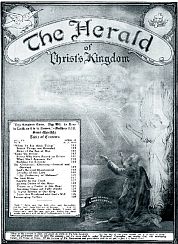
THE HERALD
of Christ's Kingdom
VOL. XI. January 1, 1928 No. 1
Table of Contents
GENERAL
REVIEWS AND OBSERVATONS
ALL
THE WAY MY SAVIOR LEADS ME
"THE
YEAR BEFORE US"
"BE
NOT DISMAYED, I AM THY GOD"
THE
ENDURING WORD OF GOD
THE
POWER TO MAKE WHOLE
ENCOURAGING WORDS
VOL. XI. January 15, 1928 No. 2
Table of Contents
THE
NEW YEAR'S OUTLOOK
THE
PASSING HOUR
THE
SIMPLICITY OF THE CHURCH AS INSTITUTED BY CHRIST AND THE APOSTLES
THE
CHRISTIAN'S CONFLICT
DANIEL
THE BELOVED OF JEHOVAH
VOL. XI. January 1, 1928 No. 1
CONSIDERING
the prominence in symbolic prophecy of the Roman Papacy, it is of more than usual interest
to the prophetic student to note that the question of the restoration of the temporal
power of the Pope has in recent times been under consideration, and "according to
reliable reports the Vatican and the Italian Government have brought their informal
negotiations of the last three years to a point where the solution of the Roman question
is, for the first time in 57 years, a possibility of the near future:" The solution
of this problem would doubtless bring some important changes. We submit below an
interesting review of this subject by Mr. Hiram Kelly Moderwell, Correspondent of the
"New York Sun":
"The
Roman question frequently misunderstood abroad, is the question as to the juridical
relations between the Roman Catholic Church and the Italian State, which was raised in the
year 1870, after some decades of hostility by the capture of Rome by the armies of King
Victor Emmanuel II of Italy. On September 20 of that year, the king, insisting that
political sovereignty over Rome and adjacent territory was essential to the unity of
Italy, and was in no way derogatory to the rightful spiritual sovereignty of the Pope,
ordered his troops to bombard the walls of the Eternal City.
"Popes Now Prisoners"
"The
Pope ordered his troops not to surrender but to resist. The Italian artillery made a
breach near the Porta Pia, and the army entered unopposed. Pope Pius IX protesting that
the forcible occupation was juridically and morally unjust, retired to the Vatican, whence
neither he nor any subsequent Pope has ever emerged during his lifetime.
"This
'voluntary imprisonment' of the Pontiff symbolizes the Vatican's attitude toward the
juridical and moral aspects of the situation thus created, an attitude that may be summed
up as follows:
"1. The
seizure of Rome by the Italians was not an act of war, since the church had never made nor
acknowledged nor provoked war against the kingdom of Italy, but a simple act of theft. It
was juridicially unjustified, since theft is a crime. It was morally unjustified, since
the Pope's spiritual authority rightfully claims and deserves-the respect of all temporal
rulers.
" 2.
The emergence of the Pope from the Vatican would be equivalent to placing himself under
the protection of the Italian State, and hence a tacit acknowledgment of its de facto
sovereignty.
"The Material Case"
"The
attitude of the Italian Government may be summarized as follows:
"1. In
so far as the Pope claimed political sovereignty over certain territory, he placed himself
on a level with any other temporal ruler and was subject to all the usual political
vicissitudes, including war and spoliation of territory. The annexation .of Rome to Italy
was absolutely essential to the territorial unity of the nation and to the political
welfare of the Italian people.
"2. In
so far as the Pope is a spiritual sovereign his sovereignty is unimpaired by his loss of
political functions. On the contrary, the vast majority of the Italian people continue
with undiminished devotion to acknowledge him their spiritual ruler, and, the Italian
State, interpreting the people's will, guarantees every protection and aid to him in the
exercise of that sovereignty.
"The
two attitudes are obviously difficult to reconcile.
Juridicially the situation might be stated thus: The Italian Government made war; the
Vatican has never made peace. Juridically therefore, a stake of war still continues. How
can it be ended? That is the Roman question.
"The
very violent emotions which accompanied the events of 1870 have in the succeeding decades
been largely calmed. But the juridical question still remains unsolved. The problem
confronting. statesmen of both sides is not the original terms of the external conflict
but the conclusion of a legal treaty of peace and the negotiation of a fair agreement on
the innumerable practical details which such a treaty involves.
"No Reparations Involved"
"If the
present phase of the negotiations is to be understood, several points must be made quite
clear:
"1. The
Vatican does not demand the restoration of political sovereignty over its former
territories -- neither over the original "Papal States," founded by Pope Julius
II, stretching across the whole of central Italy from the Mediterranean to the Adriatic;
nor over the small "Patrimony of St. Peter," together with the seaport of Civita
Vecchia, which remained to the Holy See after the Garibaldian and Savoian campaign of
1860.
"2. The
Vatican does demand absolute territorial sovereignty over a recognized parcel of ground,
however small.
" 3. It
makes this claim on two grounds: First, as evidence to the world that the spoliation of
1870 was unjustified, since the rights which it
claims to be inherent in the Pope's position cannot be abrogated without its consent, and,
second, as the indispensable material basis for the independent exercise of his world-wide
spiritual rule."
Just what
may grow out of the present negotiations between the Vatican and the Italian Government
none may definitely foresee. The restoration of the Pope's temporal power thus
constituting him an independent sovereign would doubtless increase his prestige and
influence and cause his voice to carry much greater weight amongst the powers of the
world, than it has since the loss of that power nearly 60 years ago. Some of the
Revelation visions, we believe, indicate that for at least a brief period there may be
such a restoration of the power of the Vatican, in connection with the closing scenes .of
this Age, just prior to its complete collapse and downfall. See "The Revelation of
Jesus Christ," Vol. II, Chapters 17 and 18.
_________
"ENGLAND STIRRED BY THE RELIGIOUS ISSUE"
In another quarter of Christendom, that of the
Church of England, there are "voices" giving evidence of. the continued shaking
in the ecclesiastical heavens. The indications are that modernism or modern infidelity is
taking as firm a hold of the principal religious institution of Great Britain as it has
upon those in America. The sermon recently delivered in St. Paul's Cathedral by the Bishop
of Birmingham, Dr. E. W. Barnes, characterizes the teaching of "the fall of man as
described in Genesis, as a myth." He heartily accepts the findings of so-called
science as set forth by Darwin, as the essence of wisdom; and as reported in the public
Press, "He declares that the entire range of ecclesiastical dogma and position must
now be revised according to the new knowledge, as he regards it, which has been
systematized by Darwin and a disciple of Darwin's, Sir Arthur Keith." It is reported
that the latter, Sir Arthur Keith, who is endorsed by the Bishop of Birmingham, in
addressing the British Association at Leeds, made the following statement:
"No
matter what line of evidence we elect to follow -- evidence gathered by anatomists, by
embryologists, by physiologists, or by psychologists -- we reach the conviction that man's
brain has been evolved from that of an anthropoid ape and that in the process no new
structure has been introduced and no new or strange faculty interpolated."
Dr. Barnes,
in his recent sermon at Westminster Abbey, accepts Sir Arthur Keith's views. His words
were:
"The
mind and body of man can equally be made subjects of observation and experimental inquiry.
Evidence of the gradual evolution of each is equally cogent. The human mind has been
derived by evolution from the intelligence of lower animals, just as the human body has
been evolved from the body of some primitive vertebrae."
The fact
that Dean Inge, of St. Paul's, and other eminent English churchmen come to the rescue of
Bishop Barnes during the storm of controversy that followed, announcing boldly their
support of the statement of the Bishop of Birmingham, and the further fact that the
Archbishop of Canterbury but mildly questions and does not denounce and repudiate the late
views of Dr. Barnes, clearly indicate to what extent this modern form of infidelity has
made inroads in the Church of England. Mr. P. W. Wilson, writing in the "New York
Times" of recent date, concerning the British situation, goes on to make the
following interesting observation:
"The
storm of controversy over faith and worship recalls the most dogmatic decades of the
Victorian era.
"The
astonishing circumstance is that the issue of evolution has been injected into the crisis.
It has been assumed that England emerged long since from the controversies over the
Darwinian theory that have disturbed the churches of the United States. Theologically --
so it is said -- the old country was fifty years ahead of the new. Yet in England there is
precisely the same talk of man's ascent or descent from the animal which has been
troubling the orthodoxies on this side of the Atlantic.
"Factors in the Crisis"
"The
crisis is thus complex. In the first place, there is the struggle in the Church of England
over the new Prayer Book and its interpretation, on which the Anglo-Catholics and the
Anglo-Protestants are still far from agreed. Next there has been the address of Sir Arthur
Keith, President of the British Association, who pinned his faith to a statement of
evolution which insists in the most precise terms on the fundamental truth of the
Darwinian view. .
"The
meaning of this situation to Great Britain may not be easy to appreciate on this side of
the Atlantic, where the Protestant Episcopal Church, though influential, is not large in
numbers. While the Methodists and Baptists each have about 7,000,000 adherents and the
Roman Catholics as many as both these communions put together, the Episcopalians number
not many more than a million.
"England's Established Church"
"But in
England the Anglicans, as they are there called, constitute half the religious forces of
the nation. Of their Church the King and the royal family must be communicants. They
furnish a score of Bishops to the House of Lords, where; as spiritual peers, they sit and
vote. These Bishops conduct the coronation
and all public funerals and royal marriages.
"The
established Church alone provides a chaplain to the House of Commons. Until the great war
it furnished almost all the chaplains to the army and navy. In the chapels of the historic
colleges of Oxford and Cambridge it is the Anglican and only the Anglican worship that is
conducted, and in the great foundation schools like Eton and Harrow the Anglican liturgy
alone is permitted.
"The
Anglicans control the great cathedrals and Westminster Abbey, which are monuments of
national history; nor is there a foot of English land which is not included in a parish
where the clergy are Anglican. About 8,000 schools, which children are compelled by law to
attend, are Anglican schools; and in prisons, reformatories and workhouses the Anglicans
hold the same prescriptive privileges.
"Any
question, therefore, that affects the Anglican Church, touches the nation itself at many
points and the question today is one which the man in the street can understand."
It is not
difficult to understand how, with the sweeping away of what little faith the masses of the
people have exercised in the Bible, the elements of the present time are being prepared
for the great symbolic conflagration of the present order of things, preparatory to the
establishing òf the Kingdom of Him "whose right it is."
_________
A CHEMICAL CONQUEST OF CANAAN
Not long
since, we printed in these columns the report regarding the vast wealth that is discovered
in the Dead Sea in the way of potash and other salts. Now it is reported that a concession
to extract these chemicals from the Dead Sea has been granted to a British chemical
company, which is regarded as one of the most powerful commercial organizations in the
world. This is said to be of more than passing interest to the United States. "In
1925 we imported potash salts, chiefly for use as fertilizers, valued here at $16,921,000,
and this despite the stimulus imparted by the war to develop what resources we had, under
the able direction of Dr. Teeples. If one of the now fashionable international cartels for
the control of world markets is not established by the British concessionaire and the
French and German Potash interests, farmers the world over ought to pay less than they do
now for an indispensable enricher of their soils.
"The
world has paid millions to Germany under the mistaken notion that at Strassfurt and in
Alsace nature had deposited nearly all the available potash. For thirty thousand years the
Jordan had been pouring into the Dead Sea salts now worth nearly thirteen hundred million
doltars, according to a careful survey made by the British soon after General Allenby
captured Jerusalem. There is no more precious body of water on earth than the thirty-three
cubic miles of brine that constitute the Dead Sea. Yet the references in chemical
literature to this vast potential wealth are meager.
"Although
the concession has been granted to a British company, the method of chemically exploiting
the Dead Sea devised by Dr. Thomas H. Norton, formerly of the American Consular Service,
will doubtless be adopted. At Strassfurt miners wield pick and shovel 1,200 to 5,000 feet
in the bowels of the earth. More than 2,500 boilers are required to dissolve, filter;
concentrate and crystallize the "ore" brought to the surface. But Palestine will
not be disfigured by smoking chimneys. Dead Sea brine will be evaporated by the sun in
troughs acres in extent. Mechanical shovels will scoop up tons of crystals. Electricity
generated by water power will supply the heat required to separate the more resistant
chemicals from their mother liquors. Electric trains will convey bags of potash and soda
to seaports o£ the Mediterranean. Palestine will become the seat of a rich and mighty
chemical industry.
"Dr.
Norton, himself an applicant on behalf of a company of which he is the chemist, had
formulated a plan whereby the alluring profits to be derived from the Dead Sea were to be
largely devoted to the development of the surrounding country. Transjordania and Palestine
have claims on the world that cannot be ignored. Brine with a cash value three hundred
times greater than the British debt to the United States can surely be made not only to
pay dividends but to build schools and industries and transform historic Canaan into a
land of milk and honey.
"And thou shalt remember all the
way which the Lord thy God led thee." --
Deut. 8:2.
AS THE
people of God reach the close of another year, no happier reflection can they have than
that the Divine leadings and counsel have been theirs thus far all the way. Continuing in
the same thought all such can with the poet consistently inquire:
"What have I to ask beside?
Can I doubt His tender mercy,
Who through life has been my Guide?"
Those who
have been blessed with the richest favors of Divine grace in that knowledge of spiritual
truth which reveals the high privilege of becoming sons and heirs of God to an inheritance
incorruptible, undefiled and that fadeth not away, reserved in heaven for the called and
chosen and faithful according to His purpose, have a newer failing cause
for deepest gratitude.
In addition
to all these blessings of hope and promise, there has been the blessed realization during
all the year past, and for many of us, for many years past, that though we walk through
the valley of the shadow of death, as the Psalmist aptly represents the present life, our
blessed Shepherd's rod and staff have been our comfort and our safe-guard. How often has
the friendly crook of the Shepherd's rod and staff stayed us from wandering off into
by-paths and kept us in the Narrow Way! How His chastening rod has from time to time
aroused us from dreamy lethargy and urged us on our way!, "My son, despise not thou
the chastening of the Lord, nor faint when thou art rebuked of Him; for whom the Lord
loveth He chasteneth, and scourgeth every son whom He receiveth. If ye endure chastening,
God dealeth with you as with sons; for what son is he whom the Father chasteneth not? But
if ye be without chastisement, whereof all are partakers, then are ye bastards, and not
sons." -- Heb. 12:5-8.
Let Not Your Heart Be Troubled
A further
happy consideration for God's people as they enter the portals of the New Year is that the
great Watchman of spiritual Israel, the Lord, changes not; His exceeding great and
precious promises are all yea and amen to those who obey Him -- to all who. by faith abide
in Him, trusting in the all-prevailing power of His merit, of His atonement -- who,
possessing His spirit of love are seeking to walk circumspectly in His footsteps. To all
such if they continue thus and abound, we may be sure that the New Year 1928 will be a
happy one, basing our assurance upon the Lord's promises.
It is no
doubt true with all the Lord's people at this time that as they look back and view with regret the imperfections of
even their best efforts, and then forward and see what seem to them lion-like difficulties
that appear to obstruct their onward course, they realize very keenly the urgent need of
re-enforcing their waning courage with the special promises of Divine grace to help in
every time of need. And do we, not have the blessed assurance that "As thy days so
shall thy strength be"? "Call upon Me in the day of trouble," He says,
"and I will deliver thee, and thou shalt glorify Me." As soldiers under our
great Captain we have enlisted in no uncertain struggle except our own faint-heartedness
or unfaithfulness shall make it so. Are we not fully supplied with the whole armor of God
and will we not. be amply protected against all the fiery darts of the Adversary, if we
accept of this armor and carefully buckle it on? Are we not forewarned of all the snares
and dangers that beset our onward way in these days, so that we may avoid and triumph aver
them all? Yea, verily we have been fully informed as to the policy and course of the
Captain under- whose banner we have enlisted, and of the part. we are to take under His
leading. We have His constant presence with us, even to the end of our .course. His
inspiring voice may always be heard above the clash and din of battle-"Fear not, it
is. your Father's good pleasure to give you the Kingdom." "Be of good cheer, I
have overcome the world'." "Let not your heart be troubled, neither let it be
afraid." "Greater is He that is for you than all that can be against you."
If we are weak and inclined to faint-heartedness we have only to remember the blessed
promise, "The Lord will give strength unto His people"; and by our faithfulness
in the service we shall glorify God and .He will deliver us gloriously from all our foes
both seen and unseen.
The Companionship of Christ
But how many
there are who know full well of these many promises of the Lord's Word and, are still
disposed to be fearful, doubtful, unbelieving; and thereby are paving the way for further
troubles! How long a time is required for some of the pupils in the school of Christ to
find out why they are in this school and under the Teacher! There is but one object and
that is to be taught -- to learn of Him whom God has appointed to be the great Instructor
of all His justified and consecrated sons adopted into His family. We do not come to this
Teacher to obtain His certificate that we need none of .His instructions, but that from
His Word, in conjunction with the daily experiences in life (His providences to all His
pupils), we may grow daily in His likeness -- in grace and in knowledge.
If at first
we as disciples and pupils get confused and mistake self-will for God's Will, and our.
Teacher points this out to us by some failure of our project, we are not to be rebellious
and resentful of the lesson; nor to be discouraged and disheartened. To the contrary, the
truly consecrated will earnestly strive to profit by every experience, seeking that the
lessons of one day shall be put into practice and become our aid on following days.
Experience
as well as the Word of the Lord clearly teaches that one of the most important lessons of
this school term is faith; the faith with which we became the Lord's and entered His
school must grow. And our faith can grow only by knowledge (we do not refer to worldly
knowledge, worldly learning) knowledge of the Lord, of His methods, His Plan, His
character. The knowledge by which we grow in grace and Christlikeness is the knowledge
that comes in connection with companionship with the Lord, a close walking with Him and an
intimate, personal acquaintance with the Lord as a result of fellowship with Him. We must
then study well our Master's words and general conduct and as well His providences of
private instruction to us individually -- interpreting these always by His Word. Much of
what we accept at first by faith respecting the Lord's goodness and wisdom, will gradually
become knowledge; giving basis for still greater length and
breadth of faith as well
as for greater love and appreciation of our blessed Redeemer.
The Lesson of Entire Surrender
As in
schools for earthly children, so in this, the great spiritual school over which the Lord
Jesus presides., different degrees of learning are represented in the students: some are
in the primary stages of learning and development, some in the intermediate, and some in
the graduating class. The graduating degree of discipleship in the school of Christ is the
one that all are to strive for. It is absolutely essential that we
reach this degree if we
would pass examination -- finish our course with joy and be granted the Master's
"well done," and the prize of our high calling at the end.
Those who
earnestly and obediently take up in this school the course outlined by our Divine Master
cannot fail to realize blessed results. All such find as they progress in it, the peace of
God which passeth all understanding, ruling their hearts: and this peace and rest in the
soul will transmute the trials of faith and of patience into blessings, and the sorrows
and disappointments of earthly hopes into channels of God's grace, and the perplexities of
life into full assurances of faith. This graduating degree of faith, hope, and love, is
attained by a .full submission of our wills to the Lord's will.
In other
words, the only sure, safe course is that of complete self-surrender of all to the Lord;
and to prepare the Lord's people to know, to realize this, is the object of all. the
preliminary courses in the School of Christ, leading up to this graduating course. This
final lesson to be learned is that the wills
that are to be exercised in good deeds and good works are not our own wills, except as by
adoption we have taken the Lord's will to be ours. When we became the Lord's pupils it was
by and as a consequence of the surrender of our own wills, and our first lessons in this
school were with regard to keeping our wills dead. All who have made any progress in the
Christian life, as they look backward can see that by the great Teacher's aid they have
won some victories over self-will and have come to the place where their real desires are
as expressed in our beautiful hymn:
"Lord, Thy love at last has
conquered
None of self and all of Thee."
The Lord's Will and Human Leadership
But even
after we have accepted the Lord's will (as instead of our own natural preferences) and
made it ours; and after we have resolved to do the Lord's will -- still we are in danger
and need to walk carefully, lest we misapprehend the Lord's will and adopt the will and
plans and teachings of fellow men, or of an organization of brethren instead of the Lord's
will. This peril has become very manifest in our day, when many brethren and organizations
are sending their messages abroad and making strong appeals for followers, each of them
claiming that their particular voice is the Lord's voice, and that the only safety of the
flock is in following their particular instructions. Consequently, without despising human
aid in the ascertainment of the Lord's will, while remembering that God still, as in time
past, makes use of human agencies in instructing His people, it must not be forgotten that
Satan also uses human agencies to mislead and to deceive, and that God permits this in
order to teach us that He is the real Teacher. Hence He puts His Word, the Bible, as the
test by which His people are to distinguish .between true and false teachers, saying,
"If they speak not according to this word, it is because there is no light in
them." -- Isa. 8:20.
Furthermore,
it is becoming more and more manifest to God's people in these days that if they would
triumphantly carry out the Divine will in their daily experiences, they must zealously
maintain their liberty in Christ, their freedom to study and hear the Word of the Lord;
they must not allow themselves to become inveigled into bondage by the schemes of any man
or system of men; they must come out from amongst all of these and stand fast in the
liberty wherewith Christ makes free, in order to possess that spiritual discernment that
the Lord promises to His true children.
The All Important Work of the Church
As we come
to the Scriptures to ascertain God's will, it is discovered that the great work which God
asks of us is not work for others, but work in ourselves; subduing, conquering, ruling
self. "This is the will of God [concerning you] even your sanctification."
Everything else, every other consideration in life therefore-our service of the household
of faith and our doing good unto all men as we have opportunity, etc., is subservient to
this most important work within, for as the Apostle by inspiration declares, though we
should preach the Gospel eloquently to others, and though we should give all our goods to
feed the poor, or become martyrs for a good cause, without love, the spirit of Christ and
the Father, developed in us as the ruling principle of life, we would be nothing from the
Divine standpoint.
On the other
hand, if we have fully surrendered ourselves to God, and are experiencing the
sanctification of the Spirit -- if our wills be dead and the Lord's will be fully accepted
as ours in thought, word, and act, then it is manifest 'that we have attained the will of
God and, persevering in that attitude we will surely win the prize as overcomers. even
though we may never have had great opportunities to do works of special importance before
men, and even though we may never have given largely to the poor, nor suffered as martyrs
for the Truth's sake.
This is a
point that is well worthy of much careful consideration: "This is the will of God
[concerning you] even your sanctification." And none should ever let anything becloud
or obscure this precious truth; neither other truths, nor misconceptions.. Let the Lord's
will on this subject, as expressed in His Word, dominate -our entire course in life, and
then if His will is really our will, our pathway before us will be clearly marked out. It
is then our own preparation of heart, our own development in those heart qualities that go
to make up the mature Christian character or full stature of a man in Christ, that
deserves our first consideration, inasmuch as it is this work that constitutes the will of
God concerning His people, during their pilgrimage in the Narrow Way.
"One Step I See Before Me"
Do we desire to draw aside the curtain and to know
the details of what lies in our pathway during the year 1028 But it is not God's will that
His children should know in advance just what lies before them, for He kindly veils their
eyes, and
"O'er each step of their onward
way
Doth make new scenes to rise."
Experience
teaches that it is better that we do not know in advance what may be in the cup which the
Father pours for us. It is sufficient, that we accept the assurance of His Word that our
"times are in His hard," and that His grace shall be sufficient for every time
of need, for every trial and test that His kind providence shall permit to come to us.
Are we
anxious to know the exact hour when our earthly pilgrimage shall end, or the exact time
when all the faithful Church of the Firstborn shall be assembled in the presence of His
glory with exceeding joy? We have only to recall that the faithful in Christ have
struggled on by faith all through the Age, without knowing the hour or year of their
deliverance. Nor is there extra need for us to have such knowledge now, any more than in
the past. Hence it is our conviction that the Lord has not made any revelations to any one
respecting the exact time when all the Church shall have passed beyond into heavenly
glory. We are still walking by faith with regard to this matter and we believe the Lord
would have us content to leave in His hands the entire question of the time of our
deliverance. Meantime, He would have us concern ourselves with the work that is
all-important -- that of the finishing touches of the Christian character. If we are
faithfully performing the work in hand, and doing God's will in our daily lives, then we
shall be ready, for the Master's call, no matter when it comes, whether during the year or
some years later.
Are we
inclined at times to be rebellious in connection with some of our experiences and with the
lot that the Lord seems to have given us in life? If we are, let us remember that
everything in the way of discontent, disappointment, and a rebellious spirit are strong.
indications that self-will in us is not as completely crushed and put to death as we had
hoped for. And is it not true that those who have made the complete surrender of
themselves to the Lord and who have buried their own wills entirely in the will of God can
know no disappointment, but are ever conscious that the eyes of the Lord are upon them and
that His ear is open to their cry, and there is the realization ever and always that all
things are working together for good to those who love God and who are giving evidence of
this love for Him in their daily devotion and in their works of piety and godly love.
Gird Up the Loins of Your Mind
It has been
truly said that "it is one of the evidences of reaching the graduating condition of
heart when we are able to take the oppositions of the great Adversary and of the world and
of our own flesh, patiently, uncomplainingly, unmurmuringly, "joyfully' -- as a part
of the disciplinary experience meted out to us by our all-wise and all loving Lord. Such
is the good fight. The first battle is the severest, and each subsequent victory is
easier; for with each victory, the new will (the Lord's will in us) grows stronger, and
hope's sight of the things God has in reservation for the faithful grows keener, and
strength and endurance greater. And with the very first victory come blessings which are
added to, after every victory
Blessings of
rest, peace, joy in the Holy Spirit and full assurance of faith, as our Teacher promised
"Blessed are ye when men shall revile you and persecute you and say all manner of
evil against you falsely, for My sake. Rejoice and be exceeding glad!'
"From
this standpoint, and from no other, is it possible to accept with fortitude and
resignation whatever tests of faith, perseverance, hope, and love the Lord may see fit to
permit to come upon us. In this condition all our experiences will result in blessing,
however unpropitious they may appear on the surface."
In
consideration of all that is before us in these clays of fiery trials, reverses, and
discouragements, it is without doubt the will of God that we shall, in the yea 1928,
continue to heed the Apostle's words: "Wherefore gird up the loins of your mind and
hope to the end, for the grace that is to be brought unto you at the revelation of Jesus
Christ." This girding up of the loins of the mind evidently relates to the mobilizing
and concentrating of all the forces of the soul-longings, aspirations, and affections, and
the uniting of these in the direction of carrying forward the great engagement into which
we have entered with the Lord, that of doing the Divine will. There are charms and
enticements in the world appealing to many today; there are subtle intrusions and
encroachments of the Adversary from various directions and through many instrumentalities;
hence the need for earnest vigilance and for being on guard, lest we be led astray by some
of the deceptions and enticements of the Evil One. "Keep thy heart with all
diligence," says the word of wisdom, "for out of it are the issues of
life."
"Ye Have Need of Patience"
Another
important consideration which the will of God embraces is the exhibition of patience in
all our contact and intercourse with others. "In your patience possess ye your
souls," said Jesus, thus teaching that patience is a quality of the very utmost
importance. It means to suffer and bear with others, to willingly endure wrong at the
expense of difficulty and inconvenience to ourselves. "Be patient toward all,"
says St. Paul, and his words seem to imply that the better balanced among the Lord's
people should, look with sympathy upon and exercise patient forbearance toward the
weaknesses and failures of others. The Lord's people called from the various walks,
environments, and conditions of life display a variety of weaknesses and infirmities; some
are more. fallen and imperfect than others; some in one direction and some in another. But
the Apostle's words teach us that we are to be patient unto all. The Scriptures repeatedly
admonish us, "Ye have need of patience," and day by day the advanced children of
the Lord realize the truthfulness of this, and come to appreciate patience as one of the
chief Christian graces. First; growth in knowledge helps us to grow in this grace .of
patience, for as we appreciate more and more the Heavenly Father's patience with us, it
helps us to apply the same principle toward others. Second, as we come to realize the
great disaster that is upon our race as a whole -- our fallen condition and how the fall
has affected some more in one manner and others more in another -- some chiefly mentally,
some chiefly physically, and some chiefly morally, it enlarges our sympathy toward our
fellow creatures, and thus increases our patience in dealing with them. This is
particularly true in respect to the household, of faith, amongst whom we recognize that
God has graciously called some more blemished, perhaps, than ourselves in some particular
-- though we may be more imperfect in others. The thought that our Heavenly Father has
favored and called any one should make us extremely careful how we would co-operate with
the Lord in respect to the call, and be as helpful as possible to all those who are
seeking to Walk with us in the footsteps of our Lord in. the Narrow Way. We certainly
should have special patience therefore with the brethren.
God's Children Bearers of Peace
Again, it is
undoubtedly the will of God concerning His children that as His ambassadors and
light-bearers amongst men, they shall endeavor as far as possible to be a 'means of
blessing and, peace to all with whom they may meet in the experiences of. life. The Holy
Spirit in every disciple of the Lord is to shine out. Early in His ministry our Lord
sought to impress this lesson upon the minds of His disciples. He gave instructions that
into whatsoever house they should enter they should say, "Peace be upon this
house," before entering. We do not understand. this to be a command that we should
openly and formally make such a declaration before entering any building, but we do
believe that this should be the heart sentiments of every one of the Lord's consecrated
people -- their desire, their effort, their aim -- that peace and blessing may accompany
them wherever they may go, resting, refreshing, and uplifting the hearts of the poor
groaning creation with whom they come in contact.
We all
realize that there are plenty of strife breeders in the world whose entry of the portals
of any home means strife be within these walls, whether they realize it, or say it or not.
Full of anger, malice, hatred, and strife, their hearts speak forth of the abundance
within, breeding discontent and unhappiness. With others who have passed that condition of
bitterness of soul in malice and strife, and who have set their faces to walk in the
Lord's footsteps, after the Spirit and not after the flesh, and who therefore are putting
away those works of the flesh and the devil, some time will surely elapse before they are
filled with the spirit of love: and in that interim, before they are so filled with peace
and joy and the fruits of the Spirit as to overflow these blessings wherever they go,
there is apt to be a period in which evil-speaking, backbiting, evil insinuations, evil
surmisings, unkindness, ungentleness of word and conduct, impatience, etc., will be
manifested.
The
influence of such, even though they be pupils in the school of Christ, is a carnal
influence, highly injurious to spiritual development, calculated to stop growth in the
various graces, and to disturb the peace and joy of their hearts and the hearts of others
who are seeking the way's of the Lord. The lesson for all of the Loral's followers is not
only to turn from sin to righteousness and from anger and envy and malice to love, but to
keep the heart fully filled with the latter, so that out of its abundance of love and joy
and peace our mouth may speak and our conduct may show our relationship and likeness to
our Lord, that men may take knowledge of us that we have been with Jesus and learned of
Him.
Finally, we
are reminded of the fact that no matter from what standpoint we are studying the will of
God concerning us, no matter what phase of the Christian life we are discussing, it is the
love of Christ in the heart that constitutes the moving or impelling power in the
direction of doing God's will. That love of God and love of Christ, as St. Paul expounds
in the 13th chapter of I Corinthians, embraces all the elements or ingredients that go to
make up the perfect Christian character. What strong incentive then there is for all
followers of Christ to seek to be filled more abundantly with His love! The attainment and
large manifestation of this love surely represents the graduating degree of the school of
Christ, in which we
all trust to be well
pleasing to the Lord during the new year before us. Let us then unite our hearts and
prayers, and above all our new wills with each other's and with our Master's to this end,
that we may be wholly sanctified, and for the Master's use, present and prospective, made
meet. "And the very God of peace shall
bruise Satan under your feet shortly." -- Rom. 16:20.
"Standing at the portal of the
opening year,
Words of comfort meet us, hushing every fear;
Spoken through the silence by our Father's voice
Tender, strong and faithful, making us rejoice.
Onward, then, and fear not, children of the day;
For His Word shall never, never pass away.
"I, the Lord, am with thee, be
thou not afraid;
I will help and strengthen, be thou not dismayed.
Yea, I will uphold thee with Mine own right hand;
Thou art called and chosen in My sight to stand
Onward, then, and fear not, children of the day;
For His Word shall never, never pass away.
"For the year before us, Oh what
rich supplies!
For the poor and needy, living streams shall rise;
For the sad and mournful, shall His grace abound;
For the faint and feeble, perfect strength be found.
Onward, then, and fear not, children of the day;
For His Word shall never, never pass away.
"He will never fail us, He will
not forsake;
His eternal covenant He will never break;
Resting on His promise, what have we to fear?
God is all-sufficient for the coming year.
Onward, then, and fear not, children of the day;
For His Word shall never, never pass away."
THE MOTTO FOR 1928
WE ARE not,
for the year 1928, following the usual custom and selecting a card containing a year text
motto; but are contenting ourselves rather with choosing and recommending to the friends
the following Scripture text as a motto for the year before us:
"FEAR THOU NOT; FOR I AM WITH THEE: BE NOT DISMAYED; FOR I
AM TRY GOD: I WILL STRENGTHEN TREE." -- ISA. 41:10
These words
may very properly be regarded as peculiarly in season for the Lord's people in these
times; they are words filled with comfort to those who by faith properly ponder them.
While the language of the Prophet may be understood as applying to natural Israel, and
based upon the covenant and dealings of the Lord with that people, yet the words were
doubtless written under Divine inspiration) and evidently of a prophetic character, for
the edification and comfort especially of the true Israel of God. The preceding verse
reads; "Thou whom I have taken from the ends of the earth, and called thee from the
chief men thereof, and said unto thee, Thou art My servant; I have chosen thee, and not
cast thee away." Such language is applicable in the fullest sense to the Gospel
Church alone. The admonition to them to fear not and to be courageous has all along been
in order from the beginning of the Age, inasmuch as the course of the true disciple .of
Christ has been a stormy and difficult one; and the closing days of. this Age in which we
are now living are no exception. There are tests upon the Church today of peculiar and
searching character; there are conditions that tend to cause fear and to beat down the
courage unless .one is faithfully observing the Master's instructions and exercising that
faith that rests in the conviction that the God of heaven is with him and causes His
strength to be sufficient for every time of need.
The word
dismayed signifies to have the courage broken down, "as by sudden danger or
insuperable difficulties; overcome with fear of impending calamity or failure; to fill
with despairing apprehension; utterly dishearten," etc. The Christian if permitted to
drift into this attitude is surely in a helpless condition and unable to battle with . his
adversaries.
Nearer My God to Thee
In order
that the children of God may not be dismayed or cast down, they must constantly rely upon
the Divine assurance that the Lord is with them. Not only so, but their hearts should be
kept full of: the spirit of loving and warm devotion to the Lord,. as a result of their
continual remembrance of Ha. goodness, of how much He has honored them by making them His
children and placing before them. those blessed and exceeding great and precious.
promises. The Lord by His Word and providences, would draw us very close to Himself in
love and. faith and childlike confidence. It is that sense of the Lord's nearness, of His
protecting care over us that, should constitute our support in a large sense,. in the hour
of trial. We must be seated together by faith in heavenly places in Christ Jesus if we
would be secure.
While reason
and common sense have their rightful place and are indispensable to a religious life, the
soul that never mounts upon the wings of holy and fervent devotion, that is never stirred
to its depths by a sense of Divine goodness and. beneficence, has never yet experienced
the blessed- . ness oaf the relation of sonship. A true son of a beloved and approving
father naturally experiences the fervor of tender emotion; especially. is this so of a
true son of God who recognizes in his Heavenly Father the perfection of every grace, the
crowning glory of all excellence, and who lives in close union and fellowship with Him and
has the constant witness in himself of His love and approval.
Ah, those
were no empty words of our blessed Lord Jesus when He said, "The Father Himself
loveth you." "If a man love Me, he will keep my words and My Father will love
him, and we will come unto him, and make our abode with him." It is under such
conditions that all those holy emotions of love, tenderness, faith, gratitude, and praise
fill to the brim .our cup of joy; and with holy ecstasy we exclaim, "My cup runneth
over. Surely goodness and mercy shall follow me all the days my life and I will dwell in
the house of the Lord for ever."
Was it not
in view of the Lord's providences and of His many deliverances from the power of his
enemies and of the uniform kindness and mercy of God as he meditated upon them, that led
David to exclaim, "The Lord is my light and my salvation whom shall I fear? the Lord
is the strength of my life; of whom shall I be afraid?" This consolation, variously
expressed throughout the Scriptures, comes with all its blessed potency in our times of
greatest need. The more desperate and determined the foes we encounter and the more fierce
the conflict with the powers of darkness, the more glorious is the deliverance and the
clearer are the manifestations of Divine grace. As a consequence, faith takes deeper root,
and with renewed confidence and assurance lays hold upon all these precious promises of
God; love and gratitude well up from a heart refreshed with an increased sense of the
Divine favor and blessing.
"Whom Shall I Fear?'
Thus it was
with David and others of the ancient ones who trusted in God; and so it is with God's
faithful people today who lead a life of prayer and faith and close fellowship with God.
Such closeness of communion with the Lord in adversity and in prosperity naturally tends
more and more to center the heart's affections and desires in God, until the one thing
supremely desired and sought after is that expressed by the Psalmist, that he might
continually dwell in the house of the Lord, to behold the beauty of the Lord and to
inquire in His temple. Those Who hold fast to their faith, who fear not and are not
dismayed, because of the Lord's presence with them, and are faithful in overcoming the
allurements and temptations of the world, and living more and more unto God -- these shall
indeed dwell in the house of the Lord., in His holy, spiritual temple forever. Now they
dwell in the holy place of consecration and adoption, in the secret place of the Most
High; and the Lord says, "I will not blot out his name out of the Book of Life, but
will confess His name before My Father and before His angels"; by and by such shall
pass into the glorious spiritual condition and into the immediate presence of God.
It is in
view of the sureness of the Lord's promises and this glorious outcome portrayed, that
the Christian is to be filled with holy boldness and courage. These qualities are not only
born of faith, but they increase and grow strong by a living faith developed and
strengthened by the lessons of experience. Courage born of faith and strengthened by
endurance, cries with humble boldness in the midst of the deepest darkness of the most
perplexing difficulties, and in the midst of the wildest storms and most threatening
dangers, "Whom shall I fear? the Lord is the strength of my life."
The Apostle
Paul surely caught this blessed inspiration, When he said, "Rejoice in the Lord
alway; and again I say rejoice . . . . Be careful for nothing; but in everything by prayer
and supplication, with thanksgiving, let your requests be made known unto God." Mark
how all through the Word of God we are taught not only to be sober, vigilant, diligent,
thoughtful, careful, and always abounding in the work of the Lord through whatsoever it
may bring of toil or care or reproach or persecution, but in the midst of any or all of
these experiences we are taught to be happy and to be filled with the inspiration of a
holy joy. We are confident that the peace and rest of heart to the Lord's people will be
much enhanced during the year before us, by keeping prominently in the mind, in the midst
of all their trials reverses, and vicissitudes by the way, this appealing admonition of
the Lord, "Fear thou not; for I am with thee: be not dismayed; for I am thy God: I
will strengthen thee."
"The grass withereth and the
flower thereof falleth away;
but the Word of the Lord endureth forever.
And this is the word
which by the Gospel is preached unto you." -- l Pet. 1:24, 25.
THE Savior
as He was about to take leave of His followers gave the comforting promise that shortly
thereafter the Spirit of the Highest would be shed upon them; they should receive of the
holy anointing from above. The purpose of this anointing of the Spirit was that they might
be guided into all necessary truth and be shown things to come. During His ministry Jesus
had said to His immediate disciples, "If ye continue in My word, then are ye My
disciples indeed. And ye shall know the truth, and the. truth shall make you free."
To these also He said, "To you it is given to know the mysteries of the Kingdom of
God."
This promise
of the knowledge of heavenly things, of the future development of the Divine purposes, was
not with the object of enabling any to be wise in their own conceits, neither to satisfy
curiosity. merely. But it was for the purpose of enabling these who were learners,
disciples, to perform the good pleasure and will of God, and thus
to become
qualified for the inheritance of the great things that were reserved for them in the
Divine Plan. The Master in His prayer for His followers expressed the heart o£. the truth
on this subject, when He said, "Sanctify them through Thy truth, Thy Word is
truth." Obvious it is, that the purpose of spiritual knowledge is to sanctify and
make spiritual and. to set apart for God and His purpose those whom He is choosing to be
heirs of salvation.
Not Human Theories Or Tradition
But the Word of God Alone Builds Up
But an
important consideration set forth by both our Lord and the Apostles was that the Word of
the Lord, the truth alone would produce the happy result of a sanctified life. No matter
could be of greater importance to the people of God, therefore, than that of making sure
that what they receive and feed upon as spiritual food, is the Word of God. As is well
known by all, the word of man, the word of tradition, human opinion, human conjecture, has
so often subverted, the message of truth, and so weakened it that those who feed upon such
a mixture sooner or later realize that they are very lean and poor spiritually, because
they lack the strength and nourishment of the pure truth.
In the days
of the early Church, those who were set for the defense of the truth and placed as
teachers amongst God's people, were instructed to give forth and teach the Word of God,
the heavenly wisdom, and not to attempt to give out any wisdom, theories, or conjectures
of their own. The teachers in the early Church made it clear that they had no knowledge or
wisdom of their own finding or making. They were constantly referring to the source of
their' instruction and learning as being from above.
St. Paul,
one of the foremost teachers in the early Church and so acknowledging himself to be an
Apostle and an Elder, very clearly explained to the Church that the message he had to give
was "not in words which man's wisdom teacheth, but as the Holy Spirit teacheth."
Another referring to this point has very ably said:
"He was
not
a teacher of languages
nor of mathematics nor of as astronomy nor of any of the sciences, except the one great
science to which the Lord's Gospel, or good tidings, refers. This is the signification of
the Apostle's words just quoted; and it is well that all of the Lord's people should keep
this strictly in mind. Not only, those who teach and preach, but those also who listen,
are to see to it that it is not man's wisdom that is proclaimed, but the Divine wisdom.
Thus the Apostle exhorts Timothy, "Preach the Word." (2 Tim. 4:2.) "These
things command and teach." (1 Tim. 4:11.) "These things teach and exhort."
(1 Tim. 6:2.) Going still further the Apostle indicates that all of' the Church as well as
the Elders should see to it that teachers of false doctrines, and teachers of philosophy
and "science, falsely so called," are not recognized as teachers of the Church.
The Apostle's recommendation is, "If any man teach otherwise," etc., withdraw
thyself -- do not lend support to that which is another Gospel than the one ye have
received, which was delivered unto you by them that preached the Gospel unto you with the
Holy Spirit sent down from heaven. --1 Tim. 6 :3-5; Gal. 1 :8."
Preach the Word in All Its Purity
Still
another has taken occasion to exalt the Word of God and give it its proper place on the
basis of what is contained in the sacred record concerning Moses and the manner in which
he expressed the Word of God to the people in his time:
"Moses
spake unto the children of Israel, according unto all the Lord had given him in
commandment unto them." These few words contain a volume of weighty instruction for
every servant of God -- for all who are called to minister in the Word' and doctrine.
Moses gave the people just what he himself had received from God-nothing more, nothing
less. He brought them into direct contact with the living Word of Jehovah. This is the
grand principle of ministry at all times. Nothing else is of any real value. The Word of
God is the only thing that will stand. There is
Divine power and authority in it. All mere human teaching, however interesting -- however
attractive at the time, will pass away and leave the soul without any foundation to rest
upon.
"Hence
it should be the earnest, jealous care of all who minister in the assembly of God, to
preach the Word in all its purity, in all its simplicity; to give it to the people as they
get it from God; to bring them face to face with the veritable language of Holy Scripture.
Thus will their ministry tell, with living power, on the hearts and consciences of their
hearers. It will link the soul with God Himself, by means of the Word and impart a depth
and solidity which no human teaching can ever produce.
"Look
at the blessed Apostle Paul. Hear him express himself on this weighty subject. 'And, I,
brethren, when I came to you, came not with excellency of speech or of wisdom, declaring
unto you the testimony of God. For I was determined not to know anything among you, save
Jesus Christ, and Him crucified. And I was with you in weakness, and in fear; and in much
trembling. And my speech and my preaching was not with enticing words of man's wisdom, but
in demonstration of the Spirit and of power.' What was the object of all this fear and
trembling? "That your faith should not stand in the wisdom of men, but in the power
of God." -- 1 Cor. 2:1-5.
The Pure Stream from the Heart of God
"This
true-hearted servant of, Christ sought only to bring the souls of his hearers into direct
personal contact with God Himself. He sought not to link them with Paul. "Who then is
Paul, and who is Apollos, but ministers by whom
ye believed?' All false ministry has for its object the attaching of souls to itself. Thus
the minister is exalted, God is shut out, and the soul left without any Divine foundation
to rest upon. True ministry, on the contrary, as seen in Paul and Moses, has for its
blessed object the attaching of the soul to God. Thus the minister gets his true place --
simply an instrument. God is exalted, and the soul established on a sure foundation which
can never be moved.
"But
let us hear a little more from our Apostle on this most weighty subject. 'Moreover,
brethren, I declare unto you the Gospel which I preached unto you, . . . for I delivered
unto you first of all that which I also received'-nothing more, nothing less, nothing
different 'how that Christ died for our sins according to the Scriptures; and that He was
buried, and that He rose again the third day according to the Scriptures.'
"This
is uncommonly fine. It demands the serious consideration of all who would be true and
effective ministers of Christ. The Apostle was careful to allow the pure stream to flow
down from its living source-the heart of God, into the souls of the Corinthians. He felt
that nothing else was of any value. If he had sought to link them on to himself, he would
have sadly dishonored his Master, done them a grievous wrong, and he himself would most
assuredly suffer loss in the day of Christ.
"But
no; Paul knew better. He would not, for worlds, lead any to build upon himself. Hear what
he says to his much-beloved Thessalonians: "For this cause also thank we God without
ceasing, because, when ye received the Word of God which ye heard of us, ye received' it
not as the word of men, but as it is in truth, the Word of God, which effectually worketh
also in you that believeth." -- 1 Thess. 2:13."
"Prove All Things"
It was St.
Paul's zeal for the Word of God, the pure uncontaminated Message, in opposition to the
words and tradition of men, that moved him to admonish the brethren "prove all
things, hold fast that which is good." There were various teachers then, as now, who
professed to speak the words of God, when as a matter of fact they were giving out their
own theories and speculations and therefore not speaking as the oracles of God. However
much they should ever come to respect prophesying, or public preaching, the Lord's people
should learn proportionately not to receive what they might hear without proper
examination and criticism: they should prove all things that they hear, should exercise
discrimination of mind, as to what is logically and Scripturally supported,, and what is
mere conjecture and possibly sophistry. They should prove what they hear with a view to
holding fast everything that stands the test of the Divine Word, that shows itself to be
in accordance with the Holy Spirit; and they should, as promptly, as thoroughly, reject
whatever will not stand these tests. Alas! the Lord's people today greatly need to give
attention to this exhortation; for much is being presented in the name of the Lord and as
the teaching of His Word that is neither logical nor Scriptural -- that is supported
neither by the letter nor the spirit of the Word; much that is not good, and should be
rejected. With such a discrimination prevailing amongst the Lord's consecrated ones, how
much of the chaff of the theories and vagaries that are being circulated at the present
time would be rejected, and what a hungering and thirsting there soon would be for the
good Word of God, that would stand these tests! Let us diligently heed the Apostle's
exhortation on this point.
Looking back
again to the experiences of ancient Israel we observe no more important lesson than that
which is found in the fact that the Word of God alone was to control and direct the
Hebrews in all their journeying. The word of man counted for naught; and none were to heed
any other voice than that which truly represented God. The Lord had said to Israel,
"After the doing of the land of Egypt, wherein ye dwelt, shall ye not do; and after,
the doing of the land of Canaan whither I bring you, shall ye not do; neither shall ye
walk in ordinances." The observations of the writer quoted above are again eminently
appropriate here
"The
Egyptians and the Canaanites were all wrong. How was Israel to know this? Who told them.?
How came they to be right, and all be sides wrong? These are interesting inquiries; and
the answer is as simple as the questions are interesting. Jehovah's Word was the standard
by which all questions of right and wrong were to be definitely settled in the judgment of
every member of the Israel of God. It was not, by any means, the judgment of an Israelite
in opposition to the judgment of an Egyptian or of a Canaanite; but it was the judgment of
God above all. Egypt might have her practices and her opinions, and so might Canaan; but
Israel were to have the opinions and practices laid down in the Word of God. 'Ye shall do
My judgments , and keep Mine ordinances, to walk therein; I am the Lord your God. Ye shall
therefore keep all my states and My judgments; which, if a
man do, he shall live in
them: I am the Lord.'
"It
will be well for my reader to get a clear, deep, full, practical sense of this truth. The
Word of God must settle every question and govern every conscience. There must be no,
appeal from its solemn and weighty decision. When God speaks, every heart must bow. Men
may form and hold their opinions; they may adopt and defend their practices; but one of
the finest traits in the character of "the Israel of God' is profound reverence for,
and implicit subjection to, "every word that proceedeth out of the mouth of the
Lord.' The exhibition .of this valuable feature may, perhaps, lay them open to the charge
of dogmatism, superciliousness, and self-sufficiency, on the part of those who have never
duly weighed the matter; but, in truth, nothing can be more unlike. dogmatism than simple
subjection to the plain truth of God; nothing more unlike superciliousness than reverence
for the statements of inspiration; nothing more unlike self-sufficiency than subjection to
the Divine authority of Holy Scripture.
"True,
there will ever be the need of carefulness as to the tone and manner in which we set forth
the authority for our convictions and our conduct. It must be made manifest, so far as it
may be, that we are wholly governed, not by our own opinions, but by the Word of God.
There is great danger of attaching an importance to an opinion merely because we have
adopted it. This, must be carefully guarded against. Self may creep in and display its
deformity in the defense of our opinions as much as in anything else; but we must disallow
it, in every shape and form, and be governed, in all things, by 'Thus saith the
Lord."'
"He hath done all things well: He
maketh both the deaf to hear,
and the dumb to speak." -- Mark 7:37
DEAR to the
hearts of all faithful believers, is the sacred narrative of Jesus of Nazareth going forth
upon His divinely appointed mission of love and service for mankind. The richness and
charm of that blessed life and ministry grow through the years in the hearts of all who
are properly exercised by faith and holy contemplation. The honor of being God's
mouth-piece to mankind, and the power conferred upon the well beloved Son of God, to make
whole, to forgive, heal, uplift, and bless our race are very great. The mission of the
Savior has not yet been accomplished; it has only begun. The examples of His forgiving
mercy, the exhibitions of His healing power, the manifestations of His gracious blessing
in connection with His ministry at His First Advent, we now see, were but hints or
suggestions of what will be enacted upon a sublime and glorious scale when He takes to
Himself His great power and begins His reign.
He Comes to Ennoble and the Sancfity
Jesus had
been "divinely accepted and acknowledged by the Father at His baptism; the season of
fasting and trial in the wilderness was in the past; He had returned in the power of the
Spirit into Galilee. He was now to carry forward the Divine purpose; and as the result of
the mighty works that He began to perform, "there went out a fame of Him through all
the region round about." To borrow the words of another:
"The
days of delightful seclusion in the happy valley of Nazareth were past; a life of
incessant toil, of deep anxiety, of trouble, and wandering, and opposition, of preaching,
healing, and doing good, yeas now to begin. At this earliest dawn of His public entrance
upon His ministry, our Lord's first stay in Capernaum was not for many days; yet these
days would be a type of all the remaining life. He would preach in a Jewish synagogue
built by a Roman centurion, and His works of love would become known to men of many
nationalities. It would be clear to all that the new Prophet who had arisen was wholly
unlike His great forerunner. The hairy mantle, the ascetic seclusion, the unshorn locks,
would have been impossible and out of place among the inhabitants of those crowded and
busy shores. Christ came not to revolutionize, but to ennoble and to sanctify. He came to
reveal that the Eternal was not the Future, but
only the Unseen; that Eternity was no ocean
whither men were being swept by the river of Time, but was around them now, and that their
lives were only real in so far as they felt its reality and its presence. He came to teach
that God was no dim abstraction, infinitely separated from them in the far-off blue, but
that He was the Father in whom they lived, and moved, and had their being; and that the
service which He loved was not ritual and. sacrifice, not pompous scrupulosity and
censorious orthodoxy, but mercy and justice, humility and love. He came not to hush the
natural music of men's lives, nor to fill it with storm and agitation, but to re-tune
every silver chord in that 'harp of a thousand strings,' and to make it echo with the
harmonies of heaven."
The Purpose of Divine Healing in the Church
"And He
healed many that were sick of divers diseases, and cast out many devils and suffered not
the devils to speak because they knew Him." (Mark 1:34.) We are not to conclude from
the account given us in the Scriptures, that the chief object of our Lord's First Advent
was to do all the healing that 'He could then, and relieve the people as far as possible
of their physical afflictions, at that time. To the contrary, such acts and service on the
part of the Savior were but incidental; His chief and principal mission being, as He said,
to give His life a ransom for many; and in that same connection by His words and example
to let the light of the Divine purpose and will shine out for the benefit especially of
those who should be His followers during this present Age.
Our Lord's
miracles of physical healing, though incidental were necessary at the beginning of this
Gospel dispensation. Had our Lord Jesus not performed the miracles recorded in the
Scriptures, how could we today feel the confidence, the assurance that we do respecting
Him? Had He gone about as a preacher of righteousness and expounder of the Divine Word
merely, and had He then died, just as He did die, would the proof have been as sufficient
as it now is, that He was indeed the Son of God and that His death was truly the sacrifice
of a perfect One for the imperfect one and his progeny? Would our Lord in preaching to the
Jews have accomplished any work without the use of miracles? Were they not necessary to
Him as a demonstration of His right to take the place of Moses as the antitypical leader
of the Israelites, indeed? Assuredly this is true. But the Church having been once
established as a result of the miraculous power exhibited by Jesus and the Apostles, and
additionally now being possessed of the Holy Spirit, with its wonderful power of
illumination, there is not the necessity for such manifestations of miraculous healing
power today as in the commencement of the Church's career.
Satan as Messenger of Light
It may be
truly said that nothing is more attractive to the human mind than the miraculous power of
healing disease. No one enjoys disease, pain and suffering. And most people would be glad
to be healed of disease, even if they were assured that the cures were by the power of
Satan himself. It need not surprise us that. many wrong doctrines wholly out of harmony
with God's Word commend themselves to the poor groaning creation by promises of relief
from physical ailments, without medicine, and theoretically by the power and favor of God
and supposedly in proof of the doctrines advocated by the; healers: But since these
healers hold various antagonistic doctrines, it is manifest that all are not of God, if
any of them are.
It is worthy
of our note in this connection that the Adversary has at times been permitted to exercise
supernatural power and he has attempted to duplicate the mighty works of some of. God's
holy servants of the past. Hence St. Paul intimates that Satan and his messengers, the
fallen angels, would seek to transform themselves so as to appear "as angels of
light," that they might exercise the greater influence over humanity and that thereby
they might inculcate the more successfully false doctrine, subversive of true faith in God
and His Word. It would seem that the Apostle's words are particularly applicable in our
day, that many conscientious and good people are being deceived, and that miraculous
healings are part of the Adversary's bait.
Belongs to the Age of Restitution
St. Paul
declared that the gifts granted to the early Church and :exercised by Jesus and the
Apostles, and those to whom they personally communicated them, would pass away. Our
conviction is that they did pass away -- that they gave place to the next and higher
manifestation of Divine favor, namely the fruitage of the Holy Spirit -- meekness,
gentleness, long-suffering, and love -- as evidence of God's favor and of membership in
the Church of the Firstborn. It is the general facts surrounding this whole question of
physical healing that lead to the conclusion that the miracles which Jesus and the
Apostles wrought were merely with a view to the establishment of the early Church. Nowhere
is it intimated that it was the Divine will that either humanity or Christians in general
should be healed of disease during this Age.
There is no
doubt that general healing of physical affliction will be a prominent feature of the work
of Messiah's glorious Kingdom after its establishment For that will be the Age of
restitution, the age of life, and Jesus will then be indeed the great Healer. That will be
the time when God shall wipe away all tears from off all faces and when there shall be no
more sighing and crying and no more death. Not only will the ailments of the flesh be
lifted, but restitution processes will go on step, by step, lifting humanity out of sin,
disease, and imperfection, up to full and absolute perfection, except in the case of those
who willfully and deliberately continue in opposition to the Divine arrangements, and who
in due course will be cut off from life in the Second Death.
"Who Healeth All Thy Diseases"
Some have
urged that it would seem more reasonable that the Lord's people should go to Him in prayer
or go to the Elders for healing by miraculous power, than that they should use drugs or
medicine or surgery. To this we agree, that it is very natural. It is just what the natural mind would
expect and crave, but the Lord is not dealing with His people of today as with natural men. They are not natural, but spiritual
Israelites. It is to the New Creation that the Lord now appeals; it is the New Creature
that now has the privilege of experiencing healing at the Lord's hand, forgiveness of sin,
covering with the Robe of Christ's Righteousness, so that such have. the standing before
the Father of absolute righteousness, without spot, wrinkle, or any such thing; these who
are thus forgiven, restored and renewed, know no man after the flesh, but they do know the
perfection and miracles after the Spirit; and. many a time have the Lord's people marveled
at the wonderful healing of mind and faith and hope and the wonderful refreshment, with
joy unspeakable -- the holy anointing oil received from their spiritual and glorified
Head:
"Enduring As Seeing Him Who is Invisible"
Not only is this the clear presentation of
the Lord's Word, but the logic of the proposition must be evident to all. As for footstep
followers of Christ, they have made a complete surrender of all their human, earthly
rights and privileges secured through the death of Christ, and have exchanged these for
heavenly things, the heavenly body that is to be received at the First Resurrection, the
heavenly hopes, the heavenly joys which are already the first fruits of the Spirit in
them. It does not seem consistent for those who have once devoted or consecrated their
earthly ad vantages and rights for the heavenly ones to ask for a return or restoration
of the earthly rights and privileges. Would not such a request intelligently made, signify
a withdrawal of our consecration -- signify our preference for the earthly rather than the
heavenly gifts, privileges and ad vantages? And would we as spiritual Israelites be
willing to make such an exchange again if the Lord were willing to let us do so? Surely no
one who properly appreciates the privilege of sacrificing earthly interests with Christ,
of laying down the earthly life with its advantages, in participation with the Lord and in
hope of joint heirship with Him in the Divine nature and Kingdom, would wish for a moment
to have the Lord cancel this arrangement and give him back earthly rights and restitution
privileges. Such was the viewpoint that was set before the early Church. The Lord's people
were then invited to walk the Narrow Way, they were pointed to their .privileges of
bearing the cross, of counting not their earthly lives dear unto themselves, of being
faithful even unto death; the crown of life was promised them as their reward which they
would receive in the First Resurrection.
Foreshadowed Coming Blessings
Nor has
there been any change in the Lord's dealings with His Church from the beginning till the
present time. So far as
the records show, all or
nearly all who were healed by Jesus and the
Apostles were
"sinners." Surely there is no record of a single instance in which any of. the
Apostles were healed of any disease. Although St. Paul healed many sick, yet when Epaphroditus was sick
and "nigh unto death," we
have no mention of any
attempt to miraculously recover him.
Similarly,
in the case of Timothy, we find that St. Paul neither sent him napkins and handkerchiefs
for his healing, nor advised him to pray for his own healing, nor told him that he would
pray for him, nor advised him to have others pray for him. On. the contrary, he advised
certain medicine, "for, thy stomach's sake." That the Lord specially overrules
in the cases of many of His people to give them remarkable health and strength for their
labors in His service, without their asking Him, is another matter entirely. However this
in no wise conflicts with the
fact that God used
miracles amongst outsiders; amongst unconsecrated people, as a foreshadowing of the
general blessing which will come to mankind under Messiah's Kingdom shortly to be
established. When that time
shall come "the
Good Physician who will have the power to make whole, with His entire staff of
co-laborers, members of His Body, His Bride, will participate in the great uplifting of
the Millennial day, in administering the blessings of restitution, mental, moral and
physical to all the willing and obedient of that time. But those times of restitution,
though near we believe; are not yet. They will not be ushered in until the full close of
this Age -- until the Church shall have finished her course, walking by faith and not by sight, during which she is enjoying the
spiritual miracles and not the natural ones.
"Bless. the Lord O My Soul"
The Prophet
David as he used the words; "Bless. the Lord O My soul and forget not all His
benefits: who forgiveth all thine iniquities; who healeth all thy diseases," may have
appropriated them to himself as a Jew; and may have thought of his own physical healing
and blessing as evidences of the Lord's favor under the Law Covenant. But the prophetic
application of this Psalm to spiritual Israel is still more interesting. Spiritual
Israelites, as we have seen, are New Creatures; and in addition to realizing the spiritual
healing, the forgiveness of sin and their reconciliation to God, they know something of
the meaning of the gracious promise that all things work together for good to them because
they love God and have been called according to His Divine purpose. Evermore the New
Creation has cause to exclaim, "Bless the. Lord O my soul, and forget not all His
benefits; who forgiveth thine iniquities, who healeth all thy diseases!" St. Paul,
sustaining this same thought, declared that the, great Redeemer will ultimately present
His Church before the Father faultless and perfect in love -- "Sown in weakness;
raised in power; sown. in dishonor, raised: in glory; sown an animal body, raised a spirit
body." We shall be like Him and see Him as He is and share His glory: How evident it
is that when the mystery of God shall be finished and the great consummation attained, our
dear Redeemer will have been shown to be the great Healer indeed with power to make whole
and will be worthy of all. of those blessed acclamations of praise and honor and glory.
and blessing and power and dominion that will then be made unto His holy name.
Dear
Brethren in
Christ:
I feel
constrained to. send a few, lines of thanks for the letter received a few days ago--not
expected, as date altered on "Herald" wrapper; and cards, as ordered, received,
was acknowledgment of arrival of money order -- realizing your many activities, I
esteemed. it a great favor to have your kind, encouraging words and assurance of prayers.
The past two Heralds have been so very helpful, so I desire to thank you for the continued
blessing I get from our little paper. Faith and prayer have been in these so beautifully
emphasized, and many new, thoughts are to me most strengthening - "new
thoughts," but so
expressed as to give added strength and encouragement. The great desire of my heart is to
have strong assurance of faith in prayer -- and past evidences of God's loving answer to
same are a blessed assurance of His continued goodness. To you I owe much for the great
help the "Herald'' has of late, given. And I desire to reiterate my gratitude,
praying your efforts may be blessed continually.
My husband,
in his 89th year, has been paralyzed for over 10 years and is now most
'helpless; so I have my hands full, often night as well as day --- and in my 80th year,
twelve of which I was an invalid. In our Heavenly Father's goodness I am given health and
strength for all I have to do, and I cannot be too thankful for this continued blessing. I
can occasionally attend a meeting of the friends on Sunday afternoon, which. is always a
joy -- otherwise I am isolated, from
fellowship.
Must not
take more of your time but. just felt drawn to make myself in a
way more known, to you --
and say how I appreciate the many favors received.
With
Christian love and every good wish for the New Year,
Your sister by grace, Mrs. R. I. C.
-- Ont.
VOL. XI. January 15, 1928 No. 2
REALIZING to some extent the importance of the
times in which we are living, times in which there are rapid developments and significant
changes, the beginning of a new year is properly an occasion for a fresh survey of the
outlook in the world. The opening of the year 1928, witnesses our race still struggling on
under the reign of sin and death. The various concomitants of death are ever and always in
evidence -- calamities of various kinds, sickness, violent storms, dreadful disasters,
war, and threatened war, all bringing suffering and distress. Various portions of the
earth, particularly the American continent, have been specially afflicted with floods and
violent storms during the past year, laying waste large areas of the country and causing
great suffering, and otherwise taking a heavy toll of valuable treasure and life. Then
there are increasingly grave social evils and disturbances as well as political troubles
that cause great unrest. Still our race continues to desperately labor and hope for the
better.
Knowing
nothing of the Divine purpose to establish the Kingdom of, heaven as the remedy for all
human ills, men struggle on in their own strength, and hope in the direction of their own
applied wisdom, philosophy, and science to subdue and conquer all these adverse elements.
Various organizations and societies frequently meet for the purpose of discussing the many
problems with a view to improving conditions. Thus we read in the "New York
"Times""
"Washington;
December 28. - Application of scientific principles and methods of investigation to every
sort of national problem, from the break-up of American homes through divorce to the
failure of civic campaigns of education, were advocated today by speakers before the
seventeen learned societies in session here. The outstanding impression of every session
was that most of the social and political problems of the day were to be attributed to
failure of social and political institutions to keep pace with the progress of applied
science." Here the inference is plainly given that if social and political
institutions would keep pace with the progress of science, the social and political
problems would be solved.
Voices of World Leaders
Amongst the
nations of the earth today there is to be heard numerous conflicting .voices; some crying
peace and others war. New Year messages are speaking much of peace. From France's Foreign
Minister, Aristide Briand, there comes the following statement as published in the
"New York Times" of January 1:
"France
faces 1928 with a new hope of being able to remain a force for peace in the world. Between
France and her sister Latin nation across the Alps the remaining differences are being
ironed out, and we trust that the new year will not be old before our relations will be
definitely improved.
"We
look forward to the conclusion of a new treaty with the United States as a further step
toward the consolidation of world peace, to which all conscientious statesmen in the world
must be working, even if, unfortunately, there is not full agreement on the means to
achieve the end we all seek.
"I have
every confidence that peace will be maintained in Europe and the world at large during the
year 1928. We must all work to bring a general realization everywhere that war is not a
paying business."
From the
President of the German Reichstag, Mr. Paul Loebe, we have the following:
"The
sentiment of the nations whom I have learned to know in many travels is undoubtedly
peaceful. The plain citizens, farmers and workers are occupied by worries about their work
and their bread. They do not want war, but peace.
"With
this sentiment, unfortunately, the actions of the Governments do not agree. They
continually increase armaments while having the world peace ever on their tongues.
"The
United States, whose word has great weight in the world, could make all debt agreements
and reparations plans dependent upon European disarmament, but to accomplish this the
American Government would have to set a.good example."
The Prime
Minister of Spain, Mr. Miguel Primo De Rivera, says:
"The
year is closing happily for Spain, whose international situation is clear and
uncomplicated. Spain is at peace with the whole world, and in the world councils her voice
is always for peace, which is the best guarantee of social order and prosperity at home.
"During
the coming year we hope that an agreement will be reached by friendly negotiations with
other countries interested regarding our position in Tangier. We claim to have rights
there which must be recognized, for if Spain is to maintain peace in her protectorate of
Morocco, what she is asking must be classed as necessities as well as rights."
The Foreign
Minister of Poland, Mr. Auguste Zaleski, issues the following statement:
"Permit
me to look upon the progress made in the development of international relations during
1927 through the prism of Polish politics. This does not imply any narrowing outlook, as
Poland already is closely enough linked to the whole of international politics by taking
an active part in the labors of the League of Nations Council. We witnessed several facts
in 1927 which give evidence of great progress in the stabilization of international
relations. They give evidence of an almost complete calming down of the boisterous waves .
of postwar times. Indeed, the last League Assembly was able to pass the Polish resolution
outlawing war, which became a great manifestation for the moral disarmament of
nations."
Mr. Allen
Raymond, Correspondent to the "New York Times," writes from London that "it
is quite certain as the new year dawns, that dominating the news in Great Britain in the
year 1927 has been an evolution in economic thought." He speaks "of a new
organization of the Empire's industrial and commercial life, in. a scheme called a
'rationalization of industry."
This
rationalization the British first breathed in a mere whisper after the general strike of
1926 as an antidote to rationalization as a panacea for the ills of the Empire which the
Socialists were offering. "Beyond this advance," Mr. Raymond says, "in
economic thought, 1928 finds Great Britain slightly better off in other ways than 1927
did."
Mr. Arnaldo
Cortesi says that "Italy faces the new year much better equipped to attain prosperity
and economic independence than was the case a year ago."
Gloomy Outlook in the Far East
Concerning
the outlook in the Far East, comment is not so favorable. One prominent writer, after
pointing out the circumstances of the various contending factions, sums up the matter by
saying that,
"China
is completely disorganized politically. The rivalries among the factions are still acute.
There is no prospect of peace. Economic conditions are going from bad to worse. Famine is
again abroad in the land. The foreign Powers, anxious to. settle with China, find that
there is no one with whom they can deal capable of carrying out China's part of any new
agreements. So extensive is the disintegration that time must pass before a unified China
possessing a Government capable of keeping its own people in order can be raised out of
the ashes. The Chinese, accustomed to long periods of readjustment, are more philosophical
about these delays than are foreigners. History has taught them that revolutions are long
in proportion to the extent to which they effect far-reaching changes. The present is
China's most momentous revolution.
The Spirit of America
An
interesting Editorial in the "New York Times," refers to the outlook in America:
Following the statement that the situation is materially improved between the United
States and Mexico and Latin America, this writer goes on to say that,
"More
important than any of these material things, highly important as they are, is the
attitude, the spirit, in which America is preparing to face the unknown of 1928. Unless
all the signs are misleading, this will be a spirit of hopefulness, of charity, of
quickened humane instincts, of a desire to live peaceably with all men, and of illimitable
pride in the achievements and prospects of our country. There are many things to deplore;
some things to make us ashamed; others to stir our zeal for reform; but, on the whole,
there is reason enough for all Americans to look forward, with happy confidence to another
twelve months of keeping step with what Rufus Choate called the glorious music of the
American Union."
The Prophetic Viewpoint
Nearly all
of the foregoing statements regarding the outlook in various sections of the earth, are of
an optimistic character and speak of the desire of many people today for better and more
established foundations for prosperity and peace. Nevertheless, we must take our position
with, the Prophets of the Bible, who we believe spoke as they were moved by the Holy
Spirit. Their words have described minutely the present state and circumstances of the
nations of the earth in connection with. the change of dispensation, the change of the
rulership of the world from that of Satan to, that of Christ. The fulfillment of these
ancient predictions has been much in evidence for nearly a century, but particularly
during the past fifty years, and are to be observed increasingly as the days go by. It is
true that what is termed civilization has been making rapid strides during the past
century, but it is obvious that civilization does not change the hearts of men, does not
affect the selfishness of the human heart. The great leaders, master minds of the world,
statesmen, philosophers, and men of science, are all aware of this fact and are suggesting
every kind of remedy in the hope of averting a great catastrophe. While the civilized
world, may be said to be at peace today, it is not inwardly at peace; there does not exist
a wholesome state of peace by any means. There exists at the present time all the elements
and ingredients necessary to fulfil the prophecy of Jesus and Daniel concerning a
"time of trouble such as never was since there was a nation."
Dark Clouds on the Horizon
We have only to be reminded of the dark clouds of
war that have recently been hanging so low over the Balkan States of Europe. Summing up
the situation, in the "Literary Digest" of December 10, one writer goes on to
say that,
"Straight
across the eastern edge of Europe, from the Baltic Sea to the Balkan coasts, the World War
left new boundaries, chopping up old nations, and establishing new ones. This area, as the
Baltimore "Sun" remarks, 'is as much a strain on the patience and ingenuity of
the statesmen in Europe who seek to maintain peace as a subnormal person of bad
disposition is to his family, or as the gang districts are to a modern city, or as Chicago is to the United States.' At any rate,
writes the Paris Correspondent for the Chicago "Daily News," Europe is now more
nervous than it has been for several years, and the tension is greatest along that
volcanic eastern edge."
Again in the
"Digest" of December 17, we have the following impressive statement:
"The
menace of another war, more terrible than the one which ended nine years ago, is said by
some pessimistic European observers to be rapidly growing on the European horizon, and it
is largely to be blamed, they say, on the antagonism between France and Italy in the
Balkans. The London "Westminster Gazette" sent a special correspondent into this
danger region of Europe, who reports that in the opinion of the most competent and
experienced authorities, the course of events in Southern Europe is leading directly to
war -- possibly as soon as 1930. Where that war might end, nobody can
say, this newspaper adds, and it attributes it to the rapidly developing rivalry between
France and Italy for supremacy in that sphere and in the Mediterranean."
And still
further we read in the issue of December 24, the significant statement:
"The
fear of a general flare-up such as involved the whole world in war within recent memory is
dissipated, for the time being, says Geneva dispatches, by the resumption of peaceful
relations between Poland and Lithuania. Urged by the "big five" members of the
League of Nations -- England, France, Germany, Italy, and Japan -- the two Baltic nations
agreed on December 10 to end the technical state of war that has existed for seven years,
and to enter into direct negotiations for the settlement of their differences. To American
newspaper correspondents in the Capitals of Europe and at Geneva, this means that another
little war, which might have spread to involve all Europe, has come formally to an end
over the council table of the League. Moreover, points out the Boston "Globe,"
'it is a distinct gain for the world at large.' The quarrel between Poland and Lithuania,
notes the Philadelphia "Inquirer," 'had reached the fighting stage. Something
like war was actually in progress along the border.'"
While an
outbreak or a general war is averted for the moment, it can evidently be but a temporary
postponement. This we say with all due respect to all the honest efforts of men to cure
the malady by the agency of a League of Nations, by covenants and treaties, etc.; these
are to be commended and praised to whatever extent they prevent war and serve the purposes
of peace. But no human panacea or remedy can avail for removing jealousy, hatred, and
selfishness, which in a general way are responsible for all war. Hence it can only be a
matter of time, the Lord's due time, until the crisis will be reached and the long
predicted change will come.
How grand is
the privilege of being enlightened concerning the Divine purpose and its progress toward
the promised grand consummation, as Jesus said unto His disciples, "To you it is
given to know the mysteries of the Kingdom of heaven." This standpoint of faith given
to the children of God represents indeed a very great blessing as at the opening of the
new year we observe the sorrow, suffering, and distress in which our race is struggling.
Such as have this privilege are enabled to lift up the head, hopefully, with confidence,
and to be of good courage, because of the great redemption that is being wrought out, in
the. Divine Plan. These realize from the signs in the earth today that the deliverance of
both the Church and the world draws near.
Many
prophecies viewed in the light of present events and circumstances upon the earth clearly
establish this conclusion. St. Paul, we remember, looking down to the change of
dispensation when Messiah's reign would commence, tells of the terrible shaking time when
everything that can be shaken will be shaken and utterly removed. (Heb. 12:25-29.) It is the entire present order of
things political, financial, social, and religious, designated by the Apostle Peter,
"the heavens and earth which are now," that is to pass away. For some time we
have been in this shaking period. All can see that the world's political, financial, and
governmental institutions have been undergoing this shaking process; the wide
dissemination of knowledge, and the enlightenment of the people, has featured largely in
this matter, as was foretold. (Dan, 12:1- 4.) The people in modern time have been caused
to think above that of any period of man's history. The result is a clamoring for rights
and privileges of which they have long been deprived. Logically, many issues and problems
have grown out of this situation that have never before confronted the governments of the
past, leading to the advocating of the adoption of measures of legislation never before
thought necessary. The progress and changes that are constantly made necessary by reason
of the use of new inventions and the applications of science, have much to do with
unbalancing the social and industrial world. This constant influence upon and disturbance
of the economic relations of mankind is making it impossible for the nations to maintain a
proper balance or equilibrium, financially. Thus the whole world is in a decidedly
unsettled state. There is no corner of the earth today that is immune. 'The discussions,
controversies, disputes, and disagreements which constitute the shaking process are heard
in all the nations of the earth with increasing animation and, vehemence, selfishness
being an important factor. True, indeed, the great deliverance promised comes not by the
world's peacefully accepting the will of the Lord and meekly bowing to the new order of
things, but rather because earth's new King takes unto Himself His great power and reigns.
For What Signs Are We Looking?
Observing
matters then as the Lord has outlined them long ago, we are not today looking for
indications that the operations of any of the present energies amongst men are about to
succeed in changing the hearts of mankind and making them Christlike; but rather for those
signs in fulfillment of the more sure word of prophecy, signs that signify that. the
influences of earth's coming King are already at work, looking in the direction of the
complete setting aside and passing away of the old order of things, preparatory to the
establishment of the Kingdom of God, which, in addition to ruling the nations with a rod
of iron, will lift up and bless all the willing and obedient and forever establish peace
on earth, good will toward men.
The End Not Yet
But the full
end of this dispensation of things is not yet; the deliverance of all the faithful has not
yet taken place. The Church of Christ cannot be said to have been glorified. The year
1928, as it opens, finds a people consecrated to the Divine service and walking in their
Master's footsteps, struggling on- in the Narrow Way that leads to God. Nor have we any
reason to assume or to announce that the new year we are just entering will witness the
end of all things and the deliverance of the saints. It does not seem that all the
elements are just ripe for the great conflagration predicted. Nor does it appear that all
the signs alluded to in prophecy have reached the stage of development that would be
reasonably looked for. Zionism, or the Jewish question, is one of these. While within
recent years there have been some remarkable developments, and much progress has been made
in the direction of Israel's restoration, yet it would seem that a considerable more
advancement of this matter is to be expected. The land of promise has not yet attained all
that the Prophets have described as taking place in connection with the last phase of the
time of trouble. Notable among these is the prophecy of Ezekiel 38 and Zechariah 14:1-3.
As it is not
given to any of the Lord's people today to prophesy or to foretell events, we will not
attempt to be wise above what is written. It is given to all the watchers to read the
meaning of prophecy as history unveils it, and we are earnestly admonished to give heed
unto it, that it will be as a "light unto our pathway until the day dawn," etc.
We are still walking by faith and not by sight.
The Special Concern of the Saints
We know from
the Word of the Lord that there are some things that in a peculiar and special way concern
the hearts of the Lord's people in these times. Chiefest amongst these perhaps is the
blessed hope of gaining entrance into the heavenly Kingdom. It should be most interesting
to all who entertain this. hope to recognize that the door into that Kingdom is still
open. Recognizing this fact, we observe that an important consideration is that all the
Lord's followers should be very sure that they are faithful in doing His will, in being
loyal to the principles of truth and righteousness, of rendering their service according
to the instructions of His Word. While there are saints upon the earth, there is still a
ministry to be performed. This ministry is primarily toward one another, as fellow
travelers in the way of life. They will seek to build and edify one another in holy
things, in the, new life. Additionally, all grateful and obedient children of God will
desire to let their light shine for the benefit of all around them. In so doing they will
he careful that what they announce as the Lord's Message is thoroughly established as the
truth.
Well may all
the Lord's people today give the more earnest heed to the things which they have learned
lest at any time they should let them slip. So admonishes the Apostle, "Giving all
diligence, add to your faith virtue; and to virtue knowledge; and to knowledge temperance;
and to temperance patience; and to patience godliness; and to godliness brotherly
kindness; and to brotherly kindness charity. For if these things be in you, and abound,
they make you that ye shall neither be barren nor unfruitful in the knowledge of our Lord
Jesus Christ: . . . for if ye do these things, ye shall never fall: for so an entrance
shall be ministered unto you abundantly into the everlasting Kingdom of our Lord and
Savior Jesus Christ."
"The glass has turned, and hark!
the measured chime
Proclaims another hour of passing time:
Untold its value, as it swiftly flies;
The new-born hour appears, runs out -- and dies!
"Now is salvation nearer than the
day
When we to God from idols turned away.
Scant is the measure, quickly runs the sand,
Christ on the threshold-on the latch His hand!
"Darker the shades around of
evening lower;
"Watch!' He has. said, "for no man knows the hour."
The minutes, rushing onward, -- swiftly pass
Wake, sleeper, wake, as turns the warning glass!
"Soon in the Father's presence we
shall stand
"For ever!' measured not by wheel nor sand.
Teach us eternal worth, while moments flee,
Whether we live, or die, O Lord, for Thee !"
NO OVER-LORDS,
HUMAN CHANNEL, OR HEADSHIPS
"For one is your Master, even
Christ: and, all ye are brethren."
-- Matt. 23:8.
THUS did
Jesus in the above language present to His followers the profound simplicity of the
arrangements and relationship that He desired to exist among His followers as they, should
go forth to carry forward the great commission given them in the beginning of the Age. The
Master's teachings were most explicit that God had called one Church to be associated with
His Son in the heavenly realm-one Body, the members of which were all called in one hope
of their calling; that .this Church should have but one Head, one Guide, one spiritual
Ruler, even Jesus, whom He gave "to be the head over all things to the Church, which
is His Body." Under our Master in the beginning of the Age there were appointed
twelve Apostles, under-spiritual guides to serve the Church throughout the Age, and these
are designated the twelve Apostles of the Lamb; the twelve foundations of the New
Jerusalem, in view of their important positions as spiritual teachers of the Church. (Rev.
21 :14.) Thus in the Book of Revelation,, the New Jerusalem -- the symbol of the new
Millennial government, the Church, the Bride united to her Lord -- is very clearly
delineated; and in the picture the statement is most distinctly made that the twelve
foundations of the City are precious, and that in the twelve foundations were the names
written of the "twelve Apostles of the Lamb"-no more, no less. What better proof
could we have that there were never more than twelve of these Apostles of the Lamb, and
that any others were, as the Apostle Paul suggests, "false Apostles."-2 Cor.
11:13.
No Lordship in the Early Church
Nor can we
imagine any need of more Apostles; for we still have those twelve with us -- their
testimony and the fruit of their labors -- in a much more convenient form than had those
who were personally with them during their ministry. The records of their ministries are
with us; their records of the Lord's words, miracles, etc. Their discourses on the various
topics of Christian doctrine in their epistles are in our hands today in a most
satisfactory manner. These things are "sufficient" as the Apostle explains,
"that the man of God may be thoroughly furnished." Elucidating the matter
further the Apostle declared, "I have not shunned to declare the whole counsel of
God." What more is necessary?
There is not
the slightest suggestion anywhere, to the Apostles or concerning them, that they were to
be lords over God's heritage; that they were to consider themselves as different from
other believers, exempt from the operations of Divine Law, or specially favored or secure
as respects. their everlasting inheritance. They were continually to remember that
"all ye are brethren," and that "one is your Master, even Christ."
They were counseled to bear in mind that it was necessary for them to make their calling
and election sure; and that unless they obeyed the Law of Love and were humble, as little
children, they should in no wise enter, into the Kingdom." They were given no
official titles, nor any instruction respecting special garb or peculiar demeanor, but
merely that they should in all these things be ensamples to the flock,; that others seeing
their good works should glorify the Father; that others walking in their footsteps should
thus be following in the footsteps of the Leader also, and ultimately, attain to the
same glory, honor, immortality -- partakers of the same Divine nature, members of the
same New Creation.
Their
commission was one of service -- they were to serve one another, to serve the Lord, and to
lay down their lives for the brethren. These services were to be rendered specially in
connection with the promulgation of the Gospel. They were partakers of the pre-anointing
that had already come upon their Master-the same anointing which pertains to all of the
New Creation, all of the Royal Priesthood, and is described by the Prophet, saying:
"The Spirit of the Lord is upon me because He hath anointed me to preach good tidings
unto the meek, . . . to bind up, the broken hearted," etc.
In
accordance with the Spirit of Christ in them, and in harmony, with their messages,
"the Apostles issued neither bulls nor anathemas, nor threats, but we do find among,
their loving entreaties such expressions as these: 'Being defamed, we entreat.' 'I entreat
thee also, true yokefellow.' 'Rebuke not an elder, but entreat him.' -- 1 Cor. 4:13; Phil.
4:3; 1 Tim. 5:1."
The Primitive Organization not a Sect
It is only
as Christians have humbly listened to the advice of these faithful messengers set in the
Church in the beginning of the. Age that they have been able to remain free from confusion
and difficulty on the subject of the Church's present organization; And even in our day
when so much has been written greatly elucidating this entire matter, there seems still to
prevail many. conflicting opinions among the people whose vision should be thoroughly
clarified by now. But though this subject has been dealt with exhaustively from time to
time in these. columns, still in view of the prevailing confusion and, the entanglements
in which many find themselves today, in bondage to human authorities and man-made
teachers, it seems profitable and unto the edification of all; that great prominence
continue to be given the various lines of thought that concern the organization of the
Church during its present pilgrimage, and the relationship, which the various members bear
toward one' another. Since these matters have been so ably treated by Brother Russell and
the true Scriptural view forcefully presented, we are submitting the following choice
selections from "Studies in the Scriptures," Volume VI:
"It is
to the New Testament that we must look particularly for our directions respecting the
organization and rules of the Church during the days of her humiliation and sacrificing.
The fact that these rules are not laid down in a compact form must not deter us from
expecting and finding that they are, nevertheless, a complete system.
We must fight against the natural expectations of our perverted judgments in respect to
laws, and must remember that the Church as sons of God are given a 'perfect law of
liberty,' because they are no longer servants, but sons, and because the sons of God must
learn to use the liberty of sonship and thereby show the more particularly their absolute
obedience to the law and principles of love.
"The
Apostle sets before our minds a picture of the New Creation which illustrates the entire
subject. It is a human figure, the head representing the Lord, the various parts and
members representing the Church. In I Cor. 12 this subject is grandly elaborated, and with
great simplicity, the explanation given being that, 'As the body is one and hath many
members, and all the members of that one body, being many; are one body, so also is Christ
[one body or company composed of many members]. For by one Spirit are we all baptized into
one body [whether Jews or Gentiles, whether bond or free].' The Apostle proceeds to call
attention to the fact that as the well being of a human body depends largely upon the
unity and harmony and co-operation of all its members, so also it is with the Church, the
Body of Christ. If one member suffer either pain or degradation or disgrace, all the
members are affected, willingly or unwillingly, and, if one member, is specially blessed
or comforted or refreshed, proportionately all others share the blessings. He points out
(verse 23) that we seek to cover and hide the weaknesses, blemishes, etc., of our natural
bodies and seek to relieve and help them; and that thus it should be with the Church, the
Body of Christ-the most blemished members should have special care as well as the covering
of charity-love; 'that there may be no schism [division] in the Body, but that the members
should have the same care for one another,' for the most humble as well as for the most
highly favored member. -- Verse 25.
"According
to this the Lord's organization of the Church is a very complete one indeed; but, as in
nature, so in grace -- where the organization is complete there is the less necessity for
splints and bandages. A tree is thoroughly organized and unified from tips to roots, yet
the branches are not held on by patent fastenings or cords or screws or printed rules and
laws; and so with the Body of Christ. If properly adjusted and harmonized and united on
the lines which the Lord has laid down, there will be no necessity for cords, splints or
screws to hold the various members together -- no need for laws and creeds and human
spectacular appliances t0 bring them together or hold them together. The one Spirit is the
bond of union, and as long as the spirit of life remains, a unity, a oneness of the body
must remain also, and this will be a strong or a weak union, according as the Spirit of
the Lord abounds.
"The
Apostle goes further, and points out that God is the superintendent of the affairs of this
organization, the New Creation, which He Himself devised and inaugurated. His words are,
'Now ye are the Body of Christ and members in particular. And God hath set some in the
Church [Ecclesia, body], first, apostles; secondly, prophets; thirdly, teachers; after
that, miracles, then gifts of healing, helps, governments, divers kinds of tongues.' It
will be a new thought to many who are used to setting themselves and setting each other in
places of glory and honor and trust 'and service in the Church, to realize that God has
promised the superintending of this matter amongst those who are looking. to Him for
guidance and are directed by His Word and Spirit."
"Apostles, Prophets, Evangelists, Teachers"
"It is
not reasonable to suppose that God, foreknowing this New Creation before the foundation of
the world, should be so negligent of His own work as to leave His faithful people without
a clear understanding of His will and an adequate arrangement or organization for their
well-being. The tendency of the human mind is either toward anarchy on the one hand, or
toward tight organization and bondage on the other. The Divine arrangement, avoiding both
of these extremes, marks out for the New Creation an organization simple in the extreme,
and devoid of everything akin to bondage. Indeed the injunction of the Scriptures to each
individual Christian is, 'Stand fast, therefore, in the liberty wherewith Christ hath made
us free, and be not entangled again with the yoke of bondage.' -- Gal. 5:1."
"The
Lord provides the apostles, prophets, evangelists, pastors, teachers, for the blessing of
the general Body, as respects both their present and their everlasting welfare. It is for
those who are earnestly relying upon the Lord as the Head, the Instructor, the Guide of
the Church, His Body, to expect, look for and notice His gifts in all these particulars;
and to accept and to use them-if they would have the promised blessing. These gifts are
not forced upon the Church; and those who neglect them, when offered, experience a
corresponding loss. The Lord set these in the Church at the beginning and thus gave us the
ideal Church arrangement, leaving it to His people to, follow the pattern thus set them
and to have proportionate blessings; or to ignore the pattern and to have corresponding
difficulties and disappointments. Let us, as those who desire to be led and taught of the
Lord, seek to learn how He set the various. members originally and what gifts of this kind
He has been bestowing upon His people since, that we may thus appreciate whatever gifts of
this character are, at our. disposal, and may the more zealously avail ourselves of them
for the future."
As It Was in the Primitive Church
Concerning
the apostolic arrangements and primitive organization of the Church Brother Russell
further wrote: "We find today that such an organization as obtained in the primitive
Church -- namely without a sectarian' name and without glory, .honor, and authority, on
the part of a few over the -many, and without a division into clergy and laity -- is
regarded as no organization at all. We are happy, however, to take our position amongst
these disesteemed ones; to copy closely the example of .the primitive Church and. to enjoy
correspondingly similar liberties and blessings.
"As
elders of the Church are all overseers, caretakers, watchers of the interests of Zion,
some locally and some in the broad and general sense, so also; each, according to his
talent and ability, might serve the flock, one as an evangelist, whose qualifications
fitted him and whose conditions permitted him to go about preaching the truth to beginners
;finding those possessed of an ear to hear the Good Tidings, etc.; another serving the
flock as a pastor (shepherd), because of special qualifications of a social kind, enabling
him to look after the interests of the Lord's people personally, individually -- visiting
them at their homes, encouraging them, strengthening them, holding together and defending
them against the wolves in sheep's clothing who would bite and devour them. 'Prophets'
also had their special qualifications for service.
"The
word "prophet' is not generally used today in the broad sense in which it was used in
olden times, but is rather understood to signify a seer, or foreteller. The word
"prophet' however, strictly signifies a public speaker -- an orator. A seer of
visions or a recipient of revelations might also be a prophet, in the sense of a declarer
of the same; but the two thoughts are distinctly separate. In the case of Moses and Aaron,
Moses was the greater, being the Divine representative, and the Lord said to him,
"See, I have made thee a god [mighty one or superior] to Pharaoh; and Aaron thy
'brother shall be thy prophet'-spokesman, mouthpiece. (Exod. 7:1.) We have already seen
that several of the Apostles were seers in the sense that they were granted a knowledge of
things to come; we now remark that they were nearly all prophets too, that is, public
orators-especially Peter and Paul. But there were many other public speakers, or prophets.
Barnabas, for instance, was one; and it is written "Judas and Silas, being prophets
[public speakers] also themselves, exhorted the 'brethren with many words.' -- Acts 15:32.
Humility Most Essential to Qualification
for Servants in the Church
"There
is no suggestion in the Scriptures that any person disqualified for the work to be done
should be considered the Lord's appointee to that position for which he lacks special
adaptation; but rather it is a duty that in the Body of Christ each member should serve
the others according to his
talents -- according
to his abilities -- and that each should be modest enough; humble enough, 'not to think of
himself more highly than he ought to think, but to think soberly,' according to the actual
value of the talents the Lord has. bestowed upon him. Neither. should .the Church
recognize those of their number desiring to be greatest on that account. On the contrary,
they should take cognizance of humility as being one of the essential qualifications to
eldership or to service in any department. If, therefore; two brethren seem to have equal
talent, but one is ambitious and forward and the other humble and backward, the Spirit of
the Lord, which is the Spirit of wisdom and of a sound mind, would teach the Lord's people
to appreciate the humbler brother as the one whom the Lord would specially favor and wish
them to put into the more prominent place in the service.
"It
seems less remarkable that 'goats' and goat-like sheep in the Lord's flock should aspire
to leadership than that the true sheep who recognize the Master's voice, who know His
Spirit and who are seeking to do His will, should with docility permit such goats or
goat-like sheep to take the leadership amongst them. It is well that we follow peace with
all men; but where we disregard the Word and Spirit of the Lord for the sake of peace it
will be sure to result injuriously to a greater or less extent. It is well that all should
have the docile, sheep-like nature; but it is necessary also that the sheep have
character, else they cannot be over comers; and if they have character they should
remember the Chief Shepherd's words, 'My sheep hear My voice [obey it] . . . and they
follow Me,' 'a stranger will they not follow . . . for they know not the voice of
strangers.' (John 10:5, 27.) It is the duty, therefore, of every sheep to take special
notice of the message and the manner of every brother before they aid in putting him
forward as an overseer, either local or general. They should first be convinced that he
has the real qualifications of an Elder in the Church -- that he is sound on the basic
doctrines of the Gospel -- the Atonement, redemption through the precious blood of Christ,
and full consecration to Him, His Message, His brethren, His service. They should have
charity and sympathy for the weakest of the lambs and for all the mentally and morally
lame sheep; but they would be doing violence to the Divine arrangement to choose such for
their leaders or elders. They should have no sympathy with goats, or with wolves in
sheep's clothing who strive for place and authority in the Church.
"Of Yourselves Shall Men Arise"
"It
should be recognized that the Ecclesia is far better off without any public servant than
to have for a leader a golden-tongued 'goat,' who would surely not 'direct their hearts
into the love of God,' but seductively into wrong channels. Of such our Lord forewarned
the Church; such the Apostle described, saying, 'Of yourselves shall men arise speaking
perverse things [wrong, misleading doctrines], to draw away disciples after them [to
artfully attract followers after themselves].' The Apostle says that many shall follow
their pernicious ways, by reason of whom the Truth will be evil spoken of. -- Acts 20:30; 2
Pet. 2:2.
"So we
see it today. Many are preaching themselves rather than preaching the Gospel, the Good
Tidings of the Kingdom; they are attracting disciples after themselves and their
denominations, rather than attracting them to and uniting them, only with the Lord, as
members of His Body. They are seeking to be the heads of churches, instead of having all
the members of the Body look directly to the Lord as the Head. From all such we should
turn away; the true sheep should give them no encouragement in their wrong course. The
Apostle Paul speaks of these as having a form of godliness but denying its power. (2 Tim.
3:5.) They are great sticklers for days, forms, ceremonies, ecclesiastical authorities,
etc., and are highly esteemed amongst men, but an abomination in the sight of the Lord,
saith the Apostle."
The True Basis for Christian Fellowship
It is well
remembered that Brother Russell, realizing that the tendency and practices of Christendom
had for centuries been toward a denial of the
liberties, rights, and privileges that were accorded to the members .of the Church in the
beginning of the Age, repeatedly and most clearly set forth the Scriptural basis for union
and fellowship in Christ. The following is one of his statements which is recognized to be
in every way in full accord with the New Testament Scriptures
"Unity
of faith is desirable; it is to be striven for -- yet not the kind of unity that is
generally aimed at. Unity is to be along the lines of 'the faith once delivered unto the
saints' in its purity and simplicity, and with full liberty to each member to take
different views of minor points, and with no instruction whatever in respect to human
speculations, theories, etc. The Scriptural idea of unity is upon the foundation
principles of the Gospel. (1) Our redemption through the precious blood, and our
justification by faith therein. (2) Our consecration sanctification, setting apart to the
Lord, the truth, and their service., including the service of the brethren. (3) Aside from
these essentials, upon which unity must be demanded, there can be no Scriptural fellowship
-- upon every other point fullest liberty is to be accorded, with, however, a desire to
see and to help others to see, the Divine Plan in its every feature and detail. Thus each
member of the Body of Christ, maintaining his own personal liberty, is so thoroughly
devoted to the Head and to all the members that it will be his pleasure to lay down all,
even life itself, on their behalf."
Christian Liberty in
the Apostolic Period
It was on
this broad basis for Christian fellowship that harmony and unity was maintained in the
Apostolic Age. We are not to understand that there were no occasions for disputes or
disagreements on various minor points in the early Church: On the contrary, the record
clearly shows that there were points of doctrine and practice on which there was more or
less of confusion and misunderstanding and that much patience and the Spirit of Christ was
required to maintain Christian unity and love. For example, we learn of certain
dissentions arising in the Church at Antioch. It is remembered that the Church at this
place was the center of Christianity amongst the Gentiles, and Jews born in Gentile lands.
Its Gentile surroundings, no less than its membership, tended to cultivate in it a broad
spirit of Christian liberty; some of its membership, under the influence of brethren who
had come from Jerusalem feared that it had gone too far in the matter of Christian
liberty, and held that Gentiles, upon accepting Christ through faith, should likewise
accept Judaism 'and the Mosaic Law, and come as fully under the conditions of these,
including circumcision, as though they had been born Jews. Certain brethren who had:
recently arrived from Jerusalem accentuated these fears, and as a result there was quite a
dissension in the Antioch Church, amounting, as the Greek word shows, almost to a schism,
a split. But the right spirit evidently prevailed; because, instead of splitting over a
vexed question, each party respected the conscientious convictions of the other, and it
was wisely determined to appeal the matter to the Church at Jerusalem. for such words of
counsel and advice as its leaders, the Apostles and elders, should see fit to give. The
Antioch brethren evidently had full confidence that God had appointed the Apostles, and
that their conclusion on the matter would ultimately be the correct one. At the same time
knowing that the brethren at Jerusalem were surrounded by the Judaizing influence, tending
rather to narrowness of view as respected the Mosaic customs, they sent their two leading
representatives, Paul and Barnabas, to present before the Jerusalem council the views
which seemed to the majority of the Church to be the correct ones, that thus the entire
subject might be fully, fairly, thoroughly investigated, and the mind of the Lord
determined as accurately as possible.
This was a
beautiful spirit -- the right spirit; far more commendable in God's sight and in the
judgment of sound-minded men than any immoderate course they could have taken. People who
take the immoderate course are generally those who do not have sufficient faith in the
Lord as the real Head of the Church, and in His overruling providence in the affairs of
those who are seeking to know and to do His will -- they are generally those who feel too
much self-assurance, as did even the meek Moses, when he erred in smiting the rock in the
wilderness the second time saying: "Ye rebels, must we fetch you water, out of this
rock?" -- Num. 20:10.
The truth
has nothing to lose by fairness, openness, and a reasonable moderation and the turning on
of all light obtainable. And while the Church at Antioch evidently had great confidence in
Paul and Barnabas, they properly also had
great confidence and respect for the Apostles at Jerusalem, and
reasoned that since these men all gave evidence that they were truly the Lord's special
servants and mouthpieces, it would be strange indeed if meeting together and hearing all
that could be said on both sides of the question, they could not arrive at a unanimous
decision respecting the Lord's will, that would assure the Church in general. We commend
this noble principle which is as applicable now as it was then. Today, however, as we
cannot refer questions to the living Apostles, we must refer them to the recorded teaching
of our Lord and the Apostles, seeking assistance in this amongst the brethren who appear
to have the best knowledge of God's Word and the greatest insight into the Divine Plan.
We rejoice
that there was such a spirit of broadmindedness in the early Church as is represented in
the course pursued -- we rejoice that when an important subject was to be considered, with
a view to knowing the mind of the Lord, that there was fullest liberty granted for as much
dispute or debate, in a proper manner, as was necessary to bring the whole subject before
those who had it under consideration. Such full opportunity for freedom of discussion,
within reasonable limits, is absolutely necessary to spiritual health and progress. To
shut it off means to crush proper activities of thought, and in many instances means to
accumulate a force which would ultimately result in an explosion, which would be damaging
in some respects at least. Let us remember, in this matter, the Golden Rule; and let us
accord to others differing with us the same reasonable liberty, inside the boundaries of
foundation principles, that we would like to have them accord to us, if our positions were
reversed.
Why the Christian Should Maintain His Liberty
.
The value of
true liberty amongst the Lord's people cannot be overestimated. It becomes a part of their
very life. It was because, under a wrong conception of union, this spirit of true liberty
was crushed out of the Church shortly after the Apostles fell asleep in death, that the
"dark ages" resulted, with all their ignorance, superstition, blindness,
persecution, etc. The Reformation movement of the sixteenth century was but a reawakening
of the spirit of liberty -- liberty to think inside the foundation lines of the doctrines
of Christ; liberty to believe as much or as little more, in harmony with this, as the
mental conditions and circumstances will permit, without being branded as a heretic or
persecuted by brethren; either in word or deed.
All the
liberty there is in the world today has been paid for: none of it has been attained
without sacrifices. Why?, Because selfishness is so entrenched in the race that those who
possess power, authority, privilege, opportunity, would hold these for themselves to the
disadvantage of others, to the enslavement of others, were not the rights and liberties
fought for. Looking back over the history of nations, without approving. of wars, every
reasoning mind can see, nevertheless, that only through wars have liberties come to the
race. The mistake that is being made by many today is the supposition that humanity would
ever be able to attain the condition of absolute equality and unselfishness through laws
or wars or any other means within the power of Adam's race.
If, the
world's liberty has required fighting for, much more-may we expect to battle, as those who
take the still higher ground of the Bible, and who strive for the "liberty wherewith
Christ makes free:" (Gal. 5;1.) For although this very Scripture declares that Christ
gives this freedom, the Word shows us that He gives it only to those who desire it and who
will fight for it. Their battle is not to be with carnal weapons which the law of love
forbids, yet their warfare is to be mighty through God to the pulling down of strongholds
of error.
Each Should Think and Decide for Himself
Nor should
it be difficult for us to understand why followers of Christ should be exercised by
liberty, and should carefully guard the same with jealous care. It is as individuals that
Christians are during this dispensation invited to membership in the Royal Priesthood, to
patiently continue in well doing and thus seek
for glory, honor, and immortality. It was as individuals that Jesus. addressed His
followers when He said, "I am the vine, ye are the branches"; again,
"Herein is My Father glorified that ye bear much fruit." Such also are exhorted to work out their own salvation with
fear and trembling.
It becomes
most evident, therefore, that no follower of Christ can make the calling and election
sure for another. It is a thing to be worked out by each- individual member of the Body of
Christ; and this is the spirit and teaching, of the entire New Testament on the subject.
In order that Christians may make their calling and election sure, each must for himself
learn and imbibe the great lessons of Divine Truth contained in the Scriptures. We cannot
learn these lessons for each other, nor can we build character for each other. For any one
therefore to trust in a fellow member to do his thinking for him -- to decide for him
what he shall or, shall not: believe, what he shall or shall not practice, is to give up
his liberty in Christ, the very, means by which he is to make his calling and election
sure. Therefore, no matter how much we might esteem a brother, no matter how much
confidence we might have in his judgment and learning, we should never accept any doctrine
or teaching merely because if comes from him; and this reasoning should apply equally to a
committee of brethren in whom we might naturally have confidence. For this reason the
readers of this journal have been repeatedly urged to use their own personal. judgment
with regard to accepting what they read, and receive nothing as Truth unless they
recognize that it is well established by suitable and satisfactory Scriptural evidence.
The fact that you may not see and accept every view advanced shall not be allowed to make
any difference or hindrance so far as fellowship in Christ
is concerned. Each should accept only so much as he fully recognizes to be the Truth.
The Church Warned Against Human Headships
The
spiritual individuality of every person should be preserved, and this can be done only by
his personally receiving and digesting the truths, of the Divine Word. This is why our
Lord and the Apostles so earnestly exhorted the early Church to search the Scriptures --
to make the Truth their own personally, to know and understand its meaning. Thus the
Apostle points out that one of the important purposes of an individual understanding of
the Truth is that the Lord's people might be given such a comprehension of. the Divine
will and the principles of righteousness that, having their senses exercised, they might
discern both good and evil, and thus experience sanctification by the Truth. The noble
Bereans were especially commended because of such personal search of the Scriptures daily
to prove whether or not those things were true. Nor does our study of the Truth and our
standing fast in the faith signify that we are to contend and stand for innumerable and
fanciful interpretations of the parables, symbols, and types of the Bible, which were
never designed of the Lord as a basis for the Christian's faith and practice, but were
arranged merely as a pictorial method of confirming truths and facts already known and
understood. Types should never be used to teach doctrines, but to illustrate those already
taught in plain terms. It is on the clear, plain fundamentals of the Christian's faith
that all should unite. But upon the theories and speculative views of the figurative
expressions of the Scriptures there can be no satisfactory union. Our motto rather should
be, on essentials, unity, on non-essentials, liberty and charity.
In the light
of the foregoing we find that accordingly our Lord and the Apostles sought to put the
Church on guard against the yielding up of their right and liberty to see the Truth for
themselves, and to settle every matter of doctrine and faith each for himself. Hence, too,
the forceful warnings of the New Testament against submitting to any self-appointed
leaders, or any person or combination of persons, who might attempt to lord it over God's
heritage and to take away the liberty of the sheep.
God's people
are to be just as much on guard today in reference to these matters as at any time in the
Church's history. Any organization of professing brethren, therefore, making the claim
that they .are God's exclusive channel through which truth must flow to the rest of the
Church, that they are the custodians of the sheep, that they have been set over the Church
as its special authorities and spiritual guides and that they are to decide all matters of
faith and service, such organization of brethren is surely to be regarded with
apprehension; for such boastful claims, such assumption of authority over the, sheep is
entirely without any Scriptural warrant. Such leaders would only mislead and enslave the
sheep. Jesus says, "My sheep hear My voice, and a stranger will they not
follow."
Wise Counsel
Of all the
expositions and warnings of modern times on this subject, we believe that none is more
lucid, forceful and to the point than the following given by Brother Russell:
"It has
been well said that eternal vigilance is the price of liberty: and truly it is the price
of every principle of truth and 'righteousness which we desire to hold; because unceasing
vigilance, art, cunning craft, unscrupulous hypocrisy, and blushing impudence are the
characteristics of Satan, "the prince of this world' (John 14:30; Eph. 2:2), who,
unrecognized by men, is constantly manipulating human affairs, civil and religious, for
the accomplishment of his own diabolical purposes in the enslavement of humanity to the
dictum of ignoble tyranny.
"We
certainly do not deny, but on the contrary affirm, that the Church should have living
teachers; and that the Lord has raised up such teachers all through the Gospel Age, and
will to its close, to instruct the Church in general by expounding the Word of God,
pointing out and making clear its teachings and bringing forth from the storehouse things
both new and old. But all are not teachers. Teaching, St. Paul declares, is a special
gift. (1 Cor. 12:28-30.) A teacher is one who, being fully consecrated and brought into
submission to the Divine will and enlightened concerning the Divine Plan, God can, and is
pleased to use in instructing His Church. And the basis of such selection may be a keen,
penetrating mind or other naturally or supernaturally imparted endowment and
qualification.
"But as
for a clerical class, God does not recognize it as His elect teachers; nor has He chosen
many of His teachers from its ranks. The mere claim of any man to be a teacher is no proof
that he is one by Divine appointment. That false teachers would arise in the Church, who
would pervert the truth, was foretold. The Church, therefore, is not to blindly accept
whatever any teacher may set forth, but should prove the teaching of those whom they have
reason to believe to be God's messengers, by the one infallible standard -- the Word of
God. "If they speak not according to this word, it is because there is no light in
them.' Isa. 8:20.) Thus while the Church needs teachers, and cannot understand God's Word
without them, yet the Church individually -- each by himself and for himself, and himself
only -- must fill the important office of judge, to decide, according to the infallible
standard, God's Word, whether the teacher be true or false, and whether the claimed
teacher is a true teacher by Divine appointment.
Hold Fast to the Word of God
"We
exhort all God's true Church -- the one Church -- which includes all consecrated believers
-- to awake to the principles of the Reformation, to a recognition of the right of
individual judgment upon religious questions. Demand Scriptural proofs for all you are
asked to believe; take neither the decisions of Rome, nor those of Westminster, nor those
of any smaller councils, or synods, as final settlements of the question, "What is
Truth?' And be sure that you believe and confess nothing that you do not understand fully,
and clearly. To subscribe to, or confess, what you do not understand, and therefore cannot
truly believe, is solemn lying in the presence of God and witnesses, no matter if it be
true that others, by the hundred, have done the same before you. If you did this once,
thoughtlessly, even though it were years ago, in joining a church, now that your attention
is called to it, you are bound to procure a copy of the 'covenant,' or 'articles of
faith,' the belief of which you confessed publicly, and after careful, prayerful study of
it, if you find that you do not so believe, you will be bound to deny it as publicly as
you confessed .it, or else forfeit in God's sight all claim to honesty.
"Require
of all who shall attempt to teach in the name of the Lord, the exact words of the Lord or
the Apostle which they claim support their teaching. Get the chapter and verse and look
the matter up for yourselves, critically, examining the text and the context. Weigh and
test every item of teaching which you receive as your faith, regardless of how much you
esteem the person who presents it. We know that no fellow-mortal is infallible, and that
His Word is the only standard by which God wishes us to square and measure and build up
our faith."
In view of
the many lessons from the Scripture, as well as from history, pointing out the importance
of maintaining the rights and liberties in Christ, none today need be in ignorance on this
subject.
It is
encouraging in these days to find brethren in all parts of the world who have clearly
defined perception with regard to this matter, and in accordance therewith are striving to
the best of their ability to stand fast in the liberty wherewith Christ makes free. It is
pleasing to note that the increasing, tendency on the part of these brethren is to
exercise great care that they remain free from all human entanglements and bondage. This
disposition is to be most highly commended. All such lovers of the Lord, of His will and
His Spirit are to be admonished to be of good courage, to wait upon the Lord and Ire will
strengthen their heart.
"Set your affection on things
above, not on things on the earth.For ye are dead, and your life is hid with Christ in
God." -- Col. 3:2, 3.
NO MORE
important instructions in the Word of the Lord for the Christian, are there than those
that relate to the proper directing and setting of the heart, its desires, affections, and
purposes on the Lord and upon the things that appertain to the future eternal inheritance.
"Keep thy heart with all diligence," says the Word of Wisdom, "for out of
it are the issues of life." And experience confirms the saying of Jesus, "Out of
the abundance of the heart the mouth speaketh."
St. Paul,
addressing those who have accepted the Master's call to forsake all and follow Him, and such as have
experienced the power and blessing of the Spirit and have. realized its begetting
influence, admonishes, "Set your affection on things above." It is of course
understood that none could really be expected to exercise an. interest in the things above
or set his affections upon things that are beyond the present life, unless he already has
some definite understanding and knowledge of as well as faith in those things. Because the
Lord has called out of the world, those who are to constitute the New Creation, His
"Body," His "Bride," to share with Him His spiritual, heavenly glories
and honors, they should ever keep in mind what they are living for and what their
obligations are, and should strive for those things that are above and are eternal.
Invited to run the Christian race course and seek for "glory, honor, and
immortality," the follower of Christ recognizes that it remains for him to make his
calling and election sure. Again the Apostle reminds us, "'Let us fear lest a promise
being left us of entering into His rest [the heavenly rest] any of you should seem to come
short of it."
The Natural Man and His Heritage
It is
important to have continually in mind the sharp distinction which the Scriptures draw
between the natural man, the earthly creature, and the heavenly-minded new creature. The
natural man, however well intentioned and disposed, is of the earth earthy. This, however,
does not signify that he must he sensual, degraded and devilish; for, to the contrary,
some natural men have what are in some respects very fine characters indeed, considering
that they are sharers with all of mankind in the degradation of the fall. It is remembered
that the first man was a natural man in his perfection, in the image of God. He could not
set his affections on things above, for he had no revelation respecting them, no hope or
prospect centering there, and no invitation to look in the direction of .a heavenly
inheritance. His interests, in harmony with his perfect nature, were earthly. So it will
be with humanity in the future Age. While the human race under the blessings of
restitution will experience the full lifting up to the perfection of manhood, and while
all the willing and obedient will be reverencing the heavenly laws, messages, authorities,
etc., they will properly enough be giving their thought and attention largely to earthly
things -- appreciating especially all the glory and grandeur of Paradise restored which
will then become their permanent inheritance.
Our Hope --
the House Not Made With Hands
How
different it is with those who share the heavenly call and privileges of this
dispensation! We read nothing in the New Testament messages, which were given under the
influence of the Spirit, of the Church entertaining the hope of an earthly paradise or
home. Ever and always the thoughts and affections of those walking in the footsteps of
Christ are directed upward and toward a higher heritage than anything that the natural man
can conceive of. Truly, as Jesus recognized that He was to be given a portion with the
great, even to be seated with the Father in His throne, so he assures His disciples that
they were not to be of the human plane and nature, that they were not of the world, even
as He ,was not of the world. He spoke of the Father's house of many mansions and of the
place that He was going to prepare for those who should be faithful to Him; that He would
return again for the purpose of claiming these and of taking them to be with Him as His
intimate and very close associates throughout eternity. Hence it was this doubtless that
the Apostle had in mind as he exhorted Christians to whom he ministered that they
earnestly endeavor to set their affections upon those things that appertain to their
relationship with the Lord and the blessed home that He has gone to prepare for His
followers.
It is in
connection with the carrying out of his consecration vows to be dead to earthly things and
to be alive to spiritual or heavenly things that the Christian realizes his warfare and
conflict in the Narrow Way. And in order that he may wage a successful warfare, he is
exhorted to fight a good fight of faith; that is, to exercise faith in connection with all
of his efforts and strivings, ever believing that He who has promised is faithful and will
bring to pass all that He has agreed to in His Holy Word.
The Apostle
forewarns the Christian that he must not be unmindful of the fact that though he is
regarded by the Lord and by himself and by the brethren as dead according to the flesh and
alive according to the Spirit, he has nevertheless this treasure of the new life in the
earthen vessel, which is to be reckoned or considered dead, but which actually is very
much alive and constitutes his chief enemy. Not that there are really two egos or two
wills in those who are properly following Christ; for as another Apostle warns, "the
double minded man is unstable in all his ways." Those who are acceptable to the Lord
in their consecration and who have surrendered all to Him, have only one will and it is
fully devoted to the Lord, according to the terms of their consecration. But this one new
will cannot have the new and glorious body suitable to it, until it is proved worthy of
it; and then it will gain it as a reward in the resurrection. Meantime, the conflict is on
between the new will (which has no body of its own kind) and, the old flesh (which has no
will of its own kind). In order to be a conqueror or overcomer the new will must struggle
with the old flesh and by the Lord's assisting grace keep it under, in subjection, until
the end of the course, until literally dead.
He is Able to Give Us the Victory
The Apostle
instructs the Church that in proportion as the heavenly or spiritual mind grows on the
spiritual food, the promises of the Lord's Word-in proportion as it affiliates with others
of like spiritual mind and is thus strengthened and sustained by the Holy Spirit granted
to all such, they grow stronger and stronger for their conflict with the various adverse
elements, the world, the flesh, and the Evil One. New Creatures in Christ cannot hope to
conquer the Adversary nor the world, even though they may resist them, but they are
encouraged to hope for victory in their combat with the flesh. So the assurance along this
line is that "if the Spirit of Him that raised up Jesus dwell in you, He that raised
up Christ from the dead shall also quicken your mortal bodies by His Spirit that dwelleth
in you." In other words, if the power of God was sufficient to quicken and bring back
from the dead our Lord Jesus, surely He is able as well as willing to make it sufficient
for us -- to give us the victory over our flesh to the extent that sin need not reign in
(dominate) our mortal bodies, but instead, we as New Creatures will be able to use them
more and more efficiently in the service of our Lord, to whom we have rendered our all.
It is
evident that the new heavenly mind or will has no way of expressing itself but through the
instrumentality of the mortal body; and since the latter is marked with imperfection and
weakness by reason of its inheritance from the fall, the new mind has a difficult task
before it to rise from the groveling things of sin and the sordidly selfish conditions
surrounding everything at the present time, to the grand heights of perfect love and
unselfishness inculcated by the Spirit
of the Lord by which we
have been begotten. Those who would truly fulfil the obligations of the Christian life
realize the .necessity for making heroic effort to overcome the tendencies of the flesh
and the mind of the world in order that they may live in the world as not of it, but on
the contrary, as spiritual, heavenly-minded ones, merely tabernacling for awhile with men
in a body of flesh, far from perfect or acceptable to themselves.
In view of
the fact then that the tendency of the present natural body is downward and in opposition
to the spiritual mind, it follows that even those who have already consecrated to the Lord
need to reset or re-establish their affections on the heavenly things continually. If this
were not so, the Apostle under inspiration would not have admonished the consecrated
brethren of his time to set their affections on things above. For if it be true, as some
have maintained; that the fight is over with and the real victory won at the time full
surrender was made, and if at that time the affections and the heart were permanently and
fully set upon heavenly things, there would. be no need for the Apostle to admonish these
to do that which had already been fully accomplished.
My Soul Be on Thy Guard
How true it
is that a little carelessness or indifference, a little looking away from the things which
God has in reservation for them that love Him, a little putting of our minds and
affections on earthly things, earthly hopes, earthly ambitions, earthly prospects, would
readily mean, great loss to us -- the revival, the strengthening of the old nature and a
proportionate weakening of the new, and correspondingly a great backset as respects the
race we are running for the heavenly crown, the prize of our high calling in Christ Jesus.
It is not
any wonder then that the Apostle urges the Lord's faithful people to set their affection
on things above and not on things on earth. He was only fulfilling a Christian service in
reminding the brethren of their solemn obligations along this line, and of their duty to
warn others continually of the necessity for setting, fixing their affections, their
minds, their hearts, more and more firmly on the heavenly things. It is with this end in
view that the Scriptures have been provided as a guide to our minds, and the throne of
grace has been opened to us that we may come there too, and obtain mercy and find grace to
help in every time of need. The same gracious Provider has in these days, the last days of the Age we
believe, given to the household of faith an increase of knowledge that is properly termed
meat in due season whereby they may be strong in the Lord and in the power of His might.
At a time when earthly things are more. attractive, more alluring and seductive than ever
before in the world's history, the Lord opens before His faithful ones still clearer view
of the heavenly crown, heavenly glories, honors and privileges and blessings that they
thus may give the strength to the new spiritual life which will offset the seductive
influences affecting them through the flesh.
Helps or Hindrances, Which?'
There is
before us today in the advancement of art, in the increase of wealth, in the better homes
and their better furnishment, in improved roads, landscape, and more artistic clothing, in
pictures and music and conveniences and wider business prospects and opportunities, in the
conveniences of mail, telegraph and telephone and in the broadcasting and receiving radio
devices -- in all these things we have a hundred fold more to attract our minds and
visions and desires to the earth and earthly things than had our forefathers of even a
century ago. How needful it has seemed to be that the Lord should open simultaneously to
His faithful, a clearer understanding, of His Word and purpose of the riches of His grace
and His loving kindness toward us, His wonderful provisions which eye hath not seen or ear
heard, neither hath it entered into the heart of the natural man, but which God has
revealed unto us by His Spirit. More than this, by this same word of. revelation we are
permitted to see that these heavenly glories are nigh, even at the door, and that the
earthly joys, ambitions, and prospects under present conditions can be only transitory,
and must end in connection with the great disaster that closes this Age, which will blight
every earthly prospect and at the same time mean the realization of our heavenly hopes and
prospects and the ushering in of the glorious Kingdom of God's dear Son.
It is
evident that indecision and lack of positiveness of will, of intention, are responsible
for the majority of failures and defeats in the Christian life. Even the natural man knows
something of the value of definite resolutions and -positive intentions if he would
accomplish any good or noble results. As Christians-as .disciples of Jesus, as soldiers of
the cross, followers of the Lamb, we need to have this important fact well fixed in our
hearts. Jesus admonished that those who would be His disciples indeed should sit down
first and count the cost. Those who love sin and its joys and sorrows would not be
acceptable to the Lord as members of His Bride class. He desires only .those who after
counting the cost -- the renouncement of earthly things and ambitions, etc., in favor, of
the heavenly riches, do with full purpose of heart, surrender themselves wholly to the
Lord, to henceforth be His at any and every cost, that they may win Christ and be found in
Him-members of His Body.
Importance of Full Surrender and Self-Judgment
Those who
take this step of full surrender to the Lord surely do what is proper and wise, and
realize a blessing; and that blessing will continue and increase in proportion as the same
spirit continues to guide and control in their experiences. If one is a Christian at all
his will is fixed so far as its general purpose and direction are concerned; nevertheless,
this is not sufficient-for there may be a firmness; a positiveness of the will as respects
the great fact of consecration, yet a general slackness as respects the details of the
every-day life. The suggestion is a proper one therefore that this fixity of purpose
should be extended to all the ways of life, that the words of our mouths, the meditations
of our hearts, and so far as possible the acts of life may speak forth the praises of Him
who has called us out of darkness into His marvelous light. Surely who ever takes this
position is setting, fixing, establishing his affections, his mind, his heart on things
above, and loosening them as respects things of earth.
All such
will grow the more rapidly, the more thriftily. But those who, even with fixity of will,
rule their mortal bodies slackly, too leniently, are in danger of failing to come off more
than conquerors and may receive some very severe chastening of the Lord. How much better
it is that we develop this character in harmony with the Lord's Word, without the bitter
experiences that come with the rod of correction; to have, on the contrary, the continued
assurance of the Lord's favor and smile, encouragement and blessing upon our endeavors to
set our affections on things above, to cut loose from the earthly things, and to take a
firm stand in even the small affairs of life for the Lord and His cause in harmony with
the directions of His Word.
WE HAVE much
pleasure at this. time in announcing that the volume, "Daniel the Beloved of
Jehovah," containing an exposition on the Book of Daniel, will soon be ready for
mailing. The matter is still in the hands of the printer, but we expect to have bound
copies early in February.
For the
benefit of a considerable number of new readers we would explain that this exposition
appeared as a series of articles in the columns of this journal during the years 1923,
1924, and 1925. Our much loved Brother R. E. Streeter, of Providence, R. I., who ceased
from his labors in December 1924, and who had been for some years a member of the
Editorial Staff of this journal, was the writer of the exposition. It was his last work.
In fact it was while he was engaged in writing on the twelfth chapter of Daniel that death
came to him, ending his labors. The exposition was completed after his death from notes
that were found in his study and by the aid of a number of expositions that Brother
Streeter had consulted much.
Our
confidence is that our dear Brother's long years of study of history, and prophecy,
together with his whole-hearted devotion to the Lord, and his deeply spiritual mind,
peculiarly fitted him to deal with the subject of Daniel's prophecy, as well as other
prophetic portions of the Word. Many of the Lord's people the world over can bear witness
to the rich blessings that have been their through the reading of Brother Streeter's
exposition of the Book of Revelation in two volumes, entitled, "The Revelation of
Jesus Christ." Yet our Brother, unassuming, and displaying true humility, did not
think of himself as possessing any special ability to write on these illuminating and
.illustrious prophecies of the Bible, and consented to do so only after he had been urged
to by his associates in the ministry. He freely acknowledged .that many of the
interpretations and applications were not original with himself, and that. he had derived
valuable assistance from a number of expositors; amongst these of course was Brother
Russell:
There was
not any purpose at the time the articles were published in the "Herald" of
arranging them in the form of a book; but as the exposition was prayerfully read and
studied, numerous communications were received; giving assurance that a great deal of good
was being derived from the exposition and many suggestions were sent to us, asking that
the articles be assembled and published in a book. Accordingly, some months ago the
suggestion was laid before the readers of this journal, and the friends were asked to give
the matter of publishing a volume; careful and prayerful conderation, and to advise us of
their thought and wish in the same. There has been a general response from the friends in
various parts of the world, and all of a very favorable character. Some have placed their
orders for the volume and still others have contributed toward the expense of producing
the book. As a result of the communications received the trustees of the Institute have
regarded it as the Lord's leading and will that the publication of the volume go forward.
The issuing
of this work has required a great deal of time, careful research, and investigation by
Brother Streeter and by those who assisted him in the preparation of the articles that
originally appeared in the "Herald." Then the assembling of the articles, the
rearranging and preparing of the matter and republishing it in the form of a book has
required considerable more time and attention. However, the service has all been rendered
joyfully and as a great privilege in the Lord. We now take special pleasure in placing
this volume before the friends, commending it to their careful consideration in the
confidence that there is a rich blessing in the study.
The Book of
Daniel is acknowledged by all prophetic students to occupy a most important place in the
Old Testament Scriptures. Like the Book of the Apocalypse, the prophecies of Daniel are
seen to be in the nature of prophetic photographs, outlining the history of God's people,
particularly the Church from our Lord's First Advent onward to the conclusion of this
.Age, and into the new dispensation which is to witness the resurrection of the dead and
the restitution of all, the willing and obedient to paradise and to human perfection. Many
of the prominent events and occurrences amongst the nations are clearly indicated in the
prophecies too, for the reason that they have affected the general career and welfare of
the true people of God. Well has the Book of Daniel been called, the
"Revelation" of the Old Testament. Surely the Apostle Peter as he admonished the
Church to give earnest heed to the more sure word of prophecy must have had in mind
Daniel's prophecies with others.
This volume
we are now about to send forth is to contain approximately five hundred pages. It is to be
bound in handsome dark blue cloth, stamped with gold lettering. We believe that the book
will be in every way an attractive volume. The price is to be $1.25 per copy; or 5/6 in
English money, postpaid. The
friends may send in their
orders at once for the book; in fact it will facilitate our work if those who intend
purchasing the volume will send us their orders without delay, that they may be in
readiness to be mailed out when the books are received from the printers. It will assist
us also if a number of the friends living in one town will combine their orders, so that
several books may go forward in one shipment.
1928 Index
|