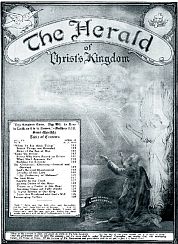
THE HERALD
of Christ's Kingdom
VOL. XI. February 1, 1928 No. 3
Table of Contents
"WHEN
YE SEE THESE THINGS COME TO PASS"
MINISTERING
TO THE MEMBERS OF CHRIST
THE
SAINTS GOD'S PECULIAR CARE
THE
VALUE O F A TRIED FAITH
ENCOURAGING
LETTERS
VOL. XI. February 15, 1928 No. 4
Table of Contents
THE
FRUITAGE OF LIVING TO THE GLORY OF GOD
FALLING
AWAY FROM STEADFASTNESS
THE
FRIENDSHIP THAT IS BEGOTTEN FROM ABOVE
JESUS
THE LORD OF LIFE
VOL.
XI. February 1, 1928 No. 3
"WHEN ye see these things come to
pass," said Jesus, then "lift up your heads" in anticipation of the closely
approaching end of the Age and the establishment of the Kingdom. The Master in His great
prophecy was referring to certain outstanding signs or manifestations that would betoken
marvelous changes at hand. While all the world is .wakened and keenly interested in the
progress of events, those who are acquainted with the Plan of God have double reason to
watch the signs of the times and to note the rapidly accumulating evidences of new and
hitherto unheard of forces and influences at work in the affairs of the earth. It is to
our general encouragement to observe in the Daily Press the progress of present relay
knowledge, inasmuch as it has an important bearing upon our outlook as those who are
watching for the Morning and who believe, that it is near at hand. In the "Boston
Herald," of January 7, we find the following interesting Editorial:
"RADIO'S LATEST"
"It was regarded as the opening of
a new epoch for the wireless when last March the news came that by means of the 'beam
system' it had been found possible to communicate from England to Australia at the rate of
225 words a minute. But that feat is now far outdone by the station which has just been
erected at Dorchester, Wessex, in the heart of the 'Thomas Hardy country.' The latest
great building devoted to radio turns out to be nothing less than a 'World's whispering
gallery.' As the center of half a mile of giant masts, all 270 feet high and carrying
aerials, it is provided with, transmitters and large brass cages, in all of which is to be
seen what has been called 'a tangle of valves and coils: Within the power house, set in
motion by seven-ton flywheels, three dynamos are at work calling up electric vibrations
from the vasty deep: These are sent out in messages so rapidly that they have been known
to circle the world in one-seventh of a second. And as to capacity for quick transmission,
the 225 words a minute recorded last March have been so much increased that it is now
possible 'at a pinch,' to send in sixty minutes no fewer than 2000 [?] words.
"Much was made nine months ago of
the ability of beam wireless to reach listenership 'beyond the seas.' Today the station at
Dorchester whispers daily across thousands of miles of ocean to both North and South
America, its messages being regularly received at New York, Rio de Janeiro and Buenos
Aires; and in a few weeks more, after the construction of another station, thirty miles
from Dorchester, England will be on speaking terms through Morse signals, with Egypt,
Japan, and the Far East. There is said to be no wastage in the method; but rather
economies of several kinds. The same masts serve for New York and for Cairo; as radio
beams follow certain definite tracks round the earth, New York, Dorchester, and Cairo are
all on the same circle. Hence 'the miracle of a message sent out into space on the west
side of the aerial going to the new world, while the same message leaving from the east
side finds its way to Egypt.' One observer, writing of the sounds emitted, describes the
usual 200 words a minute as 'like a sparrow with an industrious chirp,' and the 2000 [?]
as 'resembling a breathless dove.'
"This year it is expected to add
telephony to wireless transmission from Dorchester, so that it will be possible for a
business man in London to pick up his receiver and speak to South America, Egypt, or
Japan. In the same way photographs, prints, and checks will be transmitted -- sent, it is
claimed, from the same aerial, from the same transmitter, and on the same wave-length, the
service also covering scenes in Parliament, fashion plates, pictures of boxing matches,
and reproductions of all sorts of news items. In England this approach to 'round-the-world
wireless' is regarded as forecasting a new era for international relations, especially in
the field of business and commerce. And most of those who recall how 'wonderful' wireless
transmission at the rate of five words a minute seemed thirty years ago will come to the
conclusion that displays of the 'wizardry of science' have not yet reached their
end."
"LOOKING AHEAD FIFTY YEARS"
"Looking Ahead Fifty Years"
was the subject of an address recently delivered at the seventh assembly luncheon of the
Boston Chamber of Commerce. Mr. Babson "eliminated the Jules Verne atmosphere
somewhat by describing the work of scientists and inventors along the road to discovery in
1927. The important effects of invention were stressed and this year important work has
been made in the development of cold light. At present 95 per cent of ordinary lighting is
wasted in heat, and light like that of a fire-fly would mean 1/20 of the cost today. The
advance in the field of artificial rubber will mean rubber paved streets and rubber
carpets, This year also showed evidences of success in the invention of unbreakable glass,
unrustable metal, and a long stride towards central heating by gas.
"Greatest Future in Air"
"The perfection of the helicopter,
which would enable a vertical take-off and landing, is assured any day now and according
to Mr. Babson would mean the birth of aviation over night. Landing fields would be
eliminated and accidents prevented thus taking the airplane out of the experimental stage.
The greatest development of the ago is in the air, and the speaker said plans are being
made to run airplane 'trains.' Planes will be strung in a line like railroad trains and if
one 'goes dead,' the weight will be carried by the others. On inquiring what would happen
if the first plane went dead, Mr. Babson said the 'train' would go into reverse.
"The alchemy of gold from baser
metals would have no value as Mr. Babson said, as the discovery would simply depreciate
the value of gold but the alchemist of radium will revolutionize industry beyond human
dreams. Tremendous advances are soon to be made in the use of vending machines in retail
stores. Wood pulp will make women's dresses, with wood going in one end of a machine and a
dress coming out the other. To illustrate the value of wood pulp, Mr. Babson held in one
hand a copy of Longfellow selling at $2:00 and in the other a silk dress worth $50.00. He
said the prices were not in order as there were more brains and wood pulp in the book than
in the dress.
"Sugar from Water"
"Other developments of 1927
include 'mental polishing machines'; the use of color and sound to keep factory workers
cheerful; mining prospecting by sound; pressing a button to make rain; sugar from water
and milk from kerosene. Mr. Babson predicted a day when Boston would legislate against
delivering cow's milk.
AT THE OPENING OF 1928
An Editorial in the "Toronto Daily
Star," of January 3, indicates how the minds of some are active in endeavoring to
account for the state of unrest that exists everywhere and to adjust themselves to the new
conditions and circumstances. It reads:
"A man must be very young who
fails, at the opening of 1928, to feel that in his lifetime he has seen great changes.
Even a quite young man has seen the radio become what it is. In his time the incredible
has happened, a lone man has flown across the Atlantic. A man in Toronto has held direct
telephone conversation with a man over in London. Such things are revolutionary in their
effects.
"Yet the change within the past
fifty years that affects human life most deeply of all is of another sort altogether. The
unrest of the world is, as a rule, ascribed to the after-effects of the great war, in
which nearly all the peoples of the world were involved one way or another. There has been
something else at work, however, and the extent of this other influence has. been almost
entirely overlooked -- we refer to the gradual disappearance, within the past half
century, the almost general abandonment of the belief in hell -- a material hell as a
place of torment.
"When the belief in such a place
was universal-when it could be described graphically from the pulpit and seethingly
imagined from the pews -- hell was, even then, perhaps, more of a worry to the
comparatively good than a deterrent to the actively bad.
"Now that the general run of
people have abandoned the belief in a material hell of fire and brimstone and torment, two
effects have been produced. One, the lesser of the two, is the release of the doers of
evil from fear of the awful punishment awaiting them in the next world. In so far as hell
was a deterrent to these, they are largely now without it.
"It is the other effect that is of
tremendous import -- the effect on the decent multitudes of mankind. They had, for
hundreds of years, believed that this life was a vale of tears, a place of poverty and
suffering, that the more they endured here, the greater would be their reward hereafter --
for theirs was to be an eternal heaven, while for the rich, the self-indulgent, the
strong, the powerful, who oppressed them, there was to be hell eternal. Millions lived in
the meanest poverty, yet died content, believing they had the best of the bargain.
Millions of similar people today have no such assurance -- no such solace in enduring
privations that come upon them from existing social and economic conditions. The unrest of
the world may largely be ascribed to this change in religious belief."
PAPAL ENCYCLICAL BARS CONCESSIONS
FOR CHURCH UNITY
"All Must Come to Rome".
Of no little interest, especially in
ecclesiastical circles throughout the world, is the recent encyclical of the Roman
pontiff, constituting as it does an answer to Protestantism-its propositions, efforts and
appeals in the direction of a united Christendom. Possibly it was the International
Conference of Protestant Churches held at Lausanne last August, at which the Catholic
Church was asked to be represented, that inspired this plain statement from the Vatican in
which it is said, "The Pope completely dashes the hope of those who have believed
that Roman Catholicism. might be induced to make concessions to the other churches for the
sake of unity."
The Catholic viewpoint set forth in
this encyclical is not unlike that which has emanated from the Vatican from time to time
through its history. That viewpoint. is that the Catholic system as it. is now
constituted, was formulated in the Apostolic period; that Christ and the Apostles
organized the church to exist as a concrete, visible institution containing a literal
enrollment of all its members, and that without doubt or room for equivocation the Roman
Catholic Church. is the one and only church that has any recognition whatever from God.
Thus the Pope in his present encyclical goes on to say that
"Christ promised continual
assistance to His church with the words, 'Behold, I am with ye every day to the end f the
world." Necessarily, therefore, Christ's church not only must exist for all time, but
must, moreover, exist exactly as it was in the Apostolic times, lest we are ready to admit
either that Jesus Christ failed of His purpose or erred when He affirmed that the gates of
perdition never shall prevail against. His church.
As is well known by all who, are
familiar with Church history, the premise that is assumed in the foregoing is all wrong,
which is that the Roman Church as it is now existing and known to be operating was
instituted by Christ. It is properly maintained to the contrary that the Church which
Christ and the Apostles founded was a very much different proposition. The Church that
Jesus started was the very embodiment of simplicity, and free from all human machinery,
forms and ceremonies The Master Himself was its only Head and Teacher and He authorized
none to ssume the prerogatives of Vicar or of a visible head to His Church here on earth.
Taking up and dealing further with the
attitude of Protestants on the subject of church unity, the Pontiff goes on to say that
"They declare themselves ready to negotiate with the Roman Church, but with equal
rights, on a basis of equality. There appears to be no doubt that if they could so
negotiate they would do so with the intention of arriving at a convention permitting them
to continue to hold the opinions which now exclude them from Christ's single fold.
"Under these constitutions, it is
evident that the Apostolic See cannot participate in any way in these pan-hristian
meetings, nor adhere to nor help such attempts. So doing would be cloaking with authority
a false Christian religion. differing widely from Christ's single Church.
"How could she tolerate an
iniquitous attempt to drag the truth -- divinely revealed truth -- into a compromise? For
it is a matter of her defending divinely revealed truth."
The Pope then affirms that before the
disciples of Christ were sent forth to teach all the world, they were themselves first
taught every truth by the Holy Spirit, and he then asks, How can we admit contrasting
opinions? And he continues:
"If we admit this possibility, we
must also say that the descent of the Holy Ghost on the Apostles, that the permanence of
the Holy Ghost in the Church, and even the teaching of Jesus Christ, lost all influence
in, the world many centuries ago. To affirm this is blasphemy.
"It is easily understandable why
the Apostolic See has always refused to let its followers participate in the meetings of
non-Catholics, because it is impossible to hasten the unity of all Christians except by
obtaining the return of the dissidents to the single Church of Christ -- from which they
one day unhappily broke away.
"May they return to the only true
Church of Christ, which is manifest to everybody and by the will of its Founder must
always remain just as He constituted it for the salvation of all..
"May they return to the common
father. He, forgetting the hard words they have hurled against the Apostolic See, will
receive them with a heart of affection. If they desire, as they affirm, to join us; why do
not they hasten to return to the Church which is the mother and the teacher of all
followers of Christ?
"If they return, it must be not
with the idea or hope that the Church of the Living God, the pillar and support of truth;
will scrap its integrity and faith or tolerate their errors, but in order to submit to the
Church's government and authority.
"Would God it should be my happy
lot to be able to embrace with a paternal heart the sons for whom we mourn now that they
are separated. And would that our Divine Savior, listening to our ardent prayers, should
design to recall all sinners to the unity of the Church."
Manifestly, the Roman Church making the
stupendous claims that she is the only real and recognized Church of God, and that none
outside of her ranks are members of the Church, in any sense, could not consistently take
part in any projects looking toward the unity of all professing churches, but waits for
all others to renounce their right to existence, and, as straying and repentant sons,
return to the one fold -- the Catholic fold.
Church Union Sure Says Dr. Manning
As definite as the Roman Pontiff's word
is, refusing to make any concessions to Protestants in favor of church unity, Bishop
William T. Manning, prominent in the affairs of the Episcopal Church in America, seems not
at all discouraged nor disheartened because of the recent voice from the Vatican. At a
meeting of the Church League for Patriotic Service, Dr. Manning is reported as giving what
is regarded by some as a reply to the Roman Pontiff's encyclical. He said:
"We are living in very interesting
times. Great movements are taking place all about us. And one of the greatest is the
world-wide movement for Christian reunion. I want to say that I hope no one will feel in
the least discouraged or doubtful as to the progress of the movement for union on account
of any 'pronouncement' which has been made or may be made in regard to it.
"Even though a particular
utterance might seem unfortunate for the moment; nothing can stop or even retard this
movement. It is taking place and nothing can stop it. I doubt if anybody seriously wants
to stop it.
"Christians all over the world --
Catholic and Protestant -- are drawing nearer to each other and feeling nearer to each
other. Our own Church and the Anglican Church throughout the world will continue to play a
great part in the movement, because in the providence of God the Anglican Church includes
those things which are true and essential in Catholicism, and those things which are true
and essential in Protestantism.
"It was for this reason that our
German brethren at the World's Conference on Faith and Order held last August at Lausanne,
Switzerland, applied to, the Anglican Church the name; the Bridge Church, because they
recognized that our communion stands in a unique relation to the Catholic world on the one
hand and to the Protestant world on the other hand.
"We trust that this thought
expressed at the Lausanne conference maybe fulfilled and that ours may prove to be a
'Bridge Church,' connecting Christians of all names, helping to draw, them, toward closer
fellowship and brotherhood."
We know of nothing in the prophecies to
indicate that there will be such a return of Protestants to the Roman Church, though the
view held by some students of the Word, that there will yet be a drawing together on the
part of the two great divisions of Christendom and a closer affiliation and co-operation
between them, in connection with the closing scenes of this Age, appears to have some.
Scriptural support. We await with interest further developments.
WHILE the Master was with His followers
at His First Advent, and gathering the fruitage of the Jewish Age, He admonished His
disciples to pray the Lord of the harvest that He would send forth more laborers into His
vineyard.
In consideration of the fact that there
are brethren in various parts of the world scattered, isolated, discouraged, and. some of
them confused; and believing that there is for them a message of cheer and comfort, and
that they can be assisted, shall we not realize indeed the Voice of the Master indicating
to us our privileges of ministering to these in such a way as to enable them to become
strong in the Lord and in the power of His might. Is it not to the pleasing of our Master
today that all His faithful disciples shall exercise great concern for their brethren in
need, and not only pray that more laborers and more assistance may be supplied on behalf
of His faithful children, but that each one who clearly discerns the present situation
shall increasingly have it. upon his heart to seek by every reasonable means to co-operate
for the advancement of the cause of the Lord and the brethren?
In these remarks it is not our thought
to encourage any one in a propaganda work. Ours is not the work of the propagandist, as
that term is generally used; for we have no personal designs to work out, nor any man-made
system or scheme to publish or advertise; nor have we any system or church organization to
foster and build up. We have none of these things in our midst, but recognize merely and
solely, the simplicity and order of the primitive Church-"One is your Master, and all
ye are brethren." As ambassadors for Christ, we axe merely calling attention to the
privileges of the ministry of the true evangelist; that it is that of building up the
brethren in Christ in Christian character; and encouraging them in the development of the
fruits of the Holy Spirit, and otherwise imparting comfort as the Lord may direct,
Assisting Those in Perplexity and Distress
It has been with heartfelt interest
that we have observed the rich blessing of the Lord upon what from one standpoint seems
the feeble efforts of the brethren associated in this ministry. The visits of "The
Herald of Christ's Kingdom" to brethren in various parts of the world has without
doubt resulted in greatly strengthening many of the friends and enabling them to see their
way more clearly. As many of our readers are aware, the exposition of the Revelation, and
of the Book of Daniel as published in the "Herald," together with other studies
appearing in our journal from time to time, have played an important part in enabling many
to discern clearly the present situation, and to preserve that poise and balance in
connection with present issues and problems that is becoming to disciples of Christ. But
from what we can gather, there are a considerable number yet who likewise may be assisted.
We learn of various recent awakenings here and there, of brethren with whom we were more
or less associated in former years-brethren who by reason of the peculiar conditions.' and
tests of this day, find; themselves sorely perplexed and distressed, and who need to hear
more distinctly the Voice of the Good Shepherd saying, "This is the 'way; walk ye in
it."
We will not neglect to mention in this
connection that as we have reached that season of the year when many of the
"Herald" subscriptions expire, we have been very encouraged by the hearty
response from the brethren in all parts of this country, and in fact throughout the world,
renewing their subscription to the journal and taking occasion to speak commendably of one
feature or another. Not only so, but our subscription list appears to be holding up quite
firmly with a goodly number of new subscribers from here and there. Some of these new
subscriptions come from brethren who have just recently had our journal brought to their
attention; some are forwarded to us by friends who are thus doing their part to bring a
blessing to others.
Valuable Opportunities Still Open
It occurs to us at this point to state
again, that in getting each issue of our journal published, we have an extra number of
copies printed, and our suggestion is for those of our readers who find themselves in a
position where they could place to good advantage sample copies of the "Herald"
that we shall be glad to mail them such copies without charge, as long as our supply
lasts. We are able to supply extra copies of nearly all the issues of the
"Herald" for the past five years and several issues may be had of two years
prior to that.
During the past year or so, special
subjects of general importance and pertinent to these times, have been treated at length
in the "Herald" sometimes as a serial. The following subjects are amongst those
dealt with exhaustively:
1.
"WATCHMAN WHAT
OF THE NIGHT? THE MORNING COMETH!"
2.
AN EXAMINATION OF
PROPHETIC AND HISTORIC TESTIMONY RELATING TO THE DIVINE TIMES AND SEASONS. A CHRONOLOGICAL
REVIEW.
3.
HOLDING FAST TÓ THE
LORD AND THE TRUTH.
4.
HAS, THE WORLD OF
SIN AND DEATH ENDED? WILL MULTITUDES OF THE PRESENT LIVING, GENERATIONS ESCAPE THE TOMB?
5. WHAT SAY THE SCRIPTURES ON CHRISTIAN
LIBERTY?
6. HAS THE DOOR INTO THE NARROW WAY CLOSED?
7.
WHEN DID THE LORD
COME TO HIS TEMPLE?
8.
"BEHOLD THE
BRIDEGROOM!"
9. THE SIMPLICITY OF THE CHURCH AS
INSTITUTED BY CHRIST AND THE APOSTLES. NO 'OVER-LORDS, HUMAN CHANNEL, OR HEADSHIPS.
We have had an extra supply of all
those issues containing subjects named above, to be circulated freely amongst other
brethren who show indications of awakening to a realization of the peculiar and trying
circumstances through which the Church is passing at this time. Any of the above are at
the disposal of the friends, and may be ordered in lots, or if any choose, they may send
us the names and addresses and we will mail such subjects as you may specify to the
addresses direct.
We merely call attention to the
opportunities for service and the privileges connected with these, and to the advantages
and blessings which accrue to those who embrace them. We can, however, speak confidently
of a fact that experience has demonstrated, and to which many of the Lord's people can
testify, namely that the Lord specially blesses those who, having received light and help,
themselves, do not put their light under a bushel, but let it shine, fearlessly and
wisely, for the benefit of others: No doubt there are ways in which all who are filled
with loving zeal to serve the Master may have a part in encouraging the Cause that is so
near to our hearts.
"And we know that all things work
together for good to them that love God,
to them who are the called according to His purpose." -- Rom. 8 :28.
STRONG is the foundation afforded in
the Scriptures for the child of God to rest in the Lord. The promises of His unfailing
love and constant care are ever reassuring, so that those who have exercised faith to the
extent of fully surrendering their lives to God, and have accepted the promises made in
their behalf, have a basis for peace and comfort that surpasses anything and everything
that this world or the children of this world could possibly offer. The promise quoted
above which is limited to a specific class -- them that are called according to His
purpose, is all-comprehensive. No one could desire or ask more than what this promise
embraces. Yet there are others of similar character. Our blessed Master while sojourning
with His disciples upon earth repeatedly expressed the thought of Divine care, of the
constancy of the love of God. He said, "Your Father knoweth what things ye have need
of," implying that God had planned and promised that those who should becomé His
children would be given everything that they really needed, that would be for their
highest good. Again He said, "The very hairs of your head are all numbered."
This He said, not by way of implying that the attention and time of the Almighty were
devoted to keeping an account of the exact number of the hairs of our head, but by way of
suggesting to us the infinitude of God, not only of His ability to know anti comprehend
all things, but of the particularity of His interest in and care for such as have put
their trust in Him and have set to their seal that God is true.
"Be Careful for Nothing"
Doubtless it is upon the basis of the
various Divine promises giving assurance of God's love, of His care, of His tenor and
personal interest in all the affairs of our lives, that the Apostle admonishes the
brethren, saying, "Casting all your care upon Him; for He careth for you." This
brings us to one of the questions that lie very near to the heart of all of the Lord's
people -- the one that has to do with the burden of anxiety, of worry, of care a -
question that confronts all of us sooner or later, and one therefore that we should learn
to deal with from the standpoint of God's Word and will concerning us. All who are the
Lord's people realize that there are cares, sorrows, and reverses of life which are their
portion and which are perplexing. These cares of life come also to those who are of the
world - to some more and to some less; but they surely come to al1 who are the children of
God. Those who hearken to the Divine admonitions are invited to cast all their care upon
the Lord; not that the child of Gad is to be without care, in the sense of exercising
proper thought and giving proper attention to that which is entrusted to him, or
concerning which he is rightfully responsible; in this sense of the word all God's
children are to be full of care -- earnest vigilance and concern. But considering the word
care as it is sometimes used with regard to worry, fearful forebodings, distress, and
anxiety, surely the trusting child of God, the one who believes that Omnipotence- is ever
ready to act in his behalf, should be without such care. The Apostle Paul says, "Be
careful for nothing" -- be worried about nothing, have anxiety about nothing. So we
may properly render the words of the Apostle, "Casting all your anxiety upon Him; for
He is taking thought for you."
His advice then is not that we shall
throw off all sense of responsibility, and cease to exercise care in what we do and in
respect to our duties and, obligations; surely all would agree that the man or the woman
without care for anything in this proper sense would be totally unfit for any position in
life. Frequently there is to be noted evidences of some one not having been sufficiently
careful. Perhaps the wallpaper has been carelessly marred or the furniture scratched;
doors are slammed or left swinging when they should be closed for warmth, etc.. Some might
be disposed to say that these are very small matters! But on the other hand one who is
careless, thoughtless and inattentive to these matters is very likely to be untrustworthy
in larger matters.
Worry and Anxiety Rob Us of Our Peace
God Himself may be said to be the most
careful being in the universe in this proper sense; though He is not careful in the sense
of worry, disturbance or unrest of mind. It is the worry and fretting anxiety that would
hinder us in the Lord's service, that would rob us of our peace in the Lord, that should
be dropped and forever relinquished by us; not carelessly, but intelligently, with the
thought that our blessed Savior, our great Burden-bearer has invited us, yea, urged us to
cast all our care. all that would disturb our peace, upon Him. He assures us that He is
able to make our burdens light and to ease our tribulations and distresses. This is indeed
tike rest of faith, and. cannot be attained and enjoyed otherwise than through faith in
His love, faith in His promises.
The faith that is properly stayed on
the Lord, will not fear, nor doubt that He will provide for all proper needs. He knows all
about the affairs of each one of His trusting children and is not unmindful of their
welfare. Now the Divine admonition comes to us, saying, "Humble yourselves therefore
under the mighty hand of God, that He may exalt you in due time." How needful this
humility before God, and haw consoling and precious is the promise in that connection of
exaltation and deliverance in due time! The children of God as they go forward in this
blessed way marked out by their Lord must learn more and more fully that they are not to
ask anything according to their own natural wills, but only that His will may be done in
them and for them. They must never forget that Divine wisdom is unerring. The children of
God therefore should tell Him about. their burdens, great and small, and should
appropriate to themselves His love and sympathy, applying to their hearts the balm of His
Word, the precious promises which are the heritage of His own, trusting Him that He is
both able and willing to supply their every need -- yea, that He delights thus to bless
them if they abide in His love. As another has well expressed the thought:
"How, strong and sweet my
Father's care!
The words like music in the air,
Come answering to my whispered prayer --
He cares for thee!,
"Then naught can hurt me, shade
or shine,
Nor evil thing touch me nor mine.
Since Thou with tenderness Divine
Dost care for me!"
Divine Aid in the Christian Warfare
Again, the peculiar care of the Lord
and His concern for His trusting children is to be observed in connection with their
warfare with the world, the flesh, and the Evil One. These are the three sources from
which the Christian is assailed and attacked and therefore the protection of the Lord can
and must be relied upon. The world of humanity, depraved and under the control of the
spirit of selfishness, is largely though unconsciously the tool of Satan who now worketh
in the hearts of the children of disobedience. The world has become an enemy and a tempter
by reason of the fact that the Church is composed of those who 'have entered upon a new
life, the life of faith and fellowship with God, a life of spiritual and
heavenly-mindedness. Their hopes, desires, and aspirations in life are along radically
different lines from any the world knows or has sympathy with. Yet it is only the hearts
of God's people that are thus changed -- their flesh is still much more in harmony, with
the world than with the new order of things established in their hearts and wills by grace
and truth, through Christ. Consequently when the world through any of its children by
their words or writing or general spirit comes in contact with the Lord's people,
immediately the latter find that although their hearts are loyal to, the Lord and loyal to
all the gracious things He has promised them and to the spirit of righteousness, love and
truth, nevertheless their flesh has an affinity for and an attraction toward the world,
its things, its views, its arguments, its pleasures.
The advanced Christian though he has
reached the place, where he is enabled to reckon his flesh and its will completely dead
and buried he nevertheless has need continually with. the Apostle to re-examine the matter
lest the flesh should become alive again. . This was the Apostle's procedure. He says,
"I keep my body under [dead, buried, in complete subjection to the new mind]; lest
after 'having preached to others I myself should be a castaway."
"Your Adversary the Devil"
The third source of the Christian's
assault and conflict the Apostle mentions as being that of the Adversary. Strong and
lion-like, vigilant and fully awake, he seeks to use every opportunity against the Lord's
people, that he may discourage and them. He seeks to destroy them, to swallow them up in
calamity, patiently devour waiting and insidiously laying snares for those who are the
children of light, using his many blinded servants to mislead, deceive, and inveigle them
into yielding to the desires and ambitions of the old life; thus separating them from the
Good Shepherd and making them more and more deaf to the spiritual advice of His Holy Word.
Since God sees best to permit Satan to have this liberty, and will not take it from him
until the ushering in of the new dispensation, when he shall be bound, to deceive the
nations no more, it implies that in some sense it is profitable to the Lord's people that
this Adversary be granted liberty against them. If it were not so, faith assures us that
he would be bound forthwith, at once restrained of liberty to assault the people of God.
Writing on this same subject the
Apostle Paul declares, "We are not ignorant of his devices." Again he refers to
the "wiles of the devil"; implying that he is an ensnarer who seeks to entrap
us. Again he declares, "For we wrestle not with flesh and blood [merely], but [our
chief conflict is] with principalities and powers [unseen], with wicked spirits in exalted
positions." (2 Cor. 2:11 ; Eph. 6:11, 12.) The Apostle here seems to call attention
to the fact that not Satan alone, but all the fallen angels, the demons, his coadjutors,
are the foes of the Church,, against whose wiles and schemes and plottings, more subtle
than that of human beings, the Lord's people must be continually on the lookout.
As to Satan's methods of attack, we are
given some suggestions also. Although he is alert, like the roaring lion, he never attacks
us with a roar, but, on the contrary, subtly; he creeps upon us in an unlooked for place
and at unlocked for times, to devour us, to overcome us, to crush out of us the spiritual
life, and particularly to deprive us of faith in the Lord.
Satan Works Through Ambitious Leaders
The Apostle Paul shows us that these
subtle approaches of the Adversary are to be expected through human agencies, assuring us
that the Adversary worketh in the hearts of the children of disobedience, and the better
and more honorable and more closely identified with the Lord and His flock these children
of disobedience may be, the more pleased the Adversary will be to use them, and the more
service they may render him. Thus the Apostle declares that Satan presents himself in his
temptations as an angel, a messenger of God -- not a messenger of darkness, of error and
of gross sin, for he knows that these qualities would alarm and repel all the children of
the light: rather he appears as an angel of light, a messenger of Divine grace and truth.
His policies and tactics have often
been to get in control of affairs in the Church amongst God's people. This he' does by
assisting ambitious brethren who have little or none of the Holy Spirit to get themselves
established in the lead as the Church's teachers. Such endeavor to create a halo around
themselves as divinely appointed ones over the flock; and soon the attention of their
followers are directed away from the Lord as the only real Head of the Church to these
human authorities, channels, and heads. Under the control of these ambitious leaders, the
flock instead of being guided aright and fed upon the pure food of the Lord's Word are
given perverted teachings and doctrines, the theories and opinions of men, which do not
serve to build up the Church in those spiritual qualities of a holy life.
Special Promises for the Last Days
But the Lord's people today need not be
in ignorance of Satan's devices any more than in the past. There are precious promises
that appertain to the saints in the last days of this Age; promises of special care and
protection over the flock, over all who are the Lord's true sheep, so that none of them
shall be misled or deceived; or if they are temporarily misguided and hindered they will
soon hear the voice of the Good Shepherd warning them ,of the danger and calling them into
the paths of safety. The saints are still God's peculiar care in this late period of the
Age, and this is very clearly indicated in the 91st Psalm, where the Lord promises that in
the midst of all the snares, pitfalls, and strong delusions, those who are dwelling in the
secret place of the Most High, and abiding under the shadow of the Almighty, shall have
such Divine protection as that no evil shall come nigh their dwelling.
If, as our Lord's great prophecy points
out, His true disciples, whom He calls the "very elect," are to be subjected to
the most crucial tests, so that if possible they would be misled and deceived, what may we
expect respecting large masses of professing brethren who evidently are not living close
to the Lord and are not observing the terms of full discipleship, and who therefore could
not be deserving of the term, the "very elect"; what of these in this trying
time? We must expect as the Scriptures forcefully portray, that many will "fall from
the faith, giving heed to seducing spirits and doctrines of devils." We must expect
the number thus to fall from steadfastness in the faith, to be large, as again it is
prophetically stated, "A thousand shall fall at thy side, and ten thousand at thy
right hand; but it shall not come nigh thee, . . because thou hast made the Lord, which is
my refuge, even the Most High, thy habitation."
The Elect Living in Nearness to Him
This gives us a clue to the security of
the saints, as to why they.. will be. specially protected. Their strength will lie in
great part in that they are taking heed to the warnings of the Divine Word respecting the
present, and hence know how to beware of the wiles of the Evil One. The "very
elect," those living in nearness to the Lord, will be so in harmony with Him and so
filled with the spirit of His Word, so blessed by the exercise of their privileges as
ministers of truth and comfort, and so disposed to lay down their lives for the Truth and
in its service, that none of these snares and delusions of the Adversary will be special
attractions for them. More than this, knowing what to, expect, and looking forward with
joy to the finishing of their course in death, and of participating in the powers of the
First Resurrection, they will be wholly out of sympathy with any of the perversions of the
Truth which the Adversary may present. Nevertheless, as the Apostle intimates, there will
be in this time also. some of the Lord's people who will require the sympathy and
assistance of others, respecting whom he says that effort should be made to .seek to pull
them out of the fire, away from the influence and snares of the Adversary. (Jude 22, 23.)
The Apostle's counsel respecting the way in which the Lord's people should meet the
Adversary, implies that they will also somehow or other be enabled to. recognize him. He
says, "Whom resist, steadfast in the faith." These words suggest that in order
to resist we must have the faith-the faith that has confidence and complete trust in God;
that faith that has already led to a complete self-surrender on the Lord's altar, with the
purpose of remaining in that attitude; even unto death. It will be the faith that would
not take back the sacrifice under any consideration, but which delights to see it
consuming, and which rejoices, hoping thereby to share in that glory that shall follow.
Ministering Spirits Protect the Saints
It is most interesting and profitable
for those who are trusting in the promises of God and relying on His providential care to
ever remember how vast and inexhaustible are the Lord's resources and His powers of
protection. If as the Scriptures teach there is a powerful Adversary assisted by hosts of
demons opposing the Lord and His children here on earth, the Divine Word just as surely
teaches that God's children are surrounded by other invisible agencies much more powerful,
whose interest in the welfare .of the saints is of the highest order and who are near to
guard them in proportion ás their hearts are pure and loyal to the Lord and to His Word.
Though we do not understand the
process, we accept the fact, that God has both spoken and written and operated
miraculously through holy men of old. And we have various examples and illustrations of
this in His dealings with ancient Israel. But how these communications were made to the
Prophets we are not always informed. Quite possibly they were made through the invisible
spirit beings who serve the Lord and His people. Concerning these invisible spirit beings,
angels, the Apostle says, "Are they not all ministering [serving] spirits, sent forth
to minister unto. those who shall be heirs of salvation?" It may be that they
ministered to Elijah and Elisha and others the .information which they possessed, and
which therefore constituted them prophets. For instance, we have in, 2 Kings 6:8-18 an
account of some supernatural revelations to Elisha: we are informed that Elisha sent word
in advance to the king of Israel respecting the movements and intentions of the king of
Syria, and that his fame as a seer had extended to Syria; so that the counselors of
Syria's king explained the. matter to him, saying, "Elisha, the prophet that is in
Israel, telleth the king of Israel the words that thou speakest in thy bedchamber."
Communication through the Angels
Is it unreasonable to suppose that it
was these invisible, ministering spirits which were the Divine instrumentality in making
known to Elisha the things proper to be told to the king of Israel for his protection? It
would seem not unlikely; we think it probable. We recall also how when the Shunammite
woman came to Elisha to inquire about her son, Elisha said, "The Lord hath hid it
from me, and hath not told me." (2 Kings 4:27.) From this it is evident that it was
not by any power that the Prophet himself possessed that she had any special knowledge,
but by revelations from the Lord. And this agrees with the testimony of the Apostle Peter,
who says, "Holy men of old spake as they were moved by the Holy Spirit." (2 Pet.
1:21.) It is most probable that the Holy Spirit of God communicated information to the
Prophets through the holy angels, the invisible spirit beings who encamp round about them
that fear God. But for God to use this instrumentality in communication would make it no
less His power, just as He may use the lightning or the storm to do His work, and it is no
less His work; just as we may speak by telephone or telegraph or cable, and it is as
really our word and deed as though done without those agencies of communication.
The folly of humanity attempting to
cope with the spiritual powers is well illustrated in the incident above referred to, by
the conduct of the king of Syria in sending an armed company to capture Elisha. He might
well have reasoned that if the Prophet had information of his .most secret plans
respecting the king of Israel, she would none the less have information respecting the
proposed capture of himself But the king of Syria and some of his people were to be taught
a lesson respecting the plower of the God of Israel, and of any man whom the God of Israel
might choose to use as His channel or mouthpiece. Here, the foolishness of man was made to
show forth the wisdom and power of God.
Elisha's servant (not Gehazi, we may,
feel assured, but another more worthy), seeing. the armed host surrounding the city, was
in terror, but the Prophet, who likewise saw the armed host, also discerned another host,
more powerful, more numerous; and he entreated the Lord on behalf of his servant that he
might have an opening of the eyes, to see that all the mountains round about them were
filled with spirit 'beings-"horses and chariots of fire," or like fire, as all
spirit beings are described in Scripture. (See Ezek. 1:13, 14; Dan. 7:9; Rev. 4:3-5.) The
Lord answered the prayer t and then the young man saw what Elisha had already told 'him,
that "they that be with us are more than they that be with them."
The True Spiritualism
It is important that every Christian
should have the eyes of his understanding opened, that he may see by faith that which was
shown to Elisha and his servant literally. During this dispensation the Lord does not open
our natural eyes to see the wonderful provisions He has made for us, and His power for our
protection; but instead He gives us a still better knowledge of the subject through His
Word of grace and truth, so, that we are enabled to, walk by faith and not by sight -- to
see the armies of the Lord encamped around us and to recognize their protection of us,
without any miracle being performed upon our natural sight. None of as are sufficiently
strong to pass through the fight of Christian warfare without just such assistances as
these which the Lord has provided, and Which faith beholds, accepts, lays hold of, rests
upon, and is strengthened by.
Shall we call, this faith in invisible
spiritual powers and agencies, of God the true spiritualism of the Scriptures -- in
contradistinction to the evil spiritualism which is Satan and his fellows, the fallen
angels, the "wicked spirits, in exalted positions"? We believe that this may be
so regarded; and spiritualists admit that there are both good and. evil spirits. They are
sure that there are evil spirits because they know .how these have ensnared them in evil,
enticed them into sin. They know that they are what the Scriptures term "lying
spirits," because they have been lied to by the spirits Which communicated with them;
but they insist .that there are good spirits, and they think that sometimes they have had
communications with these. But this proposition is not sustained in the Scriptures. We are
informed that all ,the rapping„ wonder doing and other manifestations of so-called
spiritists are from the Evil One and his consorts, entirely, and that the holy angels are
engaged in a better, higher, and nobler service.
Indeed, we maintain that the good
spirits, the holy angels, make no communications with man now; that these communications
belonged to. a previous time; when they were appropriate and necessary as the channels of
Divine information. We do not need their ministry through mediums today, and are
especially forbidden to seek communication .or knowledge through such channels; this for
the same reason that we do not need the testimony of inspired seers and prophets in our
midst today, because God has made an abundant provision for us through the prophetic.
utterances of the past, to the intent that we of this Gospel Age should walk not by sight;
nor by communication with the angels, but by faith.
All the Powers of Heaven on Side of the Saints
We may realize no less clearly; but
even more clearly, than did the ancients that He who is on our part is more than all they
that be against us; we may discern by the eye of faith that the "angel of the Lord
encampeth round about them that fear Him, and delivereth them"; we may realize that
all the powers of heaven -- "more than twelve legions of angels" -- although
invisible to us, are nevertheless present, and fully subservient to every will of our
glorious Lord; and that thus surrounded and protected we are living "under the shadow
of the Almighty" and, as it were, in the hollow of His hand.
In this connection we are reminded of
our Lord's words respecting His faithful disciples, His "little ones." He
assures us that the very humblest of those who are His have high connections with the
heavenly throne, saying, "Their angels do always behold . the face of My Father in
heaven:" (Matt. 18:10.) That is to say, as the angels are all "ministering
spirits sent forth to minister for them who shall be heirs of salvation" (the Gospel
Church), there are some of them who have a charge, a watch, a care over each member of the
Body of Christ. Perhaps one guardian angel to each saint, perhaps more than one; but we
have the Lord's assurance that His provision is "sufficient." One thought that
our Lord's words give to us is, that these holy angels, charged with ministering to and
caring for the Elect, are in no danger of being detained so that they must wait for a
longtime on more important business before having access to the Father; on the contrary,
they always, have access to Him, they can always see His face; and through the Redeemer,
and by these agencies, God is ever ready to respond to our cries and to cause all things
to work together for good to them that love Him.
"Without faith it is impossible to
please Him;
for he that cometh to God must believe that He is,
and that He is a rewarder of them that diligently seek Him" -- Heb. 11:6.
BLESSED assurance, Jesus is mine,"
well represents the standpoint of faith and expresses the true state and attitude of
those who have entered into the blessings and privileges accorded to obedient sons of God
in the present dispensation. Such an attitude presupposes that the present individual
enjoying this happy situation has fled to Jesus for refuge, has found in Him an anchor to
the soul, and has laid hold of the hope set before him in the Gospel. The "blessed
assurance" that Jesus is ours is sure to bring true consolation, rest, and peace in
proportion to the measure of faith exercised in the acceptance of the great fact that God
loves us, and points us to His expression of that love in the saving power of our blessed
Lord Jesus. This state of sweet and blessed assurance, we see depends entirely upon our
faith, our trust, in that nothing visible, nothing tangible is given to us or set before
us at the present time. Hence the words of the Apostle, "We walk by faith and not by
sight."
Head Knowledge Not Sufficient
As all mature Christians well know,
faith may be said to have in it the two elements of intellectual perception and assurance,
and heart reliance. Both the head and the heart -- the intellect and the affections -- are
necessary to the faith without which it is impossible to please God. With some Christians
faith is all emotion and sentiment; with others, it is all intellectuality of the head.
But neither of these elements alone can withstand the fiery tests to which faith is
subjected. Both must be possessed and abide if our faith is to endure to the end and be
found unto praise, honor, and glory at the appearing of our Lord and Savior Jesus Christ.
The trial of the Christian's faith to. which our Lord and the Apostles refer, is a trial
not only of the intellectual knowledge of Divine
truth, but also of the heart's trust in and reliance upon God. In both respects, the true
child of God will find himself severely tested.
It is apparent in our times that a
large number of the brethren have attached an undue importance to the mental or
intellectual phase of their faith, a head knowledge, etc., to the neglect of the heart
appreciation of the Truth, and have failed to devote attention to the qualities of
holiness, righteousness, Christian forbearance, and love, such qualities as enter so
largely into the composition of the character-likeness of Christ that alone will win a
place in the Kingdom of God. It is evident that one may receive a large intellectual
knowledge of the Truth, he may be able to discern many of the fine lines and points with
regard" to some of the doctrines and so far as the letter or theory of the Truth is
concerned, and at the same time may have little or none of the real power of the Truth in
his heart and life, and be greatly lacking in those essential elements that go to make up
a truly religious life, such as is analyzed by St. Paul in 1 Cor. 13. And may we not in
this way account for the sad lack of true piety, of love and brotherly kindness amongst
the brethren today?' Is it not because of too much theory of the head and too small a
measure of religion, of the heart that there is so much of the spirit of self-seeking,, of
strife and contention abroad amongst professing brethren, resulting in many bitter
controversies and divisions in their midst? It so seems to us.
Must Have Religion in the Heart
Far be it from us to discourage the
study of the Word. Let all study the doctrines
and get as clear an understanding of the Truth as possible. Let all become rooted and
grounded, settled, and established in the doctrines of God and give earnest heed to the
same lest they let them slip. But while thus engaged in the intellectual study and
searching of the Word, let us remember that the primary object of the Truth is to reach
the heart and effect the change there that is so necessary if we would be acceptable to
God and make any progress in the development of character. Does not St. Paul tell us that
"Though I speak with the tongues of men and of angels, and have not love,. I am
become as sounding brass, or a tinkling cymbal"? And does he not add that
"Though I have the gift of ;prophecy and understand all mysteries, and all knowledge,
and though I have all [intellectual] faith, so that I could remove mountains, and have not
love, I am nothing"? Thus he places the entire burden of importance and
responsibility upon that phase of faith that relates to certain heart qualities summed up
in the word love, without which none can be acceptable nor well pleasing to God.
In searching and in studying the faith
that was once delivered unto the saints, the faith upon which depends the victory that
overcometh the world, we find that the New Testament abounds with references to what the
saint is to accomplish, with earnest appeals and admonitions to the Christian to recognize
the purpose of the faith and to see to it that his faith is working out these purposes in
his life. The knowledge of spiritual things contained in our faith is merely a means to an
end; that end is the transformation and sanctification of the life that the heart may
attain a state of holiness and become Christlike. Our faith is vain and to no avail if
this object is not attained. Jesus definitely emphasized this fact: "Sanctify them
through Thy truth, Thy Word is truth." The object then of all the revelation, óf all
the knowledge received through the intellect, is to acquaint the child of God with the
Divine will, that he may become informed as to what are his duties, as to the part he must
perform if he would permanently secure the favor of God and the crown of life which He has
promised to them that love Him.
Faith Leads to Renewing of the Holy Spirit
St. Paul in his letter to Titus imparts
some information, in fact he sums up the purposes and results of the faith in a manner
that is of much interest and importance to the people of God unto this day: "For we
ourselves also were sometimes foolish, disobedient, deceived, serving divers lusts and
pleasures, living in malice and envy, hateful, and hating one another. But after that the
kindness and love of God our Savior toward man appeared, not by works of righteousness
which we have done, but according to His mercy He saved us, by the washing of
regeneration, and renewing of the Holy Spirit; which He shed on us abundantly through
Jesus Christ our Savior."
The lesson in the foregoing is most
obvious. He is contrasting the life we were once living, as children of this world, its
spirit and general character, with what is now our experience since we, have responded to.
the Lord's voice and have found "the kindness and love of God our Savior." He
assures us that our attainment in the life of godliness was not as a result of personal
endeavors and works of righteousness of ourselves and apart from God, but that it was His
mercy that saved us by the washing of regeneration and renewing of the Holy Spirit. The
receiving into the intellect of the knowledge that Christ came and died for our sins and
arose for our justification would count for nothing if that information was not impressed
upon the heart, moving the soul to gratitude and to recognize its duties of yielding to
the power and influence of the truth; the message, that God has given us. The washing of
regeneration most evidently relates to the cleansing that comes in connection with the new
life and the quickening of the spirit. The term regeneration suggests the starting of life
again, and means to re-live. The mental recognition and acceptance of the truth; the
endorsement of the message in the mind does not .produce regeneration, does not give one a
standing in life again. "With the heart man believeth," said our Lord. It is
only as the heart, the soul, receives the message and acts upon it, responding by way of
declaring to the Lord its resolve, its decision, its determination to yield all to Him in
harmony with His Word and His will, in a life of full surrender: For it is only this
reception of the truth by way of heart obedience and resignation, that becomes the
occasion for the impartation of the Holy Spirit by which regeneration or the start of the
new life is experienced. The Apostle calls it the renewing of the Holy Spirit, which means
that without the possession of that Spirit there could be no renewing. Here then are the
results, the outworking of the intellectual and heart reception of the truth; or in other
words, the exercise of faith, in the acceptance in the mind and in the soul, of the Divine
messages, onto obedience to the will of God. And if the processes of regeneration, the
renewing of the Holy Spirit, the growing up into Christ in all things, and the walking
according to the Spirit are to be the continual heritage, the experience of the Christian
all through life, then he must continue to receive through the intellect and in the heart
the knowledge of the Lord and the impelling power of faith.
Every Man's Work of Faith to be Tried
Evidently it is such as these who are
living the new life that St. Paul refers to as those whose lives are "hid with Christ
in God." It is these that know something of the blessed assurance that Jesus is
theirs; their trust is stayed on Him and they have the confidence that He is both able and
willing to keep that which they have committed unto Him against that day.
It was said to Israel long ago,
"The Lord your God proveth you, to know whether you love the Lord your God with all
your heart and with all your soul." Similarly, the Lord is proving the New Creation;
the trials and tests in the Christian life are for the purpose of demonstrating whether or
not we have the faith in sufficient measure, and additionally, of facilitating and
assisting the work of the Spirit in developing the various elements of the holy life,
godliness, patience, brotherly kindness, love, and in producing the ultimate fruitage and
reward of life eternal.
As the faithful student of the Lord's
Word well knows, there are repeated references in the Divine messages to the fiery trials
through. which the Church is to pass. The Church has experienced these seasons of severe
testing and fiery ordeals all through the Age. But the closing days of this dispensation
are given special prominence in the Lord's Word as days of the most crucial experience for
the people of Gad. St. Paul, alluding to this time, says, every man's work shall be tried
of what sort it is; he speaks of the foundation, Christ and the ransom for all, upon which
the Christian is building. By the use of metaphor he refers to the various kinds of
material that may be used in the faith structure -- gold, silver, and precious stones,
symbolical of that which will stand the test of fire and cannot be destroyed; and the
wood, hay, and stubble, symbolical of those materials which will not endure the fire and
are readily subject to destruction.
The gold, silver, and precious stones
are doubtless descriptive of the sound doctrinal truths and teaching including the godly
life, obedience, and holy practices which the true faith inspires in the consecrated
heart. Such as build with these qualities are erecting a character-structure that will
endure the fiery tests and trials of this evil day. The wood, hay, and stubble are
descriptive of unsound doctrinal teachings, represented in the theories and opinions of
men, which do not inspire to holiness of life and those holy acts of obedience to God, but
rather tend to a life of self-indulgence and to a gratification of the natural, selfish
ambitions and a living more or less according to the flesh. Such as build of these
materials are erecting a structure that will not endure the fiery tests of this time, but
as the Apostle indicates, will be consumed and will prove a disappointment to its builder
in the end.
The Trial of Your Faith Precious
St. Peter corroborating the Apostle
Paul's description, tells us that a faith which will stand the test of fiery ordeal and
come off victorious is very precious in the sight of the Heavenly Father. Whenever the
Christian passes through a fiery trial and still retains not only his faith in the
doctrines, but also his confidence in God and his reliance upon His promises, his
integrity of heart and purpose and his zeal for truth and righteousness, that trial of
faith results in the character growing more Christlike and hence becoming more pleasing to
God, who subjects His child to such discipline for this very purpose. This same Apostle
intimates that the faith of those called throughout the Gospel Age will receive this
severe testing. He says, "That the trial of your faith, being much more precious than
of gold that perisheth, though it be tried with fire, might be found unto praise and honor
and glory at the appearing of Jesus Christ." In the present time when gold is
comparatively a rare metal, it has a special value. Therefore, the Apostle compares it to
the faith of the true disciples of Christ to whom alone of all humanity, will be given the
glory, honor, and immortality promised to those who overcome.
No marvel then that the trial of the
faith of this class is very important. None can be admitted to membership in the Body of
Christ who has not been nested and proved by the Lord. God's children are tested to
determine whether or not they believe in Him as a faithful, wise, loving and true God to
the extent of entering heartily with Him into the work of accomplishing His purposes in
them, that of the development of His character-likeness. Without this strong, well tested
faith in God and His promises we would not be able to please Him in the last and final
sense; we would not be able to show the strength and fortitude of character necessary to
qualify us as members of the "Elect" which He is now selecting, if we did not
exercise that faith that would patiently endure and successfully pass through all the
various tests and disciplines which His wisdom sees good for us at the present time.
The Test Is not One of Perfection in the Flesh
Considering that the sum of the entire
testimony of the Lord's Word is that it is the faith of His people that is being tested
and tried, we recognize that. none of the testing of the present time is to see whether or
not we can develop perfection according to the flesh. "He knoweth our frame and
remembereth that we are dust." It may be asked, Why should God test faith rather than
works? The reply is that all kinds of good works are dependent upon. the ability of the
worker; and none are able in the present state to render .perfect works (and God could not
accept anything short of perfect works as a basis of justification). Hence it would be
utterly futile to make the test, one of perfection of good works in the flesh. Therefore,
in His infinite wisdom and love God avoids making His test along those lines in which we
are absolutely incompetent, but rather makes it along the line of faith-in His wisdom, in
His love, and: in His promises. He well knows that a proper faith -- dwelling in the mind
and heart will cause its possessor to render all the good works that he possibly can. As
the Apostle James assures us, the true faith will reveal and show its real worth by the
works which it performs; and herein is the power and value of faith in the living God.
The Christian is able to wage a good
warfare, to fight the good fight of faith in proportion as he is exercised by trust in
God. He is able to work the works of righteousness and truth in proportion as he believes
the Lord's Word; he will be able to bear the cross after the Lord Jesus and fulfil the
terms of discipleship in proportion as he takes the Lord at His Word and believes in these
messages that were written aforetime for his admonition. He will be able to live apart
from the world and in the pursuit of holiness if his faith abide strong and unshaken. How
blessed indeed is the quality of faith!
Lessons From Ancient Israel
Another who is drawing lessons of faith
from Israel's sojourn in the wilderness on the way to Canaan has observed that "the
camp of Israel was a type, a vivid, striking type. A type of what? A type of the Church of
God passing through this world. The testimony of Scripture is so distinct on this point,
as to leave no room and no demand for the exercise of imagination. 'All these things
happened unto them for ensamples; and they are written for our admonition, upon whom the
ends of the world are come.'-1 Cor. 10:11.
"Hence, therefore, we may draw
near and gaze, with intense interest, upon that marvelous spectacle, and seek to gather
up, the precious lessons which it is so eminently fitted to teach. And, oh, what lessons!
Who can duly estimate them?, Look at that mysterious camp in the desert, composed, as we
have said, of warriors, workers, and worshipers! What separation from all the nations of
the world! What utter helplessness! What exposure! What absolute dependence upon God! They
had nothing -- could do nothing -- could know nothing. They had not a morsel of food, nor
a drop of water, but as they received it day by day from the immediate hand of God. When
they retired to rest at night there was not a single atom of provision for the morrow.
There was no storehouse, no larder, no visible source of supply, nothing that nature could
take any account of.
"But God was there, and that, in
the judgment of faith, was quite enough. They were shut up to God. This is the one grand
reality. Faith owns nothing real, nothing solid, nothing true, but the one true, living,
eternal God. Nature might cast a longing look at the granaries of Egypt, and see something
tangible, something substantial" there. Faith looks up to heaven, and finds all its
springs there.
"Thus it was with the camp in the
desert; and thus it is with the Church in the world. There was not a single exigency, not
a single contingency. not a single need of any sort whatsoever, for which the Divine
presence was not an all-sufficient answer. The nations of the uncircumcised might look on
and marvel. They might, in the bewilderment of blind unbelief, raise many a question as to
how such a host could ever be fed, clothed and kept in order. Most certainly they hadno
eyes to see how it could be done. They knew not Jehovah, the Lord God of the Hebrews; and
therefore to tell them that He was going to undertake for that vast assembly would indeed
seem like idle tales.
"And so it is now, in reference to
the assembly of God, in this world., which may truly be termed a moral wilderness. Looked
at from God's point of view, that assembly is not of the world; it is in complete
separation. It is as thoroughly apart from the world, as the !camp of Israel was apart
from Egypt. The waters of the Red Sea rolled between that camp and Egypt; and the deeper
and darker waters of the death of Christ roll between the Church of God and this present
evil world. It is impossible to conceive separation more complete. 'They,' says our Lord
Christ, 'are not of the world, even as I am not of the world.' -- John 17.
May We Know in Advance that We Shall Triumph?
There is a further consideration that
properly belongs to our subject and may profitably have attention here. It is the question
of how comprehensive and far-reaching is the "blessed assurance" that comes in
connection with trust and heart reliance upon the Lord. Does this assurance embrace the
idea that the Christian can, during the processes of his trial here, consider himself as
belonging to the Lord and secure in Him and that his eternal salvation is assured beyond
all peradventure? We believe this question must be answered in the negative. The very fact
that the Christian during his lifetime here is on trial for life, is passing through an
experience of testing and proving, implies a degree of uncertainty as to the outcome; in
other words he is on trial, being tested to determine whether or not he will exhibit all
the qualities desired, and ultimately show the development of character necessary to be
approved as a member of the Royal Priesthood.
To our understanding the Scriptures do
not bear out the thought that "once in grace means always in grace." There are
some Scriptures however taken disconnectedly that may seem to so teach. For instance the
Master said that none should be able to pluck His true disciples out of the Father's hand.
Again, the Apostle asks, "What shall separate us from the love of Christ?" But
neither of these texts constitutes a proof that one cannot lose his position of favor with
God during the time of His trial. The point to be noticed is that so long as the heart is
loyal to the Lord and His Word and His work, neither angels nor demons, nor men, nor any
other creature or thing would be permitted to alienate us or separate us from Him who
loved us and bought us; but if on the contrary we do not earnestly continue to desire to
abide in the Vine and to bear the fruit of the Vine and to work the works of God, thus
proving that our hearts are alienated from our Lord, under such circumstances He would not
only permit us to leave Him and His work and His Word, but indeed would force us to do so,
as expressed in the statement, "Every branch in Me that beareth not fruit He taketh
away."
Now on Trial for Life
There is a further text that may be
used to prove that one may know during the time of his trial here that he is going to
succeed in the Christian race course and that it is already determined that he is to be a
member of the glorified Church; the words are those of the Apostle John, "We know
that when He shall appear we shall be like Him, for we shall see Him as He is." But
we believe this statement was not intended to teach that the Church as individuals may
know beyond peradventure during their trial that they are to be of the Church in glory.
Rather, the statement is a general one and relates to the Church as a whole. The Apostle
is merely announcing one of the promises which relate to those who shall succeed in the
Christian race and be accounted worthy of glorification with Christ and see Him as He is.
The Apostle's words then merely signify that from the revelation the Lord has made to us,
we know that the Church is to be made like Christ. He did not stop of course in that
connection to explain that individual membership in the Church in glory depended upon
present faithfulness and the endurance of our trial successfully, even unto. death. His
words must then be understood or viewed in the light of the general testimony of the New
Testament which repeatedly sounds warnings to all disciples of Christ to the effect that
they are standing :trial here, that their position is .a solemn one. It is because of this
that one Apostle admonishes, "Spend the time of your sojourn here in fear"; --
that is, in reverential regard -- of the Lord and your .duties toward Him. St. Paul
likewise admonishes, "Work out your own salvation with fear and trembling," for
the reason that the Christian has many adversaries. He is subject to severe tests, and his
gaining the great reward depends upon his continued faithfulness in well doing.
"If We Hold Fast the Confidence"
The writer of the letter to the Hebrews
gives us a statement confirming the foregoing thought. He says we are members of Christ's
house "if we hold fast the confidence and the rejoicing of the hope firm unto the
end." The point about this text is that it contains an if; which signifies that there
are important conditions to observe and if we are faithful in doing the things specified
in the Divine arrangement then we shall reap the great reward.
The Apostle Paul again gives the Church
an emphatic warning. He says, "Let him that thinketh he standeth, take heed lest he
fall." This language can have but one meaning. It signifies that it is in every way
possible for one who, is in Divine grace and enjoying his full privileges in Christ to
forfeit these by unfaithfulness and thus fall from his steadfastness. If one can know
definitely during his trial time that he is sure to succeed and that his acceptance into
the Kingdom is guaranteed, then the Apostle's warning here has no meaning. 'To the
contrary it would seem that his warning words are intended for some who may feel an over
amount of assurance respecting themselves and who have no fear whatever of losing the
Christian race. In fact there are many warning admonitions in the New Testament evidently
intended to put all the members of the Church on guard, to cause them to recognize their
responsibility in connection with fulfilling the terms of the great engagement into which
they have entered with the Lord they must so walk in the footsteps of Christ; they must so
run as to obtain the prize; they must be careful, to give attention to the terms of their
covenant; they must "hope to the end for the grace that is to be brought unto
them"; and "if they do these things they shall never fall."
We May Withdraw from Him
The principle on which the Lord is
dealing with His Church, by which He is accepting them as individual members on trial at
the present time, and giving them the privilege of making their calling and election sure,
is surely, a sound one. He does not in any way interfere with the freedom of any one's
will, nor hinder in the exercise of choice on the part of these whom He now calls: it was
by the action of our own wills, after we had been favored with a knowledge of the Truth
that we consecrated and were accepted in the Beloved; and similarly by the action of our
own wills we can at any time withdraw from the Lord. He would not compel our loyalty; He
seeketh not the worship of slaves, or any compulsory work or service. "He seeketh
such to worship Him as worship Him in spirit and in truth." (John 4:23.) As by our
own wills or volition we placed our hands in the hand of the Lord for guidance, and
submitted our wills to His will, to be dead to ourselves and alive to our God, so by the
same will and volition we may withdraw ourselves and break our covenant and do despite to
the spirit of grace, and bring upon ourselves all the loss which this would entail. But
once having been accepted in the Beloved, nothing but our own wills could change this
relationship -- the ill-will of others could not do it; and as for our Heavenly
Bridegroom, like the Father, He changes not -- He is faithful. Nothing shall be able to
separate us from the love of God in Christ Jesus so long as our wills are actively
enlisted with the Lord and His cause.
"Always in Grace Until"
It is well, however, for us to note
from another standpoint the operations of grace on
behalf of those who have received it. For instance, suppose that our hearts are loyal to,
the Lord in the sense that we do not willingly and intentionally repudiate Him, or His
people, or His Word, or His work, but that nevertheless from some cause our hearts become
overcharged with the cares of this life, or the ambitions of this life, or the strife for
the riches of this life, and so our zeal and energy for the Lord and His cause, and our
fruit-bearing, are largely hindered (not stopped, but lessened): will the Lord's grace let
go of us in such an hour of temptation and trial and abandon us to the Evil One? Will He
say to us lightly, You are now choosing the world; I now drop you entirely, go to your
choice. Or Will He have compassion upon us, and remembering our frame, that we are dust,
go after us as lost or wandering sheep ?
The latter, we answer. Once in grace
under Divine protection and oversight, means always in grace until we shall have done
despite to the spirit of favor, by sinning deliberately, repudiating either the Lord or
His Word or its spirit. The Lord goes after His sheep frequently with the rod of
chastisement, reproof, trial, difficulty, persecution, adversities, that He may correct
them and bring them again to the narrow way; or as expressed in another place, the branch
is pruned, many of the tendrils which were catching hold of all the various attractions of
earthly life are pruned off, yet the branch remains a branch in the Vine; the very object
of the pruning is to cause that branch to bear fruit more abundantly. "If ye be
without chastisement," says the Apostle, "ye are not sons." Every son needs
discipline to fit him and prepare him for the Father's service, that he may be pleasing,
acceptable as a co-worker with God, not only in the present period, but also in the world
to come.
These chastisements will be kept up for
a reasonable time, often are kept up for years. With some they result in a complete
correction in righteousness, bringing the wandering sheep back, so instructed by its
experiences that it will never wander more. In other cases this discipline and
chastisement are repeated over and over and become a life-long experience, and the
recipients will fail to receive the great prize of the high calling, which is offered only
to the overcomers, and will be accorded a lesser reward.
Let Us Fear Yet Enjoy the Blessed Assurance
Nothing in the foregoing bearing upon
the subject of the Church's liability or possibility of failure, need interfere at all
with the attitude set forth in the language, "Blessed assurance, Jesus is
mine,"' on the part of the children of God during their trial now. They can and
should possess that perfect and blessed assurance that they are the Lord's up to date,
that everything is well with them so far as they have gone and so far as they have stood
trial; they should have the blessed consciousness, that they are well pleasing in His
sight every day; ever remembering however that in order to have this happy condition of
soul, they must observe the requirements or conditions that attach to their covenant with
the Lord; that keeping their covenant day by day they can have the consciousness that
there is no condemnation, and possess that full assurance of faith that if they continue
in the good way unto the end they shall reap the glorious consequences and shall be
ushered f0rever into the presence of the Lord.
Dear Brethren:
Again I am sending you my
"Herald" subscription. I certainly thank my dear Father for your labor of love
for the household of faith. The "Herald" is very dear to me, and I rejoice for
the sweet spirit of humility and love, in the food it brings to the hungry
"sheep." I feel sure you receive rich blessings from our Father in so close a
common-union with Him. How blessed it is to know Him; to know that some day "all
shall know Him" and have no other gods before him. All will know some time His way
and be led, instead of trying to do His work their way. Thank God, He selects the Bride
and our Lord will convert. the world, even though some sincerely think they can pick out
the Bride and others think they can organize the Church and convert the world and make
ready for our Lord to come. We surely have need to keep very close to Him in this evil
day, when the snares are so well concealed, lest we fall.
My prayer for all who love the Lord is
that we may be kept in the secret place of the Most High and abide under the shadow of the
Almighty.
Your sister in Christ by His grace,
Mrs. C. W. -- N. Y.
Dear Brethren:
Before the close of this year I feel
constrained to let you know that my thoughts have been with you every day in thankful
appreciation f the blessings I have received through the "Herald" and your kind
letters. So I feel very keenly the oneness of the sweet spirit of our blessed Lord.
Long ago I had a desire to write you,
but I am unable yet to send a little contribution for the' grand work we are engaged in.
My experiences have been and are at the present time of the severest financial
difficulties and I could not even pay the rent.
So you understand my silence-because I
hoped to send you something better. But I can tell you that my joy and trust in the dear
Lord has grown considerably and I am thankful for all the great blessings I receive from
the Lord. Though a pauper, I am rich and content whatever befalls me. Our little class
here has grown to about 12 to 14 friends who attend the meetings. Thank the Lord we enjoy
the liberty in Christ in peace and love, as it should be.
Let us strive, dear brethren, to have
the spirit of our dear Lord more and more in our hearts and to be ready always to meet
Him.
For the new year I pray and wish with
my whole heart that our dear Lord may bless and sustain you in every way.
Lovingly, your brother, A. J. M. --
Ill.
Dear Brethren:
Greetings of Christian love.
I enclose remittance for
"Herald" subscription for 1928 for two copies of each issue, one to me at the
above address, and one to ______.
We are very grateful to our Heavenly
Father, and our Lord, for the helpful articles in the "Herald." It is obvious
that the minds of the writers of the articles are properly directed, for, as the Lord
promised, the teaching manifests that the Lord is being relied upon for guidance, wisdom,
and understanding; that the Word is being strictly adhered to, and that the present needs
of the brethren in Christ are realized and provided for. We are very thankful to the ones
responsible for the articles, and for the printing, publishing, circulating,. etc., and
our only wish worthy of transmitting is that the Lord will keep the hearts and minds of
the brethren responsible for the articles in this state in which the mind of the Lord can
come through them to the Church in a form as near pure as possible while, we' are limited
by the imperfect flesh.
I know you will realize I am not trying
to praise you,. but just letting you know how much your efforts are appreciated, and how
much you help, strengthen, and build. These sentiments are read and. agreed to by the
other members of our small Ecclesia.
May the dear Lord keep you, and perfect
His work in and through you.
Your brother, by His grace and in His
service,
J:. L. L. -- Eng.
VOL. XI. February 15, 1928 No. 4
"Glorify God in your body, and in
your spirit, which are God's." -- 1 Cor. 6:20.
DISCIPLES of Christ, who are also
children of God, have been admonished to let their light so shine that their lives shall
glorify their Father in Heaven. This advice comes not only from Jesus but from those also
whom he ordained as His inspired mouth pieces, the Apostles. "Whatsoever ye
do," says St. Paul, do all to the glory of God." Again the Apostle's words used
at the head of this article, wherein he instructs the Lord's people that they should
regard their bodies as temples or dwelling places for the Lord, area strong appeal, a
constraining admonition, to all who name the name of the Lord insincerity and truth, to.
give all diligence in the direction of living to the glory of God. Again those who bear
the Lord's name are called upon to walk as "children of light," which evidently
signifies that they are to live as children of
light; to think, speak, and act as those who have the light of heaven, the light of God in
their hearts and lives. Those who thus are burning and shining lights in the world are
serving and pleasing God in the highest sense.
Indeed the Divine object in creating
and perpetuating the existence of any creature is that he may please God and honor His
glorious person. Neither is this a selfish trait in the great Jehovah in requiring all His
creatures to perform works to please and glorify Him. For as His Holy Word clearly leads
us to see, the course in life He calls us to pursue, and the works of love and devotion to
Him .that He would have us render, are in every way of a character to be advantageous to
ourselves -- ennobling, uplifting, and happifying. It is then to the ultimate and eternal
good of each of God's creatures, to their highest pleasure throughout eternity, that they
follow the counsel and advice that the Word of God has given on this deeply important
subject of ordering the life according to the good pleasure of Him, who out of His great
beneficence has given them their existence.
Only as Christ Dwells in the Heart
But how utterly incapable are any of us
in our fallen state, of living the life, thinking His thoughts, and walking in right ways
except we receive help from above. In His infinite and boundless grace our Father in
Heaven has made abundant provision for the instruction and proper guidance of all those
who earnestly seek to approach Him and to enter into the life of His fellowship and
service. Truly we learn from His Word early in the Christian experience that it is
"not by might nor by power, but by My Spirit with the Lord;" that any can really
make headway in the life óf piety and godliness. St. Paul, who was a very fine example of
the man of God, of one who was strong in the Lord and in the power of His might, gave
assurance to the brethren in the early Church that he earnestly prayed for them that they
might be strengthened with might by the Lord's Spirit in the inner man, which, as he said,
signified that Christ would dwell in their hearts by faith and that they would comprehend
with all saints the length and breadth and depth and height and that they should know the
love of Christ that passeth knowledge.
The Savior very early in His ministry
as He was laying the foundation for the instruction of His Church, anticipated the needs,
the longings, and the heart-strivings of His followers, and so instructed them to fall
back upon the great resources that were represented in .the infinitude and unfailing power
of 'God: "Ask and it shall be given you; seek and ye shall find; knock and it shall
be opened unto you. For every one that asketh receiveth, and he that seeketh findeth, and
to him that knocketh it shall be opened." Ever since the Savior uttered these words,
the faithful have proved them to be sound advice, words of wisdom.
Gratitude as an Inspiring Motive
One of the first and indeed one of the
most important lines of instruction that the Lord gives those who would live to His
pleasure and His glory, is that they should gladly and heartily surrender themselves at
His feet and put at His disposal their hearts and all they have. The spirit of gratitude,
thankfulness, and appreciation are seen to be all important It is to the sense of
gratitude to God that the Apostle appeals when he beseeches the brethren to present
themselves to God a living sacrifice, in consideration of the many and unspeakable mercies
that, have, been extended to them. Those who properly respond to the voice of the Lord and
the Word of His grace, who have been made partakers of the gifts of heaven and the Spirit
from above, should endeavor to grow as rapidly as possible in their appreciation and heart
sympathy with the Lord's spirit of love. These -should properly realize that they are
debtors to the Lord to an untold amount, because of His love and mercy extended toward
them in Christ; and they should see that having thus received the Lord's grace and the
spirit of it, they are to have so broad and so generous a feeling toward all mankind that
they will desire first of all to pay off every obligation of every kind and to "owe
no man anything, but to love one another."
But above and beyond any and all
obligations and debts to our fellow creatures, we recognize a debt and obligation to our
Creator -- not only for earthly life, its blessings, its privileges, its opportunities,
such liberties as we enjoy; but still more, for the great redemption that has been wrought
for us through the precious blood; for our knowledge of the same, for our call to
joint-heirship with our Lord, for the begetting of the Holy Spirit, for the assistance and
encouragement of the Word and its exceeding great and precious promises, which strengthen,
encourage, and direct us in the way of life eternal.
It is true, there are some arguments
that may be offered on the other side of the question, but these are not for us; we had no
claims, we had no riches, we had nothing until we had a being and were given existence. We
have done nothing wherewith to purchase the gifts of God; we owe Him for everything. There
is no room 'for any thing but gratitude and thanksgiving no matter from what standpoint we
are considering .our existence and the operation of Providence toward us. Hence the poet
has set forth the only proper attitude for any child of God:
"O how can words with equal
warmth
The gratitude declare
That glows within my inmost heart?
But Thou canst read it there."
The Debt of Love We Owe
We might perhaps wish that our parents
might shave been more wise and that therefore we might have been born with a more liberal
endowment mentally, morally, and physically; or that our community and commonwealth were
still more advanced, still more beneficent, still more liberal than they are; we might
perhaps wish that our nation had still better laws and still better regulations than it
has, or that our Creator had favored us with natural and earthly things still more than He
has favored us. But as considered foregoing, we are debtors for all that we have and are;
it is therefore appropriate that we should be thankful for everything that we do possess
and enjoy, of both earthly and heavenly blessings; and that we should realize that while
it is our privilege to do for others and to assist others, to encourage and bless and help
others, nevertheless, being debtors for all that we have we have no grounds on which to
claim more.
A sober consideration of this subject,
from this standpoint, should tend to make all of God's children, all of those who have
entered upon the new life, very considerate, submissive, appreciative, and very grateful
for mercies both temporal and spiritual. And these facts and circumstances should inspire
more and more of desire to spend all and do everything to please God and to glorify His
most worthy name. Seeing that in all respects we are debtors, we should seek to discharge
our duty toward all our beneficiaries: toward God first of all, the Fountain of every good
and perfect gift, toward the brethren in Christ, and toward all men with whom we come in
contact and as we have opportunity. We should endeavor to so walk and to so labor in life,
not only that none of either the Church or the world are injured by reason of our living
in the world, but that our lives shall in some measure and degree testify to our
appreciation of them all, and directly or indirectly be a help, an assistance toward the
best interests of each and all with whom we meet or have to do in life's ways.
By Emulating His Great Example
But without doubt the Scriptures point
out to us that in our endeavor to extend the praises of our God, we are to go beyond the
just discharge of our obligations and are to long for and strive for that love of God and
love toward our fellowman that will inspire and prompt us, according to our best
judgement, guided by the Spirit of the Lord, to give ourselves, to lay down our lives in
sacrifice and self-denial in such a way as that the Lord's .name shall be honored, and His
cause furthered in the direction of blessing and comforting fellow creatures, especially
of the household of faith.
Indeed the Divine Oracles continually
remind us from various standpoints that God is love; and that as He is thoughtful,
considerate of and patient toward His children here on earth, so He desires us to emulate
His great and worthy example. Accordingly, we must recognize that there is no direction
and no line in which we can glorify our Father in ,heaven and honor Him more than in
carrying out and exhibiting in our lives, thoughts, words, and deeds, this most worthy and
exalted quality or principle of love. No wonder the Apostle says that the end or real
intent or object of the Law is love, and that love is the fulfilling of the Divine Law or
purpose toward man. He that loveth all others so that he is constantly seeking to do, them
good, is following the holy Law, the perfect will of God.
Yet with our minds all measurably
unbalanced through the fall, resulting from original sin, though not all fallen exactly in
the same direction, it is not surprising that we frequently find ourselves and other
brethren in Christ in more or less confusion respecting the application of certain
principles laid down in the Word of God. For instance, we are instructed that love is the
fulfilling of the Divine Law; and that love of the brethren is one of the evidences of our
having passed from death unto life; and that if we love not our brother, whom we have
seen, it is a sure evidence that we do not truly love our Heavenly Father, whom we have
not seen. In their endeavor to measure up to these requirements of the Divine standard, it
is possible that some may err in an opposite direction of manifesting a brotherly love
where it should be withheld, where it would not be wise and appropriate, and in the
interest of the brother. Let us note the different kinds or degrees of love which the
Heavenly Father exercises and manifests.
Different Kinds and Degrees of Love
First, we have the love for humanity in
general: "God so loved the world that He gave His only begotten Son" to die for
us. Second, in a much higher and special sense, "The Father Himself loveth you"
-- you, who have accepted Jesus Christ as your Redeemer, and who, in His name and strength
and merit have consecrated yourselves to Him -- you are seeking now to walk not after the
flesh but after the Spirit. But that this special love of God can be lost in part, or
eventually, wholly, is clearly set forth by the Apostle's statement, "Keep yourselves
in the love of God." If any, after having tasted of the good Word of God, the powers
of the world to come, and being made partakers of the Holy Spirit, etc., shall walk after
the flesh and not after the Spirit, we may be sure that such will proportionately lose the
love of God; and, if he persist in this course, as a result will ultimately be "none
of His." For, instead of loving such, who through their knowledge and attainments and
disobedient course have become wicked, the Lord declares that He is "angry with the
wicked," and that "all the wicked will He destroy."
As sons of the Highest, seeking
unitedly to honor and glorify God, seeking to be like unto our Father in Heaven, and like
unto the copy which He has set before us in His dear Son, our Lord, we are to have for the
world in general that broad sympathetic pity and mercy -- love which would delight in
doing any and everything possible to be done for their uplifting, in accord with the
Divine Program, in the Divine time and order. Like our Father and our Elder Brother, we
are to love the brethren "with a pure heart, fervently -- with sincerity. This love
for the brethren is nothing like the love for the world. It is not the pity-love, nor mere
generosity. It is far more; it is a brotherly love. All of the children of God are
brethren, together in the new life; all these brethren have hopes, ambitions, interests
and promises linked together in the Lord Jesus and in the Heavenly Kingdom in which they
hope to share. All these brethren are joint-heirs, fellow-heirs, one with the other and
with the Lord. They are partners; their interests are mutual and co-ordinating.
Mutual Love in the Members of Christ
Additionally, they have a special
mutual sympathy of compassion; for while, as new creatures, they are rich in Divine favor
and promises, they all have serious weaknesses, according to the flesh -- drawbacks;
although, the Lord is not reckoning with them according to the flesh, but, according to
the spirit, the intention, the heart desires, nevertheless, they each and all have
besetments arising from these weaknesses and imperfections of the earthly tabernacle,
which cause them to "groan," and to sympathize one with the other in their
groanings. As the Apostle says, "We which have the first-fruits of the spirit, even
we ourselves, groan within ourselves, waiting for the adoption, to wit, the deliverance of
our body" the complete Church. Thus the sons of God have a further mutual sympathy
and love and care for each other, an interest in each other, helpfulness toward .each
other, which is entirely beyond and above and outside of any feelings which could possibly
be appreciated by the world or exercised toward it -- because the world has no such
conflict between the old nature and the new, no such covenant of sacrifice; no such
acceptance in the Beloved; no such union of heart and purpose and aim and spirit. Oh, yes!
the exhortation to love as brethren, fervently, is one which appeals to us specially.
But now we come to another point: Our
love for the brethren cannot be exactly of the same measure and exactly of the same
intensity or fervency toward all. There is something which gauges or regulates it. What is
it? It is that we love God and the glorious principles of righteousness, which are
represented in His character; and we love our Lord Jesus from the same standpoint, as
being the very exemplification of all that is good, noble, true, just, generous, loving;
and our love for the brethren must, of necessity, be in proportion as we find the brethren
to be copies of our Lord. We do not mean copies in the flesh, but viewed from the Lord's
standpoint, copies in spirit, copies in heart, copies in motive, copies in intention,
copies in loving zeal for righteousness, truth, etc. Thus, as we grow in the love of God
and in the love of Christ and in tile love of the principles which they represent, we grow
also in love toward all men and toward the brethren, but particularly toward those who
.are growing most in likeness to the Lord. This is not partiality; this is not doing to
others different from what we should wish them to do to, us. This is following the Lord
Jesus' example; for we find that amongst His Apostles, even, all of whom were chosen,
there were three specially beloved; and of those three one is specially noted as
"that disciple whom Jesus loved." He was specially loved, because he was
specially lovable; and so with us and the brethren. We should love them all warmly,
fervently, but of necessity with varying degrees of fervor, and the fervor should increase
with each in proportion as we note his growth in heart-likeness to our Lord. Surely it is
to the glory of God that we do this.
Love Making a Difference
This making of a difference is really
essential to the purity and progress of the Church. If we make no difference between those
brethren who walk after the Spirit and those who walk disorderly; or after the flesh, we
are taking away the very premium and blessing which the Lord intended should go to those
who walk after the Spirit; and we arc giving a premium, which the Lord did not intend
should be given, to those who walk contrary to His Word, after the flesh. It is as much
our duty to withhold fellowship from those who are unworthy of it as it is our duty to
grant fellowship, and that with fervency, to those whom we see to be walking in the
footsteps of Jesus. We are not to think that it is love that is prompting us to take the
wrong course of encouraging wrong-doers -- it is not love, but ignorance; and the remedy
for ignorance is to learn of the Lord, from His Word and from His example.
The Apostle Paul calls our attention to
our duty respecting the brethren, and how we should conduct ourselves toward them under
varying circumstances, saying that faithful brethren should be esteemed very highly in
love for their work's sake; that other brethren who are unruly should be warned; that
those who are feeble in their mental comprehension of the Truth should be strengthened;
that those who are weak should be helped, supported; and that we should exercise patience
toward all.
Those whom the Scriptures speak of as
unruly brethren may properly be warned, cautioned, -- in love, truly, and with patience,
but not with marks of the same love and esteem as though they were walking orderly in the
footsteps of Jesus and in harmony with the directions of His Word. The marks and evidences
of our love and esteem must be sincere; and must be in proportion as we see in the
brethren evidences of the right desires of heart to walk after the spirit of the truth.
The Apostle Paul intimates how our disapproval ought to be shown, in cases which seem, in
our judgment, to be of sufficient importance to demand a manifestation of disapproval.
Love Thinketh no Evil
Evidently the Apostle did not mean that
the brethren should be watching each other for an occasion of fault-finding in every word
and every act; but that, on the contrary, they should be so full of love one for the other
that trivial matters would be entirely passed over,
as merely of the weakness of the flesh, and not at all of intention, of the heart. The
matters to be considered worthy of manifestations of disapproval and warning are, rather,
those which are so open and manifest on the surface as to leave no room to question the
fact that they are displeasing to the Lord, and injurious in their influence upon the
brother or upon the household of faith. For instance, if the brother had been seen under
the influence of liquor; if he had been heard to utter vile or otherwise improper
language; if it were a matter of general knowledge that he was living in sin; these would be such grounds as we believe
the Apostle had in mind. But evidently the Apostle had no intention of cultivating a
spirit of fault-finding and judging one another as respects the heart and private affairs
-- use of time or money, etc. These belong to our individual stewardship and none should
endeavor to interfere with the proper liberties of conscience and conduct which the Lord
has granted to each. The Apostle is very stringent in his condemnation of such judging of
one another, which so often leads to roots of bitterness, misunderstanding, intolerance,
disfellowship, etc., and which, as the old leaven, should be purged out of our hearts and
lives.
The Apostle continues his admonition
with regard to those who are disobedient to the Word: "Count him not an enemy, but
admonish as a brother." To admonish as a brother does not mean to denounce roundly
and severely; it means to admonish in a spirit of love, gentleness, meekness, patience,
and with a sincere desire to help the brother to see the fault which we are certain
exists, and which we are sure is not evil surmising on our part.
Making a Difference on Fundamentals Only
The Apostle John shows us that this
matter of distinguishing as between brethren that are to be esteemed and brethren that are
to be warned, appertains not merely to conduct but also to doctrinal matters. Yet we may
be sure that he does not mean that we are to disfellowship a brother merely because of
some differences of view on non-essential questions. We may be sure that the Apostle does
mean his words to apply strictly and only to the fundamentals of the doctrine of Christ:
for instance, faith in God; faith in Jesus as our Redeemer; faith in the promises of the
Divine Word. These will be marks of a "brother," if supported by Christian
conduct, walking after the spirit of the truth; even though the brother might have other
views which would differ from ours in respect to certain features of the Plan of God not
so clearly and specifically set forth in the Scriptures, and on which there is room for an
honest difference of opinion. But for those whom we recognize as being doctrinally astray
from the foundation principles of Christ, the Apostle intimates that positive measures are
appropriate; not persecutions, nor railing; nor bitter and acrimonious disputes; nor
hatred, either open or secret; but a proper showing of our disfellowship with the false
doctrines held and taught by them; a proper protection, so that our influence shall not be
in any manner or degree used to uphold his denial of the fundamentals of the Gospel. This
definite course is outlined by the Apostle in these words: "If there come any unto
you, and bring not this doctrine [confessing Christ to have come into the world, in the
flesh, to redeem our race, etc.] receive him not into your house, neither bid him
Godspeed; for he that biddeth him God-speed is partaker of his evil deeds."
But, as the Apostle intimates, the
Spirit and guidance of the Lord are to be earnestly sought that we may use discretion,
judgment -- "and of some have compassion, making a difference." Some may be
recognized as being merely entrapped of the Adversary, .either in sin or in false
doctrine, as the case may be, and not willfully, intelligently, of their own volition.
While still maintaining an attitude of firmness toward such, deep compassion may be felt
and shown and the confidence and trust freely expressed that they are only temporarily
wrong; and an earnest endeavor made to restore them, either doctrinally or in respect to
their perverse moral course, to the position of fellowship with the Lord and with all the
brethren who are in fellowship with Him.
Solemnity of the Days
The days in which we live are peculiar
ones. There are professing brethren in all parts of the world who are more or less at
variance; there are, many conflicting views and teachings; and the spirit in the
brotherhood of Christ seems sadly lacking everywhere. Yet we may be sure that the Lord
knoweth them that are His, and that His purpose is going grandly forward. But surely this
is a time when those who realize the solemnity of the days in which we live, those who are
fully awake to the significance of their consecration vows, and who are deeply conscious
of their obligations toward the Lord and the members of His Body, should be intently alert
and vigilant, that they so deport themselves before the Lord and in the communion and
presence of the brethren, in that manner that will edify and build up others in holiness
of life and in the faith, and assist them to take a calm, reasonable, and conservative
view of the many perplexing questions and problems that are continually arising and which
must be dealt with.
How great indeed are our privileges and
opportunities still of glorifying our Father in Heaven. Since He places such a high
premium upon the quality of love, surely there is no more effective way of glorifying God
than that of a rich display of the power of love, of forbearance, kindness, and tolerance
toward all. It is to the Spirit of the Lord„ the Holy Spirit, the spirit of love, the
spirit of a sound mind that we must appeal at all times if we would be guided aright and
please the Lord in respect to maintaining proper relations and fellowship with all the
brethren in Christ. If this personal touch and close walk with the Lord is properly
maintained, it will go a great distance toward: preparing the true disciple of Christ to
face the peculiar tests and trials that beset him in the Narrow Way at this time, and to
triumph gloriously to the praise of the glory of His grace.
"Then I'll see what Thou hast
wrought;
Then I'll love Thee, love Thee as I ought.
Looking back, I'll praise the way
Thou bast led me, led me day by day."
"Ye therefore, beloved, seeing ye
know these things before,
beware lest ye also, being led away with the error of the wicked,
fall from your own steadfastness." -- 2 Pet. 3:17.
Written by Brother Russell in 1897
THIS exhortation applies to the Lord's
consecrated people living at the present time. The proof of this is found in the context
the Apostle has just been portraying some of the events connected with the day of the Lord
in which we are living -- the "Day of Vengeance." In verse ten he has pointed
out that the present Age will end with the dissolution of the symbolic "heavens"
and the symbolic "earth," which, as we have elsewhere shown, signifies the utter
disruption of the present social and ecclesiastical order. In verse thirteen he points out
that we are looking for a new order of things, and not hoping either to patch up the old
order ourselves or that others will succeed in patching what the Lord has declared
"shall pass away." And now in our text he refers to "these things." In
the eleventh verse he points out that those who have such expectations should be separate
and distinct from all other people in the world, saying, "What manner of persons
ought ye to be in all holy conversation and godliness?" And then in our text and in
the verse preceding it, he points out that at this particular time the Adversary will get
advantage of certain ones, will beguile them, get them to wrest the Scriptures, and thus
to deceive themselves to their own destruction; to their loss of present light at least.
Finding thus that the Apostle is
particularly addressing ourselves, let us indeed give earnest heed to his counsel; for we
well know that we live in what the Apostle Paul calls that "evil day." -- Eph.
6:13.
We notice further that the Apostle is
not addressing the worldly, nor even the average nominal! Christian ; but he specifies
that his warning is to, the "beloved," who already had attained to
"steadfastness." This implies that they had become rooted and grounded and built
up, both in the knowledge and in the love of God; for only such ever become steadfast.
Does it surprise us that the Apostle should address such a developed class of Christians
and warn them of their own personal danger of falling into the "error of the
wicked"? It does strike us as peculiar, and we are inclined to think that there must
be some hidden meaning in the expression -- "error of the wicked."
Handling the Word of God Deceitfully
It would be past comprehension that
such a class as the Apostle has just described should be in great danger of falling into
such errors of the wicked as blasphemy, or murder, or arson, or theft. We must look the
matter up more carefully, and see whether or not the translators have given us a faithful
rendering of the Apostle's words. We find that they have not, and that the word
"wicked" is too strong: the Greek word is "athemos"; according to Prof. Young's
Analytical Concordance (undisputed authority) it signifies "unsettled," or
"lawless." Now, the passage seems more reasonable. There is danger, we can
readily see, that those once established in the truth might be so led away as to become
unsettled, and to wrest the Scriptures, "handle the Word of God deceitfully,"
and thus become lawless in the sense that they would set aside the Word or Law of God, and
take instead thereof a twisted interpretation which would the better suit some theory of
their own. Such a wrong course the Apostle points out would surely unsettle them, and eventually mean the destruction
of their spiritual interests; and that they would go into "outer darkness" in
respect to "present truth." "Beware, lest ye also, being led away with the
error of the unsettled, fall from your own
steadfastness."
Testings and Siftings
The Apostle's language not only points
to the present time, but seems to imply that there would be previous fallings away or
siftings, which he calls "the error of the wicked" -- literally, "the
delusions of the unsettled or lawless." The implication seems to be that the not
settled ones would first be shaken out; and that subsequently there would come a still
more insidious trial which would test even the "steadfast." We inquire
therefore, have there been during this "harvest" time (whilst we are waiting for
the dissolution of the present order of things and for the establishment of the new order
of things) -- have there been such siftings or fallings away by delusions which have
affected those not settled ?
We answer: Yes, there have been
several: we might recount some of these. First of all came a shaking directly upon the
subject of the ransom. Certain lawless ones, "heady," rejected the testimony of
the Lord's Word, denying the Lord having "bought us" with His own precious
blood. They would accept Christ as an example only,
and claimed to be able to follow that example, and that they needed no sin-offering to
compensate for their imperfections, inherited or personal. This the Adversary's first move
was remarkably bold, yet it found adherents who were not rooted and grounded upon the
testimony of the Lord's Word. Then came the "flat earth" theory, whose advocates
strangely concluded that the shape of the earth is a part of the Gospel; the result was
that certain others of the unstable were "led away" in that delusion, by not
settled leaders who wrested certain Scriptures to their own confusion and to the
extinguishment of what light they had enjoyed.
Then came another delusion in effect
teaching the old doctrine of Universalism, that God would finally force eternal salvation
upon all men and even upon Satan himself. This theory of course also denied the ransom;
because to have admitted that the condemnation to death pronounced in Eden could not be
set aside without a ransom, a corresponding price, would logically have implied that
disobedience under the second trial, secured by the ransom, would similarly bring an
everlasting punishment -- everlasting death -- from which there could be no resurrection.
Hence, this theory boldly denied the ransom, wrested or twisted the Scriptures which speak
of the Second Death as "everlasting destruction from the presence of the Lord,"
handling this and other Scriptures so deceitfully as to declare that the Second Death
would be a great blessing to all upon whom it would come. Of course none but unstable souls could be beguiled by such open and
arrogant perversions of the Word of God.
The Anglo-Israel Question and Others
But, still another sifting came for the
"unlearned" and unsettled, not thoroughly furnished with the whole armor of.
God; this was the teaching that God is the author and instigator of all the sin, crime and
wickedness there is in the world; and that after He shall become weary of evil doing He
will reform, change His course and incite all mankind to righteousness and holiness, as He
now (this theory claims) incites the majority to sin, etc. Of all the theories which the
Adversary has brought out in this "evil day," this one seems to be the most
blasphemous. So called "orthodoxy" is certainly quite blasphemous enough, in
claiming that God, after permitting His creatures to be "born in sin and shapen in
iniquity" (which He had nothing to do with bringing upon them), claims that, as a
punishment for sins which they could not avoid, the vast majority of the human family will
be imprisoned in a flaming hell of unspeakable torture, and divinely provided with
everlasting life, so that they shall never be able to escape those sufferings by death,
and that the Devil will be similarly supplied with eternal life (but free from pain) for
the purpose of torturing them; and that fuel for the torture will to all eternity be
provided' by Divine power. We say that this is extremely blasphemous of the Divine
character, yet it is as nothing at all in comparison to the teaching which claims that God
is the instigator, the first cause, of all the sin and crime and wickedness in the world.
This theory also wrested some Scriptures to its support, just as Spiritism and Christian
Science do. Of course, only those who had never become thoroughly rooted and grounded in
the truth could ever be "led away" by such a blasphemous delusion as this.
The Anglo-Israel question, and
communistic and social questions, "led away" from the truth, and into more or
less darkness and confusion, some others who were not well rooted and grounded in the
knowledge of the fact that all present institutions will go down, and that the new order
of things to be introduced will not be of human institution, but the work of God through
the glorified Christ.
"The Error of the Wicked"
But the Apostle comes in our text to a
time after such delusions had "led
away" those not established or settled; and his warning is given to the steadfast.
The implication seems to be that the Adversary has more subtle delusions before us than
any of those in the past; and that the fully .consecrated of the Lord's people may need to
be more than. ever on guard against "the wiles of the .devil." -- "Ye
therefore, beloved, seeing ye know these things [that all of the affairs, reforms, etc.,
of the present time will avail nothing, and that all the present institutions will pass
away, and that God is about to establish His own Kingdom in His own way; and knowing
further, that just at this particular time there will be a special sifting and testing of
those who are in the light], beware lest ye
also, being led away with the error of the wicked [the unsettled or
lawless who do not bow implicitly to the Lord's Word, but wrest it to establish
theories of their own], fall from your own steadfastness."
(While the "siftings"
specially affect those who have been brought by the Lord into the light of present truth,
yet in a more general way and along different lines slightly different siftings are in
progress with the nominal Church as a whole. Each denomination is being shaken, and the
theories of Evolution, Spiritism, Christian Science, Theosophy and Moralism, are making
great inroads upon all who have named the name of Christ, even if , they have not come
into the light of the "harvest" truth. Unsettled, lacking the knowledge of the
Divine Word and Plan, necessary in this evil day, the whole nominal Church is gradually
losing its faith in the Bible, under the lead of its most able ministers, who, blinded to
present truth, and unable to rightly divide the Word of truth, are generally coming to
hold the opinion, that their own ideas respecting truth ("Higher Criticism") are
superior to the Scripture presentations.)
Deceiving and Being Deceived
The Apostle in our text cautions that
we beware against being "led away." The word here rendered led away" occurs
in only one other place in the Scriptures (Gal. 2:13), where the Apostle Paul says,
"Barnabas also was carried away with their dissimulation." The words
"carried away" give the same thought as "led away" but a little more
strongly: they imply that the danger to the steadfast will be along some line which would sweep away or carry away their judgments from the fixed
statements of the Divine Word, through personal preference, or sympathy, or through the
influence of some one held in respect or esteem. Let us all therefore be on guard, that
whoever may, consciously or unconsciously, become the instrument of the Adversary, and
seek to lead us away from the sure testimony of the Lord's Word (whether congenial to our
natural tastes or uncongenial), we may not be "carried
away" but that we may be more determined than ever that --
"To our Lord we will be true
Who bought us with His blood.
Only Jesus will we know,
And Jesus crucified"
While we see that the danger to the
majority of God's people will be through being "carried away" by sympathy,
influence, etc., we must remember that this implies that there will be certain leaders of
thought whose conduct will tend to carry away the others. It is not necessary for us to
suppose that these leaders into error will knowingly and intentionally get wrong
themselves, and carry away numbers with them into their delusions and lawless disregard
for the testimony of the Lord's Word, wresting its statements. We may rather assume that
in a majority of instances these leaders will be themselves deceived; as the Apostle
expresses it "deceiving and being [themselves] deceived." -- 2 Tim. 3:13.
All who seek to teach the Divine Plan
to others are exposed to peculiar temptations, so that the honor of serving the Lord and
His people demands a correspondingly larger measure of the graces of the Holy Spirit, as
well as of knowledge. The tendency of knowledge, as the Apostle points out, is merely to
puff up, make vain and conceited, and to become a temptation of the Adversary, to draw
away followers after them. (Acts 20:30.) Whoever therefore would be an instructor of
others, a mouth-piece of the Lord, should cultivate all the various .graces of the Holy
Spirit, including meekness; that these combined (Love) with knowledge, may build up
himself as well as build up those to whom he ministers. "Knowledge [alone] puffeth
up, but Love buildeth up."-- 1 Cor. 8:1.
Only Condition of Safety
Let us not forget that there is a way,
and one way only, whereby we may insure ourselves
against falling into any of these traps of the Adversary. This insurance is not secured
wholly by knowledge, although knowledge is a very important element in it: it is secured
chiefly by obedience to the principles laid down in the Lord's Word, and illustrated in
the life and character of our Lord and His Apostles. The same Apostle who addresses us
this caution against falling from our own steadfastness, tells us in the same epistle
(1:5-12), "If ye do these things, ye shall
never fall: for so an entrance shall be ministered unto you abundantly, into the
everlasting Kingdom of our Lord and Savior Jesus Christ."
What things? Does he give us the
particulars of this work of grace that will so insure us against falling that we shall
receive the great prize? Yes. He tells us that it is by continually adding to our stock of
the heavenly graces, -- "Add to your faith fortitude, and to fortitude knowledge, and
to knowledge self-control, and to self-control patience, and to patience piety, and to
piety brotherly-kindness, and to brotherly-kindness love; for these things being in you
and abounding, they will not permit you to be inactive pr unfruitful in the knowledge
[personal intimacy, acquaintance] of our Lord Jesus Christ . . . . Therefore, brethren,
give the more earnest heed that you may make your calling and election sure, for if ye do
these things ye shall never fall."
"A friend loveth at all times, and
a brother is born for adversity." -- Prov. 17:17.
FRIENDSHIP-LOVE is not a miracle, but
results from certain combinations. The one we love need. not of necessity be just like
ourselves, but rather would appeal to us more as a counterpart possessing qualities which
we admire, but do not so strongly possess. Darkness, however, never loved the light; the
light never loves darkness. Hence for friendship-love on a noble plane both friends must
have high ideals, noble aspirations, even though they may have these in different measure.
Each should see in the other something to esteem and to look up to; although in the case
of the Almighty this cannot be true; his love for us is of a parental character and
chiefly along the lines of sympathy for us and appreciation of our endeavors to attain to
His character standards.
Reverence for the Lord and a
recognition of the righteousness of His ways and precepts, and an appreciation of the
Divine will and providences, are most essential to all true friendship, a hindrance to all
spirit of rivalry and in general constitute a most valuable uplifting influence in every
Christian character. How much it means to us in the way of contentment to know that our
Heavenly Father is at the helm as respects all the affairs of His people! How much rest it
permits ire our own hearts! How much meekness, gentleness, kindness, and love it prompts
toward others, both to realize that they as well as ourselves are subjects of Divine care,
and to have a heart so fully submitted to the Lord as to desire that His will shall be
done irrespective of our own temporal interests or those of others.
The Basis of True Friendship
This undoubtedly is the fruitful soil
out of which all proper love amongst the Lord's people will be developed. We must love the
Lord with all our heart, mind, soul, and strength before we shall be prepared to love our
neighbor as ourselves, and to wish for him the same riches of grace that we desire for
ourselves under the Lord's providences. Still more is it necessary to have this supreme
love for God before we could in any measure approximate the degree of love which the Lord
set before His followers as a new commandment, saying, "Anew commandment I give unto
you, that ye love one another as I have loved you." Jonathan's love approximated this
Christian love, this self-sacrificing love which so loved his neighbor as to delight to
see that neighbor have the Lord's blessing upon him, even while this meant his own loss of
honor, prestige, and kingly power. Oh, that such love as this might more and more prevail
in. the hearts of the New Creation! It is to such that the Apostle says, "Let the
brother of high degree rejoice in that he a abased, and the brother of low degree rejoice
in that he is exalted" -- under the Lord's providences.
Deep Friendship for His Rival
At times friendships spring up based
upon mutual admiration, and often with a measure of selfishness in co-operation. But this
is not the result where the love and reverence of the Lord properly enter in. As for
instance in the case of Jonathan and David, selfishness would have operated against the
friendship; it is, therefore, a sample of disinterested love. Every success and honor that
came to David raised him as a popular idol to the place which Jonathan to a considerable
extent had held. Every advancement of David meant the preparation of the people to receive
him instead of Jonathan as Saul's successor. The king saw this, so did Jonathan; but they
were reversely affected by it. The king was made jealous, angry; Jonathan, reversely,
loved his rival, and that from the time of their first meeting, on which occasion he gave
to David his armor and court robes. (1 Sam. 18:4.) We read, "The soul of Jonathan was
knit unto the soul of David"; their natures interwove, intermixed -- a beautiful
description of the purest and truest of love. Alexander White says"
"Had I read, 'Jonathan loved David
as. his own soul,' for once only I should have passed it by as hyperbole, . . . but as I
read again the rest of the story, I found myself saying to the sacred writer, 'Lo, in all
this speakest thou plainly, and speakest no hyperbole.'"
Love of God Crushes Out Selfishness
David and Jonathan have had their
forerunners and successors throughout all the generations of men; 'but the story of their
devotion, one to the other, continues to exert its influence upon the minds of the
children of God as they ponder over this exhibition of fidelity. Such contemplation
reveals the power of an unselfish love to crash. out of the heart every ignoble, selfish
thought, and to elevate the mind and character up to that grand ideal so beautifully
described by the Apostle where "love seeketh not her own," "suffereth long
and is kind," "is not provoked," "thinketh no evil";
"Beareth all things, believeth all things, hopeth all things, endureth all
things" -- where love reaches its clearest expression in actual demonstration.
So often the thought is held that real,
true, brotherly love may be defined as the test of our patience, forbearance, and
sympathy, or a reciprocative response to the love bestowed upon us by others. But these
things have more to do with the passive side of love's operation, while the more positive
action of love seems to have to do with its power to achieve results-where love controls,
where the soul triumphs over hindrances that otherwise would be insurmountable, and
exhibits strength, vitality, and beauty. These in turn stand out as an attractive force
drawing to itself kindred spirits, uniting them to itself and imparting to such its own
invigorating influence until fully reflected in the oneness of true brotherhood.
Thus
we see that in the purposes of God our highest spiritual interests are served by our being
so constituted as to require the mutual friendship of kindred minds -- brethren controlled
by similar aspirations and holy desires. Not only because the, exercise of their love upon
us will react to our highest good, encouraging and stimulating our minds to reciprocate
their love by seeking to be lovable, attractive, and pleasing to them, but also because we
in turn require such companionship in Jesus in order that our love may be exercised upon
others in assisting, strengthening, and beautifying their lives by its sanctifying power.
How Should We Love Our Friends?
Now in all this, as well as in other
matters, Jesus seems to fulfil rather than to destroy. He sent His disciples out two by
two, as we believe, on a recognition of this great necessity in human life; and to this
time in all Christian service and Christian. living the strength and joy of a strong
personal Christian friendship is almost beyond computation. Another has beautifully
observed that, "The love of God never disturbs the order of things He has
established. We never love our neighbor so truly, as when our love for him is prompted by
the love of God. All other foundations for our affections have reference to self. It is
ourselves that we love in our friends, and this is an imperfect love. It is more like
self-love than real friendship. How, then, must we love our friends? We must love them in
the way that God-has ordained. We must love God in them. We must love the good things with
which God has endowed them, and we must, for His sake, submit to the privation of those
things which He has denied them. When we love them with reference to self, our self-love
makes us impatient, sensitive, and jealous, demanding much and deserving little; ever
distrusting ourselves and our friends. It soon becomes wearied and disgusted; it very soon
sees the termination of what it believed was inexhaustible; it meets everywhere with
disappointment; it looks for what is perfect, and finds it nowhere; it becomes
dissatisfied, changes, and has no repose; while the friendship that is regulated by the
love of God is patient with defects, and does not insist upon finding in our friends what
God has not placed there. It thinks of God and of what He has given; it thinks that all is
good, provided it is from Him, and it can support that which God suffers to be, and to
which it is His will that we should submit, by conforming ourselves to His designs. . . .
It is all things to all men, not in, a forced appearance and in cold demonstrations, but
from a full and overflowing heart, in which the love of God is a living spring of the
tenderest, the deepest, and the truest feeling."
A Relationship Centered in Jesus
Surely this represents the thought of
our blessed Lord as He sets before us the requirements of true brotherhood. What language
can express the delight, comfort, and strength experienced by those whose hearts are
blended together in the spirit of this deep, unselfish friendship! But facing the disciple
in this matter of friendship, there is a great limitation. He cannot enter into any close
bond save with those who are, like himself, entirely consecrated and devoted to the Lord
Jesus Christ. This is the highest law of all to him, and nothing that could possibly
interfere with his relation to the Lord must be tolerated for a moment.
The claim itself looks hard and
arbitrary, but the infinite wisdom and love thereof has been evidenced by the sad results
accruing to those who have disregarded it, and have formed friendships with the worldly,
or with those who "walk disorderly," "after the flesh and not after the
spirit," which friendships have proved to be "enmity against God."
The reason is perfectly clear to those
who have a true conception of what discipleship really is, and how radically it differs
from all other associations. It is intended to be a relationship centered in Jesus, a
union of hearts touched deeply by His love, purity, and greatness, with each individual
earnestly seeking continuance in His friendship by remembering His definite statement,
"Ye are My friends if ye do whatsoever I command you." Back of all this stands
the great desire of this One we mutually love, namely that our association centered in Him
might represent to us a high spiritual vision of His loveliness, begetting in our hearts
that spirit of oneness, helpfulness, and faithfulness so grandly exemplified in His
friendship to us.
Additionally, how evident it is that
these restrictions are necessary since Jesus has repeatedly taught us that it is His will
that His friends should in their relationship to Him and to one another bear testimony to
the world as "the salt of the earth" that there is a power in His friendship to
constitute us a witness to the practical results of union with Him, producing characters
and relationships that .demonstrate the power of His Gospel to purify and the power of His
love to bring together the high and low, the rich and poor, the learned and unlearned,
mature and immature, binding all together in a fellowship like to that above -- "that
the world may believe that Thou hast sent Me."
Heart of the Golden Rule in Friendship
Remembering this, let us now consider
how this discipleship in Jesus is, in itself, a perfect qualification for the highest form
of friendship. The disciples of Jesus drawn toward each other by the law of spiritual
affinity will find His work in them fitting them for a friendship of the strongest and
most enduring kind. There is the self-denial which He has enjoined upon them as the way of
entrance upon discipleship and the condition of its continuity. If self be smitten to
death, and the one most prolific source of dissension, resulting in the breaking up of
friendship, has gone, with what strength we can love and serve -- if we have given up our
hold on self with all its increasing demands. Then the common consecration of the life to
the Kingship of Jesus, His people loving each other, and each able to say, "That life
which I now live in the flesh, I live by the faith of the Son of God" (Gal. 2:20),
have the will and the impulse of One, and that One in His way and work is love.
Still further, there is a communion of
interests. It is written of the hosts that gathered to "Hebron" that they were
of "one heart to make David king." That common cause made a people, a nation,
solid and strong. So with friendship in Jesus. Each disciple has nothing to live for but
by word and deed to emulate Him and to be the fullest expression of His mind and
character.
When two or more of these are brought
into comradeship through the love and grace of God; and their friendship becomes fervent
with a great desire and purpose such as this, 'how strong and lasting must that friendship
be. Each will cherish for the other a very high ideal of life, character, and service, no
less than the will of God in each. The prayer of Epaphras for the Colossian brethren,
"That ye may stand perfect and fully assured in all the will of God" (Col.
4:12), is a delightful statement of the desire that disciples, comrades, ever cherish for
each other, and that 'friendship is ever looked upon as a means to that end. Thus the very
heart of the Golden Rule is reached in that friendship, for each does to the other what he
would the other should do to him. Yea, more -- each catches the spirit of Jesus, who went
beyond .the requirements of the Golden Rule, even to loving others better than Himself.
Such a love is rarely known, except among the saints; and alas, we fear not often
experienced even among these. When, however, we do find a friend who sticketh closer than
a brother, we properly appreciate him all the more because of the rarity of his kind. And
to Jonathan the depth of David's affection was shown when they were forced to part:
"And they kissed one another, and wept one with another, until David exceeded."
(1 Sam. 20:41.) This love found expression in David's lament at the death of his friend:
"I am distressed for thee, my brother Jonathan; very pleasant hast thou been unto me:
thy love to me was wonderful, passing the love of women." -- 2 Sam. 1:26.
Intelligent Love Is Never Blind
When this mutual love becomes
established amongst brethren in Jesus, then comes that delightful sense of rest and
naturalness in each other's company, which is the very essence of friendship. A writer has
most beautifully expressed this thought thus:
"O, the comfort, the inexpressible
comfort of feeling safe with a person, having neither to weigh thoughts nor measure words,
but pour them all right out just as they are, chaff, and grain together, knowing that a
faithful hand will take and sift them, keep what is worth keeping, and then, with the
breath of kindness blow the rest away."
That is the abiding condition of
friends of Jesus. All necessity for reserve and hiding is gone, in the absolute confidence
born of the certainty of high unselfish love. This laying bare of each to each produces
the true vision of each to each. I shall thus be able to recognize quickly all the
excellencies in the character of my friend, which perchance other persons may be slow to
discover. He will see. with clearest vision the points of my shortcoming and failure.
Intelligent love is never blind. We shall know
each other more deeply and truly in that life of mutual love than it is possible for man
to know man by careful calculation or closest critical observation. It has been said that
"love will stand at the door and knock long after self-conscious dignity has 'fallen
asleep," which is only another way of expressing the beloved Apostle Paul's great
words: "Love suffereth long and is kind," and because this is true, the clear
vision of friendship ever makes demands on eager consecrated service. The good recognized
will be developed by fellowship, by encouragement and fidelity -- even when that good is
costing my friend much sacrifice and suffering. As sharers in common of the friendship of
Jesus, the shortcomings of each will be a matter concerning which the true disciple-friend
will mourn and pray in secret, and of which he will speak in such tones of tender love
that his brother will be won to the highest surrender, which ever means victory and
advancement. So, together, and by the reciprocity of holy comradeship there will be a
building of each other up and a. several growth in grace.
We Need to be Near to Christ
There is no higher or more wonderful
description of possibilities of true friendship in Jesus than that contained in St. Paul's
words to the Romans (12:15): "Rejoice with them that do rejoice, and weep with them
that weep." That is true sympathy; and perfect sympathy between two is friendship.
The word "sympathy" has too long been robbed of its glory by the narrowing
interpretation which has considered it only as power to "weep with them that
weep." That is the smaller and easier part of true sympathy. Sympathy, we would say,
is the power that projects life outside the circle of personality, and shares the life of
another, feeling the thrill of the other's joy, and the pain of the other's woe.
"There is such a thing as making my brother's sin my own, and bearing it in spirit
before God, as though it were my own. We need to be very near to Christ in order to enter
into the spiritual meaning and application of all this. It is a wonderfully blessed and
holy exercise; and it can be known only in the immediate presence of God. How little we
really know of this the heart can testify. Our tendency is, when a brother has sinned, to
sit in judgment upon him; to take the place of a severe censor, to look upon his sin as a
something with which we have nothing whatever to do. This is to fail sadly in our priestly
functions. It is a most precious fruit of grace to be able so to identify oneself with an
erring brother as to make his sin one's own -- to bear it in spirit before God. This truly
is a very high order of priestly service, and demands a large measure of the spirit and
mind of Christ. It is only the spiritual who really enter into this; and alas! how few of
us are truly spiritual! 'Brethren, if a man be overtaken in a fault ye which are spiritual restore such an one in
the spirit of meekness; considering thyself, lest thou also be tempted. Bear ye one
another's burdens, and so fulfil the law of Christ.' (Gal. 6:1, 2.) May the Lord give us
grace to fulfil this blessed 'law'! How unlike it is to every thing in us! How it rebukes
our harshness and selfishness! Oh! to be more like Christ in this as in all beside!"
Friends Who Rejoice and Suffer Together
This attitude can be realized only when
the friendship is in Jesus. There it can be, and is. Is my brother in trouble, in
difficulty, in temptation? I am his companion still, and the sorrow, the perplexity, the
anguish, are mine also. Leave him now that he is fallen? Impossible! When he fell, I fell; not in the sense
of manifesting his weakness, but in sympathy with him in his failure, and I shall not feel
erect again until he has made even that fall a stepping stone to higher things.
Is my brother in joy, in prosperity, in
victory? I am yet with him, and the rapture, the success, the triumph are mine because
they are his. Be jealous of his promotion? Again, Impossible!
If he rises, so do I, and all his advancement is my greatest progress, for we are one.
Blessed is the man that hath such a
friend, and himself becomes such a friend, in the brotherhood of Jesus! It may be
impossible to have many. It is questionable whether any person apart from the higher realm
of relationship can ever have many. Such friendship. cannot be separated. Oceans and
continents may divide, but mutual love laughs at these, and in daily service, prayer, and
meditation, each is still with the other, and thinks and plans and works under the old
influences.
This friendship knows nothing of
conventionality's little axioms, but abides in the great realm of love, and does things
strange to the outside beholder or on-looker.
Friendship is always beautiful, but the
friendship of disciples of Jesus, based upon the law of spiritual affinity, and
conditioned and consummated in Christ, is Peerless.
"Blessed be the tie that binds
Our hearts in Christian love;
The fellowship of kindred minds
Is like to that above."
"And He said unto her, Daughter,
thy faith hath made thee whole;
go in peace, and be whole of thy plague." -- Mark 5:34.
ONE OF the richest expressions
concerning the Savior is that "it pleased God that in Him should dwell all
fullness"; a statement intended to convey the thought of how Jesus was made rich in
so largely partaking of those grand and sublime qualities that adorn the character of God.
Elsewhere the Apostle speaks of "the fullness of Him that filleth all things."
In other words, God who is rich in unfathomable wealth -- all might, dominion, power and
glory, is the One from whom all blessings flow. Abundance, completeness, is the thought in
the term fullness. The well beloved Son of God has been given to share the fullness of the
Father's riches, His glorious wealth and possessions.
The fact of Jesus' possessing so
largely the character-likeness of God was abundantly attested as He dwelt amongst men.
"The Law was given by Moses," says the Evangelist, "but grace and truth
came by Jesus Christ." The grace of God signifies the favor of God; and His truth
relates to the revelation of that grace, mercy and favor as represented in the great
proposition of redemption. The Law-giver, Moses, did not have the power nor was he
authorized to bring grace and truth to the human family, not even to the one nation of
Israel. That great honor was committed to the Lord Jesus Christ, who was sent from the
court of heaven, as there was none found worthy amongst the fallen sons of men, none
capable of carrying out such an exalted purpose.
The Blessed Goal, Life from the Dead
In no more effective way or manner did
our Lord show forth the Father to fallen man than in the various exhibitions and
manifestations of His deep and heart-felt sympathy in their distresses, sorrows and
suffering. Sin and death involving our race in both physical and spiritual disease and
decay, as the Scriptures throughout definitely affirm. constitute the dreadful malady that
has so long afflicted and- blighted humanity. It was this sad difficulty; this state of
ruin, that Jesus said He had come to remedy. "The Son of Man is come to seek and to
save that which was lost and to give His life a ransom for many." And we further read
that in fulfilling the Father's will and in carrying out the great commission assigned
Him, Jesus went about all the cities and villages, teaching in their synagogues and
preaching the Gospel of the Kingdom and healing every sickness and every disease among the
people. He was moved with compassion as He looked upon the multitudes and saw how deep was
their sorrow and how sere was their need.
The Savior did not heal all of humanity
afflicted, nor remove all their sorrows while He sojourned upon the earth; indeed His
mighty works were but incidental and affected but a very small fraction of our race. It
was not then the due time and not in keeping with the Divine will and program that He
should commence the healing and restoring of humanity upon that grand scale that had been
pre-determined in the councils of God to be carried out in the coming Age.
Life from the dead, is the blessed goal
and the grand consummation toward which the various manifestations of Jesus' sympathy, His
miraculous healing, etc., constantly pointed. And it is no marvel that the sacred record
tells us that after our Lord had finished the work of His First Advent, that of giving His
life a ransom for many, His disciples went everywhere preaching "Jesus and the
resurrection." Man's recovery of life by the resurrection of the dead is indeed the
very heart of the great message and work of the Son of
God. And the various awakenings from the sleep of death that are amongst our Lord's
greatest miracles are most suggestive of this fact.
Jesus Invited to a House of Mourning
The more we ponder the sacred narrative
setting forth these exhibitions of the power of God operating in Jesus, the more we are
impressed with not only these revelations of the deep, heart-felt sympathy and love of the
Savior, but with the comprehensiveness of the Divine program of redemption which is to
effect not only an awakening from the sleep of death for every member of our race, but
additionally, an opportunity to arise out of all the weakness and degradation, out of all
of these conditions associated with death, and to ultimately attain a state of perfection
of life, preparatory to entering upon that grand epoch of eternity.
The awakening and raising of Jairus'
daughter is one of the most interesting and inspiring of Christ's miracles. Jairus was
evidently a man of considerable influence in his community, for to be a ruler of the
synagogue meant, in the custom of that time, that he was also a member of the local
Sanhedrin, the court which tried certain classes of offenders, preserved general order,
convened the assembly, etc. The rulers of the synagogue had, its affairs in charge also,
and invited its readers and speakers, managed the schools in connection with it, etc. As a
man of high station in the city; he no doubt was acquainted with the nobleman of the same
city (Capernaum), whose son Jesus had healed, as recorded in John 4:46-53. His knowledge
of that case no doubt helped to increase his own faith in the Lord's power so remarkably
manifested in the circumstances here narrated.
It was while Jesus was at the house of
Matthew (Levi, the publican)-enjoying the banquet which Matthew had intended should, bring
his publican friends in contact with the Master, and probably toward the conclusion of the
banquet, that Jairus arrived on the scene to beseech our Lord for the recovery of his
daughter. In the account as given by Matthew (9:18) the ruler is represented as saying
that his daughter was already dead, while in the account before us the implication is that
although she was in an extreme condition, life still remained. The probability is that at
the time Jairus left his child she was in an extremely critical condition, and that he
surmised that by the time he was talking with the Lord she was quite probably dead -- (and
such was the case and the servants already en route to notify Jairus). Quite possibly
Jairus mentioned the matter from this standpoint: She was at the point of death when I
left her; she is no doubt dead now, but come and lay Thy hands on her that she may be
healed and live. It was a wonderful exhibition of faith, and one which our Lord evidently
fully appreciated, for He did not hesitate to go with him.
Christ Speaks Peace to us in Times of Sorrow
It was during this journey from the
home of Matthew to the home of Jairus, a great throng of people accompanying Him, that the
poor woman who had an issue of blood twelve years, and had spent all that she had and was
nothing bettered, but rather grew worse, conceived the thought that if she could but touch
the hem of Jesus' garment she should be cured -- and by the exercise of her faith in this
manner was healed. We can imagine the feelings of Jairus in consequence of this delay;
while it added to his faith in the power of Jesus, it at the same time tested his faith in
respect to the recovery of his child. The test became more severe, because just at this
juncture messengers arrived from his wife, saying that the child was dead, and that it
would therefore be unnecessary to trouble the great Teacher.
Similar are the Lord's providential
dealings with many of His people; He gives us a ground for faith, and then, as we exercise
that faith and act in harmony with it, He gives fresh corroboration; meanwhile testing it,
by permitting various difficulties, contrary suggestions, doubts, fears, etc. -- not only,
such as would arise in our minds, but such as would be brought to us through others,
sometimes those nearest and dearest. Yet our experiences have been that in all such trials
of faith the Lord has been ready to speak peace, comfort and full assurance to our hearts,
if we would but listen to His words. So it was with Jairus. When the servants arrived, and
said, Hope is gone, submit to the inevitable; Jesus also spoke a word, saying, "Be
not afraid; only believe." Again we say what a vast power there is in faith! How
necessary God causes that it shall be during this present Age. He desires that His people
shall "walk by faith." "Without faith it is impossible to please God,"
and the Apostle assures us that "This is the victory that overcometh the world, even
your faith." Indeed, in many respects faith (not credulity) is the prime essential of
an "overcomer." No one can. be an overcomer without it; with it any one can be
an "overcomer," God's grace in Christ making full provision for all such. Divine
promises and blessings are to the faith-full only -- both as respects the present and the
eternal life.
Those Who Sleep in Jesus
Jesus when He had come to Jairus' house, permitted
only Peter, James, and John to accompany Him as witnesses of the power of God. The favor
manifested toward these three Apostles on so many occasions is not to be esteemed as
simply a selfish partiality, but rather as an indication that these three who were
specially zealous amongst the Apostles were further advancd in spiritual things, and best
able to appreciate the privileges granted them.
The journey both ways had consumed
considerable time, and the preparations for the burial were far advanced at the time of
our Lord's arrival, for it was the Jewish custom to have a speedy burial after death. The
hired mourners (whom Matthew designates "minstrels") were already there, and the
usual unseemly tumult of the time was in progress. Our Lord rebuked the mourners and spoke
of the maid as sleeping, just as He similarly said of Lazarus, "Our friend Lazarus
sleepeth ; I go that I may awake him." This aroused the laugh of scorn, His hearers
not appreciating what He meant, even as the disciples did not appreciate the word
"sleep," when used in connection with Lazarus, until our Lord said plainly,
"Lazarus is dead."
The use of the word "sleep"
for death is very frequent in the Scriptures, both in the Old, and New Testaments. In the
Old Testament the patriarch are said to "sleep with their fathers," and this was
said alike of both good and bad, kings and prophets and common people. In the New
Testament the Apostle speaks of those that "sleep in Jesus," for whom we are to
sorrow not as others who have no hope, because we believe in the resurrection of the dead.
In the case of Stephen it is said that he "fell asleep," and the Apostle in
speaking of the closing of the Gospel Age declared that some of the Church would not thus
sleep, saying, "We shall not all sleep, but we shall all be changed." Dr.
Lightfoot calls attention to the fact that the Jewish theological writings, the Talmud,
contain the expression, "when he slept," hundreds of times, as signifying the
time of death; and our word cemetery means "sleeping place." Dr. Trench, the
noted scholar, says of this word sleep, "Thereby the reality of death is not denied,
but only the fact implicitly assumed that death will be followed by a resurrection, as
sleep is [followed] by an awakening."
The Morning Cometh
Death would not have been even
figuratively called sleep, except for the provision for a resurrection nor would it have
been appropriate had no awakening of the dead been intended. And although this awakening
could not fake- place without a redemption, and although the redemption price securing the
awakening was not provided until Calvary, nevertheless, all of God's people who had faith
in His promise made to Abraham, "in thy seed shall all the families of the earth be
blessed," realized that what God had promised He would surely fulfil, and that since
millions of the families of the earth had gone down into death prior to the promise, and
before the coming of the Seed of Abraham, therefore the fulfillment of that promise
signified a general awakening from the sleep of death for all mankind -- in order that all
might have the opportunity of being blessed by the glorious Seed of Abraham.
It was from this standpoint that our
Lord spoke and acted; He was already, since His baptism at Jordan, in process of providing
the ransom-His entire life was consecrated and had been accepted of the Father, although
the sacrifice had not yet been finished, and was not completed until on Calvary He cried
in His dying moment, "It is finished." As a result of the finishing of this
feature of the ransoming work, our Lord. declared that in due time the prison-house of
death would be opened and that all the sleeping prisoners would come forth; He declared,
"All that are in the graves shall hear the voice of the Son of Man and come
forth"; they that have done well (those now on trial, and approved by the Lord as
overcomers) unto the resurrection of life, and they that have done ill (those who have not
escaped the condemnation, nor been approved of God) unto a resurrection by
judgment-trial.-- John 5:28, 29.
Jesus and the Resurrection
That judgment-trial will be their
blessed opportunity of coming to a knowledge of the truth respecting the Divine character
and plan, and if they will, of coming into 'harmony with it, and by the development. of
character during the Millennium reaching full perfection of restitution at its close.
Meantime, they sleep -- "sleep in Jesus," in the sense that a hope of awakening
in the resurrection morning centers in Jesus by Divine arrangement, through the atonement
sacrifice which by the grace of God, He gave a ransom for all. -- l Tim. 2:6.
Thus it is manifest that the future
life held out before us in the Scriptures .is a resurrection hope. In harmony with this
the Apostle declared, "Of the hope and resurrection of the dead I am called in
question." (Acts 23:6.) And again it is declared that his 'constant theme in
preaching was "Jesus and the resurrection." (Acts 17:18.) There is no hope of a
future life without a resurrection, and there is no hope of a resurrection except in Jesus
-- that He died for our sins, and thus provided, for the cancellation of the death penalty
which was against us, and thus permitted the wages of sin, death, to become merely a
temporary "sleep," from which He will awaken mankind, that they may be blessed
under all the great and wonderful privileges of His Kingdom during the Millennial Age,
otherwise in Scripture called the day of judgment, or trial for the world, as this pi
present Gospel Age is the day of trial for the Church.
Jesus Enters the Hallowed Chamber
Concerning the narrative of the raising
of the daughter of Jairus, Dean Farrar appropriately remarks on how Jesus "first
stopping at the door to forbid any of the multitude to. follow Him, He entered the house
with three only of the inmost circle of His Apostles -- Peter, and James and John. On
entering, His first care was to still the idle noise; but when His kind declaration --
"the little maid is not dead, but sleepeth" -- was received only with coarse
ridicule, He indignantly ejected the paid mourners. When calm was restored, He took with
Him the father and the mother and His three Apostles, and entered with quiet reverence the
chamber hallowed by the silence and awfulness of death. Then, taking the little cold dead
hand, He uttered these two thrilling words, "Talitha cumi" -- "Little maid,
arise!" and her spirit returned, and the child arose and walked. An awful amazement
seized the parents; but Jesus calmly bade them give the child some food."
The maid awakened to life and
consciousness. She did not come back from heaven nor from a place of suffering, nor from
any condition of consciousness, but was merely awakened out of the sleep of death, and
renewed the experiences of life as before. Such an awakening from sleep-such a restoration
of the life forces that had been temporarily suspended, is of the nature of a
resurrection, but is not a resurrection; for it must be borne in mind that the maiden was
not alive before-that perfect life has not been enjoyed by any member of Adam's race since
Father Adam's fall into disobedience and under the Divine sentence of death. As the
Apostle declares, "In Adam all die," and again, "Death passed upon
all," and this maiden was no exception to the rule. Our Lord, in speaking on the
subject, implied that none have life in any sense of the word, except those who .accept
Him, and they only in a reckoned sense by faith. His words were, "Let the dead bury
their dead." "He that hath the Son hath life." As the maiden was therefore
legally dead, without perfect life, and without the right to it, before she fell asleep,
so likewise, when she awakened, in answer to our Lord's command, she awakened merely to
that death condition in which she, previously was.
Jesus the Firstfruits of Resurrection
To have resurrected the maid would have
meant to have lifted her completely out of death in every sense of the word, out of
mental, moral and physical degradation, up to the grand heights of perfection of mind and
body, as represented in the person of father Adam; and our Lord did nothing of this kind.
He merely awakened her, leaving her upon the same plane of death on which she had been
born, and had thus far lived for twelve years. The maiden will still have her opportunity
of sharing in the general "resurrection by judgments" or restitution during the
Millennial Age -- unless at some subsequent time she accepted the Gospel of the Lord
Jesus, and became one of His followers, a member of the Church of this Gospel Age; in
which event she would, if faithful, be accounted worthy of a part in the chief or first
resurrection to glory, honor, and immortality.
In harmony with this is the plain
statement of the Scriptures that our Lord Jesus Himself, in His, resurrection, was
"the firstfruits of them that slept." (1 Cor. 15:20.) Again, the Apostle makes
the same point very emphatic in his discourse to Agrippa, saying that all of his preaching
was in harmony with the statements of Moses and the Prophets: "That Christ should
suffer, and that' He should be the first that should rise from the dead." -- Acts
26:23.
The Power of the Religion of Jesus
It is only when we remember that our
Lord's miracles were merely illustrations of the great work which He will do on a
world-wide gigantic scale by and by through the power and influence of His Kingdom,
lifting up out of death all the willing and obedient of Adam's race, that we recognize and
appreciate truly the vastness of the Divine program and the unspeakable riches of truth
and grace that God has centered in our Lord Jesus in behalf of fallen humanity. Truly it
would seem that none who have received God's favors, the knowledge of His truth and
loving-kindness at the present time, should receive them in vain; that all so honored
should be awakened to newness of life and energy in devotion to the Lord and in the doing
of His will. One of the best testimonies that has ever come to our attention as respects
the power of Christian living and its influence upon others was from a lady who. asked to
be remembered in prayer that she might if possible be. enabled to lay hold of the Lord's
favor and to experience also of His truth and grace. Subsequently she was asked why she
had been anxious to have such an experience and the reply was, "I have a close
relative who has received the knowledge of the Lord, and her course in life since she has
received that blessing has convinced me that there is a marvelous power in the religion of
Jesus that I did not previously recognize. For years I have been an agnostic, an
unbeliever er, and my friends and associates are of this class. I thought there was
nothing in religion but merely ignorance and superstition, but when my relative accepted
the religion of the Lord Jesus, it made such a great. change in her life, and all her
conduct seemed so transformed that I said to myself, 'There is a power, there must be
truth in the religion of Jesus, for I see it now demonstrated in the life of this woman,
and I too desire the same for myself."'
Oh that we all might be diligent to be
thus faithful stewards of the grace of God, and faithful representatives of our great
Redeemer -- not only witnessing with our lips, but in all the departments of life
testifying that we are now sane, that we have now the spirit of a sound mind, that we love
the things that are right and true and noble and good and that we hate and are living in
opposition to the things which are sinful and contrary to the mind of the Lord and the
ways of righteousness.
Surely the great endeavor therefore of
all footstep followers of the Lord Jesus should be the same that was before the mind of
the great Apostle Paul, when he said, "that I may know Him and the power of His
resurrection [the first resurrection, the spiritual condition of glory, honor and
immortality], and the fellowship of His sufferings, being made conformable unto His death,
if by any means I might attain unto the [special, chief] resurrection of the dead."
1928 Index
|