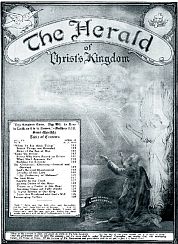
THE HERALD
of Christ's Kingdom
VOL. XI. April 1, 1928 No. 7
Table of Contents
"I
AM THE RESURRECTION AND THE LIFE"
WALKING
AS HE WALKED
"HAVE
WE FOUND TIME TO BE ALONE TODAY?"
PEACE
AND CONSOLATION
DOCTRINES
MORE OR LESS IMPORTANT
ENCOURAGING
LETTERS
VOL. XI. April 15, 1928 No. 8
Table of Contents
BEGOTTEN
UNTO A LIVELY HOPE
"THIS
IS LIFE ETERNAL"
SEEKING
HONOR BY THE PATH OF HUMILITY
SONGS
IN THE NIGHT
LETTERS
OF ENCOURAGEMENT
VOL.
XI. April 1, 1928 No. 7
"Because 1 live, ye shall
live." -- John 14:19.
OF ALL the
announcements and proclamations made amongst men there is none to really equal in
importance, that of the doctrine that there is to be a reviving or an awakening of those
that have fallen into the state of death. This teaching may very truthfully be said to
stand out preeminently above all other doctrines of the Scriptures; a doctrine that indeed
characterizes the Bible with a distinction known to no other literature or religion in the
world. Properly understood the philosophy or teaching that there is to be a resurrection
of the dead represents one of the most stupendous propositions with which the human mind
is capable of grappling.
Though the
Bible has for centuries been proclaiming a future life for our race, with the possibility
of it being eternal, by a resurrection from the dead, apparently few have derived the
comfort from it that it really affords -- indeed to effectually appreciate the doctrine of
the resurrection one must first properly grasp the truth concerning the death state --
must understand the Bible teaching that in death there is no knowledge nor device nor
understanding, and that the dead know not anything; that the soul that sinneth, it shall
die; that in death man comes to nothing and loses all, and that he would remain in this
state eternally were it not for the operation of Divine mercy.
Thus the
Bible announces that God hath looked down in compassion from the height of His sanctuary;
from heaven did the Lord behold the earth; to hear the groaning of the prisoner, to loose
those that are appointed to death. It is this news, this Good Tidings of the resurrection
hope, that constitutes the all-absorbing theme of the Bible. Jesus when amongst men
declared that He was the resurrection and the life; in other words, that God had vested in
Him the power of the resurrection, giving Him as He said in His last message to St. John,
"the keys of death and hades," which signifies the power and the authority to
open the prison-house of death and set free all the captives. Accordingly He further
announced that the hour cometh in the which all that are, in their graves shall hear the
voice of the Son of God and come forth.
Jesus and the Resurrection
St. Paul, in
his most able exposition dealing with the question of man's hope and a future life,
presents the true Bible viewpoint. Refuting the arguments of some who were denying the
resurrection hope in his time, he said, "If Christ be not risen, then is our
preaching, vain, and your faith is also vain. . . . ye are yet in your sins. Then they
also which are fallen asleep in Christ are perished." When the united testimony of
Scripture is brought to bear and given honest and careful consideration, this entire
subject becomes clear and plain: Jesus was the honored Son of God -- "The only
begotten of the Father" -- "the beginning of the creation of God." Through
Him there was given, while He was in glory with the Father, the privilege of becoming
man's Redeemer. He gladly accepted this privilege of service, "for the joy that was
set before Him"; He left the condition of glory in which He was rich, was made flesh,
very poor indeed as compared with His glorious spiritual estate, endured the cross,
despising the shame, and ultimately received the glorious exaltation to the Divine nature,
and in His resurrection became, or was made, heir of all things. In order to comply with
the Divine program it was necessary that He should lake the human nature; because it was a
man that had sinned; and as St. Paul's logic sets forth, as by man came death, so by a man
must also come the resurrection of the dead. In keeping with the Divine Law given to
Israel only the sacrifice of a perfect life could redeem the original sinner, Adam, and
his children, who shared his penalty. This then is the sum total of the necessity for our
Lord's human existence and for His death as the Apostle further explains. -- Heb. 2:14.
The Apostle
Peter speaking under inspiration on the Day of Pentecost affirms that it was not possible
that Christ should be holden of death. The reason was that He had perfectly fulfilled the
Divine requirements up to the time of His death and accordingly He had accomplished two
things: The providing of the ransom price for the redemption of the human family; and the
attestation of His own fidelity and His worthiness of high exaltation to the Divine nature
and glory. The same justice which had operated for four thousand years against man because
of transgression, was now operating on behalf of Jesus for His deliverance from death into
which He had voluntarily gone as man's redemption price. Truly the Apostle says that we
have a strong consolation who have fled unto Jesus for refuge and we realize in Him an
anchor to the soul, both sure and steadfast. The basis for our great consolation
furthermore is found in the fact that the Father's character is unchangeable; and our
Lord's resurrection becomes an evidence or as the Apostle says, an assurance, of the
carrying out of every feature of the Divine Plan, all of which centered in Him and was
made dependent upon His faithfulness unto death, even the death of the cross.
By Many Infallible Proofs
The
unfolding of the Divine purpose in connection with the death and resurrection of Christ
makes manifest indeed that He is the antitypical Seed of Abraham, approved of God, through
whom all the families of the earth, all humanity, are to be blessed. Now it becomes
manifest that the Church of this dispensation is invited to be the Bride, the Lamb's Wife,
just as Rebecca was called to be the wife of the typical Isaac, and to be His joint-heir
in the Kingdom and joint-participator with Him in the fulfilling of the promises and oaths
of God made to Abraham. When we come to the narrative of our Lord's resurrection from the
Scriptural standpoint as presented foregoing, realizing that all of our. hopes of life
eternal are dependent upon it, we come to it with much more and much deeper interest than
we could approach it from any other standpoint.
The
Evangelist declares that Christ "showed Himself alive after His passion by many
infallible proofs, being seen of them forty days, and speaking of the things pertaining to
the Kingdom of God." From this we may reasonably assume that it was not only
necessary that Christ should rise from the dead and become alive for evermore in order to
accomplish the great work planned of God and foretold by the Prophets and secured by His
own sacrifice, but it was necessary also that indubitable proof of His resurrection should
be given to His disciples for themselves and for us through them. The necessity for this
lay in the fact that in the Divine Plan this dispensation was marked out to be a faith
age-for the selection of those to walk by faith and not by sight; who should compose the
royal family, the Kingdom. But faith in order to be faith and not mere credulity must
needs have some reasonable foundation upon which to build its superstructure; and it was
to provide this foundation for faith that our Lord remained with His followers for forty
days after His resurrection before ascending to the Father.
Raised a Spiritual Body
The
disciples realized that great events were transpiring, though how great and momentous was
their character they but slightly comprehended. They realized truly .that their hopes as
respects an earthly kingdom and their Master as an earthly lord had failed. They had a
vague, indefinite hope that all that He had said to them would in some manner have a
fulfillment, but how or when or where was beyond their conception, as they knew nothing
about spiritual things, not having been begotten of the Holy Spirit to sonship and to the knowledge of things to come, for
Jesus had not yet been glorified and had not shed forth upon them the Holy Spirit. They
knew not that the new, Kingdom was to be a spiritual one and that Christ, its Head, must
pass from fleshly conditions to spiritual conditions in His resurrection even as He had
foretold, saying, "Flesh and blood cannot inherit the Kingdom of God." They had
much to learn, but they had a great Teacher and, as the sacred account tells us, His
arrangements for their instruction were specially adapted to their conditions as natural
men, to give them such foundation of knowledge and experience as would subsequently be
helpful to them when they should be endued with the power from on High.
After the
Pentecostal blessing had come, the Apostles could speak intelligently to the Church and
announce that Christ was "put to death in the flesh and made alive in the
Spirit"; the evident meaning of which statement is that Christ was raised from the
dead an entirely new creature of a new nature, not in flesh, not in human nature, but in
spirit, a spirit being. The Apostle Paul agrees with St. Peter's testimony, that Jesus was
quickened in spirit, saying that Jesus was "declared to be the Son of God with power,
according to the spirit of holiness, by the resurrection from the dead." Again, the
same Apostle, describing the First Resurrection, says: "Thus also is the resurrection
of the dead: it is sown in corruption, it is raised in incorruption; it is sown in
dishonor, it is raised in glory; it is sown in weakness, it is raised in power; it is sown
a natural [animal] body, it is raised a spiritual body." The Apostle elsewhere
declares that the Church's highest ambition is to be a partaker in this First
Resurrection, which he denominates "His resurrection," the Christ-resurrection,
the resurrection to spirit conditions, which came first to our Lord Jesus, and in which
all of His Body, His Bride, is to have a share. -- Phil. 3 :10 ; Rev. 20 :6.
God Giveth It a Body
There can be
no question that the Apostle, in this description of the First Resurrection, means us to
understand his words just as they read -- whoever interpolates and adds to the Word of
God, and declares that it was sown a natural (animal) body and raised a natural (animal)
body, and subsequently changed .to a spiritual body, wrests the Scriptures to the
darkening of his own understand on the subject. In the same connection the Apostle declares that that body which thou
sowest is not quickened, but in the resurrection God giveth it a body as it hath pleased
Him, to every seed his own body -- in the resurrection, not after it. If the Church
belongs to the spiritual seed, to which is to be given the spiritual body in the
resurrection then unquestionably the Lord Jesus, the Head of the Church, belongs to the
same spiritual seed, and accordingly God gave Him a spiritual body in His resurrection.
Likewise, in a succeeding verse, the Apostle declares that our Lord at His resurrection
became the second Adam, and then contrasting this second Adam with the first he says,
"The first man Adam was made a living soul [an animal or earthly being]; the last
Adam was made a quickening [life-giving] spirit [being]."
Clinging to Jesus
The words of
the angels to Mary would be calculated to assuage her grief, for they manifested no grief,
and by their question implied that she had no ground for it. At this juncture something
drew Mary's attention, and, turning around she discovered another person near her,
evidently in ordinary garments, whom she presumed to be a servant of Joseph of Arimathea,
the owner of the garden -- his gardener. She considered herself a trespasser to some
extent, and assuming that our Lord's body was not wanted longer in the rich man's tomb she
inquired where He had been taken, that she might take the proper steps to care for His
re-interment. Then Jesus (for it was He who had "appeared" in the form of a
gardener) spoke her name: "Mary !" At once she recognized the voice, and crying,
"Master, Teacher!" she fell at His feet, grasping them as though fearful that
somehow, if she let go, she might never get the opportunity of touching His blessed person
again. Our Lord's words to her, "Touch me not, but go, tell My brethren," would
more properly be translated, "Cling not to Me," etc. -- for I have not yet
ascended to My Father; I will be here a while yet, before I ascend, but your great
opportunity for clinging to Me and trusting in Me will be after I have presented to the
Father, and He has accepted, the great atonement for sins which I have just accomplished
at Calvary. Mary's touch could do our Lord no harm, for others touched Him subsequently,
as the record shows; but our Lord would lead Mary's mind away, from a mere clinging in the
flesh, to the higher relationship and intimacy of heart and of spirit, which would now be
possible, not only for her, but for all His followers, not only then but ever since. In a
spiritual way the Lord's people may be exhorted not only to "look unto Jesus,"
the Author and Finisher of our faith, but also to "cling to Jesus," and, by
faith to place our hands in His that He may lead us all through our pilgrim journey, in
the narrow way until He shall bring us to Himself, when we, like Him, shall be changed, in
a moment, in the twinkling of an eye, and be like Him, spirit beings, and see Him as He
is; not as He was, before His resurrection, nor as He "appeared" during the
forty day's after it. -- 1 John 3:2.
From the Cross and the Tomb to High Exaltation
The lessons
to be learned by the Lord's immediate followers would necessarily be much more difficult
to them than to those who now have been begotten of the Holy Spirit, and are thereby
enabled to appreciate spiritual things, To meet the exigency it was necessary that our
Lord, the spirit being, should be present with them for forty days, invisible, as spirit
beings are always invisible to men, unless through the operation of a miracle. it was
necessary for them to know of His resurrection in order that they should have faith in His
Message, and act accordingly, as He desired; yet, had He appeared to them in the glory of
His spirit being, opening their eyes to see the supernatural splendor as He showed Himself
in vision to St. John on the isle of Patmos, His face as lightning, His arms and His feet
shining like molten brass in the furnace -- the effect would have been to terrorize them,
and their natural minds would have been unable to link such manifestations with their
Lord, recently crucified; neither would He have had opportunity, under such conditions, to
have given them instructions, for they could not have received them by reason of terror.
It was
necessary, therefore, that our Lord, a spirit being, should manifest Himself, as He had in
the long past manifested Himself to Abraham and Sarah, and as angels, under Divine
commission, had done on sundry occasions -- as a man. (Gen. 18:1.) He must lead their
minds step by step, and their thoughts link by link, from the cross and the tomb to an
appreciation of His present exaltation as a spirit being, respecting which He Himself
explained to them, contrasting ít with His previous condition, "All power in heaven
and in earth is given unto Me." And this leading of their minds must be such as would
gradually force upon them the conviction that He was "changed," that He was no
longer a man, and no longer subject to human conditions, as before His death. Having this
thought in mind, we will have no difficulty whatever
in seeing how our Lord inculcated -- these instructions during the forty days in His
various interviews with His followers.
Christ the Firstfruits
The words of
inspiration assure us that Christ is the "firstfruits of them that slept," which
signifies that none preceded Him in the resurrection power and blessing. He was the first
to experience the complete lifting out of the death condition. It was eminently logical
and proper that He should be the first to experience the completeness of the resurrection
in view of the fact that all others were condemned and must wait to receive their
resurrection through Him. Further, ever since His ascension our Lord has been seated on
the right hand of the Majesty on High, which signifies that He there entered into a glory
of office -- that of being seated with the Father in His Throne according to the Divine
promise.
Those who
shall be accounted worthy to be of the faithful Church of Christ, His Body, are to share
with Him in His resurrection; in other words, they will be of the "firstfruits"
together with Christ. This "First Resurrection," in which the Church shares, is
to be a complete and instantaneous lifting out of the state of death into the perfection
and completeness of glory, honor, and immortality which God has provided for them who
follow in the footsteps of Jesus, His joint-heirs. These are all called the
"firstfruits unto God of His creatures." In what high and exalted terms are
these referred to in the closing messages of the Revelation
"Blessed
and holy is he that hath part in the First Resurrection." They are those who will
have followed the Lamb whithersoever He goeth, the called, chosen, and faithful" unto
death.
The Blessed and the Holy of the First Resurrection
Another,
commenting upon the high character and glorious future of these who share in the First
Resurrection, very beautifully observes that:
"They
were holy in their lives and aims while they lived in the flesh. They had the testimony of
Jesus and the Word of God, and confessed it over against a gainsaying world, and held it
fast against persecution and death, and willingly suffered the loss of all things,
counting them but refuse and offal, rather than let go their confession and hope in Christ
Jesus. They were the salt of the earth and the light of the world, the golden candlesticks
of eternal truth in the realm of abounding sin and darkness, yet never content with that
to which they had attained, but ever reaching forth unto still higher and better things,
and, like the Olympian racers, pressed toward the mark for the prize of the high calling
of God. Reviled, persecuted, evil spoken of, and accounted the very off-scourings of the
world, because of their faith, devotion, and self-sacrifice, for their Savior and His
cause, they resented not, but counted it all joy, and were exceeding glad, sure that it
was working for them afar more exceeding and an eternal weight of glory. . . . Released
forever from the death-working law in their fleshly members, their whole being has come
under the power of a complete and untemptable sanctification, which sets them apart and
consecrates them to a sublime and unapproachable holiness, to which dwellers in the flesh
must stand in greater awe than ever was called for in the sublimest of earthly kings or
the most sacred of Jewish high-priests; -- a holiness which inspires while it awes, which
attracts while it reproves and condemns, and which lifts and assures those whom it strikes
with humiliation and dread. . . . There is a great and awful majesty of consecration in a
true child of God even while living and walking here in the flesh. To the outward eye and
carnal view there is but little that is special. The thoughtful brow, the sober mien, the
dignified. behavior, the reserved and careful utterance, the keeping aloof from the
world's wild pleasures and gayeties, and the solemn regard for holy names and holy things,
along with a calm and firm confession of the truth as it is in Jesus, is. about all that
can be externally noticed. But his name is in
the books of heaven. He is there enrolled as a celestial citizen and prince. The angels
are ministers and servants to him. He is allied by regeneration to the blood royal of
eternity. He is marked with the name and sacrament of the King eternal, immortal, and
invisible. He has upon Him an unction from the Holy One, consecrating him for
transfiguration to supernal principality. He is brother and joint-heir with Him who sits
enthroned at the right hand of eternal Majesty, and who is presently to be revealed as the
King of kings and Lord of lords."
Countless Throngs Shall Rise Again
The after
fruits or later fruits in God's great program will be developed. during the Millennial
reign of Christ and His glorified Church. Humanity in general are said to share in this
resurrection which represents the second great division of the Plan of Salvation. These,
all of Adam's family who have shared in the sentence of the curse, are to come forth, to
be awakened, as a result of the resurrection power vested in the Lord Jesus Christ. They
are to come .forth in order to have their trial, in order to be instructed, in order to
have offered to them the blessings of atonement, and if they will accept the same upon
God's terms they, shall be fully delivered and experience the resurrection in the full,
complete sense of raising, to stand upright in glorious perfection and live forever. From
all parts of the earth, from every land and clime, and from out the seas, the dead shall
come forth, as the poet has truthfully said:
"From the deepest caves of
ocean,
From the desert and the plain.
From the valley and the mountain,
Countless throngs shall rise again."
It is in
connection with this grand family reunion that is to take place in the coming
dispensation, as a result of the operation of resurrection power, that we are given the
assurance that all mourning and sorrow and tears shall forever cease and pass away. The
dreaded monsters, sin and death, are responsible for all the havoc that has been wrought,
responsible for all the sights of wretchedness, sorrow and the voice of weeping that has
so long been heard. But in that coming blessed, time we are given assurance that there
will be complete victory over the grave through the resurrection power, and that He will
wipe away tears from off all faces.
When Death is Swallowed up in Victory
"Every
tear is wiped away. He who dries them off is God Himself. Human hands are poor at drying
tears. If they succeed in removing one set, others come which they cannot wipe away.
Earthly power, however good and kind, cannot go far in the binding up of broken hearts.
Only the hand that made the spirit can reach the deep sources of its sorrows, or dry up
the streams that issue from them. The springs of grief yield to no other potency. But then
His loving Almightiness shall wipe every tear. 'As one whom his mother comforteth so will
I comfort you, and ye shall be comforted,' saith the Lord.. 'Every tear,' for they be many
tears of misfortune and poverty such as Job and Lazarus wept; tears of bereaved affection,
such as Mary, and Martha, and the widow of Nain; shed tears of sympathy and mercy, such as
Jeremiah and Jesus wept over the sins and calamities of Jerusalem; tears of persecuted
innocence, tears of contrition and penitence for faults. and crimes against the goodness
and majesty of heaven; tears of disappointment and neglect; tears of yearning for what
cannot now be ours; these, and whatever others ever course the cheeks of mortals, shall
then be dried forever. . . . The time will be when death itself shall die; not by the
power .of man, not by mortal skill or earthly medicines, but by the great redemption of
God. When the sunlight of the new Genesis dawns upon this stricken world, the grand
thanksgiving shall ring out over every zone, from the equator to the poles, that 'Death is
swallowed up in victory.' Never another dying-bed shall then be seen again. Never another
grave shall then be dug. For 'death shall no longer be.'"
Such will be
the glorious consequences of that blessed dominion of Him who said, "I am the
resurrection and the life," for it is none other than He that will bring to pass the
saying that was long ago written, "O death where is thy sting? O grave where is thy
victory?" Those who now are given to know the meaning of the power of the
resurrection and the life vested in Jesus, may well join in the celebration of His
resurrection, His coming forth from the tomb inasmuch as it is the harbinger of hope for
the entire groaning creation.
"All hail the power of Jesus'
name!
Let angels prostrate fall;
Bring forth the royal diadem,
And crown Him Lord of all."
"As ye have therefore received
Christ Jesus the Lord,
so walk ye in Him." -- Col. 2:6.
AS IN
preceding studies we have walked in fellowship with Jesus, first to Jordan, then to the
wilderness, and noted that these walks were not merely the actions of a day, but were
walks illustrative of His daily life from Jordan to the cross, we now proceed to examine a
third walk -- a walk that has much to teach us respecting the whole will of God.
After having
heard from His own lips the condition and cost of true discipleship, the Apostles assured
Jesus that they had met such requirements by forsaking all to follow Him; and while this
meant much, yet even this was not enough. Such action on their part would mean nothing to
Jesus without the evidence that first of ail they were prepared to give themselves in full
devotion to Him. Bestowing all their goods in consecration was commendable, desiring to be
fully informed respecting their duties and responsibilities an excellent thing, but
underneath it all there must be that reciprocative affection of heart, before the deep
fellowship desired by Jesus could be established.
Not Yours, but You
How
impossible for any true disciple of Jesus to associate with Him daily and not catch a
vision of the intensity of His love for His own ! He had received these disciples as a
gift from the Father, and as Isaac, beholding the bride of his father's choice for him,
loved Rebecca, so Jesus received His brethren into His deepest affection. And "having
loved His own, He loved them to the end." As St. Paul in after days writes to his
beloved converts (2 Cor. 12:14, 15), in yearning appeal: "For I seek not yours, but
you: . . . and I will very gladly spend and be spent for you; . . . though the more
abundantly I love you, the less I be loved," so Jesus has ever said to His brethren,
"Henceforth I call you not servants, . . . but I have called you friends."
"As the Father hath loved Me, so have I loved you." "If a man love Me, he
will keep My words: and My Father will love him, and We will come unto him, and make Our
abode with him." (John 15:15, 9; 14:23.) His great desire has been to manifest
Himself to the objects of His love, to have them much in His presence, so that they might
comprehend more of "the length, and breadth, and depth, and height, of the love of
Christ," to have them attain that higher conception of His infinite grace and
matchless character, so as to bear testimony by their lives, as well as by their
teachings,. that they have been with Jesus and learned of Him.
"Come Ye Yourselves Apart and Rest Awhile"
Responding
to this invitation, the disciples are led away from the fickle multitude, away from the
more public ministry of preaching the Kingdom, the healing of the sick and distressed --
away for a season of unbroken fellowship with Jesus alone, for a little convention; with
the great Teacher in their midst expounding those wonderful truths of the Kingdom, not
intended for the ears of the unappreciative masses. Question meetings they surely were,
where parables and dark sayings were explained, and thereby the mysteries of the Kingdom
clarified. Yes, and into the good soil of their receptive minds, seeds of truth were being
sown that would later spring into life and vigor, when the promised Comforter should come,
and grace had well refined their hearts.
How
frequently such intervals of retirement occurred, we cannot be sure. A careful review of
the four Gospels seems to support the conclusion that on many such occasions they found
themselves alone with the Master. In fact the evidence is clear that by far the larger
proportion of the time was spent apart from the multitude. And to Jesus Himself this was
the most important part of His ministry. These seasons of rest were not days of idleness
we may be sure, but days when by precept and example Jesus was teaching His disciples the
deeper meaning of their .present and future relationship to Him. They were experiencing
that personal touch so essential, then and now, to that true Christian experience that
enthrones Jesus in the deepest, tenderest affections of the life, and without which there
cannot be that consuming devotion that destroys all self-life and crowns Him "Lord of
all."
Essentials of "a Holy Ministry
Before
pursuing this thought further, let us pause to reflect on a few related features of this
private life of Jesus amongst His disciples; for such reflection will assist us to value
these lessons all the more. We remember that Jesus had but three and a half years to
fulfil all the types and prophecies relating to His First Advent. To us this seems a very
brief period to accomplish so much -- so brief that were we not furnished with the detail
of His ministry, we would quite naturally conclude that it would be so filled with
activity, harvesting the wheat, reproving the unfaithful leaders and teachers, and by
miracles and preaching proclaiming the Kingdom, that little time would be found for
seasons of solitude and fellowship such as we have been considering.
If deprived
of the Gospels' detail of information, we would perhaps have experienced a little surprise
had we made the discovery through other sources that impulsive Peter had called in
question the wisdom of taking so much time away from active service by saying, "Why,
Lord, just the other day you asked us to view the fields that were already ripe and ready
to harvest, and you then urged us to pray the Lord of the harvest to send forth more
laborers to assist in the work. Surely under such circumstances, activity, rather than
rest, isolation, and meditation would be more consistent with such a need."
Assuming
that any of the Apostles might have reasoned thus, we are not in a position to feel
ourselves better than they. Rather, the testimony against us is so indisputable, that we
must admit that our indiscretion has more often .put the stress on our unprofitable
service rather than on the cultivation of that living faith and daily imitation of Christ.
By our actions we have proved the need of the lesson Jesus would here teach us. These dear
disciples must learn that it was the very urgency and importance of the ministry that made
it imperative that they should be much alone with Jesus.
To go out
into the work without a proper conception of its meaning, as it was reflected in that
Manifestation, "which was from the beginning, which we have heard, which we have seen
with our eyes, and our hands have handled, of the Word of Life," would have been a
great mistake. Ah yes! How often in after days fire would have been called down from
heaven upon unresponsive hearers, had they not caught His spirit! How full of spiritual
pride and arrogance their conduct would have been toward all others who might engage in a
good work aside from their particular arrangement, if they had not been prepared by
receiving the benevolent mind of Jesus! How their successes would have endangered their
own highest interests, had they not learned from His lips the suddenness of Lucifer's
ejection from heaven centuries before, when pride brought forth the baneful fruitage! How
contentious and jealous they would have been in their ambition for chief places in the
Kingdom had they not been humbled by the condescension of the great Master, who in silent
rebuke stooped to wash their feet! How could they "have compassion on the ignorant,
and on them that are out of the way" (Heb. 5:2) without real, personal contact with
Jesus, the Friend of publicans and sinners?
How
forcefully Jesus was telling them "without Me ye can do nothing." If you go
forth without My Spirit, without having learned of Me -- the meek and lowly, the fountain
of wisdom, truth, and grace -- you will be wholly unfitted for My service -- often
hindering instead of helping the mission to which I appoint you. Therefore while your
interest in the whitened fields is proper, remember that before I can trust you with such
responsibilities, you must first seek that preparation of heart that will make you
receptive vessels of the Holy Spirit and through its illumination be fitted for acceptable
service.
Failures That Attend Neglect of Prayer and of Waiting
upon God
Having
observed these incidents and their lessons to the immediate disciples of Jesus, we are now
prepared to, apply them to ourselves, recognizing that the same lessons are as vital today
as then. Just so surely as failure would have followed their untutored efforts had they
not sat at His feet, just so surely failure must inevitably follow any other course today.
We, today, have "this same Jesus"; we, too, are prospective members of. the same
Body, sent forth to bear witness to the same good news; and we too, are subject to the
same human predilections that need to be controlled by "looking unto Jesus, the
Author and Finisher of our faith." -- Heb. 12 :2.
The lesson
for us in this day of feverish excitement and unheeding haste, is this same lesson, namely
that communion with the Father and the Son must always occupy a larger place in our hearts
than service for them. Real power and effective service cannot precede, but will surely follow the outpouring and infilling of the
Holy Spirit, and for this we are urged to tarry in prayer and waiting upon God, until we
receive the needed wisdom and grace. Otherwise, there will surely be a beating of the air,
a building of wood, hay, and stubble, to be destroyed, though a possible saving of the
spirit, "so as by fire."
"Take time to be holy! The world
rushes on;
Spend much time in secret with Jesus alone;
By looking to Jesus, like Him thou shalt be;
Thy friends in thy conduct His likeness shall see."
The writer
of this beautiful hymn, Ira D. Sankey, of "Moody and Sankey" fame, has given us
the correct thought. Holiness is the great essential, and its attainment is made possible
by "beholding as in a glass the glory of the Lord," which will result in a life
bearing testimony of intimate contact with Jesus. In this connection we quote the words of
one who seemed to know by a rich experience the power of the hidden life.
"Every
true servant is sent forth from the immediate presence of God, with all its holiness and
all its grace; and he is called to be holy and gracious-he is called to be the reflection
of the grace and holiness of the Divine character; and in order that he may be so, he
should not only start from the immediate presence of God, at the first, but abide there,
in spirit, habitually. This is the true secret of effectual service . . . . There is the
greatest possible danger of getting out of the solemnity and calmness of the Divine
presence, amid the bustle of intercourse with men, and the excitement of active service.
This is to be carefully guarded against . . . . If I allow my work to get between my heart
and the Master, it will be little worth. We can only effectually serve Christ as we are
enjoying Him. It is while the heart dwells upon His powerful attractions that the hands
perform the most acceptable service to His name; nor is there any one who can minister
Christ with unction, freshness, and power to others, if he be not feeding upon Christ, in
the secret of His own soul.
"True,
he may preach a sermon; deliver a lecture, utter prayers, write a book, and go through the
entire routine of outward service, and yet not minister Christ. The man who will present
Christ to others must be occupied with Christ himself."
His Striking Example of Spiritual Maturity
The above
words are both timely and Scriptural, and they remind us of the admonition of the faithful
Apostle who could say to his brethren, "Be ye followers of me, even as I also am of
Christ." "For I determined not to know anything among you save Jesus Christ and
Him crucified." "Who of God is made unto us wisdom." (1 Cor. 11:1 ; 2:2;
1:30.) This singleness of purpose, this concentration of thought, this faithful imitation,
manifestly constitute the essence of the wisdom the Apostle would impart, since we have in
his life the most striking example of spiritual maturity and effectual service. Without
such ideals we may expect to be powerless, fruitless, and lacking in real spiritual
vitality; but let these same determinations be ours, and we will know by a rich Christian
experience the sweetness of His abiding presence. Then we will exhibit to those about us a
reflection of that glory "that shines in the face of Jesus Christ."
In this
walk, therefore, we are to see in Jesus a properly balanced life. In Him we will find no
extremes to mar the even tenor of His exemplary walk, but a beautiful equilibrium, such as
we would expect to find in one so well acquainted with God, the Father, with whom there is
no variableness, or shadow of turning, who inhabits eternity in all its immensity; to whom
a thousand years are but as a watch in the night, who took millenniums to prepare the
earth for man, and whose "little while" often spans centuries.. As one who knew
God intimately, Jesus has not left behind an example of feverish haste, or of one-sided
service that would represent God as being crowded for time in which to gather, complete,
and exalt His Church within the time and limitations of the Gospel Age. Rather, as God's
thoughts are higher than our thoughts, so Jesus, the Revealer of the Father's wisdom,
teaches us that "eternal ages are His own," and that we need to cultivate much
of the spirit of patient waiting upon God; to curb our natural inclinations to anticipate
prophetic fulfillment, either in its destructive or constructive forecasts, and to tread
with careful, reverent step the path of devotion and ministry, to the end that our
personal fellowship with Him may be given its place of preeminence, and our service for
Him kept in line, with His definite program. As an aid in this direction we will find it
helpful to go back again and again to the Gospels, and live with Him there, assimilating
His wisdom, and reading His life of oneness with the Father.
Choosing the Better Part -- Communion with Christ
Let us now
examine an incident in our Lord life that may assist us to understand the order and
relative, importance of all three features of our
discipleship -- our devotional life, our ministry of service, and our Kingdom hopes. The
destination chosen by Jesus in some of these private walks would surely be Bethany. Here
in the home of Martha and Mary, and their brother Lazarus, Jesus seems to have found a
retreat. Apparently He quite frequently visited this home, the atmosphere of which He
greatly appreciated, for John (11:5) records the fact that "Jesus loved Martha, and
her sister, and Lazarus." We may safely view this incident which we are about to
examine, not as a type for which we must find some antitypical fulfillment now, but merely
as a part of the Gospel record, intended to reveal the deeper secrets of true devotion and
faithfulness. At Bethany then we have Jesus, and with Him the disciples, and Martha and
Mary. There can be no question about Jesus occupying a place in the minds of all, but all
do not hold Him in the same position in their thoughts, nor exhibit the same devotion to
Him. One only seems to have caught the import of the occasion. Martha is cumbered with
much service, and the disciples are evidently in the immediate vicinity, but only Mary is
found at the Master's feet.
It may be
that Martha has been unfairly treated in the general thought held respecting her conduct
at this time. It is quite generally assumed that her being cumbered with. service
indicated that she was so preoccupied as to have little thought for Jesus, little time to
spend in His presence, and on this account she has been used to represent those today who
are so engrossed in household duties or other things, that they have no time to love and
serve the Master. But since it is stated that Jesus loved Martha, we are satisfied that
Martha reciprocated that love to a, certain degree, and desired to express it in her own
way. Her mistake, evidently, was not due to an absence of real interest in the visit of
Jesus, but rather in her own choice of how she would demonstrate it. There was no
consulting the mind of Jesus; rather, as we shall see, there was a disposition to feel
perfectly satisfied that her own chosen service must surely have His approval. There was
no careful inquiry as to what would please Him most, but a hasty conclusion that she
understood Him well enough to allow her own preferences to dictate her course of action.
Surely if she spent her time thinking of Him, providing for His temporal comforts, etc.,
occupied with earthly service relating to Him, it would all be alike to Jesus, and He
would surely commend her activity and interest. Would it not be possible that her mind was
so full of what she would do for Him that she never sensed her own great need of what
Jesus must do for her. She failed to realize the value of those golden hours, laden with
precious benefits for her, if she would but pause and consult the wish of Jesus.
Quite
naturally she developed the fault-finding disposition, the tell-tale symptom of neglected
communion and self-opinionated certainty. And we find her boldly expressing her criticism
of Mary's inactivity even in the presence of Jesus-rushing in where angels would :fear to
tread. But she receives the significant reply, "Martha, Martha, you are anxious and
worried about a multitude of things and yet only one thing is necessary. Mary has chosen
the good portion and she shall not be deprived of it." -- Luke 10:41, Weymouth.
Many Have not Heeded the Lesson
Again we
say, it is not necessary that this incident be considered a typical picture and an
antitype looked for here. But does it not well represent the failure of the many
throughout the Age. Has not the thought of service eclipsed the more important matters
throughout the history of the Church. In the. parable of the wheat and tares, the servants
are represented in the proper attitude, inquiring the Master's pleasure in respect to
going out to gather the tares found amongst the wheat. But alas! how very few have
followed the lesson here presented. More often they have gone forth unbidden and
unauthorized. Time and again the Lord has had occasion to rebuke their meddling
impetuosity by showing them that He had not authorized the work or sent the message. How
sad the picture then when it is observed that even today the warning goes unheeded. How
many today seem disposed to believe that service is the "better part," and
undertake a multitude of things that the plain statements of Jesus and the "more sure
word of prophecy" forbid. By this it is not intended to disregard the need of service
as a part of Christian-duty, and an integral part of the Church's! mission, but the
thought is to emphasize the vital importance of putting first things first. Some one has
well said:,
"She
who has chosen Martha's part
The planning head, the steady heart,
So full of household work and care
Intent an serving everywhere,
May also Mary's secret know,
Nor yet her household cares forego
May sit and learn at Jesus' feet
Nor leave her service incomplete."
Now let us
observe the reactions of the disciples toward this privilege. Where are they to be found?
Surely they would be near Him but -- evidently not so near as they might have been.
Perhaps they may be found in the garden nearby, and we can imagine having discovered them
engrossed in a very animated discussion about this time. Having their virtues and
weaknesses so faithfully recorded in the Gospel narratives, we do them no injustice if we
conclude that the discussion we overhear relates to their expectations regarding positions
in the Kingdom. Perhaps Peter recounts some incidents that have crystallized his
conviction. Others contribute additional proof of the Messiahship of their Master. John perhaps propounds the question,
"I wonder, brethren, when He will take up His governmental control"; and
immediately the question of who shall be greatest becomes the issue that beclouds
everything worth while. Jesus becomes merely a means to an end again. With Martha He was
only an abject of service; now, with the disciples, a medium through which a coveted
reward might be obtained. Here we have the two extremes: first, service magnified .out of
its true proportions; and then, Kingdom hopes supplanting Jesus in the dearest ambition of
the heart.
The "Better Part" Shall not be Taken Away
We return to
Mary where we find her the recipient of that beautiful commendation: "Mary hath
chosen the better part." Ah yes! and in choosing that part she chose all three
combined: Devotion, service, and Kingdom rewards. That she had the spirit of service we
know. She has borne eloquent, testimony to this. An Israelite indeed, she was surely and
consequently, deeply interested in the Kingdom. All this she expressed by her attitude
wherein she was saying, "All I want I find in Thee."
Oh the
inestimable value of that quick perception that instinctively realizes its own littleness,
unworthiness, and unprofitableness, in the presence of the blessed Master! That spiritual
sense that reveals to our own eyes our absolute poverty, and that feels that irresistible
attraction that draws us to His feet to receive of His fullness. It is one of those
heaven-born intuitions that only the spiritual may understand; and happy is the one who
thus perceives the eternal verities beneath the outward forms.
Mary had
read the Savior's mind and intuitively responded to His will, realizing at once that her
greatest need was to sit at His feet. She needed those wonderful words of life that He so
delighted to speak to receptive hearts. She knew they were "spirit and life" to
her. Ah yes, she had caught His view of any service she might render Him, that at best it
was but a means to an end, an outlet for the overflowing gratitude which fills the
rejoicing heart that has received such unmerited favor -- a part of the conditions of
,future rewards, but wholly unprofitable of itself, and only acceptable because made so by
an act of .His grace when rendered in the spirit of full obedience to His will. But
service must never monopolize the precious hours that Are needed to spend at His feet. His
desire ;for these quiet meditative seasons must always meet a responsive desire in her own
heart. And for her encouragement and ours the word goes forth, This "better
part" shall not be taken away. Martha's self-appointed service cost her the richest
blessings possible, and she fades from view. The disciples refused to believe the warning
that they would forsake the Master, yet they fled in the hour of trial. Yes, for three
whole days their faith faltered, their vision was obscured, and they merited the rebuke,
"O fools and slow of heart to believe all that the prophets have written."
Disputing over Kingdom positions had not been conducive to courage and faith; making Jesus
merely a means to an end had not established in their hearts that love that will not let
go; misused privileges will bring :back their aftermath of disappointment and regret; and
failing to believe all that the prophets have written respecting the definiteness and
fixity of God's program will lead us into many sad failures and humiliating defeats.
"They that wait on the Lord shall renew their strength," while they who
impatiently seek to hasten His purposes must suffer a corresponding loss.
Cultivate the Habit of Feeling Him Near
Brethren,
have we found our proper classification in this incident? Are we cumbered with service and
deprived thereby of fellowship with the Master? Are we so engrossed in Kingdom
prerogatives that we are preparing the way for some severe experience? Or are we keeping
ever in mind the one great need of complete separation unto the Lord; of being guided by
His example? Such classification is inevitable in any company of people. No all-wheat
class can be found on earth, and God's professing people have ever been a mixed multitude.
In the words of another:
"In
every great religious movement there always have been, and always will be a number of
individuals who cast in their lot with it, without knowing the power which inspires it.
Beware of them! They cannot stand the stress of the life of separation to God.. The mere
excitement will soon die away with them; and having no principle to take its place, they
will become hindrances and disturbers of the peace. As certainly as they are harbored in
the camp, or their principles are allowed within the heart, they lower the spiritual tone;
allure to worldly policy; suggest methods which would not otherwise occur to us; and draw
us towards the Egypt-world. Nothing but supreme principle can carry any one through the
real, separated, and surrendered life of the child of God. If you are prompted by anything
less, such as excitement, enthusiasm, fashion, contagious example-you will first be a
hindrance, and end by being a failure. Examine yourselves, whether ye be in the faith.
Prove your own selves: And if you axe consciously acting from a low and selfish motive,
ask God to breathe into you His own pure love . . . . We must cultivate the habit of
feeling Him near, as the Friend from whom we would never be separated, in work, in prayer,
in recreation, in repose. We must guard against the restlessness and impetuosity, the
excessive eagerness and impatience, which drown the accents of His still, small voice. We
must abjure all expedients He does not inspire, all actions. He does not promote -- we
must constantly have the watches which we carry next our heart synchronized by His eternal
movements. Would you walk before God? Then let there be nothing in heart or life which you
would not open to the inspection of His holy and pitiful eye."
Let us,
beloved, think deeply of these lessons learned in our walk with Him. Let us above all else
be very diligent in the cultivation of that deep spiritual life that is hid with Christ in
God, and then we will know that peace and joy in the Holy Spirit vouchsafed to those who
abide in Him, walking even as He walked.
_________
"Have you and I
Stood silent, as with Christ, apart from joy or fear
Of life, to see by faith His face;
To look, if but a moment, at its grace,
And grow, by brief companionship, more true,
More nerved to lead, to dare, to do
For Him at any cost? Have we today,
Found time, in thought, our hand to lay
In His and thus compare
His will with ours, and wear
The impress of His wish? Be sure
Such contact will endure
Throughout the day; will help us walk erect
Through storm and flood; detect
Within the hidden life sin's dross, its stain;
Revive a thought of love for Him again;
Steady the steps which waver; help us see
The footpath meant for you and me."
"Thou wilt keep him in perfect
peace, whose mind is staged on Thee: because he trusteth in Thee." "Now our Lord
Jesus Christ Himself, and God, even our Father, which hath loved us, and hath given us
ever lasting consolation -and good hope through grace, comfort your hearts, and stablish
you in every good word and work." -- Isa. 26:3; 2 Thess. 2:16, 17.
THE
Scriptures declare that God created our race for His own pleasure and in His own image, so
that man's true pleasure, happiness, and peace should be found only in harmony,
fellowship, and sympathy with his Maker, that accordingly the fellowship of the Creator
and the creature might be responsive. Though all men have lost much of the original
likeness of God, this does not alter the fact that they still crave the happiness and
peace which can never be found except under the natural, original relation to their
Creator. No matter how much a man may become depraved, how deep he may sink into sin, or
how far he may stray from the path of righteousness, he still is conscious of the fact
that he is a man, a member of the highest, noblest of God's creatures upon the earth, and
he knows and feels his degradation. Instinctively he knows that he was made for higher and
nobler ends than those toward which he seems ever tending, although he lacks the
inclination and desire to strive toward those nobler ends, and he realizes that he has not
the fortitude to resist the inherited and long cultivated bias of his fallen nature.
True Peace Only in God's Fellowship
In this
painful realization of the absence of true happiness and peace, men have sought for
gratification and rest of heart in ways in harmony with the more or less depraved
tendencies of substitutes which pride, the fallen nature -- in the poor ambition, strife,
rivalry, wealth, fame, power, etc., have to offer; but the happiness they find in these is
only delusive and at most very short-lived. The bubble of success may burst in an instant
and the peace and happiness built upon it be utterly wrecked.
It is not
difficult therefore to understand that peace, rest of mind, tranquillity of soul, indeed
the happiness that all men really crave cannot be realized except in the re-established
relationship between God and man. It was evidently the Divine intention that in the right
and normal relationship between Himself and His creatures, love should respond to love,
admiration to admiration, virtue to virtue, and grace to grace, even as face answers to
face in a glass. In this natural attitude of the Creator and the creature, generous
benevolence and filial gratitude combine in mutual happiness. God is happy in the exercise
of all the noble traits of His glorious character; and this happiness is enhanced by
appreciation of the same on the part of His creatures, and by a manifestation in them of
the same qualities and disposition of mind and heart. And likewise man must both realize
and exercise the noble endowments of his nature, and form a character modeled after that
of his Heavenly Father, if he would find that true happiness which consists in the
approval of his own conscience and of his Creator and Judge, in whose favor is life and at
whose right hand there are pleasures for evermore.
As Many as Walk by This Rule
God's
message to men is that He purposes tore-establish the relationship of Father and son
between Him self and His human creatures. His word tells us that He proposes to do this
through Christ, and emphatically declares that there is no peace to any man outside of
Christ. Such as respond to His grace and take the steps of repentance and self-surrender
are said to pass from death unto life; they pass from the condemned state, the state of
alienation, to that of peace with God and they therefore are in the way to find and
experience the peace of God which the world. can neither give nor take away. As many as
follow on in the path of obedience, as many as heed the voice and leading of the Spirit of
God, thereby give evidence that they are the sons of God. -- Rom. 8 :14.
The Apostle
Paul issues an important statement concerning these: He says, as many as walk by this
rule, peace be on them and mercy. Evidently the rule referred to is that of the new
creation, mentioned in the preceding verse -- "For in Christ Jesus neither
circumcision availeth anything, nor uncircumcision, but a new creature." Forms and
ceremonies are not the rule, but the new life itself, the new creature filled with the
Holy Spirit of God and led of the same. These are exhorted to "Walk in the
Spirit," and that if they do so, they "shall not fulfil the lusts of the
flesh," which are contrary to the mind and disposition of the Holy Spirit.
As many
therefore as walk by this rule, who live consistent with their profession as sons of God;
are guaranteed peace and mercy -- mercy because of their earnest and sincere endeavors to
walk after the leading of the Holy Spirit; for the Lord who looks upon and judges the
heart's desires and efforts is merciful and will not exact from any, more than they are
able. to .perform. Therefore notwithstanding their lameness and halting steps in following
the leading of the Spirit, He extends compassion and, gives His blessed peace to all them
that walk by "this. rule," the rule of the Holy Spirit, the rule of the new
creature.
A Discerner of the Thoughts
We are
further instructed that those who are in Christ as new creatures have put off or put away
the old man, that is, the carnal nature, so far as their heart desires and motives are
concerned; they have no, sympathy with that which is enmity against God and is not subject
to His Law; they have no affiliation in spirit with any kind of evil works or deeds which
the Apostle enumerates: "Now the works of the flesh [the fallen nature] are manifest,
which are these; adultery, fornication, uncleanness idolatry; witchcraft, hatred,
variance, emulation, wrath, strife, seditions, heresies, envyings, murders, drunkenness,
revelings, and such like: of the which I tell you before, as I have also told you in time
past, that they which do such things shall not inherit the Kingdom of God:'
One might be
inclined to wonder that the Apostle in addressing the saints should make mention of these
grosser forms of sin which could be predicted of only those who have fallen from grace;
yet, on the other hand, when we reflect that
the Spirit of the Lord is a discerner of the thoughts and intentions of the mind or heart,
we quickly recognize that any desire or sympathy on the part of the Lord's people with any
of those evils named would signify proportionately their condemnation even though they
might not engage in the outward act itself. How heart searching indeed is the Word and
Spirit of the Lord as it comes to these who have become His children by adoption! No
wonder the Apostle enjoins that having these promises, dearly beloved, let us cleanse
ourselves from all filthiness of the flesh and spirit, perfecting holiness in the
reverence of the Lord. Truly the peace of God resulting from the consciousness of His
smile and favor, represents the richest and most desirable of blessings. Yet how obvious
it is that this happy state depends upon the careful observance of the Lord's will and of
living in that atmosphere of nearness to Him and apart from everything of a defiling
character.
The Balm for Wounded Spirits
Consolation
and comfort are also a part of the heritage of such as are re-established in right
relationship with trod at the present time. The Lord addressing those who have been made
partakers of His grace admonishes, "Trust in the Lord, and do good; so shalt thou
dwell in the land, and verily thou shalt be fed. Delight thyself also in the Lord; and He
shall give thee the desires of thine heart. Commit thy way unto the Lord; trust also in
Him, and He shall bring it to pass. And He shall bring forth thy righteousness as the
light, and thy Judgment as the noonday. Rest in the Lord, and wait patiently for
Him." -- Psa. 37:3-7.
As with the
state of peace and rest, so with the quality of consolation or comfort: all creatures upon
the earth are constantly reminded of their need of consoling influences, of comfort and
solace; and as it is with the peace of God, so with these, they cannot be had except in
the divinely appointed way.
While the
Word of God abounds in precepts and admonitions, in warnings and instructions, and while
it lifts high the standard of moral excellence-so high that in our weak and fallen
condition we cannot attain unto it, and in our efforts to do so in the midst of a crooked
and perverse generation we must of necessity encounter the wrath of all the powers of
darkness strongly entrenched in the hearts of fallen fellow men, this same blessed Word
comes to the faithful children of God in the very midst of this battle of life with sweet
and refreshing consolation.
Consolation!
What is it? Oh, you who have never enlisted under the banner of the cross, you who have
never made an honest endeavor to withstand the powers of darkness, to fight the good fight
of faith, to stern the current of your own fallen tendencies, or to contend earnestly for
truth and righteousness in the midst of a crooked and perverse generation, what can you
know of the sweets of Divine consolation? It is the balm for wounded spirits on the battle
fields of time; the cooling draught for fainting souls hard pressed by the relentless foe;
the soothing caress of a loving hand upon the fevered brow of a noble contender for truth
and righteousness; the gentle whisper of hope and courage when the heart begins to fail --
Divine consolation, the only consolation that has any virtue of healing and refreshing in
it. But it is reserved only for those noble souls who are faithfully bearing the burden
and heat of the day; while those who listlessly drift with the current of the world's
favor, and of the downward tendencies of the carnal nature, can never have an intimation
of its sweetness.
Delight Thyself in the Lord
It is to the
faithful soldiers of the Lord that the above words of the Psalmist are addressed -- to the
persecuted, tempted and tried. Hear them, tempest- tossed and fainting souls: they were
long ago penned by the Lord's Prophet for your edification -- "Fret not
thyself," but "trust in the Lord and do good, so shaft thou dwell in the land,
and verily thou shaft be fed." How strong is the Lord, how wise and good! His
promises have never failed to those that put their trust in Him. We may feel that our,
efforts to be good and to do good are very unproductive, and that the opposition from
within and without is very strong; but it is when we are weak -- when we thus realize our
own incompetency -- that we may be "strong in the Lord and in the power of His
might." Let us endeavor to make straight paths for our feet, lest that which is lame
be turned out of the way, and then lay hold of the Lord's strength to help us pursue our
course in the narrow way of difficulty and trial. The fact that we are weak and lame does
not separate us from the love and power of God; for "He knoweth our frame, He
remembereth that we are dust." He knows that we have the treasure of the new nature
in earthen vessels, and therefore it is that, while we strive to overcome, we have His
proffered sympathy and aid and the imputed righteousness of Christ for our all-sufficient
covering. "Trust in the Lord and do good; so shalt thou dwell in the land; and verily
thou shaft be fed." Our food and shelter will be sure: He will never leave nor
forsake His own, but will make all things work together for good to them.
"Delight
thyself also in the Lord; and He shall give thee the desires of throe heart." This
delight in the Lord is a still more advanced step in the Christian life. It is a blessed
thing to learn to trust in the Lord; but it is when continued trust and responsive
providences have ripened into personal acquaintance and fellowship with God that we learn
to delight in Him. Yes, it is when heart answers to heart, when pleading prayer brings
recognized answers of peace, when the Divine care and love are specially seen in the
guidance of our way -- in a word, when we come to feel that the Father and the Son have so
clearly manifested themselves to us that we can recognize their abiding presence with us.
Ah! then it is that we begin to delight ourselves in the Lord. Then, however dark may be
the way, or however heavy may be the storm that rages about us, the balm of Divine
consolation is always there, so that the child of God, though often troubled on every
side, is not distressed; though perplexed, he is never in despair; though cast down, he is
not destroyed; and though persecuted, he is never forsaken.
Because Thou Hast Been My Help
To delight
thus in the Lord is to have the affections centered in Him; it is to halve the heart in
such sympathy with righteousness and truth as to see in God the fountain of all goodness
and truth, the One altogether lovely. The Palmist expresses such an attitude of heart
when, personifying our Lord Jesus, he said; "I delight to do Thy will, O my God: yea,
Thy law is within my. heart." And again, "O how love I Thy law! It is my
meditation all the day." And again when he says, "O God, Thou art my God; early
will I seek Thee: my soul thirsteth for Thee, my flesh longeth for Thee in a dry and
thirsty land where no water is . . . . Because Thy loving kindness is better than life, my
lips shall praise Thee. . . . My soul shall be satisfied as with marrow and fatness, and
my mouth shall praise Thee with joyful lips when I remember Thee upon my bed, and meditate
on Thee in the night watches. Because Thou hast been my help, therefore in the shadow of
Thy wings will I rejoice. My soul followeth hard after Thee: Thy right hand upholdeth
me." -- Psa. 63.
Such an
experience springs only from the felt consolations of Divine grace in times of sore and
pressing need, and however great the afflictions or the trials of faith, patience, and
endurance that lead to such an acquaintance with God, -there is great cause for rejoicing
in them; for
"E'en sorrow, touched by heaven,
grows bright
With more than rapture's ray,
As darkness shows us worlds of light
We never saw by day."
When the
heart has been thus centered in God, it is its most natural impulse to commit its way to
Him. As one has beautifully expressed it:
"We'd rather walk in the dark
with God
Than go alone in the light;
We'd rather walk by faith with Him
Than go alone by sight."
And how
precious is the promise to those who thus learn to trust in the Lord and go on doing good,
no matter how obstinate or fierce may be the persecution it may excite, and who delight in
the Lord and confidently commit their way to His loving wisdom. Surely they shall have the
desires of their heart, and no good thing will He withhold from them. Their fervent
prayers avail much, and in His own good time their righteousness, however misrepresented
and evil spoken of now, shall be brought forth as the light -- clear, cloudless, and
widely manifest; and their judgment, the justice and righteousness of their hearts, as the
noonday. And even while we remain here as aliens and foreigners in the enemy's land,
verily we shall be fed, both with the temporal bread and with the bread of heaven for our
spiritual sustenance. "Rejoice in the Lord, 0 ye righteous, and give thanks at the
remembrance of His holiness."
Stars of Hope Shine the Brightest
But the
Psalmist adds one more important word of counsel to the Lord's beloved children. It is
this -- "Rest in the Lord, and wait patiently for Him." Do not make the mistake
of expecting Him to give you the desires of your heart at the very instant of your
request; to make your path peaceful, easy, and pleasant as soon as you commit your way to
Him; and at once to bring forth your righteousness as the light and your judgment as the
noonday. He has not promised to do that. Time is necessary for the working out of His kind
providences in our individual affairs; for God works on philosophical principles and for
lasting and blessed results. So --
"If not today, be thou content,
poor heart!
God's plans, like lilies pure and white, unfold;
We must not tear the close-shut leaves apart;
Time will reveal the calyxes of gold."
This
waiting, under severe trial or affliction, will indeed be a blessing in disguise, if the
soul be rightly exercised unto patience, endurance, faith, hope, meekness, long-suffering,
kindness and true Christian fortitude And it will be in the darkness of these waiting
seasons that the blessed stars of hope will shine the brightest, and the bright Morning
Star, the harbinger of day, will shed His beams into the deepest recesses of our hearts.
"They that wait upon the Lord," says the Prophet (Isa. 40:31), "shall renew
their strength; they shall mount up with wings as eagles; they shall run and not be weary,
and they shall walk and not faint"
Obvious it
is that the child of faith alone is the one addressed by the Lord, and appealed to, to
receive and enjoy the heritage of faith -- peace and consolation. It is to him who
believes that God is and that He is a rewarder of them that diligently seek Him. It is the
tender consciousness in the child of God, of His supreme sovereignty and control of all
nature and creation, and a firm conviction that He is infinitely fatherly, compassionate
and loving, that furnishes the basis for all true rest and solace. Another has offered
some beautiful observations along this line that are worthy of sober reflection
In the Secret of His Presence
"The
child in the prosecution of some appointed task is doubtless helped by the presence and
observance of a fond parent; the soldier in his fierce and exhausting wars. is sustained,
even when nature is about to give way, by the presence and eye of a kind, noble, and
righteous commander; the runners in the ancient games had fleetness lent to feet by the
salutations and cheers of their respective friends in the vast audience; but no presence
has ever kept up, stimulated, qualified for the more desperate and trying emergencies and
ordeals of life like the presence of Christ. 'Thou, God, seest me,' of what talismanic
strength to countless mortals has it not been! The sway of God limited -- less boundless
than creation itself -- His presence and power momentarily withdrawn, and fearful dangers
from a score of causes in nature might reasonably be apprehended. But God, Universal
Sovereign, with eye never off His works; that Sovereign, Father, that Father full of
tenderness and love toward His trusting children, and no ground of terror remains. The
worlds will not clash, the clouds and the seas will not flood, the earthquake to limits
will be restrained, supplies will not be exhausted, an hundred other things essential to
human well-being will be secured and granted. A wonderful thought it is, God [God's power]
everywhere, but faith grasps it and the heart is consoled in it.
"'To
multitudes, at least, the story is not unknown, that of a sea captain, whose little
daughter coming to him in a storm with alarm depicted on her face, inquires, 'Are you not
afraid?' The father draws his sword and raising it as if about to strike, says, 'Do you
fear?' 'No,' says the daughter. 'Why?' 'My father holds the sword.' 'So my Father,' says
the captain, 'holds the seas in His hand.' The alarm of the child is decidedly allayed.
The reflection to both is comforting. Thus the fact of Jehovah's presence in danger, once
and again, composes.
"But
the certification of this presence is what we now desire to inquire. How do we know that
we have it? We have the word of inspiration for it, 'The Lord encampeth round about them
that fear Him'; 'The eyes of the Lord are upon the righteous, and His ears are open unto
their cry'; 'The Lord is nigh unto them of a broken heart.' Thus in a solitary Psalm is
this truth thrice affirmed. Again in David it is written, 'The Lord is thy keeper: the
Lord is thy shade upon thy right hand'; 'Thou compassest my path and my lying down, and
art acquainted with all my ways'; 'Thou hast set me behind and before'; 'Whither shall I
go from Thy Spirit? or whither shall I flee from Thy presence?' Any whither, 'Thou art
there.' In Job it is written, 'He withdraweth not His eyes from the righteous,' and in
Isaiah it is recorded, 'Thus saith the high and lofty One that inhabiteth eternity, whose
name is Holy; I dwell in the high and holy place, with him also that is of a contrite and
humble spirit.' . . . Not in these only, but in many other passages of Scripture is the
constant presence of God with his people declared."
Blessed
promises that give abundant foundation for peace and consolation! And, to the praise of
His abounding grace, His saints of the past and present all bear ample testimony of their
fulfillment.
The article published below written by
Brother Russell in 1913, being a moderate and dispassionate statement and expressing a
large amount of the spirit of love and
Christian tolerance, is commended to the careful consideration of all.
THERE are
certain features of the doctrine of Christ which are fundamental and indispensable, and
without which none would be recognized of the Lord as one of His followers. There are
other features which would seem to be useful, helpful, blessed, but not fundamental -- not
essential to membership in the Body of Christ. The fundamentals have been enjoyed by good,
saintly ones from the Day of Pentecost until now.
We, the same
class now, have the same fundamentals, and are permitted to have other privileges, truths,
"meat in due season," for our strengthening. These latter are not necessarily
essential to our membership in the Body of Christ; otherwise our forefathers who did not
have them would not have been members of Christ, and there would have been no Christ Body
for centuries.
The
fundamental theory of the Atonement is as follows
(1) All men
-- all of Adam's children -- are sinners.
(2) None can
be reconciled to God without a Redeemer's sacrifice.
(3) Jesus
came into the world to be that Sacrifice -- and later to apply that Ransom-price for the,
sins of the world.
(4) On the
basis of faith in the Redeemer's work, the believer may consecrate himself to the Divine
service, in acceptance of the Divine invitation, "Present your bodies a living
sacrifice."
(5) So
doing, the believer may -- up to the time of the completion of the Elect number --
exercise full assurance of faith that his sacrifice will be accepted. of the Father; and
that he will receive a share of the anointing of the Holy Spirit-the begetting.
(6) Such as
meet these conditions are to be accepted as brethren in the highest sense of the term.
This much would seem to have been always necessary, and more than this we believe is not
necessary today. But if by reason of our favorable day we have more knowledge, we may also
have corresponding trials, which our greater knowledge will offset.
Our advice
to the Lord's dear people everywhere is that they put no yoke upon each other, beyond the
fundamentals specified above -- that otherwise they stand free, and leave each other free,
and fellowship and agree as much as they can with each other.
If there be
a disposition to crowd each other on more than this basic faith, and if it be considered
necessary to separate in order to the progress of either of the parties, then doubtless
rather than a continual contention a separation would be the wise course.
We are not
criticizing the views of any one. Each has a perfect right to hold whatever he believes
the Bible to teach, and our views are doubtless well known to all of our readers. Briefly
stated, they are as follows:
(1) That the
one that sinned was Adam, and that he and all his posterity were involved.
(2) That a
Redeemer was necessary, that Jesus became that Redeemer, and "gave Himself a Ransom
for all."
(3) That
God. has invited some of the redeemed sinners -- not to be the Ransom-price, nor to redeem
anybody else, but to be associates of the Redeemer, members of His Body, His Bride.
(4) The
terms and conditions upon which these may have, fellowship are that Jesus as the great
Advocate shall accept them as His members -- their flesh as His flesh -- and that He shall
impute to them the share of His merit which would be coming to them as members of the
Adamic race. Then they are legally justified from all the shortcomings, weaknesses and
imperfections inherited by them; and their own wills and all their remaining powers and
talents .being consecrated, their sacrifice may be acceptable to God-as part of the
Sin-offering by the great High Priest.
Sharing thus
in the Redeemer's death, these are privileged to share in His life by the First
Resurrection. The Redeemer does not now make application of His merit to the world, aside
from the newly-accepted and added members. He will carry out the Divine program, and
sacrifice all His members before presenting, at the end of the Age, the merit of His
sacrifice on behalf of the sins of the whole world, and will thereby seal the New Covenant
for them.
In our
judgment many err in attaching too much value to the Church's sacrifice; whereas other
dear brethren err, we think, in that they do not see any value in the Church's sacrifice,
nor that she is permitted a share in the master's sacrificings at all. To us it seems like
the swing of the pendulum from one extreme to the other; whereas our view lies in the
center, as we have stated the matter.
If after
fully considering these matters, a class finds that it cannot agree, and would make better
progress as two classes, we would concur in that conclusion as a wise one, as much as we
would deplore the necessity of a division. Such a separation mould not necessarily
alienate either class from the Lord's people, nor from the Society, because both
acknowledge Jesus as their Redeemer, and both acknowledge that His blood is primarily
efficacious.
Dear
Brethren:
No doubt you will be pleased to hear from the old
backwoods teacher and evangelist who lives on the fringes of the South African Empire
surrounded by half a million heathen natives some of whom are still in a manner
semi-savages, who sometimes offer human sacrifices to appease the gods.
I have been
in this part nearly 34 years, and when I first arrived there were very few white folks.
Now there are a few-thousand, but, they are scattered about in an area of several thousand
square miles. I am one of the pioneers of Northern Transvaal and over twenty years ago I
corresponded with our dear departed Brother Russell when he lived in Allegheny, Pa., and
when he was not so busy as he was in later years and just before his death.
I acted as a
Pilgrim for him in Transvaal, and my territory was also Natal and Free State. I believe
you could have counted those of like precious faith, the Truth people, on the fingers of
one hand. There may be now, belonging .to the I. . B. S. A., a couple of hundred.
Of course
you know I now represent you in South Africa, and have done so since you started the
Institute. Although you do not very often hear from me I am very keen on knowing the names
and addresses of any in South Africa who subscribe to the "Herald" so that I can
now and then correspond with them. About ten years ago I used to write Pastoral letters to
many earnest inquirers and I believe, I have been used of God to help bring many out of
the darkness of sin into the glorious light of the Gospel and into Present Truth.
Now, dear
brethren, I should also like you to send me one of the latest books, "The Divine Plan
of the Ages." I have still a bunch of "Studies in the Scriptures" and the
Emphatic Diaglott in India paper in a nice black morocco bag which was presented to me by
a dear Sister in Pictou, N. S., Can., nearly twenty years ago; also two Students' Bibles
in India paper. I have also the Manna and the Poems of Dawn and Hymns Of Millenial Dawn
with music. In my early days I played the violin in my evangelistic work; which was
carried on in the Dutch and English languages. I am now 71 years of age, but thank God
still hale and hearty. Praise His Holy name! I once had all the Souvenir Convention
Reports from the first issue till the last, and have read them through. and through many,
many times, until I became quite familiar with the features of the speakers and their
particular characteristics. Of course, I presume you know that one puts his personality in
his writings and also that one can, more or less, be read by his writings.
Before
Pastor Russell's death I often used to hear from Brothers and Sisters in Present Truth in
America, Canada, Australia, and other countries, but not now, as I do not work any more in
conjunction with the I. B. S. A.
I forgot to
say I should also like a couple of the special Herald on Times and Seasons and Bible
Chronology; and please do not forget to send me the names and addresses of subscribers to
the "Herald" in South Africa.
With
Christian love to you a11,
Your in that
glorious expectation,
E. R. S. -- South Africa.
Dear
Brethren in Christ:
It is with
heartfelt gratitude and pleasure that I am enclosing check for my "Good Hopes".
I have been
reading very carefully and prayerfully all the issues of the "Herald" for 1927,
before starting 1928, and I have found them all just as stimulating and strengthening to
faith as when they were received a year ago . . . . I thank you for the little Hymn Book
which came just after we were able to obtain, several linen covered ones through the
kindness of Brother _____.
You could
not have chosen a year text that would have suited my needs better than the one mentioned
in the January 1st issue. I see so much before me this new year to cause
"dismay," yet the Lord's overruling providences in the past assure me that, His
grace will still be sufficient so I will continue to be obedient and "fear not"
-- "for His Word will never, never pass away." He that led me list will lead me
still so I will be calm and sink submissively into His will.
May you
continue to have evidences of His leading, not only in the work committed to you, but in
your experiences as individual new creatures in Christ, and may this year abound in rich
spiritual fruitage in us all.
Your sister
in, our "Blessed Hope,"
Mrs. M-E: D. -- Ill.
Dear
Brethren:
Greetings in
our Lord and Head.
Enclosed
please find Money Order for six shillings, subscription for ensuing year for
"Herald." I have been much helped and blessed by the reading of its contents
during the past year and do pray and trust that those responsible for its publication may
continue to be used, guided, and directed by the spirit of the Lord for the, continued
blessing of the Household of Faith and the glory of God. I have also much enjoyed and been
benefited by the reading of, the Revelation volumes, and am truly thankful to the Lord for
so clear and helpful an exposition at .this time of peculiar need in the Church's walk.
We all
realize, dear brethren, that time is rapidly moving on. The sands of time are running out,
and the crucial testing time is right on the remnant class. The message of the Book of
Revelation comes to all the truly consecrated with great force and comfort. As during all
the pilgrimage of the Church the voice of the dear Lord and Master has been plainly heard
by the faithful, so now the gracious message of encouragement and assurance is heard.
"Behold, I stand at the door, and knock: if any man hear My voice, and open the door,
I will come in to Him, and will sup with him, and he with Me. To him that overcometh will
I grant to sit with Me in My Throne, even, as I also overcame, and am set down with My
Father in His Throne.' -- Rev. 3:20, 21.
May the
richest blessing of the Lord abide with you and may He use you for the continued blessing
of the faithful, followers of the Lamb.
Yours in His
blessed service,
F. W. F. -- Eng.
VOL.
XI. April 15, 1928 No. 8
"1 know whom I have believed, and
am persuaded that He is able to keep that which 1 have committed unto Him against that
day." -- 2 Tim. 1:12.
THE APOSTLE
who penned these words was pre-eminently a man of positive conviction, and a striking
example of a living faith and hope. To him we are indebted for many of the strong,
comforting affirmations found in the New Testament, setting forth the immutability of
God's Word of Promise, in which He pledges Himself to foresee and provide for every need
of His Church individually or collectively. Again and again he would show us that God is
honored by our faith, and that He is grieved by our failure to take Him at His Word and
believe that He is able to do for us even more than we ask or think. He is ever the
messenger of a lively, hope that rings with certainty amidst all the conflicting
experiences and environments through which he passes. He possessed a faith and hope that
admitted of no defeat, for all things must work together for good to the heirs of God and
joint-heirs of Jesus Christ, and he enjoyed a perpetual triumph secured to those who have
entrusted themselves wholly to the keeping of the always triumphant, victorious Christ.
A Sweet Perfume of Christ to God
His epistles
have been a bulwark of strength to the faithful throughout the Age. To that class of loyal
witnesses of the truth who have remained true to the faith once delivered to the saints,
many of whom have sealed their testimony with their blood, his courage and uncompromising
allegiance to Christ as the only Head of the Church has been a source of tremendous
spiritual power. To the long line of faithful pastors and teachers, overseers of the
Church of God, who have recognized their responsibility to Him, and to the flock purchased
by the blood of His own Son, the Apostle's example of untiring zeal and self-saçrificing
devotion, in the face of unparalleled opposition, has been an exhilarating antidote that
has offset the powers of disappointment and discouragement which have come to every
faithful servant of the Church, from his own day, even to ours. Surely he had opportunity
to write defeat into his message and ministry when there were fears within and without,
when "profession" was everywhere, and real spiritual life a rare possession,
when the Christ he preached and gloried in was continually eclipsed by some human leader,
and when the deep spiritual truths that burned in his heart must be withheld from minds
that ought to be matured, but were yet carnal. And yet he writes, "But thanks be to
the God: who everywhere gave us triumph in Christ, and showed through us in every place.
the sweetness of the knowledge of Him! Because we are a sweet perfume of Christ to God." (2 Cor.
2:14, 15, Fenton.) How like Jesus, of whom it has been written, "He shall not fail nor be discouraged till He have set
judgment in the earth." (Isa. 42:4.) And as "debtor" both to the learned.
and to the unlearned, as he traversed the path of servitude, a "'bond slave of Jesus
Christ," he left strewn along that pathway gems of inspiring assurances that have
rejoiced the heart and quickened the spirits of all, "who walk in yonder, narrow way,
beset by many foes."
The Apostle
possessed a definite hope, an established confidence that the One he trusted was able to
keep him by His power, and equally competent to, accomplish all His purposes. Where a less
dauntless spirit might have despaired, and been continually tossed about betwixt hope and
fear, and tempted to lay down his weapons in acknowledged defeat, he maintained this
confidence that God would keep His pledge with him, and hold in safekeeping all that had
been entrusted to Him. Furthermore, he was confident that "God was not unrighteous to
forget his work and labor of love," and that despite unfavorable appearances his
"labor was not in vain in the Lord," for He whose word sent forth cannot return
unto Him void, would wrest victory from seeming defeat and crown his ministry with
success.
Deserters from the Faith
This
confident hope and assurance is all the more remarkable when we remember the confusion and
disintegration that prevailed throughout a large portion of the regions covered by his
ministry. As we read this second short letter to Timothy from which our text is taken, we
discover something of the devastating havoc that seems to have swept over the scenes of
his faithful service. Deserters from the faith, led by Phygellus and Hermogenes, abound.
Heretics like Hymenaeus and Philetus are spreading teachings that are eating like gangrene
into the very vitals of their victims. Evil workers like Alexander the coppersmith are
busy spreading misrepresentations and falsehood, calculated to injure the influence of the
Apostle. Unfaithful associates like Demas, who failed when most needed, add to the
reverses. Indeed so widespread is the disaffection that he writes to remind his beloved
Timothy of that which he already knows, "that all they which are in Asia .be turned
away from me." Elsewhere we learn of his being continually beset with Judaizing
teachers seeking to overthrow his influence, of his being accused by his brethren of
ignoble motives, his being condemned by the Jews as a traitor to Moses and the fathers.
Such was the
almost constant environment of St. Paul, such the burden that occupied his mind during the
hours of the day and often broke the slumbers of the night, and yet his "lively
hope" and persistent faith, though it might seem to waver at times like the giant oak
bending before the onslaught of the wind and storm, stands erect and unabashed when the
avalanche of error and winds of strife have spent their force, and his enemies are
forgotten in the dust.
"Ah!"
it has been eloquently said, "what does the world owe to this Apostle; what has it
owed to him; what will it owe: of pious pastors, zealous missionaries, eminent Christians,
useful books, benevolent endowments, examples of faith, charity, purity, holiness? Who can
calculate it? The whole "human race will arise and confess that amongst all the names
of its benefactors whom it is pleased to enroll from age to age, there is no one whom it
proclaims with so much harmony, gratitude, and love, as the name of the Apostle
Paul."
The Secret of His Confidence
An
outstanding feature of the Apostle's ministry was its clearly defined purpose, namely to
bring the individual believer into direct personal touch with Christ Himself, for the
obvious reason that thus alone could there be experienced that confidence and tangible
hope that springs only from an intimate knowledge of the One in whom he trusted. Thus he
reveals to us the secret of his own "intellectual assurance and heart reliance"
in the words of our text, "I know whom I have believed." And how had he gained
this knowledge? Not all at once we may be sure; but he had determined to know nothing
"save Jesus Christ and Him cruci fied." Thus he grew "in grace, and in
the knowledge of our Lord and Savior Jesus. Christ," and received of "the Father
of glory . . . the spirit of wisdom and revelation in the knowledge of Him." (Eph.
1:17.) Christ was dwelling in his "heart by faith" and he, "being rooted
and grounded in love," was able to comprehend with all saints the breadth, and length, and depth,
and height . . . of the love of Christ that passeth knowledge," and able to receive
therefore of all the fullness of God." (Eph. 3:17-19.) He was dwelling in the
"heavenly places in Christ Jesus," and because -his "life was hid with
Christ in God" he knew the Father and the
Son, and as Jesus said, "This is life eternal."
The faithful
Apostle was using no empty words when he wrote such statements as these, but he was
penning the message of the Spirit to every heart that in that blessed hunger of soul
yearns to "know Him and the power of His resurrection." To such he is no idle
theorist, therefore, when he encourages to a full assurance of faith, and whom he urges
all who have fully committed themselves to His keeping, and who, with a fixed purpose are
pressing down upon the mark, have determined to win Christ and be found in Him, to hold
fast the confidence and the rejoicing of the hope firm unto the end." -- Heb. 3:6.
What Condescending Grace
As
previously suggested, the great desire on the part of the Apostle was to bring the
believer into close association with Jesus, since this represented the stronghold of his
own hope and confidence, and was recognized as essential to an established assurance. We
must know Jesus, not merely possess certain information
concerning Him, but know by experience the integrity of His character, know Him as our
faithful Friend, in whom we may repose the fullest confidence, know Him in His power as
the triumphant Conqueror, and then know Him as the "express image" of the
Father's character in all these qualities, for "neither knoweth any man the Father,
save the Son, and he to whomsoever the Son will reveal Him." "If ye had known
Me, ye should have known My Father also." -- Matt: 11:27; John 14:7.
As we thus
come to know the Father and the Son We have the basis for a hope that lives and triumphs,
a hope that passes out of the realms of theory into the practical consciousness of a power
that "worketh in us mightily," a "faith that is an affirmation and an act,
that bids eternal truth be present fact." This is the language of Hebrews 6:17-19:
"By which God, wishing to show more certainly the unalterable nature of His decision
to the inheritors of the promises, intervened with an oath; so that by two unchangeable
things, in which it was impossible for Gad to be false, we might hove a stronger hold,
when we fly to seize the settled hope, which we have as a sure and firm anchor of the
soul, and carried inside the inner veil, where as a Forerunner Jesus has entered for
us." (Fenton.) What condescending grace! What an exhibition of love, that would
anticipate our deficient faith and provide such incentives to its fullest exercise:
"What more can He say than to you
He hath said?
You, who unto Jesus for refuge have fled."
The Power of Such a Hope
Do we enter
into all that this implies? Do we see that since God and Jesus are pledged to us in such
unchangeable promises, that there is no reason why we should doubt as to the future, or be
overcharged with anxiety for the present. We know whom
we have trusted, and we know He is able to make real to us the things for which we hope.
We know His ability to bring us off more than conquerors through our Lord Jesus Christ,
and that He is more than all that be against us. Such a faith and hope will surely keep us
in living touch with the eternal realities beyond the veil, and fill our hearts with
praise even now, while in the house of our pilgrimage. "Such a hope gives power to
life. It causes the heart to beat truer, the feet to run more swiftly, and the hands to
open more readily to help, to lift, and to give. It supplies power to him who has it, to
live more victoriously, more cheerfully, and more courageously. It makes one certain of
some of the greatest things in life. Life will not mean defeat, but achievement. Life is a
battle, but fought through the power of God in Christ it will mean, not. loss but gain,
not death but life."
When the
child of faith and hope has entered into this experience, the way has been opened for that
progressive revealment of Christ that, advances from faith to faith, and grows ever richer
because grace upon grace is multiplied. It means living in an atmosphere permeated with
the hope and confidence, the rest and peace, so graciously bequeathed by the One whom we
know and have believed.
When this
knowledge and hope possess the heart, we will find hopeful service associated with it.
This is an important matter, for both personal fellowship with the Lord and devoted
service to His brethren form parts of the whole will .of God for us, and to fail in either
would represent failure to exhibit the qualities of an overcomer. Both experience and
Scripture bear witness to the fact that it means much to continue steadfast in faithful
service. There is the constant danger of becoming weary in well doing. If we allow our
sense of gratitude to God for what He has done for us fade from our minds, how quickly
love grows cold and true service is neglected. Then again the temptation comes in the form
of discouragement, with perhaps a sense of loneliness. We begin to feel that the sacrifice
and service we engage in on behalf of the brethren fails of its purpose, our ideals of
spiritual life and maturity of character seem too idealistic, our prayers and labors for a
general outpouring of the spirit of power and for a progressive growth in grace and
knowledge, seem to bear no fruitage-and oh, how often there comes the thought that it is
useless to continue on. Why not relax our efforts and henceforth concentrate more upon
ourselves? Perhaps like the discouraged Prophet we begin to feel so bereft of kindred
spirits, that we could wish to die, since we alone are left. Under such circumstances we
need to experience the invigoration and impelling power of our "lively hope,"
which, as we have seen, is effective both in keeping alive our full assurance of faith as
respects our own relationship to the Lord, and also in energizing our zeal, which will
find expression in heroic and undismayed service.
So Great a Cloud of Witnesses
We remember
how frequently our spirits when weary and discouraged have been revived by pondering over
St. Paul's reference to the "great cloud of witnesses," whose exploits and
triumphs he rehearses for us. How often this wonderful record has brought renewed,
inspiration and fresh courage as the Apostle's lesson has gone home to our hearts.
"Seeing we also are compassed about with so great a cloud of witnesses, . . . let us
run with patience the race that is set before us."
Ah yes, we
have not forgotten the force of his suggestion introduced into that marvelous record.
"If indeed they were mindful of that from which they came forth, they would have had
an opportunity to have returned; but now they long for a better, that is, a heavenly
[country]. Therefore God is not ashamed of them to be called their God." (Heb. 11:15,
16, Diaglott.) In full view of such an array of patient, enduring conquerors, with their
faces set like a flint toward their appointed goal, who could fail to experience an
incentive to fulfil every requirement of our greater hope and ultimate goal.
Taking our
cue from the Apostle then, let us review his own unexcelled record and therein observe how
powerfully affected he was by his full assurance of faith, by his confidence in all God's
promises respecting himself and respecting all the outworkings of His Plan, and by his
invincible hope which was firmly anchored within the veil.
"When
he began his work, the world was being borne to her grave, in spite of what philosophy,
literature, and legislation could do to arrest its moral decay; but when he closed it,
some thirty years afterwards, germs of life and salvation had been sown, and even nurtured
into sturdy growth, which were destined, after three centuries, to displace the fetid
remnants of heathenism with the fresh young growth of Christian civilization.
Like a Silver Refrain
"We may
well inquire into the secret of this marvelous work to which, after that of our Lord, the
position of Christianity in the world at this moment is to be ascribed. And if we do, we
shall discover it not in his intellectual talent and eloquent speech, for these were more
than neutralized by his physical weakness, his 'thorn,' and his 'contemptible' utterance
(2 Cor. 11:6); but in sources of power which are within reach of us all, however greatly
we may come short of that commanding equipment, which, in the words of Neander, would have
made him, had he sought it, shine in the highest
rank amongst the wise and the orators of all ages, so that he would not have been second
to any of those masters of thought or of language of whom ancient Greece boasted.
"In the
forefront we must place the Apostle's vivid remembrance of the mercy that had been shown
him, 'We obtained mercy,' he says on one occasion, when attempting to explain the sources
of his indomitable perseverance through obloquy, smiting down, and daily dying. It was as
though he never could forget how deeply he had sinned, and how strenuously he had resisted
that very grace which he now proclaimed. He. was constantly returning to this precious;
thought. How could he ever despair of men, since such a one as he had found mercy? How
should he faint, when the same grace that shad laid hold of him waited to enable him? How
could he ever repay the longsuffering which had brooded over his storm-driven nature, and
had abounded over his rebellion, until it made him a trophy of its power? Like a silver
refrain, it came back on him in all times of anguish, distress, and virulent opposition,
'I obtained mercy, therefore, I dare not, must not faint.'
"From
the commencement to the close of his career Paul was impelled by the one master thought --
that he had been redeemed to serve; saved that he might save others. The memory of what
lie had been saved from and saved to was the constant incentive of his arduous and
exhausting toils. And so it is well for us, if we can get away for á time from the bustle
and rush of life, to stand beneath the Cross, where Jesus died, realizing that every drop
from His every wound appeals to our every pulse throb to. spend or be spent for the cause
that cost Him so dear. . . .
"Throughout
the Epistle (1 Cor.) Paul speaks of the great anguish through which he was passing and
whilst he rebuts the many unkind and slanderous allegations made against him, he does so
with pathetic references to his sufferings.
"The
treasure was in an earthen vessel. He was pressed, perplexed, pursued, and smitten down;
always bearing about in. the body the dying of the Lord Jesus: the outward man was
decaying; many groans escaped him, being burdened, and he often longed to be absent from
the body, that he might be present with the Lord.
God Knows How to Comfort
"In one
of the most extraordinary enumeration of antitheses in any language, he mentions, among
other sources of anguish, his spells of sleeplessness, his repeated fastings, the blows,
imprisonments tumults, toils, and pressure of his daily life. But there must have been
other and deeper reasons perhaps that he was so persistently maligned, and his teachings
so flagrantly misrepresented; or because the love of .many was waxing cold; or that the
infant churches, on which he had expended so many prayers and tears, were proving
themselves unworthy. But, however these things might be, the sufferings of Christ seem
almost to have sub merged him.
"But
the Father of mercies and God of all comfort drew near and comforted him. There were many
notes in that sweet and tender refrain that stole on the heart of His afflicted servant.
The testimony of his conscience, that he had wrought in sincerity and holiness; the Divine
faithfulness, which never gave sign of fickleness or failure; the light of the knowledge
of God that shone clear in his soul; the thanksgiving of many to God which arose through
.his sorrows ; the vision of the eternal weight of glory; the earnest of the spirit in his
soul, and the sure anticipation of the building of God which awaited him in heaven; the
blessed sense of being an ambassador of Christ and a fellow-worker with God. God knows how
to comfort; and fountains of Divine consolation arose from unknown depths for him, as they
will for thee and me. And thus though the outward man decay, the inward man will be
renewed day by day. But in spite of. all, this deeply suffering soul never abated for a
moment its devoted labors for the cause of God.
"Oh,
incomparable man, no weights could stay the flight of thy devoted spirit! Nay, as the
child's kite must be weighted to make it soar the higher, so did thy sorrows give thee new
yearnings over souls, new ambitions for thy Lord! Thou hast thy reward in the love of
Gentile hearts, until the sundown of the present age, as thou hadst thy gloryings in
Christ Jesus in things pertaining to God. We magnify Christ in thee, for we fully realize
that He wrought through thee, for the obedience of the Gentiles, by word and deed, in the
power of signs and wonders, and in the power of the Holy Spirit.
"The
Epistles of Paul resemble stereotyped plates, from which innumerable copies are produced.
Who but God can number the myriads of souls that have come in contact with his words, and
have themselves become epistles, ministered by him, 'written not with ink, but with the
spirit of the living God.' And, till the Lord come, edition after edition of character,
soul life, and blessed, victorious experience, shall be struck off from these blocks of
holy thinking which we owe to the Apostle Paul."
__________
"Blessed Lord, Thy saints defend,
Watching over them to the end;
Day by day their faith increase,
Keep them in Thy perfect peace.
Comfort, strengthen, guide and bless,
Lead them through the wilderness,
And when Thy due time shall come,
Gather all Thy loved ones Home."
"And this is life eternal, that
they might know Thee the only true God,
and Jesus Christ, whom Thou hast sent." -- John 17:3.
ALL THE
dealings of God with His people are to the end that they may be brought into oneness with
Himself, even as our Lord expressed in His prayer: "That they also may be one in us.
I in them, and Thou in Me, that they may be made perfect in one." This union, this
oneness, was in the Divine purpose before the foundation of the world. In order to bring
His people into the realization of this blessed experience the Lord repeatedly and
earnestly calls upon them to yield themselves to Him that He may work in them to do all
His good pleasure.
When we
speak of being one with a friend we mean that there is a union of purpose, thought,
desire. There are the same likes and dislikes, the same thoughts, the same purposes, the
same ideals. The final test of our oneness with Christ is character. Our Lord applied this
test to His own life when He said, "If I do not the works of My Father, believe Me
not. But if I do, though ye believe not Me, believe the works; that ye may know and
believe that the Father is in Me and I in Him." The test by which the reality of
Christ's oneness with the Father was to be known -- the fact that He did the works of His
Father -- is the same test by which our union with Him may be known. "By their fruits
ye shall know them."
The history
of the early disciples presents to us an example of the usual course of Christians. They
were first awakened to their condition and their need: they came to Christ and gave Him
allegiance; they followed Him, and worked for Him; and yet how unlike Him! They sought to
be set up one above another; they misunderstood His Words and His mission; they forsook
Him in time of danger. Still they were recognized by Him as His disciples, possessing
power to work for Him, and were sent out to preach. But they knew Him only "after the
flesh;" as "outside of them." They knew Him as their "Lord and
Master," but not as their very life. It was not until after Pentecost, when the Holy
Spirit was given them, that they knew Him as inwardly revealed, as one with them in actual
union -- their indwelling life. He was then to them, Christ within. There was no longer a
clashing of interests or a warring of wills. They were now animated by one will alone and
that was His will. They were now concerned with one interest and that was His. They were
one with Him.
The Joy of Being One with Christ
Can we not
recognize the picture in our own experience? We have believed on Him; we have left all to
follow Him; we have worked for Him, loved Him; and yet how far short we have come of being
like Him! There is a marvelous union beyond all this that is intended for us and that
Christ desires. But it is manifest that no one can be in union with Christ who is not
Christ-like. This union is not a matter of the emotions or of feeling, but something of
what we are to be. True, it is felt very blessedly, but the vital thing is not the
feeling, but the reality. "He that saith He abideth in Him ought himself also so to
walk, even as He walked."
The joy of
being "one with Christ" is beyond human words to express. It is a joy far deeper
than emotion; it is a joy of knowledge, of perception of. actual existence. Do we catch
the significance of the marvelous words -- "union with Christ"?' It seems too
wonderful, that unworthy creatures as we are should be called to such a relationship! And
yet we are exhorted t enter into it. We have been exhorted to lay down our own life that
Christ may live in us. We have been asked to have no interests but His, to share His
sufferings, to deny ourselves, to have His mind, and to walk as He walked. The Lord does
not force this upon us, but invites us to be His companions. It must be voluntary and
whole-hearted if we would experience the fullness of the promises that accompanies the
invitation. The surrender must be complete if the possession by Him is to be complete. We
must be "crucified with Christ" in order to say with the Apostle,
"Nevertheless I live, yet not I, but Christ liveth in me." The self-life must be
abandoned and the life of Christ be put on. Self must be put to death in all the dealings
of daily life.
Not until we
have thus surrendered ourselves to God is it possible for Him to fulfil all His promises
to us of leading and Divine guidance. Not until we accept the invitation to this blessed
relationship and oneness, and yield ourselves, can He fulfil His part of the relationship.
As with Israel of old, not until they had the faith to enter into the promised land could
they realize the victories, the benefits and fruitage of that land; so with the Christian.
The Lord has rich promises to be fulfilled, even here, if we are in the attitude before
Him to receive them.
The True Silent Martyrdom
There is
nothing that is calculated to elicit the admiration and love of the child of God more than
the jealous care of. Jehovah over the lives and experiences of His people. But those who
would be privileged and distinguished by having the presence and care of a holy God must
be a holy people. Jehovah. continually surrounded His typical people "at home and
abroad, asleep and awake, by day and by night, He guarded them." He provided their
food. He provided their clothing: He provided their most minute necessities. He was
interested in their most trivial affairs: Nothing was overlooked that had to do with their well-being. But all this to one who
was unholy would be intolerable. To have the presence of such a holy one surrounding his
path by day and by night would mean such a restraint as to be unendurable. But to one who
really loves God, nothing is more precious. He rejoices in the sweet assurance that God is
always near, and he delights in the holiness of life that is necessary in order to secure
the presence of God. The habits of thought, feeling, and actions must be such as comport
with the "purity and elevation of the sanctuary" -- with the presence of God.
This Divine
guidance in the life means a life of faith, and the life of faith results in two things it
enables one to see God in everything, and it keeps one in an attitude of submission and
readiness for whatever may be the will of the Lord. We must ever look to God for whatever
depends upon Him and think only of being faithful Ourselves in performing our duties and
what depends upon us. "This continual unceasing dependence, this state of entire
peace and acquiescence of soul in whatever may happen, is the true silent martyrdom of
self. It is so slow and gradual and internal that they who experience it are hardly
conscious of it."
But we must
ever remember the source of our strength and power in overcoming, and never allow the
current of our soul's communion with God to be broken. What an unspeakable privilege is
this! To think that we, weak and insignificant children, can come into the presence of the
Everlasting Father! Is there not some mistake about it? Is it possible that God from His
Throne in the heavens can find any delight in our worship or any time to bow down His ear
to our prayer? Is it possible that we have free access to the Eternal God with the
infinitesimal interests of our vanishing life? Is it not presumption? Ah, no! Other
thrones may be guarded and approach may be difficult; but for every true worshiper the
Eternal King has a listening ear; and we are not only invited but urged to come boldly
into His presence. Most precious privilege! That we may have our petitions heard; yea;
that we may even abide in His presence -- that we may have communion with Him as with a
friend! How gratefully and zealously ought we to claim this unspeakable privilege,
unceasingly for ourselves!
Spiritual Life Through Prayer
Deprive the
Christian of prayer and you deprive him of his sweetest privilege and of his chief support
-- you rob him of, his "vital breath." If prayer be so great a privilege what
more reasonable expectation than to find Christians always praying -- with our
understanding of what prayer is and what it means to the soul, it should not surprise us
to find those who so value it, to be always at it. And yet, alas! What do we find with the
many? Even with those who have some knowledge of God and His glorious Plan? The life
indeed is not without its forms of prayer, but though the form is there, the elements,
that go to make up true prayer are often wanting. How many pray "without
ceasing"? With how many is prayer a habit of the soul? What place has prayer in your
life? Does your soul delight to hide in the secret of His presence?
"Ask
and ye shall receive." God is ever ready; He is more willing to give His Holy Spirit
than are earthly parents to give good gifts to their children. If God's Word is true, if
He is so willing to give, if prayer has done and will do such wonderful things, why do we
lack? Is it not from the neglect of prayer? Why do we neglect this greatest of all
privileges? "Prayer is the channel of power, and yet we pray so little. Why is
it?" Doubtless it is but natural that the perfect man should delight in prayer and
without effort would be found holding communion with his Maker. Is not then our neglect of
this an evidence of alienation from God? Is it not the carnal life, the self-life, that
keeps us away from God and this privilege of fellowship with Him? How very few are
"acquainted with the secrets of a holy prayer''!
Many of us,
alas, find ourselves too busy to pray. The awful rush, the strenuous times 'keep us away
from our God! Ah, but is not this another evidence of our alienation from God? Were we
enjoying full union and that closeness that is our privilege, would we not be able to find
our God even in these scenes, and realize ourselves apart from these, and in every
condition find our fellowship with God? Even if this were true, we would still feel our
need. where, with '''life's busy cares and fretting noise shut out, we could be. quiet
before our God." The question with many is, How can I spare the time? The real
question is, How can we afford not to spare the time? Not find time to pray! "Not
time to receive the eternal mercies of heaven's gracious King!" If God feeds the
birds and clothes the grass, will He allow your body to starve so that you need to neglect
your higher needs -- that of the inner man? Take time to pray, for so the Master did. If
we are engaged in God's service, He will surely take care of it while we give ourselves
somewhat to prayer, since this is His own admonition. "If God calls to prayer, all
other calls for the time being are calls of men, and if God is waiting to meet us and to
better prepare us for the. work that lies before us, it would certainly seem the part of
wisdom as well as duty to wait on God before we go." The amount we accomplish after
all is according to the amount of real prayer in our lives. The Lord's service requires
the power and strength of God, which comes to us and which we take with us from the place
of prayer. We seem to realize so little the value of prayer-just what it is and what God
means it to be to us.
"In a Mysterious Way"
While it may
be difficult for us to appreciate all that is accomplished by prayer and, to what extent
the Lord overrules in the minds of others with whom we have to do, and whose conduct
toward us has an influence in our lives, yet we may be sure that as recorded in His
dealings with His faithful ones of old, He does intervene in what would seem to be a
mysterious way. A touching illustration of God's providence over His trusting ones and of
how the effectual fervent prayer of the righteous avails much, is given in an incident
which is related as follows"
"'No,'
said the lawyer, 'I shan't press your claim against that man; you can get some one else to
take the case, or you can withdraw it, just as you please.
"'There
would probably be some money in it, but it would as you know; come from the sale of the
little house the man occupies and calls "home"; but I don't want to meddle with
the matter, anyhow.'
"'I
suppose likely the old fellow begged to be let off?'
"'Well
-- yes, he did.'
"'And
you?'
"'I
didn't speak a word, to him.'
"'Oh,
he did all the talking, did he? What did you do?'
"'I
believe I shed a few tears; he didn't speak a word to me.'
"'Well,
may I respectfully inquire whom he did address in your hearing?' .
"'Almighty
God. But, not for my benefit in the least. You see' -- the lawyer crossed his right foot
over his left knee, and began stroking his lower leg up and down, as if to help state his
case concisely -- 'you see, I found the little house easily enough, and knocked on the
outer door, which stood ajar, but nobody heard me; so I stepped into the little hall, and
saw, through the crack of another door just as cozy a sitting room as there ever was.
"'There,
on a bed, with her silver head way up high on the pillows, was an old lady. I was on the
point of knocking, when she said, as clearly as could be, 'Come, father, now begin; I'm
all ready' -- and down on his knees by her side went an old, white-haired man; still older
than his wife, I should judge; and I couldn't have knocked then. He began to pray; first
he reminded God they were still His submissive children, mother and he, and no matter what
He saw fit to bring upon them they shouldn't rebel at His will; of course 'twas going to
be very hard for them to go out homeless in their old age, specially with poor mother --
so sick and helpless, but still they'd seen sadder things than ever that would be. He
reminded God, in the next place, how different it might all have been if only one of their
boys had been spared them; then his voice kind of broke, and a thin white hand stole from
under the coverlet and moved softly over his snowy hair; then he went on to repeat that
nothing could be so sharp again as the parting with those three sons -- unless mother and
he should be separated. But at last he fell to comforting himself with the fact, that the
dear Lord knew it was through no fault o his own that mother and he were threatened with
the loss of their dear little home, which meant beggary and the almshouse, a place they
prayed to be delivered from entering if it could be consistent with God's will; and then
he fell to quoting a multitude of promises concerning the safety of those who put their
trust in the Lord; yes, I should say he begged hard; in fact, it was the most thrilling
plea to which I ever listened; and at last he prayed for God's blessing on those who were
about to demand justice.' The lawyer stroked his lower limb in silence for amoment or two,
then continued, more slowly than ever:
"'And I
believe I'd rather go to the poorhouse myself, tonight, than to stain my heart and hands
with the blood of such a prosecution as that.'
"'You
are afraid to defeat the old man's prayer?' queried the client.
"'Bless,
your soul, man,, you couldn't defeat it!' said the lawyer. 'It doesn't admit of defeat! He
left it all subject to the will of God; but he left no doubt as to his wishes in the
matter; claimed that we were told to make known our desires unto God, but of all the
pleading I ever heard, that beat all. You
see, I was taught that kind of thing in my childhood; and why I was sent to hear that
prayer, I'm sure I don't know; but I hand the case over.'
"'I
wish,' said the client twisting. uneasily, 'you hadn't told me about the old fellow's
prayer, because I want the money the place would bring; but I was taught the Bible all
straight enough when I was a youngster, and I'd hate to run counter to such a harangue as
that you tell me about. I wish you hadn't heard a word of it; and another time I wouldn't
listen to petitions not intended for my ears.'
The lawyer
smiled.
"'My
dear fellow,' he said; 'you're wrong again; it was intended for my ears, and yours, too,
and God Almighty intended it. My old mother used to sing about God's moving in a
mysterious way, I remember.'
"'Well,
my mother used to sing it too,' said the claimant, as he twisted his claim papers in his
fingers. 'You can call in the morning, if you like, and tell "mother and him"
the claim has been met.'
"'In a
mysterious way,' added the lawyer, smiling."
Even so the
Lord's providence is over His people. It is the Lord God of heaven and earth who is their
Shepherd, who has charged Himself with their care and keeping, and well may they commit
their way unreservedly to Him. They have been accepted into the Divine family, -- the
"household of God," -- He is their Father. It is He who has brought them into
this relationship, and there can be no doubt that He will fulfil all that is therein
implied:
"Blessed
is the nation whose God is the Lord; and the people whom He hath chosen for His in
heritance." "Happy is that people that is in such a case, yea, happy is that
people whose God is the Lord."
"For even the Son of man came not
to be ministered unto,
but to minister." -- Mark 10:45
IT APPEARS
that no other lesson requires to be so carefully learned by the Lord's people as the
lesson of humility. It has to do with the very humblest of the Lord's followers, as well
as with those who are advanced and teachers; but the degree of force that seems to come
with the besetment or temptation to pride and self-sufficiency, seems to multiply in
proportion to the position and attainments of the individual. Pride and ambition may be in
those who have no official position in the Church, often asserted in fault-finding and
criticism which, to the hearers, is intended to imply superior wisdom or ability on the
part of the critic -- that his wisdom and ability only wait for opportunity to manifest
his greatness above his fellows. None should abject to a kindly, brotherly word of
criticism given privately and with a view to helpfulness, but merely to the kind which
vaunteth itself and seeks to do injury to the reputation of another occupying a preferred
position.
"As a Little Child"
Jesus taught
His followers that the spirit and disposition prevailing amongst them was to be vastly
different, the very reverse from that governing humanity at large. Amongst "the
Gentiles" He said the lordly spirit prevailed; their rulers are lords, and the spirit
of humble service of others, doing for others at. the expense of personal convenience, was
very much lacking. But with those who should become His followers the rule was to be
completely reversed: He who would exhibit most of the character of humility and loving
interest in and service for others was. to be most highly esteemed.
It is
recalled that Jesus took occasion to rebuke the ambitious spirit, the spirit of
self-exaltation that He saw manifest to some extent in His disciples. There was the spirit
of rivalry amongst them as to which should be greatest in the Kingdom The Master took a
little child as an exemplification of candor and guilelessness and assured them that
unless they became as little children, simple-hearted, honest, candid, they could in
nowise have any part in His Kingdom.
What a
beauty there is in the Divine order o£ things! How thoroughly all who are right-minded
can sympathize with the principles here laid down! How reasonable they are and how
contrary to the spirit of the world. Truly, the Lord's followers will in this sense of the
word be a peculiar people in their zeal for good works -- for serving one another and for
doing good unto all men as they have opportunity. The Apostle Peter emphasizes this point,
"Humble yourselves therefore under the mighty hand of God, that He may exalt you in
due time." "He that humbleth himself shall be exalted, and he that exalteth
himself shall be abased."
Our Lord Servant of All
The Lord did
not have one standard for His followers and another standard far Himself. Consequently,
when they heard Him say, Whosoever of you will be chief shall be servant of all, they
could promptly recognize that this was the course that He pursued -- that He had been
servant to them all; and it was on account of the services that He was continually
rendering them that they delighted to serve Him, to acknowledge Him their Master and to
walk in His steps. Indeed they had seen only a small fragment of the Lord's sacrificing
and of its far-reaching influence as a service to others. We can see this as we recognize
the fact that our Lord was about to die, not merely for His disciples, not merely for the
Jews, but to be a propitiation for the sins of all men, that all the human race eventually
might have a blessing -- a blessed opportunity for coming to life eternal through the
merit of His service. Our Lord called this to their attention, saying, "For verily
the Son of man came not to be ministered unto [served], but to minister [serve], and to
"give His life a ransom for many." This is one of the very explicit statements
of Scripture respecting the object of our Lord's death -- that it was not for His own sake
that He died, that on the contrary it was for ours, and that in thus dying He gave Himself
a ransom price -- a corresponding price, for the sins of the whole world.
Jesus made
use of various opportunities to impress upon the minds of His followers the great lesson
that the securing of joint-heirship with Him in His Kingdom, otherwise termed the prize of
our High Calling, represented the greatest of all undertakings. In brief all who really
signify their desire to attain that exalted station are sooner or later met with the
inquiry, "Are ye able?" Followers of Christ today hear this the Master's solemn
question indicating the terms of discipleship just as truly as those disciples heard it
when Jesus walked with them. Again, we recall that the rich young ruler who visited Jesus
and heard from the lips of the Master the cost he would need to pay in order to secure the
desired boon, went away sorrowful upon learning the terms of discipleship. It was in. that
same connection also that Jesus said, How hardly shall they who have riches enter into the
Kingdom; and the Apostles had inquired what they should have since they had left all, and
Jesus assured them that they should have an hundred-fold more in this present time, with
persecution, and in the world to came everlasting life.
A Goodly Heritage Desired
It was at
this time that James and John approached the Lord in a private manner. Matthew tells us
that 'their mother Salome' 'was with them and really made the request for them in their
names. Salome is supposed to have been the sister of Mary, the aunt of Jesus, in which
event James and John were His full cousins. Realizing that matters were drawing to a
crisis they sought of the Lord an assurance that they two might be very close to Him in
the Kingdom, one on His right hand and one on His left, the two positions of chiefest
favor.
Our Lord did
not reprove them, for doubtless He read in their hearts a great love and loyalty toward
Himself; and the desire for the positions indicated not merely the desire for the honors
and authority implied, but specially because this would bring them closer to Himself. Had
the Lord seen in their hearts an evil form of ambition, undoubtedly He would have reproved
it on the spot. His answer, however, was so framed as to impress these brothers and all of
His followers since with what is implied in joint-heirship with the Lord in the Kingdom.
Very forceful is the expression, "Ye know not what ye ask. Are ye able to drink of
the cup that I drink of, and be baptized with the baptism that I am baptized with?"
Dean Farrar
writes in an interesting, manner of this incident:
"'They
had asked in their blindness for that position which, but a few days afterwards, they were
to see occupied in shame and anguish by the two crucified robbers. Their imaginations were
haunted by twelve thrones; His thoughts were of three crosses. They dreamt of earthly
crowns; He told them of a cup of bitterness and a baptism of blood. Could they indeed
drink with Him of that cup, and be baptized with that baptism? Understanding perhaps more
Of His meaning now, they yet boldly answered, 'We can'; and then He told them that they
indeed should do so, but that to sit on His
right hand and on His left was reserved for those for whom it had been prepared by His
Heavenly Father. The throne, says Basil, 'is the price of toils, not a grace granted to
ambition; a reward of righteousness, not the concession of a request.'
"The
ten, when they heard the incident, were naturally indignant at this secret attempt of the
two brothers to secure for themselves a pre-eminence of honor; little knowing that, so far
as earth was concerned -- and of this alone they dreamt -- that premium of honor should
only be, for the one a precedence in martyrdom, for the other a prolongation of suffering.
This would be revealed to them in due time, but even now Jesus called them all together,
and taught them, as He had so often taught them, that the highest honor is won by the
deepest humility. The shadowy principalities of earth were character characterized by the
semblance of a little brief authority over their fellow-men; it was natural for them to
lord it, and tyrannize it over their fellows; but in the Kingdom of heaven the lord of all
should be the servant of all, even as the
highest Lord had spent His very life in the lowest ministrations, and was about to give it
as a ransom for many."
My Grace Is Sufficient for You
Our Lord
wished His disciples to see clearly that the Father had poured for Him a special cup of
experiences, and had required of Him special baptism into death, as conditions precedent
to His glory and Kingdom; and that whoever would become His associates in the Kingdom must
become also His associates in the sufferings of this present time -- in the ignominy and
whatever experiences I the Father might see best to permit as tests of faith and devotion
and character. Jesus did not refer to the Memorial Supper cup, but to the experiences
which it symbolized, even as He did not refer to water baptism, but to the baptism into
death which is symbolized by the water immersion.
How
heart-searching was this question! It meant, Are ye willing? because it would be
impossible for the disciples to have known their own ability except in the sense of
having confidence in God that He would give the ability to those who had their wills
thoroughly subjected to His, This is illustrated in the symbolical baptism, in which one
no more buries himself than he raises himself. We merely surrender our wills, our all, to
the Lord, and He by His Word and grace works in us to will and ultimately to do His good
pleasure -- expecting from us only the possibilities, and assisting us to these with grace
sufficient for us, for every time of need.
That these
two noble Apostles were not inspired principally by selfish ambitions in this request is
evidenced by their prompt reply to, the Lord's searching question and later on evidenced
by their faithfulness even unto death. They said, "We are able" -- that is,
"We are willing. God helping us, we will, sacrifice everything to follow in your footsteps; we will count nothing dear unto
us; we will lay aside every weight and every sinful besetment; we will run with patience
the race set before us, looking unto Jesus, the Author and Finisher of our faith."
This we may assume to be a larger statement of their devotion.
We Too, Desire to Share the Kingdom
Our Lord's
love and sympathy went out to them afresh as He answered them, guaranteeing that with such
willingness of heart they should indeed have the, experiences necessary to fit them for a
place in the Kingdom. What a comfort this is to even the weakest of the Lord's followers
who are sincere. The Lord looketh at the heart, and if He sees there full devotion to
Himself, He is pleased to grant to such His blessing, His aid, saying, 'I will never leave
thee nor forsake thee -- My grace is sufficient for thee -- My strength is made perfect in
weakness.?' We, too, are desirous of sharing the Kingdom with our Lord, yet not from- love
of exaltation above others, but from a desire to have .this evidence that we please our
Father and our Lord Jesus -- to have this closeness of relationship to Him, and to have
the privilege of participation with our dear Redeemer in the great work of blessing all
the families of the earth, and fulfilling God's redemptive purpose. It is well that all
should havethe Lord's answer clearly, before their minds, and know that unless they
partake of His cup and are immersed into His death, they can have no share in His Kingdom
of glory. Shall we not then count all. things else as loss and as dross to obtain this
necessary experience! As it comes to us let us not be fearful, nor think strange of the
fiery trials that shall try us, as though some strange thing had happened unto us. On the
contrary, even hereunto were we called, that we might now suffer with the Lord and by and
by be glorified together with Him.
The Way of the Cross Leads Home
It is again
in the symbol of the cross that Jesus presents the lesson of suffering, shame and loss for
all who would inherit with Him the Kingdom honors : "If any man will come after Me,
let him deny himself, and take up his cross, and follow Me," which signifies, If any
man desires to be a follower of Mine, to walk in My steps of obedience to the Father's
will, and to share with Me in the Father's reward. Such are to know that the cost of
discipleship will be cross-bearing. Cross-bearing signifies endurance of trials,
difficulties, disappointments -- the crossing, of the human will and preferences by
circumstances and conditions permitted of the Father. Our Lord's will was fully submitted
to God, so that it was His delight to do the Father's will, and this must be our attitude
to commence with; but after this consecration has taken place comes the trial and testing.
If we were in heaven, where all is in full accord with the Divine will, we could have no
crosses from the time we fully consecrated to the Lord; because our wills being in accord
with the Father's will and with all righteousness, and there being nothing in heaven
contrary to that which is right, we would be in accord with everything, -- and everything
would be in accord with our newly consecrated minds. Our crosses come because we are
living in "this present evil world," because the spirit of this world is
contrary to the Lord and His Spirit of righteousness and equity, and because our
Adversary, Satan, seeketh continually to stumble and ensnare us; because, also, our new
wills are circumscribed and hindered and opposed by the desires of our natural bodies,
which are more or less in accord with the things of this present time, its conditions, its
aims, its sentiments; and because the new will strives to use the body in a manner and in
a service which; under present evil conditions, continually causes it. annoyance and
suffering. These things are to be taken into consideration as the cost of discipleship --
the cost of a share in the Kingdom and, its glory, honor and immortality, promised to the
"called, chosen, and faithful."
We must
guard against the thought in this connection
that cross-bearing relates in any sense to putting away of sin ; the bearing of the cross
is quite separate from battling with the weaknesses of the flesh, nevertheless whoever has
the mind of Christ; whoever is seeking to be a cross-bearer and to stand up as a
representative of the Lord and the Truth in the midst of a wicked and perverse generation
as an ambassador of God, will surely realize that he could not be an acceptable ambassador
and could not claim that his will is sacrificed to the Lord's will, if he did not strive
against the weaknesses and imperfections in himself as well as stand for the general
principles of righteousness and truth everywhere. The Apostle included this thought and
much more in this expression: "He that saith he abideth in Him ought himself also so
to walk even as He walked." He is to walk as our Lord walked, in his general
deportment and relationship to everything that is good; and correspondingly to avoid
everything that is evil. He is to walk as nearly as possible in the footsteps of Jesus.
"God Kindly Veils Our Eyes"
It is
fortunate for God's children that in the outstart they do not, can not, estimate or
appreciate the full meaning of the words, sacrifice, cross-bearing, etc. If we could look
into the future and see from the start the various trials and difficulties to be
encountered in the "narrow way," doubtless few of us would have the courage to
make the consecration and the start -- if we could not see or appreciate beforehand, the
rewards and blessings which under Divine providence come to us in connection with every
trial-more than compensating us for every earthly self-denial and endurance. Nor can we in
advance appreciate how the Lord wishes to test our zeal and our faith, by letting us come
to the crosses of life one at a time, and letting us see their ruggedness -- hiding from
us the assisting hand by which, as soon as we take hold of the cross and put forth our
efforts, our Lord lifts the real weight of it, so that we have no more at any time than we
are able to bear. So careful is He of all those who thus become His footstep followers and
cross-bearers, and prospectively His joint-heirs in the Kingdom, that He will not suffer them to be tempted above that they are
able, but with the temptation will provide also a way of escape.
As we survey the way of the cross, the path that leads
to future glory and to that high station and honor, it is seen to be one of humiliation,
one therefore that requires humbleness and lowliness of heart and mind. And none need be
apprised of this fact more than those in the Church who are occupying positions as
teachers and instructors in spiritual things. It is for this reason that the Apostle James
warns the brethren against this danger, the danger of pride, which besets the more
talented of the Lord's people. He writes: "Be not .many of you teachers, brethren,
knowing that a man shall receive the stronger testing."
All whom the
Lord hath set in the Body, either in a humble position or in a conspicuous place, are to
be urged to carefully remember the Apostle's words -- that as our Lord humbled Himself and
was subsequently exalted, it demonstrates a principle at work in the Father's program
under which all of His Royal Priesthood must humble themselves if they would in due time
be exalted; also the Apostle's concluding argument is, "Humble yourselves, therefore,
brethren, under the mighty hand of God, that He may exalt you in due time." Now is
not the proper time for exaltation; to elevate ourselves or others under present
conditions is to incur the greater danger of a fall. Hence all who are earnest and humble
of heart should both watch and pray lest they enter into temptation along this line, which
from the very beginning of the Gospel Age has been the most serious stumbling block in the
pathway of this class.
Only the Humble Are Safe
Surely Jesus
marks humility as one of the prime essentials of a place in the Kingdom. And we can see
the importance, the reason for this. To exalt to the glory, honor, and immortality of the
Kingdom and Divine nature one who had not thoroughly demonstrated his humility of spirit
would be to place him in a position where he might become another Satan, another
Adversary, who in time, under one delusion or another, might wish to divide the Divine
honors even beyond the munificence of our Heavenly Father's provision for all those who
are truly His consecrated ones.
Evidently it
will not be very long before all the faithful will be gathered with Him-let us have
patience. Let us have faith, too, not to be doubters. Much of the endeavor to grasp and
wield authority in the Church is at first undertaken with the best of intentions, with the
desire to do and be in the highest interests of the Church. In such cases faith is not
strong enough to realize how unnecessary we are to the Divine Plan and how able the Lord
is to overrule every incident and circumstance according to the Divine will. More faith in
the Lord's power to regulate the affairs of the Church will counteract largely the efforts
of some of His people to run the Church's interest along lines of their own wisdom and
ability. Let us remember that He is able, He is willing, to work all things according to
the counsel of His own will. Let all who would so run as to obtain, remember that their
highest place is lying low, that the greatest mastery is self-mastery, and that whatever
success we might have in usurping the place and authority of our Lord and His Word would
undoubtedly react unfavorably to us in the end. Hence in self- preservation as well as in
the interest of the Church and in honor of the Lord, we need to keep self under. Well may
we ever keep in memory the Apostle's example and words: "We preach not ourselves, but
Christ Jesus our Lord, and ourselves your servants for Jesus' sake." The words of the
poet too, are always in order while we tread the path of humility:
"O! to be nothing, nothing,
Painful the humbling may be;
Yet low in the dust I'd lay me
That the world my Savior might see.
Rather be nothing, nothing
To Him lent their voices be raised;
He is the fountain of blessing,
Yes, worthy Ls He to be praised."
"The Lord hath done great things
for us;
whereof we are glad." -- Psa. 126:3.
IN A GENERAL
sense the entire Gospel Age is represented as being a night, in which sin and distress
prevail, and as the Prophet has declared "Weeping may endure for a night, but joy
cometh in the morning" -- when the Sun of Righteousness shall arise with healing in
His beams, to scatter all the miasma of sin and death! But even in this nighttime the
Lord's people do not need to sorrow as others, who have no hope. On the contrary, to His
people "He giveth songs in the night." (Job 35:10.) While they are watching,
hoping, praying for the glorious morning of deliverance, their trust in the Lord is as an
anchor to their souls within the veil. How could such children of the great King go
mourning all their days? Surely, especially now, as the Millennial morning is dawning, we
can say, "He hath put a new song into our mouths, even the loving kindness of our
God!" Those who can thus sing and make melody in their hearts unto the Lord will also
show forth the praises of Him who hath called them out of darkness into His marvelous
light -- theirs will be the psalm of life, manifesting in looks and words and tones and
sentiments the love of God received into good and honest hearts.
Since as
Christians we Have learned that it is our privilege to be always rejoicing -- to rejoice
evermore and in everything give thanks -- we need not, like the world, wait for special
manifestations of Divine favor to call forth our praise, our homage of heart and our
grateful obedience to the Lord. Rather, learning that Divine providence is in all our
affairs, ready to shape them for our good, we may rejoice "whatever lot we see, since
'tis God's hand that leadeth us." Some one has well said:
"If we
are not ready to praise God where we are, and with our conditions and circumstances as
they are, we should not be likely to praise Him if we were differently circumstanced and
our condition just that which now seems to us most desirable. Daniel could sleep better in
the den of lions than Darius in the royal palace; he who could not find rest in a lion's
den when that was the place for him, could not gain rest by a mere removal to a palace. It
is the man's self which must be changed, not his circumstances or his possessions, in
order to his having a heart overflow with joy and praise."
A Stranger in the Earth
When in 1695
Madame Guyon was imprisoned in the Castle of Vincennes, she sang praises to the Lord,
composing one of her own hymns, as follows:
"A little bird I am,
Shut from the fields and air;
And in my songs I sit and sing
To Him who places me there
Well pleased a prisoner thus to be,
Because, my God, it pleaseth Thee.
"My
cage confines me round,
Abroad I cannot fly;
But though my wing is closely bound,
My heart's at liberty;
My prison walls cannot control
The flight, the freedom, of the soul."
This
submission of the will to God on the part of His trusting children, and the realization
that all of life's affairs are in God's keeping and under His supervision gives rest to
the heart. They have a rest and peace in this surrendered condition which they never knew
when they sought to gratify self-will and ignored the right of their Creator to the homage
of their hearts and the obedience of their lives.
The
Scriptural portrait of the true child of God represents him as a stranger and a pilgrim in
the earth, a traveler, with a fixed determination to allow nothing to intercept his
progress-heavenward. He lays aside every hindering weight and close-girding sin; and turns
a deaf ear to all the allurements of the world. Furthermore, he is an alien whose
citizenship is in heaven, and thus he keeps himself free from entanglements in the world's
affairs, recognizing that God in His own due time will institute reforms that will adjust
all present inequalities, and establish the golden rule amongst men. Again he remembers
that the experiences of the present life may be looked upon as a part of his tuition,
whereby he is being prepared for future glories and responsibilities; and he should
properly expect very severe tests, very crucial sufferings, and very searching
experiences, to remove the superabundance of fleshly alloy and establish the character in
righteousness and true holiness. Thus he recognizes that all things work together for his
highest good, and rejoices accordingly.
How the Christian Numbers His Days
Again his
deportment is represented as one of sober-mindedness -- in quietness and confidence he
finds strength. Recognizing the definiteness of the Divine arrangements and the
perfections of the Divine power, he lives in the constant conviction that every promise
will be remembered, every prophetic utterance will ultimately shine forth in manifest
fulfillment, and that they who put their trust in God, both in respect to His Plan, and in
respect to their own individual experiences, will never be confounded nor ashamed. With
such a hope, backed by a supreme love for God, whom he acknowledges is too wise to err and
too good to be unkind, how appropriate it is that the Scriptures abound in statements,
illustrations, and examples, setting forth the thought that these "strangers and
pilgrims," aliens, transients, who nightly pitch their moving tent a day's march
nearer home, should be a "people who know the joyful sound," whose "life
flows" on in endless song above earth's lamentations," "rejoicing in hope,
patient in tribulation," beholding the things "not seen" but eternal in the
heavens.
The fully
surrendered child of God learns to more and more appreciate the eternal, the everlasting
life, and to spend time and energy in building up such a character as would be pleasing to
his Creator and bring the reward of "life everlasting." The Christian numbers
his days with sobriety, yet not with a disconsolate sentiment. He values the days as they
go by as so many blessings, so many opportunities of "showing forth the praises of
Him who called us out of darkness into His marvelous light," and of rendering
assistance to others in the pilgrim journey. He sees also the opportunity of developing in
himself more and more of the character pleasing in the sight of God -- to become more and
more a copy of God's dear Son. As he numbers the days gliding swiftly by, and perceives
how he is using them in harmony with the Divine instructions, he ultimately comes to that
condition of heart in which he is longing for the Kingdom and the full attainment of all
the glories into which he hopes to be ushered, as a sharer in the First Resurrection. From
this standpoint he numbers the days as they go by joyfully, and is glad when the days of
the years of his present pilgrimage end; because his hope in the Lord, and in the gracious
features of His Plan, is growing daily stronger, clearer, and brighter. Remembering as we
do the many Scriptures that portray the distress, perplexity, and fear experienced by the
world, the unmitigated sorrow of those who have no hope, being without God, strangers to
His promises, and deprived of the solace of His presence with them in the hour of trial,
the financial reverses, and the invasions of death, and remembering further the Divine
consolations, encouragements, and assurances given the Christian in the Word of God, how
earnestly we should desire to demonstrate to others the power of those exceeding great and
precious promises to rejoice the heart and inspire the life while we journey heavenward,
"singing and making melody in our hearts unto the Lord."
Distinguished by Heavenly Citizenship
Not only is
it the privilege of the Church to bear witness to the world by her message, and by her
deportment of chastity and separation, but also by her tranquillity of mind, her deep joy
in the Lord, and the sunshine of her faith, she may testify that her spiritual vision of
the eternal future does effectually minimize the transitory nature of all things human and
earthly, and magnify the everlasting glories of eternity, giving her a vision that can
even count imprisonments, stripes, nakedness, perils by sea and land, and the whole
category of suffering but "light afflictions" as compared with the definite
prospects of the future.
How unique
is the position of the child of God in contrast to all about him! He lives in the world,
but is not of it. He mingles with men and has to do with those general experiences common
to all, yet his life is one of marked differences. His heavenly citizenship distinguishes
him from all others. It imparts a power to "stea1 the bitter from life's woes."
It puts a proper valuation on the earthly honors and emoluments and counts them loss and
dross. It makes it possible to be misunderstood and misrepresented and yet count it a
blessed token of priceless value. To be "unknown, and yet well known; as dying, and
behold, we live; as chastened, and not killed; as sorrowful; yet always rejoicing; as
poor, yet making many rich; as having nothing, and yet possessing all things." -- 2
Cor. 6:9, 10.
Yea, says
the Apostle, "Godliness is profitable unto all things, having promise of the life
that now is, and of that which is to come." (1 Tim. 4:8.) And the Psalmist likewise
bears testimony to the same faithful foresight and provision on the part of God, and the
proper expressions of gratitude on the part of His favored ones: "The lines are
fallen unto me in pleasant places; yea, I have a goodly heritage." -- Psa. 16:6.
"Then let our songs abound,
And every tear be dry;
We're traveling through Immanuel's ground,
To fairer prospects nigh."
Thus Is the Church of God
An eminent
writer, H. Bonar, has given a forceful description of the church in her pilgrimage
"The
Church of God on earth is not what she seems; nay, is what she seems not. She is not a
beggar, yet she seems one; she is a King's Bride, yet she seems not. It was so with her
Lord while here. He was not what men thought Him; He was what they thought Him not.
"It is
in this way that the world is put to shame, its thoughts confounded, its greatness abased
before God. And it is in this way that Divine wisdom gets large space over which to spread
itself, step by step, and to open out its infinite resources slowly and with care (like
one exhibiting his treasures), that no part, no turn in all its windings may be left
unobserved. It is not the result only that God desires that we should see and wonder at,
but the process by which it is reached, so unlikely to effect it, yet so steadily moving
forward to its end, and so strangely successful in bringing about that, end.
"God is
showing us most minutely how 'fearfully and wonderfully' all things are made, and we among
the rest, in our first birth and in our second, in our natural and in our spiritual
growth.
"The
tree, in winter, is not what it appears -- dead; nay, it is what it appears not -- alive;
full in every part, root and branch; of vigorous though hidden vitality, which frosts and
storms are maturing, not quenching. All summer life is there; all fruitfulness is there;
though neither visible. It wraps up within itself the germs of future verdure, and awaits
the coming spring. So it is with the Church, in this age. of wintry night; for it is both
night and winter with her. Her present condition ill accords with her protests. No one, in
looking at her, could guess what she either is or is to be; could conceive what God has in
store for her. For eye has nothing to do with the seeing of it, nor ear with the hearing
of it. No one, in observing her garb or her deportment, or the treatment she meets with at
the hands of men, or the sharp, heavy discipline through which she is passing, could .take
the measure of her hopes. Faith finds difficulty in realizing her prospects, and she can
hardly at times credit the greatness of her heritage, when thinking of what she is and
remembering what she has been.
"It
often seems strange to us, and it must seem much more so to unfallen beings, that saints
should be found at all in such a world a world of atheists -- a world that from the days
of Cain has been the rejector of God's Son, both as the sacrifice for sin and as the heir
of all things. It is not on such a spot that we should naturally expect to find sons of
God.
The Great Potter Fashions His Vessels
"If a
stranger, traversing the universe in search of God's little flock, His chosen ones, were
to put to us the question, 'Where are they to be found?' certainly he would be astonished
when told that they were in that very world where Satan reined. Would he not say, 'Either
this is a mistake and a chance, or else it is the very depth of unfathomable wisdom.' For
we do not go to the crater's slope for verdure; nor for flowers to the desert. Yet it is
so with the Church. It is strange, perhaps, to find a Joseph in Egypt, or a Rahab in
Jericho, or an Obadiah in the house of Ahab, but it is more amazing to find saints in the
world.
"Yet
they are here. In spite of everything ungenial in soil and air, they are here. They never
seem to become acclimatized, yet they do not die out, but are ever renewed. The enemy
labors to uproot them, but they are ineradicable. Nay, they thrive and bear fruit. It is a
miracle; but yet so it is. Here the great Husbandman is rearing his plants from generation
to generation. Here the great Potter fashions His vessels. Here the great Master-builder
hews and polishes the stones for His eternal temple.
"Thus,
then, one characteristic of the Church is the unlikeness of her present to her future
condition. It is this that marks her out, that isolates her, as a gem in the heart of a
rock, as a vein of gold in a mine. Originally she belonged to the mass, but she was drawn
apart from it, or it fell from her and left her alone, like a pillar among ruins.
Outwardly she retains much of her former self; but inwardly she has undergone a change
that has assimilated her to 'the world to come.' Thus her affinities and her sympathies
are all with that better world. Her dwelling is still here, and in her external appearance
she is much as she used to be; but the internal transformation has made her feel that this
is not her home, and filled her with anticipations of the City and the Kingdom to come, of
which she has been made the heir. Her kindred according to the flesh are here, but she is
now allied to Jehovah, and this draws her soul upwards.
"Cut
off from home and a heritage here, yet assured of both hereafter, she of necessity lives a
life of anticipation. Giving credit to the message of grace, and resting on the blood of
Him through whose cross that grace came to her, she anticipates her judgment.
She Lives in Heavenly Anticipations
"Realizing
her oneness with the risen and ascended Christ, she feels as if already seated with Him in
heavenly places. Looking forward to the arrival of the King, she anticipates the Kingdom.
In darkness she anticipates the light; in sorrow she
anticipates the joy; in the night she anticipates the morning; in shame she
anticipates the glory. 'All are mine,' she says, 'whether Paul, or Apollos, or Cephas; or
the world, or life, or death, or things present, or things to come; al1 are mine; for I am
Christ's, and Christ is God's.' In these anticipations she lives. They make up a large
portion of her daily being. They cheer her onward in spite of the .rough waste she has to
pass through. They comfort her; or when they do not quite succeed in this, they at least
calm and soothe her. They do not turn midnight into noon, but they make it less
oppressive, and take off 'the night side of nature.'
"'I am
not what I seem,' she says to herself; and this is joy. I am not the beggared outcast that
the world takes me for. I am richer far than they. I live in the future; my treasure is in
heaven, and my heart has gone up to be where my treasure is. I shall soon be seen to be
what I now seem not. My Kingdom is at hand; my sun is about to rise; I shall soon see the
King in His beauty; I shall soon be keeping festival, and the joy of my promised morning
will make me forget that I ever wept.'
"Thus
she lives in the morning ere the morning has come. She takes a wide sweep of vision, round
and round, without a limit; for faith has no horizon; it looks beyond life, and earth and
the ages, into eternity.
"Beyond
the death bed and beyond the grave, she sees resurrection. Beyond the broken hearts and
severed bonds of time, she realizes and clasps the eternal love-links; beyond the troubles
of the hour, and beyond the storm that is to wreck the world, she casts her eye, and feels
as if transported into the Kingdom that cannot be moved, as if already she had taken up
her abode in the New Salem, the city of peace and righteousness. Beyond the region of the
falling leaf she passes on to the green pastures and, sits under the branches of the tree
of life which is in the midst of the paradise of God. Losing sight of the bitterness of
absence from the beloved of her heart, she enters the bridal chamber and tastes the bridal
joy; keeping festival even in the desert, and enjoying the Sabbath rest amid the tumult of
a stormy world."
Dear
Brethren:
Enclosed is
$_____ for a year's subscription and a volume of "Daniel the Beloved of
Jehovah." If you have the back numbers I would like to have my subscription begin
with January 1st. I also would thank you for the special issue of May l5, 1926.
I appreciate
your four sample copies; they came just on time, meat in due season. A sister after
reading one copy exclaimed, They .are just like the Watch Tower used to be. The words of
our Savior came to my mind: "My sheep know My voice." We heard a strange voice
and doings through the "Golden Age," and the radio. We were confused and
troubled, but now we have found the right pasture again, and all is well. It is an
assuring and comforting thought that we could distinguish between the voice of the
Shepherd and the stranger.
With
brotherly love,
P. G. D. -- Cal.
Dear
Brethren:
Loving
greetings in His precious name!
I believe my
"Herald" subscription expired a number or two ago. Enclosed is one dollar to
continue it. The articles in the "Herald" are certainly a great blessing and
encouragement to me. They meet a responsive cord in my heart and are a great help and
encouragement in the good fight of faith.
I am coming
to see more and more what the lessons of life mean, and to realize that "He leadeth
me." It certainly makes trials and tribulations seem light when we can really believe
that they are all so many lessons given us by the dear Heavenly Father. He knows and loves
and cares, and is never indifferent to anything that comes to us. It takes some of us
along time in the Narrow Way to really appreciate the love and care of the Father for us.
A theoretical knowledge does not reveal Him to us; neither does activity in any particular
line of service, but it is a study, diligent study of His Word in connection with our
daily experiences. We may read over and over the Scripture, "Casting all your care
upon Him, for He careth for you," and still not get the real force of it until He has
permitted some great burden of care to come upon us. We may think we have great faith and
trust in Him, but when trials, tribulations, and adversities come, it is so easy to murmur
or complain and look upon the experience as the world does. He has not promised us any
escape from the temptations such as are common to man, but tells us to think it not
strange concerning these things, for the way is very narrow and difficult. But oh, how
light all these seem when we can really feel in our hearts that He knows and loves and
cares, and that "like as a father pitieth his children, so the Heavenly Father
pitieth them that fear Him."
Pardon this long letter.
With warm Christian love, I remain,
Your sister in Christ, Mrs. H. C. --
Mich.
Dear
Brethren;
Enclosed we
are returning the copy of "Light After Darkness," which we have held longer than
we expected, having loaned it to quite a number, some of whom were in the country. We were
glad even at this late year to have a fuller understanding of the true conditions, past
and present, of the "Bible House," and grateful beyond measure to the dear Lord
for permitting us the favor of coming more fully ,into the Truth.
The
"Herald" is a great blessing to us and we pray the Lord's blessing upon you in
this true service of His people. We are making a remittance to you of $_____ to be used.
in the service as you see fit.
I have been
ill now for a year with gradual returning strength at present, and must say the recent
privilege of gaining the Truth through the study of the "Herald" articles has
been the greatest blessing for ten years. Truly, it is only the Truth that can sanctify.
We are
sending a list of names for sample copies of the "Herald," which please send
direct from your office to the addresses given. Some we have talked with and know they
will investigate carefully; others we have written, telling them to do the same. . . . ,
May the Lord bless your work.
In Christian love, .
Your brother in Christ, P. C. P.--
Ore.
Dear
Brethren in Christ:
We would
like to express our appreciation of the Heralds and the food richly provided. We have only
lately had the "Herald," and in the short time we have been much encouraged and
uplifted spiritually. We were like many more of the Lord's bewildered sheep -- had lost
the true Shepherd's voice, and after much prayer and seeking our Heavenly Father's
guidance, He opened up the way in a most wonderful manner. And now we are once more
rejoicing in the liberty of Christ and earnestly striving for the faith once delivered
unto the saints and to make our calling and election sure; "Forgetting those things
behind."
We realize,
dear, brethren, that the Church, is passing her final examination. So we do want to
encourage each other in these perilous times that we may be kept faithful unto death, and
be counted worthy to stand before the Son of Man; and then to be sharers in blessing all
mankind. May the Lord continue to bless, you and use you in encouraging and feeding His
flock that are truly hungering.
We are two
sisters in the Lord, living together for a good many years. We were colporteurs in dear
Brother Russell's time, but for a long time now not able for active service, but still
praying for those who are in the front of the battle.
Your sisters by grace,
E. C. and E. W. -- Scot.
Dear
Brethren:
Once more I
see the time has arrived to renew the "Herald" for another year. I believe my
appreciation for it increases with every issue. So often the articles seem written just
for me, especially the one on Faith; and my faith has been sorely tested these last few
years in many ways.
I do not
feel as though this has been the best year in my Christian experience, yet from the
Heavenly Father's viewpoint it may have been. I do feel that slowly through trial and
discipline I am learning to trust Him more and I know the faithful ministry of you dear
friends has been a source of comfort and refreshment many times through the year and I
feel now with the Heralds as I used to feel about the old Towers, I can not do without
them. When I tell you I am alone in this town, with no fellowship, and that when I am able
to meet with the friends in Los Angeles it means a round trip of over forty miles, you
will better understand my appreciation of any helps along the lonely way,
I wish you
dear friends one and. all a very happy new year with much joy in the Lord and His blessed
service.
Your sister in hope of His glorious
appearing,
Mrs. A. P. -- Cal.
1928 Index |