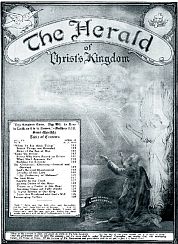
THE HERALD
of Christ's Kingdom
VOL. XI. August 1, 1928 No. 15
Table of Contents
LESSONS
OF WISDOM IN PREPARATION FOR THE KINGDOM
''TRANSFORMED"
THE
LIFE OF ONENESS WITH GOD
LUKE,
THE BELOVED PHYSICIAN
ENCOURAGING
LETTERS
VOL. XI. August 15, 1928 No. 16
Table of Contents
THE
POWER THAT RULES IN ROME
"VACATION
RELIGION"
"WE
SHALL ALL BE CHANGED"
"FOREVER
WITH THE LORD"
THE
PREEMINENCE OF JEHOVAH AND HIS APPOINTMENTS
COMPLAINTS
OF GOD AND THEIR LESSONS
THE
EPISTLE OF CHRIST
VOL.
XI. August 1, 1928 No. 15
"For it became Him, for whom are
all things, and by whom are all things,
in bringing many sons to glory, to make
the Captain of their salvation perfect through sufferings." -- Heb. 2:10, 11.
WHEN we consider the high and sublime
offices and positions that are assigned to the only Begotten Son of God and those who
shall constitute His Bride and Joint-heir we do not marvel that God has purposed for these
a course of instruction in the highest wisdom, a course of learning and discipline in
preparation for those exalted stations. On the contrary, on being informed that an
institution composed of kings and priests appointed of God. is to preside over the world
in the coming Age for the removal of sin and death and to accomplish man's uplift to
perfect life, we should logically ask at once, From whence came such an august company?
From whence did they receive their learning, their wisdom, that qualified them to fill
such offices? It will be remembered that our Lord Jesus was prophetically referred to in
the words of the Psalmist as the Chief or Great High Priest, "Jehovah bath sworn, and
will not repent, Thou art a priest for ever after the order of Melchizedec." (Psa.
110:4.) As is well known, the office of the priest or mediator between God and man;, as
presented in the Scriptures, is to restore to perfection and consequent harmony with God,
a race of beings condemned to death, or already dead, or dying. Hence the priest of
necessity must be "mighty to save." He must have both the right and the power to recall the dead to life, and
ability to instruct and discipline and thus to lead every willing subject to the perfect
estate from which our race originally fell. To secure this right he must first satisfy the
demands of Justice, which required the extinction of the human race; and these demands of
Justice could only be met by a corresponding sacrifice -- a human life for a human life.
The life of Adam and all in him could only be redeemed by another perfect human being.
Thus we have the doctrine of Atonement "Since by man came death, by man came also the
resurrection of the dead." By the sacrifice of a perfect human existence; is secured
the right of the priest to restore.
The Great Priesthood of the Future
But beyond the right or privilege of
restoring the priest mast have the power, and power would of necessity presuppose his own
everlasting existence. He must have power to create, since to restore to being that which
had completely lost existence, is to recreate it, and is a greater work even than the
first creation; he must also have perfect knowledge, both of God's requirements and of
human necessities, as well as perfect ability to guide a race so destitute, back to the
glorious heights of perfection and blessed harmony and communion with God.
Every thoughtful person must exclaim,
What an office! Who would presume to assume such a title! It belongs really and only to
Jehovah's Anointed. Even. Jesus, "the Anointed One, did not glorify Himself to become
a High Priest," but He has "been declared by God a High Priest according to the
order of Melchizedec." (Heb. 5.:4,10. Diaglott.) Jehovah honored Him by inviting Him
to that position and giving Him all power to fill it. Moreover, in accordance with the
pre-determinate counsel of God, not only was Jesus, His Anointed One, selected as the
Chief or High Priest, but He was to have associates who follow through the same
sacrificial experience, and who thereby ultimately become Joint-heirs with Him in that
high station and honor. Thus He is the "Captain" leading forth a company of sons
to share His glory and office. Jesus alone is the great High Priest; but those who compose
His Church of this Age, redeemed by His death and associated with Him now in sacrifice,
and to be associated with Him in Divine power hereafter are counted in with Him and
together with Him, will constitute the great Prophet, Priest, and King promised to
liberate and bless the groaning creation, -- the seed of promise. - Gen. 22 :18; Acts
3:20.23.
Our Priesthood the New Creation
From these
considerations it should be plain to all that our High Priest is truly a King, in whose
hands absolute power is vested. Looking back to the type God has given us, we find
Melchizedec, who is cited as an illustration of this priesthood both by the Psalmist and
the Apostle Paul. They show that Melchizedec, who was a priest upon his throne;
represented the Christ in glory and power while in the Aaronic Priesthood the special
features of the redemptive sacrifice were shadowed forth -- its perfection, its
completeness, its acceptableness as also the share which the Church has with Christ in
that sacrifice.
Christ was
not constituted a Priest of the Aaronic order : That priesthood was only the picture or
pre-figuration. The Aaronic Priesthood sprang from the Tribe of Levi, while "our Lord
[according to the flesh] sprang out of Judah, of which tribe Moses spake nothing
concerning priesthood"; and the members of His Church, His Body, are chosen chiefly
from among the Gentiles. As a man, Jesus was not a Priest; neither as men, are the saints
members of the Royal Priesthood but as "new creatures," they hold and execute
their office. Jesus as a "new creature," partaker of the Divine nature to which
He was begotten at the time of His baptism, was the Priest, and as a Priest He offered up
His perfect human nature as an acceptable sacrifice
to God. He consecrated or offered Himself in sacrifice on becoming the Priest, and He
received a special anointing for the office which was necessary to enable Him to
accomplish the sacrifice as well as to apply its benefits to men. His human nature when
sacrificed, could do nothing more-it must remain a sacrifice for ever; but the new nature,
fully developed in the resurrection, has "all power in heaven and in earth."
Who May Read His Title Clear?
The priestly
office of the new nature is not of the Aaronic order; it does not trace its lineage to any
human source. This fact is strikingly pictured in the priesthood of Melchizedec, whose
lineage and death are not recorded. He was a priest without having inherited the office
from his father or his mother-thus prefiguring Christ's Priesthood, which came not of the
lineage of the flesh, as did the Aaronic Priesthood, which Israel thought to be real.
Neither was Melchizedec's death recorded nor his successor named, that thus might be
indicated the continuity of Christ's Priesthood. (Heb. 7:3, Diaglott.) In this type the
work of sacrifice is not shown, as Melchizedec represents the Christ glorified and
reigning after the work of sacrifice has been completed, and the Divine nature fully
perfected.
St. Paul
declares Melchizedec to be greater than Abraham, thus showing that the Divine Christ will
be greater, and therefore able to bless every "friend of God" on the human
plane. "Wherefore He [Christ] is able to save them to the uttermost that come unto
God by Him, seeing He ever liveth to make intercession for them. For such a High Priest
became us, who is holy, harmless, undefiled, separate from sinners, and made higher than
the heavens [lifted higher than the highest -- to the Divine nature]." And this most
comforting assurance of such a Priest, so "mighty to save," is confirmed unto us
by the oath of Jehovah. (Heb. 7:21.) What strong consolation then may those have, who have
fled to Jehovah's Anointed for refuge: "Jehovah hath sworn, and will not repent, Thou
art a Priest for ever after the order of Melchizedec." What believer, justified by
faith and restored to full fellowship with God, who has offered himself a living
sacrifice, may not read his title clear to Joint-heirship with the Head in that glorious
anointed company? For He is authorized and is able to save completely all that come unto
God by Him now, as well as all who shall hear and come to Him during the reign of His
Kingdom. "Wherefore, holy brethren, partakers of the heavenly calling, consider the
Apostle and High Priest of our profession, Christ Jesus; for we have become associates of
the Anointed if indeed we hold fast the beginning of our confidence firm to the end."
-- Heb. 3:1, 14, Diaglott.
Perfected by the Things Which He Suffered
Now it is of
great importance that we shall not only clearly recognize the fact of the necessity for
the sacrifice and death of our Lord Jesus in connection with God's redemptive purpose and
His becoming the Great High Priest, but that we shall keep clearly before the mind the
great and solemn truth that those experiences of suffering, trial and discipline through
which the Savior passed were an important factor in His preparation for the great honor
that Jehovah conferred upon Him. As we look in the Word for testimony upon the subject, we
find that our dear Master did indeed learn certain lessons of experience: as the Apostle
declares, "learned He obedience by the things which He suffered." Not that he
had ever been disobedient to the Father's will, but that His testing at the time He came
into the world to do the Divine will, was of a character and of an intensity such as never
before had been brought to Him, nor to any other creature. His implicit obedience under
the strain and pressure of great suffering attested His love to the Father, attested His
faith in the Father's love and justice; and in all these things He fully approved Himself
of the Father; He overcame in every trial, because He had partaken so largely of the
Father's spirit and had received so much of the wisdom from above. The sacred Word
explains that it was expedient that He, in order to be the great Priest of mankind, should
be touched with a feeling of their infirmities and therefore that He should be tempted in
all points like as His followers are tempted -- along the line of personality, of
self-will; along the line of worldly ambition; along the line of faith and trust as well
as of obedience to God's will. Surely He drank deeply of the cup, but yet, rejoicingly.
said, "The cup which My Father hath given Me, shall I not drink it?"
The point of
special and keen interest to every follower of Christ is this: if it was necessary for our
glorious and worthy Lord from the heavenly courts to take of this cup of experience, of
suffering, and gain wisdom by the things He suffered, endured, and therefore to
demonstrate His confidence in God, it is equally necessary that all the members of His
Body shall likewise drink of the cup of discipline, experience, suffering, etc., if they
would hope to share with their Master in the Kingdom blessings -- glory, honor, and
immortality, the Divine nature.
Suffering with Christ
Our dear
Master's time for drinking of the cup of experience is past, yet the lessons of wisdom,
the encouragement therefrom, are still before us in the sacred record. It is now our time
to partake of the cup, to become wise unto the great salvation, to learn the lessons that
are necessary to our preparation for the Kingdom. It is not sufficient that we have begun
the course of walking in our Master's footsteps, that we have learned something of
obedience, that we have endured some trials, that on some occasions we have learned
obedience through the things we have suffered; we must continue drinking the cup of
experience with our Lord until we can gladly say -- Father, Thy will, not mine be done! If
we do not drink all of the cup with Him we shall not share in the glory to follow.
It seems
that some of the Lord's people, not discerning the matter in its proper light, are
disposed to pray that they may be spared from certain sufferings and trials; whereas, they
should understand that the sorrows, trials, and reverses of the consecrated life are
witnesses of the Spirit, that they are children of God and, are under His training and
preparation for a glorious station in .the Kingdom, to which He has called.. them. Because
if we are not tried we cannot be "overcomers"; if we do not suffer with Him and
learn to endure hardness submissively as good soldiers, and to esteem our trials and
sufferings from the right standpoint, and to count it all joy when they come to us,
knowing their object and knowing the Lord's sustaining grace and strength, we will not be
accounted worthy and "fit for the .Kingdom."
Some Trials and Chastenings as Rebukes
Others there
are who interpret these trials of life as evidences of Divine disfavor, and fail to
realize that they are designed of the Lord to shape and polish our characters and thus to
work out for us a far more exceeding and eternal weight of glory. Because of their
misunderstanding, some of the Lord's people are profited little by many of life's
experiences through which they are called to pass -- they feel the rod, but not discerning
the loving purpose behindit, they fail to learn the lesson intended,
It is true,
however, that the Lord's people at times meet
with severe trials, reverses, heartaches which come to them as chastenings, or in the
nature of correctives from the Lord, because they have not been sufficiently careful and
loyal in discerning and doing His holy will. Some of the severe trials of the Lord's
people in this Age have been pictured, or prefigured in the temptations, trials, and
sufferings that came to God's typical people in those far off days when they were
journeying from Egypt to Canaan. They frequently found the wilderness into which the Lord
sent them, the scene of severe trial, for they were called upon to deny themselves some of
the advantages and pleasures that they had enjoyed in Egypt. They were continually meeting
fresh trials of faith, courage, and endurance, trials of their confidence in the Lord and
appreciation of His promises.
So it is
with spiritual Israelites: After the Lord has given us certain lessons and experiences,
some of which come to us under quiet, restful conditions, the order of procedure may be
changed, and the indication of the Lord's providence may lead to some breaking up of
conditions which have been both favorable and unfavorable in some respects -- leading into
new circumstances and conditions and fields of action. It is not for the true spiritual
Israelite to murmur or complain or even to express a choice; but to look to the Lord for
guidance. If he can discern the leading of Divine providence, even though it be in a
wilderness condition, more and undesirable than that in which he had previously been, he
is to follow the Lord's leadings unquestionably, and with songs of faith and confidence.
Those who are anticipating the inheritance of the exceeding great and precious promises,
are now marching toward the heavenly Canaan and may well understand that other experiences are due them and
no doubt must be undergone before they clan inherit the promises. The wisdom from above
teaches us that prompt and implicit obedience to the Lord's leading without murmuring-with
joyfulness; is the proper course. And this course can only be followed by those who have
had sufficiently impressed upon them the lessons previously given of the Lord, above all,
the lesson of faith-confidence in the Lord's power, goodness, and faithfulness.
Spiritual Israelites Who Crave the World
It is
recalled that in the wilderness of Paran the Israelites murmured and cried out for the
leeks and onions and garlic and fish, etc., of Egypt. As little children to a father, they
lamented to Moses -- even regretting that they had been led out of bondage. Moses appealed
the matter to the Lord and the latter granted the request in displeasure, telling Moses He
esteemed the people to be murmurers against Himself; because He was the real leader and
Moses merely His servant. The people wanted more meat, expressing themselves as wearied of
manna, so God sent them quail. The people ate so greedily that a pestilence broke out
among them which cost the lives of many, so that they called that place Kibroth-hattaavah -- "grave of
greediness." Thus the Lord permitted their discontent and spirit of rebellion to
work out a severe penalty in a natural way.
Is it not
sometimes after the same manner with spiritual Israelites? Do not some after being well
fed on spiritual Manna, permit a selfish craving spirit to interrupt their fellowship with
the Lord to some extent -- hankering for earthly, fleshly good things -- forgetting the
wisdom of our Leader, the Lord, and that His love which thus far has fed and led us is
still with us, as wise and as good as ever? Sometimes it is a repining against our lot in
life, a desire for more ease and comfort and wealth and social influence than are within
our reach: sometimes it is a protest against our share of the aches and pains of the
groaning creation and our inability to get rid of these: sometimes it is a protest against
the illness and death of a loved one. Another, commenting upon this incident of Israel's
murmurings and crying out after the things of Egypt has said: "Here the poor human
heart lets itself thoroughly out. Its tastes and its tendencies are made manifest. The
people sigh after the land of Egypt, and cast back wistful looks after its fruits and its
flesh-pots. They do not say ought about the lash of the taskmaster, and the toil of the
brick-kilns. There is total silence as to these things. Nothing is remembered now, save
those resources by which Egypt had ministered to the lusts of nature.
"How
often this is the case with us! When once the heart loses its freshness in the Divine life
-- when heavenly things begin to lose their savor, when first love declines, when Christ
ceases to be a satisfying and altogether precious portion for the soul, when the. Word of
God and prayer lose their charm and become heavy; dull, and mechanical; then the eye
wanders back toward the world, the heart follows the eye, and the feet follow the heart.
We forget, at such moments, what the world was to us when we were in it and of it. We
forget what toil and slavery, what misery and degradation we found in the service of sin,
and Satan, and think only of the gratification and ease, the freedom from those painful
exercises, conflicts, and anxieties which attend upon the wilderness path of God's people.
The Manna Quite Sufficient for True Israelites
"All
this is most sad, and should lead the soul into the most profound self-judgment. It is
terrible when those who have set out to follow the Lord begin to grow weary of the way and
of God's provision. How dreadful must those words have sounded in the ear of Jehovah, 'But
now our soul is dried away: there is nothing at all, beside this manna, before our eyes.'
Ah! Israel, what more didst thou need? Was not that heavenly food enough for thee? Couldst
thou not live upon that which the hand of thy God had provided for thee? "Do we count
ourselves free to ask such questions? Do we always find our heavenly manna sufficient for
us?' What means the frequent inquiry raised by professing Christians as to the right or
wrong of such and such worldly pursuits and pleasures ? Have we not even heard from the
lips of persons making the very highest profession such words as these, 'How are we to
fill up the day? We cannot be always thinking about Christ and heavenly things. We must
have some little recreation. Is not this somewhat akin to Israel's language in Numbers 11?
Yes, truly; and as is the language, so is the acting. We prove, alas ! that Christ is not
enough for the heart, by the palpable fact of our betaking ourselves to other things. How
often, for example, does the Bible lie neglected for hours, while the light and worthless
literature of the world is greedily devoured. What mean the well-thumbed newspaper and the
almost dust-covered Bible? Do not these things tell a tale? Is not this despising the
manna, and sighing after, nay, devouring, the leeks and onions?
"May we
have grace to think of these things, to think seriously. May we so walk in the Spirit that
Christ may ever be a satisfying portion for our hearts. Had Israel, in the wilderness,
walked with God, they never could have said, 'Our soul is dried away: there is nothing at
all beside this manna before our eyes.' That manna would have been quite enough for them.
And so with us. If we really walk with God, in this wilderness world, our souls shall be
satisfied with the portion which He gives, and that portion. is a heavenly Christ. Can He
ever fail to satisfy? Does He not satisfy the heart of God? Does He not fill all heaven
with His glory? Is He not the theme of angels' song, and the object of their adoring
homage and wondering worship? Is He not the one grand subject of everlasting counsels and
purposes? Doth not the history of His ways overlap eternity?"
"Through a cloud of earthly senses
Bursts upon my raptured sight
Such a vision of my Father
In His glory and His might,
In His justice and His wisdom,
In His tender, watchful care,
Manifested in my Savior,
Rich in blessings everywhere.
"Oh, it thrills with love and
longing
Every fiber of my soul,
To be with Thee, in Thy presence,
While the countless ages roll.
Then a voice, 'This be Thy pattern,
See that thou in all thy ways
Make according to the pattern,
To My glory and My praise.'
"Thou the pattern, blessed Savior,
How can I a copy be
Of that gracious, sweet perfection
Manifested, Lord, in Thee?
'Keep throe eyes upon the pattern,
Look not thou aside, behind,
And beholding but My glory,
Thou shalt be transformed in mind.'
"Oh, my Father, in Thy mercy
As I gaze with unveiled face,
Let me see, as in a mirror,
All Thy brightness, all Thy grace,
So in looking, so in longing,
Shall my homely features glow
With the radiance of Thy glory,
And Thy matchless beauty show.
"All my days be crowned with
gladness,
From the center of my heart,
Praise to Thee that in the blessing
Thou wilt let me have a part.
So then, in a faithful service,
For the loving service' sake,
Changed from glory unto, glory,
I shall in Thy likeness wake.
"I shall see Thee in Thy beauty,
I shall in Thy beauty shine,
All the loving, all the longing;
Merged in purest love Divine.
Satisfied with the full sweetness
Of the bliss of heaven above,
All my future spent in blessing;
All my being lost in love."
'Whoso looketh into the perfect law of
liberty, and continueth therein,
he being not a forgetful hearer, but a doer of the work,
this man shall be blessed in his deed."
-- Jas. 1:25.
A PROPER adjustment of the mind toward
God, properly thinking of Him and the placing of a true valuation upon God's approval, His
favors, especially the great favor of eternal life, is most needful in the very beginning
and throughout the entire experience of every Christian life. Such a proper regulation of
the soul in relationship to God is accomplished only by the aid of the Holy Spirit; and
this power is given to those only who obediently surrender themselves in consecration to
do His will. The true and earnest seeker after God soon learns from the Divine Message
that the thoughts, the meditations of the heart must be properly centered upon the Lord
and upon those things that appertain to Him and the securing of His everlasting approval.
Such also soon learn that in order to succeed in stemming the tide of evil in the world,
the flesh and the Evil One, and in order to make progress in the life of piety and to
advance in Divine favor; one must live a life of close touch and communion with God. Thus
the individual who is earnestly desirous of the Divine blessing is admonished to
"draw nigh to God" and is assured that God will draw nigh to him in return.
Life Eternal to Know God
Of all the high and distinctive favors
enjoyed by the children o£ God, none is greater than that of the privilege of dwelling in
His presence and of holding communion with Him. Indeed, the exercise of this exalted
privilege is most vital and necessary to spiritual health and to the preservation of a
proper and holy relationship with God. "This is life eternal," said Jesus, to
"know Thee and Jesus Christ whom Thou bast sent." The entering of sin into the
world in the beginning of human history interrupted and took away the privilege of
personal fellowship with God. A measure of that favor and fellowship however, was accorded
certain servants of God in ancient times, in view of the great redemptive program that was
then in prospect; but since the advent of the Son of God, a proper acceptance of the
redemption through Christ fully restores the privilege of entering God's presence and of
holding communion with Him. Faith and obedience .on the part of the penitent effects the
lifting of the condemnation and the establishing of the state of peace with God:
"There is, therefore, now no condemnation to them which are in Christ Jesus, who walk
not after the flesh, but after the Spirit." Such a one thus in right relationship
with God is in a position to think of Him intelligently and acceptably. Revelations of
knowledge are given in order to facilitate the work of grace and help the devout believer
to think of God as He should and to assist Him to approach very close to the heart of the
great Eternal. It must be recognized that at least a measure of knowledge and intelligent
conception of God are necessary in order to a consciousness of that sacred presence. Our
thoughts of God growing out of His revelation to us, form the basis of our communion with
Him and indeed the foundation of the life of fellowship and prayer.
It is in connection with the exercise
of this privilege of communion with God, of approaching very near to Him, that multitudes
have experienced much difficulty. Insufficiency of faith, failure to believe fully would
seem to be at the bottom of their trouble. They seem to fail to realize the depth of mercy
and compassion that are in store for all those who properly apply for them. The truth is
that they seem not to know the Lord sufficiently; they think of Him as moved by like
passions with themselves, more or less controlled by animosity. It is an evidence of
growth in grace when we come to that place in our experience where, admitting our guilt
and unworthiness of Divine favor we have, nevertheless, become so intimately acquainted
with the Lord as to have a full assurance of faith in His declaration that our sins are
forgiven. It is probably to .such a development of grace that the Lord Jesus refers when
He said, "This is life eternal, that they might know Thee."
Influence of Thought upon the Character
But such a knowledge is not to be
obtained instantaneously, but rather, is to be the result of a growth in grace; one grows
in grace as he grows in knowledge, and reversely, he grows in knowledge as he grows in
grace; the two keeping pace the one with the other as do our feet in walking. It is
because many who have named the name of Christ do not grow in grace and knowledge that
they fail to attain that grand condition of which the Apostle speaks as "full
assurance of faith-full confidence in the Lord, in His goodness, in His wisdom, in His
love, in His providential care over all their affairs. And the lack of such growth is
owing to their failure to obediently offer sacrifices unto the Lord -- to commit all their
ways to Him. Evidently such do not give themselves over sufficiently to a contemplation of
the things of the Spirit of God. The Divine will is not as earnestly and reverently
studied as it should be.
It would seem that St. James was
speaking from this standpoint when he tells us that the one who looks into the perfect law
of liberty and continues therein as a doer of the work, who obediently performs what he
sees to be God's will, shall be blessed in his deed. How manifest it is that we are to
think of God and earnestly contemplate His messages in order that we may understand what
He would have us do, and how He would have us live. An eminent writer who has evidently
thought clearly and well upon this subject makes the following interesting statement
"Now
what the Apostle means is clear, and what he here urges upon us is that very duty, to the
neglect of which more than anything else is due the shallowness and imperfection of our
lives: He means that a man's nature is insensibly but inevitably molded by that which is
in his thoughts, and that the lives, even of Christians, are often earthly and sensual
because their thoughts are not with things above. Tell me about What you think most
frequently and most earnestly, and I will tell you what you are. For your thoughts are the
invisible influences which give its complexion to your life, even as the insect is colored
by the leaf on which it feeds. 'Abeunt studia in
mores.' What a man desires to be, that he will be. If his thoughts are ever of sin he
will be possessed of sin, he will be the slave of sin; but if his thoughts are ever of God
and the things of God then 'With open face, beholding, as in a glass, the glory of the
Lord, he will be changed into the same image from. glory to glory.'
"If,
then, you would live good or worthy lives, you must not only not suffer your thoughts to
become guilty thoughts; but you must not even allow them to be vacant thoughts. You must
fill them with all things true, pure, honorable, lovely, of good report. How can we best
do this? Best by forgetting ourselves, best by obliterating our own selfish will and
pleasure, best by thinking wholly of others and of God; for in the true life there are
three factors -- God, the soul and our fellowmen; and our duty to ourselves, our duty to
our own souls is best summed up in our duty to God and our duty to our fellow men."
The Power of Holy Fellowship
It will seem
that all could give hearty assent to the foregoing observations. And when the Wise Man
admonished "Keep thy heart with all diligence; for out of it are the issues of
life," he is telling us to guard carefully the thoughts of our hearts; to watch our
meditations; to carefully consider what motives and purposes control and guide us in .the
course we are pursuing in life. Thoughts about God and contemplations of His character and
the great qualities thereof cannot abut have an elevating effect upon every soul that is
really consecrated to Him. The same writer goes on to say further:
"Very
few of us, I fear -- very few even of the best of us -- think enough of God. That He is
our Creator, Preserver, Redeemer, that He has the sole and absolute claim upon our love
and obedience we all know; but Oh! if we all knew this in a true and living sense, how
different our lives might be. By not thinking of it often enough, or deeply enough, how
mighty a safeguard do we lose! 'Hear these three things,' said a Jewish Rabbi, 'and thou
shalt eschew transgression: the All-seeing eye, and the All-hearing ear, and that all thy
actions are written in a book.' How many a life has been kept humble, and happy, and pure,
and sweet, by the living realization of that one truth, 'Thou, God, seest me.' You know
how you are affected and made better in all your hearts, by the mere presence of some one
to whom you can look up to as good and true. You know that there are some even among your
fellows so upright, so innocent, so single-hearted, that to be with them, is to breathe a
holier and more wholesome atmosphere. Their influence, something which seems to emanate
from them and flow in upon your hearts,
surrounds you with the air of heaven as with the perfume from the waving of angels' wings.
Their Divine superiority to all that is impure or sordid seems to run liquid through your
soul, so that you feel that could you always be with them, you, too, would grow like them.
But these, alas! are rare in this world, nor can you
often be with them; nor even, were this possible, could they save your souls, or pay
your debt to God. No; but there is a Presence which not only, may be always near you, but
which you cannot escape; there is a Love always over you,
which you may reject, but cannot alienate; there is a Friend always with you, who,
even in your loneliest moments, leaves you not alone. He is a Friend living and true; nor
is He weak as we are, nor is He, as we are, ignorant of all the secrets of your hearts.
That Presence, that Love, that Friend is God in Christ. Oh that you would all cling to His
hand! Oh that now and ever you would listen to His voice! What would I not give to impress
upon you, as I feel it, that life without God is not life, but death; so impress it upon
you, by the aid of God's Holy Spirit, that every one who hears me might feel, for all his
after days, 'Much that I learned I have forgotten: by much that I might have learned I
never profited; but this, at least, I did learn, and this lesson, I trust, has so
permeated my soul, so inter-penetrated my whole that I cannot forget it if I would, that
life without God is life without joy, without peace, without happiness, without hope; and
that if I would live a life which shall come to anything -- a life which shall not be cast
as rubbish in the void, when God has made the pile complete - then I ought daily to offer
unto God myself, my soul and body, a reasonable, holy, and lively sacrifice."'
Feeding upon the Words of God
But from
whence cometh those aspirations and impulses toward God, His service, and fellowship? The
answer is, from a sober and reverent contemplation of the Divine messages of truth and
grace, a contemplation of those truths that reveal the Heavenly Father to us, His
greatness, His majesty, His loving kindness. Jesus said, "Man shall not live by bread
alone, but by every word that proceedeth out of the mouth of God." The words that
come from God are words of life in the sense that they explain to us His way, His will,
and how eternal life may be secured. The words that proceed out of the mouth of God are
words of life too, in the sense that they give light to the soul, in the sense that they
impart faith and strengthen and nourish that love and affection for God that impels to
obedient service and that prompts one to daily bring all the life, thoughts, words, and
doings into full Conformity to the will and good pleasure of God.
Those who
thus feed upon the Word of God, the manna from heaven, and whose souls are nourished
thereby, are prepared for the journey of life. In this journey or pilgrimage toward. the
city of God, the heavenly inheritance, the traveler may truly be said to be walking with
God. When St. Paul states that we as Christians "walk by faith and not by
sight," and when he admonishes that we "walk as children of light," he is
referring to this mystical walk or journey in which we are assured of God's presence and
company all the way.
Walking with God
We find this
thought of journeying together and walking with God; suggested in the Old Testament
records with regard to certain faithful and devout servants of God, though they possessed
much less information and knowledge of God than His children do today. Significant and
full of meaning are the words of the sacred record, that Enoch, the seventh from Adam,
exercised great faith in God and was translated that he should not see death, because
"he walked with God." In other words, his faith in God was such that his
thoughts, purposes and activities of life were distinctly separate and of a different
character from everything that he saw around him, And so must it ever be with the soul
that would really enjoy God's communion and fellowship. "Be not conformed to this
world," says St. Paul, "but be ye transformed by the renewing of your
mind," by the heavenly aspirations and impulses, by the contemplation of those things
that rive strength and power to faith and enable the believer to rise to exalted
conceptions and appreciation of God and unity with Him. Another has very ably commented
upon the record of Enoch's faithfulness to God:
"To
walk with God must, necessarily, put one outside the sphere of this world's thoughts.
Enoch realized this; for, in his day, the spirit of the world was manifested; and then,
too, as now, it was opposed to all that was of God. The man of faith felt he had naught to
do with the world, save to be a patient witness therein of the grace of God and of corning
judgment. The sons of Cain might spend their energies in the vain attempt to improve a
cursed world but Enoch found a better world, and lived in the power of it. His faith was
not given him to improve the world, but to walk with God "And oh, how much is
involved in these three words, 'walked with God!' What separation and self-denial! what
holiness and moral purity! what grace and gentleness! what humility and tenderness! and
yet, what zeal and energy! What patience and longsuffering! and yet what faithfulness and
uncompromising decision!
The Cross and the Coming of the Lord
"To
walk with God comprehends everything within the range of the Divine life, whether active
or passive. It involves the knowledge of God's character as He has revealed it. It
involves, too, the intelligence of the relationship in which we stand to Him. It is not a
mere living by rules and regulations; nor laying down plans of action; nor in resolutions
to go hither and thither, to do this or that. To walk with God is far more than any or all
of these things. Moreover, it will sometimes carry us right athwart the thoughts of men,
and even of our brethren, if they are not themselves walking with God. It may, sometimes,
bring against us the charge of doing too much; at other times, of doing too little; but
the faith that enables one to 'walk with God,' enables him also to attach the proper value
to the thoughts of man.
"Thus
we have, in Abel and Enoch, most valuable instruction as to the sacrifice on which faith
rests; and, as to the prospect which hope now anticipates; while, at the same time, 'the
walk with God' takes in all the details of actual life which lie between those two points.
'The Lord will give grace and glory'; and between the grace that has been, and the glory
that is to be revealed, there is the happy assurance, that 'no good thing will He withhold
from them that walk uprightly.' -- Psa. 84:11.
"It has
been remarked that 'the cross and the coming of the Lord form the termini of the Church's
existence,' and these termini are pre-figured in the sacrifice of Abel and the translation
of Enoch. The Church knows her entire justification through the death and resurrection of
Christ, and she waits for the day when He shall come and receive her to Himself. She,
'through the Spirit, waits for the hope of righteousness by faith.' (Gal. 5:5.) She does
not wait for righteousness, inasmuch as she, by grace, has that already; but she waits for
the hope which properly belongs to the condition into which she has been introduced."
Heart-Searching Questions
If it was Enoch's privilege with his
limited knowledge, to have that intimate fellowship and companionship with God by faith,
in those far off .days, it surely is no less our privilege in these days. This being true,
is it not to the point to ask ourselves the question, Have we thus come to walk with God?
Have we that fellowship and communion with Him that He was so pleased to grant Enoch? Has
there come into our lives such a manifestation of God's presence? Have we partaken of such
a measure of the spirit, mind, disposition of our Master, Christ, that it is said of us as
it was of the Apostles Peter and John, that "all men took 'knowledge of them that
they had been with Jesus"? Do the lives we live before our fellow men bear the Divine
stamp and reveal to others the Divine presence? How pertinent and yet how searching is the
question, Has God's presence become such a reality to us that our desires, our affections,
our longings, instinctively turn to God, wherever we are? Are we always found in that kind
of company, in those scenes and circumstances in which we may be sure that He is with us?
or do we sometimes find ourselves in places in which we instinctively feel that we would
prefer He did not know we were there?
Again, this figure of "walking
with God" is most expressive, and suggests a characteristic that is very well
represented in the term devoutness. One has described this as "the flavor, the
fragrance, the finer quality of piety-that something that makes the rose a rose, the
diamond a diamond, and give: to some of music's tones a touch of sacredness and selectness
that no language could explain. In this Age of intense practical tendencies there is need
of a revival of the spirit of devoutness. We see it in the fervid 'Religious Letters' of
Samuel Rutherford, which read like messages from the heavenly land. We are told that it so
covered the face of Robert Murray McCheyne with chastened glory, that sometimes to look at
him broke his audience into tenderness, and his simplest tones brought tears. It is that
fine quality of sacredness which comes from close association with the Divine Being, and
which left upon the faces of Peter and John, in the council of old, such a depth of
supernatural glory, that even the magistrates that hated them 'took knowledge that they
had been with Jesus.' It is the spirit of Mary sitting at the feet of Jesus, absorbing and
reflecting His spirit. It can have no counterfeit or imitation. It bears its own
credentials, and those who have it are quickly recognized as having been with Jesus, and
still bearing on their faces the halo of His presence. God give us the spirit of heavenly
mindedness, this touch of God, that we may better represent Him in the godless Age and
world."
The Life of Prayer
Such a walk with God is not an
impractical ideal. Indeed, to a greater or less extent it describes every truly
consecrated one. It is expressed most forcefully in the words of our Divine Master:
"How is it" said one of Jesus' disciples, "that Thou wilt manifest Thyself
to us and not unto the world? Jesus answered and said unto him, If a man love Me, he will
keep My words; and My Father will love him, and We will come unto him, and make Our abode,
with him." (John 14:22-24.) This walk with God, with Christ, is a walk that is marked
by many a silent prayer, many an utterance of praise, of thanksgiving, and many an hour of
close and intimate communion with our Savior that cannot be described by words. It may
become a habit with us, and so real will become our sense of dependence upon Him and
submission to His will in the daily, even the hourly circumstances and conditions of life,
that we need no voice to tell us that He is near. It is, however, a walk of faith, even as
it was said of Epoch that "by faith" he walked with God; for "the just
shall live by faith." Were it not that we are made conscious of our continual
acceptance in Him, "in whom we have redemption through His blood"; were it not
that we have the full assurance that we are made acceptable in Him, the blessed
realization of walking with God would not be possible. The Christian poet has expressed
this walk of faith in the beautiful words
"We walk by faith, He wills it
so,
And marks the path that we should go,
And when at times, our sky is dim,
He gently draws us close to Him.
"We walk by faith, but not
alone,
Our Shepherd's tender voice we hear,
And feel His hand within our own,
And know that He is always near."
The Reality of God's Presence
It is said of Abraham that when he was
called to go into a land which he should afterward receive for an inheritance, he obeyed, not knowing whither he
went. It was with him a walk of faith and not of sight. However, faith has the Word of God
to rest upon; let it be remembered too, that real faith obeys that Word. When we can see
and feel with our physical senses, then it is not faith, but sight. In crossing the ocean
one has a good illustration of this principle of faith in God's presence. As the vessel
glides swiftly along, there is seen ahead no path upon the sea, nor sign of the shore. And
yet at noon time, day by day, the one who is guiding the vessel, marks our path upon the
chart as accurately as if there had followed us a great chalk line upon the sea. Always at
noon time we know just where we are. And when we come within twenty miles of the land, we
know where we are as exactly as if we had seen it all three thousand miles ahead. How had
our pilot measured and marked out our course? How did he know where we were with nothing
visible on the sea to guide the vessel? Day by day he had taken his instruments, and
looking up to the sky had fixed his position and course by the sun. In this way he knew
the particular point on the sea, toward which to steer his vessel. In order that he might
keep a straight course, he watched closely the compass. "He was sailing by the
heavenly and not the earthly lights."
We have a chart, God's Word, that not
only locates, but describes the place to which we are sailing; we have the compass, the
precepts of that Word, that enables us to steer a straight course. There are the heavenly
lights, that enable us day by day to take observations, and thus to discover just where we
are, and what progress we are making in our course over the sea ,of life, which sometimes
is calm and sometimes tempestuous. To the intelligent believer the presence of God, in the
sense of His Word, His Spirit, His providences, becomes as real and useful to him, as
though God were walking before, beside, and behind him. His Word becomes a lamp to guide
our feet and a light to show us the path that we should walk in ; indeed, it is His voice,
saying, "I will instruct thee, and teach thee in the way which thou shalt go: I will
guide thee with Mine eye." (Psa. 32:8.) We learn in this most wonderful promise that
God sees the path, although it is invisible to us. He tells us that He looks out. over the
path, speaks words of instruction, and points out the way. Again the poet has well
expressed the attitude of those living in God's presence
"To me remains nor place nor time;
My country is in every clime;
I can be calm and free from care
On any shore, since, Thou art there.
"While place we seek, or
place we shun,
The soul finds happiness in none;
But with a God to guide our way,
'Tis equal joy to go or stay."
"I Will Go before Thee"
Another
promise is, "The steps of a good man are ordered by the Lord; and he delighteth in
His way." (Psa. 37:23.) In this promise we are told that not only will He guide us in
a general way, but in each successive step. The Psalmist, who had learned by long
experience the lesson of walking with God, thus expresses himself: "Truly God is good
to Israel, even to such as are of a clean heart." However, he goes on to relate a
previous experience which warns us of the necessity of keeping our eyes on our Heavenly
Companion and off others: "But as for me," he says, "my feet were almost
gone; my steps had well nigh slipped. For I was envious at the foolish, when I saw the
prosperity of the wicked. For there are no bands in their death; but their strength is
firm. They are not in trouble as other men; neither are 'they plagued like other men . . .
. Thus my heart was grieved, and I was pricked in my reins. So foolish was I, and
ignorant: I was as a beast before Thee." When, however, he got his eyes back where
they should be he said: "Nevertheless, I am continually with Thee: Thou hast holden
me by my right hand. Thou shalt guide me with Thy counsel, and afterward receive me to
glory. Whom have I in heaven but Thee? and there is none upon earth that I desire beside
Thee. My flesh and my heart faileth; but God is the strength of my heart, and my portion
forever . . . . But it is good for me to draw near to God: I have put my trust in the Lord
God, that I may declare all Thy works." -- Psa. 73:1-5, 21-28.
God's
promises to His trusting ones go even further than those already quoted. It is good to
know that He sees our path; it is good to hear His voice speaking to us in His Word; it is
good to have His counsel. The pathway at times may seem to be blocked, and He has promised
to go before us and remove the obstructions, if they are seen to be a hindrance to the new
life. We believe that the words addressed to one of old may be laid hold of by us today:
"I will go before thee, and make the crooked places straight. " -- Isa. 45:2.
Again we are
told by an Apostle who had experienced the blessedness of walking with God that "If
any of you lack wisdom let him ask of God, who giveth to all men liberally, and unbraideth
not; but let him ask in faith, nothing wavering." (Jas. 1:5, 6.) This promise covers
every need of God's people. It not only promises wisdom, but it enables us also to
distinguish between the wisdom of God and the wisdom of men, thus causing us to know
whether we are possessors of this heavenly wisdom and exhibiting it in all .our dealing
with our fellow men. "The wisdom that is from above, is first pure, then peaceable,
gentle, and easy to be entreated, full of mercy and good fruits, without partiality, and
without hypocrisy." -- Jas. 3:17.
If Any Man Will Do His Will
These
promises, however, as also all others contained in God's Word, are conditional. It will be
to our profit that we carefully observe these conditions. First, there is required firm
confidence in God's desire and willingness to guide us; and a full committal, not only of
the matter desired, but of ourselves, of all we have, into His hands. In other words, it is to the truly consecrated that these
promises belong. We read: "Trust in the Lord with all thine heart, and lean not unto
thine own understanding. In all thy ways acknowledge Him, and He shall direct thy
paths." (Prov. 3:5, 6.) This will mean a full submission to God's will and
providences; that we believe His Word, which assures us that "all things work
together for good to them that love God, who are the called according to His
purpose." And again, "If any man will do His will, he shall know of the
doctrine." In this we have Jesus' example, "Not My will, but Thine be
done." A mistrust of self and a consciousness of entire dependence upon our Divine
Master are vitally important. Concerning this Jesus said, "I am the vine, ye are the
branches: He that abideth in Me and I in him, the same bringeth forth much fruit; for
without [margin, severed from] Me ye can do nothing." -- John 15:5.
Again
obedience is one of the important conditions on which God's promises are made good to us:
"And this is the confidence that we have in Him, that, if we ask anything according
to His will, He heareth us: and if we know that He hear us, whatsoever we ask, we know
that we have the petitions that we desired of Him." (1 John 5:14, 15) "Beloved,
if our heart condemn us not, then have we confidence toward God. And whatsoever we ask, we
receive of Him, because we keep, His commandments, and do those things that are pleasing
in His sight. And this is His commandment, that we should believe on the name of His Son
Jesus Christ, and love one another, as He gave us commandment." -- 1 John 3:21-23.
Those who are truly living the life of
oneness with God, who are in deed and in truth walking with God, will desire that in all
things and in all their experiences, His dealings and. providences shall be of a kind,
whether painful or pleasant, bitter or sweet according to the flesh, to work out their
spiritual good and advantage, realizing that the great inheritance of the heavenly nature
and Kingdom of the future, is dependent upon the development of that spiritual image and
likeness to Christ, that purity of heart, that holiness of life and purpose without which
no man shall see the Lord.
"Forasmuch as many have taken in
hand to set forth in order a declaration of those things which are most surely believed
among us, It seemed good to me also, having had perfect understanding of all things from
the very first, to write unto thee in order, most excellent Theophilus, that thou mightest
know the certainty of those things wherein thou hast been instructed." -- Luke 1:1,
3, 4.
LUKE the physician, who wrote the
Gospel of Luke, was the author of the Book of the Acts. In the latter he takes up the
narrative substantially where he left it in the Gospel -- the ascension of Christ. He
recapitulates, however, to the extent of giving us a narrative of the conversation
immediately preceding our Lord's ascension. The account is evidently addressed to a
friend, of the then common name, Theophilus, who was supposed to have been a person of
considerable dignity and influence, inasmuch as he is elsewhere styled "most
excellent," a title which implied a considerable social or political rank. Luke was
not one of the Apostles, and his records are not, therefore, of apostolic authority.
Mr. Barnes observed that "Luke
does not profess to have been an eye-witness of what he recorded. (See chap. 1 :2, 3.) It
is clear, therefore, that he was not one of the seventy disciples, nor one of the two who
went to Emmaus, as has been sometimes supposed. Nor was he an Apostle. By the fathers he
is uniformly called the companion of the
Apostles, and especially of Paul. If he was not one of the Apostles, and if he was not one
of those expressly commissioned by our Lord to whom the promise of the infallible teaching
of the Holy Spirit was given, the question arises by what authority his Gospel and the
Acts have a place in the sacred canon; or what evidence is there that he was divinely
inspired?"
In reply to Mr. Barnes question we
would say that such authority as plenary inspiration was not necessary, in the recording
of plain, simple facts such as the Gospel of Luke and the Book of the Acts present. It
requires no inspiration to record a fact, though it does require some ability, and it is
reasonable to assume that since the Lord used Luke's abilities in connection with the work
of recording the facts of that time, he was guided of the Holy Spirit in the ascertainment
of the facts, which his education and natural talents eminently qualified him to state
succinctly. Luke was guided of the Holy Spirit; in the same sense that all of the Lord's
consecrated people are guided by His Spirit, which is to a different degree from that
plenary inspiration granted to the twelve
Apostles-Paul taking the place of Judas.
The first verse in the Book of the Acts
refers back to the Gospel of Luke, as a treatise of the doings and teachings of Jesus from
the time He began His ministry to its close; and some have assumed that the word
"began" might reasonably be understood to imply that our Lord continued His
ministry after His ascension, speaking and acting through the Apostles, and those
believing on Him through their word. This is true enough whether it was what Luke meant or
not; for the Scriptures invariably teach that the Church of Christ in the flesh is His
representative: as the Apostle Paul says, we "fill up that which is behind of the
afflictions of Christ, for His Body's sake, which is the Church."
An Interesting Biography
It will be interesting in this
connection to read what has been styled "An Outline Biography of Luke," said to
be partly fanciful; it has been prepared by Professor D. A, Hayes from tradition,
reasonable conjecture, and references made to his character in the New Testament:
"He was born a slave boy in the
household of Theophilus, a wealthy government official in Antioch. He grew up into most
engaging appearance and most attractive personality. He was of a peculiarly acute
intellect and of a most obliging disposition. He won his master's confidence and then his
personal liking. Theophilus decided to educate the boy at his own expense and at tie best
university in the land. So it was that the second capital event in the life of Luke was
his matriculation at Tarsus. Here he studied medicine, where the great masters in that
profession, Artæus, Dioscordies, and Athenaeus, has been educated. Just a few miles away
at Aegae stood the great temple of Aesculapius, which furnished the nearest approach to
the modern hospital to be found in the ancient world. From the university lectures Luke
got the theory of medicine; in the temple of Aesculapius he got the practice and
experience he needed. He made the acquaintance of Barnabas and Saul here, and laid the
foundations for a lifelong friendship with these men.
"His education completed, he
returned to Antioch and rendered faithful and most successful service in his master's
family. Then the Gospel was preached at Antioch, and Luke was among the first to hear it
and to accept it. He told his master, Theophilus, about it, and Theophilus himself became
interested and at last converted. Then about the first thing Theophilus did as a Christian
was to give Luke his freedom.
"The first impulse of the freedman
Luke was to get away from all the scenes of his servitude and to test his new-found
liberty by wandering far and wide at his own sweet will. He shipped as a physician upon
one of the vessels plying up and down the Mediterranean Sea, and there he had manifold
experiences. His outlook was broadened as he saw more of the world. He was of service to
many people and he made many friends. On one the ship voyages he met some members of the
family of Lucanus the poet, and they persuaded him to accompany them to their home, in
Cordoba in Spain. Luke was there when the poet was born, and the baby boy was named after
him, In this household he became acquainted with Gallio and Seneca and many other notable
men. The slave boy had risen to a considerable height, for his native ability and his
excellent education and his goodness of heart enabled him to converse with the best of men
as their equal, and as a freedman and physician he was admitted to terms of intimacy which
otherwise would have been impossible.
"In due
time he came back to Antioch and was resident there when many of the stirring events which
he narrates in the history of the Christian Church took place. Later he removed to Troas
and settled there, where Paul found him on his second missionary journey. He went with
Paul to Philippi, and was left in charge of that Church for seven years. He left Philippi
with Paul in A. D. 58, and remained with Paul
thereafter until the Apostle's martyrdom.
"Some
time after this event he wrote the third Gospel of the Book of the Acts for Theophilus,
and he fully intended to write a third volume continuing the history, but he was swept
away into the tide of Christian evangelism and never found the leisure to do it. He
labored as an evangelist in many lands, and in a ripe old age he fell on sleep and was
buried somewhere in Greece.
"Luke
was one of the most respected and best-beloved members of the early Church. His praise was
in all the churches. All women liked him and all men honored him. Apollos and he were the
most accomplished writers, and Paul and he were the most prolific writers of the New
Testament times. Take the writings of Luke and Paul out of the New Testament and it would
be less than half its present size; and of the larger half of the present contents Luke
wrote more than Paul. He was a most versatile man -- a physician, a musician, a painter, a
poet, a preacher, a prolific author, an intrepid missionary -- a man with many gifts and
many friends and manifold accomplishments. His books are invaluable. Both he and they are
worth our knowing and knowing well."
A Faithful Writer of Sacred History
Luke
commences the Gospel narrative with the following interesting statement: "forasmuch
as many have taken in hand to set forth in order a declaration of those things which are
most surely believed among us, even as they delivered among them unto us, which from the
beginning were eyewitnesses, and ministers of the Word." (Luke 1:1, 2.) This
expression clearly implies that Luke was not an eye-witness of the events of Christ's
life, but merely a collector of information from those who were eye-witnesses of the acts
of the Savior: Many others had written accounts of Christ's life but Luke evidently felt
that in conveying information to his master, Theophilus, he desired it to be in the form
of a record carefully prepared by himself from all the facts that he could gather from
those who had been brought in contact with Jesus. Thus he remarked "that thou
mightest know the certainty of those things, wherein thou hast been instructed."
The book
styled the "Acts of the Apostles" was Luke's second statement to Theophilus, I
as is clearly indicated in the expression, "The former treatise have I made O
Theophilus." It is not to be supposed that Luke himself styled his writings "The
Acts of the Apostles," for he concerned himself in the first part mainly with Peter
and in the second wholly with Paul, merely mentioning John, James, Timothy, and Cyrus. The
entire book is an expansion of Christ's works in Acts 1:8, telling how the Apostles
witnessed for Christ successively in Jerusalem, and in Judea, and in Samaria, and unto the
uttermost part of the earth.
Another
commentator has presented a most interesting review of the Acts, a portion of which is
submitted below:
"'The
Acts of the Apostles' contains a record of the organization of the Christian Church. That
Church was founded simply by the preaching of the truth, and chiefly by a simple statement
of the death and resurrection of Jesus Christ. The 'Acts of the Apostles' contains the
highest models of preaching, and the purest specimens of that simple, direct, and, pungent
manner of addressing men, which may be expected to be attended with the influences of the
Holy Spirit. It contains some of the most tender, powerful, and eloquent appeals, to be
found in any language. If a man wishes to learn how to preach well, he can probably
acquire it nowhere else so readily as by giving himself to the prayerful and profound
study of the specimens contained in this book. At the same time we have here a view of the
character of the true Church of Christ. The simplicity of this Church must strike every
reader of 'the Acts.' Religion is represented as a work of the heart; the pure and proper
effect of truth on the mind. It is free from pomp and splendor, and from costly and
magnificent ceremonies. There is no apparatus to impress the senses, no splendor to
dazzle, no eternal rite or parade adapted to draw the affections from the pure and
spiritual worship of God. How unlike to the pomp and parade of pagan worship! How unlike
the vain and pompous ceremonies which have since, alas! crept into no small part of the
Christian Church.
Throws Important Light on Apostolic Ministry
"In this book we have many.
striking and impressive illustrations of what the Gospel is fitted to produce, to make men
self-denying and benevolent. The Apostles . . . cheerfully forsook all. Paul became a
convert to the Christian faith, and cheerfully . . . gave up all his hopes of preferment
and honor, and welcomed toil and privation in foreign lands. The early converts had all
things in common (chap. 2:44); those 'which had curious arts,' and were gaining property
by a course of iniquity, forsook their schemes of ill-gotten gain, and burned their books
publicly (chap. 19:19) ; Ananias and Sapphira were punished for attempting to impose on
the Apostles by hypocritical professed self-denials (chap. 5:1-10) ; and throughout the
book there occur constant instances of sacrifices and toil to spread the Gospel around the
globe. Indeed, these great truths had manifestly seized upon the early Christians; that
the Gospel was to be preached to all nations; and that whatever stood in the way of that
was to be sacrificed; whatever toils and dangers were necessary, were borne; and even
death itself was cheerfully to be met, if it would promote the spread of true religion.
This was then genuine Christianity; this is still the spirit of the Gospel of Christ.
"This book throws important light
on the Epistles. It is a connecting link between the Gospels and the other parts of the
New Testament. . . . One of the most clear and satisfactory evidences of the genuineness
of the books of the New Testament is to be found in the undersigned coincidences between
the Acts and the Epistles. This argument was first clearly stated and illustrated by Dr.
Paley. His little work illustrating it, the 'Horae Paulinae,' is one of the most
unanswerable proofs which have yet been furnished of the truth of the Christian religion.
"This book contains unanswerable
evidence of the truth of the Christian religion. It is a record of the early triumphs of
Christianity. Within the space of thirty years after the death of Christ, the Gospel had
been carried to all parts of the civilized, and to no small portion of the uncivilized
world. Its progress and its triumphs were not concealed. Its great transactions were not
'done in a corner.' It had been preached in the most splendid, powerful, and corrupt
cities; churches were already founded in Jerusalem, Antioch, Corinth, Ephesus, Philippi,
and at Rome. The Gospel had spread in Arabia, Asia Minor, Greece, Macedon, Italy, and
Africa. It had assailed the most mighty existing institutions; it had made its way over
the most formidable barriers; it had encountered the most deadly and malignant opposition;
it had traveled to the capital and had secured such a hold even in the imperial city as to
make it certain that it would finally overturn the established religion, and seat itself
on the ruins of paganism, Within thirty years it had settled the point that it would
overturn every bloody altar; close every pagan temple; bring under its influence the men
of office, rank, and power; and that the banners of the faith would soon stream from the
palaces of the Caesars.
Wrote the Gospel of Tolerance
All this would be accomplished by the
instrumentality of Jews -- of fishermen -- of Nazarenes. They had neither wealth, armies,
nor allies. With the exception of Paul, they were men without learning. They were taught.
only by the Holy Spirit; armed only with the power of God; victorious only because He was
their Captain ; and the world acknowledged the presence of the messengers of the Highest,
and the ,power of the Christian religion. Its success never has been, and never can be
accounted for, by any other supposition than that God attended it. And if the Christian
religion be not true, the change wrought by the twelve Apostles is the most inexplicable,
mysterious, and wonderful event, that has ever been witnessed in this world. Their success
to the end of time will stand as an argument of the truth of the scheme, that shall
confound the infidel, and sustain the Christian with the assured belief that this is a
religion which has proceeded from the almighty and infinitely benevolent God."
"St. Luke must be ranked as the
first Christian hymnologist," says Dean Farrar. "In this Gospel thanksgiving is
prominent. It also gives special prominence to prayer. It is marked mainly by its
presentation of the Good Tidings in their universality and gratuitousness; it is
pre-eminently the Gospel of pardon and of pity. St. Luke dwells especially on Christ's
ministry to the world. He reveals especially
the sacredness of infancy. His is specially the Gospel of womanhood. He seems to delight
in all the records which told of the mercy of the Savior towards the poor, the humble, the
despised. It is specially the Gospel of the outcast -- of the Samaritan, the publican, the
harlot, and the prodigal. Lastly, it is the Gospel of intolerance. It is these
characteristics that have earned for this Gospel the praise of being 'the most beautiful
book that has ever been written.' Among the miracles peculiar to St. Luke are the
miraculous draught of fishes, the raising of the widow's son at Nain, and the healing of
the ten lepers. Among the parables peculiar to St. Luke are the two debtors, the good
Samaritan, the prodigal son, and the Pharisee and the Publican."
A Valuable Companion to St. Paul
It is not till we reach the 16th
chapter of the Acts that we locate a distinct reference to Luke's association with St.
Paul and others in the ministry of the Gospel. It is noted in connection with the call
from Macedonia and the journey thither by the Apostle and his associates. Having been
blessed with much success in their mission up to this point, the Apostle had in mind a
journey through Asia Minor but apparently things went unfavorable until he concluded that
the Lord was hindering their efforts and in perplexity began to think of other fields of
labor. His moment of uncertainty was the Lord's opportunity for directing him. He dreamed
that he saw a man dressed in . the costume of the Macedonians beckoning to him and saying,
"Come over and help us." The Apostle accepted this as of Divine leading and
promptly began the journey which took him into Europe. We have here an evidence of God's
supervision of all the interests of His Church. He was not averse to permitting the
Message to go into Asia Minor, for it did go there later, possibly at a more opportune
time. But this was the time for sending the Message to Europe.
It is supposed that it was about this
time that Luke, the physician, became attached to St. Paul's company; inasmuch as he
identifies himself in St. Paul's association by the statement, "immediately we
endeavored to go into Macedonia." A man of education, a scribe, as well as a
physician, the Lord evidently provided him as St. Paul's amanuensis, that thereby the
Apostle's letters should reach many of the churches of that time, as well as the Lord's
people from then until now. Thus it came that Luke wrote not only a version of the Gospel,
but also the Book of the Acts and nearly all of St. Paul's epistles. Here we have another
illustration of the privileges of various members of the Body of Christ. Luke could not be
the Apostle Paul nor could he do St. Paul's work; but he could be used of the Lord
honorably and efficiently in a greater spread of the Truth.
So it is with us. We cannot be
Apostles. We cannot do anything very great; but, if filled with the Spirit of the Lord, it
is, our privilege to be used to some extent in some service of the Truth. And any service
for the Lord and for the brethren, however menial, even to the washing of feet, is, as our
Lord shows, honorable and a privilege,
It seems that it is with good reason
that the claim is made that Luke continued in the Apostle's association to the end of his
earthly pilgrimage. Indeed . we may well suppose that Luke's presence with him and his
skilled and sympathetic aid would be most welcome and that he was the most useful of all
the Apostle's companions. We note how affectionately the Apostle Paul refers to hint in
his letter to the Colossians, written from Rome: "Luke, the beloved physician, and
Demas, salute you."
Again we have another reference in the
second letter to Timothy, "Only Luke is with me." The Apostle is now writing
from his second Roman imprisonment, urging his beloved son Timothy to hasten to Rome.
Another has appropriately concluded:
"From the time that Luke
adventured himself with Paul, through weal and woe he remained faithful. He had watched
the breaking up of the little band ; he had seen his leader grow prematurely old through
his exacting labors ; and he Lad guessed the issue of the impending trial before Nero. Yet
until the end came he would never be absent for long from the side of the man whom he
loved as his own soul."
Dear Beloved Brethren:
"Grace be unto you and peace from
God our Father and from the Lord Jesus Christ. My love be with you all in Christ
Jesus." -- 1 Cor. 16:23, 24.
Your very welcome letter of June 2, is
at hand and I thank you very much for the same. May our dear Heavenly Father and God
richly bless you all and I wish to remind you of Heb. 6:10 and Matt. 10:42, and I just now
remember what Boaz said to Ruth, "The Lord recompense thy work, and a full reward be
given thee of the Lord God of Israel, under whose wings thou art come to trust "
I am alone in this place, there are no
brethren here; but our dear Lord is here with me and I have company in the Spirit with
Him, and He takes care of me. Glory and honor be to His holy name! My health is not so
strong yet, but thank God I am feeling a little better now. Summertime is always better
for me physically, and if it is the Lord's will and He will give strength, I intend to go
to the western part of Wermland (a province in Sweden) to give some lectures and endeavor
to encourage the brethren, after the 15th of July. I wish we had a Swedish translation of
"The Herald," so our dear brethren here in Sweden could read it. All the
brethren here who cannot now partake with the I, B. S. A. nor with some others who have
separated from them, have no journal or paper to visit them monthly as in the old days
when Brother Russell was alive. The Watch Tower can no longer satisfy a true Truth-seeker
and is no food for a true Christian. But if "The Herald" was translated into
Swedish they would be very glad to read it.
I will hereby close my poor letter for
this time with much Christian, brotherly love and greetings to you all. Rom. 8:31-39; Col.
1:3-6; 1 Thess. 1:2-4; the Manna text for September the 7th, and "Hymns of
Dawn," No. 191. And I ask to be remembered in your prayers. Even though you are in
America and I am here in Sweden "we have fellowship one with another, and the blood
of Jesus Christ, His Son, cleanest us from all sin." (I John 1:7.) "Blessing,
and glory, and wisdom, and thanksgiving, and honor, and power, and might, be unto our God
for ever and ever. Amen." -- Rev. 7:12.
By His Grace I am as before,
Your brother in Christ,
C. E. W. -- Sweden.
Dear Brethren:
Greetings in our Master's name!
I have found a few new addresses of
people to whom I wish to send tracts; I would like to do something to spread the Truth.
I wish to say how thankful I am that I
receive the "Herald," which is laden with the Spirit of Christ and not filled as other publications I have read, with the spirit of
man, "whose breath is in his nostrils." I am rather glad that I live away from
the cities where there are a lot of believers filled with new thoughts that do not always
correspond with God's Word, and who say there is no more time for study -- only work. I
wonder how they overlook the plain statements of St. Paul to assemble ourselves together,
the more so as we see the day approaching, and to build one another up in the most holy
faith.
I do not hear much of anything at this
place; and yet the situation is not at all to my liking, as not one soul wants to hear
anything of God's Plan and so one has to pass all the time in silence on the things of God
and listen to their empty words which do not satisfy the Heart that would love to talk of
higher things. I often long for someone really spiritually minded, for there is none here
with whom one could have a heart to heart talk of holy things. To be always with the
worldly makes it necessary to be much on guard. When I read the "Herald" I see
my faults so plainly and all the lovely things I would like to remember and put in
practice I forget so quickly.
Now, dear brethren, may God bless you
in all your labor of love.
Your sister by His grace,
Mrs. L. DeV. -- Que.
VOL.
XI. August 15, 1928 No. 16
"ATTACKS ON POWER OF THE MONARCHY --
BATTLE WITH THE CHURCH FOR THE CHILDREN"
CONSIDERING that Rome, the seat of the
old Roman Empire and the citadel of the Papacy, occupies a very prominent place in Bible
prophecy, particularly in those prophecies that depict the closing scenes in this Age, any
unusual developments in the Italian Government are worthy of careful observation by the
"watchers," who are admonished to take heed to the more sure Word of prophecy.
It is said that Italy today "is a country of silent strife." Amongst three
outstanding figures, the King, the Pope, and Signor Mussolini, there exists a strong
spirit of rivalry; particularly the last two named, the Pope and Mussolini, are bidding
for supreme power and control in the affairs of the nation. This appears to be the
conclusion reached by a reliable correspondent o£ the London "Daily Express,"
Mr. H. J. Greenwall, "who, after his two thousand mile tour of Russia and the Near
East, has been studying Italian conditions.
"He finds, as he shows in the
following, the first of his messages from Rome, that there exists a rivalry between the
three heads of State -- the King, the Pope, and Signor Mussolini.
"The King has been forced to the
background by the Dictator; he is scarcely ever seen in Rome; his power decreases month by
month.
"The Dictator, inspired by Lenin's
idea that the training of youth is the foundation of power, is seeking to wrest the
training of the children of Italy from the hands of the Church, and his silent struggle
with the Vatican is not the least of the world's dramas today."
The "Daily Express," after
making the above observations publishes in full Mr. H. J. GreenwaIl's own statement
bearing upon the Roman situation, as follows:
"The pomp and dignity of Rome
never lessens; it is, I always think, the most dignified capital of Europe, and, moreover,
the old and new never clash.
"You walk from the Pincio Gardens,
built on one of the seven hills, through the mile-long Corso, where Mussolini makes you
walk on the left-hand pavement if you are going, and on the right if you are returning,
and you arrive in the Piazza Venezia, with its glittering white marble Palazzo Venezia,
and its huge golden statute of the late King Victor Emmanuel II. You have traversed
thousands of years of history, and yet, somehow, the old dovetails with the new.
"In Rome today a stranger within
the gates must do very much as the Romans do, otherwise the 'Duce' will get busy, and busy
as he is, he is never too busy to get busier.
"Three Heads of a State"
"Perhaps something is added to the
dignity of Rome by the fact that it holds three heads of State, two temporal and one
spiritual -- the King, the Pope, and Duke Bènito Mussolini. Now I have set down the
designations of the three I feel I have got them in the wrong order. Let us discuss the
functions of the three and their relations to each other.
"One hears less and less of the
King, whose functions to all intents and purposes have been taken over by the Dictator.
Everywhere in Italy one finds on the walls of buildings stenciled pictures of Mussolini;
sometimes in a shop window in Rome one sees a picture of the King or the Crown Prince.
When in Rome, the royal family live in Quirinal, their palace in the center of the city; a
tunnel runs beneath the royal garden, and this is used extensively for vehicle and
pedestrian traffic.
"The King is never seen by the
Romans. He goes on tours when the Dictator wishes it. Recently he went to Tripoli, but
only after Mussolini had himself visited the colony and been received in royal fashion. I
am informed that the King was much shaken by the bomb outrage in Milan, though he knew for
whom the bomb was intended.
"There
are many rumors current in Italy concerning the Heir-Apparent and his relations towards
the Dictator and his feelings concerning Fascism. If one disregards all rumors and only
concerns oneself with facts, one finds that the Italian newspapers were allowed to print
the statement that a photograph published of the Crown Prince in Fascist uniform was a
'fake,' and that. the Crown Prince will not allow the Fascist hymn to be played when he
makes official visits.
"Surrounded by Guards"
"Mussolini
lives in the Chigi Palace, surrounded by guards and henchmen. He has frequent interviews
with the King, who signs all the decrees which Mussolini places before him, but in Italy
it is remarked that the decrees which need a royal signature become fewer and fewer, and
with the early substitution of a hand-picked 'National' Assembly for Parliament the last
threads of royal prerogative in Italy will be snapped.
"The
church bells toll, the seminarists in their black gowns with distinctive colored sashes
promenade in the Pincio Gardens, walking with downcast eyes beneath the cypress trees, and
disregarding the life and bustle which goes on all around them.
"In St.
Peter's, nuns and barefooted friars kneel on the marble pavement; priests and bishops in
scarlet and purple robes pass before them, white-gowned choir boys chant magnificently;
the organ rolls and booms, and incense fills the air.
"I
stand on the dome of St. Peter's and look down in the Vatican garden. Somewhere in there
is the most romantic prisoner in the world -- his Holiness the Pope.
"Until
two years ago the Pope was pro-Fascist, of this there is no doubt whatsoever, but behind
the throne of the Pope there is a very strong man, Cardinal Gasparri, who is his adviser.
According to well informed sources here, the Cardinal, who has a very considerable
knowledge of the world, and no inconsiderable knowledge of foreign affairs, showed the
Pope the dangers of the Mussolini policy, but the Pope believed that with Mussolini there
was a good chance of much better relations between the spiritual and temporal powers.
"If you
ask a Roman the reason for the split between Mussolini and the Vatican you will be told,
as I was, 'The Italians are not really a religious people. Unlike other countries, they
have never been even engaged in a religious war, and being so near to the Vatican they do
not regard it with the same awe as, say, the Poles: But if you care to seek the facts you
will find, also as I did, that the real reason for the split is dramatic indeed, for it is
nothing less than a bitter struggle for the right to control the youth of Italy, the
coming generation of Italians.
"Bases of Fascism"
"Mussolini,
who drafted the bases of Fascism from the decrees of Napoleon III., and from the tenets of
Communism, thinks as Lenin did, 'Give me four years with the children, and I do not care
what happens.'
"Lenin
actually said this, and the result is the Young Pioneers of Russia. Mussolini is carrying
out this policy, and the result is everlasting parades of boy and girl children, wearing
the Fascist uniform, marching and counter-marching, and growing up with the idea there is
only one State, the Fascist State -- more and more force, the doctrine that might is
right.
"The
Roman Catholic Church in Italy, as in all Roman Catholic countries, has always controlled
the youth of those countries through the different Church associations. Now Mussolini has
ordered that the Roman Catholic associations of Italy are to be dissolved, and that the
whole control of such movements as the Boy Scouts, Girl Guides, and other societies and
associations for children and youths of either sex are in the future to be solely under
the control of the Fascist Party.
"The
Vatican newspaper 'Observatore,' made one brief statement on the situation, and since then
there has been silence outside the Vatican.
"Bitter Struggle"
"Certain
writers have been optimistic enough to state that the breach between Mussolini and the
Pope has been healed. This could only mean that his Holiness has surrendered completely to
the Dictator, and those who know Cardinal Gasparri, who, unlike the Pope, comes and goes
from the Vatican as he wills, know that the last word has not been said.
"All
that has happened is that the struggle for the youth of Italy, instead of being waged
publicly, is being waged silently, but it is none the less bitter and dramatic for that.
"The
Italian people may not regard the Vatican with the same awe as do the Roman Catholics of
other countries, but one has only to see the great army of priests and nuns to understand
that no Dictator, however powerful, could possibly overlook the potential meaning of such
a force. The future of the youth of Italy is still in the balance."
As is
generally understood by historical expositors of the Revelation, the wild beast of St:
John's apocalyptic vision (chapters 13 and 17) presents in symbol a prophetic photograph
of the Papal Roman Empire. The fulfillment of the vision is largely in the past. The ten
horns representing ten divisions of the Roman Empire under the Papacy, and the seven heads
representing seven different forms of government ruling from the city of Rome, are now
nearly all matters of history. The seventh or last form of the beast appears to be
represented in what is known as the Victor Emmanuel Dynasty, now ruling the Italian
Empire; this being the seventh, there is not to be another form or head to succeed the
present one now ruling from the city of Rome. The condition that is to succeed the
present, or that which would be the eighth form, proves to be the beast without a head. *
(See Rev. 17:10, 11.) In other words this would signify the state of anarchy resulting in
the complete destruction of the beast along with all the other world powers, in
preparation for Messiah's Kingdom.
___________
* See
"The Revelation of Jesus Christ," Vol. 2, Chapter 16.
_____________
Just what
may grow out of this condition of "silent strife" between the two great rival
forces in Italy, no, one can definitely forecast. One can readily see however, how a state
of civil strife and war could easily develop, precipitating not only the fall of the
Italian Government but marking at least the commencement of the collapse of great symbolic
Babylon, whose stronghold is in the Catholic system.
"Whatsoever ye do, do all to the
glory of God." -- 1 Cor. 10:31
UNDER the caption, Vacation Religion,
there appears an interesting Editorial in "The Indianapolis Sunday Star," of
July 15, which contains some very good Scriptural reasoning, profitable for all Christians
to carefully consider, especially in view of the spirit of our tending toward
lukewarmness, worldliness, and times, self-gratification. The Editorial is prefaced by
reference to a story that is related of a tourist who was driving through a certain town
and observed the notice that had been placed on a door of one of the churches. He decided
that he would like to attend the religious service and so parked his car and proceeded to
read the notice, presuming that it was an announcement of the subject of the minister's
sermon. But this is what he read on the notice, "Church Closed for Vacation During
July and August." The tourist, being of a "waggishly orthodox persuasion,"
drew a pencil from his pocket and wrote below the following: "The Devil Never Takes a
Vacation." The Editorial continues;
"The closing of a church for
vacation is a pitiful enough evidence of the sporadic and seasonal nature of much that
goes by the name of religion, but more pitiful is the evidence too often given by those
who, departing for some recreational resort, leave behind not merely their work-a-day
impedimenta and their business cares, but all the interests and inhibitions which pertain
to the attitude and behavior of faith in God. A religion that is not wanted on a vacation
is a religion that cannot be worth much at any time. If religion means to us what it
should, vacation time should be an exceptionally fine opportunity for its practice and
enjoyment.
"One of the most serious and most
dangerous phases of the long work periods which most of us are compelled to observe as a
means of livelihood is the little time and energy they leave us for undistracted attention
to the needs of the spiritual life. Even if we escape the 'deceitfulness of riches,' yet
'the cares of this world' -- which none can escape -- crowd in upon us, and threaten to
choke the growing harvest of faith within the soul. It is, of course, possible to carry
the religious outlook and attitude into all of life's routine, into every task and
activity, and this should be our aim, earnestly followed; but the realization of that aim
becomes almost, if not wholly, impossible, unless we employ our occasional freedom from
the busy round of daily duties for specific, conscious culture of the soul.
"There is, for example, nothing
that we may rightly do on Monday that we may not rightly do on Sunday, but there is much
that we may not wisely do. Sunday offers an opportunity not only for physical and mental
rest and recreation, but for such exercise of the spirit as will enrich and strengthen the
life of faith. To employ it for purposes, however legitimate, which exclude the latter use
is to lose its greatest value. And what is true of this weekly one-day vacation is no less
true of the annual longer vacation. To spend such a vacation in a manner that excludes the
thought of religion, the care of the soul, the instruction and enriching of faith toward
God, is to waste a great opportunity and to wrong ourselves.
"The things we do may not be wrong
in themselves, but the doing of them in such measure, with such abandon as to leave no
time or place for things of greater importance is wrong. It is thus that what might be
good is made ill. If our religion means to us what it should we will plan definitely to
take it on vacation. It will have a place of no less importance than we give to our
preparations for golf, far fishing, for hiking, for sketching, for motoring, for whatever
our recreational interest may be.
"There is, for example, one field
in which we can give it special forethought. What books are you putting into your
suitcase? An interesting novel or two -- 'light summer reading' perhaps? Very good. If you
have been doing a lot of serious study and thinking; if your mind has been working hard on
problems of profession or business, the mental relaxation of an entertaining story is most
desirable. Or, possibly, you have an intellectual hobby for which the round of the
business year leaves you little time. You are taking a book or two in which you can lose
yourself happily while stretched on the sand or deep in the shadowed woods. Again,
excellent. But how about your Bible? Have you put it in? And how about a book which will
stimulate your interest in the things of which the Bible treats -- a book, say, which will
give you a fresh vision of the Master, a closer contact with Him?
"Taking our religion on vacation
means maintaining the Christ attitude of unselfish consideration for others, of kindly
helpfulness among the strangers you will meet in the camp, at the summer hotel, along the
road. There will be opportunities to help, and no Christian has any license to vacate the
obligation of serving where there is opportunity.
"Taking our religion on vacation
means keeping the flag of faith flying. Real religion does not need to be obtrusive; it
does nod need to shout its piety in the ears of men; it does not need to flaunt its flag
belligerently. But it must and will keep its flag flying as if it were proud of it, and
not ashamed. It will carry quietly and modestly, but none the less effectively, the
thought and the. sense of faith in God into whatever community it enters.
"A Christian mother, who spends
part of her vacation with her children .in a summer colony of interesting people, has a
little cottage, and within its door there hangs upon the wall this text of Scripture:
"'Other foundation can no man lay
than that is laid, which is Christ Jesus.'
"That is the flag. It is a
constant reminder to herself and her family, a silent witness to all their guests. Thus to
nail up the colors helps us to maintain the attitude and to live the life which a real
religion demands.
"Take your religion with you on
vacation and, like yourself, it will be fitter for the working battle of life when you
return to it."
BROTHER S. N. WILEY FINISHES HIS COURSE
"For 1 am now ready to be offered,
and the time of my departure is at hand. I have fought a good fight, 1 have finished my
course, 1 have kept the faith; henceforth there is laid up for me a crown of
righteousness, which the Lord, the righteous Judge, shall give me at that day, and not to
me only, but unto all them also that love his appearing." -- 2 Tim. 4:6-8
BEHOLD I show you a mystery," said
St. Paul, "we shall not all sleep, but we shall all be changed"; this he wrote
concerning the conclusion of the earthly pilgrimage of the Church of Christ, and of her
entering into heavenly glory. The words are significant and full of solemn import,
especially to the Lord's people living at the present time. Considering that we are living
in the closing days of the present Age, the promised change of the Church from earthly,
human conditions to heavenly, spiritual conditions, is looked forward to by the faithful
watching class with the most thrilling and intense interest. Yet as death enters, our
midst and lays hold upon a beloved fellow member of Christ we realize a commingling in the
cup of joy and sorrow; joy indeed because the loved one was by the grace of God faithful
unto the end and is therefore borne beyond the reach of pain and suffering; sorrow, that
the tie of dove and fellowship on earth is severed and we shall see the face of the one we
love and hear the familiar voice no more.
We are sure that this is the attitude
of a goodly number of the brethren in various parts as they learn of the passing of our
beloved Brother and co-laborer in Christ, Dr. S. N. Wiley. Our dear Brother answered the
summons from above on July the 6th, and was called away from the scenes of this life to
that 'life more abundant.' The funeral service and burial took place on the afternoon of
July the 7th, in the city of St. Louis, Mo, where Brother and Sister Wiley have made their
home during the past four years.
For the last three years Brother
Wiley's health had been rapidly an the decline, and these years were spent in much
suffering which was borne with most commendable patience, fortitude and resignation to the
will of God. One of the friends in St. Louis, who has been intimately associated with
Brother and Sister Wiley, reported his passing as follows
"The end came rather suddenly, and
very peacefully. He had been a patient sufferer for a long time, and this past year was
spent in prayerful study and meditation, except for the times when he was too ill to know
or too weak for the mind to function properly. Sister Wiley has been a good, Christian
soldier. through their trials, and has stood this last experience extremely well."
We are certain that a host of friends
in different parts of the world join us in extending to Sister Wiley, heartfelt sympathy
in her bereavement and in the great loss she is sustaining at this time; and in the
additional assurance that the prayers of the brethren ascend in her behalf, that the
Father of mercies and God of all comfort may abundantly sustain and comfort her, enabling
her to have a realizing sense of the grace and the presence of the Lord.
Brother Wiley was a native of the State
of Pennsylvania, born July the 4th, 1851. Early in his life he chose the medical profession and for
forty-five years was a practicing physician. During the greater portion of this time he
resided in the vicinity of Philadelphia. It is well known that Brother Wiley attained
considerable prominence in his profession and enjoyed in a special way the confidence and
high esteem of a wide circle of friends not only inside but outside of the medical
fraternity.
His Surrender to God
From his boyhood days our dear Brother
was very religiously inclined; he became a member of the Presbyterian Church, and was
active in that body of people up to the time that he was given a clearer vision of God and
His purpose, in the year 1902. In the year 1898 our dear Brother was led of the Lord to
fully surrender all to his Divine Master and he made his consecration in the form of a
special vow unto the Lord which he wrote at the time, as follows
"I, Samuel Nelson Wiley, here and
now, give myself -- all I have and all I am -- to Jesus Christ, and I hereby declare my
intention to serve Him and Him only.
613 De Kalb Street, February
twenty-eight, 1898
Norristown, Pa. 10 o'clock p, m."
Brother Wiley was joined by his wife in
the acceptance of the better understanding of God's grace and truth in Christ, and
together they journeyed in the Narrow Way until he reached the end.
It is recalled that our Brother had a
personal and intimate acquaintance with Brother Russell, particularly during the last few
years of his life; and sometime prior to 1914 he received appointments in the Pilgrim
service under Brother Russell's direction. Subsequent to that date he continued active in
the ministry along the lines of the Photo Drama Work up to the time of Brother Russell's
death. He was in full accord with Brother Russell's exposition of the Scriptures and
regarded his "Studies" as indeed the key that unlocked God's treasure-house for
him.
We can safely say that Brother Wiley
possessed the courage of his convictions; his respect and reverence for God impelled him
to obedience and loyalty to the great principles of truth and righteousness that are so
stoutly and incessantly annunciated in the Bible. Of him it could truly be said that he
loved mercy, dealt justly and walked humbly with his God.
When soon after Brother Russell's
death, there were radical changes and innovations made in the association in which the
brethren of the Truth had so long co-labored together, changes that involved the faith and
liberty of the brethren, Brother Wiley was one who faced with becoming Christian courage
and faith in God, the crucial and fiery trials that came in connection with the crisis of
that time. Our Brother showed no hesitancy in taking his stand in defense of the truth and
the liberty wherewith Christ hath made us free.
Our Brother gave every assistance and
encouragement to the friends who passed through the troubled circumstances of that time,
and exhibited the qualities of a faithful under-shepherd of the flock. As is well known to
many, there came out of the crisis and upheaval of 1917, this association of the brethren,
one of whose chief objects has been the issuing of this journal, "The Herald of
Christ's Kingdom." Brother Wiley was selected as one of the Editorial Committee of
five to assist in supplying and supervising the matter that should appear in these
columns, which position he maintained until the end came.
Brother Wiley's deeply sympathetic
spirit and interest in the ministry of the Institute was greatly appreciated by his
associates; and the loss of his kindly co-operation and helpfulness will be very keenly
felt. His life of loving-devotion to the Lord and His cause, and his perseverance in
letting his light shine for the blessing and uplift of others has truly been an
inspiration to many, and we count it a privilege indeed to have had our Brother's close
fellowship and co-operation in the ministry. Another of the St. Louis friends who had been
intimately associated with Brother and Sister Wiley during their sojourn in that city,
wrote us concerning his illness and decease. We append portions of the letters which we
feel will be read with deep interest:
"As for the time they have spent
in St. Louis, much of it was filled with suffering, but Brother Wiley's constant thought
was to serve the Lord, His cause, and His children, and as you will remember, he served
the St. Louis Class as Elder for some time, although it is three years almost now, since
his service as Elder ceased. The 'Herald,' the books on Revelation, and the book, 'Daniel
the Beloved of Jehovah,' were enjoyed and appreciated by Brother and Sister Wiley just as
long as he was able to read them or listen to reading, also Brother Russell's writings and
above all, the' Bible, which is made luminous by "I spent many hours of study and
blessed fellowship with our dear Brother and Sister Wiley, and am so thankful for having
had the privilege of doing so. They so often expressed the wish that the call for both of
them might come at the same time, but it seems that our dear Heavenly Father has arranged
it otherwise. While we shall miss him more than I can express, we can but rejoice with him
that his sufferings are over, and that now, as we believe, he is with the Lord and all the
faithful who. have preceded him."
"Face to Face with Christ My Savior"
As the great Apostle Paul approached
the brink of the mystical river he spoke confidently of his position before the Lord; not
in any spirit of presumption or vain boasting, but entirely in an unassuming spirit and
with true Christian humility. Through the help and strength of the Lord he had been borne
through the stormy years of his experiences; he had realized the presence of the Divine
Spirit with Him and so at last could say, "I am now ready to be offered, . . . I have
finished my course." We believe that our dear Brother, with the Apostle Paul, could
also confidently affirm that he had finished his race course acceptably to the Lord, in
that he too had fought a good fight and had kept the faith unto the end. He shared the
confidence of many of the friends today that we are living in the time when the Master is
present and gathering His jewels unto Himself; in that period of the Age therefore, when
to finish one's sacrificial course in death, signifies "changed in a moment, in the
twinkling of an eye." Concerning this time St. John hears the heavenly Messenger's
voice saying, "Blessed are the dead which die in the Lord from henceforth"; they
are blessed in this peculiar sense that they do not need to enter any period of waiting in
the sleep of death. They "rest from their labors and their works do follow
them"; because the great King is present, and that for the purpose of assembling the
various forces of His Kingdom. "We shall be like Him," says another Apostle,
"and see Him as He is"; in order to be like Him and see Him as He is and
participate with Him in the work and, responsibility of that Kingdom, we must all be
"changed" to those glorious spirit conditions, and then shall be brought to pass
the saying that is written, "Oh death, where is thy sting? O grave, where is thy
victory? But thanks be to God, which giveth us the victory through our Lord Jesus
Christ."
"'Forever with the Lord!'
Amen, so let it be!
Life from the dead is in that word,
'Tis immortality.
"Here we are being spent,
As pilgrims here we roam,
Yet nightly pitch our moving tent
A day's march nearer home.
"'Forever with the Lord!'
Father, Thy blessed will
We're learning daily through Thy Word,
And seeking to fulfil.
"And when our latest breath
Shall rend the vail in twain,
Through merit of our Savior's death
We hope this bliss to gain.
"With Thee the promised throne
Then evermore to share,
We'll gladly make Thy glory known,
Thy praises everywhere."
"The earth is the Lord's; and the
fullness thereof; the world, and they that dwell therein: for He hath founded it upon the
seas, and established it upon the floods. . . . Who is this King of glory? The Lord of
hosts, He is the King of glory" "And hath put all things under His feet, and
gave Him to be the Head over all things to the Church, which is His Body, the fullness of
Him that filleth all in all." -- Psa.. 24:1, 2, 10; Eph. 1:22, 23.
THE Scriptures leave no room for doubt
that the great Divine Empire comprising all the universe and presided over by God is of
autocratic character, the very reverse of a democratic government, "of the people, by
the people, for the people." Nor is there the slightest room for protest or complaint
on the part of either angels or men, when it is remembered that all have their existence
and are permitted to enjoy life by virtue of the fact that all are God's creation, His
workmanship, the work of His hands.
As we look over the governments of
civilized nations, we find that the more autocratic the government the less intelligent
the people who will support it. For instance, up to the time of the World War, the Russian
government was largely autocratic; the authority, the power, was very largely held by the
Czar, without responsibility to a parliament or Congress representing the people. As an
example of a liberal monarchy, Great Britain is perhaps best, for there the powers of the,
sovereign are quite limited; the aristocracy being represented in the House of Lords, and
the populace in the House of Commons; these two representative bodies share with the
monarch the responsibilities of the government. The government of the United. States, in
which all the citizens are ostensibly on an equality, and in which the Citizen President,
as their choice, is the chief executive, is recognized as the highest type of civil
government, most favorable to the masses -- a republic, a democracy.
The Theocratic Government of Heaven
It may at first seem strange to some
that the type of earthly government least favorable, least esteemed by the intelligent,
the autocratic form, should most nearly represent the form of government which the
Almighty has instituted for the entire realm of creation. If an autocratic form of
government has proven itself so unfavorable to human liberty and progress amongst men now,
can it be possible that this form of government is the very best for the universe in
general, and forever? If so, wherein lies the difference? By what process of reasoning
shall we demonstrate that that which experimentally amongst men has proven itself to be
bad, should ultimately prove itself to be best? We answer that the difference is because
all men are fallen and imperfect; hence are under the dominion of sin and selfishness to a
greater or less degree; and, additionally, all are imperfect in knowledge and in judgment,
even if their hearts were fully disposed for righteousness. On the contrary, the Almighty
is perfect in His attributes, and in His knowledge; and the law of His being as well as
the law of His Empire is the reverse of selfishness -- the law of Love. It is indeed
dangerous to be fully under the power of any fallen, imperfect being, however well
intentioned; but it is a most desirable thing to, be under the guidance and control of a
perfect being, possessed of all knowledge, wisdom, justice, love, power. This is the
situation: Jehovah, our God is a Dictator, His laws are perfect, just and good, and all of
His creatures subject to those laws are blessed. Under these conditions, the autocratic,
theocratic government which now obtains in heaven, is the most desirable one of all;
hence, as our Lord suggests, we pray that this same government may ere long, come to
earth, saying, "Thy Kingdom come, thy will be done in earth as it is done in
heaven."
Jehovah Elected His Son to High Station
Although Jehovah God, our Creator, is
not elected to His position, and ,does not hold it through the consent of His creatures;
yet all of His creatures who are in harmony with the principles of righteousness delight
to hold Him as their King and Lord -- their Dictator, whose every wish it is their
pleasure to obey. As a Dictator He has appointed Christ Jesus to be "Head of the
Body, the Church." But although we are not asked to vote, as to whether or not Christ
shall be the Head of the Church, God nevertheless, respects our free moral agency to the
extent that we are not compelled to accept His arrangement in this matter. But, if we
object, it means that we are not of the Body, the Church; for the Almighty proceeds with
His own plans, and those who do not fall in with those plans merely fail to that extent to
secure to themselves the proffered blessings.
Similarly, the Almighty did not inquire
of the angels whether or not they would accept the glorified Jesus as their Lord. He
autocratically elevated our Lord Jesus, because of His implicit obedience even unto death,
even the death of the cross, as the Apostle declares, "Wherefore [on account of His
obedience unto death] God also hath highly exalted Him, and given Him a name which is
above every dame; that at the name of Jesus every knee should bow . . . and every tongue
confess . . . to the glory of God the Father." Similarly, our context declares that
in His pre-human condition our Lord Jesus was from the beginning the Head, the chief of
all His Father's creatures, works, arrangements. "For by Him were all things created,
that are in heaven and that are in earth, visible, and invisible, whether they be thrones,
or dominions, or principalities, or powers; all things were created by Him, and for Him:
and He is before all things, and by Him all things consist." (Col. 1:16, 17.) This
agrees also with the statement of John's Gospel (1:1), "In the beginning was the
Logos, and the Logos was with the God, and the Logos was a God, the same was in the
beginning with the God. All things were made by Him; and without Him was not one thing
made that was made."
The Head of Christ is God
It appears
from this, that the Heavenly Father has exercised
His autocratic government from the beginning; choosing His Firstborn Son to be His
representative in the entire work of creation. It appears further that it was to this
Firstborn Son that the wonderful opportunity of becoming man's Redeemer was first
proffered -- as a privilege; because the Almighty autocratically intended that this matter
of man's redemption should not only display His Justice and Love, His Wisdom and His
Power, in respect to mankind, but it should additionally be a test, a manifestation, of
the loyalty of His First-begotten; and that such loyalty, being fully demonstrated, would
properly become the occasion for the still further advancement of His First-begotten One
to the Divine nature, "glory, honor, immortality," -- demonstrating His
worthiness in all things to be preeminent.
It is not,
of course, the Apostle's thought that the Father made the Lord Jesus preeminent above
Himself, Jehovah. We are continually to remember the Apostle's suggestion where; after
declaring that the Father hath put all things under the Son, he adds, "It is manifest
[need not be stated] that He [Jehovah] is excepted, which did put all things under Him
[Jesus]." So, gathering the proper thought, we are still to remember that God is
first and that our Lord Jesus is first to us, as the Head of the Church, because God has
given Him this preeminence. In recognizing Jesus' full authority and headship of the
Church, we are honoring Him who appointed Him, and thus we keep God first: as our Lord
declares, "All men should honor the Son, even as they honor the Father." (John
5:23.) They are not to confound the two, but are to worship and reverence and obey both
the Father and the Son; for the latter seeks not, and does not His own will, but the will
of the Father who sent Him, and who exalted Him to His position of preeminence over all
His creatures. The Apostle explains this relationship fully and emphatically when he
declares that, The head of the woman is the man; and the head of the man is Christ; and
the head of Christ is God. -- 1 Cor. 11:3.
Man's Rule Must Give Place to God's Kingdom
While
rejoicing in liberal governments amongst men, and esteeming popular governments the most
desirable under present conditions, we, nevertheless, recognize that this is so merely
because present conditions, are evil ones; because selfishness is the reigning law amongst
men; the selfish interest and instincts of the masses may be trusted as safer for the
whole population than the selfish instincts of one individual or one class.
Consequently
while the Lord's people dwelling in different parts of the earth and under different
governments may rejoice in whatever measure of favor and blessing comes to them under
these governments, they are to recognize that none of them are in any sense God's Kingdom
or Government. While Jehovah does exercise a superintendence over the rulership of men,
causing all things to minister to the furtherance of His glorious purposes, (Dan. 4:17),
yet all these institutions and forms of government are purely of human ingenuity and
effort, the endeavors of fallen man to rule in the. absence of the Divine government.
Therefore we are still praying for the glorious Kingdom which God has promised, in which
His will alone shall be the law and His representatives, the kings over all the earth. In
keeping with this thought the Scriptures without doubt give us full assurance that all
present governments are to be overturned, to be completely removed and pass out of
existence, in connection with the inauguration of the Kingdom of God's dear Son. Neither
will the Lord make use of any part of any of the present governments as a basis for the
new Empire which is to fulfil Jesus' prayer. Jehovah does not need the assistance of
fallen man or any of his puny and weak efforts or works. How eminently proper it is that
the Lord Jehovah should treat man's works and governments as entirely unworthy of any
consideration when it comes to. establishing His own righteous and perfect government.
Another commenting upon the utter unprofitableness of man's works and endeavors has well
stated the matter: "At best, everything that is undertaken, independently of God, can
last but for the present time. It cannot, by any possibility, stretch itself into
eternity. All that is merely human, however solid, however brilliant, or however
attractive, must fall into the cold grasp of death, and molder in the dark, silent tomb.
The clod of the valley must cover man's highest excellencies and brightest glories;
mortality is engraved upon his brow, and all his schemes are evanescent. On the contrary,
that which is connected with, and based upon God, shall endure forever. 'His name shall
endure forever, and His memorial to all generations.'"
Man's
governments as is well known to the careful student of Scripture, are represented to us as
corrupt and beastly; many forms of wickedness and vice prevail; selfishness is the
controlling factor in, all the works of man. Therefore we have certain powerful
descriptions of how the Lord will proceed when the time of overthrow comes, which we
anticipate is in the not far distant future. The great metallic image of Nebuchadnezzar's
dream we are told, was intended to be a picture of man's governments or rulership from
Daniel's day until the setting up of God's Kingdom. The picture shows the coming Kingdom
of God as a stone cut out of the mountain without hands, that is, not by human hands, but
by Divine power; the stone smote the image and it was completely crushed and the wind
carried away all fragments of it. Then the stone, representing God's Kingdom, filled the
whole earth.
The Divine Rule in the Church of Christ
In the
Church the Divine law or theocracy is already to some extent established. We do not refer
to the human institutions called churches, but to the Church "whose names are written
in heaven," and whose leadership and membership as a body are directed by the Lord
Jesus, their appointed Head. As for religious systems amongst men, we .believe that on
account of the weaknesses of the race and the fact that .even the best are more or less
contaminated by selfish impulses, the despotic forms of church government are most evil,
and the democratic forms of church government proportionately the less evil, after the
same manner as in civil governments. And here we note the Lord's arrangement for His
Church to be a combination of the two forms of government. (1) It is democratic, inasmuch
as the choice of the leaders is to be determined by the judgment of the members. (2) It is
theocratic in the sense that the members are not to exercise their own preferences in
respect to their choice (votes), but are to use their best intelligence in ascertaining
the will of the Lord, their Head, in the matter; and hence are to express by their votes
so far as they are able, not their own wills, but the will of the Lord. Here is the most
harmonious and simple and beneficent arrangement imaginable under present conditions.
Jesus
Himself stated the principle upon which He desired His Church to, operate, when He said,
"One is your Master, even Christ; and all ye are brethren." He desired His
followers to understand that they were all upon one common footing and that there were to
be no lords or dictators over God's heritage. Only the twelve Apostles were given special
authorization as teachers and commisioned of the Lord as infallibly inspired
under-shepherds over the flock of God. But neither our Lord nor the Apostles said anything
concerning any special authority or power over the Church being communicated to any
individual or association of brethren, commissioning such a one or company of men as a
Divine channel to control the Church, its study of the Word, its faith or its works of
service.
The Spirit of Apostasy and Nicolaitanism in the Church
The history
of God's people shows that the earthly, carnal mind controlling ambitious leaders, has
entered in time after time amongst His professing people and introduced the Nicolaitan
spirit, usurping the right of believers, taking away their liberty and presuming to
dictate to them what they shall believe and what shall be their mode of work or service
for the Lord. Thus we have the history of apostasies unto this day and ofttimes the Lord's
faithful people have had occasion to remember the words of St. Paul, "I know this,
that after my departing shall grievous wolves enter in among you, not sparing the flock.
Also of your own selves shall men arise, speaking perverse things, to draw away disciples
after them." How different were the spirit and methods established in the Church in
the Apostolic era from that which came to dominate God's professing people in those times
that followed the primitive period ! The spirit of apostasy still predominates and rules
very largely in the ranks óf God's professing people, and how important it is that the
faithful in Christ Jesus today shall earnestly endeavor to preserve that simple order and
spirit of liberty that the Lord intended should be the heritage of His people even unto
the end of the Age.
According to
the Divine order, each individual or unit of the Church, member in the "Body" of
Christ, is to say within his own heart, "God first," and God's appointment of
Christ as a Bishop or Shepherd of His flock makes Him and His will preeminent in our
thoughts, in our hearts, in our words, in our deeds. We must, so far as we can discern His
will, follow the same; so far as we can understand His Word, we are to speak His Word; and
in our choice of leaders, His will and not our own is to control. Thus in the Church, in
the "body," in all of its associated interests and affairs, God first and
Christ, His representative, preeminent, is to be the order in proportion as each member
grows in grace and in the knowledge of the Divine will. Thus God, through His faithful,
still sets in the Church the various members, according as it pleases Him. (1 Car. 12:18.)
But this applies to each little group of the Lord's people, and to the whole Church in
general, only in proportion as they conform to His will and Word -- making God first and
Christ, the Head, preeminent.
The Rule of God's Will in the Home and Family
This same
principle is to be carried beyond the Church into the homes of the Lord's people. There,
also, God is to be first and His representative, Christ, to be preeminent. If the head of
the family be a member of the Body of Christ, and recognizes Him to be his Head, he must
recognize His laws in the family as well as in the Church. And recognizing His law he must
oppose every thing approximating anarchy -- lawlessness; he must hold up before the family
as well as before himself, Jehovah, the autocratic Governor and Lawgiver; and Christ Jesus
His autocratic representative; and the perfect law of Love, which He sets forth, to be the
law of all those who are members of His Body ; to rule in their hearts perfectly, and in
their mortal flesh as far as lieth in them, to the extent of their ability. The reign of
law in every family should be enforced both by precept and example; but it must never be
forgotten that it is the law of Love-prompted by love, executed in love, accompanied by
every kind and helpful influence possible.
This will mean that so far as possible
each member of the Church recognizing Christ as his Head, will seek to do the will of God
in his family; and this will mean that if he has not already established the Family Altar
of prayer, he will immediately do so -- to the extent that this is possible. If on account
of work or business it is impossible to have family devotions daily, he can probably have
them weekly, and we presume that the Lord will accept the good intentions and best
endeavors thus evidenced. If the man, the divinely appointed head of the family, is not a
member of the Body of Christ, the wife, though a Christian, is to recognize the Divine law
upon this subject, that the man is the head of the woman and of the family, and she is not
to establish family worship in any manner in conflict with the expressed will of her
husband. She should seek the Lord's blessing and guidance and overruling providences, that
her husband may be agreeable to the arrangement, and should await the results. The husband
who is not a Christian but is, nevertheless, morally and religiously disposed, will under
these conditions feel all the more the responsibilities of his position; and the wise and
moderate and noble conduct of the wife will have the greater weight with him because of
her moderation in this matter, and the evidence he has that she is subject to a higher law
and Lawgiver, to whom he also should be subject.
The Will of Christ in the Heart
Putting God first, and Christ
preeminent as His representative, should have an influence also upon our business dealings
in which we come in contact with the world; so that in our buying or selling, or
whatsoever we do, we should remember continually to seek to do those things pleasing in
the sight of the One whom we desire to please, and who is preeminent in our hearts. This
will mean a decrease of selfishness and an increase of love, and a decrease of meanness
and an increase of nobility of character toward all; and the result will be as our Master
suggested, saying, "Let your light so shine before men that they may see your good
works and glorify your Father which is in Heaven."
But while this matter of putting God
first, and recognizing His appointments, laws and will in all of life's affairs, will
exercise the foregoing influences in matters of the Church, matters of the home and family
and matters of business and contact with the world, yet the chief influence of all will
surely be found in our own hearts and lives. The thought of the will of Christ preeminent,
connecting with all the doings of life in public and in private, the thought that we wish
God to have the first place in our affections, and His blessing in respect to our
influence, our joys, our pleasures, our hopes, our aims, what a blessing this will bring!
What godliness, what growth in the fruits and graces of the Spirit. Very quickly this
preeminence of Christ will expand beyond the actions of life and attach itself to our
words. The true Christian will seek not only to act gently, as he believes the Lord would
be pleased, to have him act, but additionally, he will seek to speak gently, kindly,
moderately, modestly -and thus to show forth the praises of Him who hath called us out of
darkness into His marvelous light. No better homage and worship can we offer to the Lord,
and no greater honor can we do to His name amongst men, than by exemplifying His teachings
in the words and acts of our lives.
But now we come to the most important
point of all; for behind all our doings and teachings, in public and in private, are our
thoughts. It is of paramount importance that in seeking to have God first in life's
affairs, we shall see to it that He, is first in our thoughts; that Jesus there has the
preeminence which God intends He should have; that our affections should be preeminently
set upon Him more than upon husband, wife, or children; more than upon houses or lands;
more than upon honors of men. Christ is to be enthroned in our hearts preeminent over all
things -- yea, preeminent over self, and with many this submission of self is the most
difficult proposition. This is exactly what our Lord taught, saying, "If, any man
come to Me, and hate not [love not less] his father, and mother, and wife, and children,
and brethren, and sisters, yea, and his own life, [being] also, he cannot be My
disciple." -- Luke 14:26.
Mutual Helpfulness in the Body of Christ
Recurring to the illustration of the
human body, in which Christ is represented as the Head and all we are members: let us
notice how intimate is the connection between the head and the members in a healthy,
properly constituted body. Each member is in direct communication with the head by means
of the nerves (however rapidly it is effected); in case of trouble, accident, pain, the
matter is at once reported to the head, and immediately a member of the body, perhaps a
hand, is prompt to give service. The head has full direction, because the spirit of the
head pervades all the members of the body; so that, "If one member suffer, all suffer
with it"; and every member in proportion as it is in harmony with the head and its
spirit of love for the members, will be prompt to act. Sometimes in our human bodies the
hand may stretch forth assistance to the injured member so quickly that it seems
impossible to conceive that the message first went to the head, and that our hand was
subsequently directed by the head to assist; and so it is with the members of the Body of
Christ; those who are in full touch and sympathy with the Head, the Lord, are to so large
an extent of "one spirit" with Him, so anxious to do His will, and so well
informed in respect to what His will is, that they sometimes seem to act almost
automatically, in respect to rendering help by word, or deed, or otherwise to those with
whom they are in contact.
Let us, beloved in the Lord, the more
earnestly endeavor to establish the Lord Jehovah first in all things and to accord to .our
Lord Jesus that preeminence that God has assigned Him-remembering that it is out of the
abundance, of the heart that the mouth speaketh and the general conduct of life proceeds.
"Keep thy heart with all diligence; for out of it are the issues of life."
[Contributed from outside the Editorial
Staff]
"For whatsoever things were
written aforetime were written for our learning; that we through patience and comfort of
the Scriptures
might have hope'' -- Rom. 15:4.
IF WE consider our text in its
relationship to the subject that the Apostle is discussing, we observe that, having made a
quotation from the Old Testament Scriptures, he is conveying the impression that the
sacred and inspired writings are not exhausted in that particular Age to which they were
originally addressed. Herein inspired writings, produced under the influence of God's
Spirit, differ from all others in that they are frequently not intended for one Age
exclusively, but may have application to various Ages.
The finest literature the world has
produced, apart from the Bible, while it may remain interesting for centuries (even though
the conditions of the Age to which it appealed have changed) will not have a living and
practical application to any Age except that in which it was penned. The writings of
Chaucer, Shakespeare, Ruskin, etc., are of absorbing interest to Englishmen today, because
they reveal to us the Age or period in which they were produced, but they have no vital
message to the men of today.
In that particular, this entire Book of
God is in marked contrast to all other writings. All Scripture, "written
aforetime" had a local application, and a distinctive message to the times in which
it was written, but it was written also "for our learning." The Apostle makes
use of the word "Scriptures" "that we through patience and comfort o£ the
Scriptures might have hope." This word occurs in the New Testament no less than 52
times: and with one possible exception (2 Pet. 3:16), is used in reference to the
recognized Scriptures of the people of Israel, known to us as the Old Testament.
While the Apostle Peter in making use
of the phrase "other Scriptures" may have had in mind the Old Testament as in
other cases, it is possible that he may have been referring principally to the New
Testament writings which were beginning to be disseminated. Without doubt, the New
Testament by quoting so lavishly from the Old, has decidedly put its stamp of endorsement
upon the Old, so no one can say, "I take the New, and not the Old"; for the Old
is interwoven into every book of the New.
Here then, is a principle that we must
keep in mind, namely that what was written aforetime was written "for our
learning." And when God, by the exercise of His Holy Spirit moved men of old to
write, He not only moved them to write with a view to the interest of the times in which
they lived, but with a view to the
edification of those who should come after them.
Malachi Announces God's Complaints Against Israel
Among the prophetic messages that have
come down to us weighted with solemn warnings and timely lessons are the words of the
Prophet Malachi If we have reverently studied this message we will have noticed that he
was exceedingly careful ,to speak of himself only as a bearer of the "burden of the
Word of the Lord." He is simply Malachi, the messenger. He comes to bear the message,
and the burden of the Word of the Lord is so upon him and so consumes him, that we never
hear a whisper of his own personality, or catch the faintest glimpse of himself. This is
as it should be.
The peculiar need of the Age in which
he spoke and wrote was a distinct and direct message, and it was this, that he came to
pronounce. In that fact we find one of the strongest arguments for the application of that
message to this Age. We need, more than anything else today that Christian teachers should
be messengers of God, that the people should be spoken to as out of the Divine Oracle, not
that the speaker is to be an oracle, but a messenger of the Lord, and as such he is to be
lost sight of in the enormous weight of the message he comes to proclaim.
Against this people -- formal and
self-satisfied -- God, by the mouth of His messenger, uttered seven complaints which may thus be summarized:
Profanity; sacrilege; greed; weariness in service; honoring of vice; or treason against
the covenant of heaven; robbery of God; and blasphemy against Him. To these complaints they responded with the
question, "Wherein?"
There is a profanity far'worse than
that of the slum; a sacrilege far more terrible than the act of breaking into a church
building and stealing the vessels and vestments therefrom; a greed which is far more
reprehensible than the greed of a man who professes no godliness, but openly worships
Mammon; a weariness in service which even is more to be regretted than an entire
abstention from service; a form of treason by the honoring of vice, more atrocious than
outward and open disloyalty; a method of robbery which is more terrible than the
abstraction of coins from the treasury of the State; a kind of blasphemy that in
comparison, makes the revolting blasphemy of the unregenerate seem mild.
The Sin of Profanity
The first evil on the list, profanity,
is referred to in Malachi 1: 6, 7. Here we find a people calling God "Father,"
and yet giving Him no honor; calling Him "Master" and having no fear of Him;
saying "the table is contemptible," by placing upon that table polluted bread;
and yet they say "Wherein?" -- that is to say, they are perfectly orthodox in
that matter, they will not for a moment dispute with any one over the fact that God is
their Master, but fight for the position when any one dares to contradict it. Yet God
comes and says, Ye call Me Father and ye call Me Master: where is My honor; where is My
fear?
They bring
their bread to the altar, and we think if we had had the opportunity of examining it, we
would not have found it polluted in the ordinary, literal sense of the word. With surprise
we might have said, "That bread is not polluted!" Yet it was polluted by the
very men who placed it there. What is profanity? The root meaning of the word is
"Away from the temple" (pro, from; fanum, temple), and it has come to be used with
reference to things not sacred, but commonplace.
These people
were guilty of profanity in the worst possible way, in that they took the names of God and
claimed the relationships that these names imply: Father, "honor;" Master,
"fear," and yet, they did not fear Him; they accorded Him no honor except in
their words, and their creeds, and their outward doings. Thus, they degraded the sacred
things of God to the common level of mediocrity and caused the statement to be made,
"the table of the Lord is contemptible."
No one that
is polluted can offer pure bread upon God's altar. In taking or rejecting gifts, He
measures them by the character of the man who brings them. To illustrate: It has often
been asked why Abel's gift was accepted and Cain's refused. Sometimes we have been told
"because Abel brought a lamb and Cain, fruit." The real reason was that Abel was
righteous and Cain unrighteous. Both of these men brought of the fruits of their own labor
and peculiar occupation in life. We know there is another side to the subject and one full
of interest, that the very righteousness of Abel had spoken to him of his need of
sacrifice and therefore he was prompted to offer a lamb; but Cain's gift was refused
because Cain was refused, and Abel's gift was accepted because Abel was accepted.
In the case
referred to in Malachi, men approached the table and laid their gifts upon it, saying
"Father" and "Master" but before they came to that table there had
been no honor for the "Father," no fear for the "Master." They
themselves were not accepted, and their gifts, therefore, were refused.
Profanity at
its worst is to be found in the place of outward service in the very tabernacles of the
Most High. Today it is the profanity of Christendom. We do not say the profanity of the
Church. The Church and Christendom are two different things. Christendom is the outward
profession of Christianity which has libeled Christ, and has driven and still drives the
mass of humanity away from the service of God. There is no profanity which is so awful as
orthodox expression and heterodox heart. Gifts presented to God by hands that are impure,
are themselves impure, for God only receives the gift according as He has received the
giver. The offering that we bring to God is the true expression of the value at which we
appraise the altar. If a man says, "I honor the altar of God" and then puts upon
it something that his own life has contaminated, his true estimate of the value of the
altar is not found in the statements he may make, but in his contaminated gift. Such a
consideration should make us exceedingly careful how we give to God, and save us from the
great heresy of imagining we can purchase our acceptance by our gifts. God receives or
rejects all the gifts of man in proportion as He has received or rejected the giver.
In view of
this statement, how many gifts are not received by God which have been placed on His
altar! And is not this profanity within Christendom today more terribly profane and
far-reaching in its evil influence than all the profanity of the present t evil world!
The Complaint Because of Sacrilege
The second
of these complaints was that of sacrilege. (Verse 8.) Here is a movement forward in evil,
something beyond profanity, namely sacrilege; the sin which grows out of profanity, as
surely as the sin of profanity is committed. These men are now offering to God the blind,
the lame, and the sick. The Divine requirement under the Mosaic economy was that the lamb
placed upon the altar should be without spot or blemish -- the finest of the flock. But
these men have lost the sense of what worship means, in that they have retained the finest
of the flock for themselves, and brought to the altar that which induces contempt, simply
to keep up the form of sacrifice and the
appearance which they so much covet. God calls them to account for this display of
meanness and in substance says, Offer it now to your governor, the man who rules over you,
the kind of offering you are putting on Mine Altar -- will he be pleased with thee?
Why this
complaint? Because the offerings put upon the altar were valueless to the men who placed
them there, and God always values the offering by what it costs the man who brings it, and
never by its intrinsic worth. Have we learned that lesson even today? a lesson which the
Master emphasized when He sat and watched the people of His own time (the direct
descendants of these men of Malachi) putting their offerings into the treasury. He did not
measure a single gift intrinsically; but by its cost to the soul who offered it. The rich
men gave of their abundance. He saw every gift, and recognized its worth. Presently there
came a widow who dropped in two mites; and the Master remarked that she had cast in
"more than they all." In effect, He said, "Bring all the gifts that have
fallen into the treasury today, and put them together and these two mites will outweigh
them all in the balances of God."
He measured
the gift then, as always, by its cost to the giver. The men who had put into the treasury
of their abundance; did not forego any luxury when they reached home. There was no
self-denial in their giving and each might have said, as men often say today, "I do
not miss what I give." To such the Holy Spirit would say, "God does not thank
you for your gift." The widow sadly missed her two mites. What does sacrifice reveal?
Not a selfish seeking for favor, but a soul's estimate of the One to whom the gift is offered. Sacrilege
then may be said to consist in offering God something which costs nothing; while God looks
for the giving at His altar of a gift that costs something.
The Sin of Greed
The third
complaint was that of greed. (Verse 10.) This is the most severe indictment of greed to be
found in the book. These people were opening His doors, and kindling fires, because they
anticipated gain thereby. There was an ulterior motive in every gift placed upon the
altar, and in every deed performed and in service rendered. The service of God had
degenerated into the slavery of a selfish interest: men "opened doors and kindled
fires," in order that they might secure a reward. This utterance is in the form of a
question and in that form we may well consider its application to the Age in which we
live. Who is there among us that would shut the doors for nought? Why do we render God
service? Is it largely because we hope for reward in the future? If so, we are treading
dangerously near the manifestation of greed.
God wants
men who will render service to Him for the love of Him regardless of special reward. We
remember job's memorable statement: "Though He slay me, yet will I trust in
Him"; which expresses a trust in God that carries with it full resignation to His
will regardless of the degree of reward. When we give a cup of cold water, if we give it
for the sake of reward, we do not give it at all. When we minister to men who are sick and
in prison, if we do it in order that the Lore may give us reward, we do not minister at
all. God is asking for that abandonment of man to Himself which would say, "We pour
all at Thy feet, and if Thou shouldst crown us, we would rejoice, but only that a crown
was ours to cast at "the feet of Jesus." When men reach that point, greed has
been driven out of their service.
Weariness in Service
The fourth
complaint was weariness in service: "Ye said also, Behold what a weariness is it! and
ye have snuffed at it saith the Lord of Hosts." There is a process of degradation in
the lives of these men. Profanity, sacrilege, greed, and now weariness. If a man is
seeking for reward when he opens a door and kindles a fire, he will grow tired and say,
"Oh, what a weariness!" and will snuff at it; but if, putting forth every effort
and exerting his whole energy, he seeks the Kingdom for its own sake, he will never
complain of fatigue. Undoubtedly one of the most significant signs of the present time is
the prevalence of this spirit of weariness. Everywhere the complaint is heard, "The
thing is a weariness"; not always in actual words and spoken complaint, but in
conduct suggestive of weariness in well doing. The once enthusiastic, grateful service has
given place to indolence and weariness. The means of grace once so deeply appreciated and
improved have fallen into disuse and neglect. The burning zeal to grow in grace and in the
character-likeness of the Master has lost its constraining power. Where once the heart was
tuned in sweet accord with the law of God respecting the holiness and purity of character,
set forth in His Word to be the goal toward which every other thing must be subservient,
now on every hand, we hear the complaint, "What a weariness!" Yes, and today as
then the crime is aggravated by the "snuffing" repudiation of the need of such
carefulness.
The stern
days of our fathers, when they worshiped in barns and sat cold and cheerless for long
hours in spirit conflict with God -- where are they? Gone! and now we must have everything
that is aesthetic, and when we demand the aesthetic we are saying of real worship,
"What a weariness it is!" and are asking that things may be made pleasant and
easy for us. All the unhallowed and ungodly cry for short sermons is evidence that men are
saying "What a weariness it is!"
It is a
serious matter when men are tired of hearing and meditating upon the things o£ God. The
fault lies within; in the background there is greed, and behind that, sacrilege, and
behind that again, profanity. Let us search our hearts, and find whether the things of God
have become merely a duty, a weariness, that we would relinquish if we dare, and to which
we only hold for the sake of appearance.
Treason Against God
The fifth
complaint is no less obnoxious. We observe in verse 17 of the second chapter that there is
something further still: "Ye have wearied the Lord with your words: yet ye say,
Wherein have we wearied Him? -- When ye say, Every one that doeth evil is good in the
sight of the Lord, and He delighteth in them; or, Where is the God of judgment?"
What did
they mean? "Our God is a God of love; there is no judgment. That man whom you say is
evil, is good if you only knew it. God delights in him. If you would not be so critical of
his character and judge him by his intellectual powers and the success attending his
efforts, and then acknowledge that these were more important in the sight of the Lord than
overcarefulness respecting character, you would then be judging matters correctly and find
evidences of the Lord's approval of him." That is beyond weariness and snuffing; that
is treason of the very worst form; that is a countenancing and an excusing of sin; that is
an attempt to gloss evil and an endeavor to treat it lightly, as of no importance. When
man begins to excuse sin and to say that it does not matter much, that God delights in
them that do evil, that there is no judgment, then he is committing high treason.
This again
is a peculiar sin of our own day. Whenever we find a people who are weary of a strong and
robust Christianity and who seek aesthetic worship we find a people who cannot bear to be
told of the judgment of God. What are such people really doing? Lowering the standard of
Divine government, and the moment a man within the Church is guilty of that, he is
flagrantly guilty of high treason against God.
All this
about God being such a God of love that He passes lightly over sin, is the
misunderstanding of what love is. Love is the sworn foe of sin forever, and the instant
God begins to excuse sin, as we too often rashly do, He proves He does not love man. Let
me narrow that down to my own personality. If God excuses sin in me, and lets me go on,
saying, "Well, he is frail and infirm, and it is merely the flesh that is rebellious,
it does not matter," God Himself by such action insures my ruin.
The men of
our own times whom God has most signally used have been sons of fire as well as sons of
consolation. Who were the outstanding sons of consolation? They were Boanerges, the sons
of thunder, and no man is a true son of consolation unless he is also a son of thunder. A
man must have a keen, clear vision of sin as an enormity of the Ages, never to be excused,
if he is to be tender and compassionate toward the man who is a sinner. It is a false
conception of love which imagines God is not a God of judgment.
Robbery of God
In chapter
3, verse 8, we have the sixth complaint: "Will a man rob God? yet ye have robbed
Me." What a fearful charge! How had they robbed Him? For they said, "Wherein
have we robbed Thee? In tithes and offerings." In other words, there was a certain
Divine claim God made upon these people; there was a tithe to be given Him, and they had
responded to the demand. Some might answer, that is what God asked, surely that was right.
But let us consider more carefully: God demanded the tithe only as a minimum, and they had
carelessly given Him what He claimed, namely the minimum in tithes and offerings. They had
robbed God in that they had not responded to the Divine claim in the spirit in which it
was made, but had offered that which was allowed by measurement and rule, instead of being
moved by love to give abundantly unto God. Making this application to the day in which we
live, let us ask: What is the Divine claim upon the Church today? As individuals, we do
not believe God is asking us for a tithe. God's claim is all -- everything is to be His.
Blasphemy in Ancient Times and Today
We now come
to the seventh and last complaint, that of blasphemy. In verses 13 and 14 (Chap. 3), we
read, "Your words have been stout against Me saith the Lord: yet ye say, Wherein have
we spoken so much against Thee? Ye have said, It is vain to serve God; and what profit is
it that we have kept His ordinance and that we have walked mournfully before the Lord of
Hosts?" Herein we have the sin of blasphemy. What is blasphemy? The word means to
speak injuriously, to say something that shall injure the one against whom it is spoken,
and men have come to use the word principally with relation to Divine things.
The very
worst form of blasphemy is the misrepresentation of God by people who profess to love His
name, and who apparently look with exuberant delight for the coming, of His Kingdom. The
man who openly blasphemes, and who, standing beneath the sun, scans the heavens and says,
"I hate God," is far less dangerous in the influence of his life than the man
who says, "I love God" and then disobeys Him. Hearken to the words of the
Apostle John: "If a man say, I love God, and hateth his brother, [Loves his brother
less than he ought to do] he is a liar: for he that loveth not his brother whom he hath
seen, how can he love God whom he hath not seen? And this commandment have we from Him,
that he who loveth God [shall] love his brother also." -- 1 John 4:20, 21.
The
blasphemy to be afraid of is that which joins with the great congregation in saying,
"Thy Kingdom come, Thy will be done," and all the while thwarts the will of God
and denies His Kingship within. Oh, brethren, if the thousands of people who name the name
of Christ, who call themselves Christian, believe in God's Kingdom and God's will, if all
these were living in the power of the Spirit, and praying with unquestionable honesty,
"Thy Kingdom come, Thy will be done," could we not expect to see the powers of
the Age to come, working much more effectually in the lives of His people today?
Is it not
because of this form of blasphemy within the Church today, in every great organization
where men and women unite to pray "Thy Kingdom come," but who fail to practice
the principles of that Kingdom rule, that this complaint of God against His professed
people today seem; so direct a message. Surely to pray such a prayer consistently and
sincerely would lead to a faithful effort to so live and walk now as though we were living
in that day, but how evident it is that the message of this fearless Prophet needs to be
sounded in our ears today!
There are
souls, however, today forming God's Elect, whom God is using to lay His own foundation and
to do His work, prior to the setting up of the Kingdom; but the professing Church as a
whole is at fault and powerless, because it has not believed nor acted upon the teaching
of the Master.
But thank
God, there is, to the true disciple of Jesus, a glorious light ahead shining more brightly
in the Church than ever it has been in the past; and we are assured that this light will
continue to shine brighter and brighter unto the Perfect Day. May it be that the Perfect
Day is about to dawn! Amen.
ALL ARE
familiar with the fact that we have in our Bible, epistles or letters, by various ones of
the Apostles -- St. Paul, St. Peter, St. John, St. James, St. Jude. But not many perhaps,
have heard of the Epistle of Christ. St. Paul tells us that it was written in his day. He
describes the writing of it, how it was done, and declares that he was one of the
instruments used by the Lord in connection with the writing of the Epistle. Here are his
words: "Ye are manifestly declared to be the Epistle of Christ, ministered [written]
by us; written not with ink, but with the Spirit of the living God; not in tables of
stone, but in fleshly tables of the heart." -- 2 Cor. 3 :3.
How
beautiful and poetical is the thought here expressed! It is a compliment: to both the
Apostle as the Lord's faithful servant and also to the Lord's people at Corinth. It is in
line with the Apostle's statement elsewhere, "We are God's workmanship." (Eph.
2:10.) Wherever there is a true Christian -- not merely spirit-begotten, but
spirit-developed in the character-likeness of the Savior in meekness, gentleness,
patience, longsuffering brotherly kindness, and love -- we have the evidence of the power
of God at work in him to will and to do His good pleasure, not arbitrarily, but in
co-operation with the will of the individual. And wherever there is a Church, an Ecclesia,
a class of Bible students who show these evidences of the Lord's Holy Spirit working in
them and developing them, we have the Epistle of Christ, declaring and showing forth the
praises of Him who called them out of darkness into His marvelous light. In the context,
the Apostle gives the same thought in words a little different, declaring the Lord's true
people to be living epistles; "known and read of all men." (2 Cor. 3 :2.) Bibles
are invaluable, indispensable. So are books that are really helpful in Biblical interpretation; so are hymn books and tracts. All
of these show forth the Lord's praises, and assist in pointing in the right direction
those of the world who are feeling after God if haply they might find Him. But the best
Epistle -- even more valuable than the Bible; as respects reaching the hearts of men -- is
the life of a true Christian, a New Creature in Christ Jesus, to whom "old things are
passed away, and all things are become new." -- 2 Cor. 5:17.
The Elder
brethren in the Church have in St. Paul a noble example of faithfulness and loyalty. He
did not preach himself; he did not preach enticing words of man's wisdom and science,
falsely so called. (Cor. 2:1-5; 1 Tim. 6:20.) Giving himself up to the Lord's service, and
seeking not his own glory, but to do the Lord's will, the Apostle became more and more an
able and qualified minister, or servant of the Lord. The Lord used him increasingly in the
presentation of the glorious Message of God's love, as revealed in the great Divine Plan
of the Ages.
St. Paul's
faithfulness is manifest to us in the words, "This one thing I do, forgetting those
things which are behind, and reaching forth unto those things which are before in the
promises of God's Word, I press toward the mark for the prize of the High Calling of God
in Christ Jesus." (Phil. 3:13, 1,4.) That was the secret of the Apostle's power. That
is the reason why the Lord, by His Holy Spirit, has used him so much and so efficiently in
the blessing of the Church since that time -- through the streams of Truth which have come
down through his Epistles.
This should
be the spirit, not only of the Elders of the Church of Christ, but the spirit of every
member of it; for in a large sense each one of us is privileged to be a minister, or
servant, in writing the Message of God's grace in the hearts of others. But let :us not
forget that we shall not know how to write in the. hearts of others what we have not
already had written in our own hearts.
And what is
the Message, what is the Epistle, that is written in our hearts by the Holy Spirit through
the various agencies? Is it the knowledge of chronology? Is it the unraveling of types and
shadows? Is it the cracking of hard theological nuts in respect to differently understood
passages of Scripture? Is it the knowledge of the history of the Jews, the history of the
world, the history of the Church? Is it the understanding and appreciation of the
different Covenants, past, present, and to come? No, it is none of these.
All of these
subjects have more or less of value, and are more or less used of the Lord in connection
with this writing that is to be done in the hearts of His people. But writing the Epistle
of Christ is different -- the writing, the tracing of the character-likeness of the Master
in the hearts of His people -- His meekness, His gentleness, His patience, His
long-suffering, His brotherly kindness; His love, His joy, His peace.
We might
have all knowledge respecting chronology and history, might be able to quote every text in
the Bible and to cite it, too; and yet not have the Epistle of Christ written in our
hearts. It is the Epistle of which the Apostle Peter says, "For if these things be in
you, and abound, they make you that ye shall neither be barren [idle, inactive] nor
unfruitful in the knowledge of our Lord Jesus Christ"; for knowledge will have its
place: And thus with these characteristics of the Master deeply engraved upon our hearts,
we shall be granted an abundant entrance "into the everlasting Kingdom of our Lord
and Savior Jesus Christ." -- 2 Pet. 1:8, 11.
The three
great lessons which will be required of those who will be heirs of the Kingdom are: (1) A
proper, thorough appreciation of Justice, and a manifestation of that appreciation of
Justice by an endeavor to comply with the requirements of the Golden Rule -- to love our
neighbor as ourselves. (2) A further lesson is that of love, sympathy, compassion, mercy.
However exacting we may be respecting ourselves, our own thoughts, words and deeds, we are
not to exact from others, but be willing to take from them whatever they are pleased to
give-as did our Savior. This will mean (3) suffering with Christ, having fellowship in His
sufferings. It will mean the learning of valuable lessons to fit and qualify us for the
work of being kings, priests and judges with our Lord in His coming Kingdom.
St. Paul
emphasized the importance of having the Christ character engraved on our hearts when he
wrote that God's predestination is that all who will be of the Church in glory must be
copies of His dear Son -- must have the Epistle of Christ written in their hearts. (Rom.
8:28-30.) No matter how imperfect their bodies, how imperfect their attainment of their
ideals, those ideals mist be according to the Divine standard. And they must be so in
sympathy with those ideals as to be glad to suffer for their attainment.
1928 Index |