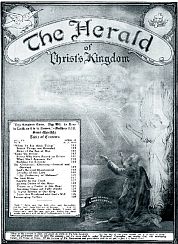
THE HERALD
of Christ's Kingdom
VOL. XI. September 1, 1928 No. 17
Table of Contents
CREEDS
TO MEET TO END WAR
THE
DEFENSE OF OUR HOLY FAITH
IF
CHRIST BE NOT RISEN
CHRIST'S
FINISHED WORK FOR US
THE
COLUMBUS CONVENTION
VOL. XI. September 15, 1928 No. 18
Table of Contents
THE
MISSION OF SORROW AND SUFFERING IN THE CHRISTIAN LIFE
DRAWING
WATER FROM THE WELLS OF SALVATION
"IT
IS HIGH TIME TO AWAKE OUT OF SLEEP"
STRENGTH
AND PEACE THROUGH FAITH
THE
LAMB OF GOD APPROVED
WORDS
OF ENCOURAGEMENT
VOL.
XI. September 1, 1928 No. 17
PRACTICALLY ALL RELIGIONS OF WORLD
WILL GATHER AT
GENEVA CONFERENCE
NOTWITHSTANDING
the fact that the civilized world is in a state of outward peace, it is manifest that all
nations are laboring under the spirit of depression on account of the fear and hatred that
exist everywhere under the surface. Hence great movements in the direction of world peace
continue to receive much attention from prominent leaders in all parts of the earth. As if
by instinct, all nationalities recognize that they appear to be steadily marching toward
a. great cataclysm of trouble that threatens all civilization, and are thereby impelled to
try every remedy and to mobilize their forces to avert the inevitable catastrophe. The
latest world peace effort under way, and one that appears to be of more gigantic
proportions than any heretofore launched, is announced in the columns of the "New
York World," of August the 5th, under the heading, "Creeds to Meet September 12
to end War," and reads:
"On
September 12 of this year, a new conference will open at Geneva, the city of many
conferences. It will contradict the familiar saying that never the East and West shall
meet.
"This
first meeting is a preliminary conference of delegates from all over the world to perfect
plans for the Universal Religious Peace Conference which will probably be held in 1930.
Arrangements are being made for this world-wide movement in which men and women from all
countries and of all religions can come together each year to discuss ways and means of
preventing war and establishing permanently that 'peace on earth,' which periodically
seems to be among the lost causes.
"Never
before in the history of the world has any such attempt been made to mobilize the
religious life and impulse of the whole world in a concerted action for universal human
brotherhood and the abolition of war.
"To Inventory Great Religions"
"Can
religion establish the spirit of peace where the treaties of trade have failed? To
accomplish this end is the high purpose of the Universal Religious Peace Conference. By
making an inventory of the elements in each of the great religions it will seek to find
out how they may contribute to the building of international justice and good will and
seek to further the spirit which peace demands.
"Individuals
from the historic religions in all nations, and others, like the Bahais and the
Theosophists, whose creeds are more recently formed, have been invited to attend the
conference. Confucianists, Mohammedans, Jains and Buddhists; Jews, Taoists and Christians;
America, Europe, the Near East and the Far East, will sink their different views on
religion for the sake of the greater common good. The eager responses to these invitations
show how anxious is the whole world for peace. Some of the delegates are already on their
way to Geneva. A number of them must traverse continents and oceans by boat and train.
Others will come across mountains and deserts, probably in ancient Biblical fashion, by
camel or on mule-back.
"These
pioneer delegates who will attend the preliminary conference number about ninety persons,
including representatives from the eleven living religions, officers of the Church Peace
Union, members of the committee and à number of notable men and women from various walks
in Fife who believe that religion offers a means of establishing lasting peace on earth
and good will among men. The proposed organization is an offspring of the Church Peace
Union, founded in 1914 by Andrew Carnegie. The union is financing the first meeting. If
the preliminary conference proves a success the Universal Religious Peace Conference will
thenceforth be able to stand on its own feet.
"The Books Used by Peacemakers"
"The
New York Headquarters for the conference is a businesslike place. The walls of the outer
office are lined with books whose militaristic titles contrast sharply with the peaceful
aim of the organization. The Bible is prominent on one shelf. On another are such books as
'Face to Face with Kaiserism,' 'The Soul of the Russian Revolution,' 'India and the War,'
'Militarism and Statecraft,' 'The War and Humanity.' Those books are as necessary to the
peacemaker as his medical charts are to a doctor. Before attempting to cure an evil its
aspect must first be studied and understood.
"The
world was never more urgently in need of devout men of faith who are concerned for the
brotherhood of mankind. Another war, like the Great War, might destroy civilization.
Linley V. Gordon, Extension Secretary of the Universal Religious Peace Conference, sees
humanity at the crossroads with the forces of religion pointing one way, the other leading
back to the jungle.
"'It is
astonishing,' Mr. Linley said, 'that so much has been done in the way of organization for
peace and yet to feel the world still hungering for deliverance from fear and hatred.
"'The
Great War was fought for security. It did not bring it. The statesmen of the world met at
Versailles to formulate a peace treaty that would usher in an era of security. It did not
come. Into the peace treaty went the twenty-six Articles of the League of Nations
Covenant, but notwithstanding the service rendered by the League, security and peace have
not appeared. Not even Locarno gave a sense of security.
"'Why
all this endless restlessness and turbulence; why the weakness of these new instruments?
"'Because
men have not been spiritually at peace. Because of the lack of the spirit of religion the
best laid plans have often broken down. How can any international agency function
successfully unless it is inspired by fraternity and fearlessness, trust and good will?'
"Can Religions of World Stop It?"
"The
work of inspiring that fraternity and building that trust into the world is the stupendous
task which the Universal Religious Peace Conference will undertake. The question will no
longer be, What has Christianity, or Buddhism, or Mohammedanism, or Confucianism been
doing while the carnage continues, abut, by an organized stand, shoulder to shoulder, can
the religions of the world stop it?
"The
findings of this group of individuals, all holding different views on religion, will be
made without fear or favor. There will be no attempt to compare religions. Individual
doctrines and forms of faith will not be discussed. While each delegate will have the
opportunity to express himself and present his ideals of religion, there must be no
boasting of the past, nor of any superiority except in his ability to serve humanity and
rid the world of the age-old curse of war. The conference states as its sole purpose to
consider how the forces of religion can be mobilized in a concerted action against war and
that spirit and those things that make for war.'
"With
their ideal of world peace before them, the delegates will thus meet on a common ground of
brotherhood."
__________
In the midst
of the world's struggle for peace, there seems ever to be the consciousness of what the
real difficulty is, as expressed above, "because men have not been spiritually at
peace. Because of the lack of the spirit of religion the best laid plans have often broken
down." And then the writer goes on to ask "How can any international agency
function successfully unless it is inspired by fraternity and fearlessness, trust and good
will?" That question is indeed well put; and because love and true brotherhood are
sadly lacking, permanent peace and good will cannot be established without the assistance
of the Kingdom of God. Devout students of Divine revelation well recognize this fact. In
other words, men, in the present unregenerate condition of heart, with selfishness as the
dominating factor, cannot establish satisfactory conditions of peace. And hence at such a
time as this, when the world has attained enormous heights of knowledge and prosperity,
and when in nearly all directions we hear the cry, "Peace, Peace," the prophetic
voice of long Ages ago quietly announces that there is no real peace; because it is not
within the power of men to establish it. And so as the ancient Seer was permitted to look
across the centuries from his day to the present time and recognize the near approach of
the Kingdom of God, at which time humanity would be on the verge of a great social
upheaval, he said, "when they shall say, Peace and safety: then cometh sudden
destruction upon them."
In other
words, only the Kingdom of God can bring peace, and before that Kingdom can be
established, human schemes and plans must prove fruitless and end in failure. Only the
fulfillment of the prayer of Jesus, "Thy Kingdom come," can bring about a
realization of the conditions represented in the angelic proclamation, peace on earth,
good will toward men.
"Beloved, when I gave all
diligence to write unto you of the common Salvation, it was needful for me to write unto
you, and exhort you
that ye should earnestly contend for the faith which was
once delivered unto the saints." -- Jude 3.
AS FORETOLD
in the Scriptures, our day is one of apostasy; of growing unbelief and infidelity; doubt
and rejection of the Scriptures as the Divinely inspired Word of God, are on the increase
everywhere. From one standpoint the greatest and most severe test upon the people of God
today concerns in a very vital way the great foundation of their holy faith. No exercise
therefore can be more important for the children of God in these days, than that of
keeping fresh before the mind the various proofs and evidences of the inspiration of the
Bible, of the validity and reliability of the Scriptures as the Word of God. Having
recently had our attention called to a remarkable lecture given some years ago by H. L.
Hastings, that presents a convincing and comprehensive review of our faith and its
foundation, it has been deemed profitable to republish the lecture in these columns and
the same is submitted below:
The question
as to the inspiration of the Bible is not a question raised by me. It is a question that
is already up for discussion through the length and breadth of this land. What are we to
do with this book? How are we to regard it? Is it the best book in the world, or the
worst? Is it a true book or is it a false one? Is it God's book, or man's?
Over and
over again this book says, "Hear ye the Word of the Lord." Now, the Message is
the Word of the Lord, or it is a lie. It is the Word of the Lord, as it professes to be,
or else it is a cheat, a swindle, a humbug, a fraud.
The Bible Either Truth or Falsehood
To
illustrate: A man tells me that Jesus of Nazareth was a good man; but then, there were
other men just as good.
But while
you say, "He was simply one of many remarkable men," He says, "I came forth
from the Father, and am come into the world"; and again, "I leave the world, and
go to the Father." He says, "O Father, glorify Thou Me with Thine own self, with
the glory which I had with Thee before the world was." Now, do you say He was a good
man and yet He told lies? What is your idea of a good man? I do not believe that a good
man lies; and I do not believe that a man who lies is a good man. Perhaps you do, and if
so, you were brought up in a different way from that in which my father brought me up. So
I do not believe that a book packed with lies from one end to the other, is a good book;
and I do not want any one to come and tell me that Jesus Christ was a good man, and the
Bible is a good book, but neither of them tell the truth. I join issue there. This book is
what it professes to be, or it is a swindle; Jesus of Nazareth was what He professed to
be, or He was an impostor.
Suppose a
man comes to town and represents himself as the son of a British nobleman. He is
well-dressed and has plenty of money; but after a while they find out that he is the son
of a blacksmith, down in the next town. Now I do not want you to tell me how well he
behaves, what fine broadcloth he wears, or what a perfect gentleman he is in all his
deportment. The fact is that he is a liar, a fraud, and a scamp. He has come under false
colors, and palmed himself off on the community under false pretenses; and the more good
things you may say about him the less I think of him; because if he is such a
well-educated gentleman, he knows better than to be going around as a fraud, and deceiving
the people. So we must accept Jesus of Nazareth and His claims entirely, or else we must
reject the whole Gospel as an imposture, and as the grandest, most stupendous fraud the
world has ever known.
Striking Peculiarities of the Bible
Now, do not
be fooled by this talk about the Bible being demolished, overthrown, and exploded more
times than any other book you ever heard of. Every little while somebody starts up and
upsets this book; and it is like upsetting a solid cube of granite. It is just as big one
way as the other; and when you overturn it again, it is right side up still. They
overthrew the Bible a century ago, in Voltaire's time -- entirely demolished the whole
thing. "In less than a hundred years," said Voltaire, "Christianity will be
swept from existence, and have passed into history." Infidelity ran riot through
France, red-handed and impious. A century has passed away. Voltaire's old printing-press,
it is said, has since been used to print the Word of God; and the very house where he
lived has been packed with Bibles from garret to cellar, as a depot for the Bible Society.
Up to the year 1800, from four to six million copies of the Scriptures, in some thirty
different languages, comprised all that had been produced since the world began. Eighty
years later, in 1880, the statistics of eighty different Bible societies which are now in
existence with their unnumbered agencies and auxiliaries, report more than 165,000,000
Bibles, Testaments, and portions of Scripture, with two hundred and six new translations,
distributed by Bible societies alone since 1804; to say nothing of the unknown millions of
Bibles and Testaments which have been issued and circulated !by private publishers
throughout the world. For a book that has been exploded so many times, this book yet shows
signs of considerable life.
It Outlives Its Foes
But, after
all, this book seems to stand abuse, and thrive upon refutation: A few months ago some
learned men, after working for a number of years on the revision of the New Testament,
finished their work. Having inserted a few modern words, instead of others which had
become obsolete, made some slight corrections of errors in translation, and rectified from
ancient manuscripts some little errors which had been made by copyists in transcribing the
book, at last the book was announced as ready to be issued on a certain day. What was the
result? Why, men offered five hundred dollars to get a copy of that book a little in
advance of its publication; and the morning it was published the streets of New York were
blockaded with express wagons backed up and waiting for copies of that book which had been
refuted, exploded, and dead and buried for so many years. Millions of copies of that book
were sold as fast as they could be delivered. They telegraphed the whole of that book from
New York to Chicago, for the sake of getting it there to print in a newspaper twenty-four
hours in advance of the mail.
A dead book,
is it? They would not pay for telegraphing the greatest infidel speech ever delivered in
this country. This old book seems to show some signs of life yet.
It outlives
its foes. If you could gather all the books written against it, you could build a pyramid
higher than Bunker Hill Monument. Now and then. a man goes to work to refute the Bible;
and every time it is done, it has to be done over again the next day or the next year. And
then after its enemies have done their worst, some of its professed friends torture and
twist and misrepresent it. It lives through all that. Infidels have been at work for
nearly eighteen hundred years, firing away at it, and making about as much impression upon
it as you would shooting boiled peas at Gibraltar.
The Wisdom of Their Wise Shall Perish
The fact is,
this book has come into the world, and it seems to have come to stay. It is in the world,
and I do not know how you are to get it out. One hundred years ago you might have found
that book in twenty or thirty translations; but now you can find it in from between two
and three hundred different versions, most of which have been made in this last
progressive, intellectual, nineteenth century. All over the globe it goes; touch any shore
and you will find the book there before you.
Every one
knows that where this book has influence it makes things safe. Why is this? If it were a
bad book, we should expect to find it in the hands of the worst men. If it were a bad
book, you would expect a man to have a revolver in one pocket and a New Testament tucked
away in another.
What makes
the book so different from all other books? Whose book is it? Who made it? Infidels have
the strangest ideas of that subject. I recollect in Marlboro, Mass:, I read in. a paper an
article written by an infidel, which stated that the Council of Nice in the year 325
compiled the New Testament. They had a lot of Gospels and Epistles, genuine and spurious,
and no one could distinguish between the two; so they put them all on the floor, and
prayed that the good ones might get up on the Communion table and the bad ones stay on the
floor; and that was the way the present New Testament was compiled.
And that
very statement can be found in infidel books now published in Boston. This writer said
that this account rested on the authority of Papias, an early Christian bishop. I replied
in a lecture, that there was one difficulty about that story -- that Papias was dead and
buried a hundred and fifty years before the Council of Nice was held. The man rose to
explain, and said that this was not the right Papias, but that it was another Papias, an
obscure Christian bishop of the fourth century. I told him I thought he was obscure, so
obscure that no one ever heard of him before or since. On investigation it was learned
that a German dominie, named John Pappus, preacher in Strausburg, and a professor at
Munster, who died in 1610, discovered this story in an old Greek manuscript entitled
"Synodikon," which was written by some one down in the Dark Ages, about the year
900; for it relates things which occurred as late as 869, or five hundred years after the
Council of Nice was dead and buried. And this story, written nobody knows when, where, or
by whom, has been swallowed, believed, and published by infidels far and near, as an
account of the origin of the New Testament.
The New Testament in Apostolic Days
I have on
one of my library shelves, between twenty and thirty volumes, containing about twelve
thousand pages of the writings of different Christian authors who wrote before A. D. 325,
when the Council of Nice was held. These books are full of Scripture. Those writers had
the same books which we have; they quoted the same passages which we quote; they quoted
from the same books from which we quote.
Origen, who
wrote a hundred years before the Council of Nice, quotes five thousand seven hundred and
forty five passages from all the books in the New Testament; Tertullian, A. D. 200, makes
more than three thousand quotations from the New Testament books; Clement, A. D. 194,
quotes three hundred and eighty passages; Irenaeus, A. D. 178, quotes seven hundred and
sixty-seven passages; Polycarp, who was martyred A. D. 165, after having served Christ
eighty-six years, in a single epistle quoted thirty-six passages; Justin Martyr; A. D.
140, also quotes from the New Testament; to say nothing of heathen and infidel writers
like Celsus, A. D. 150, and Prophyry, A. D. 304, who referred to and quoted multitudes of
the very passages now found in the Scriptures which we have. Indeed, Lord Hailes, of
Scotland, having searched the writings of the Christian Fathers to the end of the third
century, actually found the whole of the New Testament with the exception of less than a
dozen verses scattered through their writings which are still extant; so that, if at the
time of the Council of Nice every copy of the New Testament had been annihilated, the book
could have been reproduced from the writings of the early Christian Fathers, who quoted
the book as we quote it, and who believed it. And now infidels talk about the Council of
Nice getting up the New Testament. You might as well talk about a town-meeting getting up
the Revised Statutes of the State of Massachusetts, because they happened to say they
accepted or received them. The Council of Nice did nothing of the kind. The books of the
New Testament were received from the Apostles who wrote them, and were carefully
preserved, and publicly read in the churches of Christ long before the Council of Nice was
held.
Says
Tertullian, A: D. 200, "If you are willing to exercise your curiosity profitably in
the business of your salvation, visit the apostolic churches, in which the very chairs of
the Apostles still preside in their place; in which their very authentic letters are
recited, sounding forth the voice and representing the countenance of every one of them.
Is Achaia near you? You have Corinth. If you are not far from Macedonia you have Philippi
and Thessalonica; if you can go to Asia you have Ephesus, but if you are near to Italy we
have Rome."
These
apostolic churches received the Gospels at the hands of men who wrote them and the
Epistles were given and signed by men whom they well knew. Paul wrote, "The
salutation of me, Paul, by mine own hand, which is the token in every Epistle, so I
write."
Now, what
did these writers testify? They testified things which they knew. The Apostle John did not
say, "That which we have dreamed, imagined, or guessed at, that thing do we declare
unto you"; but "That which was from the beginning, which we have heard, which we
have seen with our eyes, which we have looked upon, and our hands have handled, of the
Word of Life." (1 John 1:1.) This was their testimony. They testified that they saw
Christ in His life and in His death; that they saw Him after His resurrection, and they
knew these things and testified of them. They preached Christ, who had died and risen
again. These Apostles suffered the loss. of all things, and imperiled their very lives in
proclaiming the truth; and they left their testimony on record in this book. Then, the
Apostles quote from the Prophets, and the Prophets quote from the Psalms, and refer to the
Law which was given on Mount Sinai; and so we go back from book to book, until we reach
the Book of Genesis, and that does not quote from anybody or anything. You have then
reached the fountain head.
Evidences that Bear the Impress of Divine Authorship
"But,"
says one, "I think the Bible may be a true history." So you think it is an easy
matter to tell the truth, do you? I wish you could make other people think so. Suppose you
go and read a file of the newspapers published just before the last election, and see if
you do not think it requires Divine inspiration to tell the truth, or even to find it out
after it is told. Truth is mighty hard to get at, as you can see by perusing the daily
papers on the eve of an election.
There are
certain things in the Bible which, to my mind, bear the impress of Divinity. A skeptic
will tell you what a race of sinners we read about in the Bible! Do you suppose that if
the Bible had been revised by a committee of eminent divines, and published by some great
religious society, we should ever have heard of Noah's drunkenness, or Jacob's cheating,
or of Peter's lying, cursing, or dissembling? Not at all. The good men, when they came to
such an incident, would have said, "There is no use in saying anything about that. It
is all past and gone; it will not help anything, and it will only hurt the cause." If
a committee of such eminent divines had prepared the Bible, you would have got a biography
of men whose characters were patterns of piety and propriety. Sometimes a man writes his
own diary, and happens to leave it for some one to print after he is dead; but he leaves
out all the mean tricks he ever did, and puts in all the good acts he can ever think of;
and you read the pages, filled with astonishment, and think, "What a wonderfully good
man he was!" But when the Almighty writes a man's life He tells the truth about him;
and there are not many who would want their lives printed if the Almighty wrote them.
When the
Lord undertakes to tell His story of a sinful man He does not select a poor, miserable
beggar, and show him up; He does not give even the name of the guilty woman who bathed the
Savior's feet with her tears; but He takes King David from the throne and sets him down in
sackcloth and ashes, and wrings from his heart the cry, "Have mercy upon me, O God,
according to Thy loving kindness; according to the multitude of Thy tender mercies blot
out all my transgressions." And then when he is pardoned, forgiven, cleansed, and
made whiter than snow, the pen of inspiration writes down the dark, damning record of his
crimes, and the king on his throne has not power nor wealth or influence enough to blot
the page; and it goes into history for infidels to scoff at for three thousand years. Who
wrote that?
You find a
man who will tell the truth about kings, warriors, princes and presidents today, and you
may be quite sure that he has within him the power of the Holy Spirit. And a book which
tells the faults of those who wrote it, and which tells you that "there is none
righteous, no, not one," bears in it the marks of a true book; for we all know that
men have faults and failings and sins, and among all the men described in that book, --
every man whose life is recorded has some defect, some blot, save one, and that is
"the Man Christ Jesus."
Supposed Absurdities and Errors
Men say
there are difficulties and absurdities and errors and contradictions in the Bible. After
speaking once in the city of Boston, an infidel came to me and told me that the Bible was
not true, for there was that story which Moses told about the quails. Israel lusted after
flesh, and the Lord sent them quails to eat, and they fell by the camp a day's journey on
each side, or over a territory forty miles across, and they were two cubits deep on the
ground, and the Israelites ate them for about a month. I have in my possession an infidel
paper which was published in Boston, in which there is about a column of arguments and
figures on this "quail story," giving an estimate of the number of bushels of
quail that were piled up over the country, and showing that when they were divided among
the six million Israelites each Jew would have 2,888,643 bushels of quail, which they were
to eat during the month, giving each poor Israelite 69,620 bushels of quail to eat at each
meal during the month; and therefore the Bible was not true! I answered that the Bible did
not say any such thing. He insisted that it did. "Well, said I, "find it!"
He could not find the place; so I turned over to the eleventh chapter of Numbers, and
there read that instead of the birds being packed like cordwood on the ground, three feet
deep, the account says that the Lord brought the quails from the sea, and let them fall by
the camp, as it were "two cubits high," or about three feet high upon or above
the face of the earth. That is, instead of flying overhead and out of reach, they were
brought in about three feet high, where any one could take as many of them as he chose.
And this skeptical friend had got the birds packed solid, three feet deep, over a
territory forty miles across. As if some one should say that a flock of geese flew as high
as Bunker Hill Monument, and we should insist that they were packed solid from the ground
up, two hundred and twenty-one feet high! This is a sample of the arguments to prove that
the Bible is not true!
Fulfilled Prophecy a Proof of Inspiration
The book, to
my mind, bears the marks of inspiration in the foresight which it exhibits. This book
foretells things. You cannot do that. You cannot tell what will be next year, or next
week. "The spirits," cannot tell who will be the next President. They may tell a
great many things that are past. They may tell you who your grandmother was, and may copy
the inscriptions on your grandfather's gravestone, and may tell things which were written
in the family record. They may reveal many things in the past -- for the devil knows about
the past -- but they cannot foretell the future.
The
revelations of prophecy are facts which exhibit the Divine omniscience. So long as Babylon
is in heaps, so long as Nineveh lies empty, void, and waste; so long as Egypt is the
basest of kingdoms; so long as Tyre is a place for the spreading of nets in the midst of
the sea; so long as Israel is scattered among all nations; so long as Jerusalem is trodden
under foot of the Gentiles; so long as the great empires of the world march on in their
predicted course-so long we have proof that one omniscient mind dictated that book, and
"prophecy came not in old time by the will of man."
A Complete Library in One Volume
We call this
Bible a book, but here are sixty-six different books, written by thirty or forty different
men. A man may say, "I do not believe in the Book of Esther." Well, what of
that? We have sixty-five others left. What will you do with them? A man says, "I find
fault with this chapter or with that." Suppose you do? If you were on trial for
murder and had sixty-six witnesses against you, suppose you impeach one of them, there are
sixty-five left; impeach another, and you still have sixtyifour left; impeach another, and
you have sixty-three -- enough to hang you up if you are guilty. Do you not see that you
cannot impeach this book unless you do it in detail? Each book bears its own witness, and
stands by itself on its own merits; and yet each book is linked with all the rest. Blot
out one, if you can. I am inclined to think it would be difficult to do this. This book is
built to stay together; it is inspired by one Spirit.
The
authorship of this book is wonderful. Here are words written by kings, by emperors, by
princes, by poets, by sages, by philosophers, by fishermen, by statesmen; by men learned
in the wisdom of Egypt, educated in the schools of Babylon, trained up at the feet of
rabbis in Jerusalem. It was written by men in exile, in the desert, and in shepherds'
tents, in "green pastures," and beside "still waters." Among its
authors we find the fishermen, the tax-gatherer, the herdsman, the gatherer of sycamore
fruit; we find poor men, rich men, statesmen, preachers, exiles, captains, legislators,
judges -- men of every grade and class. The authorship of this book is wonderful beyond
all other books.
And what a
book it is -- filled with law, ethics, prophecy, poetry, history, genealogy, sanitary
science, political economy. It contains all kinds of writings; but what a jumble it would
be if sixty-six books were written in this way by ordinary men. Suppose, for instance,
that we get sixty-six medical books, written by thirty or forty different doctors of
various schools, believers in allopathy, homeopathy, hydropathy, and all the other
opathies, bind them all together, and then undertake to doctor a man according to that
book! What man would be fool enough to risk the results of practicing such a system of
medicine? Or, suppose you get thirty-five editors at work writing treatises on politics,
and then see if you can find any leather strong enough to hold the books together when
they have got through.
The Diversified Authorship
Extending over Fifteen Hundred Years
But again,
it took fifteen hundred years to write this book, and the man who wrote the closing pages
of it had no communication with the man who commenced it. How did these men, writing
independently, produce such a book? Other books get out of date when they are ten or
twenty years old: but this book lives on through the Ages, and keeps abreast of the
mightiest thought and intellect of every Age.
Suppose that
thirty or forty men should walk in through that door. One man comes from Maine, another
from New Hampshire, another from Massachusetts, and so on from each state, each bearing a
block of marble of peculiar shape. Suppose I pile up these blocks in order until I have
the figure of a man, perfectly symmetrical and beautifully chiseled, and I say, "How
did these men, who had never seen each other, chisel out that beautiful statue?" You
say, "That is easily explained. One man planned that whole statue, made the patterns,
gave the directions, distributed them around; and so, each man working by the pattern, the
work fits accurately when completed." Very well. Here is a book coming from all
quarters, written by men of all classes, scattered through a period of fifteen hundred
year's; and yet this book is fitted together as a wondrous and harmonious whole. How was
it done? "Holy men of God spoke as they were moved by the Holy Spirit." One mind
inspires the whole book, one voice speaks in it all, and it is the voice of God.
The Influence of the Bible for Good
Again, I
conclude that this book has in it the very breath of God, from the effect that it produces
upon men. There are men who study philosophy, astronomy, geology, geography, and
mathematics, but did you ever hear a man say, "I was an outcast, a wretched
inebriate, a disgrace to my race, and a nuisance in the world, until I began to study
mathematics and learned the multiplication table, and then turned my attention to geology,
got me a little hammer, and, knocked off the corners of the rocks and studied the
formation of the earth; but since that time I have been as happy as the day is long; I
feel like singing all the time, my soul is full of triumph and peace; and health and
blessing have come to my desolate home once more." Did you ever hear a man ascribe
his redemption and salvation from intemperance and sin and vice to the multiplication
table, or the science of mathematics or geology? But I can bring you, not one man, or two,
or ten, but men by the thousand who will tell you, "I was wretched; I was lost; I
broke my poor old mother's heart; I beggared my family; my wife was broken-hearted and
dejected; my children fled from the sound of their father's footstep ; I was ruined,
reckless, helpless, homeless, hopeless, until I heard the words of that book!" And
since that Word entered his heart he will tell you that hope has dawned upon his vision;
that joy has inspired his heart; that his mouth is filled with grateful song. He will tell
you that the blush of health has come back to his poor wife's faded cheek; that the old
hats have vanished from the windows of his desolate home ; that his rags have been
exchanged for good clothes ; that his children run to meet him when he comes; that there
is bread on his table, fire on his hearth, and comfort in his dwelling. He will tell you
all that, and he will tell you that the book has done the work. Now, this book is working
just such miracles, and is doing it every day. If you have any other book that will do
such a work as this, bring it along. The work needs to be done; if you have the book that
will do it, bring it out. But for the present, while we are waiting for you, as we know
this book will do the work, we propose to use it until we can get something better.
Christians
sometimes try to defend the Word of God, but it is its own best witness and defender. The
best thing for us to do is to bring out the Word of God, and let "the Word of the
Spirit" prove its own power, as it pierces "even to the dividing asunder of soul
and spirit."
The book is
its own witness. It bears its own fruits and tells its own story. It is a sorrowful fact
that you can hardly go into a prayer meeting but you are likely to hear a quotation from
Scripture that is not in the Bible and never was. You may hear, "In the midst of life
we are in death," from the Prayer-book; "He tempers the wind to the shorn
lamb," from an old romance ; "God, unchangeably ordains whatsoever comes to
pass," from the Catechism; accompanied by passages misquoted, misunderstood, and
misapplied, which show that the people do not study their Bibles and do not understand
them. We need to read the Bible, to search it, study it, believe it, and obey it, and we
shall find that it is the Word of Salvation to the perishing, and that it is filled with
sanctifying power.
Proper Methods of Study
But, says
one, "I do not understand the Bible. I read it, but I cannot make anything out of
it." "How do you read your Bible?" "Oh, I read a chapter now and then!
I read it here and there." Suppose your boy comes home from school and says, "I
can't make anything of this arithmetic; it is all dark to me." You say to him,
"How did you study it?" "Oh, I read a little at the beginning, and then I
turned to the middle and read a little here and there, and skipped backward and forward.
But I don't understand it; I can't see into it."
You say to
him, "My son, that is not the way to understand arithmetic. You must begin with the
simplest elements, and master every principle, learn every rule, solve every problem, and
thus the whole book will open to you as you go on."
Take the
Bible, and read it from beginning to end, and see how it comes out. You will find it the
grandest and most thrilling story the world has ever known. Begin at the beginning, and
read until you find out who is the hero of the story. You will find that the presence of
one person pervades the whole book. If you go into the British navy yard, or on board a
British vessel, and pick up a piece of rope, you will find that there is one little
colored thread which runs through the whole of it -- through every foot of cordage which
belongs to the British Government -- so, if a piece of rope is stolen. it may be cut into
inch pieces but every piece has the mark which tells where it belongs. It is so with the
Bible. You might separate it into a thousand parts, and yet you will find one thought --
one great fact running through the whole of it. You will find it constantly pointing and
referring to one great Personage -- "the seed of the woman" that shall crush the
serpent's head; the seed of Abraham, in whom all the nations of the earth shall be
blessed; the seed of David,. who shall sit on David's throne, and reign forever; the
despised and rejected sufferer, the "man of sorrows," "the Christ of
God," born in Bethlehem, crucified on Calvary, rising triumphant from Joseph's tomb,
ascending to sit at God's right hand, and coming again to judge the world and reign as
King and Lord of ail forever. Around this one mighty Personage this whole book revolves.
"To Him give all the Prophets witness"; and this book, which predicts His coming
in its earliest pages, which foreshadows His Person and His ministry through all its
observances, types, and sacred prophecies, reveals in' its closing lines the eternal
splendor which shall crown and consummate His mighty work.
It Unfolds God's Everlasting Purpose
God's Word
declares the end from the beginning. It is not only the chart which guides every weary
wanderer to his own eternal rest, but it is the record of the great Plan and Purpose of
the Almighty. It unfolds God's everlasting Purpose, as manifested in Christ Jesus; and if
any one will read three chapters at the first of the Bible and three at the end, he will
be struck with the correspondence which there exists.
At the
beginning of the Bible we find a new world: "In the beginning God created the heavens
and the earth." At the end of the Bible we find a new world: "I saw a new heaven
and a new earth; for the first heaven and the first earth were passed away." At the
beginning we find Satan entering to deceive and destroy,; at the end we find Satan cast
out, "that he should deceive the nations no more." At the beginning, sin and
pain and sorrow and sighing and death find entrance to the world; at the end, there shall
be no more pain or sorrow, no sighing, and no more death. At the beginning, the earth, for
man's transgression is cursed with thorns and thistles; at the end, "there shall be
no more curse, but the throne of God and of the Lamb shall be in it." At the
beginning, we find the tree of life in paradise, from which the sinner is shut away by a
flaming sword, lest he eat and live forever; at the end, we find the tree of life again
"in the midst of the paradise of God," and the blessed and the blood-washed ones
have a right to the tree of life, and "enter in through the gates into the
city." At the beginning, man was beneath the dominion of death and the grave; at the
end, "the dead, small and great; stand before God," the sea gives up its dead,
and death and hell are destroyed in the lake of fire. At the beginning, the first Adam
lost his dominion over earth, and was driven out. of the garden of Eden in shame and
sorrow; at the end, we find the second Adam, victorious over sin and death, enthroned as
'King and Lord of all, and reigning in triumph and glory forever.
Now, when
you get the plan of this book, you find that it is something more than a book of detached
sentences, good maxims, and comforting words. It is a book which unfolds the Divine
Purpose, and reveals not only the way of Salvation, but it marks the pathway of the people
of God through this wilderness, and reveals the destiny of the world and the Church.
When we look
at these facts we see that this is no man-made book. When Columbus discovered the river
Orinoco, some one said he had found an island. He replied, "No such river as that
flows from an island. That mighty torrent must drain the waters of a continent." So
this book comes, not from the empty hearts of impostors, liars and deceivers; it springs
from the 'eternal depths of Divine wisdom, love and grace. It is the transcript of the
Divine mind, the unfolding of the Divine Purpose; the revelation of the Divine will. God
help us to receive it, to believe it, and be saved through Christ.
"And God shall wipe away all tears
from their eyes; and their shall be
no more death, neither sorrow, nor crying, neither shall there be
any more pain; for the former things are
passed away." -- Rev. 21:4
IT SOMETIMES
helps to make truth clearer and bring home to our hearts a soul-cheering message by
considering some of the great verities of our faith, in their negative aspects. This
method is frequently employed in the Scriptures. Again and again we find truth illuminated
in this way in the New Testament. Take for instance, St. Paul's great statement, "If
Christ be not risen from the dead" -- what? If we could imagine the Apostle pausing
in his discourse to hear our reply to such a stupendous question, or waiting for us to
take its meaning before proceeding with his argument, we would surely find the answer
pressing in upon our hearts like the cold clammy hand of death, as we shrank with horror
from the contemplation of the inevitable doom of all our hopes, if so be, that Christ be
not risen.
If Christ be
not risen, then all our hope and faith are in vain, we are yet in our sins, for the world
is yet without a Savior; "then they also which are fallen asleep in Christ are
perished." Then the sentience of eternal death is pronounced upon all our rare and
the eternal future enveloped in "the blackness of darkness forever." Then the
present night of sorrow and weeping, cannot be ameliorated by the consolations of a coming
joy and blessedness, to be experienced in the sweet bye and bye, when death shall be
destroyed, and all sorrow and pain, anguish and tears, shall be forever banished from the
earth.
Life a Great Mystery if There Be No Resurrection
If there be
no resurrection hope the inexplicable problems of man's present brief span of life
"of few days, and full of trouble," must remain unsolved, and the wisdom of his
Creator must also remain an impenetrable mystery. Then every tear, every broken heart,
every death, and all humanity's unavoidable sorrows would find expression in the complaint
of job, whose experiences were so typical of the universal character of man's present lot
"Wherefore then hast Thou brought me forth out of the womb? Oh that I had given up
the ghost, and no. eye had seen me! I should have been as though I had not been; I should
have been carried from the womb to the grave." Surely life would have been a tragedy
indeed!
If we could
imagine ourselves transported up to some elevation above the earth from which we could
view all the misery and woe, pain and anguish, sin and degradation of humanity in all
quarters of the globe, for twenty-four hours; and then remember that for six thousand
years every revolution of the earth would have presented scenes equally appalling -- yes
frequently intensified by calamities, pestilence, idolatrous immoralities and religious
intolerance -- we would then have some real knowledge of the volume of humanity's cry, and
a more adequate understanding of the loathsomeness and awfulness of the leprosy of sin as
viewed by the holy of heaven.
Suppose we
were then informed for the first time, that Jesus had come to earth; moved with compassion
and pity for mankind, that He had lived amongst men and. taught them to hope in Him as
their Savior and Deliverer through a resurrection, that He had died but never rose again
from the tomb, and that therefore all hope for the resurrection of any must be abandoned,
for if Christ be not risen then there can be no resurrection of the dead. Would we not
then say, "Oh what a colossal mistake it was to bring into existence a race of beings
possessed of such instinctive longing for life under better conditions, capable of
resisting the powers of despondency and utter discouragement even under the most trying
experiences, clinging to the hope of a happier day, despite the darkness of the night, and
regaling the gloom with their songs of a "better day coming bye and bye"! Better
far that the race had never existed, since the accumulated sorrows so: far outweigh the
comparatively few transitory pleasures enjoyed by the more fortunate members of the me,
for even those pleasures would be turned to apples of Sodom under the blight of that awful
conclusion "If Christ be not risen,"
What Shall We Do Who Are Baptized for
the Dead?
Again we
remember that throughout the Age there have been men and women who have loved
righteousness and purity, who have been delivered out of, and kept from, the depths of
human depravity, inspired by hopes of the eternal perfection and fellowships of heaven,
and the attainment of a place in glory with their Lord in His future reign; who have
suffered privations, persecutions and death, not counting their lives dear unto
themselves, strengthened by a confidence in His Word of promise that He would come again
and receive them unto Himself. What shall we say of these? Surely we must conclude with
the Apostle, "If in this life only we have hope in Christ, we are of all men most
miserable"; all is foolishness. "If the dead rise not, let us eat and drink for
tomorrow we die." (1 Cor. 15:19, 32.) How deeply this negative aspect of doctrine
strikes into the very depths of everything that is dear and precious to our hearts! The
peace that passeth human comprehension, and the joy unspeakable and full of glory, that
bears us up on eagle wings, is then a delusion, and all our blessed contemplations of the
joys beyond the tomb in our "house not made with hands, eternal in the heavens,"
have been but the thrill of a fictitious tale.
If Christ be
not risen, then there can be no such thing as a soul washed white, no experience of
forgiving grace and deliverance from the burden of conscious guilt; no message to the
weary and heavy laden to come and find rest in the arms of One who is willing and able to
help, save, and keep; no eternal home where the "rest that remaineth for the people
of God" may be entered into and enjoyed forever beyond the power of any foe to
interrupt.
The Sacred Records in Vain without Resurrection Hope
If Christ be
not risen then there is no waiting Savior to greet the faithful victor over the powers of
evil, with "His sweet well done," no Father's welcome to a Bride. gathered from
earth, and made meet companion for His beloved Son, in all the works and joys of an
endless life. A sealed tomb would be the end of all such hopes, and the cold earth would
enfold in its relentless embrace, every longing for such a future, tear from us our best
beloved forever' and ever, and turn to dust the glories of such a prospect.
If Christ be
not risen, then life becomes a tragedy that death makes mock of, in fiendish glee. Its
blight must fall on almost everything we touch, and its shadow darken every hill and
valley into which we might roam in search of consolation, comfort, or inspiration. As
children of God, we would foster the highest hopes and aspire to lofty attainments in
purity, holiness, and perfection, and in doing so we feel the need of special
encouragement to keep, on in the struggle against flesh and blood, yea against all the
invisible powers of darkness. If we turn for such encouragement to the records of men and
women, who in a former age, "subdued kingdoms, wrought righteousness, out of weakness
were made strong, waxed valiant in fight, who were stoned, sawn asunder, tempted, slain
with the sword, wandered about in sheepskins and goatskins, being destitute, afflicted,
tormented, of whom the world was not worthy," we must sooner or later discover that
such records are nothing but "vanity and vexation of spirit"; for after all they
tell only of a wasted life and a fanatical unwisdom. For if their faithfulness cannot be
rewarded with "a better resurrection" then their sacrifices were all in vain,
and their hopes have perished with them. Likewise the thrilling story of faithful
Apostles, martyrs, pastors, and teachers, who for the past two thousand years have been
inspired to an emulation of the examples of this "great cloud of witnesses," and
have left behind a record of heroism, fidelity, and purity unsurpassed in the annals of
history, must also be discounted, rejected, yea, repudiated with contempt, for if so be
that "the dead rise not," they are found false witnesses, playing upon the
tenderest feelings and longings of the human heart.
No Keys of Death and Hades if the Dead Rise not
But even if
we must discredit the record of former Ages, because they are valueless, if hope is dead,
and if the witness of Apostles and martyrs must be reduced to the level of false
testimony, we still have not yet reached the end of this searching question of the
Apostle, "if Christ be not risen." Deeper and more far reaching still is the
thought of how Jesus has entered into our lives, and molded our minds, and met our every
need; so much so that His removal would open before us an abyss so dark and void, that we
could well imagine ourselves deprived of even a place for our feet, leaving a desolate
earth aa a silent heaven. At one stroke the entire New Testament is swept away, except
perhaps the story of His descent to earth and His gracious words, and kindly deeds; but
His promises of a brighter day when He should come again in kingly power to rule and bless
the world would be but an idle tale. Now the Gospels could never be read without a pang of
regret. They would tell the story of His love for His friends, and "greater love hath
no man than this, that he lay down his life for his friends"; they would testify of
His love for a sinner race; that He came to give Himself a ransom for many, so that He
might some day return and stand at the door of the great prison house of death and set the
prisoners free; they would tell of His magnanimous love and sacrifice; but alas, there
could be no record of an open sepulchre, no proof of a risen Savior, triumphant over death
and possessed of the keys of death and Hades. Therefore there would be no basis for hope,
and consequently we must relinquish our hold on those precious records with that dirge of
melancholy in our hearts:
"Of all the sad words of tongue or
pen
The saddest are these, It might have been."
But if now
deprived of the comfort of the Scriptures, we instinctively turn for consolation to those
hymns and spiritual songs that have so often buoyed us up, and brought comfort and
strength to our chastened spirits, we are doomed to disappointment again. The awful truth
must be realized; our hymnals must go with our New Testament, if so be that the One who is
the center of both, is not risen, and enthroned in power, able and willing to help the
poor and needy, and to rejoice in the homage of grateful hearts.
The mind is
staggered at the thought of what it would mean to the saints, and to all who find
consolation and help in. the expressive language of true spiritual songs, if this medium
of the soul's exercise were snatched away. How truly the poet has suggested the thought
that occupies our mind:
"O! whither could we flee for aid,
When tempted, desolate, dismayed?
Or how would hosts of foes defeat,
Had suffering saints no mercy seat."
How often in
the past when we have been weighted down with the burden and stress of life, or
overwhelmed with bereavement and sorrow, or when the sun shone brightly over our pathway
and His praises have filled our hearts, we have turned to those glad songs, and found them
so expressive of our deepest needs, and our highest aspirations. But now these priceless
treasures must be abandoned also, for if we attempt to seek consolation here and pick up
our book in search of that solace, ,ere we have turned to the old familiar hymn a mocking
voice will have whispered in our ear, He is not risen. Then the cry for help, or the psalm
of praise, must die on our lips, for a dead Jesus could not hear.
All Our Glorious Hopes Rest upon a Risen Christ
Furthermore,
our loss must extend beyond this. The devastating work of that terrible "if" of
St. Paul has not been completed until every vestige of comfort and support is gone.
Deprived of the two great supports already mentioned, we turn now to those other valuable
helps that have brought so much joy into our lives, and served to keep our minds occupied
with higher hopes and deeper things than that which fills the lives of others. In the
desire that has been ours to see Jesus only, we have availed ourselves of many of those
helps that have been so generously and graciously provided us. The life of Christ has been
the central theme of so many books; likewise His doctrines, His pre-human, human and
present exalted conditions, His love for His saints, and for sinners. His preeminence in
all the Father's purposes, His place in Old Testament types and prophecies, the philosophy
of His sufferings and the glories of His reign, have all provided an inexhaustible field
of research and study. Many have been the faithful servants who have spent time and talent
in the unfolding of His matchless love and example. How we have prized these helps and
spent many hours feasting upon the depths of His life-giving words, as these have been
elucidated for us, by such pastors and teachers as have loved and honored His name, and
caught His spirit.
But we are
dealing with a question that now demands the removal of all these treasures from our
collection of books, tracts, or periodicals. Everything must go that has aught to say
about Jesus, that holds out hopes centered in Him that can never be realized, that
promises rest or peace through belief in His Word, or that encourages any hope of a future
life beyond the tomb. We must accustom ourselves to a world without a Savior, without
Jesus. With what saddened hearts we would part with the volumes, books and publications
that have become so much a part of our life, and numbered amongst our most precious,
earthly possessions! For if Christ be not risen, they are valueless to us, fostering a
delusive hope that is mocked by the stern realities of an endless oblivion.
How Sad if We Have no Message for Broken Hearts
Again, in a
world so full of sickness and death, how terrible the thought that we might be so utterly
powerless to console and comfort the sick and afflicted or to give encouragement to the
bereaved, if Christ be not risen! Could we imagine a situation more distressing, or think
of ourselves more helpless in the face of a great need, than to find ourselves in the
presence of death where a beloved wife, or husband, or child, had been taken away, and
broken hearts were yearning for some word of comfort, some consolation, something that
would assuage their grief, and we had to stand powerless and speechless without a message!
For if Christ be not risen, what is there to say that would help. How could we explain the
operations of that power that permits such separations; ofttimes separating devoted
families where love and peace prevail, and permitting the continuance of lives that are
full of strife and evil! How could we satisfy the broken heart that all was well, when
every fiber of body and mind was crying out against a fate shrouded in such blackness, and
without a ray of hope to which they might cling! Think of such scenes, multiplied
thousands of times in every day of human history, and try to weigh the tears and sorrows,
and to imagine the anguish of sympathetic but powerless friends to render aid, and then
know that we cannot even approximate the awfulness of that cry of anguish that must ensue
"if Christ be not risen."
He is not Here, but is Risen
"But
now is Christ risen from the dead and become the first fruits of them that slept." (1
Cor. 15:20.) Having presented the dark picture, suggestive of a Christ held captive in
death, and having stirred our souls to a realization of the possibilities of that
"if," the Apostle quickly reverses the picture and with triumphant affirmation
reveals a risen Christ who ever liveth, a Priest, forever after the order of Melchizedec,
which is God's assurance unto all men of a future resurrection and a rule of
righteousness, guaranteeing equity and justice to all. This, the greatest attested fact of
history, the deepest experience of countless human hearts, bears indisputable evidence of,
the great and glorious truth that He is risen, and has ascended on high, leading captivity
captive, and gives rise to the inspiring words of the poet:
"The rising Christ forsakes the
tomb;
In vain its bonds forbid His rise;
Cherubic legions guard Him Home,
And shout Him welcome to the skies.
"O! live forever, wondrous King!
Born to redeem, and strong to save;
O Death, thou monster, where's thy sting?
And where's thy victory, boasting
grave?"
Wondrous
truth, that sheds its joy and brightness beyond the tomb, and over the uncertainties and
shadows of this vail of tears imparting sweetness to all the bitter experiences of life!
For it assures us that death is not the end of all things, but having been conquered by
our risen Christ, the portals of the grave must open at His command, giving opportunity to
all to partake of that life, which is the gift of God; abundant life, full, free, joyous,
and blessed forevermore. Because He lives, we shall live also; Hallelujah, what a Savior!
With such a
hope as this, surely there must be a special responsibility resting upon us, we to whom
there has been committed the duty and privilege of preaching the Gospel of Christ. May it
not be that the present condition of things is a clarion call to us to make our preaching
more Christ centered. Preaching the Gospel means preaching Christ, the loving and risen
Christ, the living and present Christ, Christ, the Friend and Savior of men! Perhaps it is
because we have let our interest in other subjects so absorb our attention; that Christ
has been unintentionally crowded into the background, and we are found deficient in the
power to attract and hold men to Him. For it is of Christ; the forgiving and redeeming
Christ, the hungry soul longs to hear. "Sir, we would see Jesus!" is humanity's
cry. To possess and then to preach Him; that is the way to power, to peace and joy. All
would be well with the Church if we but had this realization of the constant presence of
the indwelling Christ; experiencing in heart and life the power that raised Christ from
the dead. For we would then be lifted above present trials and all lesser things by our
faith in a risen, all-conquering Christ, through whom all the promises of present grace
and future glory are yea, and amen, to those that believe. Let us, like the Apostle, glory
more and more in the cross of Christ, in its message of an open door into the favor of
God; in its symbolisms of a crucified life, a life laid down in deep, appreciation of the
wonderful privilege of our having fellowship in His sufferings, that we might share in the
glories to follow, when all tears shall be wiped off all faces, all sorrow, pain, crying,
and dying forever gone, and all things made new, for now is Christ risen from the dead.
[Contributed from outside the Editorial
Committee]
"For by one offering He hath
perfected forever
them that are [being] sanctified." -- Heb. 10:14.
THERE is a
very simple and concise statement in which three things are set in immediate relation to
each other: The Offering, the Perfecting, the Sanctifying; and if we study them in their
proper order, we shall see how completely they express the operations in respect to the
true people of God.
First, we
have the "one offering"; that is, a single offering; there can be no doubt as to
the meaning of this. It speaks of finality and efficacy, and permits of no additions nor
repetitions. It stands in its God-placed position in the center of the Ages, as an
isolated monument of redeeming love. It is unique in itself and in vivid contrast to the
thousands of sacrifices which preceded it (for the Law made nothing perfect) and its very
separateness stamps it with the Apostolic seal as having been given "once for
all."
Only a
philosophy either blind or arrogant would dare to belittle the God-ordained completeness
and scope of this "one offering." If the Apostle Paul wrote the words of our
text (and such is generally conceded), let us note how highly he esteemed this gracious
provision, and haw he even endeavored to exalt the Savior's sacrifice still higher by
lowering himself in self-abasement, when he confessed himself the "chief of
sinners." No wonder God hath highly exalted our Lord Jesus, and no wonder the Father
entrusts to Him a "name that is above every name." Let us never lose sight of
the place, power and value of that "one offering."
Perfected Forever
We proceed
then to examine the second point, "perfected forever." This expression may not
appear at first sight, in its true meaning, and unless we look carefully at the Apostle's
arguments in his Epistle to the Hebrews, we shall most likely get an incorrect view of
what he endeavors to prove. No instructed Christian should make the mistake of thinking
that perfection of being on any plane is here set forth. This is not a statement proving
either physical or moral perfection; but rather a description of an attitude of mind, a
state of mental satisfaction based upon a previously declared provision. Though this fact
is not hard to grasp, yet it is not generally accepted this way, and thus much of the
beauty of the Epistle to the Hebrews is wholly lost.
If the first
part of our text contrasts the mass of inferior sacrifices, with the superior Sacrifice,
then this second item of the text now under review, contrasts the ineffective and
precarious position in which law sacrificers stood as against the firm and permanent
standing provided for those who "have faith in His blood," "justified
freely from all things from which they could not be justified by the Law of Moses."
The poet has well expressed this great truth:
"On Christ the solid Rock I stand
All other ground is sinking sand."
And while
faith's anchor holds, this permanent state holds good also and provides a basis and
groundwork for each "perfected" one to go on to know the Lord; for the
sanctifying influences must of necessity follow after those experiences which first
brought the helpless sinner from darkness into light.
Freedom from the Guilt of Sin
The Apostle
therefore rightly shows that if under the sacrifice of the Law, the worshipers only gained
typical or temporary release from the accumulated failures of a year, and hence were
compelled to offer "year by year continually" those things which could never
take away sins, then how great the contrasted experiences must be for us who by "one
offering" receive "respite forever," that is, permanently while we rest by
faith under His blood. That there is no attempt to teach a literal perfection or
sinlessness of any persons, is clearly shown by the several references made by the Apostle
to the consciences of those to whom he wrote, that is, to the consciences of believers in
general. Note carefully the four following occasions where such reference is made and we
are sure that the permanency of the rest of heart by faith is here clearly taught and that
alone.
All these
quotations which follow will be found to be directly connected with each other in the
general treatment of the Apostle's subject
(a)
"Both gifts and sacrifices that could not make him that did the service, perfect as
pertaining to the conscience." -- Heb. 9:9.
(b)
"The blood of Christ . . . purge your consciences from dead works to serve the living
God." -- Heb. 9:14.
(c)
"The worshipers once purged should have had no more conscience of sins [that is, no
longer be conscious of any condemnation against them]." -- Heb. 10:2.
(d)
"Let us draw near . . . in full assurance of faith, having our hearts sprinkled from
an evil conscience [that is, from a consciousness of evil]." -- Heb. 10 :22.
The Comfort of the Scriptures
This
provision from our Father in heaven is rightly called the "comfort of the
Scriptures." It is obvious to all saintly ones who desire to walk in the Lord's ways,
that in themselves there are constant evidences of failure, disloyalty, and error though
such persons are at heart truly filled with love to Him and to our Lord Jesus. Their
blemishes might give cause for doubts and fears, did they not know that He has perfected
them forever, [permanently] as pertaining to the conscience, and additionally provided for
them in Jesus their Advocate and Intercessor, the very Comforter they need in respect to
their weaknesses. He is able to succor those who are tempted, for has He not been touched
with a feeling of our infirmities? The wisest counselor on earth could never have devised,
nor even thought out, such a scheme as this and truly we see in it, the depth of the
riches and wisdom of God. Let each perfected one then always remember that he has been and
is daily a recipient of Divine unmerited favor, and as each of us contemplates this fact,
let us be ready to sympathize with others in the Narrow Way, always ready to comfort the
sorrowful and uplift the weak, and thus encourage them on their heavenward journey. Thus
resting by faith in His blood, every faithful follower can fully enter into the new joys
of being sanctified; and this brings us to the third item of our text, "being
sanctified."
Though many
individuals have shared in the blessed assurance of there being "no condemnation to
them that are in Christ Jesus," yet all may not at once have seen how beautiful is
the way that opens before them, giving them possibilities of experiencing joys from the
Lord which are the heritage only of those who. walk by faith and which can not be
comprehended in the least degree by any other human beings at present.
It is at
such a stage in their experiences that the importance of learning to gauge the true value
of both the earthly and the heavenly treasures, becomes a necessity. It is also the period
when the desires are turned to new things, and when a cleansing process begins in the mind
and heart, urging each one to greater caution and steadfastness.
Christ's One Objective
Thoughts
that control the words and deeds, must at this juncture begin to permanently take their
place in the mind, and in reality the mind must become entirely renewed as the Apostle
says, "Let this mind be in you which was also in Christ Jesus." We therefore
naturally ask, What is the "mind" of Christ Jesus ? This is a good question and
if the right answer is found from the Scriptures, there is no doubt that the faithful
followers of the Lord will redouble their efforts to get their minds renewed and cleansed
by the means provided. It is astonishing what a wealth of information is found in the Book
of Hebrews in this connection and though the record is not unduly wordy, it is clear and
very convincing.
Our Lord
Jesus possessed an earnest and constant desire to do God's will, in fact, such was the
secret of His whole life, and it provided the power by which He overcame. His mind had but
one objective, and that was that God's will might be paramount, first and last, and that
nothing should be permitted to interpose itself between Him and His Father in this
respect. The Apostle quoted from some of the Prophet's words when he wrote Heb. 10:5, 6,
which conclusively shows that God had become weary, as it were, of the typical sacrifices
offered under Israel's Law; tired of the formalism and idolatry they had attached to it;
hence verse 7 gives a contrasted picture of the mind of Christ, "Lo I come . . . to
do Thy will O God." This burning desire was that which sanctified our Lord Jesus in
body and spirit. He turned neither right nor left, but held on in faithfulness to the very
end. "To do Thy will O God." Now notice the application the Apostle makes of
this, "By the which will we are sanctified by the offering of the body of Jesus
Christ once for all."
Review our
text again and hear the Apostle say, "For by one offering He has perfected forever
them that are [being] sanctified," and we have at once the secret of how the renewed
mind can become as the mind of Christ, because it has an objective placed before it, to do
God's will. It was for doing God's will that the Savior was brought to Calvary, and it was
the work on Calvary that brought its out from the kingdom of darkness into the Kingdom of
God's dear Son, the Kingdom of light.
"Let Us Draw Near"
In exact
harmony with the foregoing, the Apostle says, "Be ye transformed by the renewing of
your mind, that ye may prove what is that good; and acceptable and perfect will of
God." All this should give us great cause to be thankful, and also provide us with
the means for encouraging others to learn how good it is to do God's will, and what a
large share of earth's setbacks and sorrows are made ineffective and neutralized, by the
compensating satisfaction of being "perfected" and sanctified by Jesus who
willed to do the will of God successfully:
"I love Thy will O God!
Thy blessed, perfect will,
In which this once rebellious heart
Lies satisfied and still."
Though the
Apostle has said much that fills us with thankfulness and courage, yet we find, as we
continue to study his words, that as a faithful guide and teacher he does not refrain from
putting the other side of the question clearly in the shape of solemn warnings against
possible pride, arrogance and presumption.
He prefaces
these warnings with healthy admonitions, and urges his hearers to keep alive the spiritual
graces, which always prove sure antidotes against failure in doing God's will. Listen to
his encouraging words: Let us draw near with a true heart in full assurance of faith,
having our hearts sprinkled from an evil conscience and our body (Revised Version) washed
in pure Water. Let us hold fast the profession of our faith without wavering. Let us
consider one another and provoke unto love and good works. Let us assemble together. Let
us exhort one another etc. -- Heb. 10:22. There are valuable remedies always at hand in
the believer's spiritual medicine chest, because in Heb. 10:26, which immediately follows
the foregoing, the Apostle points out the dread enemy which lurks in the shadows of
discontent, hatred, pride, malice, envy, and ready to ambush the unwary.
Cast not Away Your Confidence
A failure,
says the Apostle, under the Law of Moses brought forth swift and relentless punishment
"Of how much sorer punishment suppose ye shall he be thought worthy, who hath trodden
underfoot the Son of God, and hath counted the blood of the Covenant wherewith he was
sanctified, an unholy thing . . . . It is a fearful thing to fall into the hands of the
living God!" Whatever can such language imply? Does it, as we ,often thought; show us
the awful doom of the ignorant heathen or the blatant atheist? Is its immediate reference
to the common thief, perjurer, or murderer? No, we answer, none of these as such, is
warned here., This warning is alone for those of whom the. Apostle wrote just a little
earlier, when he said, "For by one offering He hath perfected forever them that are
[being] sanctified."
So if any of
these should profane or despise the Covenant blood, then indeed such would fall into. the
hands of the living God, and in that event, truly "our God is a consuming fire."
(Heb. 12 :29.) We have no desire to dwell on this phase of the matter, but with the
beloved Apostle we quickly change the subject and say with him, "Cast not. away
therefore. your confidence which hath great recompense of reward." (Heb. 10:35.) Our
God is always ready to encourage His people, and He is a rewarder of them, that diligently
seek Him. His gifts are shared out with a lavish hand, and no good thing will He withhold
from those who walk uprightly.
As we have
therefore received the abundance of grace, let us draw near with a pure heart, knowing
that He who is for us, is greater than all who may, rise against us, and with the true
sacrificial. spirit let us celebrate His name!
SURELY the
anticipations of the brethren were fully realized in connection with the Convention held
at Columbus, Ohio,, August 4th and 5th. "It was good to be there," was the
heart felt sentiment of all; and this was manifest not only in word but in the
countenances and in the conduct of the friends in their intercourse together. The
blessedness expressed in the beautiful hymn was again realized, "The fellowship of
kindred minds; is like to that above."
The Class of
Associated Bible Students at Columbus is amongst those who in recent months have realized
it their privilege to enjoy a larger, and broader fellowship in Christ and fuller liberty
in Him to search and believe His Holy Word.
The
gathering at Columbus was made up of friends who had come from several points of some
distance from that city; about sixty altogether were in attendance on Sunday, and this
number was considered quite good. It was evident that the expectations of the brethren
were fully realized in the season of sweet spiritual fellowship in the Lord. The theme
upon the hearts and lips of all seemed to be the "Old, old story, of gracious
heavenly love"; praise to the King of kings for His abundant grace, mercy and love in
having called us out of darkness into His marvelous light.
In these
stirring times of unrest and confusion; of distress and perplexity over the world, the
serene and peaceful state of mind and heart so strikingly in evidence in those assembled,
gave assurance that the spirit of the Lord is still guiding and directing the counsels and
meditations of His people. The promise of the Scriptures is being realized in the
experiences of those who are firmly standing for the liberty wherewith Christ hath made us
free, and who contend earnestly for what they know to be right and true in the sight of
God and men, that, "in quietness and confidence shall be your strength."
The
discourses and testimonies of the brethren at Columbus, exalted the name of our God and
His well beloved Son; Jesus Christ. The glories and beauties of the Divine character were
reviewed as they shine out in one or another of the features of the Divine Plan of the
Ages. The solemn instructions of our Father's Word, admonitions and exhortations, which
have to do with inspiring the Christian with zeal, hope and love, were called to mind and
considered with profit to all. It was noted again that the Christian life is indeed a
progressive one; that "speaking the truth in love, we may grow up into Him in all
things, which is the Head, even Christ"; that this signifies that throughout the
Christian pilgrimage here we should experience greater and still greater depths of that
love Divine, all love excelling, and shall be caused to "know what is the hope of His
calling, and what the riches of the glory of His inheritance in the saints, and what. is
the exceeding greatness of His power to usward who believe, according to the working of
His mighty power."
Surely the
prominent note of the Convention was the love of Christ, the love of God, and love for one
another. All with one accord recognized that this condition of heart leads to peace and
rest -- rest in the Lord and in His sure promises that His eternal purposes shall yet be
accomplished and that soon all the faithful children of God will be delivered and blessed
forevermore.
Many of the
friends in recent years have realized but little of the convention privileges and hence
all such opportunities are all the more appreciated. A considerable number at Columbus,
expressed themselves as either desiring or intending to be present at the Buffalo
Convention. September 1-3. It is hoped that many will, in the Lord's providence, realize
the privilege of having part in the fellowship at Buffalo.
VOL.
XI. September 15, 1928 No. 18
"For our light affliction, which
is but for a moment, worketh for us
a far more exceeding and eternal weight of glory; while we look not
at the things which are seen: for the things which are seen are temporal;
but the things which are not seen are
eternal." -- 2 Cor. 4:17, 18.
THE WHOLE
creation groaneth and travaileth together until now," says the Apostle Paul; and
children .of God are no exception to this universal rule -- we also "groan within
ourselves, waiting for the adoption, the deliverance of our body" -- our company, the
Body of Christ. As was evidently contemplated in the Divine program, pain and suffering
form a large part of the experiences of our race under the reign of sin and death.
Accordingly it is well recognized that the life of every human being has its lights and
shadows, its heights of joy and its depths of sorrow. And as one has said, these
constitute the "warp and the woof of experience; and the web of character which flows
from the active loom of life, will be fine and beautiful or coarse and homely, according
to the skill and carefulness with which the individual weaves into it the threads of
experience." In every life, under the present circumstances of the predominance of
evil, the somber shades prevail. Thus the Apostle Paul had goad ground for his sweeping
statement respecting the groaning of the entire creation.
Prosperity Presents Subtle Dangers
But it is a
well recognized fact by every devout and careful student of the Divine Word, that those
who are invited to enter upon those glorious offices of the coming Age, are permitted of
God to pass through special experiences of suffering; yea, His providences so order it,
that they taste more deeply of the cup of sorrow and suffering than others of the human
race. While these are waiting for their deliverance, the daily experiences of life have a
most important mission to them, and the manner in which they receive them should be a
matter of deepest concern; for according to the use they make of them, each day's
prosperity or its adversity and trial, bears to them a blessing or a curse. Is it not true
that :those experiences which we are accustomed to regard as prosperous, often have in
them subtle dangers? If wealth increases or friends multiply, or a large measure of
earthly joy comes to us; how almost imperceptibly the heart finds its satisfaction in the
things of earth! But when the keen edge of sorrow and disappointment is felt, when riches
or health fail, when friends forsake, and enemies take up their reproach against us, the
natural tendency is to despondency and despair.
It is in
this connection that we observe a very important part of the great warfare of the
Christian life. If the Christian would please the Lord and make progress in that life of
spiritual development, holiness, and nearness to the Lord he must resist the tendency of
his natural humanity and must call upon his faith to confidently claim and expect the
victory in the strength of the great Captain of his salvation. It will not do for him to
yield to the alluring influences of favorable outward conditions; neither must he sink
beneath the weight of trials and adversities. In fact, he must not permit any experience
in life however hard and painful, to sour and harden him, or make him bitter, morose, or
unloving. Nor may he allow pride or love of show, or self-righteousness, to feed upon the
temporal blessings which the Lord in His loving providence has given him to prove his
faithfulness as a steward. With regard to the element of pride, another has well remarked:
"If anything is foreign to the spirit of Christianity it is boastful pride, and yet
it is one of those things which is difficult for conscience to reach, as it is generally
baptized with the name of self-respect." Pride is therefore one of the subtle enemies
of every new creature over which there must be triumph and victory.
"Ye Have Seen the Patience of Job"
The saints
of every Age ,have learned the blessing of afflictions and sorrows. The Psalmist David
says, "It is good for me that I have been afflicted, that I might learn Thy
statutes"; and again, "Before I was afflicted, I went astray; but now have I
kept Thy Word." (Psa. 119:67, 71.) God's faithful servant job suffered almost
overwhelming troubles, but the Lord brought him out into a large place when his testings
had accomplished their designed effect. He was proven and strengthened by his sore
experiences. Few if any .of us could suffer more. He suffered the loss of all his
property, then of all his children, whom 'he loved, then of the love and loyalty of his
wife; and finally, he was smitten with sore disease-boils, from head to foot. To crown
all, three of his friends came to see him on hearing of his great trials; and instead of
being true comforters, they added to his sorrows by insisting that his own sins must have
been the cause of all these disasters; that his experiences must surely be punishments
from the Lord because of unfaithfulness on his part. Surely poor Job was afflicted!
But did he
lose his faith in God? Hear him: "The Lord gave and the Lord hath taken away; blessed
be the Name of the Lord!" (Job 1:21.) "Though He slay me, yet will I trust in
Him." (Job 13:15.) Job was indeed much cast down, but he maintained his integrity of
character and his faith in the Lord through all. He did not charge God with injustice, and
God did not desert His faithful servant. He reproved his accusers and required them to
offer sacrifice, and instructed job to pray for them, that their trespasses might be
overlooked. In the end, he was blessed more abundantly than ever before. God made him a
great type of the human family, of the troubles of their fallen condition and of their
final restoration to all that was lost in Adam, with the blessings of added experiences to
make them wise. How faithful is the Lord in all His dealings! Truly His children should
never doubt His love.
Tests of Loyalty of Heart
The true
people of God, the saintly, in this dispensation are not left in ignorance of the logic
and reason, the why and wherefore of their present experiences and sufferings. This is
indeed the dispensation of the Spirit; when the Spirit of God searcheth all things, yea,
the deep things of God and reveals the Divine purpose and will concerning those who are
being chosen to be special heirs of salvation. The Spirit speaks with a directness upon
this subject: "Every son whom the Father receiveth, He chasteneth." According to
the counsel of the Spirit of God, all chastenings are testings, but all chastenings are
not necessarily punishments. The true child of God will judge of the purpose of his
experiences by self-examination, that he may ascertain whether in his conduct there has
been something out of harmony with the Father's will. In every case his experience is a
test of his loyalty of heart-as to his willingness to learn the lessons which the Lord is
seeking to teach, and his recognition of the source from, which they come.
The trials,
sorrows, and reverses of the consecrated child of God are not to be esteemed as the
result of Divine carelessness or indifference in regard to his interest, but rather as the
outworking of Divine providence in his behalf. Those who are, enabled to see matters from
this broad view point, are thus prepared to learn some of life's most helpful lessons,
and are thereby being qualified for the glorious future which God has foreordained for
those who faithfully carry out their covenant of sacrifice.
Ordinarily,
the word chastisement is used to signify correction for wrong doing. But in the Bible it
is especially used to convey the thought of discipline or instruction in righteousness.
Sometimes we use it in this way in the ordinary affairs of the present life. When one
commits sin he receives punishment indeed. But those who are earnestly striving to do
right are continually receiving the discipline of the Lord.
A Striking Illustration
There is
truly a Divine and exalted purpose in this training or chastisement. Those who com pose
the Church of Christ are learning how to build character pleasing in the Father's sight,
to be well fitted for that special service; and discipline is the means employed for that
instruction. The following illustration may serve to impress this lesson: If a man were
about to undertake the training of a dog for the circus, he would first of all choose the
right kind of an animal for that particular service. He would not think of selecting any
dog that might chance to come under his observation; he would be very exclusive in his
choice and select one that was capable of being taught. In carrying out his course of
instruction, he might find it necessary to chastise the dog severely in order to impress
upon his mind a certain lesson and to teach him some trick. This would not signify that
the animal was; bad, surly or vicious, but that there was no other way by which he could
learn. An animal that was being fitted to guard the house would not need the same training
that was necessary for the do that was to perform in public. The watchdog must know how to
guard property; but the animal that is to charm the public by jumping through hoops and
performing other spectacular feats, must be trained carefully by one who has in mind his
particular future career.
So it is
with the children of God. They need practical lessons in character development of a very
high order and consequently they are receiving experimental knowledge such as no other
creatures in the universe receive. Because they are trying to live righteously, trying to
please the Heavenly Father, they are being chastened for instruction, that they may be
fully conformed to the Divine will, that they may lay aside their own preferences,
desires, and ambitions, that they may not do their own will, but that of the Lord.
Such
experiences are not for the human race in general. Such experiences were not to the first
man. He was merely required to live in harmony with his environment and to be obedient to
his Creator. Neither are such experiences for the angels. They are required merely to live
righteously, to avoid sin, and to use their existence in harmony with the Divine purpose's
of their creation. Therefore we do not read that the angels have ever come under any
particular course of discipline or chastisement.
With those,
however, who are to be associated with the great Redeemer and ultimately to be exalted to
the Divine nature and glory, it is necessary that they make special manifestation of
loyalty, of self-abasement, and of self- sacrifice. What was true of Christ is also true
of His Church, His Body, which He purchased with His own precious blood. Such are called
to follow in His steps; hence every son whom the Father receives, He thus chastens.
We revert to
the illustration of the dog under training for a special purpose: The animal must yield
himself submissively to his teacher. Another dog that was watching the process by which
the one was being trained, might think that he was suffering unnecessary hardship, and
might feel that if it were himself he would assert his rights and not suffer so much. But
in the end the trained animal would prove to be the most valuable, for the one that had
escaped the suffering would remain only a commonplace dog.
A Special Premium upon Patient Suffering
So it is
with the saints of God: There are those who may say of God's children, "Those who
endeavor to do God's will suffer more than do those who do not try; we do not care to
undertake any such experience." Such as reason thus may succeed in having fewer
trials in the present life, but they will have blessings of a lower order in the world to
come, when the faithful Church will be glorified together with her Lord and Head.
These
experiences with sorrow and trouble are the very tests of character necessary for our
development. Evidently, the reason why some of the consecrated will be ultimately assigned
a lower place in God's arrangement is that they have not exercised -enough determination,
not a sufficiency of strength of character. They are such as have been willing to
compromise; and because of this willingness to, do so, they weaken their character. To be
an overcomer of the highest order, one must develop under the Spirit's leading and
training, the quality or element of fortitude, of strength of character at any cost.
There is a
further mission and purpose in the sorrows and sufferings of God's children: It is the
personal knowledge of and acquaintance with Himself that God desires and seeks from every
one whom He is choosing to the special reward of the future. Trouble and adversity are often made to minister
to this end. Yet the Lord has promised rich supplies of His grace while His faithful ones
are passing through the furnace of affliction. Sorrow and grief may, and often will, come
in like a flood; but the Lord will be our stay and strength in every experience which He
permits. The soul that has never known the discipline of sorrow and trouble has never yet
learned the joy and preciousness of the Lord's love and helpfulness. Is it not in seasons
of overwhelming sorrow and grief, that we are constrained to draw near to the Lord, and
does He not draw especially near to us at such times? So the Psalmist found it when in his
deep affliction he cried to God, saying, "Out of the depths have I cried unto Thee, O
Lord! Lord, hear my voice; let Thine ears be attentive to the voice of my
supplications!" Deeply conscious of his infirmities and shortcomings, longing for
full deliverance from every imperfection, and prophesying of the bountiful provisions of
the Divine Plan of Salvation through Christ, he adds, "If Thou, Lord, should mark
iniquities [imputing them to us], O Lord, who shall stand? But there is forgiveness with
Thee, that Thou mayest be feared [reverenced]."
Depths of Sorrow Lead to Heights of Joy
How precious
are such assurances when the soul is painfully conscious of its infirmities, of its utter
inability to fully measure up to the perfect law of righteousness! How blessed it is to
know that when our hearts are loyal and true, our God does not mark against us the
unavoidable blemishes of our earthen vessel! If we come daily to Him for cleansing,
through the merits of our Redeemer, our failures are not imputed to us, but freely
forgiven and washed away. The perfect righteousness of our Savior is our glorious dress,
arrayed in which we may come to God with humble boldness, courage, even into the presence
of the great Jehovah, the King of kings and Lord of lords.
If thus God
ignores the infirmities of our flesh, and fully receives us and communes with us, as His
dear children, we should so regard one another, considering not and charging not against
one another the infirmities of the flesh, which each humbly confesses, and which they,
like us, are earnestly endeavoring to overcome by the grace of God, to the best of their
ability. To each one of the Lord's true children the words of the Apostle apply: "If
God be for us, who can be against us? . . . Who shall lay anything to the charge of God's
Elect? Shall that God that justifieth? Who is he that condemneth? Shall Christ that
died?" (Rom. 8:31, 33, 34-Diaglott) The case is different, however, when the
infirmities of the flesh are cultivated, indulged in without proper effort to correct
them, and are justified, in order that the faults may be continued. Then, indeed, they are
charged against us, and if we do not speedily "judge ourselves," and take
decisive measures to correct them, the Lord Himself will judge and chasten us. -- 1 Con.
11:31, 32.
In the midst
of the cares, perplexities, and difficulties that come to the children of the Lord, we are
to trust Him fully, and to possess our souls in peace and patience! We are to wait
patiently for the Lord to outwork the issues of our experiences in His own good way. How
necessary is the patient waiting on the Lord! The Psalmist says, "I wait for the
Lord, my soul doth wait, and in His Word do I hope: My soul waiteth for the Lord more than
they that watch for the morning: I say, more than they that watch for the morning."
(Psa. 130:5, 6.) In every experience of sorrow and distress, and when the strain and the
jarring discords and the stinging vexations, and wounds that make the heart bleed,
threaten to overwhelm the spirit, let the child of God remember that "He knows, and
loves, and cares," and that His ministering angel is ever near us, and .that no trial
will be permitted to be too severe. The dear Master is standing by the crucible, and the
furnace heat will never be permitted to grow so intense that the precious gold of our
characters shall be destroyed, or even injured. Ah, no If by His grace the experiences may
not work for our good, they will be turned aside. He loves us too well to permit any
needless sorrow, any needless suffering.
Sweet Realization of His Abiding Care
"Commit
thy way unto the Lord, trust also in Him, and He shall bring it to pass. And He shall
bring forth thy righteousness as the light, and thy judgment as the noonday. Rest in the
Lord, and wait patiently for Him." (Psa. 37:5-7.) We must not be disappointed and
allow our faith to falter when the test of patient endurance is applied, while the outward
peace and quietness which we crave tarry long. Our Father has not forgotten us when the
answer to our .prayers seems to be delayed. Outward peace and calm are not always the
conditions best suited to our needs as New Creatures; and we would not desire conditions
in which the precious fruits of the Spirit would not grow 'and develop in us. Therefore,
"Think it not strange concerning the. fiery trial which shall try you, as though some
strange thing happened unto you, but rejoice." (1 Pet. 4:12, 13.) He who numbers the
very hairs of our heads is never indifferent to the sufferings and needs of His weakest
and humblest child. Oh, how sweet is the realization of such loving, abiding. care!
"When He giveth quietness, who then can make trouble?"
This is
Divine consolation, the only consolation that has in it any virtue of healing or
refreshment. It is reserved alone for those notable souls who are faithfully bearing the
burden and heat of the day, in the service of the King òf kings; while those who
listlessly drift with the current of, the world and the downward tendencies of the carnal
nature can never have an intimation of its sweetness.
In the Valley of the Shadow of Death
How loving
and tender is our God, and how wise and strong! His promises have never failed those who
have put their trust in Him. We may feel that our efforts to be good and to do good are
very unproductive, that the opposition from without and within is very strong. But it is
when we are weak, when we realize our own helplessness and incompetency, that we may be
strong in the Lord and in the power of His might. It is then that we may realize that His
strength is made perfect in our weakness. The fact that we are weak and lame does not
separate us from the love and power of our God, while we are striving to do His will; for
"He knoweth our frame, He remembereth that we are dust." Then let us more and
more lay hold of this strength of the Lord, that we may courageously pursue our course in
the narrow way of difficulty and trial. Precious indeed to the saint of God is the
ministry of pain and sorrow!
The
beautiful lesson of trust and confidence in the strength and protection of the Divine arm,
and the further suggestion of solace and comfort in the midst of dangers and distressing
circumstances, are forcefully brought to our attention in the shepherd Psalm: "Though
I walk through the valley of the shadow of death, I will fear no evil." Indeed the
ways of God's children are such as are here suggested. Shadows of evil, of sorrow, dark
disaster, yes, of death, are frequently hovering over the pathway of such as are earnestly
striving to please God. And while it is true as the poet has said, that even to the Lord's
true disciple, "sometimes the shadows are deep, and rough seems the path to the
goal," yet he "fears no evil."
In the green
pastures and beside the still waters of life's journey, when the pathway is smooth and
leads out through the sunlight, it seems easy enough to talk about the Good Shepherd and
speak of Him as the One who sought us and found us and led us to these green pastures and
quiet. resting places; and so we say, "He leadeth me." But as we move down into
the dark valleys of trial and affliction, when nothing of an earthly, nature can be found
to comfort our hearts and remove our fears, we feel the need of drawing closer to our
great Shepherd; and addressing Him in closer, more tender terms we say, "For Thou art
with me." It is then that we realize as not at other times how precious is the
promise: "When thou' passest through the waters, I will be with thee; and through the
rivers, they shall not overflow thee; when thou walkest through the fire thou shalt not be
burned; neither shall the flames kindle upon thee; for I am the Lord thy God ; the Holy
One of Israel, thy Savior." -- Isa. 43:2, 3.
Trusting God in the Dark
One has
said: "We pass through many a valley of shadow, ere we reach the valley. And whenever we feel our souls
overcast, we should stay to consider if there be a cause arising. from our neglect or sin.
If there be, a moment's confession will bring us out again into the light. But if there be
none, so far as we can tell, then let us be brave to plod on. Every step has been measured
out for us; even as it has been trodden before us. And God is testing its, to see whether
we can trust Him in the dark as well as in the light; and whether we can be as true to Him
when all pleasurable emotions have faded off our hearts, as when we walked with. Him in
the light. There is a good purpose in all these shadowed valleys. They test the quality of
the soul. They reveal our weak places. They unveil the stars that peer down through the
interstices of a rock or tree. They make us follow the Shepherd closely, lest we lose.
Him. They teach us the value of the rod and staff. Blessed are those who do not see, but
who yet believe; and who are content to be stripped of all joy and comfort and ecstasy, if
it be the Shepherd's will, so long as there is left to them the sound of His voice, and
the knowledge that He is near." The ancient Prophet of God seems to refer to such a
possible experience when he says: "Who is among you that feareth the Lord [Jehovah],
that obeyeth the voice of His servant [Christ], that walketh in darkness, and hath no
light? Let him trust in the name of the Lord, and stay upon his God." -- Isa. 50:10.
Preciousness of Intimate Fellowship with, God
While it may
not be of frequent occurrence, yet there are times in the Christian's experience when he
realizes that there is nothing for him to do but to trust in the naked promise that the
Good Shepherd is with him. The word of promise then becomes truly as real as if we heard
His voice, "I am with thee"; "I will never leave thee nor forsake
thee." It is indeed well to be able to. say, "What time I am afraid I will trust
Thee," but it is much better to be able to say, "I will trust Thee and not be
afraid." Another has said, "The darkness is sometimes too dense for us to be
able to see Christ. But faith can always be sure that He is there; not because of the
evidence of sense or feeling, but because He has said, 'I will never leave thee, nor
forsake thee.' He cannot break His word. He has not left us alone. He is looking down upon
us with unabated tenderness. The depths may sever Him from the apprehension of our love;
but neither death nor life, nor height nor depth, can separate us from the strong grasp of
His faithful and unchanging affection. Yes, 'the mountains may depart, and the hills be
removed; but His kindness will not depart from thee, neither will the covenant of His peace be removed."'
It is when
continued trust in the Lord and His many responsive providences in our lives, has ripened
into precious personal acquaintance and intimacy, that we learn to delight in Him. Yes, it
is when heart answers to heart, when pleading ,prayer brings recognized answers of peace,
when the Divine love and care have been clearly seen in the guidance of our way, that we
can recognize the abiding presence with us of the Father and the Son. Then, however dark
may be our way, however severe may be the storm that rages about us, the thought of Divine
protection is ever with us, so that as the children of the Lord we are never in despair;
though cast down, we are not destroyed, though .persecuted, we are never forsaken. We know
our Father's hand is ever at the helm, that His love and care are sure and unfailing.
Those who
have come into real heart sympathy with Go-d, have learned to see Him as the Fountain of
all goodness and -truth and blessing. To them He is the One altogether lovely. His Law is
their delight. His friendship and love are their very life. When the heart has become thus
centered in God it is the most natural impulse to commit its way unto Him. Such can truly
sing with the poet:
"Let sorrow do its work,
Send grief and pain;
Sweet are Thy messengers,
Sweet their refrain."
Surely these
have the desires of their heart, and no good thing shall be withheld from them. Their
fervent prayers avail much, and in the Lord's good time their righteousness, however much
it may now be misunderstood, misrepresented and evil spoken of, shall be brought forth as
the light -- clear, cloudless, and widely manifest; and their judgment, the justice and
righteousness of their course and of their hearts, shall be brought forth as the noonday.
Even, while we remain here as aliens and foreigners in the enemy's land, we shall be fed,
nourished, temporally. and spiritually, and shall rejoice-and be glad in the "house
of our pilgrimage." Precious indeed are the promises of God; and to the praise of His
abounding grace, His saints of the past and of the present all bear ample testimony to
their fulfillment.
"As ye have therefore received
Christ Jesus the Lord, so walk ye in Him: rooted and built up in Him, and stablished in
the faith, as ye have been taught, abounding therein with thanksgiving." -- Col. 2:6,
7.
HOW
beautiful in the, sight of right thinking me in
a well-balanced, self-possessed disciplined character! And in contrast with such, how
unlovely are the undisciplined and ungoverned -- the selfish, the unjust, the unkind, and
the violent-tempered! Naturally, the one awakens in us emotions of pleasure and
admiration, and the other, of pain. And if such is the appreciation of virtue and the
abhorrence of the lack of it among men who have lost much of the original image of God,
with what a keen appreciation must they be observed by a pure and holy God!
Men of the
world who have no personal acquaintance with God have no special thought as to how they
appear in His sight; but with what carefulness should those who love Him and who value His
approval, study to conform their conduct to His pure and holy mind! True, all who are
"begotten again," notwithstanding their imperfections and shortcomings through
inherited weaknesses, are acceptable to God through Christ, whose robe of righteousness
amply covers them; but the measure of their acceptableness to God, even through Christ, is
only to the extent that, while availing themselves of His imputed righteousness, they are
earnestly striving to attain actually to the standard of perfection. By so doing they
manifest their real appreciation of the Divine favor.
While the
heights of perfection cannot be reached so long as we still have these imperfect bodies,
there should be in every child of God very perceptible and continuous growth in grace, and
each step gained should be considered but the stepping stone to higher attainments. If
there is no perceptible growth into the likeness of God, or if there is a backward
tendency, or a listless standstill, there is cause for alarm.
Keeping in
mind the many illustrations in the Scriptures whereby the Lord would have us appreciate
the thought of our progressive development in grace and knowledge, we are impressed with
the Apostle's admonition in our text. Having received Christ Jesus the Lord through the
appropriation of His merit, and having made full consecration of ourselves to Him, we are
further urged to become "rooted and built up in Him and stablished in the
faith." How frequently we are thus reminded that it is the Divine purpose that the
favors and blessings He bestows upon us, are intended to produce strong, established
characters, rooted and grounded in the principles of righteousness, and firmly settled in
the truth of His Word.
I Will not Forget Thy Word
Jesus we
remember taught "First the blade, then the ear, then the full corn in the ear,"
and this order of growth is everywhere recognized in the Scriptures, in both the Old and
New Testaments. Thus the Apostles are continually urging growth and progress, admonishing
us to "grow up into Him," to press on, "Till we all attain to a full grown
man, to the measure of the full stature of the Anointed One." (Eph. 4:13.) Likewise,
the Psalmist declares of the righteous inhabitants of Zion, "They go from strength to
strength." (Psa. 84:7.) And again, "Blessed is the man whose delight is in the
Law of the Lord, and who doth meditate therein day and night. He shall be like a tree
planted by the rivers of water, that bringeth forth his fruit in his season; his leaf also
shall not wither; and whatsoever he doeth shall prosper."-Psa. 1:1-3.
Then he
frames for us this resolution: "I will meditate in Thy precepts, and have respect
unto Thy ways; I will delight myself in Thy statutes; I will not forget Thy Word."
(Psa. 119:15, 16.) Here is the secret of a pure and noble life, acceptable to God. It is
to be attained, not merely by prayers and righteous resolutions, but in addition to these,
by careful painstaking heed, by systematic and diligent effort in self-cultivation, by
care and perseverance in weeding out evil thoughts, and by diligent and constant
cultivation of pure, benevolent and noble thoughts, and by nipping in the bud the weeds of
perversity before they bring forth their hasty harvest of sinful words and deeds.
If we make
the Word of God the theme of our constant meditation, its principles will soon be
assimilated and become part of our mental makeup, making our characters more beautiful and
commendable both to God and to our fellowmen; and in harmony with this habit of the mind
the acts of life will speak.
Deep Down in the Bosom of the Rock
The purified
fountain will send forth sweeter waters than formerly, bearing refreshment and good cheer
to all who come in contact with it. It will make happier homes -- better husbands, better
wives and better children. It will sweeten the temper, soften the voice, dignify the
language, cultivate the manners, ennoble the sentiments, and lend its charming grace to
every simple duty. It will bring in the principles of love and cast out the discordant
elements of selfishness. Thus it will make the home the very garden spot of earth, where
every virtue and every grace will have ample room to expand and grow. Another has
remarked:
"So
many professing Christians are like those surface springs, that are but the mere drainings
of the upper soil. They promise well in certain seasons; they gush and flow in copious
streams when the air is full of rain and the ground is soaked with water. It is easy
enough to be a spring then. But where are they when the dry time comes, when the sun is
high and the ground is baked with heat? Men seek them, and alas! they are not to be found.
When springs are needed most they disappear, and where waters flowed is nothing found but
and sand. It is not so hard to keep up appearances of spiritual strength in times of
revival, when 'showers of blessing' fall around, but in times of drought, under the scorn
of the world, under the burning heat of bitter opposition, of fiery trial, of persecution
-- how is it with the soul then? Does it remain in its place, giving out as before the
gracious influences of a pure and meek and lowly spirit, or does it disappear and fade
away in sin and worldliness?
"Oh,
how good a thing it is to be a constant Christian! A Christian through all times and
seasons, in public and private, in all circumstances and conditions of life. Do you not
know such souls -- sweet-tempered, gentle, gracious souls, always near to God, always
with their faces shining with a light from heaven? You always know where to find them-at
the foot of the cross-ready to give you, a weary, thirsty seeker, a precious draught from
the overflowing chalice of their own faith-filled, loving hearts. But the reason why the
temperature of the [perpetual flowing] spring is always the same is because its sources
are deep. It has its origin far down below the surface of the earth among the very
foundations of the mountain itself. It is not fed by the drainage of the surface, but by
the ever living rock-hewn reservoir down in the secret places of the hills. All its
constancy and sweetness and purity is owing to the fact that its sources are deep. Herein
we have the explanation of a mystery in spiritual things. The faith that is firm and
changes not to suit the fashion of the times, that soul that is ever full of grace and
truth, the character that is Christlike, conforming not to the ways of the world, must have its sources deep -- deep down in the
bosom of the Rock. It is no wonder that many fail who profess faith in Christ, depending,
as they do, upon transitory emotions, upon shallow convictions and passing excitements.
They cannot endure a spiritual drought, because they have no depth. They have no real,
vital union with the only One who is able to keep them from falling, and to present them
'faultless before the presence óf His glory with exceeding joy."'
"Consider the Lilies"
Mr. Spurgeon
adds an interesting word that is closely related to the foregoing: "How lovely are
the lilies which grow in the water! They never pine with thirst; for their root is in the
stream, their leaves float upon it, and their flowers peep forth from it. They are fit
emblems of those believers who dwell in God, who are not occasional seekers of Divine
fellowship, but abide in Christ Jesus. Their roots are by the rivers of water, and
therefore their leaf shall not wither. A Christian minister once said to an aged
Christian, 'I pray the Lord often to visit you in His love.' 'Visit me'! cried the beloved
saint, 'Why say visit me? He lives here. Jesus dwells in me.' To that abiding fellowship,
we ought each one of us attain. 'Blessed are they that dwell in Thy house, they will still
be praising Thee.' . . . In this style of religion there are no doubts and fears; abundant
grace drowns all mistrust. A little grace will save, but it will not make us sure of our
safety. The fullness of the blessing can alone secure us the joy of it.
"The
longer I live, the more sure do I become that our happiness in life, our comfort in
trouble, and strength for service, all depend upon our living near to God, nay; dwelling
in God, as the lilies in the water. To grow on the bank of the river of the water of life
is good, but to grow in the stream is far better. God's lilies need to be in Him who is
their life. With all earnestness of' my soul, I would entreat all whom I love, to
cultivate continual communion with the Lord. It may require great watchfulness, but it
will well repay the believer for all his care. This river hath golden sands. Fellowship
with God is a land which floweth with milk and honey. I would rather spend an hour in the
presence of the Lord than a century in prosperity without Him. There are secrets of
unknown delight, which can never be known to us till we rise above the outward and
worldly, and come into the life of God, which is the life of Heaven. By faith this is to
be enjoyed even now. The faith which brought us life at the first, is the same by which we
attain to life more abundantly."
Go to the Fountain of Living Water
"There
is a great difference" remarks still another, "between water which is drawn from
the fountain, and water dipped from a stagnant pool. The one refreshes, the other
nauseates; the one is life-giving, the other brings poison and death.
"The
Word of God is a fountain of living water, but how often this water becomes stale,
adulterated, and defiled, in passing through the various channels of humanity. There are
sermons which have many of the thoughts of man, and few of the thoughts of God. Multitudes
of men content themselves with a secondhand Gospel, which is stale, flat, and
unprofitable. They do not search the Scriptures, they do not study the living Word, but
they depend on commentaries, sermons, misinterpretations and misquotations, and thus are
led into gross errors, and are derived of the freshness and vitality which resides in that
Word which liveth and abideth forever. The Word of God is living and powerful. We are to
be cleansed 'by the washing of water by the Word'; but that water must be living water. No
stagnant pool of human tradition, no turbid current of doctrinal controversy, can refresh
and cleanse the souls that thirst and pant for the living streams which flow from the
throne.
"Those
who would have living water must learn the way to the living fountain -- the Word of God
itself. A writer tells of two wells of the Doge of Venice; the water of one of them is
brought in barges from a distance, and few care to taste the insipid draught; the other is
a delicious natural well, cool and refreshing, and the people strive to obtain water from
this fountain.
"Ministers
of the Gospel, who long to be of use in this world, must not content themselves with being
mere sponges to absorb, and then give out the thoughts and ideas of others; they must, on
the contrary, draw water for themselves out of the well of salvation, and know the virtue
of those streams that make glad the city of our God. Let us turn away from the turbid
waters which men have fouled and defiled, .and let us learn to drink from the living
fountain, that which shall be in us a well of water springing up into everlasting
life."
The water of
life does not change; it is the same today as at the time when it was first issued forth.
It is the message of God's truth and grace through Christ which satisfies the thirsting,
longing soul. If we are satisfied that we have been building upon the Rock Foundation
furnished us in the Divine Revelation, we should expect that any further light coming to
us would not be contradictory to what we have found to be Scriptural and harmonious with
the Divine character. On the contrary, we should expect that all further light from the
Divine Word would be consistent with the foundations of our faith. Anything that would set
aside or make useless the first principles of the doctrines of Christ should be promptly
rejected.
"And that knowing the time, that
now it is high time to awake out of sleep; for now is our salvation nearer than when we
believed.
The night is far spent, the day is at hand." -- Rom: 13:11, 12.
PREVIOUS to
this exhortation the Apostle had been giving some wholesome counsel concerning the, proper
course of the Lord's people in the every-day duties of life. His advice seems to cover a
wide range of the little vexing cares and trials that every one must meet, and shows us
how to triumph in them through the mighty power of love. He evidently thought of the thin
veneer of politeness in the world which so often covers deep-seated selfishness, and
showed that our politeness and love should be only the genuine solid article, saying,
"Let love be without dissimulation [pretense or hypocrisy]. Abhor that which is evil
[abhor all shams and pretense]; cleave to that which is good. Be kindly affectioned one to
another; in honor preferring one another." He thought of the temptations and
vexations of our business intercourse with the world, and of its natural tendency to
engross time, energy and thought in worldly things, and therefore counseled, not that we
should give up all business, but that, while we should be energetic and "not slothful
in business," we should be careful always to be "fervent in spirit, serving the
Lord."
He thought
of the depressing tendency of the ever-present cares of life, and of the persecutions in
one form or another that are sure to come to those who will live godly; and so, while
admitting that no trial can for the present be otherwise than grievous, he tells us that
we may rejoice in hope; for the trial will not continue forever, and by and by it will
bring forth the peaceable fruits of righteousness if we are rightly exercised thereby, and
in the end the rewards of righteousness; and therefore he says we should be "patient
in tribulation; continuing instant in prayer" for that grace which is promised
according to our needs.
He thought
of the poverty and losses of some, and therefore counseled sympathy and hospitality --
"distributing to the necessity of the saints, given to hospitality. Rejoice with them
that do rejoice, and weep with them that weep. Be of the same mind one toward another.
Mind not high things, but condescend to men of low estate. Be not wise in your own
conceits. Bless [even] them which persecute you; bless and curse not. Recompense to no man
evil for evil. Provide things honest in the sight of all men."
He thought
of the numerous vexations arising from contact with those of undisciplined hearts and
said, "If it be possible, as much as lieth in you, live peaceably with all men.
Dearly beloved, avenge not yourselves, but rather give place unto wrath; for it is
written, Vengeance is Mine, I will repay, saith the Lord. Therefore, if thine enemy
hunger, feed him; if he thirst, give him drink: for in so; doing thou shalt heap coals of
fire on his head. [You will thus make him ashamed of his own conduct in contrast with
yours.]"
Finally, he
says, "Be not overcome of evil [do not allow the trials of life to make you sour, or
vindictive, or cold and, unsympathetic; nor allow the more favorable circumstances to make
you proud or high-minded or wise in your own conceits]; but overcome evil [of every kind]
with good."
Love the Fulfilling of the Law
Then he
instructs us to be law-abiding and God-honoring citizens in the communities in which we
live -- "rendering to all their dues: tribute to whom tribute is due; custom to whom
custom; fear [respectful deference or submission] to whom fear; honor to whom honor."
And after pointing to the several commandments of the moral law, he adds, "If there
be any other commandment, it is briefly comprehended in this saying, namely Thou shalt
love thy neighbor as thyself. Love worketh no ill to his neighbor: therefore love is the
fulfilling of the law."
Yes, love;
supreme love to God and then to the neighbor as to self, is that disposition of heart that
will make us victorious in every trial and temptation. In its operations toward God it
lays hold by faith upon His mighty power; it trusts His wisdom and His guidance; it takes
His standpoint of observation and patiently waits the outworking of His deep designs,
rejoicing in hope; and is persevering and faithful through all the painful processes that
lead on to victory. In its operations toward our fellow men it is pure, peaceable, kind;
forbearing, gentle, sympathetic, tender, and in strict conformity to the golden role.
"Do
this," says the Apostle-cultivate this Godlike disposition of love. And not only so,
but he would have us be diligent in its cultivation, "knowing the season,"
knowing that the time is short in which to build up in ourselves the Godlike and
Christlike character. We have not a moment to lose if we desire to, be finally approved of
God as meet for the inheritance of the saints in light.
What Manner of Persons Ought We to Be
If the
Apostle could say to the saints of his day, "Knowing the time, that now it is, high
time to awake out of sleep," etc., because they had then entered upon the Gospel Age
with its privilege of running the race for the prize of our High Calling, with how much
greater force do his words apply to these closing days of the Age. In the clear light of
unfolding prophecy we see that we are now living in the very end of the .harvest time;
that only a short time yet remains, and that before its close all the overcoming saints
will have passed the veil of the flesh and entered into the joy of the Lord as co-workers
with Him in the great work of the Kingdom. Yes, "the night is far spent" and
"the day [the glorious Millennial day] is at hand." Even now the gray streaks of
dawn appear. It is the day when the kingly Bridegroom shall receive unto Himself His ready
and waiting Bride, and the time is short in which to make ready for our gathering together
unto Him It is high time indeed to awake out of sleep; for now is our salvation, our
glorious deliverance very near.
It is
possible that some, even of the very dear and fully consecrated children of God,
surrounded by the cares of this life, or weary in the struggle against sin and evil, or
somewhat beguiled by the present things of time and sense, may have become more or less
drowsy, and so stand in special need of the stirring exhortation, "It is now high
time to awake out of sleep." It is a time for earnest, searching self-examination;
for a more diligent feeling after God, for a closer walk and more intimate fellowship with
Him, for more thorough self-abnegation, more diligent and persevering cross-bearing, and
more faithful conformity in every respect to the whole will of God concerning us.
The Apostle
says, "Let us cast off the works of darkness, and let us put on the armor of
light"; and again, "Put ye on the Lord Jesus Christ." A careful, prayerful
searching of our hearts will make plain wherein we lack of conformity to the perfect will
of God. And if we discover in ourselves any perverse way we will want to correct it and
the more fully to put on the armor of light -- the armor of righteousness and truth. Thus
we put on the Lord Jesus Christ-the mind or disposition of Christ, that spirit of love
which St. Paul says "is the fulfilling of the Law"-that love which worketh no,
ill to its neighbor; that suffereth long and is kind, that envieth not, that vaunteth not
itself, is not puffed up, doth not behave itself unseemly, seeketh not her own, is not
easily provoked,, thinketh no evil, that rejoiceth not in iniquity, but rejoiceth in the
truth; beareth all things, believeth all things, hopeth all things, endureth all things;
and without which, though we speak with the tongues of men and of angels and have it not,
we are only as sounding brass or a tinkling cymbal; and though we have the gift of
prophecy (teaching) and understand all mysteries and all knowledge, and though we have all
faith so that we could remove mountains, and though we bestow all our goods to feed the
poor, and even give our bodies to be burned, it profiteth nothing. -- 1 Cor. 13:1-7.
How
important, then, in the short time that remains to us here, that we awake fully and apply
ourselves most diligently to the cultivation of that Christlike character of holiness
without which no man shall see the Lord, or have a part in the privileges of the glorified
Church. Thus St. Peter also exhorts, "Wherefore, beloved; seeing that ye look for
such .things,, be diligent that ye may be found of Him in peace, without spot, and
blameless.'" -- 2 Pet: 3 :14.
All Must Render Account of Their Stewardship
But we are
to remember also that there is another feature of our faithfulness to the Lord that must
never be overlooked. Not only are we to be cleansed and sanctified by the knowledge of the
truth, but We have a responsibility or stewardship in connection therewith that represents
an important factor in our final approval before Him.
We recall
the words of St. Paul, "Moreover it is required of stewards that a man be found
faithful." Here is a positive element of character and a recognized obligation to
activity on the part of a, faithful steward who would merit his master's approval. A
steward is not merely a person of righteous character, whose life and conduct are above
reproach, but having been entrusted with his master's property, he is expected to be
diligent and careful in the use of his talents, and not to fold them away in a napkin to
be returned to. his master unused, just as he received them. Rather, he is to be
continually exercised in mind with the thought of the master's return, and his expectation
of finding not only his own, but as large and substantial an increase as possible, as an
evidence of the zeal and faithfulness of his appointed steward.
Thus we see
that there is no encouragement given to indolence and ease, but a definite requirement of
diligent and enterprising activity -- not the service of an hireling, whose chief
incentive is wages, nor service as men-pleasers, seeking present advantages, but the
intelligent, loving, spontaneous zeal of sons of God, as ministers of Christ and stewards
of 'the mysteries of God; holding fast to the faith once delivered to the .saints, and
"as to all things exhibiting thyself a pattern of good works, uncorrupted in the
teaching, seriousness." -- Titus 2:7, Diaglott.
"Who Is Sufficient for These Things?"
This
ministry, which all the consecrated, as ambassadors for Christ, have received, is one of
tremendous import. It greatly influences the final destiny of those to whom we preach this
Gospel of the Kingdom, the tendency being either to life or to death. "For we are
unto God a sweet savor of Christ, in them that are saved, and in them that perish. To the
one we are the savor of death unto death: and to the other the savor of life unto life.
And who is sufficient for these things? For we are not as many, which corrupt the Word of
God but as of sincerity, but as of God, in the sight of God speak we in Christ." (2
Cor. 2:15-17.) The Apostle's language here is another of the solemn warnings of the
inspired Word against the danger of the Second Death, and should awaken to a sense of
their danger any who have been deluded into the idea that there is no such possibility,
and are permitting the great Adversary thus to deceive them. There is an equal
responsibility on the part both of those who undertake to preach the Gospel and of those
who hear it. The truth is God's truth, and the responsibility of speaking as well as
hearing it is very great.
The
Apostle's words show that many in his day, as in ours, failed to realize this
responsibility, and, to answer their own selfish ends, corrupted the Word of God. To
willfully or recklessly corrupt the Word of God -- to vitiate its pure and holy doctrines;
to add to it the vain philosophies of ambitious men and seek to support their theories by
perverting its truths; to underrate its exceeding great and precious promises and mystify
the conditions upon which they may be realized; or to minimize or make void the solemn
warnings of the Word of God is indeed dangerous business, in which the faithful saints
will never engage, but in which those who fall away from the faith are usually most
active-deceiving and being deceived.
To be
faithful ambassadors for Christ-faithful representatives of the truth and faithful
proclaimers of it requires great humility and simplicity of heart. It necessitates the
complete ignoring of all worldly ambitions and aims, and the cultivation of a brave spirit
of endurance which will not shrink from any reproach which fidelity to the truth may
bring. And such service, the Apostle here shows, is acceptable to God as sweet incense, no
matter what may be the effect upon those to whom we minister, whether they accept or
reject the Message of Divine grace. What God is looking for in His people, is loyalty to
Him and devotion to His cause; and this condition of heart He appreciates, regardless of
their success or failure to secure large results. What a comfort it is amidst all the
discouraging circumstances of life, to know that the Spirit of Christ in the saints, is as
sweet incense to God. And the reward of His constant approval is richer than all the
unwholesome sweets of ambition gained by corrupting the Word of God.
Take Heed How Ye Hear
To the
hearer of this Gospel, the Message must prove either a savor of life unto (or tending to)
life, or a savor of death unto (or tending to) death. His responsibility is great: there
is no neutral ground; either he receives it or rejects it. But observe that the statement
is not that the rejection of any item of truth inevitably dooms the rejecter to death, and
vice versa, but that the tendency of such a course is to death, and of the opposite course
to life, unless interrupted -- changed.
Thus for
instance, the Lord, in reproving the Scribes and Pharisees, who rejected the Gospel and
yet claimed to be the children of God and leaders and examples of godliness to others,
significantly inquired, "How can ye escape the condemnation of Gehenna?" -- the
everlasting destruction, the Second Death. (Matt. 23:33.) In rejecting the truth so
plainly brought to their attention, and in pursuing the hypocritical course of claiming to
be faithful and devoted children of God, they were forming and establishing such
characters that repentance would, ere long, be impossible to them. Few, perhaps, clearly
realize how serious a thing it is to be making character, and that every act and every
thought leaves its impress upon the soul. Every right thought and act tend to establish
the character in righteousness, while every wrong thought and act, and every
self-deception tend to confirm and establish an unrighteous character. And when a wrong
course is adopted and persistently followed-when conscience is stifled, and when reason
and Scripture are perverted to selfish ends, until the heart is deceived and the judgment
is overcome-who can predict the repentance of such a one? Such construct characters or
wills so out of harmony with God and righteousness as. to be fit only, for destruction.
(Heb. 6:4-6.) How can such "escape the condemnation of Gehenna"? for God will
not permit any to live whose will is confirmed in unrighteousness.
By the Renewing of Our Minds
How
responsible then is the position of those who are building character in themselves and in
others! Remember that our characters are manifested by our habits of life; and each act,
even the smallest, tends to form some new habit, or to confirm one already established.
How important, then, that our thoughts and actions should not be aimless, but with a
purpose (1 Cor. 10:31); and above all, that our lives should be "transformed
[reformed] by the renewing of our minds"; that, putting aside the evil, and all
influences which tend toward evil, we should receive of the Lord, through His Word, the
"spirit of a sound mind," the "mind of Christ." In this view of the
case, it is indeed a solemn thing to live, a solemn thing to think, and to act; and it
behooves us to guard well our words, our thoughts and our actions, and ever to bear in
mind our responsibility to God, both for ourselves and for others as ambassadors for
Christ.
"And
who is sufficient for these things?" Surely none of us in our own strength. We need
first of all to give ourselves to the Lord without reserve, and then daily to drink in
more and more of His Spirit by communion with Him through His Word and in prayer; and
constantly to watch and pray lest we enter into temptation.
Let all the
consecrated endeavor more and more to realize their responsibility, both in the matter of
their own character-building and also in that of building up, others in the most holy
faith and in the character which is the legitimate result of that faith. The issues of
eternal life and eternal death are before us, and before those to whom we present this
Gospel; therefore it behooves us carefully and prayerfully to present the pure truth of
God in all sincerity and in the Spirit of Christ before God, ever bearing in mind that it
is a savor either of life unto life or death unto death.
"Grant skill each sacred theme to
trace,
With loving voice and glowing tongue,
As when upon Thy words of grace
The wondering crowds enraptured hung.
"Give strength, blest Savior, in
Thy might;
Illuminate our hearts, and we,
Transformed into Thine image bright,
Shall teach and love and, live, like
Thee."
"And the peace of God, which
passeth all understanding,
shall keep your hearts and minds through Christ Jesus." -- Phil. 4:7
AS GOD'S
children look back over the years that have passsed since first they learned to "know
the joyful sound" of the true Gospel and surrendered themselves fully to the Lord,
they view with sorrow the imperfections of even their best efforts; and as looking forward
they see the difficulties that seem to obstruct their onward course, they recognize that
they shall greatly need to reinforce their waning courage with the special promises of
Divine grace to help, in every time of need. Among others, they have the 'blessed
assurance that "The Lord will give strength unto, His people"; "Call upon
Me in the day of trouble and I will deliver thee, and thou shalt glorify Me."
As soldiers
under their great Captain, the Lord's people have enlisted in no uncertain struggle,
unless their own faint-heartedness or unfaithfulness should make it so. They are fully
supplied with the whole armor of God, which will amply protect them against the fiery
darts of the Adversary, if only they accept it and carefully buckle it on. They have with
them the constant presence of their Captain, so long as they are closely following His
leading. Above the din of battle His inspiring voice may be heard saying, "Fear not,
little flock; for it is the Father's good pleasure to give you the Kingdom"; "Be
of good cheer; I have overcome!" (Luke 12 :32; John 16:33.) If they are weak and
incline to faint-heartedness, they have only to remember the blessed promise, "The
Lord will give strength unto His people"; and by their faithfulness they, shall
glorify God, who will deliver them from all their foes, both seen and unseen.
Like all
others, the Lord's people need fortitude and patience, else they might soon become
discouraged in the conflict with the world, he flesh, and the Adversary. They need
strength; they need encouragement. In the expression, "the Lord will give strength to
His people," the word strength means, in large measure, courage. The Lord will give
courage to His people. He encourages them in a variety of ways; He encourages them through
each other, as they build one another up in the most holy faith.
Milk for Babes -- Strong Meat for Those More Developed
We,
nevertheless, look to the individual, innate strength and to its importance. "Be of
good courage, and He shall strengthen your heart, all ye that hope in the Lord."
(Psa. 31:24) We are assured that we shall be strengthened in the "inner man"
through the Spirit of the Lord. None have this particular kind of strength, that of the
"inner man," except those who have become New Creatures in Christ, to whom
"old things have passed away, and all things have become new." (2 Cor. 5:17:)
With this particular Spirit-begotten class all of the Lord's dealings are intended to
develop character.
"Desire
the sincere milk of the Word, that ye may grow thereby," and become strong. (1Pet.
2:2.) This milk of the Word the Lord gives at first to His children, that the new life or
newly formed creature may grow thereby and become able to digest stronger food and thus
develop and reach maturity. For all His own He has provided nourishment -- milk for babes,
strong meat for those more developed. (Heb. 5:12-14.) And any who would be strong in the
Lord and in the power of His might (courageous) will avail himself of the Divine
provision.
Faith's Foundation Strong
Our faith,
however, is the basis of both oar strength and our peace. And what is our, faith? Another
in writing on the faith of Abraham has given an interesting answer to the question as to
the faith of the Christian: "Faith is a sentiment or a principle not easily defined.
But be it intuition, or induction, or deduction, supported by reason, or without reason,
whatever it is we know what it means.
"The
faith of Abraham, which St. Paul so urgently commends, the same in substance as his own
faith in Jesus Christ, stands out in history as so bright and perfect that it is
represented as the foundation of religion itself, without which it is impossible to please
God, and with which one is assured of Divine favor, with its attendant blessings. If I
were to analyze it, I should say that it is a perfect trust in God, allied with obedience
tom His commands.
"He
[Abraham] was required to part with the dearest thing he had on earth, in whom was bound
up his earthly happiness. What lead he to live for, but Isaac? He doubtless loved this
child of his old age with exceeding tenderness, devotion, and intensity; and what was
perhaps still more weighty, in that day of polygamous households, than mere paternal
affection, with Isaac were identified all the hopes and promises which had been held out
to Abraham by God himself of becoming the father of a mighty and favored race. His
affection as a father was strained to its utmost tension, but yet more was his faith in
being the progenitor of off-. spring that should inherit the land of Canaan.
Nevertheless,
at God's command he was willing to. make the sacrifice, 'accounting that God is able to
raise tip, even from the dead.' Was there ever such a supreme act of obedience in the
history of our race? Has there ever been from his time to ours such a transcendent
manifestation of faith? By reason Abraham saw the foundation of his hopes. utterly swept
away; and yet his faith towers above reason, and he feels that the Divine promises in some
way will be fulfilled. Did any man of genius ever conceive such an illustration of
blended, piety and obedience? Has dramatic poetry ever created such a display of
conflicting emotions? Is it possible for a human being to transcend so mighty a sacrifice,
and all by the power of faith? Let those philosophers and theologians who aspire to define
faith, and vainly try to reconcile it with reason, learn modesty and wisdom from the
lesson of Abraham, who is its great exponent, and be content with the definition of St.
Paul himself, that it is 'the substance of things hoped for, the evidence of things. not
seen."'
"My Peace I Give unto You"
All must
concede the correctness of the foregoing observations. Tests similar to those through
which Abraham passed, the faithful throughout the present dispensation have endured; their
faith and loyalty to the Lord have been severely tested; and their peace and strength have
depended upon the power of faith. No matter how fiercely the storms of life may assail us,
we must never let go of our .anchor and allow ourselves to drift; but always remember that
"The foundation of God standeth sure"; that "His truth is our shield and
buckler"; that "What He has promised He is able also to perform,"
notwithstanding our human imperfections and frailties; that, covering these, we have the
imputed righteousness of Christ, our Surety and Advocate; that "The Father Himself
loveth us," and that "He knoweth our frame and remembereth that we are
dust," and so has compassion for the sons of His love and is very pitiful and of
tender mercy. (2 Tim. 2:19; Psa. 91:4; Rom. 4:21: John 16:27; Psa. 103:14.) Indeed,
"What more could He say than to us He hath said" to assure our faith and to
steady and strengthen our hearts to patient endurance in the midst of the trials and
conflicts in the narrow way of sacrifice?
How manifest
was our Lord's loving and tender compassion toward His disciples as He was about to bid
them farewell on the last night of His earthly sojourn! He would have their hearts at rest
and filled with peace. He, Himself had been kept by the peace of God through the trials
and tests that were permitted to come to Him. His peace was the same as that which the
Father has enjoyed in the midst of all the commotion which the permission of evil has
brought about. With Jehovah, His peace is centered in Himself because He realizes in
Himself omnipotence and infinite wisdom; while the peace of Christ was centered not in
Himself but in God, through faith in His wisdom, power and grace; so also, if we would
have the. peace of God, the peace of Christ, it must, like His, be centered in God, by
faith. This peace indeed is something which none of the vicissitudes of this life can
destroy and which no enemy can wrest from us. '
"There
is no peace, with the Lord, unto the wicked." "The wicked are like the troubled
sea, whose waters cast up mire and dirt." Their hearts are not in accord with peace
and righteousness, but are filled with selfishness. The wicked are self-seeking and
grasping; filled with anger if they cannot always get what they want; with malice if they
see some one enjoying what they cannot have. All of these things indicate a lack of peace.
To the
extent that any of the Lord's people have any of these evil propensities they cannot have
the "peace of God, which passeth all understanding," which passeth all
description. It is a rest of heart by faith. In this peace lies a satisfaction for all the
various qualities of the mind; in proportion as the mind develops the ambition of pleasing
the Lord, of communicating to others the knowledge of the Truth and the blessed
opportunity of salvation, it becomes our ambition to do good, instead of evil: So
ambition, being turned into a right line, the peace of God, which none can comprehend save
those who possess it, comes to the mind and heart.
It is not an
outward peace, however, for the Lord's people, individually and collectively, have most
distressing experiences. The Church has always been persecuted, as Jesus forewarned us:
"Marvel not if the world hate you"; "If ye were of the world, the world
would love its own; but because ye are not of the world, but I have chosen you out of the
world, therefore the world hateth you." -- 1 John 3 :13 ; John 15 :19.
"In the World Ye Shall Have Tribulation"
The peace
promised is not such as the world can always recognize and appreciate, for the possessor,
of. it, like the Lord, the Apostles, and Prophets, may have a stormy pathway. They did not
have peace outwardly. They were beset, harassed on every hand; they were persecuted and
obliged to flee from place to place; some of the saints of old were stoned to death; some
were sawn asunder. Yet the peace of God, abounding in their hearts, enabled them to endure
all these trials joyfully. Indeed, that it must be so with all the faithful until all the
purposes of God in the permission of evil are accomplished, we are distinctly forewarned,
but with the assurance that through all the storms of life this peace shall abide --
"In the world ye shall have tribulation," but "in Me ye shall have
peace." -- John 16:33.
This
promise, that God will give peace to His people, seems to apply only to a peace of heart.
Our Lord and the Apostles possessed it to such an extent that they were much happier than
their enemies. While St. Paul and Silas were in prison they sang praises to God, instead
of berating the government and threatening what would be done to them; instead of butting
their heads against the bars and saying, "God does not care for us; we will go about
our own business, hereafter." So with us. In proportion as we see matters from the
Divine viewpoint and appreciate the precious promises and let them inspire our hearts, we
shall rejoice in those promises, and our hearts will be, blessed. Even if we have trials
and difficulties that we are not able to surmount, if these are working out for us the
fruits and graces of the Spirit, we may rejoice and give thanks for these evidences of
God's love.
Loyalty, the Watchword
We see that
the peace of God is compatible with great commotion and with sorrow and pain of various
kinds; for it is not dependent upon outward circumstances, but upon a proper balancing of
the mind and the condition of a perfect heart. Such peace -- the peace of God -- was
enjoyed by our Lord Jesus in the midst of all the turmoil and confusion of His eventful
earthly life. And it was, this priceless treasure, the peace of God, that the Master
bequeathed to His disciples as He was about to leave them. "Peace I leave with you,
My peace I give unto you; not as the world giveth [in stinted measure or in perishable
quality], give I unto you. Let not your heart be troubled, neither let it be afraid."
-John 14:27:
The promise
that, "The Lord will bless His people with peace," evidently belongs to this
Age, when all creation groans and travails in pain. When the Millennial Age shall have
been ushered in, there will be prevailing conditions of peace and thus He will give peace
to all people.
Let all,
then, have for. their watchword, "Loyalty" to God and to the principles of
righteousness; and let each one write upon his heart the gracious promise, "The Lord
will give strength unto His people." Let us be faithfully "His people," and
let us earnestly desire and faithfully use the strength promised. "Faithful is He
that calleth you, who also will do it"; "He is faithful that promised." --
1 Thess. 5:24; Heb. 10 :23.
So then, if
we lack the strength or the peace promised, the fault is ours, not God's. Either we have
not the interests of His service closely enough at heart, or else we do not make use of
the strength He provides. "The Lord will give strength unto His people [His trusting,
faithful servants, those who are using to His praise the talents consecrated to their
Master, however many or few those talents maybe] ; the Lord will bless His people with
peace."
"Behold the Lamb of God, which
taketh away
the sin of the world." -- John 1:29.
WE ARE
constantly reminded in the Scriptures of the preeminence of Jesus over all others of God's
creatures, not only in respect to His position in the Father's creative plans and
purposes, but, also in His worthiness of recognition and approval because of His
perfection of character, and His unflinching obedience, demonstrated under extraordinary
tests of both.
He is
presented to us in our text as the spotless Lamb of God, possessing all the perfections of
character sufficient to meet the requirements of complete sin-atonement on our behalf. We
are all familiar with the Old Testament typical requirements and know how important it was
that the lamb that was offered up should be without blemish.
This is My Beloved Son
So vital was
this, that the priest was required to carefully inspect the victim that had been selected,
to make sure that there was no blemish in it, and then if found acceptable, seal it with
the Temple seal, in token that it was fit for sacrifice or for food. In fulfillment of
this type we recall how our Lord presented Himself to Israel five days before His
crucifixion. But though "He came unto, His own, and His own received Him not,"
but rejected Him as the antitype of the Passover Lamb, yet He had already been sealed and
approved by the Father to be the great sin offering, and the food .or bread of life
sufficient for the needs of all. To this end we have the words of Jesus Himself,
"Labor not for the meat which perisheth, but for that meat which endureth unto
everlasting life, which the Son of man shall give unto you; for Him hath God the Father
sealed." -- John 6:27.
On the banks
of the Jordan, the heavens opened, and the Spirit descending like a dove rested upon Him;
then the Father's voice from heaven proclaimed the acceptableness of this One to be the
Ransom price for Adam and his race. "This is My beloved Son in whom I am well
pleased." And when He had been actually offered up, and the human life had sunk into
death with the consciousness of a finished work, the Father's manifest approval was again
repeated in a resurrection from the dead, and reaffirmed by a high exaltation to a
position next to Himself; an approval that culminated in the universal decree, that unto
the Son every knee should bow, both of things that are in heaven, and things upon the
earth.
Moreover,
how apparent it is that every intelligent- creature must accord Him this honor, not out of
a servile acknowledgment of His right to such homage, but render it out of a deep
heartfelt desire to exalt His name, and "hail Him Lord of all," gratefully
acclaiming His worthiness to. ,all the Father's honors because of the excellencies of His
character, and the greatness of His sacrifice and service.
Looking unto Jesus
It is
interesting then in this connection to observe the keynote of the Epistle to the Hebrews
which might be said to be; "Looking unto Jesus." It is one purpose, at least, of
the Holy Spirit in this Epistle, to show that in all things Jesus has this preeminence. In
its opening chapter we have the Apostle under the Spirit's guidance beginning as it were a
general review of the many characters whose participation in the Father's Plan might seem
to bring them into competition with Jesus for the position of preeminence; but one by one
they are set aside, as in every way inferior to Jesus, the approved of God.
First, he
brings forward the angels, but only to set them aside in the presence of Jesus; for,
"To which of the angels said Heat any time, sit thou on My right hand, until I make
thine enemies thy footstool?" "And again when He bringeth in the First Begotten
into the world, He saith, and let all the angels of God worship Him."
Second, he
brings forward Moses, -- but only to set him aside also in the presence of Jesus, saying,
"Therefore, holy brethren, associates of a heavenly calling, attentively regard
Jesus, the Apostle and High Priest of our confession; . . . For He has been esteemed
worthy of more glory than Moses, as much as the builder has more honor than the house
itself. . . . Moses indeed was faithful in his whole house, as a servant, for a testimony
of the things, to be spoken; but Christ as a Son over His house, whose house we are."
-- Heb. 3:1, 3, 6, 7.
Third, he
brings forward Aaron, but only to set him aside in the presence of Jesus ; for Aaron was
made a priest after the law of a carnal commandment, and without an oath, and because of
frailties and imperfections, he was not suffered to continue by reason of death. Moreover;
he must offer up a sacrifice, first for his own sins, before he could act on behalf of the
people; while Jesus was constituted a Priest after the power of an endless life, and with
an oath; One who ever liveth to make intercession for us, and who is holy, harmless,
undefiled, and separate from sinners. "For what the law [and its representative, or
mediator, Moses] could not do, in that it was weak through the flesh, God, sending His own
Son in the likeness of sinful flesh, and for sin condemned sin in the flesh: that the
righteousness of the law might be, fulfilled in us, who walk not after the flesh, but
after the Spirit." -- Rom. 8:3, 4.
Fourth, he
brings forth Melchisedec, "First being by interpretation king of righteousness, and,
after that also king of Salem, which is, king of peace," but only to set him aside in
the presence of Jesus; for great as he was, his highest glory was limited to a passing
shadow, a momentary type of Jesus, who is to be forever a Priest upon His throne and the
center of all God's everlasting counsels.
The Mediator of a Better Covenant
Fifth, he
brings forward the old broker' covenant of works, only to set it aside in the presence of
Jesus, in whom is confirmed the new covenant, established upon better promises, securing
beyond the possibility of failure the eternal salvation of all the willing and obedient of
the human race in the coming Age. "Now of the things which we have spoken this is the
sum : We have such an High Priest, who is set on the right hand of the throne of the
Majesty in the heavens; a Minister f the sanctuary, and of the true tabernacle, which the
Lord pitched, and riot man. . . By how much also He is the Mediator of a better covenant,
which was established upon better promises." -- Heb. 8:1, 2, 6.
Sixth, he
brings forward the imposing ritual of the tabernacle service, but only to set it. aside in
the presence of Jesus; for it could "never with those sacrifices which they offered
year by year continually make the comers thereunto perfect;" while of Jesus it could
be said, "By one offering He hath perfected forever them that are sanctified."
Seventh, he
brings us at last into God's gallery of portraits, illustrating the power of faith; but
only to set them aside in the presence of Jesus, the princely Leader and perfecter of
faith; who stands so preeminently .above angels, Moses, Aaron, Melchisedec, the covenant
of Sinai, the tabernacle of the wilderness, and the saints of four thousand years, that we
are admonished to look away from all others, away from self, unto Jesus alone, the
approved of God
Dear
Brethren
I am writing
to enclose a Bank Draft for ______ ,from our Class to assist in the work in which
you are engaged.
I should
like to express again, our appreciation of the rich spiritual food with which, in the
Lord's providence, you are continually supplying us. It is this, more than anything else
that is needed at the present time by the Lord's people. It is solid. food that will build
up the spiritual life and character; and we feel very grateful to the Lord that He has
kept you from being drawn away into speculative discussions and controversies, and enabled
you to persevere so steadily on the lines of spiritual development. With so many foolish,
theories being put forward and broadcast everywhere, by those who think they have been
specially enlightened by the Lord; only to be proved false by their failure as the time
passes by without their fulfillment, . . . which must have a very unsettling effect upon
those who adopt them, it is very refreshing to turn to the pure truth as it is being
presented to us in the "Herald," which from beginning to end, is only upbuilding
in its character. I earnestly pray that you will continue on these lines, ever looking to
the Lord for the guidance and ability you need to enable you to present the truth humbly
and faithfully and clearly, in such a manner as will be truly upbuilding. For after all,
Christian character is, one .might say with truth, the sole aim of the Lord in all His
dealings with His people. It is the putting of the truth into the life that counts for everything, and every
presentation of the truth which will assist in that, will surely have the Lord's blessing
-- is indeed from Him.
Again
assuring you of our constant prayers for you all, that you may each grow in grace; and
make your calling and election sure, and also that your work may continue to have the
Lord's guidance and blessing, I remain, with warmest Christian love,
Your brother
in Christ, C. F. M. ; Aus.
1928 Index |