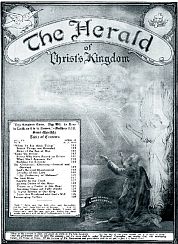
THE HERALD
of Christ's Kingdom
VOL.
XII. October 1, 1929 No. 19
Table of Contents
GENERAL
REVIEWS AND SIGNS OF THE TIMES
"TOGETHER
WITH HIM"
PREPARING
THE WAY O F THE LORD
CONVENTIONS
SERVE TO BUILD U P
HALF
HOUR MEDITATIONS ON ROMANS
A
GENERAL CONVENTION IS CALLED FOR PITTSBURGH
ENCOURAGING
LETTERS
VOL. XII. October 15, 1929 No. 20
Table of Contents
WHOM
AND WHAT SHALL WE PREACH?
BIRTH
OF THE NEW CREATION
TAKING
GOD'S NAME IN VAIN
THE
POWER OF EXAMPLE
THE
SECRET PLACE"
TEACHERS
WHO EDIFY THE CHURCH
MORE
ABOUT THE CONVENTION AT PITTSBURGH
VOL.
XII. October 1, 1929 No. 19
ANOTHER SCOURGE UPON ISRAEL
NOTWITHSTANDING
the fact that the yoke of the Moslems on the Holy Land and the Jewish race was utterly
broken down nearly twelve years ago, the dreadful scourge of hatred and murder is again
upon Israel, and another chapter is now being added to that of the others that make up the
long era of the 2520 years of Israel's downtrodden state. This recent outbreak of hatred
on the part of the Arabs and the committing of many atrocious acts, resulting in the loss
of hundreds of lives, need not be regarded as contradicting our hopes and expectations
that the time of the full emancipation and the turning away of blindness from Israelis
near at hand. Indeed, we realize from the prophetic page that close up to the moment of
Israel's final and full deliverance and restoration to God's favor, they are to be made
to feel keenly the cruel hand of persecution, the severest of which will be experienced in
connection with what is called "Jacob's trouble" (Jer. 30:7, 8); at which time
we are assured the Lord will especially manifest His power in fighting for Israel as
He did in the ancient time of fierce battle.
Jacob's Trouble
not Yet
This present
series of outrageous acts on the part of the Moslems, we would not regard as the prophetic
"time of Jacob's trouble," however near that might be at hand. Jacob's final
trouble is described as coming in connection with an attack from many nations (Zech.
14:1-3); hence the present outbreak does not fulfil the description. Further, at the
present moment there is a favorable attitude toward the Jews and the Zionist Organization
in Palestine on the part of the leading powers of the world; and Great Britain now holds
the Mandate, guaranteeing order and protection for the peoples of the Holy Land.
However much
our sympathies go out to the poor Jews as they are made the victims of such atrocious
crimes, we may be sure that the providence that has been specially manifest in connection
with this people for four thousand years, is not unmindful of their present sorrows and
distresses which can be easily overruled by the unerring wisdom and power of Jehovah for
the further discipline and final preparation of His ancient people for the reception of
Messiah and His great blessing, when the divinely appointed time is fully at hand.
In
consideration of what has been recently taking place in Palestine, the comments of Brother
Russell, written in 1897, are of special interest at this time
"The Time of Jacob's Trouble"
"While
the trouble and distress of this day of the Lord will be first and specially upon
Christendom, and eventually upon all nations, the final blast, we are informed by the
Prophet Ezekiel (38:8-12), will be upon the people of Israel regathered in Palestine. The
Prophet seems to indicate a much larger gathering of Israel to Palestine within this
harvest period than has yet taken place. He represents them as gathered there out of the
nations in great numbers, and, with considerable wealth, inhabiting the formerly desolate
places; and all of them dwelling safely at the time when the rest of the world is in its
wildest commotion. -- Ezek. 38:11, 12.
"All
men are witnesses to the fact that such a gathering of Israel to Palestine is begun, but
it is quite manifest that their exodus from other lands will have to receive some great
and sudden impulse in order to accomplish this prophecy within the appointed time. Just
what that impulse will be remains yet to be seen; but, that it will surely come is further
indicated by the words of the Prophet Jeremiah.16:14-17, 21 . . . .
"That
the Lord is, abundantly able to accomplish this we have no doubt. In every nation the
question, 'What shall be done with the Jew?' is a perplexing one, which, in some crisis of
the near future brought about suddenly by the Lord's overruling providence, will doubtless
lead, as indicated by the Prophet, to some concerted action on the part of the nations for
promptly conveying them to the land of promise. And, as they went out of Egypt in haste,
with their cattle and goods, and aided by the Egyptians who said, 'Rise up and get you
forth from among my people, . . . also take your flocks and your herds, as ye have said,
and be gone'; and as the Lord gave the people favor in the sight of the Egyptians, so that
they gave them whatsoever they required, of silver and gold and raiment (Exod. 12:31-36),
so in the next exodus, foretold by the Prophets, they will not be sent away empty, but
apparently some pressure will suddenly be brought to bear upon the nations which will
result thus favorably to Israel, so fulfilling the above prophecy of Ezekiel.
"This
enterprising race, once re-established in the land of promise, and thus separated, for a
time at least, from the distress of nations so prevalent everywhere else, will quickly
adapt itself to the new situation, and the hitherto desolate places will again be
inhabited.
"But
yet one more wave of anguish must pass over that chastened people; for, according. to the Prophet, the
final conflict of the battle of the great day will be in the land of Palestine. The
comparative quiet and prosperity of regathered Israel near the end of this day of trouble,
as well as their apparent defenseless condition, will by and by stimulate the jealousies
of and invite their plunder by other peoples. And when law and order are swept away,
Israel will finally be beseiged by hosts of merciless plunderers, designated by the
Prophet as the hosts of Gog and Magog (Ezek. 38), and great will be the distress of
defenseless Israel. 'Alas!' says the Prophet Jeremiah, 'for that day is great, so that
none is like it: it is even the time of Jacob's trouble, but he shall be saved out of it.'
-- Jer. 30:7; . . . Ezek. 38:15, 16. . . .
"In the
midst of the trouble God will reveal Himself as Israel's defender as in ancient times,
when His favor was with them nationally. Their extremity will be His opportunity, and
their blindness will be removed."
ARE THE CLIMATIC CONDITIONS OF 1929 SIGNIFICANT?
Violent
storms, floods, droughts, earthquakes have in all ages given evidence that not only man
but his home -- the earth -- is under the curse. And not only does mankind groan and
travail in pain together until now, waiting for the new dispensation, but the earth also
groans and quakes and travails to be delivered into the full and Edenic condition in which
it will be a fit home for the restored, perfected race.
The year
1929 thus far proves to be one of unusual atmospheric conditions, quite general over the
earth. Those who are of the devout "watchers" are deeply interested in
everything that relates to the great transition-the change from the dispensation of evil
and death to the dispensation of righteousness and life. And inasmuch as the radical
climatic conditions of this present year are suggestive of the great possible changes that
we reasonably expect, these matters properly claim our attention. Even careful observers
in the world are taking note of these occurrences and wondering as to their significance.
We quote briefly from one writer whose observations are published in "The
New York Times," of
August 25th
"The
world's weather has been specializing in droughts. Over the eastern two-thirds of the
United States damage is estimated as already at least $10,600,000. It may be many times
this sum before the summer is over if the soaking rains usual at this season fail to
appear or even if they hold off for another thirty days. The month just past, weather
records show, was the driest July in New York City in nineteen years. In fact, only two
Julys in the past century were drier . . . .
"Great
Britain has been similarly parched. Not only has agriculture been damaged severely, but
the water supplies of many towns and villages have failed, some for the first time. From
the other side of the world, in South China, come reports of still severer droughts, with
famine threatened and suffering already acute.
"Drought not the only Feature"
"Closer
home, no further than across the river in New Jersey, some towns are already on water
rations, with reservoir stocks depleted beyond the danger point. . .
"The
meteorological factors back of this unusual weather would be obscured, however, if one
assumed that droughts are the only extremes that have been exhibited. Only recently
Central Connecticut experienced what was probably the severest thunderstorm and hailstorm
in its history. The streets of Hartford were inches deep, it is reported, in icy marbles
as large as hickory nuts. On July 18 occurred the Colorado cloudburst which caused the
wreck of the Rocky Mountain Limited. Four days earlier a similar storm swept seven people
to their deaths at Moselle, Mo. Between these two storms, another one flooded Hutchinson,
Kans. Along much of the course of the Missouri flood damage is still occurring or is
feared.
"Elsewhere
in the world the weather's record of violence is even more striking. Early in July
torrential floods swept Eastern India and Cochin- China, with stories of hundreds of
elephants floating helplessly to drown. Four hundred human beings were drowned by Persian
floods on July 10 and 11. Turkish floods two days later caused more than 500 deaths. On
July 5 there swept across Central Europe a storm of thunder, wind and hail unexcelled in
violence or damage since the unforgotten record hailstorm of July 13, 1778, said to be the
most terrific storm of the sort in weather history. In Japan three-fourths of the average
month's rainfall fell within eighteen hours in the violent downpour of May 23; causing
millions of yen of damage to railways and a score or more of fatalities.
"A Great Cold Snap"
"During
January and February of last winter, to complete the record of a year, little more than
half over, but already marked as one of the most unusual in weather history, Europe
experienced the greatest cold in over two centuries. Trains were snowbound for two weeks
in the Balkans. Rome was snow-covered and ice crusts formed on Venetian canals. Hungry
wolves appeared in villages in Yugoslavia, Hungary and Spain. The King and Queen of
Denmark were icebound for hours on a railway ferry frozen in the Baltic. Swans frozen into
the river in Germany had to be thawed out by firemen with acetylene torches. The Flame of
Remembrance in Paris, intended to be eternal, went out because the gas froze. Monkeys in
the London Zoo suffered from frost-bitten tails. And to prove the real dangers of the cold
as well as its discomforts, the Registrar General ascribed more than 60,000 extra deaths
in England to the weather.
"Such a
list of recent weather ills might be lengthened indefinitely. Exceptionally frequent and
violent tornadoes have occurred in the United States. Droughts, crop failures and forest
fires are reported, from Europe, from the West Indies, from Australia and elsewhere in the
Southern Hemisphere. India and South Africa report the severest hailstorms there on
record. In Yugoslavia in the early months of the year over 100 people were killed by
lightning, resulting in a governmental decree describing suitable precautions."
We may be
sure that great changes must take place in the climate and soils of the earth before it
will be "prepared," as was the Garden of Eden, to be a fit home for perfect man.
Cyclones, earthquakes, thunderbolts, and alternations of droughts and deluges, and of
blizzards and cold and simoons of heat, are indications of the imperfection of earth; for
the causes are doubtless natural, and very rarely indeed can we see them to be special
dispensations of Providence. That God has the entire scope of His Plan in all its details
measured exactly, we cannot doubt, after learning the Plan of the Ages; hence we may know
that earth must reach its perfection as the garden home of man by the close of the
Millennial reign -- when man's trial being ended, it will be due time for all the willing
and obedient to enjoy God's favor to the utmost, when "there shall be no more
curse," either upon man or upon the earth for his sake. And if this be true, how
appropriate that great physical as well as moral changes should occur in this transition
period, "the day of preparation," that evil (catastrophes) may be ended, and
that by streams breaking forth in the desert, etc., the earth, like mankind, its lord, may
go on gradually progressing to the fullest perfection in all respects under the glorious
reign of the Messiah.
"PEACE AS SEEN BY THREE PEACEMAKERS"
The
following statements by three great world leaders are significant. Each of them while
expressing the hope of the ultimate success of peace, acknowledges the seriousness of the
great problem confronting the world, and the gravity of the situation in the event of
failure to achieve the desired end.
"Herbert Hoover"
"'Today,
as never before in peace, new life-destroying instrumentalities and new systems of
warfare are being added to those that even so recently spread death and desolation over
the whole Continent of Europe. Despite those lessons every government continues to
increase and perfect its armament, and while this progress is being made in the
development of the science of warfare, the serious question arises -- are we making
equal progress in devising ways and means to avoid those fruitful fruits of men 's
failures that have blotted with blood so many chapters of the world's history?'
"Artistide Briand"
"'Peace
is proclaimed. That is well; that is much. But it still remains necessary to organize it.
In. the solution of difficulties, right and not might must prevail. That is to be the work
of tomorrow.'
"J. Ramsay MacDonald"
"'The
next war, of which people are already talking so lightly, and for which governments are so
blindly preparing, will leave civilization a smoking ruin and a putrefying charnel house.
No man, woman or child will be immune. Destruction will rise from the sea and fall from
the air and people will drop mysteriously where they stand, touched by the invisible
breath of poison.
"'There
must be, no next war. By using the League of Nations, by entering a bond of mutual
security, by disarmament and arbitration, Labor can herald the endless reign of
peace."'
"We are ambassadors for Christ, as
though God did beseech you by us." -- 2 Cor. 5:20
THIS is a
most high and honorable commission, and we do not wonder that Paul, writing to the
Corinthians, declared himself and his fellow-laborers to be workers together with God and
Christ, and besought them not to receive the reconciling grace of which they were the
messengers, in vain. But not only are ministers workers together for Christ, but every one
who is called to life "together with Him" is a worker together with Him. As the
vine does not bear fruit directly, but by means of the branches, so it is with Christ.
"Together with Him," even as the branch, abiding together in the vine, so we are
workers together with Christ. If only we could fully realize and truly take hold on the
significance of the word "together," how much more fruit we would bear; how much
wasted talent and energy, mow lost in self-effort, would be saved; how light and gladsome
would the labor be; how that fellowship and union, with power, would lighten labor when it
is heavy and wearisome, and sanctify the senses, the afflictions, and the disappointments
that are so often met with in the work. Union and fellowship with Christ in spiritual
privilege and spiritual service are the whole secret of Christian life.
If we would
be workers together with Christ, we must study Him as the model workman in His Father's
business. Let us note some of the more marked characteristics of our Lord as brought out
in connection with His work among men.
First, it is
recorded of Him: "Lo! I come! I delight to do Thy will, O, My God!, Yea, Thy law is
written within My heart." This must be the key-note to all service with and for God.
It is not first the work, but the will of God that we are to do. The work is not always to
our mind or taste; but the will of God, as Faber has it, is always the "sweet will of
God."... The work itself is sometimes irksome, especially in many of its details. The
reaping is always glad; but the plowing and sowing, the patient waiting, and the careful
tending, are not always to our mind. Weariness and perplexity, "bonds, stripes and
imprisonments" are in the way; then we must have recourse to the mainspring of action
and service: "I delight to do Thy will, O My God."
Second, we
also note that our Lord said: "For their sakes I sanctify Myself." Here, again,
we have another principle of action: "For their sakes." Not for ourselves, but
for their sakes, we can give ourselves up to work for men. Deep fellowship with Christ is
necessary to this. Oftentimes we must go empty-hearted to Christ and get a filling of
Divine love.
Even those
we love most, are indifferent and ungrateful, and even worse, in the face of our care for
them. But more often our work lies among those for whom we have no natural care, and not
seldom those who are in themselves uninteresting and repugnant to us. Then it is, that
inspired by the love of Christ and moved by the will of God, we can do "all things
through Christ which helpeth us." This principle- in our work, "together with
Him," means high consecration, with self-denial, in which we learn not to look at our
own things, but on ".'the things of another." This only can teach us not to be
respects of persons; to love deeper, and beyond a man's clothes, culture and surroundings,
even at his soul, the broken image of God in him, and on to the end where, by faith, we
see him in glory. Christ at the well, talking with the fallen woman of Samaria, is an
example of doing the will of God, and at the same time sanctifying [setting apart] Himself
for the sake of another. "My meat is to do the will of Him that sent Me." -- Selected.
"Behold, 1 will send My Messenger,
and He shall prepare the way before Me: and the Lord, whom ye seek, shall suddenly come to
His temple,
even the Messenger of the Covenant, whom ye delight in:
behold, He shall come, saith the Lord of Hosts. " -- Mal. 3 :1.
THE prophecy
of Malachi which concludes the canon of the Old Testament Scriptures, closes 'with
exhortations and promises respecting the coming of Messiah, for whom the people of Israel
had, at that time, waited for fifteen centuries. His prophecy is in full confirmation of
the predictions of all the Prophets of God who had preceded him. Malachi speaks with
precision, with a definiteness and conviction concerning the coming advent of the long
looked for Deliverer and King of Israel (Chap. 3:1-12) ; the One who should inaugurate a
world-wide Kingdom and reign gloriously, restoring all things.It required however the
anointing and illumination of the Spirit from above in connection with Messiah's First
Advent to open up the meaning of the Old Testament prophecies. Thus in the light of the
Spirit's revelation the messenger mentioned by Malachi is the Christ -- not the Man Christ
Jesus alone, who was preeminently the Divine Messenger, but inclusively the whole Christ,
the Church, the Body, the under-associates, with Jesus the Head. More than this, the
Spirit's instruction through the Apostolic testimony enables us to understand that this
great Messenger appears in the twofold capacity: first as the suffering One, the
sacrificing One, and secondly as the anointed, glorified One, the King, the Restorer. The
work of suffering belongs to this Gospel Age, the reign of glory belongs to the Millennial
Age. The suffering began with the consecration of our Lord and Master at the time of His
baptism into death. The three and one-half years of His ministry were so much of His
delivering Himself into death or baptism into death, and that personal sacrifice was
finished at Calvary. During this Gospel, Age, in harmony with the Divine Plan, our
Redeemer has accepted a little flock from the world upon their renouncement of sin, their
acceptance of Him as their justification, and their consecration of their little all to
His service, "to be dead with Him that they might also live with Him, to suffer with
Him that they might also reign with Him."
Throughout
this Gospel Age this overcoming class, the Church, has been faithfully laying down,
sacrificing, life and earthly prospects and interests because of their love for the Lord
and for the principles of righteousness which He represents. Thus this entire Gospel Age
has been one of suffering. As stated by the Apostle, the Prophets foretold the
"sufferings of Christ, and the glory that should follow." (1 Pet. 1:11.) The
glory of this great Christ, Head and Body, cannot be ushered in-until all of its
sufferings are at an end. Hence, as the Apostle urges, it is for us to appreciate the
situation and understand our privilege to "suffer with Him," or "to be dead
with Him," "to fill up that which is behind of the afflictions of Christ,"
to "present our bodies living sacrifices, holy, acceptable to God, our reasonable
service." -- 2 Tim. 2:11, 12 ; Col. 1:24 ; Rom. 12:1.
The Christ in the Flesh, the Elijah
Again
through the New Testament revelations it is seen that Christ in the flesh, Head and Body,
is the antitypical Elijah, which does a work in the world preparing for and introductory
to the reign of glory, of the same class, on the spirit plane as the Christ of glory, Head
and Body. The Messenger of Jehovah is the same, though under two different conditions:
first in the flesh, in weakness, in ignominy, in sorrow and pain and dying, despised and
rejected of men; second, in glory, crowned with all power in heaven and in earth,
establishing righteousness and forcefully subduing and bringing into subjection to the
Divine will every creature and every thing, and triumphing so that finally, by the end of
the Millennial Age, this great Messenger -- by the two parts of His service, first in
suffering and second in glory -- will accomplish all that the great Jehovah purposed
respecting the race of mankind. By these two parts of His service this great and glorious
Messenger will have prepared the way of Jehovah, will have made straight all the paths,
all the arrangements, all the affairs for the establishment of the everlasting reign of
the Kingdom of heaven.
This brings
us down to. the period mentioned by the Apostle respecting Christ: He must reign until He
shall have put all things under His feet. Then the Son, the Christ, having put all things
into subjection, will Himself be subject to the Father, that ,the Father may be the all in
all of the universe (1 Cor. 15 : 28 ) , though the Father graciously and generously
provides that His Messenger -- whose loyalty will have been so thoroughly demonstrated
both by the sufferings of the present time and the glories of the Age to come-that this
glorious anointed One shall forever be associated with Him in the everlasting Kingdom, as
it is written, "Let all the angels of God reverence Him." -- Heb. 1 :6.
"The Master Whom Ye Seek"
The word
Lord in this second sentence is not in the Hebrew Jehovah, but signifies master, superior,
teacher. Jehovah is represented as the speaker, who evidently refers to the Lord Jesus,
assuring those who have the ear to hear and understand that the Messiah whom they seek
shall suddenly come to His Temple. In a certain sense or degree, in a shadowy sense, Jesus
at His First Advent offered Himself to the Jewish people -- "He came to His own and
His own received Him not," -- and He said to them, "Your house is left unto you
desolate." (Matt. 23:38.) That entrance into Jerusalem, riding on an ass, hailed by
the people with palm branches as the King, the Messiah, the Son of David, and His entering
into the Temple and scourging therefrom the money-changers and merchants, was indeed a
sudden matter, wholly unexpected by the people of that time, and to a certain extent it
fulfilled this prophecy, because that people on that occasion were typical of the great
presentation of Himself as the King, due now to be accomplished on a higher plane, on a
plane of glory, Jesus the Head now presenting Himself, not merely as the King of Israel, but as the King of the
world-not merely as the Man Christ Jesus, but as the glorified Christ with His glorified
Body, which is the Church.
There is a
difference between the significations of "quickly" and "suddenly." The
Messiah did not quickly come to His Temple in this larger sense, for over two thousand
years have elapsed since this prophecy was written, and the Temple itself ("which
Temple ye are") is not yet complete, though the living stones for it have nearly all
been chiseled and polished with the adversities of this Gospel Age, and we are now living
in the time when these living stones are being brought together on the other side of the
veil. When the whole work shall have been completed, and the glory of the Lord shall fill
the Temple, the prediction of this Scripture before us shall have its fulfillment. In this
last and final sense the coming to the Temple is not yet consummated in that the
glorification of the Church is not yet complete. It will be a sudden matter in that the
Jews, and others outside the Temple class, will be in such complete ignorance respecting
the entire procedure that the results will be wholly unexpected, a time to them most
sudden.
The Oath-bound Covenant
Our Lord
Jesus was indeed the Messenger or Servant of
the Covenant, the One through whom the Covenant would have its fulfillment. The Abrahamic
Covenant, the Oath-bound Covenant, is referred to. It is the hope of natural Israel and
the hope of spiritual Israel, which hope we have as an anchor to our souls, sure and
steadfast, within the veil. -- Heb. 6:19.
The
Messenger or Servant of that Covenant is the One through whom its provisions will be
accomplished, namely the seed of Abraham -- "which seed is Christ." (Gal. 3:16.)
Again, we see that this seed has its two developments, one in the flesh, in suffering
ignominy, the other in the Spirit, in power and great glory -- the one to mediate the New
Covenant (which was also embodied in the original Abrahamic Covenant), by offering the
sacrifice of atonement, the other to execute the gracious provisions of that Covenant,
made possible by the atoning sacrifice. The sufferings of Christ were to seal or ratify
the New Covenant and make it possible for the great Mediator, the Christ Head and Body, to
extend through it blessings to the entire human family, who were under the curse and who
are mentioned in the promise to Abraham as "all the families of the earth."
Again we
note that in the Divine Plan the "Church," the "saints," the
"very elect," the "little flock," the "Bride," is associated
by the Lord with both phases of this work, "in the sufferings of this present time
and in the glories that shall follow." It requires the work of this entire Gospel Age
to seal the New Covenant. The New Covenant is to benefit and bless Israel after the flesh
and all the families of the earth; its provisions are the forgiveness of sins, the
renewing of a right heart in all those who desire to come into harmony with the Lord and a
restitution to them of all that was lost through the original transgression and its curse.
As a result of the operation of this New Covenant there shall be no more curse, and tears
shall be wiped from off all faces, and there shall be no more sighing and no more dying
and no more pain, for the former things shall have passed away. -- Rev. 21:4.
Joint-heirs with Him
The Church,
the Bride of Christ, in advance is made partaker reckonedly, by faith, of the benefits and
blessings that will come to humanity through that New Covenant when inaugurated;
justification is reckoned as restitution, although not actually restored or perfected. The
sins of the believer are covered and the consecrated ones are reckoned as new creatures,
even though they still tabernacle in imperfect flesh. The acceptance of the Bride of
Christ is not under the New Covenant, but under that feature of the original Abrahamic
Covenant that promises the seed. The Church is not to be part of those who will be blessed
by the seed but to be associates and joint-heirs with Christ as members of the seed. This
the Apostle distinctly points out, saying, "If ye be Christ's, then are ye Abraham's
seed and heirs according to the promise." (Gal. 3:29.) If we are heirs according to
that Abrahamic promise it means that we are members of the seed class, and that our great
mission is the blessing of all the families of the earth.
The Day of His Coming -- As a Refining Fire
"But
who may abide the day of His coming? and who shall stand when He appeareth? For He is like
a refiner's fire and like fullers' soap, and He shall sit as a refiner and purifier of
silver, and He shall purify the sons of Levi and purge them as gold and silver, and they
shall offer unto the Lord offerings of righteousness."
Ah! there it
is. The world is anxious for the blessing, but realizes not to what extent the inbred sin
is incompatible with the reign of righteousness which it desires, and in which is the
great blessing God has promised. Before the blessings come, the day of wrath, the
"fire of God's jealousy," must pass upon the world. It is not to be a fire
merely to destroy but specially to purify; it is not to be a literal fire but a symbolical
fire, following which the Lord will turn to the people a pure language, a pure message, a
clear declaration of the Divine will and Plan of Salvation. -- Zeph. 3:8, 9.
The
beginning of the judgment will be especially upon the sons of Levi. The Levites
represented the household of faith, who have made a consecration of themselves to the
Lord. The "more than conquerors," the faithful of these tried Levites of the
Gospel Church will constitute the Royal Priesthood, the Body of Christ. If it is our
privilege to have some share in the fiery trials at the close of this Age, and at the
inauguration of the new dispensation, let us rejoice in whatever will bring us nearer to
our Lord, in whatever will bring us closer into harmony with Him and His service,
purifying our hearts and arousing our faith and making us all that would be acceptable and
pleasing in the sight of the Lord.
JESUS -- THE FATHER'S FAITHFUL WORKMAN
"I must work the works of Him that
sent Me, while it is day:
the night cometh, when no man can work." -- John 9:4.
THE brevity
of human life and the proper use of its brief span, is a matter of solemn importance to
every sober-minded person. Since life is a gift from God, and all are accountable to Him
for this gift, it is not surprising that we find the Scriptures constantly counseling its
proper valuation. Again and again the righteous are reminded of the value of the fleeting
days of stewardship soon to end in approval or disapproval, and the unrighteous are
likewise reminded of the issues involved in wasted time. The same Scriptures teach that
within the limits of man's "threescore years and ten" lie possibilities that are
eternal in their importance; for the present infinitesimal moment of time has been made by
the Great Creator the determining factor in deciding our portion or station in a
boundless, eternal existence beyond the grave. God, who possesses all time, "from
everlasting to everlasting," has chosen to give us but one day at a time our of His
unlimited ages, to teach us the value of these fragments of His eternity.
"So Teach Us to Number Our Days"
The great
characters of Scripture, such as Moses, David, and Solomon, recognizing the brevity of the
present life, have furnished us with conclusions, admonitions, and prayers, that find a
response in our own meditative considerations of life's stewardship responsibilities. Like
them, we must acknowledge that life is "but a shadow" that quickly passes by.
Therefore "whatsoever thy hand findeth to do, do it with thy might; for there is no
work, nor device, nor knowledge, nor wisdom, in the grave whither thou goest." Then
like Moses we pray, "So teach us to number our days, that we may apply our hearts
unto wisdom." (Psa. 102:11; Eccl .9:10; Psa. 90:12.) Such considerations as these are
intended by the Lord to impart a sober-minded understanding of the great purposes of God
in bestowing upon us the gift of life, and entrusting us with the stewardship of so great
a boon.
Thus we see
that the prayer of Moses to God for wisdom to live faithfully the few days of earthly life
is in every way a proper one for us. Obvious though it be to all, that the days of our
stewardship are few, yet only God can permanently teach us this lesson. And by His
diversified means of correction, instruction, and grace, He does teach us, and leads us in
wisdom's ways, always ready to assist us to become workmen needing not to be ashamed when
the duties of life's little day have ended.
Looking unto Jesus, Our Example
In thus
instructing us God would surely direct our attention to Jesus, the One in whom He was well
pleased, admonishing us to observe His life of service, and of his faithful application to
the work for which He came into the world. With him it is always the "Father's
business." "My meat is to do the will of Him that sent me, and to finish His
work." "The Father that dwelleth in Me, He doeth the works." His aim in
life is clearly stated: "I must work the
works of Him that sent me, while it is day; the
night cometh when no man can work." Let us therefore observe the service that gained
for our dear Redeemer the Father's approval, that we may likewise have the joy of
eventually finding our brief day of service rewarded with His sweet "well done."
First of all
we note that Jesus recognized the shortness of His day. He takes the position of a day
laborer whose day of service will be over with the coming of night. He speaks of His life
as a mission, a task, which had to be fulfilled within the limits of the time assigned by
His Father. He began His ministry with forty days of inquiry respecting the Father's will,
learning from types and shadows and prophetic utterances the time allotted and the nature
of the work to be done. When He ends His day of service, with the coming of night, He is
able to say, "I have finished the work Thou gavest Me to do." There have been no
omissions, no neglected duties, and there have been no departures from the clearly defined
commands of His Father. Surely He was a servant worthy of God's approval, and to His
Church, a perfect example that all should prayerfully seek to follow.
It is in
this way that He teaches us how to "apply our hearts unto wisdom." As His
pathway had all been arranged for Him iii the Father's wisdom, so He would have us
understand that our path has likewise been clearly set forth in the Word of God. As he
recognized that "obedience was better than sacrifice, and to hearken than the fat of
rams," so He would have us remember "that no man is crowned except he strive
lawfully"-that God's approval will be given to the one who has "been faithful
over a few things," rather than to the one who may come laden with spurious works of
his own choosing.
Although
Jesus knew that His time on earth was short, and although He would have us remember that
the same is true of our work-day, yet He was in no feverish haste. With a calmness, and a
steady, even deportment He went about His work. There was a time to work, and a time to
pray; a time for the multitude, and a time for the disciples alone. He could not be
hurried into any action by the solicitation of His friends, or the taunts of His enemies.
When His brethren urged Him to go up to the feast and make Himself known, His reply was
significant: "My time is not yet come; but your time is always ready." It was as
though He had said, yours is the worldly mind; they who do their own work, who seek their
own glory, are the masters and disposers of their own time, but My time is not
yet.
"About My Father's Business"
What an
example He is to us in all this! How He rebukes our impetuosity by His implicit obedience!
How forcefully He teaches us that "In quietness and confidence shall be your
strength" -- yes, and our safest, wisest course. To follow Him thus "imparts to
our present life an unspeakable solemnity; it endows it with an infinite preciousness and
value. And while at first sight we may feel overpowered by the thought of the short space
given us for our labor, and inclined to feverish haste and to impatient self-made work, a
truer insight will teach us that as the approach of night is altogether beyond our
calculation and control, so it behooves us, with calmest faith and implicit surrender of
our own will, to look upon each day's work and each day's trial, as portioned out to us by
Divine wisdom and love. How much of false zeal, self-chosen work, and self-appointed
times, is there in our own private and public Christian life. We run before we are sent;
we choose the kind of usefulness and work for which we fancy we have inclination and
adaptation; we select the times and method of accomplishing our task. We pursue with
spurious zeal and self-sustained energy aims of our own choice; we hurry impatiently our
own souls and those of others, and are satisfied with forced results, till experience
teaches us, to our deep humiliation, that grace also has its nature and law, and that in
God's work 'it is not of him that willeth, nor of him that runneth, but of God, that
showeth mercy."" Happy indeed will be our lot if we may say with Jesus at the
end of our day of labor, "I have finished the work Thou gayest me to do," and
there are no works of wood, hay, and stubble to be burned.
Next we note
the emphasis that Jesus puts upon the necessity of working while it is called day. "I
must work the works of Him that sent Me." This seems to have been a thought deeply
impressed upon His mind early in life, and in all after-years it is the keynote of His
obedient service. At twelve years of age He said, "Wist ye not that I must be about
my Father's business." From Jordan to the cross this "I must work" was the
motto of His life. "I must preach the Kingdom of God." He must go up to
Jerusalem. The, Scriptures must be fulfilled:
Woe is Me if I Preach not This Gospel
This view of
His responsibility to God is of vital importance to us. It was because He recognized that
His was the place of a servant commissioned with the responsibility of completing a task
laid upon Him, that He so humbly takes this .place under a servant's "I must
work." This lesson He also wove into many of His private and public discourses for
us: the vineyard left in the care of servants; the steward put in charge of his master's
goods; the one, two, and five-talented servants, were all illustrations of the lesson of
this unavoidable "I must work," in our relationship to Him as His servants.
Again and again, would-be followers are cautioned to consider carefully the requirements
of discipleship before undertaking its obligations. But once the step has been voluntarily
taken, then He would have all such remember that from 'henceforth they are bond slaves of
His. Paul realized this to be so true, and his future so dependent upon it, that he
declared, "Necessity is laid upon me; yea, woe is me, if I preach not the
Gospel."
This "I
must work" of Jesus' should therefore ring in our hearts with all its solemn
significance. The talent preserved in a napkin, the neglect of duty while the lord of the
household is absent, the forgotten privileges of service, will some day make necessary the
Master's word-"Thou wicked and slothful servant, . . thou oughtest therefore to have
put My money to the exchangers, and then at My coming I should have received My own with
usury." (Matt. 25:26.) "Depart from Me I know you
not" -- you lived in the midst of priceless opportunities, you were surrounded with
the crying want of those who represented Me in their need, and you served Me not, but
followed your own self-chosen way.
With Jesus
it was not an obedience compelled by fear, but a joyful "I must." "In the
life of Jesus we see the perfect liberty of the Son in obedience and service. Here we
behold the perfect unity of liberty and necessity. 'I must' seems to us a hard word while
we regard liberty our dearest and sweetest possession. It is because we do not fully
understand what is meant by love that we find it difficult to see liberty and necessity in
their essential and inseparable connection. But unto Jesus; 'I must' was identical with
'It is My delight.' He knew not the bondage of choice arising from a doubtful mind and a
divided heart, from a will separate from the will of God and at variance with His law.
God's law was written in His heart; it was hidden there as His most precious, inviolable
and cherished treasure, . . . the necessity which He felt was rooted in the communion of
life and love, which subsisted between the Father and the Son, and which was His joy and
strength. To obey the Father, and that by the Father's indwelling in Him, was the
nourishment of Christ's life; it was His very delight." Blessed servitude indeed,
when love and gratitude constrain us to say, "I must work."
Immanuel -- God with Us
This brings
us to the third striking' feature of our Lord's day of service; namely the fact that the
work He did was wholly the Father's work through Him, as He Himself reiterated. By this He
meant to teach that since He was solely the Father's representative, whatever works He
performed, or whatever revelations He gave to men, were merely what the Father Himself
would have performed or given had He chosen to appear amongst them. True to the name He
bore, Immanuel, He was "God with us," so much so that to His disciple He could
say, "He that hath seen Me hath seen the Father . . . The Father that dwelleth in Me,
He doeth the works." "Blessed Son of God! What
sublime humility, self-abnegation, and love was Thine! You came to reveal the Father, to
teach us that to know God was eternal life, and now we learn that the humiliations of
man's estate, the years of earthly life and absence from the heavenly courts, the poverty
and homeless wanderings, the acts of compassion
that brought healing to the sick and life to the dead, the' patient submission to
indignities and shame, were not your own works, but
things the Father Himself would have done for us had it been possible. His love He has
revealed through you. Oh teach us, that we too
may be God's true witnesses in the earth, revealing His love and sympathy for the poor
groaning creation; then no more will we ask for fire to destroy, but pray for more of Thy
grace and love."
In this
connection then let us take note of the circumstances under which Jesus made the statement
contained in our text: A man born blind had appealed for aid, and apparently both Jesus
and His disciples had been particularly interested in this case. The disciples, being
familiar with the Law of Moses, naturally concluded that his affliction might be traceable
to the sins of a previous generation. "Who did sin, this man or his parents that he
should be born blind?" Jesus not only corrects their mistaken inference, but He also
reveals His own attitude toward the affliction of this poor man, and toward all similar
afflictions of mankind. While the disciples would be concerned to ask, Who is to blame?
Jesus would ask, Who is to relieve and help? While they were thinking of guilt and
punishment, Jesus was thinking of healing and restoring. The salvation-works of God were
His meat and drink. He came not to condemn the world, but to save it. He came not to judge
the world, nor to analyze and tirade against sin, but "to preach good tidings unto
the meek, to bind up the broken-hearted, to proclaim liberty to the captives, to give the
oil of joy for mourning, and the garment of praise for the spirit of heaviness." He
came to seek and to save that which was lost; to teach that God has no pleasure in the
punishment of the wicked, but that angelic choirs break forth in paeans of praise over one
sinner that repenteth and returns again to the Father's home; to teach us that the
wandering sheep recovered from its perilous plight, is a subject of greater rejoicing than
the ninety and nine safely sheltered in the fold.
Jesus the Excellent Revelation of Love
Ah yes,
there has never been any lack of philosophers and theorists who could describe the
ulcerous canker of sin in its myriad forms; there has been no absence of schemes and
panaceas for the relief of mankind; but the world has seen only one Jesus, one Great Physician competent to help,
one "Lamb of God, which taketh away the sins
of the world."
Let us
observe "the wonderful union in Jesus of love to God and love to man. There is only
one love. Love to God and love to man are united in their origin and their nature. They
form one river flowing out of the eternal love of God." "If a man say, I love
God, and hateth his brother, he is a liar, for he that loveth not his brother whom he hath
seen, how can he love God whom he hath not seen." (1 John 4:20.) "Some of us
find it easier to ascend to God with the wings of adoration and joyous contemplation, than
to descend on the self-same ladder to our neighbor in the spirit, and with the service, of
forgiving, comforting, and helping love. But in Jesus there was only one, deep, pure;
Divine love. When He healed the sick, and opened the eyes of the blind, when He fed the
multitude, when He cast out devils, when He taught the disciples, and blessed the little
children, He was doing the works the Father had given Him to do . . . .We forget that when
we behold Jesus forgiving the sinner, and, receiving him with most tender compassion, when
we behold Jesus permitting the woman to kiss His feet, we see the Father in Him." We
also forget that though He may frequently display the Father's indignation against
hypocrisy, and speak in no uncertain sound against wrong practices, that these are the
exceptions in and not the burden of His message and ministry. Both of these omissions in
our memory are serious; for if we forget that "God was in Christ" in the work of
our redemption, and allow ourselves to think of Jesus as being more merciful than the
Father, we dishonor both. If on the other hand we think chiefly of Jesus as an exposer and
denouncer of the sinner, we do violence to His definition of God, for He said, "God
so loved the world" as to send Me, not to condemn it, but to save it.
Jesus the Great Physician
When John
the Baptist became somewhat disturbed by his imprisonment, wondering no doubt why Jesus
did not attempt his release, we find him sending his disciples to Jesus with the question,
"Art Thou He that should come, or look we for another?" How peculiarly Jesus
answered this earnest inquiry. He did not send the messengers back with a list of
Scriptural citations from the prophecies, nor did He acquaint John with some program of a
campaign against prevailing errors, but He sent them back with a message void of any
suggestion of kingly prerogatives, or of triumph over opposing forces, but a message full
of the joy of a successful, happy physician. "Tell John what things ye have seen and
heard; how that the blind see, the lame walk, the lepers are cleansed, the deaf hear, the
dead are raised, to the poor the Gospel is preached. And blessed is he, whosoever shall
not be offended in Me." Surely His servants of the present day will not overlook this
lesson; for Jesus was a workman fully approved of God, and in all things, in all periods
of the Age, an example to be faithfully and devoutly followed.
In
conclusion let us refer once more to our Lord's appreciation of the privilege of giving a
full day's service. There was no thought of ceasing to labor until the night interrupted
His work. His was a life of fullness -- full of the spirit, full of compassion, full of
loving service. "The thought of the approaching night sometimes exerts a paralyzing
influence on man's energy and activity. It tempts us to anticipate our rest or to relax
our effort. It often damps our enthusiasm. We are inclined to think that we have labored
enough, and that we can add no more to our service, or to fear that our strength, our
material, our opportunity, is exhausted. But Jesus was faithful to the end. As He
approached the last sufferings in Jerusalem, His love and His zeal burned only with the
greater intensity and brightness. To the very last in His warnings to Judas, in His final
addresses to the Jews, in the good confession which He confessed before Pontius Pilate, in
His words to the daughters of Jerusalem, in His patient and silent suffering, and in the
seven words from the cross -- He fulfilled His ministry; He was faithful -- the perfect
servant of God.
His Love for the Disciples Severely Tested
"His
love to His disciples was never more severely tested than during His last days. He never
faltered. He never relaxed His faithful, anxious care of the men whom the Father had given
Him to keep. He prayed for the disciples, anticipating the hour of temptation. On that
night in which He was betrayed, and in which all the disciples were offended because of
Him, Jesus manifested His love more fully than ever. He called them friends; He spoke to
them of the love with which they were loved, of the vital union between the true vine and
the branches; He instituted the Memorial of His dying love; He prayed for them to His
Heavenly Father. In that prayer Jesus clings with the same love to the Father and to the
disciples; and by the wonderful words, "I in them, and Thou in Me,' He places
believers in a position of glory, to which we can scarcely lift the eyes of our
heart." Why did He do all this? Because He in His love and faithfulness would have us
know "that the Father who dwelleth in Me, He doeth the works."
"As
long as I am in the world, I am the Light of the world." "In this also we are
called to follow Jesus. He is Lord and we are His servants, He is infinitely great, and we
are but little. But to the least of us the exhortation is addressed, 'Be thou faithful
unto death'; 'Occupy till I come'; work while -- as long as -- it is day. And to each one
of us some peculiar talent is entrusted. We can be, we
can do, we can suffer -- something, and in some way, in which no
other person can take our place . . . .There is no measure that we can say, 'It is
enough.' The only measure is the daily opportunity appealing to the heart, out of which
are the issues of life. Only let our heart be loving, and it will be like the measure
Jesus describes, 'Good measure, pressed down, and shaken together, and running
over.'"
AS the time
for the general assembly of the Church of the Firstborns draws nearer, the desire of
consecrated brethren to meet together to build one another up in the most holy faith
should increase and become stronger. This applies to the smaller local gatherings in
various parts as well as to the larger assemblies of the friends in a more general way in
convention. We should rejoice to find this so, and hail it as one of the proper signs of
brotherly love and general growth in faith and knowledge. It is a good sign when we find
God's people sacrificing earthly advantages in order to advance the spiritual welfare of
themselves and others.
Another of
our general conferences of the brethren, that at Buffalo, N. Y., is now in the past, and
as is our custom we are making reference to some items that are of interest to all the
friends. We cannot here report all the heartfelt testimonies given by various brethren who
came together at their own expense from several of the Middle States, including Canada,
but we can assure all that the fellowship, and expressions of loving interest in one
another were heart-cheering. Very quickly those who had never met or even heard of each
other were acquainted and friends, bound with the tie of the Spirit, warmer and stronger
than any tie of blood; others who had met previously had no less joy in renewing their
fellowship and greetings.
The
addresses of the Convention were delivered by brethren who endeavored to expound the truth
of the Divine Word in a manner, that would be uplifting spiritually and incite to new
courage and confidence in life's pathway; some discourses sought to emphasize one feature
of the Divine Message and some another, each in its own style. It was the one "Song
of Moses and the Lamb," rendered in different parts, but all in the one key of
"Love Divine." Such are sure to be the results when brethren who are ministering
in spiritual things take their keynote and time from the great Master of all, of whom the
Apostle declares, "This salvation began to be spoken by our Lord and was confirmed
unto us by them that heard Him" -- the Apostles. It was truly evident that the
friends who had assembled at Buffalo, had come with the object in view of being
spiritually refreshed -- upbuilt in the inner man, and were earnestly desirous of
receiving some fresh impetus which would enable them to press on in the good way.
While some
testified of their heartaches, trials, discouragements, they gave evidence that they were
courageously holding fast to their faith in the midst of all the present surrounding
confusion, still believing that the Lord is at the helm and that He doeth all things well.
Indeed we believe that all should be comforted by the thought that the Lord's eye, His rod
and His staff, are guiding His sheep from grace to grace and from knowledge to knowledge.
Hence it is not astonishing that we find as was predicted that "The path of the just
is as a shining light-shining more and more unto the perfect day." Little details
should indeed be expected to grow clearer day by day, while all the fundamentals of our
faith's superstructure are unchangeable.
The friends
assembled in convention at Buffalo showed forth the love of God in their faces, and not
only for one another as they communed together at various conferences, but they were
deeply solicitous for the dear friends of the Lord's family everywhere. Messages of kindly
greetings and love were received from brethren in attendance at other conventions that
were being held at the same time, and these loving sentiments thus expressed were heartily
reciprocated as set forth in our familiar hymn,
"Blest be the tie that binds
Our hearts in Christian love;
The fellowship of kindred minds
Is like to that above."
No. 1
THERE can be
no question that, as an able expositor has said, "When the Epistle to the Romans
appeared for the first time, it was to the Church a word in season." Since that time
it has played a powerful part in every great spiritual revival the Church has known. The
Great Reformation owed its birth and development to this Epistle perhaps more than to any
other portion of the Bible. "Luther, in his famous preface, says: 'This Epistle is
the chief book of the New Testament, the purest gospel. It deserves not only to be known
word for word by every Christian, but to be the subject of his meditation day by day, the
daily bread of his soul .... The more time one spends on it, the more precious it becomes
and the better it appears.' Melanchthon, in order to make it perfectly his own, copied it
twice with his own hand. It is the book he expounded most frequently in his
lectures." -- Godet.
Believing
that the present time is one to which the teaching of this Epistle is peculiarly suited,
this series of articles is purposed in the prayerful hope that they too, in their measure,
may prove to be to the readers of this journal a word in season also.
Seekers After Righteousness
Let none be
discouraged from the study of this Epistle by the fact that it contains things "hard
to be understood;" for while it is true that the most mature Christian minds well find themselves at tunes face to face
with the unfathomable ("O, the depth!" Rom. 11 :33), yet there is milk to be had
here for the veriest babe in Christ. On the other hand, let no one for a moment suppose
that by intellectually grasping the philosophy of God's Plan presented herein, he will
have thereby exhausted the Apostle's intention. No! the prominent idea of the Epistle is
the offer of the "righteousness of God" to one who finds himself stripped of his
own righteousness, and since this is so, it necessarily follows that the condition of
heart likely to profit most from the Apostle's precepts is that enjoined by our Lord in
His sermon on the mount. "Blessed are they which do hunger and thirst after
righteousness: for they shall be filled." ( Matt. 5 :6..) Such will find themselves
filled indeed by the blessed assurances found in the Epistle to the Romans.
Time, Place and Occasion
Before
commencing our consideration of the Epistle itself it will be helpful to a sympathetic
understanding of its lessons to have in mind the circumstances under which they came to be
written. Without going into disputed questions, it will be enough for our present purpose
to note that "The four books of the New Testament known as the Letters to the Romans,
Corinthians, and Galatians are allowed by practically all critics, including some of the
most 'destructive,' to he genuine productions of the Apostle Paul . . . .The date
generally assigned to the Roman Letter is 58 A. D." -- Weymouth.
One
expositor (H. C. G. Moule), whose scholarly writings contain a large measure of the spirit
of devotion to our Savior, has arranged such data as is available in a very interesting
way, and presents a beautiful word picture of the Apostle and the conditions under which
he wrote, which cannot fail to greatly assist us as we seek to approach the study of this
Epistle in the same spirit. We quote:
"It is
the month of February, in the year of Christ 58. In a room in the house of Gaius, a
wealthy Corinthian Christian, Paul the Apostle, having at his side his amanuensis,
Tertius, addresses himself to write to the converts of the mission at Rome.
"The
great world meanwhile is rolling on its way. It is the fourth year of Nero; he is Consul
the third time, with Valerius Messala for his colleague; Poppæa has lately caught the
unworthy Prince in the net of her bad influence. Domitius Corbulo has just resumed the war
with Parthia, and prepared to penetrate the highlands of Armenia. Within a few weeks, in
the full spring, an Egyptian impostor is about to inflame Jerusalem with his Messianic
claim, to lead four thousand fanatics into the desert, and to return to the city with a
host of thirty thousand men; only to be totally routed by the legionaries of Felix. For
himself, the Apostle is about to close his three months' stay at Corinth; he has heard of
plots against his life, and will in prudence decline the more direct route from Cenchrea
by sea, striking northward for Philippi, and thence over the Aegaean to Troas. Jerusalem
he must visit, if possible before May is over, for he has by him the Greek collections to
deliver to the poor converts of Jerusalem. Then, in the vista of his further movements, he
sees Rome, and thinks with a certain apprehension yet with longing hope about life and
witness there.
"A
Greek Christian woman is about to visit the City, Phoebe, a ministrant of the mission at
Cenchrea. He must commend her to the Roman brethren; and a deliberate Letter to them is
suggested by this personal need.
"His
thoughts have long gravitated to the City of the World. Not many months before, at
Ephesus, when he had 'purposed in the Spirit' to visit Jerusalem, he had said, with an
emphasis which his biographer, remembered, 'I must also see Rome' (Acts 19 :21); 'I must,'
in the sense of a Divine decree, which had written this journey down in the plan of his
life. He was assured too, by circumstantial and perhaps by supernatural signs, that he
'had now no more place in these parts' (Rom. 15:23) -- that is, in the Eastern Roman world
where hitherto all his labor had been spent. The Lord who in former days had shut Paul up
to a track which led him through Asia Minor to the Aegaean, and across the Aegaean to
Europe (Acts 16); now prepared to guide him, though by paths which His servant knew not,
from Eastern Europe to Western, and before all things to the City.
Prayer for Others Deepens Our Interest in Them
"Amongst
these providential preparations was a growing occupation of the Apostle's thought with'
persons and interests in the Christian circle there. Here, as we have seen, was Phoebe,
about to take ship for Italy. Yonder, in the great Capital, were now resident again the
beloved and faithful Aquila and Prisca, no longer excluded by the Claudian edict, and
proving already, we may fairly conclude, the central influence in the mission, whose first
days perhaps dated from the Pentecost itself, when Roman 'strangers' (Acts 2:10) saw and
heard the wonders and the message of that hour. At Rome also lived other believers
personally known to Paul, drawn by unrecorded circumstances to the Center of the World.
'His well-beloved' Epenetus was there; Mary, who had sometimes tried hard to help him;
Andronicus, and Junias, and Herodian, his relatives; Amphlias and Stachys, men very dear
to him; Urbanus, who had worked for Christ at his side;
Rufus, no
common Christian in his esteem, and Rufus mother, who had once watched over Paul with a
mother's love. All these rise before him as he thinks of Phoebe, and her arrival, and the
faces and the hands which at his appeal would welcome her in the Lord, under the holy
freemasonry of primeval Christian fellowship.
"Besides,
he, has been hearing about the actual state of that all-important mission. As 'all roads
led to Rome,' so all roads led from Rome, and there were Christian travelers everywhere
(1:8) who could tell him how the Gospel fared among the metropolitan brethren. As he heard
of them, so he prayed for them, 'without ceasing' (1:9), and made request too for himself,
now definitely and urgently, that his way might be opened to visit them at last.
"To
pray for others, if the prayer is prayer indeed, and based to some extent on knowledge, is
a sure way to deepen our interest in them, and our sympathetic insight into their hearts
and conditions. From the human side, nothing more than these tidings and these prayers was
needed to draw from St. Paul, a written message to be placed in Phoebe's care. From this
same human side again, when he once addressed himself to write, there were circumstances
of thought and action which would naturally give direction to his message.
Sound Doctrine Important
"He
stood amidst circumstances most significant and suggestive in matters of Christian truth. Quite recently his Judaist rivals had
invaded the congregations of Galatia, and had led the impulsive converts there to quit
what seemed their firm grasp on the truth of justification by Faith only. To St. Paul this
was no mere battle of abstract definitions, nor again was it a matter of merely local
importance. The success of the alien teachers in Galatia showed him that the same specious
mischiefs might win their way, more or less quickly, anywhere. And what would such success
mean? It would mean the loss of the joy of the Lord, and the strength of that joy, in the
misguided Churches. Justification by Faith meant nothing less than Christ all in all, literally all in all, for sinful
man's pardon and acceptance. It meant a profound simplicity of personal reliance
altogether upon Him before the fiery holiness of eternal Law. It meant a look out and up,
at once intense and unanxious, from alike the virtues and the guilt of man, to the mighty
merits of the Savior. It was precisely the foundation-fact of salvation, which secured
that the process should be, from its beginning, not humanitarian but Divine. To discredit that was not merely to disturb the order of a
missionary community; it was to hurt the vitals of the Christian soul, tingeing with
impure elements the mountain springs of the peace of God. Fresh as he was now from
combating this evil in Galatia, St. Paul would be sure to have it in his thoughts when he
turned to Rome; for there it was only too certain that his active adversaries would do
their worst; probably they were at work already.
Christian Conduct of Equal Importance
"Then,
he had been just engaged also with the problems of Christian life, in the mission at Corinth. There the main
trouble was less of creed than of conduct. In the Corinthian Epistles we find no great
traces of an energetic heretical propaganda, but rather a bias in the converts towards a
strange license of temper and life. Perhaps this was even accentuated by a popular logical
assent to the truth of justification taken alone, isolated from other concurrent truths,
tempting the Corinthian to dream that he might 'continue in sin that grace might abound.'
If such were his state of spiritual thought, he would encounter (by his own fault) a
positive moral danger in the supernatural 'Gifts' which at Corinth about that time seem to
have appeared with quite abnormal power. An antinomian theory; in the presence of such
exaltations, would lead the man easily to the conception that he was too free and too rich
in the supernatural order to be the servant of common duties, and even of common morals.
Thus the Apostle's soul would be full of the need of expounding to its depths the vital
harmony of the Lord's work for the believer and
the Lord's work in him; the co-ordination of a free
acceptance with both the precept and the possibility of holiness. He must show once for.
all how the justified are bound to be pure and humble, and how they can be so, and what
forms of practical dutifulness their life must take. He must make it clear forever that
the Ransom which releases also purchases; that the Lord's freeman is the Lord's property;
that the Death of the Cross, reckoned as the death of the justified sinner, leads direct
to his living union with the Risen One, including a union of will with will; and that thus
the Christian life, if true to itself, must be a life of loyalty to every
obligation, every relation, constituted in God's providence among men. The Christian who
is not attentive to others, even where their mere prejudices and mistakes are in question,
is a Christian out of character. So is the Christian who is not a scrupulously loyal
citizen, recognizing civil order as the will of God. So is the Christian who in any
respect claims to live as he pleases, instead of as the bondservant of his Redeemer should
live.
The Mystery of Jewish Unbelief,
"Another
question had been pressing the Apostle's mind, and that for years, but recently with a
special weight. It was the mystery of Jewish unbelief. Who can estimate the pain and
greatness of that mystery in the mind of St. Paul? His own conversion, while it taught him
patience with his old associates, must have filled him also with some eager hopes for
them. Every deep and self-evidencing manifestation of God in a man's soul suggests to him
naturally the thought of the glorious things possible in the souls of others. Why should
not the leading Pharisee, now converted, be the signal, and the means, of the conversion
of the Sanhedrin, and of the people? But the hard mystery of sin crossed such paths of
expectation, and more and more so as the years went on. Judaism outside the Church was
stubborn, and energetically hostile. And within the Church, sad and ominous fact, it crept
in underground, and sprung up in an embittered opposition to the central truths. What did
all this mean? Where would it end? Had Israel sinned, collectively, beyond pardon and
repentance? Had God cast off His people? These troublers of Galatia, these fiery rioters
before the tribunal of Gallio at Corinth, did their conduct mean that all was over for the
race of Abraham? The question was agony to Paul; and he sought his Lord's answer to it as
a thing without which he could not live. That answer was full in his soul when he
meditated his Letter to Rome, and thought of the Judaists there, and also of the loving
Jewish friends of his heart there who would read his message when it came.
The Apostle was God's Pen
"Thus
we venture to describe the possible outward and inward conditions under which the Epistle
to the Romans was conceived and written. Well do we recollect that our account is
conjectural. But the Epistle in its wonderful fullness, both of outline and of detail,
gives to such conjectures more than a shadow for basis. We do not forget again that the
Epistle, whatever the Writer saw around him or felt within him, was, when produced,
infinitely more than the resultant of Paul's mind and life; it was, and is, an oracle of
God, a Scripture, a revelation of eternal facts and principles by which to live and die.
As such we approach it . . . not to analyze only or explain, but to submit and to believe;
taking it as not only Pauline but Divine. But then, it is not the less therefore Pauline.
And this means that both the thought and the circumstances of St. Paul are to be traced
and felt in it as truly, and as naturally, as if we had before us the letter of an
Augustine, or a Luther, or a Pascal. He who chose the writers of the Holy Scriptures, many
men scattered over many ages, used them each in his surroundings and in his character, yet
so as to harmonize them all in the Book which, while many, is one.
He used them with the sovereign skill of Deity. And that skilful use meant that He used
their whole being, which He had made, and their whole circumstances, which He had ordered.
They were indeed His amanuenses; nay, I fear not to say they were His pens. But He is such
that He can manipulate as His facile implement no mere piece of mechanism, which, however
subtle and powerful, is mechanism still, and can never truly cause anything; He can take a
human personality, made in His own image, pregnant, formative, causative, in all its
living thought, sensibility, and will, and can throw it freely upon its task of thinking
and expression and behold, the product will be His; His matter, His thought, His
exposition, His Word, 'living and abiding for ever.'
"Thus
we enter in spirit the Corinthian citizen's house, in the sunshine of the early Greek
spring, and find our way invisible and unheard to where Tertius sits with his reed-pen and
strips of papyrus, and where Paul is prepared to give him, word by word, sentence by
sentence, this immortal message. Perhaps the corner of the room is heaped with hair-cloth
from Cilicia, and the implements of the tent-maker. But the Apostle is now the guest of
Gaius, a man whose means enable him to be 'the host of the whole Church'; so we may rather
think that for the time this manual toil is intermitted. Do we seem to see the form and
face of him who is about to dictate? The mist of time is in our eyes; but we may credibly
report that we find a small and much emaciated frame, and a face remarkable for its arched
brows and wide forehead, and for the expressive mobility of the lips. We trace in looks,
in manner and tone of utterance, and even in unconscious attitude and action, tokens of a
mind rich in every faculty, a nature equally strong in energy and in sympathy, made both
to govern and to win, to will and to love. The man is great and wonderful, a master soul,
subtle, wise and strong. Yet he draws us with pathetic force to his heart, as one who asks
and will repay affection.
"As we
look on his face we think, with awe and gladness, that with those same thought-tired eyes
(and are they not also troubled with disease?) he has literally seen, only twenty years
ago, so he will quietly assure us, the risen and glorified JESUS. His work during those twenty years;
his innumerable sufferings, above all, his spirit of perfect mental and moral sanity, yet
of supernatural peace and love-all make his assurance absolutely trustworthy. He is a
transfigured man since that sight of Jesus Christ; who now 'dwells in his heart by faith,'
and uses him as the vehicle of His will and work. And now listen. The Lord is speaking
through His servant. The scribe is busy with his pen, as the message of Christ is uttered
through the soul and from the lips of Paul."
November 1, 2, and 3, 1929
AS we go to
press with this issue of the "Herald" a long distance telephone message from
Pittsburgh advises us that a considerable number of brethren in that city have carefully
and prayerfully taken counsel together, with the result that all are of one mind in
believing that the time is ripe for the calling of a general convention in Pittsburgh in
the near future. For some time past, particularly in the last few months, there seems to
have been special influences at work that have caused a general awakening throughout the
Middle West of many brethren of the old association under which we all co-labored together
with Brother Russell. Pittsburgh seems to be the special center of this fresh awakening
and new interest at the present time. This is of particular interest to us, considering
that in the Lord's providence this city, the home of Brother Russell, was the place where
this great man of God conducted His early studies and was led of the Lord we believe in
the assembling together of the various features of Truth which reveal to our great joy and
comfort, Jehovah's sublime purpose, the Divine Plan of the Ages. It was from this great
center that the ministry and work of Brother Russell grew to enormous proportions and
converged into a world-wide movement that became the means of enlightening and comforting
thousands of Truth hungry friends throughout the world up to the time of his death in
1916.
It seems
altogether logical and appropriate therefore that there should be such a new awakening at
this time and a revival of interest in the simple and pure message of the Truth, in the
vicinity of Pittsburgh, which we trust may result in a goodly number of brethren being
fully led out of the confusion and bondage that has overtaken so many since Brother
Russell's death.
Again
special interest centers in this proposed convention in Pittsburgh, as the brethren there
have selected the anniversary of Brother Russell's death as the time for holding the
convention. The anniversary is October 31st; but as this date falls on Thursday and as it
is desired that the convention shall include Sunday, it is decided that the date for the
convention shall be Friday, Saturday, and Sunday, November 1, 2, and 3. We are advised
that an effort is to be made to secure Carnegie Music Hall, Pittsburgh, N. S., the place
where the Russell-Eaton Debates were held in 1903, as the place where the convention will
be held. This would seem to be a most desirable auditorium as well as favorable location
in that city.
We cannot
but urge upon the brethren everywhere to make the matter of this coming convention in
Pittsburgh one of earnest prayer, that God's blessing may attend all the arrangements and
efforts in such a way that His own glorious name may be honored and many of His people
edified and comforted together. Believing that there is a rich blessing in store for all
who assemble at this convention in a spirit of true humility and simplicity, it is hoped
that a large number of friends from all parts of the country may, in the Lord's
providence, find a means and way of attending the convention in Pittsburgh. Further
particulars and information will appear in the October 15th issue of this journal.
THAT YOUR JOY MAY BE FULL
Our Lord
concluded the lesson on the Vine and its fruit, so short and yet so full of meaning and
depth, by an illustration of why He gave it, saying, "These things have I spoken unto
you that My joy may be in you and that your joy may he filled full." "This is My
commandment that ye love one another even as I have loved you." Wonderful words of
life are these that have come down to us through the centuries, that have helped to cheer
and encourage so many of the Lord's followers in the Narrow Way.
We enter now
into those joys through faith, through anticipation, through rest of heart, but by and by
we shall enter upon them in the actual sense. Meantime it is the world that has not
submitted itself to the Lord, that has not appreciation of the joys of the Lord, that is
full of selfishness and ambition and strife and envy; it knoweth us not even as it knew
Him not; it knows not of our joys in the Master's service even as it never appreciated the
joys of our Lord in doing the Father's will, even at the sacrifice of His life.
It does not
astonish us that the Lord directs that we love one another, but we stand amazed with the
thought contained in these words, "As I have loved you." How can we love one
another with the same love which the Lord has for each of us? is our first inquiry. We
reply that this is impossible at first, but as we become more and more filled with the
Spirit of the Lord, we approximate more nearly to this standard of perfect love to all
that are His, a love that not only would refuse to do injury to another, but a love which
would delight to do good to a brother, yea, to do good at the expense of one's own time
and convenience. Thus Jesus loved us all and redeemed us with His own precious blood, and
to whatever extent we grow in grace, knowledge, and love of His, in that same proportion
we are Christlike and have a Christlike love. This love is the fulfilling of the Law, and
whoever has such a love for the brethren will have undoubtedly a full, sympathetic love
for the whole groaning creation, and will be glad to do now the little that is possible to
be done on their behalf, and doubly glad that the Lord in His own good time and pleasure
has a great and wonderful blessing for every member of Adam's race.
Beloved
Brethren in Christ,
The Heralds
came in due time, and I thank you so much for the extra copies, for they do contain truths
that have been of great comfort to me. I have been wondering why all of these years I did
not know of them, and the sweet spirit of truth that permeates their every thought, for
until I did get them I was in much doubt and distress. But as we believe the Lord is
ordering all of our ways, He must have seen fit for me to have the experience of seeing
the truths we love so much perverted, and it was an occasion f or me to make the
Scriptures my own to a larger extent. I have also received the paper, "Light After
Darkness." It was not through curiosity that I desired to see it, but that I might
know the truth about the conditions that we have so long feared must have taken place, and
I thank you. The sweet spirit with which it is presented has been an assurance of its
faithful presentation. Our little Class of four here have read it, and have seen that we
were right in taking our present stand, though for years we have not been in sympathy with
conditions on account of radical changes in teaching. We are glad to have been led by the
dear Lord away from the spectacular perversions of the truth called "New Light"
and to feast again with those of like precious faith, from the clear Fountain of Truth --
God's Word.
Am returning
the paper, and also enclosing some money to be used by you in this blessed work, for we
all know that it takes money to publish the literature, and how gladly we give. God bless
your every effort to strengthen the faith of the dear saints and build them up in the most
holy faith.
Your sister by His grace,
E. A. M. -- Okla.
Dear Sirs:
Some time
ago your pamphlet entitled "Where Are the Dead?" found its way to my hands, and
the statements given pleased me very much. At the conclusion of the pamphlet I noticed
that additional copies would be supplied free upon request. I also noticed that such
topics as "Christ's Second Coming, Future Punishment, the World's Hope," etc.,
would be supplied free. Now I have some friends that I would like to approach the thoughts
for their approval, so if you will kindly send me five copies of "Where Are the
Dead?" and a few other pamphlets, by return mail, I would indeed be very grateful.
Very sincerely yours,
J. H. K. -- Ohio.
Dear
Brethren:
During the
past few weeks a lady has been staying at my home during my convalescence from an
operation. She had several copies of your "Herald" and very kindly gave them to
me to read. I became greatly interested and she and I have had some very wonderful talks.
My husband and I had been praying ever since our married life of two years for a better
knowledge of the Truth and Jesus Christ. We feel this lady has been sent directly to us
for we have found such a wonderful peace and enlightenment.
I am
enclosing two dollars for a year's subscription to the "Herald," and also for
your book, "The Divine Plan of the Ages." Would you also kindly send a few of
your tracts and the journal on "Our Lord's Return" and "All About
Hell"? Do you hold meetings anywhere in this vicinity?
With Christian love,
Mr. and Mrs. E. S. -- N. Y.
Dear Ones,
Yesterday at
Camp Moden, Lake George, Canaan, Maine, twenty consecrated souls met in fellowship with a
few others. The dear ones came from many scattered points . . . .
The morning
praise, prayer, and testimony meeting was upbuilding to us all. We were thrilled through
and through, rejoicing in binding, fervent love. Present blessings and future prospects
stimulated us in building up one another in the most holy love-faith. We profited by a
discourse given by Brother ______ and a study conducted by Brother ______in the afternoon,
while the exchange in fellowship was a delight throughout the entire day.
Voluntary
contributions to meet expenses of the large shore cottage made use of realized an overflow
of $______,which all wished sent to the work you are privileged to have in hand.
At the close
it was voted to repeat this local convention September 29, 1929. Remembrance before God
was made of conventions being enjoyed at Buffalo, Springfield, and the numerous like
meetings held throughout the land at this particular holiday season.
Sister M.
joins me in love,
Your brother,
E. P. M. -- Me.
Dear
Brethren:
I have to
thank you for your priceless jewels and gems of Divine truth with which I have been able
to build a temple made without hands in which to praise God. I used to lodge Christ in the
manger, now He reigns supreme in my heart, the King of kings. And as there is joy in
heaven over one sinner that repenteth, so there must be joy for you to know your love is
bearing its fruitage. As there are great seas which divide us, there is also a boundless
ocean of love that binds us together.
And as of
old the Wise Men brought their gifts of gold, frankincense and myrrh, allow me also the
joy to lay my little crumb at my Master's feet -- £____ enclosed herewith.
Yours in the Master's service,
D. C. - Aus.
Dear
Brethren:
I am sending
herewith money for my renewal. Use the extra amount as the Lord may direct. Words cannot
express to you my hearty appreciation of the messages of Divine truth that the dear Lord
is sending us through your instrumentality.
Being very
weak in physical vitality and not able to engage in any work, and also not being able to
visit with the brethren in service and fellowship as of yore, it seems the dear Lord is
sending to me specially, such heart-searching messages as "How I may know I am in the
grace of God" to cheer and comfort and keep me meek and humble and give me strength
and grace to bear my afflictions, so long drawn out. Praise His dear name for this blessed
joy and peace!
May God
bless and keep you dear ones is my daily prayer for you. Pray for me that I may be found
complete in Him who loves me and bought me with His own precious blood.
Your brother by His grace,
S. R. C. R. -- Tex.
VOL. XII. October 15, 1929 No. 20
"For I determined not to know
anything among you,
save Jesus Christ and Him crucified." -- 1 Cor. 2:2
THE
Scriptures leave us in no doubt as to whom the laurels of victory and leadership belong in
the outworking of God's eternal purpose of the Ages, as that purpose pertains to both the
Church and the world. The Lord Jesus Christ, the Only Begotten Son of God, has been
accorded the place amongst God's creatures second to none. The Divine Word assures us that
His well beloved Son has been charged with the responsibility of executing the Divine
Plan, and no more forceful presentation of this thought is to be found anywhere than
amongst the visions of St. John, where the Savior is pictured in the throne scene as a
slain Lamb; and as set forth in that vision, He is acclaimed a victorious conqueror --
"The Lion of the tribe of Juda hath prevailed." Because of His mighty strength,
and His great worthiness, the great Jehovah placed entirely in His hands the mystical
Scroll, the great Divine Plan, for execution. In fulfillment of this picture, in the days
of our Lord's flesh, He repeatedly heard the voice from heaven saying, -- "This is My
beloved Son, in whom I am well pleased"; and at His resurrection He declared,
"All power [authority] in heaven and in earth is given unto Me."
St. Paul
assures us that "it pleased the Father that in Him should all fullness dwell,"
and that "God hath highly exalted Him, and given Him a name which is above every
name," making Him "King of kings, and Lord of lords." ( Col. 1:19 ; Phil.
2:9 ; 1 Tim. 6:15. ) Other Scriptures assure us that He is seated with the Father in His
throne, and that in this most exalted station He will ever receive the homage of angels
and men; yea, says the Apostle, every knee shall bow, and every tongue confess that He is
rightfully their Lord and Master; and so, continues the Apostle, "that in the
dispensation of the fullness of times, He might gather together in one all things in
Christ, both which are in heaven, and which are on earth; even in Him." -- Eph. 1:10,
"All Glory to Jesus be Given"
Do we ask
why such wealth of glory and such exalted station have been accorded this special Son of
God ? The answer is not far to seek. St. Paul applies the Old Testament prophecy to the
Savior, saying: "Thou hast loved righteousness, and hated iniquity; therefore God,
even Thy God, bath anointed Thee with the oil of gladness above Thy fellows." (Psa.
45:7; Heb. 1:9.) It is, without doubt, because of the perfect obedience and loyalty of the
Only Begotten Son of God in laying down His life as a redemption price for the human
family, with all that involved of ignominy, shame and contempt, that the unspeakable
riches of the heavenly court have been conferred upon Him. He truly went into the great
prison-house of death itself, and thereby achieved a most marvelous victory, and as a
result thereof. He will ultimately lead forth a multitude of captives -- whosoever wills
of all mankind will be given to enjoy the fruitage of His triumph.
In due
course, Saul of Tarsus, who was to be accorded an honorable station as one of the Twelve
Apostles, was given a vision of Christ; and do we marvel at his expressed attitude in
response to what he saw -- "Whereupon I was not disobedient unto the heavenly
vision." As he recognized his Divine Lord and Master in this revelation, he fell at
His feet in the most profound worship, and yielded his all in grateful obedience, saying:
"Unto me, who am less than the least of all saints, is this grace given, that I
should preach among the Gentiles the unsearchable riches of Christ." (Eph. 3:8.) Nor
are we astonished at the Apostle's statement in our text "I determined not to know
anything among you, save Jesus Christ, and Him crucified." The Apostle's one business
in life would be, so far as he was able, to make himself acceptable to the Lord, and to do
with his might what he could to assist others into the same condition.
In harmony
with this, the thought of our text seems to be that whatever the Apostle knew respecting
other matters prominent in his day -- customs of the Age, scientific questions, etc., --
he would ignore. He would be a specialist. He
would confine his thoughts, words end teachings along this one line; for he thought it was
worthy. He had been at Corinth as an ambassador of Christ. He was not there to air his
knowledge, but to tell the Message of the Kingdom. He
would make preaching the Gospel his one business, to accomplish which, he felt that all
his knowledge and all his energy were too little.
The Apostle
did not determine to ignore all of his knowledge without having a good reason, or purpose
therefor. It was because he wished to concentrate all his attention and influence upon one
great subject. That subject was Jesus Christ, the Anointed; Jesus the Messiah was the main
thought of all his preaching. He realized that the great Messiah was a part of the Divine
Program which had been promised -- the "Seed" which was to bless all the
families of the earth; that Jesus was that great Messiah, and that all men should
recognize him, should flock to His standard.
Not Ashamed of the Gospel of Christ
But St. Paul would preach, not only that Jesus was
the Messiah, but that He was the crucified Messiah, for he would not be ashamed of the
Divine teaching. He would preach that God sent forth His Son; and that the Son had left
the glory He had with the Father, and had lived on the earth, and had "died, the just
for the unjust," for this very purpose -- that He might manifest His obedience to the
Divine arrangement. In thus preaching Christ and His crucifixion, the Apostle was not
ignoring the fact that there was to be a Church; that the elect Church is to be the Bride
of Christ; and that Jesus was the Anointed Head over His Body, the Church. Hence, in
preaching Jesus the Anointed One, St. Paul was showing how the Divine Plan was being
outworked under Divine supervision and what the glorious results would be. To these things
he had determined that all his time and attention should go. Therefore, as the Apostle
did, so we are preaching Jesus, the Crucified One, who died for our sins, who rose again
for our justification, and who, coming in glory with His Church, is the great Messiah to
bless the world through natural Israel:
Because we
have found the Truth, we, like St. Paul, feel constrained to preach nothing but this
Message. The same truth that influenced him should influence us. If, therefore, any of the
brethren feel disposed to preach some other person or theme, here is the reproof -- "Not . . . anything save Jesus Christ, and Him
crucified." This is the only subject. St.
Paul would be as though he knew nothing else. This
subject would be the one thing to which he would give his time and attention. Let it be so
with us!
But, looking
back over the history of the Church, we are at once deeply impressed with the thought of
how few of those who have occupied positions as servants in the Church have been, like St.
Paul, faithful to their trust, faithful in the recognition of the one Divine Lord and
Master, the one Head of the Church, and in preaching Him alone. The Apostle Paul not only
desired to know nothing else among the brethren but Jesus Christ and Him crucified, but he
saw to it that he did not permit his mind and affections to be diverted from the Lord and
turned in the direction of some human head or instrumentality, thus taking the place of
his Master. Yet how often it has proved to be the case since St. Paul's day that the one
who professes to be a teacher of the Truth, has lost track of Jesus Christ and Him
crucified, and has permitted his mind to settle more or less upon some other theme and
object, and is found preaching to more or less extent the name of another instead of
Christ.
"A Voluntary Worshiping of Angels"
But our
special messages to men and the subject of our principal discourse to one another are not
to be with regard to any of the Church's servants, but concerning the all-worthy and
glorious One, and with regard to the great salvation and that blessed hope set before us
in the Gospel.
Once the
mind becomes removed from the Great Teacher, the one Message -- "Jesus Christ, and
Him crucified" -- it is easily supplanted by another. The mistake made along this
line in the past has indeed been a serious one. Time and again professing Christians have
permitted their affections and worship, to a large extent, to be transferred from Him who
is the Head, to one or another of the servants in the Church who may have been used to
impart spiritual blessing. It was against this evil tendency that the Apostle Paul rebuked
the Church at Corinth; for he found the spirit of division and dissension in their midst.
(1 Cor. 1:12.) Various factions in the Church were forming because they were losing sight
of the one Lord and Master and had begun to gather around human servants or instruments
that were being used to minister to the spiritual needs of the Church. Some said they were
of Paul, others of Apollos and others of Cephas, as though these were their real leaders,
and the source of their salvation.
But we may
properly ask the question, Why should not those brethren at Corinth exalt and preach Paul,
or Apollos, or Cephas, as they were disposed to do, and especially honor these servants?
Had not they received great blessings from these, and had not Paul, Apollos and Cephas
been greatly used for the instruction of that Church? The answer is found in the clear and
forceful reasoning of the Apostle, in the language: "Is Christ divided? was Paul
crucified for you? or were ye baptized in the name of Paul?" Thus he is virtually
saying that Christ alone deserves the special honor that the brethren in Corinth were
inclined to give to himself, to Apollos and Cephas. He is virtually saying that neither
himself nor other servants mentioned, possessed ability to give salvation to any one. The
power of salvation did not reside in them: they had not died for any one, nor had they
done anything really to impart salvation to others: they were merely acting as the Lord's
mouthpieces to call attention to the One who was really the source of their salvation, the
One alone who had been crucified for both the Church and the world, and who was therefore
"the way, and the truth, and the life." Consequently the Apostle would have them
understand that they were entirely out of order in permitting their minds to gather around
any of these servants, even though these had been specially called of the Lord as inspired
Apostles to bear the Message on behalf of the entire Church.
"See Thou Do it not"
Since the
days of St. Paul, the advice he gave the Church at Corinth has been sadly neglected; and
too often have Christians yielded to the temptation to bestow undue honor and worship upon
the instrument the Lord has used what the Apostle otherwise terms, "a voluntary
worshiping of angels [messengers]"; thus forgetting in large measure their one true
Lord and teacher.
That the
great Head of the Church is personally identified, all concede; that the twelve Apostles
are also personally mentioned, cannot be disputed, as they are said to be "the twelve
Apostles of the Lamb," "the twelve foundations of the New Jerusalem"; but
the matter of finding personal mention, either in type, symbol, prophecy, or otherwise, of
other servants of the Church beyond the Apostles, is an open question, and one concerning
which we do well to allow full and complete liberty to each other to view and decide as
each thinks best.
It is well
known that even our dear Brother Russell himself did not give any emphasis to this point
of seeing himself or other special servants in the Bible. It is recalled that he did
express his disapproval of, and even rebuked the disposition on the part of some to find
himself referred to in the Scriptures. It is also recalled that he disapproved of the
tendency on the part of some to gather around himself personally and bestow upon him undue
reverence and honor. He solemnly counseled the brethren against an undue exaltation of
himself, saying:
"As we
have been to some extent, by the grace of God, used in the ministry of the Gospel, it may
not be out of place to say here what we have frequently said in private, and previously in
these columns, namely that while we appreciate the love, sympathy, confidence and
fellowship of fellow-servants and of the entire household of faith, we want no homage, no
reverence, for ourselves or our writings; nor do we wish to be called Reverend or Rabbi.
Nor do we wish that any should be called by our name. The name of Him who died for all --
the name Christian -- is quite sufficient to designate the spiritual sons of God, the true
brethren of Christ; and whatsoever is more than this cometh of evil, of carnality, and
tends toward more of the same.
"Nor
would we have our writings reverenced or regarded as infallible, or on a par with the Holy
Scriptures. The most we claim or have ever claimed for our teachings is, that they are
what we believe to be harmonious interpretations of the Divine Word, in harmony with the
spirit of the Truth. And we still urge, as in the past, that each reader study the
subjects we present in the light of the Scriptures, proving all things by the Scriptures,
accepting what they see to be thus approved, and rejecting all else. It is to this end, to
enable the student to trace the subject in the divinely inspired Record, that we so freely
intersperse both quotations and citations of the Scriptures upon which to build." --
Z. '96, p. 306.
Esteemed Highly for His Work's Sake
That none
may misunderstand any of the foregoing statements, we desire to assure all that those in
charge of this ministry at the present time, are in perfect unity in the recognition and
appreciation of the great value and importance of the ministry and lifework of Brother
Russell. For ourselves, we feel that the testimony in Brother Russell's example and
ministry is sufficient alone to establish our faith in him as indeed a very wise and
faithful servant, on account of which we hold his memory in high and sacred regard, and
esteem him highly for his work's sake. We assure all that there has been no change
whatever in the minds of our brethren with regard to the value and special importance of
Brother Russell's place in God's ministry: in fact, we believe that there are no brethren
who more fully appreciate his valuable ministry and service to God's people than do the
brethren of this Institute; and as evidence of our continued steadfast confidence in
Brother Russell as a true and worthy servant of God, the careful reader of these pages
will have observed how freely we have published of his writings. Nor have the brethren
conducting this ministry any "new light" or any different message than that
which Brother Russell proclaimed. But while fully appreciating the great ministry of our
Brother, we believe we are following the voice of wisdom, and indeed Brother Russell's own
advice, in counseling the friends everywhere to keep their eyes fixed primarily upon the
great Head of the Church, while they honor and esteem highly for their work's sake God's
servants in the Church. It is well known that Brother Russell did not preach any man nor
any other name than that of Jesus, and we do not believe he would have his own name
preached now.
In the light
of the foregoing we are even more deeply impressed with a sense of the importance of the
Apostle's language quoted at the head of this article: "I determined not to know
anything among you, save Jesus Christ, and Him crucified." Surely if it was important
for the great Apostle to announce this as the one theme of his soul, and to preach Christ,
and Christ alone, as the power and wisdom of God, it cannot be any less important and
necessary that those who are still pursuing the course of their earthly pilgrimage should,
like the Apostle, determine to know and preach nothing else but the one Savior and His
Message.
"All glory to Jesus be given,
That life and salvation are free,
And all may be washed and forgiven;
Yes, Jesus has saved even me."
"My little children, of whom I
travail in birth again until Christ be formed in you, I desire to be present with you now,
and to change my tone;
for 1 stand in doubt of you." -- Gal.
4:19, 20.
THE wealth
of God's wonderful favor to the Church of Christ is briefly comprehended in that one
expression of the Apostle Paul, "Christ in you, the hope of glory." (Col. 1:27.)
Christ in you, dear ones, is the only Scriptural foundation for that good hope of the
prize of our high calling of God in Christ Jesus. If Christ be not formed in you, then
indeed is your hope vain, no matter how much truth or how many advantages you may possess.
The object of giving the Truth is not to satisfy mere idle curiosity, but to sanctify us
wholly; and if it does not accomplish this result, the knowledge of it is only the
stronger condemnation against us.
In writing
to the congregation of believers at Colosse who had received the Truth from Paul with
gladness and all readiness of mind, the Apostle, as the above text indicates, was obliged
to change his tone or manner of expression toward them, because their vacillating course
since receiving the Truth proved to him that the spirit of Christ, the spirit of the
Truth, was not yet formed in them. And therefore he here represents his work among and for
them as that of a mother in the first stages of gestation, travailing in painful and
laborious effort until the new being is formed. When the "new creature" is once
definitely formed, the process of development, as illustrated in the development of the
natural fetus, is less laborious and distressing; yet there is labor and anxiety all the
way to those whose care over the Church, like Paul's, is akin to that of motherhood, until
the new creature is actually born at the resurrection. After the new creature is formed,
if there be no mishap, no miscarriage, there will in due time be the birth of a glorious
being, of the Divine nature, in the likeness of our glorious Head; and great will be the
joy then of all such as have taken the motherly interest in the formation and development
of the Christian character of these called and faithful and chosen.
The Time of Quickening
There comes
a time during the period of natural gestation, shortly after the formation of the new
creature, when life begins to manifest itself in activity. This manifestation of activity
is called the quickening. If this quickening never takes place, the sure indication is
that whatever of dormant life there may have been is becoming or has already become
extinct, and the birth of the new living creature will therefore never take place unless
the dying embryo can in some way be resuscitated and brought to the quickening stage.
This is
precisely what Paul was endeavoring with much carefulness and painstaking to do for the
Church at Colosse. They had received the Truth with gladness, and Paul was for a time
greatly beloved among them as a messenger of the Truth. But very soon after, they lost
confidence in the Truth and were speedily drifting into error -- the error of trusting to
the Law Covenant of God for salvation instead of humbly depending on Christ alone, who is
"the end of the law for righteousness to every one that believeth" -- that
trusteth in Him.
The cause of
this instability and sudden turning away from the Truth on the part of the Colossian
Church is clearly intimated in the above text. It was because Christ was not formed in
them. Although they had been begotten by the Word of Truth, the new germ of spiritual
being had not yet progressed even to the definite formation of Christian character which
manifests its existence and life in activity; they had not reached the quickening stage,
although it was high time that such indication of life should appear in them. Therefore
said the Apostle, "I desire to be present with you now, and to change my tone; for I
stand in doubt of you." Ah! instead of the joyful tone, proclaiming the good tidings
of the grace of God to them, as formerly, it must now be the tone of reproof, of warning,
and of exhortation.
Value of Fixed Determination
But let us
inquire more particularly what it is to have Christ formed in us. It is not merely to have
a knowledge of Christ and of the Divine Plan which God is working out through Him; it is
not merely to have an admiration for His character and glory, or a desire to share His
glory in the day of His manifestation; it is not merely -to talk loudly of the Truth, nor
to make long prayers, nor to wear solemn faces and make loud professions of holiness. This
is the negative answer to the question, but what is the affirmative? We answer, It is to
have a Christ-like character distinctly formed in us as a result of the begetting power of
the Truth and of the exceeding great and precious promises inspiring in us love to God and
to all His creatures; faith in His sure Word of
Promise and in His ability and willingness to accomplish all His purposes; obedience, or full consecration to the will of God
at any cost to self, and a fixed determination ever to abide by His expressed will; and zeal, which makes manifest this disposition of
heart in activity for the accomplishment of the purposes of God, in so far as the
Scriptures inform us that human agency can affect them. These fundamental principles of
Christian character -- love; faith, obedience, and zeal -- must be established before the new creature can be said to
exist at all. And if they are thus established, God has provided the conditions necessary
to their gradual growth and development until, in due time, the new creature is born into
full perfection and glory of the Divine nature.
If these
principles of the Christian character are not definitely formed, or fixed in us, we will
always be vacillating in our faith and obedience, and lacking in love and devotedness to
God; and we can therefore have no good hope of the reward of the faithful. If we have
merely a little love for God which appreciates but slightly His blessings and promises,
and a little faith which indolently says -- This good news seems to be true, but I do not
exactly know; many smart men read the Bible quite differently and arrive at opposite
conclusions; it is difficult to discover which is right and I shall not trouble myself
trying to find out, so I have a general charity for all and am no bigot; and if we are willing to obey God only so
far as it suits our convenience, to trust Him as far as we can trace Him, and to advance
His Truth only so far as our indolence will permit us to discover it, and as our temporal
interests may be served by it -- if such be our condition of heart, then the Christ character is not formed in us. And
though we may have, been begotten by the exceeding great and precious promises to a good
hope of life in Christ, the germ of the new life is in a dying condition and will never
come to the birth unless it can be resuscitated and developed to the actual formation of
the Christ character, which always manifests itself in loving zeal for the Lord's cause --
for the advancement of His Truth and the upbuilding of His consecrated ones.
Evidences of the Shipwrecked Faith
How
important then, that each of those who hope to have a share with Christ in His Kingdom
sees to it that his hope is founded upon the fact that Christ is now actually formed in
him, and that as evidence of this he has manifestly reached the quickening stage in the
process of development, when love, faith, and obedience are all full of activity and
zealous in seeking and improving every opportunity for the service of God. If we hear the
Truth and merely say that we consecrate ourselves to God, and then go on living just like
the rest of the world, spending all or nearly all our time and our means merely for our
stomachs, our backs, and the temporal interests of our families and the business pursuits
of the present life, what evidence have we that we are quickened, that the Christ
character is formed in us, or that the hope of glory is ours? Many seem to make this
mistake, and the evidences of the shipwrecked faith of many such lie all about us; but,
thank God! the evidence of faithfulness -- of the actual formation and development of
Christian character -- is also apparent in the quickened zeal of many. And it is a
noteworthy fact that those whose mortal bodies are thus quickened in the service of the
Truth have the clearest perception and discernment of truth, and the Evil One is unable to
touch them with the shafts of error.
Let all who
aspire to the inheritance of the saints make sure that they have the Christ character formed in them, that the principles so notable in
Christ's character are established in them. Let us each see that we do not hinder the
development of this character by giving our time, our vitality, our means, etc., to the
pursuit of the things of this world. Have you love?
Is it manifested in fervent zeal for the honor of God, the spread of His Truth and the
blessing of His children?
Are you
seeking and finding opportunities for thus showing the Lord how much you love? Great and
inspiring was the example of Jesus in His revelation and exposition of love! He showed by
His conduct that the love of God, that all excelling love, was the prime moving factor of
His life. He laid down His life for the sheep. And so the great commandment was amongst
His parting words, "That ye should love one another as I have loved you."
Faith Giveth the Victory
Have you
faith? Is it unmistakably manifest, not merely in profession, but in bold and definite
acts of faith? Our faith will be seen to be at the bottom of all holy energy in the Divine
service; it is faith that moves us to hearken to the Word of the Lord; it is faith that
prompts obedience thereto; it is our confidence in the counsels of God that gives
strength, courage and fortitude in the hour of severe trial and temptation. And so
exclaimed the Apostle, "This is the victory that overcometh the world, even your
faith." To use an illustration: If a million dollars were promised to any man who
would walk from New York to Buffalo, and a dozen men professed faith in the promise, and
yet only one actually started out and walked, the natural and correct inference would be
that the other eleven did not have the faith. If they had the faith in such a promise it
would rouse them to activity. And just so, any man who appreciates fully and believes the
exceeding great and precious promises of God to the Church, will make haste and run for
them; and he will closely observe the directions, too, that he may not run in vain.
And if
Christ be formed in him, those established principles of Christian character will hold him
firm and steady in the midst of temptations and error, and he will not be easily moved
either from the practice of righteousness or from sound Scriptural doctrine. He will
demand a "Thus saith the Lord" for every doctrine, and on that sure word he will
dare depend. And the language of his heart as expressed in his daily life will be,
"My heart is
fixed, O God, my heart is
fixed. I will praise thee, O Lord, among the people." "Thy testimonies have I
taken as an heritage forever; for they are the rejoicing of my heart." "Thy
words were found and I did eat them; and Thy Word was unto me the joy and rejoicing of
mine heart; for I am called by Thy name, O Lord of hosts." -- Psa. 57:7, 9; 119:111;
Jer. 15:16.
While such
must be the personal condition of every heir of the Kingdom, the special work of every
such one should be to help those begotten by the Word of Truth to arrive at this condition
of fixed and quickened Christian character. Be not satisfied,
beloved fellow laborers, when those within the range of your influence are merely begotten
by the Word of Truth, but, by instruction, example, and assistance, labor diligently to
have Christ formed in them, the hope of glory; and then, so far as possible, minister also
to their further development, that they may eventually be born in the glorious, Divine
nature.
"Thou shalt not take the name of the Lord thy God in vain; for the Lord will not hold
him guiltless that taketh His name in vain." -- Exod. 20:7.
WHILE it is
true, as the Apostle Paul states Col. 2:14 ; Eph. 2:15), that the handwriting of the
ordinances or decrees of the Jewish Law, which was found to be only unto death, was taken
away by the vicarious sacrifice of Christ, so that there is now no condemnation to them
that are in Him, by faith in His blood, and also that the ceremonial or typical features
of the Law, having been fulfilled, have likewise passed away (Rom.8:1 ; Matt. 5:18), it is
nevertheless true that the moral precepts of that Law never have passed away, and never
will, because they are parts of the eternal law of right.
Among these
precepts is the above, generally known as the second commandment: "Thou shalt not
take the name of the Lord thy God in vain; for the Lord will not hold him guiltless that
taketh His name in vain." It behooves us, therefore, to consider what the Lord would
esteem as a vain use of His name. The expression, "in vain," signifies falsely,
or to no purpose; and, it will be seen, is a finer distinction of irreverence than either
profanity or blasphemy. To profane the name of God is to use it with disrespect and
irreverence; and to blaspheme His name is to revile, calumniate, reproach and abuse it.
While, therefore, it is unquestionably wrong to either profane or abuse the holy name of
our God, those also who in a milder sense take it in vain, are, we are assured, not held
guiltless.
We Stand as Guideposts
"Behold,"
says the Psalmist (51:6), "Thou desirest truth in the inward parts" -- in the
heart; and the Apostle Paul exhorts, saying: "Let every one that nameth the name of
Christ [Jehovah's Representative] depart from iniquity." (2 Tim. 2:19.) "But
unto the wicked God with, What hast thou to do to declare My statutes [laws], or that thou
shouldest take My covenant in thy mouth? Seeing thou hatest instruction and castest My
words behind thee. When thou sawest a thief, then thou consentedst with him, and hast been
partaker with adulterers. Thou givest thy mouth to evil, and thy tongue frameth deceit.
Thou sittest and speakest against thy brother; thou slanderest throe own mother's
son." -- Psa. 50:16-20.
The Prophet
Isaiah (29:13) prophesied of such a class; and, alas, many have arisen in fulfillment of
his words. Our Lord applied the prophecy to some in His day, saying: "Ye hypocrites,
well did Esaias prophesy of you, saying, This people draweth nigh unto Me with their
mouth, and honoreth Me with their lips, but their heart is far from Me. But in vain do
they worship Me, teaching for doctrines the commandments of men." -- Matt. 15:8, 9.
Seeing with
what aversion the Lord regards anything short of simple candor and honesty of heart in
those who claim to be Christians or children of God, with what carefulness should we take
upon us His worthy name! In claiming to be the divinely recognized children of God and
followers of His dear Son, we stand before the world as God's representatives, and,
presumably, all our words and actions are in harmony with His indwelling spirit. We stand
as guideposts in the midst of the world's dark
and uncertain way; and if we are not true to our professions, we are deceitful signboards,
causing the inquirer to lose the right way and to stumble into many a snare. To take the
name of God, then, claiming to be His sons, and Christians, or followers of Christ,
without a fixed determination and careful effort to fairly represent Him, is a sin against
God, of which none who do so will be held guiltless.
The Christian Gains Mastery over Sin
"Let
every one," therefore, "that nameth the name of Christ, depart from
iniquity." "If I regard iniquity in my heart," says the Psalmist, "the
Lord will not hear me." ( Psa. 66:18.) To undertake the Christian life is to engage
in a great warfare against iniquity; for, though the grace of God abounds to us through
Christ to such an extent that our imperfections and shortcomings are not imputed to us,
but, robed in Christ's imputed righteousness, we are reckoned holy and acceptable to God,
we are not, says the Apostle (Rom. 6:1, 2), to continue in sin that grace may abound; for
by our covenant with God 'we have declared ourselves dead to sin, and we have no longer
any desire to live therein. But having made such a covenant with God and taken upon us His
holy name, if we continue in sin or cease to strive against sin, we are proving false to
our profession.
"Shall
we," then, "who are dead to sin, live any longer therein?" God forbid. Let
not sin reign in your mortal body, but reckon yourselves to be dead indeed unto sin, but
alive unto God, through Jesus Christ, our Lord. (Rom. 6:1, 2, 11, 12.) This means a great
deal. It means a constant warfare against the easily besetting sins of our old nature; and
the struggle will be long and constant until the power of sin is broken; and then only
constant vigilance will keep it down. A Christian, therefore, who is true to his
profession is one who daily strives to realize an increasing mastery over sin in himself,
and who, therefore, is able from time to time to distinguish some degree of advancement in
this direction. He grows more Christlike -- more self- possessed, more meek, and gentle;
more disciplined and refined, more temperate in all things, and more fully possessed of
the mind that was in Christ Jesus. The old tempers and unlovely dispositions disappear,
and the new mind asserts its, presence and power. And thus the silent example of a holy
life reflects honor upon that holy name, which it is our privilege to bear and to
represent before the world -- as living epistles, known and read of all men with whom we
come in contact.
The Works of Faith and Piety
The
formation of such a noble and pure character is the legitimate result of the reception of
Divine truth into a good and honest heart; or, rather, such is the transforming power of
Divine truth upon the whole character When it is heartily received and fully submitted to.
"Sanctify them through Thy truth: Thy Word is truth," was the Lord's petition on
our behalf; and let none of the faithful fall into the error of some -- of presuming that
the sanctifying work can go on better without the Truth than with it. We need the
instruction and guidance and inspiration of the Truth for holy living; and our Lord's
words imply that all the Truth that is necessary to this end is in the Word of God, and
that consequently we are not to look for any further revelations through visions or dreams
or imaginations of ourselves or others. The Word of God, says the Apostle (2 Tim. 3:16,
17), "is profitable for doctrine, for reproof, for correction, for instruction in
righteousness, that the man of God may be perfect, thoroughly furnished unto all good
works."
It reveals
to us the spirit, mind, or disposition of God, and exhorts us to let the same mind dwell
richly in us; and, in conjunction with the study of the mind of God, as revealed in His
Word and communion with Him in prayer, we receive the blessed influences of His Spirit,
which bring us more and more into conformity with His perfect will. To live a holy life is
not to do some great and wonderful things; it is only to live from day to day a life of
quiet, unostentatious conformity to the will of God, of secret communion with Him in our
closet devotions and daily walk, and of zealous activity to the extent of our ability and
opportunity in His service. There is in reality no such thing as the "wonderful
piety," the "eminent piety," or the "wonderful faith," of which
we often hear and read. There is nothing wonderful about piety: we ought to be pious. Why
not? And when our piety becomes "eminent," let us beware of self-righteousness
and sanctimonious vain-glory. Neither is there anything wonderful about a clear and steady
faith and confident trust in the sure promises of God. Why should we not have faith
sufficiently sure and strong? The Christian who bears the strongest testimony for God is
the one whose faith is just simple enough to take Him at His Word, and whose piety
consists simply in reverent and loyal obedience to the will of God and in the faithful
study of His will, with a view to personal conformity to it. Such need not hesitate to
take the name of God-to declare themselves the children of God, and Christians or
followers of Christ, and to openly profess that thus they are daily submitting themselves
to God to be led of His Spirit.
Some Admonished to Do Their First Works
But let us
beware of the error of those whom the Psalmist in the above words describes as
"wicked" -- who bear the name of Christ in vain, who claim to be God's children
and to be led of His Spirit, but whose actions show that they hate instruction and cast
the words of the Lord behind them -- who make common cause with the "thieves and
robbers" who are striving to teach men to climb up to life by some other way than
that of God's appointment, and whose whole course is in opposition to God and His Truth
while they proclaim themselves His representatives and ambassadors. Let us indeed beware
of such a lamentable condition-of so taking the name of God "in vain." And let
all such hear the solemn inquiry and accusation of our great judge -- "What hast thou
to do to declare My statutes, or that thou shouldest take My covenant in thy mouth?"
etc. The words of our text assure us that such shall not be held guiltless. Nor will those
be who in any way become the aids or abettors -of these; for if we consent with
"thieves" and become partakers with "adulterers," we shall surely
share their reward of Divine indignation.
The Lord
would have His people separate and distinct from all such, and would not have them
fellowship or aid them in any way. He does not own them, and would not have us bid them
God-speed. Nor would He encourage them to bear His name, to assemble with His people for
prayer and praise, or to pose as His ambassadors of truth. The only proper course for such
to pursue is to repeat their first works -- to repent and turn humbly to God and to heed
His instruction.
When we
thoughtfully consider what it is to take the name of God in vain, we are overwhelmed with
the thought of how many are doing it. Few indeed are applying their hearts unto
instruction, yet, without the least hesitation, multitudes are taking the name of God and
of Christ in vain. Some do so recklessly because it is customary among respectable people
-- because Christ's name is a passport -- of some value in social and business life. And
what gross and hideous doctrines have not shielded themselves under the name Christian,
vainly taken? "In vain they do worship Me," saith the Lord, "teaching for
doctrines the commandments of men." (Matt. 15:9.) Therefore, let all that name the
name of Christ depart from iniquity and apply their hearts unto instruction, and verily
they shall be led of God in green pastures and beside still waters-their table will be
richly and bountifully spread, and their cup of blessing and joy and gladness will
overflow; while the wrath of God will in due time be revealed against all who take His
hallowed name in vain, however they may band themselves together, and however loudly they
may proclaim themselves heaven's appointed messengers.
"'Not my own!' my time, my talent,
Freely all to Christ I bring,
To be used in joyful service
For the glory of my King."
[Contributed]
"Become a pattern of the
believers, in word, in conduct,
in love, in faith, in purity/" -- l Tim. 4:12, Diaglott.
ALL will
readily concede that example is a most powerful factor in life, and in the words of the
above text, we have preserved for us one of the most appealing exhortations which were
ever given by the beloved and zealous Apostle Paul; to his son in the faith, Timothy. Man
is so constituted that the actions of those around, those with whom he comes in contact, affect him; example, therefore, is intimately
associated with influence. A noble life, fully
devoted to God, sheds forth a fragrance which is a living testimony to the secret power of
the sanctifying influence of His Spirit working upon the mind-"Those things, which ye
have both learned, and received, and heard, and seen in me, do: and the God of peace shall
be with you." -- Phil. 4:9.
The vital
issue, moreover, is the connection which exists between example and profession; for if one
sets up a high standard and then does not endeavor himself to live in accordance
therewith; his position, so far as others are concerned, is much less satisfactory than it
would be did he not champion such a standard at all. As brethren in the
"present" Truth, we hold forth the highest standard possible, and our example,
therefore, should be noble and consistent accordingly. What is this standard? The Apostle,
in no uncertain terms, answers the question -- "Become a pattern of the believers." The standard is that of
"believers," and much is implied in this simple term. It includes, first of all,
belief in God, in Jesus and in His sacrifice on our behalf, and belief, consequently, in
the Truth; secondly, it must include the logical consequence which flows from belief-full
consecration to do God's will, because one could not really be termed a believer if the
truth which he professed to believe slid not convince him with sufficient force as to
cause him readily to accept the great privilege of devotion to God -- "Ever, only,
all for Thee." Yes, such is a believer, and
the faithful Apostle exhorts us to become patterns
of the believers.
The Standard
The aim of
the believers should always be the highest, the very best, and second-rate things,
savoring of slackness and lack of zeal, should be of no account to us. The Scriptures
always bring this highest standard -- the superlative expression -- to our attention. We
have been fully released from sin and its
consequences, through the efficacious sacrifice of our beloved Redeemer; we are called to
full consecration to do His will -- "This one thing I do" (Phil. 3:13); and
likewise, the inheritance which is promised to the saints is of the highest degree --
"an inheritance incorruptible, and undefiled, and that fadeth not away, reserved in
heaven for you." (1 Pet. 1:4.) To enable us to run faithfully, there have been given
to us "exceeding great and precious promises" (2 Pet. 1:4), and if pleasing to
Him even to the end, there will be granted to us an abundant entrance -- "Brethren,
give diligence to make your calling and election sure: for if ye do these things, ye shall
never fall: for so an entrance shall be ministered unto you abundantly into the
everlasting Kingdom of our Lord and Savior Jesus Christ." (2 Pet. 1:10, 11.) With
these thoughts before us, let us approach the analysis of Example, bearing in mind the
words of the Apostle, "I therefore, the prisoner of the Lord, beseech you that ye walk worthy of the
vocation wherewith ye are called." -- Eph. 4:1.
The Correct Perspective
In that
natural figure, the expression "type" or "pattern" (model) can be used
in two ways: first, to refer to the original, and second, to refer to things copied from
the original. Our subject relates to those of the second category, and it is necessary,
therefore, to inquire first of all concerning that on which these patterns, or models,
should be based. The Scriptures speak to us plainly upon the matter and show that the One
on whom everything else is to be founded, is Jesus
"Christ
also suffered for us, leaving us an example , that
ye should follow His steps." (1 Pet. 2:21.) He is our copy, and by modeling our
course and conduct in accordance therewith, we can in time become patterns, examples, to
others. The Apostle brings these ideas to our attention in 1 Cor. 11:1: "Be ye
followers of me, even as I also am of Christ" -- the thought being that of imitators.
"Become imitators of me, even as I also am of Christ." (Diaglott.) This is the
way for us, if we have heard and accepted that single but all-embracing invitation,
"Follow Me." ( John 12:2,6. ) It is necessary to emphasize this feature in our
day, because many are not keeping their eyes fixed upon the Head, but are looking to man,
in the sense of idol worship. (1 John 5:21.) The human heart is so prone to look to man --
peccable man -- whereas, in the final analysis, there is but one Guide. For our example,
therefore, let us look "unto Jesus, the author and finisher of our faith." --
Heb. 12:2.
The Means Provided
None could
hope to become an example, were it not for the means which have been provided whereby this
mighty work of transformation can be carried on. This is achieved through the operation of
His Spirit upon the heart and mind, that Spirit which not only illuminates the soul by the
light which it sheds upon the Divine Word of Truth, but which also sustains and
strengthens from day to day, "Not by might, nor by power, but by My Spirit, saith the
Lord of Hosts." (Zech. 4:6.) This work, however, is not on the part of God alone, for
the individual in whose life He is working, has also his part to perform, thus "Work
out your own salvation with fear and trembling. For it is God which worketh in you both to
will and to do of His good pleasure." -- Phil. 2:12, 13.
Very
precious in the sight of the Father are those who seek always to serve Him acceptably, and
as He sees them endeavoring to live up to the pattern-standard, so He assists them by His
mighty power. The Psalmist very beautifully puts the matter when he says, "Like as a
father pitieth his children, so the Lord pitieth them that fear Him. For He knoweth our
frame; He remembereth that we are dust," and in order to be the continual recipients
of His love and care, -- we in turn must be responsorial, always being identified with
"such as keep His covenant" and "those that remember His commandments to do
them." -- Psa. 103:13, 14, 18.
"Become
a pattern," suggests the thought of time, a process involving a gradual work, and
this, as all know, is exactly in accordance with the facts of the case. At consecration
entry is made into the School of Christ, when under the guidance of His Spirit, the child
of God, through the various disciplinary experiences which come to him during his course,
learns step by step the way in which he can be pleasing to God. As life draws on apace, so
the consecrated should make progress; the vision should become clearer and the character
should be mellowed, as the saint of God cultivates over a period of time, communion and
close fellowship with the Father. This work must go on, individually and collectively,
"till we all come in the unity of the faith, and of the knowledge of the Son of God,
unto a perfect man, unto the measure of the stature of the fullness of Christ." --
Eph. 4:13.
Analysis of Example
In our text
the Apostle brings to the attention of the reader, the various characteristics of example;
otherwise stated, he brings to our attention the several main directions in which
development must be made in order to become exemplary believers. If the believer has great
faith, he could truly be said to be an example in faith, but, as the Apostle argues
elsewhere, "though I have all faith, so that I could remove mountains," without
love, it "profiteth me nothing." Another might study with great care to walk
circumspectly and thus be an example of the believers in conduct, yet if he has not
learned to "bridle" his tongue and thus be an exemplary believer in
"word," it could not be said that he has fully heeded the noble exhortation of
the Apostle. In a word, the development must be all-round.
When the Apostle Peter
urges, "add to your faith virtue; and to virtue knowledge; and to knowledge
temperance; and to temperance patience; and to patience godliness; and to godliness
brotherly kindness; and to brotherly kindness love" (2 Pet. l: 5-7), he does not mean
that we are to concentrate upon, let us say, virtue, and then after a time to turn our
attention to knowledge. No, the various features are to be developed simultaneously, and
as will be seen, the cultivation in one direction helps in another also. Thus the
crystallization of character gradually progresses toward the desired end.
Let us
examine the various features in the following order: "Become a pattern of the
believers" -- in faith -- in purity -- in word -- in conduct -- in love.
Exemplary Faith
The exercise
of faith is all-important, for it is only through faith that we can, even in the first
instance, approach unto Him. "Without faith it is impossible to please Him: for he
that cometh to God must believe that He is, and that He is a rewarder of them that
diligently seek Him." (Heb. 11:6.) As progress is made along the narrow way, however,
faith should develop and become stronger. "Become a pattern," as stated before,
suggests the thought of reaching a certain standard -- the pattern -- standard. Hence, as
believers, desiring to be able to exercise faith of such a degree, we pray, "Lord,
increase our faith." -- Luke 17:5.
It behooves
us, therefore, to inquire, How is faith increased? We answer, mainly by means of
experiences, length of service in the School of Christ, and by means of knowledge. By way
of illustration, take the case of Abraham as an example of the manner in which faith is
increased by experiences. It is recorded of him -- "By faith Abraham, when he was
called to go out into a place which he should after receive for an inheritance, obeyed;
and he went out, not knowing whither he went." (Heb. 11:8.) From that time onward,
Abraham passed through many experiences, and being rightly exercised, he learned the
lessons designed to be taught thereby, until in the most crucial period, his faith was
sufficiently strong to enable him to show such acquiescence in the Divine will that he was
willing to offer in sacrifice his only son. In this he was stayed, however, as the record
shows: "And the angel of the Lord called unto him out of heaven and said, . . .
"Lay not thine hand upon the lad, neither do thou anything unto him: for now I know
that thou fearest God"; and consequent upon his great faith, we read, "The angel
of the Lord called unto Abraham out of heaven the second time, and said, By Myself have I
sworn, saith the Lord; for because thou hast done this thing, and hast not withheld thy
son, thine only son; that in blessing I will bless thee, and in multiplying I will
multiply thy seed as the stars of the heaven, and as the sand which is upon the sea shore;
and thy seed shall possess the gate of his enemies; and in thy seed shall all the nations
of the earth be blessed; because thou hast obeyed My voice." (Gen. 22:17, 18.) Faith
is also enlarged through knowledge, of which there is a striking example in the case of
Saul of Tarsus. With almost phenomenal suddenness the truth was brought home to that one
who was persecuting the Christian Church, but as he afterwards affirmed, "I was not
disobedient unto the heavenly vision." (Acts 26:19.) As the Apostle progressed in
wisdom and knowledge, so his faith became more and more firm, yea, his vision was so clear
that under inspiration he was used to explain the great promise made to Abraham -- the
fact that the promise belongs to Christ the Head, and also to Christ the Body, Christ
being not one, but many members, and he identifies heirship in the promise as being our hope, which we have "as an anchor of the
soul, both sure and steadfast, and which entereth into that within the veil; whither the
forerunner is for us entered, even Jesus, made an high priest for ever after the order of
Melchisedec." - Heb. 6:19, 20.
This brings
us to a more detailed consideration of the connection between truth (doctrine) and faith,
for we can "become a pattern of the believers in faith" solely by means of the
transforming influence of the Truth. Referring to our day, we read, "The Spirit
speaketh expressly, that in the latter times some shall depart from the faith" (1
Tim. 4:1), and sad to say, this is confirmed on every hand by the conditions amongst the
Lord's people. Why is this? Because some are rejecting the Truth and are giving heed to
"doctrines of devils" -- error.
Strong
exemplary faith is essential, for faith is part of the armor for this day. "Above
all, taking the shield of faith, wherewith ye shall be able to quench all the fiery darts
of the wicked." (Eph. 6:16.) Without this armor, we shall surely fall, for men's
hearts are failing them for fear, whereas the consecrated, by faith understanding the
reason for these disturbances, are calm and undismayed. The Revelator pictures the saints
as standing on the sea of glass mingled with fire (judgment), rejoicing, as it were, above the trouble (Rev. 15) -- all being
transparent to the eye of faith.
How good,
therefore, is it for us to be examples of the believers in faith! How much others can be
helped in this hour of trial if we ourselves are strong in faith. As did our Lord, so can
we pray, "for thee, that thy faith fail not." (Luke 22:32.) In this testing time, let us remember the
Morning Resolve -- "I will neither murmur nor repine at what the Lord's providence
may permit because 'Faith can, firmly trust
Him, come what may.'" Faith is very precious in the sight of God, childlike trust,
based upon intellectual appreciation and heart consecration to do His will. Hence, the
Apostle affirms, "Ye greatly rejoice, though now for a season, if need be, ye are in
heaviness through manifold temptations: that the trial of your faith, being much more
precious than of gold that perisheth, though it be tried with fire, might be found unto
praise and honor and glory at-the appearing of Jesus Christ." -- 1 Pet. 1 :6, 7.
Exemplary Purity
Purity is
one of those related characteristics calling for consistency with faith, and is most
surely, absolutely essential to all those who claim to be believers. Again, however, it is
a question of process, requiring a long period of time, because prior to our consecration
to do His will, to travel along the narrow pathway of sacrifice, we were "children of
wrath" even as others, land "the time past of our lives" having
"wrought the fleshly will," it is not altogether easy to attain the pattern --
standard of purity. What is purity? It is a sincere condition, one in which sin and all
defilement are absent. Here again is truly a glorious standard, the very essence of the
Divine mind, and we are called to purify ourselves "even as He is pure." -- 1
John 3:3.
The
essential thing is purity of mind -- purity of intention -- whence springs the work of
sanctification. Pure thoughts and pure motives make for pure conduct, and the mind can
best be developed along this line by encouraging pure thoughts -- "Whatsoever things
are true, honest, just, pure, lovely, of good report, if there be any virtue, and if there
be any praise, think on these things." (Phil. 4:8.) We should cultivate the habit of
thinking along right lines, always seeking to put far from us any passing thought which
may come, contrary to our covenant of sacrifice. The mind and the power of thought control
the actions of the body.
As
development is made along the lines of purity, we shall come to hate all iniquity and
evil, welcoming the fiery trials with assurance that they will purify and make us to be
meet for His service. In our day "He shall sit as a refiner and purifier of silver:
and He shall purge the sons of Levi." -- Mal. 3:3.
To those who
reach this state of purity, the assurance is given, "Blessed are the pure in heart:
for they shall see God." (Matt. 5:8.) Hence it is essential that all evil tendencies
and thoughts should be expunged as far as possible, for "unto the pure all things are
pure." (Titus 1:15.) May all, therefore, desiring to be examples of the believers in
purity, have a pure outlook, which can be achieved only through the sanctifying influence
of the Truth. "Thy Word is very pure: therefore Thy servant loveth it." (Psa.
119: 140.) How forceful the exemplary believer who is pure!
[Continued in next issue]
[Contributed]
"Oh how great is Thy goodness
which Thou hast laid up for them that fear Thee; which Thou hast wrought for them that
trust in Thee before the sons of men! Thou shalt hide them in the secret
of Thy presence from the pride of man: Thou shalt keep them secretly in a pavilion from
the strife of tongues." -- Psa. 31 :19, 20.
THE secret
place of the Most High is in no sense a literal building made with hands; nor is it a
place which we may hire for a weekly or quarterly rent and for which we secure sole right
of tenancy. It is not a place where occupation can be leased for a fixed term of years,
and it is not a place to which the greatest earthly wealth can purchase admittance; nor
can those who are very poor plead that their poverty may excuse them and thus gain
admission free.
No, the cost
of entry is within the reach of the poorest as well as the richest, for it is the same to
all: yet very few are willing to pay the price because it demands their all -- "My
son, give me thine heart." And when we give our heart, it must be done willingly,
gladly, sincerely, and there must be no qualification or reservation, for if there should
be, then it would not be acceptable, and entry to the "secret place" will be
denied to us. If we give only a part of our heart's affection, then it will not be long
ere we realize that we do not dwell in that secret place of retirement reserved
exclusively for those who have loyally fulfilled the requirements.
But, having
paid the price, to what peace of mind and joy of heart do those enter in who continue to
faithfully keep their all upon the altar of sacrifice.
"In Thy Presence is Fullness of Joy"
What a
blessed privilege it is to be able, under all conditions of life, when thronging duties
and cares can be relinquished and the thoughts set free, to return to the place of our
rest, to allow the mind to retire to the quiet confines of the "secret place."
Indeed to cultivate this retirement to "the secret place of His tabernacle" as a
habit of thought, so that the mind instinctively hastens
there as to its permanent abiding place, its dwelling, its home, is the only way in which
it is possible to receive that great legacy which our dear Redeemer left for all His
faithful followers -- "Peace I leave with you, My peace I give unto you not as the
world giveth, give I unto you. Let not your heart be troubled, neither let it be
afraid." As another has so beautifully expressed it "The Christian's habit of
thought has much to do with his spiritual progress or retrogression, as it is also an
index of his spiritual state; and good habits of thought need to be carefully cultivated.
By 'habit of thought' we mean that normal condition to which the mind habitually returns
in the moments of mental leisure. While engaged in the active duties of life we must of
necessity bend our mental energies to the work in hand, for if we do anything merely
mechanically and without concentrating thought upon it we cannot do it well: vet even here
Christian principle, well established in the character, will unconsciously guide. But when
the strain of labor and care are lifted for a time, the established habit of thought, like
the needle to the pole, should quickly return to its rest in God."
"He Shall Hide Me in His Pavilion:
in the Secret of His Tabernacle Shall He Hide Me"
If we do
indeed habitually "dwell in the secret place of the Most High," then we might
liken the home of our thoughts, the dwelling place of our mind when at rest, to a lofty
and spacious building containing a series of never-ending delights. In its quiet and calm
precincts, where rush and bustle and all turmoil are unknown, we spend the happiest
moments of our conscious existence. "In the secret of His presence, how my soul
delights to hide," says the poet.
High up --
indeed so very high as to require keen spiritual vision to discern clearly its beauties,
is a dome flooded brilliantly with a glorious golden light, dazzling to behold. Flitting
here and there amid its gorgeous splendor can be seen birds of a beautiful golden plumage
spreading their wings in graceful flight and manifesting by their swift movements their
joy in that celestial light wherein they dwell.
Do we at
times feel that that beautiful dome of glorious golden light is too far, far away for us
ever to reach? Or can we as it were rise on the wings of faith even to that apparently
inaccessible height and with full confidence in the "exceeding
great and precious
promises"
realize that even now the God of our Lord Jesus Christ, the Father of glory has given unto
us the spirit of wisdom and revelation, the eyes of our understanding being enlightened,
that we may know what is the hope of His
calling, and what the riches of the glory of His
inheritance in the saints, and that He "hath raised us up together, and made us sit
together in heavenly places"? If our wings of faith are strong, the intervening space
will be correspondingly less, for as our faith grows stronger, the Word will be like a
telescope with an ever-increasing range of vision, making this exalted goal, so utterly
impossible of attainment to the natural senses, more and more real to us "who walk
not after the flesh, but after the spirit." In proportion to the clearness of our
vision of those scenes of glory will our peace and joy in the Lord increase.
"I love by faith to take a view
Of brighter scenes beyond;
The prospect doth my strength renew,
And hence my songs abound."
"In the Shadow of Thy Wings Will I Make My
Refuge"
Below the
dome our upward gaze discerns a larger dome, but not so brilliantly lighted, with a
silvery light flooding its interior. Flying hither and thither in its spacious confines
may be seen many birds of silver plumes. Slower of movement and lower in altitude, these
beautiful birds are clearly seen; but, alas for them, their wings lack the power to ascend
into the wonderful light of that topmost golden dome. Nor could their eyes bear the
intense light of that celestial dwelling. Rather do they cast their eyes downward and
devote their activities to the attractions to be found in the main body of the building
and the many allurements filling its spacious grandeur and resting with grace and beauty
upon its rich red marble floor.
Do we at
times feel that the wings of our faith are no stronger than the silvery wings of these
delightful birds? that our aspiring hopes can lift our yearning hearts no higher than
their habitation, which is lout a dim reflection of that higher dwelling? Would we
manifest such a limited trust in our Heavenly Father's power, such a lack of confidence in
His promised grace, as not to take Him at His word? Have we not proved our God to be true
to His promises! Would we dare say that our Father had invited us to a position impossible
of attainment? Knowing full well the difficulties of the way He had invited us to walk,
did He not at the same time promise an abundance of grace sufficient to lead us to the
goal? Wherein then do we lack? Surely it is in that element of character which God appears
to value so highly faith. Ah yes! an unquestioning faith in our Heavenly Father
will ever insure an undimmed spiritual vision and guard us against aspiring to reach a
limited station to which He has never invited us. Let us ever seek to manifest our
appreciation of the great honor God has bestowed upon us by fully availing ourselves of
the grace He has promised and ever proving that our faith is strong enough to firmly hold
on to that grace.
"And the Work of Righteousness shall be Peace"
No matter
how our longing eyes may look to that lofty, distant, golden dome that seems so far, far
away, we find ourselves, for the present, confined inexorably to the marble floor. How
thankful we are to be able to rest so confidingly upon its crimson bosom where,
"Hidden here from all my foes,
None can harm though all oppose;
For though justice once condemned,
Love did this blest shelter send."
But what a
continual feast of beauty lies there for our eyes to behold! Treasures are there which,
dimly lighted by the radiance from that far-away golden dome, provide a never-ending
panorama of delight. Palms and graceful foliage charm the eye while vines with their
luscious fruit vie with the many fragrant flowers to continually remind us of the ultimate
grace and beauty and sweetness of all God's finished handiwork. There are birds here also,
of a charming green hue, particularly pleasing to the eye and restful to the senses. So
delightful are the surroundings here that never for a moment do these beautiful birds, so,
tame and in perfect accord with their environment, cast a longing glance upwards. They
manifest a perfect contentment.
"Search We May for Many Years,
Still Some New, Rich Gem Appears"
And what an
entrancing occupation it is, searching among the luxuriant foliage all around, for those
beautiful pictures so skillfully hidden away that only the diligent searcher can find
them. But what a reward when they are found! How exquisitely beautiful they are! And even
those upon which we have gazed often and long, reveal fresh beauties each time we examine
them. Their beauty of design, harmony of color and detail, all betoken the skill of the
Master Artist. Only the mind that conceived the loveliness of nature with its
sweet-smelling flowers, its butterflies, .trees, fields, mountains and rivers, could
produce such pictures. We never grow weary of the long-'familiar ones, nor tire in our
search for new ones.
"Salvation! O the joyful Sound!"
Echoing
throughout the lofty spaces of this "secret place" can ever be heard the sweet
strains of an invisible organ. The deep pedal notes come -- reverberating through the
corridors reminding us of the stately steppings of our God, while the sweet melodies of
Jesus' sacrifice and faithfulness sound forth from the manuals; all the delightful harmony
blending perfectly with the singing of the birds and the gentle rustling of the leaves.
As we become
more and more domiciled to the "secret place"; as our thoughts become more and
more accustomed to an instinctive retirement to that abode of rest, it will ever become
more and more attractive to us, and the heavenly city, the long-for goal and end of our
journey, will become increasingly real to us until we can say, "I fancy but thinly
the veil intervenes between that fair city and me."
"O Sometimes the Shadows are Deep"
We may, nay
probably will, experience a feeling of regret every time the duties of life call us to
less harmonious surroundings. Although we have the promise that we shall be kept from
"the strife of tongues," we shall not
always be able to close our ears to such
things. We may find that the proud philosopher will still endeavor to convince, by reason
or logic, that he understands truth and we do not. We shall probably have to listen to
those who would fain convince us that salvation is won by works. There will continue to be
many cries and much confusion all around us, and many will be the times when, disturbed by
these and other distressing elements, and pressed by the duties and cares of life, we will
utter the Psalmist's cry, "Oh that I had wings like a dove! for then would I fly away
and be at rest."
"Return unto Thy Rest, O My Soul"
It is at
such times that the "secret place" proves our most sacred retreat. As we once
more enter therein and review the promises for the future, and are reminded that "God
is not the author of confusion, but of peace," we whole-heartedly praise and magnify
our Heavenly Father's name. How quieting to the troubled soul to be able thus, even in the
midst of. life's battles, to be able to say, "I can be calm and free from care on any
shore, since Thou art there."
"My God, the spring of all my
joys,
The source of my delights,
The glory of my brightest days,
And comfort of my nights."
'Tis in
times of stress and strain, or when passing through the deep waters; when storms beat or
the disciplines of life's experiences rest heavily upon us, that we find the greatest
relief and calmest delight in reviewing the treasures of "His pavilion" and
refreshing our thirsty souls with the "exceeding great and precious promises."
How true it
is that the vine-dresser must of necessity be close to the vine when pruning, and at that
time exercise special care in his attention lest the pruning knife should do harm rather
than good. And how true it is, too, that the refiner gives close and careful attention to
the gold as well as to the heat of the furnace, lest in seeking to remove the dross, the
precious metal too should be lost.
"In Darkest Shades, if Thou Appear"
And have we
not proved that it is in our hours of deepest distress, in times of sickness, pain, or
sorrow that our Heavenly Father is very near to us; that at such times the precious
promises are made especially sweet; that pain, sorrow, and loss are but channels through
which the comfort and consolation of our hope in Christ flow with concentrated blessings
to our hungry soul, longing for a closer fellowship with Him.
It is surely
then that our Heavenly Father draws us quietly into the "secret of His
presence," and there responds to the deep yearning of our inmost being to draw nearer
to Him.
"And He gave some, apostles; and
some, prophets; and some, evangelists; and some, pastors and teachers; for the perfecting
of the saints, for the
work of the ministry, for the edifying of the Body of Christ." -- Eph. 4:11, 12.
THE
Scriptures leave no doubt as to the Divine method for the development of the Church; that
it was to be through the power of the Spirit and the knowledge of the Truth; and that
certain human instrumentalities in the Church would be used of the Spirit in the
impartation of the necessary knowledge. St. Paul charged Timothy concerning his
responsibility as one of the teachers in his time, and admonished that he make full proof
of his ministry, that he should show forth those qualities of the true teacher in such a
way as that the brethren should have full evidence that his ministry was of the Spirit and
not of the energy of the flesh.
The counsel
to teachers and elders in the primitive Church is as fully applicable to those serving
today as in the Apostolic period. And they should be just as fully men of the Spirit and
of the power of God today as at any time in the Age. Their purpose should ever be to
further the spiritual interests of the Church by assisting all in the understanding of
Divine things.
How Shall We Decide What is Truth?
Sometimes
the question is asked, How shall one decide the Truth if those who attempt to teach the
Church differ? That God has been pleased throughout the entire Age to use some members of
the Body as instruments through which to send Truth to the Body is unquestionable; and
that Satan has adopted much the same plan to deceive and spread error in the Church is
also evident, not only from facts, but from Scripture statements. It would be a serious
error then, to believe anything merely because a would-be teacher wishes us to. To do so
would be to throw away chart and compass and let our faith drift before the changing winds
of prejudice and preference, and it would sooner or later make shipwreck of our faith.
A teacher is
of value only as an instrument of the Spirit of God in bringing all things to our
remembrance and notice, whatsoever things are written for our instruction in the
Scriptures. Whatsoever is more than this cometh of the Evil One and tendeth to evil. The
duty and office of a lawyer is not to make laws, but to clearly set forth the law and
present to the jury its bearing upon the case discussed; so also the duty of a minister of
the Gospel is not to make truth but to cite the testimony and quote the covenants and show
their bearing upon any subject discussed. And the duty of the Church as of the jury is to.
decide each for himself what is the mind of the written and established law.
True, this
is not the common idea regarding the ministers, servants of the Church. On the contrary
their testimony is taken so implicitly at times that it takes the place largely of God's
testimony, and thus the Law. of God is made void and the traditions and theories of
teachers are received instead. It is because many have received and become rooted and
grounded in such teachings of men, unsupported by the Word of God, that they have had so
much to unlearn and break loose from. We may urge then that doctrines be received, not
because of the teacher, but because tried and found to be the teaching of God's Word.
"Beloved, believe not every spirit [mind or doctrine, or theory] but try the spirits
[doctrines] whether they are of God." (1 John 4:1.) But mark well, that the Apostle's
words, "Believe not every doctrine," gives no support to that false caution
which never fully believes anything, and is never grounded; for his other words,.
"Try the spirits [doctrines] whether they be of God," show that it is a duty to
decide whether the doctrine is Scriptural or unscriptural. To "prove all
things," and to "hold fast that which is goad," is a statement of similar
import. But some would rather be always unsettled than go to the necessary labor of
"proving" by diligent study of the Scriptures what is good and what is erroneous
doctrine. Verily, they have their reward. Their indifference will expose them to error, of
which the Adversary will not be slow to take advantage. "If thou seekest her as
silver, . . . then shalt thou understand the fear of the Lord, and find the knowledge of
God." (Prov. 2:4.) "Light is sown for the righteous" (Psa. 97:11), but for
no others; and that heart is not right, and that soul not really truth-hungry which,
knowing the necessity of labor to prove all things, neglects it.
How the Lord Prepares His Table
Some very
timely suggestions as to teachers and what shall be received as truth have been made by
Brother Russell which we submit in the following quotation from his pen:
"When
the Lord prepares a table we may be sure of several things: first, that it will be clean;
secondly, that it will be good; thirdly, that it will be orderly, bountiful, and
beautiful. And wherever we find the Truth thus carefully set before the household of faith
-- whether by the press, the pen or the pulpit -- there we may be sure the spirit of the
Lord has been at work, directing and superintending the matter . . . .
"Then
again there are many more tables being spread with new traditions and human speculations,
to which those are promptly invited who turn away in disgust from the old, polluted
tables. In all of this the great Adversary of the Church is diligently and faithfully at
work with all his accustomed craft and cunning, using with great effect both the press and
the platform, the two most potent agencies for reaching the people.
"It is
an increasingly popular idea among religious journalists that such a journal should be a
medium merely for the expression of all shades of human opinion upon all matters of Divine
revelation, and that each individual should abstract from them all, what he conceives to
be true, and reject the rest. But this is precisely what the readers, and often the
editors, too, of such journals are unable to do, and the general confusion is only
increased unto greater blindness and denser darkness, and thus the purpose of the
Adversary is accomplished.
"There
is a deep responsibility to God which every man assumes, whether he realizes it or not,
when he becomes a public teacher. 'Whosoever shall break one of these least commandments,
and shall teach men so, he shall be called the least in the Kingdom of Heaven; but whosoever shall do and teach
them, the same shall be called great in the Kingdom of Heaven.' -- Matt. 5:19.
Make Plain the Vision
"No
table is fit for the household of faith to be summoned to that has not been spread by
careful hands, fully submitted and obedient to the great Head of the house, whose
directions are found in His Word. God says (Hab. 2:2) to some to whom He has granted a
measure of ability to serve the household, and who (verse 1) are watching (studying His
Word) to know what He would have them communicate -- 'Write the vision [what you have seen
of Divine Truth] and make it plain upon tablets.' That is, set it out in an orderly,
systematic manner, 'that he may run that readeth it' -- that he may run for the prize.
Observe that it is not every man that is called to make the Truth plain, but that some of
the class specified are called to do so for the benefit of all the rest. In the Scriptures
there are many surface truths which all may see and appreciate, but the systematic
ordering of the Divine Plan, much of which was purposely hidden and obscurely expressed,
and the bringing out of its wonderful details, was left for an appointed time. And when
the appointed time has come and the faithful watcher is led to see the systematic harmony of Divine Truth -- not
to guess at it, or to surmise about it, but: to see
it, so plainly that he can clearly, logically and Scripturally demonstrate it to
others -- then it becomes the privilege of such a one to make plain to others what the
Lord has made plain to him. And such a one may consider his ability in this direction
(together with a possible opportunity and a strong love for .the saints, which longs to
bless them with a fuller knowledge of God and to exhort and stimulate them to greater
faithfulness) as the Lord's call to him to make it plain.
Idle Speculations not Desired
"But
such should remember that the commission is to 'make
it plain,' not to make it obscure. And if a man has no truth to make plain, but is
only seeking for truth, he makes a great mistake in launching out his crude and
inharmonious ideas for the confusion of other minds. Such a one should maintain the proper
attitude of a disciple, a learner, until he does see clearly and is thus fitted to become
a teacher to others. And if he is a faithful student, studying to show himself a workman
approved unto God, ere long he may enjoy the privilege of declaring the Truth to others
through some medium, and be greatly blessed in so doing.
"Let
none of the consecrated be in haste to rush into print with crude, undefined ideas, and
thus become stumbling-blocks in the way of many others. Be content to spread the Truth you
have received, and proved to your thorough satisfaction, before some other hungry saints;
but keep the table clean; don't make up for your ,deficiency of knowledge by spreading out
a host of idle speculations. Better is a pure morsel from a clean table than great
abundance under other conditions. By and by to this morsel another morsel will be added,
and in due time the wealth of Divine bounty will be realized."
THE CONFERENCE AT ATLANTIC CITY
"It was
good to be there," was the hearty sentiment of all in attendance at the Atlantic City
Convention, held September 21 and 22. It was a time when all sought to stir up one,
another's pure mind and minister to one another in both the temporal and spiritual things.
There were upwards of 80 present on Sunday, which was very encouraging considering that
there are but few in the local Class.
Again it was
the outlook of the Lord's people as new creatures that engaged the earnest consideration
of the brethren as they mingled together and spoke to one another in psalms and hymns and
spiritual songs, making melody in their hearts unto the Lord. Increasingly the friends
recognize the importance of exhorting one another daily and so much the more as they see
the day drawing on, to make the Truth their own by continued and consistent study of it
and putting it into practice in the ways of life. Amongst the themes that were discussed
by the brethren who addressed the Convention were the following:
"Let us
give the more earnest heed to the things which we have learned, lest we let them
slip."
"Seeing
Jesus Only."
"How
God's goodness and mercy follow us all the days of our lives."
"Ensamples
in God's ancient people."
"Christ
and wisdom."
At the
Throne of Grace the brethren unitedly besought the Lord that in these last days, the very
conclusion of the Age, His faithful people passing through fiery .tests and trials,
receiving their final polishing for the Kingdom, might be kept by the power of God in the
right way and enabled by His grace to remain trusting, firm and steadfast in the Truth
unto the end. This season of fellowship like others in the past caused the hearts of those
present to burn within them with fervent desire to be present at the final assembly of the
saints, to meet in tile presence of God and in the throne of our Redeemer.
NOVEMBER 1, 2 and 3
We are very
pleased to be able to report at this time that arrangements for the Pittsburgh Convention
on the anniversary of Brother Russell's death, are progressing very satisfactorily. The
interest of many friends in the vicinity of Pittsburgh is being aroused and, we feel sure
that this interest is enlarging considerably and extending throughout the Middle West, if
not in the far West and East. Late advises from Pittsburgh inform us that the old Bible
House Chapel, for many years the home and place from which Brother Russell proclaimed the
glorious message of Truth, and which had the Divine blessing in such rich measure, has
been secured as the place not only for the three days of the Convention, but commencing
with October 6, it is to be the regular meeting place of the Pittsburgh Ecclesia. The old
Bible House Chapel, having a seating capacity of three hundred, is in every way an ideal
and satisfactory place of worship. The assembling in this chapel will bring back many
cherished memories of the old days when many of the friends in Pittsburgh and elsewhere
first heard the clear unfolding of the Truth by Brother Russell and by others of his
co-laborers. The address as many are already aware is 610 Arch Street, Pittsburgh, N. S.
The old Bible House Chapel is now known as the O. of I. A. Temple.
Considering
the needs of the Lord's people and that many at this time are finding their way out of
confusion and bondage, we are asking the brethren everywhere to make the matter of this
Convention a special one in their prayers. And here, we will just remark that at the close
of the last session of the Convention at Atlantic City, the Chairman called the attention
of the friends to the coming Pittsburgh Convention and explained that very manifestly the
providence of the Lord was working in connection with this convention and that the
occasion was being looked forward to with great interest by many brethren, particularly in
the Middle West. He further suggested that as we all were great believers in prayer, that
each one present set apart two minutes each day between now and the time of the
convention, in which to bring to the Lord in prayer the interests of the convention,
asking Him for His special blessing and guidance; believing that such an expression of
confidence in the Lord would be pleasing to Him and prepare the hearts of the friends for
a special season of fellowship in Pittsburgh. Surely the Lord will pour out a rich
blessing, if His people wait upon Him with hearts that are humble and pure and filled with
the love of Christ.
As it is
expected that there will be quite a number of brethren of prominence and influence
present, at the convention in Pittsburgh, it is hoped that there will be a very
interesting program prepared, and that a good number of representative brethren will
address the convention.
For
information regarding accommodations, etc., address Brother G. M. Wilson, 241 Rochelle
Street, Mt. Oliver, P. O., Pittsburgh, Pa.
1929 Index
|