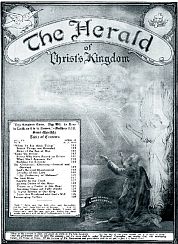
VOL.
XII. December 1, 1929 No. 23 THE
MEMORIAL CONVENTION AT PITTSBURGH "BEHOLD
I MAKE ALL THINGS NEW" HALF
HOUR MEDITATIONS ON ROMANS THOSE
WHO SHALL INHERIT THE KINGDOM OF GOD THE
PRESENT MINISTRY OF THE SAINTS VOL. XII. December 15, 1929 No. 24 THE
TWELVE APOSTLES THEIR CALLING, OFFICE, AND AUTHORITY THOSE
WHO SHALL INHERIT THE KINGDOM OF GOD VOL. XII. December 1, 1929 No. 23 THE MEMORIAL CONVENTION AT PITTSBURGHIN reporting the convention held at Pittsburgh, November 1-3, we meet with somewhat of a difficulty: Words seem inadequate to convey a true and correct impression of this spiritual season of communion and fellowship in Christ. It was a most blessed occasion in every sense of the word. The remark was frequently heard near the close of the convention, that the joy and spiritual uplift realized had exceeded anything that had been anticipated. We need not hesitate in saying that this convention was the most inspiring, the most spiritually fruitful, and presented the most encouraging outlook of any convention since the passing of our beloved Brother Russell. Indeed it was of a kind to take one back to the days of our Brother's sojourn with us and to those conventions when his presence and ministry were inspiring factors. The suggestion that had been made that all who loved our Lord Jesus Christ and were trusting in the precious blood should come with a desire and prayer to do some good as well as to get some profit, seemed to have been heeded. The spirit of meekness, gentleness, brotherly kindness, and zeal for God's Word -- all elements of the spirit of love -- which pervaded the meetings and displayed itself privately as well as publicly, was very marked. It was truly refreshing to faith to feel such joys of full heart union and sympathy without a bond of any sort except that of the spirit of the Truth, the spirit of Christ-love. The old Chapel a Sacred PlaceAs had been announced, the Convention was held in the old Bible House headquarters, where Brother Russell conducted the work for so many years. In the old Bible House Chapel the brethren assembled, the place where the Word of God in its purity was ofttimes spoken, the place made sacred by the presence and ministry of Brother Russell through long years. Truly as the brethren entered this room, especially those who had ofttimes attended services there long ago, sweet memories were recalled of the former years. Here in this Chapel many of the Lord's people first heard and received the message of Present Truth. It was the custom in the early years of the ministry of Present Truth, to hold a General Convention in this Chapel annually in connection with the observance of the Memorial Supper. Some of the brethren are still with us who recall having had the privilege of partaking of the emblems of the Lord's Supper with Brother Russell in this sacred spot. No wonder then that the friends with one accord eeply appreciated the privilege of attending a general convention of the brethren held at this time in the Bible House Chapel. The recent issues of the "Herald" had announced the Convention at Pittsburgh as being a memorial of Brother Russell's death, and such it truly was. The fact that it was the anniversary of Brother Russell's passing thirteen years ago lent much toward hallowing the occasion and making it a most sacred season to all. It would be difficult to state definitely the exact number that were present during the entire convention, but surely the number in attendance during all the sessions was between three and four hundred. The Middle West and many of the Eastern States and portions of Canada were well represented. A goodly proportion of the newly formed Pittsburgh congregation was also in constant attendance. A Gathering of the Liberty-loving People of GodAs previously announced in these columns as well as in the p: program arranged and sent out by the brethren in Pittsburgh, this was a convention where all sincere and consecrated believers who love our Lord Jesus Christ were made warmly welcome. A broad, tolerant spirit of brotherly love characterized the convention throughout. It was evident that the brethren had assembled out of a deep desire to cast aside all sectarian barriers and to worship the Lord in the beauty of holiness; additionally, to encourage and assist one another in this time of, stress and trial. to remain steadfast and loyal to their Divine Lord and to each other as brethren in Christ. Quite evident indeed was the fact noted in our announcement of this Convention, that within recent months a large number of brethren throughout the country and particularly in the vicinity of Pittsburgh have realized their need for, as well as their privilege of exercising, their God-given liberties of believing and teaching the Word as each considers pleasing to the Lord, and of taking and maintaining their stand in defense of the great principles and doctrines of the Christian faith and in support of the simplicity and order of the Church as instituted by our Lord and the Apostles. In these recent years since Brother Russell's departure the sacred treasures and heritage of the Lord's people have been called in question, resulting in severe and crucial tests which have brought great suffering to many. These tests and sorrowful experiences successfully endured and passed through by a goodly number of late, gave rise to much joy and rejoicing on the part of the brethren assembled in Pittsburgh; they were glad indeed for the recent deliverance and newly found liberty in Christ. They Testified of God's Keeping PowerThere were several testimony meetings during the Convention. and it was most interesting and impressive to note how many of those present and gave testimony. were of lone standing in the Present Truth -- many years back in Brother Russell's time. Several related their experiences of more than thirty and forty years ago, of visiting Brother Russell at the old Bible House and of hearing the Word of the Lord from his lips in all its purity and simplicity. Cherished indeed are those days and experiences! Still others, one after another, related briefly how the Lord had graciously led them out of darkness into His marvelous light, into the sunshine of His Truth, into His love, into the fellowship of His sufferings and joys, and into the glorious and sustaining hone of ultimately attaining His likeness and joint-heirship with Him in His Kingdom. There seemed also to be the general consent that the trials, sorrows, and disappointments in which all have shared. should be forgotten and passed by to give room for the more blessed consideration of our present joys and future hones through the Anointed One, thus putting in practice the Apostle's instruction to forget those things which are behind and to reach forward for those things which are before. and to press along the course for the great prize of our High Calling, looking unto Jesus, the Author and soon to be the Finisher of our faith. Many messages, letters, telegrams, etc., containing warm greetings and love were received during the Convention from various parts of the country; amongst these a cablegram from the Forest Gate Class of London, England. All of these messages were very much appreciated by the Convention. The program as published and distributed in advance of the convention was carried out quite in detail: The brethren who addressed the various sessions of the convention were nearly all such as had co-operated with Brother Russell in the ministry in one way or another. In addition to those names indicated on the printed program and published in the November 1st issue of this journal, there were several others who took part in the ministry at the convention, as follows: L. W. Jones, M.D., A. I. Ritchie, P. E. Thomson, R. R. Hollister, W. J. Hollister, C. H. S. Kuehn. All Ye are BrethrenThe Chairman selected by the Convention Committee in Pittsburgh, Brother George M. Wilson, also of long acquaintance with Brother Russell, served the convention admirably. In the Address of Welcome all were made at once to feel perfectly at home, and to realize that it was truly a gathering of the family of the Lord. The words of the Savior were recalled, "One is your Master, even Christ; and all ye are brethren." And here in this connection we desire to acknowledge the loving thoughtfulness and consideration of the Pittsburgh congregation who through their Committee, received the visiting friends and saw to it that they were comfortably located and that all needs were duly provided for. We doubt not however that their own spirits were much strengthened and refreshed through the exercises of the Convention, and may the Lord grant unto these brethren the rich reward for their love and faith as He has promised to do toward all those who are faithful to Him. They that Thought upon His NameFollowing is a list of the subjects of the principal addresses of the convention: "Are We Building
Together with God?" The brethren addressing the convention proclaimed the Message of the Lord and presented the Truth each in his own characteristic style and manner. The earnest endeavor of each one seemed to be that of holding up the Head and of honoring the Lord. Those items and matters having a bearing upon and essential to inheriting the Kingdom of God, were given first and careful consideration. Various problems and questions peculiar to these recent years were dealt with and Scriptural suggestions and advice offered we believe to the profit of all. The present outlook for the Church and the signs of the times and the close proximity of the Kingdom of God, were also touched upon in some of the addresses. Such themes are ever appropriate and interesting to the children of the Lord, even as the Apostolic admonition is that the faithful in Christ Jesus should be sober, vigilant, watchful; and they are given the assurance that as faithful brethren they will not be in darkness that the day of the Lord should overtake them as a thief. Yet it is most pleasing in these days to observe the faith and implicit trust on the part of the Lord's people by which they are quite willing to rest the matter of times and seasons in the Lord's hand; that while they may now lift up their heads with rejoicing because of the approaching deliverance, they can nevertheless trustfully wait upon the Lord and meantime give the more careful consideration to those matters and interests that have to do with the development of spirituality and the Christlike character which alone can prepare for the presence of Christ and joint-heirship with Him in His glorious Kingdom. Thus as the different speakers at the Pittsburgh Convention reviewed the wondrous Plan of Salvation, revealing more and more of "the breadth, and length, and depth, and height" of the love of the Heavenly Father through Christ our Lord, and as they in the spirit of love and meekness admonished and encouraged all to renewed effort in the Narrow Way, traversed by their Redeemer, the Convention Hall seemed filled with the presence of the Lord. Forgotten for the time were the things of this world and its affairs; the sufferings, trials, and perplexities of the daily life all seemed to fade away before the glories and splendors of the heavenly things seen with the eye of faith. Throughout the sessions of the Convention many expressions of joy and thanksgiving and hymns of worship and praise ascended to Him from whom all blessings flow. Many earnest prayers were offered in behalf of the Lard's people far and near, known and unknown to us, that in this stormy time of trial and perplexity, all might experience the needed supplies of grace and strength wherewith to battle in the cause of truth and righteousness. The Memorial to Brother RussellAs indicated on the Program, Sunday morning had been set apart as a special memorial hour dedicated to the sacred memories of Brother Russell. The ministry, character, and life work of this great man of God were reviewed from various standpoints. The hearts of all seemed solemnized with thoughts of deep and sincerest appreciation of what the service and ministry of Brother Russell had meant to the Church of these last times. Some of these reflections with regard to our beloved Brother may be summed up as follows: Meek and humble, gentle and refined, yet firm and zealous for the Truth, he was ever seeking by word and deed to bring blessings to others. No one living was more devoid of selfishness than was he. Those who knew him best, loved him most, and all marveled at his indefatigable labors, his voluminous writings, his innumerable sermons, his vast correspondence and unending dictations, his attention to minute details and yet his faculty for viewing matters comprehensively and generalizing situations as they might develop. His fearlessness in opposing error, and his kindness in dealing with opposers were a source of wonder and admiration to his associates. Though grossly slandered and misrepresented as all of God's faithful messengers have been in the past, by the small and narrow minded, who are moved by the spirit of the Adversary, and who always resort to personalities in opposing principles, he exhibited a magnanimous disposition, forgiving his enemies and even assisting those who had said all manner of evil against him falsely. The Service at the GraveThis memorial service of Sunday morning was continued in the afternoon, when about 130 of the friends journeyed to the cemetery on the outskirts of North Pittsburgh, where thirteen years ago the mortal remains of our Brother were laid in their last resting place. Here at the grave the scenes of thirteen years ago were recalled. It was just at sunset when a large concourse of friends from all parts of the country gathered to this hillside to witness the burial services of our much beloved Brother. Now again, though it is earlier in the day, it seemed that the scenes of thirteen years ago were almost being enacted again: solemn hymns expressive of our love and worship were sung; amongst these were "Rock of Ages"; "Jesus Refuge of My Soul"; and "How Vain is. All beneath the Skies." Several prayers were offered, while the heads of all were bowed in deep and solemn meditation and worship of Him who is from everlasting to everlasting, our Father in. Heaven. Praise and thanksgiving were offered to the Lord for His gracious shepherding care over his people, in providing them with such a faithful messenger and servant in the Church. And while during the thirteen years that have passed since his departure, there have been permitted severe and crucial trials upon the Church, yet through the guidance and leading of the Spirit, the Lord's faithful today were able to recognize in all such experiences the hand of Providence administering that which seemeth to Him good. Highly Esteemed for His Work's SakeAnd so in the consciousness of the great truth that the eternal God is our refuge and underneath are the everlasting arms, and that there is still over the Church the great Shepherd of our souls, we left the scenes of the last resting place, of our Brother's earthly remains, with the peace of God ruling in our hearts. Not in the spirit of superstition, idolatry, or man-worship, nor as ignoring their Divine Master, did the thoughts and hearts of the friends turn toward Brother Russell in connection with this memorial service; but as holding him in very high and holy esteem .for his inspiring example, his faithful ministry and devotion to the will of God. As was said of a faithful minister of the early Church, "He was a good man and full of the Holy Spirit," so the brethren have felt in these latter days toward Brother Russell. It is this noble Christian life, whose memory all who love the Present Truth delight to honor. We love him for his work's sake and we honor him for his continued services to us in the example he left us and in the continued uplifting influences of the grand and glorious Message so faithfully delivered over the world, which has satisfied our spiritual longings as nothing else could do. Till we Meet AgainThe final service of the Convention was held Sunday night at eight o'clock, when the last discourse indicated on the Program was given. This was followed by a few choice and appropriate remarks by the Chairman, briefly reviewing the happy and precious experiences of the three days of fellowship in Christ. Then while all the congregation joined in the grand old Hymn, "God be with you till we meet again,"' the brethren bade each other Godspeed and Goodbye, giving assurance to one another of continued fervent love and remembrance at the Throne of Heavenly Grace. Truly this Memorial Convention at Pittsburgh was a glorious success, for which we thank God from whom all blessings flow: "And if our
fellowship below ___________________ Considering the unusual character of the gathering at Pittsburgh and the special interest centering in this Convention, Doctor L. W. Jones of Chicago, well known to many of the friends in various parts of the world, on account of his association in the work during Brother Russell's ministry, has planned to prepare an elaborate Souvenir Report of the Convention at Pittsburgh. Brother Jones has had large experience in the preparation of Convention Reports, as is well known by many who still have in their possession the old Reports of the conventions covering several. years prior to Brother Russell's death. Brother Jones was present during the entire convention at Pittsburgh and made all necessary arrangements to produce a complete Report, one that we believe will be interesting, profitable and acceptable to all. The Report, we understand, is to include, various views, photographs of the old Bible House, Brother Russell's grave, etc., together with the addresses delivered at the Convention. Many of the friends have already received Brother Jones' circular letter of inquiry regarding the Report. All communications concerning the matter, orders, etc., should be sent direct to Brother Jones. "PRAISE OUR KING""Praise,
my soul, the King of heaven; "Praise
Him for His grace and favor "BEHOLD I MAKE ALL THINGS NEW"[The following address was delivered
over the Radio by one of the brethren WE direct the attention to some words found in the last Book of the Bible: "God shall wipe away all tears from their eyes; and there shall be no more death, neither sorrow, nor crying, neither shall there be any more pain: for the former things are passed away. And He that sat upon the throne said, Behold, I make all things new." -- Rev. 21 :4, 5. Accustomed as we are to sights of wretchedness and woe, experiences of sorrow, pain, and death, the promise of our text seems to many a vain one, and those who believe it, trust it implicitly, are esteemed visionary, illogical, credulous. Some of the wise men of the world have told us that what has been and is, shall be, and that while we might hope for some prolongation of human life, and some assuagement of human miseries, yet to expect that death and pain and sorrow will be abolished is absurd and indicates an illogical mind. Other leaders there are, however, who we believe are more wise, have not accepted that reasoning. In fact, the literature of the world shows that intelligent men have refused to believe that the Divine purpose in the creation of our earth has yet been attained. Continually we find references to the Morning of the New Day, to the Golden Age, etc. Not to the longings of men's hearts, however, but to the promises of our God do we look for real instruction on this subject. The Bible most emphatically declares that the entire period of human history thus far has been a night-time. The Prophet David explains, "Weeping may endure for a night, but joy cometh in the morning." (Psa. 30:5.) Thus, prophetically, we are assured that there will be a morning, whose glory, brightness, and blessing will fully compensate for all the dark shadows of the night-time past. Thy Kingdom ComeThe promise of a new Age of blessing for humanity is in full accord with the prayer which our Lord taught us as His followers -- "Thy Kingdom come, Thy will be done on earth as in heaven." Surely none will dispute that God's will done in heaven means the perfect happiness of all His faithful. Surely none will doubt that there is no death in heaven, no cemeteries, no funerals. Surely none will doubt that there is no sickness there, no tears, or suffering of any kind. Surely none will doubt that there is no sorrow in heaven nor cause for any. Why, then, should it seem to us incredible that the same Heavenly Father, who thus arranges for the sons on the spirit plane, should similarly arrange for His human sons? Why should we doubt that the love that has prevailed for the eternal happiness of the angelic hosts would be equally willing to provide .for the eternal happiness of humanity? Why, then, should we hesitate for a moment to accept the explicit declaration of the Scriptures that a great change of dispensation is coming, when, instead of the world being subject to the Prince of this world who now worketh in the children of disobedience (Eph. 2:2), it shall be instead under the domain, the rulership of the Prince of Glory, who redeemed Adam and his race from the curse of death by the sacrifice of Himself. It is time that we should recognize the great Scriptural truth that God is love, that He created us with a glorious purpose in view, and that our affliction as a race through Adam's disobedience has not changed the Divine character nor the Divine sentiment toward us. It is time that we should learn afresh that our loving Creator changes not; that all of His glorious purposes shall be accomplished, and that the word that has gone forth out of His mouth shall not return unto Him void, but shall prosper in the thing whereunto He sent it. It is time for us to learn that His permission of sin and sorrow, pain and dying has been but temporary, with a view to our instruction as respects the exceeding sinfulness of sin and with a view to the ultimate blessing of all those who will be taught of God and ultimately learn the lessons He will give through His representative, our Redeemer, who shortly will be the great Prophet, Priest, and King of the world for humanity's instruction and uplifting out of sin and death conditions back to perfection. How glorious it will be when He shall have accomplished His work, for as the Apostle declares "He must reign until He hath put all enemies under His feet -- the last enemy that shall be destroyed is death." (1 Cor. 15: 25, 26. ) We may well long for His Second Coming in power and great glory, to bind Satan and to accomplish these glorious results. It should not be wonderful to us that the Apostle, who saw clearly and explained definitely respecting these things to be accomplished in the new dispensation, held out that the glorious Messiah is the hope of the world. "A Day with the Lord -- A Thousand Years"As we look back through the vista of six thousand years and hearken to the sounds of sorrow, the indication of pain, and note the reign of sin and death; our hearts are appalled. The period seems so long we are inclined to wonder whether or not the great Creator has forgotten His creatures in their sin, that He has as yet accomplished so little for their deliverance, that as yet His favor toward us is mainly that of promise and our confidence mainly that of hope. It is only when we understand the declaration of the Bible, "A day with the Lord is as a thousand years," that we can appreciate the fact that this period of the reign of sin and death is not nearly so long from the Divine standpoint as from ours. We may be certain Divine wisdom, justice, and love assure us that the period in which sin is permitted to have control of our race is none too long for the outworking of the glorious features of the Divine Plan. We can see that it has been crowded full of experiences to our race, that the birth and life and death of the twenty thousand millions of Adam's posterity is a gigantic work crowded into a comparatively brief, space. And what will this six thousand years amount to anyway in comparison to the eternity of blessing which under God's provision may be the portion of those immense hosts! Furthermore, we are to remember that no individual member of our race suffered for six thousand years, that the cup of sorrow, pain, and death as it has reached individual lips to be drained has been comparatively a small one. On the contrary, the thousand years of Christ's Millennial reign, in which the earth shall be made to blossom as the rose and the human race be recovered from the tomb, and the light of Divine favor scatter every shadow-this experience for each member of the race will of itself quite outbalance the shorter period of their contact with sin and death conditions. Thus, if the Divine Plan had nothing for our race beyond the Millennium, there would be to each individual during the Millennium an abundant offset for his trials, pains, and sorrows of the present brief experiences. But the Millennium itself, the Scriptures show, is but the vestibule, but a schooling to prepare all who will accept it for an eternity of perfect bliss beyond, when there shall be no more sighing, no more crying, no more dying -- when the present things of sin and death shall have been utterly banished. "The Groaning Creation Waiting"Most beautifully does the Apostle picture the present condition of the world with its longing for something better which it does not clearly appreciate, but which we who are guided by the Word of God do understand. He says, "The whole creation groans and travails in pain together," and again he tells us that they are "waiting for the manifestation of. the sons of God." (Rom. 8:22, 19.) The groaning, the travailing, the pain, the death, are literal enough, sure enough, manifest enough. The waiting part can be appreciated only by those who know what God has promised in our text and in various co-related Scriptures which give us assurance of the Millennial Kingdom and its glorious work of blessing for the world. God's revelation of His plans; His purposes, is, in this Age, only for His saints -- "To you it is given to know the mysteries of the Kingdom of Heaven," but to outsiders these things are spoken in parables and dark sayings. (Mark 4:11.) "The secret of the Lord is with them that fear [reverence] Him: and He will show them His covenant." (Psa. 25:14.) When the Apostle declares that the groaning creation is waiting for the manifestation of the sons of God, he furnishes the key by which those in the proper attitude of heart to be taught of the Lord may enter into some of His secrets. The difficulty with the majority who attempt to study the Bible is that they fail to get the proper standpoint of view; they think of the Bible as addressed to all the world now; they think of God as dealing with all men in this Age; whereas the Scriptures clearly teach that the time for Divine dealing with the world is not yet come; that in the interim God is merely dealing with special classes; as, for instance, in the past He dealt with the patriarchs and not with the world in general; from Sinai to Calvary He dealt with the Jewish nation only, but not with the world; and since Calvary to the Second Advent of .our Lord and the completion of the Church He deals not with the world, but with the special class whom He calls out of the world -- the household of faith from amongst whom He selects the "very elect" to be the Bride and joint-heir with their Redeemer in His Millennial Kingdom glory. The Apostle declares this to be the Mystery, the secret of the Divine Plan which obscures the same from the minds of men in general. Our Lord Jesus was indeed the promised Messiah, the King of Israel, of whom it had been written that He should bless all the families of the earth through His glorious Kingdom reign. But, instead of beginning that reign, that Kingdom, that blessing of the world, that scattering of darkness and binding of. Satan as soon as He had secured the ransom price, He instead began another feature of the Divine Plan, namely the selection of the Kingdom class and company of joint-heirs, a "little flock" to be the Bride of Christ, otherwise styled "members of His Body." This has been the work of the entire Gospel Age, anything else being merely incidental thereto, and as soon as this selection of the Church and the polishing and preparation of the individuals thereof is completed, the next work will be in order -- the pouring out of a blessing through these upon humanity in general. "Beloved, now are we the sons of God, and it doth not yet appear what we shall be; but we know that when He shall appear we shall be like Him; for we shall see Him as He is." (1 John 3:2.) The Lord's faithful, consecrated ones are His sons even now, though hampered with unfavorable surroundings and. imperfect conditions. They are waiting for their "change," which shall be accomplished in a moment, in the twinkling of an eye, and which will constitute their resurrection from human to spirit conditions. Then in glory, the promise is that they shall "shine forth as the sun in the Kingdom of their Father." (Matt. 13:43.) In this poetic expression the Lord pictures the glorious effulgence of truth and grace which shall shine forth from Himself and His glorified Church, .in that due time when the present Age shall have ended and a new Age, the Millennium, shall have begun. It is to those sons of God in glory that the Apostle points and assures us that the whole creation is groaning and travailing in pain together, waiting for their manifestation, their shining forth as the Sun of Righteousness with healing in His beams."-Mal. 4:2. The Restitution of All ThingsThis is the same epoch, this is the same glorious refreshment coming to the world at our Lord's Second Advent and the glorification of the Church which the Apostle Peter so graphically portrays, saying, "Times of refreshing shall come from the presence of the Lord; and He shall send Jesus Christ, which before was preached unto you; whom the heaven must retain until the times of restitution of all things which God hath spoken by the mouth of all His holy prophets since the world began." -- Acts. 3:19-21. The restitution of mankind to the perfection lost through the fall is another way of expressing the same thing that is mentioned in our text, namely that God will make all things new. When He created them at the first they were very good, man being in his Creator's image and likeness. It was the fall and the resulting reign of sin and death that brought down our race from its high and noble condition, and what it needs is just what God proposes to do-make it new again, restore it again. And so our Master said that He came to seek and to recover that which was lost. (Luke 19:10.) Man was lost, his life-rights were lost, and these our Lord purposes to bring back to him, to put within his grasp and to assist him to put a value on them during the Millennial Kingdom. Thus, says the Apostle, "Christ died for our sins, according to the Scriptures." "As in Adam all die, even so in Christ shall all be made alive." No wonder the doctrine of Atonement is given so much prominence in the Bible and is set forth as the foundation of all hope, both for the Church in this Age, and humanity in the coming Age. But even yet, notwithstanding the death of Christ, the Creator does not propose to infract His law nor to permit a sinner to have eternal life. Hence, instead of granting eternal life to sinners, He has turned them over to their Redeemer to be instructed and assisted and chastened, uplifted and rewarded during the Millennial Age -- so many as will -- to the intent that by the close of that Age all the willing and obedient shall have reached full perfection and be fully able thereafter to thoroughly obey every Divine requirement; because no longer sinners, no longer weak, no longer degraded or impaired, they shall be absolutely perfect through the uplifting influences of their Redeemer. All who will not avail themselves of this privilege will still abide under Divine wrath and be destroyed in the Second Death, .from which there will be no recovery; but all the willing and obedient will be granted the gift of God -- eternal life through Jesus Christ our Lord. Every reference that the Scriptures make to that coming Age of the world's promised uplift and opportunity, pictures it as a time of marvelous blessings -- blessings that will be for all the living and the dead, in the sense that our Lord Jesus said, referring to that. time: "The hour cometh in which all that are in their graves shall hear the voice of the Son of God and come forth." They will come forth from the tomb in order that they may receive the benefits of His atoning sacrifice and be given a trial for everlasting life. All shall Know the LordOne of the most wonderful things the Bible tells us of respecting that New Day is the great intelligence and enlightenment which it will bring to every creature. "The light of the knowledge of the glory of God shall fill the whole earth as the waters cover the face of the great deep." (Isa. 11:9.) "And they shall teach no more every man his neighbor, and every man his brother, saying, Know the Lord; for they shall all know Me, from the least of them unto the greatest of them, saith the Lord." (Jer. 31:34.) Ultimately every knee shall bow and every tongue shall confess to the glory of God. What an enthusing prospect the Bible holds out before the Church and so many of the world as can exercise a measure of faith to believe! The world indeed sees to some extent that great blessings are coming; but just what these are and how they are to come, mankind knows not; for "the world by wisdom knows not God." The worldly wise have rejected the Bible, and do not trust it as a revelation from God: Thus the wise are caught in their own craftiness. Their boasted wisdom ensnares them and blinds them to the Divine revelation. Nevertheless some of our great thinkers, statesmen, and leaders of thought, are rapidly seeing that the world is just on the verge of the most wonderful inventions and knowledge, which will transform the face of the earth and the people thereof. They are corroborating the Bible unwittingly; for they believe it not and know not of its messages. But, now, let us take note of the fact that the dawning of the New Age is already here. Earnest students of the Scriptures are recognizing more and more clearly that the special blessings which humanity have been enjoying for the past sixty years, in the way of the vast increase of knowledge, modern inventions, and conveniences, are but foregleams of the new dispensation. Some have been calling attention to the fact that we are closely approaching unto the Millennial Dawn; indeed, Bible chronology quite clearly teaches us that six thousand years from creation have already ended -- six great days of a thousand years each, mentioned by St. Peter: "A day with the Lord is as a thousand years." Thus the seventh great day, also a thousand years long, has commenced. We have been enjoying its dawning. It is to be a grand day; what wonder if the dawning be remarkable! Signs of the Approaching MorningIt may surprise some to be told that the past sixty years mean more to the world in the increase of education, increase of wealth, increase of all manner of labor-saving inventions and conveniences, increase of safe-guards and protection for human life, than did all the six thousand years which preceded them-many times over. The world has probably created a thousand times as much wealth during the past sixty years as during those entire six thousand years preceding. Yet these changes came so gradually that few have noticed them. Sixty years ago, nearly all the labor of the world was done with sweat of face; today it is nearly all accomplished by machinery. Sixty years ago, the sewing machine was just reaching perfection; today it is everywhere indispensible. So with the thousand household conveniences! So with nearly all of our sanitary and plumbing arrangements! So with the farm implements, reapers, and binders, mowers, automobiles, electrical and gas engines, etc., etc., all belong to these sixty years. In our cities our modern conveniences are wonderful! Solomon in all his glory never dreamed of such things as the poorest human being in America may enjoy Prophecies respecting streams in the desert and the wilderness blossoming as the rose are having fulfillment -- not miraculously, but in harmony with the Divine order of an increased intelligence amongst men. Artesian wells are being drilled, great irrigating canals constructed, not only in the western part of the United States and Canada, but also in far-off Mesopotamia. The results are marvelous. Is not the Bible being fulfilled? Who can dispute these facts? What do they signify? We answer that they exactly corroborate the Divine declaration which describes our day: "Many shall run to and fro; knowledge shall be increased; the wise [of God's people] shall understand, and there shall be a time of trouble such as never was since there was à nation." -- Dan. 12:4, 10, 1. "A Night Also"We are in the Morning of the Age mentioned in our text. Ah, what a glorious morning! How changed the human conditions from those of our grandfathers! How thankful the whole world should be. Shouts of thanksgiving and praise should be rising from all people of the favored lands of civilization, and helping hands should be outstretched to carry the same blessings to heathen lands. But is it so? Are the people happy and rejoicing and appreciative of the New Day -- the gift of, Divine providence? No! in proportion as the blessings of God have come, the discontent of humanity has increased; and unbelief, not only in respect to the Bible as the Divine revelation, but in many instances in respect to the very existence of an intelligent Creator. . Notwithstanding the great increase in the world's wealth, and the fact that there art some noble souls who are using their share of the wealth in a praiseworthy manner, nevertheless the general operation of the law of selfishness prevails; and all the legislation which has been enacted, or which can be enacted, fails to restrain the great giant institutions -- corporations -- of our day, fails to hinder them from the exploiting of the masses in the interests of comparatively few. According to the Bible, God foreknew the conditions of our day as we are now reviewing them; and in the text mentioned in Isaiah (21:11, 12) He gives a key to the solution -- elsewhere in the Scriptures made very plain. Through the Prophet God tells us of the dark night coming -- after the Morning Dawn has well ushered in -- a dark storm-cloud just at sunrise. This dark hour is described in Daniel's prophecy and also in Jesus' prophecy, to be "a time of trouble, such as never was since there was a nation." Students of prophecy recognize in the great distress of nations in recent years ominous signs pointing to the conclusion of this Age, at which time the Scriptures clearly show that Messiah, the great King, will take His great power and exercise it, with the result that the raging waves of the sea of human passion will all be quieted; the fires of anarchy will all be extinguished, and the reign of Righteousness and Peace will begin. The Outcome GloriousCannot we see the wisdom of the great Creator's Program -- that He will allow mankind to convince themselves of their impotency, of their need of a God, and of the fact that there is a God and that His glorious purposes for humanity are revealed in His Word? Ah, no wonder the Bible speaks of that revelation of the Lord as "the still small voice of God," speaking to mankind through Messiah's kingdom! No wonder the Lord declares that "then He will turn to the people a pure Message, that they may all call upon the name of the Lord to serve Him with one consent" ! -- Zeph. 3 :9. We rejoice that such glorious things are coming -- even if it is necessary that the world reach them through the tribulation of the time of trouble. Happy are those whose eyes and tars of understanding are open now, and who are in such heart relationship with the Lord that He can make known to them in advance something of the riches of His grace and loving kindness and tender mercies, and can show them how all the troubles that are coming are intended to work out blessings for the human family. Surely as we come to the knowledge of the Divine character and Plan our perfect love for God casts out all fear; and we are able to rejoice in all of His prophecies and promises. HALF HOUR MEDITATIONS ON ROMANSNo. 3 "Paul, a servant of Jesus Christ, called to be an Apostle." -- Romans
1 :1. IN the last issue of this series we began a review of the life experiences of, St. Paul,, the undisputed author of our Epistle. At that time we considered to some extent his early life and in the last issue of this series we began a life review of the experiences of the Apostle Paul, the undisputed author of our Epistle. At that time we considered to some extent his early life and conversion, and noted the providential circumstances which led him to become "a servant of the Lord Jesus Christ. In the words of another: "For he is indeed 'Jesus Christ's bondservant'; not His ally merely, or His subject, or His friend. Recently, writing to the Galatian converts, he has been vindicating the glorious liberty of the Christian, set free at once from 'the curse of the law' and from the mastery of self. [Those formerly under the Law Covenant from its "curse" and all from the mastery of self.] But there too, at the close (6:17), he has dwelt on his own sacred bondage; 'the brand of his Master, Jesus.' The liberty of the Gospel is the silver side of the same, shield whose side of gold is an unconditional vassalage to the liberating Lord. Our freedom is 'in the Lord' alone; and to be 'in the Lord' is to belong to Him, as wholly as a healthy hand belongs, in its freedom, to the physical center of life and will. To be a bondservant is terrible, in the abstract. To be 'Jesus Christ's bondservant' is Paradise, in the concrete. Self-surrender, taken alone, is a plunge into a cold void. When it is surrender to 'the Son of God, who loved me and gave Himself for me' (Gal. 2:20), it is the bright home-coming of the soul to the seat and sphere of life and power."-Moule. A Witness of our Lord's ResurrectionThe particular form of service to which he has been called, he tells us, is that of an apostle. It is a rare commission, and we could well pause to give it a larger place in our meditations here. However, as it is our hope to consider the calling, office, and authority of the Twelve Apostles in a separate series of articles in this journal in the near future, we will content ourselves at this time with noting that they were our Lord's chosen witnesses of His resurrection. (John 15:27; Luke 24:46-48; Acts 1:8, 22.) Their general commission did not greatly differ from that of the other disciples, nor from that of our own, which we understand is to preach the Gospel of the Kingdom to the meek. (Isa. 61:1, 2 ; Matt. 10:5-7 ; Luke 4:17-21; 10:1-17.) But their special mission was that of witnessing, and among the many things concerning Jesus to which they were to bear faithful testimony, the most important of all was the fact of His resurrection. A very little reflection is sufficient to enable us to grasp the significance of this. Let us suppose for a moment that the Gospel Message had come to us complete in every detail, except in this one particular, namely that no mention was made of our Lord's resurrection; or that the testimony concerning it was wavering and unreliable. In that case, where would our hopes be today? What would be our hope of life beyond the grave? Our hope would be the same as that of those two disciples on the way to Emmaus, before they knew that Jesus has been raised from the dead. (Luke 24: 13-35.) Their hopes were buried in His grave. They had trusted in Jesus, and had entertained high hopes, but now, since Jesus had died, they were sad (verse 17), their hopes having withered. How different with them when the fact of His resurrection was made known to them. What joy displaced their dejection! It became true of them then, as it has of us who have believed since-they and we have been begotten again unto a hope of life by His resurrection. (1 Pet. 1:3.) Because He lives, we have grounds for hoping that we shall live also. (John 14:19.) In His resurrection lies our assurance. (Acts 17:3.1.) But while it is our privilege today to let Jesus Christ have full sway in our lives, to let Him be indeed our Lord, while it is our joy to make humble and glad confession of this fact, and while in our hearts we may believe the testimony of the Apostles that He was raised from the dead, and while in this lies our salvation (Rom. 10:9, 10), yet this does not constitute us witnesses of, but merely believers in His resurrection. Blessed indeed are we, who not having seen, have yet believed. (John 20:29. ) But it remains true that the testimony of these Twelve Foundations is that on which we, with the rest of the Church, depend. -- Rev. 21:14 ; Eph. 2:20-22. It is an interesting study, and one by no means unrelated to our subject, to trace in the Acts of the Apostles how they proceeded to carry out their commission. Our Lord had said, "Ye shall be witnesses unto Me both in Jerusalem, and in all Judaea, and in Samaria, and unto the uttermost part of -the earth." (Acts 1:8.) But first they were to receive "power." "Tarry ye in the city of Jerusalem," was His word, "until ye be endued with. power from on high." (Luke 24:49.) Accordingly we find them waiting at Jerusalem in prayer and supplication (Acts 1:14), until they had received the promise of the Father. Then commenced the work of witnessing, as the Spirit gave them utterance. (Acts 2:4.) One cannot but be impressed with the prominence given to the resurrection of Jesus in this, their first witness given under the guidance and in the power of the Holy Spirit "Ye men of Israel, hear these words; Jesus of Nazareth . . . by wicked hands have crucified and slain: whom God raised up, having loosed the pains [grip, Fenton] of death: because it was not possible that He should be holden of it." -- Acts 2:22-24. "This Jesus bath God raised up, whereof we all are witnesses." -- Acts 2:32. "Ye . . . killed the Prince of Life, whom God hath raised from the dead; whereof we are witnesses." -- Acts 3:15. "They taught the people, and preached through Jesus the resurrection from the dead." -- Acts 4:2. "Be it known unto you all, and to all the people of Israel, that by the name of Jesus Christ of Nazareth, whom ye crucified, whom God raised from the dead, even by Him doth this man stand here before you whole." -- Acts 4:10. "The God of our fathers raised up Jesus, whom ye slew." -- Acts 5:30. Thus it was that at Jerusalem "with great power gave the Apostles witness of the resurrection of the Lord Jesus; and great grace was upon them all." (Acts 4:33.) But soon a crisis came, and with the martyrdom of Stephen commenced "a great persecution against the Church which was at Jerusalem; and they were all scattered abroad ,throughout the regions of Judaea and Samaria." (Acts 8:1.) This had the effect of extending the witness throughout those regions. -- Acts 8:14, 25. The Apostle to the GentilesSo far the sacred historian has recorded the witness of the Apostles given "in Jerusalem, and in all Judaea and in Samaria," but what of the third, and by far the greatest part of their commission, that of carrying their witness to "the uttermost part of the earth"? Would not this involve witnessing to the despised Gentiles? Up to this time, even by those "which were scattered abroad upon the persecution that arose about Stephen" the word had been preached "to none but unto Jews only." (Acts 11 :19.) That the "unsearchable riches of Christ" should be preached to the Gentiles, that the latter were to share equally with the Jews in the blessings of the Gospel, was wholly foreign to the Apostles' conception. A tremendous revolution of thought would be necessary ere they could proceed with their witness. This was brought about by means of a vision granted to the Apostle Peter. Therein he learned "What God hath cleansed, that call not thou common." (Acts 10:15.) His subsequent experience with Cornelius convinced him "that God is no respecter of persons: but in every nation he that feareth Him, and worketh righteousness, is accepted with Him." (Acts 10:34, 35.) It is not without deep interest that in this extension of the witness to the Gentiles we note the same prominence given to the resurrection of Jesus. "We are witnesses of all things which He [Jesus] did both in the land of the Jews, and in Jerusalem; whom they slew and hanged on a tree: Him God raised up the third day, and shewed Him openly; not to all the people, but unto witnesses chosen before of God, even to us, who did eat and drink with Him after He rose from the dead." -- Acts 10:39-41. But while to the Apostle Peter was thus granted the privilege of extending the Gospel invitation to the Gentiles, as he had previously, on the day of Pentecost, to the Jews, God had in preparation a special agent whom He was about to call to this glorious, though difficult ministry one who, "by the grace of God," was to "labor more abundantly than they all." --1 Cor. 15:10. Have I not seen Jesus Christ Our Lord?In our previous "meditation" we considered the inner experiences of this Apostle, as the power of the risen Lord was exercised in his heart. It is, however, of the very highest importance that we distinguish the Damascus experience from all the visions with which he was afterwards honored, and which are recorded in the Acts of the Apostles and in the Epistles. We have already noticed that the Apostles were our Lord's chosen witnesses of His resurrection, and unless St. Paul had seen the risen Christ, he could not qualify as a witness. "The attempt has been made in modern times to explain in a purely natural way the sudden revolution which passed over the feelings, convictions, and life of Saul," but as Godet has pointed out, this "transforms the narratives in the Acts into fictitious representations, since, according to this explanation, Saul's fellow-travelers could have seen nothing at all." "They did not discern the Person who spoke to him, so it is said (Acts 9:7), but they were struck with a brightness surpassing that of ordinary sunlight (22:9; 26:13); they did not hear distinctly the words addressed to him (Acts 22:9), but they heard the sound of a voice. (Acts 9:7.) . . . It must therefore be admitted that while Saul alone saw the Lord and understood His words, his fellow-travelers observed and heard something extraordinary; and this last particular suffices to prove the objectivity of the appearance." Conybeare and Howson have written on this subject very interestingly and instructively as follows: "No journey was ever taken, on which so much interest is concentrated, as this of St. Paul from Jerusalem to Damascus. It is so critical a passage in the history of God's dealings with man, and we feel it to be so closely bound up with all our best knowledge and best happiness in this life, and with all our hopes for the world to come, that the mind is delighted to dwell upon it, and we are eager to learn all its details. "If the importance we are intended to attach to particular events in early Christianity is to be measured by the prominence assigned to them in the Sacred Records, we must confess that, next after the Passion of our blessed Lord, the event to which our serious attention is especially called is the Conversion of St. Paul. Besides various allusions to it in his own Epistles, three detailed narratives of the occurrence are found in the Acts. Once it is related by St. Luke (9), twice by the Apostle himself -- in his address to his countrymen at Jerusalem (22), in his defense before Agrippa at Caesarea (26). "In the twenty-second and twenty-sixth chapters of the Acts we are told that it was 'about noon' -- 'at midday' -- when the 'great light' shone 'suddenly' from heaven. (22:6; 26:13.) And those who have had experience of the glare of a mid-day sun in the East, will best understand the description of that light, which is said to have been 'a light above the brightness of the sun, shining round about Paul and them that journeyed with him.'. All fell to the ground in terror (26:14), or stood dumb with amazement. (9:7.) Suddenly surrounded by a light so terrible and incomprehensible, 'they were afraid.' 'They heard not the voice of Him that spake to Paul' (22:9), or, if they heard a voice, 'they saw no man.' (9:7.) The whole scene was evidently one of the utmost confusion: and the accounts are such as to express, in the most striking manner, the bewilderment and alarm of the travelers. "But while the others were stunned, stupefied and confused, a clear light broke in terribly on the soul of one of those who were prostrated on the ground. A voice spoke articulately to him, which to the rest was a sound mysterious and indistinct. He heard what they did not hear. He saw what they did not see. To them the awful sound was without a meaning: he heard the voice of the Son of God. To them it was a bright light which suddenly surrounded them: he saw JESUS, whom he was persecuting. The awful dialogue can only be given in the language of Scripture. Yet we may reverentially observe that the words which Jesus spoke were 'in the Hebrew tongue.' The same language, in which, during His earthly life, He spoke to Peter and to John, to the blind man by the walls of Jericho, to the woman who washed His feet with her tears -- the same sacred language was used when He spoke from heaven to His persecutor on earth. And as on earth He had always spoken in parables, so it was now. That voice which had drawn lessons from the lilies that grew in Galilee, and from the birds that flew over the mountain slopes near the Sea of Tiberias, was now pleased to call His last Apostle with a figure of the like significance: 'Saul, Saul, why persecutest thou Me? It is hard for thee to kick against the goad.' As the ox rebels in vain against the goad of its master, and as all its struggles do nought but increase its distress -- so is thy rebellion vain against the power of My grace. I have admonished thee by the word of My truth, by the death of My saints, by the voice of thy conscience. Struggle no more against conviction, 'lest a worse thing come unto thee.' An Apostle by the Will of God"It is evident that this revelation was not merely an inward impression made on the mind of Saul during a trance or ecstasy. It was the direct perception 9f the visible presence of Jesus Christ. This is asserted in various passages, both positively and incidentally. In his first letter to the Corinthians, when he contends for the validity of his own apostleship, his argument is, 'Am I not an Apostle? Have I not seen Jesus Christ, our Lord?' (1 Cor. 9:1.) And when he adduces the evidence for the truth of the resurrection, his argument is again, 'He was seen . . . by Cephas . . . by James . . . by all the Apostles . . . last of all by me . . . as one born out of due time.' (15 :8.) By Cephas and by James at Jerusalem the reality of Saul's conversion was doubted (Acts 9:26, 27) ; but 'Barnabas brought him to the Apostles, and related to them how he had seen the Lord in the way, and had spoken with Him.' And similarly Ananias had said to him at their first meeting in Damascus: 'The Lord hath sent me, even Jesus who appeared to thee in the way as thou camest.' (9:17.) 'The God of our fathers hath chosen thee that thou shouldest see that Just One, and shouldest hear the voice of His mouth.' (22:14.) The very words which were spoken by the Savior, imply the same important .truth. He does not say, 'I am the Son of God-the Eternal Word -- the Lord of men and of angels': -- but, 'I am Jesus' (9 :5; 26:15); 'Jesus of Nazareth.' -- 22:8. "The direct and immediate character of this call, without the intervention of any human agency, is another point on which St. Paul himself, in the course of his apostolic life, laid the utmost stress; and one, therefore, which it is incumbent on us to notice here. 'A called Apostle,' 'an Apostle by the will of God,' 'an Apostle sent not from men, nor by man, but by Jesus Christ, and God the Father, who raised Him from the dead'; these are the phrases under which he described himself, in the cases where his authority was in danger of being questioned. No human instrumentality intervened, to throw the slightest doubt upon the reality of the communication between Christ Himself and the Apostle of the heathen. And, as he was directly. and miraculously called, so was the work immediately indicated, to which he was set apart, and in which in after years he always gloried the work of 'preaching among the Gentiles the unsearchable riches of Christ.' Unless indeed we are to consider the words which he used before Agrippa as a condensed statement of all that was revealed to him, both in his vision on the way, and afterwards by Ananias in the city: 'I am Jesus, whom thou persecutest: but rise; and stand upon thy feet; for to this end I have appeared unto thee, to ordain thee a minister and a witness both of these things which thou hast seen, and of those things wherein I will appear unto thee. And thee have I chosen from the House of Israel, and from among the Gentiles, unto whom now I send thee, to open their eyes, that they may turn from darkness to light, and from the power of Satan unto God'; that they may receive forgiveness of sins, and inheritance among the sanctified, by faith in Me.' "But the full intimation of all the labors and sufferings that were before him was still reserved. He was told to arise and go into the city, and there it should be told him what it had been ordained that he should do. He arose humbled and subdued, and ready to obey whatever might be the will of Him who had spoken to him from heaven. But when he opened his eyes, all was dark around him. The brilliancy of the vision had made him blind. Those who were with him saw, as before, the trees and the sky, and the road leading into Damascus. But he was in darkness, and they led him by the hand into the city. Thus came Saul into Damascus-not as he had expected, to triumph in an enterprise on which his soul was set, to brave all difficulties and dangers, 'to enter into houses and carry off prisoners to Jerusalem -- but he passed himself like a prisoner beneath the gateway; and through the colonnades of the street called 'Straight,' where he saw not the crowd of those who gazed on him, he was led by the hands of others, trembling and helpless, to the house of Judas, his dark and solitary lodging. "Three days the blindness continued. Only one other space of three days' duration can be mentioned of equal importance in the history of the world. The conflict of Saul's feelings was so great, and his remorse so piercing and so deep, that during this time he neither ate nor drank. He could have no communion with the Christians, for they had been terrified by the news of his approach. And the unconverted Jews could have no true sympathy with his present state of mind. He fasted and prayed in silence. The recollections of his early years, the passages of the ancient Scriptures which he had never understood, the thoughts of his own cruelty and violence, the memory of the last looks of Stephen -- all these crowded into his mind, and made the three days equal to long years of repentance. And if we may imagine one feeling above all others to have kept possession of his heart, it would be the feeling suggested by Christ's expostulation: 'Why persecutest thou ME?' This feeling would be attended with thoughts of peace, with hope, and with faith. He waited on God: and in his blindness a vision was granted to him. He seemed to behold one who came in to him, and he knew by revelation that his name was Ananias, and it appeared to him that the stranger laid his hand on him, that he might receive his sight. "Ananias came into the house where Saul, faint and exhausted with three days' abstinence, still remained in darkness. When he laid his hands on his head, as the vision had foretold, immediately he would be recognized as the messenger of God, even before- the words were spoken, 'Brother Saul, the Lord, even Jesus, that appeared unto thee in the way as thou camest, hath sent me, that thou mightest receive thy sight, and be filled with the Holy Ghost [Spirit].' These words were followed, as were the words of Jesus Himself when He spoke to the blind, with an instantaneous dissipation of darkness: 'There fell from his eyes as it had been scales: and he received sight forthwith' (9:18): or, in his own more vivid expression, 'the same hour he looked up ón the face of Ananias.' (22:13.) It was a face he 'had never seen before. But the expression of Christian love assured him of reconciliation with God. He learnt that 'the God of his fathers' had chosen him 'to know His will,' 'to see that Just One,' 'to hear the voice of His mouth,' to be 'His witness unto all men.' He was baptized, his body was strengthened with food; and 'his soul was made strong to 'suffer great things' for the name of, Jesus, and to bear that Name 'before the Gentiles, and kings, and the children of Israel.' " Extending the witnessBut while those unacquainted with the Scriptures might, if they chose, find ample proof of his apostleship along the lines above indicated, we who have rejoiced in "his" Gospel, find the seal of his apostleship in our hearts and lives. Surely, if any amongst us should be found calling his apostleship in question (whoso readeth, let him understand), his reply to the Corinthians of his time would come with equal force to such. "If to others I am not an apostle, yet certainly I am to you; for you are the seal of my apostleship in the Lord." (1 Cor. 9 :2, Diaglott.) As the light has shined into our hearts from his inspired writings, we have with James and Cephas and John perceived that Paul was entrusted with the glad tidings -for the uncircumcision, even as Peter was for the circumcision; "(For He that wrought effectually in Peter to the apostleship of the circumcision, the same was mighty in Paul toward the Gentiles)." -- Gal. 2:7, 8.. With the raising up of this special servant, this Apostle by way of call, the work of witnessing takes on larger dimensions. Missionary journeys are undertaken, and it is seen that by means of missions, the "uttermost part of the earth" must receive its witness of Jesus. Soon the inevitable conflict arises between the fast growing Gentile Christianity, and those followers of the Lord formerly under the old Law Covenant. The first Council of the Christian Church harmonizes this conflict, and in the chapters of the Book of the Acts which follow, the religion of Jesus is seen to be unlimited by Mosaic Law. Next, "We are told of perplexing hindrances to the movements of St. Paul and his colleagues, until a supernatural vision solves the problem. St. Paul sees a man of Macedonia who cries, 'Come over and help us.' The opening of the Gospel to Europe is the new departure: as the Apostles cross over to Macedonia, the country of the future, the region of infinite progress, receives the new religion from the more stationary orient in which it had had its birth. A new stage has been accomplished towards the christianization of the whole world. "With this enlargement in the sphere of action is again united an enlargement in the methods of the sacred task. To the missionary journey is now added the missionary epistle, and four Pauline epistles find their place in this section of New Testament history. The significance of this stage is immense. It is not merely that the ministry of the written word is added to the ministry of the spoken word; there is enlargement in the conception of Christianity itself. Hitherto evangelization has limited itself to the etymological significance of the word: there has been simply a proclamation of the good tidings of Christ. But the work for which the epistle is to be an instrument is the growing doctrine of Christianity, and the realization of that doctrine in church government as well as in Christian life. The Church of Thessalonica, looking, like the other churches, for the immediate coming of the Master, has been perplexed by the death of some of its members: the Epistles to the Thessalonians solve their perplexities with the largeness of the Christian hope. Another church has been entangled in disputes with upholders of the Mosaic Law: the Epistle to the Galatians insists on Christian freedom. The succession of missionary epistles embody the gradually developing theology in a series of solutions to the multiplying difficulties of the churches. "So wide has now become the enlargement in the Apostles' conception of their work and their methods that the question at this point is, where this embryonic history of world evangelization is to stop. The answer to this question from the standpoint of that age was summed up in the word-Rome. Rome was the center of civilization, the symbol of world unity. Hence in the final section of the Book of Acts a series of strange providences is found to bring the Apostle of the Gentiles to Rome. And before he journeys thither he sends forward his Epistle to the Romans: a this the harmonization of Jewish and Gentile Christianity, of the Old and the New Testament, is expounded to the metropolis of universal civilization." -- Moulton. THOSE WHO SHALL INHERIT THE KINGDOM OF GODContinued from last issue from the text, Matt. 5:1-12 THE fifth blessed condition is that of Mercifulness. Mercy is the outward expression that man can discern, resulting from an appreciation of righteousness and a hunger and thirst for it in the renewed heart. After we have taken the preceding step's, and have learned to appreciate the inequities of the present time, and our own imperfections (unrighteousness) and those of other men; and after we have learned that God alone is able to right these matters in the full and complete sense, and that He has made provision for the righting of every wrong, and for the restoration to His favor of all who will accept His grace in Christ, to be made known to all in due time -- it is then we begin to feel merciful, benevolent, kind, toward others, to an extent and degree that we could not feel these sentiments previously. Worldly people, who have not traveled on the pathway marked by these blessings of character and growths in grace, cannot to the same degree sympathize with nor feel merciful toward others. Each day of our life, each hour, and each moment, we partake of His undeserved mercy. All the blessings we enjoy are proofs of His mercy. If we, also, show mercy to the poor, the wretched, the guilty, it shows that we are like God. We have His spirit, and shall not lose our reward. And we have abundant opportunity to do it. Our world is full of guilt and woe, which we may help to relieve; and every day of our lives we have opportunity, by helping the poor and wretched, and by forgiving those who injure us, to show that we are like God. The Lord lays great stress upon this quality of mercy, declaring that whatever else may be our attainments of knowledge or of grace, if we have not this one we can never be acceptable to Him -- if we do not have mercy upon others neither will our Heavenly Father have mercy upon us. And to insure that we do not consider this mercy to be merely an outward form, an expression of forgiveness and benevolence, our Lord expounds the matter, saying, "If ye do not from the heart forgive one another, neither will your Heavenly Father forgive you." It must be a genuine mercy, and not a feigned one; it must cover from sight, and so far as possible blot from memory, the failings and weaknesses of others, else it cannot hope for forgiveness and blotting out of its own shortcomings which its hunger and thirst for righteousness has clearly revealed to it. Only the merciful shall obtain mercy; and if we have not mercy at the hands of the Lord all is lost; for by nature we were children of wrath. even as others, and under just condemnation. The exercise of mercy, benevolence, forgiveness, is a blessing, not merely because it is essential to our own forgiveness, and hence to our salvation, but also because this condition of heart which sympathizes with others in their failures and imperfections helps to rid our hearts of certain works of the flesh and of the Devil, which incline to cling to the Lord's people long after they have been justified by faith, and even after they have made full consecration of themselves to the Lord and are seeking to "walk not after the flesh, but after the spirit." The Apostle includes amongst the works of the flesh which require putting away, after we are fully the Lord's, the following: anger, malice, hatred, envy, strife. All of these qualities of selfishness are antagonized by mercy, and by it largely they are driven from their secret hidings and entrenched positions in our hearts. The blessed character of Mercy is closely related to Love, for it is in proportion as we obtain the Lord's spirit of love that we manifest toward others mercy, even as He has manifested His love toward us in the mercy extended to us in Christ. Love and mercy, consideration for others, has much to do with driving out envy. How can we envy those whom we love sincerely? How can we have malice toward those who are our enemies, if we love them and have mercy, compassion, upon them, and forgive them from our hearts? How can we have hatred toward them if we have mercy upon them, and feel toward them only a forgiving spirit? And how can we be strifeful, if we have a merciful, a forgiving spirit ready to forgive trespasses against us, as we hope for forgiveness of our trespasses against the Divine law? "Mercy rejoiceth against justice," the Apostle explains. (Jas. 2:13.) Divine Mercy satisfied Divine justice, and thus prepared the way for the rescue of our race from the sentence of justice: and so those who have become partakers of the Divine Spirit, and in whom it has reached a reasonable development, will permit their mercy to triumph over their conceptions of justice (for they have no law of justice over their fellows which needs to be satisfied). While justice may not be blind in the Lord's people, while they may discern the faults of others most clearly, and while they may seek to let justice rule in respect to all of their own words, and thoughts, and actions, nevertheless they are to let mercy triumph in their hearts over justice as respects those who trespass against them, and they are not to hold resentments against those who have done them injury, nor to seek to avenge themselves and to inflict justice upon their opponents. Rather, they are to say, It is for God to be just; it is for me, who am a transgressor also against perfect justice, through the weaknesses which I have inherited, to have compassion upon my fellow-creature, who has inherited similar yet different weaknesses: it is for me to exercise accordingly the Divine command, the blessed characteristic of mercy, compassion, forgiveness. And those who do so not only get rid of the evil works and sentiments of the world, the flesh, and the Devil, but increasingly become filled more and more with the spirit of love and gentleness and patient submission to the Divine will, and thus the merciful are blessed even in the present time. The Pure in Heart shall see GodThe sixth step of blessedness is Purity of Heart -- purity of motive, purity of intention, purity of effort, purity of will: purity, in the sense of sincerity, of transparency, of truthfulness. In other words, Blessed are the honest-hearted, those who have absolutely right intentions. True, there are worldly people who to some extent might claim honesty of heart, purpose, intention, but until they have come along the way of Divine appointment in Christ, until they have become His followers through faith and consecration to Him, and until they have taken the preceding steps of blessedness, we could not class here specified. Many have misunderstood this statement, "pure in heart," and have thought of it as signifying absolute perfection -- not only outward but inward; not only of words and of deeds, but also of thoughts. This view of the matter has tended to discourage some who honestly said to themselves, I am not perfect in deed nor in word nor in thought; how then can I claim to be blessed under this provision as one of the pure in heart? We answer that this is a misconception. The Lord knows as well and better than we do that in our flesh dwells no perfection; that by reason of the fall all of Adam's children have their teeth set on edge by the sour grape of sin, so that sometimes we cannot do the things that we would do, and through ignorance we no doubt frequently leave undone the things which we ought to do. -- Jer. 31:29, 30 ; Rom. 7:16-18. The Lord taught a great lesson during the Jewish Age by the giving of the Law to that people, with a promise of life attached to it, but the Apostle assures us that God foreknew, even when He gave that Law to the Israelites, that "by the deeds of the Law should no flesh be justified in His sight" -- that on the contrary the clearer the Law would be discerned the more clear would be the knowledge of sin-of imperfection. God's provision in Christ is that He will forgive those imperfections which are due, not to personal willfulness, but to the original sin; and the weaknesses and imperfections which have resulted from it -- He will extend His mercy toward us as respects those deflections which are not willful. That our Lord Jesus was not ignoring human imperfection is evident from the statement He makes in reference to the fifth of these blessed characteristics, namely that the merciful "shall obtain mercy" -- an implication of our need of mercy. Having assured us that we may obtain mercy, He is not in this sixth Beatitude declaring that we must be absolutely perfect in thought, word, and deed; for if we were so, or could attain to such a condition, it would be wholly unnecessary for God to provide us mercy and forgiveness of sins through Christ's sacrifice. The thought of "pure in heart" is not perfection of conduct nor of word, nor of thought, but perfection of intention as respects all of these. Our desire and effort must be for perfection -- in thought, word, and deed. The standard before us, to which our hearts, our wills, must give assent, is the Divine standard -- "Be ye perfect, as your Father in heaven is perfect." (Matt. 5:48.) God has set no lower standard than this absolute perfection; but He has provided for us grace, mercy, and peace through Christ, if we will walk in His footsteps, this purity of heart being one of the essential steps in the narrow way. Only the pure in heart have the promise of seeing God. They continue faithfully to the end of the pilgrimage, not only attaining the likeness of the Lord Jesus Christ in the present life (Rom. 8:29) in their purity of heart, purity of intention, sincerity of their efforts toward God and men, but eventually according to the Lord's promise, they shall, by the power of the First Resurrection, be changed from earthly to heavenly, spiritual conditions. Then, as the Apostle declares, "we shall be like Him, for we shall see Him as He is." And when we have thus become changed to be like the glorious Son of God, who is "the express image of the Father's person," we shall be able also unquestionably to see the Heavenly Father Himself, and shall be introduced to Him by our dear Redeemer -- "complete in Him," "without spot or wrinkle or any such thing." -- 1 John 3:2; Heb. 1:3; Eph. 5:27; Col. 2:10. In this, as in the other blessings, a portion, a foretaste, comes in the present life. There is such a thing as having the eyes of our understanding opened, that we may be enabled to "comprehend with all saints what is the breadth and length and height and depth, and to know the love of Christ." (Eph. 3:18.) But not all have this opening of the mental eye; not all are privileged to see the glories of Jehovah's character in symmetrical harmony, Divine justice, wisdom, love, and power co-ordinated and co-operating in unison for the blessing of every creature, according to the purpose which God purposed in Himself before the world was. But who may enjoy this blessing, this clearer vision, and who may, by seeing it, be enabled more and more to grow in likeness of that glorious perfection? Only "the pure in heart," only the sincere, the honest-hearted. Those who have a double mind, a double will, are Scripturally said to have a double vision, a double eye. They see spiritual things cross-eyed, see things double, and proportionately indistinctly. Many of God's people. have failed thus far to grow up into Christ in all things, see thus doubly and confusedly - they see something of the heavenly things, and something of the earthly; they see but dimly and indistinctly the lines of the Divine character, and proportionately they lack ability to copy it. Let all who have named the name of Christ seek more and more to have but the one Master, and an eye single to His glory and service-a pure, a sincere, a faithful heart. (Continued in next
issue) THE PRESENT MINISTRY OF THE SAINTS"Whatsoever ye do in word or deed, do all in the
name of the Lord Jesus." -- Col. 3:17. ONE of, the most distinguishing figures or metaphors employed in the Scriptures to represent the exalted and close relationship of Christ's followers to Himself, is that of members in the Body of which Christ is the Head and Supervisor in general. For this reason, one of His Apostles has expressed the matter thus, that "As He was, so are we in this world." And all His true disciples are called upon to demonstrate their loyalty. to the Lord by walking in His footsteps. Faithfulness in following in this way unto the end will bring them the promised change from the human nature to the Spirit nature in a resurrection like that which highly exalted our great Head. As our Lord's was a most honorable position as the ambassador and representative of the Father, so ours is the same; for He counts us as members of His body, His flesh and His bones. However He forewarns us not to expect worldly appreciation of the high standard of His teaching, but contrariwise, in proportion as we are faithful unto Him and the heavenly Kingdom of light -- in proportion as we let our light so shine that men may see our good works and glorify our Father in heaven -- we will draw against ourselves the opposing forces of darkness. Our Master explained this, saying, that the darkness and those who are of the darkness hate the light, and therefore oppose all who are children of the light in proportion as they are faithful representatives of it. Considering this special relationship that we have to our Master, there is this important consideration to be borne ever in mind, namely that as we can do nothing and are nothing of ourselves, we must ever recognize that all our performances, all our deeds and all that we offer to the Lord must be in the name of our glorious and living Head. With some the tendency is that whatsoever they do, whether in word or deed, they shall do all in their own name-for their own credit, for their own glory. This is a spirit and .disposition contrary to that which the Lord is seeking and he who maintains such a disposition will surely not be accounted worthy of any place in the Kingdom, whatever may be his ultimate end. The class which the Lord is seeking will be composed of those only who have such an appreciation of the Lord and His grace that they will take delight in crediting all the honor, all the praise to Him. An important feature of the present ministry of the saints is that of the announcement of the Glad Tidings; for as we are distinctly informed, every member of the New Creation is called or anointed to preach, to proclaim the Divine Message of truth and grace. No one is to enter this ministry out of selfish ambition to shine or to. become distinguished; nor is any one to follow his own imaginations or personal feelings in the matter. Rather, he is to recognize by faith that the Divine Word calls upon all who receive the grace of God not in vain, to "show forth the praises of Him who hath called us out of darkness into His marvelous light." This call includes all begotten of the spirit of the truth-male and female, bond and free, rich and poor, educated and uneducated-all nationalities. What further commission is needed than this -- "He hath put a new song into my mouth" -- even "the loving kindness of Jehovah." Our Master has assured that in so far as His people will hearken to His words, He will "set the various members in the Body" as pleases Him -- some to one service and some to another-"to every man according to his several abilities." But He also clearly shows us that some will seek to "set" themselves as teachers; and that accordingly it is the duty of the Church to look continually to Him as their true Head and Leader and not .to favor the self-seeking ambitious brethren; that neglect of this duty will mean neglect of His Word, deficiency therefore of love and obedience; and will surely be to the spiritual disadvantage of any company of the Lord's people as well as to the disadvantage of the self-set teacher. The Lord's rule on this subject is clearly set forth to be, "He that humbleth himself shall be exalted; and he that exalteth himself shall be abased." The true Church is to follow this rule, this mind of the Spirit, in all matters in which she shall seek to know and obey her Lord. The Lord's method is to advance only him whose zeal and faithfulness and patient perseverance in well doing has shown itself in little things. "He that is faithful in that which is least, is faithful also in much." "Thou hast been faithful over a few things: I will make thee ruler over many things." There is always plenty of room at the bottom of the ladder of honor. Whosoever will, need not for long be without opportunities for serving the Lord, the Truth and the brethren in humble ways which the proud-spirited will disdain and neglect, looking for service more honorable in the sight of men. The faithful will rejoice in any service, and to them the Lord will open wider and yet wider doors of. opportunity. Thus His will, exemplifying the wisdom from above, is to be carefully followed by every member of the New Creation. This lesson of humility, of willingness to serve in small things and in obscure ways, is further brought out and amplified in the expressions of another which seem quite appropriate in this connection "It is said that Beethoven when he had completed one of his grand musical compositions, was accustomed to test it on an old harpsichord, lest a more perfect instrument might flatter it or hide its defects. Many are unwilling to put the results of their labors to any such test as this, preferring to be deceived and to deceive others with outward appearances. With reference to human character it may be observed that those traits that most entitle us to the love and esteem of men, and which honor us most in the sight of God, are not always revealed on notable occasions and by extraordinary events, but manifest themselves in the quiet course of every-day life. This is the old harpsichord that tries the character on its real merits. It is one thing to appear in the midst of .popular favor and worldly success, and another to carry a noble, generous, and magnanimous spirit amid the worries and anxieties and trials that spring up along the path hour by hour and day by day. Ruskin has truly said that 'Greatness is the aggregation of minuteness.' It is the sum of little things well done that constitutes, as a whole, a really useful and noble life. It is not those who wait in idleness for some chance opportunity to distinguish themselves and do the world a great service who are likely to be the benefactors of the race, but rather those who proceed earnestly about their daily duties 'doing with their might what their hands find to do.' There are but few to whom it is given to discover new continents, to do an act that frees a race from bondage, to utter thoughts that stir the heart of mankind, but it is given to each and to all to pass each day of life so well, so nobly, so truly, so faithfully, so' near to God, that all life is lifted up, and all the world made better by such living and doing." AT THE MINNEAPOLIS CONVENTIONReports coming to us of the Minneapolis Convention have been most encouraging. Evidently the Spirit of the Lord was with the brethren in goodly measure, and manifest so that a rich blessing was experienced. We publish below report sent us by the Minneapolis Class Dear Brethren: As previously announced in the "Herald," the Associated Bible Students of Minneapolis, Minn., arranged for a convention on Friday evening, October 18th, and the full days October 19th and 20th. The Convention is now past history, and I wish to take this opportunity to say that it was a blessed occasion in every respect. Many earnest prayers went up to the Throne of Grace to the end that the Lord might be with us. His spirit. was present in a la. large measure; hence the blessings received. Several brethren expressed their regret that the convention was over so soon. Our feelings were somewhat like those of the three disciples on the Mount of Transfiguration -- the atmosphere was so holy, restful, and blessed that we were all loath to part. The average attendance was about eighty or ninety, although on Sunday afternoon there were about 125 present. Stirring addresses were given by Brothers Edgar, Hoskins, Read, and Zink. It was but natural that after the recent attack on the Great Pyramid of Egypt, a number of brethren, who otherwise do not meet with us, should come to hear Brother Edgar discuss the subject. Our local Class broadcasts every Saturday evening between 7:30 and 8:00 over station WRHM on 1250-Kilocycles. I would suggest to those readers of the "Herald" who live within the radius of the station that they listen in and also advise their friends and neighbors to do so. We have secured the half hour mentioned on favorable terms, and we feel that in this way the Lord has opened one way to us of telling the good news. On Saturday evening, the 19th, Brother Hoskins spoke over the radio on the subject, "Behold, I make all things new," concerning the glorious restitution times coming. One of the local elders had transferred his radio from his home to the convention hall, and the brethren had the pleasure of taking in the entire radio program. In this connection I wish to say that the beautiful singing by the radio chorus contributed much to the blessedness of the Convention. They sang for us several of the very precious Hymns of Dawn. Last, but not least, was the service rendered by certain brothers and sisters who provided and served supper on Saturday and Sunday evenings. They were, of course, just as anxious to hear all the talks as the rest of us, but they deprived themselves of the pleasure of taking in at least a portion of two discourses in order that they might minister to us in some of the temporal things, thus enabling us to have that much more time for fellowship. The sentiment of the brethren here is that it was one of the most blessed conventions they had ever attended-so much like the old time conventions-and they are hoping that it may be our privilege to have another convention some time in the not too distant future. With much Christian love, I am, Your brother in Christ, F. H. Johnson, Secretary. VOL. XII. December 15, 1929 No. 24 ABIDING IN THE LOVE OF GOD"Keep yourselves in the love of God; looking for
the mercy of THE first blessing that comes to us, as the eyes of our understanding open and we come to some knowledge of the Divine character and love, is that we perceive or discern or come to realize the higher type of the love of God. As the Apostle says, "Hereby perceive we the love of God, because He [Christ] laid down His life for us." "Herein was manifested the love of God to ward us, because God sent His only begotten Son into the world that we might live through Him." (1 John 3:16; 4:9.) We cannot keep ourselves in this love unless we have gotten into it. The love of God, is a different kind of love to that which is common to the natural man, and we need to be directed into it, and to grow or develop in it, ás the Apostle testifies, saying, "The Lord direct your hearts into the love of God." (2 Thess. 3:5.) We are directed into this love through the Divine Word which brings to our attention the peculiarity of God's love as distinguished from that of the natural fallen man. While love in the natural man is more or less selfish, even in our very best exercise of it on behalf of friends, God commendeth His love toward us as being of a superior kind, in that while we were yet sinners, aliens, strangers, enemies through wicked works, under His gracious, loving Plan Christ died for us. This kind of unmerited, sacrificing love is wholly different from anything that is known to fallen humanity. As our Lord Jesus said, the greatest love amongst men would be that a man should lay down his life for his friends, but to lay down his life for his enemies, is certainly a much higher type of love-unselfish, gracious, heavenly. -- John 15:13; Rom. 5:7. How the Love of God Is ReceivedIt is after we have thus perceived the love of God that it begins to operate upon us, if we are in a favorable condition -- if our hearts are good ground, prepared under Divine providence for this knowledge. Of such the Apostle says, "The love of Christ constraineth us" -- draws us, awakens a reciprocating love in our hearts, so that in turn we love God. Not that we first loved God, but that His love attracted and developed ours. (1 John 4:19.) The effect of this love upon the good-ground heart is that very shortly it decides that it could do nothing less than love similarly in return, and thus be willing to lay down life itself in God's service. It esteems that this would be but a reasonable service, a reasonable recompense for Divine favors. The Apostle Paul sums up this transformation from selfishness to the love of God in a few words, saying, "We ourselves also were at one time foolish, disobedient, deceived, serving divers desires and pleasures, living in malice and envy, hateful and hating one another; but when the goodness and love of God our Savior toward man appeared He saved us [delivered us from this evil condition of heart] , riot on account of works of righteousness which we had done, but according to His own mercy, He saved us by the washing of regeneration and renewing of the Holy Spirit, which He shed on us abundantly through Jesus Christ our Savior." -- Titus 3:3-6. -- See Diaglott. The Love of God PerfectedThis newness of spirit, this new mind, this mind in accord with the love of God, the Apostle assures us is not received except by those who receive the Holy Spirit, following the steps of both justification and consecration. The new life is to grow and the Christian is to be more and more filled with the Holy Spirit-more and more filled with the love of God; hence we may expect that there will be differences of attainment in this matter, and we should know what to look for as evidences of our growth in grace and of our attainment of this love of. God. The Apostle John declares, "This is [proof of our possession of] the love of God, that we keep His commandments, and do not find them grievous." (1 John 5:3.) He who keeps the Lord's commandments, but who finds them grievous, has thus an evidence that he is not in heart-harmony with them, that he has not made a full consecration of himself to the Lord -- the obedience of such an one would be no proof whatever of the possession of "the love of God." But whoever of the Lord's people is so in harmony with Him that they delight to do His will, have in this an evidence that the love of God is dwelling in them richly and abounding. This is the same thought which the Apostle again expresses, saying, "Whosoever keepeth His Word [loves the Word of. God, and takes pleasure not in turning, twisting, and endeavoring to avoid the force of that Word, but who keepeth or cherisheth it, loveth it, and seeketh to conform thereto] in him verily is the love of God perfected." -- 1 John 2 :5. This reminds us of our dear Redeemer, in whom verily the love of the Father was perfected, and who is represented by the Prophet as saying, "I delight to do Thy will, O God; yea, Thy law is within my heart." (Psa. 40:8.) And our Lord marked out the same spirit as being essential to those who would be His disciples, saying, "If ye keep My commandments, ye shall abide in My love, even as I have kept My Father's commandments and abide in His love." (John 15:10.) There is no suggestion in any of these or in other Scriptures that mere outward formalistic obedience and piety count anything with the Lord. The Lord "seeketh such to worship Him as worship Him in spirit and in truth" -- such as have the spirit of righteousness, love for righteousness, love for truth, love for all the qualities of the Divine character, and a desire to conform thereto in thought, word, and deed. Walk in Love Although the first evidence of the possession of "the love of God" is a love for God, nevertheless the Scriptures distinctly point out to us that an additional requirement is specified, namely love for the brethren -- for those who have the spirit of God especially, but in a general way at least a sympathetic love for all mankind. Thus the Apostle says, "If we love one another, [it is an evidence that] God dwelleth in us, and [that] His love is perfected in us." (1 John 4:12.) The same Apostle emphasizes this same point, saying, "Whosoever hath this world's goods [interests, affairs], and seeth his brother have need and shutteth up his bowels of compassion from him, how dwelleth the love of God in him?" (1 John 3:17.) The intimation is that such a lack of love and sympathy, and such a restraint of assistance to a brother in need, would imply that the love of God either did not at all dwell in such an one, or that it was but slightly developed-far from being perfected. Nor does this love merely exercise itself toward the brethren in matters of temporal necessities; rather, it affects all the affairs of life, leading the one who enjoys it to "walk in love," "forbearing one another in love." (Eph. 5:2 ; 4:2.) And even were it necessary to speak an unpalatable truth, the spirit of the Lord, "the love of God," will dictate the speaking of the truth in love, which the Apostle assures us is essential to our growth in Christ. -- Eph. 4:15. Knowledge is valuable, but only incidentally; of itself the Apostle assures us knowledge would be inclined to puff us up, make us vain and boastful, and thus quite out of harmony with the spirit of God, the spirit of love, meekness, gentleness. Knowledge might make us merely tinkling cymbals giving out a sound, but possessing no real merit in the Lord's sight. But knowledge, when it serves its proper purpose, brings us to the appreciation of "the love [that is] of God" and to a realization of the wisdom of copying His character, that we should seek so far as possible to be like our Father which is in heaven, copies of His dear Son, our Lord. The Apostle brings this position clearly to our attention when he says, "That ye being rooted and grounded in love may be able to comprehend with all saints what is the breadth and length and depth and height and to know [appreciate] the love of Christ . . . and be filled with all the fullness of God." -- Eph. 3:17-19. Practice in the Daily AffairsUndoubtedly love is the principal thing to be studied, to be appreciated, to be copied and practiced in our lives. We trust that a large proportion of the brethren have already become partakers of this "love of God." and that all such are seeking to have it perfected in them, and to be rooted and grounded in it. We have the Apostle's assurance that only those who take this standpoint can make permanent and thorough progress in grace and knowledge. Those who have entered the school of Christ, and who refuse to progress in it toward perfection, may assuredly expect that sooner or later their knowledge of the Divine Plan will slip from them; while those who do make progress in this proper direction may expect that the lengths and breadths of the Divine Plan will continue opening before them, and that their growth in knowledge will keep pace with their growth in love. In harmony with our text, it is necessary to remember that this is not a matter that God attends to, but a matter which requires our own attention. God has made all the provisions whereby we may know of His love, and may be constrained by it, and may be accepted into it, but it devolves upon us to keep ourselves in the love of God; and we can thus keep ourselves in His love only by seeking to practice in the daily affairs of life the principles of His love; permitting the love of God to constrain us daily to sacrifice ourselves in the Lord's service, for His honor and for the spread of His truth; permitting the love of the brethren to so fill our hearts that, as the Apostle expresses it, we may be glad to "lay down our lives for the brethren" (1 John 3:16); permitting a sympathetic love for mankind in general, the "groaning creation," in all of its trials and difficulties, to exercise our hearts so that we shall more and more feel kindly and generously toward all with whom we have contact and to make us helpful to, them as we have opportunity; permitting this love even to extend to the brute creation under our care, so that we will not be negligent of their interests: all this seems essential to our keeping ourselves in this love of God. Let us more and more practice, and thus become more and more perfected in this love, which is the spirit of our Father, the spirit of our Lord, and the spirit of all who are truly members of the Body of Christ. THE TWELVE APOSTLES THEIR CALLING, OFFICE, AND AUTHORITY"Jesus answered them, Have 1 not chosen you
twelve?" -- John 6:70. Part 1. RECOGNIZING our Lord Jesus, as the divinely appointed and worthy Head of the Church, which is His Body, let us mark with what deep concern and wise forethought He considered all the interests of that Body, even to the end of the Gospel Age -- the period of the Church's probation. Immediately after His forty days of meditation and peculiar temptation in the wilderness, we find our Lord preaching the Gospel of the coming Kingdom; and from among those who heard Him gladly, with hearing of faith, and who became His disciples, He made choice of twelve men to be the Apostles of the new dispensation. These were men from the humbler walks of life: Four were fishermen; one was of the despised publicans; the callings of the others are not mentioned. The Twelve Separate from other DisciplesConcerning this choice of the twelve, we learn that, while under various circumstances the Lord called each individually to forsake all and follow Him, which they promptly did (See Matt. 4:17-22 ; Mark 1:16-20; 3:13-19; Luke 5:9-11), there was also a special occasion upon which He dedicated them to their office as apostles. Of this Luke gives an account, saying that prior to this event our Lord withdrew to a mountain to pray -- evidently to take counsel of God with reference to the interests of the prospective Church; and that He continued all night in prayer-"And when it was day, He called unto Him His disciples [Greek, mathetas, learners or pupils]; and of them He chose twelve, whom also He named apostles [apostolos -- ones sent forth]." (Luke 6:12, 13.) Thus the twelve were marked as a distinct and separate class among the Lord's disciples. Verse 17 also makes the distinction very clear between these twelve and the other disciples. The other disciples, not so chosen, were also beloved of the Lord, and were doubtless in full sympathy with this appointment, recognizing it as in the interests of the work in general. And in making the choice the Lord doubtless took cognizance, not only of the willingness of heart on the part of. these twelve, but also of the circumstances and fitness of the individuals for the pioneer work that was before them. Thus, for instance, when He called the sons of Zebedee to leave all and follow Him, He did not call their father. The following was to be, not merely a mental following of His doctrines, etc., but the leaving of business, home, friends, and earthly plans and prospects, etc., to go about with Him or under His direction in the work of the Lord. That our Lord at that time revealed much of the great importance attaching to His solemn setting apart of the twelve, is not at all probable, as it would have been impossible for them to comprehend it then; but these dear brethren, chosen from the humbler walks of life to be the Lord's special ambassadors, appreciated their privilege, notwithstanding the facts that privation and persecution would certainly be their immediate reward, and that the reward of the future could not then be clearly discerned. Our Lord's object in selecting the twelve at that time was that He might begin with them a course of instruction and training which would fit them for their future work as apostles; for they did not fully enter upon that work until after the day of. Pentecost. After their ordination, the twelve were fully under the Lord's direction and much in His company; and they were careful students of His character, His Gospel and His methods. The Commission of the ApostlesThe commission of the Apostles was, in the main, the same as the commission of the Lord and of the whole Church. It was to preach, the Gospel of the Kingdom. (Compare Isaiah 61:1, 2; Luke 4:17-21; Matt. 10:5-8; Mark 3:14, 15; Luke 10:1-17.) And to this work they zealously devoted themselves during the time of the Lord's presence with them, as well as subsequently; though we are not informed that their success in the work was any more marked during that time than was that of the seventy whom the Lord also appointed to this ministry, though not to the apostleship. (Luke 10:17.) But in addition to this general commission to preach the Gospel of the Kingdom, the Lord by and by showed the twelve that He was preparing them for a special work in the future -- that they were to be His witnesses to bear testimony of Him after His death. They must be witnesses, too, upon whom the people could rely as having been with Him from the beginning of His ministry, and therefore manifestly acquainted with His doctrine and purpose. (John 15:27; Luke 24:48.) And not only so, but these twelve were also chosen to become, under Divine providence, the founders and special teachers of the Gospel Church, when in due time they should be endued with power from on high. In other words, our Lord's object in selecting or ordaining these twelve was to so train and empower them, and to so establish their testimony concerning the truth of God, that, through them, such as hunger and thirst after righteousness might be convinced of the Truth, and that from among such, "a people for His name" (a bride for Christ -- a church) might be selected, trained and prepared for their exaltation as "joint-heirs with Christ" in His Kingdom. This purpose in the selection of, the twelve was implied in the prayer of our Lord just prior to His crucifixion (See John 17: 6-9, 20, 21) -- "I have manifested Thy name unto the men [the Apostles] which Thou gayest Me out of the world: Throe they were, and Thou gayest them Me; and they have kept Thy word. Now they have known that all things whatsoever Thou hast given Me are of Thee; for I have given unto them the words [the doctrine] which Thou gayest Me, and they have received them . . . . I pray for them; I pray not for the world, but for them which Thou hast given Me; for they are Thine . . . . Neither pray I for these [Apostles] alone, but for them also which shall believe on Me through their word [the entire Gospel Church -- to the end of the Age]: that they all may be one [in heart and purpose and love], as Thou, Father, art in Me, and I in Thee, that they also may be one in us [and then He shows the ultimate purpose of this selection, both of the Apostles and of the entire Body of Christ, in the following words] -- that the world [that "God so loved, even while they were yet sinners"] may believe that Thou has sent Me" -- to redeem and restore them. Specially Called and Solemnly OrdainedThe number of the Apostles corresponded to the number of the sons of Jacob, the representatives and founders of the tribes of Israel, which in one phase of their typical character stood for the entire Gospel Church, and in another for the whole world. And in the Book of Revelation these Apostles are designated as the twelve foundations of the New Jerusalem, the glorious Church. (Rev. 21:14; Eph. 2:20, 21.) Just so the foundation which sustains the Church is designed ultimately to sustain the whole world. But if these foundation stones were laid in the sand, the building reared upon them would be very insecure, and could not stand forever. (Matt. 7:25-27.) But they were not laid in the sand, but upon the sure and steadfast Rock, Christ Jesus. -- Matt. 16:16-18; 1 Pet. 2:4-8. While all of the twelve were chosen early in the Lord's ministry that they might be His witnesses, because they had been with Him from the beginning, when one of them (Judas) dropped out, having proved a traitor to his trust, the Lord supplied his place with Paul, who was made a witness of His glory after His resurrection and ascension. (Acts 26:13; 1 Cor. 15:8.) And thus the testimony of the eleven eye and ear witnesses of the Lord's ministry, death, and resurrection, and of the twelfth as to His glorious exaltation, is a firm foundation for the faith of the whole Church, to the end of the Age. The election of Matthias by the eleven, to fill the place of Judas (Acts 1:23-26), was simply a human error -- an over-officiousness on their part to attend to the Lord's business without His direction. It was done previous to the day of Pentecost and the descent of the Holy Spirit. The eleven chose two, and asked the Lord to take His choice of them, and indicate the same by directing upon which the lot should fall. Of course the lot must fall upon one of them; but that was no indication of the Lord's will; and the Lord simply ignored their choice and in due time indicated His own in the election of Paul. And in His subsequent Revelation He describes twelve foundation stones in the New Jerusalem, not thirteen. Matthias was probably a very excellent brother; but he was not an apostle. But, we inquire, what evidence is there that these twelve ordinary men were ordained to fill the important office of apostles in the Church? True, we see that, after our Lord's resurrection and ascension, the Apostles were the strength and consolation of the infant Church. Having been the constant companions and disciples of the Lord, and eye-witnesses of His miraculous power, and having proved their loyalty and faithfulness to Him by bearing His reproach with Him, very naturally the saints of their day found in them props for their faith; and they rested upon their teaching, took courage from their example, and wisely heeded their counsel. But were they ever intended to be more than such helps? Were they ever intended to be authoritative teachers whose words, more than those of others, would express the Divine mind? We answer, Yes; and the Lord clearly indicates that He would have the Church so regard them, and the helpful service He purposed to have them perform for the entire Body of the Anointed. Let us hear the testimony: (1) As already noted, we have seen that these men were specially called and solemnly ordained, as a class distinct and separate from the other disciples, and given a particular and significant name -- the Apostles -- to distinguish them from the others. (2) We have also noticed that, although during our Lord's earthly ministry, the work of the Apostles differed nothing from that of "the seventy," nor were their labors any more signally blessed (Luke 9:6; 10:17), yet they were more directly and continually under His training, and that either some or all of them were the chosen witnesses of every remarkable feature and event of His course during the three and a half years of His ministry. They were the witnesses of His teachings and of His personal character and manner of life, and of His miracles and the effects of His teachings and work in His day. They were the only ones invited to partake with Him of the last Passover Supper, and to receive the instructions of that solemn hour with regard to its typical significance and with regard to the changed features of that institution which would make it commemorative thenceforth of the real Lamb of God which taketh away the sin of the world. They were the witnesses of the agonies of Gethsemane and of His betrayal 'and arrest, as well as of His calm submission to the fate which He knew awaited Him. They were the witnesses, too, of all the circumstances of His crucifixion, death, and burial; and also of the fact of His resurrection. Special Witnesses of His Resurrection(3) After His resurrection we find our Lord promptly taking up His work just where it had been broken off by His death -- the work of still further preparing the Apostles, His chosen witnesses, to bear reliable testimony to the whole Church. We find that while He appeared to many other disciples besides the Apostles, and to upwards of five hundred at one time (1 Cor. 15:5-8), He was specially careful to very clearly establish the fact of His resurrection to the Apostles. We find Him carefully looking up each one of "the eleven" -- sending the women who were first to the sepulchre to communicate the fact of His resurrection to each of them, and specially mentioning Peter, lest he should be overcome with discouragement on account of his previous unfaithfulness (Mark 16:7); opening the understanding of the two (Luke 24:27, 32) on the way to Emmaus, satisfying doubting Thomas with tangible evidence; specially re-affirming Peter's commission; and fully convincing all and sending them out into the work again. -- John 20:26-28; 21 :15-17 ; Acts 1:1, 2 ; Luke 24:52. (4) We find further that "the eleven" were to be chosen witnesses of the Lord's ascension and that there is no evidence of the presence of any others on that occasion. Compare Acts 1:1-13, specially noticing verses 2, 4, 9, 11. The expression, "Ye men of Galilee," signified "the eleven," all of whom were Galileans. See also Luke 24:48-51 and Matt. 28:16-19. The Apostles were thus the special witnesses of the Lord's resurrection, although He was seen by others; and thus the Lord made sure of having in them competent witnesses, that our faith in their testimony might be clearly established. Peter says, "And we are witnesses of all things which He did, both in the land of the Jews and in Jerusalem; whom they slew and hanged on a tree. Him God raised up the third day, and showed Him openly, not to all the people, but unto witnesses chosen before of God, even to us, who did eat and drink with Him after He rose from the dead. And He commanded us to preach unto the people," etc. -- Acts 10:39-43. See also Acts 13:31; 1 Cor. 15:3-8. The Anointing of the Spirit(5) We see that, while the testimony of the Apostles was at first restricted to the Jews, the Lord, after His resurrection, taught them that repentance and remission of sins must be "preached in His name among all nations, beginning at Jerusalem." And then He added, "And ye are witnesses of these things; . . . but tarry ye in the city of Jerusalem until ye be endued with power from on high." . . . "Ye shall receive power after that the Holy Spirit is come upon you, and ye shall be witnesses unto Me, both in Jerusalem; and in all Judea, and in Samaria, and unto the uttermost part of the earth." (Luke 24:48; Acts 1:8.) Since "the uttermost part of the earth" -- America, for instance -- could not be reached and thus ministered to during the lifetime of the Apostles, it is manifest that the major part of this witnessing was to be done through their writing and after their death. Thus they testify to us, and we consider this commission from the Lord to them to do so, and the particular training they received from Him, as the best possible endorsement of their testimony and guarantee of its reliability. (6) In obedience to the command to wait for the promised power, the Apostles and the other disciples, about a hundred and twenty in number, tarried in Jerusalem, assembling together in an upper room, and waiting in prayerful expectancy from day to day until the day of Pentecost brought the promised blessing -- the "power from on high," the baptism of the Holy Spirit. (Acts 1:14.) In this great blessing, specially promised to the Apostles, apparently all of the faithful souls present with .them shared. "They were all filled with the Holy Spirit and began to speak with other tongues as the Spirit gave them utterance." However, from Acts 2:7 it would appear that "the eleven" (all of whom were Galileans) were the public speakers. It evidently brought to their minds clearer visions of Divine Truth, filling their hearts with joy and praise; so that out of the abundance of their hearts they spoke the wonderful words of life as the Spirit miraculously gave them utterance in the various languages of the peoples represented there. And as a result of that power three thousand souls were converted that day. While all the faithful waiting ones share the special outpouring of the Spirit that day, and the same Spirit was also poured out upon the Gentiles later (Acts 10:44-47), and has continued with all the consecrated and faithful ever since, we are particularly assured that all of "the eleven" were there, and that not one of them failed to receive this gift of the Spirit without which their apostleship could not be recognized. -- See Acts 1:13, 14 ; 2 :1. He is a Chosen Vessel unto Me(7) Although it may seem remarkable that the Lord permitted a Judas to appear among the Apostles, while Saul of Tarsus verily thought he was doing God service as a Pharisee of the Pharisees, and was permitted to remain in ignorance of the truths of the new dispensation until all the privileges of the Lord's presence and personal instruction, etc., and even the out pouring of the Spirit on the day of Pentecost, which the others enjoyed, were entirely past, there was in this also, as we are now privileged to view it, another master-stroke of wise policy; for Paul was made a witness of the Lord's glory -- "as one born out of due time" -- as one "born from the dead" before the time before the time for the Church's exaltation and glory, when, being made like the Lord, they shall see Him as He is. (1 Cor. 15:8; 1 John 3:2.) And in visions and revelations the Lord more than made up to Paul what he lacked to make him a competent and reliable witness to us -- 2 Cor. 12:1-4, 7; Gal. 1:11, 12; 2:2. And when the Lord Himself testifies to us (Acts 9:15), "He is a chosen vessel unto Me, to bear My name before the Gentiles and kings and the children of Israel," that is all the endorsement Paul needed to put him on at least an equal footing with the others, as one of the chosen twelve. In addition to this testimony of the Lord and, to the worthy zeal of Paul in bearing witness to the Truth, and to the manifestation of the power of the Holy Spirit in him, we have also Paul's own testimony concerning himself. He says, "I certify you, brethren, that the Gospel which was preached by me is not after man; for I neither received it of man, neither was I taught it, but by the revelation of Jesus Christ." (Gal: 1:11, 12.) And again he says, "He that wrought effectually in Peter to the apostleship of the circumcision [the Jews], the same was mighty in me toward the Gentiles." -- Gal. 2:8. Paul was pre-eminently the Apostle to the Gentiles, and the others more particularly to the Jews. Hence Paul has by far the more to say to us through his numerous epistles; but in their day "the eleven" were more prominent in the Church than he -- Peter, James and John, as Paul says, being regarded as pillars among them. (Gal. 2:9.) Paul was the pushing pioneer; and his work among the Gentiles of his day was by no means a light, nor an honorable task, if the estimation of men. It exposed him to all sorts of danger, persecution and humiliation. And even in the Church his zeal was not fully understood and appreciated; for he had occasionally had to produces the evidences of his apostleship. THE LOGOS BECAME FLESH"And the Word was made flesh, and dwelt among us
(and we beheld His glory, the glory as of the only begotten of the Father) full of grace
and truth," -- John 1:14 IT seems needless to say that the commemoration of the Savior's birth is really for those only who believe the Divine testimony concerning Him. That testimony distinctly is that He was supernaturally born and constituted to be a Redeemer; to be a Savior in the sense of being capable of presenting to God an atoning sacrifice, the offset of the penalty, death, which rests upon the human race. The memories associated with the birth of Jesus are always most hallowed and sacred to those who have come to truly see Him as the Christ of prophecy-as the one set forth it the Divine Plan as the Lamb of God "which taketh away the sin of the world." As 'the Scriptures indicate respecting Jesus' First Advent that it was a great light shining in the midst of gross darkness, so the circumstances have remained much the same down through the nineteen centuries since;, inasmuch as the Prince of Darkness, the great Adversary, has continued to hold "the dominion of death," "until He come whose right it is." Consequently, the followers of the meek and lowly Nazarene, obeying their Master's commands have been burning and shining lights in the midst of surrounding darkness. They have borne forward the announcement concerning the purpose of the Advent of Christ and the coming of His Kingdom for the redemption and uplift of humanity. The Light Shined in the Dark ValleyIt was said of the time of Jesus' birth that "The people that walked in darkness have seen a great light." (Isa. 9:2.) As our Lord declared, "The light shined in darkness and the darkness comprehended it not." He was the light of the world and was in the world and the world knew Him not. But there is a higher and deeper and broader sense in which these words are to be understood -- they apply to all peoples who have been favored with the opening of the eyes of their understanding during this Gospel Age. The people of Galilee in the day of our Lord's personal ministry; and other parts of the earth since, with a similar humble class of people, have more or less had amongst them representatives of the true light, and in every case the light has shined in darkness and the darkness comprehended it not, as our Lord declared to be the case. Only a few appreciate this shining now because, as the Apostle declared, "The god of this world bath blinded the minds of them that believe not" -- the eyes of their understanding are so darkened by false doctrines, misunderstanding, and superstition that they cannot see those glorious things which can now be seen only by the eye of faith, by those whose eyes of understanding have been opened. That the prophecy was not confined to the people of Galilee is evident from the last clause of the same verse, "They that dwell in the land of the shadow of death, upon them hath the light shined." The land of the shadow of death is the whole world, for the shadow of death has been on the whole world ever since the first transgression in Eden, ever since the curse or sentence of death was pronounced upon our race. As the Prophet David describes it, the Lord's true people are blessed even while in the present valley and under the shadow of death: he says, "Though I walk through the valley of the shadow of death, I will fear no evil for Thou art with me." It is to this class who walk with the Lord, who trust Him, that the true light shines -not as the glorious Sun of Righteousness, as it will shine by and by when the Millennial Kingdom is established, but merely as the little lamp, "Thy Word is a lamp to my feet, a lantern to my footsteps." All Men in ExpectationThat even the Gentile world was in expectation of the coming Messiah (Luke 3:15) is manifest from this visit of the wise men (Greek Magi, sages) from the east -- possibly from Persia. The term originally belonged to a class of priests among the Medes and Persians, who constituted the king's privy council and who cultivated astrology, medicine and occult and natural science. Ancient authors make frequent reference to them. Later the term was applied to all eastern philosophers. In the Far East the Chinese and Japanese and other nations have cherished a very ancient tradition that God would descend to the earth in visible form, to enlighten men and to redeem them from their sins. Tacitus, Suetonius and Josephus all testify that there prevailed throughout the entire East at this time an intense conviction, derived from ancient prophecies, that ere long a powerful monarch would arise in Judea and gain dominion over the world. Virgil, who lived a little before this, tells that a child from heaven was looked for who should restore the golden age and take away sin. Confucius, in China, about B. C. 500, prophesied the appearance of such a deliverer, and a deputation of his followers, going forth in search of him, was the means of introducing Buddhism into China. Zoroaster taught the Persians that a pure virgin would bring forth a child, and that as soon as the child would be born a star would appear, which he added, "follow wheresoever it leads you, and adore the mysterious child, offering your gifts to him with the profoundest humility. He is the Almighty Word, which created the heavens." These expectations doubtless arose from the intermingling of the Jews with foreign nations. The prophet Daniel was himself associated with some of their wise men. (Dan. 2:48.) His prophecies were made known to them, and the calculations by which he pointed to the time of Messiah's advent. These in course of time were woven into their literature. Nearly all of the ancient religions are confessions of human need; and in their blind gropings in the dark they reveal the depths of, man's degradation and misery. The miraculous star in the east, for which some of the Gentile wise men had been taught by a mere vague, groping superstition to look, finally made its appearance, and guided those blind feelers after God to the wonderful Light of the world. Thus kindly God condescends to human ignorance and weakness. "A bruised reed He will not break, and smoking flax will He not quench." All men will in due time have full, clear testimony to establish their faith in the Holy One of Israel, and all who love righteousness will gladly accept Him. Those who now can walk by faith have all the evidences which hopeful, loving faith requires. But none the less shall all the doubting Thomases and all the now blinded world in due time have the more tangible evidences in store for them. But more blessed are those who can now walk by faith. -- John 20:29. Truth Seekers at That TimeThe inquiry of the wise men betokened a proper condition of heart -- first, it showed that they had respect and reverence, and that they desired to render homage to the mighty God of Israel, and to His Messenger to men. Second, it showed faith in the divinely inspired prophecies which had been irregularly interwoven with their own vague ideas and traditions. Third, it showed their zeal as truth-seekers, and their humility of heart in leaving their own philosophies, etc., and coming to inquire of the God of another nation. They seemed to desire truth on the great subjects of God and of human destiny, regardless of all other considerations. And they accordingly declared their disposition to render the homage due to the appointed Ambassador of Israel's God, when they should find Him. Jesus was born to be a King as well as a Savior. The latter term includes the former; for the great salvation is secured by both His humiliation (even unto death) and His exaltation (as a King and Deliverer). By His vicarious sacrifice our salvation was made legally possible; and by His glorious reign it will become an accomplished fact. The record shows the faith -- though it was an irreverent and selfishly jealous faith --of Herod and his official staff in the God of Israel and in the words of His inspired Prophets; and also the thorough acquaintance of the Jews with the prophecies. Without hesitation they pointed to the predictions of time and place and repeated Christ's foretold mission. Indirectly, we have here strong evidence of the esteem which the Hebrew Scriptures everywhere commanded. Herod's selfish faith, which sought the infant King that he might kill Him, was in strong contrast with the reverent and devotional faith of the wise men. Fearing the overthrow, of his own power, he was moved with envy toward the infant rival, who was already attracting the world's attention. But, as usual, the wrath and duplicity of an evil man was overruled for good; for the king gave to the wise men the directions from the Jewish Prophets -- to go to Bethlehem, an additional assurance to that of the star that they were being rightly guided, and that, too, by the God of Israel. Leaving the King's presence, the wise men observed that the star also led in the direction of Bethlehem, and, standing over where the young child was, the miraculous luminary had accomplished its mission; the infant Redeemer and King was found and reverently worshiped and presented with the choicest and most costly gifts. Thus even in His infancy this light that was to lighten the Gentiles began to shine into some waiting and devout Gentile hearts. Angelic Hosts Proclaim Peace on EarthIt is interesting to recall here that the angels appearing to the Shepherds, gave them an intimation of the humble conditions under which this great King of earth was born into the world -- as a babe, wrapped in swaddling bands and lying in a manger. This was necessary, not only to their identification of Jesus, but necessary also to bring down their thoughts from the great and grand results to the humble beginnings, lest they should be misled in their expectations. And as it is with every part of the Divine Plan, so also it should be in respect to all of our proclamations of the same. We are not only to tell of the future glory and greatness and grandeur, but we are also to tell of the present humiliation-not only of our Savior, who humbled Himself to take a low estate amongst men, and to die for our sins, but also to point out that the Elect are called to walk in His steps, under similarly humiliating circumstances -- to suffer with Him, if they would reign with Him; to die with Him, if they would live with Him. And thus also the Prophets spoke not only of the glory that should follow, but also of the sufferings of Christ (Head and Body) which must precede the glory. (1 Pet. 1:11.) The lesson to every one who has ears to hear it, is, "No cross, no crown." Let us, then, humble ourselves under the mighty hand of God, and rejoice in every step of the humiliation, that He may exalt us in due time to share the glories of His Son our Lord, and to share with Him the grand work of blessing all the families of the earth. It was a fitting climax that, after the one angel had told the surprised shepherds of the good tidings of great joy for all people and was ready to depart, he should be joined by an angelic host, proclaiming, "Glory to God in the highest, and on earth peace, good will toward men." This was but a reiteration of the Gospel Message already delivered. It declared that the work which should be accomplished by the Babe just born, should redound to the highest glory and honor of Jehovah God, His Father. It declared also that through this work to be accomplished by Jesus should come to earth Divine good will and consequently peace-and all that these would imply in the way of blessings of restitution and privilege of. attaining everlasting life. As the shepherds, having heard of God's grace, manifested their interest by visiting and paying their homage to the Savior, so each one who has heard of the grace of God with an appreciative heart can do nothing less than seek the Lord and do Him reverence, and serve His cause by proclaiming the gracious Message with which he has been favored. Let us each do so, and thus more and more increase in our hearts the joys of the Lord and our appreciation of His grand Gospel. The Word Offered UpThe Evangelist declares that the Word was made flesh. The Revised Version renders it, "The Word became flesh." Both are correct, and both contradict the two extremes of view held by Christendom. It was the Word that was made flesh, and hence our Lord's was not an ordinary birth. On the other hand, note that it does not say that the Word was incarnated or got into flesh or obsessed it, but says quite correctly, "The Word was made flesh -- the Word became flesh." Let us make no mistake in the reading of this message on this important subject; let us take it just as it is written, without twisting. The lesson is that the great One, the beginning of the creation of God, the only begotten of the Father, full of. grace and truth, came down from that glorious condition as a spirit being, and was made flesh and dwelt among us, as the Apostle says. "The Man Christ Jesus" was not an incarnated being, but was Himself the One who had been with the Father, and whose nature as a spirit being had "been changed, exchanged for human nature as a fleshly being. It was when He made His consecration at thirty years of age and symbolized it in water baptism that He received His begetting of the Holy Spirit to a new nature, a spiritual nature, as high or higher than He had before. From that moment on He was the Anointed One, which in the Greek signifies the Christ, and in the Hebrew the Messiah. He was anointed with the Holy Spirit, "with the oil of joy above His fellows." And directly after this anointing came upon the Master, He began the work of, selecting those who were to be joint-heirs, otherwise styled the members of His Body, the Under-priesthood, the Bride, the Lamb's Wife. In the preceding verse we have seen how some of these "fellows" were given liberty to become the sons of God -- to be begotten of the Holy Spirit, with a view to their ultimately reaching the same glorious nature. It is not the Word made flesh that was glorified and exalted; rather the Word made flesh offered up Himself a living sacrifice to the Father and carried out that sacrificing covenant, completing it at Calvary when He cried, "It is finished." The sacrifice was finished, the Word made flesh had died, had ceased to be. Neither was that Word made flesh ever revived. No, He gave His life a ransom for many, for Adam and all his race, and never revived as a man, never took back that sacrifice. Hence we may go free; as it is written, "Deliver him from going down into the pit; for I have found a ransom for him." -- Job 33:24. We Beheld His GloryBut if the Word made flesh died and did not rise again, what did arise from the dead? and who is the Lord of Glory that now ever liveth? The thought we believe is, that the Lord of Glory was begotten a new creature at the time the Word made flesh offered up Himself, namely at the time of our Lord's consecration and symbolization of that covenant at Jordan. This New Creature's life was not given for the life of the world; the New Creature was not sacrificed for sins. No! It was the Word made flesh, the man Jesus, that was sacrificed, while Jesus the New Creature, begotten again, was delivered in the resurrection -- raised from the dead on the third day by the Father. When the Apostle says, "And we beheld His glory, the glory of the only begotten of the Father, full of grace and truth," we may not surely know his thought. He may have meant that subsequent to our Lord's resurrection he and the other Apostles had beheld the Lord's glory when He had manifested Himself to them; or he may have meant that during the days of His flesh before His sacrifice of it was complete, they beheld His glory, His honor, His dignity, His perfection, as the earthly image of God -- God manifest in the flesh. In any event we may here apply to ourselves, not only a good doctrinal lesson, but also a good practical lesson, for we are amongt those who are hoping to be glorified together with our dear Redeemer that we may become joint-heirs with Him sharing His glory and Kingdom. The lesson shows us clearly that if we would be so honored by a share in His resurrection, we must be faithful now and make our calling and election sure by walking in His steps and finishing the sacrificing of our flesh: "I beseech you, brethren, by the mercies of God, that ye present your bodies a living sacrifice, holy and acceptable to God, your reasonable service." -- Rom. 12:1. "COMMUNION WITH OUR FATHER""Oft when alone
in prayer I kneel "With heart
subdued, and head bowed low, "I have no boon
to ask of Him, "But as He smiles
and draws me near "Though from my
gaze He hides His face, THOSE WHO SHALL INHERIT THE KINGDOM OF GODContinued from last issue from the text, Matt. 5:1-12 THE seventh Beatitude is an outward manifestation of the sixth. The purity of heart toward God, which others cannot discern, will manifest itself in this seventh characteristic of blessedness and growth -- namely in peaceable desires and efforts to promote peace in others. For beyond question no one will be a peacemaker from this Divine standpoint unless he have already become sincere, pure in heart toward God; and unless he have also the preceding developments of grace in his heart: (1) humility, (2) sympathy, (3) patient submission, (4) hunger and thirst for righteousness (which includes trust), (5) a love or mercifulness toward others; (6) sincerity of heart. And one who has developed these characteristics to any particular degree can surely be nothing else than peaceably disposed himself, and a peacemaker with others. Very evidently but a small number of the Lord's people have progressed so far as to have this grace markedly developed and exemplified in their lives. The great majority, even of those who have named the name of Christ, seem to pursue a reverse course, which indicates that even if, their hearts are pure and their sympathies large, they have still much to learn in the school of Christ; for instead of being peace promoters they are strife promoters. Yet this is not of evil intent, but rather of habit, and of ignorance and of failure to discern the wide difference between the Divine course of love, and the opposite course of selfishness which prevails in the world. Strife-making is chiefly stirred up with the tongue, though it may be aroused by a gesture or by a glance. Likewise, peacemaking is chiefly done with the tongue, though it also may operate through the eye. How many Christian people, we all know who have tongues which 'are continually stirring up strife! The Adversary controls many in this manner long after they have escaped from his control in many other respects; and this is largely because they do not detect that in this they are doing Satan service-do not even detect that they are stirrers up of strife, hatred, envy, malice, and planters of roots of bitterness by which many are defiled. When will Christians learn the length and breadth and depth of the injunctions "Speak evil of no man," and "Let no corrupt communication proceed out of your mouth, but that which is good, to the use of edifying"? (Thus 3:2; Eph. 4:29.) How long will it take some of God's true children to learn that in uttering an evil thing (even if they were positive of its truth), they may be doing a world of evil? How long will it take them to learn that it is not always necessary to speak the truth, nor ever proper to do so except when it would be for the edifying of others? How many lessons, line upon line, must they have to convince them that they are not only to avoid gossip about other people's business, and faultfinding, and cynicism, but that all these are evidences of their deficiency in love -- of their deficiency in the likeness of Christ, and their lack of the qualities of the peacemaker; and that these lacks need to be striven against earnestly, if they would make their calling and election sure to a place in the Heavenly Kingdom? Oh, that all would learn by heart, and continually seek to exemplify in life, the words of the Apostle, "Whatsoever things are true, whatsoever things are honest, whatsoever things are just, whatsoever things are pure, whatsoever things are lovely, whatsoever things are of good report; if there be any virtue, and if there be any praise, think on these things." Those who are thinking on the true and lovely and good and beautiful things will speak to each other of the same; hence the importance of having our hearts filled with good things, in order that out of the abundance of the good things of our hearts our mouths may speak continually good things, that the Lord would approve, and that would minister blessing to those who hear. -- Phil. 4:8 ; Luke 6 :45. Shall Be called Children of GodSuch have a very precious promise, well worthy of their efforts -- "They shall be called the children of God" -- they have God's Spirit, the likeness of His dear Son has been traced in their hearts; they have been sanctified with the Truth; they shall ultimately be "meet for the inheritance of the saints in light." Only such at heart will the Lord ever recognize as His sons and joint-heirs with His great Son, our Lord, in the Kingdom. Moreover, this is a test which we may well recognize for ourselves particularly, and to some extent for each other, as evidencing the degree of our growth as children of God -- our peaceable dispositions, and our carefulness to pursue such a course in life as will tend toward peace. Some of the Lord's people find in themselves naturally considerable of a spirit of combativeness, unfavorable to peace. Indeed, it requires something of the spirit of combativeness to fight a good fight against the world, the flesh, and the Adversary, and to "contend earnestly for the faith"; so that those who have combativeness naturally find themselves in antagonism with others along some line continually. However, they should not be discouraged by this, but should remember that combativeness is a valuable servant and soldier, if turned and exercised in the right direction. Its exercise toward fellow-creatures must be modified by mercy, by a realization of our own imperfections and the imperfections of all. Combativeness must be trained to fight along the lines of love and mercy -- to fight for the Truth and for all the servants and agencies of the truth, and against error, but not against the blinded and ignorant servants of the error. Combativeness must be given plenty to do in fighting against the imperfections and weaknesses of our own natures, and being thus busily engaged in this good work, it will find comparatively little time for assaulting others: and realizing the difficulties connected with the conquering of self, it will have the greater compassion for the weaknesses of others. The blessing that comes through persecution is the eighth Beatitude. It is not until. the Lord's people have experienced some of these preceding blessings of His grace that they reach the point where they can "glory in tribulations also," as did the Apostle Paul. But our Lord carefully distinguishes as between different kinds of persecution, marking out the blessed kind as distinct from all other sorts. We are not to invite persecution by fault-finding and general cantankerousness and combative opposition to everybody and everything; nor are we to invite persecution by fanaticism. Rather, we are to cultivate the "spirit of a sound mind," and to learn gradually what the sound mind of the Lord is, as revealed in the Scriptures. Even then, no doubt we will be falsely accused by the world of "fanaticism," because the wisdom of God is oft esteemed foolishness with men, as often the wisdom of men is foolishness from the Divine standpoint. Whenever a course of action would appear to be fanatical and unreasonable, we are to hesitate to do it until we have first made sure that we find the same spirit, teaching, and example in our Lord and in the Apostles: then we may safely follow, regardless of what the world may say or think respecting our course. For instance, from the Divine standpoint it is insanity for a man to labor day and night to amass millions, for his children to fight over at his death; but from the human standpoint this is the reasonable course. From the Divine standpoint it was wise for the Apostles to spend their lives in the service of the Truth, sacrificing earthly interests and prospects, name and fame, to obtain eventually a part in the chief resurrection, and eternal glory, honor, and immortality; but this, from the world's standpoint was foolishness, fanaticism. Blood of the Martyrs Seed of the ChurchIt is in keeping with the foregoing that another has remarked: "We are not to seek persecution. We are not to provoke it by strange sentiments or conduct, or by violating the laws of civil society, or by modes of speech that are unnecessarily offensive to others. But if, in the honest effort to be Christians, and to live the life of Christians, others persecute and revile us, we are to consider this as a blessing. It is an evidence that we are the children of God, and that He will defend us. All that live godly in Christ Jesus shall suffer persecution." If persecution come to us as a result of our following the Lord, and the Apostles, their teachings and example, and if it is because of our faithfulness to the vows of consecration to His service that all manner of evil is said against us falsely, then indeed we may rejoice; for so were the Prophets persecuted, so was our Lord persecuted, so were the Apostles and all the faithful ones since persecuted. Being thus in good company in our experiences, it becomes a witness or testimony to us that we shall be in like good company in that day when the Lord shall make up His jewels. Again it has been well said that "If, in the faithful endeavor to be Christians, we are reviled, as our Master was, then we are to take it with patience, and to remember that thousands before us have been treated in like manner. When thus reviled., or persecuted, we are to be meek, patient, humble; not angry; not reviling again; but endeavoring to do good to our persecutors and slanderers. (2 Tim. 2: 24, 25.) In this way many have been convinced of the power and excellence of that religion which they were persecuting and reviling. They have seen that nothing else but Christianity could impart such patience and meekness to the persecuted; and have, by this means, been constrained to submit themselves to the Gospel of Jesus. Long since, it became a proverb, 'that the blood of the martyrs is the seed of the Church."' All who have such experiences may well rejoice, and if, as the Lord's words intimate, the more of such experiences we have the greater will be our reward in heaven, then the more may we rejoice in these experiences. And if we be without such experiences, it behooves us to look well to ourselves, lest peradventure it mean that we are not faithfully walking in the "narrow way" of self-sacrifice, or are not doing with our might what our hands find to do, but are holding back our sacrifice. Should such be the reflection of any, let him not be discouraged, but, in the language of the Prophet, let him "bind the sacrifice to the altar," with fresh cords of love and of zeal, praying the Lord to accept the sacrifice, and to furnish opportunities for being and doing and suffering for His cause, and for the Lord's and the Truth's sake. -- Psa. 118:27. The prismatic sum of all these graces is Love; and those who have them are lovable and shall by and by be made gloriously lovely, with and like Him who is "altogether lovely." Our call is to attain these blessed conditions in the Kingdom. "A PRAYER OF FAITH AND LOVE""Father, I lay my
hand in Thine today, "Father, I
dedicate my life to Thee,
LETTERS OF ENCOURAGEMENTDear Brethren: It was truly an oversight on my part for not renewing the "Herald" subscription earlier. I have now forwarded it to the Letchworth Committee as usual . . . . There would now be a tremendous blank in my life if I had to do without the "Herald." It is such a very loving little message every fortnight as it were, just sent straight from our Heavenly Father to help us along the narrow path, for nearly always there is an answer to some problem that has perhaps been a little difficult to understand correctly, or to get the right viewpoint. Personally I have found it has been a wonderful help in throwing light on so many things, and I am sure others who, by the grace of God, are privileged to enjoy it, have found the same help. My prayers are with you all that God's blessing and guidance may continually be yours. It is just over two years that I have had the "Herald" and come to some understanding of God's wonderful Truth, through His mercy. My life now has a, very different meaning. It just influences every little detail of our daily lives, and gives us an altogether different outlook on things around. God's peace of mind is a very marvelous thing to possess, even a small portion in these very difficult times in which we are now living. His wisdom and love we cannot help feeling. To me it is a most marvelous privilege to be allowed to share in His blessings, and to feel that our Lord is not so very far off. Please accept my appreciative thanks for all the help I have received through the "Herald." My heart is just full of gratitude to all who have helped me to get near to God. May His blessings be ever with the members of the Institute to help and guide them in their noble work. Yours very gratefully, E. D. -- Eng. Dear Brethren: I have just been reading the November 1st issue of the "Herald," and how good it is! How it warms my heart, and gives me strength to press on in the way the Lord seems to have chosen for me a somewhat lonely way, since there are no meetings which I can attend, and only a few here who take the "Herald," and they are very feeble in health physically, though strong in the Lord spiritually. I note with great interest the Convention to be held in Pittsburgh. This rejoices my heart more than anything I have heard in a long time. It seems so fitting that the friends should re-gather there, as the light of Present Truth first dawned there so many years ago. How Ilong to be there, and to enjoy the fellowship of those who will attend. And this is also the sentiment of the other dear ones here, as just expressed by telephone to me. May the dear Lord Himself be there to own and to bless this convention of His people. We surely will be with you in spirit and in prayer. We have met and remember well, most of those who are to speak. May this be a feast of good things long to be remembered and may it serve to encourage and strengthen the brethren. I am enclosing $ ____ which please use as seems good to you. How we wish it were more, but the dear Lord knows our desire to help in any little way possible. Praise His name that He accounts this desire to our credit. Dear brethren, pray for me that I may be faithful to the Lord, the Truth, and the brethren. I think the "Herald" is doing a wonderful work for the brethren, and you have my grateful thanks and prayers that you may be steadfast in the faith once delivered to the saints -- to the end of the way. Your sister in the love of Christ, A. H. S. -- Texas. Dear Brethren: Enclosed find one dollar to pay for my first year's subscription to the "Herald." I very much enjoy reading the "Herald," and hope it will continue to declare the Message of the Coming Kingdom in season and out of season, until the glorious consummation. I especially enjoyed the article on Christian Unity. I wish there might be a real attempt to put into practice the theory there enunciated. This would involve a systematic attempt of all who profess to believe most of the things Brother Russell taught, to get together on the common ground of Scriptural fundamentals; but leaving a considerable latitude for differences of opinion upon the (seeming) implications growing out of those fundamentals. Could there not be Unity in Love alongside Liberty in doctrines? Are the disgraceful schisms we see everywhere inherent in our humanity, or is there grace and truth enough amongst us to achieve a love that includes toleration of some differences of opinion? Does our Christianity break down here? In joyful anticipation of the Coming Kingdom, and with all good wishes for you and your work, I remain, Yours sincerely, C. C. R. -- Colo.
Dear Brethren: You will find enclosed one dollar for subscription to the "Herald" for one year. I am an old subscriber to the Watch Tower. My husband and I began subscribing in 1886. He died in 1909, and I continued our subscription until it began to drift, when I became much dissatisfied with its teachings. I dropped out entirely. The "Herald" was handed to me very recently by a dear brother and sister for which I feel so thankful. I had never seen a copy before and did not know of its existence . . . . I am 81 years of age. I used to affiliate with the Class nearby until division was brought in and since that, the Class has all gone to nothing. So I am here all alone. I do not know of any other person who is consecrated as we believe. There have been many colporteurs, and many books have been sold, but "no man cometh unto Me except the Father draw Him." . . . The tests which have come to the Church in the last few years have been very severe and many have fallen. I would not be standing if I had let go of my hold upon Brother Russell's teachings and his explanation of the Bible. I was a student of the Bible from a child. I loved it so dearly that I. was always searching for understanding, but I never got anywhere until I learned from dear Brother Russell that Jehovah had a Plan and that He was working out that Plan. That was the sweetest thing that had ever fallen upon my ears. So wonderful, and still more wonderful! I am happy to look forward to the coming of the "Herald" into my home. It is such a facsimile of the old Towers. I am so in accord with its teachings. As we watch the signs of the times we can see that the powers of the air are having more liberty and are leading and captivating humanity more and more until total destruction comes of earth's forces. I will close with asking an interest in your prayers, as I remember you. Ever yours in the Redeemer, Mrs. R. J. A. -- Ore. |