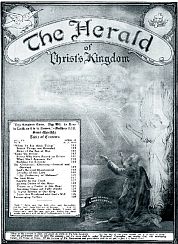
THE HERALD
of Christ's Kingdom
VOL. XII. May 1, 1929 No. 9
Table of Contents
CHRIST
THE FIRSTFRUITS OF THE RESURRECTION
THE
SEVEN EVENTFUL YEARS
"THE
FIRST OF THE PILGRIM FATHERS"
"THE
BRIDE, THE LAMB'S WIFE"
VOL. XII. May 15, 1929 No. 10
Table of Contents
SIGNS
OF THE TIMES
LESSONS
LEARNED IN THE SECRET PLACE
THE
PSALMS AS A STIMULUS TO HOLY LIVING
ABLE
TO COMPREHEND WITH ALL THE SAINTS
MOUNT
CALVARY
IN
MEMORY OF THE SAVIOR'S DEATH
"NOT
THE SPIRIT OF TIMIDITY"
ANNUAL
MEETING OF THE PASTORAL BIBLE INSTITUTE
VOL. XII. May 1, 1929 No. 9
"But now is Christ risen from the
dead, and become the firstfruits
of them that slept." "Be thou faithful unto death,
and 1 will give thee a crown of life." --1 Cor. 15:20; Rev. 2:10.
WHAT is
generally termed Easter Sunday celebrates the momentous event of our Lord's resurrection
from the dead. This year according to Jewish reckoning, April 26 will mark the anniversary
of our Lord's coming forth from the tomb. Christ's resurrection must be conceded to be
either a truth or a falsehood. St. Paul assures us that if it is untrue our faith, our
hope; our preaching, our teaching are of no avail -- useless; if the resurrection of the
dead be impossible, then the resurrection of Jesus was impossible. If the resurrection of
the Savior did not take place, then we have no proof and no ground for believing that
Divine power could resurrect the Church or others of the human family; but if Divine
power, "brought again from the dead the Great Shepherd of the sheep," it is
Jehovah also who will bring us from the dead by Jesus in God's due time.
If the
resurrection be a myth, then, says the Apostle, all those who have fallen asleep in
Christ, with faith in Him, have perished -- they could never have any further existence
anywhere, in any condition of either pain or pleasure. Any one who believes in the
resurrection of the dead, both of the just and the unjust, must logically believe that
they are all dead, except as it may be considered that they exist in the Divine promise,
purpose, and in the arrangement to give them life again. The decision of the resurrection
question is a most momentous one as it has a vital bearing upon and affects practically
every doctrine of the Christian faith.
"If Christ be not Risen"
We can thank
God that the Apostle was not here insinuating the possibility of our Lord's not having
risen; but he would put the question in this form merely that we might see how weighty is
the question -- how much depends upon the answer. He exultingly answers, "Christ is
risen !" We rejoice in this for several reasons: First, how sad it would be if He who
laid aside His glory and was made flesh and tasted death on our behalf should have lost
all by His loyal endeavor to, serve us and to do the Father's will! How glad we are that
He is risen and that He was not raised again in the flesh, with the loss of His heavenly
glory, but was raised as the King of all, fair above all others, and was made a partaker
of the Divine nature
Secondly, we
are glad on our own account and on account of all humanity for if our Lord Jesus had not
'been raised from the dead it would have proved one of two things: either that He. had not
been faithful -- up to the Divine standard, and therefore that His life could not be a
satisfaction for the human life lost in Adam, or else it would have proved that God who
had promised to raise Him from the dead if He would be obedient unto death, had been
unable to do so; and if unable to raise Him from the dead, we likewise would be without
hope, even if our sins were canceled by virtue of His sacrifice.
By Many Indisputable Proofs
Doubtless it
was in view of the vast importance of belief in the resurrection that there has been
furnished to Christian believers the most indubitable proof that Jesus Himself came forth
from the dead. Divine providence had seen to it that there was amongst the twelve Apostles
one especially of philosophic turn of mind, Thomas, who required the most explicit and
absolute evidence of the truthfulness of the claim that Jesus was risen; thus furnishing
all the stronger basis and foundation for the faith of believers all along through the
centuries since, who have not been privileged to see the Savior in visible form face to
face as did Thomas and the other Apostles.
Amongst the
most important considerations bearing upon the resurrection are the following: first,
Christ had often foretold, His own death and resurrection. (Matt. l2:40; 16:21; 20:19.)
Second, there was no doubt that He was really dead. On this the Jews, Romans, and the
disciples were all equally well satisfied. Third, every proper precaution was taken to
prevent His removal by stealth. A guard said to be usually consisting of sixty men, was
placed at the tomb for the express purpose of keeping Him, as the sepulchre was secured,
by a large stone and by a seal. Fourth, on the third day the body was missing. In this all
were agreed. The high priest did not dare to call that in question. They labored,
therefore, to account for it. The disciples affirmed that He was alive. Nor, could it be
reasonably claimed in this connection that the disciples were deceived in their belief
that their Master had come forth. They had been with Him three years; they knew Him as a
friend; they again ate and drank with Him; they put their fingers into His hand and side
and conversed with Him; they were with Him more or less during a period of forty days.
There were enough of them to bear witness. Law usually requires not amore than one or two
competent witnesses, but here were eleven plain, honest men who affirmed in all places, at
all times, that they had seen Him. Can it be possible that they could be deceived? Then
all faith in testimony must be given up.
Character of the Witnesses
Another
writing upon this important point has observed that the Apostles "gave every possible
evidence of !their sincerity. They were persecuted, ridiculed, cursed, and, put to death
for affirming this, yet not one of them ever expressed the least doubt of its truth. They
bore everything rather than deny that they had seen Him. They had no motive in doing this,
but the love of truth. They obtained no wealth by it; no honor; no pleasure. They gave
themselves up to great and unparalleled suffering -- going from land to land: crossing
almost every sea, and enduring the dangers, toils, and privations of almost every clime
for the simple object of affirming everywhere that a Savior died and rose again. If they
knew this was an imposition and if it had been, they would have known it in what way is
this remarkable conduct to be accounted for? Do men conduct in this way for nought? And
especially in a plain case where all that can be required is the testimony of the
senses?"
Atonement Linked with the Resurrection
Surely the
sweetest story ever told is contained in the blessed message which came from Him who spake
as never man spake. Glorious resurrection hope! Precious Bible! The one book in all the
world which teaches the resurrection of the dead and that presents the truth on the
subject of the state of those who have fallen in death; that they are unconscious and know
not anything; that they are out of existence and have no hope of further life except by
Divine interposition through the working .of the most stupendous miracle, the resurrection
of the dead. The doctrine of the atonement is so simply and beautifully stated in
connection with the resurrection hope: "Since by man came death, by man came also the
resurrection of the dead." As by the disobedience of one, all were plunged into,
ruin, into death, so by the righteousness and the free-will offering of another, the
counterpart of the first perfect man, the justice of God is to be satisfied and the death
penalty met for all the children of Adam.
Burst the Bars of Death
In the
poetic language of the hymn, Christ Jesus "burst the bars of death" in His
resurrection. It was not possible for Him to beholden of death, writes the Apostle. (Acts
2:24.) The Divine verdict went forth that He had been faithful and that to Him should come
the reward of life upon the highest plane -- the Divine nature. -- Eph. 1 :20, 21.
Our fancies
may legitimately picture that the holy angels marveled at the Redeemer's experiences from
the time that He left the heavenly glory and was made flesh and dwelt amongst us until, by
His resurrection change, He returned again from the earthly nature to the heavenly plane,
"far above angels." As they sang at His nativity a rapturous song of glad
tidings of great joy to all people, so they were filled with amazement, surely, that the
Father should permit Him to be tempted and tried; and that He should pour for Him His cup
of suffering, which He drained to the dregs. They marveled when "He died, the just
for the unjust." They looked and wondered, as hour after hour He remained in the tomb
-- dead. Their loyalty to the heavenly Father was tested during that period, but was
rewarded when they beheld that Divine power raise Him up even to a more excellent glory
than that which He had before.
With what
alacrity the angels mast have acknowledged the risen One, in harmony with the Father's
declaration, "Let all the angels of God worship Him." "Worthy is the Lamb
to receive glory and honor, dominion, might and power." The point of special interest
to us is the change of nature which our Redeemer experienced in His resurrection. That
change did not take place during the three days of Jesus' burial, but during the three and
a half years of His ministry, which ended with His resurrection. When thirty years of age
He gave Himself --- He surrendered His earthly privileges and rights and hopes into the
Father's hands, to be obedient to everything which Divine providence might permit. At that
moment His sacrifice of His flesh was accepted. The evidence of this acceptance was the
impartation of the Holy Spirit, which, as a dove, rested upon Him; and exercised a
quickening and illuminating influence upon His mind, enabling Him to understand more than
human things and to perform more than human acts.
For Whom is the First Resurrection?
It was
Jesus, a New Creature, begotten of the Spirit at Jordan, that did the mighty work of the
Father. His flesh, His humanity, was gradually laid down sacrificially, in harmony, with
the Divine providences. He drank "the cup" which the Father poured for Him. And
thus it is with all of those who are to share in the first order or rank in the
resurrection. To all of these the Master says, "Are you able to drink of the cup that
I drink of and to be baptized with My baptism?" This is the great question for every
follower of Christ. All who affirmatively answer this question and enter into fellowship
with Christ in the present life of sacrifice and of doing the Father's will, are also made
partakers of His Spirit; these also realize something of the heavens or heavenly things
opening unto them, quickening and illuminating their souls so that they are enabled to
press on in the Narrow Way, walking in His footsteps unto the end: These also are enjoined
by the Apostle, "If ye then be risen, with Christ, seek those things which are above,
where Christ sitteth at the right hand of God. Set your affection on things above, not on
things on the earth. For ye are dead, and your life is hid with Christ in God." These
are the "blessed and holy" who will have pant with Him in the First
Resurrection, and be given the crown of life; they shall be priests of God and of Christ
and shall reign with Him a thousand years.
[Contributed]
"Seventy weeks are determined upon
thy people and upon thy holy city,
to finish the transgression, and to make an
end of sins, and to make reconciliation for iniquity, and to bring in everlasting
righteousness, and to seal up the vision and prophecy, and to anoint the most Holy."
-- Dan 9:24.
IN THESE
days when the Scriptures are assailed more vehemently than ever before, it should be the
sole object of every child of God to make the very best use of those holy records and to
remember that He who said, "Thy Word is truth," was Himself the God-given Fount
of truth for all time.
Godly Bible
students are not easily led astray by the specious findings of godless professors or
psuedo-saints, but and here we need caution -- there are other presentations that in
essence are equally specious and misleading, which emanate from sources that hold
reputation for exhibiting and exalting many of the truths of God's Word. Such claims do
not therefore come from wolves in sheep's clothing always, abut are put forward with more
or less sincerity, though often -- more than often -- the effect is to beguile and mislead
some of the Loral's sheep.
Christians
should always be prepared to question every proposition which claims Scripture for its
support, and to put such to the Scriptures themselves for corroboration or refutation, and
by no means to wait only for the obvious misrepresentations of God's Word before using the
Divine touchstone. Light is always the antagonist of darkness, and the children of the
light love the light, the truth on all subjects. Copying the noble Bereans of old is never
out of date, but is always productive of a fruitful 'blessing in every emergency of doubt.
Things Foretold
Knowing that
the Scriptures give a most orderly record of the Divine will and plan, let us just look
carefully into one of the most momentous periods in the history of the human race -- a
period in which is developed and nourished the real germ of hope and power-which God sets
in motion. These things were set forth in the prophetic Scriptures long before they became
operative, were noted in detail, and were all momentous events in themselves, intended to
act in concert as it were to the complete performance which had been outlined by the
Divine Spirit. By a careful study we shall see that all these predictions had their
fulfillments within the specified period, either in completion or at least in primary
operation.
The
fullness, the wonder, and the magnificence of such work cannot be fully estimated, and
words are inadequate to express the whole grandeur of these proceedings which mean so much
to God's people now and which contain the fruitful germ that will blossom out in blessing
to the remainder of our race in God's due time. And all in seven years!
The most
hardened person in the world would feel some sort of pleasure if he knew, as we know, that
the precious records of God's Word give us most certainly every necessary .detail which He
is causing to operate for bringing about the longed-for release from the thraldom of sin
and death under which poor humanity has labored with unremitting weariness through sixty
centuries and during which time the dark and silent prison-house of death has swallowed up
its millions; and though humanity has struggled to free itself by countless efforts, no
escapee has been found.
Seventy Weeks Determined
Let us
consider now the notable passage from the record in the Book of Daniel. (Chap. 9:24.)
"Seventy weeks are determined upon thy people and upon thy holy city, [1] to finish
the transgression, [2] and to make an end of sins, [3] and to make reconciliation for
iniquity, [4] and to bring in everlasting righteousness, [5] and to seal up the vision and
prophecy, [6] and to anoint the Mast Holy."
First of all
let us native that this record is the report .of a conversation between God's angelic
messenger and Daniel the beloved of Jehovah. The angel's report concerned Daniel's people
and city -- called, "thy holy city," and was conveyed to Daniel as a direct
result of the prayer of a contrite heart, in which prayer Daniel was humble enough to
class himself as a delinquent along with the remainder of Israel, who had miserably failed
to appreciate God's loving care for them. And this feature should give us all
encouragement to go boldly to the "throne of grace" and find help in time of
need, seeing that .our many digressions and failures are constantly making us need Divine
help and forgiveness.
How then
shall we understand the angel's words concerning the "seventy weeks"? Many
students of prophecy have concluded that this expression is what might be termed prophetic
license -- a method of describing a period of years. A day for a year is not at all an
uncommon method of prophetic usage, and so in this case (as we can prove from other
sources) the term "seventy weeks," or "seventy sevens," really means
seventy sevens of years in its outworking. 70 x 7 = 490. The angel points out in verse 25
a certain historic event as marking the beginning of this period, and the appearance of
"Messiah the Prince" as marking nearly the end of it. He divides the whole
period into three parts: (1) 49 years, (2) 434 years, (3) 7 years.
Reserved for the Last Seven Years
Without
going into the question of proving the exact date of "the going forth of the
commandment to restore and to build Jerusalem," which we believe was given during the
reign of Artaxerxes, the Persian king, let it suffice us to note that if Messiah the
Prince refers to Jesus at the waters of baptism (and we suggest that it does), then that
was the 483rd year from the Persian King's command and would then leave seven years for
the completion of the full period of 490 as given by the mouth of God's messenger to
Daniel.
We thank God
for this prophecy, for it is one of the most important, and one which has had the most
direct and complete fulfillment. Besides, in itself it is a challenge to the traducers of
God's Book, because the most skeptical of opponents cannot deny the fact that the writings
of Daniel were extant and complete long before the days of Jesus, and they thus bear
undeniable testimony to Him, to His First Advent, and to the supreme foreknowledge of God
who devised the whole plan of redemption.
Although
seventy weeks are mentioned in verse 24 as being the period cut off, in which the
fulfillment of all those remarkable items contained in the remainder of the verse are to
become operative, a very superficial examination of Scripture and history concerning it
will show that all the work expressed in the verse was reserved for the last seven years,
so making that period of primary importance, as we have suggested. Another fact we must
also draw to attention before we analyze further the angelic message is, that Daniel's
information was handed to him some five hundred years before our Lord's birth and within
about one hundred years later God gave His last message to the Prophet Malachi and thus
closed up the canon of Old Testament Scripture. From that time to our Lord's birth -- a
period of roughly 400 years -- there was silence. God gave no more information to His
ancient people, but it was left to those who maintained a loyal faith in Him to wait and
hope and to look forward for the promised Messiah. God leas used similar tests for faith
since those days, with the result that He has found a prepared and purified people ready
to do His bidding.
Beginning with Messiah the Prince
Malachi's
words are like a beacon light flashing across those four dark centuries and lighting right
into the Savior's day. "Unto you that fear My name shall the Sun of Righteousness
arise with healing in His beams; and ye shall go forth, and grow up as calves of the
stall."
We have
before us then in Daniel 9:24, a stated long period and a record of matters to be brought
into being during that period. We have also seen that the said period of 70 weeks was
arbitrarily divided by the angelic interpreter into three periods: (1) 49 years, (2) 434
years, (3) 7 years --
To finish the transgression,
To make an end of sins,
To make reconciliation for iniquity,
To bring in everlasting righteousness,
To seal up the vision and prophecy,
To anoint the Most Holy.
We therefore
ask, Did the first 49 years in Persian history bring forth any of these great works? We
would answer, No. Or did the next long period of over 400 years leave any record of these
special blessings and helps being operative in any way? We think not. It remains therefore
for us to inquire whether the final seven years can give us our required answer, and to
that end we will examine what records we have and see if we can find the necessary details
which agree with the words of the angel to Daniel. As we take each item in turn, let us
remember the period of the noted seven years as that marked from the baptism of Jesus
(Messiah the Prince) to the conversion of Cornelius (Acts 10), the first from the Gentiles
to receive the baptism of God's Holy Spirit. Let us start then with the first item in
Daniel 9:24.
"To Finish the Transgression"
Daniel said
in chapter 9, verse 11, "Yea, all Israel have transgressed Thy law," and Isaiah
declared that "for the transgression of my people was lie smitten." We know this
reference is to our Lord Jesus, the smitten Lamb of God; and we know that Isaiah also said
that "He was wounded for our transgressions." Here then is simple proof of the
angel's promise being centered in the worker Christ and brought to fruition during the
notable seven years of the prophecy. Daniel's people were to be the first to get relief
from the great Deliverer, who in order to "finish the transgression," made an
end of the Law by nailing it to His cross. St. Paul pointedly said, "The commandment
which was ordained to life, I found to be unto death" (Rom. 7:10), and he thus voiced
the sad experiences of every member in Israel who had been born into and brought under the
Law Covenant mediated by Moses at Mount Sinai. Year by year continually every Israelite
was reminded of that Law's perfection and of his own imperfection. Year by year
continually the sacrificial blood was shed to
atone for accumulated transgressions against God's just and holy law. How glorious the
truth in Christ Jesus must have been to them when they saw the power that held them in
bondage, nailed to His cross and hence done away for ever. No longer under its command, no
longer condemned by it.
"To Make an End of Sins"
Let us
remember that there were other sinners besides the Jews, many of them living in shameful
idolatry and mental darkness, and blinded by the false claims of Paganism -- without hope,
without God. These, God in His great love included in His scheme of deliverance, so that
the Apostle truly describes the great transaction on Calvary as a culminating act, done
"once for all." The means for canceling the condemnation on the whole race was
brought into being during the notable seven years, and thence onward its active operations
have been patent to all Bible students and have become incorporated in historic verities.
"He is the propitiation for our sins: and not for ours only, but also for the sins of
the whole world."
"To Make Reconciliation for Iniquity"
This
threefold statement of the angel messenger is significant. Though the death of Christ laid
the sound basis upon which all hope of deliverance might be centered, yet it was God's
mighty power in raising Him from the dead which gave the first impulse to the glorious
proclamation which followed, Christ Himself 'being the first ambassador, for He it was who
caused their .hearts to burn within them as "He talked by the way." He opened
the Scriptures, and the word for active reconciliation was quickly taken up by the
messengers of the Gospel: "We pray you yin Christ's stead be ye reconciled to
God." "Repent" has been the continuous call for reconciliation ever since,
and as one writer says, "A sinner can be reconciled in a moment by coming. in the
appointed way, but he must persevere in the proper attitude of mind if he desire the
reconciled state to continue." The great fact then before us is that the basis for
reconciliation was indeed laid firmly within the time allotted by the Divine messenger to
Daniel -- in the closing "week" (7 years) of the seventy.
"To Bring in Everlasting Righteousness"
About 2400
years have passed away since these words were first uttered, and where can we look today
for everlasting righteousness? Faith alone has kept alive through all this time like a
steady, burning flame, lighting the pathway of believers who have held fast to the Divine
promise. For "everlasting righteousness" is certainly guaranteed by the angel
messenger, inasmuch as it was included among the other things to be brought to light
during these notable "seven years." Possibly one of the most concise utterances
concerning this was made by the writer to the Hebrews (chap. 10:5, 14); "for by one
offering He hath perfected for ever them that are [being] sanctified." Here again our
attention is drawn to the Redeemer's work -- the cross of Calvary -- the sin-bearing
Savior and all the value of His work. The "righteousness of the law" is a
Biblical expression and easily recognized as a condition unattainable by any of the fallen
race. Even Israel, to whom God's oracles were committed, found themselves helpless under
the Law's just demand, and so we read, "Israel hath not attained to the law of
righteousness" (Rom. 9:34); "going about to establish their own
righteousness" (Rom. 10:3); "For Christ is the end of the law for righteousness
to every one that believeth." (Rom. 10:4.) Moses gave no Jew a permanent status as a
righteous person, but Christ provides a firm basis of hope by His death -- His one
offering -- and so gives each one who is being sanctified an assurance of this standing
guaranteed by the Word of the living God, so that such may serve Him with reverence and
godly fear. Repetition of sacrificial offering was the need in Israel's day, but no
repetition will ever be needed of that sacrifice which was given "once for all"
and through which we draw "near to God" with hearts sprinkled from a
consciousness of evil -- true participators in everlasting righteousness.
"To Seal Up the Vision and Prophecy"
An
alternative reading is put forward by many commentators, and with some authority we think.
The reading is thus: "To seal up the vision and prophet." The reference to
prophecy itself seems the less likely application, because in harmony with the other
utterances of the angel this particular feature seems to require its fulfillment to fall
within the last seven years of the "determined" period. The thought suggested is
that of making sure the word of prophecy and the vision by a fulfillment in which a
promised personage will be made manifest.
Surely no
other can be pointed to in this passage than the great "Prophet like unto
Moses," whom Jehovah promised should be raised up. The record in John 6:27 is that
"Him hath God the Father sealed." Such is the testimony of Jesus Himself, and we
have still the greater testimony from God Himself-"This is My beloved Son, hear ye
Him." Thus in the mouth of two witnesses the truth is established, and the greater
than Moses identified. So sealed with the Holy Spirit and power, Jesus went forth
testifying to the Kingdom and inviting the nation of Israel to come and participate in its
joys and hopes. In picture symbol our great anointed Priest and risen Lord is seen in the
Book of Revelation, "having the seal of the Living God" -- possessing the power
of shedding forth and :bringing under the Spirit's influence (sealing) His own servants.
And many other references and allusions may be found agreeing with the thought here set
forth concerning God's greatest Prophet -- the Son of God with power.
"To Anoint the Most Holy"
Sealing or
anointing the High Priest and anointing the under-priests are familiar expressions which
refer us primarily to the visible class of directors of public worship instituted tinder
the Law Covenant; but an inseparable feature of a place
for worship must not be overlooked, and we think this feature is the more prominent in
this last portion of the angel's statement to Daniel -- "To anoint the most
holy." Moses had his minute directions for building the place which should be the Sanctuary for the
people, where they could look for Divine instruction and deliverance in times of stress
and doubt, and danger. But for us the promise is "the secret place of the Most
High," a "temple not built with hands." Do not let us forget that the
literal place of worship and its anointing oil, sacred and special, were brought into
evidence and dedicated by Moses to Divine service before the sacrificial purposes for
which it was erected were commenced. Thus the angel's message in this connection would
show Daniel that God had in mind a new mode and a
new place of worship which would differ from that of the Jews. The Savior made no
secret of this fact in His reply to the Samaritan woman. He relegated both Samaritan and
Jewish nominal worship to oblivion when He said, "When ye shall neither in this
mountain, nor yet at Jerusalem, worship the Father" but "the hour . . now is,
when the true worshipers shall worship the Father in spirit and in truth." The
sanctuary and city of Jerusalem as God's dwelling places have long since been rejected,
but in the days of Jesus a "Most Holy" (place) was surely anointed where
"all one in Christ .Jesus" have since found a permanent "temple" in
which to worship God in spirit and in truth. Let us thank God .that our "temple"
is served by a High Priest who stands a "priest for ever after the power" (that
is, on account of) "an endless life," seeing "He ever liveth to make
intercession for us."
The Beginnings of the Blessings of Light
Thus the
angel's message to Daniel noted under the foregoing six captions gives us such food for
thought and recapitulation of which should fill our hearts with overflowing gratitude to.
God, the Giver of all good. In those seven eventful years marked out so clearly in the
word of prophecy are the beginnings of blessings of light, health, peace, joy, and life,
not only for us who have had a fore-view of the love of God in Christ, but also for
"whosoever will" in due time of our fellow men who will seek for them with
earnest hearts when the Divine provisions are made known to them.
We would
earnestly draw attention to this particular section in the Book of Daniel and would point
out that although we have only touched upon the six points in the prophecy, there are
items also noted by the angelic messenger to which we have made no detailed reference, but
the importance of Which cannot be overestimated; and our hope is that the Lord's people
will be encouraged to study them, rightly divide them, fit them into their proper places
in God's redemptive scheme, and get a rich blessing as a result.
"ABRAM DEPARTED" --
"ABRAM WENT FORTH" -- "ABRAM PASSED THROUGH" -- "ABRAM
REMOVED" -- "ABRAM JOURNEYED" -- GEN. 12:4-9.
"He went out, not knowing whither
he went." -- Hebrews 11:8.
ALL through
the history of mankind there has been a little band of men, in a sacred and unbroken
succession, who have confessed that they were pilgrims and strangers upon earth. Not more
certainly does the scallop-shell on the monument of the cathedral aisle indicate that he
whose dust lies beneath, once went on pilgrimage beyond the seas, than do certain
indications, not difficult to mote, betray the pilgrims of the Unseen and Eternal.
Sometimes they are found afar from the haunts of men, wandering in deserts and in
mountains, dwelling in the dens and caves of the earth -- to which they have been driven
by those who had no sympathy with their other-worldliness, and hated to have so strong a
light thrown on their absorption in the concerns of the earth, and time, and sense. But
very often they are to be found in the marketplaces and homes of men, distinguished only
by their simpler dress; their girded loins; their restrained and abstemious appetite;
their loose hold on gold; their independence of the maxims and opinions and applause of
the world around; and the far-away look which now and again gleams in their eyes, the
certain evidence of affections centered, not on the transitory things of time and earth,
but on those eternal realities which, lying beneath the vail of the visible, are only
revealed to faith.
Three Distinctive Marks
These are
the pilgrims. For them the annoyances and trials of life are not so crushing or so
difficult to bear; because such things as these cannot touch their true treasure, or
affect their real interest. For them the royalties and glories ; the honors and rewards;
the delights and indulgences of men have no attraction. They are children of a sublimer
realm, members of a greater commonwealth, burgesses of a nobler city than any upon which
the sun has ever looked. Foreigners may mulct an Englishman of all his spending money; but
he can well afford to lose it, if all his capital is safely invested at home, in the Bank
of England. How can a dukedom in some petty principality present attractions to the scion
of an empire, who is passing hastily through the tiny territory, as fast as steam and
wealth can carry him, to assume the supreme authority of a mighty monarchy? The pilgrim
has no other desire than to pass quickly over the appointed route to his home -- a track
well trodden through all ages -- fulfilling the duties, meeting the claims, and
discharging faithfully the responsibilities devolving upon him, but ever remembering that
here he has no continuing city, and seeks one which is to come.
The immortal
dreamer, who has told the story of the pilgrims in words which the world will never let
die, gave three marks of their appearance:
First:
"They were clothed with such kind of raiment as was diverse from the raiment of any
that traded in that fair. The people, therefore, of the fair made a great gazing upon
them; some said that they were fools, some they were Bedlams, and some they were
outlandish men."
Secondly:
"Few could understand what they said, they naturally spoke the language of Canaan,
but they that kept the fair were men of this world; so that from one end of the fair to
the other they seemed barbarians to each other."
Thirdly:
"But that which did not a little amuse the merchandizers was that these pilgrims set
very light by all their wares; they cared not so much as to look upon them, and if they
called on them to buy, they would, put their fingers in their ears, and cry, Turn away mine eyes from beholding vanity, and
look upwards, signifying that their trade and traffic was in heaven."
Confessed They were Pilgrims and Strangers
Evidently
this type of man was well known when the great dreamer dreamt -- and long before. For the
Apostle Peter wrote to scattered strangers (1 Pet. 1:1) and reminded them as strangers and pilgrims, to abstain from fleshly
lusts. And long before that day, in the sunniest period of Jewish prosperity, David, in
the name of his people, confessed that they were strangers
and sojourners as were all their fathers; and that their days on earth were as a
shadow on the hills, now covering long leagues of landscape, and then hasting away, chased
by glints of brilliant sun.
We left the
Patriarch moving leisurely southward; and thus he continued to journey forward through the
land of promise, making no permanent halt, till he reached the place of Sichem, or
Shechem, in the very heart of the land where our Lord in after-years sat weary by the
well. There was no city or settlement there then. The country was sparsely populated. The
only thing that marked the site was a venerable oak, whose spreading arms in later ages
were to shadow the excesses of shameful idolatry. (See Judges 9:27-46; 1 Kings 12:25.)
Beneath this oak on the plain of Sichem, the camp was pitched; and there, at last, the
long silence was broken, which had lasted since the first summons was spoken in Chaldea,
"And the Lord appeared unto Abram, and said, Unto thy seed will I give this land: and
there builded he an altar unto the Lord, who appeared unto him." -- Gen. 12:7.
He did not,
however, stay there permanently, but moved a little to the south, to a place between
Bethel and Ai, Where, according to Dr. Robinson, there is now a high and beautiful plain,
presenting one of the finest tracts of pasturage in the whole country.
The Tent, the Altar and the Promise
Three things
then engage our thought: the Tent, the Altar, and the Promise.
(1) The
Tent. -- When Abraham left Haran his age was seventy-five. When he died he was one hundred
and seventy-five years old. And he spent that intervening century moving to and fro,
dwelling in a frail and flimsy tent, probably of dark camel's hair, like that of the
Bedouin of the present day. And that tent was only a befitting symbol of the spirit of his
life.
He held
himself aloof from the people of the land. He was among them, but not of them. He did not
attend their tribal gatherings. He carefully guarded against intermarriage with their
children, sending to his own country to obtain a bride for his son. He would not take from
the Canaanites a thread or a sandal-thong. He insisted on paying full market value for all
he received. He did not stay in any permanent location, but was ever on the move. The tent
which had no foundations, which could be struck in half-an-hour -- this was the apt symbol
of his life.
Frequently
may the temptation have been presented to his mind to return to Haran, where he could
settle in the town identified with his family. Nor were opportunities to return wanting.
(Heb. 11 :15.) But he deliberately preferred the wandering life of Canaan to the settled
home of Charran; and to the end he still dwelt in a tent. It was from a tent that he was
carried to lie beside Sarah in Machpelah's rocky cave. And why? The question is fully
answered in that majestic chapter which recounts the triumphs of faith. "Abraham
dwelt in tents, because he looked for the City which hath foundations." (Heb. 11 :9
R. V.) Precisely so: and the tent-life is the natural one for those who feel that their
fatherland lies beyond the stars.
The Spirit of Our Times
It is of the
utmost importance that the children of God should live this detached life as a testimony
to the world. How will people believe us, when we talk about our hope, if it does not wean
us from excessive devotion to the things around us? If we are quite as eager, or careworn;
quite as covetous or grasping; quite as dependent on the pleasures and fascinations of
this passing world as themselves: may they not begin to question whether our profession he
true on the one hand; or whether after all there be a real city Yonder on the other.
We must not
go on as we are. Professing Christians are too much taken up in business cares, in
pleasure-seeking, in luxury, and self-indulgence. There is a slight difference between the
children of the Kingdom and the children of this generation. The shrewdest observer could
hardly detect any in their homes, in the education of their children, in their dress, or
in their methods of doing business. They eat, they drink; they buy, they sell; they plant,
they build; they marry, they give in marriage -- though the flood is already breaking
through the crumbling barriers to sweep them all away.
Yet how is
it to be altered? Shall we denounce the present
practice? Shall we inveigh against the reckless worldliness of the times? This will not
effect a permanent cure. Let us rather paint with glorious colors that City which John
saw. Let us unfold the glories of that world to which we are bound. Let us teach that even
here, the self-denying, resolute, and believing spirit may daily tread the golden
pavement, and hear the symphonies of angel harps; and surely there will come into many a
life a separateness of heart and walk which shall impress men with the reality of the
unseen, as no sermon could do, however learned or eloquent.
The Lesson of Self-Surrender
(2) The
Altar, -- Wherever Abraham pitched his tent, he built an altar. Thus the Pilgrim Fathers,
on the shores of the New World, set up their altars of worship even before they reared
their homes. And long after the tent was shifted, the altar stood to show where the man of
God, had been.
Ah, it would
be a blessed token of our religious fervor if we could set up altars in every house where
we pass the night, and in every locality where it might be our hap, to live, setting the
example of private and family prayer, which would live long after we had passed away. If
we would only dare to do it, the very Canaanites would come to revere the spot where we
had knelt, and would hand on the sacred tradition, stirring coming generations to kneel
there also, and call upon the name of the Lord.
Let us also
remember that the altar means sacrifice, whole burnt--offering, self-denial, and
self-surrender. In this sense the altar and the tent must go together. We cannot live the
detached tent-life without some amount of pain and suffering, such as the altar bespeaks.
But it is out of such a life that there spring the most intense devotion, the deepest
fellowship, the happiest communion.
If your
private prayer has been lately hindered, it may be that you have not been living enough in
the tent. The tent-life of separation is sure to
produce the altar of self-denial and of heavenly fellowship. Confess that you are a
stranger and a pilgrim on the earth; and you will find it pleasant and natural to call on
the name of the Lord. We do not read of Abraham building an altar, so long as he dwelt in
Charran; he could not have fellowship with God whilst living in open disobedience to Him:
or as long as he was ensconced comfortably in a settled life. But out of the heart of the
real pilgrim life there sprang longings, desires, and aspirations, which could only be
satisfied by the altars which marked his progress from place to place.
But
Abraham's altar was not for himself alone. At certain periods the whole clan gathered
there for common worship. A motley group that, in which slaves bought in Egypt or Ur
mingled with those born in the camp, in which children and parents, young and old, stood
to offer their common sacrifice and worship. "I know Abraham," said God,
"that he will command his children and his household after him." (Gen. 18:19.)
He, in whom all families of the earth were to be blessed, practiced family religion; and
in this he sets a striking example to many Christians whose homes are altar-less. Would
that Christians might be stirred by the example of the Patriarch to erect the family
altar, and to gather around it the daily circle of their children and dependents, for the
sweetening and ennobling of their family life! Many an evil thing, like the gargoyles on
the cathedral towers, would be driven forth before the hallowing influence of praise and
prayer.
The Counsel of the Lord Standeth Fast
(3) The
Promise. -- "Unto thy seed will I give this land." (Gen. 12:7.) As soon as
Abraham had fully obeyed, this new promise broke upon his ear. And it is ever thus.
Disobey and you tread a path unlit by a single star. Obey, live up to the claims of
God-and successive promises beam out from heaven to light your steps, each one richer and
fuller than the one before. Hitherto God hath pledged Himself only to show the land; now
He bound Himself to give it. The separated pilgrim life always obtains promises.
There was no
natural probability of that promise being fulfilled. "The Canaanite was then in the
land." Powerful chieftains like Mamre and Eshcol; flourishing towns like Sodom,
Salem, and Hebron; the elements of civilization -- all were there. The Canaanites were not
wandering tribes. They had settled and taken root. They built towns, and tilled the land.
They knew the use of money and writing; and administered justice in the gate. Every day
built up their power, and made it more unlikely that they could ever be dispossessed by
the descendants of a childless shepherd.
But God had
said it; and so it came to pass. "The counsel of the Lord standeth fast forever; the
thoughts of His heart to all generations." (Psalm 33:11.) I know not what promise may
be overarching your life, my reader, with its bow of
hope; but this is certain, that if you fulfil its conditions, and live up to its demands,
it will be literally and gloriously fulfilled. Look not at the difficulties and
improbabilities that block the path, but at the might and faithfulness of the Promisor.
"Heaven and earth shall pass away, but His words shall not pass away." Not one
jot or tittle shall fail. (Mark 13:31; Matt. 5:18; Luke 16:17.) And promise after promise
shall light your life, like safety lighthouses at night along a rocky coast, which pass
the vessel onward, till at last the rays of the rising shine full on the haven where the
mariner would be. -- Abraham, or The Obedience of
Faith"
-- F. B. MEYER.
"1 have espoused you as a chaste
virgin unto one husband,
even Christ." -- 2 Cor. 11:2.
More than
three years ago a series of articles dealing with the subject of the Body and the Bride
appeared in these columns in several consecutive issues of the "Herald," as it
seemed especially appropriate that the subject be exhaustively dealt with at that time.
However, our attention has been recently called to a clear and comprehensive treatment of
this subject by Brother Russell in the Watch Tower of April 1, 1892, and it is suggested
that the republishing of Brother Russell's review would be timely. Concurring in this
suggestion we are reprinting Brother Russell's article in full below. -- EDITORIAL
COMMITTEE.
THE letter
of the Apostle Paul in which these words occur was addressed to the Church of God at
Corinth and to all the saints in all Achaia (2 Cor. 1:1), and together with the other
epistles was designed by the Holy Spirit for the instruction of the whole Church, during
the entire Gospel Age. Therefore, when the Apostle says, "I have espoused you as a
chaste virgin unto one husband, even Christ," it is evident that the entire faithful
Church is meant -- all who as "wise virgins" will continue faithful to the
espousal vows. Such will, in due time, be accepted of Christ as His glorious Bride without
spot or wrinkle or any such thing.
Types and Symbols of Christ and the Church
This
beautiful figure of the Church's relationship to Christ is made very prominent in the
Scriptures. See the invitation to become the Bride in Psa. 45:10, 11, and the promised joy
and gladness of those who accept it and prove themselves worthy of it. Then read Paul's
counsel to the husbands and wives who are truly wed in the Lord: they two shall be one
flesh -- as one person, having but one mind and one common interest, purpose, and aim. And
for this purpose, to this end, each is to forsake the former ties which united them to
parents and brothers and sisters. Then says the Apostle, "This is a great
mystery" -- it is something rarely seen, even among Christian husbands and wives --
"but I speak concerning Christ and the Church," the Bridegroom and Bride between
whom the union will be perfect. -- Eph. 5:22-33.
Isaac and
his wife, Rebecca, furnish a striking type of Christ and the Church as bridegroom and
bride, to which we will refer later; and the Revelator points to the heavenly Jerusalem,
the glorified Church, as the Bride; the Lamb's Wife.
The teaching
of this oft-repeated and beautiful symbol, by which the Lord would have us understand and
appreciate His great love and tender care for us as His Church, is so plain that it seems
strange that any should fail to comprehend it; yet through a misapplication of a type some
few have reached erroneous conclusions on the subject.
Views Advocated by Some
Two of the
dear friends of the Truth think they have found new light on this subject, though their
views differ somewhat, and both cannot be right. One holds that the patriarchs and
prophets of the past dispensation, mentioned in Heb. 11, will, in their resurrection,
constitute the Bride; and the other holds that the Bride of Christ is to be composed of
the living Israelites now regathering to Palestine; who, as we have seen, shall be the
first to be blessed, and restored to human perfection under the new Millennial
dispensation. While dissimilar in some respects, these views are sufficiently alike to be
examined together.
We reply
(1), It would be impossible in God's order to call the Bride before the Bridegroom. It
pleased the Father that in the Anointed One all fullness should dwell -- that in all
things He should have the pre-eminence. (2) It would be ail incongrouus and impossible
union for the Bridegroom to be spiritual, and the Bride to be human: It would be out of
harmony, too, with our Lord's prayer, "Father, I will that they also whom Thou hast
given Me be with Me where I am, that they may behold My glory"; and again, with His
statements -- "I go to prepare a place for you," and "I will come again and
receive you unto Myself, that where I am there ye may The also." How could Bridegroom
and Bride have fellowship and union, joint-heirship and joint-inheritance; if one were of
the spiritual and the other of the human nature?
Both of the
objecting friends recognize the force of the type to which we long ago called attention
that Abraham, Isaac, and Rebecca represent Jehovah, Christ, and the Bride. But both seem
to have forgotten that a type must not be used to teach a doctrine, but merely to
illustrate one that is already taught in plain terms.
The Lesson of Rebecca and Isaac
Both proceed
to claim that Isaac represented the entire Gospel Church -- Head and Body -- and that
Rebecca, his bride, must therefore represent some other class. They claim that, as we have
shown, or rather as the Apostle has shown, that Sarah, Isaac's mother, was a type of the
Abrahamic Covenant (Gal. 4:24, 31), and as Sarah died before Eliezer was sent to seek a
bride for Isaac, therefore the Gospel Covenant must come to an end, before the call of the
Bride; and hence that the calling of the Bride will be deferred until this Gospel Age is
ended. The fact that the servant is instructed not to take a wife for Isaac from among the
Canaanites, but to go to Abraham's own kindred for her, they interpret to signify that the
Bride must be of the natural seed of Abraham, claiming accordingly that she could not be
selected from Jews and Gentiles as the Gospel Church has been selected, but must be Jewish
exclusively.
We have
stated thus fully and clearly their position, which we believe to be erroneous, so that
the answer may be the more conclusive to these friends and to all.
Let us see
to it, beloved, that we are of those who hold the Head (Col. 2:19), who acknowledge in
every thought and doctrine the pre-eminence of our Redeemer. He is the antitype of Isaac
-- not we. He, alone, and apart from us, was the heir of all things. We were strangers to
Him and afar off, like Rebecca, when Christ (Isaac) became Lord of all and was highly
exalted and given a name above every name, and when in consequence He could say, "All
power in heaven and in earth is given unto Me." Ah, yes! "Of the people there
was none with. Him."
It is since
He is thus Lord of all, and our Lord, that we or any have received an invitation from the
Father to become His Bride and Joint-heir. To us the spirit of truth declares, as Eliezer
declared to Rebecca and her family concerning Isaac: His Father is very rich, and all that
He hath He has given to His Son -- "He is Lord of all" the estate, and fully His
Father's representative, and the Father now seeketh for Him a bride and joint-heir.
The Spirit's Blessing on the Bride to Be
And as in
the type certain gold ornaments were presented to Rebecca from the moment that she
entertained the good tidings, so with us: from the moment that we first gave ear to the
Father's invitation or "high-calling" we have been blessed. The ornaments, being
of gold, symbolize Divine blessings, gold always symbolizing Divine things. The golden
adornments were: first, earrings, representing the blessed effect of hearing the call; and
secondly, bracelets for the hands, representing the blessed effect of the Divine call upon
our doings thereafter.
And so these
blessings came merely from the attentive hearing of the high call; and yet greater
blessings followed when we accepted that call and said that we would leave our father's
house (the human nature) and our own people (earthly friendships) and, go to our Espoused
One. (Psa. 45 :9-11.) So in the type -- when the decision was reached and Rebecca was
"betrothed" or "espoused" to Isaac, whom having not seen she loved,
the servant presented her with vessels of silver (symbolizing truths), and with further
jewels or ornaments of gold (Divine blessings and graces), and with new raiment,
symbolizing her newness of life and relationship to the Father and the Son whose call she
had accepted. -- Gen. 24:22, 53.
And as
Rebecca's mother and brother also received some valuable presents from the servant of
Abraham when she received her greater blessing, this symbolizes the fact that not only are
the fully consecrated ones blessed when they leave all to accept the
"high-calling," but others of the sympathizing ones of the household of faith
(the justified, but not fully sanctified) also receive spiritual blessings through the
betrothed class, even before the union with the Bridegroom.
As Christ Loved the Church
It should be
noted, then, that our friends are building their theories upon several misinterpretations.
(1) Sarah's death before the bride of Isaac was called would show that the promised
"Seed" mentioned in the Abrahamic Covenant was fulfilled in the person of our
Lord Jesus -- the heir, and the only heir under that Covenant. (Heb. 1 :2; Titus 3:5-7.)
This the Apostle expresses clearly, saying -- "He saith not, And to seeds, as of
many; but as of one, And to thy seed, w which is Christ." (Gal. 3:16.) That the
Apostle here uses the name Christ to refer to our Lord Jesus personally, exclusive of his
Church, is shown clearly by his further use of the word in the succeeding verses of this
same chapter. See verses 22, 24, 26, 27. In verses 28 and 29 he brings in the name Christ
as applicable to all the Church, but in such a manner as to show that it is our coming
into betrothal and union with Him that gives us a share in that name and in the honors and
glorious future which it implies "If ye be Christ's [if ye, like Rebecca, the type,
have accepted the Father's offer to become joint-heirs with His Son, if ye have joyfully
accepted the calling -- presented to you by the servant, the Spirit of truth, and have
forsaken all, and are fully betrothed to your Lord] then [not by being, like your Lord,
natural heirs of those covenant blessings, but by your union with Christ] ye are Abraham's
seed and heirs according to the promise" [children of God, whom Abraham typified; and
if children, then heirs; heirs of God and joint-heirs with, by and through Jesus Christ,
our Lord].
In Eph.
5:28-30, the Apostle shows that for Christ to love His Bride is to love Himself, for in
accepting the Church as His Bride the Lord accepts her as His own Body, even as in the
type of this (Adam and Eve and the human union), the wife is accepted as 'the very flesh
of her husband and her body as an addition to his members -- and the husband as her head.
Thus, now, the consecrated, espoused ones while in the flesh represent Christ in the
flesh; and in their daily sacrifices they are filling up that which is behind of the
afflictions of Christ (Col. 1 :24) ; and by and by, when glorified, when made
spirit-beings like their glorious Lord, they will be His glorified spouse and joint-heir,
and still loved as Himself-as members of His Body.
Church to Receive Christ's Name as His Bride
Again, the
view that the Bride must be of the natural seed of Abraham is a mistake. Rebecca was not
of the seed of Abraham. If it had been the design to represent the Bride of Christ as
being taken from among the Jews, the natural seed of Abraham, no doubt a daughter of
Hagar, who represented the Jewish or Law Covenant, would have been chosen. On the
contrary, when studying or applying a known type we should be sure not to mix type and
antitype. Abraham as a part of the type represented God: and hence Abraham's own people
represent God's people, as contrasted with the Canaanites, who represented the willfully
wicked. This feature of the type points out to us the fact that while God does call
sinners to repentance, He does not call sinners to become joint-heirs with Christ, His Son
and heir. To this close and .glorious relationship He invites only those whom He
recognizes as friends of righteousness and truth. In a word, this type confirms the
teachings of the Apostles, that it is after we have been "justified by faith, and
have peace with God through our Lord Jesus Christ, that we have access into this grace [this call to joint-heirship with the only
begotten Son and heir] wherein we stand-rejoicing in hope of [sharing] the glory of
God." (Rom. 5:1, 2.) Then we shall be fully united to Him, and see Him as He is,
receive His name, which is above every name, and enter into (his mother Sarah's tent) the
privileges and opportunities for blessing the world promised in the Abrahamic Covenant,
represented by Sarah. -- Gal. 4:24.
So, then, we
have shown Scripturally (1) that Isaac primarily represented our Lord, the "heir of
all things," personally, and no others; (2) that the joint-heirs were represented in
Rebecca, his bride, who was his only joint-heir; (3) that Rebecca typified a class
selected from among justified believers believers in God (Abraham) and in Christ (Isaac)
-- which is true only of the household of faith and surely not true of the Jews; (4) that
the Abrabamic Covenant, represented by Sarah, bore only one seed, which is Christ Jesus,
and that it died or ceased as a mother when He had finished His course and become heir of
all things; (5) that if we would become joint-heirs of the opportunity and honor (of being
God's seed through whom the blessing of the world will come) contained in that Abrahaniic
Covenant, typified by Sarah, there is no other way than by becoming Christ's -- by giving
ourselves to Him According to the Father's invitation by the spirit of the Truth losing
our own name and taking His, and forgetting our Father's house (earthly hopes and
ambitions) and our own people and becoming wholly His-His Bride, whom He loves and will
cherish as "His own body."
Some Objections not Well Taken
Next, let us
look at the objection which seems to have led into the misinterpretations which we leave
here sought to correct. It is claimed that because the Church is sometimes called the Body
of Christ, of which Jesus is the Head, it could not also be the Bride. Therefore, say the
objectors, the Bride must be one class and the Body another class.
This at
first has a show of logic, but we must not trust our imperfect minds to reason straight,
if we wander away from the Word and forget that "thus it is written." We must
compare spiritual things with spiritual things, as the Apostle directs, and let the Word
of God be its own interpreter. Just as unreasonably might we say that if Christ is the
"Good Shepherd" and we members. of His Body, we could not also be "His
sheep," or members of the "little flock" to whom .it is the Father's good
pleasure to give the Kingdom, and that the Little Flock could not be the Bride, because no
shepherd ever marries his flock. Just as unreasonably we might say, too., that when Christ
is termed the Captain of our salvation, and we "good soldiers," the soldiers
must be another class; because it is said that we are the Body of Christ and members in
particular. Just as unreasonably might we argue that those whom Christ is not ashamed to
call His "brethren" must be a different class from those called the Bride and
the Body of Christ, because naturally a man does not marry his brethren, nor are they his
own body. Just as unreasonably might we proceed to argue that a captain never marries his
soldiers, and that hence the Bride, the Body, the good soldiers, the brethren and the
little flock of sheep must be different classes. The same reasoning would also apply to
the relationship of Christ as our great High Priest. and ourselves as the Royal Priesthood
under Him; to Christ the pearl merchant and the Church the pearl; to Christ the sower of
the "good seed," and "wheat" the children of the Kingdom; to Christ
the chief corner stone and the overcoming Church the living stones builded up into Him
unto a holy temple of God; to Christ the vine and His people the branches.
A little
reflection upon these facts will surely convince all that our friends were mistaken in
concluding that because the Church in some places in Scripture is called "the
Body" she could not also with equal propriety be called "the Bride" of
Christ. Perhaps, indeed, their error may result (under the Lord's overruling providence)
in bringing clearer views on the subject, not to themselves alone, but also to others of
the Church.
Why Various Figures are Used
The above
figures, while very different, serve, each better than any other, to illustrate some
peculiar feature either of the character of the Lord or of the Church, oar of the
relationship between them. For instance, as sheep the Church must be meek, willing to be
led -- not wayward, headstrong and perverse like goats; they must, however, not only be
meek and docile and peace-loving like sheep, but like soldiers they must "fight a
good fight" and overcome the world and its influence, conquering self and overcoming
obstacles put in the way of their service for the Lord 'by the world and the devil. Sheep
are not overcomers and overcomers are not sheepish; two opposite truths were to be taught
and two opposite illustrations were necessary; as "sheep" we follow our Shepherd
and gladly obey His word, and as "soldiers" of the cross we fight against all
opposition that would hinder our following and obeying our Captain; but we fight the good
fight for truth and right and love, and not selfishly and with carnal weapons.
The figure
of a body beautifully represents the intimate relationship existing between our Lord Jesus
and His Church. He is the Head -- He plans, directs, supervises and cares for the various
members of His Body, the Church, and all real members are dependent upon each other and
upon the Head and are bound together by the ties of spiritual love and common interest.
And although the Head has been actually absent for over eighteen hundred years, He has yet
been present in His care and by His Spirit, and representatively through certain members
of the Body upon whom He, in His absence, confers certain gifts representing His qualities
and office as the Head of the Church -- the eye, the mouth, the ear members. (1 Cor.
12:15, 21.) We should have missed much had the illustration of the Lord as the Head and
the Church as His Body been omitted. We are glad that no good thing or .illustration
helpful to. those who would walk uprightly has been omitted.
And when
once clearly seen and fully appreciated, we feel sure that none will regret the use by the
Spirit of any figures used to show the Church and her relationship to her Lord-especially
that representing her as the chaste virgin espoused to Christ and soon to be made one with
Him in nature and likeness and glory and work. As the figure of head and body represented
the care of the Lord in and over the Church during His actual absence in a "far
country," the figure of the betrothed or espoused virgin, longing for the coming of
the Bridegroom and the consummation of her hopes and His promises, represents the actual
state of the case far better. Like Rebecca we were already virgins, pure ones, whose sins
had been pardoned (by the grace of God through the atoning sacrifice of Christ), and
therefore of the household of faith, before we were called of the Spirit to go to Him to
become His Bride and Joint-heir. Like her we each (and all of the faithful Little Flock
from the first) have been betrothed to our (Lord and are following on to know the Lord and
see Him as He is and to share His glory-sunder the lead of the Spirit. Already we have
exceeding great and precious promises, gifts and graces of the Spirit, but we are not
satisfied: we prize .them and treasure them, but we think of them only as foretastes of
the greater blessings to come when we shall enter fully into the joys of our Lord. We
shall be satisfied only when we shall see Him as He is -- when we shall awake in His
likeness. -- 1 John 3:2 ; Psa. 17:15.
Blessed Vision of Faith
All along
the journey, like Rebecca, the Church has been on the look-out for Him whom, not having
seen, she loved, and do whom, though she saw Him not, yet she rejoiced with joy
unspeakable and full of glory at the thought of the coming union. (1 Pet. 1:8.) And now,
oh, blessed vision! our eyes of faith, like Rebecca's, are keen and we see one in the
field (the world) approaching us. Like Rebecca, we ask our Guide (the Spirit of Truth) who
it is -- half surmising from the first that it is our Beloved, as we see His stately
steppings among the nations and note the promised signs of His presence The Spirit of the
Lord through His Word is even now assuring us that what we see is "the sign [or
manifestation] of the Son of Man," and that the 'hour of our rapture is near at hand.
Soon we shall pass beyond the veil of death and be with Him (See Gen. 24:64, 65) and be
accepted with Him into the work and office of fulfilling the Covenant represented in
Sarah. This in the type is shown by the entrance of Rebecca with Isaac into Sarah's tent.
When it is
remembered that the Apostle refers to Mother Eve as a likeness of the Church and Father
Adam as a figure of our Lord Jesus; and when we remember that in order to the development
of Eve a deep sleep fell upon Adam and she was formed from his wounded side, we see a
beautiful harmony between this type and the facts. In order that we should have a being at
all and be capable of receiving a call to be the Bride of Christ, it was necessary that
our Lord should die for us --- the deep sleep of death came upon Him, His side was riven
as the price of our life, our existence -- and being thus justified by His death we were
,acceptable to Him as His Bride. When all the chaste, wise virgins (i. e., the
"overcomers," the "good soldiers," the faithful, fruit-bearing members
or "branches" of the "Vine," the obedient "sheep," the
sacrificing royal "priests") have (been selected and prepared and made ready for
union with the Bridegroom, the marriage or glorification will be accomplished; and then
the regeneration of the world will follow.
The Regeneration of the World
But here
again some are inclined to err: comparing spiritual things with natural, they fall into
the error of expecting that the world will be regenerated somewhat after the manner of the
first generation or natural birth; and consequently they begin to wonder and speculate as
to how the Bride of Christ will conceive and bring forth children during the Millennial
Age, and point to Adam and Eve and their offspring as an illustration of Christ and the
Church and the regeneration of the world.
All this is
a mistake, and comes from carrying a figure further than God intended, and further than
the plain statements of His Word authorize. The expression regeneration does signify to
give life again, but it in no way implies that it will be given in the same way as now.
Adam was the first generator of his race; Christ is prepared to be the second Father, the
Re-generator to such of the race as will accept the life He offers in His way and upon His
conditions. The time for this offer of regeneration to the world will be in the Millennial
Age, as our Lord, clearly shows. (Matt. 19:28.) He will then cause all to hear the Good
Tidings that as they lost human perfection (mental, moral, and, physical) in Adam, they
may have their inherited condemnation: blotted out, and may regain those blessings and
favors lost at the hands of Christ their Redeemer, by proving their desire to be at one
with God through Him.
As during
the Gospel Age the Church, the Bride, is regenerated and begotten to a new nature by faith
in and obedience to certain exceeding great and precious promises limited to this Age, so
in the next Age other precious promises of earthly restitution will be the begetting
influence by obedience to which, under God's arrangement, they shall be regenerated and
restored to the original likeness and, harmony with God.
The figure
of the bridegroom and the bride is at an end when they twain are made one. To carry this
figure further and talk about children of the Bride is unwarranted by the Scriptures, and
is unjustifiable speculation. We would have just as much right to speculate further about
the Lord's "sheep," and to say that sheep are cared for in order to get their
wool and finally for the shepherd to sell off or to kill and eat, and that, therefore,
after awhile all the Church will be so dealt with by our Good Shepherd.
Adam and Eve Prefigured Christ and the Church
If the type
of Adam and Eve and their union, representing the union to be accomplished between Christ
and His Church, did not end at that union, but continued and included the bearing of
children, then the sin of Adam and Eve and their expulsion from Eden must also be parts of
the type, which must be fulfilled on a still more awful scale than the type. But, we
repeat, the type ended when Adam accepted of Eve as his wife -- when they became one; for
this final union or oneness and joint-heirship, between Christ and His faithful followers,
is all that was intended to be typified.
Just so,
too, with the type of Isaac and Rebecca: it ends where Isaac receives his espoused into
his mother's tent, and does not extend to the long-time barrenness of Rebecca; nor to the
two kinds of twin sons (who figure in an entirely different type, as the Apostle shows);
nor to the blind old age of Isaac, and his deception by Rebecca and Jacob.
The majority
of the figures used .apply to and illustrate matters of the present Age, and terminate
with this Age; being finished they are either dropped or merged into other figures which
better represent the changed condition of affairs beyond the present Age. When the new
conditions have been ushered in, there will no longer The use for the symbols which now
serve so well to illustrate the true Church, such as "good fish," "wise
virgins," ""good soldiers," "vine-branches,"
"sheep," "wheat," etc. In connection with the parable of the
harvesting of the "wheat" class the Lord clearly shows this change of
illustration: for, instead of speaking further of glorified wheat, He changes and uses the
sun as a more appropriate figure, saying: "Then shall the righteous shine forth as
the sun in the Kingdom .of their Father." Just so with the figure of "the Bride,
the Lamb's Wife." It is used repeatedly in reference to the Church during the period
of her espousal, but ceases and is merged into another symbol or figure with the end of
this Age.
The Jewish Marriage Custom
Those who
have but an imperfect knowledge of the old Jewish usage in marriage, which is the basis of
the illustration, might suppose that the Church could not be appropriately or properly
likened to the bride or wife until the marriage. This would be true according to present
custom; but the Jewish custom fits the facts much better, and was doubtless so arranged of
God as a type. This old custom was for the father or some friend of the man to make a
contract, arrange terms, etc., for him with the one to be invited to become his wife and
joint-heir. Such a one was called "the friend of the bridegroom." With them this
contract constituted the real marriage, but the contracting parties lived apart usually
for a year, after which came the wedding feast celebrating their union, and thereafter
they lived together. John the Baptist at our Lord's First Advent occupied the position of
"friend of the Bridegroom" toward the Jewish nation -- seeking to have them
accept of Christ the Bridegroom and become His Bride. (John 3:29.) The nation as a whole
rejected the offer, but a small remnant of them (the Apostles, etc.) accepted, and also
became in turn the friends of the Bridegroom, the mouthpieces of the Spirit to seek among
God's people -- believing Gentiles included -- for the chaste, wise virgins and to espouse
such to Christ -- telling them of "the riches of grace in Christ Jesus." While
the Church as a whole is sometimes spoken of as one virgin, because the marriage to be
completed soon will .be with one Lord, yet each faithful individual of the Church is
recognized as a wise virgin, and really, each is individually and separately espoused to
the Lord. This is clearly stated by the Apostle in Rom. 7:4: "Wherefore, my brethren,
ye also are become dead to the Law by the body [sacrifice] of Christ; that ye should be
married to another, even to Him: who is raised from the dead."
Voice of Bride and Bridegroom Heard no More in Her
So then the
work of espousing "wise virgins" to Christ as to a husband has been in progress
throughout the entire Gospel Age; and each espoused one is in turn permitted, to serve in
another capacity -- as a "friend of the Bridegroom" to tell others of the great
privilege and, co-operating with the Spirit of the Truth; to say, "Come," to
whomsoever will. (See Rev. 22:17, 20.) And the living representatives of this class at any
time have constituted; properly speaking, the Bride or Church, although the Church or
Bride will not be actually complete without all the members. As in Jewish custom the
espoused virgin was called a bride from the time of her consent or contract with the
bridegroom, so the espoused virgin Church is called Christ's Bride -- before the
consummation of their union. Accordingly, the Scriptures speak of the marriage feast
coming after the "wife hath made herself ready." -- Rev:19:7.
In Rev.
18:23, when speaking of Babylon's fall, it is declared that the voice of the Bridegroom
and the voice of the Bride shall no more be heard in her: clearly showing that previously
they had spoken in and through Babylon, the confused, class, and that the names Bridegroom
and Bride were applicable before Babylon's fall and before the marriage feast.
In Rev. 21:9
we are invited to "come hither" to the yet future standpoint and get a view of
the Bride, the Lamb's Wife; and see how she will then appear. "And he showed me the
holy city Jerusalem descending out of heaven from God, having the glory of God."
This, it will be noted, is given to mark the change of the symbol from a bride to a city;
just as elsewhere the figure was shown to change from "wheat" to "the
sun." A city is a symbol of a government, and the calling of it the New Jerusalem
city would signify the new, antitypical government of peace. There has been no occasion
for the use of such a symbol during the Gospel Age, because the Church has not been in
ruling, power; and when glorified with her Lord the figure of a virgin-bride waiting for
full union with the Bridegroom will no longer be appropriate as now; hence the change from
the one symbol to the other.
"Thy Maker is Thy Husband"
The Old
Testament makes several references like the above to some union or Covenant between
Jehovah and Israel. See Isa. 54:1-6; Ezek. 16:32; Jer. 3:14; Hosea 2:2-7, 14-20. The
contracting parties are Jehovah and Israel, but the reference to a union is in a less
particular sense than the New Testament references to Christ and the Bride, the Lamb's
Wife. Indeed, the word husband as above simply means caretaker. In another place Judah is
represented as being the unfaithful husband. (Mal. 2:11-15.) In Isa. 62:3-5, in
representing the future blessing of the land of Israel, the figure is changed, and it is
said that her sons shall marry her, and that she shall be as a lamp and as a crown in the
Lord's hand, and that He will rejoice over the restored land like as a bridegroom rejoices
over his bride.
Further Evidence in the Covenants
Of all the
references Isaiah 54 is the most explicit; and upon it God has given us light through the
Apostle Paul. (Read Gal. 4:22-31 in the Emphatic Diaglott and in Rotherham's translation.)
Here we are
shown clearly that the barren woman who is to be blessed and to bring forth children and
to sing, and whose Maker is her husband, refers neither to the people of fleshly Israel
nor to the people of spiritual Israel. The Apostle declares the whole thing "an
allegory," a figure, a type; and he explains the figure. Abraham was a type of God
and Abraham's wives were types of God's Covenants. The covenant first declared was the
Gospel Covenant, by which God promised to bless the world through the promised Seed, which
is Christ. This covenant was typified by Sarah. But this promise has (been barren for a
long time-.all the families of the earth have not been blessed, although nearly four
thousand years have elapsed since God recognized that covenant and swore by Himself to
bring forth such results. Meantime (430 years after recognizing this covenant -- Gal.
3:17) God made another covenant -- not so great, however, nor by any means so good a
covenant as the former -- the Law Covenant. This covenant was typified in Hagar, Sarah's
servant.
For a time
it appeared that the children of the Law Dispensation (fleshly Israel) were the full
inheritors of tile first promise or covenant, as Hagar lore Ishmael for Sarah and upon her
knees as her representative. In the type, Ishmael passed for a time as Abraham's son and
heir, just as Israel after the flesh for centuries appeared to be the promised children of
God in whom all nations should be blessed. But not so was God's plan, according to which
the offspring of Hagar the servant represented a servant class, while the offspring of
Sarah represented, a class of sons and heirs.
The Hagar
Covenant, the Law Covenant, did bring forth some noble servants of the Lord -- "Moses
verily was faithful as a servant over all his house" (of servants), but few in all --
Abraham, Isaac, and Jacob, -- and the holy Prophets down to John. (Heb. 3 :1-6.) There the
Sarah Covenant began to bear: Christ our Lord was begotten and born of the Spirit and
became Son and Lord and heir of all -- Christ as a Son over His own house (also sons),
whose house are we if we hold fast to our hope, firm unto the end of our trial.
As Sarah had
but one son, so the covenant which she represented has but one "Seed, which is
Christ," which, however, under God's gracious provision, is made to include all such
as are accepted through Christ to be His "brethren." But the promise includes
not only the development and blessing of the Seed, but also the blessing of all the
families of the earth through that Seed, and hence, as the Apostle shows, it was the whole
Gospel in few words. -- Gal. 3:8.
The Hagar or
Law Covenant was again fitly represented by the rocky, barren Mt. Sinai, where the Law was
given and where the servant house was organized as a nation. It was also represented by
the capital city of that nation, Jerusalem which was continually besieged and in
captivity. So says the Apostle: the Sarah
Covenant is represented in "the exalted Jerusalem" -- the Kingdom, soon to came
into power to bless the world -- whose offspring and heirs through Christ we already are.
This is the city (i. e., government) of which Christ shall be the Head, the city of the
Great King and of which Jerusalem the literal was but an imperfect type. -- Heb. 12 18-24;
Rev. 21:9-27.
We are Approaching Mount Zion
Abraham and
others of the Ancient Worthies believed God, that He would establish righteousness in the
earth, and that under His righteous government they would fully realize all that God had
promised them. It is, under this perfect city or government from God, through. Christ,
that they shall find a country (literally, a home) .which could never have come under the
imperfect city (government) of bondage which was typified by Hagar. (See Heb. 11:16.)
Nevertheless, these all have been waiting for the true Seed and Heir (Christ) to came, and
until His Church, His Bride, shall be selected and united with Him, because it is by and
through us, "the Seed," that the Kingdom shall come and all their good hopes be
fulfilled. -- Heb. 11 :39, 40.
But much of
the Sarah Covenant is still future. Christ has become heir of all things, but He has not
yet used His great power and reigned; He has not yet entered fully into the glory of His
high office. He has finished the sacrificial features of His work and all things are ready
for the consequent work of blessing the world; but He waits, according to the Father's
Plan, until His "brethren," His "Body," His Bride, shall be selected
and have made herself ready. And we, His espoused -- what of us? We are coming to Him and
to the Kingdom which He and the Father have promised, we are running the race for the
great prize of our high calling to joint-heirship in His Divine nature and glory. We are
not filled with fearful apprehensions approaching Mt. Sinai with its thunders and with its
law which none could keep, but we are approaching a very different condition of things,
which should and does fill our hearts with rejoicing. We are approaching Mount Zion (the
Kingdom of Zion), the city (government) of the living God, the heavenly Jerusalem, and to
(association with) an innumerable company of angels -- a full assembly -- to the gathering
together of the Church of firstborn ones, having been enrolled in the heavens: and to a
judge who is God of all, and to the spirits of the righteous made perfect, and to the
Mediator of the New Covenant -- Jesus -- and to the blood of sprinkling which speaketh
better things than that of Abel (which speaks our pardon and peace instead of crying for
just vengeance). This, beloved, is what for eighteen hundred years and more we have been
approaching, and which now, thank God, we are very near. But the world is approaching
another manifestation of Divine power, more terrible than that at Sinai, and of which that
was but the illustration -- a time of trouble such as was not. since there was a nation --
no, nor ever shall be again -- a trouble in which both the symbolic earth (society) and
the symbolic heavens, (ecclesiasticism) shall be shaken and utterly removed, to make room
for our Kingdom which shall never be shaken, because founded by love and mercy -- upon
principles of justice.
VOL. XII. May 15, 1929 No. 10
VOL. XII. May 15, 1929 No. 10
SPEAKING of
our day, our Lord in His great prophecy (Matt. 24) foretold that it would witness many
stirring events and developments which would be observed by both the Church and the world,
but with widely different reactions thereto. To the Church, walking in the light of
prophetic unfoldings, these events give reason for renewed confidence and hope; but to the
unregenerate and worldly mind the signs foretelling the near approach of God's Kingdom
cause "men's hearts to fail them for fear" as they behold the results of the
increase of knowledge spreading over the earth and affecting all branches of organized
society. Noting the remarkable fulfillments of prophecy relative to this day of increasing
bight, in the unsurpassed progress made in the way of labor saving inventions and
conveniences, the enlightened watchers find great cause to lift up their heads and rejoice
in these unmistakable evidences of the near approach of their own deliverance and their
entrance into the Kingdom. Moreover, they rejoice also in the knowledge that even though
these developments are now filling men's hearts with fear and perplexity, and causing more
or less of suffering to many, yet, as they know, the outcome eventually will be rejoiced
in by all, when the benefits of the Kingdom are made manifest to the many who now fear its
approach.
As far back
as 1897 Bible Students have had in their possession a very remarkable examination of the
whole question of man's inability to help himself, or to escape the inevitable results of
his own selfish system, in Volume IV of Brother Russell's "Studies in the
Scriptures." This early survey of the difficulties confronting both the capitalists
and the laboring classes has been recognized by many as being a very wonderful forecast of
the developments witnessed in the intervening years, particularly at the present time.
It will be
of interest, we believe, to all those acquainted with this review, written some thirty-two
years ago, to read the following clipped from a recent issue of the "Literary
Digest," and to then recall this early information imparted to us in advance of the
world, so that our hope might be the more firmly anchored in the only remedy for
humanity's problems and perplexities:
"An Automobile Plant Without Men"
"Paraphrasing
'Pinafore,' we may ask in astonishment, 'What! no men!' and the answer will be, 'Well,
hardly any!' For L. R. Smith, President of the A. 0. Smith Corporation, frankly confesses,
in 'The Magazine of Business' (Chicago), that he -still requires a few. So much of the
work, however, is purely automatic that he now (builds 8,000 frames a day with 120 men,
which he calls 'a mighty fine job, but mighty poor engineering.' Apparently he will not be
satisfied until he builds 10,000 a day with no men at all, and as he entitles his article,
'We Build a Plant to Run Without Men,' it may be assumed that this is his goal, even if it
be not yet attained. Writes Mr. Smith:
"'Can
automobile frames be built without men? This is the question we asked ourselves as we
watched men in our plants doing certain mechanical things over and over again. Its answer
rested in the subconscious minds of engineers. And it was on the basis of engineering
confidence that ours was an attainable goal, and on the basis of financial confidence that
the venture would be worth while, that we bonded ourselves for $3,000,000 and set to work,
with a time schedule of three years in which to get into production.
"'In
1904, my father, in a burst of enthusiasm, offered a bonus of a house and lot to the
superintendent of assembly whose unit could produce twelve frames in a single day. And now
we are "shooting" at thousands !
"'It is
highly probable that watching our workers do the same thing over and over again, day in
and day out, sent us on our quest for the 100-per-cent mechanization of frame manufacture.
It is a fact that when we determined on this particular quest it was with the
predetermined and pre-stated idea that if we failed, we could go on as we had been going,
except that for approximately ten years we would have to work for nothing, from the
standpoint of capital earnings, while we paid off our indebtedness.
"'We
had naturally tackled the most intricate jobs first. We had worked back and ahead from
stations that demanded the maximum of mechanical response, such as the point of final
assembly, where the frame on its moving jug pauses in the grasp of metal fingers, out of
which, from basement hoppers, are shot by compressed air, at the rate of 1 000,000 a day,
the cold rivets that are dowled a few seconds later into the frame.
"'Seconds?
Sometimes I share the amazement of a none-the-less sophisticated visitor as we watch a
completed frame leave the conveyor-end, brushed and cleansed for the paint line every ten
seconds of the production shift. New drives are being installed which will make the future
production at the rate of one frame every six seconds.
"'Simplification,
standardization; elimination, and condensation rang continuously in the minds of our
engineers, as one primary objective after another was reached and passed. The result would
naturally be better frames, principally because our mechanism must necessarily be so
precise to insure automatic control, that the slightest flaw in raw material or machining
would shut down the whole works.
"'Walking
through the plant with one of our chief engineers, we were discussing the progress we have
made.
"'"Think
of it," he exclaimed, "We started out to build 7,200 frames a day with 180 men.
(That was our original objective.) We now know that we can build 8,000 frames a day with
120 men. I'd say that was a mighty fine job!"
"'"And
mighty poor engineering!" I replied. And it was. Ask any engineer. That is why I say
that we have accomplished what we set out to accomplish -- in spirit. When it comes to the
letter of our mission, we failed. Even now we are using more men than we should. And
principally because our organization has so successfully coped with the big problems that
it has small appetite for the smaller ones that remain. Only these stand between what we
have accomplished and 100 per cent engineering achievement.
"'A
frame plant without men! Can it be done? Yes, figuratively. And even literally we can say
now that we surpassed our objective."
Extract From "Battle of Armageddon"
With this
before us as an illustration of the increasing difficulties confronting the present
generation, and as showing to what straits working men must eventually be driven if a
remedy beyond human power is not found, let us note the following, taken from the Volume
to which we have previously referred:
"Where
machinery was first introduced the results in competition with human labor and skill were
feared; but the contrary agencies, already referred to (general awakening, in Christendom
and outside, the manufacture of machinery, wars, armies, etc.), have until now more than
counteracted the natural tendency: so much so that many people have concluded that this
matter acts contrary to reason, and that labor-saving machinery is not at war with human
labor. But not so: the world still operates under the law of supply and demand; and the
operation of that law is sure, and can be made plain to any reasonable mind.
"Suppose
that civilization has increased the world's demands to five times what they were fifty
years ago (and surely that should be considered a very liberal estimate), how is it with
the supply? All will agree that invention and machinery have increased the supply to more
than ten times what it was, fifty years ago. A mentally-blind man can see that as soon as
enough machinery has been constructed to supply the demands, thereafter there must be a
race, a competition between man and machinery; because there will not be enough work for
all, even if no further additions were made of either men or machines. But more
competition is being added; the world's population .is increasing rapidly, and machinery
guided by increased skill is creating more and better machinery daily. Who cannot see
that, under the present selfish system, as soon as the supply exceeds the demand (as soon
as we have over-production) the race between men and machinery must be a short one, and
one very disadvantageous to men. Machines in general are slaves of iron, steel, and wood,
vitalized by steam, electricity, etc. They can not only do more work, but better work,
than men can do. And they have no minds to cultivate, no perverse dispositions to control,
no wives and families to think of and provide for; they are not ambitious; they do not
form unions and send delegates to interfere with the management of the business, nor do
they strike; and they are ready to work extra hours without serious complaint or extra
pay. As slaves, therefore, machines are far more desirable than either black or white
human slaves, and human labor and skill are therefore being dispensed with as far as
possible; and those who own the machine slaves are glad that under present laws and usages
their fellow-men are free and independent, because they are thereby relieved of the
responsibility and care on their behalf which their enslavement would necessitate.
"The
workmen of the world are not blind. They see, dimly at least, to what the present system
of selfishness, which they must admit they themselves have helped to foster, and under
which they, as well as all others, are still operating, must lead. They do not yet see
clearly its inevitableness, nor the abjectness of the servitude to which, unless turned
aside, it will surely and speedily bring them. But they do see that competition amongst
themselves to be the servants of the machine -- slaves (as machinists, engineers, firemen,
etc.) is becoming sharper every year.
"'The
Olyphant Gazette' says
"'The
wonderful strides of science, and innumerable devices of this inventive age, are fast
driving manual labor out of many industries, and thousands of workingmen who found
remunerative employment a few years ago are vainly seeking for something to do. Where
hundreds of men were engaged in a mill or factory, now a score will do a greater amount of
work, aided by mechanical contrivance. The linotype has thrown thousands of printers idle,
and so on throughout the various trades, machinery does the work more expeditiously, with
less expense, and more satisfactorily than handwork.
"'The
prospects are, that in a few years the mining of anthracite coal will be largely done by
electric contrivance, and that man and the mule will be but the accessory of an electric
device where labor entailing motive power is at issue."'
The
developments in all lines of industry, both in this country and abroad, have surely
fulfilled this forecast. The vast army of unemployed miners in the British coal fields,
and elsewhere, has now assumed such proportions that even with a revival of industry it
would be impossible to reinstate any appreciable number of them, or to effectively remedy
a condition brought about to a very large degree by the increase of inventions; electrical
and otherwise. How great therefore is the worldwide need of Messiah's Kingdom.
____________
"NEW LIGHT ON THE FLOOD"
"It
must be somewhat disconcerting for many of the destructive critics of the Old Testament to
find the spade of the archaeologist setting aside, one after another, their 'assured
results.' If there was one thing rationalism was certain of, it was that the narrative of
the flood that swept every living thing from the face of the earth, except eight persons
and the beasts and animals in the ark with them, was a myth. The story of Noah's Ark has
for generations been the sport of infidelity. And the hands of the infidel have been
strengthened by the support of those who have lent the weight of their supposedly
'Christian' scholarship of refuting the authenticity of the stories of the Bible.
"Modern
scholars whose works have been hailed throughout the world without hesitation relegated
the flood story to the realm of myth, folklore and superstition. Dr. Peake in his
well-known commentary finds no place for the Deluge in history, while Dr. Gore in his
recently published work makes it to be a local inundation of Palestine which subsequent
history embellished and declared to be a universal flood. But dispatches published on
Tuesday take a different view. Describing the work of the Field Museum -- Oxford
University Expedition, the director of the work expresses the conviction that, from the
evidence discovered, the Deluge, as described in the Book of Genesis, actually took place
as related, and approximately about the time conservative scholars have fixed the date.
"Again
and again the historicity of many of the events recorded in the Old Testament has been
disputed by critics, and just as often have their positions had to be abandoned as
archaeology has thrown light upon the literal accuracy of the stories."
"In the secret of His tabernacle
shall He hide me; He shall set me up upon a rock." -- Psa. 27:5. "When thou
prayest, enter into thy closet, . . . and thy Father which seeth in secret shall reward
thee openly." -- Matt. 6:6.
ONE of the
things we discover when we lift our minds above the discouragesments and perplexities of
life's anxieties up to the serene, pure atmosphere of faith and spiritual vision, is that
we habitually live very much beneath our privileges; that we utterly fail to appreciate
and to appropriate the fullness of the riches of God's grace as we should; that our joy in
:the Lord and our peace and rest in Him are much less than they might be; yea, that we
should be far happier, far holier than we are. It is under the influence of the quiet hour
when alone with God, and when occupied in this meditative survey of our full inheritance,
that we are able to hear most clearly the Spirit's call, urging us to seek a higher life,
a deeper experience, loftier purposes, a greater fullness of Divine grace.
That God has
desired for each of us a greater measure of His blessing than we have appropriated; that
we ought to progress from grace to grace and to rise higher in experience, we acknowledge.
But do we realize how very much there is of the fullness of His grace and willingness too
bless that we know almost nothing of experimentally? How numberless are the things that
belong to our inheritance in Christ that we have as yet never claimed far ourselves
personally by a living faith!
Maturity a Christian Duty
But it is
not enough for us to confess that it is our privilege as Christians to enjoy all the blessings that
may result from a union and fellowship of spirit with Christ. It is more than a privilege.
It must be viewed as a manifest duty and evidence of sincerity. We should constantly
remember that all our privilege's in grace represent God's will for us, and that our
attitude of mind should never be that of an indolent confession of what we might be, but
that of grateful, faithful determination to attain to all that His Word teaches us we can
be. Then His promises of peace, His delineations of character consistent with
discipleship, His precept and example will all speak to us of glorious possibilities
within our reach, if we will but leave the lower level of our habitual "I ought"
and rise to the higher ground of possession and a confident "I will."
Do we really
desire the full realization in our experience of the Spirit's expressed intention and
purpose? Do we earnestly seek "to comprehend with all saints what is the breadth, and
length, and depth, and height; and to know the love of Christ, which passeth knowledge,
that we might be filled with all the foulness of God"? Do we truly yearn to
"rejoice evermore," to live "abounding with thanksgiving," to be
"kept tin perfect peace" because of a heart stayed upon God, to be
"strengthened with all might by His spirit in the inner man"? If this be our
goal, then we must be much alone with God, in whose. presence these holy aspirations are
intensified, brought to their full fruition, and openly manifested; for so it is written,
"Thy Father which seeth in secret shall reward
thee openly."
Few Strong in the Lord
But is it
not true that by far the greater number of the Lord's people live very much below these
exalted privileges and remain strangers to the real spirit-filled life? From the
standpoint of vigor, freshness, fervency, and happiness, how many there .are who seem
barely alive. How feeble and intermittent their spiritual pulse. How slow their spiritual
progress. How rare their spiritual triumphs. Haw few their spiritual joys. There is no
conquering faith, no consuming vision, sand but little of the joys of salvation manifest
in their confessions -- no filling of His courts with praise.
Even if it
be admitted that such a meager experience is better than entire deadness and indifference,
just as we might think of an invalid as being better than a corpse, yet haw regrettable
this immature condition of soul must appear to our blessed Lord, whose Ward of promise
throws open the avenues of grace to a real life of victory, peace, and joy. Surely He did
not come to restore us from death to sickness! Does He not teach us that His work in us
should mean a restoration from death in trespasses and sin, to the fullness of a happy
life?
When our
Lord rose from the grave, He did not arise encumbered with the grave-clothes still wrapped
about Him. These were left behind, and He came forth to that full resurrection freedom, so
beautifully illustrative of the "newness of life" that may The experienced by
those to wham the Apostle speaks: "If ye then be risen with Christ, seek those things which are
above." Full sonship privileges are here represented and all the fullness of our
present and eternal oneness witch Christ Jesus. When Lazarus stepped from the tomb he (brought his grave-clothes with him, just as
many Christians seem to do. Like him they are delivered from the condition of death; they
experience the freedom from the powers of that death penalty under which the unregenerate
lie, and pass out from the kingdom of darkness into the kingdom of forgiveness and peace,
but the appendages of the sepulchre still remain. They have received life, but not the
"liberty" to enjoy that life to the full. This should not be. We all need the
knowledge of His full measure of peace for the sake of our own spiritual development. We
need it, furthermore, in order that we may take our place in the great commission that
comprehends our duty to Christ, our duty to His Church, and our duty to the race for whom
He died.
Ye Are My Witnesses
"Ye are
my. witnesses," said Jesus, but how can we ever hope to have our life (which is our
real witness) tell upon our fellows if we are only half alive ourselves? If the well of
peace within ourselves is not overflowing, how can we hope to refresh others? If our song
of praise is stilled by the burdens of life, how can we inspire others to rise above their
sorrows? If we live with our minds absorbed with the difficulties, tests, and crosses of
the Narrow Way, how can we fix the minds of others on the "far more exceeding and
eternal weight of glory" beyond these momentary afflictions? We cannot lift others
out of the "tribulation class" if we are not on higher ground than they, and
exhibiting in our own lives a buoyancy of hope, and a security of standing that will
inspire their hearts with desire and confidence.
But to thus
fulfil our obligations, and to measure up to all our wonderful privileges of fellowship
and joy, we need to cultivate this spirit of fellowship with God, to be much alone with
Him, to abide in the secret place. So often we labor to know these things in our
experience, and think to gain them by some special act of our own, and as often meet with
disappointment because the power to "mount up with wings as eagles" does not
come. Then we fall back again to the lower level, more convinced than ever that it is not
intended that we shall ever soar to those heights of joy and communion where our lives
will shine with the reflected radiance of the Master's presence. But let none be
discouraged. As surely as He has promised it, so surely will we experience it if we
continue to seek His blessing in the secret place, and then step out into the "large
place" where He may openly reward our faith.
From Grace to Grace
"For
out of His fullness we all received; even favor upon favor." (John 1:16, Diaglott.)
How beautifully this expresses the unending nature of the Divine munificence. Yea, how
continuously we are reminded, in the Scriptures of the inexhaustibleness of the Divine
character, and in the same connection shown that the sweetest and the most satisfactory
evidence of our vital union with Him is revealed in an absorbing desire to know Him more
and more.
How like the
everlasting hills are the stately steppings of God, and the progressive unfoldings of His
grace. As the foothills of the mountain ranges are but the beginnings of the earth's
elevations that lead on from the lower levels to higher and higher peaks, so God is ever b
beckoning His children to follow on to higher experiences and to clearer visions of the
inheritance that still lies beyond the present attainments. From the days when Enoch
walked with God and enjoyed sweet fellowship with Him, until the present time, there have
been saintly souls that have experienced this rich succession of enlarging visions in
their walk with Him, and as we read their records today, we discover the secret of their
superior powers. They were men of vision and communion -- men whose eyes were not limited
to their immediate surroundings, and occupied with trifling things of the moment. They
were men like Enoch and Abraham, whose vision swept the millenniums of intervening ages
and saw the earth a paradise of joy and gladness: yes, and their far-sighted vision and
anticipations of future glories made them the special friends and confidants of God.
According to Your Faith
So it has
been with all such throughout the ages. The faithful have had their eyes fixed on the
distant horizon; forgetting the things which are behind, remembering that the things of
the present have little worth, they have pressed on to the things which are before. Truly
they have constituted a "great cloud of witnesses" that stir our hearts to
emulation. For so ought we to live, even as they, in the confident, undismayed expectation
of greater attainments. Is this not what His Word implies, when He directs our minds to
our proper growth in grace? Is it not for this purpose that He teaches us that our
blessings of joy and fellowship will be in proportion to our faith? showing us clearly
that the limits of His giving are the limits we set by our faith to receive; that the joy
and blessing we experience is all measured out to us according to the measure of our
preparation to appropriate. They who come to the flowing spring with the largest vessels,
will take away the largest measure of refreshing water to rejoice their hearts.
Surely,
then, since He has said, "Open thy mouth and I will fill it," He must be grieved
that we expect so little; as evidenced by our weakness of faith and expectations -- coming
with our little vessels so contracted by doubts and fears, and the vision of our real
needs and of His sufficient supply so obscured that we seem to expect so little from Him
who is able to do for us abundantly more than we can ask or think. It is all very well to
expect little of the world, and equally proper to expect little of ourselves, but we
cannot expect too. much of God, if we come in simple faith and pure devotion. The more we
expect of Him the happier, richer, holier we will be. He wants us to come into His
presence believing all His promises, however great and wonderful they may be, telling Him
we believe them all to be yea and amen to those who embrace them, and telling Him that we
want and expect them to be fulfilled in our own relationship with Him, to the end that we
may know the fullness of the life that results from dwelling in the secret place with Him.
Seeking Complete Oneness with Christ
Let us
settle it definitely in our minds that there are deeper joys that will surely come to us
if we will bust learn the power of the secret place, and in that conviction and
expectation open our minds to the joy of Christ's personal love and abiding presence. Then
His strength will be made perfect in our weakness, and we will know the blessedness of
emptied vessels overflowing with the infilling of His fullness. Then a quickened faith,
intensified love, renewed strength, redoubled diligence, and an enlarged vision,
penetrating through to the things not seen will be that stamp upon our character that is
received only in the secret place.
We should
never make the mistake of supposing that the time ever comes in this life when we have
reached perfection and there is no further need for progress. "'Not as though I had
already attained, either we're already perfect," exclaimed the great Apostle Paul,
whose spiritual life grew so gloriously manure with the passing of time. And is it not
manifest to all that the transforming factor in his life was that consuming desire to
visualize "the excellency of the knowledge of Christ Jesus." As a fruitful
branch in the Vine he ways ever bearing testimony in his life to the power of communion
and fellowship with God.
Some one has
said: "If we should live to be a hundred years old, the Lord wants the last day of
the last year of our life to be a day of further growth." Growth means knowing God,
and we can always know more of God if we will-we must, if we would continue to grow.
"Christian
people often say, 'The simple Gospel is enough for me.' It is enough, so far as salvation
from death . . . is concerned. But it is not enough that we should be content merely to be
saved, for the greater part of the New Testament is taken up with more than this. It is
filled with God's own mighty challenges and invitations to those who are saved to enter
into ever richer experiences of fellowship with Him, in all that is included in the words
Christian growth. This is the exhortation in the passage in Hebrews, that we should leave
the first principles of the 'doctrine of Christ,' and go. on unto perfection, or mature,
full growth.
"The
story is told of a little girl to whom some one said: 'How you do grow!' to which she
replied: 'Of course I does; I wouldn't be real if I didn't."'
And this
which is true in nature is also true in grace. When the heart is fixed with this desire
for reality, the Holy Spirit will soon teach that the soil on which character grows is
found in the secret place of fellowship and heart to heart communion with the Lord .in
prayer and meditation. "Where there is much prayer there will be much of the spirit;
where there is much of the spirit there will be ever increasing prayer. So clear is the
living connection between these .two that when the spirit is given in answer to prayer, it
ever wakens more prayer to prepare for the fuller revelation and communication of His
Divine power and grace."
HOLY living
is here regarded as something more than righteous conduct; just as being is more than
doing, and holiness goes beyond righteousness. Correct conduct in all its forms is
necessarily included, but holy living has in it the vitality and the bloom which spring
from communion with a holy God. To such living, the Psalms are, by experience, found to
supply a mighty stimulus.
That they
should do so, lies in the very nature of things. Not only do they emphasize character in a
remarkably varied and persistently recurring way, but they set the sympathetic soul in
pursuit of character by moving the deepest springs of desire and endeavor. They bring the
soul into contact with God, in the highest and most spiritual acts of adoration, praise,
and prayer. To use the Psalms devoutly, is to come into the presence-chamber of the
All-Holy. One has only to consider the proportion of direct address to Deity which the
Psalms contain, to perceive the extent to which the man who sincerely uses them commits
himself to sentiments of penitence, confidence, adoration, love, desire; so as to place
himself under moral compulsion either to mean what he says, or to desist from saying it,
unless he would recklessly embark on the repugnant course of daring .hypocrisy.
It is not
meant that a man cannot respectfully listen to prayers and praises in which he is not for
the present prepared to commit himself by voluntary personal undertaking. Yet still,
setting callous formalism aside as downright iniquity and mockery, the compelling power of
devout compositions, especially when voiced !by worshipers believed to be sincere, must
ever be either sympathetically to join, or candidly to dissent and refrain. Supposing,
however, the beginnings of faith and desire to be present in even so feeble a degree, and
the inclination be indulged to join in the devout utterance of the Psalms -- then, what is
the nature of the influence under which a man's mind consents to come? It must be -- to
become holy.
The Psalms Extol God's Holiness
Is God
Himself holy? And is He, in psalms like these, directly addressed? To the first of these
two vital questions an affirmative answer is here assumed -- without argument. To the
second, some fresh emphasis is sought to be given. At this point the appeal of necessity
lies to experience. Thousands -- myriads -- now living can attest that to the best of
their judgment when turned towards the witness of their own consciousness, there is such a
thing as speaking directly to the Omniscient, in perfect confidence of being heard of Him.
There is such a thing as communion with God. There is such a thing as doing that which
These. holy psalms are evermore doing. And it is a part of thus consciousness that thereby
is let in upon the worshiper's soul the mightiest stimulus to become -- what the God
addressed is -- holy. . . .
It is
conceivable that the importance which the Psalter attaches to human character should be
obscured by the incidental nature of its enforcement and especially by the surpassing
energy with which the influences fitted to bear on character are concentrated on the
worshiper's mind. In other words, the grand mission of the Psalmists seems to be, rather
to display and illustrate the character which Jehovah already bears, than to enforce the
character which His adorers are called upon to work out. Their songs of set purpose
glorify God; incidentally, they educate man.
But their
educative influence, when concentrated, is very strong. The first psalm -- introductory to
the whole collection -- is devoted to character. The fifteenth, dramatically extols
character: so does the twenty-fourth, with still more brilliant scenic energy. The
fifty-first, with bitter tears for failure, exactly enforces character -- thorough, pure,
influential. The seventy-second, in a quite unexpected way, extols character as
exemplified in the person of its ideal King; and, out of many to name but one more, the
extremely dramatic one-hundred and eighteenth in a remarkable manner sets character on the
highest conceivable pedestal by opening the gate of Jehovah only to the righteous. If
behind these direct and indirect encomiums on good character there be massed the strongly
disapproving reflections with which the Psalter abounds on men of the stamp of Cush and
Doeg and Athithophel -- to name no more of the throng of the cunning, the double-tongued,
the ungrateful, the impious -- it will in candor be confessed that the mighty moral
influence of the Psalms is in favor of the noble, the trusty, the devout, the merciful,
the God-like. And even if the execrations of the Psalter on the perfidious and vile are
sometimes carried to what in ourselves would be culpable and un-Christ-like excess which
we whole heartedly deplore, nevertheless passion for righteousness which, when refined, is
of incalculable moral value.
The Psalter Never Tired of Praising Jehovah
We have
alluded to the larger freedom of the Psalter in displaying the character of God than in
prescribing the attributes needful to constitute godly men. And this, indeed, is one of
the crowning glories of the Psalms. They extol God with a will. They are never tired of
praising Him. They delight to effloresce on this ever-welcome theme. For example, they
pile up epithets of delight and satisfaction in Jehovah (as witness Psa. 18:1-3; 144:1,
2); they echo and re-echo His mast gracious Divine Name (146:5-10); by the aid of a simple
pronoun of reference, they unfurl clause after clause in His praise (103:3-5); they
begrudge not to exhaust the whole alphabet to initial His sole doings and perfections
(111, 145).
Not as a
feeble, doubtful God, do the Psalmists extol Jehovah. His character, in their esteem, is
weighted with wisdom; it is nerved with moral energy. Their God is a good hater: He
detests cruel men, and He abhors hypocrites. His pity does not blind His judgment. He
searches men through and through, and sees them as they are. Those who have lived and
served Him, and walked in His ways, and then, alas! have sinned against Him, are not here
seen easily commending themselves to be received back into Divine favor. No! their
repentance has to go down to the springs of their life; and their restoration has to be a
re-creation. Not otherwise can they have given back to them the joys of Jehovah's
salvation.
When
restored, or as already serving God with loyalty, they not only adore Him, but they think
of His presence with a holy passion of desire to be admitted thereinto. The very blaze of
His holiness warms their craving to be with Him. It was, then, not without amplest warrant
that we said at the beginning of this chapter that the stimulating power of the Psalms to
move to holy living is grounded in the very nature of things. Educatively, that is what
the Psalms mean: "Be ye holy, for I am holy."
No "Abba Father" in the Psalms
It would not
be frank -- it would not be honest in a Christian -- to say that the Psalms perfectly meet
every want. In truth, they create a demand for more than they supply. To express this
abstract assertion in concrete form suggested by the Psalms themselves, how remarkable a
thing it is that, whereas it is foretold of David (89:26) that he should do the very thing
which Christians are always doing, namely, call God "Father !" yet he never once
does it. He well-nigh says this in hundreds of instances: adoration, admiration,
affection, fond comparison -- these are ever springing to his lips, ever drawing forth
from his lyre the sweetest of sounds; and yet his inspired lips never well-over with the
one decisive child's moral in recognition of his Father. There is no "Abba
Father" in the Psalms! Where direct address is so conspicuously dominent, where
term's of direct address are so various and abundant, from "Shield" to
"Sun," from "Shepherd" to "King" -- the omission is
symptomartic. The Spirit of Sonship had not been bestowed: the Son Himself had not
arrived: the relationship itself, through founded and figured, had not been personally
perfected; and so the adequate channel of utterance was not in existence -- hence the
lack. But the Son of David and of God has come at length, personally realized the
endearing relationship, received first for Himself and then for us; the Spirit of Sonship,
and so now we cannot desist from the outcry for the utterance of which our inmost heart
yearns, as, to David's Shield, Sun, Shepherd, King, even to Jehovah, we cry, "Abba!
oh Father !" Henceforth the holiness of the Psalms acquires in our esteem a
refinement of moral beauty it never before possessed, because now we view it as illumined
by a Messianic light; and we are moved to its pursuit by a charm and a power which we
gratefully acknowledge as reaching us through the mediation, through the death,
resurrection and ascension into heavenly glory, of David's Son and Lord. -- ROTHERHAM
AS THE
mental eyes and ears of the believer begin to take in the fullness of God's provision
for His creatures, his former fears begin to subside; and he begins to get a realizing
sense of the goodness and love of God, as never before. He will begin to rejoice in the
wideness of God's mercy like the wideness of the sea, and to catch the significance of the
promises foretelling the ultimate removal of the curse and its results. But still he will
have queries. He will want to know when this day of which the Scriptures speak will begin
-- the day of the world's judgment, or trial in righteousness, under favorable conditions.
He will want to know why it did not begin immediately after our Lord's death and
resurrection -- if it waited for and was dependent upon His atoning work. This will be the
proper opportunity for opening before the eyes of his understanding another department of
our heavenly Father's gracious Plan, showing him what is so clearly set forth in the
Scriptures, namely that the Father has purposed an elect and select Church to be as a
Bride joined to Christ, her Lord and Redeemer and Bridegroom, as a special illustration of
Divine mercy and goodness, sharing His glory, honor, and immortality --
"changed" to the Divine nature in the First Resurrection.
Beginnings of Comprehension
He now will
begin to understand faintly what the Apostle meant when he declared, "Eye hatch not
seen nor ear heard, neither have entered into the heart of man, the things which God hath
prepared [in reservation] for them that love Him; but God hath revealed them unto us by
His Spirit." (1 Cor. 2:9, 10.) He will begin to appreciate the fact that when we
enter the Load's family and become members of the household of faith, we are only on the
threshold of knowledge and appreciation, and have need of progress and growth. He will
begin to understand the force of the Apostle's words when he said, speaking to Christians
and not to worldly people, "I bow my knees unto the Father, . . . that He would grant
you . . . that ye, (being rooted and grounded in love, may be able to comprehend with all
saints what is the breadth and length and depth and height; and to know the love of
Christ." (Eph. 3:14-19.) As again he says, "I cease not to give thanks for you,
making mention of you in my prayers, that the Father of glory may give unto you the spirit
of wisdom and revelation in the knowledge of Him, the eyes of your understanding being
enlightened; that ye may know what is the hope of His calling, and what the riches of the
glory of His inheritance in the saints." -- Eph. 1:16-18.
It requires
time for heart and head so to expand as to take in a glimpse of such a wonderful blessing
as this which God has provided for the "elect." But whoever gets even a faint
glimpse of the greatness of God's favor toward the Church, will not be surprised that in
the Divine Plan so liberal an allowance as nearly nineteen centuries was made for the
calling and chastisement and perfecting of the saints for the great and glorious work to
which they, as joint-heirs with Messiah, are called. Neither will they think strange, the
fiery trials which try all of these whom the Lord our God calls, and accepts as
probationary members of the elect Kingdom class. They will perceive, readily enough, that
if it was expedient, yea, necessary, that our Lord Jesus, with all of His experience in
the heavenly courts, must "learn obedience by the things which He suffered," and
prove His loyalty to the Father by faithfulness even unto death, much more must His
followers whose previous history was that of sinners, be tried and thoroughly tested in
respect to their loyalty to the Lord.
From this
standpoint, the experiences of Christians take on a totally new meaning; and those who
have made consecration of themselves to the Lord realize that they are running for a mark,
and for a prize. No longer are their steps so unsteady, no longer are their hearts so
faint and so careless, no longer do the world's baubles prove so enticing and ensnaring.
God is thus working in them through the Word of His grace, through its exceeding great and
precious promises. Through these He works in them to will to be faithful to Him, and then
to do -- conform their lives to the requirements of His Word. The same truth becomes also.
a power, a strength of God in them, enabling them more and more to do those things which
they should, the things pleasing in Gods sight.
Experience the Best Teacher
In this
view, all is clear and plain; not only do we see that God permits evil in the world that
the world may learn certain lessons by bitter experience, as to the natural rewards of
evil doing, but we see also a ministry of evil in respect to the saints, in their testing
and polishing and refining; making them ready, and proving them worthy, as overcomers, to
inherit the wonderful things which God, has in reservation for the faithful. This will be,
to the intelligent believer, a full explanation of why God has not yet undertaken the
blessing of the world -- of why the promises, made through the Prophets, of a coming time
when the knowledge of the Lord will fill the earth, and the curse be rolled away, have rat
yet been fulfilled. They can see that it is the rolling away of thus curse, the wiping
away of all tears, the bringing of blessings to mankind, that is the very work for which
God has commissioned His glorified San, and for joint-heirship in which He is selecting
the Bride, the Lamb's Wife.
From such a
vantage point of view, the most sluggish intellect will catch wonderful and refreshing
glimpses of glory and blessing that are to follow, as soon as the present "ministry
of evil" shall have accomplished its work. Looking into the future they begin to
realize something of the lengths and breadths and heights and depths of the Divine Plan,
and they will be ready to exclaim, "Oh, if God's Plan its so great that it has
required such a broad foundation, such great preparation, in the person of our Lord, and
in the persons of His people who will be joint-heirs with Him in the Kingdom, how very
great must be the blessing that shall The ministered to the world through these, when the
appointed time shall come!"
Progressive Unfolding Truth
At first,
the thoughts of the blessing coming to the poor groaning creation, and of the glories
coming to the faithful and; loyal and suffering saints, will overwhelm the new born babe,
and he can see and think of nothing else, for a while, than the stupendous grace of God
manifested in this wonderful plan of human salvation. But, by and 'by, he will begin to
think of himself, and what part he is privileged to have under the Divine arrangement;
and, as he sees a possibility of joint-heirship with the Lord amongst the faithful
overcomers, he will find that all the exceeding great and precious promises of God's Word,
and the new hopes inspired thereby, will be an energy and a power in his soul which he
never before knew -- a purifying energy, a sanctifying power. "He that hath this hope
in him purifieth himself, even as he is pure." Instinctively he will begin to heed
the Apostle's exhortation, to "lay aside every weight, and the sin that doth so
easily beset us; and to run with patience the race that is set before us in the
Gospel." -- Heb. 12:1.
Soon after,
various exhortations of the Word will have a new and a deeper meaning to him. As for
instance, when he reads the Apostle's exhortation "Let us cleanse ourselves from all
filthiness of the flesh and of the spirit, perfecting holiness in the reverence of the
Lord" (2 Cor. 7:1), his words, his thoughts, his actions, his clothing, his personal
appearance, will all come under inspection from a new standpoint; he is no longer a
condemned sinner, hurt a justified and sanctified son of God -- His representative -- His
ambassador. It will be a new thought to him, to some extent, that cleansing the flesh is a
part of the sanctifying work; and that a cleansing of the spirit or mind or thoughts or
intentions, is equally necessary, in order to the attainment of a condition of heart
pleasing and acceptable to the Lord. And although he will never attain the perfection in
the flesh, because of inherited blemishes, he will, nevertheless, assuredly make
considerable progress in this direction; and not to see some progress should be a cause of
disappointment, and should lead to self-examination at the mercy seat. (Heb. 4:16.) He
will hear, moreover, the Apostle Peter's exhortation to the same class, saying, "Add
to your faith virtue [fortitude]; and to virtue knowledge; and to knowledge self-control;
and to self-control patience; and to patience godliness; and to godliness brotherly
kindness; and to brotherly kindness love. For if these things be in you and abound, they
make you that ye shall be neither barren nor unfruitful in the knowledge of our Lord Jesus
Christ . . . . For so an entrance shall be ministered unto you abundantly into the
everlasting Kingdom of our Lord and Savior Jesus Christ." -- 2 Pet. 1:5-8, 11.
Let Us Go On to Perfection
But though
the mind be thus established in the fundamentals of the truth, and be familiar with all
the special features of the Plan of God, we are assured !by the Apostle that in order to
fully comprehend with all saints the scope of God's eternal purposes, we must continue to
grow, and progress, lentil full development has been attained. The babe must pass through
the various stages of growth before full grown manhood can be reached, for the spiritual
law is as fixed in its principles and operations as is physical law. If it were not so,
the physical could not be so frequently used as it is for illustrations of spiritual
things. Thus, for instance, in spiritual life, as revealed in the Scriptures, we have
duplicated that principle so well known in physical law, of growth and development --
first the (blade, then the ear, and afterward the full corn in the ear; first the infant,
then the boy, and afterward the full grown man; first the babe in Christ, then the growing
child, the young man, and finally the full stature of a man in Christ. (Heb. 5:13, 14; 1
John 2:12-14; Eph. 4:13-15.) In both cases there is also a marked similarity in the
process of development. As in nature both plant and animal life are sustained by
appropriate nourishment, food, light, heat, air, etc., thus strengthening them to perform
the various functions of their being, so the spiritual new creatures in Christ must have
and appropriate proper nourishment that they may continue to live and, grow. There is this
difference, however, to be observed between the physical and the spiritual life in the
processes of development, namely that the former matures quickly, while the latter is of
slow growth -- a plant to bloom in eternity.
As new
creatures in Christ, babes in the family of God, we realize our adoption as sons only when
we have renounced the vain pomp and glory of this world and turned fully to God, claiming
no righteousness of our own, but humbly accepting the imputed righteousness of Christ. No
one is even a babe in Christ who still cherishes iniquity in his heart, or who fails to
recognize his need of the covering of Christ's righteousness. But having been converted,
turned about from sin to, Gold and righteousness, having learned of Christ, having put off
the old man (the carnal, sinful disposition) and put on the new man, which, after God, is
created in righteousness and true holiness (Eph. 4:24) and having been renewed in the
spirit (disposition) of our minds, we are reckoned sons of God, babes in Christ. An from
that infantile standpoint, which has in it, undeveloped, all the elements of the man, the
duty and privilege of such is to grow, to develop as new creatures in Christ. We are not
to content ourselves with the lispings and prattlings of infancy, nor with the milk diet
suitable to that age, but, making due use of these as steppingstones, we should go on unto
perfection.
Attaining Full-Grown Stature
It was in
view of such considerations that the Apostle wrote the words of 1 Cor. 13:11. He himself
had rapidly passed on from the early stages of Christian character to higher degrees of
development, and yet he was not counting that he had attained the perfection which was the
mark at which he was aiming (Phil. 3:13, 14.) He had, however, passed beyond both infancy
and 'boyhood to the stature of a young man in Christ. Looking back over the pathway of his
Christian experience, he recognized these different stages, and, for our profiting
recorded his thought, saying, "When I was a child, I spake as a child, I understood
as a child, I thought as a child; but when I became a man, I put away childish
things."
This was
true both of his natural life and his spiritual life -- the reference being specially to
the latter, of which the former was merely an illustration. By the illustration he would
draw our attention to the fact that if we have been children of God for some time we
should be able, on looking backward over our Christian experience, to trace a good degree
of advancement toward the mark of perfection. While as mere babes in Christ our hearts
must always be loyal to God and true to righteousness, our very inexperience causes us
often to stumble; our knowledge of the right ways of the Lord is very imperfect, and, our
powers of discernment are very unskilled; we have much to, learn both of revelation and
experience. The child in Christ has its own childish understanding, thoughts and ways, and
his brethren in Christ should not expect from him the wisdom of the sage. Nor should' he
himself !presume to have such wisdom; for only through knowledge and the discipline of
experience does wisdom come; and then, only when we have allowed them to work in us the
peaceable fruits of righteousness.
Lament of the Unprogressive
For our
growth and development in the Christian character God supplies all that is needful in the
way of nourishment, and it is our part to make use of all the help He sends. By study and
meditation upon His Word of truth, by prayer and communion with God, we partake more and
more of His Spirit, and are led into a closer acquaintance both with the Lord Himself, and
also with His works and ways. And by exercise of the strength thus gained in active
service of the Lord, we are prepared to receive more and more of the fullness of His
grace, and so to go on from grace to grace, and from one degree of advancement to another.
Butt
notwithstanding these recognized principles of Christian growth and development, it is a
lamentable fact that many who can point with exactness to the day and hour when first they
gave their hearts to the Lord and received the Holy Spirit, the seal oaf their adoption,
are compelled to realize, when they consider the matter at all, that, instead of advancing
toward the stature of men in Christ, they have actually retrograded. Often such painfully
look back to the blessedness of that first experience .of the grace of God in their
hearts, and say
"Where is the blessedness I knew
When first I sought the Lord?
Where is the soul-refreshing view
Of Jesus and His Word,?"
It is a
thing of the past with them, and its joys have fled. Why is this? It is because they have
failed to appropriate the means of grace which God has supplied, and because, instead of
striving against the downward tendencies of the carnal nature, they have allowed those old
dispositions to rise up and reassert themselves. In some cases a morbid desire for
something new and strange has led away from the Truth into the forbidden paths of human
speculation -- philosophy and science, so called -- until the mind became bewildered, and
confused in the labyrinths of error -- the snares of the wicked one. In other cases the
measure of truth possessed has been held in unrighteousness. The tongue has been permitted
to wag in the service of sin and uncleanness, manifesting unkindness, lack of Christian
courtesy and forbearance, evil surmisings, self-exaltation, pride, boastfulness, vaunting,
etc., etc. And these unholy indulgences have been excused and even cultivated; they have
not been striven against nor repented of; hence the spiritual decline.
It is for
these causes that the blessed sense of fellowship and communion with God, experienced when
first the Holy Spirit set the seal of adoption upon the heart, has been lost by many. God
cannot dwell in a heart so unfit for His presence. And no Christian can look back to the
time of his first experience as a child of God and recall any such evil disposition at
that time. Had his heart been in such a condition then, God would not have accepted him;
and it is only as we strive against sin that we can continue to abide in His love and
favor.
Maintaining Our First Love
Who cannot
look back to his first experience in the Christian life and. remember how the love of God
filled his heart and overflowed toward all His creatures, especially to them of the
household of faith-a love that could bear well the beautiful description of 1 Cor. 13:4-7:
"Charity [Love] suffereth long and is kind, envision not, vaunteth not itself, is not
puffed up; doth not behave itself unseemly, seeketh not her own, is not easily provoked,
thinketh no evil, rejoiceth not in iniquity, but rejoiceth in the truth; beareth all
things, believeth all things, hopeth all things, endureth all things."
Realizing
such to be the will of God, this was the attitude of heart which the seeker after God
sought to attain. And such an attitude he was enabled to realize when the spirit of
adoption sealed him as an accepted son of God. Yet God, who remembers that we are dust,
that we are morally weak from the fall, knew with what difficulty we must endeavor to
maintain this condition of heart and mind when assailed by temptations, and worn with the
disappointments and trials of life. Nevertheless, he does look for the cultivation of
these graces of character in us. He does, and has a right to expect us to strive to live
godly, and to war a good warfare against the world, the flesh, and the devil. And,
therefore, notwithstanding the facts of trials and temptations, the maturer growth of
Christian character should find our first love deepened into a more steady, constant and
enduring thing, not characterized, perhaps, with so much of the gush and fluster of youth,
but rather with the mellow benedictions of a more nearly ripened character.
That the
Church in this sifting and proving time will be individually tested as to character, as
well as to faith, is certain. The prospective heirs of the Kingdom must, like their Lord,
be tried and tested in every point; and it behooves every one, therefore, to watch and
pray, lest he enter into temptation, and diligently to cultivate such a character as will
stand every test applied to it. But in the hour of testing let none mistake love of .peace
for love of righteousness. Let us see to it that the same mind dwells in us that is in
Christ, our Pattern. So shall we be children of
God, beloved and owned of Him.
MOUNT
Calvary is lord of the "Sacred Mountains," and by its baptism of blood and
agony, its moral grandeur, and the intense glory that beams from its summit, is worthy to
crown the immortal group. . . . What associations cluster around Mount Calvary! What
mysteries hover there! What revelations it makes to the awe-struck beholder! "Mount
Calvary!" At the mention of that name the universe thrills with a new emotion, and
heaven trembles with a new anthem, in which pity and exultation mingle in strange, yet
sweet accord. Glory and brightness are on the hill-top, and shall be to the end of time;
but there was a morning when gloom and terror crowned it, and heaven itself, all but God
the Father, gazed on it in wonder, if not in consternation.
The strange
and painful scene in the garden had passed by, and the shameful examination in the lighted
chamber of the high priest was over. Insult and contempt had marked every stop of the
villainous proceeding, till at length one wretch more impious than the rest advanced and
struck Christ in the face. The cheek reddened to the blow, but not with anger or shame;
yet methinks as the sound of the buffet was borne on high, there was a rustling of myriad
wings, as angels started from their listening attitude, waiting the thunderbolt that
should follow.
This too
passed by, and also the second mockery of a trial in Pilate's hall; and the uprisen sun
was flashing down on the towers and domes of Jerusalem, and the vast population was again
abroad, thronging every street. But a few took any interest in the fate oaf Jesus of
Nazareth, yet these few were filled with the bitterest hate. The victim was now in their
power -- given up to their will, and they commenced the bloody scene they were to enact,
by spitting in His face and, striking His unresisting cheek with blow after blow. To give
greater force to their insults, they put a crown on His head made of thorns, and mocked
Him with sarcastic words, and strove with fiendish skill to irritate Him into some sign of
anger or complaint. After having exhausted their ingenuity, and failing in every endeavor,
they "led Him away to be crucified."
It was a
bright and beautiful day when a train passed out of the gates of Jerusalem, and began to
ascend the slope of Mount Calvary. The people paused a moment as the procession moved
boisterously along the streets, then making some careless remark about the fate of
fanatics, passed on. The low and base of both sexes turned and joined the company, and
with jokes and laughter hurried on to the scene of excitement. Oh, how unsympathizing did
nature seem! The vine and fig tree shed their fragrance around -- the breeze whispered
nothing but love and tranquillity, while blue and bending arch above seemed delighted with
the beauty and verdure the spread-out earth presented. The birds were singing in the
gardens, all reckless of the roar and' jar of the great city near, as Jesus passed by in
the midst of the mob.
His face was
colorless as marble, save where the blood trickled down His cheeks from the thorns that
pierced His temples; His knees trembled beneath Him, though not with fear, and He
staggered on under the heavy timber that weighed Him down, till at last He fainted. Nature
gave way, and He sunk to the earth, while the hue of death passed over His countenance.
When the sudden rush around Him, caused by His fall, had subsided, the cross, or rather cross-piece, which He had carried, was given to
another, and the procession again took up the line of march.
But
suddenly, over the confused noise of the throng and rude shouts of the molt, there came a
wild lament. Friends were following after, whose sick, Christ had healed, whose wounded
hearts He had bound up, and on whose pathway of darkness He had shod the light of heaven;
and now they lifted up their voices in one long, mournful cry. He turned at the sound and
listened a moment, then murmured in mournful accents: "Weep not for Me, but weep for
yourselves and your children."
Jerusalem on
fire suddenly rose an His vision, together with its famine-struck and bloated population,
staggering and dying around the empty market-places -- the heaps of the dead that loaded
the air with pestilence, and all the horror and woe and carnage of that last dreadful
siege; and forgetful of His own suffering, He exclaimed, "Weep not for Me, but for
yourselves and your children."
Soon the
procession reached the hill-top, and Christ was laid upon the ground, and His arms
stretched along the timber He had carried, with the palms. upturned, and through them
spikes driven, fastening them to the wood. Methinks I hear the strokes of the hammer as it
sends the iron, with blow after blow, through the quivering tendons, and behold the
painful workings of that agony-wrung brow, and the convulsive heaving and swelling of that
blessed bosom, which seemed striving to rend above the imprisoned heart.
At length He
is lifted from the ground His weight dragging on the spikes through His hands; and the
cross-piece inserted into the mortise of the upright timber, and a heavy iron crushed
through His feet, fastening them to the main post, and He is left to die. Why speak of His
agony, of His words of comfort to the dying thief, of the multitude around Him, or of the
disgrace of that death. Not even to look on that pallid face and flowing blood could one
get any conception of the suffering of the victim.
Who Can Measure the Anguish!
The gloom
and terror that began to gather round the soul, as every aid, human and Divine, withdrew
itself, and it stood alone in the deserted, darkened universe, and shuddered, was all
unseen by mortal eye. Yet even in this dreadful hour His benevolent heart did not forget
its friends. Looking down from the cross, He saw the mother that bore Him gazing in tears
upon His face, and with a feeble and tremulous voice, e turned to John, who had so often
lain in His bosom, and said, "Son, behold thy mother." Then turning to His
mother, He said, "Behold thy son." His business with earthly things was now
over, and He summoned His energies to, meet the last most terrible blow, before which
nature itself was to give way.
He had
hitherto endured all without a complaint the mocking, the spitting upon, the cross, the
nails, and the agony-but now came a woe that broke His heart. His Father's -- His own
Father's frown began to darken upon Him. Oh, who can tell the anguish of that loving,
trusting, abandoned heart at the sight! It was too much, and there arose a cry so piercing
and shrill and wild that the universe shivered before it; and as the accents, "My
God, My God, why hast Thou forsaken Me?" fell on the ears of astonished mortals, and
filled heaven with alarm, the earth gave a groan as if she too was about to expire; the
sun died in the heavens, and the earthquake thundered on to complete the dismay;
That was the
gloomiest wave that ever broke over the soul of the Savior, and He fell before it. Christ was dead; and to all human appearance the
world was an orphan.
How heaven
regarded this disaster, and the universe felt at the sight, I cannot tell. I know not but
tears fell like raindrops from angelic eyes, when they saw Christ spit upon and struck.
I know not
but all the radiant ranks on high, and even Gabriel himself turned with the deepest
solicitude to the Father's face, to see if He was calm and untroubled through it all. I
know not but His composed brow and serene majesty were all that restrained heaven from one
universal shriek of horror, when they heard groans on Calvary, dying groans.
I know not
but they thought God had "given His glory to another," but one thing I do know
-- that when they saw through the vast design, comprehended the stupendous scheme, the
hills of God shook to a shout that had never before rung over their bright tops, and the
crystal sea trembled to a song that had never before stirred its .depths, and the
"Glory to God in the highest," was a "seven fold chorus of hallelujahs and
harping symphonies."
Yet none of
the heavenly cadence reached. the earth, and all was sad, dark and despairing around Mount
Calvary. The excitement which the slow murder had created, vanished. With none to resist,
and none to be slain, a change came over the feelings of the multitude, and they began one
by one to return to the city. The sudden darkness also that wrapped the heavens, and the
throb of the earthquake, which made those three crosses reel to and fro like cedars in a
tempest, had sobered their feelings, and all but the soldiery were glad to be away from a
scene that had ended with supernatural exhibitions.
Gradually
the noise and confusion around the cross receded down the slopes -- the shades of evening
began to creep over the landscape, throwing into still more ghastly relief those three
white corpses stretched on high and streaked with blood and all was over. No, not over,
for the sepulchre was yet to open, and the slain Christ was yet to mount the heavens in
His glorious ascension.
I will not
speak of the moral grandeur of the atonement of the redemption purchased by the agony and
death on Calvary, for they are familiar to all. Still they constitute the greatness and
value of the whole. It is the atonement that makes Mount Calvary chief among the
"Sacred Mountains" -- gives it such altitude that no mortal eye can scan its
top, or bear the full effulgence of its glory. Paul called upon his young disciples to
summon their strongest energies and bend their highest efforts to comprehend the
"length and breadth, and depth and height" of this stupendous theme -- a length
which reaches from everlasting to everlasting; a breadth that encompasses every
intelligence and every interest; a depth which reaches the lowest state of human
degradation and misery, and a height that throws floods of glory on the throne and crown
of Jehovah. -- Selected.
IT has been
the privilege of Christians once more to celebrate the anniversary of our dear Savior's
death -- on the evening of April 23rd, which we believe was, according to ancient Hebrew
reckoning the 14th of Nisan; this being the time appointed for the observance of the
Jewish Passover established in the Law of Moses. Again, saintly followers of Christ,
singly and in little groups, in all parts of the earth memoralized the great redemptive
sacrifice made in behalf of all the race, by partaking of the simple emblems, the broken
bread and the cup of "the fruit of the vine."
This simple
memorial, so expressive of the Savior's love, devotion, and humility is strangely at
variance with that of any other as established by the customs and dispositions of men. How
different from the world's procedure to celebrate the death of a man as a mark of
reverence and love rather than the anniversary of his birth; and in place of some imposing
arch of triumph with special festival days of the blowing of trumpets, the sounding of
cymbals and noisy demonstrations, a quiet season of communion and partaking of simple
emblems. How like the meek and lowly Son of Man, the Lamb of God, to thus arrange for the
commemoration of the great transaction by which the world is to 'be delivered from sin and
death, and which in due time will seal and make effective a New Covenant in which all may
rejoice everlastingly in the glorious freedom of the children of God!
Not only is
the death, the redemptive sacrifice, of our Lord represented in this Memorial, but also
that which only the sanctified followers of the Master are able to discern -- the Mystery
of God concealed from ages and now made known to His saints. (Col. 1:26.) The gracious
invitation of the Lord inviting His disciples to share with Him in His cup of sacrificial
sufferings and death, and to be broken with Him as part of the unleavened loaf in behalf
of the world -- "all the people" -- this oneness with Christ as members of His
Body to suffer with Him now and to reign with Him when the Kingdom is fully established in
power and authority, is devoutly recognized by God's true and saintly people as a part of
this grand Memorial. Sharing with the Savior in His death we shall also participate with
Him in His resurrection -- the Chief Resurrection.
With these
and similar thoughts the brethren of Brooklyn and New York met together on the evening of
April 23rd and partook of the Lord's Supper. We sang together hymns of praise and
thanksgiving. We worshiped the Lord for the privileges ,of this occasion. The significance
of the Passover was reviewed. The solemn meaning of the emblems was considered. The Lord's
people the world over were remembered at the Throne of Grace, and we prayed that the
occasion might prove a blessed one to all, and too, we were comforted with the thought
that we were remembered in the prayers of others.
"For God hath not given us a
spirit of timidity; but of courage,
of love, and of a sound mired." -- 2 Tim. 1:7.
THERE is one
kind of fearlessness which is begotten of self-esteem, and enters in especially where
there is a lack of humility. This is not the kind enjoined upon the Lord's people. They
are to be both tender-hearted and humble-minded. The spirit of courage possessed by the
saints is based largely upon their faith in the Lord. Realizing the Divine love and
providential care, these can apply to themselves the gracious assurance that "The
Father Himself loveth you" and that "All things shall work together for. good to
them that love God, to the called ones according
to His purpose." It is this realization of Divine all-wisdom and all-power that gives
the strength of heart referred to in our text. It will be readily seen, then, that this
courage is based upon faith, though of course the faith must have a foundation of
knowledge. The proper relationship of our growth is primarily knowledge: faith, courage,
activity, and all of these continue to grow, and in their maturity make us wise, faithful,
courageous overcomers in respect to the spiritual matters to which we have been called.
Sometimes we
realize our deficiencies and are notable to locate the cause. Some one says, I want to be
an overcomer, to gain the victory over the spirit of the world, over the tendencies of my
own fallen flesh and over the wiles of the Adversary, but somehow I cannot; I fail. Such
should learn to look for the source of failure, the deficient element, and should fortify
himself in respect to the same. Let him ask first, Is my failure to overcome due to a lack
of courage? Am I fearful, and hence unable to fight the good fight of faith and by the
Lord's assistance to gain the victory? If he has the courage he may find that he has not
been sufficiently trusting the Lord, but leaning too much on . his own strength. Such
should remember the Apostle's words, "When I am weak, then am I strong";
reversely, "when I am strong in self-assurance, I am then weak," because the
Lord wishes me to rely not upon myself, but upon Him, His strength, His grace. If the
courage be found deficient, the reason evidently is that the faith is lacking, and if so,
there is a reason for it: either a lack of knowledge on which to build faith, or a lack of
exercise and development of faith. The knowledge is to be sought from the right quarter,
in harmony with the Lord and His Word, and the faith is to be exercised, continually
recognizing the Lord's interest in us as His children, as testified to by His Word and by
noticing the readings of Divine providence in our daily affairs.
Love Casts Out Fear
There is a
proper fear or reverence and disinclination to offend our heavenly Father and our
Redeemer, which we wish never to lose. Perfect love will not cast out this fear, but
rather intensify it. The fear which love casts out is timidity, a servile fear or dread of
the Lord or of Satan, or the fallen angels, or of men and what they might do unto us.
Perfect love cannot be attained without knowledge, faith, courage, and overcoming. It is
the result of the exercise of all this Divine arrangement that brings us nearer to God
and makes us truly thankful and appreciative of His gracious purposes and omnipotent power
for their accomplishment. The spirit of courage needs special cultivation by the Lord's
people. And this cultivation means growth in all the graces. For instance, if calamity
befall us or threaten us we should immediately think of the fact that our Lord assures
us that an insignificant sparrow cannot fall to the ground without the Father's notice,
and that we are of much more value than many sparrows. This thought at once strengthens
the heart, nerves the arm, quickens the pulse of endeavor, provided we can realize that
God is for us, that no earth-born cloud intervenes between our souls and the love for us
which He has declared. If a cloud does obscure the Father's love we must the more
earnestly, the more persistently get from behind it by getting our hearts right with the
Lord, by going to Him in prayer, by confessing our trespasses and by requesting mercy
and grace to help and to restore us to His favor. "Be of good courage and He shall
strengthen thine heart," is one of the blessings assured us in His Word. In the
Divine order courage is necessary in order to strength and victory. Some one has said,
"One with God is the majority." With the courage to grasp this thought and to
hold it things almost superhuman seem possible to the Lord's people, while without this
courage they may naturally be weak and easily vanquished.
Courage in the Evil Day
Never
before, perhaps, was courage so needed as it will be needed in the evil day just before
us; but the Prophets' descriptions of the great trouble time before us are very figurative
when they speak of fire and clouds and pillars of smoke, saying of this time, "I will
show wonders in the heavens and in the earth, blood and fire and pillars of smoke,"
etc. But the consecrated children of God need have no timidity in respect to these matters
if they have the proper courage, developed by proper exercise and built upon proper faith,
founded upon the knowledge of Divine revelation. His attitude of heart will be, "I
will fear no evil, for Thou art with me; Thy rod and Thy staff, they comfort me."
Whether, therefore, storms financial, political, religious, or demoniacal, come his way,
the child of God may rest secure and be of good courage. The Lord is both able and willing
to care for his interests and bring him off victor.
The Elect to be Undeceivable
The
Scriptures abound with testimonies to the effect that the severe trials of the near future
will be along the lines of deception. They speak of lying angels and deceivableness of
unrighteousness and "lying wonders" and tell us that the Lord will send or
permit a strong delusion that they may believe a lie. If we gain the right conception of
the matter these deceptions are to affect the whole world, including its wise men, and
indeed practically everybody except the "very elect"; and the "very
elect" will be preserved, not through their own wisdom or superiority, but through
the power of God, "For there shall arise false Christs, and false prophets, and shall
shew great signs and wonders; insomuch that, if it were possible, they shall deceive the
very elect." -- Matt. 24:24. Our Lord in the parable of the wheat and tares tells of
the harvest work and how in the present time He would gather "together His elect from
the four winds, from one end of heaven to the other." (Matt. 24:31.) It is by thus
gathering them that they will be protected in the time of strife and trouble when others
will be deceived. But they are not to be gathered physically into one place, but
spiritually; their minds, their hearts, their affections are to be gathered together,
centered. The Scriptures tell us that our Lord is this great Center to which His Elect
must all be gathered if they would have rest or peace, if they would overcome the world,
the flesh, and the peculiar snares of the Adversary, which will now be laid for the feet
of all and will more or less entrap all except the Elect Class.
"Gather My Saints unto Me"
Figuratively
all of these "very elect" ones are gathered, and the place is thus described,
"I will say to the Lord, He is my refuge; in Him will I trust"; and again,
"He that dwelleth in the secret place of the Most High shall abide under the shadow
of the Almighty." (Psa. 91:1.) Ah! no wonder that we also read, "No harm shall
come nigh them." How could harm come to any who are thus close to the Lord? A
thousand shall fall at thy side; ten thousand at thy right hand; but it shall not come
nigh thee; because thou hast made the Lord thy refuge; thou hast made the Most High thy
habitation."Psa. 91:7. This nearness to God, into which His "very elect"
will be gathered, will be the source of their protection. And the dangers to others will
be in proportion to their distance to this great citadel of strength, this fortress,
this refuge or tower.
"Then let our songs abound,
And every tear be dry;
We're trav'ling through Immanuel's ground,
To fairer prospects nigh."
"All Power is Given unto Me"
These were
our Lord's words after His resurrection. They were true then. They have been true
throughout this Age, and they are still more completely true today, because we are now
living in the time of which it is written, "He shall take unto Himself His great
power and reign." His reign has in some senses of the word already begun. He is
already marshaling forces which will complete the overthrow of everything opposed to His
Kingdom and its righteous laws. And we may be sure that the members of His Body still in
the flesh this side of the veil are no less subjects of His providential care than is the
world and its affairs. We may be sure that nothing is transpiring, either in the nominal
Church or amongst the kingdoms of the world; amongst socialistic or political parties or
in the financial world contrary to what will best serve our Lord's purposes in connection
with the events just before us and the outworking of the same in fullest accord with the
prophecies. Oh, that we could get this thought rightly settled in our minds! Yea, as the
Scriptures say, "Settle it in your hearts" that our Lord is at the helm
superintending all of earth's affairs at the present time in a much more practical sense
than ever in the past. And have we not seen His graciousness towards the Church in all the
years that are already past? And can we doubt His continued supervision of the affairs of
His betrothed to the grand consummation? "He who hath begun the good work in us is
able to complete it," and He who has thus far conducted His work is able still to
direct it, order, bless it and use it to His own praise and to the blessing of His people.
"Who led thee first will lead thee
still;
Be calm and sink into His will."
Let us not
be timid either as respects the outcome of the harvest work in general, or as respects our
own personal relationship to it and to the Lord. Let us learn more and more to be on the
lookout for the leadings of His providence, and utilizing the knowledge which He has given
us from His Word, stand fast in the faith. Let us not be surprised concerning the fiery
trials which may try us and the stormy billows which may at times seem about to overwhelm
us, "For greater is He that is on our part than all that are against us" --
however numerous, however strong, and whether demons or men. Let us remember that we are
called to be overcomers and that the victory that overcometh the world is our faith.
"Praise to God, immortal praise,
For the love that crowns our days;
Bounteous source of every joy,
Let thy praise our tongues employ;
All to Thee, our God, we owe,
Source whence all our blessings flow."
THE time of
the Annual Meeting of the Pastoral Bible Institute draws near -- on Saturday, June, 1, at
2 p. m. As usual the meeting will be held at the headquarters of the Institute, 177
Prospect Place, Brooklyn, N. Y. This annual meeting of the Institute is provided in its
constitution that there may be at least one conference each year of the members whereby
the general interests and outlook of the ministry may be considered. As the directors are
elected for only one year at a time, their office expires on the first Saturday in June,
and the first business of the annual meeting is the election of seven directors to assume
the responsibility of the service for the ensuing year. The trustees or directors are
elected from the membership of the Institute and any member is eligible for nomination for
this office; and any of the members present at the annual meeting may exercise their
privilege of nominating any member for election. Following are the names of the brethren
who constitute the Board of Directors serving at the present, and whose office expires on
June 1:
I. MARGESON, WESTWOOD, MASS.
J. J. BLACKBURN, TORONTO, ONT.
P. L. GREINER, ULSTER PARK, N. Y.
I. F. HOSKINS, BROOKLYN, N. Y.
B. A. PARKES, PHILADELPHIA, PA.
B. BOULTER, PLAINFIELD, N. J.
It will be observed that while the
full number of the directorate is seven, only six names appear above; this is because one
of the directors elected last year resigned from the directorate; -- hence the vacancy.
It is always
encouraging to have a representative gathering at this annual meeting, so that as many as
possible may be brought into personal touch with the ministry and its progress, as of
course in connection with the election there is a general report of the directors
regarding various features of the work. Any of the members are invited to offer any
suggestion or constructive criticism that they may desire.
The brethren
who have been serving the past year acknowledge with thanksgiving their privileges in this
connection, and are truly grateful for the Divine blessing which has been experienced in
goodly measure. There is always the consciousness, however, of imperfect service and the
wish that more might have been accomplished and larger results attained. Nevertheless it
is realized that all activities and endeavors of footstep followers of Christ are subject
to His control.
The friends
are generally aware of the service and nature of this institution: It is a general
co-operation of the brethren from various parts who have associated themselves together
upon a legal basis for the protection of any goods or funds that are contributed; and in
order that they might be in a position to transact business and carry on any business
engagement necessary in connection with the different branches of the ministry such as the
issuing of a journal, publishing books, tracts, etc. This form of association has been
found best too in that it leaves no opportunity for an ambitious leader to appoint himself
and declare his leadership of the ministry. No business is transacted in the name of any
one individual or number of individuals. All the proceedings are entirely subject to the
control and direction of the brethren themselves who form this association. Let it be
remembered, however, that this is not a sectarian church organization or channel with a
creed and tests of fellowship or church membership. Nor is there any kind of unscriptural
tests or bondage or interference with any brother or any Class of brethren in their study
of the Lord's Word and in teaching and preaching what they believe to be the truth. The
condition of membership involves merely an expression of interest and a desire to
co-operate in the advancement of the cause of truth.
Any one
holding a certificate of membership may vote at the election by proxy if he is not able to
attend in person. Such proxies may be sent to the secretary, or placed in the hands of any
one who will be present at the annual meeting. A proxy form is mailed to each member prior
to the election. In this way all the members whether present in person or not are enabled
to take part in the annual meeting.
Following
the annual meeting on Saturday afternoon, there will be preaching services in the
evening-probably two services, at 7 and 8 o'-Clock. The Associated Bible Students of
Brooklyn have arranged for a one-day convention on the following day, Sunday, June 2. See
notice of this on the second page of this issue.
1929
Index |