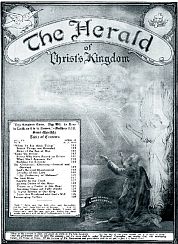
THE HERALD
of Christ's Kingdom
VOL.
XII. August 1, 1929 No. 15
Table of Contents
AWAKE
THOU THAT SLEEPEST AND ARISE
THE
WORD OF GOD OUR SPIRITUAL FOOD
"TRACE
IT BACK"
THE
POWER OF THE CROSS
LOYALTY
TO GOD, HINDRANCES AND SUCCESS
WHOLESOME
COUNSEL FROM ABOVE
ENCOURAGING
LETTERS
VOL. XII. August 15, 1929 No. 16
Table of Contents
SIGNS
AMONGST THE JEWS
THE
FAIRER ZION
LOCATING
OURSELVES IN THE GRACE OF GOD
THE
LEAVEN OF THE PHARISEES
TAKE
HEED TO YOURSELVES AND THE FLOCK
ENCOURAGING
LETTERS
VOL. XII. August 1, 1929 No. 15
"Be not drunk with wine, wherein
is excess; but be filled with the Spirit."
--- Eph. 5:18
ST. PAUL'S letter to the Ephesians,
specially chapter 5, verses 11 to 21 inculcates the transforming
tendency of the Truth. Like all of the New Testament epistles, it is addressed, not to the
wicked, not to the worldly, but to the Christian. The Lord's spirit, the spirit of truth
and righteousness, received as a result of faith in the Redeemer and consecration to Him
as a follower, a pupil, is the beginning of a new life, which starting in the will, should
grow, develop, in crease, until it permeates and fills all the avenues of life -- its
affections, its ambitions, its cravings.
Today, as in the Apostle's day, those
who have become the Lord's people through faith and consecration need to be informed
respecting the possibilities of their new life, else they may permit it to lie
comparatively dormant-permit it to be covered up, and finally to be extinguished,
smothered by the old nature -the will of the flesh, its affections, its ambitions, its
cravings. While, therefore, it is important that conversion should take place-a turning of
the will, the intention, from sin to holiness, from self to God -- it is very important
that conversion be not esteemed to. be the end, but merely the beginning of the
Christian's course. It is, of course, important that the begetting should be of the truth,
and not of error, so that the new mind may be of the proper kind; but even when properly
begotten of the truth, as a child of the Kingdom, it is essential that the new creature
shall be nourished first with the "milk," subsequently with the "meat"
of the truth, which God has provided for this very purpose.
In Danger of Complete Failure
New converts, like new-born babes, are
much inclined to sleep; but while this in nature is profitable, in grace it is dangerous.
For the new creature to sleep in self-satisfaction means death. The begetting of the
spirit has been for the very purpose of energizing ; and hence, the Apostle here calls
upon such "babes in Christ," fallen asleep under the spirit of the world and
thus in danger of complete failure in the way of character development, saying,
"Awake thou that deepest, and arise from the dead, and Christ shall shine upon
thee." ( R.V. ) The "new creature" is to recognize the fact that the whole
world is dead -- not merely under a death sentence, not merely figuratively dead -- but in
a death condition, as respects the highest and noblest things of righteousness and truth.
Our begetting of the Holy Spirit of truth gives us merely a first suggestion of our own
condition by nature, and the condition of the whole world, in trespasses and sin-in
thought, word, and deed. It is necessary that the mind should first be awakened to seek
for other things; it is necessary that the ear should hear the voice of Him who now speaks
unto us from above -the anointed Head of the anointed Body; it is necessary that the eyes
of our understanding should he opened that we may see the true situation of things. And
all this is well represented in the Apostle's figure of awakening.
We regret to say that the general
tendency with many brethren in positions of service in the Church is not to awaken the
sleepers, but rather to lull them to sleep. This however, is not always, nor generally
done with a view to serving the Adversary, and permitting the new life to .become extinct,
just as not many nurses and mothers wilfully contribute to the weaknesses, diseases, and
death of the infants under their charge. In both cases good intentions are often thwarted
by ignorance of the governing laws. Those who occupy the position of teachers, while not
devoid of good intentions as respects the babe in Christ, lack the theoretical and
practical knowledge which they should inculcate-they are babes in spiritual matters
themselves, as the Apostle wrote in one of his epistles, "For when for the time ye
ought to be teachers, ye have need that one teach you again which be the first principles [rudiments] of the oracles of
God." -- Heb. 5 :12.
Energy of the New Creature Required
When the believing, converted,
consecrated, begotten, sleeping, "new creature" has been awakened -- when the
eyes and ears of his understanding have been opened, as above suggested, to see the true
conditions of the world, and to realize himself as a "new creature" in Christ --
his next duty is to arise. His arising from the dead signifies the activity of the new
mind, the new will, in directing and controlling his mortal body. This implies effort; the
putting forth of all the energy of the new creature. It requires no effort to sleep, or to
lie after one gets awake; but to rise requires the exercise of every muscle. Arising is
not an instantaneous act, but a process requiring one movement after another, until it
is fully accomplished; so also is the arising of the "new creature" from the
dead conditions of sin and trespass against the laws of righteousness and truth and
purity; it requires his every effort, and is a work of time. Indeed all experienced
Christians who have followed the Apostle's injunction to arise from the dead, have found
that it requires days, months, years, of energetic effort to rise up above, superior to
the fallen tendencies of his own flesh, common to the world of mankind. He finds that even
after he has risen fully up, so that he does not willfully practice sin, nor countenance
it in any sense or degree, he still must be on his guard lest he be entrapped by the
weaknesses of his mortal body, or by the allurements of the world, or by the temptations
of the Adversary, and thus stumble again over some of the things of sin and death from
which he had arisen by the Lord's grace.
The Apostle in the previous verses has
explained some of these things of sin and death to which the Lord's people should become
thoroughly awake, and from which they should arise completely. In verse 3, he mentions
some evils which should be "not so much as named among you -- as becometh
saints." In verse 4, he mentions "foolish talking" as among the things of
sin and death from which the Lord's people must arise. While we believe that the saints
will make most progress themselves, and be most helpful, to others, by avoiding all kinds
of light and unedifying conversation, and while we strongly recommend this course to all,
nevertheless, we do not understand the Apostle here to refer to what might be designated
as harmless jokes or levity. From the text we understand him to refer to coarse,
lascivious talking, and to a more refined jesting with half-suggestions of profanity or
vice, sometimes practiced by the educated and witty.
Living Epistles of Our Daily Lives
We are to arise from all such low
conditions of thought, word, and deed as we find prevalent about us; because as children
of God, begotten by His Spirit, we can have no fellowship with these things. We must
regard them as the Apostle suggests, as "unfruitful works of darkness." The
Apostle by this word, unfruitful, no doubt intended to give us the thought that sin is
destructive instead of productive-that its tendency is toward death. On the contrary,
the tendency of the new mind of Christ is toward fruit-bearing, development, blessing,
uplifting, refreshment. Not only is this true in the individual Christian, but as our
Lord's words suggest, the individual Christian exercises a preservative influence on
others. Wherever he may live he is a shining light dispelling the darkness of sin; he is
the salt of the earth, preserving the mass from corruption. The moral standing of the
civilized world today is unquestionably largely due to the indirect influence of the
Holy Spirit in God's people, which, as the Apostle declares, reproves the world. Our
reproof of sin may always be through the living epistles of our daily lives which, as
bright and shining lights, should ever reprove by manner, look, act, and tone, everything
tending toward darkness and sin -- "let your light so shine before men that they
seeing your good works may glorify your Father in heaven." Occasionally it may be
proper, and still more occasionally it may be duty, for us to speak or to act in
opposition to darkness, but the light of a godly life, testifying for the truth and
exhibiting the Holy Spirit, is certainly one of the most forceful reproofs of sin that can
be administered. While passing, we might have in mind the Apostle's words,
"unfruitful works of darkness," laying emphasis upon the last word. Sin is
figuratively represented by darkness; and, additionally' it generally prefers literal
darkness for the accomplishment of its purposes. The Lord's children are children of the
light, and are to walk in the light of truth; they are to have their hearts enlightened
and their minds so illuminated as to make them burning and shining lights in the midst of
a crooked and perverse generation, blinded and darkened by the Prince of Darkness. And
all such, while endeavoring to arise from the dead and to live separate from the world,
are recommended to walk in the light of truth, and so far as possible to live in the light
actually -- to see that their homes are well lighted --recognizing that even the natural
light is a foe to the darkness of sin.
Increasing Light for the Righteous
The Apostle suggests the necessity of
taking the various steps above outlined, before the Christian will get fully into the
light himself. It is after he has arisen from the dead by the Lord's help, by the help of
the brethren, by the assistance of the exceeding great and precious promises of the Word,
by the indwelling spirit of the Word; after he has arisen from the dead and indeed while
he is arising from the state of sin and death, while he is attempting to bring his members
into subjection to the new life, a new light is shining upon him -- his light is
increasing, his knowledge of the Lord, his knowledge of sin, his knowledge of
righteousness, his appreciation of truth and righteousness "in the inward
parts," as the Prophet expresses it. The light shining upon him, and deep into* the
recesses of his heart, may sometimes cause distress, as he finds that his own natural
weaknesses and imperfections are even greater than he had at first been aware of;
nevertheless, as a child of the light, begotten by the Father of lights, he loves the
right, and hates the sin; and the more clearly the light shines upon him and shows him the
blemishes of his own mortal body, the more he runs for and strives for the perfection
which the Lord assures him he shall attain to in the actual resurrection -- of which the
present "rising to walk in newness of life," is but the figure.
The Apostle, progressing with the
thought before us, declares that the one who thus arises from the dead is not even then to
stand still. He must walk -- not after or toward the flesh and its standard, but after and
toward the Spirit and its standard, and he will need to walk circumspectly -- with careful
scrutiny of each footstep. The Apostle suggests that any other course than this would be
foolish. We are to remember that our Adversary was more disposed to let us alone while we
were asleep; but that now, when we are awake and seeking to walk after the Spirit, he will
be on the alert to ensnare and entrap us; hence the need of our circumspection. The Lord
gives us light, not only on our own characters, and upon sin and righteousness in general,
but, additionally, He gives us light upon the road we are to travel. This light upon our
pathway is the light shining from the Scriptures of which the Prophet declares, "Thy
Word is a lamp to my feet, a lantern to my footsteps." He who neglects the lamp,
neglects one of the very important means of walking circumspectly. And alas, how many
Christian people today, with the Bible in their homes, are neglecting to trim and use it
as a lamp; if not standing in the dark, they are walking in the darkness, stumbling, or in
danger of stumbling, continually. Let us remember the importance of this Lamp, and use it;
to the intent that ours may be the "path of the just, shining more and more unto the
perfect day."
"Because the Days are Evil"
God's children are to redeem the time
-- to purchase opportunities for the new creature and its interests and concerns, at the
expense of the old nature. We as new creatures are to exchange the things of darkness for
the things of light; the opportunities for sowing to the flesh for the opportunities of
sowing to the Spirit. The opportunities must be thus purchased else we will have none: if
we give way to the inclinations of the flesh, its appetites and desires, it will consume
all there is of time and opportunity, strength and influence, and leave nothing for the
new creature, "because the days are evil"; that is because they are unfavorable
to spiritual progress. They present thousands of temptations for worldly pleasure and
worldly ease and worldly fame and worldly progress; and thus they multiply the tests which
come upon us as "new creatures." We must remember that the Lord desires that
these tests shall demonstrate the degree of our
love, the degree of our sincerity, the degree of our consecration to Him; the more our
love for the Lord and for righteousness, the greater will be our zeal in snatching time,
opportunity, influence from the flesh and consecrating it to spiritual things. In so doing
we will not be unwise, but will display our understanding of the Lord's will. (Verses 16,
17.) Unless we are awake, we cannot arise to present newness of life; and unless this
arising to newness of life is accomplished, we cannot share in the First Resurrection.
Filling of the Spirit Cure for Sorrow
The Apostle contrasts two spirits.
Under present conditions men naturally look for something to exhilarate them, to refresh,
to revive -- to counteract life's trials, burdens, and sorrows. Many of the dead in
trespasses and sins find this stimulant and relief from care, in various intoxicating
stimulants -- wine, spirituous liquors, opium, etc., but the child of God is to look in a
totally different direction for his stimulant, his exhilaration, his relief from care and
trouble -- he is to be "filled with the spirit" of the Lord. He is not merely to
have a little of it, but is to become intoxicated with it to the extent that it will
change the general appearance of all his surroundings and conditions in life. And cannot
each advanced Christian, filled with the Lord's Spirit testify that this is true? -- that
all things are changed from the new standpoint and its new hopes, new ambitions, new
relationships? Can he not say, "Old things have passed away, all things have become
new"? What need has he for the wine cup to drown his troubles, or smother his
sorrows? He knows from observation if not from experience that all such exhilaration and
oblivion to sorrow brings an after effect of pain: he knows also from experience and
observation that-to be filled with the Lord's Spirit need not be a temporary oblivion to
sorrow, but a permanent one, that "Earth hath no sorrow that Heaven cannot
cure"; that even the deepest pains and sorrows of the heart are more than
counterbalanced and cancelled by the joys of the Lord secured through the possession of a
fullness of His Spirit.
The lightness of heart of the
intoxicated "dead in trespasses and sin" often leads to bacchanalian revelry and
song, repulsive even to the same person when sober; but the filling of the Spirit of the
Lord leads to songs and rejoicing, not only with the lips, but with the heart -refreshing,
comforting, and uplifting, not only to the singer but also to the hearer. It is this
"new song" in the heart that
constitutes the Christian a separate and distinct being from all others about him.
"Thou hast put a new song in my mouth, even Thy loving kindness, O Lord!"
Because it is in the heart, therefore, it must be in the mouth also, and must influence
all the affairs of life; for we cannot but speak the things which have so wonderfully
uplifted and refreshed our souls. And the speaking of these things is the proclamation of
the Gospel, "good tidings of great joy, which shall be to all people."
Spirit Makes Us Humble
In our new attitude, figuratively risen
from the dead and walking in newness of life with the Lord, our Redeemer and Head, all of
life's affairs have a new coloring. Not only can we sing:
"Sweet prospects, sweet birds,
and sweet flowers,
Have all gained new sweetness to me"
but we can glory in tribulations also,
and give thanks for these, as well as life's blessings, to the Heavenly Father, in the
name of our Lord Jesus; knowing, having the conviction, the assurance, that life's
disciplines are working out for us a "far more exceeding and eternal weight of
glory." And not only so, but this dependence upon the Lord and filling with His
Spirit makes us humble; so that we do not think of ourselves above what we ought to think,
but think soberly. It is in view of the humility of this class that the Apostle suggests
that they submit themselves one to another in the reverence of the Lord. Those who have
the Lord's Spirit will have the brotherly kindness which is a part of it; and will be
quite willing to defer to each other's preferences in many things -- in all things not
contrary to the principles of righteousness -- in all things in harmony with reverence to
the Lord, His Word, and the principles it inculcates.
It may not be amiss here to remind
ourselves that the Scriptures show two kinds of symbolic or figurative intoxication: the
one above described, filling with the Spirit of the Lord and its joys, and peace, and
comfort -- the results of the fruitage of the vine which the Heavenly Father planted, of
which Christ is the central stock, and of which His followers are all
"branches." The other wine is a counterfeit, an illicit wine; it is not produced
by the vine of the Father's planting, but from the. grapes of the "vine of the
earth." It is of this vine that the Lord tells us Great Babylon has made all the
nations drunken -- the wine of her inconsistency, of her infidelity. This is the wine or
spirit of the world and of human tradition.
Many Today Intoxicated
Looking all about us we fear that many,
who think they are filled with the Holy Spirit of the Truth, are really filled with this
intoxication of human theories and uncertain teaching. Those intoxicated with this wine
will shortly be aroused to a realization that it was sadly adulterated, and the affects
will be painful. Those who are intoxicated with this wine of unsound doctrine are
rejoicing not in the cup of the world and of devils, not in gross sins, but nevertheless
not in the spiritual things. They glory in the prosperity of their particular
organization; they are generally intoxicated with love for sectarianism and the outward
show of works, so that worldly persons, dead in trespasses and sins, are often loved and
bothered by those intoxicated with this adulterated spirit, while saints are spurned and
treated as enemies because of faithfulness to God in rebuking the wrongful teaching and
its doctrinal falsities.
Let us, dear brethren, beware of the
natural wine and its drunkenness -- of the cup of devils, gross sins and immoralities; let
us beware of the still more deceptive wine mixed by misguided teachers, which has a form
of godliness, and which tends to stupefy and to give illicit joy; let us, however, having
made sure of the Lord's pup, drink thereof and be filled with the Spirit of our Master and
with His joys.
By Archbishop Leighton (about A.D.
1675)
THIS is the end of the ministry, that
you may be brought unto Christ, that you may be led to the sweet pastures and pleasant
streams of the Gospel; that you may be spiritually fed, and may grow in that heavenly
life, which is here begun in all those in whom it shall hereafter be perfected.
As the milk that infants draw from the
breast, is most connatural food to them, being of that same substance that nourished them
in the womb: so when they are brought forth, that food follows them as it were for their
supply in that way that is provided in nature for it; by certain veins it ascends into the
breasts, and is there fitted for them, and they are by nature directed to find it there.
Thus as a Christian begins to live by the power of the Word, he is by the nature of that
spiritual life directed to that same Word as his nourishment.
Whereas natural men cannot love
spiritual things for themselves, desire not the Word for its own sweetness, but would have
it sauced with such conceits as possibly spoil the simplicity of it; or at the best love
to hear it for the wit, and learning, which, without any wrongful mixture of it, they find
in one delivering it more than another. But the natural and genuine appetite of the
children of God, is to the Word, for itself, and only as milk, "sincere milk";
and where they find it so, from whomsoever, or in what way soever delivered unto them,
they feed upon it with delight.
As Some Appropriate the Word
Desire the Word, not that you may only
hear it; that is to fall very far short of its true end; yea, it is to take the beginning
of the work for the end of it. The ear is indeed the mouth of the mind, by which it
receives the Word (as Elihu compares it, Job 34:3), but meat that goes no further than the
mouth (you know) cannot nourish. Neither ought this desire of the Word to be only to
satisfy a custom; it were an exceeding folly to make so superficial a thing the end of so
serious a work.
Again, to hear it only to stop the
mouth of conscience, that it may not clamor more for the gross impiety of contemning it;
this is to hear it not out of desire, but out of fear. To desire it only for some present
pleasure and delight that a man may find in it, is not the due use and end of it; that
there is delight in it, may help commend it to those that find it so, and so be a means to
advance the end; but the end it is not.
To seek no more but a present delight
that vanisheth with the sound of the words, that die in the air, is not to desire the Word
as meat, but as music, as God tells the Prophet Ezekiel of his people. "And lo, thou
art unto them as a very lovely song of one that hath a pleasant voice, and can play well
upon an instrument; for they hear thy words, and they do them not."
To desire the Word for the increase of
knowledge, although this is necessary and commendable, and being rightly qualified, is a
part of spiritual accretion, yet take it as going no further, it is not the true end of
the Word. Nor is the venting of that knowledge in speech and frequent discourse of the
Word and the Divine truths that are in it; which, where it is governed with Christian
prudence, is not to be despised, but commended: yet certainly the highest knowledge, and
the most frequent and skilful speaking of the Word, severed from the growth here
mentioned, misses the true end of the Word. If any one's head or tongue should grow apace,
and all the rest stay at a stand, it would certainly make him a monster; and they are no
other, that are knowing and discoursing Christians, and grow daily in that, but not at,
all in holiness of heart and life, which is the proper growth of the children of God.
And as we ought in preaching, so you in
hearing, to propound this end to yourselves, that you may be spiritually refreshed, and
walk in the strength of that Divine nourishment. Is this your purpose when you come
hither? Inquire of your own hearts, and see what you seek, and what you find, in the
public ordinances of God's house. Certainly the most do not so much as think on the due
intendment of them, aim at no end, and therefore can attain none; seek nothing; but sit
out their hour, asleep or awake, as it may
happen, or, possibly, some seek to be delighted for the time, as the Lord tells the
Prophet, "to hear as it were a pleasant song"; if the gifts and strain of the
speaker be anything pleasing.
That the Heart May Be Quickened
Or, it may be, they want to gain some new notions, to add somewhat to
their stock of ,knowledge, either that they may be enabled for discourse, or, simply, that
they may know. Some, it may be, go a little further: they like to be stirred and moved for
the time, and to have some touch of good affection kindled in them; but this lasts but for
a while, till their other thoughts and affairs get in, and smother and quench it; and they
are not careful to blow it up and improve it. How many, when they have been a little
affected with the Word, go out and fall into other discourses and thoughts, and either
take in their affairs secretly, as it were, under their cloak, and their hearts keen a
conference with them; or if they forbear this, yet, as soon as they go out, plunge
themselves over head and ears in the world, and lose all which might have any way
advantaged their spiritual condition. It may be, one will say, "It was a good
sermon." Is that to the purpose? But what think you it hath for voter praise or
dispraise? Instead of saying, "Oh! how well was that spoken," you should say,
"Oh! how hard is repentance! how sweet a thing is faith! how excellent the love of
Jesus Christ!" That were your best and most real commendation of the sermon, with
true benefit to yourselves.
How sounds it to many of us at least,
but as a well contrived story, whose use is to amuse us, and possibly delight us a little,
and there is an end?-and indeed no end, for this turns the most serious and most glorious
of all messages into an empty sound. If we keep awake, and give it a hearing, it is much;
but for anything further, how few deeply beforehand consider, "I have a dead heart;
therefore will I go unto the Word of Life, that it may be quickened; it is frozen, I will
go and lay it before the warm beams of that sun that shines in the Gospel: my corruptions
are mighty and strong, and grace, if there be any in my heart, is exceeding weak: but
there is in the Gospel a power to weaken and kill sin, and to strengthen grace: and this
being the intent of my wise God in appointing it, it shall be my desire and purpose in
resorting to it, to find it to me according to His gracious intendment; to have faith in
my Christ, the fountain of my life, more strengthened, and made more active in drawing
from Him; to have my heart more refined and spiritualized, and to have the sluice of
repentance opened, and my affections to Divine things enlarged; more hatred of sin, and
more love of God and communion with Him.
"In the beginning God." --
Gen. 1:1.
"Could the Bible begin more
inspiringly than with those four words? Man is so made that he must search for origins.
When he sees a beautiful house, he knows that it had a builder, he scouts the idea that it
could have come about by mere chance. But he is not satisfied with learning the name of
the builder; he must know whence came the stone and the brick and the wood that make up
the house. Even here he refuses to stop. He wants to know who made the materials that the
builder put together in the house, and thus he traces back all effects.
"Now,
only two answers to this question of origins are possible. We can trace everything back to
chance or to God. As some one has said, as we go back in our search we can come either to
Fate or to Father. But Fate is blind and the world we see around us is a most marvelous
piece of intricate work. Fate is cruel, and the world is full of evidences of love. Only
an obstinate and stupid mind can see Fate as the origin of the universe. The thoughtful
soul sees in it all the hand of his infinite Father.
"What we find, as we thus trace
things back, will decide our life attitude. Is it Fate? Ours will be an attitude of gloom,
suspicion, doubt, antagonism, despair. Is it Father? Our attitude will be one of cheer,
confidence, faith, love, and hope. Let the last be our view, for it is the truth.
"Our Father, who art in heaven,
hallowed be Thy name. Thy Kingdom come. Thy will be done, on earth as it is in heaven. --
Amen."
"But God forbid that 1 should
glory, save in the cross of our Lord Jesus Christ, by whom the world is crucified unto me,
and 1 unto the world." -- Gal. 6:14.
IF there was ever a time when the
truths connected with the cross of Christ needed a fresh emphasis, surely that time is
now. Serious indeed is the widespread rejection of the Bible teaching of the vicarious
sacrifice of Jesus by the great mass of Christians today. Because of this we are not at
all surprised to note the alarm of some as they observe that more and more the tendency of
all higher education of the present day is away from the cross. It must seem to such that,
humanly speaking, eventually this precious truth must be crushed to the earth, unless the
masses of church membership can be aroused to a concerted action against it. And doubtless
there is much of sincerity and hope of victory in some of the strenuous efforts being made
today in defense of the doctrine of salvation through faith in the shed blood of Christ.
With all such sincerity and effort, the more enlightened prophetically and doctrinally,
should properly sympathize. A clearer knowledge of the meaning of the cross, ,and the fact
that there is much beating of the air on the part of others less enlightened, should not
interfere with our sympathies toward them, even as Paul was glad to have Christ preached
by friends or opposers. It is always well to remember that God is overruling in all such
matters and that even the wrath of devils may be made to praise Him.
But while deeply interested in every
honest effort made in defense of the cross, we are usually unable to do more than maintain
an attitude of sympathy toward many thus engaged. Very often we find that those who claim
loyalty to the cross and full faith in its sin-atoning aspects, deny its real meaning and
efficacy by other serious and blinding errors. Under such circumstances co-operation and
association would be almost impossible without involving ourselves in a compromise
displeasing to the Lord. It therefore becomes our privilege now to emphasize the pure
message and the comprehensive meaning of the cross of Christ in which we glory.
Let Us Examine Ourselves
In this connection it is well for us to
be first of all properly critical of ourselves. The Scriptures teach that judgment and
examination should first begin with our own conduct. They teach that unless we first judge
ourselves we are immediately disqualified as competent judges of others. While therefore
we might properly conclude that the truths centered in the cross needed special emphasis
for the sake of those who may be abandoning it, or in a mistaken way defending it, are we
sure that we ourselves fully grasp all its significance? Too often the tendency is to
approve ourselves by making comparisons. We judge the views of others by their relative
nearness to our own interpretations, and noting the greatness of their deflections
therefrom, we begin to compliment ourselves accordingly. This the Apostle said was a great
mistake. "They measuring themselves by themselves, and comparing themselves among
themselves, are not wise." (2 Cor. 10:12.) The reason is so obvious that he did not
need to explain why: They were overlooking the one and only standard approved of God --
the Christ of the cross.
It is therefore a source of real profit
for the sincere in heart to apply the searching light of truth to the emotions of the
heart and the acts of life; for knowledge always brings increased responsibility and must
never be mistaken for a sure evidence of immunity from guilt. "Let him that thinketh
he standeth take heed lest he fall." The prayer of the sincere is always,
"Search me, O God, and know my heart: try me, and know my thoughts." Let us then
examine ourselves to see whether we be in the faith. Let us stand before the cross that we
may read; mark, and inwardly digest its messages to us; for it is only when the cross
speaks to us, and our hearts are tuned to its messages, that our confession of faith
becomes a thing of value.
Reveals Exceeding Sinfulness of Sin
The first message of the cross has to
do with the reality of sin. It presupposes the inquiry: Why was the cross necessary at
all? And the answer is found permeating the whole of Scripture, namely God's
uncompromising hatred of sin. From the story of Abel's acceptable offering in the dawn of
history, to the shout of the redeemed hosts beyond the restitution glories of the coming
Age, we hear the strain, "When I see the blood, I will pass over", "Without
the shedding of blood there is no remission of sins"; "He died the just for the
unjust, that He might bring us to God"; "He bore our sins in His own body on the
tree." Ah! yes, the cross speaks of a broken fellowship, a disinherited race, a dead
and dying world, because of a broken law. It speaks of the wrath of God revealed in the
curse of death that relentlessly sweeps the race into the tomb. It teaches that sin is a
hateful thing in the sight of God, so hateful that His anger must burn against it. It
cannot be mitigated or modified. Neither can it be forgiven, for His law, which cannot be
altered or amended declares -- "The wages of sin is death." The cross therefore
most emphatically reveals the exceeding sinfulness of sin.
It is most important that we learn this
lesson of sin's hatefulness. God has desired to deeply impress this fundamental truth upon
the minds of all His creatures. His law as given to Israel emphasized it. "He that
despised Moses' law died without mercy under two or three witnesses," "For
whosoever shall keep the whole law, and yet offend in one point, he is guilty of
all." (Heb. 10:28; Jas. 2:10.) All the intelligent creatures of heaven and earth must
therefore know that He will make no agreement or covenant with sin. He will enter into no
arrangement whereby sins may be graded or classified as greater or less heinous. Sin is
sin, and death its unavoidable wages. If sin had been forgivable, and God's nature and
veracity remain unaffected thereby, we might well inquire, Why the cross? But since His
holiness and character are such that He cannot look upon sin with any degree of allowance,
all is clear. "The Lord bath laid on Him the iniquity of us all." "With His
stripes we are healed." The demands of justice were met in Him, and now God can be
just and the justifier of them who believe in Jesus, and for His sake obtain forgiveness
from all their guilt and sin.
By Grace Are Ye Saved
But the point to be remembered is that
our unchangeable God has never changed His attitude toward sin. This message of the
cross He intends shall be indelibly stamped upon our hearts that we may hate and flee from
evil -- loving righteousness and hating iniquity. If the searching light of the law of
Moses revealed man's exceeding sinfulness, as Paul teaches that it did, then the testimony
of the cross comes with even greater force. And if the punishments under the Law
illustrated God's dealings with sin, that lesson is reinforced with emphasis in the
story of the cross, where God must turn His face from the one who bore our guilt. We bring
our sins to the cross, but we cannot, and praise God, we need not, take them beyond it.
They must end there in our hatred of them, for without holiness no man shall see the Lord
or live in His presence. A true perception of this truth, learned best at the foot of the
cross, will prove a great factor in cleansing ourselves from all filthiness of the flesh
and spirit. The second message we may read from the cross is, "By grace are ye saved
through faith; and that not of yourselves: it is the gift of God." Learning this in a
definite way will represent encouraging progress. It is a truth that God has needed to
teach men in all ages. From the day when Adam sought to cover himself with his cloak of
withering leaves until the present, man has been prone to insult the holiness of God by
his subterfuges. The altars of Cain and Abel have stood side by side in all generations.
On that of Cain may still be found the offerings of human efforts and provision, from
which God must withhold His approval. On that of Abel the shed blood has always been
found, testifying constantly to the believer's acknowledgment of helplessness aside from
the atonement secured through the shedding of the blood of Christ.
It was this truth doubtless that
inspired the writers of those beautiful hymns, "Rock of Ages," and "Face to
Face"
"Could my tears forever flow,
Could my zeal no languor know,
These for sin could not atone;
Thou hast saved and Thou alone.
In my hand no price I bring;
Simply to Thy cross I cling."
Then, when the toils of the way are
passed, and clinging to the cross has kept the soul anchored through storm and calm, the
song will be
"And I shall see Him face to
face
And tell the story, saved by grace."
That Will Be Glory Indeed
How difficult it has been for many to
get the proper view of the relation of works and grace. That certain works are essential,
no one can dispute. Again and again we are reminded of the need of diligence in our
stewardship of talents possessed, of diligence in "working while it is called
day," for finally we shall be called upon to render up an account of our privileges.
But meditation before the cross will quickly remove any misunderstanding regarding the
value of our service to God. It is while we gaze thereon that we really discover how
very unprofitable we are, and it is there we realize in truth that,
"Were the whole realm of nature
mine
That were an offering far too small."
We then come in humble acknowledgment
that our sacrifice is so small, our little all so insignificant, and our service so
imperfect, that we are lost in the marvel of His condescending grace. Thus Jesus taught
us, "When ye shall have done all those things which are commanded you, say, We are
unprofitable servants." He said this, not to discourage our efforts, but. to
encourage our acknowledgment of His grace in permitting us to be His servants at all.
When with unobscured vision we behold His face, and see the unspeakable glories of the
heavenly courts, we will then fully realize how very imperfect our works are. How little
inclination we will then have to ask a reward for service rendered. Just to be there and
to see Him face to face will be glory indeed.
How strange it is then that while we
may sing,
"He has called us to a station,
We could ne'er by merit win,"
we are nevertheless so prone to stress
what we are doing for God, rather than to say, "Hear what the Lord hath done for
me!" All this will be changed as we meditate on the greatness of His work on the
cross for us. How could one sit before the cross and drink in the message of His grace and
not feel utterly unworthy of it all? How could such an one ever entertain the thought that
his services were worthy of so great a favor as his salvation represents. Before the cross
we learn that our works -- the works enjoined upon us by the Scriptures -- are the
expression and manifestation of the love and gratitude. of our hearts, the result of that
deep realization of indebtedness that sings,
"O! to grace how great a debtor
Daily I'm constrained to be!
Lord, Thy goodness, like a fetter,
Binds my grateful heart to Thee."
What Shall I Render unto the Lord
Another message written upon the cross
reveals the meaning of that full consecration of our all to God that Jesus taught and
exemplified. This message is most important also. It. is God's definition of the term,
"A covenant by sacrifice," such as the Church is invited to make. It is also the
criterion of the only acceptable kind of consecration whereby membership in the Church is
possible. Furthermore, it stamps as imposters any who claim such consecration, when the
life of sacrifice and self-denial does not support that claim. This reality is observed in
the exacting demands of the cross, in the consecration of Jesus. Its bitter cup of
ignominy and shame -- the final fulfillment of His covenant -- must be drained ere God's
will had been fully done. With Him it was by way of the cross that He would enter into the
Father's approval. From Jordan to the tomb it was an actual experience of a baptized will
that delighted in the consuming processes whereby the consecrated life was being given up.
With constant reiterations He expressed His intention to finish His baptism, drink the cup
the Father had poured for Him, and give up all that He had.
Hence, as we study His life and observe
the reality of His suffering and sacrifice, we realize that it is eminently important that
we ask ourselves certain heart-searching questions: Does my life of consecration involve
self-denials and sacrificings similar to that of Jesus? How real will my share ilk His
Kingdom be if it is on a par with my actual, consecrated experiences now? Can I stand
beside His Apostles and truthfully say, "I have left all to follow Thee. What
therefore shall I receive?" Has my consecration vow been an empty promise, or has it
truly been "a covenant by sacrifice," a life totally different from what it
would have been had no such covenant been made ?
On this point our Lord was most
emphatic: "Except a grain of wheat fall into the ground and die, it abideth
alone." The fire of loving devotion burning in His own heart continuously, wholly
consumed all that had been laid down without reserve in consecration, and to us He says,
"For whosoever will save his life shall lose it; and whosoever will lose his life for
My sake shall find it." "And whosoever doth not bear his cross, and come after
Me., cannot be My disciple." Let us take
heed that we entertain no modification of these words, but let us seek more and more of
His Spirit of fervent love and consecration as it is clearly written upon His cross for
our enlightenment and example.
The Power of God unto Salvation
A further message written prominently
upon the cross speaks to us of its power. The ultimate purpose of our calling is the
attainment of the character-likeness of Christ. Thus it is that we progress from the first
step of reconciliation to the further act of consecration, and then learn the purpose of
God in accepting us as sons. "This is the will of God concerning you, even your
sanctification." As we have seen, the holiness of God forbids fellowship with
sinners, and limits all but His adopted sons to the outer courts of communion. But for
those who are received into His family as sons, He has willed their transformation, and
predestined their characters, requiring that they be "conformed to the image of His
Son." So while the cross has spoken to these of forgiving love, and the removal of
the sins of the past, and then led on to a full consecration representing love and
gratitude, much more must yet be done. There must he experienced a power. that will
accomplish in the consecrated life all that the Lord requires of those whom He will
finally accept as sharers with Him in His Kingdom glories.
As we ponder upon this aspect of the
cross, in its many lessons to us, we must surely feel the power of its influence urging on
to a full experience of all that it makes possible to us. In this connection we recall two
of the Apostle's statements: "For I determined not to know anything among you, save
Jesus Christ and Him crucified." "For I am not ashamed of the Gospel of Christ:
for it is the power of God unto salvation, to every one that believeth." What Paul
meant by "the power of God unto salvation" was not merely the act of love
revealed in the forgiveness of our Adamic guilt, but also the "mighty power which He
wrought in Christ, when He raised Him from the dead," dwelling in us and
"quickening our mortal bodies by His Spirit that dwelleth in us" -- the power
that raises us up to walk in newness of life, and cleanses us from all filthiness of the
flesh and spirit, perfecting holiness in the reverence of the Lord; the power that works
out our full development as new creatures in Christ Jesus. That power Paul found in
contemplating the crucified Christ and the Gospel centered therein.
But how is this lesson learned from the
cross? The reply is that it is the result of the foregoing messages received into good and
honest hearts. To use a familiar phrase, it is the "cause and effect" of our
response to the love revealed to us through the cross. When sin is seen in all its
hatefulness, and God has shown us His attitude toward it as we have learned it from the
cross, when we have properly grasped the fullness of His grace as the cross teaches it,
when our grateful hearts have responded in full consecration to Him who died on the cross
for us, and our souls cry out for the sanctification awaiting us through Him, then every
aspect of the cross becomes a power in our lives, constraining us to apprehend the whole
will of God for us. This is the "effect" produced by the "cause" for
such appreciation and devotion.
The Real Test of Loyalty to the Cross
Love is the greatest thing in the
universe, and the cross its greatest manifestation. Our love therefore will habitually
linger near the cross, and whatever we may learn there of the will of God will become to
us the sole object of life. Thus when we hear Jesus say, "If ye love Me, keep My
commandments," we will understand that after all, the test of our character will be
the reaction of our desires toward all that pleases Him and glorifies our Heavenly Father.
When we have progressed to. this point, we will possess the tangible evidence of the power
of the cross.
When we can read the commands of Jesus
that embrace our relationship to God and the brethren, and meditate on all the grandeurs
of character-likeness to Christ set forth by the Apostles, and then know that all within
us yearns for the fullest measure of these attainments, we know the power of which Paul
writes. When the character that God predestined for the Church in ages past becomes our
greatest purpose in life, and we can truthfully say, "I shall be satisfied when I
awake with Thy likeness," and when God can say of us as He did of Jesus, "Thou
hast loved righteousness and hated iniquity," then we know the power of the cross of
Christ, our lives and conduct being the evidence that this is true.
In the days of Paul, "denying the
faith" had a very comprehensive meaning. To him it did not necessarily mean a
rejection of the cross, or as we would say, "a denial of the Ransom." To the
Apostle it was sufficient for an individual to fail to demonstrate the power of the Gospel
in his conduct. Let us note his words: "They profess that they know God; but in works
they deny Him, being abominable, and disobedient, and unto every good work, void of
judgment." (Titus 1:16, Margin.) "If any provide not for his own, and specially
for those of his own house, he hath denied the faith, and is worse than an infidel."
Others he describes as "Having a form of godliness, but denying the power
thereof." (1 Tim. 5 :8 ; 2 Tim. 3 :5.) Such characters were "the enemies of
the cross of Christ" -- rather an infidel than a pseudo-Christian, who by his conduct
would bring reproach upon the cross by failing to exhibit its transforming effect in the
life.
While it is important therefore to shun
all teachings that reject the cross as the symbol of atonement between God and man, it is
also a matter of supreme importance that we examine ourselves carefully and guard against
such conduct as would mark us as deficient in these essential evidences of faithfulness to
the lessons of the cross. Loyalty to the cross will require of us the fullest measure of
the mind and spirit of Christ. His teaching and example all lead us to the foot of the
cross.
"And all the people shouted with a
great shout, when they praised the Lord, because the foundation of the house of the Lord
was laid." -- Ezra. 3:11.
LOYALTY to the Lord, and faith in His
promises, are costly. The Lord has so arranged the matter, to the intent that only those
who are willing to pay the price may enjoy these blessings. Only the faithful and obedient
are willing to pay the price. Thus the Lord proves His people, separating the merely
nominal believers from the true, selecting to Himself His "jewels," His
"peculiar people."
This principle applied to the Jews who
returned to Jerusalem from Babylonian captivity, in response to the Lord's provision
through the proclamation of King Cyrus. Out of the great hosts of all the tribes of that
nation carried captive there were only forty-two thousand three hundred and sixty (42,360)
of the proper faith in God and the Abrahamic promise, and of the true zeal and courage,
ready to respond. The remainder of the nation had become so comfortably settled in
Babylon, socially and financially, that their interests in these things outweighed their
faith in the Abrahamic promise. Thus God sifted the nation, and in this motley group from
all the tribes He had the jewel class -- the very best and most loyal part of all the seed
of Abraham. As the Apostle explains in respect to the elect Church in this Gospel Age, so
we might say of these Jews returning from Babylonian exile, that there were not many of
them great or wise or learned or noble, according to the course and wisdom of this world.
Hopes Deferred, Trials Many
Nor had their trials ceased with the
surrender of brighter prospects in Babylonia. They left their friends in Babylon, full of
zeal, and to some extent admired by their more worldly-wise compatriots, who preferred to
remain in the foreign land. The escort granted them by the king, the presents of money,
and the costly vessels of the temple service, were with them, and their hopes ran high as
they began their journey of nearly 800 miles, about the distance from Philadelphia to
Chicago. According to tradition they must have been about four months traveling, whereas
an express train in our day would make the distance in seventeen hours.
The toilsome journey ended, they
finally rested at Jerusalem, only to find still greater discouragements. But a very few of
them had ever seen the place before, and those few had seen through the eyes of childhood,
for it had now been seventy years since the captivity commenced when Daniel and his
companions were taken, and the city had lain waste a large portion of this time, according
to the Word of the Lord. (2 Chron. 36:21. ) The wall and the temple had been demolished by
Nebuchadnezzar's orders, and many of the private residences were also left in ruins, and
now for seventy years of such desolations, the place was a wilderness. Trees were growing
in what formerly were streets. Everything was disorder. Any other class than those full of
faith and zeal, as these were, would have been utterly discouraged. We are to remember
that the Lord thus tries our courage, and faith, and zeal, not to destroy these qualities,
but to deepen and fix them -- to establish us, to develop us in character. As with the
typical Israelites there, so it is now with the spiritual Israelites-all such trying
experiences, under Divine providence, will work out to our advantage if we will but
persevere in our faith, and love, and zeal.
It required more than a year to put
themselves in reasonable condition for living, and then their attention turned to the.
rebuilding of the temple. That they should have begun so soon to think of the house of the
Lord speaks well of their spiritual condition. We read, "They sang one to another in
praising and giving thanks to the Lord, saying, For He is good, for His mercy endureth
forever toward Israel." (R. V.) We have a description given in Ezra, chapter 3, of
the laying of the foundation of the temple, and the priests and the Levites, appropriately
robed, making a joyful noise before the Lord, as representing the faith and confidence of
the people in the precious promises associated with that temple and with that city. Alas,
poor Jews! we sympathize with them greatly as we remember that as a nation they clung to
those Abrahamic promises for over 1,600 years, and yet finally rejected the Prince of
Life, and in consequence were left desolate, as a house, or nation. The Apostle remarks,
concerning their faith in the Abrahamic promise, "unto which promise our twelve
tribes instantly serving God hope to come." How glad we are for this downtrodden
race, that although Israel hath not obtained the chiefest favor, but only the
"elect" have obtained it, while the rest were blinded, nevertheless God's mercy
and favor still have them in mind, and assure us that they shall obtain mercy through our
mercy shortly -- that the blindness that has been on Israel, during the selection of
spiritual Israel, will surely pass away, furnishing them the chief opportunity for
reconciliation to God, under the New Covenant provisions of the Millennial Age. -- Heb.
8:10-12.
A New Song in My Mouth
As with the mind's eye we see those
poor but faithful Israelites, out of all the tribes, praising God as they laid the
foundation of the temple, it suggests to us how much more the spiritual Israelites who
have returned from mystic Babylon should shout and sing the praises of our King from our
higher standpoint of knowledge and appreciation of His grace and truth. Speaking of us,
the spiritual Israelites, the Prophet declares, "Thou hast put a new song into my
mouth, even the loving-kindness of our God." All spiritual Israelites who are in
the right attitude of heart toward the Lord, are full of songs of gratitude and praise --
not always audibly, however, for many can best sing and make melody in their hearts unto
the Lord; and indeed the Psalm of Life, which each of the Lord's followers declares in
actions and words to those about him, is the best testimony, the best praise we can
raise, more to the glory of our King than any others.
If the Israelites who remained in
Babylon, whose faith and courage were insufficient, could have witnessed the scene at a
distance, they doubtless would have shouted for joy, that they had not undertaken such a
pilgrimage and such a work of restoration; but as Paul and Silas could sing in the prison,
with their backs bleeding from the cruel lash, while others enjoying every luxury of life
in the same city were miserable, so it was with those returned Israelites. Full of faith
and hope they were also filled with joy as they looked forward in prospect for still
further favors from the Lord, in harmony with His glorious promises. And so it is with the
Lord's people today: our rejoicing is not because of temporal favors and advantages and
privileges, but on account of those joys which are ours through faith and hope, inspired
by the Divine promises-the culmination of the same promises for which the natural
Israelites were aspiring, and which are
secured to us through the great Jew of the seed of Abraham, our Redeemer, our Bridegroom.
The shouts were discordant -- some of joy, some of weeping. Those who looked forward in
hope shouted for joy. Those who looked backward, and pictured before their minds Solomon's
grand temple, wept as they thought of the insignificance of the present one in
comparison. And so today among spiritual Israelites, there are some who weep for the
past, when they should be rejoicing for the future. The Apostle exhorts us to "forget
the things which are behind, and to press forward to the things which are before."
The lessons we learn from past experiences, even from adverse experiences, while they
should be kept in memory, need not be mourned over by spiritual Israelites, for they can
call to mind that the merit of Christ's sacrifice covers all of their unwilling blemishes
and mistakes. Carrying with them their experiences they should press forward to fresh
victories and fresh joys in the Lord.
"First Pure, Then Peaceable"
It should be remembered that these
42,000 people, about 35,000 of whom are supposed to have belonged to the tribes of Judah
and Benjamin and Levi, and the remainder from the other nine tribes, occupied only a small
district in Palestine, about twenty-five miles square, Jerusalem being the center. The
remainder of the territory of Palestine was more or less settled by immigrants. The king
of Babylon followed the practice of moving the captives from one nation into the
territory of another, so that their old associations being broken up they would be more
dependent upon the Babylonian government and lose their own natural traits. These people
of various nationalities that had settled in Palestine had acquired some of the traditions
of the land and its religious customs, and in our Lord's day, about 566 years later, they
were known as the Samaritans. Of them our Lord said, "Ye believe ye know not what; we
know what we believe, for salvation is of the Jews." Respecting the same people, we
remember our Lord's commandments as He sent forth the twelve Apostles and later also the
seventy disciples to proclaim Him, He said, "Go not into the way of the Gentiles, and
into any city of the Samaritans enter ye not; but go rather to the lost sheep of the house
of Israel." -- Matt. 10:5, 6.
These mixed peoples, whom we will for
convenience call Samaritans, paid little attention to the Jews returned from Babylon
until they heard of their project of rebuilding the temple on its own site, the
consecrated site, for it is supposed that Abraham's typical offering of Isaac was made
upon this very "dome of the rock" upon which the temple was built, a rock that
to this day is held sacred by Musselmans, Jews and Christians. The Samaritans had been
unneighborly up to this time, but now seemed to catch an inspiration from this temple
building as they remembered the ancient glories of the nation of this land, whose great
king, Solomon, had built the first temple. Ceasing to act as enemies, the Samaritans
proffered their assistance in the building of the temple. We cannot doubt that they were
sincere in this proposition, and that really their religious fervor impelled them to make
it.
Many who have read of the rebuilding of
the temple think the Israelites made a great mistake in rejecting their aid and declining
to affiliate with them. But such are evidently in error, since our Lord Jesus by His
conduct and words fully substantiated the thought that the Samaritans had nothing whatever
to do with the true temple and its building. God had been sifting the true seed of Abraham
to select from it the faithful few, and now to have invited the Samaritans to come in and
join them in the temple building and temple services would have been to bring in a
semi-heathen mixture, which the Lord did not desire. Why the Lord did not desire it can be
seen only from the one standpoint -- not that it was His wish to send those Samaritans to
eternal torment, nor that He wished to destroy them in the Second Death, but that He has
for future development a great Plan of Salvation which will affect every nation, people,
kindred, and tongue, including these Samaritans. In the interim He wished to develop the
typical seed of Abraham, and subsequently the spiritual seed of Abraham, to be His agents
and representatives in conferring His blessings upon all nations.
"Which Temple Ye Are"
We find the same thought abroad today;
troubling those who have come out of Babylon, and who are wishing to build the true temple
of God -- the holy temple, the antitypical temple, "which temple ye are." The
foundations of our temple were laid at Pentecost, under apparently very unfavorable
conditions from the world's standpoint a dead Leader, and a handful of a few hundred
disciples scattered and considerably discouraged. Nevertheless, those who recognize the
Lord's hand in the matter see things differently: with the eye of faith they discern in
Jesus the great Rock of our Salvation typified by the "rock of the dome," the
top of Mt. Zion, on which the altar of sacrifice stood. The same eye of faith now discerns
that the twelve Apostles are the foundation stones of Divine appointment, built upon the
Rock Christ Jesus; and that upon the ministries of those appointed representatives of
Christ, a glorious Church, a glorious temple of the Lord is being erected. Those who then
had the eye of faith shouted for joy, and all who since possess the same spiritual vision
rejoice in the greater work which the Lord is accomplishing, as they see the preparation
now of the "living stones," which, by and by, in the First Resurrection, shall
be brought together complete as the glorious temple of God, in and through which all the
families of the earth may have intercourse with God to their blessing.
Samaritans Amongst Spiritual Israelites Today
There are numerous
"Samaritans" today who really have neither part nor lot in this great temple and
its construction. These Samaritans are found in various churches and groups of professing
brethren, men and women of good character and of religious inclinations. Some of them are
"good Samaritans," ready to relieve the sick, the indigent. Worldly wisdom says
that these should all be recognized as "Israelites indeed," even though they be
not fully consecrated to the Lord to do His will. Many are inclined to upbraid others now
as the natural Israelites were upbraided for refusing the fellowship and co-operation of
the Samaritans of their day.
There is but one course for the Lord's
people to follow: they should appreciate whatever is good in these, their neighbors and
friends; they should deal justly and kindly with them, but they should remember that. as
oil and water will not mix, so likewise there cannot be any real union between the
consecrated and the unconsecrated in respect to their religious views and their endeavors
to co-operate in the Divine service. Their standpoints are opposite, affiliations are
injurious to both parties. If the spiritually begotten ones, the Israelites indeed,
attempt to meet the ideas of the Samaritan class, they will be compromising their own
covenant with the Lord. Likewise, if the Samaritan class or the broadminded ( ?) class of
our day be encouraged to affiliate with the consecrated, it will injure them in that it
will deceive them into thinking that they have become joint-heirs in the Divine promises;
whereas none can inherit under those promises except through faith in the Redeemer,
circumcision in the heart, and a full consecration unto the death. Such only become
regularly and legitimately Israelites indeed, probationary members of the "very
elect" Church.
When their co-operation in temple
building, etc., was declined, the Samaritans became the bitter opponents of the Jews, whom
they, no doubt, described as bigoted. Consistently with their views of the subject they
did all in their power, politically and otherwise, to hinder the temple building, and thus
the trials and difficulties of the servants of God were greatly increased and multiplied.
So it is today. Those who are faithful
to the Lord, "the people who do know their God," are esteemed to be religious
bigots and fanatics by some of the respectable, who profess to have larger and broader
views, and who, in harmony with their erroneous conceptions of the situation, are more or
less acting in a way to hinder the real work of the consecrated, the preparation of the
living stones of this temple. We need to understand the situation properly, otherwise we
would soon be discouraged, and think of God as being against us because He permits such
opposition. But with the right view of things before our minds we may realize that all the
oppositions of the partly consecrated are really beneficial to us, helpful in that they
serve to do the chiseling and polishing of our characters, necessary to fit and prepare us
for honorable stations in the temple of glory soon to be completed. One thought not to be
lost sight of is, that in the Lord's arrangement, we are the stones, He the master workman
-- and all the trials and difficulties and oppositions and perplexities and
disappointments of our experience are the chisels and wheels and emery-sand for our
preparation. From this standpoint only are we able to follow the Apostle's advice to --
rejoice in tribulations also.
"Understanding is a wellspring of
life unto hint that hath it:
but the instruction of fools is folly." -- Prov. 16:22.
THE Scriptures generally instruct that
the power of comprehension, of understanding, especially in connection with the knowledge
of God and an acquaintance with Him and His will, are of the utmost importance. The
Apostle Paul prayed for Timothy -- "The Lord give thee understanding in all
things." The Master's promise to His disciples as their present heritage was that the
Holy Spirit would guide them into an understanding of spiritual truth and show them things
to come concerning God and His will and purpose; that such understanding would be the
power of God fortifying them against evil and enabling them to go forward in the
overcoming life; and that it would constitute them living examples of the value and
efficacy of the Christian religion.
The comprehension which the Spirit of
the Lord imparts becomes a fortification to the man of God against self-deception. Again
the Wise Man admonishes, "There is a way that seemeth right unto a man; but the end
thereof are the ways of death." Here is a solemn warning against self-deception --
against pursuing a course of conduct which is radically wrong, being opposed to the spirit
and, intent of the Divine Law and yet which may be made to seem right by a line of false
reasoning, suggested by the will of the flesh and apparently founded upon the Word of God,
yet denying its fundamental principles of righteousness. The delusions of Satan also
greatly help along such deceptions and thus the blinded one is urged along in a course
which seems to him to be right, but the end of which is disaster and death.
False Teachers and Strong Delusions
Followers of Christ should above all
things guard themselves against the folly of this way. To do this, we must ever remember
that even though through Christ we have a standing of justification before God, the human
heart, which we still have, is "deceitful above all things and desperately
wicked" (Jer. 17:9), and that it requires constant watching and purging to .enable us
to put into practice the Apostle Paul's rule -- in simplicity and godly sincerity have
your conversation in the world. (2 Cor. 1:12.) Truly it requires humility, sobriety and
godliness to carry out the Apostle's advice. If the heart be puffed up with pride, or is
ambitious for vain glory, or if it be selfish, or in any measure intoxicated with the
spirit of the world, then we should beware; for there is great danger of getting into that
way that seemeth right to a man because blinded by his own perverse will or fleshly mind.
The Adversary is always ready to take advantage of the self-will and perversities of the
natural mind, and to make darkness appear as light. That there have been many strong
deceptions through all the ages of man's history, must be conceded by all who are at all
informed. "The whole world Beth in the wicked one," says the Apostle, and in
these circumstances humanity is largely and badly deceived. Those who have escaped the
condemned state and darkened condition of mind, are warned that they must be on guard
against subtle, deceptive, and misleading influences and teachings whose name is legion.
Many warnings are given in Holy Writ concerning the perilous delusions of the last days in
which we are now living. Concerning the present trial time of the Church, Brother Russell
wrote: "The studied effort of false teachers -- false brethren developing in the very
midst of the Church -- is to offset the Truth by plausible forms of error, to unsettle
confidence both in the Truth and in all teachers of the Truth, thus to lead away disciples
after them and their theories.
They Will not Endure Sound Doctrine
"In consequence of the allurements of these false
teachers, and of the unfaithfulness of many to the love and service of the Truth which
they have received, a class in the midst of the Church will give much encouragement to the
ambitions of these false brethren; for, says the Apostle (2 Tim. 4:3, 4), the time will
come when they will not endure sound doctrine, but after their own desires [desires for
something new] shall they gather to themselves teachers, having itching ears [for new and
strange things]; and they shall turn away their ears from the Truth, and shall be turned
unto fables.
"Nor will this class be only a
small minority; for, in order that the faithful may not be discouraged when brought face
to face with these things, they are forewarned (Psa. 91:7) that, before this conflict
ends, a thousand shall fall at their side and ten thousand at their right hand. Thus,
realizing that God foreknew it all and that the accomplishment of His glorious purposes is
not in the least endangered thereby, they may still have confidence and joy in view of the
glorious consummation of His Plan, and of their promised position in it . . . .
"Such 'evil men,' says Paul (Ver.
13) 'shall wax worse and worse [more and more bold and aggressive, as' they receive
encouragement from that rapidly increasing class who will no longer endure sound
doctrine], deceiving [others] and being deceived' (themselves -- becoming more firmly
intrenched in the snares of their own weaving, so as to make it impossible to extricate
them). But, nevertheless, the time is coming when they shall proceed no further; for their
folly shall be manifested unto all men, as was the folly of Jannes and Jambres, who could
not forever withstand the teachings of Moses, the servant of God. -- Ver. 9.
"Then St. Paul proceeds to call
attention to 'the ground of Timothy's confidence in himself as a faithful teacher of
Divine Truth, saying, 'But thou hast fully known my doctrine, manner of life, purpose,
faith, long-suffering, charity, patience, persecutions, afflictions which came unto me at
Antioch, at Iconium, at Lystra; what persecutions I endured; but out of them all the Lord
delivered me.' -- Ver. 10, 11."
Keep Thy Heart
The best safeguard which Christians
have against the snares of Satan is that understanding which the Wise Man describes as
"a wellspring of life unto him that hath it." Such understanding is not merely
that of the head but of the heart specially; for "with the heart man believeth unto
righteousness," and "out of the heart are the issues of life." If the heart
be wrong, the head will seek to justify it, and in so doing will pervert judgment and
truth. Therefore take heed and "keep thy heart with all diligence."
Not only will the "wise and
understanding heart" keep the feet in the paths of righteousness, but also "the
heart of the wise teacheth his mouth, and addeth learning to his lips," so that he
shall speak forth "words of truth and soberness," words of wisdom, of kindness,
and of love. Oh how important that the fountain should be sweet, that thus the stream that
issues from it may be healthful and refreshing to all within the range of its current!
Truly, "Pleasant words [of wisdom, of counsel, and of loving kindness] are as a honey
comb, sweet to the soul, and health to the bones [in that they refresh and comfort and
stimulate courage and thus fortify the soul and strengthen it to noble deeds]."
How different is the picture of the
ungodly man! An ungodly man diggeth up evil [apparently finding a morbid satisfaction in
searching for it], and in his lips there is a burning fire. A froward man soweth strife,
and a whisperer separateth chief friends. A violent man enticeth his neighbor and leadeth
him into the way that is not good. He shutteth his eyes .to devise froward things: moving
his lips, he bringeth evil to pass." Thus, as Isaiah says, "the wicked are like
the troubled sea when it cannot rest, whose waters cast up mire and dirt. There is no
peace, saith my God, to the wicked." -- Isa. 57:20, 21.
The Knowledge Resulting from Experience
Is it any wonder then that the Lord has
repeatedly and solemnly impressed upon the minds of His children the importance of a real
heart knowledge and understanding of His will and of the right way in which they should
go! Was not this the substance and effect of the Apostle Peter's admonition (2 Pet. 1:5) ?
Beginning with those who already have some knowledge, enough to be a basis for faith, he
exhorts them to add to their faith fortitude (Common Version, virtue); he implies that if
they hold to their faith against the attacks of the enemy it will develop fortitude, and
added grace and character. And when he says, "Add to your fortitude knowledge,"
we would understand him to mean that if faith be held firmly, and fortitude of character
result, this under the Spirit's guidance will bring the faithful one to deeper and wider
expanses of knowledge; or, as the same Apostle suggests, the faithful one will grow in
both grace and knowledge; and the Holy Spirit, through its begetting will enable such to
know, appreciate the deep things of God, the things freely given unto such by God, the
knowledge of God resulting from our experience in the school of Christ. It is concerning
this knowledge, not merely concerning the intricacies of doctrinal matters, but the heart
sympathy and communion with the Lord Himself, that the Apostle Paul exclaims, "I
count all things but loss for the excellency of the knowledge of Christ Jesus my
Lord."
Development of other Graces
This knowledge received into a good and
honest heart, will bring .forth the fruitage or grace of character here termed
"self-control" (Common Version, temperance). As is elsewhere stated, "He
that bath this hope in him, purifieth himself," controls himself, purges out more and
more of the old leaven. Following and connected with the attainment of such self-control
would come patience: for the self-mastery would teach the necessity for sympathy with and
patience toward others. This patience in turn would lead to and develop the next grace
mentioned, namely piety -- a condition in which the love of God is shed abroad in the
heart, influencing all the thoughts and words and deeds. This condition further develops
brotherly kindness-a love for all who are brethren and yoke-fellows in the cause of
righteousness and truth, the cause of God. And brotherly kindness leads to that still
broader and deeper experience designated the chief of all graces, namely love, love for
God, love for the brethren, love deep and pure and true, which thinketh no evil and is not
puffed up, is not easily offended; rejoices always in the truth and never in iniquity.
This is the climax of Christian attainment in the present life-the grace of all graces,
which never fadeth, and which will but be perfected when we receive the new resurrection
body.
Indeed blessed then is the man that
hath learned the right ways of the Lord and walketh therein with a perfect heart. Such an
one, unlike the wicked who go about digging up evil, delights himself in doing good and in
speaking forth the words of truth and soberness. He is slow to anger, and studies
carefully how to rule his own spirit, which is surely a great work, and worthy of the
ambitions and efforts of every Christian. Truly, how sweet -and blessed are the closing
years of a long life devoted to this most worthy end, of ruling one's own spirit in
harmony with the principles and precepts of the Word of God; when, as Whittier has
beautifully expressed it,
"All the jarring notes of life
Seem blending in a psalm,
And all the angles of the strife
Are rounding into calm";
and when the hallowed influences of
ripened Christian graces are manifest to every beholder. Surely, the hoary head in such
cases "is a crown of glory," if it be found in the way of righteousness.
Dear Brethren
Greetings in our Master's dear name!
Because we think it would encourage you to continue in the Lord's work when a word of
cheer from those on the other side of the ocean (even from the small and backward Holland)
reaches you, we resolve to let you know of the proceedings of our spiritual growth, since
we got into connection with your beautiful exposition of the Truth.
Being tired of the general buffeting
which we had to undergo, because we did not agree with the now generally accepted ideas of
the Lord's commands, we almost got into spiritual lethargy. But being inspired by the
example of the faithful in the past, we tried to get at the rock-bottom of everything, at
last crossing your way and, thank God, our drowsiness gave place to greater activity. This
activity brought a feeling of peace and assurance in the Lord's leading. We were
strengthened at the same time by the Christian-like articles of the "Herald,"
which lack anything akin to boastfulness and noisy advertisement of self, but overflow
with love for the brethren and the Lord. It made us remember the old time articles by our
beloved Brother Russell.
Remember, dear brethren, that we were
at a disadvantage as regards the Truth, from a human standpoint. We had furthered the work
of the Watch Tower in Holland to such an extent that we became identified with it. All
those brethren down here that are connected to said Society, came to a knowledge of its
exposition by our preaching. When our eyes were opened and we took our turn to the faith
once delivered to the saints, the cry of the opposition tarred and smirched us, so that we
were made impossible, being denoted as imposters and hypocrites, lawless and children of
the Devil. One of our brethren was called the Devil himself, and those who were weak . . .
were warned against him and threatened with excommunication if they ventured to
intermingle with any of the brethren that stayed by said brother.
Furthermore we had no communication
whatever with foreign brethren, so we could not exchange opinion, and because the brethren
in Holland in general are not versed in the English language, neither in the German, they
were not acquainted with the Truth sufficiently to appreciate to the full the cunning and
subtle way which was used by "God's Organization" to entrap those humble
children of the Lord. Therefore, we could not have the assistance, morally and
spiritually, of others of like precious faith, as for example, in England and America. The
strife was ,a hard one indeed, but praise the Lord! He has led to the victory and
established us in His Truth. Notwithstanding our fewness of number (some 10 in all!) the
Lord is blessing us increasingly every day. In the last time using you to make our cup of
joy run over. Hold on brethren, even if you do not see direct results of your work. Please
remember that the Lord is using it to do that which He intended it to do.
We have taken the liberty, without your
consent, to translate these articles into Dutch, on behalf of aforesaid small number of
kindred brethren. Of course we take it for granted that you would not object to our doing
so. Mind brethren, we are not making any corporation's distribution of these translations.
It is simply and solely for our brethren. We are remembering you all daily at the Throne
of Grace that the Lord may always keep you humble and meek, because there is danger in
such a lofty and responsible position. Headiness and boastfulness may easily creep in, as
you are aware yourselves by the examples in the past and also in the present.
We once more thank the Lord for His
benevolence to bring your admonitions to us in such a far-away land (terra incognita !) We
shall thank you for a word of consent to our act of translating your publications.
May the Lord bless you and keep you
faithful unto ,the end that you may hear the "Well done, good and faithful
servant." We remain,
Your
brethren by Grace,
P.
C. D. and M. B. -- Holland.
Dear Sirs
Please find enclosed seventy-five cents
for which please send me by return mail the "Divine Plan of the Ages," also send
with it six copies of "When the Morning Cometh:" I want some of my friends to
read them. I had one handed to me on Saturday and have read it with much benefit to my soul.
Yours
working for the Master,
N.U.
-- N.Y. N. U.-N. Y.
Dear Brethren in the Lord:
For a long time I have desired to send
for your journal, "The Herald of Christ's Kingdom," and so now my soul longs for
its helps, and the sweet spirit of its fellowship. I have had two copies that were sent to
me some time ago, which I have read over many times, always with the same blessing and
encouragement. You no doubt have seen the great devastation the Watch Tower has wrought
against the Truth, and our beloved Pastor, Brother Russell. If they had deliberately set
out to defame him and his work, they could not have better accomplished their design. I am
so anxious to be affiliated with those dear brethren who still hold the Truth in
righteousness, and who can supply me with literature to help tell the old, old story of
God's love to the groaning creation.
In the name of the Lord . . . I will be
glad to have you send me a few tracts and if I can use more, will let you know later. And
also send me a copy of "Light After Darkness." I will order some books from you
later, and try to do my part in financing this means which we have to serve our dear Lord.
After long years of grief for what
looked like the overthrowing of the Lord's work, and many fiery trials and much weeping
and' praying for guidance, I have come to the conclusion that we who are still holding the
Truth, are passing through this crucible, to prove if we have loved the Truth, and will
keep it, regardless of all that can be brought against it and us.
There are just a few who like myself
are still clinging to the Rock of Ages, the Truth as we learned it from our dear present
Lord. All others have gone on believing what has been taught against it, even if they have
to use a typographical error to prove it to themselves.
One very dear sister wrote me that she
had searched the Bible through and found Scriptures to prove that Satan was the builder of
the Pyramid, and I thought, Why not search and find Scriptures to prove it was like we
have always believed it to be.
My heart surely goes out in warm
Christian love to all who are still walking in this very Narrow Way; and I do long for
their sweet fellowship, for I am, still developing a character which I hope will be
pleasing to my Lord.
With Christian love and God's blessing
on all of this way,
Your
sister in the Anointed,
Mrs.
E. A. M. -- Okla.
VOL. XII. August 15, 1929 No. 16
"Comfort ye, comfort ye My people,
with your God.
Speak ye comfortably to Jerusalem." -- Isa. 40:1, 2.
IN the closing pages of his exposition
of "The Revelation of Jesus Christ," published by our Institute, our late
beloved Brother R. E. Streeter, makes the following significant statement:
"The signs of the full end of the
Age are to be looked for in' three special directions or sources. These are:
"1. Signs amongst the Jews.
" 2. Signs amongst the Gentiles.
" 3. Signs in the Christian
Church, both the true and false.
"In all these directions the signs
of the complete end are described. The Apostle Paul gives what is probably the most
significant sign, and evidently the final one to be looked for in the first direction
above mentioned, as indicating the change of the Kingdom class. He says: 'Blindness in
part is happened to Israel until the fullness of the Gentiles be come in.'' (Rom. 11:25.)
When it becomes apparent that the truly orthodox of the Jewish people get their eyes open
to see that Jesus Christ is their Messiah, and come to an understanding of what is
referred to in the Scriptures as the 'hidden mystery,' that of gathering out the
joint-heirs of the heavenly Kingdom from amongst the Gentiles, which is clearly stated to
be the special purpose of God for this Age, during the period of Jewish blindness -- then,
and not until then will the Age reach its full end. Those who will live to witness that
may know that the Kingdom in all its power and glory will be ushered in immediately. We
believe that some Christians may possibly witness some of the events and developments
leading up to and in close proximity to that time." -- pp. 627, 628.
With such thoughts as these in our mind
we were much interested in learning recently of the progress of the Hebrew Christian
Alliance of America, Chicago, Illinois. The purpose of this organization's existence is
stated in the pages of its Quarterly Magazine as follows:
"1. To furnish a corporate witness
to the Jews of the saving power of the Gospel of Jesus Christ."
"8. To aid through the
International Hebrew Christian Alliance in a world witness to the Jews concerning the
Messiahship of Jesus Christ."
Some Hebrew Christian friends of our
acquaintance having extended us a hearty invitation to attend their Fifteenth Annual
Conference, we were at once struck with the spirit of its active members. It was in the
following language that the Rev. Jacob Peltz, General Secretary of the Alliance, brought
this conference to the attention of the delegates
"I have been reading again the
fifteenth chapter of the Acts of the Apostles, giving the account of the first conference
of Hebrew Christians held in Jerusalem nineteen hundred years ago. We do not know how many
Hebrew Christians attended this Jerusalem Conference. Likely all the Apostles were there,
including Paul. Some of the more important personages in attendance were the Apostle
James, who presided over the conference; Paul and Barnabas, who had come fresh from their
missionary journeys and electrified the delegates when they declared 'what miracles and
wonders God had wrought among the Gentiles by them'; and the Apostle Peter, who made a
passionate appeal for Christian liberty. The issues and results of this conference were
momentous. We are still reaping the fruits of the wise decision of those early
spirit-filled Hebrew Christians . . . .
"Let us earnestly pray for our
conference the presence and power of the same spirit that came upon the Jewish Apostles of
old when they met in Jerusalem long ago."
As a sample of the challenge which this
Alliance is making to the Jews to take up the study of the Messiahship of Jesus Christ, we
cannot do better than quote the following from one of their leaders, Dr. Max I. Reich:
"THE PRESENT DUTY OF ISRAEL; JEWS ON THEIR
HONOR"
After introducing his subject under the
above caption, this writer proceeds to state:
"Now we have long felt that in
three directions particularly, the Jewish people owe a debt to truth and honor to which we
would respectfully draw their attention.
I. Getting at the Sources
"It is very important that the
Jewish people should get their understanding of Christianity direct from the Christian
sources, as far as documentary evidence is concerned, that is from the New Testament.
Orthodox Jews, who are still by far in the majority, seldom look at a New Testament. They
have gathered impressions from their Talmud and from their other books, such as the
infamous Toldoth Jeshu, a medieval lampoon of Jesus of Nazareth, which have
given the beginnings of Christianity an anti-Christian twist in their minds. It is clear
that the Talmud, composed several centuries after the birth of Christianity, when the
feeling of Jews had become embittered against Christians on account of the evil treatment
they were receiving at their hands, can hardly be expected to be an unbiased witness. The
account which the Talmud gives of the origin of Christianity is shockingly blasphemous.
"We maintain that the Jewish
people owe it to truth and honor to allow the Christian records to tell their own story.
They will find themselves in a familiar atmosphere when they begin to read the Gospels.
They are thoroughly Jewish. Take away the Jewish background of the Gospels; eliminate
everything that has its roots in the history or religion, in the national, social and
synagogal customs, modes of thought, idiosyncrasies, feelings, aspirations, which are
properly Jewish, and very little would be left.
"Moreover, he would soon be
impressed with the crystal bright honesty of the writers. The most painstaking effort to
disparage their sincerity has failed to make out its case. Nineteen centuries have been
refreshed by the stream of life that flows through their writings. They tell a story too
wonderful to have been invented. They narrate enough of themselves to let us see that they
were intellectually and spiritually incapable to have imagined their Hero. If He is a miracle in
personality, to have drawn upon their imagination in describing Him would have constituted
a miracle in literature. The pen-portrait of Jesus in the Gospels must have been preceded
by a life actually lived to make the story possible.
"Jews must learn to look away from
the poor copies of Jesus in His professed followers to the original. At the best, even
true disciples are still Christians in the making. They
are unfinished articles. Why judge of Christianity by them alone? Even Jews resent it if
their nation is appraised according to some particularly unworthy representative. They
point us to Abraham. So believers in Christ point to Him. And His Face shines out from the
pages of the Gospels. No Jew has the right to speak the final word concerning Him till he
has honestly tried to come face to face with Him there.
II. A New Attitude Towards Jesus of Nazareth
"For many centuries Jews, tried to
forget Jesus. The very name once so common in Jewish nomenclature (it stands for Joshua,
and there was more than one called by that name in the New Testament) ceased to be used.
The Jewish people has, done its best to obliterate His memory.
"However, that has not been an
easy matter. During their long exile the majority of them have been forced to live in
close proximity to the Christian Church. They have by Divine providence to do with each
other, though they both have often wished to shirk this responsibility.
"Now the Person of Jesus is a
perpetual challenge to both Jew and Gentile. Every generation must take up the challenge
afresh. He forces men to account for Him, to explain Him, to say who He is. Men cannot for any length of time leave
Him alone. The very insane opposition to Him in some quarters proves this. And when the
world thinks it has at last done with Him, He springs a surprise on it: He causes a new
wave of spiritual influence to proceed from Him, which draws the weary multitudes with
their sins and their sorrows, their diseases and their burdens, their perplexities and
their bewilderments, to gather around His feet.
"This has been the history of the
last nineteen centuries. It may not be easy for a Jew, with his deeply ingrained
prejudices, to give to Jesus the proper place that belongs to Him. Personally I look for
Jews to learn of Him and to grow in the knowledge of Him, as the first Jewish disciples
did. The confession of the skeptical Thomas: 'My Lord and my God,' comes at the end and
not at the beginning of the Gospel story.
'But Jews are in honor bound to be fair
with Jesus. Cannot they recognize His moral superiority? Can they not see in Him the
crystallization of all that God intended to set forth in Israel? Is He not the incarnation
of the essence of what the Law, the Psalms and the Prophets taught? Do they not feel in
His presence they are in the presence of immaculate purity? He never confessed sin! Do we
not feel instinctively that He is different from even the holiest saints who, we know,
were the greatest penitents also ? And as men listen to Him, what consummate wisdom, what
crystal purity, what sublime poetry! Never man spake like this Man! Perhaps the rabbis
have said many beautiful things also, but they said many foolish and puerile things, which
Jesus did not say. What drew the first disciples to Him? They did not come with a
ready-made creed. They felt His superhuman wisdom. They said: 'Lord, to whom shall we go?
Thou hast the words of eternal life.' I appeal to my brother who is a Jew, to begin with
Jesus thus: Let him be a respectful listener to Him. Let Him make His own personal
impression on thee. And then give Him the place in thy thoughts and feelings thy
experience in His Presence has compelled thee to give.
"There is a day almost within
sight when the Spirit of Grace and of supplication will be poured out on the Jewish
people. Then will they look upon Him whom they have pierced; not only on the cross, but by
their long repudiation of His Messianic claims, and great will be their mourning. They
will mourn for Him as for a first-born, and be in bitterness for Him as for an Only One.
See Zech. 12:10. All the. great names Israel has been so proud of will be forgotten then. Only One will remain worth mentioning. In the loss
of Jesus of Nazareth, Israel lost her Only One, for whose sake, that He might be 'the
Glory of Israel,' Israel has been formed and preserved from millennium to millennium till
our day. -
III. The Revision of the Trial of Jesus
"There is a third matter
concerning which Jews are on their honor, and that is the necessity of revising the trial
of Jesus which ended in his being handed over to the Roman government to be crucified.
That trial was clearly a travesty of justice. It was a mock trial. And until it is
officially revised it casts a deep shadow over the Jewish people.
"Let it not be forgotten that the
condemnation of Jesus was the act of the Sanhedrin, the official representative of the
Jewish nation. There is considerable talk just now of reviving that institution.
One of its first acts will have to be
the reexamination of the evidence on which the terrible verdict was based in the days of
Annas and Caiaphas. Jewish Christians particularly will have to insist on this being done.
"What a misnomer the name of the
president of the Sanhedrin then! Annas means 'merciful.' Josephus has a good deal to say
of him. He was a man who had blunted his moral sense by a life of cruel selfishness.
Before this cunning and unscrupulous politician the holy Jesus was placed for judgment!
Annas set aside the just provisions of the Jewish law in that trial. He conducted a
private investigation, when Jewish justice demanded publicity. He based his accusation on
an admission extracted by an ensnaring question to the accused; he condemned him in the
face of Deut. 17:6; 19:15; Num. 35:30. Another illegality was the fact that the trial
before Annas was held between two and three o'clock at night.
"Though the accused should have
been considered innocent till his guilt had been proved, Jesus was sent 'bound' to
Caiaphas, as if he had been legally convicted. Then followed another illegal night
examination. Then instead of waiting for witnesses to come forward, the unjust judges
actually searched for such. And not finding true witnesses they manufactured false, and their witnesses contradicted each other! Finally Jesus was
condemned on His own confession, contrary to a
fundamental principle of Jewish jurisprudence (See Mishna Sanhedrin VI, 2).
"Truly the words of Isaiah were
fulfilled on that occasion: 'How is the faithful city become a harlot! She that was full
of justice; righteousness lodged in her, but now murderers.'
"Are we not right in claiming that
this shameful mockery of justice should be revised? Jews, in the persons of their
representatives, must set themselves to this matter and wipe this blot off their
escutcheon. I know that through ignorance they did it. Hence mercy waits for their
repentance. And when they will have ceased to be at odds with God about Him whom the
builders rejected, and who in His Church has become the head of the corner, but Israel's
stumbling stone and rock of offense, then will He become Israel's foundation stone. And a
new and more glorious Israel will be erected on this 'sure foundation' than the Israel of
her most glorious past. And .from this new and regenerated Israel will flow, as from the
glory-filled temple seen by Ezekiel in his closing vision, rivers of blessing to the
uttermost parts of the earth."
While it is far from our purpose to
convey the thought that orthodox Jews are, in any material numbers, getting their eyes
open to see Jesus as their Messiah, but believe on the contrary that this happy condition
is still future, yet every indication in that direction is heart-cheering to the true
saint of God, and it is for this reason that the matter is brought to the attention of our
readers. It was our Lord Himself who said:
"Now learn a parable of the fig
tree; when his branch is yet tender, and putteth forth leaves,, ye know that summer is
nigh: So likewise ye, when ye shall see all these things know that it is near, even at the
doors." -- Matt. 24:32, 33.
Many will recall the words of our
dearly loved Brother Charles T. Russell in this connection, written in 1897:
"The sprouting of the fig tree may
have been but a casual remark, but we incline to think that it was not. The peculiar
circumstance narrated of our Lord's curse
upon a fig tree which bore no fruit, and which withered away directly (Matt. 21:19, 20)
inclines us to believe that the fig tree in this prophecy may be understood to signify the
Jewish nation. If so, it is being signally fulfilled; for not only are thousands of
Israelites returning to Palestine, but the Zionist movement, as all know, has now assumed
such proportions as to justify Conventions of representatives from all parts of the world
to meet year by year to put in practical shape the proposal for the reorganization of a
Jewish state in Palestine." -- Studies in the
Scriptures, Vol. IV, p. 604.
Certain it is that God hath not cast
away His people which He foreknew, and if as the Apostle has pointed out, their temporary
downfall and removal from the place of chief favor was the occasion of God's salvation
being extended to the Gentiles, what still more marvelous blessings will come to the
Gentiles as a result of the restoration of the Jews to favor again? As another has
paraphrased the related passage:
"If their partial fall be the
world's wealth, the occasion by which 'the unsearchable wealth of Messiah' (Eph. 3:8) has
been as it were forced into Gentile receptacles, how much more their fulness, the filling
of the dry stream with its ample ideal stream? .. . . What blessings for 'the world' for
'the Gentiles' may not come through the vehicle of such an Israel?" -- Rom. 11 :12.
And again, (verse 15):
"If the throwing away of them . .
. was the world's reconciliation, the instrumental or occasioning cause of the direct
proclamation to the pagan peoples of the Atonement Of the Cross, what will their reception
be, but life from the dead?" -- H. C. G. Moule.
That the ministry of The Hebrew
Christian Alliance is bearing some fruit was abundantly evident in the testimonies of
Hebrew Christians which formed an impressive part of each evening's service of their
Conference. Many of these testimonies showed a very real experience of "suffering for
Christ's sake," many having had to endure ostracism and persecution from relatives
and friends because of their confession of Christ. One dear sister, who years ago had been
persuaded by her relatives to secure a divorce from her husband because of his fidelity to
Christ, told how the Lord had in due time opened her eyes, too, to the redemption that is
in Christ Jesus, and won her to Himself. Not long after this, she was reunited to her
former husband in the bonds of marriage. No wonder there was a calm assurance, as in tones
full of conviction she, who had at one time been so ashamed of Jesus, gave as her
testimony: "I am not ashamed of the Gospel of Christ."
We, who, by faith in Christ Jesus, have
become sons of God; who have been baptized into Christ, and have clothed ourselves with
Christ, recognize that in Him there is neither Jew nor Gentile, but if we are indeed
members of the one Body, then Christ is all in all. In that new creation, in which we are
being remolded so as to become like Him, we know that all such distinctions will cease.
(Col. 3:10, 11; Gal. 3:26-29.) Those having this spirit will appreciate the following
lines from the pen of the writer already quoted, and echo his sentiments, as he sets forth
that which shall end not only his, but our quest:
Zion, thy stones to us are dear,
None love thee more:
How oft thy walls in dreams appear
On alien shore!
Mother of sorrows! Ah we know
And feel thy pain,
Having, too, drunk the cup of woe,
Again, again.
We seek thy good; God grant thee
peace!
For now has come
The hour that grants thy son's release
To turn back home.
Yet we have seen a light above
The noon-day sun,
The glory of the Prince of Love
Through suffering won.
A radiance in His once-marred Face
That turns to dross
The best of earth, and gives us grace
To face the Cross.
High in God's sinless Paradise
He fills the throne;
A fairer Zion meets our eyes
Where He has gone.
Where burning seraphim adore
With covered face,
While ransomed penitents explore
His wealth of grace.
Soon, soon, with hosts unnumbered, we
Loosed from all sin,
In robes of shining purity,
Shall enter in.
Where, wand'rings and temptations
past,
In God's deep rest,
Our eyes shall see that which, at last,
Shall end our quest.
Max I. Reich
"The Spirit itself beareth witness
with our spirit,
that we are the children of God." -- Rom. 8:16
THE question of solemn concern for all
God's people is that of determining their relationship to Him, their place, the measure of
their development in the school of Christ, and their general standing before the Lord.
While God's children are still sojourning in this house of their pilgrimage, there are, of
course, many things that they do not know, and as the Apostle says, they see now through a
glass darkly; but when the great day of God's revealing is fully ushered in, then
everything will be made clear and plain, then they shall see as looking directly in each
other's face -- "face to face."
But while waiting for this time, there
are certain things that it is important for us to know definitely and without doubt.
Admitting that we might not be able to locate others in relationship to the Divine Plan,
should we not be able to locate ourselves? And if so, how may this be done? Surely we
should be able to locate ourselves in respect to our standing in the grace of God. It
becomes a question of our knowing the various steps to be taken and corners to be turned,
and we should know just how many of these we have taken and just about where we are. It is
well and profitable at times for all disciples of Christ to carefully review and note the
steps of a righteous man, called of God to joint-heirship with His Son.
Steps toward God
First, there must be that definite
longing for righteousness, truth, purity, which will imply a drawing by the Lord's Spirit
along the lines of the less depraved faculties of our fallen nature. Our response to this
drawing is to seek righteousness and to seek meekness. To all such the Lord says, Draw
near unto Me and I will draw near unto you. Numerous steps then of obedience to the Lord
may be taken after the first one of turning our back upon that of willful indulgence in
sin. Each step will bring us a little nearer to the Lord and to righteousness and should
show us more clearly than before that "in our flesh dwelleth no perfection,"
that we cannot measure up to even our own estimate and imperfect conception or
interpretation of the Divine law -- that we need special grace and help from on high. It
may properly be said that this entire course of approaching unto the Lord and to
righteousness is one of justification, in the sense that it tends to harmony with God and
His righteous requirements. The soul that thus reaches the place where it cries out after
the living God, by this time sees clearly the need of the Savior, that Jesus is the
Redeemer. Such an one hears the message, "No man cometh unto the Father but by
Me." And such respond, "Lord, gladly will I go to the Father through you."
Second, the reply of the Savior as to
what are the terms of securing discipleship and Divine favor in its fullness, points us to
the next step in the way to God, and accepted, brings the desired blessing. The Master's
words are, "If any man will be My disciple, let him deny himself, and take up his
cross and follow Me." Nor does the Lord urge haste in making the decision. The haste
is left to the suppliant, whose love of righteousness and desire for fellowship with God
will be measured by his haste in accepting the terms of discipleship. To one and all the
Master says, "Sit down first and count the cost." Do not hastily put your hand'
to the plow and then draw back. Those who hesitate and take long years in counting the
cost, will very probably not decide in favor of the Christian race, for the Adversary will
come along with too many persuasive arguments to discourage them in the great undertaking.
The wise and reasonable course is to proceed at once to soberly and carefully weigh the
proposition, and having considered it in all its phases, to recognize that it is but the
reasonable service to give up all of self with earthly hopes, aims, prospects, joys,
entirely into the Father's hands, as a grateful expression of gratitude, a willing
sacrifice; and joyfully accept the prospect of suffering trials, testings, and provings in
the present life, and if faithful, to realize at last the glory, honor, and immortality on
the heavenly plane promised.
The Office of the Advocate and the Spirit
It should really not require long for a
mature person of loyal and appreciative heart to realize that the Lord's service is a
desirable one and that the price, our little all of earthly life and possession, is
insignificant. Indeed, the zealous and faithful one will speedily, say, "Here, Lord,
I give myself away, 'tis all that I can do." Then comes the Redeemer's part. For in
harmony with the Father's Plan He now stands as Advocate for all such as have come unto
the Father through Him. His intercessions avail for all true applicants and gain for them
a complete standing in righteousness and justification in the presence of the Father. He
advocates their cause as their representative in the heavenly court, approving of them and
of their consecration, having additionally, by the imputation of the merit of His own
sacrifice, made up for their deficiencies, that they may be made the righteousness of God
through Him. We see thus our Lord Jesus, the Advocate, presents our case and covers our
blemishes; and our sacrifices are accepted of the Father -- up to the time when the last
member shall have been received -- up to the time when the door to this High Calling shall
have been closed, when the last of the wise virgins shall have entered beyond the veil.
In the example of what took place in
the formation of the Church in the beginning of the Age, we see that the Father's
acceptance of consecrated believers was indicated by their adoption and begetting of the
Holy Spirit and the commencement of the sealing the impressing upon them as new creatures
of the Divine likeness, disposition, or spirit. All of the members of the Church since
that time have had this experience of the spirit, and we of today should all know very
positively whether or not we have taken the two definite steps noted foregoing. If we have
not taken these steps, we have the solution to our, failure to enter into and enjoy the
spiritual life.
The Fruit of Abiding in Him
But let us consider further that it is
riot sufficient that we take the steps above mentioned, not sufficient that we have
received the Holy Spirit, and have been accepted of the Father; for we have been
instructed and admonished concerning a work of grace that is to follow; and we must be
sure that we continue to abide in Christ. The beloved John touches the keynote of the
matter when he says, "He that saith be abideth in Him, ought himself also so to walk,
even as He walked." (1 John 2:6) This proper abiding in Christ is sure to be
productive of those results designated by the Apostle "the fruit of the Spirit."
For the purpose of forming and
establishing the Church in the beginning of the Age, the proclamation of the Gospel was
accompanied by miraculous gifts. But that purpose having been accomplished and the Church
started on its way, those miraculous manifestations passed away as the Apostle Paul points
out. (l Cor. 13:8.) Instead of the gifts came
the fruits. of the Spirit as evidences or proofs of acceptance by the Lord and induction
as members or branches of the Vine. To be sure, the fruit buds are small at first. They need much of the husbandman's faithful
care. Thus our great heavenly Husbandman prunes us-He cuts away the earthly things to
which we are prone to cling. Indeed, He leaves us without much earthly support except that
which is connected directly with the Root, the Vine. Thus separating from earthly
ambition, in harmony with our consecration unto death, the Spirit of the Lord comes into
us, more and more producing fruits of the Spirit, even as the juices of the vine go to the
branches and its clusters. Our Master assures us that such prunings are an evidence of our
membership in the Vine and of our fellowship in the sufferings of Christ; for the heavenly
Husbandman thus treats all true branches of the true Vine. All experienced Christians
should be able to see something of these fruits and graces. Our spiritual energy should be
manifested in a variety of ways toward the Lord, toward His brethren, and toward all
mankind in proportion as we have contact with them.
Amongst other manifestations of Divine
favor will be increasingly the desire for fellowship with the Lord in prayer and through
His Word -- a love of the Divine Plan, a delight in everything that is righteous, just,
true, noble -- a desire to promote all such interests to the extent of our opportunities.
Evidence of faithfulness will be seen in our being accounted worthy to suffer reproaches
and persecutions for the Lord's sake and the Truth's sake, and our acceptance of these as
of Divine providence. Still other indications of harmony with the Lord will be observed in
our increased appreciation of His Holy Word, a deeper insight into its precious teachings,
and an increasing pleasure in serving it out to others -- not for vain glory, in which the
energy of the flesh may have opportunity to display itself, but for the Lord's glory and
for the good of those who desire to know His will.
Several Things that Inevitably Follow
Obviously, the most vital
manifestations of the spiritual life and of genuine relationship with God are to be looked
for in the working of the Spirit in the inner soul and life of the individual disciple,
rather than in a display of outward work. In other words, it is that regeneration or
making alive of the Spirit in contrast. to the putting to death of the flesh and the
subduing of it propensities. It is what St. Paul designates the "putting off" of
the one and the "putting on" of the other.
"I have noticed," says
another, writing along these lines, "that wherever there has been a faithful
following of the Lord in a consecrated soul, several things have, sooner or later,
inevitably followed. Meekness and quietness of spirit become in time the characteristics
of the daily life. A submissive acceptance of the will of God, as it comes in the hourly
events of each day, is manifested; pliability in the hands of God to do or to suffer all
the good pleasure of His will; sweetness under provocation; calmness in the midst of
turmoil and bustle; a yielding to the wishes of others, and an insensibility to slights
and affronts; absence of worry or anxiety; deliverance from care and fear -- all these,
and many other similar graces, are invariably found to be the natural outward development
of that inward life which is hid with Christ in God. Then as to the habits of life; we
always see such Christians sooner or. later laying aside thoughts of self, and becoming
full of consideration for others; they dress and live in simple, healthful ways, they
renounce self-indulgent habits, and surrender all purely fleshly gratifications. Some
helpful work for others is taken up, and useless occupations are dropped out of the life.
God's glory, and the welfare of His creatures, become the absorbing delight of the soul.
The voice is dedicated to Him, to be used in singing His praises. The purse is placed at
His disposal. The pen is dedicated to write for Him, the lips to speak for Him, the hands
and the feet to do His bidding. Year after year such Christians are seen to grow more
unworldly, more serene, more heavenly-minded, more transformed, more like Christ, until
even their very faces express so much of the beautiful inward Divine life, that all who
look at them cannot but take knowledge of them that they live with Jesus, and are abiding
in Him.
Solemn Questions
"I feel sure that to each one of
you have come some Divine intimations or foreshadowings of the life I here describe. Have
you not begun to feel dimly conscious of the voice of God speaking to you, in the depths
of your soul, about .these things? Has it not been a pain and a distress to you of late to
discover, how full your lives are of self ? Has not your soul been plunged into inward
trouble and doubt about certain dispositions or pursuits in which you have been formerly
accustomed to indulge? Have you not begun to feel uneasy with some of your habits of life,
and to wish that you could do differently in certain respects? Have not paths of
devotedness and of service begun to open out before you, with the longing thought, 'Oh,
that I could walk in them!' All these questions and doubts and this inward yearning, are
the voice of the Good Shepherd in your heart, seeking to call you out of that which is
contrary to His will. Let me entreat of you not to turn away from His gentle pleadings!
You little know the sweet paths into which He means to lead you by these very steps, nor
the wonderful stores of blessedness that lie at their end, or you would spring forward
with an eager joy to yield to every one of His requirements. The heights of Christian
perfection can only be reached by each moment faithfully following the Guide who is to
lead you there; and He reveals the way to us one step at a time, in the little things of
our daily lives, asking only on our part that we yield ourselves up to His guidance. Be
perfectly pliable then in His dear hands, to go where He entices you, and to turn away
from all from which He makes you shrink. Obey Him perfectly the moment you are sure of His
will; and you will soon find that He is leading you out swiftly and easily into such a
wonderful life of conformity to Himself, that it will be a testimony to all around you,
beyond what you yourself will ever know."
Treading the Same Path with Him
The writer in the foregoing excerpt has
presented the logical as well as the Scriptural sequence of progress, experience, and
attainment on the part of those who are in the school of Christ and who by faith yield
themselves submissively to God's will. And the great question with all such will be, Am I
having experiences common to all who are associated with Jesus? Such will indeed have for
their motto, "He that saith he abideth in Him, ought himself also so to walk, even as
He walked." And how did our Master walk? He lived daily and hourly in harmony with
the will of His Father; He was fully submissive to the Divine will, even though it meant
sacrifice unto death, even the cruel death of the cross.
Whoever then has the Lord's Spirit and
is controlled by the same will and holy influence, is a member of the Body of Christ and
will seek to walk after this fashion, to do the will Of God in all things. It will mean a
walk of holiness and full devotion to God. In other words, those who profess to be the
Lord's followers, profess to be Christians, and should see to it that their walk in life
is in harmony with their profession. As disciples of the great Teacher we realize that it
is our place to recognize Him as our Pattern and as our Instructor in the glorious things
which the Father has invited us to share with Him. If therefore we say that we are in Him,
this profession should be borne out by our walk in life. Evidently the Apostle in
referring to the walk of Jesus has reference in particular to His experience after He made
His consecration. He walked in this way three and a half years. It was a walk, not
according to the flesh, but according to the Spirit. We then are to walk as our Master
walked in our general deportment; and while we cannot in an imperfect body measure up to
all the perfection of Jesus, who was perfect in His flesh as well as in His spirit, we can
however tread the same path in the same direction toward the same glorious goal toward
which He walked; and so doing faithfully day by day, we shall by His grace attain the same
exceeding great reward.
"For 1 say unto you, That except
your righteousness shall exceed the righteousness of the scribes and Pharisees, ye shall
in no case
enter into the Kingdom, of Heaven." -- Matt. 5:20.
DURING the long period between the
Prophet Malachi and the ministry of Jesus, many changes had taken place in Jewish customs
and institutions. It is not generally remembered that approximately four hundred years had
passed after Malachi had foretold the appearance of the Messenger of the Covenant, before
Jesus appeared on the scene, at His First Advent. And without this knowledge it is rather
difficult to grasp the peculiar aspects of Jewish religious life when our Lord began His
ministry, or to understand why the scribes and Pharisees were recognized by Jesus as the
greatest hindrances to those who were seeking the way of truth.
Four hundred years is a long period in
the history of any people. Great changes must necessarily take place. Language and
customs, parties and institutions will be constantly undergoing changes as political
influences and religious practices mold the character of the nation. And these four
centuries had brought many political and religious changes to the Jewish nation, as the
history of the Maccabees will show. Furthermore, during that long time, God had sent them
no prophet to direct their religious life, as He had done up to the days of Malachi. Under
these circumstances it is not hard to understand that many departures, and numerous
innovations would characterize their worship when John the Baptist and Jesus began their
respective ministries.
Pharisees and Sadducees under the Searchlight of Truth
It was during these centuries that the
two main religious parties -- the Pharisees and Sadducees -- developed into the position
and prestige they occupied at the time of the First Advent. The Pharisees were the
holiness element, coveting pre-eminence, because of their strict interpretation of the
Law. The Sadducees represented an element of society opposed to many of the Pharisaical
traditions and endless washings, rites, and burdensome requirements. They also opposed
certain vital principles and doctrines set forth in the Law and the Prophets, such as the
resurrection of the dead, etc. But it was the Pharisees who came in for the special
condemnation of John in his preparatory work, and later on received from Jesus a severe
and terrible arraignment, in which He employed language calculated to represent the
deepest possible abhorrence of their external punctiliousness, made the more abominable by
their hypocritical, self-righteous boastings.
In thus exposing their true character
Jesus was acting on the principle that where great opportunities have been enjoyed, great
claims made, and great prerogatives assumed, corresponding character and faithful conduct
will be expected. Precept and example, teaching and life, must harmonize before His
judgment seat. They had claimed a superior holiness -- "trusting in themselves that
they were righteous and despising others"; they had made much of being separated from
all other sects and parties, and assumed the right to be judge of all; and they had become
quite dogmatic in the assertion of their sole right to interpret the Scriptures. On all
three points they utterly failed under the searching examination to which the life and.
teachings of Jesus exposed them. Hence His repeated warnings against their practices.
"Happened unto Them for Ensamples"
When, therefore, our Lord warned His
disciples to "Beware of the leaven of the Pharisees, which is hypocrisy," He was
warning them against an insidious influence that would always constitute a pitfall in
their pathway -- an influence which must be carefully guarded against. Leaven works
gradually. Beginning in a small way it spreads its influence until the whole is leavened.
Be the mass ever so pure, and the movement away from Babylonish bondage characterized by
the most devout searching for light and liberty, yet, as Jesus taught, the Kingdom of
Heaven continues to be "like leaven, which a woman took and hid in three measures of
meal until the whole was leavened," and the utmost vigilance is still required to
escape the leaven's baneful effects.
Jesus knew human nature well enough to
know that where His teachings did not become rooted in the character of the individual,
sooner or later, where there was a desire to appear religious, the Pharisaical
characteristics would manifest themselves. Past and present Church history presents the
evidence that the "leaven of the Pharisees" appears and reappears as, revival
and reformation, apostasy and falling away, follow in successive order through all
generations.
Let us then take a comprehensive survey
of the years between the days of Malachi, Israel's
last Prophet, and the appearance of Jesus at His First Advent; or, viewing the same
period as the time between the end of the general movement from Babylonish captivity and
the time when the most holy of that nation were gathered out as the elect Israelites
indeed. The spiritual mind will need no further explanation to see the application of so
important an object lesson. Surely Paul's statement may be considered here: "Now all
these things happened unto them for ensamples: and they are written for our admonition,
upon whom the ends of the world are come. Wherefore let him that thinketh he standeth take
heed lest he fall. (1 Cor. 10:11, 12.) The
history of natural Israel has. been recorded for the special benefit of the spiritual
sons, and the wise in heavenly wisdom will not fail to.. note the lessons taught them
through this house of servants.
Religion Had Sadly Declined
We cannot do better while engaged in
this survey than to quote from the historian who has given this. subject an exhaustive
study. His description of the gradual growth of Phariseeisin comes to us not only as a
matter of history, but as an aid in understanding the import of the warning given by
Jesus.
"The priestly orders and offices
had been thoroughly reorganized after the return from Babylon, and the temple services and
annual feasts continued to be observed at Jerusalem with strict regularity. Besides,. a
new and most important religious institution had arisen, which almost threw the temple
with its priesthood into the background. This was the synagogue with its rabbis. It does
not seem to have existed in ancient times at all, but was called into existence after the exile by reverence for the written Word. Synagogues were multiplied
wherever Jews lived; every Sabbath they were filled with praying congregations,
exhortations were delivered by the rabbis -- a new order by the need of expounders to
translate from, the Hebrew, which had become a dead language -- and nearly the whole of
the Old Testament was read over once a year in the hearing of the people. Schools of
theology, similar to our divinity halls, had sprung up,. in which the rabbis were trained
and the sacred books interpreted.
"But in spite of all this
religiosity, religion had sadly declined (by the time of Jesus' ministry). The externals
had been multiplied, but the inner spirit had disappeared . . . . The representative
religious men of the time were the Pharisees. .As their name indicates, they originally
arose as champions of the separateness, of the Jews from other nations. This was a noble idea, so long as the distinction
emphasized was holiness. But it is far more difficult to maintain this distinction.
than such external differences as peculiarities of dress, food, language, etc. These were
in course of time substituted for it. The Pharisees were ardent patriots, ever willing to
lay down their lives for the independence of their country, and hating the foreign yoke
with impassioned bitterness. They despised and hated other races, and clung with undying
faith to the hope of a glorious future for their nation. But they had so long harped on this idea, that they had
come to believe themselves the special favorites of heaven, simply because they were
descendants of Abraham, and to lose sight of the importance of personal character. They
multiplied their Jewish peculiarities, but substituted external observances, such as
fasts, prayers, tithes, washings, sacrifices, and so forth, for the grand distinction of
love to God and love to man.
Traditions of the Elders Substituted for the Word of God
"To the Pharisaic party belonged
most of the scribes. They were so called because they were both the interpreters and
copyists of the Scriptures and the lawyers of the people; for, the Jewish legal code being
incorporated in the Holy Scriptures, jurisprudence became a branch of theology. They were
the chief interpreters in the synagogues, although any male worshiper was permitted to
speak if he chose. They professed unbounded reverence for the Scriptures, counting every
word and letter in them. They had a splendid opportunity of diffusing the religious
principles of the Old Testament among the people, exhibiting the glorious examples of its
heroes and sowing abroad the words of the Prophets; for the synagogue was one of the most
potent engines of instruction ever devised by any people: but they entirely missed their
opportunity. They became a dry ecclesiastical and scholastic class, using their position
for selfish aggrandizement, and scorning those to whom' they gave stones for bread as a
vulgar and unlettered canaille.
"Whatever
was most spiritual, living, human, and grand ire the Scriptures they passed by. Generation
after generation the commentaries of their famous men multiplied, and the pupils studied
the commentaries instead of the text. Moreover, it was a rule with them that the correct
interpretation of a passage was as authoritative as the text itself ; and, the
interpretations of the famous masters being as a matter of course believed to be correct,
the mass of opinions which were held to be as precious as the Bible itself grew to
enormous proportions. 'these were 'the traditions of the elders.' By degrees an arbitrary
system of exegesis came into vogue, by which
almost any opinion whatever could be thus connected with some text and stamped with Divine
authority. Every new invention of Pharisaic singularity was sanctioned in this way.
Peculiarities were multiplied until they regulated every detail of life, personal,
domestic, social, and public ....
Blinded Regarding Vital Issues
"This was the chaff with which
they fed the people in the synagogues. The conscience was burdened with
innumerable details, every one of which was represented to be as divinely sanctioned as
any of the Ten Commandments. This was the intolerable burden which Peter said neither he
nor his fathers had been. able to bear. This was the horrible nightmare which. set so long
on Paul's conscience. But worse consequences flowed
from it. It is a well-known principle in history, that, whenever the ceremonial is
elevated to the same rank with the moral, the latter will soon be lost sight of. The
scribes and Pharisees had learned how by arbitrary exegesis and casuistical discussion to
explain away the weightiest moral obligations, and make up for the neglect of them by
multiplying ritual observances. Thus men were able to flaunt in the pride of sanctity
while indulging their selfish and vile passions ....
"The scribes also. busied
themselves with this element in the Scriptures [the Messianic prophecies] and the
cherishing of Messianic hopes was one of the distinctions of the Pharisees. But they had
caricatured the prophetic utterances on the subject by their arbitrary interpretations,
and painted the future in colors. borrowed from their own carnal imaginations. They spoke
of the Advent as the coming of the Kingdom of God, and of the Messiah as the Son of God.
But what they chiefly expected Him to do was, by the working of irresistible force, to
free the nation from servitude and raise it to the utmost worldly grandeur. They entertained no doubt that, simply because they
were members of the chosen nation, they would be allotted high places in the Kingdom, and
never suspected that any change was needed in themselves to meet Him. The spiritual
elements of the better time, holiness and love, were lost in their minds behind the
dazzling forms of material glory. Such was the aspect of Jewish history at the time when
the hour of realizing the national destiny was about. to strike."
Is There a Repetition of History Today?
If some future historian should
undertake to write the history of our day -- this last day exodus from Babylon -- would
his record be materially different from the one foregoing? Would it be a story of a great
revival of Bible study, of increasing facilities for understanding the Word of God, of
places for such study opening up all over the land, and of multiplied teachers capable of
assisting in recovering the Scriptures from. the neglect of the past? Would the story then
follow the beaten path and record the failure of the many to properly value such
opportunities; and would it repeat the history of the past by relating the retrogression
that so often has followed such exceptional opportunities for permanent advancement? The
possibilities of such a record being written are so real, that it becomes. the duty of all
the faithful to diligently observe the Master's warning and be on guard against the leaven
that so insidiously undermines the faith and character of the individual and effectively
paralyzes any reformation movement.
"Unanswered yet? Faith cannot be
unanswered;
Her feet are firmly planted on the Rock.
Amid the wildest storms she stands undaunted,
Nor quails before the loudest thunder shock.
She knows Omnipotence has heard her prayer,
And cries, 'It shall be done, sometime,
somewhere!"
"Take heed therefore unto
yourselves, and to all the flock, over the which the Holy Spirit hath made you overseers,
to feed the Church of God,
which He hath purchased with His own blood." -- Acts 20:28.
ST. PAUL'S story of his Ephesian
experiences, as he summoned them up, on the shores of Miletus, in his parting address to
the Elders of the Church, is amongst the most touching and pathetic to be found in the
record of human suffering and patience. -- Acts 20 :18-35.
The Apostle, writing during these
eventful months, speaks of himself as "a man doomed to death and made a spectacle to
the world; for Christ's sake, a fool, weak and dishonored; suffering hunger and thirst,
when work was scant and ill-paid; having no certain dwelling-place, because unable to hold
a situation long together through the plotting of his foes; hated, buffeted; reviled,
persecuted, defamed; made as the filth of, the world, and the off-scouring of all things.
When he tells the story of the afflictions which befell him during his residence in Asia,
he says that he was weighed down exceedingly beyond his power, insomuch that he despaired
even of life; that he was pressed on every side, perplexed, pursued, smitten down,
groaning in the tabernacle of his body and always bearing about the dying of the Lord
Jesus. In addition to all these things that were without, there pressed on him daily the
care of all the churches. There was also his anxiety about individuals, as he ceased not
to admonish every one of them night and day with tears." s
We are not to understand the Apostle to
be speaking boastfully, but rather as a plain rehearsal of matters which his hearers would
fully concede and of which be boasted nothing. The rehearsal was given, not for his own
sake, not as indicating personal vanity and self-praise, but with a view to quickening the
recollection of his hearers and making the lesson of the hour more impressive. He reminded
them that for the space of three years they had known him intimately, the manner of his
life, his devotion to the Lord, to the service of the Truth, and to the service of the
brethren. He reminded them of his humility of mind; that he had not been with them as a
boaster; that his conduct had not been haughty and overbearing; that he had not sought to
"lord it" over the Church, but on the contrary, he had endured amongst them many
trials and difficulties with the Jews, with "false brethren."
"Bound in the Spirit"
They knew of his work, his endurance,
and of his holding back nothing from them that would be helpful to them; that he had
taught them both publicly and privately as circumstances opened to him opportunities. He
had testified both to Jews and to Greeks that there is only the one Gospel of Christ, to
be accepted through faith and by turning away from sin. By calling attention to these
elements of his own character he was laying the foundation for his subsequent exhortation
to them that they should copy his zeal, his fidelity. He had been a faithful overseer or
bishop, watching over their interests. He had been a faithful pastor, guiding their
welfare, and seeing to their nourishment in spiritual things. Knowing the truthfulness of
these presentations and having the whole situation in mind, they would be the better
prepared to receive from such an one his parting exhortation-the great lesson which he had
to give them.
He informed the brethren that although
possessed of his physical liberty, he felt a bondage or restraint upon his mind that he
could not shake off; that he must go to Jerusalem; that this was the Lord's providence for
him; and that at the same time he received assurances from others through the
"gifts" that bonds and imprisonment awaited him at Jerusalem. Then he adds these
courageous words: "But none of these things move me; neither count I my life dear
unto myself, so that I might finish my course with joy, and the ministry, which I have
received of the Lord Jesus to testify to the Gospel of the grace of God. And now, behold,
I know that ye all, among whom I have gone preaching the Kingdom of God, shall see my face
no more." The Apostle had become apparently more intimately acquainted with the
Ephesus Church than with any of the others. Apparently it was one of the most flourishing
of them all. He had, by the Lord's providence, spent more time with them, and evidently
the results procured justified the prolonged stay. Partings between friends are always
grievous. And parting with no hope of seeing each other again this side the veil is a
doubly severe ordeal.
"Preaching the Kingdom of God"
Incidentally we note the message which
the Apostle delivered and which he here particularly emphasizes as the Gospel of Christ --
"preaching the Kingdom of God." It is right that we should recognize that this
is the same Gospel which we are preaching today, or, if not, that we are not preaching
aright. The grace of God was manifested in the gift of His Son, that He, by the grace of
God, should taste death for every man. The grace of God was further manifested in an
outline of how the death of Christ was designed to bring blessings to our race:
(1) By ultimately establishing a
Kingdom under the whole heavens for the rule of mankind; for the suppression of sin and
death; for the uplifting of those bound by these enemies.
(2) As a precedent to that general
blessing to the world, for which we pray, "Thy Kingdom come; Thy will be done on
earth as it is done .in heaven," the Divine proclamation first calls out the
"little flock" to be joint-heirs with their dear Redeemer in that Kingdom. Thank
God that these precious truths, respecting the grace of God and the Kingdom of God, so
long covered and hidden from our sight by the traditions of the Dark Ages, are now coming
forward, are now being revealed by the enlightenment of our eyes by the Spirit -- that we
might know the things that are freely given us of God, and that thus we might be assisted
in making our calling and our election sure.
Secret of Success Filled with the Spirit
No wonder the Apostle could add the
forceful words, "I testify unto you this day, that I am pure from the blood of all
men; for I have not shunned to declare unto you all the counsel of God." What he
preached to the Church at Ephesus during his three years' stay amongst them is surely the
same message which, by Divine arrangement, has come down to us in his epistles addressed
to the various churches. Surely from these epistles we now assent that Paul was very
patient in reproving, instructing, encouraging the Lord's dear people. He was much used of
the Lord because he had given himself, his will and all so thoroughly to the Lord. What an
example was the Apostle for all of us!
The One, the only One, to whom we dare
submit our wills fully, completely, is the Lord. He invites this full submission of the
will to Him; and we, in His name and as His ambassadors, may freely invite our children,
our friends, our neighbors, to this same full submission of their hearts to the Lord. The
more fully consecrated the will, the greater the submission, the more blessed should be
the experience-the greater the usefulness in the Lord's service. This is the substance of
St. Paul's exhortation, "Be ye filled with the Spirit," sanctified, set apart
wholly unto the Lord. In proportion as this condition of consecration or will --
submission is attained -- in such proportion we may be used of the Lord as His
mouthpieces, His instruments, ready for His service, the service of the Truth, the service
of the flock. St. Paul was a noble example of such a full self-consecration to the Lord;
of such a filling with the Spirit; of such an emptying of self-will; of such a deadness to
the world, its will, its plans, its service.
No wonder the Apostle was able to
assure the brethren that they might follow him, as he was following Christ. Christ was
filled with the Father's Spirit. St. Paul, a loyal follower in His footsteps, had a
similar filling experience though of smaller capacity. And all who will live godly in
Christ Jesus must similarly be filled with His Spirit, the will of Christ, the will of the
Father -- and be dead to earthly ambitions. The Apostle's thought in calling the elders
was to impress upon them that, like himself, they not only were consecrated to the Lord,
but, as teachers in the Church, they had a double responsibility -- in respect to
themselves and in respect to the Church of which the Lord had made them overseers.
Special Trials for Elder Brethren
Notice his words, "Take heed
therefore unto yourselves and to all the flock in which the Holy Spirit hath made you
overseers [bishops] to feed the Church of God, which He purchased with the blood of His
own [Son]." -- Ver. 28.
Several points in this are worthy of
careful attention. The Revised Version, quoted above, says, "In the which the Holy
Spirit hath made you bishops," thus agreeing that the general Scripture statement
that the elders of the Church are not over the Church in the sense of a superior or
"clergy" class, but in the Church -- members of it -- overseeing members,
assisting members, by appointment of the Lord through the channel of the Church. Note the
two points:
(1) They needed to take heed to
themselves and to take heed to the flock. Whoever attempts to do shepherding in the Church
will need, first of all, to watch himself lest he fall into temptation, for, as the
Apostle declares, Those who accept the position of elders in the Church, pastors,
overseers, are exposed to special trials, special difficulties. They need primarily to
take heed to themselves, lest, having preached to others, they themselves become
castaways.
(2) Those who accept the ministry or
service of the Church as Elder-brothers under the Divine regulation should realize that
they have assumed a weighty responsibility respecting which they must "give an
account to God." (Rom. 14:12.) This does
not mean fault-finding with the brethren. It does not mean merely preaching to them; nor
merely visiting the sick and counseling the troubled. It means an oversight, a care of all
the interests of the congregation and the individuals of it in their every detail. Those
who are overcharged with the cares of this life are not in a condition, in any sense of
the word, to accept the responsibilities of this service in the Church of the living God
and should not be invited to do so; should not be voted for as Elders. Only those who seek
first the interests of the Lord's Kingdom and the righteousness which it represents are in
any sense or degree properly suited to such service in the Church. They should consider it
a part of their responsibility to notice how the dear brethren and sisters are
.progressing, especially in their spiritual interests. They should feel it a part of their
duty to warn, to encourage, to assist all of these, as opportunity may offer.
It is not the prerogative of all the
brethren and sisters in the Church to endeavor to set each other right, unless it be in
some personal matter specially related to themselves. Then Matt. 18:15 should be strictly
followed. An Elder, however, by his very election, has been asked to take such an
oversight of the affairs of the congregation, to give such advice, to give such reproofs,
as the nature of the case may seem to demand-in meekness, remembering himself also, lest
he should be tempted, if not along the same lines, then possibly along some other line of
temptation. He, too, of course, should follow Matt. 18:15.
Grievous Wolves and Perverse Talkers
The Apostle, by way of impressing this
duty of oversight upon the elders, reminds them that the Lord purchased this flock with
the precious blood of the Lamb of God, and that this value in the Lord's sight should be
so deeply impressed upon their minds that they would be willing to lay down their lives
for the brethren in any service which they could render.
Emphasizing the caution already given,
the Apostle prophetically declared that there would be great need of their taking heed to
themselves, because of their own selves, of the flock itself, and especially amongst the
Elders, men would arise speaking perverse things, to draw away disciples after them;
desirous of being leaders, they would not hesitate to produce a schism or division in the
Church to help along their ambition. The word perverse (here) in the original signifies
distorted, twisted. The thought is that those who begin to lose the Spirit of the Lord,
begin to lose their clearness of appreciation of the Truth. As personal and selfish
ambitions cloud their vision, they see the Scriptures more vaguely and feel free to twist
or distort them to make them support their ambitious sentiments. How true the Apostle's
words; how great a danger there is along these lines, especially to the Elders, the
overseers of the flock! Evidently selfish ambition is one of the greatest of foes with
which they must contend.
Nor do these ambitions suddenly
germinate, bloom and bear fruit; the process is a gradual one and hence the more
dangerous, the more deceptive, the less likely to have our notice. How important then that
all of the Lord's flock, and especially the Elders, take heed to themselves and scrutinize
their conduct, and above all, the motives lying behind their deeds! And how important it
is to remember that absolute purity of the will is essential. Every admixture of
selfishness, however little, is a poisonous virus which, if unchecked, would lead to the
Second Death. "Take heed to yourselves," is the admonition, for, the Apostle
goes on to say, that of their own selves should men arise telling truths in a distorted
fashion, for the purpose of drawing away disciples after them; for the purpose of being
leaders in the flock; for the purpose of having praise and honor of men. Ah, how dear the
price -- the loss of Divine favor and of eternal life
"Grievous wolves" are
ferocious wolves. For a time they may deceive the sheep by an outward manner and outward
profession, covering their wolfish nature. They and the outward conduct by which they
deceive are Scripturally designated, "Wolves in sheep's clothing." The Shepherd
certainly knows their character before it becomes manifest to the sheep; but the docile,
innocent sheep are deceived until these wolves begin biting and devouring and scattering
the flock. The howls of anger, malice, hatred, envy, and strife are noted in the
Scriptures as "works of the flesh and of the devil"-not works of righteousness
and peace and love, the Spirit of the Lord. The wolf does injury with his mouth, and so do
these -- slandering; backbiting, and doing every evil work.
St. Paul warned the Elders of the
Ephesus Ecclesia what to expect, and his words are true. Hymenaeus and Alexander,
Phygellus and Hermogenes, and Philetus are mentioned by name. (1 Tim. 1:20 ; 2 Tim. 1:15 ;
2:17.) The same principles are still at work. The same warning still needs to be heeded.
Indeed, the Scriptures in general imply that the severest experiences along these same
lines are due to come upon the Church in "the evil day" with which this Gospel
dispensation will close.
"Night and Day with Tears"
"Therefore watch, and remember,
that by the space of three years I ceased not to warn every one night and day with
tears." Here are two points set before us: first, the duty of the Elders of the
Church to watch against these evils so graphically portrayed; to watch for the interests
of the flock as against the wolves; to watch to give the wolves as little opportunity as
possible to tear the flock and backbite them; and to warn the sheep lest any of them,
becoming inoculated with the rabies of the wolves, should display signs of hydrophobia and
begin backbiting one another, with the usual symptoms of hydrophobia -- with an apparent
thirst for water (Truth) yet a refusal to drink it.
Second, the Elders are to watch also
against those sure to arise "of your own selves." Proper watching will begin
with our own hearts, saying, Lord, is it I ? And proper watching will in time discern such
characters as Hymenaeus and Philetus and, following the Apostle's example, will expose
them -- not from any feeling of bitterness towards them, but in the interests of and for
the protection of the flock. St. Paul reminds the brethren that such was his own course --
one of great watchfulness, interest, care, over then and over all the Churches of Asia
Minor. The expression, "night and day with
tears," shows us clearly that the great Apostle felt properly the weight of
responsibility resting upon him as a servant of God and an ambassador of the King of kings
and an over-shepherd and overseer of the Lord's flock -- as a "minister of the New
Covenant," delegated by the Great Head to assist in calling out those who will be the
members of His Body, for their instruction and building up in the "most holy
faith," that eventually they might all come, to the full measure of the stature of
manhood in the Body of Christ, as the great Mediator, Prophet, Priest, and King of the
world.
Divine Assistance Provided
The exhortation closed thus, "And
now, brethren, I commend you to God, and to the word of His grace, which is able to build
you up, and to give you an inheritance among all them which are sanctified." The
Apostle's thought seems to have been that his words, his earnest exhortation, might not
only awaken them, but lead them to inquire as to what defenses could be depended upon for
the crisis thus pointed, out. He draws attention to the fact that God, the great Center of
all our blessings, from whom comes every good and perfect gift, is on our part, is on the
part of all those who are seeking to co-operate with His arrangements. By way of further
explanation he mentions the Scriptures, the Word of God's grace, the Gospel message. He
tells them that they, and we also, may be assured that the Word of God is able to build us
up, to give us the necessary development of character, of heart and head, and to give us
ultimately a share in the great inheritance which God has in reservation for all those who
are sanctified by this message.
Let us lay this well to heart: neglect
of God's Word of grace, neglect of His promises, means a deficiency of strength to bear
the trial which is our portion. It means also the opening of the door for Satan to put
light for darkness and darkness for light for our confusion. It means that those who will
not give strict heed in following might be unable to distinguish between the bleating of
the sheep and the howl of the wolf ; might be unable to distinguish between those who are
holding fast and blowing on the trumpets of the Lord's Word and those who are seeking to
cause divisions amongst the sheep and speaking perverse things -- misrepresenting facts,
that they might divide the flock and draw some after themselves.
Let us make no mistake. It is a
question of inheritance or no inheritance, amongst them which are sanctified. He who is
faithful in that which is least acknowledges the Lord and His provisions in connection
with all of his blessings, temporal and spiritual, will be prepared to look forward with
continued zeal and will receive the Shepherd's care accordingly. On the other hand, those
who do not appreciate the Lord's provisions and the "meat in due season" will
not be prepared; will quite likely be deceived by those who endeavor to deceive them and
draw them aside to themselves.
As an Example to the Flock
St. Paul had already pointed out that the lesson
of the Law was that the ox that threshed the corn should be allowed to have a share of it
for his nourishment; and that similarly those who minister to the Church in spiritual
things legally, justly, should have a share in the temporal blessings of those whom they
serve. He had also pointed out that if he had served the Church spiritual things of
immeasurably more value to them than earthly things, it would be a small thing indeed for
the Church to minister to his temporal needs. But, while noting these as points of equity,
which should be observed by the Church, he did not require these things of them. It would
be to their advantage to see these matters in their proper light and to act accordingly.
But if they did not see their privileges in serving him and other ministers of the Truth
in temporal matters, he perceived that this offered him a still larger opportunity for
self-sacrifice, self-denial in the service of the Truth. Their neglect he did not resent,
saying, You have refused me temporal necessities, I will refuse you spiritual comforts. On
the contrary, his reasoning was this: These dear sheep need the spiritual blessings and I
am so glad that I am privileged by the Lord to be His servant in dispensing them. The more
it may cost me in the way of self-sacrifice, self-denial, the more it will evidence to the
Lord my love for Him, for His Truth, for His flock, and the more I will have of the Great
Shepherd's favor, because I will be more like the great Redeemer, who bought the sheep by
the sacrifice of Himself.
On these lines the Apostle proceeds to
call attention to his course -- not boastingly, but for their advantage, that they might
be the better able to discern what would be the proper character of an under-shepherd of
the Lord. He says, "I have coveted no man's silver or gold or apparel." He was
not serving them for the accumulation of wealth, nor to secure the comforts of the present
life. He coveted their hearts. He coveted the pleasure of bringing them into relationship
with the great Head of the Church as members of His Body. He appreciated his privileges as
a minister of the New Covenant along these lines -- preparing the members of the Body of
Christ, the Mediator, and helping them to make their calling and election sure to the
glorious things promised in the Word.
Source of His Victory Outside Himself
He continues, "Yea, ye yourselves
know, that these hands have ministered unto my necessities, and to them that were with
me." Apparently some of those who were of St. Paul's company had no trade or could
find no profitable employment, while the Apostle's trade of sail-making, tent-making, was
apparently a lucrative one, furnishing employment in the various seacoast cities visited.
Apparently the others were largely dependent upon this leader for things temporal, as well
as things spiritual. He had never complained. He did not now complain. He merely drew
their attention to the proper course which he believed he had followed, which he believed
was pleasing in the sight of the Lord. He commended to them a similar spirit of love for
the Lord and love for the flock and love for the Truth -- to the self-sacrificing degree.
Thus they might be faithful stewards of God's .mercy, faithful overseers of His flock. His
own form of stating the message is summed up thus, "I have showed you an example, how
that so laboring ye ought to support the weak, and to remember the words of the Lord
Jesus, how He said, It is more blessed to give than to receive."
Reviewing the Apostle's story of his
labors and sufferings for Christ, another has beautifully commented:
"As the result of it all we wonder
how such a man, under such drawbacks and in face of such opposing forces, could be more
than a conqueror. Evidently we are driven to seek the source of his victory outside
himself. It was through Him that loved. He not only overcame, but he was more than an
overcomer; he overcame with ease; he brought off the spoils of victory -- and this because
he was in daily communication with One who had loved, did love, and would love him, world
Without end; and who was ever pouring reinforcements into his soul, as men will pour fresh
oxygen air to their comrade who is groping for pearls in the depth of the sea.
"The only matter about which the
Apostle, therefore, felt any anxiety was whether anything could occur to cut him off from
the living, loving Lord. 'Can anything separate me from the love of Christ?' -- that was
the only question worth consideration.
"Taking the extreme conditions of
Being, he carefully investigates them, knowing that they include all between. First he
interrogates the extremes of existence, 'death and life'; next, the extremes of created
intelligences, 'angels and principalities and powers'; next, the extremes of time, 'things
present and thins to come'; next, the extremes of space, 'height an depth'; lastly, the
extremes of the created universe, 'any other creature.'
"Each of these extremes has thus
passed in review, and he has eagerly peered into its depths. He is like a man proving
every link of the chain on which he is going to swing over the abyss. Carefully and
fervently he has tested all, and is satisfied that none of them can cut him off from the
love of God; and since that is so, he is sure that nothing can ever intercept those
supplies of life and strength of God that shall avail to make him more than a
conqueror."
Dear Brethren
It has been a long time since we have
written you, waiting to send you at least something to pay postage on the literature sent
out to friends. Your offer is "free," nevertheless we feel it, is but just and
proper to share in this expense, so we are sending one dollar at present, hoping later to
be able to do more . . . . We are sending a few names for samples of Heralds.
We have been getting some very peculiar
letters from some of our formerly very dear sisters, . . . requesting that we do not send
them any more Heralds, that they do not savor of Christ's spirit, and that unless I
"change and come back into the. Present Truth, we must part." I wrote them that
the parting would be of their own choosing, that when I consecrated, it was to the Lord,
and to no organization, no society, no sect, no head but Christ -- it was a consecration
until death. I could not take any other path than what the Lord had marked out for me,
even at the cost of the loss of every, earthly tie, if so be He required it. I also told
them that if they failed to see the kind and Christlike spirit in all the
"Herald" writings, I feared they had lost their ability to appreciate the spirit
of truth from the spirit of error, etc.
They say also, "Your friends come
to our entrance and ask us to come to their meetings as though we were of the world, and
persecute us." They forget how they (we) used to go to the nominal Church and do the
same thing and they thought we were
persecuting them, when we were trying to do
them good.
We were saddened to hear of dear
Brother McKechnie's death, for we had learned to love him the very short season we were
with him, and we rejoice to believe he is with the faithful overcomers on the other
side-no more pain, suffering, or weariness of the flesh-partaker of immortality, a
joint-heir with Christ. O, what a blessed inheritance! We long for that blessed day and to
be worthy by His grace of the same. Pray for us. We need your prayers; the trials are
severe. We pray for you and your service of love in these perilous times. Our desire is to
attend the Columbus Convention, July 27 and 28, Providence permitting. God bless you all
and keep you in His care.
Faithfully,
Mr. & Mrs. H. W. D. -- Ohio.
Dear Brethren in Christ
Am enclosing $______Please renew our
subscription for another year, . . .
We want to convey our appreciation of
your faithful service to the Lord and His brethren . . . . Personally, we both have been
quickened to newness of spiritual life, and God's Word has become illuminated, and the
words of Jesus are in our hearts and minds as "spirit and life." So the
"Herald," taken together with the several conventions I was privileged to attend
and the discourses at Columbus and Toledo last summer, has been a blessing greater than
any other that has come to us for many years. It makes us think of Brother Russell's
saying -- "Back to the old paths, to the old theology that the Lord and the Apostles
taught." We as a people had drifted and been too much occupied with various
speculating theories, forgetting that "charity [love] begins at home." Our
hearts were not growing in love and understanding . . . . The trials came, the sifting
time was on us, and we were bewildered, confused. Our knowledge failed us. We were not
leaning on the Head of the Body for guidance and instruction, and the fellow-member that
we were looking to for direction having left us, we felt that we were in need of some
other fellow-servant to take his place. Oh, what a sad picture
We rejoice in your ministry of
"holding the Head"' of the Body before the vision of the brethren as the, true
Teacher and Shepherd and Bishop of our souls. The brethren needed to be told these things.
The Lord has blessed the message to our upbuilding in love and faith and joy, and so we
who were storm-tossed and weary have found peace, and the Truth has made us free. Whom the
Son makes free is free indeed.
We appreciated what was printed about
dear Brother McKechnie, because we had been anxious about him since we learned of his
serious illness last winter. We had prayed daily that the Heavenly Father would sustain
and comfort him through the dark shadows, and that he would be strengthened to endure and
have the "peace of Christ" in his heart. The report was very comforting to us.
We enjoyed his visit here a year ago and were impressed with his humble, beautiful
Christian character, and his loyalty to God's Word rather than man's word. His mind was
broad enough to dwell upon the height and depth and breadth and length of the love of God,
and still narrow enough to have no head but Christ. . . . May the Lord's richest
blessings be yours is our prayer.
Yours in Him,
Mrs. D. A. W. -- Ohio.
Dear Brethren
My heart is just full of thanksgiving
to God, that I feel I must send a line along to you. It is just a year now since I started
to take the "Herald." I find it a great help always one or more of the articles
fit my case and give me help and strength to still go forward.
It was in the spring of 1928 that I was
led by God through ill health to a dear, dear friend, who showed me the way to my God and
Truth. I was, prior to that, a ship without a rudder. I dived into nearly everything --
Theosophy, Higher Thought, Christian Science -- but was just hungry for the real thing. I
am now through the grace of God on a Rock, and just know I am guided day by day, moment by
moment, every step of the way.
I have renewed my subscription at the
Letchworth office for the "Herald."
I know that "all things work
together for good to them that love the Lord." May God's richest blessing be on this
good work.
Your sister by His grace,
B. C. -- Eng.
1929 Index |