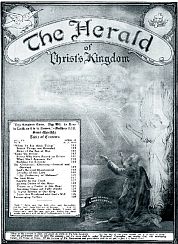
VOL. XIII. January 1, 1930 No. 1 LOOKING
BACK WE PRAISE THE WAY THE
TWELVE APOSTLES THEIR CALLING, THE
REPULSIONS OF CHRISTIANITY HALF
HOUR MEDITATIONS ON ROMANS CONCERNING
AN ANNUAL CONVENTION VOL. XIII. Januany 15, 1930 No. 2 SOBER
REFLECTIONS AS WE ENTER THE YEAR 1930 VALUABLE
OPPORTUNITIES STILL OPEN THINK
IT NOT STRANGE CONCERNINGTHE FIERY TRIAL OUR
SPIRITUAL WARFARE -- VICTORIES AND DEFEATS THE
TWELVE APOSTLES THEIR CALLING AND AUTHORITY VOL. XIII. January 1, 1930 No. 1 LOOKING BACK WE "He led them forth by the right
way, that they might go WE esteem that thankfulness is
an abiding grace in all true Christians. Indeed; children of God, have a never failing
cause for deepest gratitude. Such cause is revealed particularly in their call to share in
the heavenly inheritance. Nevertheless, the close of the old year and the beginning of the
new being an occasion of general retrospect, the Lord's people recognize their thankful
hearts stirred to fresh gratitude and the impulse within leads them to exclaim, "What
shall I render unto the Lord ?" Reflecting again at this time, we call to mind how
,great was the favor of the Lord which revealed the hope of life everlasting for the human
race at large -- of full restitution to the Divine favor and likeness as was at first
possessed by our father Adam; and great was the joy further, when first by faith we began
to appropriate the Word of the Lord and the promises thereof in such a way that it meant
to us an entering into the life of justification, and that in God's appointed time the
everlasting treasure with all its attendant glory and blessing would be ours. But beyond
even this are the exceeding great and precious promises to those who press on in the life
of fellowship and consecration and who have been called according to God's purpose to
become the Bride and Joint-heir of His blessed Son. How Shall We Pay Our Vows? Truly, those who have followed
on to know the Lord and who are being led forth by the right way, have spiritually feasted
on the bounties of Divine favor; while in things temporal, under whatsoever circumstances
we have been placed, having the assurance that all things work together for good to them
that love God, we have realized that godliness with contentment is great gain, having
promise of the life that now is (so long as God wills to have us remain here) and also of
that which is to come. Wherefore we can and do at this time most heartily, "offer
unto God thanksgiving." And shall we not render unto Him, not only the praise of our
lips, but also the incense of truly consecrated lives throughout the year that is just
before us? Shall we not, dearly beloved, hear our gracious Master appealing to us in
sympathetic admonition, Consecrate yourselves anew to the Lord today ! And not in the
sense either of invalidating the consecration once made, possibly many years ago, of all
we had, but rather in the sense of reaffirming and emphasizing that sacred covenant. Let
us again tell our dear Master that we consider ourselves entirely His and that it is still
our purpose to keep our all upon the altar of sacrifice during the new year and until that
sacrifice is wholly consumed in His service. Then let us proceed with studious care from
day to day to pay these our vows of full consecration unto the Most High. Does some one ask, How shall
we pay our vows unto the Lord? This, of course, is an important question with all the
truly consecrated. Shall we not consider that when we surrendered ourselves fully to the
Lord, we thereby signified that we would not hold anything back for self -- that
consecration included all our possessions, our time, our physical energies, and our mental
attainments? And it implied the sacrifice of all our former earthly ambitions, hopes and
aims, so that we should no longer pursue them to any extent. This, and nothing less, is
what our vow of full consecration signifies. It embraces further that these possessions or
personal qualifications which the Lord designates talents, are not only to be released
from the service of worldly ambitions, etc., but they are to be so released, not for
aimless inactivity, but for the purpose of being utilized in opposite directions -- in the
service of God, of His Plan, of His children. The Lesson of the Reckoning Time It is well for us here to call
to mind the parable of the talents. (Matt. 25:14-30.) Here the Lord illustrated very
clearly how we are to pay our vows of consecration to the Most High. In the parable the
Master had important and valuable interests to leave in charge of his servants; and as
these servants had all engaged to serve him he had a right to expect of them a sincere and
faithful interest in the work. Yet he did not expect more of them than they were severally
able to accomplish. He rightly expected larger returns from the one who had five talents
than from those who had one or two talents, and in the reckoning it will be observed that
the servant who had doubled his two talents was just as highly commended as the one who
had doubled his five. The reply to each was the same -- "Well done, good and faithful
servant, thou hast been faithful over a few things, I will make thee ruler over many
things; enter thou into the joy of thy Lord." And had the servant with the one talent
been similarly faithful, he would have received the very same commendation. We observe
also that the parable does not represent the obligations of the world in the use of their
talents, but merely of "His own servants" -- the consecrated believers only.
Further, no servant was left without some talent of usefulness and responsibility. Each
one had at least one talent; and for the right use of that one talent he was just as
accountable to his Master as were those who had more. But the professed servant with
one talent was unfaithful to his Master and yet he evidently wanted to be considered a
servant still and probably thought he was worthy of commendation and reward for not
perverting the Lord's money to other uses. He had taken good care of the talent. He had
not turned it in opposition to the Lord, but he had simply buried it -- failed to use it.
At the reckoning time, he who had received the one talent said, "Lord, I knew Thee,
that Thou art an exacting man, reaping where Thou hast not sown and gathering where Thou
hast not scattered. And I was afraid and went and hid my talent in the earth: Lo, there
Thou hast Thine own." In reply the Master pronounced
His emphatic disapproval of the neglect and thoughtlessness of this servant. It will be
observed that this servant was not what men would generally call wicked. He was simply an
idler, willing if he could, to draw a servant's approval and commendation, but lacking any
real activity in his Master's business. He had no ill-will toward his Master; he was
probably very glad that the other servants kept the business from going into utter ruin;
he did nothing to hinder them from using their talents, but he did not feel the
responsibility he had assumed in becoming a "servant," nor did he take a proper
interest in his Master's affairs. Yet as a faithless, slothful servant, he was in fact a
covenant-breaker, and therefore "wicked," and certainly unfit to be trusted with
still greater responsibilities on the Master's return. Be of God Cheer But we are bearing in mind
that this was not a real case; it was simply a parable used to illustrate real cases. And
if the illustration fits our individual case, let it not lose its effect upon us. The very
object of the parable is to arouse some to a sense of their shortcomings and to recover
them from the lethargy into which they have relaxed, by reminding them of their
responsibility. Activity in the Lord's service to the full extent of our ability or
talents is what the Lord has a right to expect of all who profess to be His servants; and
it is what He does expect. Therefore, if we have but one talent, let us not bury it, but
cultivate and use it -- do what we can, and all we can, in the Master's service to which
we have already consecrated our lives. Beloved in Christ, how truly
solemn are the obligations that we have assumed in entering into fellowship with our
Master by consecration and sacrifice! Yet the Word assures us that we can discharge these
obligations cheerfully, joyfully, considering the blessed goal to which faithfulness to
God leads. Let us hear the words of Jesus ringing clearly in our ears, "Be of good
cheer, I have overcome the world." Long ago the Father's word of counsel was that the
path to glory was not an easy way -- "through much tribulation," and by
"patient continuance in well doing seek for glory, honor, and immortality."
Recalling the glorious and exalted character of. the station to which we have been
invited, is .it any wonder that our Father instructs that those things cannot possibly be
ours unless our consecration to Him and submission to the influences of His providences
and promises shall change, transform, and renew our minds; so that the things once loved
we will hate, and the things once hated we will love. As a father spareth not the rod of
chastisement from the son whom he loves, so the Lord will not spare the rod of affliction
and chastisement from those who are truly His; because He loves them and because He
desires to develop in them such a character as will be pleasing to Him, and as will permit
Him eventually to make them His sons on the plane of glory-heirs of God, joint-heirs with
Jesus Christ their Lord. "Be Sober, Be Vigilant" The heavenly counsel
respecting the necessity of chastisement and our correction in righteousness, that we may
become conformed to the image of God's dear Son, is accompanied with assurances of tender,
sympathetic love from the Father -- assurances that "Like as a father pitieth his
children, so the Lord pitieth them that reverence Him." He says to us also, through
another Apostle, "Faint not when thou art rebuked of Him: for whom the Lord loveth He
chasteneth, and scourgeth every son whom He receiveth." He explains that such
discipline is not prompted by anger toward us, but by His love, and if we are rightly
exercised by the discipline, trials, experiences, of life, they will "work out for us
a far more exceeding and eternal weight of glory"; they will work out in us such
characters as the Lord will be able to use in the service to which He has called us -- the
service of the Millennial Kingdom-the service of the Royal Priesthood, to be associated
with Christ in the work of judging and blessing the world of humanity. The proper response
of all who have the true spirit of sonship is expressed in the language of our Lord and
Master, "Not My will, but Thine be done, O Lord; I delight to do Thy will O My God;
yea Thy law is within My heart." Such as thus respond to the chastisements of the
Lord, get more and more into Divine favor, and hear other words of comfort, of grace, of
help. An admonition given to the
primitive Church, "Be sober, be vigilant," etc., is fully applicable now. The
language signifies that we should be free from the intoxication of the spirit of the world
and that we should be in full possession of the right mind and of all our spiritual
faculties; to be watchful, on guard and see to it that no encroachment of the Adversary is
making headway and robbing us of our spiritual heritage in Christ. The faithful watchers
of today realize that the Apostolic admonition to be sober and watchful is most timely
under the present circumstances. The tests upon God's people in these recent years have
been crucial and severe; but the Lord according to His promise has been giving strength to
His people. In connection with these strong delusions of the recent past, the Lord has
been giving discernment and understanding of His will to those who have earnestly sought
Him. Tried by Fire The past year has been one, we
are glad to observe, in which a considerable number of the brethren have been given to
realize afresh their privileges of liberty in Christ, and by the grace of God have had
courage sufficient, to step out of bondage into the freedom in Christ in which alone they
can thrive spiritually and grow up into Christ in all things who is the Head. If to all of
us, in some respects, this year just passed has been full of trials, let us keep clearly
in mind that the great Refiner and Purifier has had us in his furnace to separate the
dross from the gold and to cause us to reflect His image, (Mal. 3:3.) Happy are they who
have been tried by the fire and not been found wanting, but have had their hearts more
firmly established in the Truth, and have let go the traditions of men and taken hold more
firmly than ever of God's gracious favor in Christ Jesus our Lord Looking forward we can but
expect the same work to continue until every part of our faith-building is tried, and the
wood, hay, and stubble all consumed; for "The day that cometh [is now present] shall
try every man's work of what sort it is." (Mal. 4:1; 1 Cor. 3:13-15.) If in the past
our building has stood the test and not been destroyed, let us rejoice; but still with
trembling, remembering that the trial is not all over yet. "Be not high-minded, but
feat." "Let him that standeth, take heed lest he fall." If there is in our
building anywhere that which will not stand the test of fire, it must go -- replace it
quickly by that which will abide. If there is anything lacking
in our consecration -- if in anything we have a will not surrendered to and harmonized
with God's will -- we should surely take heed to it, for the Lord will discover it. If, as
one of His jewels, we are being polished to radiate His light, we should take heed that in
us there shall be no self-will, which as a grit might cause a flaw and mar our beauty and
acceptableness with Him when making up His jewels. It is not probable that
trials, besetments and difficulties in the Narrow Way will be any less in the year before
us than in the one ended. The furnace may get hotter still than in the past. Yet, let us
remember that the greater our reverses, the greater the supply of "grace to help in
every time of need," for which it is our privilege to call at "the throne of
heavenly grace." Call to mind the words, "My grace is sufficient for thee,"
and "count it all joy when ye fall into temptation," knowing that if exercised
thereby it will work out for us an exceeding and eternal weight of glory. Need of Fervent Love amongst the Brethren In connection with meeting the
various tests and trials before us, we will be assisted and realize our strength renewed
by participating in the Master's service and exercising that solicitude on behalf of other
brethren -- bearing with them, sympathizing with them, and in every way lending the
helping hand, either temporally or spiritually or both in this time of urgent need. Every
exertion in the Lord's service and done as unto Him is sure to bring a compensating reward
and blessing upon the heart of the laborer. Whether the days or years of our earthly
pilgrimage be many or few, let us seize fresh opportunities for sacrificing -- service.
Nor should we feel discouraged or discomfited at opposing influences and if few will
believe our report -- our Message. It is the few only who have "an ear to hear,"
that we should expect to assist. We will need to keep in mind that we are most surely in
the last days, when the Church of Christ is about to reach the end of her warfare; and a
time therefore when the various members of the Christ, sorely tried and tempted, need the
tender sympathy and care of one another's deep and fervent love. If at any time we are inclined
to feel discouraged, us call to mind the Master's experience, for if He, that most
distinguished Visitor from the heavenly court, came and went amongst His fellows without
being really known or appreciated, how can any of His followers expect better treatment!
If the majority heard His words and heeded them, then we might expect many to hear ours.
But if as a mass they rejected His words, they will reject ours also. It is sufficient
that the disciple be as his Lard. (Matt. 10:25; John 13:16.) Then with grateful
thanksgiving for the past and present, and earnest prayer and confidence for the future,
let us go forth with the whole armor of God girded on yet more securely, with the girdle
of truth and trust; and grasping yet more firmly our shield of faith in His protecting
care, and with the sword of the Spirit, His own Word, in hand, let us fight a good fight
until we finish the work given us, that we may be of those accounted worthy to enter
into the joys of their Lord. THE
TWELVE APOSTLES Part 2. IN our previous article of
this series we considered the commission of the Apostles. But let us inquire further as to
the office of the Apostles in the Church: Is it merely their historic testimony of the
Lord and His teachings upon which we are to depend? or was their witnessing to include
more than this? Evidently they were to bear
witness to all they knew, and to all they learned under the special guidance of the Holy
Spirit. Only thus would they be faithful stewards of that which was intrusted to them.
"Let a man so account of us as . . . stewards of the mysteries of God," said
Paul. (1 Cor. 4:1.) And the same intent was expressed by the Lord when He said, "I
will make you fishers of men," and again, "Feed My sheep" and
"lambs." Again, Paul says that "the mystery [the deep truths of the Gospel
concerning the high calling of the Church -- the Christ] hidden in other ages, is now revealed unto His
holy [justified and consecrated, and so reckoned holy] Apostles and Prophets, by the
Spirit," and that the object of its being revealed to them was "to make all men see what is the fellowship of
the mystery [upon what terms they may have the privilege of fellowship in this mystery
-- of joint-heirship with Christ], which from the beginning of the world hath been hid in
God." (Eph. 3 :3-11.) And, again, after speaking of how the Church was to be built
upon the foundation of the Apostles and Prophets, Jesus Christ Himself being the chief
corner stone (Eph. 2:20-22), he says, "For this
cause [viz., the building up of the Church, the temple of God] I, Paul, [am] the
prisoner of Jesus Christ for you Gentiles. "-- Eph. 3:1. Apostles were not Lords Thus we see that the Apostles
were not only to bear historic testimony of Christ, but they were also specially prepared
and empowered, through the influences of the Holy Spirit, both to discern and teach the deep things of God, which they did as wise and
faithful stewards of the blessings intrusted to them for the good and edification and
building up of the whole Church. "Freely ye have received, freely give," said
the Master; and they were careful to obey the injunction, and through them the same
blessings have come down to us -- even "to the uttermost part of the earth." But still we would reverently
press our reasonable investigation a step further and inquire, Are these Apostles to be
regarded as in any sense lords in the Church?
or, in other words, when the Lord and Head of the Church departed, did any of them take
the place of the Head? -- or did they together constitute a composite head, to take his
place and assume the reins of government? Or were they, or any of them, what the popes of
Rome claim to be as their successors-the vicars or substitutes of Christ to the Church,
which is His Body? Against such a hypothesis we
have the plain statement of Paul -- Eph. 4:4,5 -- "There is one Body" and "one Lord"; and therefore among the
various members of that Body, no matter what may be the relative importance of some, only
the one Lord and Head is to be recognized.
This the Lord also clearly taught when, addressing the multitudes and His disciples, He
said, "The Scribes and Pharisees . . . love . . . to be called Rabbi; but be not ye
called Rabbi; for one is your Master, and all ye are brethren." ( Matt. 23:1,2,6-8.)
And again, addressing the Apostles, Jesus said, "Ye know that those presuming to rule
over the Gentiles exercise lordship over them; and their great ones exercise authority
over them, but it shall not be so among you; but
whosoever will be great among you shall be your servant, and whosoever of you will be the
chief est shall be servant of all; for even the Son of Man came not to be ministered unto,
but to minister, and to give His life a ransom for many." -- Mark 10:42-45. Nor have we any evidence that
the early Church ever regarded the Apostles as lords in the Church; or that the Apostles
ever assumed such authority or dignity. Their course was very far indeed from the papal
idea of lordship. For instance, Peter never styled himself "the prince of the
Apostles," as papists style him; nor did they ever title each other, or receive such
homage from the Church. They addressed or referred to one another simply as Peter, John,
Paul, etc., or else as Brother Peter, John or Paul; and all the Church were similarly
greeted-as brothers and sisters in Christ. (See Acts 9 :17; 21:20 ; Rom. 16:23 ; 1 Cor.
7:15 ; 8:11; 2 Cor. 8:18 ; 2 Thess. 3 :6, 15 ; Philemon 7, 16. ) And it is written that
even the Lord Himself was not ashamed to call them all brethren (Heb. 2:11), so far is He
from any domineering attitude in the exercise of His lordship or authority. Ensamples to the Flock True, there were
"bishops" (those who, like the Apostles, had a general supervision and oversight
of the work at home and abroad); and "elders" (those older and more advanced in
the knowledge of the Truth, etc., who took the general oversight and supervision of local
congregations -- Acts 14:23) ; and "deacons" (those specially charged with the
temporal business matters of the various congregations -- Acts 6:1-3); and
"evangelists" (or traveling preachers of the Word); but they never used these
terms as honorary titles. The conditions of fitness for these services in the Church are
clearly set forth in 1 Tim. 3:1-13 ; 2 Tim. 4 :1-5. Nor did any of these leading
servants in the early Church go about in priestly robes, or with cross and rosary, etc.,
courting the reverence and homage of the people; for, as the Lord taught them, the
chiefest among them were those who served most. Thus, for instance, when persecution
scattered the Church and drove them out of Jerusalem, the eleven bravely stood their
ground, willing to do whatever might come, because in this trying time the Church abroad.
would look to them at Jerusalem for encouragement and help; and had they fled, the whole
Church would have felt dismayed and panic- stricken. And we find James perishing by the
sword of Herod, Peter with a similar fate in view, thrust into prison and chained to two
soldiers (Acts 12:1-6), and Paul and Silas beaten with many stripes, and then cast into
prison and their feet made fast in the stocks, and Paul enduring "a great fight of
afflictions." (Acts 16:23, 24; 2 Cor. 11:23-33.) Did they look or act like lords? We
think not. Stewards of the Mysteries of God Peter was very explicit in
this matter, when counseling the elders to "feed the flock of God" (He did not say, Your flock,
your people, your church, as many ministers today speak, but the flock of God), not as lords of, the heritage, but being patterns
to the flock-patterns of humility, faithfulness, zeal, and godliness. (1 Pet. 5 :1-3.) And
Paul says, "I think that God, hath set forth us the Apostles last, as it were
appointed to death; for we are made a spectacle unto the world and to angels and to men.
We are fools for Christ's sake, . . . we are despised; . . . we both hunger and thirst and
are naked and are buffeted and have no certain dwelling place, and labor working with our
own hands. Being reviled, we bless; being persecuted, we suffer it; being defamed, we
entreat: we are made as the filth of the world and the offscouring of all things." (1
Cor. 4:9-13.) Not much like lords in all this, were they? And in opposing the idea of some
of the brethren who seemed to be aspiring to lordship over God's heritage, Paul ironically
says, "Now ye are full, now ye are rich, ye have reigned as kings without us"; but further along he counsels the
only right way, which is that of humility, saying, "Be ye followers of me" in
this respect,-, and again, "Let a man so account of us as of the ministers [servants] of Christ, and stewards of the
mysteries of God." -- 1 Cor. 4:8-11. Nor did the Apostles ever
claim a monopoly of the teaching or of the pastoral work of the Church; nor did the Lord
ever intimate that they should do so. Paul says, "He [Christ] gave some apostles, and
some prophets, and some evangelists, and some pastors and teachers, for the perfecting of
the saints, for the work of the ministry, for the edifying of the Body of Christ, till we
all come in the unity of the faith and of the knowledge of the Son of God unto a perfect
man-unto the measure of the full stature of the Anointed One-that we henceforth be no more
children, tossed to and fro and carried about by every wind of doctrine, . . . but,
speaking the truth in love, may grow up into Him in all things, which is the Head even
Christ." -- Eph. 4:11-15. God hath Set Them God has raised up these
various helps, and has abundantly blessed their labors, both in the early Church and all
along throughout the Gospel Age. But the prominent and
leading position of the Apostles, as those specially empowered
to minister to us in spiritual things, is clearly indicated. The Lord's personal
supervision and appointment of the various orders or grades of teachers and helps is
clearly indicated by the Apostle Paul's words -- "God hath set [placed] some in the Church -- first, apostles; secondarily, prophets; thirdly,
teachers; after that miracles, then gifts of healings, helps, directors and diversities of
tongues." Then he inquires, "Are all apostles? are all prophets? are all
teachers? are all workers of miracles?" etc. (1 Cor. 12:28, 29.) No; certainly not;
and if we would be led of the Lord we must recognize this order of His appointment-those
whom "God hath set" in the Church for
its instruction and edification. And of these we must always remember that the Apostles
are first, though every member of the Body may
declare the unsearchable riches of Christ. See Heb. 5-12. In recognizing this priority
of the Apostles we are not underrating or casting any discredit upon the ministry of the
other helps and helpers which the Lord provided for the edification of the Church. Thus,
for instance, the testamonies of the "evangelists" Mark and Luke and Stephen are
as trustworthy as those of the Apostles; for they all had "the same mind and spoke
the same things." And to such faithful witnesses whom the Lord has raised up from
time to time all through the Gospel Age, we find the Apostles committing their charge ere
they were called to rest. -- 2 Tim. 4:1-6. Warned against the Ambitious Thus, when the noble Apostle
to the Gentiles was about to finish his course, we find him committing the interests of
the work to the "elders" of the Church (the faithful advanced and active ones);
and his charge applied not only to such persons then living, but down even to our day.
After declaring his own faithfulness as a servant of the Lord and the Church, and his
solicitude for the great work, he said to them, "Take heed, therefore, unto
yourselves and to all the flock over which the Holy Spirit hath made you overseers, to
feed the Church of God, which He [Christ] hath purchased with His own blood; for I know
that after my departure shall grievous wolves enter in among you, not sparing the flock.
Also of your own selves shall [ambitious] men arise, speaking perverse things, to draw
away disciples after them . . . . And now brethren, I commend you to God, and to the word
of His grace, which is able to build you up and to give you an inheritance among all them
which are sanctified . . . . I have showed you all things how that so laboring ye ought to
support the weak, and to remember the words of the Lord Jesus, how He said, 'It is more
blessed to give than to receive.'" -- Acts 20:17, 28-35. And Peter likewise exhorts the
"elders," saying, "Feed the flock of God which is among you, taking the
oversight thereof, not by constraint, but willingly; not for filthy lucre, but of a ready
mind. Neither as being lords of God's heritage, but being ensamples to the flock." --
1 Pet. 5:1-3. But in judging of such
teachers whom we have reason to believe the Holy Spirit has appointed in the Church, it is
our duty always to see that their teachings are the same as those of the Lord and the
Apostles-of the Head of the Church and of those whom he has so clearly indicated as
specially empowered to instruct us in the deep things of the Divine Plan, which were not
due to be declared in the days of His personal presence, but which He made known
subsequently to His holy Apostles and Prophets. (John 16:12; Eph. 3: 5.) The Truth, thus
divinely inspired and first announced b3, the Lord's chosen agents, the Apostles, even
they themselves, had they fallen away, could not nullify. (But that none of them did fall
away is manifest .from Rev. 21:14.) This Paul distinctly states in Gal. 1:8-12. The early Church rightly
reverenced the piety and the superior spiritual knowledge and wisdom of the Apostles, and,
regarding them, as they really were, as the Lord's specially chosen ambassadors to them,
they sat at their feet as learners; yet not with blank, unquestioning minds, but with a
disposition to try the spirits and to prove the testimony. (1 John 4:1; 1 Thess. 5:21;
Isa. 8:20.) And the Apostles, in teaching them, enjoined this attitude of mind, which
required a reason for their hope, and they encouraged it, and were prepared to meet it-not
with enticing words of man's wisdom (of human philosophy and theory), but in demonstration of the Spirit and of power, that the faith of the Church might not stand
in the wisdom of men, but in the power of God. (1 Cor. 2:4,5.) They did not cultivate a
blind and superstitious reverence for themselves. Under Direction of Holy Spirit We read that the Bereans
"were more noble than they of Thessalonica in that they received the word with all
readiness of mind and searched the Scriptures daily [to see] whether those things were
so." And it was the constant effort of the Apostles to show that the Gospel which
they proclaimed was the very same gospel darkly expressed by the ancient Prophets,
"unto whom it was declared that not unto themselves, but unto us [the Body of Christ] they did minister the
things now reported unto you by them [the Apostles] that have preached the Gospel unto you
with the Holy Spirit sent down from heaven" (1 Pet. 1:10-12); that it was the very
same gospel of life and immortality brought to light by the Lord Himself; and that its
greater amplification and all the particular details discovered to the Church by them,
under the leading and direction of the Holy Spirit-whether by special revelations or by
other and more natural means, both of which were used -- were in fulfillment of the Lord's
promise to the Apostles, and through them to the whole Church -- "I have yet many things to say unto you, but ye cannot bear
them now: howbeit, when He, the Spirit of Truth, is come, He will guide you [the Apostles
first, and through them the whole Church] into all truth; for He shall not speak of
Himself [independently of Me], but whatsoever He shall hear, that shall He speak [i.e., He
will be My messenger to you] . . . He shall
glorify Me, for He shall receive of Mine and
shall show it unto you. All things that the Father hath are Mine [there is no conflict
between us; His plan is My plan, and His way is My way] : therefore said I that He shall
take of Mine, and shall show it unto
you." -- John 16:12-15. It was right, therefore, for
the Bereans to search the Scriptures to see whether the testimony of the Apostles agreed
with that of the Law and the Prophets, and to compare them also with the teachings of the
Lord. Our Lord also invited a similar proving of His testimony by the Law and the
Prophets, saying, "Search the Scriptures .... for they are they that testify of
Me." The whole Divine testimony must be in harmony, whether it be communicated by the
Law, the Prophets, the Lord, or the Apostles. Their entire harmony is the proof of their
Divine inspiration. And, thank God, we find that harmony existing, so that the whole
Scriptures of the Old and New Testaments constitute what the Lord Himself terms "the
harp of God." (Rev. 15:2.) And the various testimonies of the Law and the Prophets
are the several chords Of that harp, which, when tuned by the Holy Spirit dwelling in our
hearts, and swept by the fingers of the devoted searchers after Divine Truth, yield the
most enchanting strains that ever fell on mortal ears. Praise the Lord for the exquisite
melody of the blessed "song of Moses and the Lamb," which even we have learned
through the testimony of His holy Prophets, of whom the Lord Jesus is chief. Upon this Rock But although the testimony of
the Lord and the Apostles must harmonize with that of the Law and the Prophets, we should
expect them to testify of things new, as well as old;
for so the Prophets have led us to expect. (Matt. 13:35; Psa. 78:2; Deut. 18:15, 18; Dan.
12 :9.) And so we find them not only expounding the hidden truths of ancient prophecy, but
also disclosing new revelations of truth. It may be well here to notice
a further claim of that great anti-Christian organization, the Church of Rome, viz., that
Peter is the rock upon which the Gospel Church is built, and that to him and his
successors, the popes, were confided the keys of the Kingdom of heaven with power to open
and to shut, to admit or exclude, whomsoever they will, and to bind. or loose whomsoever
and whatsoever they please. The Scripture upon which this
doctrine is founded is Matthew 16:15-19. In, reply to the Lord's question, "Whom say
ye that I am?" Peter answered, "Thou art the Christ, the Son of the Living
God." And the Lord replied, "And thou art Peter [petros -- a stone] ; and upon this rock [petra -- a rock, a large stone] I will build My
Church." Thus, in harmony with numerous Old Testament references, such as Isaiah
8:14, the Lord is seen to be the great Rock upon which the Church is built, while Peter is
one of the living stones in the glorious temple of God built upon that Rock, which he had
just confessed as the Rock of our Salvation -- the Christ. And Peter himself freely admits
the, relationship of all the living stones, himself included, to the great Foundation
Stone-the Rock Christ Jesus-saying (1 Pet. 2:4, 5), "To whom coming as unto a living
stone, disallowed indeed of men, but chosen of God, and precious, ye also as lively [living] stones are built up a spiritual house," etc. The ability to bind and loose
on earth and in heaven, was granted not only to Peter but to all the Apostles; and we
believe signified that God would so guide the words of the Apostles in their presentation
of the Truth to the Church, that all the faithful might have full confidence in their
teachings. Whatever they bound upon the Church as duties, we may know are so recognized in
heaven; and whatever they loosed as respecting the Mosaic Law, etc., we may know that they
were supernaturally directed to do so, and that the same are loosed or set aside in
heaven. THE REPULSIONS OF CHRISTIANITY WE dwell much upon the
attractions of Christianity, but rarely stop to think that it may also have repulsions
which are vitally necessary to its purity and permanence. If the Church of Christ draws to
herself that which she cannot assimilate to herself, her life is at once imperiled; for
the body of believers must be at one with itself, though it be at war .with the world. Its
purity and its power depend first of all upon its unity. So that if perchance the Church
shall attract men without at the same time transforming them; if she shall attach them to
her membership without assimilating them to her life, she has only weakened herself by her
increase, and diminished herself by her additions. It is a hard and ungracious saying
then, to declare that the Church of God in the world must be able to repel as well as to
attract. Nature is an austere teacher
on this point, she has given to the rose its exquisite fragrance, but she has also armed
it with thorns, so that while the delicious odors attract, these little sentinels stand
guard with their drawn bayonets to defend the flower, which is endangered by its very
beauty and sweetness. And the Church of Christ has too much of loveliness and excellence
to be trusted on earth without defenses. Hypocrites will hide under her beautiful
garments; covetous men will make gain of her godliness; pleasure-seekers will turn the
grace of God, which she offers, into lasciviousness, and the avaricious will make
merchandise out of her pearl of great price, unless her outward attractiveness is guarded
by some counter defenses. "The Bride of Christ," has the Church with wonderful
honor been named. And think you that the Heavenly Bridegroom would leave her in this world
without endowing her with that stern chastity of holiness, and that native aversion to
impurity which should be her defense against such as would betray her? "The King's
daughter is all glorious within; her clothing is of wrought goad. So shall she be brought
unto the King in raiment of needlework." But "as
the lily among thorns so is My beloved among the daughters." The beauty of
Christ's Church is guarded by the asperity of her discipline. Her graces are hedged about
with self-denial; her gifts are compassed with crosses, and her triumphs are crowned with
thorns. This is her only safety from such as might otherwise be won to her only to waste
and dishonor her. Sanctity of Life and Character which Christ requires in His
Church is her most powerful defense. It is her native chastity that constitutes her truest
safeguard. Nothing is so severe as purity; nothing so effectually repels the familiarities
of the wicked. We think to fence the fold of God .with guards and restrictions so that the
unsanctified and the unclean may not come in. This is a confession of weakness and
frailty. The holy virgin of the Lord has been endowed with a native purity which is her
true shield and defense. What means the Scripture when it commands us to stand, "having the breastplate o f righteousness"?
Is it not an intimation of that which all experience verifies, that righteousness is
the strongest repellant of wickedness and corruption which the soul can wear? You say that
purity shrinks from contact with impurity; but remember that this aversion is mutual.
Uncleanness recoils from purity; it sinks abashed from its presence as the wild beast
cowers and quails before the imperial eye of a fearless man. I am not theorizing on this
point. Ungodly men have confessed to a discomfort amounting almost to torture which the
enforced association with the good and holy has produced. It is said that if we live in
the same luxury, and dress with the same extravagance, and drift in the same tides of
fashion; if we seek wealth with the same greed, and pursue pleasure with the same
fondness, and love society with the same; devotion; and if with all this we are popular
preachers and eminent Christians, and zealous churchmen, we shall win multitudes to our
faith. We shall have made men think well of themselves, by these cordial affiliations
which is the surest step to making them think well o f us and of our church. And so we
have won them. But alas! what have we done?
We have gained them by being ourselves "conformed to this world," instead of by
their being "transformed by the renewing of their minds." We have brought them
into the church by lowering its fellowship to them, instead of by raising them to its
fellowship. The Church that is holy is armed with a perpetual degree of excision against
the hypocritical and profane and unclean. It says to the worldly and ungodly and impure:
"Stand by thyself; come not near to me, for I am holier than thou" -- words
which are most improper for any man to speak with his lips; but most honorable for the
Church to express by her silent, unconscious example. Do I speak coldly and harshly of the relations of Christians
to the world -- as though it were their principal care to keep: aloof, from it, or if
touching it by enforced association, to gather up their garments, lest they be defiled by
its contact? God forbid that I should so think. "This man receiveth sinners and
eateth with them," is the blessed tribute which was paid to Jesus Christ, by His
enemies. If we at all bear His character and do His work we shall be like Him in this
respect. Christ Crucified Or take another exhortation of
Scripture. "Let us put on the armor of
light." Here light is made the Christian's shield -- light whose beams search
into every nook and corner of earth's impurity and yet contract no defilement; absorbing
from everything the clear crystal water but rejecting every particle of
uncleanness-attracting always, but always rebuking. These, O Church, are thy weapons of
defense and conquest. Then again, we find in the
doctrines and invitations of the Gospel just that mingling oaf tenderness and sternness
which is calculated to draw men from their sins
instead of drawing them in their sins. "Come unto Me, all ye that labor
and are heavy laden, and I will give you rest," and, "If any man will come after
Me, let him deny himself and take up his cross and follow Me." What worldling is
likely to run hastily after Christ in obedience to such a summons? What disciple is likely
to be captured with such an invitation before his heart is really won? There is the check
of rigid exaction in Christ's calls, as well as the allurements of gracious love; so that
while men are drawn, they may not be hurried into an impulsive, premature profession. Have you thought to analyze
the attraction of Christ's cross, to see how strongly this principle holds there ?
"And I, if I be lifted up from the earth, will draw all men unto Me," says
Jesus. But what is it that is thus set forth as the central attraction of Christianity?
The most repulsive object on which the natural man can
look -- Christ crucified -- draw men it will, as long as there is a sinner sighing for
pardon, or a penitent seeking peace; draw men it will, when they have guilt to be
cleansed, and burdens to be lifted, and stains to be washed. But it will draw not one
through his aesthetics tastes, or his sense of the beautiful, or his poetic sentiment.
There is a, cross which can do so: that jeweled and exquisitely carved adornment which
hangs upon the neck of beauty -that cross wrought with diamonds and robbed of its
"offense," "Which Jews might Kiss and Infidels Adore" that can attract men without
converting them. And who knows what evil it has done to men's souls on this account --
this cross in which beauty culminates and ignominy utterly disappears. How it has filled
eyes with its charms which have thereby been cut off from beholding "the Lamb of God
that taketh away the sin of the world"; how
it has helped to substitute sentiment for faith, and poetic feeling for godly sorrow, and
the crucifix for the Crucified. You see what the true cross of Christ did when Peter held
it up on the day of Pentecost. It wrought intense conviction as it showed men what their
sin had done. Its nails seemed to be plucked out and driven into the breasts of the
multitude, till being "pricked in their hearts," they cried out: "Men and
brethren, what shall we do ?" And then it brought peace as quickly as it had brought
contrition, when it was made known that this Crucified One had "borne their sins in
His own body on the tree." This is the attraction of that cross which is ordained to
be the power of God unto salvation to every one that believeth. It is an attraction which
pierces while it draws, and wounds while it wins, and thus proves a worthy instrument of
God's electing love. And we have seen in the history of the Church what the spurious cross
could do; as for example, when the monks went forth among our ancestors in Britain to win
them to Christianity. The crucifix was lifted high; it was supplemented by all the pomps
and splendors of an imposing ritual; chants were poured forth, censers were waved, bodies
were prostrated, and thousands in a 'day gave in their allegiance to the new religion. But
it was the senses that were won, not the hearts; and baptized pagans were brought into the
Church only to paganize Christianity. This is an illustration of the evil that always
comes of magnifying the attractions of the cross while diminishing its wholesome
repulsions. And the same law holds in
regard to all the institutions of Christianity. Its baptism is described as a "burial
with Christ," a "baptism into death" ; so that he who submits to it must in
spirit become like his Lord, "obedient unto death, even the death of the cross."
Its sacrament of fellowship is "a communion of the blood of Christ," and "a
communion of the Body of Christ" -- expressions from which the natural man has always revolted. Its worship is
required to be "in spirit and in truth"; its music the "sacrifices of
praise" ; its Gospel the "foolishness of preaching," its example before the
world "in simplicity and godly sincerity." Enough here surely to temper the
inducements of Christianity! But this is evidently according to the Divine Plan-that the
Gospel should act upon men by an elective affinity, winning their faith but offending
their pride; constraining the sincere by their love of Christ, but testing the superficial
with the searching question of Christ, "Are ye able to drink off the cup that I shall
drink òf, and to be baptized with the baptism that I am baptized with ?" My
brethren, we are living in a time when men are bent on making a luxury of religion. They demand that our doctrine
shall be pleasant, our worship refined and artistic, our ordinances beautiful and
alluring. No "bitter herbs" must be upon our tables as we keep our Passover; no
heavy crosses must be laid upon our shoulders as we follow Christ. Shall We "Preach Christ Crucified in a Crucified Style" -putting the nail through
those refinements of reason that so often cover up the blood of expiation, and pressing the thorns into
that intellectual pride which would soften propitiation
to a moral influence? Shall we be content with that plainness in worship and strive
for that holiness of life, which can commend Christ while humbling us, and gain men's
hearts though offending their tastes? Oh, ungracious calling, that we must displease the
world when we might perchance delight it, and turn its impatient gaze upon its sins, when
we might rivet its admiration on ourselves! But so long as good and evil are in the world,
grace and severity must be in our lives and our doctrines. Wonderful is that high
commendation of the Son of God" -- Thou hast loved righteousness and hated iniquity, therefore God, even thy God,
hath anointed Thee with the oil of gladness above Thy fellows." -- (Extracts from a
sermon by Rev. A. J. Gordon, in Messiah's Herald.) "Looking unto Jesus the author and
finisher of our faith." --Heb. 12:2. THE language of the Apostle
above is chosen as our motto for 1930, in the confidence that as a sacred and constant
reminder of our obligation and of the source of all our help, it will inspire to renewed
courage and will daily strengthen the weary traveler in the Narrow Way. The Psalmist of
old declared, "Whom have I in heaven but Thee, and there is none upon earth that I
desire beside Thee." This is the only appropriate attitude for the surrendered heart
and consecrated will. Those who have caught a true
vision of Jesus recognize in Him indeed the Captain of their salvation; they recognize
that there is no other name given under heaven whereby men may be saved. He has gone on
before, having opened up a new and living way or a new way to life; it is the way of the
cross. His example is before us and His footprints remain and can be clearly seen by those
who have the eye of faith to see the invisible things. Truly, how important it is that
followers of Jesus shall keep their eyes fixed upon Him as the great Captain of their
salvation. By watching Him they become acquainted with all His movements; they become
familiar with His ways; and they are in a position to understand His commands and what His
counsel and instruction is to His followers. When therefore the writer of
Hebrews would incite the believers to afresh courage in the Christian life, he would
remind them of their privileges of looking unto Jesus; he would have them constantly
impressed with the fact that he is the Author of their faith and will be the Completer of
their salvation. There is every reason why disciples of the Master should look unto Him,
should contemplate His example. By so doing they will prevent their thoughts and
affections from being diverted to other sources and objects here below, and with their
eyes fixed upon Him, the One altogether lovely, they will not want to be looking after or
upon the things of time and sense, the things that are seen, but are of a perishable
character and are passing away. Add the poet has well expressed this thought in the words: "Since my eyes were fixed on
Jesus, The Illustrious Alpha and Omega Another has made the following
appropriate comment in this connection: "We are to look to His holy life; to His
patience and perseverance in trial; to what He endured in order to obtain the crown land
to His final success and triumph." On the words, "The Author
and Finisher of our faith," it is remarked that "the meaning is, He is the first and the last
as an example of faith, or of confidence in God-occupying in this, as in all other
things, the pre-eminence, and being the most complete. model that can be placed before us:
The Apostle had not enumerated Him among those who had been distinguished for their faith,
but he now refers to Him as above them all; as a case that deserved a stand by itself . .
. . He is at the head of all those who have furnished an example of confidence in God, for
He was Himself the most illustrious instance of it. The expression then does not mean
properly that He produces faith in us, nor that
we believe because He causes us to believe --
whatever may be the truth about that -- but that He stands at the head as the most eminent
example that can be referred to on the subject of faith. We are exhorted to look to Him,
as if at the Grecian games there was one who
stood before the racer who had previously carried away every palm of victory; who had
always been triumphant, and with whom there was no one who could be compared. The word finisher corresponds in meaning with the word author. It means that He is the completer as well as the beginner; the last as well as the first. As there has been no one hitherto who could
be compared with Him, so there will be no one hereafter. 'I am Alpha and Omega, the
beginning and the ending, the first and the last.' The word does not mean that He was the
finisher of. faith in the sense that He makes our faith
complete or perfects it-whatever may be true about that -- but that He occupies this
elevated position of being beyond comparison above all others. Alike in the commencement
and the close, in the beginning of faith and in its ending, He stands pre-eminent. To this illustrious Model we
should look -- as a racer would on one who had been always so successful that he surpassed
all competitors and rivals." Considering therefore all that
Jesus means to us, as our Savior, our Example, our Captain, and as our Advocate before the
Father, no wonder the Apostle urges the brethren to look away from all earthly
considerations unto Jesus, since all their blessed hopes center in Him, and in Him all
fullness dwells. At such a time as this, when
the elements and forces of infidelity would subvert the faith of the saints, and when the
influences of the world about us would lead away from Christ and the great things that
constitute our spiritual heritage, how important that all who are hoping for the mastery,
and expecting to be crowned as victors, shall, as the Apostle enjoins, "lay aside
every weight, and the sin that doth so easily beset us, . . . looking unto Jesus the
Author and Finisher of our faith." "Lord, arm me with Thy Spirit's
Might, HALF
HOUR MEDITATIONS "Paul, a servant of Jesus Christ,
called to be an apostle" -- Rom.l:1. No. 4 THE more one ponders the life
of the Apostle Paul the more evident it appears that he was indeed a "vessel"
chosen by the Lord, and that his apostolic career was followed under the guidance of the
Holy Spirit. It is true that he lacked the rich memories of the Eleven, as the Holy Spirit
brought back to their minds. those things which Jesus had said to them. (John 14:26.)
"He did not, however, set out empty. He possessed the living and glorified Christ,
who had just revealed Himself in him. He possessed in himself and knew by experience the
gratuitous and universal (world-wide) salvation, without legal condition, without respect
of person, the work of the death of Christ and of His Spirit of life. This gospel that he
had to preach, he had neither received of man, nor learned by the teaching of any man; he
possessed it 'by the revelation of Jesus Christ.' (Gal. 1:12.) That was his part, his own
lot in the great partition 6f grace made among the first agents of the preaching of
salvation (Eph. 3 :2, 7), what he called 'his gospel' . . . in distinction from
evangelical preaching in general, which was common to him with other apostles . . . .
(Rom. 16:25.) Doubtless the illumination by which he was put in possession of that fund on
which as an apostle he drew, was only gradually produced during those (three) days passed
at the Lord's feet. But when he stood up to act, he bad sight, physically and spiritually.
Like the man born blind, he could say: 'I was blind, but now I see.' He was prepared to
begin the work for which he had been set apart, and to which he was going to devote
himself with all the resources 'of Semitic fervor, of Greek agility, and of Roman energy.' "The seven years (from 37
to 44) that followed his conversion were for St. Paul a time of apprenticeship and trial.
Not only did he need them for his confirmation; the Church herself, at that time, was not
yet ready to put her hand to the great work of the conversion of the Gentile world. But it
was from her the signal had to come. Here there was something else than an individual
task. "This period embraces:
1st, three years of preaching by Paul in Damascus and Arabia; 2nd, his first visit to
Jerusalem after his conversion, and a somewhat long sojourn at Tarsus; 3rd, the year's
ministry exercised by him in the recently founded Church of Antioch." -- GODET.* ____________ * This writer
recognized with other scholars the truth of Lightfoot's statement: -- "as regards the
exact dates in St. Paul's life absolute certainty is unattainable." The dates and
periods given therefore are to be understood as approximate only. ____________ Earliest Preaching From the moment of his
conversion and call to the apostleship there was a readiness in his heart to render glad
and immediate obedience to his newly found Lord. (Acts 26:19; Gal. 1:16.) Consequently he
did not seek to mark out a path for himself, but sought the headings of the Lord. He had
not far to go to begin to preach Christ. In his unconverted state he had planned to de
fend the Jews of Damascus against what he had thought
was the God-dishonoring teaching of Jesus. Commencing his apostolic labors with these very
same Jews of Damascus, he now pleads with them the cause of the Christ he has learned to
love. "Thence he soon extended his labors to the surrounding regions of Arabia. Ac
cording to Gal. l: 17,18, he consecrated three whole years to those remote lands. The Acts
sum up this period in the vague phrase 'many days.' (9:23.) For the Apostle it doubtless
formed a time of mental concentration and personal communion with the Lord, which may be
compared with the years which the Apostles passed with their Master during His earthly
ministry. But we are far from seeing in this sojourn a time of external inactivity. The
relation between Paul's words, Gal. 1:16,, and the following verses, does not permit us to
doubt that Paul also consecrated these years to preaching. The whole first chapter of the
Epistle to the Galatians rests on the idea that Paul did not wait to begin preaching the
Gospel till he had conferred on the subject with the Apostles at Jerusalem, and received
their instructions. On the contrary, he had already entered on his missionary career when
for the first time he met with Peter." -- GODET. Returning again from Arabia to
Damascus (Gal. 1:17), he by his bold preaching in the name of Jesus (Acts 9:27) confounded
the Jews, proving that "this is very Christ." (Acts 9:22.) Thereby he incurred
their enmity, and he began to learn something of "how great things he must
suffer" for the name of Christ. (Acts 9:16.) Only by the overruling of the Lord's
providence was his life saved. Years afterwards, in writing to the Church at Corinth, he
tells them of this, one of the earliest of his "light" (?) afflictions. A whole
garrison of soldiers kept the city, purposing to apprehend him. (2 Cor. 11:32, 33; 4:17.)
Luke records that the Jews watched the gates of the city day and night to kill him, but
with the co-operation of some faithful disciples, he was taken by night and let down by
the wall in a basket, and thus made his escape. -- Acts 9:24, 25. To Jerusalem to see Peter "Preserved from
destruction at Damascus, he turned his steps towards Jerusalem. His motive for the
journey, as he tells us in the Epistle to the Galatians, was a desire to become acquainted
with Peter. Not that he was ignorant of the true principles of the Gospel. He expressly
tells us that he neither needed nor received any instruction in Christianity from those
who were 'Apostles before him.' But he must have heard much from the Christians at
Damascus of the Galilean fisherman. Can we wonder that he should desire to see the brother
with whom now he was consciously united in the bonds of a common apostleship . . , and who
had long on earth been the constant companion of his Lord? "How changed was everything since he had last
traveled this road between Damascus and Jerusalem. If; when the day broke, he looked back
upon that city from which he had escaped under the shelter of night, as his eye ranged
over the fresh gardens and the wide desert, how the remembrance of that first terrible
vision would call forth a deep thanksgiving to Him, who had called him to be a 'partaker
of His sufferings.' And what feelings must have attended his approach to Jerusalem. 'He
was returning to it from a spiritual, as Ezra had from a bodily, captivity, and to his
renewed mind all things appeared new. What an emotion smote his heart at the first distant
view of the temple, that house of sacrifice, that edifice of prophecy. Its sacrifices had
been realized, the Lamb of God had been offered: its prophecies had been fulfilled, the
Lord had come unto it. [Its greatest sacrifice
had been realized, the Lamb of God had been offered: its prophecies had been, in part, fulfilled, the Lord had come unto it.] As he
approached the gates, he might have trodden the very spot where he had so exultingly
assisted in the death of Stephen, and he entered them perfectly content, were it God's
will, to be dragged out through them to the same fate. He would feel a peculiar tie of
brotherhood to that martyr, for he could not be now ignorant that the same Jesus who in
such glory had called him, had but a little while before appeared in the same glory to
assure the expiring Stephen. The ecstatic look and words of the dying saint now came fresh
upon his memory with their real meaning. When he entered into the city, what deep thoughts
were suggested by the haunts of his youth, and by the sight of the spots where he had so
eagerly sought that knowledge which he had now so eagerly abandoned. What an intolerable
burden he had cast off.' "What Things Were Loss to Me" "Yet not without grief
and awe could he look upon that city of his forefathers, over which he now knew that the
judgment of God was impending. And not without sad emotions could one of so tender a
nature think of the alienation of those who had once been his warmest associates. The
grief of Gamaliel, the indignation of the Pharisees, the fury of the Hellenistic
Synagogues, all this, he knew, was before him. The sanguine hopes, however, springing from
his own honest convictions, and his fervent zeal to communicate the truth to others,
predominated in his mind. He thought that they would believe as he had believed. He argued
thus with himself -- that they well knew that he had 'imprisoned and beaten in every
synagogue them that believed in Jesus Christ,' -- and that 'when the blood of His martyr
Stephen was shed, he also was standing by and consenting unto his death, and kept the
raiment of them that slew him'-and that when they saw the change which had been produced
in him, and heard the miraculous history he could tell them, they would not refuse to
'receive his testimony.' (This was the argument used in the trance in the temple. -- Acts
22:17-21) . "Thus with fervent zeal,
and sanguine expectations, 'he attempted to join himself to the disciples' of Christ. But,
as the Jews hated him, so the Christians suspected him . . . they could not believe he was
really a disciple. And then it was that Barnabas, already known to us as a generous
contributor of his wealth to the poor (Acts 4:36, 37), came forward again as the 'Son of
Consolation '-'took him by the hand' and brought him to the Apostles . . . . When Barnabas
related how the Lord Jesus Christ had personally appeared to Saul, and had even spoken to
him, and how he had boldly maintained the Christian cause in the synagogues of Damascus,
then the Apostles laid aside their hesitation . . . . And he was with them, 'coming in and
going out,' more than forgiven for Christ's sake, welcomed and beloved as a friend and a
brother. Warned of Imminent Danger "This first meeting of
the fisherman of Bethsaida and the tentmaker of Tarsus, the chosen companion of Jesus on
earth, and the chosen Pharisee who saw Jesus in the heavens, the Apostle of the
circumcision and the Apostle of the Gentiles, is passed over in Scripture in a few words.
The Divine record does not linger in dramatic description on these passages which a mere
human writing would labor to embellish. What took place in the intercourse of these two
saints -- what was said of Jesus of Nazareth who suffered, died, and was buried -- and of
Jesus, the glorified Lord, who had risen and ascended, and become 'head over all things to
the Church' -- what was felt of Christian love and devotion -- what was learnt, under the
Spirit's teaching, of Christian truth, has not been revealed, and cannot be known. The
intercourse was full of present comfort, and full of great consequences. But it did not
last long. Fifteen days passed away, and the Apostles were compelled to part. The same
zeal which had caused his voice to be heard in the Hellenistic synagogues in the
persecution against Stephen, now led Saul in the same synagogues to declare fearlessly his
adherence to Stephen's cause. The same fury which had caused the murder of Stephen, now
brought the murderer of Stephen to the verge of assassination. Once more, as at Damascus,
the Jews made a conspiracy to put Saul to death: and once more he was rescued by the
anxiety of the brethren. "Reluctantly, and not
without a direct intimation from on high, he retired. from the work of preaching the
Gospel in Jerusalem. As he was praying one day in the temple, it came to pass that he fell
into a trance, and in his ecstasy he saw Jesus, who spoke to him, and said, 'Make haste
and get thee quickly out of Jerusalem: for they will not receive thy testimony concerning
Me.' He hesitated to obey the command, his desire to do God's will leading him to struggle
against the hindrances of God's providence -- and the memory of Stephen, which haunted him
even in his trance, furnishing him with an argument. But the command was more peremptory
than before: 'Depart; for I will send thee far hence unto the Gentiles.' The scene of his
apostolic victories was not to be Jerusalem. For the third time it was declared to him
that the field of his labors was among the Gentiles. This secret revelation to his soul
conspired with the outward difficulties of his situation. The care of God gave the highest
sanction to the anxiety of the brethren. And he suffered himself to be withdrawn from the
Holy City." -- CONYBEARE and HOWSON. Paul at Tarsus The brethren brought him down
to Caesarea, and sent him forth to Tarsus, his native city; and there in the midst of his
family, while awaiting new directions from the Lord, he preached the Word in the regions
of Syria and Cilicia, nearby. (Acts 9:30; Gal. 1 :21.) Here in the home of his childhood,
while exiled from the earthly Jerusalem, we may be sure he was "diligently occupied
in building up the walls of the 'Jerusalem which is above.' " It is probable, too,
that during this time he had the revelation of unutterable things to which he makes
reference in 2 Corinthians 12:1. "Now at least, if not
before, we may be sure that he would come into active intercourse with the heathen
philosophers of the place. In his last residence at Tarsus, a few years before, he was a
Jew, and not only a Jew, but a Pharisee, and he looked on the Gentiles around him as
outcasts from the favor of God. Now he was a Christian, and not only a Christian, but
conscious of his mission as the Apostle of the Gentiles. Therefore he would surely meet
the philosophers, and prepare to argue with them on their own ground, as afterwards in the
'market' at Athens with 'the Epicurians and the Stoics.' . . . 'How far Saul's arguments
had any success in this quarter we cannot even guess; . . . At least, he was preparing for
the future. In the synagogue we cannot believe that he was silent or unsuccessful. In his
own family, we may well imagine that some of those Christian 'kinsmen,' whose names are
handed down to us-possibly his sister, the playmate of his childhood, and his sister's
son, who afterwards saved his life-were at this time by his exertions gathered into the
fold of Christ." -- Rom. 16:7, 11, 21; Acts 23:16. -- CONYBEARE and HOWSON. Antioch -- the Missionary Center of the Gentile World While the Apostle was thus
occupied with the Lord's work in Tarsus and vicinity, the Lord was Himself preparing in
Antioch another field of action for his "chosen vessel" to which He was about to
lead him. Ah! ! brethren, we who in any sense labor in the Maser's vineyard, shall we not
take comfort from these words? It is still true that "He goeth before you."
(Mark 16:7.) He leads the way. It is His work not ours. Never let us doubt but that He
will properly supervise all the interests of His own cause. So let us continue to serve
the Lord with gladness. Since it is His gracious will, let us labor on together with Him, rejoicing in the privilege, though it
bring many tears. Can we doubt but that it is He who has led us thus far, and will He not
lead us to the end for His own Name's sake? In the case of the Apostle Paul, the Lord's
leadings came in a personal visit which Barnabas made to Tarsus to bring him to Antioch.
Some Hebrew Christians who were natives of Cyprus and Cyrene, and who had no doubt
rejoiced at the news of the conversion of Cornelius, when they were come to Antioch,
proclaimed the Good Tidings to the Greeks (Gentiles) there, and as the record reads:
"The hand of the Lord was with them, and a great number believed, and turned unto the
Lord." Commenting on this passage our dear Brother Russell pithily remarks: "Believing is one thing, and 'turning' every
sentiment, hope, ambition, curd desire to the Lord is quite another." Brethren,
these are heart-searching words. Have we turned to the Lord in this sense ? "Whatever length of time
had elapsed since Saul came from Jerusalem to Tarsus, and however that time had been
employed by him -- whether he had already founded any of those churches in his native
Cilicia, which we read of soon after (Acts 15:41) -- whether (as is highly probable) he
had there undergone any of those manifold labors and sufferings recorded by himself (2
Cor. 11) but omitted by St. Luke -- whether by active intercourse with the Gentiles, by
study of their literature, by traveling, by discoursing with the philosophers, he had been
making himself acquainted with their opinions and their prejudices, and so preparing his
mind for the work that was before him-or whether he had been waiting in silence for the
call of God's providence, praying for guidance from above, reflecting on the condition of
the Gentiles, and gazing more and more closely on the plan of the world's
redemption-however this may be, it must have been an eventful day when Barnabas, having
come across the sea from Seleucia, or round by the defiles of Mount Amanus, suddenly
appeared in the streets of Tarsus. The last time the two friends met was in Jerusalem. All
that they then hoped, and probably more than they then thought possible, had occurred.
'God had granted to the Gentiles repentance unto life.' (11:18.) Barnabas had 'seen the
grace of God' (11 :23) with his own eyes at Antioch; and under his own teaching 'a great
multitude' (11:24) had been 'added to the Lord.' But he needed assistance. He needed the
presence of one whose wisdom was higher than his own, whose zeal was an example to all,
and whose peculiar mission had been miraculously declared. Saul recognized the voice of
God in the words of Barnabas: and the two friends traveled in all haste to the Syrian
metropolis." -- CONYBEARE and HOWSON. Christians First at Antioch Quoting again from Brother
Russell: "Saul -- or Paul -- was
seemingly ready for the opening of this door of service and entered it with his peculiar
fervor -- yet humbly, remembering his own unworthiness to preach Christ, whom he had
persecuted and slain, representatively, in His disciples. Barnabas and Paul, instead of
saying to the intelligent people of Antioch, 'We must leave you to go and look up some
uncivilized peoples, barbarians, cannibals, etc.,' took a different view of the matter,
and, seeking the most intelligent auditors they could interest, stayed with them a year
after they were converted-teaching them. Alas, that so many now feel that teaching is
unnecessary. How the actions of the Apostle Paul agree with his teachings. -- See Eph.
4:11-13. "'And the disciples were
called Christians first in Antioch.' Whoever may have started this name it matters not: it
is the most fitting title that could be conceived of followers of Christ. What a pity it
is that in modern times it is considered a valuable addition to prefix Methodist,
Presbyterian, Baptist, Lutheran, etc. Surely, to all who rightly view the matter, our
Master's name is a sufficient one for all who are His. Let us not only adopt the apostolic
simplicity in practice and in doctrine, but also in name. We do not belong to Wesley,
Luther, Calvin, or any other man; and we should show that we are Christ's, and His alone,
by refusing the names of others than the heavenly Bridegroom. Thus, too, we stand where we
can have fullest fellowship with all the Lord's true followers. "The fruits Of the Spirit
are here shown by the willingness of the Christians at Antioch to contribute to the
famine-stricken and persecution-spoiled brethren at Jerusalem. It was a noble return in
temporal matters for the spiritual favors they had received from the believers at
Jerusalem, through Barnabas, and Paul, whom he had brought. And this seems always to be
true where the Spirit 04 Christ has operated and dwells richly: each is anxious to serve
the other, first with the spiritual and priceless favors, and second with temporal favors
as opportunity offers. -- See 1 Cor. 9:11." CONCERNING
AN ANNUAL It is most gratifying to
continue to receive messages from friends in various parts, with regard to how much
refreshment and spiritual uplift was received in attendance at the Convention recently
held in Pittsburgh. We have no doubt that the overflow of this blessing has reached others
who were not in attendance, and that these will realize still further of encouragement in
reading the Report that is being prepared by Brother Jones of Chicago. The following message from the
brethren in Pittsburgh has just reached us, expressive of the excellent good results and
fruitage of the Convention. No doubt the friends far and near will heartily concur in the
suggestion of an Annual Convention at Pittsburgh, on the anniversary of Brother Russell's
death. RESOLUTION Whereas, the recent Convention
of Bible Students, held November 1, 2, and 3, 1929 in Pittsburgh, on the anniversary of
the death of our beloved Pastor, Charles Taze Russell, having been a great blessing and
encouragement in the Chris tian way to those who were privileged to attend and., Whereas, there have been many
expressions of appreciation, suggestions, and requests from brethren in various parts of
the country that it be made an annual occasion for the gathering at Pittsburgh of those
who love the Lord and "the liberty wherewith He has made us free," therefore be
it Resolved, by the Pittsburgh
Ecclesia of Bible Students in meeting assembled, that an annual convention be held at
Pittsburgh at the above mentioned season each year as long as it seems to have the
approval of our Lord and Master Jesus Christ; and that the dates for the Convention for
the year 1930 be fixed as October 31, and November 1 and 2, these dates falling on Friday,
Saturday, and Sunday. Be it further Resolved, that the Secretary
be instructed to send copies of this Resolution to the Pastoral Bible Institute and to Dr.
L. W. Jones for publication. Passed by a unanimous vote on
December 1, 1929, by the Pittsburgh Ecclesia of Bible Students. J. C. Jordan, Secretary "That mystic word of Thine, O
sovereign Lord! "Abide in me -- o'ershadow by Thy
love "As some rare perfume in a vase of
clay "The soul alone, like a neglected
harp, "Abide in me: there have been
moments pure, "These were but seasons beautiful
and rare; Dear Brethren: Greetings in the name of our
Lord and Redeemer! Thank you for your kind and
considerate letter. My subscription for continuance of the "Herald" was sent
through to Letchworth, possibly a little oversight which has been set right since your
letter left there, but it was not sent in to Letchworth until October and I much regret
the little delay. However, I regard the little incident as a real opportunity of telling
you how much I appreciate the Heralds which are so helpful. No matter what the trial or
difficulty, when the precious paper arrives there is the Master's words of comfort either
exhorting and encouraging, enlightening or reproving, and all in the sweet spirit of the
Master and always to suit the need. No, my friends, not while the "Herald"
continues thus, do I want its visits to cease. My own issue is passed on to another
isolated brother and sister and returned, then forwarded to a dear old isolated sister of
80 years; then she in turn forwards it to another isolated sister. After that I have not
yet learned if it enriches others. These are days of trial, of
fiery trial I may say, when every one's work is being tested whether of gold, silver and
precious stones, or of wood, hay, and stubble. Surely there never was a time so fraught
with heartaches and tears through the subtle delusions and consequent ostracism, but we
surely know that His sheep hear His voice and a stranger will they not follow. And He sees
to it that we are not lacking the necessary food for spiritual growth and the necessary
fellowship with one another of like precious faith, even though it be through, the printed
page mostly. Yet looking above and beyond
these things, what causes we have for rejoicing almost daily, to witness some further
fulfillment of prophecy, and I feel so richly blessed that I'm able to visit one here and
there on occasions and talk over these wonderful times and to enjoy a study together on
the deep spiritual truths, and to feel the Lord is truly present, although unseen with the
naked eye; for He, said, "where one or two are gathered together in My name, there am
I in their midst." And it is so. If not taking up too much of
your precious time I'd like to mention a little incident that really happened whilst
staying in the country, quite a little old world village in Hampshire, just a little way
from where a rather tried, and sorrowful and, sad to say, faithless friend and myself
emerged from a footpath on to the highway. A gate opened and a shepherd came out and held
open the gate. He said something either to the sheep or his faithful old dog. The sheep
walked out and of themselves lined up (from use) in the road and stood still. The shepherd
shut the gate (other sheep were in that field) and he then walked along the line of sheep
to the front of them. Then they all walked solemnly along up the hill, the dog walking by
the shepherd's side. But when a vehicle passed, the dog waited on the outside until it had
passed, seemingly to see no harm came to the sheep. I was so struck with what I saw that
when I gained my speech, the first words were from John 10 -- I need not repeat them. My
next were, that man is either from the East or he is a Christian. Here in England the
shepherds (at least all I've seen before, and I came from a pastoral country) drive their
sheep. My poor friend thought me mad.
Well it's only natural, but somehow I'm convinced she will not forget the incident any
more than I. But it takes the kindred mind to realize how beautiful, how dear, the picture
was to my eyes, and to my mind. You will I know appreciate the full spiritual
illustration. Yes, and ever since, I can see not only that, but further as portrayed by
Isaiah in chapter 40:10, 11. May our prayers for each and
all of God's little ones unite at His dear feet as a sweet savor. May the Lord continue to
bless you as you humbly seek to build us up in the most holy faith and comfort us through
the printed page. Assuring you of remembrance in
my prayers, that He may bless your service, Your
sister by His grace, N. C. -- Eng. Dear Brethren: Enclosed find one dollar for
the "Herald" for one year. More and more do I enjoy its well written gages that
bring such comfort to me in my isolated condition. But the dear Lord is ever with me, as
His precious promises are always with those who love Him and keep His Word. Just here, my brethren, I want
to thank you for the precious light let in on the Scriptures. The secret desires of my
troubled heart are answered for my uplift, just as though I had laid my perplexities
before you; thus convincing my faith that the dear Lord knows our every need and directs
His beloved servants who write, to put into words the answer, of sweet comfort and peace
that my longing heart is hungering for. Unto Him be the praise and glory. To none can the
"Herald" be of greater comfort and meat in due season than to myself, as I am
cut off from fellowship with the Truth friends, excepting, with a few dear sisters who
came in the Truth when our dear Pastor was living, in 1907, as also your own most helpful
spiritual exhortations.. As we see the signs of the
time of trouble everywhere,. may we help each other by the prayers of faith, without
ceasing.. May the dear Lord give you His rich blessing is my daily prayer. Your
sister in Christ, Mrs. A. A. W. -- Fla. Dear Brethren I am writing just a few lines
to let you know that I am very much pleased with the articles of encouragement on the
pages of your "Herald." They are truly food for thinking Christians. There has, to my judgment,
been very little spiritual food coming from other sources in late years. There has been a
famine in the land, for seekers of the Truth. The souls have grown lean of hunger for the
food to strengthen the pilgrim on his way towards the promised inheritance above. We
surely are in the evil day, and we may ask, Who will stand and who will fall. May the great God of Heaven
bless your efforts in bringing to the sick and weary; encouragement in these last days of
trial upon the Church. I have been reading, the
"Herald" for six months as a subscriber, also several back numbers sent me. I am
glad to have it at our home and I ask God's blessing upon the friends who are helping to
bring back the King. Should any one of the Pilgrims
come out our way I extend to him an invitation to come, in and get acquainted. I am enclosing a check for
$______to help along the blessed work. Please send the "Herald" for one year to
_____. Your
brother in Christ, W. O. Olsen. -- N. Dak. Since receiving the above
letter we learn that this Brother has finished his earthly course. VOL. XIII. Januany 15, 1930 No. 2 SOBER
REFLECTIONS THINGS TO COME -- AND THE PRESENT
VIEWPOINT "The Spirit of truth . . . will
guide you into all truth . . . THE privilege of being shown
things to come is granted in order, first, that the children of God may not be overwhelmed
with fear and discouragement at the seeming calamities of the future; secondly, that they
may be co-workers with God in harmony with His Plan; and thirdly, that seeing their future
relationship with that Plan they may be fully prepared to enter into that new relationship
and its duties and privileges. While a part of the work of
the Holy Spirit; or Spirit of Truth, is to guide the children of God into a clear
apprehension of present duty and privilege, and to give them such knowledge of things as
is needful, another of its offices is said by our Lord to be that of showing them
"things to come"; for the things to come as well as things past and present are
of great importance to the Church. Such knowledge is not given merely to gratify
curiosity, but for a definite and worthy purpose. It is wisely hidden from the merely
curious, and graciously revealed to the meek disciple who seeks to know the Divine mind
more perfectly, in order that he may the more fully conform to it. Heavenly Mysteries for the Saintly It is only such truth-seekers
that are ever rewarded with the knowledge of things to come, and of the relationship of
things past and present to those which are yet future -- or in other words, whoever comes
to see the beauty and harmony or Divine truth as a system has a special advantage. The
scoffing skeptic may diligently search the Divine Oracles but he never finds the Truth
until he comes with reverence and humility as a meek disciple. He reads the wonders of
Divine revelation in a disjointed way, but cannot systematize or comprehend them. And even
if God's children set them forth systematically, they are to him foolishness: he cannot
receive them. Nor can any man retain this Divine Truth after he has found it, unless he
retain the meek spirit in which he first received it, which also implies the right and
diligent use of it. The question of future things
or "things which must shortly come to pass," has been before God's people all
along through the Age; and in proportion as they have given heed to the more sure word of
prophecy and have heeded the Master's admonition to watch, they have been strengthened,
comforted, and blessed. While many of the prophecies of the Bible have passed into
history, there are many, yea, the most signal and important forecasts of the Bible, that
still await fulfillment, some of them we believe in the comparatively very near future. It
would seem that at no time in the past has it been more important than at the present that
the Lord's faithful children should give heed to the sure word of prophecy: It was
concerning the closing Hours of the Age that our Master earnestly admonished, "What I
say unto you 'I say unto all, Watch." Yet if has been of great
importance that the followers of our Lord shall see to it that what they are studying and
following is the leading of the Holy Spirit. It is most necessary to be on guard against a
spirit of fanaticism; against a disposition to arrive at foolish and unwarranted
conclusions; to see to it that it is not mans wisdom nor theories nor human conjectures
that we are building upon, but plain declarations of the Divine Word and the recognition
of them in process of fulfillment. The Coming Great Change Foretold The Scriptures we believe give
unmistakable testimony to those who have full faith in its record, that there is a .time
of general disaster and ruin (from all human standpoints), ahead of the present
comparative calm in the world -- a trouble
which will embroil all nations, overthrow all existing institutions, civil, social and
religious, bring about a universal reign of anarchy, and prostrate humanity in the very
dust of despair, thus to make them ready to appreciate the power that will bring order out
of that confusion and institute the new rule of righteousness. In view of these calamities
the Lord's consecrated ones are told not to be alarmed knowing what the grand outcome is
to be. For about a century now,
prophetic expositors have been specially calling attention to Scripture prophecy and
making comparisons with events and developments in the world, thus to show the imminency
of the close of this Age and the establishment of the Kingdom. of Heaven. Particularly
during the past fifty years has the progress of, knowledge and events been so rapid as to
make very lucid and clear the proper application of many prophecies as they relate to the
end of the Age and the inauguration of the new dispensation. Such prophecies, together
with modern events and progress, have been carefully and exhaustively reviewed in recent
times so that he that readeth, in humility and under the guidance of the Spirit need not
be in darkness, that this day of the Lord should overtake him as a thief.* It
is recognized increasingly that it is the flashings of Jehovah's lightning, the letting in
of knowledge upon the world on all subjects, that constitutes the predominating factor in
the causes that are leading unto the great crisis of this Age; not that knowledge of
itself produces evil or disastrous consequences, but that knowledge in conjunction with
human depravity And selfishness leads to such results. __________ * See Volume IV -- "The Battle of Armageddon." ___________ Modern Knowledge Combined with Selfishness As has been frequently pointed
out, modern knowledge has brought great changes to the world, influencing its financial
and industrial situation; science and inventions have been important factors in disturbing
the social and economic conditions of the world as they formerly existed. Just at this
writing there comes before us a recent statement from the Public Press in confirmation of
the foregoing and of what other writers have minted out: "A machine in use in
Chicago makes 40,000 bricks in one hour, where one man formerly made 450 bricks in eight;
a machine with two men loads as much pig iron in a day as 128 men formerly loaded; four
men with acetylene torches in a railroad shop perform in three to seven hours the work
that once occupied eight men three weeks; one machine automatically makes as many glass
bottles in one hour as forty-one made by hand; three men replaced twenty-eight in a steel
mill when one piece of machinery was introduced; in American motor car works, the same
number of men, with new machinery, turn out three times the number of cars that were
manufactured in 1914. "Labor-saving machinery
is here to stay. The old hand methods, of course, are gone in most industries. But this
steady supplanting of men presents a real problem that Americans must soon deal with: The
excess labor no longer is being absorbed as it was twenty-five years ago. In addition, the
steady rise in the wage level moves employers to look for new ways to cut down help, by
use of new machines and more efficient methods. Workmen's compensation laws in most of the
states are so framed that, to obtain low accident insurance rates, those with a slight
physical handicap are forced out." The foregoing we may say is
but a hint of how modern knowledge has affected the status of the world and is continually
introducing new issues and problems to be dealt with. All thinking men whether they have
faith in the word of. prophecy or not, see in the present circumstances of the nations of
the earth, that which threatens just such a culmination as the Scriptures predict; and the
thoughtful of the world logically stand in fear and dread of it. As a consequence, the
daily papers and the weeklies and monthlies, religious and secular, are continually
discussing the outlook and prospects growing out of the great changes that have come to
the world in these modern times. Well intentioned indeed, and
to be commended are those world leaders and statesmen, who recognizing from the present
situation, dire possibilities, are endeavoring by various instruments, treaties,
agreements, leagues, an international court, etc., to make the world proof against further
strife and bloodshed. Thus the year 1930 opens with the world's leaders soberly engaged
with its problems. A great New York newspaper contains the following headlines in bold
type: "GREAT ISSUES FACE THE WORLD IN 1930" Then follows an enumeration of
prominent questions: "Naval Disarmament, German Reparations, Self-Rule for India,
Chinese Extraterritoriality and Recognition of Soviet Russia are among the Problems that
will Test. the Ingenuity and Patience of Statesmen." We submit a brief statement
from the one who is writing under the above headlines: "As the world enters the
new year it finds itself confronted by a large number of international issues, problems
and questions, to keep it busily occupied during the allotted fifty-two weeks. The gravity
of these affairs, the potentialities of ill they involve, the increased burdens that
widespread sections of humanity will have to bear if they are not satisfactorily resolved,
deepen the responsibilities of the statesmen who have them in charge and give them the
opportunity to make 1930 a year of splendid achievement and to write their own names
prominently upon the scroll of fame." In consideration of the issues
and problems that confront humanity in all portions of the earth, it is recognized that
there never was such a general time of banding and taking counsel together as at the
present. Not only are nations allying with each other for protection against other
nations, but the various factions in every nation are seen to be organizing to protect
their several interests. There are many well meaning and influential people who are still
disposed to deceive themselves saying, Peace! Peace! when there is no possibility of real
peace, until God's Kingdom comes into control, compelling the doing of His will on earth
as it is now done in heaven. Judgment begins with the House of God As the earnest student of
sacred prophecy well knows, the battle of this great day has its beginning really in the
Church of God, as saith the, Apostle Peter, "Judgment must begin With the house of
God." Our Master in one of His parables taught that the closing days of the Age would
be a period of harvest, a gathering and a general winnowing and sifting of the wheat
class, preparatory to their being gathered into the garner of the Heavenly Kingdom. It is
undoubtedly this phase of the day of the Lord that most interests the true saintly class
at the present time, inasmuch as of this solemn hour it has been written, "Who shall
be able to stand?" Passing over the great
doctrinal shaking and controversies that have been observed in the leading branches of
Christendom in modern times, our deep interest centers in those fiery trials and tests of
faith that have been permitted to come to faithful children of God in these last times.
All must concede that it is proper and right that these prospective joint-heirs of God's
Kingdom should be fully tested before its establishment, before being permitted to enter
into their reward; and consequently the Lord has permitted and will permit our great
Adversary to severely test and try all accounted worthy of the light of His glorious
Truth. In this time of trial various arts and devices of the Adversary have been employed
to overthrow the faith of the saints and these have been constantly multiplying. New
theories and devices have been constructed purporting to contain wonderful truths, surely
lacking the real foundation of the Word of God. "Strong delusions" is how the
Apostle styles the allurements and deceptions of the present time, because, he tells us,.
Satan himself is clothed in garments of light. These deceptions have been and are being
brought with force against the consecrated and awakened children of God who have escaped
from bondage. Along the lines of fiery trials upon the faithful, Brother Russell has very
ably written: Deceptions in the Evil Day "Such as fall away. under
these delusions are thereby shown to be 'condemned' as
unworthy a share in the Kingdom of the elect -- none such will escape, for the deception
will be so strong that 'if it were possible they would deceive the very elect'. But the
deception of the elect, the faithful, will not be possible: God knoweth them that are His
-- who meekly abide under the wedding-garment of Christ's imputed righteousness and who
are daily seeking to be the more conformed to the image of God's dear Son. All others
shall be deceived and led astray from the Truth, being unworthy of it -- who have pleasure
in error, and who have not that pleasure in the Truth which gladly endures hardness and
persecution for its sake. If one error does not overcome such, the persistent Adversary
will be permitted to bring another and another. He will surely find some seeming messenger
of light to bear such a deceptive doctrine to ensnare such as reject the favor of God,
expressed in the sacrifice for sins once for all. "And let us remember that
a preparation for thus leaving the foundation and getting ready for the deception is laid.
beforehand, always. Instead of the Truth leading such to humble service of the Truth, it
leads to pride or to carelessness and worldliness, or to that idle curiosity which, while
willing and curious to know the present and the future, never leads to its service; or,
neglecting the Word of Truth, they fall into purely human reasoning and, getting a theory,
start to twist the Scriptures to fit the theory; or imbibe some of the worldly ambitions
to be thought well of, to be considered liberal-minded and very charitable to every thing,
whether it be truth or error, and to every one who claims to be a teacher, whether he
teach the true Gospel or a base and deceptive counterfeit. All possessing such a
self-seeking compromising spirit are not worthy of the Truth, and must go back into the
outer darkness, whether we wish so or not. Some of the many deceptions and snares will
overcome all such. "Or should we become
listless and indifferent in the service of the Truth, and have consecrated time on our
hands which we are willing to occupy in other ways than as we covenanted to do, the
Adversary will find some convenient method off occupying the time and some plausible
excuse for so doing, wherewith to silence conscience; and to such a covenant-breaker will
soon be sent a strong delusion, because he is not a lover (server) of the Truth.
"There is but one sure,
safe course for the saints to pursue if they would gain the prize of our high calling, and
that is a course of fidelity and loyalty to the Truth with. a full determination to give
no heed to seducing spirits who seek either to present to us another gospel, or to attract
our attention away from the true Gospel and from the one service of preaching that Gospel
of the Kingdom to which our lives have been consecrated, to the study of other themes and
interests. Our Lord has opened up before us the chart of His wonderful Plan of the Ages
and has shown us the written specifications, so that the things to come might be as surely
known to us by faith as the things past and present are known by history and experience.
He has thus taken us into His confidence as beloved sons and heirs of the Kingdom to come.
He showed us these things because at the time of the showing we were justified by faith in
the precious blood of Christ, and consecrated to His service, and because we were meek and
had faith in His Word and were loyal to Him and desired to continue faithful. So we were
reckoned of Him as worthy of the Truth and eligible to the high calling. "Having received all
these favors of knowledge and grace, our use of them becomes the test off our loyalty and
faithfulness. If we are ashamed to bear witness to them lest we offend those who advocate
false doctrine, preferring their favor to God's favor; or if we hold the Truth lightly,
with an open ear for every doctrine opposed to the doctrine of Christ, and a God-speed for
every advocate of error as well as of truth; or if we make no effort to withstand error,
or to help the weak, or to spread abroad the knowledge of the right ways of the Lord, we
are surely unfaithful to our trust and must lose it. "But ye, brethren, who
are still walking in the light, be faithful to the end. The things to come reveal a
glorious reward for your faithfulness. In this our part of the battle of the great day, a
thousand will fall at your side and ten thousand at your right hand (Psa. 91:7); but be
not dismayed. Like Gideon's typical band, the victory is reserved to the faithful few.
Glory, not in numbers nor in worldly favor. The devices of error alone will prosper in
that way. Glory only in faithfulness to the Master, and make haste to accomplish His
appointed work for this time of sealing the elect, and bear the 'good tidings of great joy
unto all people,' saint or sinner, wherever you can reach them. "Speak as the Oracles of God" "And in attempting to
teach others -- for all who have the Truth are commissioned to declare it to others -- let
us remember the Apostle's counsel: 'If any man speak, let him speak as the oracles of
God.' (1 Pet. 4:11.) To teach what we claim to be Divine Truth, even in the humblest way,
is .to incur great responsibility; for in so doing we stand as God's representatives, and
the Prophet Isaiah (5:20;21) says, 'Woe unto them that call evil good, and good evil; that
put darkness for light, and light for darkness; that put bitter for sweet, and sweet for
bitter. Woe unto them that are wise in their own eyes and prudent in their own sight.' "Hear again the Word of
the Lord by the Prophet Ezekiel (13:1-23) saying, 'Son off man . . . say thou unto them
that prophecy out of their own hearts, Hear ye the Word of the Lord: Thus saith the Lord
God; Woe unto the foolish prophets that follow their own spirit and have seen nothing! . .
. They have seen vanity and lying divination, saying, The Lord saith: and the Lord hath
not sent them: and they have made others to hope that they would confirm the word. Have ye
not seen a vain vision, and have ye not spoken a lying divination, whereas ye .say, The
Lord saith it; albeit I have not spoken.' '"Therefore thus saith
the, Lord God: Because ye have spoken vanity and seen lies, therefore, behold, I am
against you, saith the Lord God. And Mine hand shall be upon the prophets that see vanity,
and that divine lies: they shall -not be in the assembly of My people, neither shall they
be written in the register of the house of Israel; and ye shall know that I am the Lord
Eternal.' "Let us, therefore, be
zealous for the Truth, in declaring the glorious things to come, according to God's,
revealed Plan, but take heed that we be not of those foolish prophets that follow their own spirit and have seen nothing. No man has any
commission from God to be a teacher of Divine truth who has not first learned what the
truth is and become fully convinced of it, so that he can say with. confidence, Thus with the Lord! and here are the chapter and
verse, and thus and so it harmonizes with every other chapter and verse of the' Word. Let
us have confidence in the sure Word of the Lord and with humble boldness declare it and
with zeal and vigor as loyal soldiers of the cross defend it against every opposing device
of error. 'If any man speak, let him speak as the oracles of God; if any man minister, let
him do it as of the ability which God giveth [not of his own], that God in all things may
be glorified through Jesus Christ, to whom be praise and dominion forever and ever.' -- 1
Pet. 4:11." VALUABLE
OPPORTUNITIES SPECIAL IMPORTANT NOTICE FOR Having reached that season of
the year again when many of the "Herald" subscriptions expire, we have been very
much encouraged by the hearty response from the brethren in all parts of this country, and
in fact, throughout the world, renewing their subscription to the journal, and taking
occasion to speak commendably of one feature or another. Not only so, but our subscription
list appears to be holding up quite firmly with a goodly number of new subscribers from
here and there. Some of these new subscriptions come from brethren who have just recently
had our journal brought to their attention; others are forwarded to us by some who are
thus doing their part to bring a blessing to others. We have already mentioned on
previous occasions that we have extra copies of each issue of the "Herald"
printed, and to those of our readers who find themselves in a position where they can
place to good advantage sample copies, we shall be glad to mail them these without charge,
as long as our supply lasts. If any so choose, they may send us the names, and we will
mail sample Heralds to such addresses direct. Believing that this journal
could be a blessing to a larger number of the Lord's people, we are now placing before the
brethren a suggestion and ask all to give it careful and prayer-consideration: We will
arrange to include free an extra copy of each
issue of the "Herald" to each and. every regular subscriber (whether paid for,
or on credit, or on the free list) who will promise to pass on the extra copy to some one
who may be thought to be susceptible to the Truth and who might become a regular
subscriber. This will mean to those who enter into this arrangement that they will receive
through the year thereafter two copies of the "Herald," instead of one; the
extra copy to be used; solely as a sample copy and passed on to a different person each
time, with a brief word of explanation concerning the journal, the subscription price,
etc., thus to encourage the person to subscribe. The little missionary effort you will put
forth in placing the extra copy in other hands twice a month will surely react favorably
in your own heart; and who knows how much of a blessing may be brought to another by such
ministry. We are confident that our subscription list can be greatly increased during the
coming year by co-operating together in this plan; and we trust to hear from many of our
subscribers, to the effect that they will promise to give out an extra copy of the
"Herald." Just a brief statement on a post card thus conveying your promise to
us is all that will be necessary. THINK IT
NOT STRANGE A DEFENSE OF CHRISTIAN LIBERTY We submit below an interesting
letter that recently came to our attention, written by one of the brethren in Cincinnati.
As is apparent, it was written in connection with the circumstances that attended the
withdrawal, a few months ago, of some fifty of the brethren from their former association
in Cincinnati. The separation took place because these friends were denied the exercise of
their Christian privileges and liberties in Christ. While the letter as originally written
was not intended for publication in these columns, we have secured the Brother's
permission and submit it here, believing it will prove both interesting and profitable to
our readers. -- Editorial Committee. Dear Brethren: In fairness to all concerned,
the following is a statement of my position relative to the present crisis upon the
Church, especially that now being experienced by the Ecclesia in Cincinnati. The. Divine Plan of the Ages,
as set before the Church in these last days of her earthly experience, is in my
estimation, the only hope for salvation; first, for the Church, and second, for the world
of humanity. It is just like God, or our highest conception of Him. We are astounded as we
behold His amazing grace. It has become our privilege to be enlisted in His cause. We love
the Truth, and; Jehovah, the God who is its author. We love the brethren, therefore,
"we know that we have passed over from death unto life, because we love the
brethren." Some have been compelled for
the purpose of their spiritual, welfare to separate, due to the destruction in our midst
of that liberty and freedom that is found in
Christ. Because some have minds which did not run in the same groove as some others, they
have been grossly maligned, and some, sad to say, have pretended to be entitled to
distinguish and judge their professed brethren (a thing which is not and never has or will
be their province, but the Lord's). Some have consigned these to either the Great Company
or the Second Death. "However the firm foundation of God stands, having this
inscription [seal], 'The Lord knows those who are
His.'" -- 2 Tim. 2:19. It is error to judge and
consign to any condition, those who might cease to meet or affiliate themselves with any
organization or arrangement. It is error to feel that we must belong or be bound in some
organization while tabernacling in the flesh, to insure our salvation; and, it most
certainly is error to hold that severance from any such organization or arrangement
relegates such to either the Great Company or the Second Death. To sever our relation to
the Lord would be the thing to be abhorred. Simplicity of the Primitive Church One is your Master even
Christ; and all ye are brethren. In the language of a certain writer let, us consider and
trace some of Church history to throw light upon the foregoing, to wit: "The Church
was in the beginning a community of brethren,. guided by a .few of the brethren. All were
taught of God, and each had the privilege of drawing for himself from the Divine fountain
of light. (John 6:45.) The Epistles which then settled the great questions of doctrine did
not bear the pompous title of a single man -- of a ruler. We learn from the Holy
Scriptures, that they began simply with these words: 'The apostles and elders and brethren
send greeting unto the brethren.' -- Acts 15:23. "But these very writings
of the Apostles already foretell that from the midst of this brotherhood there shall arise
a power that will destroy this simple and primitive order. -- 2 Thess. 2. "Let us contemplate the
formation and trace the development of this power so alien to the Church. "Paul of Tarsus, one of
the greatest Apostles of the new religion, had arrived at Rome, the capital of the empire
and of the world, preaching in bondage the salvation which cometh from God. A Church was
formed beside the throne of the Caesars. Composed at first of a few converted Jews,
Greeks, and Roman citizens, it was rendered famous by the teaching and the death of the
Apostle of the Gentiles. For a time it shone out
brightly, as a beacon upon a hill. Its faith was everywhere celebrated; but ere long
it declined from its primitive condition. It was by small
beginnings that both imperial and Christian Rome advanced to the usurped dominion of
the world. How the Mystery of Iniquity Worked "The first pastors or
bishops of Rome early. employed themselves in converting the neighboring cities and towns.
The necessity which the bishops and pastors of the Campagna felt of applying in cases of
difficulty to an enlightened guide, and the
gratitude they owed to the Church at the metropolis, led them to maintain a close union
with it. As it has always happened in analogous circumstances, this reasonable union soon
degenerated into dependence. The bishops of Rome considered as a right that superiority which the surrounding
Churches had freely yielded. The encroachments of
power form a great part of history; as the resistance
of those whose liberties are invaded forms
the other portion. The ecclesiastical power could not escape the intoxication which impels
all who are lifted up to seek to mount still higher. It
obeyed this general law of human nature . . . . There was originally no dependence
implied in this honor thus paid. They treated the Roman pastor as if they were on a level with him. But usurped power increases like
an avalanche. Admonitions, at first simply fraternal, soon became absolute commands in the
mouth of the pontiff . . . . While speaking of one church of God, it no sooner refers to
its manifestation to the world, than it enumerates 'the Churches of Galatia, of Macedonia,
of Judea, all churches of the saints. These churches may undoubtedly, to a certain extent,
look for visible unity; but if this union be
wanting, they lose none of the essential qualities of the Church of Christ .... The semblance of an identical and
exterior organization. was gradually substituted for
that interior and spiritual communion, which is the essence of the religion of God.
Men forsook the precious perfume of, faith, and bowed down before the empty vessel that
had contained it. They sought other bonds of union, for faith in the heart no longer
connected the members of the Church; and they were united by means of bishops,
archbishops, popes, miters, canons, and ceremonies. The living Church re tiring
gradually within the lovely sanctuary of a few solitary hearts, an external church was
substituted in its place, and all its forms
were declared to be of Divine appointment. Salvation no longer flowing from the Word,
which was henceforward put out of sight, the priests affirmed that it was conveyed by
means of the forms they had themselves invented, and that no ore could attain it except by
these channels . . . . The salvation of souls no longer depended entirely on faith in
Christ, but also, and in a more especial manner, on union with the Church . . . . The idea
of a universal Christian priesthood was gradually lost sight of; . . . and those who
separated from the bishop were placed in the same rank with Korah, Dathan, and Abiram.' .
. . "Thus
everything was changed in the Church. "It was at first a
community of brethren, and now an absolute monarchy was established in its bosom. All
Christians were priests of the living God, with humble pastors as their guides. But a
haughty head .is upraised in the midst of these pastors; a mysterious voice utters words
full of. pride; an iron hand compels all men, great and small, rich and poor, bond and
free, to wear the badge of its power. The holy and primitive equality of souls before God
is lost sight of. At the voice of one man Christendom is divided into two unequal parties
on the one side is a separate caste of priests, daring to usurp the name of the Church,
and claiming to be invested with peculiar privileges in the eyes of the Lord; and, on the.
other, servile flocks reduced to a blind and passive submission -- a people gagged and
fettered, and given over to a haughty caste . . . . The clergy and the monks are looked
upon as the most natural channels through which to receive the grace of God." Again Brethren are Cast Out Brethren, these quotations are
taken from Vol. I, D'Aubigne's History of the Reformation and relate a tragic
story of the experiences of the Church of Christ. How clearly is shown the fallacy of
membership in an organization, and how necessary our union to Christ, the Head of the
Church. Note the statement" "These Churches may
undoubtedly, to a certain extent, look for visible
unity; but if this union be wanting, they lose none of the essential qualities of the
Church of Christ." So we clearly see, brethren,
that it is our relationship to our Lord and Head that is the vital and all important
concern of each one. Brethren, what have we been experiencing here? Has it not been the
spirit of contention, of strife, of attempted compulsion? Is not the Church today making
the same mistake, or rather is it. not duplicating its history? Have not those who loved
the liberty wherewith Christ made free had, so to speak, the anathemas of many pronounced
against them? Have they not also been put in the class of Korah and Dathan by their
professed brethren? A real Christian cannot
countenance many things facing the Church at present. But in harmony with our Pastor's
admonition in the Watch Tower of Sept. 1, 1902: "Let our sentiments and
our cause of action always be noble and pure, and on the right side of every subject that
comes forward for ventilation and investigation" Have we not rejoiced together
in the knowledge of the Truth? Have we not been blessed by the restoration to the
simplicity of organization of the Church with the Divine arrangement of the Lord as Head
and the Church His Body? Our Pastor in Vol. VI, pp. 240, 241 and 242 says: "Unity of faith is
desirable; it is to be striven for -- yet not the kind of unity that is generally aimed
at. Unity is to be along the lines of 'the faith once delivered unto the saints' in its
purity and simplicity, and with full liberty to each member to take different views of
minor points; and with no instruction whatever in respect to human speculations, theories,
etc. The Scriptural idea of unity is upon the foundation principles of the Gospel. (1) Our
redemption through the precious blood, and bur justification by demonstrated faith
therein. (2) Our sanctification, setting apart to the Lord, the Truth and their
service-including the service of the brethren. (3) Aside from these essentials, upon which
unity must be demanded, there can be no Scriptural fellowship -- upon every other point fullest liberty is to be accorded, with, however, a
desire to see, and to help others to see, the Divine Plan in its every feature and detail.
Thus each member of the Body of Christ, maintaining his own personal liberty, is so
thoroughly devoted to the Head and to all the members that it will be his pleasure to lay
down all, even life itself, on their behalf. . . . "Those whom the Son makes
free can never participate heartily in such unions, in which personal liberty is utterly
destroyed. . . . We will, doubtless, surprise many by saying, that instead of having too
many divisions or splits of the kind we now see on every hand, the real need of the Church
of Christ is still more liberty -- until each
individual member shall stand free and independent of all human bonds, creeds, confessions, etc." Read also Vó1. VI, pp. 326,
327,328. "Let every man be fully
persuaded in his own mind." Many Loyal Hearts are Bleeding Now this liberty in the Church
in many localities has been destroyed, and many brethren fully consecrated have been
compelled to free themselves from this condition, and in their attempt to do so they have
been excluded from their former affiliations or have voluntarily in some instances left,
to assemble with those who still accord the Scriptural
liberty to all. The organization has followed
a policy of letting them go -- paying no attention to those who by injustices and
iniquities were driven into the wilderness condition. Are these not brethren? Are we not
to lay down our lives for the brethren? Does obedience to the will of God entail the
driving out of our brethren with the weapons of the Adversary, slander, sarcasm, ridicule,
etc.? Surely not! The voice alluded to which forced them out was not the voice of the
Shepherd. His sheep will not follow a stranger. Many loyal hearts are
bleeding, not merely in Cincinnati, but throughout the world. We are witnessing a
repetition of Church history. All but the "very elect" shall be deceived.
"Having begun in the spirit, are ye now made perfect by the flesh?" 2 Peter 3:17, 18. -- "Ye
therefore, beloved, seeing ye know these things before, :beware lest ye also being led
away with the error of the wicked, fall from your own steadfastness. But grow in grace, and in the knowledge, of our Lord
and Savior Jesus Christ." Pastor Russell commenting on
.the foregoing text in the Watch Tower of July 1, 1903, says: "And indeed there are
those -- and such is the general sentiment among the teachers of false doctrine -- who
think that it is not either necessary or advisable to be established in the faith. To be
established is to be a bigot, is the idea they advance. And so it is, if one is so unfair
in mind as to accept and tenaciously hold that which he has never proved either by .sound
logic or Bible authority. But he is not an unreasoning bigot, who, in simple faith, on the
authority of God, accepts the Word of God. And such, and only such, as do so are established in the Truth.
The difference between the strong and steadfast Christian and a bigot is that the one is
established in the Truth, while the other is established in error. The former knows the
Truth, and the Truth has made him free from all doubts and misgivings, and from all desire
to delve into the muddy pool of human speculations. To all such Paul says, "'As ye have therefore
received Christ Jesus the Lord, so walk ye in Him, rooted and built up in Him; and established in the faith, as ye have been taught
[by us, the Apostles] abounding therein with thanksgiving. But, 'Beware lest any man spoil
you through philosophy and vain deceit after the tradition of men, after the rudiments of
the world, and not after Christ.' -- Col. 2:6-8. "If therefore, we love
and obey the Lord and desire to grow in His favor, His Written Word is our daily
meditation and study; and thus we grow in knowledge; not,
however, by finding out each year that what we learned last year was false, but by
adding to what we learned last year, by putting on more and more of the armor of God until
we realize its glorious completeness in the full discernment of the Divine Plan of the
Ages. We are then ready to do valiant service for the cause of truth in withstanding the encroachment of error (Eph.
6:10-13), being established, strengthened and settled in the faith. -- 1 Peter 5:10." Faithful Sheep Hear the Shepherd's Voice In November 1, 1903, our
Pastor says: "Let us give diligence to His voice, remembering His Word -- that His
sheep hear His voice and follow Him. Let us
discriminate, discern His voice, with its truthful accent, so different from the voice of
error. Strangers true sheep will not follow, for they know not the voice of strangers.
They do not like its money ring, or its worldly ambition ring, or its priestcraft tone, or its contradiction of the spirit of the Divine Message and
method." The Christian must of
necessity believe that the statement of the Apostle is true as contained in Eph. 4:11-16: "And He gave some,
apostles; and some, prophets; and some, evangelists; and some, pastors and teachers; for
the perfecting of the saints, for the work of the ministry, for the edifying of the Body
of Christ; till we all come in the unity of the faith, and of the knowledge of the Son of
God, unto a perfect man, unto the measure of the stature of the fullness of Christ: That
we henceforth be no more children, tossed to and fro, and carried about with every wind of
doctrine, by the sleight of men, and cunning craftiness, whereby they lie in wait to
deceive; but speaking the truth in love, may grow up into Him in all things, which is the
Head, even Christ: from whom the whole Body fitly joined together, and compacted by that
which every joint supplieth, according to the effectual. working in the measure of every
part, maketh increase of the Body unto the edifying of itself in love." Faithful Apostolic Advice Believing this the Christian
cannot approve or be persuaded that it is the Lord's Spirit that tampers with this
arrangement and disrupts it. The Christian also believes that the Lord sets every member
in the Body as it pleaseth Him and any man-concocted scheme for disrupting this order must
be displeasing to the Lord. In Eph. 6:12 the Apostle tells
us: "For we wrestle not against flesh and blood, but against principalities, against
powers, against the rulers of the darkness of this world, against spiritual wickedness in high places." Let us put on the whole armor
of God. Let us not forget that we are all called in one hope. Let us not 'forget the will
of God concerning us, even your (our) sanctification. Let us not forget that it is God
that worketh within us 'both to will and do of His good pleasure; that He desires us to be
filled with His Spirit; to be conformed to the
image of His Son; to be transformed by the renewing of our minds; to press down on the
mark for the prize of the high calling; to make ourselves ready as the Bride; to be a part
of the sacrificing High-priest now, -and eventually of the High-priest in glory. "For by grace are ye
saved through faith; and that not of yourselves; it is the gift of God: not of works, lest any man should boast." It is my privilege to "stand fast therefore in the liberty wherewith
Christ hath made us free." It is my privilege and my duty to lay down my life for
the brethren who have been sorrowing and dismayed by the biting and devouring which has
been going on in the Church. "The fruit of the Spirit
is love, joy, peace, longsuffering, gentleness, goodness, faith; meekness, temperance;
against such there is no law." The Christian can say with
Paul: "I am not ashamed for I know Him whom 1 have believed, and am persuaded that He
is able to guard that which I have committed unto Him against that day." Did not the beloved Apostle
John experience in the latter days of the early Church the like casting out of brethren ?
-- See 3 John 9-11: "I wrote unto the Church ; but Diotrephes, who loveth to have the
pre-eminence among them, receiveth us not.
Wherefore, if I come, I will remember his deeds which he doeth, prating against us with
malicious words; and not content therewith, neither
doth he himself receive the brethren, and forbiddeth
them that would, and casteth them out o f the Church. Beloved, follow not that which
is evil, but that which is good. He that doeth good is of God, but he that doeth evil hath
not seen God." Are we not constrained to heed
the same Apostle's teaching in 2 John 8-11? -- "Look to yourselves, that we lose not
those things which we have wrought, but that we receive a full reward. Whosoever
transgresseth, and abideth not in the doctrine of Christ hath not God. He that abideth in
the doctrine .of Christ, he bath both the Father and the Son. If there come any unto you,
and bring not this doctrine, receive him not into your house, neither bid .him God speed:
For he that biddeth him God speed, is partaker of his evil deeds." The same Apostle says in 1
John 5:9-12: "If we receive the witness of men, the
witness of God is greater; for this is the witness of God, which He hath testified of
his Son. He that believeth on the Son of God hath the witness in himself : and this is the
record, that God hath given to us eternal life, and this life is in His Son. He that hath
the Son, hath life: and he that hath not the Son of God, hath not life." The Things of Vital Importance Is it not manifest that the
thing of present vital importance is our relationship to Jesus Christ? Is it not as true
today as at any period of the Church's earthly pilgrimage that we "work out your
[our] own salvation with fear and trembling: for it is God which worketh in you [us] both
to will and do of His good. pleasure"? And "Being filled with the fruits of righteousness,
which are by Jesus Christ, unto the glory and praise of God," shall we not even
as Paul' be found "Praying always with all prayer and supplication in the spirit, and
watching thereunto with all perseverance and supplication for all saints: . . . to
make known the mystery of the Gospel" which
is "Christ in you the hope of glory." We
are told "God who at sundry times and in divers manners spake in trues past unto the fathers by the Prophets, hath
in these last days spoken unto us by His Son." Let us heed the words of the Son,
especially in Matthew 5th, 6th, and 7th chapters. Let us fight the good fight of
faith, let us "Learn o f" Jesus for He
is "meek and lowly." Shall we not emulate Him ?
Shall we not endeavor to cultivate by close communion with Him that wisdom spoken of by
James 3:13-18? Let us be on the alert. "For Satan himself is
transformed into an angel of light. Therefore, it is not a great thing if his ministers
also, be transformed as the ministers of righteousness; whose end shall be according to
their works." "Let no man beguile you
of your reward, in a voluntary humility and worshiping of angels, intruding into those
things which he hath not seen, vainly puffed up by his fleshly mind, and not holding the
Head from which all the Body by joints and bands having nourishment, ministered, and knit
together, increaseth with the increase of God." The Spirit of the Lord brings Liberty Paul says: "Now the Lord
is that Spirit: and where the Spirit of the Lord is, there is liberty. But we all, with
open face-beholding as in a glass the glory of the Lord, are changed into the same image from glory to glory, even as by the Spirit o f the Lord." What is our first concern as
Christians? Is it not the works of grace within? Verily! and the work of primary
importance is the making ready of ourselves individually and collectively as the Church
for the Bridegroom, and secondary in importance (but a necessary requirement) the holding
of the Word of Life to others. An especial feature is to have the epistle of Christ
written in our hearts. "I do not say that I
.have already won the race or have already reached perfection. But I am pressing on,
striving to lay hold of the prize for which also Christ has laid hold of me. Brethren, I
do not imagine that I have yet laid hold of it. But this one thing I do, forgetting
everything which is past and stretching forward to what lies in front of me, with my eyes
fixed on the goal I push on to secure the prize of God's heavenward call in Christ Jesus.
Therefore, let all of us who are mature believers cherish these thoughts; and if in any
respect you think differently that also God will make clear to you. But whatever be the
point that we have already reached, .let us persevere in the same course." --Phil.
3:12-16, Weymouth. "He drew a circle and shut me out,
"Where the Spirit of the
Lord is, there is liberty"; therefore, by force of circumstances and obedience to the
heavenly guide, the Word of God, I am privileged to rejoice in the present experience upon the Church of God and to assemble with those
in the wilderness condition. -- Jude 21 ; 2 Peter 3:14. With
Christian love, Paul M. Ellis "Yet nerve thy spirit to the
proof, "Nor heed the shaft so surely
cast, OUR
SPIRITUAL WARFARE -- "As for me and my house, we will
serve the Lord." -- Joshua 24:15. MANY and varied are the
lessons given in the Divine revelation in behalf of the Church of Christ, intended to
incite and inspire to faithfulness, and entire devotion to God. "Walk in the Spirit:'
says St. Paul, "and ye shall not fulfil the desires of the flesh." Without
doubt, to walk in the Spirit signifies to live in the Spirit; to have the whole course of
conduct in line with the instructions of the Spirit and in opposition to the old life of
the flesh, which has been renounced by all true followers of Christ. Israel's experience of old
presents some lessons that were intended to serve as safeguards and as warnings to those
of this higher Spirit dispensation. Among the great and inspiring lessons coming down to
us from those far off days is the general review and summing up that Joshua gave to his
brethren of the children of Israel near the close of his life. (Joshua 24.) Joshua desired
in these last hours of his life to make an appeal to his brethren on behalf of
faithfulness to the Lord, that would long be remembered by them: He recognized the fact
that God seeketh such to worship Him as. worship Him in Spirit and in truth -- not of
fear, nor of compulsion, but of a willing mind, and his argument accordingly was along
this line -- brethren, let us make a firm resolve that in view of God's goodness to us we
will ever be faithful to Him; let us fear Him in the sense of reverencing His commands, in
the sense of fearing to displease one who has been so gracious to us; let us remember,
too, that notwithstanding His graciousness, He is dealing with us along the line of
principle and that if we depart from the principles He approves, His blessing and favor
will depart from us. Let us put away therefore the gods which our fathers served, and let
us serve Jehovah only. It may have been that there
was still a lurking of idolatry, or it may have been that Joshua was merely guarding them
against the idolatrous tendencies which more or less assail all mankind -- a tendency to
forget measurably the invisible and to set upon earthly objects -- idols -- the affection
and reverence which properly belong to Him. Joshua would incite the people to a good
resolution. The Question of Loyalty to God The Israelites had come into a
land whose people practiced idolatry, accompanied by a lascivious form of worship, and
there the laws of God upon them would necessarily mean restraint, against which their
fallen natures would more or less rebel, and Joshua wished them to have these matters well
before their minds and to decide the question of loyalty to God in full view of .the facts
as they already realized them, or would subsequently appreciate them. On the one hand were
the license and attractions of licentious forms of idolatry and the pleasures of sin, such
as they are, for a season, without Divine favor; on the other hand were the restraints of
the Divine Law accompanied by Divine favor, protection, and care, relating not only to the
present life but to that also which is to come. He inquired whether it seemed evil, that
is, undesirable to them to be Israelites, to be God's people, to be under the restraint of
His law in order to have His favor and blessing. They would as a people now be tested
along this line individually and nationally, and he desired to anticipate the coming tests
and trials of their faith and obedience by fortifying their minds and leading diem to make
a decision one way or another. Then as a leader he took his own position most positively
on the side of the Lord, saying, "As for me and my house, we will serve the
Lord." Similarly it is manifest, too,
that spiritual Israelites need frequently to incite one another to faithfulness to God, to
an appreciation of what He has done for us and what He rightly expects of us, and to
caution one another against what we recognize to be the tendencies of the world -- the
drawing away of our hearts and affections toward earthly things. Jehovah a Jealous God The people responded nobly to
Joshua's appeal, that they appreciated God's care and blessing and that they would be
faithful and loyal to Him; but realizing that promises are easily made and need to be
deeply impressed, Joshua repeated the injunction the second time, saying in substance: Ye
cannot serve the Lord easily; you must not imagine that the promises you are making can be
kept without considerable effort, neither, must you imagine that a partial, perfunctory
observance of the Divine Law will please the Lord or have His blessing-He is a jealous
God. As a husband or wife having entered into the marriage relationship would properly be
jealous of any intrusion or indifference or coldness, so the Lord having accepted Israel
as His ,peculiar people, would watch over them with a jealous care, would not be
indifferent if they divided their affections or worship as between Him and others. And God
is the same today and forever, and wishes His spiritual Israel to understand that to abide
in His love means obedience to His regulations, all of which are reasonable services. He
would have us understand clearly that while He has favored us by lifting our feet from the
horrible pit and miry clay of sin, condemnation, and death, and has counted us justified,
placing our feet upon the Rock, Christ Jesus -- although He has adopted us into His family
as sons, robed in Christ's righteousness, accepted us in the Beloved One, nevertheless,
having done these favors for us, He would disown us and cast us off as unworthy of further
favor if we deliberately prove unfaithful to Him. As the Israelites reaffirmed
their decision to be faithful to the Lord, so let us, spiritual Israelites, engrave deeply
upon our hearts our consecration and let us frequently revive and renew that consecration,
that the cares of life do not obliterate it in any degree. There Arose Another Generation But pursuing our lesson
further, it is recalled that the Israelites had been instructed by the Lord to utterly
exterminate the people of the land, which extermination we believe, prefigured our
conquest as spiritual Israelites over the improper desires .and affections entrenched in
our fallen natures. To the contrary of Jehovah's instruction and their sacred vows to
wholly follow the Lord God, Israel settled down to enjoy the Land of Promise without fully
exterminating the condemned ones; and the false religion of the idolators later on
contaminated the Israelites through friendship and fellowship, and thus these whom God had
condemned gradually alienated the hearts of many from their full, proper loyalty to the
Lord, seducing many off them into a lascivious idolatry. And so we read: "The people
served the Lord all the days of Joshua, and all the days of the elders that outlived
Joshua, who had seen all the great works of the Lord, that He did for Israel. And Joshua,
the son of Nun, the servant of the Lord, died, being a hundred and ten years old . . . .
And also all that generation were gathered unto their fathers; and, there arose another
generation after them, which knew not the Lord, nor yet the works which He had done for
Israel. And the children of Israel did evil in the sight of the Lord, and served Baalim; and they forsook the Lord God of
their fathers, which brought them out of the land of Egypt, and followed other gods, of the gods of the people
that were round about them, and bowed themselves
unto them, and provoked the Lord to anger. And they forsook the Lord, and served Baal
and Ashtaroth." -- Judges 2:7-13. How suggestive is this sad
narrative of Israel's apostasy, of what has time after time taken place in spiritual
Israel of this dispensation! Spiritual Israelites who do not wage. a valiant battle
against the natural desires of their carnal natures, find shortly that the flesh prospers
at the expense of the spiritual life and that truces with the flesh mean that their love
for the Lord is gradually cooled until some form of idolatry creeps in -- the love of
money, of praise of men, or of self, etc., dividing with the Lord the love and reverence
of their hearts. Must be a Living Link Connecting Soul with God "How admonitory is all
this! 'how full of solemn warning to us all!" says another, writing with regard to
the apostasy that followed the death of Joshua. "The grand, all-important, special,
and characteristic truth so soon abandoned! The one only true and living God given up for
Baal and Ashtaroth! So long as Joshua and the elders lived, their presence and their
influence kept Israel from open apostasy; but no sooner were those moral embankments
removed than the dark tide of idolatry rolled in and swept away the very foundations of
the national faith. Jehovah of Israel was displaced by Baal and Ashtaroth. Human influence
is a poor prop, a feeble barrier. We must be sustained by the power of God, else we shall,
sooner or later, give way. The faith that stands merely in the wisdom of men, and not in
the power of God, must prove a poor, flimsy, worthless faith. It will not stand the day of
trial; it will not bear the furnace; it will most assuredly break down. "It is well to remember
this. Second-hand faith will never do. There must be a living link connecting the soul
with God. We must have to do with God for ourselves individually, else we shall give way
when the testing time comes. Human example and human influence may be all very good in
their place. It was all very well to look at. Joshua and the elders, and see how they
followed the Lord. It is quite true that 'as iron sharpeneth iron, so doth the countenance
of a man his friend.' It is very encouraging to be surrounded by a number of truly devoted
hearts -- very delightful to be borne along upon the bosom, of the tide of collective
loyalty to Christ -- to His Person and to His Cause. But if this be all-if there be not
the deep spring of personal faith and personal knowledge, if there be not the divinely
formed and the divinely sustained link of individual relationship and communion, then when
the human props are removed, when the tide of human influence ebbs, when general
declension sets in, we shall be, in principle, like Israel following the Lord all the days
of Joshua and the elders, and then giving up the confession of His name and returning to
the follies and vanities of this present world -- things no better, in reality, than Baal
and Ashtaroth. "But, on the other hand,
when the heart is thoroughly established in the truth and grace of God, when we can say --
as it is the privilege of each true believer to say -- 'I know whom I have believed, and
am persuaded that He is able to keep that which I have committed unto Him against that
day,' then, although all should turn aside from the public confession of Christ, although
we should find ourselves left without the help of a human countenance or the support of a
human arm, we shall find 'the foundation of God' assure as ever, and the path off
obedience as plain before us as though thousands were treading it with holy decision and
energy." Again Apostasy in Spiritual Israel In carefully reflecting upon
the comments of this writer, one can scarcely fail to associate in the mind the general
chain of events and circumstances that have been before our eyes in these recent years.
The powerful and inspiring ministry of that great marl of God, our beloved Brother
Russell, accomplished much in cleansing the sanctuary, of putting the Lord's people in a
position of strength and fortification. against their Adversary. But alas, no sooner is
the presence of our beloved Brother removed, and the elements of carnality and apostasy
appear upon the' scene and all is changed. Unsound and uncertain doctrines are placed
before the people; the unsafe and uncertain teachings of men take the place òf
established principles and sound interpretations. The headship and authority of Christ
gives place to human authority and the leadership of men. The counsels of the Lord's Word,
the admonitions to Christlikeness, to meekness, patience, humility, long-suffering, and
brotherly love, are largely ignored and set at naught, and thus the effect of these
apostate influences has been and is to cause the Lord's people to forget their real
mission and to cease their spiritual warfare against their enemies and adversaries
represented in their selfish and fleshly nature. But as it was in the days of
ancient Israel, not all were, carried away into idolatry and false worship, so in
spiritual Israel: The Lord all along through the Age has had those who have remained
steadfast -- in their loyalty and adherence to the simplicity of the Truth as it is in
Christ Jesus. While the records of Israel of old indicate that the masses of the people at
times were turned away from the Lord, it would not be reasonable to suppose that all the
Israelites at any time went away completely into idolatry; we should understand rather
that a considerable number of them became alienated for a time repeatedly from the love
and worship of the Lord and thus repeatedly brought upon them Jehovah's disfavor. And
applying this lesson to Israel after the Spirit, we would not expect that the Lord's
displeasure with His people would delay until they had fully and completely gone into
idolatry to self, or wealth, or fame; but rather that when some of the affections of the
heart begin to go out to other things, the Lord's. chastisements would be sent to reprove
and rebuke and correct while still there is in our hearts something of obedience and love
toward. Him -- before the world, the flesh, and the Adversary should have time to capture
us completely. Must with Purpose of Heart Cleave unto the Lord Those records of Divine
chastisements and Israel's subsequent repentance and the Lord's deliverances were all
proofs of the Divine love and care for that consecrated people. So far as we have
information, Divine power was not exercised thus upon other nations for their reproof and
correction, etc. They were left as strangers, foreigners, aliens from God and from His
promises. So at this time the Lord's corrections in righteousness, His chastisements,
etc., are evidences of special protection and care in relationship to the house of sons.
It is because of our acceptance in Christ and our consecration to the Lord that He in turn
has accepted us as sons and has given us the experiences, trials, and adversities needful
to our testing and character-development; and it is to the intent that we may realize the
treachery and seductive influences of our own fallen natures, represented by the
Amalekites and Canaanites, and that we may utterly destroy these and thus come eventually
into the condition mentioned by the Apostle when he declared that the consecrated should
bring every thought into captivity to the will of God in Christ, It is this continual
heart-surrender and submission to Him that delights and pleases the Lord. "In every part of the
Divine volume we see how much importance God attaches to the attitude and state of the
heart, with respect to Him or to His Word, which is one and the same thing. When the heart
is true to Him, all is sure to come right; but on the other hand, we shall find that where
the heart grows cold and careless as to God and His Truth, there will, sooner or later, be
open departure from the path of truth and righteousness. There is, therefore, much force
and value in the exhortation addressed by Barnabas to the converts at Antioch -- 'He
exhorted them all, that with purpose of heart they
would cleave unto the Lord.' "How needful then, now,
always! This 'purpose of heart' is most precious to God. It is what we may venture to call
the grand moral regulator. It imparts a lovely earnestness to the Christian character
which is greatly to be coveted by all of us. It is a Divine antidote against coldness,
deadness, and formality, all of which are so hateful to God. The outward life may be very
correct, and the creed may be very orthodox; but if the
earnest purpose of heart be lacking -- the affectionate cleaving of the whole moral being
to God and His Christ, all is utterly worthless. "It is through the heart
that the Holy Spirit instructs us. Hence, the Apostle prayed for the saints at Ephesus,
that 'the eyes of their heart might be
enlightened'; and again, 'That Christ may dwell in your heart by faith.'" Value of Positive Decision It is this heart devotion and
service to the Lord that represents the only way in which we can assure ourselves that no
form of worldly idolatry will have any place in our lives. If we merely attempt to serve
the Lord in an outward or perfunctory manner, it will be but a little while until
insidiously the world, the flesh and the Adversary will draw our attention and energies
away from the Lord to various things, entangling them in earthly alliances and worship
that will mean spiritual poverty and lukewarmness, if not absolute coldness of heart
toward the Lord. Let us therefore, like those addressed by Joshua, reach a positive
decision once for all; and whatever it may cost and however seductive and beautiful the
service and worship of self or mammon may appear to us, let us in view of the experiences
of the past and the promises which reach into the future, decide that we will serve the
Lord; not waiting for Him to raise His hand in judgment and in denunciation, but listening
to His voice that we may know His will and do it. When Israel of old learned one
lesson after another, and as fast as each was learned sent a cry of loyalty up to God, His
power was exercised on their behalf and their deliverance was effected. So with the
spiritual Israelite, when he recognizes the true situation, and with thorough repentance
turns unto the Lord and cries for deliverance from his own weaknesses and imperfections
according to the flesh, his prayer is heard and his deliverance is provided for with the
assurance that the Lord's grace is sufficient. The condition of the spiritual Israelite is
represented in the words, of the Psalmist, "They cry unto the Lord in their trouble
and He saves them out of their distresses." Such a cry to the Lord, however; implies
that the sins and weaknesses of the flesh were contrary to the transgressor's will; it
implies that in some manner he was seduced or entangled by the world, the flesh, or the
adversary, and that his heart is still loyal to the Lord and to the Truth. All such who
cry unto the Lord in sincerity and faith shall be heard, shall be delivered. His grace is
sufficient for us. THE TWELVE APOSTLES THEIR Part 3. HAVING observed with what
particularity the Lord chose, empowered, and commissioned His twelve Apostles to serve the
Church, our next inquiry is whether we are to consider their teachings as verbally or
otherwise inspired. In pursuing our inquiry we would call attention to the following
observations (1) We notice the promise of
the Comforter, the Holy Spirit, though it was ultimately to reach the whole Church through
the ministration of the Apostles, was specially given to them. (John 16:13-15.) This was
given to the eleven on the night of the last Supper, after Judas had gone out (John
13:31); and when Paul, the twelfth, was ordained, it applied to him also with equal force,
and was so fulfilled. The promise reads, "But the Comforter, which is the Holy
Spirit, whom the Father will send in My name, He shall teach you all things, and bring all
things to your remembrance, whatsoever I have said unto you; . . . and He will show you
things to come." -- John 14:26; 16:13. Thus we learn that the
apostolic inspiration was to be threefold in its character, consisting (a) of a guidance
into all truth concerning the Divine purposes and plan; (b) of such refreshment of the
memory as would enable them to recall and reproduce all of the Lord's personal teaching
while He was with them; and (c) of special subsequent revelations of things to come -- of
the "many things" the Lord had to tell them, which they were not able to bear
until after His death and resurrection and the descent of the Holy Spirit. -- John 16:12. The Spirit's Supervision of Apostolic Writings (2) Beginning with the second
of these propositions -- the refreshment of the memory -- we think it is manifest that the
promise did not imply a dictation of the exact order and phraseology in which they should
express those things. Nor do their. writings give evidence of such dictation, although
this promise is of itself a guarantee of the correctness of their accounts. In each of the
four Gospels we have a historic account of the Lord's earthly life and work, and in each
the individuality óf the writer appears. Each, in his own manner and style, records those
items which seem to him most important; and; under the Lord's supervision, all together
furnish as complete an account as is necessary to establish the faith of the Church (a) in
the identity of Jesus of Nazareth with the Messiah of the Prophets; (b) in the fulfillment
of the prophecies concerning Him; and (c) in the facts of His life, and the Divine
inspiration of all His teachings. If the inspiration had been verbal (that is, by word for
word dictation,), it would not have been necessary for four men to rephrase the same
events. But it is noteworthy that while each thus exercised his own individual freedom of
expression; and his choice of the most important events worthy of record, the Lord so
supervised the matter that among them nothing of importance was omitted, and that all that
is needed is faithfully recorded and is thoroughly trustworthy, as evidenced both by the
personal integrity of the writers, and also by the promise of the influence of the Holy
Spirit to refresh their memories. In this connection it is a noteworthy fact that the
Apostle John's record supplements those of the other three -- Matthew, Mark, and Luke --
and that he mentions, chiefly, discourses, circumstances, and incidents of importance
omitted by the others. A glance at the Table of Gospel Harmonies in your Bagster or Oxford
"Teachers' Bible" will show this. (3) Another proposition of the
promise was, "He will guide you into all Truth" (or "teach you all
things" --concerning the Truth): Here we have the promise of just what we see
evidenced in the writings of all the Apostles; though they were plain and unlearned 'men,
their Scriptural exegesis is most remarkable. They were able to confound the wisdom of the
wisest theologians, not only of their own time, but ever since. No eloquence of error 'can
stand before the logic of their deductions from the Law and the Prophets and the teachings
of the Lord. The Jewish rulers and elders. and scribes marked this, and "took
knowledge of them that they had been with Jesus"-that they had learned His doctrine
and caught His spirit. -- Acts 4:5, 6, 13. We notice that a large
proportion of the apostolic epistles, particularly Paul's, consists of such logical
arguments, based, upon the inspired writings of the Old Testament and the teachings of the
Lord. And those who have partaken of the same spirit, by following the lines of argument
they thus present, are led by them to the same truthful conclusions; so that our faith
does not stand in the wisdom of men, but in the power of God. (1 Cor. 2:1, 4, 5.) But in
this sort of teaching, as well as in the historic testimony, we see no evidence of word
for word dictation, and that the Apostles were mere mechanical amanuenses; but, rather,
they clearly show that they were filled with a knowledge of the Truth and with the spirit
of the Truth -- with a holy enthusiasm to declare the Good Tidings, which burns and glows
upon every page, and which kindles in the hearts of all of God's people the same sacred
flame. Special Visions and Revelations (4) The last proposition of
this promise is that the Spirit would show them (and by implication the whole Church
through them) things to come. Thus they were also to be prophets or seers to the Church.
Some of the things to come were evidently shown to the Apostles by this superior
illumination of the mind or quickening of the mental forces -- the guidance of judgment --
in the interpretation of law and prophecy and the teachings of the Lord. But more .than this was
necessary, and therefore, special visions and
revelations by the Holy Spirit were granted to instruct them concerning the things to
come. Among these were -- (a) The vision of the coming
glory of the Kingdom with its earthly and heavenly phases, as seen on the Mount of
Transfiguration -- Matt. 17:2-9; (b) Paul's vision of the third
heavens or Millennial Kingdom (Eph. 3:3-6; 2 Cor. 12:1-4), which so wonderfully influenced
his life and writings; although not due and hence not permitted to be plainly expressed in
his day; (c) Paul's vision of the
Macedonian desire and call for his services -- Acts 16:9, 10; (d) Peter's vision of clean
and unclean beasts, directing him to use the keys of the Kingdom (Matt. 16:19) in opening
the door to the Gentiles, of whom Cornelius was the first convert (Acts 10) ; and (e) The remarkable revelation
to John on Patmos, which consisted of a series of visions portraying in sign language all
the prominent features of the course of Christianity until the end of the Age. This
partakes more of the character of the ancient prophecies; for though John saw and
faithfully recorded these visions for the future benefit of the Church, he himself could
not have fully understood them because the seals were not yet opened in his day, and the
truths therein symbolized were not yet meat in due season for the Lord's household. But
now as it does become meat for the household; the honor of the Apostles and the importance
of their service for the Church in connection with it will be more and more appreciated by
all who partake of its refreshment and strength -- other helps and servants being now used
of the Spirit in setting forth those truths. Thus the Apostles were
divinely instructed with reference to the deep and hitherto hidden things of God. When
supernatural means were necessary, such means were used, but when the natural means were
sufficient, they were directed in the use of the natural means, the Lord always guiding
them into correct presentations of the truths from
which He designed to feed His Church, at the hands of other servants, during the entire
Gospel Age. Indeed we may rest assured that the Divine Word, given or elaborated through
the twelve Apostles, will constitute the text book from which the world also will be
instructed during the Millennial Age. Apostolic Fallibility Five circumstances mentioned
in the New Testament are usually considered as opposed to the thought of apostolic
infallibility, which we have presented foregoing. These we will examine separately, as
follows: (1) Peter's denial of our Lord
at the time of the crucifixion. It is not disputed that this was a serious wrong, and one
for which Peter was sincerely penitent. Bat it was committed before he had received the
Pentecostal blessing; and, besides, the infallibility claimed for the Apostles is that
which applied to their public teachings -- their writings -- and not to all the acts of their lives, which were
affected by the blemishes of their "earthen vessels," marred by the fall in
which all of the children of Adam suffered -- which blemishes are forgivable through the
merit of Christ's righteousness. The apostolic office for the service of the Lord and the
Church was something apart from the mere weaknesses of the flesh. It did not come upon
perfect but upon imperfect men. It did not make their thoughts and actions perfect, but
overruled those thoughts and actions, so that the teachings of those twelve are
infallible. And this is the kind of infallibility now claimed for the popes -- that when a
pope speaks ex-cathedra, or officially, he is
overruled of God, and not permitted to err. This they claim as apostles -- claiming that
they possess apostolic office and authority. But all this is contradicted by various
Scriptures: twelve alone were chosen, and not in succession, but at once (Luke 6:13-16) ;
and when one failed and another took his office (Acts 1:26), there were still but twelve;
and the last pages of inspiration show us that only the teachings of the twelve are foundations for the faith of the Church,
or will be recognized as such in the New Jerusalem. (2) The fact that Peter
"dissembled" or acted in a two-faced manner on one occasion, in dealing with
Jews and Gentiles, is pointed to as proof that the Apostles were "men of like
passions" as others, and were not infallible in conduct. Again we concede the charge,
and find that the Apostles conceded this (Acts 14:15); but we repeat that these human
weaknesses were not permitted to mar their work and usefulness as apostles -- as those who
preached the Gospel with the Holy Spirit sent down from heaven, (1 Pet. 1:12; Gal.
1:11,12) -- not with man's wisdom but with the wisdom from above. (1 Cor. 2:5-16.) And
this error of Peter God at once corrected, through the Apostle Paul, who kindly but firmly
"withstood him to the face, because he was to be blamed." (Gal. 2:11.) And it is
quite noticeable that Peter's two epistles show no trace of wavering on the subject of the
equality of Jews and Gentiles in Christ, nor any fearfulness in. acknowledging the Lord. (3) The Lord left the Apostles
in uncertainty respecting the time of His. Second Coming and Kingdom -- simply telling
them and all to watch, that when due they
might know and not be in darkness on the subject, as the world in general, will be. It is
manifest, too, that the Apostles rather expected the Second Advent and Kingdom within the
first or second centuries; but their lack of knowledge on this subject has in no wise
marred their writings, which, under Divine direction, made no such statements, but on the
contrary declared -- "that day cannot come,
until there come a great apostasy, and the man of sin be revealed, the son of
perdition" -- Antichrist. -- 2 Thess. 2:3. A Seeming Contradiction (4) Paul, who wrote, "I,
Paul, say unto you, that if ye be circumcised, Christ shall profit you nothing" (Gal.
5:2); caused Timothy to be circumcised. (Acts 16:3.) And we are asked, Did he not thereby
teach falsely, and in contradiction to his own testimony? We answer, No: Timothy was a
Jew, because his mother was a Jewess (Acts 16:1) ; and circumcision was a national custom
amongst the Jews, which began before the Law of
Moses and Which was continued after Christ had "made an end of the Law, nailing it to
His cross." Circumcision was given to Abraham and his seed, four hundred and thirty
years before the Law was given to Israel as a nation at Mount Sinai. Peter was designated
the Apostle to the circumcision (that is; to the Jews), and Paul, the Apostle to the
uncircumcision (that is, to the Gentiles) -- Ga1. 2:7,8. Paul's argument of Gal. 5: 2 was not addressed to Jews. He was addressing
Gentiles, whose only reason for desiring or even thinking about circumcision was that
certain false teachers were confusing them, by telling them that they must keep the Law
Covenant, as well as accept Christ -- thus leading them to ignore their justification by
faith. In Gal. 5:2, Paul shows them that for them to be circumcised (for any such reason,) would be a repudiation of
their justification through Christ, and hence of the entire work of Christ. That Paul found no objection
to Jews continuing their national custom of circumcision is evident from his words in 1
Cor. 7:18,19, as well as in his course with
Timothy. Not that it was necessary for Timothy
or any other Jew to be circumcised, but that it was not improper, and that, as he would be
going amongst Jews to a considerable extent, it would be to his advantage, giving him the
confidence of the Jews. But we see Paul's steadfast resistance, on this subject, when some
who misconceived the matter sought to have Titus circumcised -- a full-blooded Greek. --
Gal.. 2:3. Evidence of the Lord's Approval (5) The account of Paul's
course, recorded in Acts 21:20-26, is reflected
upon as being contrary to his own teachings of the truth. It is claimed that it was
because of wrong-doing in this instance that Paul was permitted to suffer so much as a
prisoner and was finally sent to Rome. But such a view is not borne out by
Scripture-stated facts. The record shows that throughout this entire experience Paul had
the sympathy and approval of all the other apostles, and, above all, the Lord's continued
favor. His course was at the instance of the other Apostles. It was testified to him by
prophecy; before he went to Jerusalem (Acts 21:10-14), that bonds and imprisonment awaited him; and it
was in obedience to his convictions of duty that he braved all those predicted
adversities. And when in the very midst of his trouble, we read, "The Lord stood by
him and said, Be oaf. good cheer, Paul: for as thou hast
testified of Me in Jerusalem, so must thou bear witness also at Rome"; and later
we find the Lord again showing him favor, as we read,
"There stood by me the angel of God, whose I am, and whom I serve, saying, Fear not,
Paul; thou must be brought before Caesar: and lo, God hath given thee all. them that sail
with thee." (Acts 23:1.1 ; 27:23,24.) In view of these facts, we must seek an
understanding of Paul's course in correspondence with his uniformly bold and noble course
-- esteeming very highly the work and testimony which God not only did not reprove, but on
the contrary approved. Harmonizing the Gospel and the Law Coming then to the examination
of Acts 21:21-27, we notice (verse 21) that Paul had not taught that Jewish converts should not circumcise their
children; nor did he repudiate the Mosaic Law --
rather, he honored it, by pointing out the greater and grander realities which Moses' Law
so forcibly typified. So far, therefore, from
repudiating Moses, he honored Moses and the Law, saying, The Law is just and holy and
good, and that by it the knowledge of ;the
heinousness of sin had been increased; that the Law was so grand that no imperfect man
could obey it fully, and that Christ, by keeping it, had won its rewards, and now under à
special covenant of sacrifice, was offering everlasting life and blessings to those unable to keep it who, by faith; accepted as the
covering of their imperfections His perfect obedience and sacrifice. Certain ceremonies of the
Jewish dispensation were typical of spiritual truths belonging to the Gospel Age, such as
the fasts, the celebration of new moons and Sabbath days and feasts. The Apostle clearly
shows that the Gospel of Christ neither enjoins nor forbids these (the Lord's Supper and
Baptism being the only injunctions of a symbolic character commanded us, and they, new
ones). -- Col. 2:16,17 ; Luke 22:19; Matt. 28:19. One of these Jewish symbolic
rites was that observed by Paul and the four Jews, which we are now examining, termed
"purifying." Being Jews, they had a right; if they chose, not only to consecrate
themselves to God, in Christ, but also to perform the symbol of this purification. And this is what they did -- the men
who were with Paul having made, additionally, a vow to humiliate themselves, before the
Lord and the people, by having their heads shaven. These symbolic ceremonies cost
something; and the charges presumably made up the "offering"
of money -- so much for each, to defray the expenses of the Temple. Paul never taught the Jews
that they were free from the law -- but, on the
contrary, that the Law had dominion over each of them so long as he lived. He showed,
however, that if a Jew accepted Christ, and became "dead
with Him," it settled the claims of the Law Covenant upon such, and made them
God's freemen in Christ. (Rom. 7:1-4.) But he
did teach the Gentile converts that they had never been under the Jewish Law Covenant, and
that for them to attempt the practice of Jewish Law ceremonies and rites would imply that
they were trusting in those symbols for their salvation, and not relying wholly upon the
merit of Christ's sacrifice. And to this all of the Apostles assented. See Acts 21:25;
15:20, 23-29. Our conclusion is that God did
most wonderfully use the twelve Apostles, making them very able ministers of His Truth,
and guiding them supernaturally in the subjects upon which they wrote -- so that nothing
profitable to the man of God has been omitted -- and in the very words of the original
manifested a care and wisdom beyond what even the Apostles them selves comprehended. Praise God for this
sure foundation. |