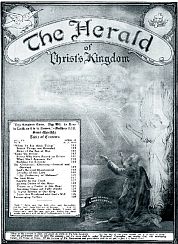
VOL. XIII. April 1,
1930 No. 7 IN
SACRED REMEMBRANCE OF CHRIST OUR PASSOVER ACCORDING
TO THE PATTERN SHOWN IN THE MOUNT HALF
HOUR MEDITATIONS ON ROMANS ANNOUNCEMENT
IN RE ANNUAL MEETING VOL. XIII. April 15,
1930 No. 8 IN
DEFENSE OF THE CHRISTIAN TRUTH A
PRAYER OF MOSES THE MAN OF GOD VOL. XIII. April 1, 1930 No. 7 IN
SACRED REMEMBRANCE OF "For even Christ our Passover is
sacrificed for us; THE OBSERVANCE of the Memorial
of our Lord's death becomes increasingly sacred and precious to those who make progress in
the knowledge and understanding of the full significance of His sacrificial death.
Recognizing our Lord Jesus as the center of the Divine Plan, and His death on Calvary as
the basis of God's redemptive purpose, the Passover Supper becomes a holy reminder not
only of God's boundless grace, but also of our own sacred duties and responsibilities.
Without dnúbt it is to the edification of Christ's" followers that they earnestly
and reverently heed the example of and listen. to their Divine Master in respect to the
observance of the simple yet powerful Memorial, "This do in remembrance of Me."
We are sure that all who in faith have hearkened to the Master's words have thereby been
blessed in the inner man. The Apostle is surely
expressing the mind of the Lord with regard to all His true followers, when He exhorts
that we keep the feast because Christ our Passover is sacrificed for us. The Lord thus
greatly honors spiritual Israel with the high privilege of celebrating the most
significant and important of all events-the death of our blessed Redeemer, the
ransom-price for the redemption of all the world. Familiar to all students of Scripture is
the Passover lesson found in the typical experiences of fleshly Israel, centuries in
advance of our Lord's First Advent. The cruel bondage of Israel under Pharaoh, the ruler
of Egypt, calls to mind the bondage of corruption under which "the whole
creation" is laboring being burdened under the reign of sin and death; and Pharaoh
fitly typified Satan, "the god of this world." In the deliverance of all Israel
under the leadership of Moses, we see the deliverance, the liberation of all who reverence
God and His law; under the leadership of the greater than Moses, Christ, Head and Body,
during the Millennium. In the overthrow of Pharaoh and his hosts we see the type of the
destruction in the Second Death of Satan and all who follow his course. These antitypical
events are all the pictured results of the antitypical Passover of which Christ is the
central figure. Deliverance of the First-born One Evangelist records that
our Lord said to His disciples, "With desire have I desired to eat this Passover with
you before I suffer." It was His last commemoration of the Jewish rite, which as a
Jew He, was to observe legally, fully. We may not know positively the particular hour of
the fourteenth day át which our Lord and the disciples partook of the Passover, but
probably it was near midnight, when after the Passover had been eaten our Lord instituted
the new memorial of His own death, the Lord's Supper, substituting it for the Passover
supper of the Law, and intimating this in His words, "This do ye, as oft as ye drink
it, in remembrance of Me." "This" represented the antitypical Lamb,
"the Lamb of God, which taketh away the sin of the world," and doing
this-breaking the bread and drinking of the fruit of the vine-showed forth our Lord's
death and not any longer the death of the type, because the antitype had now come, and in
this same day, a few hours later, He would be killed, crucified. Our Lord was thus laying
a deep and broad basis for the new institution, His Church, and separating it from the
Jewish type by pointing out to the believers, Himself as the antitype, and the higher
meaning connected therewith -the deliverance of alt true Israelites, not from Pharaoh, but
from Pharaoh's antitype, Satan, the deliverance of all the first-born of God's people from
death into life more abundant -- eternal life. All who see clearly the type
should realize that it could never pass away until its antitype had come, and the antitype
of the killing of the Passover lamb must occur on its anniversary, the fourteenth day of
Nisan. Hence the significance of the Scriptural statement that "they could not take
Him because His hour was not yet come." (John 7:30; 8:20.) God had foreseen the
entire matter, and had prearranged everything pertaining to it, and the type had marked it
most definitely. We no longer celebrate the type, but believing that the antitypical
sacrifice of the Lamb of God has taken the place of the type,, we as Christians "do
this" in remembrance of the antitype; for, as the Apostle says, "Even Christ our
Passover [Lamb] is slain; therefore let us keep the feast." -- 1 Cor. 5:7, 8. Another anniversary of this
great event draws near. The Memorial of our Lord's death will, this year, fall, according
to the Jewish reckoning, on Saturday, April the 12th. Consequently the appropriate time
for celebrating His. Memorial would be on the "same night in which He was
betrayed," the night of Friday, April the 11th -- not immediately at six
o'clock, but later on, allowing time for certain necessary preparations, and for certain
examination of the meaning of the symbols and consideration of the whole subject afresh. Primary Significance of the Bread and the Cup In presenting to the disciples
the unleavened bread, as a memorial, our Lord gave a general explanation, saying,
"Take, eat; this is My body." The evident meaning of the words are, This
symbolizes or represents My body. It was not actually His body, because in no sense of the
word had His body yet been broken; in no sense would it have been possible for any to have
partaken of Him actually or antitypically then, the sacrifice not being as yet finished. But
the picture is complete when we recognize that the unleavened bread represented our Lord's
sinless flesh-leaven being a symbol of sin under the Law, and specially commanded to be
put away at this time. On another occasion our Lord gave a lesson which interprets to us
this symbol. He said, "The bread of God is He that cometh down from heaven, and
giveth life unto the world. I am the bread of life." -- John 6:33, 35. In order to appreciate how we
are to eat or appropriate this living bread it is necessary for us to understand just what
it was. According to our Lord's explanation of the matter it was His flesh which He
sacrificed for us. It was not His pre-human existence as a spirit being that was
sacrificed, although that was laid down and its glory laid aside, that He might take our
human nature. It was the fact that our Lord Jesus was holy, harmless, undefiled, separate
from sinners, and without any contamination front father Adam, and hence free from sin --
it was this fact that permitted Him to be the Redeemer of Adam and his race, which
permitted Him to give His life a ransom for all, to be testified in due time. When we recognize that it was
the pure, spotless human nature of our Lord Jesus that was laid down on behalf of sinners,
sacrificed for us, we see what it is that we are a privileged to appropriate. The very
thing which He laid down for us we are to "eat," appropriate to ourselves; that
is to say, His perfect human nature was given for us and redeemed Adam and all his race
from condemnation to death, to a right to return to human perfection and everlasting life
if they will. The Scriptures show us, however, that if God would consider all of past sins
cancelled and should recognize us as having a right to return to human perfection, this
still would not make us perfect nor give us therefore the right to everlasting life. In
order for the race of Adam to profit by the redemption accomplished by our Lord's
sacrifice, it is necessary that He should make a Second Advent, and then be to the whole
world a Mediator, Prophet, Priest, and King, to assist back to perfection and to harmony
with God all who will avail themselves of the privileges then to be offered. Justification Prefigured It is this same blessing which
the Gospel Church in this Age receives by faith through the Redeemer, namely justification
by faith -- not justification to a spiritual nature, which we never had and never lost,
and which Christ did not redeem, but justification to human nature, which father Adam did
possess and lose, and which Christ did redeem by giving His own sinless flesh as our
ransom sacrifice. The partaking of the bread, then, means to us primarily acceptance and
appropriation to ourselves. by faith, of justification to human rights and privileges
secured by our Lord's sacrifice of these. Likewise the fruit of the vine
symbolized our Lord's life given for us -- His human life, His being, His soul, poured out
unto death on our behalf ; and the appropriating of this by us signifies primarily our
acceptance of restitution rights and privileges which the Lord has thus, at His own cost,
secured for us. The Deeper Significance The additional and deep
meaning of the Memorial, our Lord did not refer to directly. It was doubtless one of the
things to which He referred, saying, "I have yet many things to say unto you, but ye
cannot bear them now; howbeit when He, the Spirit of Truth, is come, He will guide you
into all truth, and show you things to come." The Spirit of Truth, speaking
through the Apostle Paul, clearly explains the matter of this secondary and very high
import of the Memorial, for he says, writing to ,the consecrated Church : "The cup of
blessing which we bless, is it not the participation of the blood of Christ? The bread
which we break, is it not the participation of the Body of Christ?" -- to share with
Christ as joint-sacrificers even unto death, that thereby they may be counted in with Him
also as sharers of the glory which He has received as a reward for His faithfulness.
"For we being many are one loaf and one body." (1 Cor. 10:16, 17.) Both views of
this impressive ordinance are important: it is necessary that we should see, first of all,
our justification through the Lord's sacrifice. It is proper then, that we should realize
that the entire Christ is, from the Divine standpoint, a composite body of many members,
of which Jesus is the Head, and that this Church as a whole must be broken, and that in
this respect each member of it must be a copy of the Lord Jesus and must walk in His
footsteps of self-sacrifice. We do this by giving our lives, "laying down our lives
on behalf of the brethren," as Christ laid down His life for all. Fellowship in His Death In passing the cup to His
disciples Jesus said, "This is My blood of the New Testament [covenant] which is shed
for the remission of sin." This invitation 'by the Master to drink of His cup
represented not only the offer to them of the benefits of His shed blood and the
appropriation of His Merit unto their justification, but the invitation embraced also the
thought of joining Him in a sacrificial death, of sharing His sufferings, and of being
counted in with Him in the work of the Sin-offering, in behalf of all mankind. To our
understanding the Master's words implied that the shed blood was to effect the sealing of
the New Covenant between God and Israel and on behalf of all mankind through Israel. Not
that any sacrifice or shed blood additional to that of Jesus' was necessary in order to
accomplish atonement and to establish the New Covenant in the future: nor was the offering
to us of the privilege of participation in the cup of Christ's sufferings and death an
indication that His sacrifice was insufficient and that we could add anything to it..
Rather, it illustrates the grace of God-that He is willing to receive us and make us
joint-heirs with our Lord and Savior if we have His Spirit. Here then, is the beautiful
reminder that in accepting the cup, we covenant to enter with Him into His sufferings and
sacrifice, even unto death: "The cup of blessing which we bless [for which we give
thanks as the greatest imaginable favor of God bestowed upon us], is it not the communion
[the general union, the fellowship] of the Body of Christ?" In other words, does it
not represent our Lord's sacrifice and our share with Him in His sacrifice, by His
invitation, in harmony with the Father's Plan, in which from the foundation of the world,
He foreknew the Church would be associated with Jesus. Oh, what a depth of meaning
attaches to the communion cup from this standpoint! Oh, what heart-searching should go
with the accepting of it! How evident it is that this communion cup represents not merely
the turning from sin, not merely believing in Jesus, not merely preference for right over
wrong, but chiefly the presentation of believers' bodies living sacrifice to
God-sacrifices considered holy because of the imputation of Jesus' merit, which sacrifices
God has accepted, begetting the offerer to the new nature as a new creature. -- Rom. 12:1. The Celebration in the Kingdom As usual our Lord had
something to say about the Kingdom. It seems to have been associated in His every
discourse; and so on this occasion He reminds those to whom He had already given the
promise to share in the Kingdom if faithful, of His declaration that He would go away to
receive the Kingdom and come again to receive them to share it: He now adds that this
Memorial which He 'instituted would find its fulfillment in the Kingdom. Just what our
Lord meant by this might be difficult to positively determine, but it seems not
inconsistent to understand Him to mean that as a result of the trials and sufferings
symbolized there will be a jubilation in the Kingdom. "He will see of the travail of
His soul and be satisfied." He will look back over the trials and difficulties
endured in faithful obedience to the Father's will, and will rejoice in these as He shall
see the grand outcome in the Kingdom blessings which will come to all mankind. And the
same jubilation will be shared by all His disciples who drink of this wine, first in
justification, and secondly in consecration, and who suffer with Him. They are promised
that they shall reign with Him, and when the reign is begun and when the Kingdom work has
been established, looking back they as well as He will praise the way that God has led
them, even though it be a "narrow way," a way of sacrifice, a way of
self-denial. Let us keep the feast in joy
of heart, and yet with due appreciation of its solemnity, not only as relates to our
Lord's sacrifice for us, but also as relates to our own covenant of sacrifice to be dead
with Him. Let us consider Him: Looking unto Jesus as the "Lamb of God," we
behold His spotlessness --- "holy, harmless undefiled, separate from sinners."
We behold how "He was led as a sheep to the slaughter; and like a lamb dumb before
his sheerer, so opened He not His mouth." (Acts 8:32.) By speaking the word He could
have resisted those who were intent upon His destruction. He assures us that no man took
from Him His life; that He laid it down Himself-voluntarily. He laid it down not in
obedience to the Father's law, for justice could not demand sacrifice, but He laid it down
in accordance with the Father's will, saying, "I delight to do Thy will, O My God;
Thy law is written in My heart." From this standpoint the Christian believer can
rejoice greatly that the Redeemer spared not Himself, but freely delivered Himself up with
the foreknowledge that in the Divine purpose the value of His sacrifice would ultimately
redound, first for the benefit of His followers, and subsequently for the blessing of all
the people. Hence in partaking of the broken, unleavened bread; we memorialize the purity,
the sinlessness, of Him who gave Himself to be, in God's due time, the Ransom-price for
all mankind. From this important standpoint we realize that His shed blood signified that
His death was necessary in order that our condemned humanity might be restored to life
without infracting the Divine Law. Our hearts should pause here to appreciate, not only
the Love of our Lord Jesus Christ, but also the love of the Father, who designed the
program; and the Justice of God thus exemplified; and the Wisdom of God in making the
arrangement; and the faith also to comprehend the Power of God, as it will ultimately be
manifested in the full carrying out of all the glorious purposes and promises which we
memorialize. Our Lord's faith stood the
test of all these trying hours which He knew to be so near to the time of His apprehension
and death. The fact that He rendered thanks to God for the bread and for the cup is
indicative of a joyful acquiescence in all the sufferings which the breaking of the bread
and the crushing of the grapes implied. He was satisfied already with the Father's
arrangement, and could give thanks, as by and by He will greatly rejoice. In line with
this was the singing of a hymn as they parted, a hymn of praise no doubt, thanksgiving to
the Father that His course was so nearly finished, and that He had found thus far grace
sufficient for every time of need. According to the custom of
former years, the brethren will meet on this anniversary to celebrate again the great
transaction by which we were brought back from condemnation, and to celebrate also our
consecration, if so being dead with Him, we shall be sharers also in His Resurrection, the
First Resurrection, to glory, honor, and immortality. All who are living in the
vicinity of New York City, or any who can find it convenient to come from nearby places,
will be warmly welcomed at the Memorial service to be held in Brooklyn on the evening of
April 17th at 8 o'clock. "Not what 1 will, but what Thou
wilt." -- Mark 14:32-42 GETHSEMANE was not a flower
garden but an olive orchard or garden. The supposed site is still carefully preserved and
guarded. In the garden are some very ancient olive trees, and one extremely old oak. The
name signifies an oil press-a name that is full of significance. When we remember that the
Jews used the oil of the olives both for food and light, and that Jesus is the nourisher
as well as the enlightener of the world, we see a special fitness in His having His trying
experiences, which almost crushed His soul, in a garden used for the crushing of olives
and the extraction of their oil. The Son of God in Gethsemane, therefore, presents to us
in some respects the most pathetic and touching scene of the entire Bible. The narrative so familiar to
every Christian is one full of precious lessons, especially to those who by His grace are
endeavoring to follow in the Lord's footsteps. And it is in every way with becoming
propriety that the true disciple of Christ should seek to learn these lessons and grasp as
fully as possible the meaning of the Master's sufferings and the purpose of Gethsemane's
dark hour. He Sought the Father's Face It is believed that the
passage was made at midnight across the Kedron and up the slopes of Olivet into this
garden. It seems that the Savior realized that He was entering this place for the purpose
of fighting a great battle that was to win for Him the victory of Calvary; for out of this
agony Jesus stepped calm and strong for the final hour, and herein is a great lesson for
His followers. We must win our battles before we come to them, in secret prayer and
gathered strength. We observe that the Master
realized that His hour of betrayal and fierce temptation was close at hand; He first
comforted, counseled, and prayed for and with His disciples, and then His next strong
impulse was to seek a solitary place for prayer and communion with God that He might find
grace to help in this time of sore need. He wanted to see full and clear the light of His
Father's face before He stepped into the final darkness. He sought to fall into perfect
submission to the will of God and feel the assuring, sustaining power of His omnipotence;
He knew full well that He could then bear the cross. And, dearly beloved, have not all
true followers of Christ realized that "prayer is the highest preparation for every
duty and burden? It quiets the soul and it clears its vision so that it can see the path
of truth and duty. In entering any Gethsemane let us enter through the gate of prayer, and
then we can endure the agony and may be able to come out calm and strong." Value of True Sympathy Leaving all but Peter and
James and John at the entrance of the Garden, as a sort of outer guard against the sudden
intrusion of His betrayer upon His last hour of prayer, He advanced with the three -- the
three in whose ardent natures He seemed to find the most active and consoling sympathy --
and with an earnest appeal to them to watch and pray, He left them and went about a
stone's throw beyond. All realize that sympathy has
a wonderful power to lighten burdens. "Solitary suffering is doubly hard to bear. It
gives us a sense of unsupported and forsaken loneliness that kills all courage and fills
us with despair. The presence of a friend rallies our energies and inspires us with new
life." We may reasonably suppose that it was the simple presence of these chosen
disciples that Jesus wanted, not their talk. There was nothing they could say to Him that
would help Him; but their watchful waiting near by would comfort Him. Another has added,
"The best sympathy is not that which is most talkative and fussy. The silent
presence, the sympathetic tear, the thoughtful, helpful act, these go deeper. There are
chambers of sorrow in which voluble speech is an impertinence and silence is soothing to
the soul." It was when Jesus and the
three disciples were buried deep in the seclusion's and shadows of the Garden that a
mysterious dread as of the horror of a: great darkness came upon Him, and He began to be
greatly amazed and sore troubled, and said unto them, "My soul is exceedingly
sorrowful unto death." We may not enter into all the meanings of this language, for
it probably involves bearings end relations that stretch infinitely beyond our
understanding and experience. Yet much is explained to enable us to grasp to a
considerable extent the significance of our Lord's suffering. Why Gethsemane's Agony But it may be asked, Why
should the thought of death have so much more terror for the Redeemer than it has had for
some of His followers, yes, than it has had for people in general? Hundreds of martyrs have gone
to deaths equally terrible or more so. Hundreds have exhibited great courage, fortitude,
in the face of equally horrible deaths. How shall we account for this attitude of the
Savior and His so earnestly praying that the hour or the cup might pass from Him? In order to appreciate this
question and its proper answer, we must remember how different was the Master from all the
remainder of mankind. A death sentence rests upon all the world. We all know that it is
merely a question of time when we shall die. We all know that the dying process can last
but a few hours at most. Not only have we no hope of escaping death, but by reason of
being nine-tenths dead already our intelligent faculties are more or less benumbed. We are
more or less reckless, careless and proportionately fearless. There are soldiers who will
rush to battle in the face of instant death with apparently not a fear, and there are
horses which will do the same thing. The greatest courage, however, is manifested by those
who know, understand, appreciate fully, just what they are doing and who greatly fear
death, but who notwithstanding press onward in obedience to the command of duty and of
love. Jesus was such a soldier. He comprehended, as others had not comprehended, what
death really is. He appreciated, as others did not appreciate, the meaning and value of
life. Jesus had left the he heavenly
glory, divesting Himself of the higher nature on the spirit plane, exchanging it for the
human nature, because man had sinned and because in the Divine purpose and arrangement He
was to die, the just for the unjust, as man's redemption-price. This was the Father's will
concerning Him. He tells us that for this purpose He came into the world. This thought
dominated His entire life. Daily He was laying down His life in doing the will of God and
in serving humanity. Now He had come to the great climax. The Cup That was Poured for Him The Heavenly Father had
promised that if our Lord was faithful in this work given Him to do, He would be raised
from the dead by Divine power to the spirit plane of being and to a station still higher
than He had before. He doubted not the Father's faithfulness in this matter, nor did He
doubt the Father's power. But the Father's provision and promise were conditional; only if
our Lord would perform His part faithfully would He receive the resurrection to the higher
life. If in any sense or degree, great or small, He should yield to sin, the penalty for
sin would be upon Him -- "dying, thou shalt die." Here, then, in this awful hour
all the griefs and burdens of the whole world seemed to be rolled upon His shoulders, and
He was to suffer as though He Himself were the sinner -- to suffer death, extinction of
being, trusting alone in the Father's grace for a resurrection. Into this one hour were
crowded, not only the mental realization of death and the physical agony and shame, the
cruelty and torture of a horrible death, but also the sense of desolation to be
experienced when even His beloved disciples, overcome by fear and dismay, should forsake Him; and the sorrowful reflections upon
the irretrievable loss of Judas, and upon the course of the Jewish nation -- 'His
own", People, who despised Him and were about to call down upon their own heads the
vengeance of His blood, saying, "His blood be upon us and on our children." He
foresaw the terrible calamities that in consequence must soon overwhelm them. Then the
degradation of a whole guilty world, which must continue to groan and travail in pain
until by His sacrifice He should gain deliverance for them from sin and death, caused Him
to feel the burden of responsibility to an extent which we can only approximate, but
cannot fully comprehend. And in addition to all this was His knowledge of the fact that
every jot and tittle of the law with reference to the sacrifice must be perfectly
fulfilled according to the pattern in the typical sacrifice of the day of atonement. If He
should fail in any part of the work, all would be lost, both for Himself and for men. And
yet, though a perfect man, He realized that the flesh, however perfect, was unequal to the
task. "Nevertheless Not My Will" How much depended upon our
Lord's fortitude in that awful hour, alone and defenseless in the darkness of overwhelming
night, awaiting the certain arrival of His betrayer and the will of His persecutors
maddened with hate and full of the energy of Satan! Oh, how the destinies of the world and
of Himself seemed to tremble in the balances! Even the perfect human nature was not equal
to such an emergency without Divine aid, therefore it was that He offered up prayers and
supplications with strong crying and tears unto Him who was able to save Him from death,
by a resurrection. The necessary comfort was provided through the Prophet Isaiah (42:1,6),
by whom Jehovah said, "Behold My servant whom I uphold, Mine elect, in whom My soul
delighteth: . . . I, the Lord, have called Thee in righteousness, and will hold Thine
hand, and will keep Thee [from falling or failure], and give Thee for a covenant of the
people, for a light of the Gentiles . . . . He shall not fail nor be discouraged." When the fearful ordeal in
Gethsemane strained the powers of endurance almost to their utmost tension, it was then
that Jesus said, "Abba, Father, all things are possible unto Thee. If it be possible,
let this cup pass from Me: Nevertheless not My will but
Thine be done." The words "All things are possible unto Thee" represent the
strong ground of confidence, the prayer first laid down. Prayer has no meaning unless it
first puts God on the throne of the Rock of Ages. If His power and providence we're
limited, He would be impotent to respond, to our appeals. Faith asserts the sovereignty of
God and then commits all things to His hands. "Nevertheless not My will but Thine be
done." This was a strong, sure check Jesus put upon His own will-the invulnerable
safeguard, He threw around Himself against unholy desires and mistaken, forbidden
petitions, the mighty rock on which He kneeled: Another has remarked: "These elements of the
Master's prayer are still the grounds and safeguards of prayer for us. We also must take
our stand on the omnipotence of God and be sure that He can command all the forces of the
universe and cause them to work together for our good. We also may shrink in our human
infirmity and fear from life's trials and agonies, but God knoweth our frames and
remembereth that we are dust and will be patient with us. Yet we must trust Him and meet
every insurgence of our will with a 'nevertheless' that will put God's will over ours and
accept it as best for us; even the fullest expression of the Father's love." Faith That Scattered the Darkness of Calvary Then, though the cup .might
not pass from ,Him, His prayer was heard and a special ministry from God strengthened Him.
Just how, we know not, but probably by refreshing His mind with the precious promises and
prophetic pictures of the coming glory, which none of His disciples had sufficiently
comprehended to thus comfort. Him in this hour when the gloom of thick darkness settled
down upon His soul, crowding out hope And bringing a sorrow exceeding great, "even
unto death." Ah, it was Jehovah's hand upholding Him, blessed be His holy name!
according to His promise, that He might not fail nor be discouraged. The result of that 'blessed
ministry was a reinforced courage which commands the, deepest admiration. It was not a
courage born of stoical indifference to pain and shame and loss, but a courage born of
that faith which is anchored fast within' the veil of the Divine promises and power. With
His eye of faith upon the glorious victory of truth and righteousness, when He should see
of the travail of His soul and be satisfied -- satisfied with the eternal joy and
blessedness of a redeemed world, with the welcome and wealth of the Father's blessing; and
the love and gratitude of every loyal creature in heaven and in earth -- yes, comforted
and encouraged thus with a realizing sense of the rewards of faith and faithful endurance
to the end, He could now calmly and even courageously; go forth to meet the foe. Yes, this
was the victory by which He overcame; even His faith, and so we also are to overcome. "He had passed beyond the
need of their help: His victory was won. The cross was already as good as behind Him. With
calm courage that feared no evil, with masterful faith that scattered the, darkness of
Calvary, He said, 'Rise up, let us go; lo; he that betrayeth Me is at hand.'" Now commenced the realization
of the dreadful forebodings of Gethsemane. Mark His calm, dignified fortitude, as He
addresses Judas, and the Roman soldiers, and its effect upon them. They were so
overpowered with the grandeur, and nobility of this wonderful man that they could not have
taken Him had He not voluntarily placed Himself in their hand. Notice, too, His kind
consideration for the bewildered and weary disciples, and His loving excuse for them,
"The spirit truly is willing, but the flesh is weak," and His request to the
Roman soldiers at the time of His arrest that they might be permitted to go their way
(John' 18:8), that so they might escape sharing in His persecutions. So through all the
trial and mocking, and finally the crucifixion, His courage and solicitude for the welfare
of others never failed. Angels Bear Up the Feet of Him As we thus view our Lord under
a trial so crucial, and mark how the hand of Jehovah upheld Him, let it strengthen the
faith of all who are endeavoring to walk in His footsteps, to whom He says, Be of good
cheer, I have overcome the world and, This 'is the victory that overcometh, even your
faith. (John 16:33; 1 John 5:4.) Has not the Lord, Jehovah. commissioned His angels also
to bear us the "feet" of the Body of
Christ, lest at any time they be dashed against a stone (lest some overwhelming trial
should prove too much for them) ? (Psa. 91:11, 12.) Yes, as surely as His hand upheld the
Head, our Lord Jesus, so surely will He bear up the feet. "Fear not, little flock: it
is your Father's good pleasure to give you the Kingdom;" though through much
tribulation ye shall enter it. The angels are all ministering spirits sent forth to
minister for them who shall be heirs of salvation. Though their ministry is unseen by us,
it is not therefore unreal, but potent for good. Our fellow-members, too, in the Body of
Christ are all the Lord's active messengers to each other, thus in turn sharing the
privilege of bearing up the feet. But to have this help in time
of need we must invoke it. Every day and every hour is indeed a time of need; hence our
necessity of living in an atmosphere of prayer -- to pray without ceasing. And if the Lord
.needed often to seek retirement from the busy scenes of His active life to be alone with
God, to keep the close bond of loving sympathy established, surely we need to do so; and
in so doing We shall always find grace to help in time of need. In seasons of heavy trial
the darkness may indeed so deepen upon the soul; as in our dear Lord's case, s almost to
shut but the stars of hope; yet if, like the Lord, we hold on to the omnipotent arm of
Jehovah and meekly say, "Nevertheless, not my will, but Thine be done," His
grace will always be sufficient; and with the Psalmist we can say, Though my flesh and my
heart fail, yet God- is the strength of my heart and my portion forever (Psa. 73:26); and,
with the Lord, our hearts will respond -- "The cup which my Father hath given me,
shall I not drink it?" ACCORDING
TO THE PATTERN Continued from last issue from text;
Heb. 8:5 WE COME now to the last
chapter in Matthew's account of the Sermon on the Mount, and as we should expect, it
constitutes a further very searching analysis of character. In concluding His sermon our
Lord directs His remarks against some of the special transgressions of many of His
professing people, and finally closes the door into the Kingdom against all who have
failed in obedience to His requirements as given on this occasion. Judge not. that Ye be not Judged Chapter 7 opens with a much
needed caution. In fact it is a test of one's real character, searching the measure of our
love; and failure to heed it will result in a severe reprimand sooner or later. Jesus was
most tolerant with general human faults, and the term "hypocrite" never passed
His lips except when His indignation was aroused by false professions. When He found a
profession of holiness belied by a conduct of selfish uncharitableness, He did not
hesitate to apply this scathing term, for He wanted it understood that he who would
undertake to condemn and judge others must be very circumspect in his own walk. His Gospel
is one of sympathy, and both love and justice agree that it is entirely wrong for one who
himself is wholly dependent upon Divine mercy, to deal harshly With another. Was this not
the purpose of our Lord's illustration of the two debtors. With a feeling of indignation
we judge the debtor who was forgiven the large amount, when, with his hand at the throat
of his fellow unfortunate, he demanded his few pence. But ah, have we walked so carefully
that we need not feel this sharp rebuke of the Master? The pattern here is very exacting.
Let us honestly examine ourselves and see if we have been acting ín all things according
to its standard. Earlier ín this sermon (Chap.
5) we were shown that we must deal with all others, even our enemies, in mercy and
benevolence. We were to observe that the sunshine and the rain fell alike on the friends
and enemies of God, and noting this we were to deal most leniently and kindly with all --
thus to emulate our Father in heaven. In that portion of the pattern we heard the voice of
love earnestly seeking to show us the more excellent way, seeking to awaken in us that
reciprocal appreciation of the mercy we have ourselves received that would lead us to
gladly extend it to all others. Now, however, in Chapter 7, it
is the voice of justice we hear. "Thou hypocrites" "with what judgment ye
judge, ye shall be judged" These words are so fraught with solemn import that we feel
led to quote the words of Brother Russell bearing on this point "Emphasizing this
lesson,, our Lord suggests that those who are, always finding fault with the 'brethren,'
who like themselves are seeking to walk the narrow way -- who can never see the noble
efforts of the 'brethren' to copy the Master, but are continually picking at them, are the
very ones who have the greatest faults in themselves -- lovelessness . . . . This
loveless, faultfinding, brethren-accusing class the Lord denominates hypocrites. -- Why?
Because in finding fault with others they are evidently wishing to give the inference that
they are not afflicted with the same malady of sin themselves; they evidently wish to give
the impression that they are holy, and since they know in their own hearts that this is
untrue, and that they have many failings, many imperfections -- therefore their course is
hypocritical, false, deceptive, displeasing to God. Their claim that their fault-finding
is prompted by love for the erring and a hatred of sin is deceptive and hypocritical as
our Lord's words clearly show. Otherwise they would find plenty to do in hating and
condemning and battling with their own sins and weaknesses; casting out their own rafter
of self-conceit and hypocrisy. The experience thus gained would make them very tender and
merciful and loving in their assistance of others." One of the Besetting Sins of the Church A wise philosopher of earlier
days has said "If thou canst not make thyself such a one as thou wouldst, how canst
thou expect to have another to thy liking." But Jesus had anteceded him, long before,
by saying, "Thou hypocrite, first cast out the beam out of throe own eye; and then
shaft thou sec clearly to cast out the mote out of thy brother's eye." But we need to
carry this lesson further. Its condemnation of petty judging of others in personal
matters, etc., is a lesson so manifestly set forth that all may readily feel its force.
But there is another kind of judging often indulged in that our Lord makes no possible
allowance for. He instructs us to distinguish between "wolves" and
"sheep," "grapevines" and "thorn-bushes," "figs and
thistles," but He gives us absolutely no license to go beyond that in judging the
hearts of brethren. As respects all other possible traits of character the one general
rule applies: "If any man have not the spirit of Christ he is none of His." Any
violation of this rule will bring the transgressor under the full force of our Lord's
warning, and for reasons so obvious that He considered it superfluous to do more than
state the operations of the Divine rule of justice. We have reference in the above to what
might be termed the besetting sin of the Church collectively, namely
"forbidding," or condemning others who "walk not with us." In all
stages of Church history there has been the most flagrant neglect of this command of
Jesus. Its appearance in the early Church grieved the Apostle Paul, and his earnest
entreaties and forceful protests are still needed. It grieved faithful servants of the
Church in subsequent periods, and, one of many, has written, "It is one of our trials
that the Bible, with its tender and hallowed bearing upon all that is sweet and noble in
our lives -- with its words so stately and full of wonder, and full of music, like the
voice of an archangel -- should have been made in these days the wrangling ground for
sectarian differences: but if with our whole hearts we are striving to live according to
its spirit, we need fear little that we shall trip in a right pronunciation of the
shibboleths of its letter. Surely it is deplorable that because of mere questions of
authorship, of historical accuracy, of verbal criticism, having for the most part little
or no bearing on. the spiritual or moral life, party should be denouncing party; and
Christian excommunicating Christian, and so many
hands tearing in anger the seamless robe of Christ. It is, alas, the due punishment
for our lack of charity, our Pharisaism, our unwisdom, that while we have been so eager
about such controversies, the love of many should have waxed cold." The Truly Spiritual Judge Themselves It grieved one of the Lord's
faithful servants in our own day, and in the faithful discharge of his duty he wrote
condemnatory of all uncharitable judging: "But few of the Lord's
people realize to what extent they judge others, and that with a harshness which, if
applied to them by the Lord, would surely bar them from the Kingdom. We might have feared
that under our Lord's liberal promise, that we shall be judged as leniently as we judge
others, the tendency would be to too much benevolence, too much mercy, and that 'thinketh
no evil' might be carried to an extreme. But no! All the forces of our fallen nature are
firmly set in the opposite direction. It is more than eighteen centuries since our Lord
made this generous proposal to judge us as leniently as we judge others, and yet, how few
could claim much mercy under that promise! It will be profitable for us to examine our
proneness to judge others Let us do so, prayerfully." The Gospel of Jesus has ceased
to influence us whenever and to whatever extent loving sympathy is lacking. The value of
such sympathy -- and this is the larger meaning of the passage in hand -- is due to the
law of reciprocity which plays so large a part in the teachings of Jesus. The repentance
or spiritual revolution which is the beginning of the Gospel of preparation of ourselves
for the near approaching Kingdom, will have the effect of leading us to judge ourselves,
and the more honestly we do that, the more charitably we will judge others When we find
ourselves habitually judging and condemning others, it is an unmistakable evidence that we
have ceased to sit in severe judgment upon ourselves. If we have knowledge of a fault in
our own characters (and no honest soul forgets his, own defects) and yet uncharitably
judge others, we merit the stern rebuke, "Thou hypocrite." "So utterly vain
is profession without principle, and the outward appearance of religion without the inward
reality." Living According to the Golden Rule "Therefore all things
whatsoever ye would that men should do to you, do ye even so to them: for this is the Law
and the Prophets." The purpose of Jesus here is to show how that love of God which is
the center of true religion, shall be given the human expression that will bring it out
into actual life. Here again He is teaching that that individual has no real experience of
the saving power and goodness of God, whose life is not full of effective, practical love
for his neighbor. The pattern here shown does not put the premium, as so many think, on
not doing, but on doing. There seems to be a very general preference shown by the majority
of Christians for the brazen rule of Confucius, "Do not do to others what you would not wish them to
do to you," but the Golden Rule goes much deeper than that. Men might, through policy
or for other reasons, deal justly with each other, refraining from doing them injury,
etc., but yet have their hearts filled with selfishness and meanness, and be very far from
loving others as themselves. Our Lord's Golden Rule is
absolutely a love-rule, and it leaves nothing to be desired; nothing could possibly be
added to it. It is not merely a negative law; "Thou shalt not" do an injury; it
is a positive law; "Thou shalt" do good. Thou shalt do thy neighbor all the
good, all the kindness, all the service, that thou wouldst have him do to thee. This rule
has no parallel anywhere, in any writings, and could not possibly have a superior. This
Golden Rule was the one by which our dear Redeemer's every action was measured, and under
which He laid down His life on our behalf, and it is essential to and incumbent upon all
those who would be His disciples. Whoever expects to share the Kingdom must give diligence
to the formation of character, and this rule is absolutely indispensable to the
development of Christian character, to develop in us not the principle of equity or
justice only, but also, that spirit of love that will always be unselfishly doing for
others. O how grandly rounded out in spiritual character would all of the Lord's true
saints become, if they consistently followed this feature of the pattern shown , in the
Mount. By Their Fruits Ye Shall Know Them As the sermon opened with a
statement embracing the essential qualities of Christian character, and has progressed in
unfolding those principles, so now it is to end most appropriately with words calculated
to impress its conclusions on our minds. The importance of being "doers of the Word
and not hearers now proceeds to set forth the
rules for careful obedience, in contrast with the unsatisfactory results to those who fail
to obediently follow the pattern. He illustrates this by suggesting that grapes are not to
be expected on thorn-bushes nor figs on thistles. There need be no doubt respecting the
character and the fruitage of the life of those who are obedient followers of Christ. "The thought such a kin
and refreshing them. O thistle-lik cause trouble errors; an instead of reaching to poison,
contact. people, ought ing between them, and their lives are continually stroyers.
peacemakers." Again, forth goo brings fort
is clear. whether t voutly followed, no application as we ha and grant ceptable f review
the have born shall know never bear The We have full sermon, points ha
space would verse con gathered fact that revocable days when duo better one? He to Jesus'
w e would rock found than a fragment heard, "There Mount to thought us the Bible THE HERALD OF CHRIST'S KINGDOM only" is to be the final
lesson. Jesus s to set forth the good results
of caree, in contrast with the unsatisfactory those who fail to obediently follow the
illustrates this by suggesting that grapes e expected on thornbushes nor figs on re need
be no doubt respecting the chare furtive of the life of those who are followers of Christ. "The thought is that the
Lord's true people are of such a kind that the fruit of their lives is nourishing and
refreshing toward all who have fellowship with them. On the other hand there are persons
who, thistle-like, are always scattering seeds that will cause trouble -- false doctrines,
evil surmisings and errors; and there are some who, like thorn-bushes, instead of bearing
refreshing fruit, are continually reaching out to impede, to irritate, to annoy, to vex,
to poison, to injure, those with whom they come in contact. The intimation clearly is that
the Lord's people ought to have little difficulty in distinguishing between the false
teachers who would mislead them, and the under-shepherds who gladly lay down their lives
in the service of the flock. The one class are continually mischief-makers, underminers,
destroyers. The other class are helpers, strengtheners, peacemakers." Again our Lord declares that a
sound tree brings forth good fruit, but a corrupt or diseased tree brings forth
undesirable, evil fruit. The contrast is clear. By their fruits it will be clearly
manifest whether the outlines of the pattern have been devoutly followed, or whether there
has been little or no application of His words to the daily life. Favored as we have been
with the knowledge of the Truth, and granted years of opportunity for producing acceptable
fruitage, we surely do well to prayerfully review the time past of our lives, to see how
we have borne up under this test. "By their fruits ye shall know them," for
"thorns and thistles" can never bear good fruit. The Blessedness or being like God We have now briefly reviewed
the wonderful sermon, though many of its very important points have not been examined, for
the reason that space would not permit anything like a verse by verse consideration.
However sufficient has been gathered, we trust, to refresh our minds with the fact that
this sermon comes to us as a definite, irrevocable standard of faith and practice. In
these days when a standard needs to be lifted up, can we do better than to give careful
consideration to this one? Herein we have a pattern, which according to Jesus' own words,
we must studiously copy if we would find our structure securely built on the rock
foundation. Indeed there seems to be more than a fragment of truth in the statement often
heard, "There is enough in the Sermon on the Mount to save any man." While we
reject the thought usually implied, namely that the rest of the Bible needs little
attention, we co recognize that here in this pattern we have a high and lofty goal, which
if reached, will be the evidence that all Scripture has been fully appreciated. Whether we are spiritual or
materialistic will be demonstrated by our reaction toward this pattern. The attainment of
the perfections of God's righteous. character is the one special purpose set before us.
Its blessed results can be experienced only by those who actually hunger and thirst after
righteousness. Unless we enter, heart and soul, into the undertaking we have voluntarily
assumed in becoming disciples we are destined to suffer loss. Jesus has here shown us that
being righteous, holy, for righteousness' sake, is a greater reward than any other
attainment. Therefore in the little that we have examined this has been the point
emphasized. No other expediency or motive must be allowed: to divert our mind from this
point. The answer to every inquiry we might raise as to why this requirement, or why that
course of action, would be "that ye may be the children of your Father in
heaven." Character is the end and object of the pattern -- to eventually possess that
perfected character, Jesus teaches, is the only worthwhile purpose of discipleship. The
materialistic, the superficial, the double-minded, think only of rewards for service
rendered. Jesus would teach us the higher view of things, the unspeakable joy and
blessedness, not merely of getting something, but of being holy and perfect, in, God's own
likeness. He wants us, above everything else, to really experience the meaning of the
words we so often use: "If I in Thy likeness, O Lord, may
awake A statement credited to the
late Mark Twain seems to apply to many in reference to this pattern. given us by Jesus:
"It is not those portions of the Bible that I do not understand that give me the most
trouble, my greatest trouble is connected with the parts that I very clearly
understand." Just so it is here, the very simplicity of this sermon, and the
absence of any real cause for misunderstanding its specifications make it all the more
imperative that we give heed to its requirements. It is just a simple, plain setting forth
of simple principles and truths so stated that "any man who heareth these sayings" may
proceed to build in line therewith. "Ignorant and unlearned men" may enter the
school of Christ and have these principles so woven into their character, that though the
floods of error may come, and the winds of strife may rage, the innovations of men may
multiply, and the buildings of "wood, hay and stubble" totter and fall, yet they
shall not be moved, for Jesus says, "I will liken him unto a wise man, which built
his house upon a rock." Let us. clear brethren, see that we do all things according
to the pattern shown in the Mount "For He taught them as one having authority, and
not as the scribes." HALF
HOUR MEDITATIONS No. 7 "Earnestly seek to commend
yourself to God as a servant who, AS WE study the Epistle to the
Romans can we do so in the confidence that we have the text in the original language, and
in the exact words in which it proceeded from the Apostle's hands, and further, is the
letter, as he wrote it, correctly reproduced in our English versions? Translated from the Greek "On the title-page of the
New Testament we are informed that it was translated out of the original Greek. We shall
endeavor to show that the Epistle was written by Paul in Greek; that, within limits which
we will specify it is preserved as he wrote it in the Greek text used by the translators
of the Authorized English Version; and that their translation is on the whole correct. "It might be supposed
that a letter to a Roman Church would be written in Latin. It is quite certain that it was
not. The Latin Fathers never claim their own language as the original of any part of the
Bible. Augustine complains that in the early days of the Church, whoever obtained a Greek
MS. and knew anything of Greek, undertook a translation; and that therefore almost all the
Latin copies were different. He adds, 'But among the interpretations themselves, let the
Italic be preferred before others.' The best was therefore a translation. Such was the
variety of the Latin copies, that in A. D. 382, Damasus, bishop of Rome, committed to
Jerome the task of revision. Jerome published the Gospels in A. D. 384. In his preface he
says to Damasus, 'Thou urgest me to make a new work out of an old one, to sit as arbiter
on copies of the Scriptures scattered throughout the world; and, because they vary among
themselves, to determine which are they .that agree with the Greek truth.' This proves
that the Greek copies were the standard with which the Latin were to be compared.
Moreover, that the Epistle was written, not in Latin, but in Greek, is also put beyond
doubt by a comparison of the Greek and Latin MSS. In the Latin we constantly find that the
same thought is expressed in different ways: in the Greek, the variations are nearly all
such as would naturally arise from the mistakes of a copyist. "The use of the Greek
language in this letter was justified by its great prevalence in Rome. This is testified
by many writers ; . . . Most of the early bishops of Rome bear Greek names." -- BEET, Three Classes of Documents We now ask, To what extent do
the Greek texts from which our English versions were translated reproduce the Epistle as
Paul wrote it? To answer this question we turn to three classes of witnesses 1. Greek Manuscripts. The Greek Manuscripts "The Greek MSS. are of
two classes: uncials (or majuscules), written in capital letters; and cursives (or
minuscule), in running hand: Roughly speaking, the uncials are earlier, and the cursives
later, than A. D. 1000. "Eleven uncials of this
Epistle are known. The most famous are, the MS. lately (1844,-59) found by Tischendorf in
the monastery of Mount Sinai, and now preserved at St. Petersburg; the Vatican MS. at
Rome; and the Alexandrian MS. presented in A. D. 1628 by the patriarch of Constantinople
to Charles I and now in the King's Library at the British Museum. The last is supposed to
have been written in the 5th and the two others in the 4th century. They are written on
beautiful vellum, and each forms a thick quarto volume some 10 in. to 14 in. square. They
have two, three, or four columns of writing on a page. The letters follow each other
without any separation into words ; and there are very few stops. Corrections by later
hands are found in all. Each of them contains a large part of the Old Testament and
Apocrypha, all in Greek. The Alex. and Vat. MSS. contain the greater part, and the Sinai
MS. the whole, of the New Testament. Not less interesting is the Ephraim MS., in the
Imperial Library of Paris. By a strange sacrilege, the writing of the Scriptures was
erased to make room for the works of Ephraim, a Syrian father. Fortunately the erasure was
not perfect. By the use of chemicals to restore the defaced writing, and by careful
examination, the whole has been deciphered. It contains important fragments of the Old and
N New Testaments, including part of this Epistle and seems to have been written in the 5th
century. Next in value is the Clermont MS., of the 6th century, with Greek and Latin on
opposite pages. The others are of later date." -- BEET. "As soon as men began to
study these documents a little more attentively, they found three pretty well marked sets
of texts, which appear also, though less prominently, in the Gospels: 1. The Alexandrine set, represented by the four oldest
majuscules, and so called because this text was probably the form used in the churches of
Egypt and Alexandria; 2. The Greco-Latin set,
represented by the four manuscripts which follow in order of date, so designated because
it was the text circulating in the churches of the West, and because in the manuscripts
which have preserved it, it is accompanied with a Latin translation; and, 3. The Byzantine set, to which belong the three most
recent majuscules, and almost the whole of the minuscules; ; so named because it was the
text which had fixed and, so to speak, stereotyped itself in the churches of the Greek
empire. "In case of variation
these three sets are either found, each having its own separate reading, or combining two
against one; sometimes even the ordinary representatives of one differ from one another
and unite with those, or some of those, of another set. And it is not easy to decide to
which of those forms of the text the preference should be given. "Moreover, as the oldest
majuscules go back no farther than the fourth century, there remains an interval of 300
years between them and the apostolic autograph. And the question arises whether, during
this long interval, the text did not undergo alterations more or less important.
Fortunately, in the two other classes of documents we have the means of filling up this
considerable blank. Ancient Translations "There are two
translations of the New Testament which go back to the end of the second century, and by
which we ascertain the state of the text at a period much nearer to that when the
autographs were still extant. These are the ancient Latin version known as the Itala, of which the Vulgate or version received in
the Catholic Church is a revision, and the Syriac version, called Peschito. Not only do these two ancient documents
agree as to the substance of the text, but their general agreement with the text of our
Greek manuscripts proves on the whole the purity of the latter. Of these two versions, the
Itala represents rather the Greco-Latin type, the Peschito the Byzantine type. A third and
somewhat more recent version, the Coptic (Egyptian),
exactly reproduces the Alexandrine form." -- GODET. "The Syriac is written in
the language called, in the New Testament, Hebrew; of which we have specimens in Matt.
27:46; Mark 5:41; 7:34; 15:34; Rom. 8:15 ; 1 Cor. 16 :22. To distinguish it from the
tongue of Moses and David, we now call it Syriac or Aramaic. It was the mother-tongue of
Christ and the Apostles. Many MSS. preserved by scattered Syrian churches have been
brought to Europe and examined. The Latin copies are very many, and possess interest as
being the only form in which the Bible was accessible to the Western Church during the
dark ages. Several other versions of less fame have also been examined and compared."
-- BEET. Quotations from the Fathers "But we are in a position
to go back even further, and to bridge over a good part of the interval which still
divides us from the apostolic text. The means at our command are the quotations from the
New Testament in the writers of the second
century. In 185, Irenaeus frequently quoted the New Testament in his great work. In
particular, he reproduces numerous passages from our Epistle (about eighty-four verses).
About 150, Justin reproduces textually a long passage from the Epistle to the Romans
(3:11-17). About 140, Marcion published his edition of Paul's Epistles. Tertullian, in his
work against this heretic, has reproduced a host of passages from Marcion's text, and
especially from that of the Epistle to the Romans. He obviously quoted them as he read
them in Marcion's edition. He says. himself: 'Whatever the omissions which Marcion has
contrived to make even in this, the most considerable of the Epistles, suppressing what he
liked, the things which he has left are enough for me.' In this continuous series of
quotations, embracing about thirty-eight verses, we have the oldest known evidence to a
considerable part of the text of our Epistle. Tertullian himself (190-210) has in his
works more than a hundred quotations from this, letter. "One writer carries us
back, at least for a few verses, to the very age of the Apostle. I mean Clement of Rome,
who, about the year 96, addresses. an Epistle to the Corinthians in which he reproduces
textually the entire passage, Rom. 1:28-32. The general integrity of our text is thus
firmly established." -- GODET. Comparative Value of the Texts In discussing the relative
values of these manuscripts in cases where they differ this eminent scholar says: "As
to variations, I do not think it possible to give an a priori preference to any of the three texts
mentioned above [namely, the Alexandrine, the Greco-Latin, and the Byzantine, into which
the eleven uncials and most of the cursives are grouped]. Any one who has had long
experience in the exegesis of the New Testament will, I think, own three things: 1. That
all preference given a priori to any one of
the three texts is a prejudice; 2. That the sole external
reason, having some probability in favor of a particular reading, is the agreement of
a certain number of documents of opposite types;
3. That the only means of reaching a well-founded decision, is the profound study of the
context." Tischendorf remarks: "The
three great Manuscripts alluded to (Sinaitic, Vatican and Alexandrian) differ from each
other both in age and authority, and no one of them can be said to stand so high that its
sole verdict is sufficient to silence all contradiction. But to treat such ancient
authorities with neglect would be either unwarrantable arrogance or culpable negligence;
and it would be indeed a misunderstanding of the dealings of Providence if, after these
documents had been preserved through all the dangers of fourteen or fifteen centuries, and
delivered safe into our hands, we were not to receive them with thankfulness as most
valuable instruments for the elucidation of truth. "It may be urged that our
undertaking is opposed to true reverence; and that by thus exposing the inaccuracies of
the English Version, we shall bring discredit upon a work which has been for centuries the
object of love and veneration both in public and private. But those who would stigmatize
the process of scientific criticism and test, which we propose, as irreverent, are greatly
mistaken. To us the most reverential course appears to be, to accept nothing as the Word
of God which is not proved to be so by the evidence of the oldest, and therefore the most
certain, witnesses that He has put into our hands." -- TISCHENDORF. "What then is the
testimony of these various witnesses? What do they say about the correctness of the text
used by our translators? They reveal an immense number of variations in the extant MSS. of
the New Testament, and of this Epistle. In almost every verse they appear. But we also
find that by careful examination the number is, for practical purposes, greatly reduced.
Very many are proved by the overwhelming weight of contrary testimony to be the mere
mistakes of copyists. A large proportion of them affect the meaning of the text very
slightly, or not at all. A frequent variation is 'Jesus Christ' and 'Christ Jesus;' and
the same word spelled in different ways. When all these are set aside, the number is
reduced within moderate bounds. . . . To detect, amid these variations, the words actually
written by the Sacred Writers is the important and difficult task of Biblical Textual
Criticism . . . . The results of this study are embodied in the revised texts of the
Critical Editions, and in other works . . . . Each of these works represents the toil of a
lifetime, toil overlooked for the most part by men but remembered by Him who will reward
every man according to his work." -- BEET. Variations Insignificant It is most encouraging to
learn the practical net result of this study so far as it relates to our Epistle. The
following lists, prepared by the writer last quoted, show how close is the agreement of
the eminent scholars who have made this their lifetime toil, "an agreement the more
valuable because the principles they have followed in revising the text differ so much;
and how small and few are the alterations they propose." List 1. Corrections to our Authorized Version 1. "And even as they did
not like to retain God in their knowledge, God gave them over to a reprobate mind, to do
those things which are not convenient; being filled with all unrighteousness, fornication,
wickedness, covetousness, maliciousness; full of envy, murder, debate, deceit, malignity;
whisperers, backbiters, haters of God, despiteful, proud, boasters, inventors of evil
things, disobedient to parents, without understanding, covenant-breakers, without natural
affection, implacable, unmerciful: who knowing the judgment of God, that they which commit
such things are worthy of death, not only do the same, but have pleasure in them that do
them." -- 1:28-32. Omit "fornication"
and "implacable". 2. "The righteousness of
God without the Law is manifested, being witnessed by the Law and the Prophets; even the
righteousness of God which is by faith of Jesus Christ unto all and upon all them that
believe." -- 3:21, 22. Omit "and upon all". 3.* "Where is
boasting then? It is excluded. By what law? of works? Nay, but by the law of faith.
Therefore we conclude that a man is justified by faith without the deeds of the Law."
-- 3:27, 28. "For" instead of
"therefore". 4.* "Because
the law worketh wrath: for where no law is there is no transgression." -- 4:15. "But" instead of
"for". 5.* "And being
not weak in faith, he considered not his own body now dead." --- 4:19. Omit the second
"not". 6.* "Let not
sin therefore reign in your mortal body, that ye should obey it in the lusts
thereof." -- 6 :12. Omit "it in". 7.* "Neither
yield ye your members as instruments of unrighteousness unto sin: but yield yourselves
unto God, as those that are alive from the dead, and your members as instruments of
righteousness unto God." -- 6:13. "As if" instead of
"as those that are". 8.* "But now
we are delivered from the law, that being dead wherein we were held." -- 7:6. "Being dead to that"
instead of "that being dead". 9. "For I know that in me
(that is in my flesh) dwelleth no good thing: for to will is present with me; but how to
perform that which is good I find not." -- 7:18. Omit "how" and read
"is" instead of "I find". 10. "There is therefore
now no condemnation to them which are in Christ Jesus, who walk not after the flesh, but
after the spirit:" -- 8:1. Omit "who walk not after
the flesh but after the spirit". 11. "For He will finish
the work, and cut it short in righteousness; because a short work will the Lord make upon
the earth." -- 9:28. Read "Because finishing
and cutting short His reckoning, the Lord will do it upon the earth." 12. "But Israel, which
followed after the law of righteousness, hath not attained to the law of righteousness.
Wherefore? Because they sought it not by faith, but as it were by the works of the Law.
For they stumbled at that stumbling stone." -- 9 :31, 32. Omit the second "of
righteousness," "of the Law" "For". 13. "As it is written,
Behold I lay in Sion a stumbling-stone, and rock of offense; and whosoever believeth on
Him shall not be ashamed." -- 9:33. "He that" instead of
"whosoever". 14. "So then faith cometh
by hearing, and hearing by the word of God." -- 10:17. "Christ" instead of
"God." 15. "And if by grace then
is it no more of works otherwise grace is no more grace. But if it be of works, then is it
no more grace; otherwise work is no more work." -- 11:6. Omit "But if it be of
works, then is it no more grace; otherwise work is no more work." 16. "For this, Thou shalt
not commit adultery, Thou shalt not kill, Thou shalt not steal, Thou shalt not bear false
witness, Thou shalt not covet; and if there be any other commandment, it is briefly
comprehended in this saying, namely Thou shalt love thy neighbor as thyself." --
13:9. Omit "Thou shalt not bear
false witness." 17.* "He that
regardeth the day, regardeth it unto the Lord; and he that regardeth not the day, to the
Lord he doth not regard it." -- 14:6. Omit "and he that
regardeth not the day to the Lord he doth not regard it." 18. "For to this end
Christ both died, and rose, and revived, that He might be Lord, both of the dead and of
the living." -- 14:9. "Came to life"
instead of "rose and revived". 19.* "We shall
all stand before the judgment seat of Christ." -- 14:10. "God" instead of
"Christ." 20. "But if thy brother
be grieved with thy meat, now walkest thou not charitably. Destroy not him with thy meat,
for whom Christ died." -- 14:15. "For" instead of
"But." 21.*
"Whensoever I take my journey into Spain, I will come to you; for I trust to see you
in my journey." -- 15:24. Omit "I will come to
you." 22.* "And I am
sure that, when I come unto you, I shall come in the fullness of the blessing of the
Gospel of Christ." -- 15:29. Omit "of the
Gospel". 23. "The grace of our
Lord Jesus Christ be with you all. Amen." -- 16:24. Omit this verse. List 2. Corrections to our Authorized Version 1. "But we are sure that
the judgment of God is according to truth against them which commit such things." --
2:2. "For" for
"But." 2.* "Therefore
being justified by faith we have peace with God through our Lord Jesus Christ." --
5:1. "Let us have" or
"We have". 3.* "But if
the spirit of Him that raised up Jesus from the dead dwell in you, He that raised up
Christ from the dead shall also quicken your mortal bodies by His spirit that dwelleth in
you." -- 8:11. "Because of His
spirit" or "By His spirit." 4. "And we know that all
things work together for good to them that love God." -- 8:28. "All things work
together" or "God works all things together." 5. "It is good neither to
eat flesh, nor to drink wine, nor anything whereby thy brother stumbleth, or is offended,
or is made weak."-14:21. Omit "or is offended, or
is made weak". 6. "That I may come unto
you with joy, by the will of God, and may with you be refreshed."-- 15:32. Omit "and may with you be
refreshed." "All other differences
are so unimportant or so weakly supported as to be unworthy of notice. The common text of
the rest of the Epistle may be accepted on the unanimous witness of men who have spent
their lives in testing its correctness. We notice that only ten
variations in List 1, and two in List 2, marked thus *, make any practical
difference in the sense of the Epistle. Even these do not affect the drift of the argument
or the doctrine taught . . . . Let the student mark in his Bible these twelve passages,
and then read the Epistle. How small is the change. How little it disturbs the sense of
the whole." -- BEET. "In conclusion,"
says Godet, "it must be said the variations are as insignificant as they are
numerous." "Some," Beet
suggests, "may ask, If the differences are so small, is not the criticism of the text
a useless study? If the labor spent had done nothing more than prove that the differences
are so small, it would be well repaid. But it has produced other results. The corrections
of the text, small as they appear, are important. Nos. 3, 5, and 6 of List 1 make the
argument more clear, or the words more forceful. No. 19 detects an unfair argument for the
divinity of Christ. In other parts of the New Testament still more important variations
will be found. In one case a question of authorship is affected by the changes we are
compelled to adopt. In short, every word of Scripture is more precious than gold; and no
labor is lost which removes from it a particle of alloy." Do Our English Translations fairly Reproduce the Text? "One question remains. Do
our translations fairly reproduce the text translated? In asking this question we must
remember that every translation is imperfect. It is a lens which absorbs and deflects,
while it transmits, the light. This applies especially to languages far removed in time
and circumstances. The words do not exactly correspond: phrases correspond still less.
Even such common English words as 'for' and 'but' have no precise equivalents in Greek. In
every translation, something is lost in accuracy, clearness, and force. And translations
often err, not merely in failing to give the writer's full meaning, but by putting other
thoughts in place of his. We ask then, To what extent do our versions put before us Paul's
thoughts? The variety of translations will answer our question. With the Authorized
English Version published in A. D. 1611, may be compared the Roman Catholic Version published at Rheims in A. D.
1582; and the Revised Version published in A. D. 1881. We have here three translations, of
very different origin. Yet in the main they agree. We find in all the same Epistle, the
same arguments, the same truth. The same spirit breathes in all. It is therefore the
spirit not of a translator, but of the original writer." Suggestions for Bible Study "Before a going on to the
Exposition of the Epistle we may be allowed to urge the great importance of systematic and
consecutive study of the Bible. . . . Even a commentary becomes a snare
when the reader, instead of using it as a help to his own study of the Bible, seeks
chiefly to know what the commentator says. The commentator is most successful when he
writes so that his own words are forgotten, and the sacred text only, but with greater
clearness, remains in the reader's mind. "All this implies that
the Bible must be, not only read devotionally, but studied intellectually. Indeed it will
be of use to us devotionally chiefly in proportion to the care with which we have
previously endeavored to trace its meaning. And this requires mental effort. Those who
think that a mere reference to such meditations as these, will at once remove the
difficulties of the Bible, are doomed to well-merited disappointment. These notes are
written, not to render needless, but to stimulate and assist, the reader's own thought. A
man who has only an English Bible, but endeavors with all his powers to grasp its meaning,
will do better than one who has the best commentary, but is too idle to think for himself.
The Epistle before us is the result of mental effort, and can be understood only by the
mental effort of the reader. He who spoke in Paul thought fit to use the Apostle's
intellect as a means of speaking to us; and He designs our own hovers of thought to be the
means by which we shall hear His voice. "But it must not be
thought that to understand the Bible a great or cultivated intellect is needful. All
entrance into the sacred chamber is God's gift. And, although He thinks fit to bestow it
only upon those who use the powers and opportunities He has given, He will withhold it
from none who diligently and perseveringly seek it. Therefore the study of the Bible must
be devotional as well as intelligent, for the oracle will be dumb unless the Spirit give
to it a living voice. But our study must also be intelligent. To consecrate to God all but
our intellect is to keep back a part of that which He claims, "Through inattention to
the exact meaning of Bible words, or rather through the habit, very common formerly and
not yet extinct, of assuming a meaning for these words without any investigation whatever,
the teaching of the Bible has been greatly obscured, and serious confusion and error have
resulted. "We must also endeavor to
understand and feel the force of the arguments used by the sacred writers; and especially
by Paul. Some have, given little attention to this, because of their belief of the
Apostle's infallible authority. They accept each assertion as true, and care riot how. it
is proved. But by so doing they thwart his purpose. For he seeks to convince his readers
by argument: and those who do not understand the argument cannot be convinced by it. And,
unless we are convinced by Paul's arguments, we cannot be sure that we correctly
understand the assertions they contain. Nor can we reach the great principles which are a
the groundwork of his teaching." -- BEET. ANNOUNCEMENT
IN RE At the eleventh Annual
Meeting: of the Pastoral Bible Institute, held June 1, 1929, the following resolution,
after being regularly moved and seconded, was unanimously adopted Resolved (1) In writing the report of
this Annual Meeting in the pages of the "Herald" emphasis be given to the
privilege and responsibility of the members to nominate brethren to serve as directors and
have the names of such nominees published in the "Herald" previous to the Annual
Meeting. ' (2) That three months previous
to the next Annual Meeting emphasis be given to this matter in the pages of the
"Herald." (3) That a further emphasis be
given in the pages of the "Herald" two months previous to the next Annual
Meeting. In harmony with the above this
resolution appeared prominently in the Report of the Annual Meeting published in the June
15, 1929 issue of the "Herald." Attention is again drawn to
the Special Notice which appeared in our March 1st issue, and the hope is expressed that
the membership is being stirred up to their privilege and duty of seeking the mind of the
Lord on such an important matter. "Like a river glorious is God's
perfect peace, "Every joy or trial cometh from
above, VOL. XIII. April 15, 1930 No. 8 IN
DEFENSE OF THE HOW REFRESHING it is to find
occasional evidences of loyalty to the Word of God emanating from quarters usually
considered wholly inoculated with present-day Modernism and Infidelity. Again and again
voices are heard throughout the land, lifted up in defense of the humble believer who
clings to the inspired Scriptures, despite the continual onslaught of "science
falsely so-called." God has never left Himself without a witness in the earth, and in
His overruling wisdom how often a word is spoken; or an act performed, that stands out as
a testimony for Him, and that is often directed to eyes and ears that would be entirely
outside the scope of His more definitely consecrated ministers' activities It has always been the
tendency on the part of the few faithful witnesses for God to feel that they alone remain
steadfast in their allegiance to Him, that all other voices have been silenced, or so
steeped in slumber or error, that only through their own efforts is the defense of the
faith even attempted. Thus it was that the discouraged Prophet lamented his isolation.
"I, even I only, am left; and they seek my life, to take it away." How surprised
he must lave been to learn that when the hour came for attacking Ahab's strongholds, Jehu
would lead forth an army of "seven thousand in Israel, all the knees which have not
bowed unto Baal, and every mouth which hath not kissed him." -- 1 Kings 19 :14, 18. God's Word discourages this
tendency to draw the lines so closely around ourselves as to get out of sympathy with all
others, and to feel that God's name and Word are wholly neglected and dishonored except by
us and through our particular effort -- that we only are left to bear witness for Him. Jesus Himself was frequently
refreshed in spirit to discover evidences of true faith in surroundings where the soil
seemed utterly barren and fruitless. The faith of the Centurion who believed that the
simple word of Jesus was as potent in its healing power as His personal touch, was to
Jesus a bright jewel in the midst of general unbelief, and He could not refrain from
commenting upon it. "Verily I say unto you, I have not found so great faith, no, not
in Israel." (Matt. 8:10.) This broader view that would always acknowledge merit
wherever found, He endeavored to inculcate and impress upon the minds of His immediate
disciples. Instead of rebuking and disowning the services of one outside the number of His
chosen Apostles, He credited the outsider with good motives and left him free to serve in
the sphere open to him. "Forbid him not: . . . For he that is not against us is on
our part." -- Mark 9:39, 40. The Apostle Paul rejoiced that
Christ was preached by any other sympathetic agency, or even by agencies measurably
antagonistic to his own efforts; just so long as Christ was preached, the ultimate results
must accrue to the glory and prestige of that name. Thus it should be with us today. Our
clearer understanding of the glorious Plan of God, and therefore our more efficient
testimony to others regarding the harmony of God's Holy Word, should never make us so
narrow and unsympathetic as to sweep all others aside in a wholesale condemnation. We
cannot prize too highly our light and knowledge, but our true appreciation of it will be
demonstrated by the humility and charity in which we hold it. We live in a day when it is
considered by many to be the proper thing to rail against all others who profess the
Christian religion. Clergy and Press are supposedly utterly destitute of any free and
honest element -- all are charged with unfaithfulness to the Word of God and as being
enemies of the true Church. As illustrating the need of a more charitable view, and of
giving careful attention to the spirit fostered by the example of Jesus, we append the
following, clipped from the "Toronto Globe," -- a purely secular paper, exerting
a wide influence in its own particular field of financial, political, and general news
activities, and in no sense of the word a religious daily "The Faith of a Child" "Would most grown people
be worse off, or better, if they had the faith of a child? A Christian magazine comments
on the expression of a certain brilliant novelist who has said that 'Fundamentalism' is
'Infantilism,' and notes that the novelist has unconsciously paid Fundamentalists a high
tribute, for 'Those who are willing to acknowledge the limit of their own wisdom, listen
to the Teacher of teachers, and become as receptive as infants, are the only ones who
may enter His Kingdom.' "There would seem to be
something in this, if we take the word infantilism in the sense of childlikeness. If it
means arrested development, then of course it is a condition of disease, not health. But
if we think of the word as suggesting certain qualities and attitudes of the child mind
and heart, it is a strikingly accurate description of an attitude that God can greatly
bless. Indeed, childlikeness is the only attitude God can bless in the things that
matter most and eternally. It was the Lord Himself who said: 'Whosoever shall not
receive the Kingdom of God as a little child, he shall not enter therein.' "In the Scriptures the
child mind is the normal mind of faith, the attitude toward God that believes and obeys.
There are many instances of this throughout the Bible, and one of the most impressive
and beautiful is that of a certain king who came to the throne when his kingdom, over
which his father had reigned, was at its height of glory and wealth and dominion, one of
the great kingdoms of all history. "The inspired record tells us that the Lord
appeared to this king one night in a dream and said to him: 'Ask what I shall give
thee.' The king replied in humility, recognizing God's great mercy to his father and
great kindness in letting that father's son come to the throne. Then came this humble
prayer from the mighty monarch: "'And now, O Lord my God,
Thou hast made Thy servant king . . . and I am but a little child; I know not how to go
out or come in. And Thy servant is in the midst of Thy people which Thou hast chosen, a
great people, that cannot be numbered nor counted for multitude. Give, therefore, Thy
servant an understanding heart to judge Thy people, that I may discern between good and
bad: for who is able to judge this Thy so great a people?' "That was the childlike
prayer of Solomon as he humbled himself before God. Modern teachers would probably say he
had an inferiority complex. The Almighty did not seem to think so, for we read that 'the
speech pleased the Lord.' And God replied: 'Lo, I have given thee a wise and an
understanding heart; so that there was none like. thee before thee, neither after thee
shall any arise like unto thee.' "Solomon lost nothing and
gained everything by coming to God in the acknowledged helplessness of a little child and
in full reliance upon God. For God not only gave him the wisdom that he acknowledged he
lacked, and that he knew he needed; but. also riches, and honor, and pre-eminence in every
way among the kings of the earth. Childlikeness was the secret of greatness in a kingdom
on earth, ever as the Lord says it is the secret of greatness in the Kingdom of Heaven. "Children may be mistaken
in trusting those who are not worthy of their confidence and faith; but men can never be
mistaken in trusting God. Therefore it is that God asks men to come to Him in the attitude
of the child, and with the faith of a child. He has given men His own Word, revealing to
them all they need to know concerning Himself and themselves, their lost condition apart
from Him, His provision of salvation through His Son, and much else concerning this life
and the life to come. Those who have the faith of a child toward God believe
unquestioningly what He tells them. And they are ready not only to believe His Word, but
also to do His will as there revealed. "They believe that the Bible authenticates its
claim for itself that all Scripture is inspired of God. "They believe that the
Man Christ Jesus is the eternal Son of God, and that He became man by the virgin birth. "They believe that He,
and He alone, has made atonement for men's sins by His shed blood, having died on the
cross as the sinner's Substitute and Savior, and that God raised Him from the dead on: the
third day. "They believe that
salvation is had by faith alone in this sufficient sacrifice and Savior, and that God's
Word is true that 'by grace are ye saved through faith; and that not of yourselves: it is
the gift of God.' "And they count
confidently on the return of the Lord to consummate the redemption of the world, believing
that 'this same Jesus, which is taken up, from you into heaven, shall so come in like
manner as ye have seen Him go into heaven.' "If they are called
'infantile' because of this childlike faith, they are not troubled by the charge. They
rather rejoice, remembering the word: 'For ye see your calling, brethren, how that not
many wise men after the flesh, not many mighty, not many noble, are called: but God hath
chosen the foolish things of the world to confound the wise; and God hath chosen the weak
things of the world to confound the things which are mighty; and base things of the
world, and things which are despised, hath God chosen, yea, and things which are not, to
bring to nought things that are: that no flesh should glory in His presence.'" "He is not here: for He is
risen." -- Matt. 28:6. IT NEED hardly be said that if
Jesus had not been raised up from the dead we would have no basis for the preaching of the
Gospel; for that message is, that by the grace of God, Jesus' death was the price of man's
redemption; and because arrangement has thus been made for the payment of the penalty for
the whole race of humanity, and because Jesus thus redeemed all from the sentence of death
by His own death, therefore in due time, in God's appointed time, Adam and all His
posterity are to be released from the sentence of death and come out of the tomb. Based
upon this great fact, Christ as the great King is to establish His Kingdom upon earth and
through it lift from mankind the burden, the penalty of death, and then all who are in the
grave shall hear the voice of the Son of Man and come forth to the glorious opportunities
of the Millennial Kingdom -- opportunities for reconciliation with God and relief from
all the imperfections of the fall. To preach such a Gospel with the fact before us that
Jesus had died and without any proof of His resurrection would be vain preaching, foolish
preaching, deceiving the people. To believe such a Gospel under such circumstances would
be to brand ourselves as foolish and fanatical; and to have any hope that our dead friends
could ever be benefited by a dead Christ would be absurd. In this connection another has
very ably and force fully summed up this matter: "A dead Christ might have
been a teacher and a wonder worker, and remembered and loved as such. But only a risen and
living Christ could be the Savior, the life, and the life-giver -- and as such preach to
all men. And of this most blessed truth we have the fullest and most unquestionable
evidence. We can, therefore, implicitly yield ourselves to the impression of these
narratives and still more to the realization of that most sacred and blessed fact. This is
the foundation of the Church, the inscription on the banner of her armies, the strength
and comfort of every Christian heart, and the grand hope of humanity: 'The Lord is risen
indeed.'" Seeing, then, the importance
of the Lord's resurrection, and how every feature of the Gospel is dependent upon this
great fact, we understand why it was that the Apostles, preaching forgiveness of sins and
a future blessing, based everything upon the fact that Jesus not only died for our sins as
our ransom price, but that He rose again for our justification, for our deliverance from
the sentence, the guilt, the penalty, that is upon us as a human family-the death penalty.
No wonder, then, that our, Heavenly Father arranged that we should have so explicit an
account, so detailed a statement of everything pertaining to our Lord's resurrection; ago
wonder that the evangelists recorded matters with such minuteness, no wonder that in all
the preaching of the Apostles this great fundamental truth, which was the basis of their
own faith toward God, was set before the Church as being all important. From this
standpoint the resurrection theme must be of deep interest for all of the Lord's people
for all time -- until the outward manifestations of the Kingdom shall attest the things
which the household of faith must now accept by faith built upon this testimony. He arose on the Third Day We concur with the generally
accepted -- and, we believe, well-attested view, that our Lord's crucifixion on the 14th
of Nisan, Jewish time, corresponded to the sixth day of the week, which we now, call
Friday. According to the records, our Lord died at three o'clock in the afternoon. Calvary
was but a short distance from the gate of Jerusalem, the temple and Pilate's residence.
Hence, Nicodemus and Joseph, members of the Sanhedrin, evidently friendly to Jesus, but
not sufficiently convinced of the truthfulness of His claims, or else not sufficiently
courageous to lay down their lives with Him, had not far to go after noting His death to
secure consent for His burial; and the tomb. in which it is claimed He was buried is
within a stone's throw of the supposed location of the cross. It has been presumed,
therefore, that our Lord was buried about four o'clock on the afternoon of that day,
corresponding to our Friday. The next day, which we call Saturday, and which the Jews
called the seventh day or Sabbath, began -- Jewish time -- Friday evening at sundown, and
ended on what we call Saturday at sundown, and our Lord's resurrection took place early in
the morning of the first day of the week, which we now designate Sunday. Thus our Lord arose from the
dead on the "third day." He was in death from three o'clock until six on Friday,
all of the night following, all of the next day, Saturday, all of the next night, which,
according to Jewish reckoning, was the forepart of the first day of the week. This would
not make three days and three nights full, complete-seventy-two hours -- but we believe it
did constitute what the Lord meant when He declared that He would rise from the dead on
the third day. Some, desirous of counting full three days and three nights have been led
to claim that Our Lord was crucified on Thursday; but neither would this make three days
and three nights-seventy-two hours. In order to have three full days and three full nights
we would be obliged to suppose that the Lord was crucified on Wednesday. But all the
testimony is against such a supposition and the weight of it decidedly in favor of
Friday, and the counting of a part of each three days and nights as being what our Lord
referred to. But if any one have a different view from ours, we will not contend with him;
it is a trifling matter, of no importance whatever. Nothing was dependent upon the length
of time our Lord would be dead. The important items were that He should actually die, that
He should be dead long enough for it to be positively known that He was dead, and that He
should rise from the dead. Destroying the Temple and Raising It up When our Lord, spoke in
advance, saying, "Destroy this temple, and in three days I will raise it up" --
"He spake of the temple of His body." (John 2:21.) But of which body did He
speak -- of the flesh? -- of the body which He took in order that He might be the
sacrifice for sin, of the body which He consecrated to death? Was it that body that He
meant would be raised on the third day? We answer that that body was not His temple, but
merely His tabernacle. Our Lord's resurrection body was not the one which the Jews
destroyed, but a spiritual body which they had never seen, but which was revealed to the
Apostle Paul as "one born out of due time" when, on his way to Damascus, Jesus
appeared unto him "shining above the brightness of the sun at noonday." It is much more reasonable to
suppose that our Lord spoke of His Body which is the Church and of which He was and is the
Head. The Jews destroyed the Head, and all down through the Gospel Age the various members
of the Body of Christ have been called upon to "suffer with Him," "to be
dead with Him," "to lay down their lives for the brethren." The Body has
been in process of destruction from Jesus' day until now, and very soon, we believe, the
last member will have proved himself "faithful unto death." Now, let us see how
the Lord will raise up this temple of which He was the great foundation stone, and of
which the Apostle Peter declares, each of His faithful disciples is a living stone. (1
Pet. 2:4.) Considering the time from the Lord's standpoint -- "A day with the Lord is
as a thousand years" -- our Lord died approximately in the year 4142 -- after four
days had passed and the fifth day had begun. The destruction of the Temple
of God, which is the Church, began there in the destruction of the chief corner stone and
has progressed since -- during the remainder of the fifth day, all of the sixth, and we
are now in the beginning of the seventh day -- "very early in the morning;" And
the promise of the Lord is that the Church's resurrection shall be completed about this
time -- "the Lord shall help her early in the morning." (Psa. 46.5.) Thus we
view the matter, that the Lord was a part of the three days dead, and rose on the third day, early in the morning, and that likewise
the First Resurrection will be completed -- the entire Body of Christ will be raised on
the third day, early in the morn Jesus Foretold He would Arise Evidently the matter of the
resurrection was beyond the mental grasp of the Apostles themselves at the time it
occurred. Jesus had foretold that He would rise again on the third day, but they had not
comprehended the meaning of His words. None of them for a moment thought of His
resurrection, but merely of what they could do in the way of embalming His body, and
showing to it, as His remains, the same sympathy and love which they would have shown to
the remains of any dear friend or brother or sister. Thus it was that being hindered from
coming to the sepulcher on the Sabbath day by the Jewish Law, which forbade labor of any
kind on that day, the Lord's friends began to gather at the sepulcher; probably by
previous appointment, about daybreak, after the Sabbath -- on the first day of the week.
There were a number from Galilee, and probably they were lodged with other friends in
different parts of the city, and possibly with some at Bethany; hence they went by
different routes. The accounts vary, and are yet in perfect accord and all true. They are
told from the different standpoints of each writer, and are all the more conclusive to us
as evidences in that they show that there was no collusion between the writers of the
Gospels -- no endeavor to state the matters in exactly the same terms, as there surely
would have been had the account been a manufactured one, a concocted story. Arguments against the Truth are Weak Before the arrival of any of
the disciples, while the Roman guard was still on duty at the tomb, an angel of the Lord
appeared on the scene and a shock like that of an earthquake was experienced, and the
guard, or "watch," became as dead men -- almost swooned or fainted -- but,
recovering, hastened from the spot to make their report to the chief priests, at whose
instance they had been appointed to this service. The chief priests induced them to
circulate the report that the body had been stolen by His disciples while they slept, and
this report was evidently current for quite a time subsequently, as we read, "the
saying is commonly reported among the Jews until this day"-- up to the date of
writing Matthew's Gospel, which is supposed to have been written some nine years after the
event. Like all arguments against the truth, it was a weak one, but the best they could
do. How foolish would be the testimony of men who would say what took place while they
were asleep! A bribe was given to the guard as the price of this false statement, and they
had the assurance of protection, security against the ordinary penalty for a Roman soldier
sleeping while on duty; but then they were not on duty for the Roman government; they were
merely a complimentary guard furnished in the interests of the priests and at their
solicitation. Meantime, while the guard was
on its way to, the priests to report matters. the Lord's friends began to gather, with
their love and spices, etc. The women of the company arrived first, and in so doing
attested for all time the love and sympathy of their. hearts, and honored, yea, glorified,
their sex in so doing The three mentioned in our lesson have since had noble mention by
the poets of all nations. During the forty days which
began that morning, and which ended with our Lord's ascension, He appeared at most eleven
times, sometimes to one and sometimes to another, and on one occasion to above five
hundred brethren at once. It is quite probable that instead of eleven times there were
only seven, and that the other four records were merely differences of description of four
of the seven manifestations. "He showed Himself by Infallible Proofs" Our Lord's first appearance
was to Mary Magdalene, out of whom He had cast seven demons, and who, thenceforth, became
one of our Lord's most earnest followers. She had much forgiven her; she loved much, and
her love had brought her early to the sepulcher. Apparently, Mary Magdalene was the first
of the women to arrive at the sepulcher, and immediately on finding that Jesus was not in
the tomb, she hastened to announce the fact to John and Peter. Returning to the sepulcher
later, she apparently reached it after the other women had been there and had gone their
way, and it was while she was still near the tomb that Jesus appeared to her first of all,
as described by John 20:11-18. Subsequently the Lord met the
other women as they were en route to make known the news to the household of faith. He
addressed them, "All hail!" which in the Greek was the usual salutation,
practically signifying, Rejoice! They fell before Him, worshiping Him and grasping Him by
the feet, and appeared afraid that anything henceforth should separate them from Him. Our Lord's message was to tell
the disciples that He would meet them again in Galilee. Thus it way that, after five or
six appearances in the vicinity of Jerusalem, our Lord did not further manifest Himself to
His followers, and they returned to their home country, Galilee, where He met them, as He
had engaged to do. We must remember that the most of our Lord's ministry was spent in
Galilee and that the majority of the believers were Galileans. It was to be expected that
all the household of faith should have some opportunity for witnessing to our Lord's
resurrection, and so the Apostle Paul tells us that in one of these later manifestations
in Galilee, "Our Ford was seen by above five hundred brethren at one time; of whom
the greater part remain unto this present [the time the Apostle was writing], though some
are fallen asleep." -- 1 Cor. 15:6. Now the Lord of Glory It is necessary that we should
note carefully the two objects our Lord had in view in the various manifestations He gave
His followers of the fact that He 'had risen from the dead. The first of these was a
demonstration that He was no longer confined to earthly conditions, as they had known Him
to be, during the previous years of acquaintance, but was now, like all spirit beings,
able to go and come like the wind -- invisibly, secretly. Like all spirit beings He was
now glorious. The Apostle explains the resurrection of the overcomers of the Church in 1
Cor. 15:51, 52, and the Scriptural assurance is that in our resurrection we shall be like
the Lord, see Him as He is and share His glory. The Scriptures also assure us that our
resurrection is really a part of His resurrection, a part of the First Resurrection --
that Jesus the Head of the glorious Christ was raised from the power of death. The
exaltation came to Him in His resurrection change. It was true of Him then, as it will be
true of all the members of His Body in due time, that He was sown in weakness, raised in
power, sown a natural [animal, human] body, raised a spiritual body. This spiritual body of our
Lord was just as glorious in the moment of His resurrection as it was, at any time after
or is now. It had all the powers. properly granted to spirit beings in harmony with the
Lord. He was not, as previously, merely the man Christ Jesus, but was now the Lord of
glory. As such He was able to associate Himself with His disciples, either visibly or
invisibly, or to appear as a flame of fire in the burning bush, or as a wayfaring man, as
He appeared with others to Abraham, or in any manner He might see fit. He was the same
glorious being who subsequently appeared to Saul of Tarsus, shining as the lightning, much
as. the angel appeared when the Roman guard was overcome and fled. He that Descended is the Same that Ascended Our Lord's last appearance to
His Apostles was the one on the Mount of Olives at the time of His ascension. Apparently
all the Apostles and perhaps others returned to Jerusalem and to the Mount of Olives,
their instruction being to tarry at Jerusalem until they should be endued with power from
on high. It was while they were present with Him receiving final instructions that He was
parted from them; the form that they beheld gradually receding into the clouds was
received out of their sight. In this arrangement the Lord did the best thing possible to
be done for those who had not yet been begotten of the Spirit and who, therefore, could
not understand spiritual things. He represented in the flesh the things which really
transpired in the spirit. Then the Apostles could understand after they had been begotten
of the Spirit, and it is from the standpoint of the begetting and not from the standpoint,
of the natural man that their records come down to us. It was years after this that
Paul wrote, "Last of all He was seen by me also, as of one born before the
time." He was seen of the other Apostles as the gardener, as a stranger, as the
Crucified One, etc., etc., but when Paul, the last of the Apostles saw Him it was not so,
but as we shall see Him by and by when we are changed to His likeness -- he saw Him as one
of premature birth. The Church of the Firstborn are at the resurrection changed to be like
their Lord and see Him as He is. Any special revelation of the Lord might have been
withheld from the Apostle Paul until the same time except that it was necessary that the
Apostles should be "witnesses," testifiers to the fact that Christ had not only
died but had also risen from the dead; and in order that Paul as an Apostle might thus
testify, he was granted the vision of the glorified One: He saw Him as we shall see Him in
that h saw Him in the brightness o His excellent glory and not as the others, veiled in
the flesh. Thank God that the time is not far distant when, similar to those who have
slept in Jesus and been changed to His image, we who are alive and remain shall also be
changed, in a moment, in the twinkling of an eye, to be made like Him, to see Him as He
is, to share His glory. Not all in the same moment, but each in his own moment, changed
instantly -- until gradually, thus being changed by passing from death to life, the full
number of the very elect shall be completed and the reign of glory shall begin. The Firstfruits unto God The very heart of the Gospel
story is as expressed in the words, "Now is Christ risen from the dead, and become
the firstfruits, of them that slept." Others have been awakened from the sleep of
death temporarily merely to relapse into it again subsequently, but our Lord Jesus was the
first "born from the dead," the "firstfruits of them that slept" -- as
the Apostle declares, "He was the first that should rise from the dead." His
resurrection was the life resurrection -- to perfection on the spirit plane. In that He
was the firstfruits of them that slept; the implication is that the others slept similarly
and are to come forth in the resurrection as spirit beings after the same manner. To be
the firstfruits implies that the others will be of the same kind, for although our Lord
was the firstfruits of all that slept in the sense that His resurrection preceded all
other resurrections, in another sense -- He is the firstfruits of the Church, which is His
Body. It is in a still larger sense that the Christ, Head and Body, is the firstfruits
brought up to life of the whole world; as the Apostle James expresses the matter, "Of
His own will began He us with the Word of Truth, that we should be a kind of firstfruits
of His creatures." -- Jas. 1:18. Thus we see a firstfruits in
two senses of the word: as, for instance, we see that strawberries are the firstfruits in
the sense of the word that they come before other fruits in the spring -- so the
expression that the Church is the firstfruits unto God of His creatures does not imply
that all will have the same nature. Then again we may speak of the first ripe strawberries
as the firstfruits of the strawberries. It was in this latter sense that our Lord Jesus
was the firstfruits of the Church; and since the Church is the firstfruits of the whole
creation, it follows that Christ keeps this place of primacy, not only in the Church, but
in respect to all who will ever be raised up fully out of death into the fullness and
perfection of life. Reaching the point of full
acceptance with God and of being meet for His presence and for the crown of life, is
presented to us in the Scriptures as a gradual process of growth and development -- the
work of a lifetime. For this growth in the Christian character God supplies all that is
needful in the way of nourishment, and it is our part to make use of all the help He
sends. By study and meditation upon His Word of Truth, by prayer and communion with God,
we partake more and more of His Spirit, and are led into a closer acquaintance both with
the Lord Himself and also with His works and ways. And by exercise of the strength thus
gained in active service of the Lord, we are prepared to receive more and more of the
fullness of His grace, and to go on from grace to grace and from one degree of advancement
to another, until the state of ripe fruitage appears. It is most interesting to know what
are the signs of full maturity. Another has asked and answered this important question
most satisfactorily: "What are the
distinguishing marks of a ripe character? One mark is beauty. Ripe fruit has its own
perfect beauty. As the fruit ripens, the sun tints it with surpassing loveliness, and the
colors deepen till the beauty of the fruit is equal to the beauty of the blossom, and in
some respects superior. There is in ripe Christians the beauty of realized sanctification,
which the Word of God knows by the name of 'beauty of holiness.' "Another mark of ripe
fruit is tenderness. The young, green fruit is hard and stone-like. The mature Christian
is noted for tenderness of spirit. "Another mark of ripeness
is sweetness. The unripe fruit is sour. As we grow in grace we are sure to grow in
charity, sympathy and love. We shall, as we ripen in grace, have greater sweetness toward
our fellow-Christians. Bitter spirited Christians may know á great deal, but they are
immature. "Those who are quick to
censure may be very acute in judgment, but they are as yet immature in heart: I know we
who are young beginners in grace think ourselves qualified to reform the whole Christian
Church. We drag her before us, and condemn her straightway; but when our virtues become
more mature, I, trust we shall not be more tolerant of evil, but we shall be more tolerant
of infirmity, more hopeful for the people of God, and certainly less arrogant in our
criticisms. another and a very sure mark of ripeness is a loose hold of earth. Ripe fruit
easily parts from the stem." -- SPURGEON. A PRAYER
OF MOSES Psalm 90 IN THIS psalm we hear the
voice of the ages. Its language is filled with the solemn stateliness of a remote
antiquity, and every phrase comes to us freighted with the experience of generations. Week
after week, through many centuries, it has been read over the graves of thousands of the
children of men, and there is probably no one dwelling in a Christian land who has not
heard it repeated so often that its very words have become familiar Yet I suppose there
are many of us who have never associated it in any vital way with the history of its
author, and some of us, perhaps, who have never even thought who wrote it. But, surely, there is
something strangely significant in the, idea that this funeral psalm, antedates all the
others, and that it was probably, the utterance of the greatest man of the Hebrew race,
one of the most colossal and heroic personages of all history, the man who led the
grandest pilgrimage that ever crossed the earth, and talked face to face with God, and at
last died in mysterious solitude, and was buried without the presence of human witnesses
or the touch of human hands to lay him in the grave. If any one ought to know the meaning
of our mortal existence surely it is he. If any man is qualified to sum, in few and
weighty words, that experience which is common to us all, and make the personal
application of that great sermon which every death preaches, surely this is the man. And
we ought to be glad that he has done it. We have something better than any funeral address
in this inspired Prayer of Moses, the man of God. By Faith Moses forsook Egypt The story of his life divides
itself into three parts, each about forty years long. The first part, beginning with the
romantic incident of the ark of bulrushes and the Egyptian princess, was passed in the
splendor and luxury of a royal court. He was born, according to the world's phrase, with a
silver spoon in his mouth; and though he was a peasant's child, he enjoyed all the
privileges that the most exalted rank and the most abundant wealth could give. But none of
these things contented him. His soul was restless and ill at ease amid all the pomp and
pleasures of Pharaoh's palace. He longed to be free from the golden chains of an alien
luxury. He longed to do something for his oppressed and down-trodden people, who were
groaning under the yoke of the same capricious despotism which had lifted him to princely
dignity. In his fortieth year he broke away with violence from all the entanglements of
royal favor, and entered upon the second part of his life, a sojourn of forty years in the
wild country of Arabia. There he dwelt among the awful precipices and lonely valleys of
Horeb, guarding the flocks of Jethro, his father-in-law, and communing in solitude with
the Spirit of the living God. It was á life of self-conquest, and discipline, and
profoundest meditation on the great truths of religion. But even this did not satisfy him;
for out of it there came the secret, resistless call to return top Egypt to take up the
burden of his people's shame And trouble. And so he entered the third part of his life.
Armed with no other symbol of authority than the shepherd's staff upon which he had
leaned, and with which he had directed his sheep in the desert, he went back to the royal
court to defy and overcome the king, to gather the children of Israel and lead them out
through the wilderness to a new country and a new life. This was his great, work, for
which all the preceding years had been only a preparation. In this work he succeeded, and
failed. He accomplished the Divine purpose, but he did not accomplish his own hope. He
made the Israelites a nation, but he left them without a country. He led them to the
border of the promised land, but he never set his foot within it. Only with his eyes did
he behold its "sweet fields beyond the swelling flood," and then laid down his
finished, uncompleted task, and sung his own funeral hymn. Forty years of almost
superhuman labor as the uncrowned monarch of a great people; forty years of forbearance
with the incredible folly and perversity of his followers; forty years of homeless
wandering as in a maze through a desert which might have been crossed in forty days; forty
years of trouble, in which he had seen all his companions, save two, fall and die by the
way -- and now it is all ended, and Moses, lifted in the spirit far above the level of the
thoughts of ordinary men, will tell us in this psalm what it all means. Dwelling under the Shadow of the Almighty 1. "Lord, Thou hast been
our dwelling-place in all generations." This is the first thought that comes into the
mind of the venerable pilgrim. Solemn, majestic, tranquillizing, it rolls forth, like the
deep music of a mighty organ, the truth of the eternal dwelling-place in God. It seems as
if he must have been looking back into the far-distant past, retracing the line of his
life through the labyrinth of the wilderness, and the terrors of Mount Sinai, and the
waters of the Red Sea, and the struggle with the hard-hearted Pharaoh, and the lonely
pastures of Horeb, and the perilous intrigues and uncongenial luxuries of the court, back
to the time when he was cast out as a waif upon the waters, cradled only in the care of
his Almighty Father, and remembering that through all these years his only, true home had
been in God. But his thoughts must have gone back even beyond this to the lives of those
who had gone before him Joseph and Jacob and Isaac and
Abraham and Noah and Enoch, and all the fathers of the faith -- these also had been
strangers upon earth and dwellers in God. A tent for the wandering body, but an
everlasting mansion for the soul -- this is what Moses saw; this is what we can see, when
we take a long, true look at life. Wherever thou art, if thou believest in God, He is thy
roof to shelter thee, He is thy hearth to warm thee, He is thy refuge and thy
resting-place. If once thou hast found this home and entered it, thou canst not be
defenseless or forlorn, for He who remains the same amid all uncertainties and changes, He
whose goodness antedates creation and whose faithfulness outwears the mountains, He with
whom there is no variableness nor shadow or turning, is thy habitation and thy God. How this truth steadies and
confirms the soul! It is like a great rock in the midst of hurrying floods; and from this
standing-place we can look out serenely upon the mutabilities of life. So Teach Us to Number Our Days 2. Thus Moses comes to his
second thought; the strange contrast between the eternal God and His ephemeral creatures;
the swift and shadowy course of mortal life under the changeless heavens. He had lived
nearly twice as long as you and I can hope to live, and yet it all seemed to him like the
flowing and ebbing of a rapid tide, the growth and withering of a field of grass; the
imperceptible flight of a brief watch in the night. Doubtless there were peculiar facts in
his own history which colored his impressions, and which we can trace in the different
verses in the psalm. He had seen the hosts of Egypt carried away with a flood; he had seen
the sons of Korah cut down in a moment and conslimed; he had seen the thousands who had
come out with him from Egypt laid in their desert graves, because they had incurred the
anger of God by their perversity and chosen to pass away their days in His wrath. But
still his view of life is the same that has been taken by all wise men. Life is a dream. While we are
in it, it seems to be long and full of matter. But when it draws to an end, we realize
that it has passed while the clock was striking on the wall. "As I look back,"
says the old man, "it seems to me but yesterday that I first knew I was alive." Life is a troubled dream. It
does not flow smoothly. It has moments of distress and fear. And the cause of its
disturbance is our secret sin which God sets in the light of His countenance. Our physical
transgressions against the laws of our well-being, which bear their fruits in aches and
pains and infirmities; our spiritual transgressions, the evil passions of anger and envy
and lust, which we have harbored in our hearts until they have filled us with conflict and
discontent; all those faults and follies of which we in our blindness were, ignorant, but
which the All-wise God could not help seeing, have sown the seeds of trouble, and we have
reaped the harvest of grief. Life is an unfinished dream.
Even when it is drawn out to its full length, even when an uncommon strength enables us to
carry the burden on beyond the limit of three-score and ten, the thread is suddenly cut
off, and we fly away in haste. Death, is always a surprise. Men are never quite ready for
it. The will is left unwritten. The enterprise halts uncompleted. The good deed is not
accomplished. The man who says, "I will devote my fortune now to the services of God
and humanity," flies away suddenly, and his wealth is squandered by the spendthrift
heir. The man who resolves to be reconciled to his enemy and die at peace with all
mankind, is cut off in a moment and the words of repentance and forgiveness are never
spoken. It is the old story. Moses, who lived one hundred and twenty years, died too soon,
for he never entered the land of his pilgrimage, and his dream was left unfinished. Life Worth While because God overrules Well, then, life is a
disappointment. But do, you not see that if you have learned this beforehand, it can never
disappoint you? The mistake is. that we expect too much from the world. We find fault with
it, and mourn over it, and berate it, because it is not heaven, but indeed it is a very
good world, if we will only take it for what it is. It is a place of pilgrimage, and
surely pilgrimage has its advantages and pleasures. It is a place of discipline, and
surely adversity hath its sweet uses. It is a place where our years pass away like a tale
that is told; but then remember that it is God who is telling the tale; and if we will
only listen to Him in the right spirit, the progress of the story will be wonderfully
interesting and its sequel wonderfully glorious. For this is the secret of it all, that
life is not broken off short, but will be carried in another sphere; the one thing that we
need to learn now is how to live so that the first volume shall be good and the second
shall have the promise of being better. Three Things for which Moses prayed 3. So Moses comes to his
prayer, which is at once a petition to God and an instruction to men. It shows. us what
things we ought to desire and ask, in view of the shortness of life; and it urges us, by a
logic which does not need words, to set ourselves earnestly to the attainment of these
desires. For there is no good in praying for anything unless you will also try for it. All
the sighs and supplications in the world will not bring wisdom to the heart that fills
itself with folly every, day, or mercy to the soul that sinks itself in sin, or usefulness
and honor to the life that wastes itself in vanity and inanity. There are three chief things
here for which Moses prayed, and for which he labored, and which, by the favor of God, he
received. First,. such a sense of the
brevity of life as to lead to its utmost improvement. If your cup is small, fill it to the
brim. Make the most of your opportunities of honest work and pure pleasure. If we had
twice as much time to spend, we could not afford to squander any of it on vain regrets, or
anxious worriments, or idle reveries. The best thing that we can get is what the text
calls "a heart of wisdom"; for such a heart is full of medicine for the day of
sickness, and music for the day of sadness, and strength for the day of trial, and riches
for eternity. Remember that what you possess in the world will be found at the day of your
death to belong to some one else; but what you
are, will be yours forever. The second thing for which
Moses prays is such an early sense of the mercy of God as will fill every day with joy.
And the word "early" which is used here, means "in the morning," at
the beginning of life. It is a great blessing to know God in childhood, so that not a
single day need be passed in ignorance of His merciful kindness, not a single trial need
be borne without His help, not a single pleasure need be enjoyed as if it were the
careless gift of chance or the theft of our own cleverness. Moses had a life like this: he
belonged to God in, the morning, and he rejoiced in His mercy until the evening. There are
many who have had the same privilege, and some who have thoughtlessly thrown it away. Let
us be sure that a whole life spent with God is better than half a life. There is no
satisfaction in anything without His mercy; therefore seek it at once. It is better late
than never, but it is far better early than late. The third thing for which
Moses prays is a share in the work and glory and beauty of God. The words in which he asks
for this are magnificent and full of meaning. "Let Thy work appear unto Thy
servants"; give us some knowledge of Thy great and holy purposes; let us see Thy
beneficent activity in the world; and let the glorious accomplishment of Thy plans be
manifest unto our children. Send Thy beauty upon us; order and harmonize our designs
according to Thy great Wisdom; "and establish Thou the work of our hands"; build
the little stones, which we can hew and polish, into Thy great cathedral, so that they
shall endure forever; "yea, the work of our hands, establish Thou it." Our Works of Faith and Love Abide Forever This is the deepest prayer of
every true man and woman. We cannot bear to think that all our hopes and labors must
vanish into thin air as soon. as we are gone. We long to leave something behind us which
shall last, some influence of good which shall be transmitted through our children, some
impress of character or action which shall endure and perpetuate itself. There is only one
way in which we can do this, only one way in which our lives can receive any lasting
beauty and dignity; and that is by being taken up into the great plan of God. Then the
fragments of broken glass glow with an immortal meaning in the design of His grand Mosaic.
Then our work is established, because it becomes part of His work. And so the psalm ends with a
large and hopeful look towards the future, as it began with a reverent and grateful look
towards the past. It has been well said that it stands like the pillar of cloud and fire
which followed Moses through the desert. One side is dark, the other side is bright. For
when we look towards the earth, we see the shadow of death, and hear the voice which
cries, "All flesh is grass," but when we look towards heaven, we see the light
of God, and hear that other voice which says, "For they rest from their labors, and
their works do follow them." -- SELECTED. (Contributed) "Brethren, I count not myself to
have apprehended: but this one thing 1 do, forgetting those things which are behind, and
reaching forth unto those things which are before, 1 press toward the mark for the prize
of the high calling of God in Christ Jesus:' -- Phil. 3:13, 14. IN THIS connection the Apostle
is briefly reviewing his experiences as a man, an Israelite. We notice from the record
given us that he, like some of God's people in this day, had considerable natural
advantages, many things to be grateful for, many things to treasure as a man. The Apostle
was fully aware of this, and no doubt he was trained from his youth up to esteem them very
highly. It is only reasonable to assume that he at one time looked forward to using these
advantages to the full, and even increasing and extending them; it would be quite
legitimate and proper so to do in following the ways and will of man, However any ambition
he may at one time have held in this direction was completely submerged into the will of
God, when this was made clear to him. He laid his all at Jesus' feet, and never from that
moment would he countenance any suggestion that he had acted beyond reason. It meant no
easy path for this noble soul, neither could
there be any satisfaction for the flesh -- none whatever. As to those about him, some
thought him mad, a fool, a riotous disturber of the peace; others felt him to be too
extreme, too advanced, believing and teaching things hard to understand. Few of them
appeared to realize that he was as human as the rest of them according to the flesh, and
that it was only through constant determination and effort that he, like other disciples
of the Lord, was enabled by God's grace to walk, not according to the flesh, but according
to the Spirit, keeping his body under. This One Thing I Do When revealing His will to the
Apostle, the Lord set before him an opportunity of which comparatively few of the human
race have ever been permitted to know anything. The prospect made such a strong appeal to
him that he was enabled to say from his heart, "I count all things but loss for the
excellency of the knowledge of Christ Jesus my Lord: for whom I have suffered the loss of
all things, and do count them but dung, that I may win Christ, and be found in Him,"
and later proceeds to say -- "Brethren, I count not myself to have apprehended: but
this one thing I do, forgetting those things which are behind." There were things which were
calculated to hinder the Apostle in his race for the prize of the high calling of God in
Christ Jesus, and he was determined to forget them, that he might make straight paths for
his feet, and rid himself of every encumbrance calculated to interfere with his prospects
of winning Christ, to be found in Him. It was a wise, a sane, thing to do, and showed the
earnestness, the sincerity of the man. Doubtless he possessed a well-balanced mind, as
well as an honest heart, and was enabled to discern quite clearly that things which are
seen are temporal, fleeting, unsatisfactory, whereas things unseen by the natural eye are
eternal in the heavens, and form more than the heart could wish for. In verses 4 to 7 the Apostle
refers to the things he meant to forget, to no longer set his heart upon nor take
satisfaction in. They were things pertaining to the flesh, harmless, even good in,
themselves, yet they were not likely to help, but rather hinder him in the race he had now
entered. Circumcision has little
importance for those not under the Mosaic Law; yet it was an ordinance of God, and meant
much to the Jew. It was God's hall-mark for him, and was made incumbent upon him as part
of the requirements of God's Law. (Gen. 17.) Quite naturally the Jew esteemed highly this
ordinance, which marked him out. as more favored of God than other peoples. The Apostle
must have shared these views at one time, for he was born under the Law, and was
circumcised as he tells us himself. (Ver. 5.) Yet, as he could not keep the Law perfectly,
circumcision was of no avail to him, or to others like him. (See Rom. 2:25-29.) So Paul
counted this ordinance but loss and dross for Christ, and amongst those things he could
well forget, even though others continued to set much store upon it. By Burial with Christ In the same connection the
Apostle shows that consecration, circumcision of the heart, is the true circumcision, now
incumbent upon all of God's specially favored people, Jew or Gentile. By circumcision of
the heart, a true covenant of sacrifice with God, we become the spiritual seed of Abraham
(Gal. 3:27-29) and are subject to the laws of the New Creation, which bring privilege,
advantage, blessings, and it is a very necessary preliminary to the attaining of God's
full favor. Yet, though this is so, we dare not rest in the ordinance; if we have been
inclined to do so hitherto; to that extent we would better learn to forget. When the Apostle speaks
elsewhere of our being buried together with Christ in baptism, he does not refer to the
act merely, but rather to that which immersion represents -- we must be dead to self, to
this world, dead with Him, and must suffer with Him whilst thus dead. And this must be our
daily experience to the end of our earthly career, for by no other means can we hope to
gain the prize of the high calling of God in Christ Jesus. The Apostle passes on to refer
to his birth and station: "Of the stock of Israel, of the tribe of Benjamin, an
Hebrew of the Hebrews, as touching the Law, a Pharisee." Applying the thought to
ourselves, could not many of us say: Born of Christian parents, a people favored. greatly
of God -- probably a loyal people as compared to others around us, greatly respecting
God's law, schooled in the letter, as were the Pharisees of old. There is much to thank
God for in all this; yet our future hope must not rest its confidence in such things.
Doe's not the wooing by our Bridegroom suggest "Forget also thine own people; and thy
Father's house; so shall the King greatly desire thy beauty: for He is thy Lord, and
worship thou Him." The Apostle, after reciting the advantages of birth and station
says: "Forgetting those things which are behind, and reaching forth unto those things
which are before, I press toward the mark for the prize of the high calling of God in
Christ Jesus." Touching zeal : we must not
forget to be zealous and to continue so to the end, or we will not be like Jesus, of whom
it was correctly spoken -- "The zeal of Thine house bath consumed Me." We cannot
have a true and deep love for God. and not be zealous, although it might express itself
differently under different circumstances. But our confidence for the future must not be
based upon zeal only. : In fact the same Apostle warns us against misdirected zeal. (See
Rom. 10:1-3, 21.) It is worse than useless to put confidence in such things, for by so
doing we merely deceive ourselves. The Apostle's own experience shows that misdirected
zeal may carry one to the length of persecuting brethren for whom Christ died, as he says,
"Concerning zeal, persecuting the Church." Saul is not the only God-fearing man
who has done that; it is a thing to be on our guard against. We may have enjoyed a
considerable share in the Lord's harvest work, even to the extent of holding positions of
responsibility in respect to same. We may have been enabled to do so without showing any
bitterness towards others who differed from us. Yet it may be well, in the interests of
our future, to forget these things, the better to press on. There are no flowery beds of
ease for those pressing towards the mark for the prize of the high calling of God in
Christ Jesus. Blameless and Harmless the Sons of God The Apostle next proceeds to
show that he was outwardly blameless -- a most necessary thing for all of us --
"Giving no offense in anything; that the ministry be not blamed." Yet this is
not everything. It may be that our refusing any longer to conform our lives to ways of the
world has brought us into derision, and cost us much sacrifice, the loss of many
advantages and opportunities of the present life, even the loss of many friendships, some
near and dear; possibly the loss of all worldly possessions. As to this the Apostle says,
"Though I bestow all my goods to feed the poor, and though I give my body to be
burned, and have not love, it profiteth me nothing." -- 1 Cor. 13:3. Therefore, forgetting the
cost, let us continue to reach forth for that prize so nearly attained, counting those
things that were one time gain to us, as loss for Christ, that we may be found in Him. So
then, dear brethren, whilst setting our affections on higher things, whilst delighting to
do our Father's will, under circumstances not the most congenial perhaps, whilst pressing
on towards the mark for the prize of the high calling of God in Christ Jesus, let us
forget -- that is, let us not count upon or rest in the advantages we have enjoyed in the
past, any privileges which have been ours hitherto, even the work we have clone in God's
harvest. field, and any loss we have sustained consequently. Let us not set too much store
upon these things lest after all we are found resting our hope in them. Let us, instead,
realize that the future days, the remainder of our days in the flesh are the most
important ones to us all; far more important than all the experiences of the past. As the
Apostle puts it "Brethren, I count not myself to have apprehended: but this one thing
I do, forgetting those things which are behind, and reaching forth unto those things which
are before, I press toward the mark for the prize of the high calling of God in Christ
Jesus." Seeing, then, how important to us all is the present and the future, even
all-important, do not let us dwell upon our troubles of the past, or talk about them ; to
do so will not help us either now or in the days to come. Rather let us forget them.
"Forgetting those things which are behind" applies well here. If Ye Suffer for Righteousness' Sake Most of us, if not all of us,
have been passing through trying experiences of late years; fiery trials perhaps. Now we
find ourselves, at times, unnecessarily reciting our troubles to others. Is it wise,
brethren ? We know it does very little if any good. to others or to ourselves; and we
surely know that it is really a very dangerous thing to do. Let us remind ourselves of the
Apostle Peter's words -- "If ye suffer for righteousness' sake, happy are ye; and be
not afraid of their terror, neither be troubled." So then, as long as our sufferings
are for the sake of righteousness, they are something for us to be happy about, as new
creatures in Christ Jesus. Is it because we are so very happy about our sufferings, that
we are apt to talk about them? If not, then let us forget about them as quickly as
possible. The remembrance of some things helps to make the Narrow Way more narrow, more
difficult than it need be. If, for conscience sake, some tender ties have been broken, or
happy relationships sadly interfered with, let us just leave it with the Lord, and try to
forget -- not forget the loved ones of course, but love them still, yet try to forget what
it has cost us to maintain our first love, acknowledging one Master, and one only. We
cannot hope to "contend earnestly for the faith" at this time, without some
signs of warfare. Let us ever remember that our privileges were purchased for us by the
precious blood of Jesus. What are we prepared to. suffer to retain our glorious heritage? That We May Win Christ Beloved brethren, let us be
determined to count all our sufferings but "light afflictions" and, forgetting
those things which are now in the past, press on. Now let us proceed to remind
ourselves of some things which we, as God's children, must remember, and not forget. First, that we, by God's
grace, have been purged from our old sins by the precious blood of Jesus. That we have
been bought with a price, and must, therefore, glorify God in our body, which is His. We must not forget to do good
as we have opportunity. We must continue to publish the "glad tidings" of the
coming Kingdom. We must ever remember that we
have been personally called, chosen of God, in the one hope of our calling. Let us
remember that we have entered into a solemn compact with God -- a covenant of sacrifice.
We must remember, and perform the precepts of God's Word. We must watch and pray, lest we
enter into temptation. We must hold fast that which we have, that no man take our crown. These are things which we must
not forget. Let us then seek to be free from those things we may profitably forget, and
cherish those things which we should never forget. Let us run with patience the
race set before us looking unto Jesus the author and finisher of our salvation, counting
all things but loss and dross. that we may win Christ, and be found in Him. "As ye have therefore received
Christ Jesus the Lord, so walk ye in Him, rooted and built up in Him, and established in
the faith, as ye have been taught, abounding therein with thanksgiving." -- Col. 2:6,
7. THE QUALITIES of a well
developed Christian character come gradually and in connection with patient and diligent
endeavor through the various experiences of life. Progress may be hastened or retarded by
our diligence or by a measure of indifference with regard to heeding the Divine
instruction. The Word of Truth, the Word of God is assigned a very important place in
connection with the work of the Spirit. The Apostle Paul urged those
to whom he wrote to continue in this faith, and not to try to combine earthly philosophy
with this heavenly Message. As they had received Christ as God's Anointed and their
sufficiency in all things -- the One "in whom are hidden all the treasures of wisdom
and knowledge," in whom "dwelleth all the fullness of the Deity bodily" --
so they were to walk. As they had recognized Him as the heavenly Teacher, so they were to
continue to make progress in the same way the path, that leads to glory, honor, and
immortality. They were not to think for one moment that any human teaching could be mixed
with the Divine Message; for any other doctrine would serve only to confuse the heavenly
Message in the minds of the hearers. Development of the Spiritual Plant Having stated the matter in
this way, the Apostle then uses a forceful illustration to show how we are to progress in
Christ. Turning from the figure of a man walking in Christ as a member of His Body; St.
Paul gives us the picture of a tree, the root of which goes downward and the trunk of
which reaches upward, to obtain that nourishment which will give it strength and
stability. As the roots of a tree push themselves downward and imbibe the nutriment of the
soil, while at the same time the trunk and the branches reach up into the atmosphere to
obtain through the leaves the necessary elements of growth, so the mentality of the
Christian takes hold of the great and precious promises of the Word of God, while at the
same time he is. building character through his heart appreciation of these promises, in
connection with the experiences of life. The roots of faith push down deep into the
knowledge of the Divine Plan, while the tree of character grows higher and higher,
developing and maturing the rich fruits of the Holy Spirit of God; for instruction is a
form of construction. While the Christian is thus
growing up in character-likeness to our Redeemer, and his roots. of faith are reaching
deep down into the deep things of the Word of God, he is becoming established, settled. A
tree that is well rooted in the earth is hard to uproot. It has a wonderful strength, a
wonderful hold upon the earth, and requires years to die out. So it is with the Christian
whose faith has been properly established; he should be so fixed, so established in the
promises of God's Word, that no wind of
doctrine could overturn his faith. Whoever is continually looking
around for something new is thus demonstrating the fact that he is not established in the
faith. Having once made sure that the Divine Plan is the Plan of God, we should not permit
ourselves to be moved away from that position. On all Christians who are thus rooted and
grounded in the Scriptures the theories of our day -- Evolution, Christian. Science, New
Thought, etc., or any of the more recent apostasies from the faith-have no effect
whatever. No Christian growth will be developed nor spiritual life retained unless the
soul becomes fixed and settled in the Truth as it is in Christ Jesus. The Sunshine and the Rain As a tree does not breathe the
same element at all times, and as it is not always flooded with sunshine, but needs also
the rains and storms for its development, so the child of God needs varied experiences and
sometimes change of environment to best develop all the fruits of the Holy Spirit. The
great Husbandman knows just what experiences and surroundings each one of His
"trees" needs -- how much sunshine, how much rain, how much cold, how much heat,
and how much pruning -- and He will supply just what is best adapted to each case. He
knows how to vary these conditions, environments, etc., without disturbing the process of
rooting and upbuilding, but developing it. This we do not know how to accomplish, but
would bring upon ourselves spiritual disaster. So we need to keep ourselves continually under the care of
the skilful Husbandman and earnestly co-operate with Him, that we may grow and become
strong and immovable-firmly established. Depth of Root shown in Vigor and Fruitage T he depth and the spread of
the roots of a tree are shown by the vigor and the fruitage of the tree. A tree that is
not deeply and firmly grounded can neither bring forth rich, luscious fruit nor furnish
cool, refreshing shade to man. Depth of root is absolutely essential. So the Christian's
faith must be deeply grounded in Christ; and thus shall we also grow up into Him, learning
more and more what is the Divine will as expressed in Him. The rooting process is unseen,
and can be judged only by its outward manifestations. When there is luxuriant foliage,
there is good rooting. But the growth must not stop there; fruit must be borne. And so the
spiritual life of the child of God will manifest itself more and more in its likeness to
Christ. To vary the figure, the Christian will not only be a branch in the Vine, but will
bear rich clusters of fruit, which should become more choice in quality and size year by
year. We sometimes see Christians
who have little knowledge of worldly things and yet have deep spirituality, very deep
rooting and grounding in Christ, a clear insight into the deep-things of God, and a rich
Christian experience. Perhaps their knowledge of the usages of polite society is less than
that of many others of. their brethren; they may have had fewer opportunities to learn all
these details; and yet their ripe attainments in Christ may shame some who are more
outwardly correct according to the social standards of the world. How careful we should be
that our standards of judgment and our estimates of character are fashioned after the
pattern of the Master-that we look beneath the surface; that we note rather the real, the
essential traits, than any outward peculiarities of the flesh, which in the sight of the
Lord would have no weight in deciding the quality of the character or the place in the
Kingdom. Suggestions for Reflection If we are to be the judges of
the world in the next Age, how shall we be fitted for this position; if we do not learn
now how to take the proper viewpoint, the Lord's viewpoint, in our estimates of our
brethren? If our love and our esteem for them is gauged by trifles, yea, by matters even
unworthy of notice in the eyes of the Lord, are we developing the qualities of character
which will fit us to be the judges of the incoming Age? How are we growing up into Christ
in all things? Let us judge ourselves rigidly along these lines, that we may indeed become
like the Master and win His final approval. The Apostle urges that we
become established in the faith. This term refers to "the faith which was once
delivered to the saints" -- the one faith. This is to hold at all costs. Satan will
attempt to divert our minds into other channels, to draw our attention to some new thing.
But the Plan of God, the Truth of God, as revealed in Jesus Christ our Lord, is but one.
It is given us for our instruction in righteousness, "that the man of God may be
perfect, thoroughly furnished unto every good work." (2 Tim. 3:17.) It is not the
truth of geometry or trigonometry or geology or astronomy or any other science that we are
to be diligent to study and be grounded and built up in, but God's Word. (John 17:17.)
These other truths are very well in their way, but we have little time to study these now.
We shall have all eternity in which to learn all the wonders of creation, but now we are
to apply ourselves especially to the mastery of spiritual Truth, the deep things of the mystery of God,
revealed to His saints for a specific purpose. Importance of Self-Scrutiny The Apostle's words in our
text lead each child of God back to the time when he first made his own consecration.
Under what conditions did we come into Christ? We recall that it required much humility on
our part to acknowledge that we were sinners, utterly unable to save ourselves. Some seem
to forget the way in which they started. They started with faith and humility and
meekness, and with the desire to be truly built up into the Master's likeness. But they
seem by degrees to lose sight of this, and begin to grow in another direction than
straight upward into the fullness of Christ. They like to make some show before the world.
They come to neglect the first principles of Christian development, while still talking
about the doctrines, or making up doctrines of their own. Thus gradually these getaway
from the doctrines and the Spirit of Christ. The Apostle puts us on guard against these
dangers: Are we sure that we ever really received Christ? Are we sure that we ever
actually made a full consecration to God and became New Creatures? We should know this. If
we did, then we should make sure that we are progressing in His likeness. Without careful
scrutiny, we might think we are progressing when we are not. The Narrow Way remains narrow
unto the end of the journey; a mere profession of faith and a certain round of observances
are not sufficient. Remember that we are to confess the Lord by our looks, by our manner,
by all the acts and words of life. Only by continual scrutiny of
ourselves in the light of God's Word can we make real progress in the narrow way in which
our Master walked. Truth is to become brighter and fuller and more luminous as we go
onward. To this end, we must keep close to the Word and in line with His program. The Lord
will not accept little, undeveloped sprouts for the Kingdom, but He wants those that have
grown and matured-strong, sturdy "trees of righteousness." -- Isa. 61 :3. God's Word Alone Will Upbuild Let us then delve into the
promises of God more and more. As we do this, the roots of faith will draw up the
nutriment and send it out into our life, and we will grow, just as a tree grows, because
nourished, fed. Thus alone will we become established in the faith, and not in our
imaginings nor the imaginings of others. Our faith is to grow stronger and more vigorous
day by day. It is not to be a faith in ourselves or in anything apart from the Lord. Faith
is what we started with in the beginning, and we shall need it in increasing measure as we
go on in our upward way -- faith in God and in His sure Word. Dear Brethren: Greetings in the name of our
Heavenly Father and our Lord and Savior Jesus Christ. I cannot refrain from writing and
acquainting you how delighted we are with the message as it comes to us through the
"Herald," which some kind friend has subscribed for, to whom we are very
grateful. For many years we have been
reading the Watch Tower, and for a long time it was looked for more than our natural food.
Its message seemed to heal our every ailment. During those years we spent the happiest
days of our lives, and we often wondered why the Heavenly Father so favored us by so
opening our eyes to His most wonderful truths, while thousands far better learned and
apparently more earnest than we had been, were still in darkness. But there came a time
when the Watch Tower changed its policy, giving out conflicting ideas and using such
oppressive methods as could not be identified with those of the Lord Jesus as given us in
the New Testament. This entirely confused us. We had been led from a
position of absolute confidence to a condition of confusion and doubt. Yea, more than
that, we had been lured away to a miserable condition of heart. Our minds had formerly
been built up so high toward that "channel," that we were entirely
disfellowshipped from all others. Our own family being Plymouth brethren had cast us off,
and we were now being shunned by the majority of those with whom we formerly,
fellowshipped, without a cause other than that we did not take an active part in selling
books. We did not condemn the Tower, although we could not accept many of its new ideas
which were giving us spiritual indigestion, in fact, entirely surfeited us with the
emphasis placed on certain ideas which were highly speculative and without base. We were hungering for that
which is more wholesome and based on God's Word, while much that we were receiving from
that channel was simply man's imagination: And while we were in that condition, Satan did
not fail to take advantage of us; in fact, we have been passing through a very trying
experience: on the farm, adversity on every side, and being forsaken by most of the
friends of the I. B. S. A., it seemed we had to bear it all alone; for the Watch Tower has
committed such as us to a place of disfavor with its God, and we have been led to wonder
oftentimes while so confused whether it were true in our case. But we thank our Heavenly
Father from the depth of our hearts that He is again removing us from confusion and giving
us full confidence in Him, permitting us to realize that we need not heed the condemnation
of any fallible man-printed journal, for the Lord knoweth the hearts of every one. He
knoweth them that are His. If our craving desire is to love, honor, and serve Him, and if
we endeavor to do those things which are pleasing in His sight, He will not discard us,
whether we sell books bearing the name of any one human being for not; for Him that cometh
to Me I will in no wise cast out, and we may approach Him personally without the aid of
pope or other man-made channel. Thank God we know the channel which He has always
recognized; founded, upon Christ Jesus and the twelve Apostles of the Lamb, and in which
we have absolute confidence, and read for ourselves His instructions given us in His own
most precious book, the Bible. We enjoyed the January 15th
"Herald" very much, but the February 1st is absolutely sublime, every article:
and paragraph being so brim full, giving us a real luxurious feast of fat things which
took possession of our minds to such an extent that we gave up everything else: until we
had carefully read it all, and in conclusion we. remarked, Isn't it simply beautiful. No doubt our beloved friend
sent you the subscriptions too late for the January 1st "Herald." We would be
glad if you could send us that one, so that if it please our Heavenly Father that we be
here at the end of 1930, we may have at least one full year's "Herald." While
reading the February 1st issue I thought if I could get a few extra copies of that date I
could place them where they may be appreciated, being so pure and free from any appearance
of offense or provocation. Sister S. joins me in these
remarks, trusting that as we study and meditate upon the message as it comes, to us from
time to time through the "Herald," both you. and we might be drawn together in
that one bond of fellowship in our blessed Savior Jesus Christ, and thus continually grow
into His likeness, until it shall please Him to take us home to be with Him and see Him
face to face.. The grace of our Lord Jesus
Christ be with you all. Your
brother by Divine favor, W. H. S. -- Man. Dear Brethren in Christ: "It seems like old times
to be sending a subscription, through you," a brother said to me yesterday, when I
received his subscription to the "Herald" -- "it was through you that I
subscribed to the Watch Tower, and now to the 'Herald.' O how I wish there were more to
see the good things, that they might rejoice with us. . . . It is remarkable how many
strangers we are having of late at our meetings, not only from our former associates,. but
from other places, and they are pleased to receive a "Herald" on leaving . . . .
I am glad you have a tract such as you mention -- one which can be easily folded in an
envelop. We are hoping you will remember us and: send a supply at your earliest
convenience. I wish we could all see our
privilege in the Lord's service and send a "Herald" now and again to brethren
with whom we formerly associated. It was through Heralds sent that the two subscriptions
which I am enclosing were gained. I think that the "door" is not yet
closed-there is yet opportunity for service. Praying the blessing of the
Lord upon you all, I am Your
brother in Christ, W. J. D. -- Mass: Dear Brethren: A brother mailed me a copy of
the "Herald" and as a consequence I desire you to add my name as a subscriber.
It indeed has revived my love, hope, and courage. Thanks to Him! Yours
by His grace, E. H. K. -- Me. |