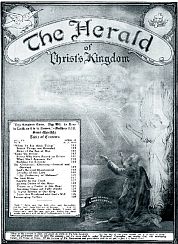
THE HERALD
of Christ's Kingdom
VOL. XIV. May 1-15, 1931 Nos. 9 - 10
Table of Contents
Liberty,
the Heritage of the True Church
The
Simplicity of the Early Church
The
Chambers of the King
The
Coming of the Lord to His Temple
The
Present Mission of the Church
Holding
Fast to the True Faith
The
London Convention
Encouraging
Messages
A
Message to the Watchers and to Al1 Who Mourn
in Zion
“Stand fast therefore in the
liberty wherewith Christ hath made us free,
and be not entangled again with the yoke of bondage.” -- Gal. 5:1.
CHANGES
events, and circumstances in these days have caused many of God’s faithful people to
re-examine and search the Scriptures more diligently than ever, if possible; to discover
what are the foundation principles of Christian liberty, fellowship, and unity. Let us,
beloved, ever come to the Scriptures, and from them learn the truth about this as well as
every important matter of faith and practice. The final test of the Christian is that of
love, and the spirit of division and sectarianism cannot be retained if the Divine
approval is to be secured.
True liberty
is the first great blessing entered upon when one becomes a follower of the Lord Jesus
Christ. The fetters of bondage are broken, and real liberty, freedom from the bondage of
the guilt and power of sin, is begun (Rom. 5:1; 6:12-14) liberty of conscience, which
requires freedom to examine both sides of a matter pertaining to our Christian life and
service. Indeed, it is a duty to so act so far as circumstances and ability permit.
“He that answereth a matter before he heareth it, it is folly and shame to him.”
-- Prov. 18:13.
St. Paul Warns Against Sectarianism
Christian
liberty signifies freedom from sectarianism, from bondage to sects and parties of men. The
word sect means a division, a part cut off, or cutting off from. It is not sectarianism,
however, to be separated from a sect, for such separation is necessary. Sectarianism is
that spirit and disposition to divide and separate God’s people by setting up creed
fences, or by fixing certain bounds and limits, and by applying tests of fellowship and of
church membership such as have no authorization in the Divine Word. Thus sectarianism is a
separation from the true Church, where alone there is true Christian liberty. On this
Brother Russell very aptly wrote:
“The
first danger against which St. Paul warned the Church was sectarianism; and he was
evidently heeded at the time at least, for no great sects of Paulites or Apollosites
developed. But, as usual, the great enemy, thwarted in one direction, moved to the
opposite extreme, and attempted to insist upon a oneness very different from what our Lord
or the Apostles ever taught. This attempt was to have every recognized member of the
Church think exactly alike, on every minutia of Christian doctrine. This attempt finally
developed into Papacy, where every matter of doctrine was decided by the popes and
councils; and every man who desired to be considered a Church member was obliged to accept
such decisions fully, and to profess that such decisions were his belief, his faith;
whereas they were not his in any sense but that of adoption. They were generally either
blindly received or hypocritically professed with mental reservations. This was not at all
the oneness urged by St. Paul. He urged a oneness of heart and mind, and not a
thoughtless, heartless or hypocritical profession. He urged a oneness such as naturally
results from the proper exercise of the liberty which we have in Christ-to search and
believe the Scriptures, and to grow in grace and in knowledge, every man being thus fully
persuaded in his own mind, and firmly rooted and grounded in the one faith as set forth in
the Scriptures.” -- Z. ‘08-116.
Essentials of Liberty, Unity and Fellowship
There are
seven things associated with the attainment and enjoyment of Christian liberty, unity, and
fellowship. Any additions to or subtractions from these will, proportionately, mar or
destroy these priceless gifts.
We will
mention, first, because it embodies all the others, that of believing in Christ, and
continuing in His Word: “Then said Jesus to those Jews who believed on Him, If ye
continue in My Word, then are ye My disciples indeed, and ye shall know the truth, and the
truth shall make you free.” -- John 8:31, 32.
The second
is that of receiving the Spirit. The Galatian Christians were in danger of becoming
enslaved again in bondage, through, certain teachers who had come among them and who were
teaching them that some additional qualifications were necessary in order to enjoy the
full liberty wherewith Christ had made them free. To warn them against this false teaching
and to recover them, from this error, the Apostle wrote: “O foolish Galatians, who
hath bewitched you, that ye should not obey the truth, before whose eyes Jesus Christ hath
been evidently set forth, crucified among you? This only would I learn of you, Received ye
the Spirit by the works of the law, or by the hearing of faith?” -- Gal. 3:1, 2.
The third
important thing is that of receiving evidence of Divine Fatherhood. We quote: “For ye
have not received the spirit of bondage again to fear; but ye have received the Spirit of
adoption [sonship], whereby we cry, Abba, Father.” -- Rom. 8:15.
The fourth
is that of experiencing the “one baptism.” “Know ye not, that so many of
us as were baptized into Jesus Christ were baptized into His death?” -- Rom. 6 :3.
The fifth is
that of becoming members of the one Body -- the Church. “For as the body is one, and
hath many members, and all the members of that one body, being many, are one body: so also
is Christ. For by one Spirit are we all baptized into one body.” -- 1 Cor. 12:12, 13.
The sixth is
that of being begotten unto one hope. “Blessed be the God and Father of our Lord
Jesus Christ, which hath begotten us again unto a living hope by the resurrection of Jesus
Christ from the dead, to an inheritance incorruptible and undefiled, and that fadeth not
away, reserved in heaven for you.” -- 1 Pet. 1:3, 4.
The seventh
is, that of entering into the enjoyment of a like precious faith. “Simon Peter, a servant and an apostle of Jesus Christ, to them that have
obtained like precious faith with us through the righteousness of God and our Savior Jesus
Christ.” -- 2 Pet. 1:1.
Maintained only through the Spirit
Christian
liberty can be maintained only by holding fast to these seven vital matters, as we
read “As ye have therefore received Christ Jesus the Lord, so walk ye in Him; rooted
and built up in Him, and stablished in the faith, as ye have been taught, abounding
therein with thanksgiving. Be ware lest any man spoil you through philosophy and vain
deceit, after the tradition of men, after the rudiments of the world, and not after
Christ. For in Him dwelt all the fullness of the Deity bodily.” (Col. 2 :6-10.) And
again: “Let no man beguile you of your reward in a voluntary humility and worshiping
of angels [human messengers] … and not holding the head.” -- Col. 2:18, 19.
Those who
have experienced the blessings associated with these seven lines of thought ‘are
bound together by the bonds of fellowship and unity. This blessed liberty, fellowship, and
unity can be maintained only by earnest endeavor, through the Spirit. “I therefore,
the prisoner of the Lord, beseech you that ye walk worthy of the vocation wherewith ye are
called, with all lowliness and meekness, with long-suffering, forbearing one another in
love; endeavoring to keep the unity of the Spirit in the bond of peace.” (Eph.
4:1-3.) It will require earnest endeavor because Satan has his counterfeit of these and is
ever seeking to lead away from the true to the false. This blessed unity, fellowship, and
liberty will require making use of al1 the gifts of the Spirit possible. “Wherefore
He saith, when He ascended up on high, He led captivity captive, and gave gifts unto men .
. . . He gave some apostles, and some prophets, and some evangelists, and some pastors and
teachers; for the perfecting of the saints, for the work of the ministry, for the edifying
of the Body of Christ; till we all come in the unity of the faith, and of the knowledge of
the Son of God, unto a perfect man, unto the measure of the stature of the fullness of
Christ.” -- Eph. 4:8-13.
These seven
foundation truths are all that is necessary to enjoy this ‘blessed fellowship, unity,
and liberty. The Apostle mentions them altogether. “One Body, and one Spirit, even as
ye are called in one hope of your calling; one Lord, one faith, one baptism, one God and
Father of all, who is above all, and through all, and in you all.” -- Eph. 4:2-6.
The
Apostle’s words may be summarized as follows:
(1) The Author of unity -- “One
God and Father.”
(2) The Center of unity -- “There is one Lord.”
(3) The door of unity -- “There is one baptism.”
(4) The kinship of unity -- “There is one Body.”
(5) The nature of unity – “There is one Spirit.”
(6) The goal of unity -- “There is one hope of your calling.”
(7) The creed of unity -- “There is one faith.”
What Is the One Faith?
It is very
often along the line of the last item above, that Satan seeks to destroy the precious
heritage of the Christian. How important that we should know what is the faith here
referred to. Let us carefully note the following from Brother Russell’s pen:
“The
one faith, which all should hold, was a very simple one; one so simple that all, the
learned and the unlearned alike, could grasp it and comprehend it, and be ‘fully persuaded in their own minds’
concerning it. It was not a dose of incongruous mysteries, inconsistent with themselves
and inharmonious with reason as well as with the Bible, to be swallowed by the ignorant
with credulity, and by the learned with hypocritical mental reservations: but it was so
simple, so clear, so reasonable, that any and every honest follower of
Christ could be fully persuaded in his own mind regarding
its truth.
“What
is this one faith? The basis of it is stated by Paul, thus: ‘I delivered unto
you first of all that which I also received [first of all -- as a foundation truth or
doctrine, upon and in harmony with which all other doctrines must be built], how that. Christ died for our sins, according to the
Scriptures; and that He was buried; and that He rose again the third day, according to the
Scriptures.’ (1 Cor. 15:3, 4.) ‘There is one God and one Mediator between
God and men, the man Christ Jesus, who gave Himself a ransom for all, to ‘be
testified in clue time.’ – 1 Tim. 2:5, 6.
“This,
in a word, confesses sin and utter helplessness; it acknowledges God’s loving plan
for our redemption; it owns that our Lord’s death was our ransom price; and that
forgiveness (justification) and reconciliation to God, and the restitution of believers,
come as a result of faith in this Redeemer, when in due time it is made known to each and
all.
“These
brief statements contain the whole Gospel, in the same sense that an acorn contains an oak
tree. Without this Gospel kernel, the true Gospel can never be possessed; hence this must be insisted on as a test of Christian
fellowship. This must be received, else the Gospel is not received. When it is received,
the Gospel is received . . . . This true Gospel, this simple faith, easily understood and
confessed by the weakest babe in Christ, must also be, and always, and equally, the faith
of the most developed sons of God. This one faith (and not the endless ramifications and
details of faith which lead out from it) St. Paul placed as a standard or test of all
claiming the name Christian. All the consecrated who agreed on this one standard, or
foundation truth, St. Paul counted as in and of the one Church. While each member was to
grow in grace, knowledge and ‘love, there would always be harmony and oneness in the
faith and fellowship of the Church, if all growth were kept in line and harmony with this
foundation truth.
The Mistake of the Past
“Here
was a perfect basis of union, which allowed for all the various stages of individual development in the truth, and which most
effectually guarded against errors. For if this simple creed were today made the standard
by which all doctrines should be tested, it would speedily lead to the discarding of every
error and to the true union of the Church in the ‘one Lord, one faith, and one
baptism.’
“The
endeavor to compel all men to think alike on all subjects, culminated in the great
apostasy and the development of the great Papal system; and thereby the
‘Gospel,’ the ‘one faith,’ which Paul and the other Apostles, set
forth, was lost-buried under the mass of uninspired decrees of popes and councils. The union of the early Church, based upon the simple
Gospel and bound only by love, gave place to
the bondage of the Church of Rome – a slavery of God’s children, from the
degradation of which multitudes are still weak and suffering.” -- Z. ‘08-117,
118.
“The
true teacher’s place,” said Brother Russell, “and the true Bible
student’s place, is outside of all human bondage, free to examine and feed upon all
portions of the good Word of God, and untrammeled to follow the Lamb whithersoever He
leads.” -- Vol. III, p. 145.
“Every
one who comes to realize the liberty of the sons of God and full freedom from
Babylon’s bondage should expect to meet other attempts of the great Adversary to
bring him into other bondages, or to stumble him. The Lord permits these severe testings,
that the class now sought may be manifested, and prepared for His service in the Kingdom
of glory.” --- Vol. III, p. 188.
“The
value of the true liberty amongst the Lord’s people cannot be overestimated. It
becomes a part of their very life. It was because, under a wrong conception of union, this
spirit of true liberty was crushed out of the Church shortly after the Apostles fell
asleep in death that the ‘dark ages’ resulted, with all their ignorance,
superstition, blindness, persecution, etc. The Reformation movement of the sixteenth
century was but a re-awakening of the spirit of liberty, . . . liberty to think inside the
foundation lines of the doctrines of Christ; liberty to believe as much or as little more,
in harmony with this, as the mental conditions and circumstances will permit, without
being branded as a heretic or persecuted by brethren, either in word or deed.
“Let
all who are the Lord’s people, and who have tasted of the liberty wherewith Christ
makes free, see to it that they stand fast in that liberty, and as soon as an attempt is
made to restrain it, if not sooner, let them get out completely from all the bondages of
human systems, that they may stand firmly, and loyally with the Lord, our Redeemer, our
Instructor, our King.” -- Z. ‘02-170.
The only Real Unity, That of the Spirit
Christian
unity is not simply the holding together of those who see eye to eye in all the minutia of
doctrine and of particular kinds and methods of service; not the holding together simply
of those who are cooperating with one human and necessarily imperfect channel for service;
and not necessarily the making use of those gifts (teachers) who hold to one particular
human channel. Rather, the unity that should exist in the Body of Christ is especially
designated by the Apostle as a unity of the Spirit:
“Endeavoring to keep the unity of the Spirit in the bend of peace.” (Eph.
4:3.) This spirit is seen in its perfection as we note the mind or disposition of Christ
as He manifested it to the Father, to His disciples, and to the world. In this respect we
note that it was a dependent, submissive, prayerful, and loyal spirit in its relation to
His Father, and a gentle, self -sacrificing, and cross-bearing spirit in its relation to
men.
In his celebrated work, “The History of the
Reformation,” D’Aubigne gives a most clear and comprehensive exposition of what
constitutes the basis and substance of Christian unity. Note carefully the following brief
statement to the point:
“Just
as all the members of my body have an intimate and indefinable relation with one another,
because the same life animates them, the same head makes them move, so every Christian
finds himself really and indissolubly united to all other Christians by an identical
relation with the same Savior. This is what is called the ‘communion of saints.’
This communion is not only a system, a doctrine, it is a reality, a fact which exists in the world as certainly as the
union of the members of the same body.
’There
can be really no Christian union in the Church, unless it proceed from the spiritual and
internal fact which I have mentioned. Our part is not to make a Christian union, but rather to recognize it, to exhibit it, to take away the
obstacles which hinder it from having free course. Christian union must proceed first of
all from unity of spirit. The whole theory of
Christian unity is found in these words of the beloved disciple: ‘Whosoever believeth
that Jesus is the Christ, is born of God; and every one that loveth Him that begat, loveth
him also that is begotten of Him.’”
This writer
goes on to warn against the mistake too often made of stressing the importance of outward
unity, in form or appearance merely, when the real inward unity of spirit does not exist.
We quote:
“Farther,
I cannot conceal my fear lest mere unity of form be unavoidably not the manifestation, but
the substitute of internal union. I fear, that when much stress is laid on unity of
ecclesiastical constitution, this unity may be obtained at the expense of the internal
constitution of vital Christianity. The Romish Church is a sad and striking proof of the
danger I point out.”
Some Important Characteristics
Some
characteristics of real unity are: Recognizing but one Head, Christ, as supreme authority
in the Church; making the Scriptures paramount, putting them in the first place, as the
final settlement of all matters of interest to the Church; putting what one might think to
be the very best of helps in a secondary place; making the seven basic truths mentioned in
Ephesians 4:4-6, the only essentials of Christian fellowship; giving every one full
liberty to study and increase in spiritual knowledge, and according to every one the
privilege of expressing in a reasonable manner his belief.
True
Christian fellowship can never be withdrawn from any of those who recognize and experience
the blessings associated with the seven .basic principles laid down by St. Paul. Those who
are in fellowship with the Father and with His Son, Jesus Christ, are our brethren -- ours
to love, ours to serve, and ours to lay down our lives for. The fear of what man may do,
or what of misunderstanding and ostracism may come because of obeying this law of love,
this new commandment, will not deter the faithful from serving or laying down their lives
for the brethren.
“Let No Man Deceive You”
A careful
review of the history of the Church reveals that the methods of the Adversary have often
been to direct the attention of the Lord’s people away from Christ, its true Head, to
some human arrangement -- either to an individual, fellow mortal, self-constituted head,
or to some human concern, lean-made organization, etc. Such person or organization is set
up as the Church’s spiritual teacher and guide in her life and service. As such
procedure is emphatically in violation of the Apostolic teaching, the Holy Spirit does not
operate in or teach through such teachers, and the result is that the professing Church
has been repeatedly overrun with false teachers and teachings, subversive of the truth,
and general apostasy and departure from the faith have come in. It was in order that His
followers should be on guard against such perils that Jesus admonished, “Take heed
that no man deceive you.” Those who profess to be teachers were to be proved by the
infallible word of Christ and the Apostles. The Church was admonished to “Try the
spirits,” the teachings, the doctrines, etc.
“The
mere claim of any man to be a teacher,” declared Brother Russell, “is no proof
that he is one by Divine appointment. That false teachers would arise in the Church, who
would pervert the truth was foretold. The Church therefore is not to blindly accept
whatever any teacher may set forth, but should prove the teachings of those whom they have
reason to believe God’s messengers, by the one infallible standard, the Word of God.
‘If they speak, not according to this Word, it is because there is no light in
them.’ (Isa. 8:20.) Thus while the Church needs teachers, and cannot understand
God’s Word without them, yet the Church individually -- each by himself and for
himself, and himself only -- must fill the important office of judge, to decide, according
to the infallible standard, God’s Word, whether the teacher be true or false, and
whether the claimed teacher is a true teacher by Divine appointment.”
Christ, the Center of Our Unity
On the
subject of Church organization and what it is that unites Christians together in Christ,
we submit the following as a most clear and Scriptural statement, well worthy of the
careful and prayerful consideration of all
“And
then as to the ‘standard’ [around which we gather]: What is it? Is it a
doctrine? Nay. Is it a theological system? Nay. Is it an ecclesiastical polity? Nay. Is it
a system of ordinances, rites; or ceremonies? Nothing of the sort. God’s warriors do
not fight under any such banner. What is the standard of God’s militant host? Let us
hear and remember. It is Christ. This is the only standard of God and the only standard of
that warrior band which musters in this wilderness world, to wage war with the hosts of
evil, and fight the battles of the Lord. Christ is the standard for everything. To have
any other would only unfit us for that spiritual conflict to which we are called. What
have we, as Christians, to do with contending
for any system of theology or church organization? Of what account, in our estimation are
ordinances, ceremonies, or ritualistic observances? Are we going to fight under such
banners as these? God forbid! Our theology is the Bible. Our church organization is the
one Body, formed by the presence of the Holy Spirit, and united to the: living and exalted
Head in the heavens. To contend for anything less than these is entirely below the mark of
a true spiritual warrior.
“Alas!
alas! that so many who profess to belong to the Church of God should so forget their
proper standard, and be found fighting under another banner. We may rest assured it
super-induces weakness, falsifies the testimony, and hinders progress. If we would stand
in the day of battle, we must acknowledge no standard whatsoever but Christ and His Word,
the living Word, and the written Word. Here lies our security in the face of all our
spiritual foes.
Holy Spirit Gathers Us to the Risen Christ
“It is
ever the aim of Satan, as it is the tendency of our hearts, to lead us to stop short of
God’s mark in everything, and specially in the center of our unity as Christians. It
is a popular sentiment, that ‘the blood of the Lamb is the union of saints,’
that is, it is the blood which forms their center of unity. Now, that it is the infinitely
precious blood of Christ which sets us individually as worshipers in the presence of God
is blessedly true. The blood, therefore, forms the Divine basis of our fellowship with
God. But when we come to speak of the center of our unity as a church, we must see that
the Holy Spirit gathers us to the Person of a risen and glorified Christ; and this grand
truth gives character -- high and holy character -- to our association as Christians. If
we take lower ground than this we must inevitably form a sect or an ism. If we gather
around an ordinance, however important, or around a truth, however indisputable, we make
something less than Christ our center.
“Hence,
it is more important to ponder the practical consequences which flow out of the truth of
our being gathered to a risen and glorified Head in the heavens. If Christ were on earth,
we should be gathered to Him here; but, inasmuch as He is hidden in the heavens, the
Church takes her character from His position there. Hence, Christ could say, ‘They
are not of the world, even as I am not of the world’; and again, ‘For their
sakes I sanctify Myself, that they also might be sanctified through the truth.’ (John
17:16, 1.9.) So, also in 1 Peter, we read, ‘To whom coming,
as unto a living stone, disallowed indeed of men, but chosen of God and precious; ye also,
as lively stones, are built up a spiritual house, an holy priesthood, to offer up
spiritual sacrifices, acceptable to God by Jesus Christ.’ (Chap. 2:4, 5.) If we are gathered to Christ we must be gathered
to Him as He is, and where He is; and
the more the Spirit of God leads our souls into the understanding of this, the more
clearly we shall see the character of walk that becomes us. It is Christ’s position
which gives character to the position of the Church, and her position should ever give
character to her walk. The more closely we adhere to Christ, and to Him alone, the stronger and the safer we shall be.
To have Him as a perfect covering for our eyes, to keep close to Him, fast by His side,
this is our grand moral safeguard.”
God Has Delivered His People at Various Intervals
At various
intervals in the history of the Church of Christ, because of certain departures from
primitive simplicity of doctrine and life, it has become necessary for the Lord’s
people to retrace their steps and go back to the very foundation itself. As we all know,
the Reformation in the sixteenth century marked one of these periods. The doctrine of
justification by faith in the sacrifice of Christ, which is the foundation of all true
Christian life and experience, had been lost sight of except by a few; and the testimony
of these few had been almost silenced. When God desires to restore His truth and its
liberty to His people, He usually first causes it to be discovered and worked out in the
experience of one or more individuals and then uses such person or persons to communicate
it to others. The individuals used in the days of the Reformation were such as Luther,
Zwingle, Knox, Calvin, Wesley, and others.
The great
Protestant movement which began so well and was carried forward with such sweeping
success, gradually merged into sectarianism, and instead of advancing in its work of
restoring additional truths to the Church, it culminated in another apostasy. It was the
Divine intention, however, that in these latter days all the “holy vessels”
(precious truths) must be restored to their place in the “temple”; and to this
end God caused another “earthen vessel” to pass through experiences in search
for truth, that qualified him to be the instrument for this great work -- the harvest
work. The movement, under his wise supervision, prospered as had other reform movements to
considerable proportions, and gathered around it many who were greatly blessed as they
learned of God’s love for His creatures.
However,
there was not the faintest intention it! the mind of this servant of God, that another
sectarian organization should grow out of his life work; for the purport and spirit of all
his messages noted foregoing-clearly show that he was emphatically opposed to
sectarianism. He taught that the only ties that should bind God’s faithful together
were, the simple bonds of love and common interest it; the cause of the Redeemer, based
upon the two fundamental propositions of faith in Christ’s redeeming sacrifice and full consecration to do the will of God.
The only object of the organization (a purely business one) which had been formed by
God’s servant when there were but few associated with him, was that of uniting the
efforts and powers of all to bring the precious truths to the Lord’s consecrated and
declare the “good tidings” of the coming Kingdom. No thought of its being a
religious sect ever entered the minds of any in those earlier days. The blessed truths had
come through .God’s servant who made no claim of being anything more than one of
Christ’s footstep followers whose privilege it was to be an index finger pointing the
people of God back to “the old paths.”
Tests Peculiar to These Latter Days
Living as we
are in the closing days of the Church’s history, of which time our Master said, God
would gather out of His Kingdom all things that offend and them which do iniquity, we can
be assured that He would not long tolerate a wrong or sectarian spirit to exist among His
faithful people. And therefore, inasmuch as such conditions are permitted to come in, it
is proper to expect some providential intervention in connection with the interests of His
people, to uncover and expose to view that which would not have His approval, and snake
clearly manifest to the faithful, to how great an extent the evil had taken root.
Many
brethren today who are alert and are watching unto prayer realize that a very grave
situation has developed amongst the body of Bible Students the world over since the
departure of Brother Russell, nearly fifteen years ago. The life work of our dear Brother,
as many realize, has been very largely discredited and set aside. The institution used by
Brother Russell for the dissemination of the Truth has undergone revolutionary changes, so
that its publications, purpose, and activities are altogether of a different character
from those during Brother Russell’s time. Changes in the spirit, teachings, and
service, have rapidly come in, one after another. The spirit of liberty in Christ has been
supplanted by a state of bondage to a human organization. Those therefore who in true
piety and godliness are walking with their Master, hear
His call to
separate themselves from all such unholy association and state of bondage. Such realize
afresh the necessity to stand fast in the liberty wherewith Christ makes free and to throw
off every yoke of bondage, whether instigated by an individual who has exalted himself in
the Church, or by a human organization.
More than
this, such separated ones possessing the spirit of true unity and of the love of Christ
realize the leading of the Master to associate themselves together merely as brethren in
the Lord and as ecclesias after the manner and example of the primitive Church, instituted by Christ and
the Apostles, who recognized no other authority or headship in the Church than that of the
one who said, “One is your Master, even Christ, and all ye are brethren.” Such
devout disciples of the Lord, endeavoring to get back to Apostolic simplicity, will be
exercised by the spirit of tolerance and will not try to bring each other into bondage to
one another’s opinions and private interpretations regarding this or that
non-essential issue or item of the faith ; but will recognize the broad basis for
Christian fellowship and unity as set forth above, namely faith in the precious blood of
Christ and consecration to the Divine will. If ît was important for the disciples of the
early Church to thus adhere strictly to the counsels that were issued by the Holy Spirit
then, it is of equal importance that faithful disciples of Christ today shall heed those
same counsels. They are to- preserve the purity of the faith and tó be exercised unto
godliness, and undergo the transforming influence of the Spirit of Christ. Thus will they
be prepared, in the near future we trust, to hear the Master’s welcome voice and
share with all the faithful of the Age in the unspeakable joys, riches and glory of the
Church Triumphant.
“For one is your Master, even
Christ: and all ye are brethren.” – Matt. 21:8
THUS did
Jesus in the above language present to His followers the profound simplicity of the
arrangements and relationship that He desired to exist among His followers as they should go forth
to carry forward the great commission given them in the beginning of the Age. The
Master’s teachings were most explicit that God had called one Church to be associated
with His Son in the heavenly realm--one Body, the members of which .were all called .in
one hope of their calling; that this Church should have but one Head, one Guide, one
spiritual Ruler, even Jesus, whom He gave “to be the head over all things to the
Church, which is His Body.” Under our Master in the beginning of the Age there were
appointed twelve Apostles, spiritual under-guides to serve the Church throughout the Age,
and these are designated the twelve Apostles of the Lamb, the twelve foundations of the
New Jerusalem, in view of their important positions as spiritual teachers of the Church.
(Rev. 21:14.) Thus in the Book of Revelation, the New Jerusalem -- the symbol of the new
Millennial government, the Church, the Bride united to her Lord -- is very clearly
delineated; and in the picture the statement is most distinctly made that the twelve
foundations of the City are precious, and that in the twelve foundations were the names written of the “twelve
Apostles of the Lamb” -- no more, no less.
No Lordship, Human Channel, or Headship
Nor can we
imagine any need of more Apostles; for we still have those twelve with us -- their
testimony and the fruit of their labors -- in a much more convenient form than had those
who were personally with them during their ministry. The records of their ministries are
with us; their records of the Lord’s words, miracles, etc. Their discourses on the
various topics of Christian doctrine in their epistles are in our hands today in a most
satisfactory manner. These .things are “sufficient” as the Apostle explains,
“that the man of God maybe thoroughly furnished.” Elucidating the matter
further the Apostle stated, “I have not shunned to declare unto you all the counsel
of God.” What more is necessary’’
There is not
the slightest suggestion anywhere, to the Apostles or concerning them, that they were to
be lords over God’s heritage; that they were to consider themselves as different
from other believers, exempt from the operations of Divine Law, or specially favored or
secure as respects their everlasting inheritance. They were continually to remember that
“all ye are brethren,” and that “one is your Master, even Christ.”
They were counseled to bear in mind that it was necessary for them to make their calling
and election sure; :and that unless they obeyed the Law of Love and were humble, as little
children, they should in no wise enter into the Kingdom. They were given no official
titles, nor any instruction respecting special garb or peculiar demeanor, but merely that
they should in all these things be ensamples to the flock; that others seeing their good
works should glorify the Father; that others walking in their footsteps should thus be
following in the footsteps of the Leader also, and ultimately attain to the same glory,
honor, immortality -- partakers of the same Divine nature, members of the same New
Creation.
Their
commission was one of service -- they were to serve one another, to serve the Lord, and to
lay down their lives for the brethren. These services were to be rendered specially in
connection with the promulgation of the Gospel. They were partakers of the anointing that
had already come upon their Master-the same anointing which pertains to all of the New
Creation, all of the Royal Priesthood, and is described by the Prophet, saying: “The
Spirit of the Lord is upon me because He hath anointed me to preach good tidings unto the
meek, . . . to bind up the broken hearted,” etc. In accordance with the Spirit of
Christ in them, and in harmony with their messages, “the Apostles issued neither
bulls nor anathemas, nor threats, but we do find among their loving entreaties such
expressions as these: ‘being defamed, we entreat.’ ‘I entreat thee also,
true, yokefellow.’ ‘Rebuke not an elder, but entreat him.’ -- 1 Cor.
4:13; Phil. 4:3; 1 Tim. 5:1.”
The Primitive Organization not a Sect
It is only
as Christians have humbly listened to the advice of these faithful messengers set in the
Church in the beginning of the Age that they have been able to remain free from confusion
and difficulty on, the subject of the Church’s present organization; and even in our
day when so much has been written greatly elucidating this entire matter, there seems
still to prevail many conflicting opinions among the people whose vision should be
thoroughly clarified by now. But though this subject has been dealt with exhaustively
from time ,to time in these columns, still in view of the prevailing confusion and the
entanglements in which many find themselves today, in bondage to human. authorities and
man-made teachers, it seems profitable and unto the edification of all, that great
prominence continue to be given the various lines of thought that concern the
organization of the Church during its present pilgrimage, and the relationship which the
various members bear toward one another. Since these matters have been so ably treated
by Brother Russell and the true Scriptural view forcefully presented, we are submitting
the following choice selections from “Studies in the Scriptures,” Volume VI:
“It is
to the New Testament that we must look particularly for our directions respecting the
organization and rules of the Church during the days of her humiliation and sacrificing.
The fact that these rules are not laid down in a compact form must not deter us from
expecting and finding that they are, nevertheless, a complete system. We must fight
against the natural expectations of our perverted judgments in respect to laws, and must
remember that the: Church as sons of God are given a ‘perfect law of liberty,’
because they are no longer servants, but sons, and because the sons of God must learn to
use the liberty of sonship and thereby show the more particularly their absolute obedience
to the law and principles of love.
“The
Apostle sets before our minds a picture of the New Creation which illustrates the entire
subject. It is a human figure, the head representing the Lord, the various parts and
members representing the Church. In 1 Cor. 12 this subject is grandly elaborated, and with
great simplicity, the explanation given being that, ‘As the body is one and hath many
members, and all the members of that one body, being many, are one body, so also is Christ
[one body or company composed of many members]. For by one Spirit are we all baptized into
one body [whether Jews or Gentiles, whether bond or free].’ The Apostle proceeds to
call attention to the fact that as the well being of a human body depends largely upon the
unity and harmony and cooperation of all its members, so also it is with the Church, the
Body of Christ. If one member suffer either pain or degradation or disgrace, all the
members are affected, willingly or unwillingly, and if one member is specially blessed or
comforted or refreshed, proportionately all others share the blessings. He -points out
(verse 23) that we seek to cover and hide the weaknesses, blemishes, etc., of our natural
bodies and seek to relieve and help them; and that thus it should be with the Church, the
Body of Christ -- the most blemished members should have special care as well as the
covering of charity -- love; ‘that there be no schism [division] in the Body, but
that the members should have the same care one for another,’ for the most humble as
well as for the most highly favored member. -- Verse 25.
“According
to this the Lord’s organization of the Church is a very complete one indeed; but as
in nature, so in grace -- where the organization is complete there is the less necessity
for splints and bandages. A tree is thoroughly organized and unified from tips to roots,.
yet the branches are not held on by patent fastenings or cords or screws or printed rules
and laws; and so with the Body of Christ. If properly adjusted and harmonized and united
on the lines which the Lord has laid down, there will be no necessity for cords, splints
or screws to hold the various members together -- no need for laws and creeds and human
spectacular appliances to bring them together or hold them together. The one Spirit is the
bond of union, and as long as the spirit of life remains, a unity, a oneness of the body
must remain also, and this will be a strong or a weak union, according as the Spirit of
the Lord abounds.
“The
Apostle goes further, and points out that God is the superintendent .of the affairs of
this organization, the New Creation, which He Himself devised and inaugurated. His words
are, ‘Now ye are .the Body of Christ and members in particular.. And God hath set
some in the Church [Ecclesia, body], first, .apostles; secondly, prophets; thirdly,
teachers; after that miracles, then gifts of healing, helps, governments, divers kinds of
tongues.’ It will be a new thought to many who are used to setting themselves and
setting each other in places of glory and honor and trust and service in the Church, to
realize that God has promised the superintending of this matter amongst those who are
looking to Him for guidance and are directed by His Word and Spirit.”
“Apostles, Prophets, Evangelists, Teachers’
“It is
not reasonable to suppose that God, foreknowing this New Creation before the foundation of
the world, should be so negligent of His own work as to leave His faithful people without
a clear understanding of His will and an adequate arrangement or organization for their
well-being The tendency of the human mind is either toward anarchy on the one hand, or
toward tight organization and bondage on the other. The Divine arrangement; avoiding both
of these extremes, marks out for the New Creation an organization simple in the extreme,
and devoid of everything akin to bondage. Indeed the injunction of the Scriptures to each
individual Christian is, ‘Stand fast, therefore, in the liberty wherewith Christ hath
made us free, and be not entangled again with the yoke of bondage.’ -- Gal.
5:1.”
“The
Lord provides the apostles, prophets, evangelists, pastors, teachers, for the blessing of
the general Body, as respects both their present and their everlasting welfare. It is for
those who are earnestly relying upon the Lord as the Head, the Instructor, the Guide- of
the Church, His Body, to expect, look for and notice His gifts in all these particulars;
and to accept and to use them -- if they would have the promised blessing. These gifts are
not forced upon the Church, and those who neglect them, when offered. experience a
corresponding loss. The Lord set these in the Church at the beginning and thus gave us the
ideal Church arrangement, leaving it to His people to follow the pattern thus set them and
to have proportionate blessings; or to ignore the pattern and to have corresponding
difficulties and disappointments. Let us, as those who desire to be led and taught of the
Lord, seek to learn how He set the various members originally and what gifts of this kind
He has been bestowing upon His people since, that we may thus appreciate whatever gifts of
this character are at our disposal, and may the more zealously avail ourselves of them for
the future.”
As It was in the Primitive Church
Concerning
the apostolic arrangements and primitive organization of the Church Brother Russell
further wrote: “We find today that such an organization as obtained in the primitive
Church -- namely without a sectarian name and without glory, honor, and authority on the
part of a few over the many, and without a division into clergy and laity -- is regarded
as no organization at all. We are happy, however, to take our position amongst these
disesteemed ones, to copy closely the example of the primitive Church and to enjoy
correspondingly similar liberties and blessings.
“As
elders of the Church are all overseers, caretakers, watchers of the interests of Zion,
some locally and some in the broad and general sense, ,so also each, according to his
talent and ability, might serve the flock, one as an evangelist, whose qualifications
fitted him and whose conditions permitted him to go about preaching the truth to beginners
-- finding those possessed of an ear to hear the Good Tidings, etc.; another serving the
flock as a pastor (shepherd), because of special qualifications of a social kind, enabling
him to look after the interests of the Lord’s people personally, individually
visiting them at their homes, encouraging them, strengthening them, holding together and
defending them against the wolves in sheep’s clothing who would bite and devour them.
Prophets also had their special qualifications for service..
“The
word ‘prophet’ is not generally used today in the broad sense in which it was
used in ‘olden times, but is rather understood to signify a seer, or foreteller. The
word prophet, however, strictly signifies a public speaker -- an orator. A seer of visions
or a recipient of revelations might also be a prophet, in the sense of a declarer of the
same; but the two thoughts are distinctly separate. In the case of Moses and Aaron, Moses
was the greater, being the Divine representative, and the Lord said to him, ‘See, I
.have made thee a god [mighty one or superior] unto Pharaoh; and Aaron thy brother shall
be thy prophet’ -spokesman, mouthpiece. (Exod. 7:1.) We have already seen that
several of the Apostles were seers in the sense that they were granted a knowledge of
things to come; we now remark that they were nearly all prophets too, that is, public
orators -- especially Peter and Paul. But there were many other public speakers, or
prophets. Barnabas, for instance, was one; and it is written ‘Judas and Silas, being
prophets [public speakers] also themselves, exhorted the brethren with many words.”
-- Acts 15:32.
Humility Most Essential to Qualification
for Servants in the Church
“There
is no suggestion, in the Scriptures that any’ person disqualified for the work to be
done should be considered the Lord’s appointee to that position for which he lacks
special adaptation; but rather it is as a duty that in .the Body of Christ each member
should serve the others according to his talents -- according to his abilities and that
each should be modest enough, humble enough, ‘not to think of himself more highly
than he ought to think, but to think soberly,’ according to the actual value of the
talents the Lord has bestowed upon him. Neither should the Church recognize those of their
number desiring to be greatest on .that account. On the contrary, they should take
cognizance of humility as being one of the essential qualifications to eldership or to
service in any department. If, therefore, two brethren seem to have equal talent, but one
is ambitious and forward and the other humble and backward, the Spirit of the Lord, which
is the Spirit of wisdom and of a sound mind, would teach the Lord’s people to
appreciate the humbler brother as the one whom the Lord would specially favor and wish
them to put into the more prominent place in the service.
“It
seems less remarkable that ‘goats’ and goat-like sheep in the Lord’s flock
should aspire to leadership, than that the true sheep who recognize the Master’s
voice, who know His Spirit and who are seeking
to do His will, should with docility permit such goats or goat-like sheep to take the
leadership amongst them. It is well that we follow peace with all men; but where we
disregard the Word and Spirit of the Lord for the sake of peace it will be sure to result
injuriously to a greater or less extent. It is well that all should have the docile,
sheep-like nature; but it is necessary also that the sheep have character, else they
cannot be overcomers; and if they have character they should remember the Chief
Shepherd’s words, ‘My sheep hear My voice [obey it] . . . and they follow
Me,’ ‘a stranger will they not follow for they know not the voice of strangers:
(John 10:5, 27.) It is the duty, therefore, of every sheep to take special notice of the
message and the manner of every brother before they aid in putting him .forward as an
overseer, either local or general. They should first be convinced that he has the real
qualifications of an Elder in the Church -- that he is sound on the basic doctrines of the
Gospel -- the Atonement, redemption through the precious blood of Christ, and full
consecration to Him, His Message, His brethren, His service. They should have charity and
sympathy for the weakest of the lambs and for all the mentally and morally lame sheep; but
they would be doing violence to the Divine arrangement to choose such for their leaders or
elders. They should have no sympathy with goats, or with wolves in sheep’s clothing
who, strive for place and authority in the Church.
“Of Yourselves Shall Men Arise”
“It
should be recognized that the Ecclesia is far better off without any public servant than
to have for a leader a golden-tongued. ‘goat,’ who would surely not ‘direct
their hearts into the love of God,’ but seductively into wrong channels. Of such our
Lord forewarned the Church; such the Apostle described, saying, ‘Of yourselves shall
men arise speaking perverse things [wrong, misleading doctrines], to draw away disciples
after them [to artfully attract followers after themselves].’ The Apostle says that
many shall follow their pernicious ways, by reason of whom the Truth will be evil spoken
of. --Acts 20:30; 2 Pet. 2:2.
“So we
see it today. Many are preaching themselves rather than preaching the Gospel, the Good
Tidings of the Kingdom; they are attracting disciples after themselves and their
denominations, rather than attracting them to and uniting them only with the Lord, as
members of His Body. They are seeking to be the heads of churches, instead of having all
the members of the Body look directly to the Lord as the Head. From all such we should
turn away; the true sheep should give them no encouragement in their wrong course. The
Apostle Paul speaks of these as having a form of godliness but denying its power. (2 Tim.
3:5.) They are great sticklers for days, forms, ceremonies, ecclesiastical authorities,
etc., and are highly esteemed amongst men, but an abomination in the sight of the, Lord,
saith the Apostle.”
The True Basis for Christian Fellowship
It is well
remembered that Brother Russell, realizing that the tendency and practices of Christendom
had for centuries been toward a denial of the liberties, rights, and privileges that were
accorded to the members of the Church in the beginning of the Age, repeatedly and most
clearly set forth the Scriptural basis for union and fellowship in Christ. The following
is one of his statements which is recognized to be in every way in full accord with the
New Testament Scriptures:
“Unity
of faith is desirable; it is to be striven for -- yet not the kind of unity that is
generally aimed at. Unity is to be along the lines of ‘the faith once delivered unto
the saints’ in its purity and simplicity, and with full liberty to each member to
take different views of minor points, and with no instruction whatever in respect to human
speculations, theories, etc. The Scriptural idea of unity is upon the foundation
principles of the Gospel. (1) Our redemption through the. precious blood, and our
justification by faith therein. (2) Our consecration, sanctification, setting apart to the
Lord, the truth, and their service, including the service of the brethren. (3) Aside from
these essentials, upon which unity must be demanded, there can be no Scriptural fellowship
--upon every other point fullest liberty is to be accorded, with, however, a desire to see
and to help others to see, the Divine Plan in its every feature and detail. Thus each
member of the Body of Christ, maintaining his own personal liberty, is so thoroughly
devoted to the Head and to all the members that it will be his pleasure to lay down all,
even life itself, on their behalf.”
Christian Liberty in the Apostolic Period
It was on
this broad basis for Christian fellowship that harmony and unity were maintained in the
Apostolic age. We are not to understand that there were no occasions for disputes or
disagreements on various minor points in the early Church. On the contrary, the record
clearly shows that there were points of doctrine and practice on which there was more: or
less of confusion and misunderstanding and that much patience and the Spirit of Christ was
required to maintain Christian unity and love. For example, we learn of certain
dissensions arising in the Church at Antioch. It is remembered that the Church at this
place was the center of Christianity amongst the Gentiles, and Jews born in Gentile lands.
Its Gentile surroundings, no less than its membership, tended to cultivate in it a broad
spirit of Christian liberty; some of its membership, under the influence of brethren who
had come from Jerusalem feared that it had gone too far in the matter of Christian
liberty, and held that Gentiles, upon accepting Christ through faith, should likewise
accept Judaism and the Mosaic Law, and come as fully under the conditions of these,
including circumcision, as though they had been born Jews. Certain brethren who had
recently arrived from Jerusalem accentuated these fears, and as a result there: was quite
a dissension in the Antioch Church, amounting, as the Greek word shows, almost to a
schism, a split. But the right spirit evidently prevailed; because, instead of splitting
over a vexed question, each party respected the conscientious convictions of the other,
and it was wisely determined .to appeal the matter to the Church at Jerusalem for such
words of counsel and advice as its leaders, the Apostles and elders, should see fit to
give. The Antioch brethren evidently had full confidence that Goal had appointed the
Apostles, and that their conclusion on the matter would ultimately be the correct one.
At the same
time knowing that the brethren at Jerusalem were surrounded by the Judaizing influence,
tending rather to narrowness of view as respected the Mosaic customs, they sent their two
leading representatives, -- Paul and Barnabas, to present before the Jerusalem council the
views which seemed to the majority of the Church to be the correct ones, that thus the
entire subject might be fully, fairly, thoroughly investigated, and the mind of the Lord
determined as accurately as possible.
This was a
beautiful spirit --- the right spirit; far more commendable in God’s sight and in the
judgment of sound-minded men than any immoderate course they could have taken. People who
take the immoderate course are generally those who do not have sufficient faith in the
Lord as the real Head of the Church, and in His overruling providence in the affairs of
those who are seeking to know and to do His will -- they are generally those who feel too
much self-assurance; as did even the meek Moses, when he erred in smiting the rock in the
wilderness the second time saying: “Ye rebels, must we fetch you water out of this
rock?”-- Num. 20 :10.
The truth
has nothing to lose by fairness, openness, and a reasonable moderation and the turning on
of all light obtainable. And while the Church at Antioch evidently had great confidence in
Paul and Barnabas, they property also had great confidence and respect for the Apostles at
Jerusalem, and reasoned that since these men all gave evidence that they were truly the
Lord’s special servants and mouthpieces, it would be strange indeed if meeting
together and hearing all that could be said on both sides of the question, they could not
arrive at a unanimous decision respecting the Lord’s will, that would assure the
Church in general. We commend this noble principle which is as applicable now as it was
then. Today, however, as we cannot refer questions to the living Apostles, we must refer
them to the recorded teaching of our Lord and the Apostles, seeking assistance in this
amongst the brethren who appear to have the best knowledge of God’s Word and the
greatest insight into the Divine Plan.
We rejoice
that there was such a spirit of broadmindedness in the early Church as is represented in
the course pursued -- we rejoice that when an important subject was to be considered, with
a view to knowing the mind of the Lord, there was fullest liberty granted for as much
dispute or debate, in a proper manner, as was necessary to bring the whole subject before
those who had it under consideration. .Such full opportunity for freedom of discussion,
within reasonable limits, is absolutely necessary to spiritual health and progress. To
shut it off means to crush proper activities of thought, and in many instances means to
accumulate a force that would ultimately result in an explosion, which would be damaging
in .some respects at least. Let us remember, in this matter; the Golden Rule; and. let us
accord to others differing with us the same reasonable liberty, inside the boundaries of
foundation principles, that we would like to have them accord to us, if our positions were
reversed.
Why the Christian Should Maintain His Liberty
All the
liberty there is in the world today has been paid for: none of it has been attained
without sacrifices. Why? Because selfishness is ,so entrenched in the, race that those who
possess power, authority, privilege, opportunity, would hold these for themselves to the
disadvantage of others, to the, enslavement of others, were not the rights and liberties
fought for. Looking back over the history of nations, without approving of wars, every
reasoning mind can see, nevertheless, that only through wars have liberties come to the
race. The mistake that is being made by many today is the supposition that humanity would
ever be able to attain the condition of absolute, equality and unselfishness through laws
or wars or any other means within the power of Adam’s race.
If the
world’s liberty has required fighting for, much more may we expect to battle, as
those who take the still higher ground of the Bible, and who strive for the “liberty
wherewith Christ makes free.” (Gal. 5:1.) For although this very Scripture declares
that Christ gives this freedom, the Word shows us that He .gives it only to those who
desire it and who will fight for it. Their battle is not to be with carnal weapons which
the law of love forbids, yet their warfare is to he mighty through God to the pulling down
of strongholds of error.
Each Should Think and Decide for Himself
Nor should
it be difficult for us to understand why followers of Christ should be exercised by
liberty, and should carefully guard the same with jealous care. It is as individuals that
Christians are during this dispensation invited to membership in the Royal Priesthood, to
patiently continue in well doing and thus .seek for glory, honor, and immortality. It was
as individuals that Jesus addressed His followers when He said, “I am the vine, ye
are the branches”; again, “Herein is My Father glorified that we bear much
fruit.” Such also are exhorted to work out their own salvation with fear and
trembling.
It becomes
most evident, therefore, that no follower of Christ can make the calling and election sure
for another. It is a thing to be worked out by each individual member of the Body of
Christ; and this is the spirit and teaching of the entire New Testament on the subject. In
order that Christians may make their calling and election sure, each must for himself
learn and imbibe the great lessons of Divine Truth contained in the Scriptures. We cannot
learn these lessons for each other, nor can we build character for each other. For any one
therefore to trust in a fellow-member to do his thinking for him-to decide for him what he
shall or shall not believe, what he shall or shall not practice, is to give up his liberty
in Christ, the very means by which he is to make his calling and election sure. Therefore,
no matter how much we might esteem a: brother, no matter how much confidence we might have
in his judgment and learning, we should never accept any doctrine or teaching merely
because it comes from him; and this reasoning should apply equally to a committee of
brethren in whom we might naturally have confidence. For this reason the readers of this
journal have been repeatedly urged to use their own personal judgment with regard to
accepting what they read, and receive nothing as Truth unless they recognize that it is well
established by suitable and satisfactory Scriptural evidence. The fact that you may not
see and accept every view advanced shall not be allowed to make any difference or
hindrance so far as fellowship in Christ is concerned. Each should accept only so much as
he fully recognizes to be the Truth.
The Church Warned Against Human Headships
The
spiritual individuality of every person should be preserved, and this can be done only by
his personally receiving and digesting the truths of the Divine Word. This is why our Lord
and the Apostles so earnestly exhorted the early Church to search the Scriptures-to make
the Truth their own personally, to know and understand its meaning. Thus the Apostle
points out that one of the important purposes of an individual understanding of the Truth
is that the Lord’s people might be given such a comprehension of the Divine will and
the principles of righteousness that, having their senses exercised, they might discern
both good and evil, and thus experience sanctification by the Truth. The noble Bereans
were especially commended because of such personal search of the Scriptures daily to prove
whether or not those things were true. Nor does our study of the Truth and our standing
fast in the faith signify that we are to contend and stand for innumerable and fanciful
interpretations of the parables, symbols, and types of the Bible, which were never
designed of the Lord as a basis for the Christian’s faith and practice, but were
arranged merely as a pictorial method of confirming truths and facts already known and
understood. Types should never be used to teach doctrines, but to illustrate those already
taught in plain terms. It is on the clear, plain fundamentals of the Christian’s
faith that all should unite. But upon the theories and speculative views of the figurative
expressions of the Scriptures there can be no satisfactory union. Our motto rather should
be, on essentials, unity, on non-essentials, liberty and charity.
In the light
of the foregoing we find that accordingly our Lord and the Apostles sought to put the
Church oil guard against the yielding up of their right and liberty to see the Truth for
themselves, and to settle every matter of doctrine and faith each for himself. Hence, too,
the forceful warnings of the New Testament against submitting to any self-appointed
leaders, or any person or combination of persons who might attempt to lord it over
God’s heritage and to take away the liberty of the sheep.
God’s
people are to be just as much on guard today in reference to these matters as at any time
in the Church’s .history. Any organization of professing brethren, therefore, making
the claim that they are God’s exclusive channel through which truth, must flow to the
rest of the Church, that they are the custodians of the sheep, that they have been set
over the Church as its special authorities and spiritual guides and that they are to
decide all matters of :faith and service, such organization of brethren is surely to be
regarded with apprehension; for such boastful claims, such assumption of authority over
the .sheep is entirely without any Scriptural warrant. Such leaders would only mislead and
enslave the sheep. Jesus says, “My sheep hear My voice, and a stranger will they not
follow.”
Wise Counsel
Of all the
expositions and warnings of modern times on this subject, we believe that none is more
lucid, forceful and to the point than the following given by Brother Russell:
“It has
been well said that eternal vigilance is the price of liberty: and truly it is the price
of every principle of truth and righteousness which we desire to hold; because unceasing
vigilance, art, cunning craft, unscrupulous hypocrisy, and blushing impudence are the
characteristics of Satan, ‘the prince of this world’ (John 14:30; Eph. 2:2),
who, unrecognized by men, is constantly manipulating human affairs, civil and religious,
for the accomplishment of his own diabolical purposes in the enslavement of humanity to
the dictum of ignoble tyranny. …
“We
certainly do not deny, but on the contrary affirm, that the Church should have living
teachers; and that the Lord has raised up such teachers all through the Gospel Age, and
will to its close, to instruct the Church in general by expounding the Word of God,
pointing out and making clear its teachings and bringing forth from the storehouse things
both new and old. But all are not teachers. Teaching, St. Paul declares, is a special
gift. (1 Cor. 12:28-30.) A teacher is one who, being fully consecrated and brought into
submission to the Divine will and enlightened concerning the Divine Plan, God can, and is
pleased to use in instructing His Church. And the basis of such selection may be a keen,
penetrating mind or other naturally or supernaturally imparted endowment and
qualification.
Hold Fast to the Word of God
“We
exhort all God’s true Church -- the one Church -- which includes all consecrated
believers -- to awake to the principles of the Reformation, to a recognition of the right
of individual judgment upon religious questions. Demand Scriptural proofs for all you are
asked to believe; take neither the decisions of Rome, nor those of Westminster, nor those
of any smaller councils, or synods, as final settlements of the question, ‘What is
Truth?’ And be sure that you believe and confess nothing that you do not understand
fully and clearly. To subscribe to, or confess, what you do not understand, and therefore
cannot truly believe, is solemn lying in the presence of God and witnesses, no matter if
it be true that others, by the hundred, have done the same before you. If you did this
once, thoughtlessly, even though it were years ago, in joining a church, now that your
attention is called to it, you are bound to procure a copy of the ‘covenant,’ or
‘articles of faith,’ the belief of which you confessed publicly, and after
careful, prayerful study of it, if you find that you do not so believe, you will be bound
to deny it as publicly as you confessed it, or else forfeit in God’s sight all claim
to honesty.
“Require
of all who shall attempt to teach in the name of the Lord, the exact words of the Lord or
the Apostle which they claim support their teaching. Get the chapter and verse and look
the matter up for yourselves, critically, examining the text and the context. Weigh and
test every item of teaching which you receive as your faith, regardless of how much you
esteem the person who presents it. We know that no fellow-mortal is infallible, and that
His Word is the only standard by which God wishes us to square and measure and build up
our faith.”
In view of
the many lessons from they Scriptures, as well as from history, pointing out the
importance of maintaining the rights and liberties in Christ, none today need be in
ignorance on this subject.
It is
encouraging in these days to find brethren in all parts of the world who have clearly
defined perception with regard to this matter, and in accordance therewith are striving to
the best of their ability to stand fast in the-liberty wherewith Christ makes free. It is
pleasing to note that the increasing tendency on the part of these brethren is to exercise
great care .that they remain free from all human entanglements and bondage. This
disposition is to be most highly commended. All such lovers of the Lord, of His will and
His Spirit are admonished to be of good courage, to wait upon the Lord and He will
strengthen their heart.
“One thing have 1 desired of the
Lord, that will 1 seek after;
that 1 may dwell in the house of the Lord all the days of my life, to
behold the beauty of the Lord, and to inquire in His Temple.” -- Psa. 27:4.
HOW
CONSTANTLY David’s thought was associated with the temple of the Lord ! How his soul
longed, yea, fainted for the courts of God’s dwelling place ; and with what warmth he
confessed his love for the place where the Shekinah glory shone! “Lord, I have loved
the habitation of Thy house, and the place where Thine honor dwelleth.” “As for
me, I will come into Thy house in the multitude of Thy mercy: and in Thy fear will I
worship toward Thy holy temple.” (Psa. 84:2; 26:8; 5:7.) So delightful to his heart
was the hallowed precincts of the house of God that he could. say, “I was glad when
they said unto me, Come, let us go up into the house of the Lord”; and to be a humble
door keeper therein, was immeasurably more desirable than to join in full accord, or dwell
in compromise with the wicked.
In our text
the Psalmist is telling us not only of his great desire to thus abide in the favor of the
Lord, but he emphasizes the reality of that desire by the positive statement, “that
will I seek after.” Evidently he did not believe that dwelling in the Lord’s
house was a matter of easy attainment, or that once having entered that “secret place
of the Most High” special effort would thereafter be unnecessary. Furthermore, he
seems to have clearly recognized that a brief, superficial survey of God’s house,
could never satisfy the soul drawn thereto by the cords of fervent devotion. “All the
days of my life” he visualizes as being necessary to “behold the beauty of the
Lord and to inquire in His temple.” Doubtless he was able to appreciate the fact that
eternal ages will never exhaust the wonders of the Divine character, and that therefore
the inquiring mind might continue to revel in new discoveries, worlds without end.
How We Dwell in the Lord’s House
To dwell in
the house of the Lord, as the term is frequently used in Scripture, represents something
much more than dwelling in some building or place dedicated to His worship. In its larger
sense it represents our dwelling in His favor, our personal enjoyment of contact and
fellowship with Him, living under the shadow of His protecting care. This meaning of the
expression makes possible the thought so frequently intended when reference is made in
Scripture to our progressive growth in spiritual life. As a house is usually a building
composed of various rooms set apart for specific purposes, so also in the house of the
Lord -- the environs of His favor -- there are succeeding chambers arranged, one beyond
the other, where His “favor upon favor” is experienced by the one who will not
only enter, but “seek after” the inexhaustible “joys of His
salvation.” Let us explore these chambers, reviewing the beauties of those already
passed and written into our Christian experience, and meditating deeply upon the present
and future possibilities accruing to us, because our “lives are hid with Christ in
God.”
As drawn by
the mercies of God we entered the Lord’s house, we came in by the “door”
opened by Divine love. No other entrance could have been found whereby any could enter
this vestibule of the King’s chambers, for here alone is the Way, the Truth, and the
Life. Nor, coming as we did with grateful hearts, were we disposed to seek by other means
to assume these sacred privileges. The goodness of. God manifested in His Gift of love,
and the sufferings of the One who bore our guilt and shame, were the magnets that drew us
to that “door.” Love could find no other so precious and all sufficient. And in
this connection it might be well to observe that much of the joy that comes from a sense
of full forgiveness is lost to many, because they have failed to understand the
fundamentals of true repentance.
Godly Sorrow Worketh Repentance
The term
true repentance cannot be defined as being chiefly a turning from sin, brought about
perhaps by deep regret for a wasted life, or because some word of Scriptural exhortation
may have brought the better qualities of the mind into action, resulting in making the
evil practices loathsome, and turning the mind to higher things. Godly sorrow, which is
real repentance, springs from a quickened sense of how the love of God has been set at
naught and offended. For an illustration of this we think of David’s penitent tears
as he sorrowed over his great sin and sought forgiveness. “Against Thee, Thee only, have I sinned,
and done this evil in Thy sight.” (Psa. 51:4.) It is therefore self-evident that the
one who cultivates the habit of merely generalizing his sins of omission and commission,
and with little thought concludes his prayer with a request for forgiveness, can never
know this deep joy of which we write. Did not Jesus teach this when He said, “Her
sins which are many, are forgiven; for she loved
much: but to whom little is forgiven, the same loveth little.” (Luke 7:47.) We
cannot miss the point. The self-righteous Simon thought lightly of his guilt, but the
truly repentant Mary was broken by her sorrow, and as a result she carried away a joy of
sins forgiven to which Simon was an utter stranger. And so it is with us, this precious
“door” by which .we enter will be appreciated just in proportion as we lament
our sin, and loathe its contamination. Thank God for the “door” by which
“we have access by faith, into the grace wherein we stand, and rejoice in the hope of
the glory of God.” (Rom. 5:2.) So we “enter His gates with thanksgiving, and
into His courts with praise.” -- Psa. 100:4.
In the Beginning God
The genesis
of Christian experience begins with God. “In the beginning God.” Superficial
thought may more frequently center around the supposition That the beginning of a
righteous life is dependent upon some initial step that we take toward God, but a little
consideration will show that it is only as we come to know what God has already done for
us, that we are influenced at all toward the life of love and gratitude. Let the Apostle
be our guide as we review this first chamber, and let us be attentive to the order
followed in the explanations given of its meaning, and its fulfillment in our experience.
He will first draw our attention to a very dark background, so dark and void that the
first word that-must be spoken is the word that broke the darkness which enveloped the
shapeless earth
“Let
there be light.” In that dark background we will see that regardless of any measure
of inherent goodness we might yet retain, or regardless of how high or low we might be on
the plane of respectability or in the life of the benighted savage, we are no higher in
social standing than convicts, and further removed from fellowship with God than the most
menial slave from social intercourse with his master. “There is none righteous, no
not one.” “All have sinned”; “sold under sin”; “children of
wrath”; “become altogether unprofitable”; no man able to deliver himself or
to redeem his brother. Truly this is a dark picture, well calculated to humble the pride
of man and turn his thoughts to the only source of help -- “the God of all
grace.”
With this
background intelligently comprehended, we are now prepared to feast our .eyes upon the
things that reveal the matchless love of God, the works of God that draw us to Him.
“When there was no eye to pity and no arm to save, His eye pitied us and His arm
brought salvation.” “While we were yet sinners, Christ died for us.”
“Herein is love, not that we loved God, but that He first loved us.” “Who loved us and
washed us in His own precious blood”-not washing us and then loving us, but loving us
first and then washing us. “God so loved the world, that He gave His only begotten
Son” -- all this while “‘we were enemies through wicked works.” Truly
we may sing:
“I’ve
found a friend; O! such a friend!
He loved me ere I knew
Him;
He drew me with the cords of love,
And thus He bound me to
Him.”
Let us not
hasten from this chamber, for it is here that we begin to experience those influences that
will bind us to Him with “ties which naught can sever,” holding us fast as the
willing bond-slaves of Jesus Christ. We must linger long enough to grasp much of the
stupendous cost of our redemption from sin and death, if we would be prepared to
understand the sublime condescension of that Divine love which passed- by angels, and
chose for dwellers in these hallowed chambers, the sons of men, members of a fallen race.
Love Divine all Love Excelling
Let us, in
mind, watch the great drama of love unfold. In eternity past God was all alone, complete
in Himself, with all of love bound up in His own being-a love so full, so predominant,
that it becomes the chief component of His character. “God is love.” But love
must find expression in active operation, and so God’s love found its first
opportunity in “the beginning of the creation of God,” the Logos. And how this
Firstborn of all was loved by the Father -- daily His delight, rejoicing always before
Him.” Then through Him Love’s expression expanded on and on through all the
works of creation, with man as its climax. But in due time sin enters and man is fallen.
Love is now to have its fullest possible expression. One day there is an absent one from
the circle of heaven’s hosts. Perhaps there was wonderment and surprise, for it may
be that the Father had not disclosed His Plan to any but the Son. But later they find Him
-- “found in fashion as a man.” Surely they marveled as they beheld His humble
estate -- then the rejection, the shame, and the ignominy; finally upon the air is heard
the cry of a broken heart: “My God, My God, why hast Thou forsaken Me?”
Human
language could never describe the wonderment of heaven over these events. But, beloved
have they not had still greater cause for amazement in what they witness now? Must they
not wonder again and again that the human heart cal remain so little affected by these
things? Are they surprised that some of us think so lightly, and so seldom, of a sacrifice
so great as that of tile Father and the San oil our behalf?
“How
greatly He must have loved us! It was love, and only love, that kept Him standing at the
bar of Pilate, bending beneath the scourge of the soldiers, hanging in apparent
helplessness on the cross. Not the iron hand of relentless fate; not the overpowering
numbers or closely-woven plots of His foes; not the nails that pierced His quivering
flesh. No, it was none of these. It was not even the compulsion of the Divine purpose. It
was His own choice, because of a love that would bear all things if only it might achieve
redemption for those whom He loved more than Himself. ‘He loved me, and gave Himself
for me.’
“Surely
we may trust that love. If it moved Him to endure the cross and despise the shame, is
there anything that it will withhold, anything that it will. no-t do? His love is stronger
than death, and mightier than the grave. . . . To believe and accept it is eternal life.
To dwell within its embrace is the foretaste of everlasting joy. To be filled by it is to
be transfigured into the image of God Himself.”
Are we
privileged to be one of the called? If so, what emotions have such visions of the love of
God, and of the sacrifice of Jesus stirred within our souls? All, there could be but one
answer from a grateful heart: “Here, Lord, I give myself away, ‘tis all that I
can do.” Take my life, and let it be filled with a consuming devotion to the love
that bought me “Take myself –- I wish to be ever, only, all for Thee.” And
as He invites us into the succeeding chamber of consecration, He who can read our hearts
has already heard its alert response: “Gladly will I toil and suffer, only let me
walk with Thee.” Blessed eagerness of a heart in love with Jesus.!
The Chamber of Consecration
As we read
the Gospel records of our Lord’s ministry, how often we meet the words, “If any
man will come after Me,” or expressions of similar import. And as we read, we observe
that these words were often very much misunderstood, even by His disciples. On one
occasion at least, they show that their understanding was very limited. They had doubtless
heard Jesus several times teaching this ‘abandonment of earthly possessions as being
necessary to discipleship, and they were satisfied that they had fully complied with the
requirements; hence they ask, “Lord, we have
left all to follow Thee, what therefore shall we receiver” They had left all, and they had followed Him, that was all settled; now the
thing of special interest was the reward for having left a few boats and their fishing
equipment, a position as tax collector, and other occupations.
For the
moment Jesus accepts their claim as true, and He does not attempt to explain that as yet
they had only begun to come after Him, knowing so well that later on when full
understanding came, they would follow to the utmost bounds. But as we are about to enter
this chamber we may well pause to inquire of our own hearts as to how clearly we
understand what is really comprehended in the word consecration. It may be that we too
have need of a much fuller comprehension of a term so full of meaning. Perhaps we may even
wonder if we could truthfully say, “Lord, we have left all to follow Thee.”
The
rudimentary features of consecration are, we believe, well understood by Bible students.
We have no need therefore to be taught that it involves our talents of money and time, the
sacrificing of our earthly hopes and prospects, the complete setting of ourselves apart to
the service of God. Neither do we need to be taught that much of suffering, reproach, and
death will he our portion, if we are loyal to the Lord and His Word. But as we lingered in
the first chamber long enough to feel the drawings of love and gratitude, we recall. that
all such things as earthly possessions counted for little, if only we might follow where
He leads. So now we leave these first principles of consecration, and go on to perfect our
understanding of the secret forces that make such a life a joy and delight.
Consecration Scripturally Defined
Consecration,
in its primary meaning, is devotion to the will of God, and this devotion means strong
affection, ardent love. This is what Jesus meant when He said, “For their sakes I
consecrate Myself, that they also may be consecrated in truth.” (John 17:19, R. V.)
His great desire was that the same passion that filled His own heart, and the zeal that
consumed Him, should always be perpetuated in the lives of His disciples. He desired that
they should not just gather at His table, but that they should go forth to live His life,
showing forth His death until He come. Looking carefully at the life of Jesus we find that
His strong affection and ardent love were the dynamic forces that controlled Him, and this
is full of significance to us. The reason consecration is
so often thought of as being-chiefly a matter of cross-bearing, self-denials, and
sufferings, is because so many have never lifted it out of the realm of their own petty
doings, into the sublimer realms of love’s opportunity. It is because they are
lacking in strong , ardent love and affection. Think of Jacob as illustrating the point:
Seven long years he served for his beloved Rachel, “but they seemed to him but a few
days, for the love he had to her.” How uncomplimentary it would have been to the
object of his love, had he thought otherwise.
We talk much
of the “narrow way that leads to life,” but by failing to grasp the true meaning
of this descriptive term of Jesus, we again associate the terms “narrow way” and
“consecration” with restriction and confinement, as though their real meaning
was painful limitations rather than superabundance. Jesus walked the narrow way and
therein we are privileged to walk also. But let
us note carefully that the way is not “narrow” to the true child of God, but is
full of delights and hidden treasures. It is narrow in the sense that the carnal mind can
find no pleasure within its confines, but those who walk with Jesus in this way, know that
there are no compensations in the broad way comparable with the realization that by
walking in this way they have been brought out into “a large place.” Thus it is
that after a time the soul’s desire is, not to continue in the narrow way from a
sense of duty, but because there only, the heart’s desires are satisfied. How
restricted, how limited, the spiritual man would feel, if confined to the supposed broad
limits of the pleasure-loving way! How his soul would yearn for the freedom and the
fullness of the narrow way of life!
Remembering
then that love of Jesus is the spring of true consecration, we will learn to revel in the
thing we find in this chamber and, so doing, it will be with us as it was with Him -- His
strong, ardent love for God made His consecration experience a joy and delight. “I
delight to do Thy will, O My God.” “And when He had given thanks, He took the
cup.” So it was with Paul, his love lifted consecration out of the sphere of duty
into the category of God’s greatest favor to grateful hearts. Thus we learn to
appreciate the reality and force of all that the Scriptures teach us of the sufferings,
self-denial, and cross-bearing that will follow full consecration; and we also learn the
blessed ‘truth of our Master’s words, “My yoke is easy and My burden is
light.” They “seem to us as nothing for the love we bear to Him.”
The Chamber of Spirit-Infilling
The entrance
to the chamber of consecration just passed is of course the place of Spirit-begetting. It
is there that we present ourselves, all we have, all we are, and ,all we hope for as human
beings, through Jesus Christ our Lord. It is there that we are accepted of the Father,
begotten to the new nature, and made prospective members of the Bride of Christ. But we
may properly make a distinction between an initial begettal of the Spirit, and the fuller
operations of that Spirit in the Spirit-filled life, by putting the chamber of
Spirit-infilling beyond the one we have just examined, bringing our justification and our
consecration joys and privileges with us.
It is a
matter of regret that the moment the Spirit-filled life is spoken of, so many immediately
associate thoughts of something vague and theoretical. Because of an entire
misunderstanding, a prejudice against such an experience has been developed, until the
advocate of the Spirit-filled life is rated a well-meaning but impractical enthusiast. But
let us hope that our sojourn in this chamber, surveying its dimensions, and learning how
to have its fullness duplicated in our experience, will disabuse our minds of unscriptural
theories, and permit us to know whereof we speak when we-talk of the witness of the Spirit
within.
In these
days when there seems to be a special danger of substituting belief for spirituality, it
is manifest that a knowledge of this question is of supreme importance, for many are
confusing elementary knowledge with what we are authorized by Scripture to call, a
Spirit-filled life, and it is essential that this distinction be recognized.
For the
purpose of illustrating the point, let us refer to the disciples prior to the outpouring
of the Spirit at Pentecost. These men had declared their faith in Jesus as the Messiah,
tile Son of God. They knew Him and believed His
teachings, but as yet they were far from being what He knew would be their condition later
on. They were in close bodily contact with Jesus, witnessing His example, hearing His
instructions, enjoying intimacies and opportunities of an exceptional character, yet
notwithstanding all, Peter remains. “unconverted,” incapable, inefficient.
Likewise the others. For three years or more they had the most pointed rebukes, the most
effective instruction, and the most complete and forceful example of a virtuous life, and
after all is over what do we find? We find that neither Christ with them, nor Christ
sacrificed for them, availed to accomplish that marvelous transformation which came to
them subsequent to Pentecost.
But this
does not surprise us when we linger long enough to inquire what Jesus meant by His
statement to them, “It is expedient for you that I go away; for if I go not away, the
Comforter will not come.”‘ The expediency was an absolute necessity, for without
the power of the Spirit invigorating them they must remain permanently inefficient. With
these facts before us, it is not difficult to observe that even Spirit-begetting must be
followed by Spirit-infilling or the life will remain a fruitless, powerless, joyless
experience, without inspiration, objective, or worthwhile results. How futile then are the
hopes of those who limit their hinds to the mere rudiments of doctrine respecting what the
Holy Spirit is, and a multitude of definitions respecting its operations -- who live in
the round of comparisons ‘between their views and those of others who may believe
that the Spirit is a third person of a mysterious trinity. How can we know anything
about the Spirit-filled life until we definitely expect the fulfillment of the promise,
“Ye shall receive power, after that the
Holy Spirit is come upon you” (Acts 1:8), and then studiously apply ourselves to the
business of understanding what we are to expect?
Be Ye Filled with the Spirit
The only
life that can be properly called an overcoming life is that life which is actually filled
and controlled by the Spirit. On this point Paul is quite emphatic. “This then is
what I mean. Let your lives be guided by the Spirit, and then you will certainly not
indulge the cravings of your fallen natures.” (Gal. 5:16, Weymouth.)
The though,, is clear, the incompatibility of the Holy Spirit with the desires of the
flesh make it impossible for both to dwell in the heart at the same time; therefore when
the Spirit fills the heart, it becomes literally true, “You will certainly not
indulge the cravings of your lower natures.” And this does not apply solely to
depraved nature’s wrong desires, but also to many of its otherwise legitimate
enjoyments. Do we smile indulgently at the brother who is ready to tell us that “the
Lord took away my craving for liquor or
tobacco” or “the Lord took away my
desire for worldly amusements’ and think of him as being tainted with some
questionable faith-healing hallucination? If we are so disposed, let us be sure that we
really understand our brother’s experience. There is a possibility that he may be a
living testimony of the truthfulness of the Apostle’s positive statement quoted
above, and a standing rebuke to our own palpable failure to attain a victory over some
petty weakness. What we have failed to overcome perhaps by pledges, or some other energy
of the flesh, our brother has conquered by being filled with the Spirit.
Holy Spirit Given only When Asked for
The
Spirit-filled life begins with prayer. When Paul says, “Be ye filled with the
Spirit,” we immediately think of the words of Jesus, “If ye then being evil,
know low to give good gifts unto your children, how
much more shall your Heavenly Father give the Holy Spirit to them that ask Him.”
(Luke 11:13.) The measure of our infilling will be in proportion to the earnestness we
have shown in prayer. Do we really desire more of this indwelling power? If so, let us
hearken to these words
“If the
Lord’s consecrated people could all be brought to the point where the chief aim in
life, the burden of all their prayers, would be
that they might have a larger measure of the Spirit of the Lord, the spirit of holiness,
the spirit of the Truth, the spirit of Christ, the spirit of a sound mind, what a blessing
it would mean! If then they should wrestle with the Lord until the breaking of the day,
their hold upon Him would be sure to bring the promised blessing. The Lord has revealed
Himself to His people for the very purpose of giving them this blessing; nevertheless He
withholds it until they learn to appreciate and earnestly desire it.”
The Holy
Spirit will not be given in answer to intermittent formalistic petitions, but only when
the vision is fixed on its indwelling as the greatest objective in our religious life.
Therefore the chamber of Spirit-infilling is the place of importunate prayer.
The Spirit Searcheth the Deep Things
There is a
profound significance in the text that tells us of the Spirit’s eagerness to search
out the deep things. “For the Spirit searcheth all things, yea, the deep things of
God.” And when we remember that these deep treasures are beyond the comprehension not
only of the natural man, but also beyond the vision of many in the Church, it becomes the
more important that we understand what is meant. When Paul writes to the Corinthian
brethren, he must forego the deep things: “And I, brethren, could not speak unto you
as.. unto spiritual, but as unto carnal, even as unto babes in Christ.” But there
were others to whom he could go much further in unfolding spiritual things: “Howbeit
.we speak wisdom among’ them that are perfect.” (1 Cor. 3:1; 2:1, 6, 7.) Now the
question remains: Who are the perfect, or mature? For answer we turn to Hebrews 6:1, and
we find that they are those who ha have graduated beyond the first “principles of the
doctrine of Christ, . . . not laying again the foundation of repentance from dead works,
and of faith toward God, of the doctrine of baptisms, and of laying on of, hands, and of
resurrection of the dead, and of eternal judgment.” Not that the Apostle discounted
these important truths, or encouraged a neglect of them, but rather that he yearned to see
the brethren attain that development of mind that would enable them to appropriate the
deeper truths of the Spirit-filled life, and thus attain full manhood .in
character-likeness to the Lord.
All these
“first principle” truths are the framework of the Divine Plan, but the deeper
things are beautifully suggested in the rendering Weymouth gives us of 1 Cor. 2:11:
“For among human beings, who knows a man’s inner thoughts except the man’s
own spirit within him? In the same way, also, only God’s Spirit is acquainted with
God’s inner thoughts” -- that is to say, only such as are mature in spiritual
discernment can understand and fellowship with God in His inner thoughts, and this is
exactly what Jesus meant in the statement we- have already quoted, “If I go not away
the Holy Spirit cannot come.” Jesus with His
disciples for many times three and a half years could never have done for them what He
could do when He came back in the power of His
Holy Spirit to dwell in them, and so it is with
us. When He and the Father have taken up their abode in us, then we do experience the
Spirit-filled life, and become absorbed in the inner thoughts of God.
Are We Carnal or Spiritual Characters
As to where
we stand in this matter of spiritual discernment, suppose we let the Apostle decide. Any
careful student of Scripture must observe the marked contrast in Paul’s address to
the Churches of Corinth and Ephesus. To Corinth he must write in reproof: “And I,
brethren, could not speak unto you as unto spiritual, but as unto carnal, even as unto
babes in Christ. I have fed you with milk, and not
with meat; for hitherto ye were not able to bear it, neither yet are ye now
able.” But to Ephesus he can write: “Wherefore: I also, after I heard of your
faith in the Lord Jesus, and love unto all the saints, cease not to give thanks for you,
making mention of you in my prayers; that the God of our Lord Jesus Christ, the Father of
glory, may give unto you the spirit of wisdom and revelation in the knowledge of Him: the
eyes of your understanding being enlightened; that ye may know what is the hope of His
calling, arid what the riches of the glory of His inheritance in the saints, and what is
the exceeding greatness of His power to us-ward who believe, according to the working of
His mighty power, which He wrought in Christ, when He raised Him from the dead, and set
Him at His own right hand in the heavenly places, . . . and you hath He quickened, who were dead iii
trespasses and sins.” -- 1 Cor. 3:1, 2; Eph. 1:15-20; 2:1.
Ah yes, he
could write to them about the inner thoughts of God, for the Holy
Spirit in them was searching out, and reveling in the deep things of God. Thus being
Spirit-filled they were not like the Corinthians, divided into Paulites and Peterites,
neither were they disputing over meats and drinks, new moons and Sabbaths, etc.,
conducting themselves like babes, but as men of mature mind and clear vision. Thus the
Spirit-filled life is the one effectual fortification against .substituting human
leadership for the Headship of Christ, or substituting the writings of men, however devout
and trustworthy, for the only infallible guide of the Church, the Spirit-inspired Word of
God. To be Spirit-filled is to know the reality that was in the mind of Jesus when He
said, “The water that I shall give him shall be in him a well of water springing up
into everlasting life.” (John 4:14.) What Jesus teaches by this guarantee is, that
where the truth which emanates from Him has its sway in the heart, the life will throb
.with vigor, warmth, and power. Our life will be recognized by its definite relation to
His life, and as His life was one of fervent pulsating devotion to God and His will, so
ours will be lifted out of the mere realm of belief and duty into the energetic, robust,
sacrificing zeal that literally consumes us. It will enable us to respond, as we so
earnestly desire to do, to the possibilities that are definitely related to the purpose of
God in sending the Holy Spirit into our lives. “The stone cannot respond to the embrace of the lichen
which dots its surface with specks of living green, or the ivy which twines its clinging
arms about it, or the butterfly which lights for a moment upon its surface and is gone. Life alone can respond to life, and that which
meets, explains, embraces, uplifts, and in a thousand ways inspires and vivifies the
manifold human life of which we form a part, is living indeed. The reader of Scripture,
then, who believes in ‘the living Word’ will search in all his reading for such
signs of life. He will ask in every chapter and on every page, what are its living
relations with the throbbing life in the midst of which he moves.”
Ye Shall Receive Power
The Bible is
only another book of impractical mysticism and meaningless platitudes, if we cannot
believe that its statements are actually spirit and life to all that hunger for the
conscious realization of spiritual maturity. But God’s Word is not vitiated by our
failure to fully attain its power in our lives. Men have lived its precepts and stand as
exhibits of its verity. God’s Spirit can take of that Word and wash us by its
cleansing influence, until its “quick and powerful” searchlight has pierced
through soul and spirit, joints and marrow, until our meanness and carnality, lukewarmness
and coldness, is shamed out of our hearts, and we are made “an example of the
believers; in word, in conversation, in charity, in spirit, in faith, in purity.”
That Holy
Spirit indwellng our hearts, will set our souls on fire with such án ardent devotion to
the person of Jesus Christ that we Will of a truth lose sight of all besides. It will burn
us up with the missionary zeal that fills the New Testament pages. It will impart to us
such a devotion to the people of God, that our lives will no longer be dear unto
ourselves, because of a fervent enthusiasm to finish the ministry that grace has committed
to us. It will give us such a living admiration for that holy, mature, and vigorous
spiritual unity, and cooperation in the one Body, one cause, and one objective, that will
gloriously deliver us from the petty limits of our own littleness, and make us a burning
and shining light in a Church that is literally crying today, “Show us the Father and it sufficeth us.” It
will make our own individual heart, the soil where all the fruits and graces of the Holy
Spirit may grow, and bloom, and .reach fruition, to the glory of our God, and to our
eternal joy, working in us by the same power that raised our Lord Jesus from the dead.
Amen, so let it be.
“Behold, 1 will send My Messenger, and He shall
prepare the way before Me: and the Lord, whom ye seek shall suddenly come to His temple,
even the Messenger of the Covenant, whom ye delight in: behold, He shall come, saith the Lord of Hosts.”
-- Mal.
3:1.
THE prophecy
of Malachi which concludes the canon of the Old Testament Scriptures, closes with
exhortations and promises respecting the coming of Messiah, for whom the people of Israel
had, at that time, waited for fifteen centuries. His prophecy is in full confirmation of
the predictions of all the Prophets of God who had preceded him. Malachi speaks with
precision, with a definiteness and conviction concerning the coming ad vent of the long
looked far Deliverer and King of Israel (Chap. 3:1-12); the One who should inaugurate a
world-wide Kingdom and reign gloriously, restoring all things.
It required
however the anointing and illumination of the Spirit from above in connection with
Messiah’s First Advent to open up the meaning of the Old Testament prophecies. Thus
in the light of the Spirit’s revelation the messenger mentioned by Malachi is the
Christ -- not the Man Christ Jesus alone, who was pre-eminently the Divine Messenger, but
inclusively the whole Christ, the Church, the Body, the under-associates, with Jesus the
Bead. More than this, the Spirit’s instruction through the Apostolic testimony
enables us to understand that this great Messenger appears in the twofold ,capacity: first
as the suffering One, the sacrificing One, and secondly as the anointed, glorified One,
the King, the Restorer. The work of .suffering belongs to this Gospel Age, the reign of
glory belongs to the Millennial Age. ‘The suffering began with the consecration of
our Lord and Master at the time of His baptism into death. The three and one-half years of
His ministry were so -much of His delivering Himself into death or baptism into death, and
that personal sacrifice Was finished at Calvary. During this Gospel Age, in harmony with
the Divine Plan, our Redeemer has accepted a little flock from the world upon their
renouncement of sin, their acceptance of Him as their justification, and their
consecration of their little all to His service, “to ‘be dead with Him that they
might also live with Him, to suffer with Him that they might also reign with Him.”
Throughout
this Gospel Age this overcoming class, the Church, has been faithfully laying down,
sacrificing, life and earthly prospects and interests because of their love for the Lord
and for the principles of righteousness which He represents. Thus this entire Gospel Age
has been one of suffering. As stated by the Apostle, the Prophets foretold the
“sufferings of Christ, and the glory that should follow.” (1 Pet. 1:11.) The
glory of this great Christ, Head and Body, cannot be ushered in until all of its
sufferings are at an end. Hence, as the Apostle urges, it is for us to appreciate, the
situation and understand our privilege to “suffer with Him,” or “to be dead
with Him,” “to fill up that which is behind of the afflictions of Christ,”
to “present our bodies living sacrifices, holy, acceptable to God, our reasonable
service.” -- 2 Tim. 2:11, 12; Col. 1:24; Rom. 12:1.
The Christ in the Flesh, the Elijah
Again
through the New Testament revelations it is seen that Christ in the flesh, Head and Body,
is the antitypical Elijah, which does a work in the world preparing for and introductory
to the; reign of glory, of the same class, on the spirit plane its the Christ of glory,
Head and Body. The Messenger of Jehovah is the same, though under two different
conditions: first in the flesh, in weakness, in ignominy, in sorrow and pain and dying,
despised and rejected of mien; second, in glory, crowned with all power in heaven and in
earth, establishing righteousness and forcefully subduing and bringing into subjection to
the Divine will every creature and every thing, and triumphing so that finally, by the end
of the Millennial Age, this great Messenger -- by the two parts of His service; first in
.suffering and second in glory -- will accomplish all that the great Jehovah purposed
respecting the race of mankind. By these two parts of His service this great and glorious
Messenger will have prepared the way of Jehovah, will have made straight all the paths,
all the arrangements, all the affairs for the establishment of the everlasting reign of
the Kingdom of heaven.
This brings
us down to the period mentioned by the Apostle respecting Christ: He must reign until He
shall have put all things under His feet. Then the Son, the Christ, having put all things
into subjection, will Himself be subject to, the Father, that the Father may be the all in
all of the universe (1 Cor. 15:28), though the Father graciously and generously provides
that His Messenger -- whose loyalty will have
been so thoroughly demonstrated both by the sufferings of the, present time and the
glories of the age to come -- that this glorious anointed One shall forever be associated
with Him in the everlasting Kingdom, as it is written, “Let all the angels of God
reverence Him.” -- Heb. 1:6.
“The Master Whom Ye Seek”
The word
Lord in this second sentence is not in the Hebrew Jehovah, but signifies master, superior,
teacher. Jehovah is represented as the speaker, who, evidently refers to the Lord Jesus,
assuring those who have the ear to hear and understand that the Messiah whom they seek
shall suddenly come to His Temple. In a certain sense or degree, in a shadowy sense Jesus
at His First Advent offered Himself to the Jewish people “He came to His own and His
own received Him not” -- and He said to them, “Your house is left unto you
desolate.” (Matt. 23:38.) That entrance into Jerusalem, riding on an ass, hailed by
the people with palm branches as the King, the Messiah, the Son of David, and His entering
into the Temple and scourging therefrom the money-changers and merchants, was indeed a
sudden matter, wholly unexpected by the people of that time, and to a certain extent it
fulfilled this prophecy, because that people on that occasion were typical of the great
presentation of Himself as the King, due now to be accomplished on a higher plane, on a
plane of glory, Jesus the Head now presenting Himself, not merely as the King of Israel,
but as the King of the world -- not merely as the Man Christ Jesus, but as the
glorified Christ with His glorified Body, which is the Church.
There is a
difference between the significations of “quickly” and “suddenly.” The
Messiah did not quickly come to His Temple in this larger sense, for over two thousand
years have elapsed .since this prophecy was written, and the Temple itself (“which
Temple ye, are”) is not yet complete, though the living stones for it have nearly all
been chiseled and polished with the adversities of this Gospel Age, and we are now living
in the time when these living stones are being brought together on the other side of the
veil. When the whole work shall have been completed, and the glory of the Lord shall fill
the Temple, the prediction of this Scripture before us shall have its fulfillment. In this
last and final sense the coming to the Temple is not yet consummated in that the
glorification of the Church is not yet complete. It will be a sudden matter in that the
Jews, and others outside the Temple class, will be in such complete ignorance respecting
the entire procedure that the results will be wholly unexpected, a time to them most
sudden.
The Oath-bound Covenant
Our Lord
Jesus was indeed the Messenger or Servant of the Covenant, the One through whom the
Covenant would have its fulfillment. The Abrahamic Covenant, the Oath-bound Covenant, is
referred to. It is the hope of natural Israel and the hope of spiritual Israel, which hope
we have as an anchor .to our souls, sure and steadfast, within the veil. -- Heb. 6:19.
The
Messenger or Servant of that Covenant is the One through whom its provisions will be
accomplished, namely the seed of Abraham -- “which seed is Christ.” (Gal. 3:16.)
Again, we see that this seed has its two developments, one in the flesh, in suffering
ignominy, the other in the Spirit, in power and great glory -- the one to mediate the New
Covenant (which was also embodied in the original Abrahamic Covenant), by offering the
sacrifice of atonement, the other to execute the gracious provisions of that Covenant,
made possible by the, atoning sacrifice. The sufferings of Christ were to seal or ratify
the New Covenant and make it possible for the great Mediator, the Christ Head and Body, to
extend through it blessings to the entire human family, who were under the curse and. who
are. mentioned in the promise to Abraham as “all the families of the earth.”
Again we
note that in the Divine Plan the “Church,” the “saints,” the
“very elect,” the “little flock,” the “Bride,” is associated
by the Lord with both phases of this work, “in the sufferings of this present time
end in the glories that shall follow.” It requires the work of this entire Gospel Age
to seal the New Covenant. The New Covenant is to benefit and bless Israel after the flesh
and all the families of the earth; its provisions are the forgiveness of sins, the
renewing of a right heart in all those who desire to come into harmony with the Lord and a
restitution to them of all that was lost through the original transgression and its curse.
A result of the operation of this New Covenant there shall be no more curse, and tears
shall be wiped from off all faces, and there shall be no more sighing and no more dying
and no more pain, for the former things shall have passed away. -- Rev. 21:4.
Joint-heirs with Him
The Church,
the Bride of Christ, in advance is made partaker reckonedly, by faith, of the benefits and
blessings that will come to humanity through that New Covenant when inaugurated;
justification is reckoned as restitution, although not actually restored or perfected. The
sins of the believer are covered and the consecrated ones are reckoned as new creatures,
even though they still tabernacle in imperfect flesh. The acceptance of the Bride of
Christ is not under the New Covenant, but under that feature of the original Abrahamic
Covenant that promises the seed. The Church is not to be part of those who will be blessed
by the seed but to be associates and joint-heirs with Christ as members of the seed. This
the Apostle distinctly points out, saying, “If ye be Christ’s, then are ye
Abraham’s seed and .heirs according to the promise.” (Gal. 3:29.) If we are
.heirs according to that Abrahamic promise it means that we are members of the seed class,
and that our great mission is the blessing of all the families of the earth.
The Day of His Coming -- As a Refining Fire
“But
who may abide the day of His coming? and who shall stand when Hø appeareth? For He is
like a refiner’s fire and like fullers’ soap, and He shall sit as a refiner and
purifier of silver, and He shall purify the sons of Levi and purge them as gold and
silver, and they shall offer unto the Lord offerings of righteousness.”
Ah! there it
is. The world is anxious for the blessing, but realizes not to what extent the inbred sin
is incompatible with the reign of righteousness which it desires, and in which is the
great blessing God has promised. Before the blessings come, the day of wrath,
the “fire of God’s jealousy,” must pass upon the world. It is not to be a
fire merely to destroy but specially to purify; it is not to be a literal fire but a
symbolical fire, following which the Lord will turn to the people .a pure language, a pure
message, a clear declaration of the Divine will and Plan of Salvation. -- Zeph. 3:8, 9.
The
beginning of the judgment will be especially upon the sons of Levi. The Levites
represented the household of faith, who have made a consecration of themselves to the
Lord. The “more than conquerors,” the faithful of these tried Levites of the
Gospel Church will constitute the Royal Priesthood, the Body of Christ., If it is our
privilege to have some share in the fiery trials at the close of this Age, and at the
inauguration of the new dispensation, let us rejoice in whatever will bring us nearer to
our Lord, in whatever will bring us closer into harmony with Him and His service,
purifying our hearts and arousing our faith and making us all that would be acceptable and
pleasing in the sight of the Lord.
“‘Tis sweet to feel that He
who tries
The silver takes His seat
Beside the fire that purifies,
Lest too intense a heat --
Raised to consume the base alloy
The precious metals, too, destroy.
’Tis blessedness to know that He
The piece He hath begun
Will not forsake till He can see
To prove the work well
done
His image, by its brightness known,
Reflecting glory like His own.
“But ah! how much of earthly
mould,
Dark relics of the mine,
Lost from the ore, must He behold
How long must He refine,
Ere in the silver He can trace
The first faint semblance of His face!
“Thou great Refiner! sit Thou by,
Thy promise to fulfill!
Moved by Thy hand, beneath Thine eye,
And melted at Thy will,
O may Thy work forever shine,
Reflecting beauty pure as Thine!”
“THE PRESENT MISSION OF’ THE
CHURCH IS THE PERFECTING OF THE SAINTS FOR THE FUTURE WORK OF SERVICE; TO DEVELOP IN
HERSELF EVERY GRACE; TO BE GOD’S WITNESS TO THE WORLD; AND TO PREPARE TO BE KINGS AND
PRIESTS IN THE NEXT AGE. -- EPH. 4:12; MATT. 24:14; Rev. 1:6; 20:6.”
THIS
STATEMENT as to the present mission of the Church, taken from the second page of this
journal, has been published editorially and otherwise for the past thirty years and more.
Its expressions are as true and abiding today as when first published. It is important
that we consider well what the Lord would have us do in these latter days, as expressed in
the above summary of the Church’s mission, and then to observe what has been
accomplished by those who have attempted other lines of service than that which the
Scriptures outline.
Directing
our attention to the mission of the Church at the present time, we find it clearly stated
in the Scriptures that first, it is the “perfecting of the saints for the future work
of service.” This is the primary object of the Christian era -- the development of
Christlikeness in the Lord’s people. This is the will of God, “even your
sanctification”; and to sanctify means not only to set apart to Divine service, a
dedication of one’s life to the Lord’s service, but also to make holy, to purify
from sin and all the defilements of the flesh. The Lord’s people are not merely to
attain to standards of morality and maintain these, but additionally are to be developed
as New Creatures; attaining to conditions of spirituality, and this can be reached, only
through the sacrifice of all fleshly, earthly desires and ambitions -- the transformation
of the mind and heart from human considerations to those which are heavenly, as expressed
by the Apostle, “And be not conformed to this world, but be ye transformed by the
renewing of your mind, that ye may prove what is that good and acceptable and perfect will
of God.” (Rom. 12:2.) The knowledge of the gracious arrangements of the Creator has
an ennobling influence, and those who have received the invitation to be joint-heirs with
Christ, are sanctified and purified by the hope placed before them in the Gospel --
“And every man that hath this hope in him purifieth himself :even as He is
pure.” (l. John 3:3.) This purity of heart and mind signifies the putting away, of
all malice, envy, hatred, bitterness, and strife, and the gradual development of the
fruits of the Spirit-meekness, patience, humility, peace, kindness, longsuffering and
love. It is the operation of the Holy Spirit of the Lord through the instruction. of His
Word which enables the consecrated followers of Christ in the daily experiences of life,
fighting the good fight of faith against the world, the flesh, and the Adversary, to
overcome, and to acquire the Christian virtues necessary to an entrance into the Kingdom
of Heaven. And not only is the soldier of the cross to engage in this warfare continually
in his own behalf, but further, as he has opportunity, he is to encourage and assist
others in overcoming, and is to do good unto all men, even to the extent of blessing his
enemies, those who might be in opposition to himself.
No Compromise With Worldly Methods
Notwithstanding
the clear Scriptural statement of the Church’s mission foregoing, there are still
those who ask if we have not now reached a time when the Lord’s people should
undertake lines of service differing from those outlined by our Lord and the Apostles --
in view of changed conditions among men, should we not now change our methods of appealing
to men? Is it not now due time that we compromise with the worldly spirit and with worldly
methods and in fact revise the message altogether, given by Jesus and the Apostles?
Furthermore, are not the hosts of those who are of the “Present Truth” to
consider themselves organized under a human leadership, a visible headship here on earth,
and to think of themselves as “God’s organization” or “Channel,”
already equipped and authorized to deal a death blow to Satan and his organization, and
thus make way for the reign of the glorified Kingdom beyond? In seeking the proper answer
to these questions, let us see to it that our hearts are truly humble and consecrated
before the Lord and that our desire is to know and do only His will and not the will of
any man or system of men; and let us seek an understanding of the platter from the only
reliable source of information, the infallible Word of God.
Going back
to Jesus and the Apostles as the only inspired guides and instructors with regard to all
these questions that concern the present status of the Church and her mission, we find no
word teaching us or instructing any one to attempt to organize the Church in the present
Age, in the sense of the formation of a human system or a humanly organized arrangement
containing only the true Church and eliminating all the tare or fictitious element.
Neither Jesus nor the Apostles attempted to form any such organization. They merely gave
out the Divine message broadcast and allowed it to fall on various kinds of ground, some
favorable and some unfavorable, some producing much fruit and some producing little or no
fruit. It is recalled further that Jesus gave the parable of the wheat and tares to
illustrate the general conditions and circumstances in which the Church would be existing
throughout this Age. The lesson is thus emphasized of the true and the false growing side
by side throughout the Age. Jesus forbade any to separate the wheat from the tares by
attempting to organize the Church above what He and the Apostles through the Holy Spirit
had done. None were to erect denominational lines or fences by creating certain formulas
of belief and courses of service (either written or unwritten) and to make these, tests of
membership in the Church.
But alas,
the instructions of the great Teacher have been sadly neglected. The sectarian party
spirit soon gained control, and soon men began to organize the Church, began to create
barriers, and by their theories and creeds, sought to determine who were of God’s
Zion or “God’s organization,” and who were not. The story is a sad one from
the beginning of these departures in the close of te Apostolic period unto this day. It is
the history of the apostasies, the history of human organizations and systems, some
greater and some smaller-- the history of man’s attempt to order and regulate,
contrary to the Divine instruction; and all because the Church became overrun with the
unregenerate and unconsecrated. The voice of the Spirit of God has found little or no
place.
Where is God’s Zion?
Where has
the true Church, God’s Zion or organization, been all this time? The answer is, it is
impossible to locate the true Church in any one compact body, in any human system or under
any one denominational association. Since they are those whose names are written in
heaven, and since they are those only who are in heart relationship with God by faith and
consecration, they have been known to Him alone. As for God’s organization upon the
earth, there is nothing in the Bible to show that the Church in the flesh would ever be
assembled in one concrete association or organization and constitute exclusively
God’s specially chosen Church. Rather we find from prophecy, including the Book of
Revelation, that the true Church would be a scattered people all through the Age; and no
one was authorized to separate the wheat from the tares, or to try to organize the Church
into one compact body. In fact, we have no picture of the Church, while here in the flesh,
as a complete organization, where the wheat alone are assembled, separated from the tares,
until we look beyond the veil into the glorified state. It is there and then that the
Master’s words apply, “Then shall the righteous shine forth as the sun in the
Kingdom. of their Father.”
Even now in
the end of the Age, when the light is shining more brightly than ever before, none can
assemble God’s Zion or organization into any one denominational or institutional
arrangement through any test whatsoever; none can claim with any degree of evidence or
proof that such as might be thus assembled are alone the Church, and that all outside of
such human organization are excluded from the true Church. All who proceed thus to
organize the Church are doing so in violation of the example and instruction of the great
Teacher, who said that only one was the Master and Teacher of the Church, and all were
brethren under Him.
Some of the Evils of Human Organizations
One of the
outstanding and deplorable conditions. in connection with every attempt to organize
God’s. Zion is that of the exaltation of human teachers. ás lords over the.
heritage. It is always to be observed that such human organizations become overrun by
majorities of the unconsecrated. Ambitious, scheming, and designing men get themselves
placed in the lead and control of the flock, whom they term “God’s
organization,” and who make it their business to mislead the sheep into believing
that they are God’s appointees, special and Divine agents, to direct and instruct the
sheep as to what they shall believe and as to what service they shall perform; immediately
the poor sheep are shorn of their liberty to think or decide on issues or problems. for
themselves or to determine what is truth. Thus as God’s exclusive, anointed channel,
made up of ambitious leaders, it exercises authority over those composing the
organization, who are given to understand that they must obey the behests of those in.
power, and failing to do so, they are threatened” with excommunication from the
Church, “God’s organization,” and turned in the direction of the Second
Death. How long will God’s people not learn that all this procedure and condition are
not the proofs of true leadership in spiritual Israel, but are part and parcel of the
spirit of apostasy, repeated in history time and again. Let him that readeth understand!
Great and Wonderful Works
Another
important consideration is that those who have attempted to organize God’s Zion have
ever displayed great outward activity; “increased in goods,” and “great and
wonderful works” for the Lord, are the boast of all those who have beers set up as
Divine agencies over the Church. Great ecclesiastical activity and “works” is
offered as the seal or proof that they are God’s organization; but such evidence is
turned by the true Word of God into the occasion of their condemnation. Thus. Jesus
foretells how some will ultimately come to Him “in that day,” claiming the right
to entrance into the inheritance of the saints on the basis of great activity, “Have
we not done wonderful works”? etc., etc. And Jesus declares that their wonderful
works will receive no recognition. They will not be rewarded. -- Matt. 7.:21-23.
Every
apostate church system throughout the Age has cited its wonderful works as evidence of its
Divine endorsement. Perhaps the greatest and most formidable of these human systems is the
Papacy, whose record goes far back in this dispensation, the influences beginning in the
Apostolic period (2 Thess. 2:7), that led to its growth, development, and triumph in the
fifth and sixth centuries. As “God’s organization” it has claimed the right
to receive into the Church and excommunicate -- it has pronounced its anathemas upon all
who have denied and rejected its claims. It is well known that the boast of this system
for centuries has been in its great outward show of works. Today its magnificent
institutions of learning, schools, colleges, seminaries, its charitable institutions, its
great and marvelous hospital establishments for the relief of suffering, are cited as
proofs that they are God’s organization. Nor can any one successfully dispute the
claim that from one standpoint there is much of good in their works. There is much of
education in their schools, and a great deal of charity work, and much is accomplished to
relieve the suffering; but all of these wonderful works are contaminated with the vilest
of errors and misrepresentations of Jehovah that at once stamp them with Divine
disapproval, and place them in the classification of “works” that the Master
will not recognize.
Announcing a Mixed Message
Similarly
other attempts to organize God’s Church have come along, of more or less smaller
caliber, but yet evincing the same spirit and citing their works as proof of the Divine
sanction. Each one in its turn has claimed to be God’s Zion, God’s organization
for the accomplishment of His purpose. Each one has erected the denominational fence to
keep out such as will not recognize its claim. Each has taught its adherents to keep their
eyes fixed upon the leaders of
“God’s Zion” as the visible head of the Church on earth, while the real and
only Head, the Lord Jesus Christ, and His teachings have been ignored and set aside. Each
one has made its threats and branded those who have become enlightened sufficiently to get
out of the organizational pen, as heretics and as “going out of the Truth” into
the Second Death. Each has had its network and system of good works – “great and
wonderful works” -- but as in the case of the Papacy, so it has been with all of
these who have followed in Papacy’s footsteps, and have attempted to organize
God’s Church! Their works have been sadly contaminated, their ministry has been that
of proclaiming and announcing a mixed message, a mixture of truth and error; wrongful
interpretations of one portion or another of the Word of God, and misapplication of the
Truth in such a way as to pervert its true meaning to a g: eater or less extent,
dishonoring the Lord, have characterized each of these human organizations, even unto this
day.
Why God’s Children Should “Come out of
Her”
The true
works, of the individual life, the works of piety, godliness, spirituality and love, have
been sadly lacking in the various great and wonderful works of these organizations, and
this in fact is the reason for their condemnation. It is these conditions named foregoing
that have always followed in the wake of every attempt to organize God’s Zion.
Briefly they are: the exaltation of self-styled leaders and channels to take the place of
Christ, the Head; the taking away of the liberty of the flock; the introduction of error;
the substituting of human energy and works for the influence and life of the Holy Spirit;
the neglect 9f the real work of the Church, that of character-building, resulting in
general apostasy. It is these conditions that have made it necessary for Christ’s
true followers, who have had their eyes fixed upon Him as the Head, and not upon any
fellow mortal, to draw apart, to “Come out
of her, My people, that ye be not partakers of her sins, and that ye receive not of her plagues.” These come out that they may
exercise their liberty in Christ, that they may give Christ, who alone is the Head of the
Church, His proper place in their hearts, in their lives, and in their service, and that
they may grow spiritually. These come out that they may have liberty to enjoy the
fellowship of all such of like precious faith, not to form a new organization of Zion
after these various human models from which they have been driven forth, but to
voluntarily associate together under the influence of the Holy Spirit, having no bondage
to hold them together except that bond which united and held in unison the early Church,
the bond that has united all consecrated believers, and bound them together as one in
Christ all through the Age -- the bond of Christian unity and love under the direction of
the Holy Spirit.
In harmony
with the foregoing as to the present state and mission of the Church, attention is called
to the following Scriptural, forceful, and lucid statement by Brother Russell which is
commended to the careful consideration of all:
“THE CHURCH’S DIVINELY APPOINTED MISSION”
“Seeing we have this ministry, as
we have received mercy, we faint not.”
-- 2 Cor. 4:1.
“What
is the mission of the Church? What ministry or service has the Lord appointed to His
consecrated people? This question is one that should be prominent and clear before the
mind of every consecrated child of God. It is of the utmost importance that the servant
know what is expected of him before proceeding far in rendering service; otherwise he will
be more than likely to waste his energies in wrong directions -- leaving undone
those things which ought to be- done, and giving attention to matters which would better
be attended to otherwise, according to the Plan and arrangement of the Great Supervisor of
the Plan of Salvation --- the Lord.
“Although
our sympathies are with every good work, we are at the same time to inquire of the Lord
respecting how, where, what, we may do in His
service, if we would be co-laborers together with Him -- ‘Lord, what wouldst Thou
have me to do?’ Our query should not be addressed to fellowmen, nor should we accept
the burdens and duties and obligations which their judgments and consciences would lay
upon us. Rather, we are to hearken to the voice of the Lord (the Scriptures), and are to
follow His directions, regardless of our own and other people’s conjectures as to
what would be most expedient.
“Nowhere
in the Scriptures are God’s people directed to spend their time in efforts at morally
reforming the world. Our Lord did not engage in this work, neither did the Apostles, nor
did they offer any suggestion to the effect that the work of the Church should ever differ
from the work which they performed and directed us to continue. On the contrary, they
declare that we have the Apostles for ensamples of how we ought to walk. They declare that
our Lord’s course was in full, perfect harmony with the Divine will and Plan, and
that the Apostles faithfully followed His example: and we are exhorted to simply become
coworkers with God in His work, already instituted -- not to alter or attempt to improve
on it. There were moralists and moral reformers in our Lord’s day; some along the
line of total abstinence, some along the line of asceticism, inculcating rigid
self-denials in food, clothing, etc., as essential to a moral uplift of the people. There
were also political reformers, who sought the establishment of republican institutions, in
His day; and social reformers, who sought to establish forms of communism. There were also
dress reformers at that time, who advocated certain peculiar styles of clothing beneficial
to health, morals, and religious sanctity. Do we find that our Lord or His Apostles ever
associated with any of these, or that they ever in any word or act gave sanction or
encouragement to any of these theories or reforms? No, not once.
No Authority for any Change
“If,
then, the teaching and example of our Lord and His Apostles are our criterion of the will
of the Lord, the Church’s commission is not to morally reform the world. But perhaps
some one will say times are changed from what they were and the Church’s work should
change accordingly. We answer that the Apostle Paul declares, in so many words, ‘I
have not shunned to declare unto you all the counsel of God.’ (Acts 20:27.)
Whatsoever, therefore, is additional to that which was stated by the Apostle is not the
counsel of God. And any counsel from any other quarter is not to be received by
Christians, and is sure to be misleading. Again, the Apostle says to Timothy, respecting
the Word of God, ‘All Scripture is given by inspiration of God, and is profitable for
doctrine, for reproof, for correction, for instruction in righteousness : that the man of
God may be perfect, thoroughly furnished unto all good works.’ (2 Tim. 3:16, 17.) If, therefore, it was God’s design that the
Church’s mission should change at some future time, we should be able to find in the
Scriptures some intimation of this kind, and some authority for the change. And if we
find no authority for a change in her mission, we should make no change.
“The
question then arises, If the Church is not to rule the world in this present Age, and if
she is not to be the world’s instructor, uplifter, by moral reforms, what is her
mission -- what other mission can she have?
“(a)
Her chief mission is toward herself. She is to lift up the light in the world-the True
Light -not with the expectation of enlightening Ithe world, not with the thought that her
feeble lamp shall scatter earth’s night of sin and darkness of superstition, for that
can be accomplished only by the coming of the Morning-the Millennial Morning-when the Sun
of Righteousness shall arise with healing in His beams. She holds up the light of the
truth, the light of the Gospel, during this night, to attract some --
‘a peculiar people’ -- not to
attract and gather all, but ‘even as many as the Lord our God shall call.’ (Acts 2:39.) Her message respecting
the love of God and the salvation which is in Christ Jesus, as it rings out into the
world, is not expected to awaken the world and
to lead the world to the Lord. No; she is merely bearing ‘witness’ -- a witness
which will have to do also with a future knowledge and opportunity to be granted to the world during the Millennium.
Only the Few Blessed Now
“She is
instructed by the Word of the Lord not to expect that any but a comparatively small number
will appreciate her light or her message : as the Prophet foretold, so she has found it.
‘Who hath believed our report? and to whom is the arm of the Lord revealed?’
(Isa. 53:1; John 12:38.) As the Scriptures declare, so she finds it, that the vast
majority of mankind are blind, so that they cannot see the light; some are stone blind, so
as to see nothing; while others are partially blind and can get a little glimmer of it by
which they can discern some things indistinctly. In hearing, likewise, the world’s
ears are dull of hearng -- ‘deaf,’ say the Scriptures. Some hear nothing, others
hear very imperfectly, few hear the message of Divine love and mercy clearly and
distinctly. The Church is to realize that her mission is not to these, the blind and deaf,
but to him ‘that hath an ear [to hear, let him hear!’ -- Rev. 2:7; 3:6, 13, 22.
“As our
Lord did not expect many to respond to His preaching, and particularly implied that only a
small number would be able to do so, saying, ‘No man can come unto Me except the
Father which sent Me draw him,’ so His Church throughout this Age is to realize that
when she lifts up the light and lifts up her voice, no man will come in response except as
the Father draws him. And as the Father drew only a comparatively small remnant of the
Jewish nation to our Lord, so the Church should not be surprised that He has drawn only a
comparatively small proportion of Gentiles throughout this Age.
Church Now Bearing Fruit of Spirit
“(b) It
is another part of the mission of the Church to care for those who do see the light which
she holds up, and who are attracted by that light, and who come unto the Lord. She is to
teach and instruct such, and ‘to introduce them to the full fellowship of the high
calling by making clear to them, as the Lord’s mouthpiece, ‘what is the hope of
our calling,’ present and future -- now to suffer with Christ for righteousness sake,
to cultivate His Spirit, His disposition, to bear much fruit of the Spirit in our own
hearts and lives, and thus,, under Divine supervision, to be fitted, polished, and
prepared for a place in the glorious Temple of the future, for a share in the glorious
work of the incoming Age -- the blessing of the world. -- 1 Cor. 1:26; Eph. 1:18; 2 Thess.
1:11.
“The
Church is supplied by her glorious Head, Jesus Christ, with certain gifts of the Spirit,
amongst her member:; of the earth; and these co-working together in their various offices
are to strengthen, establish, upbuild, develop, one another, growing in grace and in the
knowledge and spirit of the Head, until the whole Church shall eventually, by the close of
this Age, be brought to the stature of the fullness of perfection as the Body of Christ,
under the Lord Jesus as the Head. (Eph. 4:13.) But she is not to expect that all, even of
those who see her light, and who hear her proclamation, and who draw near in harmony with
her message, will eventually come into full membership in this glorious Body of Christ. On
the contrary, she is assured of the Lord in advance that, while only a few, comparatively,
will hear her message, the call, a still smaller number will accept the call -- for many
are called, proportionately, to the few who are chosen -- who make their calling and
election sure by faithfulness to the conditions imposed. -- 2 Pet. 1:10.
Crucial Tests of Loyalty
“(c)
The conditions imposed upon the Church are designed of the Lord to be crucial tests of her
loyalty to Him, and to the law of the Covenant under which she was received by Him.
Trials, difficulties, persecutions, are useful in proving whether or not her covenant of
consecration is from the heart: those who have merely made a lip covenant will be sifted
out, manifested, separated from the true ones whom the Lord designates His jewels, and His
sons„ and whom He purposes to make joint-heirs in the Kingdom with His well beloved
Son, our Lord Jesus. It is for this reason that this, call and election, or selection, of
the Church takes place during this present Age, while evil is still permitted to reign in
the world, and while the majority of mankind are under the blinding influences of the
great Adversary, not yet bound.” -- Rev. 20:1-3.
“One of
the particular, trials with many of the Lord’s people is that they are frequently
upbraided by less consecrated, worldly-wise professors, with the suggestion that they are
selfish, and neglectful of the true work of the Church, because they do not join with
others in the various political, social, financial and moral reforms of the world; or in
revival efforts to drive and scare the worldly, whom God has not ‘called’ by the
truth along Scriptural lines. If we are obliged to endure something on this score for
Christ’s sake, it is only a part of ‘the sufferings of Christ,’ in which we
should rejoice, realizing that the Lord knows our faithfulness to Him and to His Word. We
may, realize, also, that in due time others shall see the Divine Plan actually fulfilling,
as we are now permitted to see it by the eye of faith; and they will then see that the
‘wise virgins’ were wise in that they hearkened to and obeyed the Lord’s
Word, and made themselves ready for the future work of service for the world. -- Rev.
19:7; Eph. 4:12.
Sympathy with all Good Works
“We can
sympathize with those who see nothing; we can sympathize also with those who see a little,
and who strive toward moral and other reforms, and in various ways for the sectarian
prosperity rather than for the upbuilding of the saints, the Church of the living God,
whose names are written in heaven. We should have patience, particularly with those who
give evidence that they are laboring in harmony with their convictions. If they are
engaging in good works of any kind, they deserve our sympathy, and undoubtedly will obtain
a blessing as a result. The true Church is laboring not merely for a blessing, but for the
blessing -- the prize of our high calling of God in Christ Jesus.’ (Phil. 3 :14.) Let
all then who see the prize, and who see the light of God’s glory shining in the face
of Jesus Christ our Lord, be faithful to the Father’s terms, conditions, calling,
service. Let all such give attention to this ministry (service) which we have received,
and faint not; be not discouraged, whether men hear or ,whether they forbear; whether they
think ill of us or whether they speak ill of us; let us remember that our report at the
end of the trial is to be rendered to the Lord Himself, when He is making up His jewels.
Let us remember that the first condition of acceptance with Him is loyal obedience to His
Word -- the evidence of love for Him and faith in Him. (2 Cor. 10:5, 6.) Let us remember,
also, that the second qualification He will look for in us is love for the brethren,
readiness to be, to do, and to suffer, to die on behalf of those who are really, truly,
consecrated children of God, seeking to walk in His ways.
“All
thus following in the ministry (the service) which we have received of God, find
themselves today walking in the footsteps of Jesus and the Apostles, and find the various
predictions made respecting the entire Church applicable to its living members also, as,
for instance, following our text, the Apostle declares of this class who have this
ministry:
“‘We
preach not ourselves, but Christ Jesus the Lord; and ourselves your servants [the
Church’s servants, not, the world’s servants] for Jesus’ sake. . . . We are
troubled on every side, yet not distressed; we are perplexed, yet not in despair;
persecuted, but not forsaken; cast down, but not destroyed; always bearing about in the
body the dying of the Lord Jesus [always representing Christ and His sacrifice as dying
members of His Body] that the life also of Jesus might be made manifest in our body. For
we which live [as new creatures in Christ Jesus] are always delivered unto death for
Jesus’ sake [our consecration at the beginning was a consecration to death; it
changes not; it will always so continue, until we have finished our course .and have
actually died], that the life also of Jesus might be made manifest in our mortal
flesh.’ -- Verses 5-11.” -- Z. ‘99-6-11.
Satan Would Mislead the Church
As pointed
out in the foregoing article, the Church commission is a unique one-she has but one theme,
one message to give out, and that is the. Gospel Message. This theme of all who properly
represent the Lord, was well expressed by St. Paul: “‘I determined to make known
nothing among you except Jesus Christ and Him crucified.” (1 Cor. 2:2, Diaglott.) As
bearing upon this particular point, we quote again:
“Similar
[to those of our Lord] are the temptations which Satan presents to the consecrated
followers of Jesus : Make a great show before the world and the nominal church ; attract
their attention by any means, and not simply by the preaching of the cross of Christ;. use
the spiritual powers and blessings that you :have received for doing some great and
striking work; which will appeal to the natural man, and thus secure quick and great
success; do this instead of doing the quiet and
less conspicuous work of presenting spiritual things to the spiritual class, which
work the vast majority ,can in no wise appreciate, but will only shun you, ,consider you
peculiar, and which not only will lose you the sympathy of the mass, but will bring you
specially the hatred of some of the principal professors of Christendom.
“Our
Lord’s utter refusal of every other way of carrying out His mission than the one
which the Father had marked out, the way of self-sacrifice. the Narrow Way, was indeed a
great victory.” -- Z. ‘00-30, 32.
The Real Ministry of the Saints
Again the
essence of our mission is summed up:
“To
follow the Lord’s instruction the Royal Priesthood should first, when discipling,
inform those who have ears to hear that they are sinners, through the fall -- imperfect in
thought, word, and in act, and consequently unacceptable to God and under sentence of
death, extinction; but that God has made a provision for their rescue, and their return to
harmony with Him and to life everlasting; that Christ Jesus, in harmony with the
Father’s Plan, paid the penalty of Adamic sin and condemnation, and thus purchased
the whole race of Adam, and proposes to set at liberty all who obey Him; that now He is
offering release by faith to as many as have the hearing ear -- ‘even as many as the
Lord your God shall call,’ and that such as hear and accept the call may reckon
themselves as ‘justified by faith,’ as having their sins covered, and as being
thus reconciled to the Father through faith in Christ; and that now, if they become
followers or disciples of Christ they may become joint-sacrificers with Him and by and by
be made joint-heirs in His Kingdom and its great work of blessing the world.
“Let us
as the Lord’s people, seeking for the old paths, note well the Master’s
instruction in this connection, and let each one of us who seeks to serve His cause labor
exactly along the lines here marked out-not thinking that his own imperfect judgment or
that of fellow-mortals is superior to the Lord, but to the contrary, that the Lord, the
Head of the Church, alone was competent to give the proper commission which must be
followed implicitly . . . . Let us remember, too, while using all the wisdom we can in
this service, that the Lord’s object in giving us a share in His work is not so much
what we can accomplish as in the blessing that the labor will bring upon us. This will be
an encouraging thought to the dear ones who are engaged in the ‘Volunteer’ work;
and if they find many discouragements and but small results, the reflection that the
Master knoweth them that are His, and that He appreciates every sincere effort made to
serve His cause and to lay down our lives on behalf of the brethren, will give courage and
strength to those who otherwise might faint by the way.” -- Z. ‘01-154, 155,
156.
Our Great Work is beyond the Veil
In the light
of the foregoing we see that the members of the Church in the flesh are to be witnesses
for the Truth, the Glad Tidings of peace and comfort, heralding the coming Kingdom of
Heaven, and that in so doing they will be acting as peacemakers, “pursuing peace with
all, and that holiness without which no man shall see the Lord.” Hence we are not to
suppose that it is a part of the mission of the Church to convert the
world to the principles of Christianity under the present conditions of evil. Nor are we to
get the thought that it is the duty of the Lord’s people to reform or change in any
way the present social, political, or ecclesiastical systems. Nor is it our mission to
undertake to smite them either physically or symbolically. It is not our mission to
intermeddle with the kingdoms or governments of this world, for to do so would be
busy-bodying in affairs in which the Lord has not authorized His people to be engaged. If
the Church were to oppose and smite the present institutions, social or ecclesiastical
then all persecutions or sufferings resulting therefrom would be deserved as those
institutions would have the inalienable right; to defend themselves and to oppose those
who were seeking to injure or to destroy them. Those thus suffering would do so, not on
account of righteousness, but because of mistaken zeal directed along improper channels.
But some one
may say, Does not the Apostle clearly indicate that the Church is to engage in the work of
demolishing the present systems of error, the religious denominations promulgating false
doctrines, when he says, “For the weapons of our warfare are not carnal, but mighty
through God to the pulling down of strongholds.” (2 Cor. 10:4.) We answer, not so,
but that the Apostle was referring to an individual work in the mind of the consecrated
believer. The overthrowing and destruction of the strongly-entrenched errors, or
firmly-established structures of systematic theology contrary to the Truth, is the work
represented in the expression, “pulling down of strongholds.”
It is very
evident that this was the Apostle’s thought when we examine the context, for
continuing, he says, “Casting down imaginations and, every high thing that exalteth
itself against the knowledge of God, and bringing into captivity every thought to the
obedience of Christ.”
We may be
assured that those who proceed, contrary to the Divine commission, to engage in a work of
injuring and smiting present institutions, are sure to involve themselves in serious
difficulties, and generate a condition of mind and heart in which they are easily misled
and deceived by the great Adversary. It is but a slight step from this stage of smiting to
that of smiting the brethren in Christ and devouring one another. The light of recent
events, aside from that of the Scriptures, has demonstrated the truthfulness of this
statement.
When the
Lord’s people are exhorted to “earnestly contend for the faith which was once
delivered unto the saints” (Jude 3), it does not necessarily mean to fight and oppose
all who do not accept the Truth, but that they are to oppose the error in defense of the
faith, and in the spirit of meekness and love, for “the servant of the Lord must not
strive, but be gentle unto all . . . in meekness instructing those that oppose themselves;
if God peradventure will give them repentance to the acknowledging of the truth.” --
2 Tim. 2 :24,. 25.
Let all the
saints of God then, labor on in the work the Lord has assigned them-the work of perfecting
the saints for the future work of the ministry, looking forward to the time when it shall
be said of His glorious Bride: “Let us be glad and rejoice, and give honor to Him:
for the marriage of the Lamb is come, and His .wife hath made herself ready.” -- Rev.
19:7.
“Therefore, brethren, stand ,fast,
and hold the traditions which ye have been taught, whether by word, or our
epistle.”-- 2 Thess. 2:15.
THE LIGHT of
the truth upon the Christian pathway has gradually increased throughout the Christian era
as foretold in the Scriptures. The testimony of Jesus, which is the spirit of prophecy,
has richly illuminated the Divine Message as was promised, so that none of those walking
by faith need falter, nor be dismayed. Such may realize with some of old the force of the
Master’s words, “Blessed are your eyes for they see and your ears for they
hear.” “The path of the just [the righteous] is as the shining light, that
shineth more and more unto the perfect day,” until now in the end of the Age, and in
the dawning of the new day of the Lord, the perfect day, the household of faith is
illuminated as never before.
Every
doctrine of the Holy Scriptures, we believe, has been clearly made known so as to be
generally understood by the Lord’s saintly ones. The Holy Spirit has guided the
devout followers of Christ “into all truth.” (John 16:13.) To a considerable
extent this has meant a revelation of “things to come,” as the Lord promised.
In all the
history of the Church there has not been such a bountiful feast of spiritual good things
as in these last times. Oh, the blessedness of these times when the mysteries of the
Kingdom of Heaven have been laid bare! Through the faithful ministrations of various
chosen instrumentalities who have shunned not to declare the whole counsel of God, we are
permitted to behold what holy men of old, prophets, patriarchs, and many righteous and
devout servants of the Lord endeavored to look into, and were riot able; yea, and which
even the angels from on high desired to understand, but were not granted the privilege. --
1 Pet. 1 :12.
No wonder we
are exhorted to guard the Truth with jealous care, for so great and marvelous is the
Lord’s Message, and so highly valued by Him that He places it on a parity with
Himself, saying, “He that is ashamed of Me and My words, of him shall the Son of Man
be ashamed.” We are warned that it is an easy matter to let go of the Truth, and that
we should with great care endeavor to ‘hold fast’ to it, as the Apostle says,
“Therefore we ought to give the more earnest heed to the things which we have heard,
lest at any time we should let them slip [escape from these leaky vessels].” (Heb.
2:1 -- See margin.) The warning of our Master should never be forgotten: “If
therefore the light that is in thee be darkness, how great is that darkness!” --
Matt. 6:23.
“Who May Abide?”
Every
consecrated disciple of Christ faithfully walking in His steps and in the light of the
Divine Lamp realizes that without doubt we are living in the “last days” of this
dispensation -- near the time when it shall be said “His wife hath made herself
ready.” Every faithful student of Holy Writ knows that our Lord and the Apostles and
Prophets focused their attention upon this particular time, and uttered many messages that
were fraught with the deepest and most solemn significance-messages that warn the
Christian to be vigilant, watchful, and constantly on guard lest he let slip his hold upon
the heavenly treasures and all the exceeding great and precious hopes involved in his
heavenly calling.
Down the
corridors of time there comes the echo of the Prophet’s voice, “Who may abide
the day of His coming? and who shall stand when He appeareth?” The intimation is that
not many will abide, not many will stand-the majority will fall. The reason is given. He
will require such purity, such holiness, that few will come up to His requirements. The
test He will impose will be like fullers’ soap, which is the foe of every spot Upon a
garment white. His requirements- will be like those of a refiner of silver -- all the
dross must be eliminated, in a furnace hot enough to insure its separation. The test will
last a considerable time, for He will sit as a refiner sits, giving close inspection, that
the heat be neither too great nor too little, the time neither too long nor too short.
In the Midst of Fiery Trials Today
While from
the days of the Reformation onward, the sanctuary of the Lord has been undergoing
cleansing, it is to be noted that particularly during the last century a considerable
number of godly men have been used of the Lord to help many to find their way out of
darkness into light, and to take a stand firmly on the side of righteousness, truth and
honesty -- the side of the Lord. Faithful under-shepherds of the Lord have, by their
example and precept and in the most forceful manner, ceased not to warn their brethren in
Christ night and day-yea, and we doubt not that it was often with tears, as they have
looked forward to the closing hours of the Church’s history. In consideration of the
prophetic testimony they have seemed to sense the great trials and tests of faith in the
Church’s pathway. Alas, the Lord’s people throughout the world now find
themselves in the midst of those very fiery ordeals to which the warning messages of the
past have so often pointed forward. The strongest and most subtle tests of the Age are
upon the brethren.
Why the Pastoral Bible Institute Exists
The fiery
experiences above referred to, the painful and distressing circumstances that have
developed amongst the brethren in these recent years, have become the occasion for the
forming of this association of brethren known as the “Pastoral Bible Institute.”
The passing of Brother Russell in 1916, as is well known, resulted in a general crisis in
the work in which we were all engaged. The change in the management and controllership of
the institution conducting the work, meant a complete change in the spirit, policy, and
methods of administration; and in that same connection brethren who had served long years
in association with Brother Russell and who had occupied important positions of trust and
responsibility, were summarily dismissed from their offices and posts of duty for no
reason whatever other than that of their stand in defense of the principles of the Truth,
and the lifework and ministry of Brother Russell, with whom they had cooperated. As a
result of this general sad situation-departures, changes, and innovations many problems,
questions, and issues of the most vital importance, involving the Truth and the liberty of
the people of God, came before the brethren the world over. Out of this crisis and
upheaval that immediately followed, in which many brethren everywhere were deeply
affected, there came into existence this association designated the “Pastoral Bible
Institute”; friends everywhere meeting with practically the same tests of faith and
being called upon to face substantially the same issues and problems, involving their
loyalty to Christ the Head, saw the special advantages of uniting together and forming
this association, and authorizing the publication of a semi-monthly journal and such other
forms and statements of the Truth, as would be within their power. This gathering together
in this arrangement represents an honest endeavor of earnest and sober brethren to
preserve the purity and simplicity of the teaching of Christ and the Apostles, and the
upholding of the Truth in general. More than this, the object of this united effort has
been to mutually encourage and assist the brethren to hold fast to the Truth and to
maintain a proper poise and balance spiritually amidst all the perplexities and confusion
of the present hour; and further that the brethren might, in this manner, more effectually
bear testimony to the Truth, and carry on a work of the ministry to whatever extent it
might please the Lord in the remaining days while we sojourn in the flesh.
For Mutual Assistance
Nor have the
brethren who have been exercising the stewardship of this ministry, taken upon themselves
these offices, privileges, responsibilities, or to any extent sought to act on their own
initiative. It was only after they were appealed to by hundreds of brethren in all parts
of the world that this plan for mutual encouragement and for carrying on a ministry was
formed; one of the provisions being that those whom the friends desired to thus serve and
discharge this responsibility should be elected annually by brethren at large.
As is known
by many, the chief and principal features of this ministry relate to the issuing of a
semi-monthly journal, “The Herald of Christ’s Kingdom,” and otherwise
sending forth the Divine Message in printed form by means of books, leaflets, etc.;
additionally, that of assisting brethren of ability to travel from place to place and
minister the Word of Grace to larger or smaller groups of friends who desire and request
such service. The Lord has very graciously blessed what has been done up to the present
time.
If any are
inclined to ask by what authority is such a ministry undertaken, or have we the ordination
of any human system or arrangement, our reply is that as Bible students we have learned
that all consecrated believers are ordained to the ministry -- anointed of the Lord to
preach; and we are instructed that such need look to no human anointing or authorization
to bear the Message. All who have the spirit of the Lord God upon them as members of the
Christ are anointed to preach; no brother, therefore, or group of brethren, could be said
to have a monopoly over the ministry of the Word.
Known by Their Fruits
But how will
others know that a brother’s ministry is of the Lord, and such as they would be safe
in accepting as having the Lord’s approval? Our reply is that we believe that faithful ministers of the Lord will not need to
make any announcement or proclamation regarding themselves, that they are being used of
the Lord. We believe that they will need to go into no system of argument to establish
their identity as the Lord’s servants or as His instruments of bearing His Truth to
others; neither will it be necessary for them to issue any commands or threats to others
to coerce them into recognizing their authority as the Lord’s mouthpiece. To the
contrary, all who have been anointed of the Spirit of the Lord, and who are properly
ordained to bear the Message, will so display the same in their conduct, and in the kind of message they give out that others
will understand that they are truly representing the
Master and His spirit. Thus, as it was said concerning the Apostles that the people
perceived that they had been with Jesus and learned of Him, so this is still true of the
representatives of the Lord. We are to recognize those who would assist the Church by
their example, their fruits, and by the spirit and message they proclaim.
Since the
starting of this journal, more than twelve years ago, we have been brought into
communication with brethren in all parts of the world; many tell of their pain and
heartaches during the past fourteen years, and of the grace of the Lord that has so
marvelously sustained and kept them through all of their experiences. These also write of
how they appreciate more than ever the Truth, the knowledge of the Lord, the knowledge of
the principles of truth end righteousness, received mainly through the ministration of our
Pastor while he was with us, and that this knowledge is truly. their shield and buckler at
the present time. Others there are who, finding themselves passing through the mists and
shadows of these latter days, and confronted with many perplexities, ask us to point them
to some human channel or instrumentality on which they can lean and trust, and in fact,
inquire if the “Pastoral Bible Institute” or the “Herald” claims to be
a special channel on which they may rely. Our reply to these is, that we have entertained
no thought whatever of this kind. To the contrary, we should regard any such claims,
whether made by us or others, as presumptuous and
entirely unscriptural. We can do no better than remind all, of the Savior’s
instructions on this point: “One is your Master, even Christ; and all ye are
brethren.” The Master thus taught His followers to recognize no supremacy amongst
themselves in the sense that any of their number would have authority and predominance
over the others, except that the Apostles themselves were divinely ordained to be the
twelve foundation stones, and the mouthpieces for the entire Age. Thus, as we read over
the record of the experiences of the early Church, we cannot but be impressed with the
purity and great simplicity of the arrangements by which all were recognized together as
brethren of the one Master. This very fact should teach us that any device or arrangement
that we might set up in the way of a human headship would be contrary to the Lord’s
Word on the subject, and would be sure to work injury sooner or later.
The Divinely Appointed Channels
Notwithstanding
the fact that all the warnings of Holy Writ are against anything in the nature of human
headship, the history of the Gospel Church shows that her greatest failures have been
along this very line. Let us, therefore, dear brethren, note well the lessons of the past
and profit by them. Do not the Scriptures teach that the Great Head of the Church Himself,
is our only source of help? and He has promised to guide and be with His people even, unto
the end of the Age. Concerning the Lord’s arrangement for the guidance of His Church,
Brother Russell said:
“Divine
truth is never found except in the divinely appointed channels; and those channels are the
Lord and the Apostles and Prophets. To continue in the doctrine set forth in their
inspired writings, to study and meditate upon them, to trust implicitly in them, and
faithfully to conform our characters to them, is what is implied in continuing in the Word
of the Lord.” -- Z. ‘03-61.
Some dear
brethren have written us indicating that they are inclined to grow tired and impatient, as
well as doubtful to some extent, because all of the various features and developments that
we were expecting have not come about as rapidly as we had supposed they would some years
ago. We desire to encourage all such to lift up the head, that they grow not weary in well
doing. All the signs about us indicate that the Kingdom of the Lord is even at the door.
If it has pleased our Father to permit us to sojourn here for a little longer time than we
had supposed, let us rather be glad and rejoice in the further opportunity of bearing
testimony to the Truth, and of proving our love for Him by serving Him and the brethren:
Let us consider that if out of gratitude and thankfulness to God we have consecrated our
lives to Him, this consecration is not unto a certain date to which we may look forward,
but until our sacrifice its consumed in death – “Be thou faithful unto death and
I will give thee a crown of life.” -- Rev. 2 :10.
Some have
appealed to us to open the columns of the “Herald” to all who wish to present
their views, no matter how contradictory they may be, or how visionary and far-fetched.
Again we must express our regret to disappoint some along this line. We are living at a
time when there is much confusion existing everywhere. Many voices are appealing to the
Lord’s people from various directions. We do not believe that it would be pleasing to
the Lord to encourage this confusion by helping to sound. these conflicting voices and
printing in these columns all the personal notions and speculations of various brethren,
however well meaning they may be. To the contrary, we believe that the Lord’s leading
rather is that we should exercise great care in whatever is presented before the
Lord’s sheep. The Spirit of the Lord itself would so dictate. We cannot imagine our
Lord or the Apostles taking part in furthering any line of teaching that they did not
regard as truth.
Still there
are brethren who write us, advising that we should now repudiate many of the precious
truths that have been made clear during the past century or so. We are sorry to disappoint
any in this respect, but must plainly state that we have no thought whatever of
repudiating any truth.
Our Message the Old, Old Story
Some have
wondered why we do not undertake to publish some new light on the Bible -- why we do not
bring forth something fresh and startling that no one else ever thought or heard of. We
would say on this point, that we are presenting the truth of the Lord’s Word as fast
as we see it. We do not believe that the Lord wishes us to be looking for and craving
something new and startling. The story of heavenly love is not new; it is many centuries
old. It is the same truth announced by the angels and taught by Jesus and the Apostles and
Prophets.
Nothing in
these remarks, however, is intended to discourage the Lord’s people from walking in
the light, which they are exhorted to do -- of seeing more and more clearly the various
details of the Divine Plan for the establishing of their faith; and for the assisting of
character building. Far be it from us to put the slightest hindrance in the way of the
Lord’s people as they journey in the path of light that is promised to grow brighter
all the way. However, looking at the example and teaching of our Lord and the Apostles we
recognize that the advancement in the light was to be a gradual matter, as promised by the
Master Himself: “He [the Holy Spirit] will guide you into all truth and show you
things to come.”
As for the
special revelation of truth in these last times -- this is in keeping with the foregoing,
and with our Lord’s promise to gird Himself and to come forth at His Second Advent to
serve the household of faith with things new and old. And have we not had most convincing
evidence that the Lord has been fulfilling this promise?
Finally, it
is well for all to remember that while the Scriptures admonish that we seek for the Truth
and seek to make progress in the same, the Word of the Lord just as truly disapproves of our striving to be wise above what is
written. Let us not forget the solemn warning in the last chapter of the last book of
the Bible: “If any man shall add unto these things, God shall add unto him the
plagues that are written in this book.” This warning would seem to be against
everything in the nature of unsound doctrine -- of that which is visionary, speculative,
or fabulous. Nor are the Lord’s people to give heed to those teachers who are unsound
in the faith. We believe that the Apostle Peter tells us what sound doctrine is when he
states that “We have not followed cunningly
devised fables, when we made known unto you the power and coning of our Lord Jesus
Christ, but were eye-witnesses of His majesty.” (2 Pet. 1:16-18.) Neither our Lord
nor St. Peter nor any of the Apostles proclaimed their own guesses or fancies. They gave
only what they were sure was the Divine Message, and such as they were authorized to bear
to others, as they well knew that it was only the truth that would sanctify and’ set
apart for the Divine service. Therefore all the brethren are admonished to “Prove all
things, hold fast that which is good.” “Try the spirits [doctrines,
teachings].” (1 Thess. 5:21 ; 1 John 4:1.) No saint should allow another to do his
thinking for him, but each should seek to be such a developed Christian, and to so
exercise the spirit of discernment, that he will be able to detect the difference between
good and evil, and discern between the spirit of truth and the spirit of error.
The Lord Shall Judge His People
In the first
article of the initial issue of this journal, December 1, 1918, we stated that the spirit
and policy of the “Herald” would be strictly in accordance with the principles
and precepts of the Great Founder of Christianity, who gave us the one universal rule of
action, viz.: “A new commandment I give unto you, That ye love one another.”
(John 13:34.) We have no thought or intention of departing from this standard.
Accordingly, as stated in that issue of this journal, we will not enter into any quarrel
or controversy with those who may choose to view matters differently from us: neither
shall we in the columns of the “Herald” undertake to warn others against such.
We believe that we need not be troubled about any one who may be striving against us, that
we should warn others respecting them. If we have a proper focus on the precepts of our
Father’s Word we should see that the prerogative of judging others is not one that is
given to any of the Lord’s people at the present time. If others, therefore, differ
with us in their methods of teaching and. service, we shall not judge them into the Great
Company class, nor into the Second Death, nor into any condition of disfavor. We shall not
judge them at all! We are sure the Lord is abundantly able to judge His people; and He
assures us that in due time He will bring to light the hidden things of darkness and make
manifest those of whom He approves. Hence it is not for us tò even attempt to say what
the standing or condition of “any one is before the Lord. He is the one who is
dealing with His people; and His Word assures us that He knoweth them that are His. On
this point Brother Russell wisely said:
“It is
not for us at the present time to pass, judgment upon any one. It is not for us to say that this one or that one belongs to
the Little Flock or to the Great Company. According to the. Scriptural instructions,
we know that the Lord will not make public His decision of this matter until the end of
this Age. Then he will make à decision as to those who will receive the higher nature and
those who will receive the subordinate nature. We are all ‘called in the one hope of
our calling’ (Eph. 4:4), and it is for each of us to make our calling and election
sure. Our trials, our difficulties, our weaknesses, are so different that only the Lord will know or can determine who are
worthy. The Apostle declares that He would not even judge himself, let alone others.
There is one that judgeth, even Christ.” – Z. ‘14-38.
In
consideration of all the circumstances, dear brethren; and standing at the threshold of
the Kingdom, what manner of persons indeed ought we to be in all manner of conversation
and godliness! In view of these things, shall we not admonish one another, yea, all the
brethren, to diligence, carefulness, and to patient endeavor to preserve the unity of the
spirit in the bond of peace. Above all, we exhort to great loyalty to the Word of God, and
loyalty to sound doctrine, and to the great and holy principles of truth and righteousness
therein laid down; not forgetting that humility and meekness and patience and love are
most important essentials, and only as we have these largely developed as the controlling
factors of our lives, will we be judged more than overcomers and be given an entrance
abundantly into the everlasting Kingdom of our Lord and Savior Jesus Christ.
Very
encouraging messages have reached us from London, England, informing us of the very
blessed season of fellowship enjoyed at their recent convention. This gathering was
representative of the now very general inquiry for the old paths that is being manifested
throughout the world, and we have special pleasure in publishing the following report
submitted to us by one of the London brethren, which we believe will be of interest to all
“Herald” readers:
It is with
deep appreciation and gratitude to the Heavenly Father that we record the blessings
received at the London Easter Convention, 1931. Truly the Lord’s smile was clearly
manifested -- His children expressed a desire to meet and to encourage others to do
likewise, preparations were made to this end, and the good Giver of every blessing did not
disappoint them.
It was
interesting to renew one another’s acquaintance after a number of years, and with
many, hopes were enlivened, faith strengthened, and the. sweet impulses of love quickened
as the Bread of Life was broken to all. To some the gathering together became an
opportunity to touch as it were the hem of the Savior’s garment in the hope of
finding once again health in the spiritual sense: to others the opportunity was an
occasion to show love and affection, as Mary did of old, to token their gratitude for
deliverance.
Truly the
Lord who delights to open His hand to sup ply the need of His loved ones and reward acts
of devotion and efforts along the lines of a living faith answered prayer. We could see it
manifested in the emotions of joy that would not be suppressed, we discerned it in the
light of the eyes which eloquently pro claimed the love existing between brethren of
like precious faith, and we felt it in the handshakes that grew more and more fervent
towards the close of the Convention.
The hall
itself approached the ideal with regard to its suitability, and it is estimated that about
600 attended the varying sessions. Group photographs were taken and a small souvenir
report proclaimed in memory of the occasion.
Warm
appreciation was manifested at the presence, of our dear Brother I. F. Hoskins of
Brooklyn, N. Y., who spoke with the courage of his convictions on the real need of the
hour. The message he gave was to the effect that. the spirit of truth, the Holy Spirit,
the spirit of faith, holiness, and prayer was now more than ever necessary to enable us to
stand in this evil day, mere Scriptural head knowledge being quite a secondary adjunct.
Brother Carl
Luttichau of Denmark also became one of the speakers and he was listened to with keen
interest on account of his recent experiences.
Messages of
love were received from Pittsburgh, San. Francisco, Sweden, and other parts of the world,
including one from the two Brothers Sadlack who wrote the “Desolations of the
Sanctuary.” In return the following message. was unanimously carried:
“Since
it has pleased the Father of Mercies through His gracious providences to richly bless our
fellowship at Conway Hall, London, we do hereby send our Christian love and greetings to
every individual and all the dear Ecclesias represented and associated, with Hebrews 6:10,
11: ‘For God is not unrighteous to forget your work and labor of love, which ye have
showed toward His name, in that. ye have ministered to the saints, and do minister. And we
desire that every. one of you do show the same diligence to the full assurance of hope
unto the end.’”
Dear
Brethren:
I am writing
to tell you how much we, Brother F and myself, enjoyed the fellowship with the dear
friends on Friday, the 27th; also the inspiring talk from Brother McKeown. We have talked
of nothing else since, and it is years since we heard such words. They have been so
helpful and really something to meditate on.
Imagine what
it was to us, for we have had no fellowship with any of the friends since 1927. Of course
we had heard of you, but in a very different way from what we know you now . . . . No
wonder we are told not to judge. It has surely been a lesson to me. We thank our Heavenly
Father every day for leading us back into the old paths again, and He certainly has been
leading us.
I have often
wanted to write you and tell you about ourselves, . . . that our home is consecrated to
the Lord, and if we can start a Class here we shall be very pleased to do so. It seems
those who have come out from the Society are fearful of going to any kind of meeting. Well
if we start and there are only the two of us, we must not be discouraged; we must trust in
the Lord. We are always reading and studying, so it is all the same to us in this home.
There is just my son and I, and we are greatly blessed in that we are of one mind. If you
care to send a brother this way we will gladly receive him. Our prayers for you daily are
that our Heavenly Father may, strengthen and encourage you in sending out at this time the
uplifting messages that come to us through the “Herald.”
Your sister by His grace,
Mrs. A. F.-Ont.
Dear
Brethren:
Just a few
lines in thanks and appreciation of yours of February 26th, and also for the March 15th
“Herald” just received.
Often in
days gone by I have been lifted up above the cares of the daily round which had all but
overpowered me, and the petty annoyances of the school room, by a quiet hour of meditation
upon the thoughts presented in the “Herald.”
Often saints
and pilgrims of bygone times and distant ages were brought vividly to mind, and fresh
courage, strength, and determination infused into my fainting spirit. Then, at times, led
away by strange and distant voices, I have been recovered by a reading and meditation of
the “Herald.”
Only
recently have I fully been set at rest, and Ì feel a new urge, a yearning heart desire,
to please Him whom I love, and with whom I desire to be eternally. My soul shrinks from
the very thought of even for a moment being away from Him and His love -- my All in All,
during the Ages to come.
Dear
brethren, beneath the imperfect form of crude words, I have attempted to unveil to you my
soul, my inmost desire, my very self. I do feel so empty, so naked, so barren. I do want
to start afresh, redeem the time, consecrate anew, and filled with the power of the Risen
Savior, I want to live to Him, commune with Him, grow in love and grace, and have my soul
prepared to, be presented spotless before my Lord. I can do nothing of myself. I can do
all things through Him. I love Him. Brethren, pray for me.
Your loving brother,
G. R. G. -- Ont.
My dear
Brethren:
Please
accept my many thanks for your interest and love for me in sending from time to time the
“Herald.” Many times it has encouraged me, when almost another step seemed to
mean defeat. The trials are many, complicated, and difficult, the Adversary is doing his
work well -- not evil, but deceiving and being deceived is the weapon now used with force
among those who would be true children of their Heavenly Father. “New light,”
“broader minds,” “I am of such and such Class,” “I belong to the
Bride, the Body,” or the “true Church” -- others all wrong, “Christ
has not come,” etc. That man of God, Brother Russell, is being denied now by many who
once loved him.
What a day
we live in, brethren. I do sincerely appreciate all the knowledge received by the love of
the brethren, in the confirming of our faith -- the faith once delivered to the saints.
“New light” complexes matters; “broadmindedness” permits worldliness;
“doubts” cause weakness. The helps were truly sent in good time to strengthen
His true children, those who had made a covenant to sacrifice . . . . I am doing my best
now in weakness and He will do the rest by His power, so that in that Day, I with you may
be counted worthy.
Trusting I
may continue to receive my “Herald” regularly, and hoping one day to be able to
repay this kindness, I am
Yours in the Master’s service,
A. J. R. -- Eng.
At this time
we are bringing to the attention of our readers and to the brethren in general, an
eight-page leaflet, entitled, “A Message to the Watchers and All Who Mourn in
Zion.” This leaflet contains a kindly and sympathetic word in season for our brethren
of the association in which many of us co-labored. It is well known that at this time many
are waking to realize the unhappy circumstances in which they have been laboring: having
been denied their Christian liberties and privileges, they have been distressed and
perplexed and long to hear the voice of the Good Shepherd and to be assisted out of the
confusion and discord with which they are surrounded.
Our leaflet,
“A Message to the Watchers” is an appeal to reason together respecting the
developments and general circumstances that have come about since Brother Russell’s
death, and directs the attention of all who are hungering and thirsting after
righteousness to the Word of the Lord as it bears upon the time in which we are living. We
therefore urge a very free distribution of this leaflet among our brethren in need,
believing that it will be a means of assisting a goodly number at this time. Lists of
addresses may be sent to us also and we will mail the leaflet direct.
1931 Index |