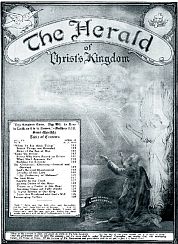
THE HERALD
of Christ's Kingdom
VOL. XIV. June 1, 1931 No. 11
Table of Contents
Unity
as Taught by Christ
Ye
Are God’s Workmanship
Providence
and the Great Reformation
Endurance
Half
Hour Meditations on Romans
Announcement
of Conventions
VOL. XIV. June 1, 1931 No. 12
Table of Contents
Made One With Christ
Guarding
the Heavenly Treasures
The
Peaceableness After Purity
The
Courage of Faith and Weakness of Fear
Providence
and the Great Reformation
A
Message From Abroad
Letters
of Encouragement
Concerning
Radio Service
VOL. XIV. June 1, 1931
No. 11
“Endeavoring
to keep the unity of the Spirit in the bond of peace”
-- Eph. 4:3.
THE UNITY of
the Spirit of which the Apostle speaks is greatly to be desired amongst the Lord’s
people; for it is that state and condition that accompanies the presence and exercise of
love. However widely scattered may be the children of God throughout the world, the
counsel of the Spirit is that they should be thoroughly one, thoroughly knit together in
the love of Christ. This was an important feature of the Master’s prayer during His
last hours, as recorded in John 17:21: “I pray that they all may be one; as Thou,
Father, art in Me, and I in Thee, that they also may be one in us; that the world may
believe that Thou hast sent Me.” And the Apostle Paul further assures us that God has
tempered or compounded the Body together with its various members in orders that there
should be no schism in the Body (1 Cor. 12 :25) ; but rather that they should have a care
for one another.
David in
Psalm 133, after calling our attention to the goodness and pleasantness of brethren
dwelling together in unity, goes on to tell us why it is so desirable: “It is like
the precious ointment upon the head, that ran down upon the beard, even Aaron’s
beard; that went down to the skirt is of his garments.” Thus in picture David tells
us that the precious ointment of the Spirit, the spirit of love and unity, among brethren
is like the oil poured upon the High Priest’s head that ran clown over his body; thus
conveying the thought of that spiritual anointing and power extending to all the
brotherhood in Christ.
That unity
that comes from real love among the brethren, is also like the dew upon Hermon in that it
is refreshing and invigorating, conducive to growth and development and spiritual
fruitage. The dews that fell upon Mt. Hermon and the mountains of Israel did not come
until the rainy season had ended; and herein lies the force of the comparison, in that the
dews on Mt. Hermon pictured the giving of life and its blessings. Just so, the unity of
the Spirit among the Lord’s people results in much refreshment to all who come in
contact with it in the present life, and is essential in securing life eternal.
Unity in the Early Church
Brother
Russell has very beautifully observed that: “It is noticeable too what a beautiful
unity of spirit and of faith, and what steady cooperation, there was among the Apostles
and Elders of the early Church. They were all zealously endeavoring to pr each ‘the
same things,’ the ‘sound doctrine’ of the truth of which they were fully
persuaded. One was not endeavoring to eclipse another by getting some brand new patented
theories of his own. Apollos was not endeavoring to discount the teachings of Paul; nor
were the Elders of the various little companies endeavoring to lead the sheep under their
care into by-paths of speculation and vain philosophies. No, it was not so, though from
time to time false teachers came among them with the evil spirit of vainglory, attempting
these things to draw away disciples after them; but the true ones, on the contrary, were
faithful to one another, as they were also to the Lord. Paul planted, and Apollos Watered,
and God gave the increase.”
But just as
it has been in connection with all reform movements of the past, when the agencies that
brought for forth those movements were taken away, grievous wolves have entered in and
worldly-minded, selfish, and designing leaders have scattered the flock, so it is at the
present time; for again tire working king of these apostate influences has resulted in
scattering the flock and bringing destruction to the spirit of unity and peace. The
experiences of the past become lessons for us today -- lessons to the Lord’s people
now scattered throughout the world, and yet in spirit finding themselves drawn together in
the bonds of unity and love into larger and smaller companies during these very difficult
experiences of recent years.
And it is to
these that the message of the Apostle is just as forceful and wholesome as it was to the
Ephesian brethren in the early Church. We should therefore be hearing the Apostle in our
midst today saying: “Endeavor [put forth earnest effort, using all diligence] to keep
the unity of the Spirit in the bond of peace.” It is one thing to obtain and to be in
possession of the spirit of peace and unity, and quite another to preserve and hold fast
to that unity after we have once come into possession of it. This unity of love and of the
Spirit is obviously not a condition that can be attained by resolutions or by any
organizational machinery; neither by any set of rules or arrangements that can be made by
man. It is purely God-given, and is secured according to certain terms and conditions and
received gradually through development; the truth and the spirit of the truth operating
upon good and honest hearts, bringing to them a deep and reverential love for the Author
and Giver of all good, and thereby creating a bond, an affectionate desire and love toward
those of like precious faith, as expressed in the words
“The
fellowship of kindred minds is like to that above.”
Diversity Compatible with Unity
It is
significant that neither our Lord nor the Apostles ever made any attempt to reform those
who had lost the unity of the Spirit, but they did give much counsel and instruction as to
how to keep or preserve the oneness of Spirit in the Body. One Apostle frankly tells us
some of the causes for dissension and division amongst the Lord’s people: he mentions
pride, ambition, headiness, worldliness, and carnality in general (1 Tim. 6:4, 5; 1 Cor. 3:3); and therefore instructs us
to pursue a course directly opposite -- “with all lowliness,” the reverse of
high-mindedness, headiness, and the spirit of self-seeking; and urges that all the
brethren earnestly endeavor to preserve that blessed unity and peace by exhibiting the
quality of meekness which is always submissive and unassuming, and forbearing toward
others in love. Such a course will ever be prompted by the Spirit of the Maser which is
the opposite of the spirit of dissension and discord. How important indeed it is that each
of the brethren remember that the Apostolic instructions are to each of us individually as
disciples of Christ who have made this unreserved consecration to the Lord and who profess
to be walking in His steps.
Thus the
Apostle entreats the brethren to walk worthy of their profession, to walk worthy of the
vocation wherewith they have been called. And since there is but one Lord or Master over
the Church and therefore but one Lawgiver and Counselor for the one Body, and only one
influence or Holy Spirit from that one Head, and inasmuch as all authority resides in Him,
and no part of it delegated to a human institution or organization or individual or
company of individuals, it of course follows that all who have taken up this holy
vocation, to walk in the steps of Jesus, of walking as He walked, are individually, to
exercise his discernment and judgment as to the Lord’s will concerning the various
questions and issues that stand related to our holy calling; each one is to exercise his
own discretion in regard to all the various items and teachings that are placed before the
brethren for acceptance or rejection. It is recognized that some lines of teaching are of
vital importance, while there may be other items of lesser importance, or rather of a
character concerning which there might be room for a measure of difference of opinion; and
in regard to the latter, the spirit of love will indicate forbearance and Christian
tolerance. The Spirit of Christ in each disciple will prompt him to make such comparison
of Scripture with Scripture, to seek the aid of the Holy Spirit, and the use of sanctified
judgment that will enable him to reach as sound conclusions as possible. None in the
Church has a right to judge or condemn his brother with regard to differences of view
along the lines that are not vital to our Christian relationship. It is for this reason
that the Apostle enjoins that our walk in the Narrow Way should be characterized by
long-suffering in respect to what may seem poor judgment, or weaknesses and frailties of
the brethren, just as our Lord is long-suffering and patient with us and does not expect
perfection of our judgment or in our walk before Him.
God Judges the Heart
Accordingly,
if some of the brethren prefer to call the covenant which they have made before God in
their consecration, by some other name than that which is designated by others, because to
them it seems more appropriate, then it would not be our right to judge or condemn, if we
look at the heart intention as God looks at our hearts. Thus we are forbearing one another
in love and keeping the unity of the Spirit in the bond of peace.
It is by
carefully observing and obeying the instructions of the Apostle as laid down in his prefix
to our text, that unity, peace, and sweet fellowship amongst the Lord’s people can be
preserved, and not by other methods. And to this end, that the Body of Christ might be
united in the oneness of the Spirit, edified in Christ, prepared to minister to others for
their good and for the final perfection of the saints, God “gave some apostles, and
some prophets, and some evangelists, and some pastors and teachers.”
Is it asked
how long shall we need these instructors and these admonitions of the Apostle in
connection with our preparation for the Kingdom? The answer is, “Till we all come in
[margin, into] the unity of the faith.” Not, then, until merely a part of the Body
only may become united as to what is the faith once delivered to the saints, but till all
the Body of Christ shall have come to a knowledge of the Son of God-till we all shall have
come to a full grown man and to the measure of the full stature of the Anointed One.
(Diaglott.) Finally “when that which is perfect is come, then that which is in part
shall be done away. For we see through a glass darkly; but then face to face: now we know
in part; but then shall we know even as also we are known.” -- 1 Cor. 13:9, 10, 12.
“And be not conformed to this
world: but be ye transformed by the renewing of your mind, that ye may prove what is that
good, and acceptable,
and perfect, will of God.” -- Rom. 12:2.
IF ANY man
be in Christ Jesus, he is a new creation, so writes the Apostle, and with painstaking care
he unfolds to us in his various epistles the progressive steps comprehended in the
development of this new creation. The term new creation is in itself a very suggestive
one. We have in it a clear distinction made between all previous creative acts and this
operation of Divine power which now calls forth this new order of beings. It is a new
manifestation of the diversified wisdom of God, revealing lengths and breadths of His love
never before displayed in such marvelous Ways, for the Apostle tells us that we are to
“be to the praise of His glory,” “that in the ages to come He might shew
the exceeding riches of His grace in His kindness toward us through Christ Jesus.”
(Eph. 1:12; 2:7.) If then the former creations of God, in endless variety and beyond our
ability to fully comprehend, elicit our interest and admiration, how surpassingly
wonderful and transporting must be a correct understanding of the love and power exhibited
in this, His new creation.
To be a
spectator of God’s creative acts, as no doubt the angels have been from unknown time,
would indeed be a wonderful privilege; but God in His Word has shown us that we take
precedence to the angelic hosts in the enjoyment of many of the greatest exhibitions of
His love and power. In our association with our Lord in the everlasting future, we shall
be exalted far above all these spirit beings, both in nature and in station, because He
has set His love in this special way upon us. When therefore we discover that we are not
merely, spectators of this last and most amazing manifestation of God’s creative
power, but the actual subjects of that purpose and design, what a responsive joy and
gratitude we experience! And this is exactly what the Scriptures tell us we are: “Ye
are God’s workmanship created in Christ Jesus.” “It is God which worketh in
you both to will and to do of His good pleasure.”
We are
therefore to have revealed in us, in this most extraordinary way, the power of Him by whom
all creative work has been accomplished, and through whom its myriad forms live and move
and have their being. Surely, then, we cannot fail to be appreciative of the great
privilege of being thus transformed by the renewing of our minds in harmony with the
Divine will, until we shall prove or experience in full thaw good and acceptable and
perfect will of God, ,which in its final intention is our complete conformity in character
and nature to God’s dear Son.
In all
God’s creative work He has selected elements, powers, or material, suited to His
purposes. Sometimes He gathers up the invisible powers and elements and produces the
object He has designed. Again He may gather up the visible, material dust of the earth,
and fashion a creature “of the earth, earthy.” Then, in the formation of His new
creature He has chosen to gather the material from among men, taking not many rich or
great, noble or wise; but selecting characters most suitable to His purposes of grace, He
brings forth this entirely new order of beings whereby and through whom the wonders of His
love are to be eternally revealed. From “the hole of the pit” He gathers the
crude materials, drawing these to Jesus, through whom. forgiveness and sonship are made
possible, and permitting them through a full consecration to present themselves to God to
the end that He may work in them to will and to do His good pleasure. Under the power of
His Word and Spirit these are “changed from glory to glory, even as by the Spirit of
the Lord,” until made meet for the inheritance of the saints in light. Understanding
then this general modus operandi of God’s workings, it is surely proper for us to be
deeply interested in the possibilities so fraught with eternal significance to us, and in
connection with which we are invited to be co-workers with God.
The Spirit’s Witness to Our Growth
As a
definite witness of the Spirit whereby we may know assuredly of our standing in Divine
favor, nothing can be more tangible and nothing more to be desired than the confidence
that our opening text is being verified in our experience. This statement is no abstruse
phrase, but a practical, easily understood presentation of an obvious fact, since “as
a man thinketh in his heart, so is he.” Any one who understands the character-forming
influences of thought, may grasp at once just how we are transformed by the constant
renewing of our minds, by their constantly revolving around the perfect will of God. In
harmony with all Scripture bearing on this point, it teaches that this goal of Cod’s
purpose respecting us is reached by a gradual process of development, a growth made
possible by Divine love, to those who delight themselves in the perfect will of God. Our
first acts of faith are to be followed by a perpetual renewing or upturning of our minds
toward the things of God, laying hold of that for which God has separated us from the
things of earth. Then will come the blessed assurance that if our minds are thus fixed and
our ideals thus centered in God’s working in us, and the Spirit, given unhindered sway in our lives, to
make these things more and more real to us, we shall eventually realize that He who is the
Author of our faith will also be its Finisher, even producing that holiness without which
none shall see the Lord.
In His first
definite statements regarding the special work of the Holy Spirit, our Lord declared that
it would be a work of convincing of sin, judgment, and righteousness. This is worthy of
special note, for it most clearly teaches that these are the fundamental facts upon which
all our subsequent progress will depend. If these things have not been laid clown as a
permanent foundation, then whatever superstructure has been reared will assuredly be
unstable and must eventually be found incomplete and unsatisfactory. How important then
that we give much thought to the great need of clean hands and a pure heart.
Be ye holy
for I am holy, is an exhortation so frequently presented to us in one form or another in
the Word of God. And such reminders of God’s holiness are well calculated to produce
a constant renewing of one’s mind regarding the matter of our separation from that
which displeases Him. How possible it is to go through years of experience without being
specially exercised in mind about this matter. How possible to rest in a grateful
appreciation of the mercy of God, and yet fail to reach the place in Christian experience
where His holiness, His anger against sin, fire the soul with a consuming desire to be
like Him in that same holiness. To think of being with God, basking in the sunshine of His
favor, is indeed an ennobling thought, but let us upturn and renew the operations of our
mind, until the higher, richer, more effectual thought grips our souls, that it is His
will for us to some day possess in full His own holiness and then be with Him, because we
are like Him.
A Sure Token that We love Righteousness
Since so
much depends on our appreciation of holiness, and the eagerness with which we seek it, it
becomes a matter of special importance that we analyze our reactions toward this
requirement. It will not be a sufficient assurance of a correct vision to find ourselves
out of tune with the more conspicuous forms of sin, and exercised in mind to be free from
such transgressions. If we would secure a real anchorage for our faith and hope, it must
be found in the most positive demonstration that we love righteousness and hate iniquity
with the intense desire to be wholly filled with the former and completely separated from
the latter. As a test then of our real condition of mind, what are the reactions we
experience when brought face to face with such statements as these: “Be ye perfect
even as your Father in heaven is perfect.” “Follow after holiness, without which
no man shall see the Lord.” “‘Cleanse yourselves from all filthiness of the
flesh and spirit, perfecting holiness in the reverence of the Lord.” “Our God is
a consuming fire.” Many other texts also there are which by no means strengthen the
hands of the wicked that he should not turn from his wickedness, by promising him life,
but on the contrary are well calculated to test us to the very depths.
To the pure
in heart these Scriptures are jewels set in the Word of God, the influence of which is
most encouraging and assuring to their hearts. Does Jesus say, “Be ye perfect even as
your Father which is in heaven is perfect,” and the Apostle admonish separation from
all filthiness of the flesh. and spirit, and shut out from Divine favor all who are not
holy? Yes, indeed! And thank God the standard remains inflexible. If I am invited to be
thus holy, then unquestionably I can be if I want to be. If God has worked in me to will so
great an attainment, He is able to work in me to do in harmony with His requirements, and
nothing is impossible with God. To the pure in heart the standards of righteousness are
never too high. As such in the daily renewing of their mind catch clearer visions of the
holiness of God and receive a corresponding understanding of their own condition aside
from Christ, it is to rejoice in the power of God, who is able to do for us exceeding
abundantly above all that we ask or think. We love righteousness for its own sake; we hate
evil in every form because it has been made abhorrent to us. And being wholly confident
that He who has begun the good work in us is able also to complete it, our whole life
reveals that perfect righteousness is the goal of our thought and hope, and some day we
know we shall be satisfied, for we shall awake in His likeness-God’s workmanship
gloriously completed, without coercion, without hindrance, because we were daily renewing
our minds, turning them upward to the influences of the perfect will of God.
On the other
hand our reactions may be such as to make manifest our lack of development. Some there are
who, instead of thus renewing their minds in this upward, progressive way, seem to form
the fixed habit of attempting to live in the reverse order. They too are familiar with the
Scriptures we have just considered, but they are disposed to view them from an entirely
different angle. Perhaps like the one-talented servant, they, if their innermost thoughts
were expressed, would say, “I knew that Thou wert a hard man,” therefore I have
made no real effort to meet your requirements. Do we not take this position when we look
at these possibilities of the Christian life and say, “The quest is not for me.”
I have too many weaknesses, too many influences within and without to overcome, therefore
I can never be such as these Scriptures demand. We need to be extremely careful here, for
quite unconsciously we may be exhibiting, not only a deficient faith, but more serious
still, a failure to manifest a supreme love for righteousness, and thus raise an effectual
barrier to the very thing God wants to will and to do in us. The stream cannot rise higher
than its source, and if we are thinking in such terms of defeat and hopelessness, how can
we enter into the possibilities of our opening text? To such the words of the Apostle are
a most forceful reminder that the viewpoint is wrong. Ye are God’s workmanship. It is
God that worketh in you. Where love and faith are alive and fervent, before every obstacle
that might seem to stand in the way, the cry is raised, “Lord, if Thou wilt, Thou
canst make me clean”; and immediately Jesus turns it back on us again, “With God
all things are possible,” “only believe.”
To a very
large degree we classify ourselves as to where we belong in God’s arrangement. If our
response is such as to demonstrate that our very souls are captivated with the
requirements of a holy life as set before us in God’s Word, our classification is
easily determined. If on the other hand we toss away these great possibilities as unreal
to us, or beyond our attainments, yet hoping that we will be embraced in the mercy of
God’s Plan somewhere, do we not take our place with that great multitude who have
thought more of obtaining mercy during the present life, and acquittal at the portals of
death, than with those who have a consuming desire to finally possess His holiness, a
desire that will not be silenced, and a love and faith that .will not let go so great a
hope. In developing His new creation, God’s special purpose is not chiefly the
exercise of His forgiving grace, but: it is rather the accomplishment of the great end to
which He has thus opened the door -- our sanctification and complete holiness. To such
therefore as see themselves largely in the condition of defeat before a standard so high,
we would repeat the thought emphasized ìn our text, “Be ye transformed by the
renewing of your mind, that ye may prove [know in a real experimental way] what is that
good, and acceptable, and perfect, will of God” for you. Abandon the dormant,
stagnating thought. Turn the mind upward in a daily renewal toward the things that are
possible in the hands of God, and then greater things you shall yet see. Only believe.
Growing up into Christ
To be
dwarfed in physical stature is one of those misfortunes that we are happy to have escaped.
Should one of our children after several years of normal growth suddenly develop an
affliction that would permanently check its growth how distressed we would feel. But if
this is a sad occurrence in the development of that which is natural, how much more
regrettable it is in the case of spiritual children. What must be the emotions of God when
such paralysis overtakes one of His children? Growth is a very familiar Bible term, and
one that needs to be kept constantly, in mind. “First the blade, then the ear, then
the full corn in the ear.” “New born babes” require the sincere milk of the
Word. Mature characters need the “strong meat” in order to properly reflect the
will of God. As God’s building we “grow up into an holy temple in the
Lord,” and in our entire Christian experience the work begun in us must be
progressive until He who has been its Author becomes also its Finisher. What a depth of meaning there is then
in the Apostle’s admonition wherein we are urged to grow up into Christ.
The
operations of growth in all animal and vegetable life are shrouded in mysteries too deep
for the human mind to fully comprehend. We can, however, understand its laws sufficiently
to gather valuable lessons therefrom. This is beautifully illustrated in the sublime
statement of Jesus: “Consider the lilies of the field, how they grow; they toil not,
neither do they spin: yet I say unto you, that Solomon in all his glory was not arrayed
like one of these.” The glory of Solomon was the product of human agencies. The
beauty of the lily was due to the fact that it was God’s handiwork. This lesson is
not intended to teach inactivity, but to show the fundament secret of growth, to reinforce
the fact that no man by taking thought, by self-effort, can add one cubit to his stature.
Growth is from within, and as with the lily, so with us, it is a matter of extracting from
the soil and sunshine the elements of growth. Peter tells us that unto us are given
“exceeding great and precious promises; that by these ye might be partakers of the
Divine nature.” Here is soil in which our characters are to take root, and as we con
these promises over and over in our minds, we are influenced by the conditions laid down
in such promises and being favorably affected by the exceptional nature of the privileges
they embrace, by any by they become so much a part of our experience that we realize the
Apostle’s statement a living fact in our lives. Paul tells us to focus our minds on
the things that are pure and just, good, lovely, the things worthy of praise and of good
report, and by so doing a work is being accomplished in us clay by clay. Beholding as in a
glass the glory of the Lord, we are “changed into the same image from glory to glory,
even as by the Spirit of the Lord,” and so all along the line we are drinking in and
assimilating that which produces spiritual life. Imperceptibly the Holy Spirit is taking
hold of these holy aspirations, these fervent desires and longings after holiness, this
blessed hunger and thirst after righteousness, and God, honoring our faith, will weave
these elements into our character by that same Holy Spirit.
Rightly Dividing the Word of Truth
In the
matter of our natural food we recognize the need of combining certain wholesome products
in proper portions in order to secure the greatest amount of physical vigor therefrom. In
spiritual life this is equally important. “All Scripture given by inspiration of God
is profitable,” and it becomes the duty of the man of God to recognize the
proportions and the relative importance of the variety of food contained in the Bible. If
we are giving heed to what the Spirit says to the Church, we will have no difficulty in
recognizing that by far the larger proportion of thought on our part needs to be
concentrated on the attainment of the holy character which we are now considering.
The
devotional life, the life of intimate communion and fellowship with God, the life of
prayer, illustrated in Jesus Himself, the life of peace and joy in the Holy Spirit, is the
life more particularly emphasized by the Apostles. Let us take a careful survey of the New
Testament teachings, and observe the preponderance of emphasis given to the importance of
a definite realization of enlightenment, of transformation, and of heavenly communion.
Jesus very well recognized that the deep things of the spiritual life could not be
imparted by Himself to His immediate disciples. Had the special feature of His message
been an announcement of glad tidings of great joy to all people, doubtless He could have
made it all quite clear to His disciples prior to His death and resurrection, since such a
message is within the comprehension of natural-minded men. But not until the Holy Spirit
was given, and not until it had illuminated the minds of the Apostles, was it possible to
reveal the great truths of “Christ in you the hope of glory,” and that
“whom He did foreknow, He also did predestinate to be conformed. to the image of His
Son.” Therefore, if in our dividing of the Word of Truth we have not been recognizing
the special importance of our own growth in true holiness and deep spiritual life, we have
failed to act consistent with the advice given by the Apostle, and we have been hindering
the work of God in our own hearts.
The Importance of the Prayer Life
Would we
then experience a deepening of our joy and peace, and realize a stronger faith in the
power of God’s Word to transform us? If so, let us put ourselves in line with His
creative influences and have our hearts rejoiced with the results. There can be no
question about the importance of the prayer life being taught in the Bible. Then since we
need not continue laying the foundation principles again, let us go on to perfection. Let
us go, as did the disciples, and entreat the Master to teach us to pray, to make prayer
our life and not merely a duty. Let us study the subject of prayer, earnestly entreating
God to reveal its possibilities to us, to deepen our love for the secret place, increase
our faith to receive, and all the while there will be growth. This renewing of our mind,
producing congenial atmosphere in which the Holy Spirit now moves, will assure the growth
we seek -- God’s workmanship progressing to its completeness.
Do we think
of the deep spirituality of Paul or John or some faithful character of the past and
present, and feel ourselves drawn with desire toward that same attainment? If so, let God
do the work for us. Let our minds revel in the things that are spiritual, devotional,
elevating. Let us throw our minds open to the influence of that leading of the Spirit
which will enable us to comprehend with all saints, past and present, the lengths and
breadths, heights and depths of Divine love, and then we shall experience a definite
growth upward into the fuller life. Like the lily we will be absorbing that which produces
growth. We will not be worried about growing, but just grow. If we are given a vision of a
more fruitful life, either through the Word itself or through the life of some other saint
of God, and our hearts thrill with desire to experience these things ourselves, let it be
remembered that such desires repeated, meditated upon, taken to God in thanksgiving, will
eventually shed abroad in our hearts their blessed fruitage. God’s work will have
been going quietly on. Our upturned minds, assimilating His Word, visualizing His
completed purposes in our lives, will bring this blessed transformation. Oh, if we will
only let God do what we have long since learned we can never do ourselves, how rich will
be the realization that He is definitely working in us to will His good pleasure, even our
sanctification, and also working in us to do the things that represent full cooperation
with Him in the development of His new creation.
“What is the Level of My Life?”
In
conclusion let us quote the words of one who has understood the beauty of God’s
methods of working in us when thought has been elevated to its proper level:
“Faith
lays hold of the almighty power of God, the power that raised Jesus from the grave of
Joseph to set Him at the right hand of the Majesty in the heavens. And in the might of
that power it walks across the unstable wave and climbs the steeps of air, and holds its
own, its position as on the throne, against all the assaults of hell. It is impossible to
live the ascension or heavenly life, which is certainly ours, without ascension and Divine
power: But that is within reach of an appropriating faith . . . . It is a serious question
for each one to ask, ‘What is the level of my life? Is it mine, or my
neighbor’s, or God’s? Am I living as a risen and ascended one, behind whom is
sin and death, while above is the uncreated light of eternity?’ Alas! so many of us
are leveling our appreciation of our standing down to the lowness of our experience,
instead of seeking to level our experience and practice up to the height of our standing
in Jesus!
“Now
faith when in proper exercise does two things. First it reckons that a position belongs to
it which we do not feel, but which it dares to claim on the warrant of God’s Word.
Second, it lays hold on the power of God to make that position a reality in daily and
hourly experience.
“And if
only we live thus, life will pass on happily and usefully. Its stay will shape itself into
a psalm like that which David, the shepherd and king, sang centuries ago. It may begin
with the tale of a shepherd’s care for a lost and truant sheep. But it will not stay
ever on that level; it will mount and soar and sing near heaven’s gate; it will spend
its days on the level of those shining table-lands where God Himself is Sun; and it will
finally pass into that holy and glorious home circle, each inhabitant of which may affirm,
without the least shadow of presumption or of fear, “I will dwelt in the house of the
Lord forever.”
Ninth of the Series
THE RESULT
of Luther’s first examination before the legate plainly appeared to be in the
Reformer’s favor. He was given opportunity to prepare a statement in writing. But the
examination and trial continued the following day. Luther’s friends accompanied him
to the legate’s palace. Amongst these was Staupitz who remained loyal to Luther and
fully comprehended his position, and was confident that unless Luther continued steadfast
in his faith in the Lord as his deliverer, he must fall. Staupitz said, “My dear
brother, bear constantly in mind that you have begun these things in the name of the Lord
Jesus Christ.” “Thus did God environ His humble servant with consolation and
encouragement.”
Arriving at
the legate’s palace, Luther found all in order once more for the continuance of the
trial. Luther had written his answers and after the customary salutation he was permitted
to read the following declaration with a loud voice:
“‘I
declare that I honor the holy Roman Church, and that I shall continue to honor her, I have
sought after truth in my public disputations, and everything that I have said I still
consider as right, true, and Christian. Yet I am but a man, and may be deceived. I am
therefore willing to receive instruction and correction in those things wherein I may have
erred. I declare myself ready to reply orally or in writing to all the objections and
charges that the lord legate may bring against me. I declare myself ready to submit my
theses to the four universities of Basle, Friburg in Brisgau, Louvain, and Paris, and to
retract whatever they shall declare erroneous. In a word, I am ready to do all that can be
required of a Christian. But I solemnly protest against the method that has been pursued
in this affair, and against the strange pretension of compelling me to retract without
having refuted me.”‘
Apparently
the cardinal was not expecting just such a protest as Luther had read in his hearing. And
in consequence he sought to hide his confusion by affecting to smile and by assuming an
appearance of moderation.
“‘This
protest,’ said he to Luther, with a smile, ‘is unnecessary; I have no desire to
dispute with you, either privately or publicly; but I propose arranging this matter with
the kindness of a parent.’
“Continuing
with the most affectionate air, De Vio said: ‘My dear friend, abandon, I beseech you,
so useless an undertaking; bethink yourself, acknowledge the truth, and I am prepared to
reconcile you with the Church and the sovereign bishop. . . . Retract, my friend, retract;
such is the pope’s wish. Whether you will or whether you will not, is of little
consequence. It would be a hard matter for you to kick against the pricks.’
“Luther,
who saw himself treated as if he were already a rebellious child and an outcast from the
Church, exclaimed: ‘I cannot retract! but I offer to reply, and that too in writing.
We had debating enough yesterday.’
“De Vio
was irritated at this expression, which reminded him that he had not acted with sufficient
prudence; but he recovered himself, and said with a smile: ‘Debated! my dear son, I
have not debated with you: besides, I have no wish to debate; but, to please the most
serene Elector Frederick, I am ready to listen to you, and to exhort you in a friendly and
paternal, manner.’
“Luther
could not understand why the legate was so much scandalized at the term he had employed;
for (thought he), if I had not wished to speak with politeness, I ought to have said, not debated, but disputed and
wrangled, for that is what we really did yesterday.
Error Seeks Vindication in Abuse
“De
Vio, who felt that in the presence of the respectable witnesses who attended this
conference, he must at least appear anxious to convince Luther, reverted to the two
propositions, which he had pointed out as fundamental errors, being firmly resolved to
permit the reformer to speak as little as possible. Availing himself of his Italian
volubility, he overwhelmed the doctor with objections, without waiting for any reply. At
one time he jeered, at another scolded; he declaimed with passionate, warmth; mingled
together the most heterogeneous matters; quoted St. Thomas and Aristotle; clamored,
stormed against all who thought differently from himself; and apostrophized Luther. More
than ten times did the latter try to speak; but the legate immediately interrupted him and
overwhelmed him with threats. Retract! retract! this was all that was required of him. He
raved, he domineered, he alone was permitted to speak. Staupitz took upon himself to check
the legate. ‘Pray, allow Brother Martin time to reply to you,’ said he. But De
Vio began again; he quoted the Extravagances and the opinions of St. Thomas; he had
resolved to have all the talk to himself during this interview. If he could not convince,
and if he dared not strike, he would do his best to stun by his violence.
“Luther
and Staupitz saw very clearly that they must renounce all hope, not only of enlightening
De Vio by discussion, but still more of making any useful confession of faith. Luther
therefore revertd to the request he had made at the beginning of the sitting, and which
the cardinal had then eluded. Since he was not permitted to speak, he begged that he might
at least be permitted to transmit a written reply to the legate. Staupitz seconded this
petition; several of the spectators joined their entreaties to his, and Cajetan,
notwithstanding his repugnance to everything that was written, for he remembered that such
writings are lasting (scripta manent) at length consented. The meeting broke tip. The
hopes that had been entertained of seeing the matter arranged at this interview were
deferred; they must wait and see the issue of the next conference.
Victory Gained by Humility and Firmness
“The
permission which the general of the Dominicans had given Luther to take time for his
reply, and to write his answer, to the two distinct accusations touching indulgences and
faith, was no more than strict justice required, and yet we must give De Vio credit for
this mark of moderation and impartiality.”
Two days
later the examination before the legate proceeded again; and again the same tactics of
cajoling, browbeating, and threatening on the part of Cardinal De Vio were utterly
unavailing. Luther remained steadfast to his conviction under the cruel fire and
bombarding of the Cardinal whose final words to Luther were: “ ‘Retract, or
return no more.’
“These
words struck Luther. This time he will reply in another way than by speeches: he bowed and
left the hall, followed by the Elector’s councilors. The cardinal and the Italians,
remaining alone, looked at one another in confusion at such a result.”
Thus after
ten days under the hand of Rome’s representative, the Cardinal De Vio -- tortuous
days of insistence, without just reasoning, on the part of him who sat in judgment, Luther
hurried away from Augsburg before daybreak, riding fast and hard towards Wittemberg. God
had preserved him from harm, but to stay longer than necessary might be tempting God. When
De Vio heard of his departure he was both disappointed and angry. He had hoped for the
honor of healing the wound the heretical monk had given the Church and to strengthen. the
Pope’s weakening influence in Germany. Rome had gained nothing in the conference,
rather, she had lost, for the uprightness, simplicity, and firmness of Luther shone in the
light of it, and, on the other hand, the haughty and unreasonable ways of Rome had been
most evident. Victory, gained by a humble friar over Rome’s proud representative! Can
we wonder that men were filled with astonishment? All the way to Wittemberg Luther’s
journey became a triumph. De Vio by letter begged Elector Frederick to send the
mischievous monk to Rome, or to banish him from his territories, but Frederick had no
thought of delivering up an innocent man to Rome. He wrote this reply to De Vio:
“Since Doctor Martin has appeared before you in Augsburg, you ought to be satisfied.
We did not expect that, without convincing him of error, you would claim to oblige him to
retract. Not one of the learned men in our states has intimated to us an opinion that
Martin’s doctrine is impious, anti-Christian, or heretical.” He then refused the
request made by De Vio.
The
university of Wittemberg increased in reputation. Young men came from all parts of Germany
to hear the instructor whose teachings had brought a new era in religion and learning. It
is. told that many of these as they arrived for the first time in sight of the steeples of
Wittemberg, would pause, and bless God that He had caused His light to shine forth from
Wittemberg to penetrate distant lands, even as it had shone forth from Mt. Zion.
Luther lived
in expectation of being driven from Germany, and one day a letter came from Frederick,
asking him to leave Wittemberg. He was preparing to depart not knowing where to go unless
to France, when a second letter was brought to him. In this the Elector bade him hasten
his departure. Sadly then Luther remarked to his friends gathered about him, “When my
father and mother forsake me, then the Lord will take me up.” The fate of the
Reformation seemed to hang by a single thread which this banishment might easily break.
The friends were in tears, when another letter arrived:
“As the
Pope’s new envoy,” the letter ran, “hopes that everything may be settled by
a conference, remain for the present.” The mighty power of the Lord was again in
evidence: “At the Word of the Lord,” says the Prophet, “His servants go
down to The depths, and mount up again to heaven.”
Luther now
published his report of the conference at Augsburg, and, sending the document to a friend,
remarked in an accompanying letter,” ‘I shall send you what I have written, in
order that you may judge if I am right in believing that the Antichrist of whom St. Paul
speaks now reigns in the court of Rome.’”
Clearness of
vision did not come to Luther at once, darkness and light were strangely intermingled at
times as letters written by him to the Pope attest: “Most Holy Father: May your
holiness condescend to incline your paternal ear, which is that of Christ Himself, toward
your poor sheep,. and listen with kindness to his bleating . . . . Most Holy Father, I
declare it in the presence of God, and of all the world, I never have sought, nor will I
ever seek, to weaken by force or artifice, the power of the Roman Church or of your
Holiness. I confess that there is nothing in heaven or earth that should be preferred
above that Church, save only Jesus Christ the Lord of all.” Light came, not suddenly,
but by degrees, and we see in these words the truth that the Reformation was not a
rebellion against a system; and opposition to the Pope was but a secondary thing -- the
inevitable outcome of that great principle and positive doctrine which underlay and
brought about the Reformation -the transcendent teaching that Jesus Christ is King of
kings, Lord of lords, and far above The Church of Rome.
The Word of God the Invincible Test
It
was the custom at this time to meet in public discussion, where hearing was given
those questions of views that interested or agitated the minds of the people. Such an
occurrence was that of the Leipsic discussion in which Luther met an opponent before a
large audience. An impartial witness of the encounter gives us this interesting picture of
the Reformer:
“Martin
Luther is of middle size, and so thin, by reason of his continual studies, that one can
almost count his bones . . . . His knowledge and understanding of the Holy Scriptures are
incomparable: the whole Word of God is at his fingers’ ends.”
Eck, his
opponent, relied upon the word of the early Fathers, St. Augustine, St. Ambrose, and
others. Luther showed himself as thoroughly acquainted with such authorities, but insisted
that the word of the Scriptures was above them. How familiar do the words of Eck in answer
to this sound to us of this day: “I am astonished,” said he with sarcasm,
“at the humility and diffidence with which the reverend doctor undertakes to stand
alone against so many illustrious Fathers, thus affirming that he knows more of these
things than the Soverign reign Pontiff the Councils, divines, and universities! . . . It
would no doubt be very wonderful if God had hidden the truth from so many saints and
martyrs till the advent of the reverend father.”
After
several days the discussion was ended by Luther with these words, “The reverend
doctor avoids the Holy Scriptures, as the devil flees from the cross. For my part, saving
the respect due to the Fathers, I prefer the authority of the Word of God; and it is that which I would press upon our judges.”
The dispute
of words did not vanish in mere smoke, but a new fire was enkindled in many minds.
Especially was this true of the students of the University of Leipsic. They had seen the
reliance of Luther on the Word of God. They had also noted the stand upon the traditions
of men alone that Doctor Eck had taken, and many of these young men left Leipsic for
Wittemberg, drawn there by truth, doubling the number of its students.
Melancthon
had been present at the discussion, but had taken little part in it. But a new purpose in
life was born for him at the conference, and he turned from literature which had claimed
him, and from that hour “bowed the heights of his learning before the Word of
God.” From this time Melancthon and Luther went on together hand in hand -- a loving
John, an energetic Paul. “I,” said Luther, ‘’was born for struggling
on the field of battle with parties and devils. Thus it is that my writings breathe war
and tempest. . . I am like the sturdy wood-cutter, who must clear and level the road. But
our master of arts, Philip, goes forward quietly and gently, cultivating and planting,
sowing and watering joyfully, according as God has dealt to him so liberally of His
gifts.”
Melancthon
in his first theologcial writing pointed out the mistake of explaining the Holy Scriptures
by the writings of the godly, instead of explaining the writings of the godly by the
Scriptures: “How often,” says he, “has not Jerome been mistaken! -- how
often Augustine! -- how often Ambrose! How often do we not find them differing in judgment
-- how often do we not hear them retracting their errors! There is but one Scripture
divinely inspired and without mixture of error.” And again, ‘There is a
philosophy enjoined us with respect to the Scriptures given by God; it is to bring to them
all the thoughts and maxims of men, as to the touchstone by which these are to be
tried.” Thus the Word of God was enthroned in its proper place and the writings of
the Fathers in turn placed in theirs.
(To be continued)
“We . . . rejoice in hope of the
glory of God . . . we glory in tribulations also: knowing that tribulation worketh
patience [endurance]; and patience, experience [tried character]; and experience, hope;
and hope maketh not ashamed.” -- Rom. 5:2-5.
THUS WE may
venture to translate Paul’s glowing sentences. And as we spell them out together
afresh, the consciousness comes home to most of us, does it not, how far short we
Christians come of the glad endurance of difficulty and trouble which marked the
blood-stained days of apostolic times. We glory in
tribulations, and for Paul the tribulation was not at all the kind of gentle friction
which is all that the word covers for most of us today, but the heart-crushing
experiences which the word really connotes, and which were a ministered to him through
lictors’ rods, stoning, and shipwreck. -- Cor. 11:25. . . .
It has been
often remarked how confident and full of rejoicing the language of the New Testament is.
In spite of all the trying experiences through which they were called to pass, there is an
entire absence of self-pity from the vocabulary of the saints of those earlier days. Why,
indeed, should they pity themselves? They had found Christ; they had escaped the unnamable
corruptions which were in the world. And in an age when for most thoughtful people suicide
seemed the only possible way of deliverance from the evils of life, the Christians had
learned that for them to live was Christ. Why, indeed, should they be sorry? Death for
them had been swallowed up in victory (1 Cor. 15:54), and the glory of their
risen Lord, which lighted up the tomb, shed its backward radiance over all life.
It was out
of an experience such as that, that the New Testament vocabulary was born. And one of the
greatest words in that vocabulary was the word which I have ventured to translate endurance, and which our English versions always
render as patience. It seems to make the word
still more wonderful to us when we remember that it was used constantly on the lips and
pens of those who were after all men of like passions with ourselves. (James 5:17.) They
were no demi-gods. They had the same kind of contacts that we have. Wife and child, home
and business, these things belonged to them just as they do to us. Yet they learned to
speak this kingly dialect, and therefore surely so may we.
Constant under a Load or Strain
The special
word of which we are thinking just now means to remain constant under a load or strain. It
suggests the framing of a great ship, the girder of a mighty bridge, the column of some
gigantic temple. And as one contrasts the Christianity of today with that of the old
heroic days in which Paul and the rest lived, it seems as if we lacked just this very
quality of endurance which they so wonderfully possessed. For the most part we have a much
easier time than did the saints of God when it was a capital offense merely to be a
Christian. And yet, so often our spiritual lives are poor and querulous while theirs were
overflowing with the great words of the faith like “endurance” and
“hope” and “glory.”
It is
salutary and humbling for us to contrast our difficulties and vexations with the active
perils and persecutions of the first centuries . . . . Such trivial things have power to
move us and even sometimes, as we say, to shake our faith .... while brothers and sisters
in the Lord . . . [have been] in actual peril of their lives; for no other reason than
that they believed on the Lord Jesus. I wonder how many of those who read this page will
be bound to confess in their hearts that these great words of the faith have very little
real meaning for them. How often we have stumbled and almost fallen out of the ranks
altogether because of some comparatively trivial vexation which we have suffered at the
hands of somebody else.
But it is of
no use to contrast our lives with those of fellow-Christians unless it leads us to seek
for a remedy for the conditions and results which we discover. And to discover the remedy
we must first be quite sure about the cause of our failure. We recall our Lord’s own
words, “Without Me ye can do nothing.” (John 15:5.) The secret of our
“Christian ineffectiveness is that we have too often forgotten Him. “The people
that do know their God shall be strong, and do exploits.” -- Dan. 11 :32.
Now for us
the problem is how to relate this power that there is for every one of us in Christ Jesus,
to our own circumstances and conditions. The answer lies in the context of the verse which
I have set at the head of this article. It is not part of the words printed here, but let
us turn today in our Bibles now as we read. And let us seek that God Himself may use the
words as a search-light upon our own hearts and lives as we do so. “The love of God is shed abroad in our hearts by
the Holy Spirit which is given unto us.” Here we touch the real need both for
character and life. It is nothing less than that we can have God’s own love abiding
within us. Love is God’s character, the very expression of His being. (1 John 4:8.)
And while that character is so far above out of our sight (Psa. 10:5) that we cannot even
conceive of it, much less imagine it, yet God in this passage, from the Roman letter which
I have quoted, promises to come so near to us that He Himself shall, so to speak, live His
own life through our individuality. For the love of God in our hearts is neither
God’s love to us nor our responsive love to Him merely. While the phrase cannot be
said to exclude these ideas altogether, yet its primary reference is to God’s love as
it is in itself shed abroad in, and energetic through, the heart of him who fully trusts
the Lord Jesus Christ. This is obviously something to which none of us can ever hope to
attain. It is the result of God Himself dwelling within and working within our heart. This
at once removes it far outside the range of our possibilities and yet at the same time
brings it quite near to us. For what the best of us can never do in himself, that God can
do in the worst of us. Thus it is not a question of our attainment but of our willingness.
God’s power is as mighty for His weakest child today as it was for a Paul.
Can We Trust the Character of God?
The question
is, Are we willing for the consequences of that power; should we permit it, if I may use
the word, to be exercised? God’s love in our heart, dear reader, might have peculiar
and perhaps unwelcome consequences in personal, social, business, and church life. We may
not know beforehand what those consequences will be. The important thing is whether we can
trust our God for whatever consequences may befall. And that brings us back to the one
ultimate foundation upon which all our hope for this world and the next must rest, and
that is the character of God. Can we trust the character of God? That is the most
momentous question which any human being can have to answer. And presumably, if we are
Christians at all, we have found an answer to our own satisfaction. For God’s
character has been revealed in the Lord Jesus Christ as in no other way. If we have,
trusted Him for salvation, we can surely trust Him to deal with the consequences of our
obedience to His will. If we are willing to face the consequences, God is surely willing
to shed abroad His love in us. Without that love thus shed abroad, we can never know the
glow of the glory and hope which animated Paul. It is for lack of this that Christian life
everywhere is becoming so anemic today. Out of our weakness we may be made strong if only
we are willing to let God do with us the things that He has spoken to us of .-- Selected.
No. 16
“All
we like sheep have gone astray; we have turned every one
to his own way.’ -- Isa. 53:6.
IN OUR
previous Meditations we have seen that the Apostle’s theme is summarized in verses
sixteen and seventeen of chapter one:
“For I
am not ashamed of the Good News. It is God’s power which is at work for the salvation
of every one who believes -- the Jew first, and then the Gentile. For in the Good News a
righteousness which comes from God is being revealed, depending on faith and tending to
produce faith.” -- Weymouth.
Ere we leave
this matchless theme, and proceed with the Apostle to its masterly unfolding, which
occupies, with the exception of his conclusion (15:14 to 16:27), the entire remaining
chapters of the Epistle, we must not fail to mark his quotation from the Prophet. So
convinced is he of the essential unity which prevails between the Old Testament writings
and the Gospel he has been commissioned to preach, that he cannot announce it without
quoting a passage from the Old Testament in its support. This good news from God,
revealing to believers salvation resulting from a righteousness arising from faith, (not
by works of righteousness which we have done, Tit. 3:5), far from being a repudiation of
the old covenant is in fulfillment of its vital principle: “As it is written.”
“For the words of Habakkuk may be interpreted to express the central spirit of the
Old Testament ‘the righteous shall live by faith.’”
The Just shall Live by Faith
“The
Prophet, as we refer to his brief pages, manifestly finds his occasion and his first
significance in the then state of his country and his people. If we please, we may explain
the words as a patriot’s contribution to the politics of Jerusalem and pass on. But
if we do so, we pass on upon a road unknown to our Lord and His Apostles. To Him, to them,
the prophecies had more in them than the Prophets knew; and Habakkuk’s appeal to
Judah to retain the Lord Jehovah among them in all His peace and power, by trusting Him,
is known by St. Paul to be for all time an oracle about the work of faith.”
“With all that prides itself on its own strength, whether in the case of foreign
conquerors or in Israel itself, the Prophet contrasts the humble Israelite who puts his confidence in God alone. The former will perish;
the latter, who alone is righteous in the eyes
of God, shall live . . . The [Greek] word, [translated] shall live, embraced in the Prophet’s view:
(1) Deliverance from present evils (those of
the Chaldean invasion), and, in the case of posterity, deliverance from evils to come; (2)
The possession of Divine grace in the enjoyment
of the blessings of the Promised Land. These two notions are, of course, spiritualized by
Paul. They become: deliverance from. . . .
[death] and the possession of eternal life. It
is the idea of salvation (verse 16)
reproduced.”
In our
outlines of this Epistle* we noted that the development of this Gospel theme extends from
1:18 to 5:21. We also noted that in this portion of the Epistle three leading thoughts
appear, the first of which, expounded in the section beginning with 1 :18 and ending with
3:20, is the world’s need of a faith-righteousness, or a righteousness by faith. The
Apostle’s line of argument in this section is it, very simple one. He elucidates four
plain propositions:
__________
*
Meditations No. 8, “Herald,” June 1, 1930.
___________
(1) Apart from a faith-righteousness
the Gentiles are without hope. -- 1:18-32.
(2) So also are the Jews. -- 2:1-29.
(3) The advantages possessed by the
Jew do not exempt him from punishment. -- 3:1-8.
(4) The above three propositions are
in harmony with Old Testament Scriptures. -- 3:9-20.
Another Revelation
“St.
Paul has enunciated his great thesis. There has arrived into the world a new and Divine
force making for man’s fullest salvation: the disclosure of a real fellowship in the
moral being of God, which is open to all men, Jew and Gentile equally, on the simple terms
of taking God at His word. This word of good tidings St. Paul is to expand and justify in
his Epistle; but first he must pause and explain its antecedents. Why was such a
disclosure needed at this moment of the world’s history? Why has St. Paul spoken of
‘salvation,’ or why does he elsewhere speak of ‘redemption,’ instead
of expressing such ideas as are most popular . . . today -- development or progress? It is
because to St. Paul’s mind, man as he is is held in a bondage which he, ought to find
intolerable, and the first step to freedom lies in the recognition of this. Again, why
does St. Paul lay such emphasis on faith, mere faith, only faith -- why is he to insist so
zealously on the exclusion of any merit or independent power on man’s part? It is not
only because faith, the faculty of mere reception and correspondence, represents the
normal and rational relation of man to God, his Creator, Sustainer, Father. It is also,
and with special emphasis, because there has been a great revolt, a great assertion of
false independence on man’s part; and what is needed first of all is the submission
of the rebel, or much rather the return of the prodigal son, simply to throw himself on
the mercy of his Father and acknowledge his utter dependence upon Him for the forgiveness
of his disloyalty and his outrages, as well as for the fellowship which he seeks in the
Divine life. The fuller statement therefore of St. Paul’s Gospel must be postponed to
the uncloaking of what man is without it. The note of severity must be struck before the
message of joy . . . .”
“Thus
St. Paul immediately follows up his initial statement of the revelation of a Divine
righteousness with the assertion of another ‘revelation’ made plain to the
consciences of men.” “For the wrath of God is revealed from heaven against all
ungodliness and unrighteousness of men, who hold the truth in unrighteousness.” --
1:18.
God’s Anger at Man’s Sin
“Let us
not shun that ‘revelation.’ It is not the Gospel. The Gospel, as we have seen,
is in itself one pure, warm light of life and love. But then it can never be fully
understood until, sooner or later, we have seen something, and believed something, of the
truth of the anger of the Holy One. From our idea of that anger let us utterly banish
every thought of impatience, of haste, of what is arbitrary, of what is in the faintest
degree unjust, inequitable. It is the anger of Him who never for a moment can be untrue to
Himself; and He is Love, and is Light. But He is also, so also says His Word, consuming
Fire (Heb. 10:31; 12:29); and it is a ‘fearful thing to fall into His hands.’
Nowhere and never is God not Love, as the Maker and Preserver of His creatures. But
nowhere also and never is He not Fire, as the judicial Adversary of evil, the Antagonist
of the will that chooses sin.” The Greek word here translated wrath, frequently translated anger, “denotes the Divine displeasure or indignation against sin; the
Divine purpose to inflict punishment. It is the
opposition of the Divine character against sin; and the determination of the Divine
mind to express that opposition in a proper
way, by excluding the offender from the favors which He bestows on the righteous .. . . We
all admire the character of a father who is opposed.
to disorder, and vice, and disobedience in his family, and who expresses his opposition in a proper way. We
admire the character of a ruler who is opposed to
all crime in the community, and who expresses those feelings in the laws . . . and why
shall we be not equally pleased with God, who is opposed to all crime in all parts
of the universe, and who determines to express it
in the proper way for the sake of preserving order and promoting peace.”
The Gentiles, Taught by Nature and Conscience,
have Failed to attain Righteousness
“In
chapter 1 from verse 18, St. Paul is undoubtedly describing the miserable state of the Gentile world. From the beginning of chapter 2 he
addresses a personage who very severely judges the Gentile abominations just described by
Paul., and who evidently represents a wholly different portion of mankind. At verse 17 he
apostrophizes this personage by his name: it is the Jew; and he demonstrates to him
that he also is under the burden of wrath. Hence it follows that the first piece of this
section goes to the end of chapter one, and has for its subject: the need of salvation
demonstrated by the state of the contemporary Genile world.
“According
to Paul’s usual style, the first verse (1 :18) contains summarily all the ideas
developed in the following piece. The study of the verse will thus be an analysis by
anticipation of the whole passage.”
“For
the wrath of God is revealed from heaven against all ungodliness and unrighteousness of
men, who hold the truth in unrighteousness.” -- 1:18.
“The
transition from verse 17 to verse 18 by for, can only be this: There is a revelation of righteousness by the Gospel, because
there is a revelation of wrath on the whole
world. The former is necessary to save the world from
the consequences of the latter. From the notion of wrath,
when it is applied to God, we must of course remove all that pollutes human wrath,
personal resentment, the moral perturbation which gives to the manifestation of
indignation the character of revenge. In God, who is the living Good, wrath appears as the holy disapprobation
of evil, and the firm resolve to destroy it. But, it is false to say, as is often clone,
that this Divine emotion applies only to the evil and not to the evil-doer. In measure as
the latter ceases to oppose the evil and voluntarily identifies himself with it, he
himself becomes the object of wrath and all its consequences.” [“Because of
these things cometh the wrath of God upon the children of disobedience.” -- Eph. 5
:6.].
From Heaven
“This
manifestation proceeds from heaven. Heaven here does
not denote the atmospheric or stellar heaven; the term is the emblematical expression for
the invisible residence of God, the seat of perfect order, whence emanates every
manifestation of righteousness on the earth, every victorious struggle of good against
evil. The visible heavens, the regularity of the motion of the stars, the lifelike and
pure luster of their fires, this whole spectacle has always been to the consciousness of
man the sensible representation of Divine order. It
is from this feeling that the prodigal son exclaims: ‘Father, I have sinned against heaven in thy sight.’ Heaven in
this sense is thus the avenger of all sacred feelings that are outraged; it is as
such that it is mentioned here.”
Ungodliness and Unrighteousness
“Here
are two views of sin; ungodliness, or want of
respect for God; unrighteousness, or want of
conformity to the law laid down for man’s conduct. Every sin deserves both of these
names. But in some, the ungodliness, in others,
the unrighteousness, is most conspicuous.”
These two views of sin have been well defined as “every denial of the essence or of the will of God.” Later on in this passage we
shall find them distinguished and expanded; the one “in the refusal of adoration and
thanksgiving,” the other “in the refusal of the knowledge of moral good
proceeding from God.” Another, writing on these words, makes the following luminous
comment: “Awful opposites to the ‘two great .commandments of the
Law!’“
The Truth Suppressed
The Apostle
tells us that the wrath or anger of God is revealed from heaven against all ungodliness
and unrighteousness of men who hold the truth in
unrighteousness. What is the truth to which the Apostle here makes reference? and what
does the expression: “hold the truth” signify? We answer: The truth referred to
is the knowledge of God, as communicated to the human conscience. We shall later see this
explained by the Apostle in verses 19 and 20. The meaning of the verb here translated
“hold” must be determined by the context. In some passages the evident meaning
is “to hold fast” as for example, 1 Cor. 15:2, “By which also ye are saved,
if ye keep in memory [if ye hold fast] what I preached unto you.” Or again, Luke
8:15, “That on the good ground are they, ‘which in an honest and good heart,
having heard the word, keep it [hold it fast], and bring forth fruit with patience.”
But the word cannot be understood in this sense in the passage before us. “They who
hold the truth in unrighteousness, do not hold it for the sake of keeping it in
possession, as an article which they valued, and therefore were desirous of retaining in
safe and cherished custody.” They hold it down, or suppress it. This is its
signification in other Scriptures, as for example, 2 Thess. 2:6, 7: “And now ye know what withholdeth [holds
back, holds down, or suppresses] that he might be revealed in his time. For the mystery of
iniquity cloth already work only he who now letteth [holds back, holds clown, or
suppresses] will let, [hold back, hold down, or suppress] until he be taken out of the
way.” Here the Apostle alludes to the Roman power “that so confined Antichrist,
as to keep him back -- so that he came not out into full and immediate
manifestation.” It is in this second sense that men hold the truth in
unrighteousness. St. Paul will shortly prove that the GenThes had the truth; namely that
which may be known of God. (Verse 19.) This truth was given them to mold their thought and
life. They preferred unrighteousness, and thus held back or held down the truth.
“They acted towards the truth, in voluntarily resisting its control, and shackling
its freedom, as a foolish and unprincipled king does towards his best and wisest
counselor, whom he throws into prison to have him out of the way, resenting his past
fidelity, and determined to be no longer troubled with his salutary but unpalatable
admonitions.” Another writing on this passage forcefully remarks: “The men in
question ‘hold down the truth in unrighteousness.’ The rendering ‘hold
down’ is certified by both etymology and context; the only possible other rendering,
‘hold fast’ is negatived by the connection. The thought given us is that man,
fallen from the harmony with God in which manhood was made, but still keeping manhood, and
therefore conscience, is never naturally ignorant of the difference between right and
wrong, never naturally; innocently, unaware that he is accountable. On the other hand he
is never fully willing, of himself, to do all he knows of right, all he knows he ought,
all the demand of the righteous law above him. ‘In unrighteousness,’ in a life which at best is
not wholly and cordially with the will of God, ‘he holds down the truth,’
silences the haunting fact that there is a claim he will not meet, a will he ought to
love, but to .which he prefers his own. The majesty of eternal right, always intimating
the majesty of an eternal Righteous One, he thrusts below his consciousness, or into a
corner of it, and keeps it there, that he may follow his own way. More or less, it
wrestles with him for its proper place. And its even half-understood efforts may, and
often do, exercise a deterrent force upon the energies of his self-will. But they do not
dislodge it; he would rather have his way. With a force sometimes deliberate, sometimes
impulsive, sometimes habitual, ‘he holds down’ the unwelcome monitor.”
To what Manifestation of God’s Anger does the
Apostle Refer?
Does the
Apostle refer to a manifestation of God’s anger in the past, present, or future? We
answer that in the text under consideration he is speaking of a manifestation then
visible. The word is in the present tense: “For the wrath of God is being revealed.” No doubt there had been
manifestations of His wrath or anger in the past. His anger “was revealed when the
sentence of death was first pronounced, the earth cursed, and man driven out of the
earthly paradise, and afterwards by such examples of punishment as those of the Deluge,
and the destruction of the Cities of the Plain by fire from heaven, but especially by the
reign of death throughout the world . . . . Above all, the wrath of God was revealed from
heaven when the Son of God came down to manifest the Divine character, and when that wrath
was displayed in His sufferings and death, in a manner more awful than by all the tokens
God had before given of His displeasure against sin.” It is also true that there will
be a revelation of righteous judgment in the ‘day of wrath’ yet future. But tie
manifestation of wrath mentioned by the Apostle is the “giving over” by God,
thrice mentioned in the context, verses 24, 26, and 28. How terrible a manifestation of
wrath this was will appear when we come-to examine those verses. Moreover, while a
faith-righteousness, is being revealed in the Gospel only to faith, that is to say, only
to believers, the revelation of God’s wrath was obviously made “not merely to
the conscience of the believing Christian, but also to the ordinary observer of human
affairs.”
Review
Briefly
reviewing what we have seen in our analysis of this verse (l:18), we have found it to
contain “three principal ideas:
“(1) The Gentiles knew the
truth.
“(2) They repelled it.
“(3) For this sin the wrath of
God is displayed against them:
“The truth is explained , in verses 19, 20 ; it is
God’s revelation to the conscience of the Gentile’s.
“The
notion: to repress, the truth, is explained, in
verses 21-23 (and 25) these are the voluntary errors of paganism.
“The
idea of the revelation of Divine wrath is
developed in verses 24-27; these are the unnatural enormities to which God has given the
Gentiles up, and by which He has avenged His outraged honor.
“All
the notions of verse 18 are thus resumed and developed in their logical order, verses
19-27; such is the first cycle (ungodliness). They
are resumed and developed a second in the same order, but under another aspect (unrighteousness), verses. 28-32.” Finally it
seems to us that St. Paul “regards the monstrous degradation of pagan populations,
which he is about to describe (verses 24-27 and 29-32), not as a purely natural
consequence of their sin, but as a solemn intervention of God’s. justice in the
history of mankind, an intervention which he designates by the term: ‘to give over.’ “
Dayton, Ohio, May 29, 30, 31
As
previously announced in the May 15th issue of the “Herald,” the brethren in
Dayton, Ohio, have made preparations for a three-day convention, May 29, 30, 31. We now
take pleasure in reminding the friends of this convention and of the special effort made
by the Class of Associated Bible Students in Dayton’ to make this a particularly
profitable gathering. A good program of well known speakers, we are assured, has been
arranged for, and we are confident that all who love the “old paths” will find
the occasion one of special joy and encouragement. Our hope is that, many of the brethren
throughout the Middle West may find. it convenient to assemble in holy convocation at this
time, and share in the blessings promised to those who meet together in the name and
Spirit of the Lord.. A warm welcome is assured to all believers in the ransom, and sharers
in the grace of our Lord Jesus Christ.
The
following quotation from letter just received
will be of interest to all who purpose to attend:
“Plans
for the convention are shaping up most satisfactorily. Subjects submitted by brethren are
of the character to indicate a very high spiritual plane for the convention as a whole.
“All
sessions, excepting that .of Sunday afternoon, are to be held. in the new Y. M. C. A.
Auditorium. This new building is located very pleasantly and has suitable eating places,
rest rooms, etc., conveniently located. This auditorium seats over 400.. Should the
brethren come without other information, they can readily find the Y. M. C. A. Building,
on 117 West Monument Avenue.
“The
public meeting Sunday afternoon will be held in a very high class and well known
auditorium, which is located in the Engineers’ Club.
“We hear from many friends that they are
coming to the convention. Speakers are, numerous and able: For information, brethren may
address the class secretary, Mrs. B. A. Grenier, 2430 Hillview, Avenue, Dayton, O.”
Lynn, Mass., May 30, 31
A letter has
also been received from the brethren in Lynn, Mass., informing us of their plans for a two-day
convention to be held over Decoration Day. Through this letter from which we quote,
the brethren at Lynn assure all who can attend, that every effort will be made to make the
occasion a profitable one:
“The
friends at Lynn, Mass., are arranging for a two-day convention to be held May 30 and 31.
As these dates. include a holiday, Memorial Day, we believe this to be an appropriate time
for such a gathering.
“We
would appreciate much the privilege of extending through the columns of the
‘Herald’ a warm invitation to all who love our Lord to assemble with us at that
time, assuring them of a glad welcome. We anticipate á season of sweet fellowship and
rich blessing from the Lord. All meetings will be held in Lee Hall, Lee Hall Building,
City Hall Square. Any desiring information in regard to rooms may address Mrs. Pearl E.
Webber, 9 Boynton Street, Swampscott, Mass.”
Buffalo, N. Y., July 4, 5
Advance
notice has been received from Buffalo, N. Y., acquainting us with the fact that
arrangements are under way for a convention of Associated Bible Students, in that city,
July 4 and 5. Details as to the program,; etc., have not yet reached us, but we are
confident that, every effort will be made to make the best possible arrangements for this
gathering. It is hoped therefore that many of the friends convenient to this point will
make their plans accordingly, and come together at Buffalo, not ‘only to receive a
blessing themselves, but to give a blessing, to others.’ “He that watereth shall
.himself be watered.” Full information as to address of the convention hall, program,
etc., will be furnished in a later issue of the “Herald.”
VOL. XIV. June 1, 1931
No. 12
Made One With Christ
“That they all may be one; as
Thou, Father, art in Me, and 1 in Thee, that they also may be one in us.1 in them, and
Thou in Me, that they may be made perfect in one; and that the world may know that Thou
hast sent Me, and hast loved them, as Thou halt loved Me.” -- John 17:21, 23.
IT IS MOST
obvious that the ultimate design and purpose of all the dealings of the Lord with those
who become His children is that they may be brought into complete oneness with Himself,
that the prayer of Jesus may be fulfilled.
The
Scriptures teach that God is not the author of the confusion and discord upon the earth
today. On the contrary, He is the God of order, of harmony, of peace, and His glorious
purpose has ever been that in the consummation of His great Plan there will be perfect
oneness and harmony in heaven and earth. All the steps of His great design point in the
direction of this happy end so clearly marked out in His Word of revelation.
It is
therefore most reasonable that those whom He has called into His fellowship at the present
time should be taught and have impressed upon their minds this lesson of the necessity for
complete oneness with Him and with one another as His children. But it is manifest that
not all of the Lord’s children enjoy that nearness to God and closeness of walk with
Him. May it not be that it is because the eyes of many are too dim and their hearts too
unbelieving that they do not grasp more fully their privileges? Surely we must gather from
the Gospels which record our Lord’s own sentiment, and from the epistles, that it is
for the purpose of bringing His people into personal and actual realization of a thorough
oneness with Him that the Lord d calls upon them so intently and so repeatedly to abandon
themselves to Him that He may work in them all the good pleasure of His will.
All the
experiences of a believer from the time he enters upon the Christian life should lead in
the direction of closer fellowship with the Lord. The Lord wills that all those who shall
be with Him in His Kingdom shall learn valuable lessons at the present time; lessons that
have to do with uniting them more fully to Himself and to one another; for such union is
most essential in living the triumphant life that they are called to live in order to be
qualified for their future high office. Until, therefore, we have intelligently laid hold
on this most sacred truth and have with firm determination embraced it, our yearning
hearts cannot be satisfied, nor have they entered fully into their privileges in Christ,
of rest and satisfaction in Him.
Another,
writing upon this subject, has said to good effect, that “the usual course of
Christian experience is pictured in the history of the disciples. First they were awakened
to see their condition and their need, and they came to Christ, and gave in their
allegiance to Him. Then they followed Him, worked for Him, believed in Him; and yet how
unlike Him! Seeking to be set up one above the other; running away from the cross; misunderstanding His mission and His
words; forsaking their Lord in time of danger; but still sent out to preach, recognized by
Him as His disciples, possessing power to work for Him. They knew Christ only ‘after
the flesh,’ as outside of them; their Lord and Master, but not yet their life.
Christ Inwardly Revealed
“Then
came Pentecost, and these same disciples came to know Him as inwardly revealed; as one
with them in actual union, their very indwelling life.
Henceforth He was to them Christ within, working in them to will and to do of His good
pleasure, delivering them, by the law of the Spirit of His life, from the bondage to the
law of sin and death under which they had been held. No .conger was it, between themselves
and Him, a war of wills and a clashing of interests. One will alone animated them, and
that was His will. One interest alone was dear to them, and that was His. They were made one
with Him.
“And
surely all can recognize this picture, though perhaps as yet the final stage of it has not
been fully reached. You may have left much to follow Christ, dear reader; you may have
believed on Him, and worked for Him, and loved Him, and yet may not be like Him.
Allegiance you know, and confidence you know, but not yet union. There are two wills, two
interests, two lives. You have not yet lost your own life that, you may live only in His.
Once it was ‘I and not Christ.’ Next it was ‘I and Christ.’ Perhaps
now it is even ‘Christ and I’ But has it come yet to be Christ only, and not I
at all?”
How
important, therefore, it is that the consecrated believer give his most earnest attention
to ascertaining the secret of reaching the place where self has been lost, and where he is
entirely hidden in Christ and is constantly abiding in Him. None can reach this happy
state in its fullness instantly or in one bound. It is here a little and there a little,
following on to know the Lord and putting into operation the truth as fast as we learn it,
that is, the will of the Lord concerning us.
The Secret of True and Abiding Rest
“Know
ye not that ye are the temple of God, and that the Spirit of God dwelleth in you!” (1
Cor. 3:16.) To whom were these words addressed? Were they not written to some who were
even babes in Christ, and whom the Apostle calls “carnal,” and who walked
according to men? Yet it was the privilege of even such to have at least a beginning of
this experience of soul union with the Lord; and this unspeakable glorious mystery of the
indwelling of Christ may be the possession of even the weakest and most failing believer
in Him. It is -not, therefore, a new thing that we as believers are to ask for, but rather
to lay hold of and to realize that which we have already professed to be and to have. Of
every real believer in the Lord Jesus it is most certainly true that his “body is the
temple of the Holy Spirit which is in you, which ye have of God.”
However,
though it be true that our bodies are the temples of the Holy Spirit, it is also true that
unless we are deeply conscious of just what this means, unless we know it: and live in the
power of it, we are missing the great blessing that the Lord intends us to have and,
“like the treasures under a man’s field, which existed there before they were
known or used by him, so does the life of Christ dwell in each believer as really before
he knows it and lives in it as it does afterward; although its power is not manifested
until, intelligently and voluntarily, the believer ceases from his own life, and accepts
Christ’s life in its place.”
In this
connection it is indeed important that we do not make the mistake of supposing that union
with Christ is a matter merely of one’s emotions instead of being one of character.
Instead of being something that we are to feel, it is something that we are to be. There
may indeed be feeling very blessed, but the thing of signal importance is not the feeling
but the reality.
It will be
conceded by all that a person cannot be one with Christ who is not Christ-like. It is
often too much overlooked, we believe, that very strong emotions of love and joy are
regarded as evidences of Divine union; and, too, in instances where the absolutely
important proofs of the Christ life and character are obviously lacking. How contradictory
this is of the plain Apostolic admonition: “He that saith he abideth in Him ,ought
Himself also so to walk, even as He
walked.” There is no avoiding the conclusion that in the very nature of things one
should be expected to live consistent with that which he professes to believe.
There are
certain friends on earth with whom we are in very close fellowship, and we may speak of
being one with such and such a friend. The thought is that there is a unanimity or oneness
of purposes and thoughts and desires. Even though our friends may be very zealous in their
expressions of love and unity, yet there can be no real oneness between us unless there
are at least in some measure the same likes and dislikes, the same thoughts and purposes
and ideals. Surely, the same manner of reasoning is applicable to the fellowship and
oneness with the Master. Oneness with Christ evidently means that we have come to love and
appreciate the things that, He loves and appreciates, and that His ideals have come to be
established as our ideals. Union with Him therefore signifies that we have been made
partakers of His Spirit and of His life. All such will find that it will not be contrary
to their new minds òr dispositions to be Christ-like and to walk as He walked; but it
will be in full accordance with our new desires, aims, and ambitions. The graces of the
Spirit-sweetness, gentleness, meekness, patience., long-suffering, charity, kindness are
all natural to the new creature in Christ who has become a partaker of His mind. How could
it be otherwise!
The Test of Divine Union
As in the
case of our Lord, the test which He gave to His followers by which the reality of His
oneness with the Father was to be known, was the fact that He did the works of the Father;
nor is there any other test for us now. It is an eternal truth in the very nature of
things that a tree is known by its fruits. The person, therefore, who has entered into
Divine union and become one with Christ in God, will bear the fruits of a Christ-like life
in his conversation, and in fact in all the deportment of life; for “he that saith, I
know Him, and keepeth not His commandments, is a liar, and the truth is not in him. But
whoso keepeth His Word, in him verily is the ‘love of God perfected. Hereby know we
that we are in Him.”
Let us,
dearly beloved, come to Him, if possible, in deeper earnestness, and so fully commit
ourselves to Him for His keeping that we shall indeed now enjoy the blessings of perfect
trust and rest in the Lord.
[Contributed]
“Therefore we ought to give the more earnest heed
to the things which we have heard, lest at any time we should let them slip. For if the
word spoken by angels was steadfast, and every transgression and disobedience received a
just recompense of reward; how shall we escape, if we neglect so great salvation; which at
the first began to be spoken by the Lord, and was confirmed unto us by them that heard
Him; God also bearing them witness, both with signs and wonders, and with divers miracles,
and gifts of the Holy Spirit, according to His own will?” -- Heb. 2:1-4.
LET US go
back some nineteen centuries and imagine ourselves members of that early Church in
Palestine, born and reared according to the Jewish faith, firmly believing in the Divine
supervision of Jehovah over the Jewish peoples, with a culture and a civilization dating
aback to the days of Abraham, when his faith in the promises of Jehovah caused him to be
called the friend of God, and with the Law and the Prophets centering around us as a
nation who will be a great factor in the working out of a Plan of Salvation. We are still
worshiping with them in the temple -- we are attached by ties of family and of blood and
of tradition. We have believed that out of Zion should come the Deliverer. Moses, the
temple, and the old tabernacle in the wilderness, with its system of priesthood and its
sacrificial ceremonies, are all a part of our very being. We have been zealous above the
average; we have honestly striven to serve God, and be cause of this there has been
vouchsafed to us a deeper understanding of these things. A little window has been opened,
and we have looked out and seen that a new epoch has dawned, that a new dispensation has
come, that prophecy is fulfilling be fore us, that the Messiah has come, and the long
looked for deliverance is about to be accomplished.
As we study
the situation in the light of greater knowledge we see the old order was but a pattern of
the real, the better thing, that the Aaronic priesthood was inferior to the new order of
priesthood, that Levi while in the :loins of Abraham paid tithes to Melchisedec.
Our hearts
rejoice and we cast our lots .with those of similar mind and conscience. We are living now
above the clouds and we see that those sacrifices of the Atonement Day were significant of
new sacrifices by (those sacrifices necessary to ) the consecrated follower of the
Messiah. All else seems like loss and dross -- the pride of life and the desires of the
eye, and the desires of the flesh are seen in their true relative value. We experience the
ecstasies of that first love and we determine that nothing can separate us from the love
of God which is in Christ Jesus-neither death nor life nor angels nor principalities nor
powers nor things present nor things to come nor height nor depth nor any other creature.
-- Rom. 8:38, 39.
Character of the Times
This
briefly is the state of mind of those early Jewish Christians. Then comes the test. Nero
sits upon the throne and his persecution of the Jews arouses a hatred which groves until
over the horizon looms the black cloud of revolt. The Jewish people recall the magnificent
prophecies concerning the nation-God’s care over them in Egypt and His final
deliverance, the evidence of His presence at Sinai, His leading in the wilderness, and all
their later experiences. Priest and politician are scheming for independence, they recite
the deeds of the Maccabees, and they sing the war songs of David. They recall the
prophecies concerning the nation as the supreme ruler of the earth. They remind them that
they shall rule the nations with a rod of iron. They do not see, nor do they care to know
the true significance of those songs and prophecies. They desire only to kindle to madness
the minds of the people against the Romans. We see the people fired with ambition and
rushing on to that awful disaster which destroyed every vestige of national life -- on to
that tragedy of blood and of horror which came with the advent of Titus when he destroyed
their temple and slaughtered thousands, the hand of Rome finally reaching to every corner
of their national home and the Jew becoming almost a slave to the powers that then were.
In this
state of the Jewish mind the teachings of Jesus became a crime not only against their
faith, but against their nationalism; not only a heresy, but a base betrayal.
The
followers of Jesus now became subject to a propaganda to recall them from their deflection
from the Jewish ideals. Ostracism and persecution became the order, and upon those who
were none too well grounded they had their influence. They turned their eyes from that
unfailing Source of strength and power. The Greater than Moses and Aaron began to dim
before their eyes, and they were influenced by the things of the earth and the flesh. The
spirit of fear became dominant in their minds; the spirit of love and of power and of a
sound mind was becoming feeble.
The Culmination of Their Scriptures
It was to
these Jewish Christians of Palestine that the writer of the Book of Hebrews says,
“Therefore we ought to give the more earnest heed to the things which we have heard,
lest at any time we should let them slip.”
The entire
message is written from the Jewish standpoint and can be properly understood only when we
study it from that angle. They knew of the inspiration of the Word. They understood the
feast days and the holy days to be divinely ordained. They knew that God at sundry times
and in divers manners spake in time past unto the fathers by the Prophets, that is, He had
from time to time given them the measure of His revelation which they were able to receive
and which He wished them to have. Much was not understood by them, but was spoken for the
benefit of those coming later, those upon whom the ends of the Ages should come.
There was no
danger of these Jewish Christians turning away from the living God to the gods of the
pagan. They were not asked to accept another and a different faith. They could readily
understand that Christianity was the outgrowth of Judaism. It was the culmination of their
Scriptures, the blossoming of the flower from the bud, into its full beauty and grandeur.
If the
Adversary could persuade them that they had been a little overzealous, ‘that while it
leas commendable in them to serve God-surely it was-but why not do it as God Himself had
ordained in the Law? This was the creditable thing. God commends loyalty to His Word and
rewards right living. This Nazarene was a zealot and unfaithful to the very Law of God.
Being a Jew and showing the degree of disloyalty, 73e deserved the fate which befell Him,
as did those active in spreading His doctrines and making proselytes. These and similar
arguments were doubtless dangerous to their eternal well being, so the. writer draws his
comparisons of, the greatness of the Law and of Moses with the greater glory of Jesus, for
he says that God in these ‘last days hath “spoken unto us by His Son, whom He
hath appointed heir of all things, by whom also He made the worlds: who being the
brightness of His glory, and the express image of His person, and upholding all things by
the Word of His power, when He had by Himself purged our sins, sat down on the right hand
of the Majesty on high.”
Admonition to the Faltering
Great as was
the former things in glory, how insignificant when compared with the new. The old order
was by Divine authority, but was not intended to be permanent. The new order was by Divine
authority, and is intended to be permanent, for He hath spoken by His Son whom He has made
heir of all things, by whom also He made the worlds. The attempt is made in the Epistle to
make the contrast as great as possible that those faltering by the way should be aroused
to their danger -- shocked, if you please. Hence the admonition to give the more earnest
heed to the things which they had heard put the two side by side, the old and the new,
measure them from every angle, .weigh them well and act according to the measure of a
sound mind within them, Earnestness is urged, for it is a matter well worth their
consideration .in view of their eternal welfare. They had covenanted with God to sacrifice
their all upon the altar, and a failure to do so was to be followed by the most serious
consequences. Restoration to the favor of their fellows meant estrangement from God. They
could not recede from their former stand without entering into the Second Death. Failure
to give more earnest heed to the things which they had heard was the probability of
letting those things slip. The meaning of the word slip in the original is to lose the
contents of a vessel as by means of a leak; thus without replenishing, the entire contents
would be lost; or again as though a vessel were tied to something in the midst of a swift
current, so that the vessel should remain steadfast and should not be carried down the
stream by the current to destruction.
These were
momentous times for these Jewish Christians and it lids always been a matter of earnest
heed in all the years since the Age began. But may there not be as great danger to the
Church of today as there was to this early Church in Palestine?
We believe
that this admonition was written for the benefit of all, and that we can receive great
good if we will follow it with the early Christian Churches in mind, and their particular
attitude and training in relation to the old order of things.
All Need to give more Earnest Heed
Our
spiritual life depends upon our experiences with Christ in our own lives. Christianity, as
well as other religions, easily drifts into formalism or ritualism and this means death.
Ritualism belongs to the Law and the Law is dead so far as the Christian is concerned in
his relationship to God and our Savior Jesus Christ. Ritualism passing as Christianity,
has caused more suffering in the world than any one other cause. The bloodshed, the
hatreds, the bigotry, the racial and religious prejudices and their results have largely
been caused by this instrument of Satan. We are in danger of the spirit being supplanted
by the letter. Works are among many replacing faith. Love, the crowning virtue of them
all, seems to be an ever diminishing quality, even among many styling themselves as
followers of Jesus. Pomp and ceremony, self-pride, adulation, and exaltation are ever
present, while meekness and humility is rarely found. Summed up, the whose list of sins of
the Church as well as of the world at large is selfishness.
So our
struggle to reach the ideals set by our Master is to conquer self, and until this is done,
there can be no true growth or development in Christian character; for we are not
Christians in Christ’s order of things until we have laid clown our lives upon the
altar, which is so well illustrated by the brazen altar of the tabernacle. The expression,
“When He had by Himself purged our sins,” called to the mind of these Jewish
Christians the sacrifices of their Law and the cleansing from sin and impurity which these
sacrifices accomplished. The writer of those words did not mean the purification of man by
instruction in Christian doctrines or by example. He referred to the sacrificial death of
the Savior, the antitypical Bullock. We as Christians must be able to say with the Apostle
Paul, “I am crucified with Christ: nevertheless I live; yet not I, but Christ liveth
in me: and the life which I now live in the flesh, I live by the faith of the Son of God,
who loved me, and gave Himself for me.” -- Gal. 2:20.
The Former Days of Illumination
There are
several thoughts contained in the passage we have selected for study. First, the urge to
give more earnest heed. to the things they had heard lest they let them slip -- that is to
the promises, the prophecies, and all those things which they at one time. accepted
without; question as true; the relationship to God through Christ which they had once so
strongly experienced.
Second, the
warning against the neglect of so great salvation.
Third, the
reasons given why they should not fail in their Christian privileges.
The second
point seems to be the center of the argument around which other things turn -- the neglect
of this, so great salvation; and we will consider this before the rest. What does the
writer mean by this neglect of so great, salvation? We recall that these to whom he
.writes were not of the world, profane and irreligious, but were the professed followers,
of our Lord Jesus Christ, members of the priesthood. They had yielded their all on the
altar of sacrifice. They had tasted and seen that the Lord is good. They could recall the
former days, in which after they were illuminated, they had endured a great fight of
afflictions, partly while they were made a gazing stock, both by reproaches and
afflictions, and partly while they became companions of them that were so used. They took
joyfully the despoiling of their goods, knowing in themselves that they had in heaven a
better and an enduring substance.
Their faith
was growing dim. They had lost their first love, their old habits of life and of thought
were again reviving in their hearts. They were growing weary of the long wait for the
fulfillment of their hopes. They had expected the setting up of the Kingdom long before
this, and their disappointment was causing the things which they had once heard and
believed to slip. They were drifting with the adverse current of their day away from these
things, out in the ,broader waters which would lead to destruction. There was a strong
tide running toward Judaism, which they had once repudiated, and unless, they gave more
earnest heed, they were in danger of being swept away from their Christian faith, away
from Christ Himself.
The Dangers that Beset Them
This was
not the neglect which was menacing them. Not a rejecting of the Gospel, nor opposition to
the doctrines and teachings of Jesus and the Apostles, but a neglect experienced by those
who had trodden under foot the Son of God and
had counted the blood of the covenant wherewith they were sanctified an unholy thing and
had done despite to the spirit of grace. Their danger was neglect -- a passive sin not an
active sin. They were becoming lukewarm. They were neglecting the means of grace. They no
longer found joy in the “assembling of themselves together” as they once had
done. They failed to consider one another “to provoke unto. love and good
works.” They were casting side glances at the old Jewish pattern, forgetting the
glory of the substance in the dim light of the shadow. The fear of men was crowding from
their minds the fear of God. They were neglecting. And to even the human mind this is a.
humiliating experience.
Is it
possible that there may ‘‘be a similar heart condition in some of the
Lord’s people at this time? It is true that the evil influences to which we are
liable are not the same. We are in no danger of the proselytizing influence of Judaism or
any other religion new or old, but are we in danger of being carried by adverse currents
into mere worldliness and neglect of the Divine ordinances? Are we liable to the strong
delusions of our times? Our Lord said that we would be, and the Apostle Paul reiterated
it. We see the effects of these delusions upon the nominal Church and the world. Various
philosophies, and ethical systems, mysticism, theosophy and psychology, higher criticism,
and evolution are being taught and accepted by millions among so-called Christian peoples;
and we see thousands and tens of thousands falling by our side. We are perhaps in no
danger of these grosser evils and deceptions, but may we be turned aside by the stress of
the times m other directions? May we by these be in danger of letting slip the things
which we have heard? The constant stress of occupation and line of thought from contact
with which we cannot escape may be our danger unless we are able to rise above them.
Matters of lesser importance to our eternal welfare may gradually be substituted, until we
find our love of Christ waning and our minds becoming of the earth, earthy. It may be
trouble which threatens to overwhelm; it may be peace and happiness in undue measure; it
may be the struggle against poverty and misfortune; it may be the pressure of business or
the intoxication of success; or it may be even an abnormal activity in religious work
itself. Anything which so occupies our minds or demands our time in such measure that we
have little strength or inclination to give earnest heed to the things which we have
heard, places us in the same dangerous position in which the Jewish Christians found
themselves. We are as likely as they to drift away from that first love which also
endangered the Church at Ephesus.
How shall We Escape if We Neglect
And then to
us may come the question, How shall we escape if we neglect so great a salvation? The
answer is found in the first part of the passage we are studying -- “We ought to give
the more earnest heed to the things we have heard.” We who have made a solemn
covenant by sacrifice dare not neglect so great salvation. “For if after we have
escaped the pollutions of the world through the knowledge of our Lord and Savior Jesus
Christ, we are again entangled therein and overcome, the latter end is worse with us than
the beginning. For it had been better for us not to have known the way of righteousness,
than after we have known it, to turn from the holy commandment delivered unto us.” --
2 Pet. 2:20, 21.
It was a
happy moment when we ceased to do evil and learned to do well, but it is only by patient
continuance in well doing that we can hope to receive that crown of righteousness which is
laid up for all who love the appearing of our Lord, our Head, our High Priest.
The act of
consecration. marked our passing from the court into the holly, from a humanly minded
condition to that of spirit begettal, as Abraham’s seed and heirs according to the
promises, joint-heirs with Jesus Christ. And only by keeping our minds stayed on these
promises can we be kept in perfect peace. “Eternal vigilance is the price of our
liberty” in Christ Jesus. It is needful if we become not castaways to give, to the
end of our days, earnest heed to the things which we have heard.
It was to
Christians who had shown great zeal in the cause of Christ, who had suffered persecution
for His sake, of whom the writer asks the question, “How shall we escape if we
neglect so great salvation?” Earnest heed is needful that one may be more and more
filled with the mind of God, the Holy Spirit of God, that it may inspire every thought,
word, and action, and lead thus to the development of its fruits. Cease to believe and we
again become condemned already. Cease to abide in Him and we are cast forth as a branch.
No matter how great our early devotion and our patience, no matter how we labored and
worked and how much we may have borne for His name’s sake, neither did we faint,
still it is needful that we give earnest heed to the things we have heard, for how shall
we escape if we neglect so great salvation?
Inspirations from the Cross
There are
several reasons given in the text why we should give snore earnest heed. First, the source
of this great salvation was our Savior Himself. For God “hath in these last days
spoken unto us by His Son.” At sundry times and in divers manners He had in times
past spoken unto the fathers by the Prophets. These were but the servants of God; and
likewise the angels, for “of them He saith, Who maketh His angels spirits and His
ministers a flame of fire.” He speaks now by the One whom the angels were commanded
to worship, who is the brightness of His glory, the express image of His person, who
created all things and upholds them still by the word of His power; who having purged our
sins, is made heir of all things and is seated at the right hand of the Majesty on High.
It is He who sacrificed His life, agonized in Gethsemane, died on the cross, and descended
into the lowest depths of degradation and misery that every human soul might come, if he
will, into harmony with God. It is He, the Redeemer of all the world who spoke to them,
warned them of their danger, and reproved them of their sins.
So He speaks
today to us who profess to believe the living Christ -- He who passed not only through
Gethsemane and the judgment hall to death, but by the resurrection into the Holy of
Holies, crowned with glory and honor, through whom we are sanctified and for which cause
He is not ashamed to call us brethren, for He says, “I will declare Thy name unto My
brethren; in the midst of the congregation will I sing praise unto Thee.” To quote
from another: “And it is the diving Christ that speaks to us. I cannot but feel that
the religious life of Christendom has suffered grievous harm from the constant
representation of the Lord Jesus . . . in the weakness and humiliation of His death on the
cross . . . . Men look upon Him in those dreadful hours when He was crowned only with
thorns, when His scepter was a reed, when an imperial robe was thrown upon Him, in
mockery, when He stood as a criminal before an earthly ruler, when the cruel instruments
of ecclesiastical tyranny were permitted to heap upon Him insult and scorn, when the
rabble of a degraded nation triumphed over His apparent discomfiture, when He was deserted
by His friends, when even the Divine glory was unable to penetrate the dense clouds of
suffering and disaster into which He entered for the salvation of mankind: We hear Him
asking for vinegar to relieve His burning thirst, crying out in the bitterness of His
soul, because the light of God’s countenance is hidden from Him. God forbid that we
should ever cease to speak of having redemption in His blood. We are not ashamed of the
cross. To us it is the symbol of triumph and the memorial of salvation. But it is not
fitting that we should forget the glory which preceded or the glory which was to follow.
He is no longer in Gethsemane, no longer on the cross, no longer in Joseph’s
sepulcher.
“We are
adoring, not a living being, but a creation of our fancy, when we pray to a Christ crowned
with thorns. He has assumed [that which is far beyond] His former glory. He reigns at the
right hand of God. He wears the signs of the most awful and august authority.”
If We Hold the Beginning of Our Confidence
Could we
have a better reason for giving more earnest heed to the things which we have heard? How
can we escape if we let them slip? Another reason for our earnest heed is the
Church’s participation in the glory of its Head -- the glory of Zion, of which the
Psalmist sings (Psa. 87) -- translated by another singer of later times thus:
“Glorious
things of thee are spoken,
Zion, city of our God.
He whose word cannot be broken
Formed thee for His own
abode.
On the Rock of Ages founded,
Naught can shake thy sure
repose;
With Salvation’s walls surrounded,
Thou shalt triumph
o’er thy foes.
“Then the streams of living
waters,
Springing from eternal
love,
Will supply thy sons and daughters,
And all fear of want
remove.
Who need faint while such a river
Ever flows their thirst to
assuage?
Grace, which like the Lord, the Giver,
Never fails from Age to Age.”
“The
Lord loveth the gates of Zion more than all the dwellings of Jacob.” (Psa. 87:1.)
This being true how can we neglect so great salvation? And finally how shall we escape if
we do neglect? This is the great salvation; there is no other for Christ’s Church. We
are not by the grace of God going to let these things slip. We are not, by the power of
the Holy Spirit, going to neglect this great salvation.
“For we
are made partakers of Christ, if because] we hold the beginning of our confidence
steadfast unto the end.” And we know “it is impossible for those who were once
enlightened, and have tasted the heavenly gift, and were made partakers of the Holy
Spirit, and have tasted the good word of God. and the powers of the world to come, if they
shall fall away, to renew them again unto repentance; seeing they crucify to themselves
the Son of God afresh, and put Him to an open shame.”
For the
earth which drinketh in the rain that cometh oft upon it, and bringeth forth herbs meet
for them by whom it is dressed, receiveth blessing from God: But that which beareth thorns
and briers is rejected, and is nigh unto cursing; whose end is to be burned. “But,
beloved, we are persuaded better things of you, and things that accompany salvation, . . .
for God is not unrighteous to forget your work and labor of love, which ye have showed
toward His name.”
“Christ, the Wisdom and the Power!
From our labor’s fleeting hour
To that timeless age of bliss
Which shall crown the toil of this.
Grant that all our life may be
Hidden and revealed in Thee.
“‘That our work may be Divine
Seek we not our own but Thine;
Lost to self and found in Thee,
Find we sweet humility,
Zeal by warmest love refined,
True devotion’s single mind.
“So in Thee we shall be strong,
Seem the labor light or long;
And though clouds of self and sin
Darken round us and within,
So not dimly shall we see
Light to lighten all, in Thee.”
“First pure, then peaceable.”
-- James 3:17.
There is a
peaceableness which comes before purity; and it is not beautiful. It is the, gentleness of
a shallow nature. There is all the difference in the world between the peace of an inland
lake and the peace of the great sea. The one is calm because it is sheltered from the
great storm, the other because it has lulled the breeze to rest upon its bosom. Even so it
is with the passions of the heart. There are lives among us which are only inland lakes.
They roll not, they toss not; and yet we do not deem them beautiful. We feel that their
peace has cost them no struggle; they are calm because they cannot help it. I do not prize
the forgiveness of my sin by soul’s like these; they have not love enough to be
angry.
But there
are other lives which are like the great sea. Theirs is not the peace of passionlessness,
but of passion -- of that purity called love. When I do wrong, they forgive me for
Christ’s sake -- not because they are indifferent to Christ. They pardon me, not
because they are ignorant of the flood, but because they see the rainbow. The shallow
heart can pardon because it regrets not my yesterday; the pure heart can pardon because it
sees my tomorrow.
Grant me, O
Christ, the peacemaking that comes from purity: I would not learn forgiveness by ceasing
to feel my brother’s sin; I would learn it by coming to know my brother’s
possibilities. I would not that his night should become less dark to me; but I should like
to have a clearer view of his morning. I feel that the pure in heart, just because they
see God, have a great advantage for pardoning; they have the vision of all eternity with
its boundless possibilities. Give me that vision, O Lord -- what the pure in heart see.
Give me the sight of the many hopes that bloom in the many mansions of my Father. Give me
a view of the many springs of hidden mercy that are flowing underground in the paradise
fields. When I am tempted to send the flood, let me see my brother’s bow of promise.
Let me see the flower as it will bloom in Thy garden; let me hear the music as it will
sound on Thy harp. Let me figure my brother in the light of kindlier skies. Let me figure
him without the grave-clothes -- without the impediments of time. Let me figure him in a
new environment -- with the old heredity expelled, and the old upbringing supplanted. Let
me figure him born again of a new life, of a purer blood. Let me figure .him brought up in
fresh surroundings -- in the presence of Thy glory. Then shall my forgiveness be the fruit
of fervor, not of coldness. I shall reach the blessing of the merciful when I have
received the vision of the pure in heart. -- Selected.
“We are
well able to overcome it.” -- Num. 13:30.
“WE
WALK by faith;” says the Apostle Paul, and the faithful follower of Christ, along
through the years, realizes through experience the wisdom and truthfulness of the
Apostle’s words, that all progress in the Christian life is according to faith, and
in proportion as the believer is able to step out in full confidence and go forward in the
strength of the Divine promises and the unfailing Word of God. Jesus truly said that man
shall not live by bread alone, but by every word that proceedeth out of the mouth of God.
But to live by His Word, it must be received and appropriated by faith. We must feed upon
it and live according to it.
Again, there
comes before us one of those deeply solemn lessons from Israel’s wilderness journey;
one that teaches us the cause of failure, as well as the secret of success in God’s
service. And as all experienced Christians have observed that it is mistrust that leads to
disobedience and failure, so it is simple and implicit faith in God that produces a life
of devotion, obedience, and loyalty to Him.
It was early
in Israel’s experience that they reached the place known as Kadesh-barnea, on the
border of the promised land, with the hills of the latter in full view. In harmony with
the program that they should have the inheritance of Canaan, it was proposed that they go
up immediately to possess the land; but caution and fear suggested that first spies be
sent out, that they might have a better knowledge of the real value of the land, and also
a better knowledge of the obstacles to be encountered in taking possession of it. With
Israel, as well as with Christians today, the opportunity was afforded of doubting the
beneficence of the Divine arrangement, of doubting the wisdom and love of God, and
conjecturing the impossibility of taking possession of the land, and the probability that
even then they should find it far less attractive than the Lord, at the mouth of Moses,
had reported.
Faith needs no Human Props
“And
the Lord spake unto Moses, saying, send thou men, that they may search the land of Canaan,
which I give unto the children of Israel: of every tribe of their fathers shall ye send a
man, every one a ruler among them. And Moses by the commandment of the Lord sent them from
the wilderness of Paran; ; all those men were heads of the children of Israel.” --
Num. 13:1-3.
If we would
properly grasp the reason for the foregoing commandment, it must be considered in
connection with a statement by Moses later recorded in the Book of Deuteronomy; where, in
reviewing the facts of Israel’s remarkable history in the wilderness, he recalls the
following important and nteresting circumstance: “And when we departed from Horeb, we
went through all that great and terrible wilderness, which ye saw by the way of the
mountain of the Amorites, as the Lord our God commanded us; and we came to Kadesh-barnea.
And I said unto you, Ye are come unto the mountain of the Amorites, which the Lord our God
doth give unto us. Behold, the Lord thy God hath set the land before thee: go up and
possess it, as the Lord God of thy fathers hath said unto thee; fear not, neither be
discouraged. And ye came near unto me every one of you, and said, We will send men before
us, and they shall search us out the land, and bring us word again by what way we must go
up, and into what cities we shall come.” -- Deut. 1:19-22.
Here the
secret of Israel’s difficulty is made known and it becomes manifest that it was in
response to the unbelief and lack of faith on the part of the people, that God gave the
commandment concerning the sending of spies. Had they been controlled by proper trust and
reliance upon God, they would have acted upon those solemnly significant words of Moses:
“Behold, the Lord thy God hath set the land before thee: go up and possess it, as the Lord God of thy
fathers ‘hath said unto thee, fear not,
neither be discouraged.” There is no intimation here about the necessity for
spies in order to help God to fulfill His promise. Faith has no need of spies, when it has
the promise and the presence of the Living God to rely upon. Since Jehovah had declared
the land to be theirs, it must surely have been worth having, and truly His promise was
most definite and complete. He had testified to the quality and character of the land in
the highest terms. -- Deut. 8:7-9.
Unbelief Rejects God’s Ways
In
consideration of the Divine foreknowledge respecting the journey to the promised land and
of all the difficulties and reverses incidental thereto, what need could there have
possibly been for the sending of spies, except in response to the heart of unbelief. And
was it not this unbelief on the part of the people that prompted them to say: “We
will send men before us, and they shall search us out the land, and bring us word
again”?
“If the
reader will turn to the opening pages of the First Book of Samuel, he will find something
similar in the matter of the appointment of a king. The Lord commanded Samuel to hearken
to the voice of the people, and make them a king. (1 Sam. 8:22.) Was it that He approved
of the plan? Most surely not; on the contrary He declares plainly that it was a positive
rejection of Himself. Why then command Samuel to appoint a king? The command was given in
consequence of Israel’s condition. They were growing weary of the position of entire
dependence upon an unseen arm; and they longed for an arm of flesh. They desired to be
like the nations around them, and to have a king who should go out before them, and fight
their battles for them. Well, God gave them their request, and they were very speedily
called to prove the worthlessness of their plan. Their king proved a most complete
failure, and they had to learn that it was an evil and bitter thing to forsake the living
God and lean on a broken reed of their own selection.
“Now,
we see the same thing in the matter of the spies. There can be no question, in the mind of
any spiritual person who studies the entire subject, as to the fact that the scheme of
sending the spies was the fruit of unbelief. A simple heart that trusted God would never
have thought of such a thing. What! are we to send poor mortals to spy out a land which
God has graciously given to us, and which He has so fully and faithfully described? Far be
the thought; nay, rather let us say, ‘It is enough; the land is the gift of God, and
as such it must be good. His word is enough for our hearts; we want no spies; we seek no
mortal testimony to confirm the word of the living God. He has given; He has spoken: this
is enough.’”
The Christian’s Consolation in Christ,
But Real Faith at High Premium
Doubtless
the lesson in all this matter was intended for Israel after the Spirit. Indeed, we should
not forget that the failure of natural Israel, and the Divine dealings with them in
consequence, were in a special sense intended. as ensamples to us. God offered much to
Israel alter the flesh, and was grieved at their failure to appreciate their privileges,
as the Apostle states. (Heb. 3:10, 17.) Of spiritual Israel much more may reasonably be
expected, and yet there are significant correspondencies. We observe the same lack of
faith all along the line-the constant trend toward apostasy. To spiritual Israel God has
given every ground for confidence. The long promised Savior came in due time. Most
reliable witnesses have testified concerning the purpose of His ministry, sacrifice, death
and resurrection, and finally concerning the outpouring of the Holy Spirit. By many
indisputable proofs, there is given a strong consolation for all those who have fled unto
Him for refuge. The Divine call has come to His followers to walk in His footsteps, to
bear the cross, to live the life of self-mastery, the overcoming life, and to attain, at
last, a share in the inheritance that is “incorruptible, undefiled, and that fadeth
not away, reserved in heaven for those who are kept by the power of God unto salvation
ready to be revealed in the last time.”
Additionally,
to strengthen faith in Him He has given us the more sure word of prophecy. And now in
these days, far down the stream of time, it becomes most obvious that much of this word of
prophecy has passed into history, and Jesus’, words are frequently recalled:
“And now I have told you before it come to pass, that, when it is come to pass, ye
might believe.” This combined prophetic testimony teaches us that “the end of
all things is at hand” -- all things as they relate to the conclusion of this Age,
and the introduction of the new Age of life and promise. Yet, with all this display of
grace and Divine provision for all needs, real faith today, is at a high premium and there
is to be noted everywhere in spiritual Israel the tendency to want to “spy out the
land,” and to neglect the path of faith, to seek by natural means, and according to
the spirit of the children of this world, to attain the promised inheritance. The warning
of the Apostle Paul to the early Church is most fitting, therefore, at this time:
“Take heed, brethren,, lest there be in ally of you an evil heart of unbelief in
departing from the living God. But exhort one another daily, while it is called today;
lest any of you be. hardened through the deceitfulness of sin.” -- Heb. 3:12, 13.
The Majority and the Minority Report
The order
was that twelve men should go to spy out the land, and we read: “And Moses sent them
to spy out the land of Canaan, and said unto them, Get you up this way, southward, and go
up into the mountain: And see the land, what it is; and the people that dwelleth therein,
whether they be strong, or weak, few or many; and what the land is that they dwell in,
whether it be good or bad; and what cities they be that they dwell in, whether in tents,
or in strongholds . . . . So they went up, and searched the land from the wilderness of
Zin unto Rehob, as men come to Hamath . . . . And they returned from searching of the land
after forty days . . . and said, We came unto the land whither thou sentest us, and surely
find it floweth with milk and honey; and this is the fruit of it. Nevertheless the people
be strong that dwell in the land, and the cities are walled, and very great: and moreover
we saw the children of Anak there . . . . But the men that went up with him said, We be
not able to go up against the people; for they are stronger than we.” -- Num.
13:17-19, 21, 25-33.
The report
given foregoing is shown to be by ten of the committee of twelve. Two of the number,
Joshua and Caleb, not concurring in this report gave a very reverse one. They said:
“The land, which we passed through to search it, is an exceeding good land. If the
Lord delight in us, then He will bring us into this land, and give it us; a land which
floweth with milk and honey. Only rebel not ye against the Lord, neither fear ye the
people of the land; for they are bread for us: their defense is departed from them, and
the Lord is with us: fear them not.” -- Num. 14:7-9.
There was a
most deplorable lack of faith upon the part of the masses of Israel. Almost unanimously
they decided that they had been misled, that their best course was to return to Egypt and
proffer their services again to the Egyptian taskmasters. They decided that their coming
out of Egypt was a mistake, that the journey through the wilderness was wasted time, and
that they now stood in a hopeless position, a people without a country. It is the story of
unbelief that impresses us all through this record. Had the people and their leaders been
properly exercised by faith, they would have quickly recognized that the same hand which
had conducted twelve men safely into the land could just as easily have conducted the
whole congregation of Israel there, and thus God’s promise would at once have been
realized. But without that faith, the whole scheme proved a failure, and the results only
revealed the real condition of the hearts of the people.
Faith Brings in the Living God
“There
is always sure to be a ‘nevertheless,’ where man is concerned, and .when
unbelief is at work. The unbelieving spies saw the difficulties -- great cities, high
walls, tall giants. All these things they saw; but they did not see Jehovah at all. They
looked at the things that were seen, rather than at the things that were unseen. Their eye
was not fixed on Him who is invisible. Doubtless, the cities were great; but God was
greater. The walls were high; but God was higher, The giants were strong; but God was
stronger.
“Thus
it is that faith ever reasons. Faith reasons from God to the difficulties: it begins with
Him. Unbelief, on the contrary, reasons from the difficulties to God; it begins with them.
This makes all the difference. It is not that we are to be insensible to the difficulties;
neither are we to be reckless. Neither insensibility nor yet recklessness is faith. There
are some easy-going people who seem to get along through life on the principle of taking
things by the smooth handle. This is not faith. Faith looks the difficulties straight in
the face; it is fully alive to the roughness of the handle. It is not ignorant-not
indifferent-not reckless; but what? It brings in
the living God. It looks to Him; it leans on Him; it draws from Him. Here lies the
grand secret of its power. It cherishes the calm and deep conviction that there never was
a wall too high for the Almighty God -- never a city too great -- never a giant too
strong. In short, faith is the only thing that gives God His proper place; and, as a
consequence, is the only thing that lifts the soul completely above The influences of
surrounding circumstances, be they what they may. Of this precious faith, Caleb was the
exponent, when he said, ‘Let us go up at once, and possess it; for we are well able
to overcome it.’ These are the pure accents of that lively faith that glorifies God
and makes nothing of circumstances.
“But,
alas! the great majority of the spies were no more governed by this lively faith than the
men who sent them; and hence, the one believer was talked down by the ten infidels.
‘The men that went up with him said, We be not able to go up against the
people.’ The language of infidelity was flatly opposed to the language of faith. The
latter, looking at God, said, ‘We are well able.’ The former, looking at the
difficulties, said, ‘We are not able. Thus it was and thus it is. The eyes of faith
are ever covered by the living God, and therefore difficulties are not seen. The eyes of
unbelief are covered with circumstances, and therefore God is not seen. Faith brings in
God, and therefore all is bright and easy. Unbelief always shuts God out, and therefore
all is dark and difficult.”
Only Few in Spiritual Israel Obtain the Promises
One has but
to read the Church’s history of the past nineteen centuries to find the counterpart
of all this sad lack in ancient Israel enacted throughout the career of spiritual Israel.
St. Paul while still with the Church, by the power of the Spirit, sensed the dangers and
perils that would beset the Church and warned the Lord’s people concerning the
impending apostasy. He referred to the wolfish and ambitious who would creep into the
Church and work havoc amongst its members. (Acts 20:29, 30.) This same Apostle with others
saw the elements of apostasy setting in in his day. A little later there is disclosed in
the Apocalyptic visions of St. John, what was to be the tried and troubled state of the
Church throughout the Age. History now unfolds before our gaze the fulfillment of many of
those startling and marvelous pictures which set forth the professing Church as she has
been composed of an admixture of all kinds, classes, and grades, assuming the name of
Christ. And as it was in the case of Israel of old, the majority were found going wrong
and fighting against God, so throughout the Age and unto this day the majority are easily
swayed by influential leaders who leave usurped positions of power and control; and the
voice of the minority, who generally represent the true standpoint of faith in God, is of
little influence, and its testimony given no weight.
All of these
facts concerning the state of spiritual Israel throughout the Age are further brought
snore or less prominently to our attention in the seven messages addressed to the seven
churches, as recorded in the second and third chapters of the Book of Revelation. Therein
the Lord is shown to be constantly reproving, judging, and warning His professing Church;
the truly faithful amongst whom are generally shown to be few in number. But they are the
overcomers and to them appertain the fulfillment of the exceeding great and precious
promises. May all of God’s truly; trusting children today profit by the voice of inspiration coming from those far off
days, and in this time of confusion, fiery ordeals and tests of faith, exercise that trust
and confidence that will wait upon the Lord and endure as seeing Him who is invisible. We
shall reap in due season, if we faint not; for He is faithful that promised.
Tenth of the
Series
THE
THEOLOGICAL disputes of the days during the period of the Reformation, to which men of the
world of today would not give a few brief moments, were listened to for days with great
attention by laymen, knights, and princes. However, from the standpoint of those who were
really desirous of knowing the truth on the issues being discussed, there was little
gained. “At Leipsic, [where the discussion was held],” said Luther, “there
was great loss of time, but no seeking after truth. We have been examining the doctrines
of our adversaries these two years past, so that we have counted all their bones.”
Alas! how history has been repeated! How many today have fallen into the same error! --
“ examining the doctrines of our enemies” rather than the doctrines of the
Bible, forgetting that it is not the “voice” of the “stranger” that we
are to know so thoroughly, but that it is our knowledge and intimate acquaintance with the
“Good Shepherd,” His “voice,” His doctrines, that will insure our
quick discernment of the voice of the stranger, from whom we will “flee.” Such is the admonition of our
Lord Himself. Let us never fail to give heed to Him and His words, for “they are
spirit and they are life.”
“Luther
separated from the Papacy, and then felt towards it a decided aversion and holy
indignation . . . . ‘Oh! what thick darkness!’ exclaimed he . . . ‘How
difficult a thing it is to throw off errors confirmed by the example of all the world, and
which, through long habit, have become a second nature to us . . . . I no longer permit
myself to be indignant against those who are still attached to the Pope, since I, who had
for so many years studied the Holy Scriptures so attentively, still clung with so much
obstinacy to popery.’”
Here again
we may profitably consider the example of the Reformer. It is only as our service to
others comes from loving and sympathetic hearts that it can be the most effective. Such
was the example of our Great Pattern, who looked upon those about Him with
“compassion,” and was touched with a feeling of their infirmities. This feature
of helpful service cannot be stressed overmuch, for it is of vital importance.
Luther Expounds Justification by Faith
Far from
retreating, Luther advanced daily. In His Commentary on the Epistle to the Galatians he
aimed a violent blow against the errors then prevailing, for in this he “expounded
with great power the doctrine of justification by Faith.” “Since our sins were
so great that nothing could take them away except a ransom so immeasurable,” wrote
Luther, “shall we still claim to obtain righteousness by the strength of our own
will, by the power of the law, or by the teaching of men?” As is often the case, so
with the Reformer, “His adversaries compelled him to advance more quickly than he
would have done without them.”
A bull of
excommunication was prepared for Luther. “As soon as this bull shall be
published,” said the pope, “the bishops are to search diligently for the
writings of Martin Luther in which these errors are contained, and to burn them publicly
and solemnly in the presence of the clergy and of the laity . . . . ‘And if he does
not recant within the space of sixty days, we, by these presents, sentence himself and his
adherents as open and obstinate heretics.” An order was also given to seize Luther
and his partisans and send them to Rome.
For
centuries Rome had followed her sentence of condemnation with death. It is easy then to
imagine what would have awaited those servants of God in the dungeons of the Imperial
City. But the sword of excommunication, upheld in the Papal hand about to strike, but
served to increase the Reformer’s courage. Attacking the errors of the church
sacraments, he boldly wounds Rome as he places faith in the divinely given position which
is hers, as he sets forth faith’s excellence that men may behold: “God has
preserved to us,” said he, “this sacrament (‘baptism) alone pure from human
traditions. God has said: ‘He that believeth, and is baptized, shall be saved.’
. . . If God is for me, who can be against me? Oh, how rich is the baptized Christian!
nothing can ruin him but his own refusal to believe.
Edict of the Diet of Worms
“For
this reason,” continues Luther after he has summed up the doctrine of baptism,
“I declare that neither pope, nor bishop, nor any other man living, has authority to
impose the least thing upon a. Christian without his own consent. Whatever is done
otherwise, is done by an arbitrary assumption. We are free from all men.”
Shortly
after the arrival of the Pope’s bull in Germany, Luther published his book on the
“Babylonish Captivity of the Church.”
Although
already under the Pope’s condemnation, he is summoned by the Emperor, Charles, the
Fifth, to appear before him at Worms for an inquiry touching the doctrines and writings he
put forth. Here before as august an assembly as earth could convene, stood the man who had
been placed under interdict by the Pope, whose lips had been ordered closed forever, who
had been cut off from human fellowship by the Papal decree. Before the throne
of Emperor Charles, with the imposing assemblage around him, Luther again declares that if
any will prove to him by the writings of the Prophets and the Apostles that he is in
error, he will not only retract but will himself gladly consign all his writings to the
flames. Then, looking about on the assembly which held life or death for him in its hands,
he added: “I stand here, and can say no more: God help me! Amen.” Thus spoke a
single monk, in the presence of an emperor and the chiefs of the nation; a humble man, but
strong in the knowledge of truth, and faith in God; a vessel of common clay, but broken
and filled and made meet for the Master’s use. “When ye shall be brought before
governors and kings for My sake, take no thought how or what ye shall speak, for it shall
be given you in that same hour what ye shall speak. For it is not ye that speak, but the
Spirit of your Father which speaketh in you.”
The Edict of
the Diet of Worms is written and duly signed. Luther is branded as the worst of heretics,
“a madman, or possessed by the Devil.” He is declared a being who is not a man,
“but Satan himself under the semblance of a man in a monk’s hood,”
“who has collected in one offensive mass all the worst heresies of former ages,
adding his own to the number.” His person is to be seized as soon as the terms for
his safe-conduct have expired, and a stop put to his madness. His works are to be burned.
A reward was to be given the one who seized him, and a ban was to be placed on those who
aided him.
On the
journey back from Worms, Luther was apprehended by five mysterious, masked horsemen and
carried to a lonely castle surrounded by the dark solitude of the forest. It was
God’s will that the one who had been receiving such bitter persecution from Rome
should disappear for a time from the scene of action. To the grieving friends of the
Reformer all seemed lost in the absence of the leader, but God remained. The cloud so dark
to them had hidden from their sight a silver lining -- the defender of the faith, although
his fate was unknown to them, was imprisoned for his own safety, and the truth would like
leaven, in the quiet watches, penetrate the body of the people, its radiance diffusing far
and wide.
The Reformation in Switzerland
At this
period a steady movement was in evidence in the quiet valleys of Switzerland. The same
spirit that was breathing forth in Germany was here also calling forth the same, faith.
The same One who gave the heavenly truth to Luther, gave also to Zwingle. As states the
historian:
“It was
not Germany that communicated the light of truth to Switzerland, Switzerland to France,
and France to England: all these countries received it from God; just as one part of the
world does not communicate the light of day to the other, but the same brilliant orb
imparts it direct to all the earth. Infinitely exalted above men, Christ, ‘the
day-spring from on high,’ was at the epoch of the Reformation, as He had been at the
establishment of Christianity, the Divine fire whence emanated the life of the world. One
sole and same doctrine was suddenly established in the sixteenth century, at the hearths
and altars of the most distant and dissimilar nations; it was everywhere the same spirit,
everywhere producing the same faith.
“The
Reformation of Germany and that of Switzerland demonstrate this truth. Zwingle had no
communication with Luther. There was no doubt a connecting link between these two men; but
we must not look for it upon earth: it was above. He who from heaven gave the truth to
Luther, gave it to Zwingle also. Their bond of union was God. ‘I began to preach the
Gospel,’ says Zwingle, ‘in the year of grace 1516, that is to say, at a time
when Luther’s name had never been heard in this country. It is not from Luther that I
learnt the doctrine of Christ, but from the Word of God. If Luther preaches Christ, he
does what I am doing; and that is all.’”
Thus from
the records we learn that God was pleased to use various agencies to proclaim His Truth at
this time-each taught from the Word. In Switzerland there was not one reformer, but many,
although one head seemed raised above the rest. We find Wittembach, Capito, Haller,
Myconius, Calvin, and others besides Zwingle. This Swiss Reformer was the son of a
shepherd. Often as a child he would sit at the knee of his pious grandmother, anxiously
receiving into his heart her Bible stories, etc. In later years he applied himself to
scholastic theology, but he came to see its emptiness; and was called to fill a position
of pastor in a church. After ordination by the bishop, he took up his duties as a priest.
He began to study Greek, his ambition being to know that language that he might study the
Gospel in the original. “Zwingle turned his eyes to heaven,” says his best
friend, “for he would have no other interpreter than the Holy Spirit.”
“‘Philosophy and theology,’ said he, ‘were constantly raising
difficulties in my mind. At length I was brought to say, we must leave these things, and
endeavor to enter into God’s thoughts in His own Word. I began earnestly to entreat
the Lord to grant me His light; and although I read the Scriptures only, they became
clearer to me than if I had read all the commentators.’ He compared Scripture with
itself; explaining obscure passages by those that are clear . . . . When Zwingle thus
turned towards Holy Scripture, Switzerland took its first step toward the
Reformation.”
Zwingle did
not in his earlier preaching expose, as did Luther, the weaknesses of the Church, but as
truth dawned for him in his study of the Word, he imparted it to his flock. “He
endeavored to instill the truth into their hearts, and then relied on it for the result
that it was destined to produce. ‘If, the people understand what is true,’
thought he, ‘they will soon discern what is false.’ Here again the fact is
impressed upon us by another Reformer that if we have the Truth in head and heart, there
will be no doubt as to our discerning the error. Let us apply our hearts unto wisdom. The
great Adversary would if possible keep our minds engaged with the teachings of others, the
doings of others -- anything but the words and works of our Lord. Our preparation of heart
for the presence of our glorious Bridegroom is in feeding upon Christ and upon His Word.
But the time
came when Zwingle found it necessary to denounce error, even as in the springtime of his
labor the quiet sowing of the seeds of truth seemed all sufficient for the advancing
light. He was involved at times in the political intrigues and prejudices about him, which
if continued would gradually have absorbed and choked the higher aspirations of his soul,
but a watchful Providence willed otherwise, and Zwingle was called to a convent whose
administrator delighted to gather about him learned men. “God never leaves in the
tumult of the world,” says one, “those whom He is training for the people. He
leads them aside -- he sets them in solitude, where they may feel themselves in his
presence, and gather inexhaustible instruction. The Son of God Himself, the type in that
particular of His dealings with His servants, passed forty days in the desert.” And
so God took the Swiss Reformer from the clashing factions of the world about him and led
him to the solitude of a hermitage, to the quiet seclusion found within the walls of an
abbey. Over the gate of the abbey was this inscription, “Here may be obtained
complete remission of sins.” An image of the Virgin in the monastery was alleged to
have miracle working powers, and pilgrims in great numbers from all quarters of
Christendom came here for the promised grace.
Zwingle felt
the corruption of it all and forgetting leis- own best interests he fearlessly attacked
the superstition of the visiting crowd about him. “Think not,” cried he from his
pulpit, “that God is in this temple more than in any part of creation. . . . What
power can there be in unprofitable works, weary pilgrimages, offerings, prayers to the
Virgin and the saints, to secure you the favor of God? What signify the multiplying of
words in prayer?’ What efficacy in the cowl, or shaven crown, or priestly garments
falling, and adorned with gold! God looks upon the heart -- and our heart is far off from
God.”
From this
most venerated sanctuary in Switzerland he continued to point to the true source of
forgiveness-to that Lamb of God that taketh away all .sin : “Christ,” he cried
to his listeners, “Christ, who offered Himself on the cross once for all, is
the sacrifice and victim which satisfies for all eternity, for the sins of all
believers.” “Christ alone saves us,” he declared, “and He saves us
everywhere.”
(To be continued)
[Believing the
friends will be interested in learning of the pilgrimage in which Brother Hoskins is
engaged across the water, we publish the following
which arrived too late for our last issue.]
London, England,
May 2, 1931.
My beloved
brethren in Christ:
Having now
covered quite an extended pilgrimage in Great Britain, I am taking occasion at this time
to write at least briefly of some items that will be of general interest, and a more
detailed account may follow later.
I desire
first to express the heartiest appreciation of the loving interest that many of the
friends in America have indicated in this visit. The assurance of their prayers all along
the way has given much strength and comfort.
I arrived in
London about one week prior to the convention that was to be held over the Easter holiday.
The passage across the ocean was very rough all the way, delaying the journey somewhat and
making it not too pleasant. However, I was permitted to have some rest on arrival, and
only a few meetings about London were addressed before the convention.
Though a
report has already come to Brooklyn from one of the brethren here, I will add my own
personal testimony, that the Convention was attended by the blessing of the Lord in rich
measure. The assembly was quite a general one, and while the city of London and its
environs affords a large area from which to draw for a convention, there were large
sections of the country and many Classes represented at this Easter gathering, several
coming from Scotland. Various sessions of the convention were attended by 300 and 400, and
the number in attendance during the four days would amount to upwards of 600. It was
surely the consensus of opinion that the whole convention was most inspiring. The songs,
prayers, .and testimonies of the friends were continually giving evidence of how their
hearts were overflowing with thanksgiving and gratitude to the Giver of all good. The
close of the convention found many testifying of much refreshment and spiritual uplift.
During the
four weeks following the London Convention, I have been engaged somewhat extensively in a
pilgrimage that has taken me into several of the principal cities of England and Scotland.
I feel that I am not exaggerating the matter when I say that in all places visited, I have
found loyal and faithful hearts appreciative of the Truth and rejoicing to make the Word
and will. of the Lord their daily meat and drink.
In Glasgow,
Scotland, where I have been just recently, the meetings were highly gratifying; the
attendance rose to upwards of 400 on Sunday, a considerable number coming from surrounding
parts. Here again there was splendid evidence of many anxious and loyal hearts seeking to
lay hold more abundantly of the higher life -- the life of the Spirit. Shining
countenances told of how the knowledge of the Lord and His goodness is still working in
the brethren the peaceable fruits of righteousness. It has been most encouraging to be
assured again and again that the feeble endeavors to minister the true and spiritual
consolation during this pilgrimage have revived the love and courage of many, and renewed
their determination to persevere in fellowship of the sufferings of Christ.
Having had
urgent request from brethren in Switzerland and Germany, I am at this time about to
undertake a trip to those parts of the Continent, covering about three weeks, after which
time there will still be other visits to be made in Great Britain and Ireland.
Although I
have felt keenly the strain of these travels, I am hoping for a continuance of the grace
and strength of the Lord whereby to complete the itineraries that are before me. I most
earnestly, therefore, request the prayers of the friends at home as well as elsewhere to this
end,.
With my very
fervent love to one and all,
Your brother and, servant in the love
of Christ,
I.
F. Hoskins.
Dear
Brethren:
I wish to
acknowledge receipt of the book, “The Revelation of Jesus Christ.” I have read
about one hundred pages, and must say that it is filling a long-felt desire for an
explanation of this most wonderful book that would be soul-satisfying. I like the style,
and especially the spirit it is written in. Its criticisms are positive, yet friendly. It
is not written in great swelling words. Its subject matter is not the product of one mind,
but it is the compilation of the evidences and testimonies of many faithful and studious
men. The humbleness and faithfulness of the author or compiler is displayed, and not his
importance. Yet who can read the book and not appreciate the office or place in the Body
which the writer holds. I thank God for Brother Streeter, for the measure of the Spirit
given unto him, and for its wonderful operation upon his mind in enabling him to bring
forth things new and old.
I began the
study of the book first by asking the Lord for a sufficient measure of His Spirit to
enable me to prove the correctness or incorrectness of its claims and presentations. As I
began to read, my joy and rejoicings began to increase. I soon saw that it was no ordinary
book, but that it was deep, and needed a close and careful study, that the efforts of the
author were to get at the very root of the subject presented. While there are many things
as I read that are new to me, yet I find many, many things that coincide with what were
already my honest convictions on the matter. So you see these additional evidences and
testimonies tend to strengthen me so much ....
Brethren, as
I am able by His grace to behold His face through the Heavenly mirror and to come to some
appreciation of His greatness and of His wonderful message of truth, I am filled to
overflowing. But oh, my nothingness and unworthiness! Pray for me, brethren, that I too
may yet as a little joint or member in the Body be used to the praise of His glory.
Yours in Him,
H. B. M. --
Ala.
Dear Sirs:
Last summer,
my sister, who is in Australia, sent me copies of “Daniel the Beloved of
Jehovah” and the “Revelation of Jesus Christ.” After reading them, I felt
that my whole outlook on life had been changed and I decided to spend all my spare time in
future in Scripture study. Some very old pamphlets my sister sent bore the address 34
Craven Terrace, and I wrote and told them I had these books and asked for the subscription
terms of the “Herald of Christ’s Kingdom.” They answered that the
“Watch Tower and Herald of Christ’s Presence” were the same publication,
and I ordered it and a number of books and also attended the Class . . . . I was
disappointed in this Class but continued for some time as I felt I had been
“led” to join them, but I couldn’t accept the book “Light” they
were studying and I left the Class. Some time after, my sister sent the “Desolations
of the Sanctuary” and I realized why I hadn’t been able to continue with the
Class.
My sister
has sent a subscription for the “Herald” for Mother, and we are finding it a
great help and comfort. The spirit in which the articles are written is so different from
that of the other publications. We are living very secluded lives at present and I
don’t know any one who is interested in these matters. It would be nice sometimes to
have some one else to talk with about them, but I haven’t felt I could join another.
Class.
With best
wishes,
Yours truly,
E. R. S. -- Eng.
Dear Sir:
Enclosed is
a money order for fifty cents. Please send me your book containing 360 pages, also send me
a few copies of the leaflet, “Christ’s Second Coming:” In some way I got
one of the leaflets.
Yours truly,
F. J. S. -- Kans.
In a recent
issue of the “Herald” the attention of our readers was drawn to the fact that
the radio activities of the Church of Greater New York were not under the direction of the
Pastoral Bible Institute, but solely under the supervision of the Radio Committee
appointed by the local Church, this Committee being composed of the Elders of this
Ecclesia. It now seems necessary to make a further statement in order to remove some
misunderstandings which appear to exist.
We are in
receipt of letters from friends which indicate that because certain names appear in
connection with the Radio Committee, they have been led to conclude that this work is
another branch of the Institute’s ministry. Others write indicating uncertainty of
mind, and some donations have been received with letters wherein it was evident that the
contributor believed the money sent was going into the funds of the Institute for this
particular work. In order therefore that no one be left in uncertainty or be contributing
funds under wrong impressions, we desire to repeat that the present Radio work is not a
part of the Institute’s activities.
We are
always glad to learn of the proclamation of the message of gracious heavenly love, and of
the great Divine Plan of the Ages, and are therefore glad for the measure of success that
has attended the efforts of the Radio Committee. However, with our own limited funds, and
the settled conviction that the ministry of the brethren themselves, the ministry of
building one another up in spiritual life, remains the work of paramount importance among
the saints, we shall continua to concentrate our own particular efforts along the lines we
have heretofore followed.
1931 Index |