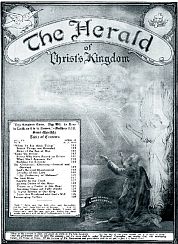
VOL. XV. December,
1932 No. 19 Half Hour Meditations on Romans VOL. XV. December, 1932 No. 19 Strengthened with Might"That He would grant you, according to the riches of His glory, to be strengthened with might by His Spirit in the inner man." - Eph. 3:16. THE PEOPLE of God having here no continuing city, and wending their way through many reverses, trials, and heartaches toward their heavenly Home, have need of much strength-faith, courage, and fortitude; in fact, they are unable to hold out to the end of their journey without these qualities. For this reason the Christian is admonished that he grow not weary in well doing; that in due season he shall reap if he faint not. The child of God who would triumphantly reach the promised Beulah Land must not yield to weakness, faintheartedness, but must seek to have his strength daily replenished and renewed, that he may be enabled to make the necessary and proper measure of progress month by month and year by year. Not by Might nor by Power Yet the Lord has repeatedly counseled His people against the impression that they are to fight, walk or run in the pathway of life, in their own human energy and strength. God's ancient people were exhorted to wait obediently upon Him, with the promise that He would renew their strength; He would strengthen the hearts of those who were of good courage-who would exercise faith arid trust. The Psalmist himself after long years of training under the Lord's providence had learned to say, "The Lord is my strength and my shield; my heart trusted in Him, and I am helped; therefore my heart greatly rejoiceth; and with my song will I praise Him. The Lord is their strength and He is the saving strength of His anointed." (Psa. 28:7, 8.) Again, when the Lord gave to Zechariah the prophetic vision of the golden candle, stick with its seven lamps and of the two olive trees, the Prophet was informed by the angel that the fulfillment of the vision representing the Gospel Church and her witnessing ministry would not be accomplished by human wisdom and strength, "Not by might, nor by power, but by My Spirit, saith the Lord of hosts." - Zech. 4:1-6. One of the most important lessons for the child of God, the follower of Christ, to learn early in his Christian experience, is that the Lord is the source of his strength, that it is through the power and Spirit of God alone that he will be able to do the Divine will, contend successfully with the forces of evil around him, maintain in, his own life the high and lofty standard of righteousness and holiness, and make progress in the pilgrim way. Through Christ Which Strengtheneth Me As the Savior was taking His departure from His disciples early in the Age and commissioning them to go forth to bear the Message and to represent Him, He expressly instructed them to wait in Jerusalem until they should be endued with power from on High. As if to say to them, My dear disciples, I wish you to learn first of all this important lesson, that is, that you have no strength nor power nor wisdom in yourselves to achieve anything; I am laying upon you a great and solemn responsibility in commissioning you as My Apostles to speak the Divine Message before men and to be the special light-bearers for the Church of the entire Age. But I wish you to understand that you have not the power nor-strength, in yourselves to successfully carry out this mission; it will be only as you humbly place yourselves in full resignation in the hands of God to be used by Him, to be assisted and strengthened by His Spirit, which you will receive within a few days following My departure. Therefore wait until you receive the promised blessing. The great Apostle Paul though not one of these to whom the Lord directly gave this commission at the time of His ascension, was one who quickly responded when his turn came to be called into the ministry. His Epistles show that he soon learned that his strength and source of power were in the Lord: "I can do all things through Christ which strengtheneth me, is the beautiful and simple testimony of one who had, from the human standpoint good reason for boasting in himself and in his own achievements and abilities. Coming down to the concluding hours of the Apostle's earthly pilgrimage, we observe how humble and yet how confident are the closing words of his testimony -- "I have fought a good fight," etc. He did not boast of perfection in the flesh, for he had said to the contrary, that he had constant need to keep his body under, in subjection to the spirit and mind of Christ. He had learned to say that he would not boast, save, in the cross of the Lord Jesus Christ. His boast was in the Lord and in the strength and wisdom which the Holy Spirit imparted to him and which enabled him to discharge faithfully his duties as an ambassador for Christ. "I Have Kept the Faith" The Apostle did not boast either of how many churches he had founded, nor of how many he had converted and baptized in the Christian faith. He did not boast of his knowledge of the Lord's Word, nor of his ability as a speaker, nor of how many Epistles he had written, nor of his imprisonment and suffering for the sake of the Gospel. His boast on the contrary was simply that he had fought well, fought faithfully, fought the best he was able, against sin abounding on every hand and weaknesses in himself. Neither did he boast that he had created or made a faith, nor that he had expressed the Gospel in the most clear and positive manner which would descend generations after him to glorify God and to bless His people; but his boast merely was that he had "kept the faith"- the faith which God through His Word had inspired, the faith he had received and which was given to all the Lord's people; he had kept it, he had been faithful to it, he had lived out the faith in his own life, he had not bartered it for a mess of pottage of earthly advantage. On the strength of these two points-his having kept the Word of the Lord's testimony obediently, and his having fought in defense of it to the end of his course to the best of his ability-on the strength of these two things he built his hope for the crown of rejoicing in the Kingdom with the Redeemer and the faithful at His appearing. What an encouragement is here for the very humblest of God's people! Not by intellectual or physical strength, not by wonderful works, not by anything that we can do or have done for the Lord, His Cause, and His people, are we to hope for eternal glory; but simply with the Apostle. we are to seek to use faithfully the talents we do possess and the opportunities the Lord provides for us. We are to keep the faith, not denying the faith under any consideration -- not to secure the favor of any, nor to avoid the frown of any, may we be unfaithful to the Word of God's testimony. We keep the faith by observing in our general course in life the various principles which the faith inculcates. If we do this successfully we will like the great Apostle be fighting the good fight of faith against selfishness in its every phase, especially in ourselves, and we will be developing in ourselves more and more under the Lord's instruction, His Spirit, the spirit of love, the Holy Spirit. The result of the entire procedure will be a fixed and established character acceptable to God. Spiritual Power to Act for God Now it is while we are still struggling in the midst of the battle of life and endeavoring to go forward in the face of the enemy that we need to know assuredly how we may be strengthened with might by His Spirit in the inner man; how we can lay hold more abundantly of the power of that Spirit that gives strength. Who that has had experience in the discouragements and conflicts of the Christian way has not learned that one of the principal methods for imparting to us that might and strength from above is through the exercise of the great privilege of prayer -- the inestimable privilege of personal touch and communion with the Great Spirit or Father of all spirits! Another whose writings give evidence of large as well as deep experience in seeking the Lord and finding Him, confidently affirms that "Prayer, patient, persevering prayer, secret communion with God, deep and real exercise of the soul in His presence, where alone we can arrive at a true estimate of ourselves and things around us," has a tremendous bearing upon to what extent we flourish spiritually and receive power with the Lord; "and not only so, but also obtain spiritual power to act for God amongst our brethren, or toward the world without. 'Elias was a man of like passions with us'; and he found himself in the midst of a dark apostasy, and wide-spread alienation of heart from God. He beheld the faithful falling from amongst the children of men; he saw the tide of evil rising around him, and the light of truth fast fading away: the altar of Baal had displaced the altar of Jehovah, and the cries of the priests of Baal had drowned the sacred songs of the Levites; in a word, the whole thing was one vast mass of ruin before his view. He felt it; he wept over it; he did more-'he prayed earnestly.' Power of the Spirit of Prayer "Truly we may say, it is good to wait upon God: it not only leads to happy results as seen in God's answer to it, but there is also much sweetness and comfort in the exercise itself. How truly happy it is for the tempted and tried believer to find himself alone with God! How blessed to allow his spirit to flow out, and his affections to ascend to Him who alone is able to lift him above the depressing power of present things into the calmness and light of His own most blessed presence! May we all be found, then, waiting more upon God-making the very difficulties of our day an occasion for drawing near to the mercy seat, and then we shall not only exert a salutary influence in our respective spheres, but our own heart will be comforted and encouraged by private waiting upon our Father, for the promise has never yet failed, 'They that wait on the Lord shall renew their strength!' Precious promise! May we make full proof of it! "We want to be more in the presence of God, in the real sense of our need; if we felt our need more, we should have more of the spirit of prayer. And it is the spirit of prayer we want-that spirit which puts God in His own proper place as giver, and us into our proper place of receivers. There are many who make a kind of god of prayer -- many who let their very prayers get between their souls and the God of prayer. How often are we deceived by the mere form of prayer-with the formal utterance of words which have no reality in them! This is a great snare. We should always take care that our prayers are the natural outflow of the spirit within us, and not of the mere superstitious performance of what we think ought to be done. But not only may we as individual children of God and followers of the Lord Jesus be strengthened with might in the inner man by our spiritual exercises daily in the privilege of holy communion and fellowship with God, but we may as communities or assemblies of His people be further assisted and strengthened with holy might by joining our prayers and in a united way, as His people, praying together and speaking often to one another of one feature or another of our holy faith and thus encouraging and building up one another in the same. "An exercise which seems so sadly neglected when it is so specially needed is united prayer among Christians. It will be generally found that collective life and energy, service and testimony, will be in proportion to the measure of collective waiting upon God. Where there are not public prayer meetings, there is sure to be a lack of service and testimony; the interests of the Church of God are not realized, and, as a consequence, the things of earth occupy a place of undue prominence in the minds of Christians. If we felt our collective weakness, there would be a collective utterance of that weakness, and moreover a renewal of our collective strength. Now I think it will be found that all important movements among the people of God have been the result of united heartfelt prayer. And surely we may say it is natural that it should be so. We are not to expect that God will pour forth His reviving grace on those who rest satisfied with their deadness and coldness. The word is, 'Open thy mouth wide, and I will fill it.' If we are satisfied with what we have, how can we expect to get more? Let it be therefore the aim of the Christian reader to stir up his fellow-Christians around him to seek the Lord in united prayer, and he may be assured of it, the happy results will be speedily seen." As New-Born Babes Desire Sincere Milk It is the explicit teaching of the Scriptures that strengthening with might in the inner man is accomplished not instantly, but gradually through the years as the heart responds obediently to the Divine Word of instruction and to the providences of the Lord. Not only so, but it is represented as a process in which there must be a working together with God in the building up of faith, hope, and love. It is recalled that one of the figures employed in the Scriptures to illustrate the life of faith and the process of gradual development is that of a new, born babe. Though many of the Lord's people may be persons of mature years in the natural life, yet in the spiritual or life of faith they may be but babes. And the Apostle counsels them as new-born babes to earnestly de-' sire and seek for the sincere milk of the Word-the primary simpler truths, the foundation teaching and doctrine. These are the plain clear teachings of the Scriptures, such as the original perfection and glory of humanity created in the image of God; the fall of our race under the first trial and its plunge into ruin and death; the redemption of our race as the result of the payment of an equivalent price -- the sacrifice of the Man Christ Jesus who gave Himself a ransom for all; the actual and final deliverance of the redeemed race in God's due time and order. Those who in simple and childlike faith accept these truths and who, laying aside all malice and all guile and hypocrisies and envyings and all evil-speaking, endeavor to live worthy of this salvation, esteeming it as only a reasonable service to devote themselves thenceforth to the service of God, are accepted of Him as sons and heirs-as spiritual sons. The Word of the Lord assures that these little ones are very precious in the Lord's sight. It was with reference to such that the Lord said to the Apostle, "Feed My lambs"; and again that He gave warning to false teachers, saying, "Whoever shall ensnare one of the least of these who believe in Me, it would be better for him that a millstone were hanged about his neck and that he were sunk in the depth of the sea." Again, under the figure of a tender shepherd caring for a weak and straying lamb, He shows His earnest solicitude for these babes of the family, saying, "It is not the will of your Father which is in heaven that one of these little ones should perish." Should Go on to Perfection But while these newly formed ones in Christ, because of their very feebleness and inexperience have much special care bestowed upon them and are dearly beloved of the Lord, and while their meek and teachable spirit is commended to all, it is most certainly not the will of God that they should always remain babes. The very object of His commending to them the milk of the Word is that they may grow thereby out of this infantile state up to the maturity of spiritual life-"That we be no more children tossed to and fro and carried about with every wind of doctrine." There should come a time in the experience of every healthy, growing child of God when he would be able to leave the first principles of the doctrines of Christ-the foundation doctrines-having them firmly fixed, established and settled in his mind, and therefore not needing to dig them up and, lay them over again-and go on growing in spiritual strength, might and grace, and in the knowledge of the truth unto perfection. The Apostle Paul reproved some of his day because they did not thus grow saying, "For when for the time [spent] ye ought to be' teachers, ye have need that one teach you again which be the first principles of the oracles of God; and are become such as have need of milk, and not of strong meat: for every one that useth milk [only] is unskilful in the Word of righteousness; for he is a babe." The Lord's people therefore are not to live continually on the milk diet, but by every word that proceedeth out of the mouth of God. Some of these words are the simple truths above noted-the milk; and others are deeper truths, the strong meat for those who, nourished by the pure milk, have grown and have developed considerable firmness and strength of Christian character. This stronger food says the Apostle is for adults -- for those possessing faculties habitually exercised in the discrimination of both good and evil. He also warned them of the dreadful results to them if they should fall away. A Time of Many Conflicting Doctrines It is most essential that the Lord's people shall be on guard against accepting as strong meat, as deep spiritual truths, that which is more or less contaminated, mixed with error, sophistry, human theory, and speculation. This is an important consideration. Today there are many professed teachers of spiritual things endeavoring to impart their beliefs and doctrines to others. Not all of the doctrines taught today are sound; there is much conflict between them tending to engender contention and strife. In fact, it will be readily conceded that much that is being propagated by many leaders is very unsound and unsafe teaching inasmuch as it does not bear the earmarks of the Spirit of the Lord and is not supported by His Word. Various theories and much that is purely speculative and not sufficiently established on the Divine Word is. publicly announced and published by various teachers who, as the Apostle affirms, would seek to draw away disciples after themselves; and whose ministry therefore does not have the wholesome effect of building up the saints in holy might, power, and in the spiritual qualities of the new creature in Christ Jesus. The Apostle therefore calls upon all the faithful to be of humble mind, to exercise great care and much spiritual discernment, that they may discern between that which is good and that which is evil. If babes in Christ are fed on adulterated milk-a mixture of truth and error which always produces confusion -- the result will be that they will sicken and die, unless the unwholesome diet is speedily removed and the sincere, pure milk is sought after and used. Often it is the case that there is not sufficient care on the part of the babe in Christ about seeking the pure milk of the Word; and many of the mature ones are too careless about setting the impure milk before them. Likewise, the strong meat or deeper truths may be more or less defiled by a mixture of error and misrepresentation and the result will be that the individual feeding upon this will languish and become spiritually sick, at least will remain weak and will fail to be strengthened with might as the Lord designs. It behooves all who are truly the Lord's people to bear in mind the Apostolic advice, to desire and seek after only that which is pure and uncontaminated, of the Lord's Word, whether it relates to the milk or the strong meat of that Word, and to resolutely discard all else. The words of another are of force here: "If we are feeding upon God's reality, we shall unhesitatingly reject Satan's counterfeit. This is the best possible way in which to escape the entanglements of error, in every shape and character. 'The sheep hear His voice, and . . . follow Him; for they know His voice. And a stranger will they not follow, but will flee from him; for they know not' the voice of strangers.' (John 10:4, 5.) It is not, by any means, needful to be acquainted with the voice of a stranger, in order to turn away from it; all we require is to know the voice of 'the good Shepherd.' This will secure us against the ensnaring influence of every strange sound. While, therefore, I feel called upon to warn the reader against strange sounds, in reference to the Divine mystery of Christ's humanity, I do not deem it needful to discuss such sounds, but would rather seek, through grace, to arm him against them, by unfolding the doctrine of Scripture on the subject." St. Paul's Prayer for the Church Again, let the fact be deeply engraved upon the minds of the Lord's people that they are to be strengthened with might by His Spirit in the inner man. Nothing can be achieved except the Lord's holy power enter in and work out in the individual life what is that good and acceptable and perfect will of God. Not only so, but, as another has remarked, "The mind or spirit of the world must be driven out of our hearts, in proportion as we would have them filled with the Holy Spirit, mind, influence. Selfwill must also give place. And because it is in proportion as we are emptied of all things else that we are ready to receive of His fulness, therefore the Lord would have us come into this condition of earnest desire for filling with His Spirit of holiness, that. we may be willing and anxious to displace and eradicate every other contrary influence and will. "This evidently is the thought of the Apostle, in his prayer for the Church at Ephesus, that 'Christ [the Spirit of Christ] may dwell in your hearts by faith [that figuratively He may sit as king, ruler, director of every thought, word and deed]; that ye being rooted and grounded in love [the Holy Spirit or disposition} may be able to comprehend with all saints what is the breadth, and length, and depth and height, and to appreciate the love of Christ, which passeth knowledge, that ye may be filled with all the fulness of God.' He who is filled with the Spirit of Christ, and with a full appreciation of the love which He manifested, will have the Father's Spirit in full measure. . . . "Our text [Luke 11:13] institutes a comparison between kind earthly parents giving natural food to their children, and our kind heavenly Parent giving His Holy Spirit to them that ask Him. But as the earthly parent sets the food within the reach of his family, but does not force it upon them, so our heavenly Parent has set within the reach of His spiritual family the good provisions of His grace, but He does not force them upon us. We must hunger and thirst for them, we must seek for them, not doubtfully, but with faith respecting His willingness to give us good gifts. When, therefore, we pray for the Holy Spirit, and to be filled with the Lord's Spirit, we are to look about us and find the provision which He has made for the answer to these prayers, which He has thus inspired and directed. Babes in Christ Seeking Outward Signs "We find this provision in the Word of truth; but it is not enough to find where it is: if we desire to be filled, we must eat; assuredly we must partake of the feast or we will not experience the satisfaction which the eating was designed to give. He who will eat not of a full table will be empty and starved, as truly as though there were no food. As the asking of a blessing upon the food will not fill us, but thereafter we must partake of it, so the possession of the Word of God, and the offering of our petition to be filled with the Spirit will not suffice us; we must eat the Word of God, if we would derive His Spirit from it. "Our Master declared, 'The words that I speak unto you, they are spirit and they are life' (John 6:63); and of all who are filled with the Spirit it is true, as spoken by the Prophet, 'Thy words were found and I did eat them.' (Jer. 15:16; Rev. 10:9.) It is absolutely useless for us to pray Lord, Lord, give us the Spirit, if we neglect the Word of truth which that Spirit has supplied for our infilling. If we merely pray for the Spirit and do not use the proper means to obtain the Spirit of truth, we will continue to be at most only 'babes in Christ,' seeking outward signs, in proof of relationship to the Lord, instead of the inward witness, through the Word of truth, which He has provided." The Apostle Peter after delivering his admonition to the brethren to receive pure spiritual truths and to grow thereby, indicates to them what will be some of the manifestations of strength which they derive from being spiritually nourished and built up. The spirit of resignation to God, of submission to His will and providences will be in evidence in these growing ones. Such will manifest that measure of Christian fortitude as that they shall take patiently the various kinds of sufferings, buffetings, and distressing experiences of life. These will not have the effect of embittering them or making them sour or resentful toward those who may be the instruments used, "For," says the Apostle, "even hereunto were ye called: because Christ also suffered for us, leaving us an example, that ye should follow His steps: who did no sin, neither was guile found in His mouth: who, when He was reviled, reviled not again; but committed Himself to Him that judgeth righteously." What wonderful might, what marvelous power was here exhibited by the Son of God! Surely He was strengthened with might by the Spirit of God in the inner man, to enable Him' to remain steadfast and loyal to the Divine will in the face of the most tragic circumstances. The Lord Your God Proveth You The Apostle Paul likewise exhorts, "Consider Him that endured such contradiction of sinners against Himself, lest ye be wearied and faint in your minds." To consider Him, would seem to be to take note of, to have in mind, to reflect upon, and not to easily forget how our Lord endured various trials and opposition of sinners against Himself. Here again is a most important consideration for our careful reflection in these days. It is a time when various and many evil reports are circulated; when there is a great deal of the spirit of intolerance, the spirit of bitterness and resentment; a time when faithful brethren in Christ are evilly spoken of, and therefore much of the Spirit from above is required that there be no railing and no reviling or retaliation on the part of those who would carefully walk in the steps of their Divine Master. We are at liberty to reveal and display only the spirit of long-suffering and patience toward those who would do us evil, for this is the sum of the Apostle's great exposition of the quality of love, which he says suffers long and is kind. It is on the lookout to do good and to bless all and to curse not. In their experiences the Lord's people today have endured some opposition of men and sinners against themselves; but they have not yet resisted unto blood. They have not yet passed through the trying experiences through which He passed. When we remember that while we are poor, imperfect creatures, like our neighbors, He was holy, harmless, undefiled, then it is good to reflect that He endured patiently the opposition of sinners. When trying experiences came to Him, He did not consider them as being merely from the individual with whom they originated, but as being, on the other hand, under the supervision of the Father. If therefore the Father permitted such experiences to come to Him, He was bound to prove His loyalty by patient endurance; as He said, "The cup which My Father hath given Me, shall I not drink it?" So it is with spiritual Israel, "The Lord your God proveth you." In proportion as we are able to take our Lord's viewpoint in our experiences in life, we can be calm. If the Father permits trying experiences for our testing, that we may be "strengthened with might," or for the testing, or proving of others, in ways we may not understand, it is our privilege to rejoice to have His will done, as the poet has expressed:
Half Hour Meditations on Romans No. 32 "Mercy and truth are met together; righteousness and peace have kissed each other." - Psalms 85:10. IN OUR previous Meditations we have seen that the grand theme with which our Epistle is concerned is that age-old question: "How can man be just with God?" (Job 9:2; 25:4.) St. Paul well knows, indeed all men intuitively realize, that there can be no such thing as final acceptance with God apart from personal righteousness. During the first half -of his life the Apostle had zealously sought to attain righteousness by "works of law," but in the mercy of God he was brought to realize the impossibility of this, and "his" Gospel has to do with another method of securing righteousness. This other method he declares to have originated with God, and to be available to all mankind on the one condition of faith. "I am not ashamed of the Gospel," he has told us, "for it is the power of God unto salvation to every one that believeth for therein is being revealed to believers a righteousness from God which has its origin in faith."-Rom. 1:16, 17, Free Translation. Reading rapidly through the Epistle at one sitting to get its broad outlines clearly in mind (See Meditations No. 8), we saw that the manner in which we obtain this gift from God (we never could attain it), is by its being first imputed and then imparted to us. We saw, too (Meditations No. 15), that while it was imputed to us instantaneously on our exercise of faith in God, its impartation is a gradual process. Something of the same thought may be seen in Psa. 103:3, not, of course, in its application to fleshly Israel, but to the Gospel Church: "Who forgiveth [instantaneously] all thine iniquities; who healeth [gradually] all thy diseases." When, therefore, we are told by the Apostle that "now, apart from law, a righteousness of [or from] God hath been manifested," (Rom. 3:21) such "righteousness of God should not be limited in our understanding of it, to imputed righteousness only, but within its meaning the thought of imparted righteousness should also be embraced. These two parts of the one gift may be spoken of as together constituting our righteousness from God-our justification; imputed righteousness being referred to as justification by faith; and imparted righteousness being referred to as sanctification. While it would not appear to be of greatest importance what terms we use to describe these favors, provided we possess the substance of the matter in our life's experience, yet it will conduce to clearness of thought in our own minds, and perhaps avoid the possibility of confusing the minds of others, if we distinguish between imputed and imparted righteousness and, whenever possible, do so by the use of those terms adopted by the Apostle himself. His Gospel theme, then, is justification (righteousness, both imputed and imparted), but so far as we have yet gone in our study of the Roman letter, he has limited his discussion of this theme to imputed righteousness only to justification by faith. In his development of this part of his theme he first stressed the world's need of it, not by reference to Adam and the condemnation we inherit from him but by an appeal to the facts of history-to the record of the personal individual sins of men, showing both the plight of the Gentiles (Romans 1:18-32), and of the Jews (Romans 2:1.29), and after anticipating and answering objections (Romans 3:1.8), summed up his conclusion by declaring that all the world is guilty before God; and that by means of works of law no human being shall be declared righteous in God's sight. (Romans 3:9.20.) Then, having in this long interval (Romans 1:18-3:20) satisfactorily demonstrated the world's need, he proceeded to show God's provision to meet that need in the bestowal of righteousness to man as a gift. (Romans 3:21-24.) In the verses we are now to consider he will explain how it was possible, on the one condition of faith, for this free and universal gift of righteousness to be given by God to men. It was made possible, he will tell us, by the atonement sacrifice of Christ. Brief Summary of Divine Wisdom "Christ Jesus, whom God hath set forth to be a propitiation through faith in His blood, to declare His righteousness for the remission o f sins that are past, through the forbearance of God; to declare, I say, at this time His righteousness: that He might be just, and the justifier o f him which believeth in Jesus." - Rom. 3:25,26. These two verses, in conjunction with the four which precede, are among the most important in the Bible, and have been called the very "marrow of theology." "Almost all expositors seem to have realized with more or less depth of conviction, and with feelings varying according to their illumination and the ratio of their evangelical sympathy with the Apostle, that they had to do here with words of peculiar significance, and with ideas which, in the Apostle's own judgment, were of transcendent moment. Luther draws attention, in the margin of his Bible, to the importance of this section. He says, over against verse 23rd and following verses -- 'This is the chief point, and the very central place of the Epistle, and of the whole Bible.' Calvin, on verse 24th, and referring to the contents at once of that verse, and of the two which follow says-'There is probably no passage in the whole Bible that more exhaustively exhibits the justifying righteousness of God: for it shows its efficient cause, the mercy of God; its material cause, Christ with His blood; its formal or instrumental cause, faith springing from the Word; and its final cause, the glory of the Divine justice and goodness.' " "And yet it is so short that the statement seems scarcely to have begun when all is said, within so few lines are the most decisive thoughts concentrated. It is really, as Vitringa has said, 'the brief summary of Divine wisdom."' The Author of Our Salvation "It is God Himself, who, according to this passage, is to be regarded as the Author of the whole work of redemption. The salvation of the world is not therefore wrested from Him, as is sometimes represented by the mediation of Christ. The same thought is expressed elsewhere; for example, 2 Cor. 5:18: 'All is of God, who hath reconciled us to Himself by Jesus Christ'; and John 3:16: 'God so loved the world that He gave His only-begotten Son.' This point should never be forgotten in the idea we form of expiation." Established Beforehand The word translated "set forth" has been viewed by expositors from various standpoints, and has received different explanations. Scholars tell us that it may signify either of two meanings: (1) "To exhibit, present publicly (in view of oneself), or (2) to set before oneself in the innermost shrine of the spirit; to decide, to design beforehand within oneself." It will be noted that the text of the Authorized Version adopts the first of these two meanings, and that in the margin the alternative meaning of "foreordained" is given. Both meanings are in full accord with the teaching of St. Paul both elsewhere and in our Epistle. For the first meaning we may compare Gal. 3:1: "O, thoughtless Galatians! who fascinated you, before whose very eyes Jesus Christ was openly set forth as a crucified one?" (Rotherham) The second sense is however the prevailing one in the New Testament, for example, Romans 1:13: "I would not have you ignorant, brethren, that oftentimes I purposed to come unto you"; and Eph. 1:9: "Having made known unto us the mystery of His will, according to His good pleasure which He hath purposed in Himself." While the first meaning is not impossible, the context, in our opinion, speaks strongly in favor of the second meaning. "The fundamental idea of the passage is the contrast between the time of God's forbearance in regard to sin, and the decisive moment when at once He carried out the universal expiation. It is natural in this order of ideas to emphasize the fact that God had foreseen this final moment, and had provided Himself beforehand with the victim by means of which the expiation was to be accomplished." If this be the true thought then the translation, "Christ Jesus, whom God hath foreordained [or "whom God hath established beforehand"]," would already give a hint of the contrast with the phrase "at the present time" which appears in verse 26. Moreover such an expression, placed as it is at the head of the whole passage, "brings out forcibly the incomparable gravity of the work about to be described." The At-one-ment The Greek word translated propitiation is hilasterion and to explain it very many commentators have had recourse to the technical meaning which it has in the Septuagint or Greek translation of the Old Testament, where it denotes the Mercy Seat, the Propitiatory or lid o f the Ark of the Covenant. This meaning is urged in the Emphatic Diaglott, in a footnote to this passage, and is stressed by Brother Russell in Scripture Studies, Vol. V, page 442. Supporting this viewpoint is the fact that in the only other place in the New Testament where the word occurs, namely, Heb. 9:5, it has this sense. There are other commentators, however, of equal scholarship and devotion, who prefer translating it in the passage before us as a propitiatory sacrifice, or the means o f propitiation. Thus, one such, referring to the Mercy Seat, above which the Shekinah shone and on which the blood of atonement was sprinkled, writes: "Here is indeed a manifest and noble type of Christ. But on the other hand the word hilasterion gets that meaning only indirectly. Its native meaning is rather 'a price o f expiation.' - And a somewhat sudden insertion here of the imagery of the Mercy Seat seems unlikely, in the absence of all other allusion to the High-Priestly function of our Lord." It has also been observed that if the matter in question were a well known definite object, the only one of its kind, such as the Mercy Seat, the word "the" could not be omitted, whereas it does not appear in the Greek text. It has been further observed that if the word "set forth" previously discussed, be understood in the sense of "exhibiting publicly" there is a contradiction between this idea of publicity and the part assigned to the Mercy Seat in the typical Atonement Day arrangements, for this object remained concealed in the sanctuary, the High Priest alone could see it, and he only through a cloud of smoke. And if the verb be understood in the sense of "established beforehand," it is still more difficult to apply the idea of an eternal purpose, either to a material object, such as the Mercy Seat itself, or to its typical connection with our Lord Jesus. In regard to the sense of the passage, the difference is not at all material, nor does it, so far as we can see, in the slightest degree affect the Apostle's reasoning. In either case there is reference to a significant type. The proper idea of "propitiation" is, to render propitious or to render favorable. Thus in Luke 18:13 the publican says to God 'Be merciful, show Thyself propitious to me," which is equivalent to saying "forgive me." Whether we think of our Lord Jesus, as (1) the Mercy Seat (the Propitiatory), or (2) as the propitiatory sacrifice (the means of propitiation), we should beware of entertaining the thought that He produced any change in Jehovah's character; as if Jehovah required to be supplied with a motive to pity, an inducement to be merciful, a price for love and grace. "Far be such a thought from our minds! We ought to conceive of Jehovah, as eternally, immutably, infinitely, compassionate and merciful. That any transition is produced in His nature [disposition), by the mediation of Christ, from previous vindictive cruelty to benevolence and compassion, . . . is a supposition full of blasphemous impiety. God has been from eternity, and to eternity must continue the same; 'without variableness or shadow of turning.' Being absolutely perfect, He cannot change to the better; for perfection cannot be improved; the slightest alteration, therefore, of what He is, would detract from that infinite excellence, without which He would not be God. But while God is infinitely and immutably good, He is at the same time, infinitely and immutably holy, and just, and true. Never ought we to speak of Him as acting at one time according to mercy, and at another according to justice; if by this mode of expression it be meant that the claims either of justice or of mercy are in any part of His procedure, in the smallest possible degree, suspended or left out of view. He never acts in opposition to the one or to the other, but always agreeably to both. The character of God is perfect excellence; infinite goodness: -- not a hemisphere of separate stars, but one glorious sun of pure and 'holy light.' The attributes which constitute this character, though we may speak of them, and reason about them, distinctly, are completely inseparable in their exercise. Through Faith -- in His Blood Some, indeed most commentators connect the phrase "in His blood" with the word "faith" thus: "through faith in His blood." While this may be grammatically possible, yet we believe those expositors correctly interpret the mind of the Apostle who separate these clauses, and understand them as each qualifying the hilasterion, the Mercy Seat, or the means of propitiation. The American Revised Version seeks to indicate this sense by placing a comma after the word faith, while it is still more clearly indicated in the phraseology of the Emphatic Diaglott, which reads: "Christ Jesus, whom God has set forth to be a Mercy Seat, by His own Blood, 'through the faith." The Apostle has told us that God established Jesus beforehand as the means of propitiation; he here explains how that means operates. Two conditions are required to make the means effective: one on the part of the Savior, and one on the part of the sinner. Propitiation does not take place except through faith on the part of the saved, and except through the shedding of His blood on the part of the Savior. Moreover these two conditions were not afterthoughts on the part of Jehovah, but were decided on when He "set forth" or "established beforehand" Jesus as the means of propitiation or as the Mercy Seat. When in His eternal counsels He determined within Himself that Jesus should be the means of propitiation, He also stipulated with Himself that this should not be apart from these two conditions. Through Faith It is easy to see the necessity for faith as the instrumental condition on the part of the individual, for the sacrifice of Jesus could have no saving virtue whatever to one who refuses to acknowledge its necessity or to rely on its efficacy. And if this be true in regard to the first stage in salvation, justification by faith, imputed righteousness, much more apparent must it appear in connection with the development of the new life of faith, sanctification, imparted righteousness. For it is truth alone which sanctifies (John 17:17), and all should realize that the influence of truth on the state of the mind and on the character of the heart and life, must, in the very nature of the case, depend upon the truth being understood and believed. Truth unknown and uncredited can effect nothing. The Gospel coming as it does to sinners as a testimony, it is difficult to conceive of any other way in which the blessings revealed in it can be received and enjoyed except upon the believing reception o f such testimony, that is to say, faith therein. In His Blood According to Lev. 17:11 the life is in the blood. The blood being shed therefore is the life exhaling. "Now the willful sinner has deserved death. Having used the gift of life to revolt against Him from whom he holds it, it is just that this gift should be withdrawn from him. Hence the sentence: 'In the day thou sinnest, thou shalt die.' Every act of sin should thus, in strict justice, be followed by death, the violent and instant death of its author. The sinner, it is true, no longer understands this; for sin stupifies the conscience at the same time that it corrupts the heart and perverts the will. Such, then, is the law which must be set in the light of day before pardon is granted, and that it may be granted. Otherwise the sovereign majesty of God on the one side, and the criminal character of the sinner on the other, would remain shrouded in the. conscience of the pardoned sinner; and such a pardon, instead o f laying ,a foundation for his restoration, would consummate his degradation and entail his eternal ruin. Thus are justified the two qualifications of the means of propitiation indicated here by the Apostle: in blood, and by faith; in other terms: (1) The judgment of God on sin by the shedding of blood; (2) The adherence of the guilty to this judgment by faith. The Apostolic utterance may consequently be paraphrased thus: 'Jesus Christ, whom God settled beforehand as the means of propitiation on the condition of faith, through the shedding of His blood.' " "Oh! Christ, what burdens bowed Thy head! Parsons, Kans. "As previously reported the liberated brethren in this vicinity have since May 1931 been assembling each month in little conventions, usually at 'Neodesha or Iola. A wonderful season of fellowship and blessing is always enjoyed by an assembly of usually fifteen to thirty of those of like precious faith in an all-day program consisting generally of a Berean study, a discourse, a prayer and praise service, and another discourse. "In an effort to reach others who for various reasons had not been enabled to drive the greater distance, our last convention was held at Parsons, October 23. Friends from Kansas City, Oswego, Galena, Bartlesville, Coffeyville, Independence, Neodesha, as well as Parsons, were present; some of whom testified that this was their first opportunity of assembling with a group of this kind, and could hardly find words to express the joy and blessing which was theirs at this wonderful opportunity. We have all along had unmistakable evidence of the Lord's approval and special blessing attending our efforts in these little services, and are thankful to hear of similar efforts in other localities and to know the Lord's blessing has likewise been manifest. And our prayer is that we may yet hear of other localities where a similar work and consequent blessing may be had. "We are sorry to receive the 'Herald' but once a month, but on the other hand feel it a very wise policy to thereby make more frequent the Pilgrim visits. Incidentally we are grateful for the approaching visit of dear Brother Blackburn. An incident relating to his approaching visit seems quite providential when we recall a like occurrence on the occasion of his last visit with us: At our March 20th convention, we arranged for the April convention to come on the 18th. Two days after this arrangement was made we received the 'Herald' with Brother Blackburn's itinerary routing him here on this same prearranged convention date. October 23, at a convention held in Parsons, arrangements were made for our November convention to be held at Iola on the 20th. Now' comes the 'Herald' giving us Brother Blackburn here at Neodesha on the 19th, and at Iola on the 20th-our prearranged convention date. In both instances we have said, 'This is surely the Lord's providence,' and we are rejoicing and looking forward to a great blessing from Him who 'worketh all things after the counsel of His own will'." Waukesha, Wis. "We have just had another of our splendid little conventions at Waukesha last Sunday-two-meetings in the morning and two in the afternoon. There were three from Rockford, five from Beloit, five from Richfield, and the remainder of a company of about forty from west of Milwaukee. Never we believe has there been a deeper, more fervent spirit of oneness in the Lord in our conventions than was enjoyed here last Sunday; the meetings increasing in warmth of spirit up to the last, when a real love feast in the closing song and prayer finished a perfect day in the courts of the Lord's house. "The preceding Sunday it was the privilege of a few of us to attend a little gathering of the friends at Rockford, Ill., which was also marked by a delightful spirit, profitable fellowship, and helpful messages. Please do not let Brother Blackburn pass any of us by at any of these places if it can possibly be avoided." [The plan here proposed is designated "Good Hopes," because nothing is actually promised-only generous hopes expressed, based upon the future prospects as they now appear. Those who desire to make use of this plan may fill out both of these memoranda. One should be kept for the refreshment of the memory; the other mail, to us.] PASTORAL BIBLE INSTITUTE Dear Friends: -- Conscious of the privilege and opportunities that are before us for the promulgation of the Truth, I am deeply interested in the spread of the Glad Tidings of the lengths and breadths, the heights and depths of redeeming love expressed for us in God's great Plan of the Ages. Having considered carefully and prayerfully how to use my various talents to my Redeemer's glory and for the service of His people, I have decided that so far as my "money talent" goes, I can do no better than to follow the rule laid down for us by the great Apostle Paul (1 Cor. 16:2), and will therefore endeavor to lay aside on the first day of each week, according to my thankful appreciation of the Lord's blessings during the preceding week. Of course, I cannot in advance judge or state particularly what the Lord's bounty may enable me to set apart weekly, and hence it is understood that the sum indicated is not my promise, but merely my conjecture or hope, based upon present prospects; and should I not succeed in doing as well, it is understood that there is no obligation to make any contribution and the Lord will know my heart. My object in specifying in advance what I hope to be able to do in this cause is to enable those in charge of the work of publishing and circulating the Truth to form estimates, lay plans, make contracts, etc., with some idea of what I will at least try to do in the exercise of this my highly appreciated privilege. My present judgment is that during the coming year I shall be able to lay aside for the work of the ministry the amount of per week. To comply with United States Postal Laws, all or any portion of my donation may be applied as subscription price for "The Herald" or free literature sent to the Lord's Poor, or others as the "Institute's" officers may deem advisable. That the work be not hindered, I will endeavor to send what I shall have laid aside for this cause at the close of each quarter. (Name) (Post Office) (State) HERALD SUBSCRIPTIONS-ON GOOD HOPES ACCOUNT The friends who contribute to the "Good Hopes" (described on the reverse side of this sheet) at times desire to send "The Herald" to friends who are not yet interested enough to subscribe for 'themselves, or to deeply interested friends who are too poor to subscribe and backward about accepting our "Lord's Poor" offer. They are invited to give us such addresses below-the expense to be deducted from their donations. Give full addresses, and write very plainly, please, mentioning the length of the subscriptions. "For God so loved the world, that He gave His only begotten Son, that whosoever believeth in Him should not perish, but have everlasting life." "For unto you is born this day in the city of David a Savior, which is Christ the Lord." - John 3:16; Luke 2:11. THE author of the Book of Hebrews declares that "a strong consolation" is given the Christian believer, a firm foundation for his faith; that it is for all who have "fled for refuge" to lay hold upon the hope set before us. Indeed we see that our confidence in Jesus, that He was the sent of God, the Redeemer, the Messiah, the Deliverer of His people, rests not merely upon the testimony of the Apostles in the New Testament records, wonderful and convincing as these testimonies are. They are valuable and important to us from the fact that they evidence the fulfillment of promises, types, and prophecies given by the Lord with more or less clarity and explicitness all along down the stream of time through the preceding four thousand years. He who does not discern something at least of the Divine Plan of the Ages in connection with our Savior, His birth, His three and one-half years' ministry, His sacrificial death, His resurrection, His ascension, etc., fails to get the real strength and power of the Divine revelation designed by the Lord to be the firm foundation for His people's confidence in Him and in all the glorious things which He has promised He would yet accomplish through this great Savior. The Prophets Spoke Beforehand We observe the original promise of the Lord shortly after the blight of sin had come upon our first parents and brought them under Divine sentence. (Gen. 3:15.) We observe the promise made to Abraham respecting Messiah, that He should be of his posterity. (Gen. 22:18.) We observe the same to Jacob, and to David. (Gen. 28:14; 2 Sam. 7:12-16.) Through Isaiah the Prophet, His coming and His greatness are foretold. (Isa. 9:6-7; 11:1:9.) Daniel the Prophet also refers to the importance of His work of making an end of sin and bringing in everlasting righteousness, and thus sealing the visions and prophecies which the Lord had just given respecting Him, and the favors to come through Him. (Dan. 9:24.) It is recalled also how this Messiah was typified in Isaac, who was not only the heir of the promises made to Abraham, but who also in a figure was put to death and received again from the dead. It is further remembered that the types and figures of Mosaic arrangement foreshadowed these great truths and how Moses himself was declared to be like unto the greater One who would come after him. We are impressed further with the fact that the Divine predictions of the Prophets of old concerning a coming Redeemer, call our attention largely to the fact that He is to be a King, a Deliverer, a Savior. This point is made prominent because God appealed to mankind along the line of their necessities and hopes. The sacrificial feature of the Lord's ministry was made less prominent than His power and majesty and glory, because the sacrifice related especially to God and was to meet the demands of the Divine Law against a sinner race. The question of how God would settle the matter consistently with His own sentence of death resting upon the race, would to the average human mind be much less important than the statement of the resultant glories of restitution and blessing. Hence we find the references to the sacrificial features of our Lord's ministry, largely presented under types and symbols intended to be comprehended only by those who, as sons of God, would be guided into the truth by the Holy Spirit. In the Beginning Was the Logos Heeding the Apostle's admonition to "consider Him," our great Redeemer, "in whom was life," we do not go far in our considerations and meditations upon Him and His Advent into this world, without realizing the mind traveling backward to discover whence came this One in whom was life, and what was His place in the counsels of God before He began the work of human redemption? Reaching far into the remote past, to the beginning of earthly creation as mentioned in Genesis, the Divine revelation informs us that even then the Logos, the Word, existed with God. The "Word" is a very appropriate and significant title for our Lord Jesus in His prehuman condition: it is the translation of the Greek word Logos, which might more literally be rendered, "the expression"; for the great and honorable One, the Heavenly Father's companion "before the world was" made, who is declared to have been "the beginning of the creation of God," was in every sense of the word a full and complete expression of the Divine will, mind, purpose, character. To illustrate the office of the Logos in His prehuman relationship to God, it is said that in olden times the kings kept themselves more or less apart from their subjects; they were rarely seen. It is said that it was a custom for them, when addressing multitudes of their subjects, to sit behind a screen or curtain, while in front of this stood the king's interpreter or representative, who spoke the king's words in a loud tone to be heard by all who were there. How beautifully this represents the honorable position of our Lord Jesus as the mouthpiece of the Father; He is His representative to every creature, to angels and to men. He is His active agent; by Him were all things made and without Him was not anything made. He Laid Aside His Glory Thus of this First Begotten One the Apostle writes that He was in the form of God, a likeness of Jehovah. (Phil. 2:6.) And that in that position of great favor and dignity, He was not lifted up in pride, but possessed always of the spirit of obedience and subserviency to the Divine will; and that it was a proof of this subserviency and obedience and humility that the Logos became flesh, the Man Christ Jesus. Abruptly the writer, John the Evangelist, passes from our Lord's great work in the creation of all things as the Logos, to His appearance amongst men and declares, "In Him was life; and the life was the light of men." Our Lord is here contrasted with other men who were fallen and who did not have life nor light. But our Lord Jesus having been transferred from the spirit plane, from the heavenly condition to that of the human in its perfection, He still had life and light, and this light constituted the light amongst men. They perceived that He was a remarkable character-"Never man spake like this man." "They marveled at the gracious words that proceeded out of His mouth." They had never before seen one in whom was life; all others whom they had met, like themselves were dying creatures and nearly dead. But this perfect One had life to give and He did lay down that existence, that life, as the redemption price for the human family, and thus in great humility He became obedient unto death, even the death of the cross; and on account of which Jehovah God hath highly exalted Him by a resurrection to the Divine nature, far above angels, principalities and powers and every name that is named; to a position higher than any other, higher than His prehuman condition, next to the Father, an associate of His throne, His glory, His power, His nature. The Angel's Inspiring Message Truly inspiring were the words of that messenger who proclaimed the Advent of the Savior to the shepherds on Judea's plains; after announcing the fact that he had appeared to bring glad tidings of great joy, he went on to show the basis for such a message and declared that all the good things mentioned should come to pass because the Savior, the Messiah had been born-the One so long looked for in Israel, the promised seed of Abraham in whom not only Israel should be blessed and exalted to honor and dignity, but in whom also "all the families of the earth should be blessed." It would seem that the order of presentation used by the heavenly messenger is the proper presentation of this subject which should be adopted by all who seek to be used of the Lord as His ambassadors in the calling of the elect Church. First, there is the grand pronouncement of Divine favor and blessing, that it is a cause for joy, and that ultimately it shall extend to every creature. Second, there is the specific explanation of how all this is to be accomplished through a Savior, a Deliverer, who in order to deliver His people from the wages of sin, death, into eternal life and blessing, must first of all save them from their sins; and we see from other Scriptures that this salvation from sins signifies not only the payment on our behalf of the penalty of Adamic sin, but also subsequently man's instruction in righteousness and lifting out of sin; in which uplift each one is required to cooperate to the extent of his will and his ability. All Love Excelling It is as we thus get a comprehensive view of God's eternal purpose as it centers in Christ, that we recognize the sending of His Son to deliver humanity was the greatest possible gift that could be bestowed, and that it represents the supreme expression of His sympathetic love and compassion for humanity. He beheld that although mankind were sharers in the original sentence of death, yet many amongst them would, if granted an opportunity, gladly accept the Divine arrangement and come back into at-one-ment with their God and rejoice to do His will and to abide in His favor. On this account our Heavenly Father had sympathy toward our race and prepared this great program of which the coming of Jesus in the flesh as a sacrifice for sin was the first step or manifestation. "God so loved the world that He gave His only begotten Son [to humiliation and sacrifice in death], that whosoever believeth in Him should not perish, but have [obtain] everlasting life." Jesus expounding further the condescending love of His Father toward our race, stated that God's object in sending His Son into the world was not to have the world condemned, for our race was already condemned, sharing with the father of our race, Adam, the original condemnation or sentence of death. On the contrary, God sent His Son to save the world-to recover mankind from that sentence or condemnation and this agrees fully with another statement of Scripture which declares of believers that "there is now no condemnation to them that are in Christ Jesus." It is realized, of course, that as yet only believers have thus escaped; all the remainder of the world are still under wrath, "children of wrath," and there is no other way of escape except through Christ, for there is no other name given under heaven or among men whereby we must be saved. The world at large awaits the establishment of the Kingdom to realize their opportunity. That Ye Love One Another The great lesson coming to us from a careful study of the character of God and of Christ as exhibited in the Divine Plan, is that as God and His beloved Son have revealed their love in redemption, we should logically in turn be exercised by a sense of gratitude and thankfulness and should realize love as a power and a force, welling up in our own hearts toward the Father and the Son, even as the Apostle declares that "the love of Christ constraineth us" and "the goodness -of God leadeth men to repentance." And so the Apostle John agrees likewise, when he says, "He that loveth not, knoweth not God; for God is love. In this was manifested the love of God toward us, because that God sent His only begotten Son into the world, that we might live through Him. Herein is love, not that we loved God, but that He loved us, and sent His Son to be the propitiation for our sins." Thus as during this Age the effect of the Gospel of the love of God and of Christ is to draw the hearts of those who have ears to hear and to cause them to love the Giver and to express that love in grateful submission and obedience, so in the coming dispensation when the revelation of the love of God is made unto all creatures on earth, including all "in their graves," we are told that the blessed result will be that of drawing humanity in general unto God by that same power of Divine love, causing them to render the -same loyal and loving obedience to the Father and the Son, and that consequently all voices in heaven and in earth will be heard to express their love and praises to Him who hath wrought out for them such a glorious redemption, the willfully disobedient then being destroyed. The beloved John adds another note of great importance to all, "Beloved, let us love one another: for love is of God." "If God so loved us,. we ought also to love one another. . . . If we love one another, God dwelleth in us, and His love is perfected in us. Hereby know we that we dwell in Him, and He in us, because He hath given us of His Spirit." Truly, then, it is the good pleasure of the Father and the Son that all who shall be permitted to enter their fellowship and enjoy the blessings of their presence and communion with them should be partakers of that love and so express that love to one another, even as the Father and the Son have loved them. [The following letter is by Brother Russell's nephew] Dear Brethren: We have just left the last meeting where dear Brother Blackburn spoke to us those "wonderful words of life," and I want to say I have not heard a more glorious, heart searching, heaven-ringing sermon, since I last heard our dear Brother Russell, that dear servant of God. Am still feeling that upward pull on my heart strings. I write this to you, dear brethren, who have so loyally and fearlessly helped many of God's consecrated ones back into the fold, after such a scattering as we have received. . . . How my heart throbbed with joy when I read your booklet -"A Message to the Watchers and to All Who Mourn in Zion." What an encouragement to each to press on in the Narrow Way, especially now when we see how many have fallen, once at our side, and as we thought then, well nigh the goal. Dear ones, count me as one, ever on your side, as long as you thus show that "Spirit of Christ." Dear Brother Blackburn, of small stature and weak voice, has thundered forth the Message of God which is still echoing through the portals of my heart and made a sure light to my feet as I now am walking with Christ and God day by day. How patient God has been with me, all these years of a "half-way" walk with Him. But now how wonderfully He has aroused me to whole-hearted action. I am so thankful, how can I keep from singing! I am glad to say I have never once left our dear Brother Russell and never will, for I fail to find where he ever left the Lord Jesus. I would like you to advise me of the price for six First Volumes, "Divine Plan of the Ages," to give to some whom I have found worthy. My wife, Sister Land, joins me in love. Our prayers are for your encouragement and blessing. Cheer up, dear brethren, we will yet see that mighty Usurper fall, never to rise again. With much Christian love and fellowship, Yours in Christ, Joseph R. Land-Calif.
Dear Brethren in Christ: I would be pleased if you would send along another copy of June 15 "Herald." Only one of ours came to hand, and I specially want to have the extra copy because of the two articles "The New Name of the Church," and "What is Truth?" They are what we need so much just now. I like to have them near at hand, if the one copy is lent. Surely the numbers of those whose hearts are set on the one thing are getting less and less. So many are so occupied With works of one kind and another, and so many others are following some new thing, or are so listless. It all makes us realize how great the dangers are and will be, and how very needful it is that we each as individuals keep near to the Lord, and eagerly avail ourselves of the helps He sends us. One of the best of these helps on this long part of the way has been the "Herald." We cannot thank the Lord and you enough. There is some talk all the time of improvement in things in Australia but we know nothing of it yet. We believe the Lord is directing our affairs and in that alone we rest. It is a wonderful rest too. As a little company of people here He has been very gracious to us. We have peaceful fellowship very regularly, and nothing but the pure Truth presented to us. As well as all that, we can have our own private Scripture study, and the regular visits of the "Herald," as well as some helpful study notes which come to us from Melbourne. So we have much to be thankful for, and are eagerly looking for the great consummation of our hopes. Much may come first which would make us fearful if we don't keep very close to Him, but it seems best to leave all that to Him, doesn't it? Even if it is His will that some of our helps are withdrawn, we always have Him and His Word. Brother M and I unite in warm Christian love, and grateful thanks, Your sister in Christ, H. M.-So. Aus.
Dear Brethren in Christ: Greetings! Just a line to thank you for the kind letter you sent me in answer to mine in which I enclosed Money Order for "Herald" renewals for Brother D and myself and in which I stated that our little Class was undergoing hard times. I thank you for the cheery words and the sweet exhortations to continue in the service of the Master. You may remember that I told you that one of our dear sisters was sinking fast, one that we dearly loved. I must now tell you that the dear one has passed beyond to take up her stand we believe and hope, with her great High Priest. I must also tell you that our dear Brother D- for whom we sent "Herald renewal subscription has also passed beyond. He also was a faithful and true servant of the Truth and the Master. We are now so few in number that we only have cottage gatherings; we are refreshing our minds with a renewal of the study of the Fourth Volume of "Studies in the Scriptures," and what a blessing we are having from it, for the times we are now living in are really and vividly depicted therein, and truly we can say that our dear late Pastor had the spirit of enlightenment and knowledge given him to understand the Divine Word as he did, and write as he did concerning the time of the end and the great Armageddon. In this book are (as you are aware) all the signs shown that would lead to the great time of trouble; and although we may have yet a long time to wait for the downfall of earthly kingdoms, and the glorification of the saints, "the little flock," yet we must admit that we are passing through another spasm of trouble which is another foretaste of what the state of things will be when the final struggle for mastery does take place. . . . We are enjoying so much the reading of the "Herald" . . . May the Lord continue to give you all that joy of understanding that you will be able to continue giving help to the faithful through these pages which are so earnestly looked for every post. With Christian love and prayers for you all in your labor of love, I remain Your brother by His grace, W. G.-S. Africa
Dear Brethren: I received the 1000 tracts in good condition, but I surely haven't shown any appreciation by neglecting this acknowledgment so long. "Those things I would not, I do." I find, dear brethren, by complying with your request in regard to the distribution of the tracts-to give them only to those who have sufficient interest to read them-that very few of the tracts otherwise distributed are really read. I was out all one day last week and only placed a few tracts, but they got into hands that seemed to appreciate them. However, numbers is not our goal, but rather to get in. touch with those who have an ear to hear. May God bless our combined efforts. I hope I am able to trust the Lord more and more day by day and rely upon His strength, for He saith "My strength is made perfect in your weakness." Brother L,- and I are planning on going out . with tracts in the morning. I have been typing my address on the tracts and also that other free tracts may be had for calling for them. We attended the Convention at Milwaukee and were greatly blessed. There were seven of us attended the first day, and three stayed over for the next day, enjoying the discourses very much. . . Must close, praying the Lord's rich blessing upon your labors in the spreading of the Glad Tidings and the edifying of the Body of Christ. Your brother by His grace, G. L.-Wis. |