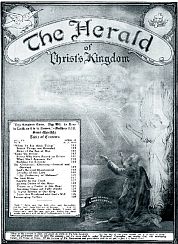
THE HERALD
of Christ's Kingdom
VOL. XV. May 1, 1932
No. 9
Table of Contents
Value of the
Knowledge of the Divine Plan of the Ages
Living Waters
Half Hour
Meditations on Romans
Letters of
Encouragement
The
Institute's Annual Meeting
VOL. XV. May 15, 1932 No.10
Table of Contents
The Church's
Inheritance in the Apocalypse
Living Waters
"A CRY O F THE SOUL"
The Man of
Sin
The Evil
Heart of Unbelief
Interesting
Memorial Reports
VOL. XV. May 1, 1932 No. 9
Value
of the Knowledge of the
Divine Plan of the Ages
OUR OBLIGATION TO GIVE THE "WATER OF LIFE"
TO ALL WHO THIRST CAN WE DO MORE TO
FURTHER THE MINISTRY OF THE TRUTH?
September 1, 1921, there was laid before the readers of this journal a suggestion that
had for some years prior to that time been under advisement-that of printing the
"Divine Plan of the Ages," Volume I of Scripture Studies, by Brother Russell.
Realizing that it was considerable of 'a proposition, the project was not hastily
undertaken. Hence it was thought best to lay the matter before the "Herald"
readers, that we might have the advantage of the judgment of many we might have the
advantage of the judgment of many to ascertain their mind, we published at that time in
these columns under date of September 1, 1921, an article the response to which resulted
in our issuing an edition of the "Divine Plan of the Ages," early in 1922.
Now at this time the edition of the volume that was published then, is nearly
exhausted, and there is now brought to our attention another suggestion with the request
that it be given careful considerations. In connection with presenting this late
suggestion it is thought well to republish the article which appeared in September 1,
1921, and the same is submitted below under the above caption, "Value of the
Knowledge of the Divine Plan of the Ages." The suggestion is that a special
ninety-six page edition of the "Herald" be gotten out containing the reprint of
the "Divine Plan of the Ages," this to be practically a reproduction of the
ninety-six page issue or edition of the Watch Tower that was published by Brother Russell
and was generally designated as the "ZA," meaning the Divine Plan of the Ages
in Watch Tower form. The thought primarily in this proposed publication is that it can
probably be placed in the hands of our readers at ten cents per copy, or in lots at the
rate of five cents each, for general distribution. We suggest therefore that the article
below be carefully and prayerfully read and considered, after which it is hoped that we
shall hear from our readers very generally expressing their opinion and wishes as to the
advisability of issuing the "Divine Plan of the Ages" in "Herald"
form. Please note also other suggestions at the conclusion of this article. Editorial
Committee.
UNSPEAKABLE indeed have been
the blessings of light, joy, peace and fellowship with God, experienced by those who have
beheld the vision of the Divine Plan of the Ages God's purpose for the removal of the
curse from the earth and the bringing in of eternal righteousness. Yea, it would truly be
impossible to estimate the blessed results that have come to those who, out, of
consecrated hearts, in these days have earnestly sought, and have been given to know
"the mysteries of the Kingdom of Heaven" as contained in the revelation of the
Divine program. Probably chiefest among these results is the realization of the
sanctification of the spirit and of the transformed life--a state in which the heart can rejoice with unspeakable
joy and confidently exclaim, "Old things have passed away, and .behold all things
have become new.'' As is well recognized by earnest students of the Sacred Word, the
great center of the Divine Plan is the only-begotten Son of God, declared to be the First
and the Last, Jehovah's Chief Representative in the execution of His purposes. The
consecrated Christian soon learns, therefore, to sing:
"My hope is built
on nothing less
Than Jesus' blood and righteousness;
I dare not trust the sweetest frame,
But wholly lean on Jesus' name.
On Christ, the Solid Rock, I stand;
All other ground is sinking sand."
It was the Savior
Himself who announced that the truth concerning God's character and Plan, and the
knowledge of His righteous requirements, was to constitute the sanctifying power in the
lives of His followers: "Sanctify them through Thy truth: Thy Word is truth." In
other words, the knowledge of God is necessary for those who would build character
acceptable to Him. The true foundation upon which we should build, is faith in the
righteousness of our Lord and Savior Jesus Christ; faith that His sacrifice for sin was
once for all a complete and full ransom price for Adam and all his posterity. It is those
who build upon this foundation that may hope to multiply their grace and peace
"through the knowledge of God and of Jesus our Lord." To the advancing Christian
the knowledge of God means far more than merely to know that there is a God and that there
is a Lord and Savior; to him it means an acquaintance with the Father and with the Son, a
knowledge of the mind of Christ, which is a full and clear representation to us of the
mind of the Father.
As our intimate knowledge of the Divine Plan and character increases, so must also our
grace increase; for those who do not attempt to come into harmony step by step with that
which they see of the Divine character, will soon lose interest in such knowledge, while
those who have the interest which leads to further and further study, must of necessity be
growing in grace continually. As they grow in grace, so, also will they grow in peace; for
peace also is a progressive thing. Those who have made progress in the knowledge of the
Divine Plan and character, have found their peace to be an ever-increasing one, and those
who have advanced some distance in the good way, can speak of it in the language of the
Apostles and realize it in their hearts' as being "the peace of God, which passeth
all understanding."
"THE SWEETEST OF ALL STORIES"
Let us at this point pause to take at least a cursory view of those essential truths of
the Divine program, even though we have already considered them many times -- truths that
have an important bearing upon our progress in faith, hope and love, and in the production
of the fruits of the spirit.
First of all we are given great assurance, particularly in the New Testament, that our
Lord Jesus is the Head of an Ecclesia, a body of specially called-out ones. (Eph. 1:22,
23.) There can be no question that the different members of the Church are being called,
drawn by a selective process, from the world of mankind. The testimony of the Scriptures
as to the object of the call seems also to be clear. The Apostle Peter says that the
Church is a people for a purpose; i.e., God -has a special object or purpose in selecting
the Church--they are to "show forth the praises of Him who hath called them out of
darkness into His marvelous light," and "that men may see their good works, and
glorify their Father which is in Heaven." -1 Pet. 2:9; Matt. 5:10.
God has purposed to make a New
Creation in connection with the redemption of the world, and He calls the Church to be
associated with her Lord in the Divine nature, "far above principalities, and powers,
and every name that is named;" and as soon as the Church, this New Creation, I shall,
have been completed, mankind will have an opportunity to learn the lesson of
righteousness, to come to a knowledge of God, and will be raised up out of sin and death,
out of the weaknesses that have come to them through sin. This uplifting time is
definitely marked out in the Scriptures as "times of restitution"--the
restitution of that which was lost. Since that which was lost was human perfection and
Edenic bliss, mankind will not get heavenly things, such as the New Creation, the Church,
inherit, but they will receive earthly blessings. God's will shall be accomplished. The
world will be brought to perfection during the thousand years of Messiah's reign. The most
important piece of, restitution work relates to man. The hard, stony, selfishness of heart
which is worldwide is neither Godlike nor to God's glory.
"Man's inhumanity
to man,
Makes countless thousands mourn."
Nineteen centuries of
preaching show that the cure for this malady is not in our power, and that only. the few
even desire to seek for the Lord's spirit of gentleness and tenderheartedness. But the
Great King of Glory is also the Good Physician. He alone can cure the disease of sin and
its results. Through Him God's promise to Israel will be fulfilled: "I will take away
the stony heart out of your flesh, and I will give you an heart of flesh." (Ezek.
36:26.) This work will proceed from Israel to -all the families of the earth, uplifting
all of the obedient out of sin and death to all that was lost in Eden and redeemed on
Cal-vary.
Before sin entered the world,, the Divine provision indeed for our first parents was
the Garden of Eden. The Scriptures tell us that after God had created various orders of
spirit beings, He made man, "a little lower than the angels." (Psa. 8:5.) The
human race began with Adam and Eve, who had ability to grasp and appreciate the Divine
arrangement, as the brute creation have not. God made man in His own likeness. The fact
that sin came in and brought father Adam under the sentence of death does not signify that
the Heavenly Father had changed His arrangement. The purpose which He had in the beginning
has never changed. Therefore, as we read, the promises of restitution, our minds turn to
the future, guided by the Word of God, and in mental vision we see Paradise restored-not a
garden merely, but the entire earth made beautiful, fruitful, sinless, happy. Thus, we
recall the inspired promise so familiar to us--"And God shall wipe away all tears
from their eyes; and there shall be no more death, neither sorrow, nor crying, neither
shall there be any more pain;" for the former things of sin and death will have
passed away and all things will have been made new.-Rev.. 21:4, 5.
PARADISE, HOME OF REDEEMED WORLD
We can now see why the entire world was not made an Eden in the beginning, namely,, God
intended to give the race a trial, and according to the record of the Scriptures, if the
first pair had maintained their righteousness, their holiness, -they would have continued
to be perfect and would have propagated a perfect race; and' if sin had not come in,, God
would have been responsible for their Maintenance; but foreseeing that sin would come in,
He merely made Eden perfect and allowed the remainder of .the earth to continue in an
unfinished condition. Consequently God said to Adam, "Cursed is the ground for thy
sake; In sorrow shalt thou eat of it all the days of thy life; thorns also and thistles
shall it bring forth to thee; and thou shalt eat the herb of the field: in the sweat of
thy face shalt thou eat bread, till thou, return unto the ground."--Gen. 3:17-19.
God foresaw that if the earth had been originally perfect, the death struggle would be
longer and the degradation of man greater. 'The poverty of the world has assisted in
keeping mankind back from greater depths, of iniquity. The sentence, "In the sweat of
thy face shalt thou eat bread," was evidently intended as a blessing; that man might
learn lessons-the experience of battling with the earth for his living. As the Creator
said to the man regarding the curse of the earth, it was "for thy [man's] sake."
So man has learned that "the wages of sin is* death." Had mankind remained
perfect they might have learned the lesson of the sinfulness of sin in the same way that
the angels have learned; but hastening to commit sin, they have learned evil first, and
have been subject to all the vicissitudes of sin and death. The angels have learned the
other lesson-what righteousness is, what God is, not merely in the abstract, but in an
appreciative sense. The Heavenly Father has not, however, changed His original Plan. When
the Kingdom is set up, "the earth shall yield, her increase," and God assures
us, "I will make the place of My feet glorious." The evidences are that that
time is near at hand. We see signs of the promised blessings coming. What are our vast
irrigation schemes by artesian wells and by. aqueducts, but fulfillments of the prophecies
pertaining to the reign of Christ, and the blessing of the earth? "In the wilderness
shall waters break out, and streams in the desert." "The wilderness, and the
solitary place, shall be glad for them; and the desert shall rejoice, and blossom as the
rose."--Isa. 35:6, 1.
"I SEE A NEW CREATION RISE!'
But, we ask at this point, where comes in the portion of the New Creation-the Church,
of whom Jesus is the Head? The Scriptures answer that the Church is called out to be a.
privileged people and to become joint-heirs with our Lord in His Kingdom. We ask further
whether He is really to have a Kingdom. The Scriptures answer, Yes, at the end of the
Gospel Age, He appears not as a sin-offering, but as a great King, Prophet, judge, to
dispense the blessings procured by His death. We ask respecting the share of the Church at
the present time. The answer comes that those who faithfully follow the Lamb through good
report and evil report, who take up their cross and follow Jesus, will be accounted worthy
to be His associates in the Kingdom. We ask if the Church in the glorified state will be
able to combat the evil tendencies of the world. The answer is, Yes; Satan will be bound
for a thousand years, that he may deceive the nations no more till the thousand years have
been fulfilled. During those years , the Savior's mission will be to bless mankind as the
"Sun of righteousness," with "healing in His beams," and His Church is
to have -a share with Him in the blessing of the world. Neither is this some new
proposition, for we learn that this was God's plan and purpose from "before the
foundation of the world." This is verily the Gospel, or Good Tidings, first declared
to, Abraham: "In thy seed shall all the families of the earth be blessed."--Gen.
12:3.
God intended to bless all the members of the human race, all nations and kindreds and
tongues, and purposed that the blessings should come to them through the seed of Abraham.
The Jewish nation was merely the typical seed; the antitypical Seed is The Christ (Jesus
the Head, and the Church,. His Body) who will bless all the families of the earth: but the
earth must wait for its blessing until the Church shall have been completed, shall, have
passed beyond the veil, and shall sit with Christ in His throne.
Asked as to the success of the blessing which will attend the work of Christ and the
Church, the Scriptures -answer that "every knee shall bow, and every tongue
confess," and that the knowledge of God shall fill the whole earth." As to
whether this means universal salvation--that everybody will be saved: the answer is, that
as all die in. Adam,, so all are to be revivified-brought back to the privilege of
attaining everlasting life, through the merit of Christ's sacrifice-but that the
attainment of everlasting life will depend upon the manner in which the privilege is used.
None will be coerced or compelled.
The majority of mankind have such respect for righteousness that if its rewards were as
sure and as desirable as are those of sin, unquestionably they would prefer to do right.
Our observations reveal that many have been almost forced to do evil. Only the very few
are willing to renounce sin and walk in the "Narrow Way". of obedience and
self-sacrifice. While those who do so in this Age are to have a very special reward,
others who love righteousness and hate iniquity will, under the rule of Christ's Kingdom,
have every assistance, without compulsion. They will have co-operation in their endeavors
for righteousness. The Scriptures, however, with equal force declare that as death was the
original penalty of sin in Adam's case, so it will always be the penalty for sin, and that
whoever during the future Age persists in willfully sinning shall die the "Second
Death," from which there will be no resurrection, no redemption, no hope of recovery.
Thank God, the unwilling and disobedient will not be consigned to endless torture, but to
an everlasting cutting-off.
The perfected earth will then abide forever for the ,glorious being, man, restored to
God's image and likeness. Thus eventually, when all wilful sinners shall have been blotted
out, we find the Scriptures state that "every creature which is in heaven, and on the
earth, and such as are in the sea," will be heard saying, "Blessing, and honor,
and glory, and power, be unto Him that sitteth upon the throne, and unto the Lamb forever
and ever." (Rev. 5:13.) Thus the Lord will gather together all the faithful, both in
heaven and earth, under the headship of Christ,, whose head is Jehovah. (-Eph. 1:10.) How
grand the consummation!
The foregoing is surely the sum of the Divine Plan in brief. The contemplation of these
messages of God's Holy Word cannot but have an ennobling and sanctifying effect. All who
have truly caught this vision of the Divine Plan of the Ages have felt the impulse to go
forth bearing it to others. Such have realized their commission, that they have been
anointed to preach. First of all our Lord Jesus, then the Apostles, and subsequently a
goodly number of others have throughout the Gospel Age been faithful to the call to
"bear testimony to the truth," and, as expressed in the language of St. Paul,
have not been "disobedient to the heavenly vision."
Nor have the closing years of this Age witnessed any less of privilege and opportunity,
nor found those less zealous or faithful in the ministry. To the contrary, we may safely
say that during the past fifty years most wonderful opportunities have been before the
consecrated, and a goodly number have quickly responded and have entered upon the greatest
of all privileges-that of proclaiming Glad Tidings of Great joy.
IS THE CHURCH'S MISSION HERE FULFILLED?
During the past five years, following the death Of PASTOR RUSSELL, certain unexpected
developments, changes and innovations have come, and many of the brethren of the Truth
have realized the opportunities for spreading the Truth greatly curtailed. This in turn
has caused some to show weariness in well doing, while others have concluded that the
Church's mission in the flesh is finished; that the time of her ministry is over; that the
Church is complete, even though some are still in the flesh; and that we have reached the
time for standing in idleness. Still others of the brethren seeming disposed to drift
listlessly along with the tide, have realized a cooling of their spiritual ardor, and are
reclining more or less in lethargy and in idleness so far as spiritual energy and activity
are concerned. However, we are happy to observe that in the midst of all of this grave and
unhappy situation, there are those who have kept the fires of their Christian faith, love
and zeal burning, and have all along been inquiring, "Lord, what wilt thou have me to
do?"
It will be remembered that our INSTITUTE was called into existence some three years ago
by the brethren in different parts of the country in order that they might assist and
encourage one another in holy things, and in order that they might unite their efforts in
some general ministry. While there have been hindrances and discouragements of one kind
and another, and while the efforts have seemed feeble, it has been plainly manifest that
the Lord has blessed the arrangements made, and some splendid opportunities have been
opened up for witnessing to the Divine Message. Addressing the brethren the world over in
this message, we desire to say that while all along we have been endeavoring to be
watchful, to note the Lord's providences and to observe any opportunities for service that
He might present to ourselves or others, it has been especially upon our hearts recently
to inquire if we are doing all we can in the Master's service in these last days, and if
we may not reach out and lay hold of certain opportunities for giving the blessed
"Water of Life" to others around us more than we have been doing. We cannot
believe that the ministry of the Church in the flesh is at an end. Most assuredly there
are, still members of Christ on earth "filling up that which is behind of His
afflictions," and as there are still opportunities for sacrificing and serving, the
inevitable conclusion is that the mission of the Christ in the flesh is not yet entirely
fulfilled, and surely will not be until the last member has passed beyond. In preceding
issues-of this journal we have presented the evidence which to our minds is convincing
that the door into the "Narrow Way"--the door into the Church militant is not
yet closed. We conclude, therefore, that the commission given by Jesus in the beginning of
the Age, to bear the Message of the Gospel to others, is still applicable, and for
those, His consecrated Body members. More than this, experience convinces us that zealous
activity in the ministry of the Truth produces most whole some results in the hearts
of those so engaged, provided the service is rendered with, the right motive and from the
true viewpoint-that of offering a message of comfort to others, and that of a desire to
spread the name of, and to glorify our Father in Heaven.
THE TIME NOT YET, BUT DRAWING NEAR
We believe that none can say just when the career of the Church in the flesh will end.
So far as anyone can know, it may be for some years yet. We cannot know just how long. To
our understanding there are several events of vital importance yet to come to pass before
the Kingdom is established, events that for all we know may require several years. Amongst
these is that of the restoration of the Jews and their establishment in a state of
independence in their own land. We may truth-fully say that much progress has been made in
that direction in recent years, but there is room for much yet before that nation is ready
for the Divine government, Messiah's Kingdom.
Another feature is that of the Triple Alliance. We believe there are certain plain
statements in the Old Testament prophecies, as well as in the Book of Revelation, that
indicate that it will be a still closer drawing together of the two great ecclesiastical
powers--that of Catholicism and Federated Protestantism--and some sort of co-operation
with the civil government in an attempt to hold the present order of things together.
Considerable, has transpired looking in the direction of the fulfillment of this matter in
recent years, but there are still important developments to be expected before the results
will be realized that we have reason to look for.
Another matter: The kingdoms of this world are still intact and exercising dominion of
human affairs, and hence the old order of things presided over by the "prince of this
world" still exists--"the present heavens and earth" have not passed away.
These, the Scriptures tell us, must be "dissolved," before "the new heavens
and new earth" appear--the establishing of the Kingdom.
WATCHING AND WAITING,
YET ATTENTIVE TO OUR FATHER'S BUSINESS
We believe that none can say how
many years may be required for the developing of any of the foregoing features; nor is it
necessary for us to know. During the past few months we have been discussing in these
pages. in more or less of a general way "the times and seasons.," feeling sure
that this is a subject fit and proper for us to consider together, especially as it is a
theme that is given considerable prominence in the Bible. We have endeavored to note ,that
the failure of some of our cherished expectations really form no grounds whatever for
discouragement with regard to our real hopes and
expectations. The disappointments that have come have indeed proven tests of faith; and
under the Lord's providence, if our hearts remain true and loyal to Him, what we have
experienced along this line will Surely result in further spiritual good and not in any
real loss. We have considered it proper to endeavor to see and to point out to others what
has seemed to us to be
a discrepancy of nineteen years in our chronological system, and by which we account for
the failure of some things that we supposed would be in evidence long before this; and we
have suggested, in view of our recent chronological deductions, which we still feel are
well grounded, that it could not be unreasonable for us to think that there might be a
culmination of matters and a climax reached in the passing away of the present order of
things approximately around 1934: but we had not
thought, to place any halo around that or any other year as marking beyond
peradventure the exact time of the last end of this order of things and the conclusion of
our. earthly pilgrimage; for we still feel that the evidence is not of that conclusive
character that we would be warranted in laying
plans for any particular year. This was not our thought at all in presenting the
suggestions that we. did
bearing upon the extension of the time. Our thought merely was, and still is, that by an
examination of the chronological lines we might see something of a reasonable Solution to
the present situation in which many of the Lord's people have realized themselves in more
or less of a maze on account of their unfulfilled hopes and expectations; and we believe
that we will be pleasing the Lord if we continue our investigation and look to Him for
guidance, in obedience to His command to "watch," to note whatever further
evidence and light upon this matter He may be pleased to bring to our attention. Meantime
it seems to us that the course of wisdom for all the brethren is, not to insist that we
must locate some particular year and positively settle upon that, for so far as we know,
it may never be given unto us to have such positive knowledge in advance as to the exact time. We think the important lesson
to be observed and followed is, that whether we remain in the flesh one year, five years,
or twenty years, we should be concerning ourselves with regard to our Father's,
business--the adjusting and keeping spotless of our own robes, and persevering in the
spread of the Truth concerning our Father's character and Plan.
CAN WE DO MORE TO COMFORT THE SORROWING?
What we now desire to bring before the consideration of the brethren is that of
instituting some more effectual as well as substantial means of reaching other hearing
ears and others who thirst;, for surely there are some yet to be found, and who, for all
we know, may be fully in line to be members of the Bride class. All about us are sights of
wretchedness and sorrow, and vast numbers to whom we may offer assistance and the message
of comfort contained in the Good Tidings. Some recent public meetings have made very
evident that there are those hungering and thirsting for the Truth. More than this, but
recently certain cases have come under our observation, some who have just accepted the
Message and are delighted to meet in regular study of the Plan, and give evidence that
they have full acceptance with the Lord and the blessing of the Spirit. All of these
manifestations seem to speak to us of the Lord's will that we become more exercised and,
active if -possible in the promulgation of the Message.
And in response to the question, What shall we do? we are impressed that there is no
better or effectual means of bearing testimony to the Truth today than that of plac ing
in the hands of others the First Volume of Studies
in the Scriptures--THE DIVINE PLAN OF THE AGES, which
we' have briefly reviewed in this article. We can think of no better, nor as good and
substantial a statement of the Truth as is contained in this Volume. to this we believe
all the brethren will agree. It may be truthfully said that in the First Volume of the
Studies we have all the substantial and essential features of the entire six books so far
as the foundation features of 'the Divine Message of truth and grace is concerned; all the
necessary and important doctrines are thoroughly treated, with accompanying Scrip ture
testimony bearing thereon. In the Chart of the Ages with its complete, explanation in the
Volume, what a mar velous mine of Truth is opened up. We see truly the Stately steppings
of our God throughout the Ages. The doctrines of conversion, justification, sanctification
and glorification are fully and most satisfactorily explained. The hope of the Church and
of the world is clearly set forth. The Scripture teaching concerning the object and
purpose of our Lord's Second Advent is exhaustively ex plained. The chapters treating
the permission of evil the world's judgment Day-the Church's change of na ture,
together with the Three Ways-the Narrow Way, the Broad Way, and the High Way-and the
subject, the Kingdom of God-all of these themes so beautifully explained are indeed rare
gems of Truth. The closing chapters of the Volume leading down to the close of the
present dispensation and dealing with the Scriptures that show the change of dispensation'
from that of the present to "the Dispensation of the Fulness of Times," are also
of great interest and importance.
BROTHER RUSSELL PRESENTS QUESTIONS OF SOLEMN IMPORT
Finally, in the closing pages of the last chapter we have a rare and beautiful
statement bringing home to the reader and making practical application of the lessons
contained in the preceding pages of the Volume. Let the reader ponder well the following
lines:
"A knowledge of these things, and the evidences that they are nigh, even at the
door, should have a powerful influence upon all, but especially upon the consecrated
children of God, who are seeking the prize of the Divine nature. We urge such, while they
lift up, their heads and rejoice, knowing that their redemption draweth nigh, to lay aside
every weight and hindrance, and to run patiently the race in which they have started. Look
away from self and its unavoidable weaknesses and imperfections, knowing that all such
weaknesses are covered fully by the merits of the ransom given by Christ Jesus our Lord,
and that your sacrifices and self-denials are acceptable to God through our Redeemer and
Lord-and thus only. Let us remember that the strength sufficient which God has promised
us, and by use of which we can be 'overcomers" ,is provided in His Word. It is a
strength derived from a knowledge of His character and plans, and of the conditions upon
which we may share in them. Thus Peter expresses it, saying, 'Grace and peace be
multiplied unto you through the knowledge, of God, and of Jesus. Christ our Lord,
according as His Divine power hath given unto us all things that pertain unto life and
godliness, through the knowledge of, Him who hath called us to glory and virtue; whereby
are given unto us exceeding great and precious promises, that by these ye might be
partakers of the Divine nature.'--2 Pet. 1:2-4.
"But to obtain this knowledge and this strength, which God thus proposes to supply
to each runner for the heavenly prize, will surely test the sincerity of your consecration
vows. You have consecrated all your time, all your talents, to the Lord; now the question
is, How much of it are you giving? Are you still willing, according to your covenant of
consecration, to give up all?--to give up your own plans and methods, and the theories of
yourselves and others, to accept of God's plan and way and time of doing His great work?
Are you willing to do this at the cost of earthly friendships and social ties? And are you
willing to give up time from other things for the investigation of these glorious themes
so heart-cheering to the truly consecrated, with the certain knowledge that it will cost
you this self-denial? If all is not consecrated, or if you only half meant it when you
gave all to the Lord, then you will begrudge the time and effort needful to search His
Word as for hid treasure, to obtain thus the strength needful for all the trials of faith
incident to the present (the dawn of the Millennium) above other times.
"But think not that the giving will end with the giving of the needful time and
energy to this study: it will not. The sincerity of your sacrifice of self will be tested
in full, and will prove you either worthy or unworthy of membership, in that 'little
flock,' the overcoming Church, which will receive the honors of the Kingdom. If you give
diligence to the Word of God, and receive its truths into a good, honest, consecrated
heart, it will beget in you such a love for God and His Plan, and such a desire. to tell
the Good Tidings, to preach the Gospel, that it will become the all-absorbing theme of
life thereafter; and this will not only separate you from the world and from many nominal Christians, in spirit, but it will lead to
separation from such entirely. They will think you peculiar and separate you from their
company, and you will be despised and counted a fool for Christ's sake; because they know
us not, even as they knew not the Lord.--2 Cor. 4:8-10; Luke 6:22; 1 John 3:1; 1 Cor.
3:18.
"Are you willing to follow on to know the Lord through evil and through good
report? Are you willing to forsake all; to follow as He may lead you by His Word?--to
ignore the wishes of friends, as well as your own desires? It is hoped that many of the
consecrated who read this volume may by it be so quickened to fresh zeal and fervency of
spirit, through a clearer apprehension of the Divine Plan, that they will be able to say,
'By the grace of God, I will follow on to know and to serve the Lord, whatever may be the
sacrifice involved."'
How
plainly evident it is in the above lines that our beloved Pastor was endeavoring to impart
to the consecrated a sense of their responsibility, inasmuch as they were given to know
these blessed Truths set forth in the preceding pages of the Volume, that a proper sense
of gratitude and appreciation of the Lord's goodness would lead them to seek to impart the
blessing of the Truth to others. We believe it would not be overestimating the matter to
say that we have in this Volume a quite complete presentation of the Gospel theme.
Shall We Publish the Divine Plan of the Ages in Magazine
Form
The foregoing review published in
these columns in September, 1921, presented to our readers what we believe to be the
Scriptural attitude and outlook with regard to the spread of the Truth as contained in the
volume, the "Divine Plan of the Ages." Though we are now eleven years nearer the
consummation of all things, we know of no reason for any change from the position
assumed at that time. And now as the edition of the "Divine Plan" published in
1922 is practically exhausted, the suggestion appeals to us strongly to get out an
inexpensive edition of the volume in magazine form as suggested at the head of this
article. Our thought is that while the magazine or "Herald" form would really
contain six complete issues of the "Herald," we would allow this special
ninety-six page issue to take the place of two months or four regular issues of the
journal; in other words, each "Herald" subscriber would receive this special
ninety-six page copy as instead of four regular issues. A goodly supply, of several
thousand extra copies, could be published so that it could be furnished to all at probably
ten cents for single copies and five cents a copy in lots. In this inexpensive magazine
edition the brethren could have once more the privilege of spreading the Truth more freely
as contained in the "Divine Plan of the Ages," at such a time as this when on
account of the perplexity, distress and suffering in the world, more people are in a
favorable attitude and are of inquiring mind with regard to the import of these days and
their events.
We trust not to be misunderstood by
any in this connection: it is not in the spirit of any "big work" idea or of a
propaganda, nor yet with the thought that there is some symbol, type, or picture to be
fulfilled through human energy and effort; rather, wt are encouraging the brethren in
this ministry purely from the standpoint: that faithful servants of God have gone forth
all along through the Age from the Apostolic period, namely from the evangelical viewpoint
of letting our light shine, of bearing testimony to the grandest of all messages, and
announcing to men that the night is passing and that the morning cometh.
After the brethren have carefully
reviewed the foregoing article and given these suggestions prayerful consideration, we
shall be glad to hear from all our readers as to their opinion bearing upon the suggestion
of publishing the "Divine Plan of the Ages" as above, and in that connection, if
such a publication is favored, please state about how many of the magazine Volume I you
would hope to order. We merely now desire to ascertain the view of the brethren, and if
they approve of the suggestion, to learn about how large an edition of the magazine
"Herald" we should publish. We rest the matter with the Lord, asking the prayers
of all for His guidance and unerring wisdom.
"And he showed me a pure river of
water of life, clear as crystal, proceeding out of the throne of God and of the
Lamb."-Rev. 22:1.
THE TERM "Living Waters" is
used in the Scriptures as descriptive of the Word of God. And how apt is this description!
Everywhere the value of pure water is
appreciated. While life is capable of being sustained without food for weeks, this is
not possible without water. A few days at most, and death results when the body is denied
water. Yet gift of God though water is, and as such it was appreciated in the parched and
thirsty lands of the East-the water-carriers of Palestine actually calling it by that
name as they sold it-it does but symbolize the refreshment which comes from that still
greater gift, the living, life-giving, life-sustaining, life-transforming, Word of God.
By the Word of God, however, we are
not to understand the paper and ink with which the Bible is printed, but the thoughts and
purposes of God conveyed to our minds by these means. The printed page may and indeed
does perish, but God's thoughts will not perish, nor will His purposes fail. At the first
the Gospel was proclaimed by word of mouth only, but it was none the less the power of God
unto salvation to believers; it was just as much water of life to thirsty souls; just as
much the Word or God, as later, when it came to be expressed in written form. When,
therefore, we speak of the Word of God, and say that the term, "Living Waters,"
aptly describes it, we have in mind the gracious message of the Gospel of God, wherein is
revealed His plans and purposes for our salvation, such message being based on the
redemption work accomplished by our dear Redeemer; the message, moreover, being energized
by the Spirit of God, its Author, whom it reveals, and from whom it derives the power it
imparts to us to lay hold on its promise of eternal life.
The expression "Living
Waters" and words of similar import occur in several places in the Scriptures.
Perhaps the most familiar is John 4:10, where are recorded the words of our Lord to the
woman of Samaria : "If thou knewest the gift of God, and who it is that saith to
thee, Give Me to drink, thou wouldst' have asked of Him, and He would have given thee
Living Water."
Of Living Water Jehovah Himself is
the Fountain. Speaking by the Prophet Jeremiah (Jer. 2:13) He says: "My people have
committed two evils; they have forsaken Me the Fountain of Living Waters, and hewed them
out cisterns, broken cisterns, that can hold no water." In harmony with this passage
the Apostle John, in the glorious vision, saw a pure river of water of life, clear as
crystal, proceeding out of the throne of God and of the Lamb. (Rev. 22:1.) No such river
flows today, but in that day, the great Millennial Day of Christ, after the chaste virgin
shall have become the Bride, the Spirit and the Bride will say, Come, and whosoever will
shall then take the water of life freely.
(Rev. 22:17.) The prophecy of Isaiah will then meet fulfillment. "Ho, every one that
thirsteth, come ye to the waters, and he that hath no money; come ye, buy and eat; yea,
come, buy wine and milk without money and without price." - Isa. 55:1.
Our Present Privilege
Meantime consecrated believers of
this Gospel Age have a blessed privilege extended to them now, before that river flows.
These having sat down and counted the cost, and having realized that all they have, and
all they are, and all they hope to have or to be are as loss and dross compared to the
fellowship of Christ are invited to drink of the Living Waters now. As Jesus said in His
further words to the woman at the well: "Whosoever drinketh of this water shall
thirst again : but whosoever drinketh of the water that I shall give him shall never
thirst; but the water that I shall give him shall be in him a well of water [or as the
Diaglott renders the passage, "shall become in him a fountain of water"]
springing up into everlasting life."
In another place our Lord said:
"This is life eternal, that they might know Thee the only true God, and Jesus Christ,
whom Thou hast sent." (John 17:3.) In other words, eternal life will result to those
who, having heard the gracious message brought to them concerning God's character and
purposes, embrace its teachings.
Again, "Then said Jesus unto the
twelve: Will ye also go away? Then. Sin-ion Peter answered Him, Lord, to whom
shall vie go? Thou hast the words of eternal life." (Thou hast Living Water.) - John
6:68, 69.
In Phil. 2:15, 16 the Apostle exhorts
believers that they should be as lights in the world holding forth the word of truth.
Holding forth Living Water would be an. expression having the same significance.
With these preliminary remarks let us
notice four characteristics of the 'Word of God which cause it to be justly described as
Living Water. It is (1) living, (2) life-imparting, (3) life-sustaining, (4)
life-transforming.
The Word of God is Living
First, then, let us consider the
remarkable fact that the Word of God is alive, or living. The Apostle Peter speaks of
believers as being begotten again not of corruptible seed but of incorruptible by the Word
of God which liveth and abideth forever. Quoting from Isaiah he goes on to say: For all
flesh is as grass, and all the glory of man as the flower of grass. The grass withereth,
and the flower thereof falleth away, but the Word of the Lord endureth forever. Arid, he
goes on to say, This is the word which by the Gospel is preached unto you. - 1 Pet.
1:23-25.
Again in Hebrews 4:12 we find another
statement to the same effect: The word of God is quick and powerful-living and
energetic, as the Diaglott translates the passage.
In these passages, the one from First
Peter and the other from Hebrews, the Word of God is spoken of as living. Why is the Word
of God thus spoken of? It is because in the Scriptural sense of the word "life,"
the Word of God is the only thing in the world that is truly living. To quote from
another:
"In the world around us the
beings and things which we call 'living' may just as appropriately be spoken of as
'dying.' What we call 'the land of the living' might better be described as the land of
the dying. Wherever we look we see that death is in possession and is working according to
its invariable method of corruption. . . Death is the real monarch of this world, and we
meet at every turn the gruesome evidence and results of the universal sway of him who
has 'the power of death, that is the Devil.' (Heb. 2:14.) . . . The mighty and awful power
of death has made this earth of ours a great burying ground - a gigantic cemetery.
"Can it be that there is an
exception to this apparently universal rule? Is there, indeed, in this world of dying
beings, where the forces of corruption fasten immediately upon everything into which
life has entered, . . one object which is really living, an object upon which corruption
cannot fasten itself, and which resists and defies all the power of death? Such is the
assertion of the passages of Scripture which we have quoted."
Jesus and the Written
Word
Before we test this assertion let us
note one of the many points of resemblance between Jesus and the written Word. When Jesus,
the personal Word, was made flesh and dwelt among us, there was nothing in His appearance
to show that "in Him was life." "That fact was demonstrated, not by His
blameless and unselfish behavior, nor by His incomparable teachings and discourses, but by
His resurrection from the dead. The only power which is greater than that of death is the
power of life." Raised from the dead by the power of the Father, Jesus is manifested
to us as the Living One, the One who became dead, and who, behold, is alive for
evermore, having the keys of death and of hades. - Rev. 1:18, R. V. Margin.
"Similarly, there is nothing in
the appearance and behavior (so to speak) of the Bible to show that it has a
characteristic, even Divine life, which other books have not. It bears the same
resemblance to other writings that Jesus, the son of Mary, bore to other men. It is given
in human language just as He came in human flesh. Yet there is between it and all other
books the same difference as between Him and all other mien, namely the difference between
the living and the dying. 'The Word of God is living.' "
How Shall We Define
Life?
With all the wisdom and learning of
our times men have not yet succeeded in furnishing a satisfactory definition of life.
"But if none of us can say what life is, we can all distinguish between that which is
living (even' in the ordinary sense of the word) and that which is not living; and our
best idea of the meaning of life is obtained by comparing that which has life (whether
animal or vegetable) with that which has not life, as minerals, or any non-living matter.
We know that between the two there is a great gulf, which only Divine power can span; for
it is only the Living God who can impart life to that which is lifeless.
"We look then, at the written
Word of God to see if it manifests characteristics which are found only in living things,
and to see if it exhibits not merely the possession. of life of the perishable and
corruptible sort with which we are so familiar by observation, and which is in each of us,
but life of a different order-imperishable and incorruptible.
The Power of Discernment
"The power of discernment
belongs only to intelligent living beings; and the power of discernment possessed by
man does not go beneath the surface of things. Yet the passage in Hebrews already quoted
(Hebrews 4:12), asserts that the Word of God is a 'discerner of the thoughts and intents
of the heart.'
"This is a very remarkable
statement, yet it is true, and millions of men have felt and recognized the searching and
discerning power of the Word of God. We go to it not so much to learn the thoughts of
other men, as to learn our own thoughts. We go to other books to find what was in the
hearts and minds of their authors; but we go to this Book to find what is in our own
hearts and minds. To one who reads it with ever so little spiritual intelligence, there
comes a perception of the fact that this Book [that is to say, its Author] understands and
knows all about him. It lays bare the deepest secrets of his heart, and brings to the
surface of his consciousness, out of the unfathomable depths and unexplorable recesses of
his own being, 'thoughts and intents' whose existence' was unsuspected. It reveals man
to himself in a way difficult to describe, and absolutely peculiar to itself. It is a
faithful mirror which reflects us exactly as we are. It detects our motives, discerns our
needs; and having truthfully discovered to us our real selves, it counsels, reproves,
exhorts, guides, refreshes, strengthens and illuminates."
Scholars have pointed. out that the
Greek word rendered "discerner" in Hebrew 4:12, means literally
"critic" (kritikos), and that this is its only occurrence in Scripture. How
very significant is it that the designation "higher critics" has been assumed
by some who, compassed about with infirmity as all men are, claim to be critics of this
"Critic." The time is near at hand when the haughtiness of men shall be brought
low, and the Lord alone shall be exalted in that day. Then the Word of God shall judge the
"higher" critics.
"Meanwhile the Living Word shall
continue to be the discerning companion of all who resort to it for the help which is not
to be had elsewhere in this world of the dying. In going to the Bible we never think of
ourselves as going back to a book of the distant past, to a thing of antiquity; but we go
to it as a book of the present-a living book. And so indeed it is, living in the power of
an endless life, and able to build us up and to give us an inheritance among all them
that are sanctified. - Acts 20:32.
Fresh and Refreshing
"The Bible differs radically
from all other books in its perpetual freshness. This characteristic will be recognized
only by those who know the Book in that intimate way which comes from living with it, as
with the members of one's family. . . . It is a remarkable fact that the Bible never
becomes exhausted, never acquires sameness, never diminishes in its power of
responsiveness to the quickened soul who comes to it. The most familiar passages yield
as much (if not more) refreshment at the thousandth perusal, as at the first. It is indeed
as a fountain of living water. The fountain is the same, but the water is always fresh,
and always refreshing. We can compare this to nothing but what we find in a living
companion, whom we love and to whom we go for help and fellowship. The person is always
the same, and yet without sameness. New conditions evoke new responses; and so it is with
the Bible. As a living Book it adapts itself to the new phases of our experiences, and the
new conditions in which we find ourselves. From the most familiar passages there comes
again and again a new message; just as our most familiar friend or companion will have
something new to say, as new situations require it. . . .
"But while the Bible resembles,
in this important respect, a living person, who is our familiar, sympathetic, and
responsive companion, it differs from such a human companion in that the counsel,
comfort, and support it furnishes are far above and beyond what any human being can
supply; and the only explanation of this is that the source of its life and powers is not
human, but Divine.
The Bible is Always Up to Date
"One of the most prominent
characteristics of books written by men for the purpose of imparting information and
instruction is that they very quickly become obsolete, and must be cast aside, and
replaced by others. . . . In fact, every book which is written for a serious purpose
begins to become obsolete before the ink is dry on the page. This may be made the occasion
of boasting of the great progress of humanity . . . but the true significance of the
fact is that man's books are all, like himself, dying creatures.
"The Bible on the other hand,
although it treats of the greatest, and most serious of all subjects, such as God, Christ,
eternity, life, death, sin, righteousness, judgment, redemption-is always the latest,
best and only authority on all these and other weighty matters whereof it treats.
Centuries of 'progress' and 'advancement' have added absolutely nothing to the sum of
knowledge on any of these subjects. The Bible is always fresh and thoroughly 'up to date.'
. . . Generation succeeds generation, but each finds the Bible waiting for it with its
ever fresh and never failing stores of information touching matters of the highest
concern, touching everything that affects the
welfare of human beings.
The Bible is Indestructible
The Bible manifests the fact that its
Author possesses inherent, imperishable life in that it survives all the attempts that
have been made to destroy it.
"The Bible is the only book in
the world that is truly hated. The hatred it arouses is bitter, persistent, murderous.
From generation to generation this hatred has been kept. alive. There is doubtless a
supernatural explanation for this continuous display of hostility towards the Word of
God, for that Word has a supernatural enemy who has personally experienced its
power," when, as the Sword of the Spirit, it was wielded so skilfully by our Lord
when tempted.-Matt. 4:1-10.
"But the natural explanation of
this hatred is that the Bible . . . gives no flattering picture of man and his world, but
just the reverse. The Bible does not say that man is a noble being ever aspiring towards
the attainment of exalted ideals. It does not describe the career of humanity as
'Progress' as the brave and successful struggle of man against the evils of his
environment; but quite the contrary, declares it to be a career of disobedience and
departure from God, a preference for darkness rather than light.
"Nor does the Bible predict the
ultimate triumph of 'civilization.' It does not say that human nature shall improve under
the influences of education and self-culture, even with that of Christianity added. On
the contrary it declares that evil men shall wax worse and worse.' - 2 Tim. 3:13.
"Even of 'this present evil Age'
(Gal. 1:4). . . . during which-the world has had the enormous benefit resulting from the
light of . . . . an open, Bible, it is not predicted that man and his world would undergo
any improvement, or that the development of the Age would be in the direction of
better conditions on earth. On the contrary the Bible declares that 'in the last days
perilous (or difficult) times shall come. For men shall be lovers of their own selves,
lovers of money, vaunting, proud, evil speakers, disobedient to parents, untruthful,
unholy, without natural affection, implacable, slanderers, inconsistent, savage, not
lovers of good, betrayers, headlong, puffed up, lovers of pleasure rather than lovers of
God; having a form of piety, but denying the power of it.' - 2 Tim. 3:1-5, Gr.
"Such is the character of man,
and such is to be the result, as Scripture foretells it, of all his schemes of betterment,
education, development, self-culture, and civilization. . . . And because of this the
Bible is heartily detested. Men have sought nothing more earnestly than they have sought
to destroy this appallingly accurate portrait of themselves and their doings. . How
astonishing it is that any intelligent person should, suppose that man drew
this picture of himself, and predicted this as the outcome of all his own efforts! No
wonder the Bible is hated. and for the simple and sufficient reason that it declares the
truth about man and his world. The Lord Jesus set forth clearly both the fact and its
explanation when He said to His unbelieving brethren, "The world cannot hate you;
but Me it hateth, because I testify of it that the works thereof are evil.'-John 7:7.
The Bible's Destruction Sought at First by Violence
"Other books arouse no such
hatred. There may be books which men dislike, and such they simply let alone. But the
Bible is, and always has been, hated to the death. It is the one book that has been
pursued from century to century, as men pursue a mortal foe. At first its destruction has
been sought by violence. All human powers, political and ecclesiastical, have combined
to put it out of existence. Death has been the penalty for possessing or reading a copy.
. . . No expedient that human ingenuity could devise, or human cruelty put into effect,
has been omitted in the desperate attempt to put this detested book out of existence. But
the concentrated power. of man utterly failed in the attempt. Why?"
Attempts to Make Void the Word of God by Tradition
Moreover, "violence having
failed to rid man of the Bible, other means have been resorted to in a persistent effort
to accomplish that object. To this end the intellect and learning of man has been
enlisted. The Book has been -assailed from every side by men of the highest
intelligence, culture, and scholarship. Since the art of printing has been developed,
there has been in progress a continuous war of books. Many books against the Book-man's
books against God's Book. Its authority has been denied, and its veracity and even its
morality impugned, its claims upon the' consciences of men have been ridiculed; but all
to no purpose, except to bring out more conspicuously the fact that 'the Word of God is
living,' and with an indestructible life."
Then, too, men have sought to make
void the Word of God by their traditions. Perhaps this was never more true than amongst
those who have been enlightened with a knowledge of 'present truth.' But it refuses to be
made void. It will not die. Why?
If it were a man's book, it would be
unnecessary to take any measures for its destruction. "A book produced by dying men
need only be let alone to die of its own accord. The seeds of death are in it from the
start. But all attempts to destroy the Bible have utterly failed. Why? "How can this
fact be explained except by the statement that the 'Word of God is living,' and that the
source of its life is beyond the reach of man-in the very being of the Living God?"
"Sweetly echoes the Gospel call,
Wonderful words of life!
Off'ring pardon and peace to all,
Wonderful words of life!
Praise the Lord forever
For these words of favor
Beautiful words! Wonderful words!
Wonderful words of life!"
(To be continued)
No. 27
"God commendeth His love toward us . . . while
we were yet sinners." - Rom. 5:8.
WITH THE twentieth verse of chapter
three, the Apostle, we have seen, brought his long argument in proof of the world's need
of salvation, to a close. Before proceeding to the next division of the Epistle, which
extends from Romans 3:21 to Romans 5:11, it will be well for us to review the ground we
have covered, reminding ourselves again., as we do so, of our purpose "not to
analyze only or explain, but to submit and to believe," convinced, as we are,
that the Epistle is not only Pauline but Divine. (Meditations No. 1.)
As we saw in our "Outlines"
(Meditations No. 8), the Epistle to the Romans, like St. Paul's other letters, begins with
a preface (Romans 1:1-15), which includes a greeting (Romans 1:1-7), and a thanksgiving.
(Romans 1:8-15.) Next St. Paul introduces "his" Gospel, the great theme of this
Epistle, namely the righteousness of God by faith, and then, knowing that such a theme
will make its special appeal to those only who realize their need of it, he proceeds, in
the passage we last considered (Romans 1:18 3:20), to establish the fact that the whole
world is in need of such a righteousness.
The argument of the Apostle in this
last mentioned passage, has been interestingly and instructively paraphrased by
another as follows:
"Failure of the Gentiles" - Romans 1:18-32
"This message of mine is the one
ray of hope for a doomed world. The only other revelation, which we can see all around.
us, is a revelation not of ... [a righteousness of God by faith] but of the wrath of God .
. from heaven . . upon all the countless offenses at once against morals and religion of
'which mankind are guilty. They stifle and suppress the truth within them, while they go
on still in their wrong-doing. . . . It is not merely ignorance. All that may be known of
God He has revealed in their hearts and consciences. For since the world has been created,
His attributes,, though invisible in themselves, are traced upon the fabric of the visible
creation. I mean, His Power to which there is no beginning and those other attributes
which we sum up under the common name of Divinity.
"So plain is all this as, to
make it impossible to escape the responsibility of ignoring it. The guilt of men lay not
in their ignorance; for they had a knowledge of God. But in spite of that knowledge, they
did not pay the homage due to Him as God: they gave Him no thanks; but they gave the rein
to futile speculations ; they lost all intelligence of truth, and their moral sense was
obscured. While they boasted of their wisdom, they were turned to folly. In place of the
majesty of the . . . [incorruptible] God, they worshiped some fictitious representation
of weak and perishable man, of bird, of quadruped or reptile.
"Such were the beginnings of
idolatry. And as a punishment for it God gave them up to moral corruption, leaving them
to follow their own depraved desires wherever they might lead, even to the polluting of
their bodies by shameful intercourse. Reprobates, who could abandon the living and true
God for a sham divinity, and render divine honors and ritual observance to the creature,
neglecting the Creator (Blessed be His name forever!).
"Because of this idolatry, I
repeat, God gave them up to the vilest passions. Women behaved like monsters who had
forgotten their sex. And men, forsaking the natural use, wrought shame with their own
kind, and received in their physical degradation a punishment such as they deserved.
"They refused to make God their
study: and as they rejected Him; so He rejected them, giving them over to that abandoned
mind which led then into acts disgraceful to them as men: replete as they were with every
species of wrong-doing; with active wickedness, with selfish greed, with thorough inward
depravity their hearts brimming over with envy, murderous thoughts, quarrelsomeness,
treacherous deceit, rank ill-nature; backbiters, slanderers; in open defiance of God,
insolent in act, arrogant in thought, braggarts in word towards man; skilful plotters of
evil, bad sons, dull of moral apprehension, untrue to their word, void of natural duty and
of humanity: Reprobates, who, knowing, full well the righteous sentence by which God
denounces death upon all who act thus, are not content with doing the things which He
condemns themselves, but abet and applaud those who practise them.
"Transition from Gentile to Jew-Both alike
Guilty" - Romans 2:1-16
"The Gentile sinner is without
excuse; and his critic -- whoever he may be -- is equally without excuse, even though
(like the Jew) he imagines himself to be on a platform of lofty superiority. No such
platform really exists. In fact the critic only passes sentence upon himself, for by the
fact of his criticism he shows that he can distinguish accurately between right and
wrong, and his own conduct is identical with that which he condemns. And we are aware that
it is at his conduct that God will look. The standard of His judgment is reality, and not
a man's birth or status as either Jew or Gentile. Do you suppose-you Jewish critic, who
are so ready to sit in judgment on those who copy your own example -- do you suppose that
a special exemption will be made in your favor, and that you personally will escape? Or
are you presuming upon all that abundant goodness, forbearance, and. patience with which
God delays His punishment of sin? If so, you make a great mistake. The object of that
long-suffering is not that you may evade punishment but only to induce you to repent.
While you with that callous impenitent heart of yours are heaping up arrears of Wrath,
which will burst upon you in the Day of Wrath, when God will stand revealed in His
character as the Righteous Judge. The principle-of His judgment is clear and simple. He
will render to every man his due, by no fictitious standard ('such as birth or status) but
strictly according to what he has done. To those who by steady persistence in a life-work
of good, strive for the . . . [incorruptible] glories of the Messianic Kingdom, He will
give that for which they strive, viz., eternal life. But to those mutinous spirits who are
disloyal to the right and loyal only to unrighteousness, for such there is in store anger
and fury, galling, nay crushing, pain: for every human being they are in store, who
carries out to the end his course of evil, whether he be Jew or whether he be Gentile-the
Jew again having precedence. On the other hand the communicated glory of the Divine
Presence, the approval of God and the bliss of reconciliation with Him await the man who
labors on at that which is good-be he Jew or Gentile; here too the Jew having
precedence, but only precedence: for God regards no distinctions of race.
"Do not object that the Jew has
a position of privilege which will exempt' him from this judgment, while the Gentile has
no law by which he can be judged. The Gentiles, it is true, have no law; but as they have
sinned, so also will they be punished without one. (See ver. 14, 15.) The Jews live under
a law, and by that law they will be judged. For it is not enough to hear it read in the
synagogues. That does not make a man righteous before God. His verdict will pronounce
righteous only those who have, done what the Law commands. I say that Gentiles
too, although they have no written law, will be judged. For whenever any of them
instinctively put in practice the precepts of the Law, their own moral sense supplies
them with the law they need. Because their actions give visible proof of commandments
written not on stone but on the tables of the heart. These actions themselves bear witness
to them; and an approving conscience also bears them witness; while in their dealings with
one another their inward thoughts take sometimes the side of the prosecution and sometimes
(but more rarely) of the defense. These hidden workings of the conscience God can see; and
therefore He will judge Gentile as well as Jew, at that Great Assize which I teach that He
will hold through His Deputy, Jesus Messiah.
"Failure of the Jews" - Romans 2:17-29
Do you tell me that you bear the
proud name of Jew, that you repose on a written law as the charter of your salvation? Do
you boast that Jehovah is your God, that you are fully acquainted with His revealed Will,
that you adopt for yourself a high standard and listen to the reading of the Law every
Sabbath-day? Do you live yourself out with so much assurance as a guide to the poor blind
Gentile, a luminary to enlighten his darkness? Do you call your pupils dullards and
yourself their schoolmaster? Are they mere infants and you their teacher? You, who have
all knowledge and all truth visibly embodied for you in the Law? Boastful Jew! How does
your practice comport with your theory? So ready to-teach others, do you need-no teaching
yourself? The eighth and seventh commandments which you hold up to others-do you
yourself keep them? You profess to loathe and abhor idols ; but do you keep your hands
from robbing their temples? You vaunt the possession of a law ; and by the violation of
that law you affront and dishonor God who gave it. As Isaiah [and Ezekiel] wrote that
the Gentile held the name of God in contempt because they saw His people oppressed and
enslaved, so do they now for a different reason-because of the gross inconsistency in
practice of those who claim to be His people.
"True it is that behind the Law
you have also the privilege of circumcision, which marks the people of Promise. And
circumcision has its value if you are a law-performer. But if you are a law-breaker you
might as well be uncircumcised. Does it not follow that if the uncircumcised Gentile keeps
the weightier statutes of the Moral Law, he will be treated as if he were circumcised? And
uncircumcised as he is, owing to his Gentile birth, yet if he fulfils the Law, his
example will (by contrast) condemn you who with the formal advantages of a written law
and circumcision, only break the law of which you boast. For it is not he-who has the
outward and visible marks of a Jew who is the true Jew; neither is an outward and bodily
circumcision the true circumcision. But he who is inwardly and secretly a Jew is the true
Jew ; and the moral and spiritual circumcision is that ,which really deserves the name.
The very word 'Jew'-descendant of Judah-means 'praise.' (Gen. 29:35.) And such a Jew has
his 'praise,' not from man but from God.
Objections Anticipated and Answered - Romans 3:1-8
"If the qualifications which God
requires are thus inward and spiritual, an objector may urge, What becomes of the
privileged position of the Jew, his descent from Abraham, and the like? What does he gain
by his circumcision? He does gain much on all sides. The first gain is that to the Jews
were committed the prophecies of the Messiah. (Here the subject breaks off; a fuller
remuneration is given in Romans 9:4, 5.)
"You say, But the Jews by their
unbelief have forfeited their share in those prophecies. And I admit that some Jews have
rejected Christianity, in which they are fulfilled. What then? The promises of God do not
depend on man. He will keep His word, whatever man may do. To suggest otherwise were
blasphemy. Nay, God must 'be seen to be true, though all mankind are convicted of
falsehood. Just as in Psalm 51 the Psalmist confesses that the only effect of his own sin
will be that (in forensic metaphor) God will be 'declared righteous' in His sayings (the
promises just mentioned), and gain His case when it is brought to trial.
"A new objection arises. If our
unrighteousness is only a foil to set off the righteousness of God would not God be unjust
who punishes men for sin? (Speaking of God as if He were man can hardly be avoided.) That
too were blasphemy to think! If any such objection were sound, God could not judge the
world. But we know that He will judge it. Therefore thee reasoning must be fallacious.
"If, you say, as in the case
before us, the truthfulness of God in performing His promises is only thrown into relief
by my infidelity, which thus redounds to His glory, Why am I still like other
offenders-brought up for judgment as a sinner?
"So the objector. And I know
that this charge of saying 'Let us do evil that good may come' is brought with slanderous
exaggeration against me -as if the stress which I lay on faith compared with works meant,
Never mind what your actions are, provided only that the end you have in view is right.
"All I will say is that the
judgment which these sophistical reasoners will. receive is richly deserved.
"Universal Failure to Attain to
Righteousness" - Romans 3:9-20
"To return from this digression.
What inference are we to draw? . . . [Have we Jews a defense? No, in no wise.] The
indictment which we have just brought against both [Gentiles and Jews]' (in 1:18-32;
2:1-29) proves that they are equally under the dominion of sin. The testimony of Scripture
is to the same effect. Thus in Psalm 14 (here with some abridgment and variation), the
Psalmist complains that he cannot find a single righteous man, that there is none to
show any intelligence of moral and religious truth, none to show any desire for the
knowledge of God. They have all (he says) turned aside from the straight path. They are
like milk that has turned sour and bad. There is not so much as a single right-doer among
them. This picture of universal wickedness may be completed from such details as those
which are applied to the wicked in Psalm 5:9 Just as a grave stands yawning to receive the
corpse that will soon fill it with corruption, so the throat of the wicked is only opened
to vent forth depraved and lying speech.- Their tongue is practised in fraud. Or in Psalms
140:3 . . : the poison 'bag of the asp lies under their smooth and flattering lips. So,
as it is described in Psalm 10:7: throat, tongue, and lips are full of nothing but cursing
and venom. Then of Israel it is said (Isa. 59:7, 8) : They run with eager speed to commit
murder. Their course is marked by ruin and misery. With smiling paths of peace they have
made no acquaintance. To sum up the character of the ungodly in a word (Psa. 36:1) :
The fear [reverence] of God supplies no standard for their actions.
"Thus all the world has sinned.
And not even the Jew can claim exemption from the consequences of his sin. For when the
Law of Moses denounces those consequences it speaks especially to the people to whom it
was given. By which it was designed that the Jew too might have his mouth stopped from
all excuse, and that all mankind might be held accountable to God.
"This is the conclusion of the
whole argument. By works of Law (i. e., by an attempted fulfilment of Law) no mortal may
hope to be declared righteous in God's sight. For the only effect of Law is to open
men's eyes to their own sinfulness, not to enable them to do better. That method, the
method of works, has failed. A new method must be found."
Dear Brethren:
The friends, located in southern
California, gathered in convention at Los Angeles, April 3. The total number of friends
was 290.
The chairman was Brother R. G.
Osborn. His opening remarks seemed to be the voice of the Lord speaking to us, and
directing us to the words of promise, "Lo I am with you alway, even unto the end of
the age." The thought was emphasized by the chairman that it was most pleasing to the
Lord for His people to meet together in convention in order that our hearts might be
warmed by the spirit of the truth, and it was a day of great rejoicing.
After the devotional service led by
Brother H. V. Warren, we sat at a feast of fat things. I do not mean to convey the thought
that we did not enjoy the devotional period when the brethren were expressing their love
and joy, for we surely did, but it seemed to prime us, so to speak, for the three very
able talks which followed.
The first lecture was delivered by
Brother E. P. Taliaferro on the subject of "Christ the Advocate, Mediator,
Testator." Following this, Brother Robert E. Nash spoke on "Christian
Warfare." Then followed the public address on the subject: "A World Empire at
Hand" by Brother G. R. Pollock. These talks stirred the friends to renewed zeal. The
spirit of the Lord was upon the convention, and the friends are rejoicing now as in days
gone by. This was indeed a reunion convention in every sense of the word. The total number
attending the public meeting was 375. Those who heard the truth for the first time were
made glad; and so were we.
We received a great blessing from
Brother McCoy's visit and I think he was specially used to help draw the friends together,
and manifest more of the spirit of love for the brethren, not only here, but also love for
our brethren in the East.
Wishing you the continued blessing of
the Lord, I am,
Yours in His service, E. J. W.-Galif.
Dear Brethren in Christ:
I am writing to thank you for sending
to the little group of Associated Bible Students in S -, our dear Pilgrim Brother C. W.
McCoy.
We are only three or four elderly
sisters, and circumstances are such that we do not meet regularly or often, but perhaps
these things make us more appreciative of a visit from the dear earnest Brother, whose
service to the friends here is made possible by the-publishers of the "Herald."
We felt immediately that in Brother
McCoy we, had with us one on whom we could safely depend for counsel and advice in those
things of importance to the Church of Christ at this time. The 28th of March, the date of
Brother McCoy's visit here, was a beautiful day. Three sisters, two of them elderly and
not strong, were happy to be able to come to thee home where this letter is being written,
to meet Brother McCoy, and all were here during the afternoon, and till 9 p. m., when the
Brother had to leave to go to the hotel for the night. I wish that we could do something
for him to express our appreciation of. the inspiration and help he gave to us in the few
hours he was with us.
Brother McCoy sought to impress upon
our minds that this is a testing time for the Church, and that each one who hopes to win
the prize of the high calling should judge himself, or herself, and be on guard against
temptations from without and from within. I have been so much alone for years, without
even - a ten-minute conversation with any member of the I.B.S.A. (those with whom I was
once associated) that I have not fully realized what a "confusion of tongues"
there is today among those who once seemed to understand and love "present
truth."
Recently I met two who once seemed to
be earnest: consecrated Bible students. One brother is all taken up with "Unity"
and wanted to send me a book,. "In Tune with the Infinite." A sister who passed
from Catholicism through Christian Science, and the I.B.S.A., was telling how inconsistent
and contradictory the Bible is, and I judge from things she said that she thinks there was
no need of a sacrifice for sin.
"It must needs be that offenses
come, but woe to him by whom the-offense cometh." I know I need to pray,
for help that I may judge myself and not others. I think we will need the help given by
the "Herald," more and. more as time passes.
I am sending you a money order for
$_____. It is just a mite to help in the work you, are doing for the' Lord and for us. And
will you kindly send me some extra, copies of the "Herald" if you have-them? I
will, send a list of those I would like, if you can furnish them. I have the
"Heralds" for the past' four years, on file, and as I read them over I seem to
appreciate them better than when I read them first. It is my prayer that the Lord may give
you all that you need to finish the work He has given you to do.
Your sister in His name, H. M.-Calif.
Brethren cooperating in the capacity
of this association known as the Pastoral Bible Institute, are again reminded of the
Annual Meeting of the Institute. According to its constitution this meeting is due to be
held on the first Saturday of June each year; but this year, on account of the Institute
having arranged for a General Convention to be held in Brooklyn over the 30th of May
holiday season, the members of the Institute at a special meeting called on Saturday
evening, April 2nd, took action whereby the date of the Annual Meeting is transferred from
the first Saturday in June to the last Saturday of May, in order that the Annual Meeting
might be held in connection with the General Convention that has been set for Brooklyn
covering the dates, Saturday, Sunday, and Monday, May 28, 29, and 30. Hence the
announcement now that the Annual Meeting will this year be held at 2 p. m. on Saturday,
May 28, at the offices of the Institute, 177 Prospect Place, Brooklyn.
The purpose of the meeting is the
election of directors for the ensuing year, as well as the consideration and transaction
of such other business as may properly come before it. On such occasions opportunity is
given the members to freely discuss the various features of the work, and suggestions
calculated to improve the ministry of the Institute are invited. It is therefore hoped
that all members who find it possible will be present at this meeting, which is designed
especially to accelerate the service of the Lord and His people.
In this connection a cordial
invitation is again extended to all of our brethren who can make it convenient to attend
this meeting regardless of whether or not they hold membership in the Institute. Reports
will be submitted covering various features of the ministry of the Lord's people, which
we believe will be of interest to all who are bearing the welfare of the Church upon their
hearts.
In harmony with a. resolution adopted
by the membership at the Annual Meeting held three years ago which gave opportunity for
the members of the Institute to place the names of brethren in nomination in advance
of the Annual Meeting, a reminder of this was given in the announcement. of the Annual
Meeting which appeared in the' March 1 issue of the "Herald," and we there
stated that "if after careful and sober deliberation the members feel led of the Lord
to place in nomination other brethren and will forward the names and addresses of such to
this office immediately, such names will be published in the May 1st issue of the
'Herald,' so that all the members will have an opportunity of knowing what brethren in
addition to those now serving, are candidates for election and may cast their votes
accordingly."
Up to the present time one nomination
has been received, that of C. P. BRIDGES, Lynn, Mass.
The names of the brethren who have
been serving the past year were given in the announcement that appeared in the March 1st
issue of this journal.
In drawing attention to this coming
Annual Meeting we desire once more to urge upon- the brethren the importance of
this obligation resting upon each individual interested in the activities of the
Institute. To this end we are hopeful that the Annual Meeting will be well attended this
year, and we are anticipating also real active interest on the part of many who are
hindered by distance and other circumstances from being personally present. For the
benefit of these, arrangement is made; whereby all the members may have a voice in the
election by indicating on a proxy form the names of those whom they desire elected as
directors for the coming year. These proxy forms will be mailed to each member before the
election and those who do not expect to be present at the Annual Meeting should fill out
the form and return to this office before the election date.
Realizing the carefulness that should
characterize all our efforts to carry on the Lord's work, we do well to remember that
the needed wisdom is promised to those who take full advantage of the privilege of prayer.
We therefore entreat all the brethren to keep these responsibilities much before the
Lord that thus we may enjoy the fullest' possible measure of Divine guidance
and blessing in our united efforts to serve Him and His people.
VOL. XV. May 15, 1932 No.10
"Blessed is he that readeth, and
they that hear the words of this prophecy, and keep those things which are written
therein: for the time is at hand."-Rev. 1:3.
SURELY ALL Bible students admit the
prophetic character of the Book of Revelation. Its opening statement announces that it
is a Divine prophecy, "which God gave unto Him [Jesus], to show unto His servants
things which must shortly come to pass." Again the text quoted at the head of this
article sets forth the Lord's pronouncement of His blessing on him "that readeth, and
they that hear the words of this prophecy." Since, then, it is clearly evident that
the Apocalypse is a Divine prophecy, it is deserving of a place not only amongst the
sacred and inspired writings, but it should also be regarded as a portion of the more sure
word of prophecy, to which we do well to take heed as unto a light that shineth in a dark
place until the day dawn.
Blessed is He that Readeth
Other considerations that are of much
importance in connection with this question of the value of the Apocalypse are to be noted
in the Master's own statement, "I Jesus have sent mine angel to testify unto you
these things in the churches"; and "he that hath an ear, let him hear what the
Spirit saith unto the churches." And we observe further in this connection that the
Savior's words already alluded to, "Blessed is he that readeth," etc., are
intended to be of special encouragement and inspiration to those who "keep those
things which are written therein"; as though to impart the idea that there were to be
various things set forth in this Divine prophecy that would convey to the mind of Christ's
true disciples something of what God's will is concerning them-things, therefore, that
they should keep, in the sense of observe and obey, and thus prove to Him the sincerity
and genuineness of their relation to Him as His children.
Again we have the solemn warning
given in the closing passages of the Apocalypse against any attempt to prevent an
investigation and study of the Revelation: "Seal not the sayings of the prophecy of
this Book: for the time is at hand." Surely these words have in them the significance
that the Apocalyptic messages set forth important truths valuable for the Lord's people;
hence the .warning against any attempt to discourage or hinder the study and
appreciation of this Divine symbolic prophecy. Surely we could not hope for. any
stronger encouragement to examine and study the Revelation than that represented in the
above line of reasoning. We are confident the facts will show that as God's people have
given heed to this admonition all down through the Age, and have studied the marvelous
symbolic visions of the Revelator, they have realized a corresponding blessing, a
strengthening of their faith and hope.
Reveals God's Providential Care
As many of the visions of the
Revelation describe the faithful, passing through scenes of great suffering and
persecution, the knowledge represented in the visions was doubtless intended to supply a
special need; for the Church always has needed the help and blessing that accompanies a
knowledge of the "more sure Word of prophecy." We believe that it will be
acknowledged by all Bible students that there is no portion of the Bible that to so great
an extent as the Revelation reveals God's providential care and overruling of the events
of history, both good and evil, for the Church's development in grace and knowledge. There
is no doubt that the faithful who down through the Age have studied the Revelation, have
been helped to discern the Divine overruling in connection with the affairs of the Church.
On this point the facts have been well expressed by Brother Russell:
"During the Christian Age, some
of the saints sought to understand the Church's future by examining this symbolic Book,
and doubtless all who read and understood a part: of its teachings were blessed as
promised. (Rev. 1:3.) The Book kept opening up to such, and in the days of the Reformation
was an important aid to Luther in deciding that the Papacy, of which he was a
conscientious minister, was indeed the 'Antichrist' mentioned by the Apostle, the history
of which we now see fills so large a part of that prophecy."-Vol. I, pp. 27, 28.
If it is reasonable to suppose that
Luther derived important aid in deciding issues of great magnitude in his day, it is
equally reasonable to suppose that other reformers derived benefit and help from the same
source. Yea, verily, it is most evident that these wonderful prophecies were given for the
counsel, assistance, and protection of the Church through the long, dark centuries of her
pilgrimage and of, her witnessing to the Truth. As. we read the writings of God's faithful
ones of the past, we learn-,that the Revelation visions have proved to be a mighty power
in the Church's history and that they have served to preserve the faith of the Church in
times of peril and general apostasy. We have found that the knowledge of some of them and
the testimony thereto have given birth to great reformation movements,; and they have
inspired confessors and supported martyrs to the cause of Christ, some of whom sealed
their faithfulness at the stake, while others suffered dreadful deaths in other ways. A
knowledge of some of these marvelous prophetic photographs has been largely
instrumental in breaking the chains of priestcraft, superstition, and tyranny and has
brought multitudes out of bondage to the same.
Foretold and Fulfilled
In the light of a number of
considerations it is our conviction that by far the larger part of the Apocalypse may be
at least in a general way clearly understood, and that the Lord's people today may read
so clearly the fulfillment of the symbols of Revelation in the historical record, as that
by far the interpretation of the greater portion of the Book need not be doubtful but
fully established. We do readily concede that there are portions of the Revelation that
have not yet been fulfilled, particularly the last four chapters of the Book; but with
comparatively few exceptions the fulfillment of the first eighteen chapters is in the
past, and who of us would assume the responsibility of saying that we cannot understand
an-y of the last four chapters because their fulfillment is still future?' To the
contrary, we believe that all will agree that in the light of other portions of the
Bible, even though the fulfillment of the last four chapters is still future, it is easy
to understand very much of their significance which brings special consolation and profit
as they do clearly reveal to us the consummation of the Divine Plan in the deliverance
and glorification of the Church, the resurrection of the dead, the restitution of all the
willing and obedient to human perfection and life, Paradise, with perfect harmony and
peace reigning everywhere. Thus while the full significance of the last four, chapters
will be realized more fully when those symbols have been fulfilled, it is surely to our
profit to study them now in the light of history and other portions of God's Word.
"The Revelation of Jesus Christ"
For the benefit of a considerable
number of new readers as well as a reminder to old readers, we may profitably make
reference in this connection to the exposition of the Book of Revelation that was
published 'by our Institute some ten years ago; an exposition in two volumes, consisting
of about 600 pages each. These studies in the Apocalypse were published in the confidence
that they would prove a rich blessing to many of the Lord's people particularly under the
present circumstances of, crucial testing and trial through which they were passing.
During the years since, hundreds of letters from friends in all parts of the world clearly
reveal that a goodly number have been deeply interested in the study, and their
testimonies give assurance that they have been richly blessed in contemplating the truths
set forth. These results are as we, had anticipated, and we have no doubt that there are
still others at this time who realize the force of the Master's words, "Blessed is he
that readeth."
In publishing the exposition of the
Revelation, our Institute was highly favored in having associated with us in the
ministry the late Brother R. E. Streeter, of Providence, R. I., a brother of large
experience in the ministry of the Divine Word. More than twenty years prior to his death
in December, 1924, he became closely associated with Brother Russell in public work. In
fact it may truthfully be stated that for the last forty years of his life, Brother
Streeter had been well known to many Christian people in various parts of the world as a
result of his extensive travels and the prominent part he took in the ministry of the
Truth. Our Brother's sterling Christian character, his piety and deep consecration to the
will of God could not be questioned by any who had been brought in close contact .with
him. Very early in his Christian experience he became an earnest searcher and student of
history as well as of prophecy; for truly, he who would understand prophecy must become
informed respecting many details of history. Brother Streeter devoted long years to the
study of both of these branches, as a result of which he was peculiarly fitted and
qualified to speak and write along the lines of prophetic truth to the people of God.
Gathered together the Rays of Light
Being of humble, Christlike mind,
Brother Streeter shrank from attempting an exposition of the Revelation, and it was only
after being urged by the publishers of the "Herald" that he consented to present
the result of the long years of his study;, and since now his writings have appeared in
print and come before the eyes of hundreds of the Lord's people, the conviction of many
is that our Brother has in a remarkable manner gathered together the rays of light and
focused them upon the two prophecies of Daniel and the Revelation in such a way as to
enable the truth-seeker to clearly discover much of their real import. In fact we may
safely say that the preparation and publication of the expositions which we have issued,
"The Revelation of Jesus Christ, and "Daniel the: Beloved of Jehovah,"
represent many years of the most painstaking effort and careful research; many of the
Old Testament prophecies are exhaustively treated. Careful consideration and due weight
have been given to the able, worthy and scholarly expositions of the Apocalypse that have
been put into the hands of the truth-seeker by godly men throughout the Age, and
particularly those that have been written during the past century-men whose writings give
evidence of soundness of mind and of a large measure of the Lord's Spirit by which they
have discerned deeply of the Divine truth regarding the meaning of the Apocalyptic
visions. Many of the friends who have studied the Revelation expositions by Brother
Streeter assure us that they have been very largely relieved of confusion and perplexity
and have been enabled to maintain a balance and poise of mind that has kept them free from
the spirit of fanaticism, and of fanciful speculation so prevalent at this time.
Predictions Grandly Fulfilling before Our Eyes
Realizing, as all the faithful
watchers must, that the remaining members of the Church of Christ in the flesh, have been
undergoing the severest trials and are perhaps passing into the most crucial tests of
their earthly career--possibly their Gethsemane experiences-we regard it as most pleasing
to our heavenly Master to avail ourselves of all the provisions in the way of truth and
grace that are represented in His many messages. It is surely in season that the
brethren everywhere make a careful, sober study of the Book of Revelation. Living as we
are in a period when some of the events predicted in the Book are grandly fulfilling
before our eyes on a most gigantic scale, events too of vast magnitude that mark the
overthrow of Satan's empire and the ushering in. of the long promised reign of
righteousness, the Kingdom of God, surely it is appropriate for us to inquire and to be
prepared to receive whatever our Master may be pleased to say unto us at this time,
especially as He has promised to be with His faithful people even unto the end and has
admonished, saying„ "Blessed is he that readeth and they that hear the words of
this prophecy."
In presenting us with an exposition
of the Revelation, Brother Streeter did so in the spirit appropriate to one who would
properly handle the holy things, namely that of making no claim of Divine inspiration and
infallibility, but as that of appealing to the brethren to exercise their own' personal
liberty in the acceptance or rejection of what is presented, and to use the spirit of a
sound mind in receiving only that' which appeals to them as being established by Scripture
and the facts of history. So now we, in again bringing this exposition to the attention
of our readers, desire to do so in the same spirit. We merely say to all, that these
expositions appeal to us as being sound and reasonable and we invite the brethren to give
them careful consideration.
Relationship of Daniel's Prophecy
Closely related to the Apocalypse in
the New Testament is the prophecy of Daniel in the Old Testament; and similar to the Book
of Revelation, the Book of Daniel is recognized to be largely a forecast of history, an
announcement of future things-future from the day in which Daniel lived. Indeed none can
read carefully and critically the prophecies of St. John and Daniel without observing a
most remarkable resemblance between- the two, and the impression is common among writers
and students that no matter what interpretation or construction is placed on the two
Books, it is difficult to expound or write on one of them without carefully considering
the other and without substantially producing to a considerable extent an explanation of
the other.
Surely there is a special value and
importance attached to the Book of Daniel appertaining to the Lord's people at the
present time: devout and spiritually minded students of prophecy stand in this early
portion of the twentieth century, in much the same position as did the Prophet Daniel as
he neared the end of the seventy years of servitude in Babylon, when his prophecies were
written. He recognized that the servitude in 'bondage to Babylon was drawing to a close;
and he "understood by books" that deliverance and the return of his people to
their own land was very near at hand. However, Daniel's request for a fuller understanding
of the communications made to him was refused and he was told that the prophecies were not
intended for the benefit of the generation of that time but rather for those of the then
far distant future. He was instructed to shut up the words and seal the book; that the
significance of the prophecies or the revelation of their meaning, was reserved to
"the time of the end." The language clearly indicates that even in the time of
the end none of the wicked should understand, but it was said to him that "the wise
shall understand."
There is in the mind of the true
watchman in Israel today, from various signs and predictions, a conviction that the long
reign of sin and death is about to draw to a 'close ; that the times in which we live have
about them a "character of finality"; that the bondage of humanity to the great
task= master, Sin, is soon to be broken; and as the days go by this conviction deepens. In
other words, the watchers of today, like Daniel of old, "understand by books,"
especially the Books of Daniel and the Apocalypse, that the days are about fulfilled and
that the Word of God permits of no room for doubt that we have reached the last days of
this dispensation, and that we have well nigh come to the end of the present order of
things.
These Expositions Made Possible to
All
The two volumes of the exposition
entitled "The Revelation of Jesus Christ, comprising 1200 pages, and the volume
entitled "Daniel the Beloved of Jehovah," of about 500. pages, are bound in good
substantial imitation leather and cloth bindings; and the cost of the production of these
volumes, owing to the limited edition, was approximately $1.25 per copy, the price at
which they have been distributed since their original publication. However, in
consideration of the stress of the 'times and the value that we believe both of these
expositions are to the Lord's people at this time, arrangements have been made whereby we
will now distribute each of the two volumes of the Revelation at 90 'cents per copy, or
$1.80 for the set postpaid; and 90 cents per copy for the volume on Daniel's prophecy. At
this low figure it is hoped that many of the friends who have not yet had the advantage of
these expositions, will avail themselves of this privilege of securing these books. We
would add that any whose circumstances do not permit them to afford the price above
mentioned may have the loan of either or both expositions if they will so state their
wishes.
A further item is that the two
volumes of the Apocalypse have been translated into and published, in the
German language by Brother S. Lauper, Degersheim, Switzerland, and any who desire may send
direct to this Brother and secure the volumes; or if any prefer, they may send direct to
us and we will take care of the order.
(Continued from last issue)
"If so be ye have tasted that the Lord is gracious."- 1 Pet. 2:3.
IN THE previous article of this
series, we noted that the Word of God is properly described as "living" because
it manifests characteristics which are found only in living things. We were reminded of
the resemblance which the written Word bears to Jesus, the personal Word of God; that it
possesses the power of discernment; that like a living companion it is always fresh and
refreshing; that unlike the books of dying men, this Book does not become obsolete, and
that neither violence nor more refined methods have sufficed to render it void, or to
abate or diminish in any degree its abundant vitality.
The Word of God is Life-imparting
"We come now to something higher
and deeper. The great mystery of a living thing is the power it. possesses of propagating
its kind ... We may ask then, Is the Word of God a living Word in this particular sense?
Does it have the mysterious power of imparting life; and if so, is the life it imparts of
the same sort as its own?" Does it reproduce in accordance with the formula nine
times stated in the Book of Genesis, namely "after its kind?"
"This brings up the great
subject of spiritual conception and generation, concerning which the Scriptures give not a
little information. Into this highly interesting but difficult subject we will not now
enter. Even the beginning and maintenance of physical life in plants and animals
(including man) are great and inscrutable mysteries. This is true in all stages of the
process, particularly in the initial stage of germination, which is the beginning of a new
individual existence from a previously existing individual of the same: species. How much
more mysterious, then, must be the process of spiritual generation! The Lord Jesus, in His
conversation with the learned and intellectual Pharisee, Nicodemus, indicated that the
subject was a very mysterious one by the words, 'The wind bloweth where it listeth, and
thou hearest the sound thereof, but canst not tell whence it cometh, and whither it goeth
: so is every one that is born [or begotten]
of the Spirit.'
"Therefore, even after we have
learned all that is given us to know concerning the beginning of physical life in the
naturally begotten, and spiritual life in the supernaturally begotten, the subject
remains as mysterious as ever, since the Author of life has reserved it among the
'secret things' which 'belong unto the Lord our Gold.' - Deut. 29:29.
"But the fact of natural
generation cannot be questioned, though the process be involved in unfathomable mystery.
The fact of spiritual generation is equally sure to all who believe the Word of God. The
Bible plainly declares it, and those who believe on the Christ of God know also by
experience the beginning of a new kind of life.
"For present purposes it is
sufficient to point out that spiritual generation is analogous (as might be expected) to
natural generation, being effected by means of a seed, which having been deposited in a
prepared place, is quickened by the Spirit of God, and becomes itself 'spirit,'-that is to
'say, a new nature which is spiritual in its character; for 'that which is born [or
begotten] of the Spirit is spirit.' - John 3:6.
"The fact of spiritual
conception and the nature of the seed whereby it is effected, are plainly declared in 1
Pet. 1:23: 'Being born [or having been begotten] again, not of corruptible seed, but of incorruptible, by the Word, of
God which Liveth and abideth forever.'
"There is an immense amount of
truth of the highest importance contained in this passage; but the statement which
especially concerns us is that the seed of the new birth is from the living Word ('the
Word of God which liveth'). This statement plainly teaches that the Word of God possesses
the highest endowment of a Iiving being, namely that of imparting life. And with. this
agrees the teaching of our Lord Jesus in the parable of the sower, that greatest of all
parables, that parable without the understanding of which we can understand none, in the
explanation of which He said: "The seed is the Word of God." - Luke 8:11.
In harmony with our Lord and with St.
Peter, St. James declares : "Of His own will begat He us with the word of truth." Yet another
Apostle, St. John, in speaking of the spiritual conception of the sons of God declares
that they are begotten not of blood, nor of the will of the flesh, nor of the will of man,
but of God. (John 1:13.) "Except a man be begotten of water (that is to say, of
Living Water, the water of life, the Word of God; except a man be begotten of this
water) and of the Spirit, he cannot enter into the Kingdom of God." (John 3:5.)
"Though. the process be inscrutably mysterious there can be no doubt as to the fact.
When the Word of God is truly 'heard' and thereby received into a prepared heart, that
Word becomes truly a seed, spiritual and incorruptible in nature, which, when quickened by
the Spirit of God, becomes the life-germ of a new creature-a son of God.
"The same truth is very clearly
taught in our Lord's explanation of His parable of the sower, to which reference has
already been made. . . . 'That on the good ground are they, which in an honest and good heart, having heard
the Word, keep it, and bring forth fruit with patience.'
The Word of God is Life-sustaining
We have seen that the Word of God is
Living. We have. seen that it is Life-imparting. The third characteristic we wish to
notice is that it is Life sustaining. "Man shall not live by bread alone [that is
to say, man shall not have his life sustained by bread alone], but by every word that
proceedeth out of the mouth of God." - Matt. 4:4.
"The life possessed by human
beings is not only a derived life, that is, life obtained from an external source, but it
is a dependent life, requiring continual sustenance. It must be sustained by constant
and suitable nutrition, received into the body at short intervals. Man's strength whereof
he boasts, and indeed his very existence-are dependent on food." Furthermore this
food which man requires, lie is unable to produce, even though all the materials are at
hand of which it is composed. For the food' which will sustain his life "must itself
be organic matter, that is to say, matter which has once-been living.' The humble
vegetable organism ... extracts the nitrogen from the earth, and the carbon from the
carbon dioxide in the atmosphere, and combines these, in exactly the proper proportions
with the oxygen and hydrogen in water, and with traces of lime and other elements, and
forms with the aid of heat and light from the sun, living tissue, suitable and necessary
for. food." Man is unable with all the skill and learning of all the chemists of
the world to turn any of the minerals of the earth and air, inert, lifeless elements, into
living tissue, capable of nourishing living creatures. Only God can do this. As the
Psalmist says: "He causeth the grass to grow for the cattle, and herb for the service
of man; that He may bring forth food out of the earth." - Psa. 104:14.
Again, "if the conversion of
minerals into foodstuff by the members of the vegetable kingdom is a process displaying
the marvelous wisdom of God, the process of digestion and nutrition is not less so."
Nothing is more wonderful than that food, taken into the body by way of the mouth, should,
without any supervision or further attention "be digested, the valuable parts
separated from the worthless, the latter discharged from the body, the former converted
into tissue, muscle, bone, sinew, nerve-cell, blood-corpuscle, hair, nails, etc., and
distributed automatically throughout the body, each to the place requiring it, and all in
due proportion. . . .
Feeding on Christ by Faith
"As with the physical life, so
it is with the spiritual life of those who 'have been begotten again of the
"incorruptible seed of the Word." These new creatures require appropriate food;
and God has abundantly provided for this need. We have already noticed a resemblance
between our Lord Jesus, the personal Word of God and the written Word. Now, as we come to
consider the important subject of spiritual sustenance this relationship is again
brought to our attention. Both are spoken of as food for the children of God.
The third, fourth, and fifth chapters
of the Gospel by John treat of the imparting of eternal life through Jesus to
those who believe on Him; the sixth chapter treats of feeding on Him by faith. In
the sixth chapter, "after feeding the multitude miraculously, thus showing Himself
as the One by whose power food is multiplied on the earth, He reveals Himself as the
'Bread of Life.' Twice He says, 'I am that bread of life' (verses 35 and 48) and in verse
33, 'For the Bread of God is He which cometh down from heaven, and giveth life unto the
world.' He who gives the life is the One also who sustains it. Again He
says: 'I am the living Bread which came down from Heaven.' (Verse 51.) And of His words He
says: 'It is the spirit that quickeneth the flesh profiteth nothing; the words that
I speak unto you, they are spirit and they are life.'-Verse 63.
"The importance of nourishing
and sustaining the new life received upon coming to Christ, and the unhappy consequences
which always result from neglect of the appropriate diet, have been so often and so
forcibly stated by the servants of Christ, that it seems hardly necessary to dwell upon
this matter. What our subject specially calls for is to note the correspondence between
God's way of sustaining man's physical life by food derived from a living source, and His
way of sustaining the believer's spiritual life by food from a living source, that is to
say from the living Word."
St. Peter reminds t is that the proper condition of a child of God
when first-brought into relationship with Christ is that of a new-born babe.
"Wherefore," says he, "as new-born babes desire the unadulterated milk
of the Word of God that ye may grow thereby." Except. when it is asleep, a newborn
babe seems to have only one interest in life, namely that of imbibing milk. How earnestly
it desires milk! And this is a good illustration of the spiritual appetite which
newly-begotten Christians should manifest for the Word of God. And then, to show that even
the written Word of God is of value to us only as it brings us into vital
relationship with Jesus, the personal Word of God, St. Peter, instead of saying
"If so be ye have tasted that the Word is gracious," drops the figure of
speech, and says instead, "If so be ye have tasted that the Lord is gracious."
"Break Thou the bread of life,
dear Lord to me As Thou didst break the loaves beside the sea; Beyond the sacred page I
seek Thee, Lord, My spirit pants for Thee--Thou Living Word."
Nourished Up in the Words of Faith
Moreover there is not: only milk for
babes, but strong food for those who are mature. "And there is the penalty of
arrested growth paid by those who remain content with the relatively weak diet suitable
for infants . . . [such] are unskilful in the
word of righteousness. Infants cannot do anything for themselves, much less can they
prepare food, or render any other service to others. Hence the Apostle . . . writing to
the Hebrews, upbraids some of them because, at a time when they ought to have been
teachers, they had need to be taught again the first principles and were become 'such as
have need of milk and not of strong food. For every one that useth milk is unskilful in
the word of righteousness; for he is a babe. But strong food belongeth to them that are of
full age.' - Heb. 5:12-14.
"Jeremiah says, 'Thy words were
found and I did eat them.' (Jer. 15:16.) Thereby he . . . found strength to sustain him in
his most difficult and trying ministry, from which, because of his timid and sensitive
disposition, he shrank back in agony of soul. To be a good and effective minister of
Christ it is necessary that one be well nourished through partaking largely of the
abundant spiritual food which the Living Word supplies. Thus Paul admonished his child
in the faith, Timothy, to whom he wrote, 'If thou put the brethren in remembrance of
these things thou shalt be a good minister of Jesus Christ, nourished up in the words of faith and of good
doctrine.' -- 1 Tim. 4:6.
A Practical Lesson
"One practical point with
reference to the process of nutrition should be noted. While the living creature cannot
comprehend the process, and has no part whatever in supervising it, or carrying it on, and
while he is therefore not responsible for the results, the process cannot be carried on
unless he takes the food into his being and properly masticates it. Therefore, tip to the point of swallowing the food, the living
being is responsible, and his volition is exercised. After that, the process passes beyond
his knowledge and control. Food may be of the best quality, and may be in greatest
abundance, but it imparts no nourishment while it remains in the pantry, or on the
table.
"In like manner the
responsibility is with the child of God to partake of the spiritual food so plentifully
provided, and to meditate therein day and night. (Psa. 1:2.) Meditation upon what is read
is to spiritual nutrition what mastication is to physical nutrition, and it takes time.
The result, however, is ample compensation for time so occupied." It means a
fruitful life, a vigorous and healthful life in Christ, for godliness hath promise of the
life that now is, as well as of that which is to come.
"I heard the voice of Jesus say,
'Behold, I freely give
The living water; thirsty one,
Stoop down, and drink, and live!'
I came to Jesus and I drank
Of that life-giving stream;
My thirst was quenched, my soul revived,
And now I live in Him."
(To be continued)
"O God of truth, for whom alone
I sigh,
Knit Thou my heart by strong, sweet cords to Thee.
I tire of hearing; books my patience try.
Untired to Thee I cry;
Thyself my all shalt be.
"Lord, be Thou near and cheer my
lonely way;
With Thy sweet peace my aching bosom fill;
Scatter my cares and fears; my griefs allay;
And be it mine each day
To love and please Thee still.
"My God! Thou hearest me; but
clouds obscure
Even yet Thy perfect radiance, truth Divine!
Oh for the stainless skies, the splendors pure,
The joys that aye endure,
Where Thine own glories shine!"
"Let no man deceive you by any
means: for that day shall not come, except there come a falling away first. and that man
of sin be revealed, the son of perdition." - 2 Thess.
2:3.
NO CAREFUL and devout student of the
sacred Word can have failed to observe the prominence given in the Scriptures to a certain
notorious character styled "the Man of Sin" or the Antichrist. And the fact of
its prominence is sufficient reason why it is a subject proper and profitable for careful
consideration by the faithful truth-seeker. In fact the Apostle's argument in his second
letter to the Thessalonians clearly implies that an understanding of who and what:
constitutes the Man of Sin was to be of signal importance to the Lord's people in enabling
them to recognize something of the time when the day of the Lord's second presence should
be expected. The Man of Sin is distinctly noted throughout the sacred writing' not only in
the clear description. of his character, but also in the plain indication of the times and
places of his beginning, prosperity, and decline.
Many Shall Come in My Name
Whatever may have appeared on the
scene prior to our Lord's First Advent, "the Man of Sin" must be located at a
point subsequent to that time, inasmuch as its appearance and revelation in power is
distinctly referred to in the New Testament Scriptures as a thing future from the
Apostolic period. Truly, Jesus in His sweeping prophecy covering in a general way the
entire history of the Gospel Age, declared that from time to time various deceivers would
appear and lead, many astray. His words are, "For many shall come in My name, saying,
I am Christ [or I represent Christ and the true message]; and shall deceive many."
(Matt. 24:5.) And in fulfillment of the Master's forecast there have been various false
teachers, deceivers, and many imitations of Christ throughout the Age; and the time in
which we live is no exception in this regard. Buy while there have been false Christs and
false teachers all along throughout the Age, we do not find the prophetic Man of Sin, or
Antichrist, amongst any of these individual impostors or false teachers, inasmuch as none
of them really meet the requirements set forth in the prophetic description.
It will be of advantage in
identifying the Man of Sin or the Antichrist, to keep clearly in mind the various titles
by which this notorious character is designated, for he is otherwise called "that
wicked one," "the mystery of iniquity," and "the son of
perdition"; the Prophet Daniel called it also "the abomination that maketh
desolate" (Dan. 11:31; 12:11) ; and our Lord refers to the character as "the
abomination of desolation spoken of by Daniel the Prophet." (Matt. 24:15.) These
various titles or designations used in description of this prominent evil power prepare us
to look for some very unusual and outstanding character, superabounding and exercising
power and influence far above and beyond any of these individual impostors, or false
christs of the past or of the present.
Where Shall We Look for Antichrist
The question properly intrudes
itself, When and where in history or in the fulfillment of prophecy should we logically
look to locate this evil character whose sweeping influence and power for evil affects
the affairs of the Church and the world in such a way as to deserve such prominent mention
by our Lord and the Apostles? We believe we shall find our answer to this question only as
we follow the guidance of the Spirit and carefully examine the various pieces of
information that set forth the description of the Antichrist's revelation. Some have
attempted to fix the time of the development and manifestation of the Man of Sin in
connection with the last days of the Age; and in this time of the Lord's second Presence,
and their conclusion is that certain brethren and confessors of Christ, styled "false
brethren" and deceivers, constitute the fulfillment of the prophetic description.
While, as we have freely admitted above, there are false brethren and many deceivers and
false teachers at the present time, yet we know of none who have appeared in modern times
that at all approximates the requirements of prophecy with regard to this evil character.
In the first place St. Paul's description of the Antichrist necessarily forbids any
attempt to fix the rise and manifestation of the Man of Sin in the closing days of this
Age or in connection with Christ's Second Coming, for says the Apostle, "that day
shall not come, except there come -a falling away first, aid that Man of Sin be revealed,
the son of perdition. In this connection we cannot do better than quote extensively from
Scripture Studies, Volume II, by Brother Russell:
Before the Day of the Lord
"It is clearly stated, not only
that this Man of Sin must first rise, but that he must develop and prosper before the Day
of the Lord comes. Before Christ's day the prosperity and influence of this power
will have reached their climax and will be on the decline; and it is, to be by the bright
shining of the Lord's presence at His Second Advent that this Man of Sin shall be
utterly destroyed. These foretold circumstances we must observe, in order to see whether
this caution to the Church in Paul's day is still applicable in our day. Now, after
eighteen centuries, the claim is again made that the day of Christ has come; and the
important question arises, Does anything which Paul said in correcting the error of the
Thessalonians stand as an objection to this claim now?
"From the Apostle's exhortations
to the Church, to watch for the Lord's return, taking heed to the sure word of prophecy,
and from his care in pointing out the signs of Christ's presence, the character of His
work at that time, etc., it is evident that he was quite as anxious that the Church should
be able to recognize the Lord's presence when He should come, as that: they should not be
deceived into the error that He had come before the time of His presence. A fall into the
latter error, in the early part of the Age, exposed those who embraced it to the
deceptions of the Antichrist principle which was even then working; while a failure to
recognize the Day of the Lord, and His presence in the day when His presence is due,
exposes those failing to recognize Him to the continued deceptions and false doctrines
of Antichrist, and blinds them to the grand truths and special privileges of this day.
Hence the Apostle's anxiety for the Church at both ends of the Age, and his warning --
'Let no man deceive you by any means.' Hence also the exact description of the Man of Sin,
in order that he might be recognized in his time.
"While Christians in this end of
the Age are inclined to forget even the promise of the Lord's return, and, when they
do remember it, to think of it only with dread and fearful forebodings, the early Church
looked for it anxiously, and with joyful anticipation, as the fruition_ of all its hopes,
the reward of all its faithfulness and the end of all its sorrows. Consequently, the
believers of that day were ready to hearken diligently to any teaching which claimed that
the Day of the Lord was either very near or present; and hence they were in danger of
being deceived on this point unless they were careful students of the teachings of the
Apostles on the subject.
"Let no Man Delude You
"The Church at Thessalonica,
impressed with the erroneous teachings of some, to the effect that the Lord had come
again, and that they were living in His day, evidently supposed that the idea was in
harmony with Paul's teaching in his first epistle to them, wherein he said (1 Thess.
5:1-5) that the Day of the Lord would steal on quietly and unobservedly, as a thief in the
night, and that, though others would be in it unawares, the saints would be in the light
concerning it. Learning of the serious error into which they had fallen, of supposing
the day of the Lord's presence to have already come, Paul wrote them a second epistle, the
central thought of which was the correction of this error. He says :-'Now we beseech you,
brethren, concerning the coming of our Lord Jesus Christ and our gathering together unto
Him, that ye be not readily agitated in mind nor troubled; neither by spirit, neither by
word, neither by letter as from us, as though the Day of the Lord [enestemi.] is
present. Let no man delude you, by any means; because the falling away [apostasy] must
first come, and there must
be revealed that Man of Sin, the Son of Destruction, the Opposer, exalting himself above
all, being called a god [mighty ruler] or that receives homage-so as to seat himself in
the Temple of God, openly displaying himself that he is a god. Remember ye not that while
I was yet with you I told you these things? And now ye know what interposes, in order that
He [Christ] may be revealed in His own [due] season. But insubordination [to Christ] is
already working, only as a secret thing, until the now hindering one shall be out of the
way; and then shall that insubordinate one be revealed, whom the Lord shall kill with
the spirit of His mouth and annihilate by the bright shining of His [parousia]
presence.' Paul could write thus positively of the development of the Man of Sin
before the Day of the Lord, because of his study of Daniel's prophecy, to which our Lord
also, referred (Matt. 24:15) ; and probably because Paul himself, in his 'visions and
revelations,' had been shown the great havoc which this character would work in the
Church.
The Man of Sin and the Revelation of Christ
"It should be observed that Paul
did not use arguments such as some today are disposed to use against the claim that the
day of the Lord has begun. He did not say, 0 foolish Thessalonians, do ye not know that
when Christ comes your eyes shall behold Him, and your ears shall hear a dreadful sound
of the trump of God? and that you will have further proof of it in the reeling tombstones
and the rising saints? Is it not evident that if such a criticism had been proper,, Paul
would have been quick to avail himself of an argument so simple and so easily grasped? And
moreover, is not the fact that he did not use this argument a proof that such an argument
is not, and could not be, founded on the truth?
"From the fact that Paul, in his
energetic effort to correct their error, offered but this one objection to their claim,
he thereby evidently endorsed as correct their general ideas of the Day of the Lord --
that it could be commenced while many might be in ignorance of it, that it could come
without outward demonstration to mark it. But the only ground of his objection was, that
there must first come a falling away, and, in consequence of that falling away, the
development of the Man of Sin -which, whatever it may be (whether a single individual,
or a great Antichrist system which he thus personifies), must rise, flourish and begin to
decline-before the' day of the Lord's presence. So, then, if this one objection which Paul
offered be no longer in the way-if we can clearly see a character in actual existence
whose history corresponds in every particular to the prophetic description of the Man of
Sin, from the beginning of his existence down to the present time -- then Paul's
objection, which was well taken in his day, and his only one, is no longer a valid
objection against the present claim that we are living in the Day of the Lord, the day of
the Lord's presence."
Not Some Literal Super-Man
Nor can we credit the views of some
who claim not only that the Second Coming of Christ is still future and is to be a
manifestation of the literal body of Christ, but that the Man of Sin is some one
individual man that is to exalt himself in the earth and exercise superhuman power in such
a way as to have the entire world at his feet in a brief space of time. The various
descriptions of the Antichrist, we believe, definitely forbid such a literal
interpretation; in fact, no one individual could possibly fulfill what the various
prophecies call for in this regard. Let. us note again the clear, lucid statements of
Brother Russell bearing upon this particular matter:
"Without any desire to treat
lightly the opinions of others, .we nevertheless feel it necessary to point out to the
reader a few of the absurdities connected with the common view concerning Antichrist, that
thereby the dignity and reasonableness of the truth on this subject may be properly
estimated, in contrast with the narrow claim that all which the Scriptures predict
concerning this character will be accomplished by some one literal man. This man,
it is claimed, will so charm the whole world that in a few short years he will secure to
himself the homage and worship of all men, who will be so easily imposed upon as to
suppose this man to be God, and, in a rebuilt Jewish temple, to worship him as the
Almighty Jehovah. All this is to be done at lightning speed,-three and a half years, say
they, misinterpreting the symbolic time, even as they misinterpret the symbolic 'man.'
"Tales of fiction and the most
absurd imaginations of childhood furnish no parallel to the extreme views of some of
God's dear children who are stumbling over a literal interpretation of Paul's language,
and thereby blinding themselves and others to many precious truths, which, because of
error on this subject, they are unprepared to see in an unprejudiced light. No matter how
much we may sympathize with them, their 'blind faith' forces a smile as they seriously
tell over the various symbols of Revelation which they do not understand, misapplying
them literally to their wonderful man. In this, the most skeptical age the world has ever
known, he will,, they claim, in the short space of three and a half" years, have the
whole world at his feet, worshiping him as God, while the Caesars, Alexander, Napoleon;,
Mahomet and others sailed through bloody seas and spent many times three and a half years,
without accomplishing the one thousandth part of what is claimed for this man.
"And yet those conquerors had
all the advantages of dense ignorance and superstition to aid them, while today we live
under conditions most unfavorable to such a development of deceit and fraud -in a day
when every hidden thing is being manifested as never before; -in a day when fraud of the
sort claimed is too preposterous and ridiculous for consideration. Indeed, the tendency of
our day is toward a lack of respect for men, no matter how good, talented and able, l' or
what offices of trust and authority they may Occupy. To such an extent is this true, as
never before, that it is a thousand times more likely that the whole world will deny that
there is any God, than that they will ever worship a fellow human being as the
Almighty God....
The Man of Sin and the Apostasy
"Strangely enough, too, they who
take this literal view of the Man of Sin are generally those who are believers in the
Lord's Pre-millennial coming, who are looking for and expecting the Lord to come 'at any moment now.' Why cannot all see the
Apostle's meaning, when he positively declares that the Day of the Lord (the Day of His
presence) cannot come and should not be expected until after the Man of Sin has been
revealed? .It required over forty years to build the former Jewish temple, and it would
surely require at least ten to twenty years to build, with more than former magnificence,
the new temple at Jerusalem, where they expect a literal Man of Sin to be installed and
worshiped as God. Why then should those who believe thus expect the Lord to come at any moment now? Such a view is out of harmony with
reason as well as with the, Apostle's prophecy. Consistency demands that they should
either give up looking for the Lord at any moment, or else give up their expectation of a
future Man of Sin; for the Day of the Lord's presence cannot come until the falling away
(the apostasy) has taken place, and until the Man of Sin has been developed and revealed
out of that apostasy.
"But when we get a correct view
of the Apostle's words, together with correct ideas of the manner of the Lord's
coming, we find no such discrepancies and contradictions, but a convincing harmony and
fitness. And such a view we now present. Its Scripturalness the reader must prove.
Man of Sin Professedly Christian
"The various titles applied to
this system are evidently symbolic. They do not refer as names to a single individual, but
as character delineations to a corrupt religious and civil combination, developed within
the nominal Christian Church, which, by its subtle opposition to Christ, the Head, and His
true Church, His Body, well earns the name Antichrist. Such a system could fulfil
all the predictions made concerning the Antichrist, or Man of Sin, though an individual
could not. It is evident, moreover,. that this Antichrist system is not one of the heathen
systems of religion, such as Mohammedanism or Brahminism; for the Christian Church has
never been under the control of any such system, nor did any of these systems originate in
the Christian Church. They now are, and always have been, independent of the Christian
Church.
"The system which fully answers
the description given by inspiration must be professedly Christian, and must contain a
large majority of those who claim to be Christians. And it must be one having its start as
an apostasy, or falling away from the true Christian faith-an apostasy, too, which was
secret and stealthy, until circumstances favored its assumption of power. Its stealthy
beginning was in the days of the Apostles, in the desire of some teachers to be greatest.
Counterfeit of the True Church
"We need not look long to find a
character fitting all the requirements perfectly; one whose record, written by secular
historians as well as by its own deluded servants, we shall see agrees exactly with the
prophetic delineations of Antichrist. But when we state that the one and only system whose
history fits these prophecies is Papacy, let no one misunderstand us to mean that
every Roman Catholic is a man of sin; nor that the priests, nor even the popes of the
Church of Rome, are, or have been, the Antichrist. No man is 'the Antichrist,' 'the Man of
Sin,' described in prophecy. Popes, bishops and others are at most only parts or members
of the Antichrist system, even as all of the Royal Priests .are only members of the true
Christ, under Jesus their Head, and in the same manner that these in their present
condition are together the antitypical Elijah, though no one of them is the Elijah or the
Christ foretold. Notice, further, that the Church of Rome as an ecclesiastical system only
is not the 'Man of Sin,' and is never presented under any figure of a man. On the
contrary, a woman is always the symbol used for a church separate from its head and Lord.
The true Church is symbolized by a 'chaste virgin,' while the apostate church, which has
fallen away from ;primitive purity and fidelity to the Lord, is symbolically called 'a
harlot.' As the true 'virgin' Church continues to be such to the end of the Age, when she
is to be united to her Lord and take His name-Christ-so the apostate church was not the
Antichrist, or Man of Sin, until she united with her lord and head, the pope, the claimed
vicegerent of, Christ, and became a religious empire, falsely styled Christendom, which
signifies Christ's Kingdom.
"Papacy is the name of this
false kingdom; and it was built upon a misapplied truth-the truth that the Church is
called to be kings and priests unto God and to reign on the earth. But the time for
reigning had not yet come; the Gospel Age was not appointed for that purpose, but for the
selection, development, discipline, humiliation and sacrifice of the Church, following in
the footprints of her Lord and patiently waiting and enduring until the time appointed for
the promised exaltation and glorious reign-the Millennial Age.
False Teaching Led to Antichrist
"The Lord foresaw that nominal
Christianity would spread over the world, and that, becoming popular; it would be embraced
by many who would appreciate the form without entering into the spirit of its institution.
He foresaw that as numbers of this sort would identify themselves with the Church, the
worldly spirit, which is the opposite of the spirit of self-denial and self-sacrifice,
would come in with them; that selfishness and a desire to be great and to rule, thus
coming in, would not have long to wait until they could seize an opportunity, and that
thus the Church would seek to dominate the world before the time-or, rather, that the
worldly element which would enter the Church would make its influence felt, and in the name of the true Church would grasp the
civil power of earth which God had given over to the Gentiles, and which cannot pass fully
into the hands of the true Church until the close of the Times of the Gentiles, A.D. 1914.
"And thus it actually
transpired; the nominal church began to fall away as it increased in numbers under the
teaching and example of ambitious men whose ideas grew more and more favorable to the
power and worldly influence which numbers and wealth brought with them. Gradually the
spirit of the Church became worldly, and the things of the world were coveted. The
suggestion of ambition was, 'If the great Roman Empire, with all its power and
influence, its armies and wealth, were only to support the Church, how honorable and noble
it would then be to be a Christian! How speedily then would heathen persecutions cease!
Then it would be in our power not only to overawe them, but to compel their adherence to
the Church and cross and name of Christ. It evidently is not God's design that the Church
should forever be subject to the world and persecuted by it; the Apostle's words, 'Know ye
not that the saints shall judge the world?' as well as our Lord's promises that we shall
reign with Him, and the many prophecies which refer to the reign of the Church,
indicate clearly that such is God's Plan. True, the Apostle wrote that our Lord would
first return and exalt the Church, and exhorted that we should 'wait' for the Lord; but
several centuries are now past, and we see no sign of the Lord's coming. We must
understand that the Apostles were to some extent in error. To us it seems clear that we
can and should use every means to obtain a hold upon civil government and conquer the
world for the Lord. It must be, too, that the Church should have a head -- one to
represent the absent Lord and to represent the Church before the world-one who would
receive the homage of the world, exercise the authority of Christ, and rule the world with
a rod of iron, as the Prophet David predicted.'. Thus gradually by a slow
process of reasoning covering centuries, the real hope of the Church for exaltation to
rule and bless the world-namely the Second Coming of the Lord -- was lost sight of, and a
new hope took its place -- the hope of success without the Lord, under the headship and
lead of a line of popes. And thus, by collusion, intriguing and exchange of favors with
the world, the hope of the Church became a false hope, a delusive snare by which Satan led
from one evil and error to another, both of doctrines and of practice.
All the World Wondered
"The point at which the apostasy
developed into the 'Man of Sin' was when the Papal hierarchy exalted itself under the
headship of an arranged line of popes, and claimed and attempted the rulership of earth in
the name of, and pretending to be, Christ's Millennial Kingdom. It was a false,
fraudulent claim, no matter how thoroughly some of its supporters believed it. It was a
fraudulent, counterfeit kingdom, no matter how sincere some of its organizers and
supporters may have been. It was Antichrist's, no matter how much they claimed and
believed it to be the true Christ's glory and kingdom and power upon earth. It is a
mistake to suppose that to be conscientious is always to be right. Every system of error
doubtless has as many conscientiously deluded votaries as it has hypocrites, or more.
Conscientiousness is moral honesty, and it is not dependent upon knowledge. The heathen,
misinformed, conscientiously worship and sacrifice to idols; Saul, misinformed,
conscientiously persecuted the saints; and so, too, many papists;, misinformed,
conscientiously did violence to the prophecies, persecuted the true saints and organized
the great system of Antichrist. For hundreds of years Papacy has not only deceived the
kings of the earth as to its power and claimed Divine authority, and ruled over them, but
even in the Church, God's Temple, where Christ alone should be recognized as Head and
Teacher, it has seated itself and claimed to be the only teacher and lawgiver; and here
it has deceived all, except the few, by its phenomenal success and boastful claims.
'All the world wondered'-were astonished, deceived, bewildered -- 'whose names were not
written in the Lamb's book of life,' and many whose names are written as saints of God
were. seriously perplexed. And this deception is the stronger because of the very
gradual formation of these ambitious designs and their yet more gradual realization.
It extended over centuries, and, as an ambition, was already secretly at work in Paul's
day. It was a process ;of little by little adding error to error, the supplementing of one
man's ambitious declarations by those of another and another farther down the stream of
time. Thus, insidiously, did Satan plant and water the seeds of error, and develop the
greatest. and most influential system the world has even known -- Antichrist.
Falsely Bears Christ's Name
"The name 'Antichrist' has a
twofold significance. The first is against (i. e., in opposition to) Christ: the second
significance is instead (i.e., a counterfeit) of Christ. In the first sense the,
expression is a general one, which would apply to any enemy opposing Christ. In this sense
Saul (afterward called Paul), and every Jew, and every Mohammedan, and all the Pagan
emperors and people of Rome, were antichrists -- opposers of Christ. (Acts 9:4.) But it is
not in this sense of the word that the Scriptures use the name Antichrist. They pass over
all such enemies, and apply the term Antichrist in the sense given above, as now its
secondary meaning, viz., as against in the sense of misrepresenting, counterfeiting,
taking the place of the true Christ. Thus John remarks, 'Ye have heard that the Antichrist
shall come. Even now there are many antichrists.' (1 John 2:18, 19.) [The Greek
distinguishes between the special Antichrist and the numerous lesser ones.] And John's
subsequent remarks show that he does not refer to all opposers of Christ and the Church,
but to a certain class who, still professing to be of the Christ Body, the Church, had
left the foundation principles of the Truth, and were therefore not only misrepresenting
the Truth, but were, in the eyes of the world, taking the place and name of the true
Church-hence really counterfeiting the true saints. John says of these, 'They went out
from us, but they were not of us': they do not represent us, even though they may deceive
themselves and the world on this subject. In the same epistle John declares that those he
mentions as many antichrists have the spirit of the Antichrist.
"Here, then, is what we should
expect, and what we do find in Papacy: not an opposition to the name of Christ, but an
enemy or opponent of Christ in that it falsely bears His name, counterfeits His Kingdom
and authority, and misrepresents His character and plans and doctrines before the world --
a most baneful enemy and opponent indeed worse far than an outspoken foe. And this is
true, be it remembered, even though some of those connected with that system are
conscientiously astray -- 'deceiving and being deceived."'
(To be continued)
"Little
children, keep yourselves from idols."-1 John 5:21.
THE SIN of unbelief is back of all
unfaithfulness and disobedience. It was that which caused Israel of old to run after
idolatry. They were ever inclined to mistrust Jehovah and thus failed to endure as seeing
Him who is invisible. Their unbelieving hearts desired the gods of the heathen round
about, of wood and stone, such as their eyes could see and their hands could handle.
The creation of the golden calf in
the wilderness was one of the outstanding examples of the idolatrous heart: "And
Aaron said unto them, Break off the golden earrings, which are in the ears of your wives,
of your sons, and of your daughters, and bring them unto me. . . And he received them at
their hand, and fashioned it with a graving tool, after he had made it a molten calf; and
they said, These be thy gods, O Israel, which brought thee up, out of the land
of Egypt." It showed that they had abandoned all idea of the presence and character
of the true God. How quickly they must have turned aside out of the way to have made such
a gross, terrible mistake!
The Christian, though living under
the greater advantage of this Age, under the influence of the Holy Spirit, and taught to
look away unto Jesus, is not immune from this evil of allowing the affection to become
fastened upon some golden calf of his own making, upon some object or thing, to at least
the partial exclusion of the things of the Spirit; and a state of idolatry has set in.
Idolatry in the Heart
"The human heart loves something
that can be seen," says another, "it loves that which meets and gratifies the
senses. It is only faith that can 'endure, as seeing Him who is invisible.' Hence, in
every age, men have been forward to set up and lean upon human imitations of Divine
realities. Thus it is we see the counterfeits of corrupt religion multiplied before our
eyes. Those things which we know, upon the authority of God's Word, to be Divine and
heavenly realities, the professing Church has transformed into human and earthly
imitations. Having become weary Of hanging upon an invisible Arm, of trusting in an
invisible Sacrifice, of having recourse to an invisible :Priest, of committing herself
to the guidance of an invisible Head, she has set about 'making' _these things; and thus
from age to age, she has been busily at work, with 'graving tool' in hand, graving and
fashioning one thing after another, until we can, at length, recognize as little
similarity between much that we see around us, and what we read in the Word, as between a
'molten calf' and the God of Israel.
"'Make us gods!' What a thought!
Man called upon 'to make gods, and people willing to put their trust in such! My reader,
let us look within, and look around, and see if we can not detect something of all of
this. We read, in 1 Cor. 10, in reference to Israel's history, that 'all these things
happened unto them for ensamples [or types], and they are written for our admonition, upon
whom the ends of the world are come,' (Ver. 11.)- Let us, then, seek to profit by the
'admonition.' Let us remember that although we may not just form and bow down 'before a
'molten calf,' yet, that Israel's sin is a 'type' of something into which we are in
danger of falling. Whenever we turn away in heart from leaning exclusively upon God
Himself, whether in the matter of salvation or the necessities of the path, we are, in
principle, saying, 'Up, make us gods.' . . . Our only safeguard is to be much in the
presence of God. . . . When we get out of the Divine presence, there is no accounting for
the gross errors and evils into which we may be betrayed."
The Golden Calf of Human Leadership
One of the most glaring
demonstrations of idolatry and apostasy amongst God's professing people throughout the
Age, and one of the most fruitful sources of evil in the Church has been along the line of
setting up a human headship, a man-made authority in the Church. The invisible Christ and
the guidance of His Spirit have been repeatedly rejected as insufficient and
unsatisfactory. The boastful and blatant claims of a fellow mortal or of a number of,
fellow mortals who assume superior prerogatives in the Church are soon recognized and they
are preferred as teacher and authority, displacing Christ.' The people must have some
literal system that they can "belong to," some man-made institution with its
head or authority setting aside Christ, and with its machinery, its creed, its tests of
fellowship; and so this golden calf becomes to them their ark of safety, their Divine
channel, "God's organization," through which they receive instruction and
through which they offer themselves and their service to God. And they will hear nothing
but the boasts, warnings, and threats of man's authority, while the Master with His Spirit
and His gentle voice of entreaty are lost to their ears.
No such human system or channel did
Christ and the Apostles set up. They constantly pointed to the work of the invisible
Spirit, and admonished that all believers rest in the unfailing headship of Christ's
authority alone. All who are following the Divine instruction shall never be misled by the
perversions of truth, or the subversions of the Word of God that come from the golden calf
of human authorities.
Christ Our All-Sufficient Leader
"We are called to live by faith;
we can see nothing with the eye of sense. Jesus is gone up on high, and we are told to
wait patiently for His appearing. God's Word carried home to the heart, in the energy of
the Holy Spirit, is the ground of confidence in all things, temporal and spiritual,
present and future. He tells us of Christ's completed sacrifice; we, by grace, believe,
and commit our souls to the efficacy thereof, and know we shall never be confounded. He
tells us of a great High Priest, passed into the heavens, Jesus, the Son of God, whose
intercession is all-prevailing; we, by grace, believe, and lean confidingly upon His
ability, and know we shall be saved to the uttermost. He tells its of the living Head to
whom we are linked, in the power of resurrection life, and from whom we can never be
severed by any influence, angelic, human, or diabolical; we, by grace, believe, and
cling to that blessed Head, in simple faith, and know we shall never perish. He tells us
of the glorious appearing of the Son from heaven; we, through grace, believe, and seek
to prove the purifying and elevating power of 'that blessed hope,' and know we shall not
be disappointed. He tells us of 'an inheritance, incorruptible, undefiled, and that
fadeth not away, reserved in heaven for us, who are kept by the power of God,' for
entrance thereinto in due time; we, through grace, believe, and know we shall never be
confounded. He tells us the hairs of our head are all numbered, and that we shall never
want any good thing; we, through grace, believe, and enjoy a sweetly tranquilized heart.
"Thus it is, or, at least, thus
our God would have it. But then the enemy is ever active in seeking, to make us cast away
these Divine realities, take up the 'graving tool' of unbelief, and 'make gods' for
ourselves. Let us watch against him, pray against him, believe against him, testify
against him, act against him. Thus he shall be confounded, God glorified, and we ourselves
abundantly blessed."
From reports received from various
parts of the country it is evident that there has been a general observance of the
Memorial of our Lord's death on the evening of April 19, which, according to the Hebrew
reckoning in the Jewish calendar, marks the beginning of Nisan 14. It has been very
encouraging to hear from a goodly number of Classes who report that they experienced
richly of the Lord's blessing in memorializing afresh the great event which is always a
reminder of the abounding love of God and of His dear Son. Submitted below are some of the
reports received which we doubt not will be read with interest:
Dear Brethren:
On the evening of April 19th our
Class of Associated Bible Students met and observed the Memorial of our Lord's death.
Fourteen partook of the symbols of His broken body and shed blood. We all felt that He was
present with us in spirit on this solemn occasion and that it was a blessed privilege to
be members of His true Church.
With much Christian love,
T. E.-Ohio.
Dear Brethren in Christ:
Believing you will be interested in
knowing how many of the Lord's dear ones partook of the emblems of the broken body and
shed blood of our dear Redeemer, whether they be few or many, I herewith report that I was
privileged to serve a small Class of 4 at W-. Although there were but 4, still we feel
sure that our dear Lord_ was there while we were renewing our contract with Him with the
symbols of unleavened bread and wine, saying in our hearts that we are still willing to be
broken and suffer with Him, for we know that He has done the same for us....
With Christian love from all who were
there, and praying that you may be blessed in your efforts to serve Him faithfully,
S. H. M.-O.
Dear Brethren:
Greetings in the name of our Lord..
The Class of Associated Bible
Students here wish to report the celebration of the Memorial of our Lord's death on the
evening of April 19th. Twenty-three were served in the Class, with six additional being served in their homes later; a
total of twenty-nine.
We rejoice at this evidence of the
Lord's blessing on our efforts here in less than one year. Brother H. conducted the
service in a reverential and holy manner. We all felt the blessed presence of the Holy
Spirit; granting each a blessing.
Faithfully, your brethren in the best
of bonds, Phoenix Ecclesia, Ariz.
Dear Friends:
Greetings in our Redeemer's Name.
I was asked by the brethren in our
little Class here to express our appreciation of the visit of our Brother Blackburn, whom
we all love so much. We had two .meetings and both were most helpful.. We shall
be glad to be remembered in the future, if it is the Lord's will.
I would also mention that we had a.
real impressive evening, April 19th, at the Memorial. Three of the friends came over 40
miles. In all, we were 10 consecrated. One sister has lately consecrated and partook
with us....
With deepest Christian love,
Your brother by His grace, O. C.-Tex.
Dear Brethren
We are pleased to report that 58 were
with us and partook of the Memorial last Tuesday evening, April 19th. Our Elders served
two who were unable to get, out because of illness, making a total of 60 participating. Brother B- of R---
was with us and remained here until Thursday. We were glad to have this privilege of
fellowship with the dear sincere brother.
Brother Zink has been with us for the
past few days and has given us several talks. We have enjoyed his service very much. . . .
The "Herald" has been a great source
of blessing to us and we wish to express our gratitude to you for your labors on our behalf. May the Lord's blessing attend you.
Sincerely,
Minneapolis Ecclesia, Minn.
Dear Brethren:
I write you to tell you that Sister H. and Sister C- were
with me in my home for the Memorial, and we three had a blessed little .service together, and
were indeed thankful that our dear Lord permitted us to observe the Passover once more together, since we
were not situated so we could meet with a Class anywhere.
We remembered. His promise that where two or three
are gathered in His name He would be with them. We also appreciate very much the help we
get from the "Herald."
With Christian love,
Mrs. A. H. C.-Mo.
Dear Brethren:
Last night 6 consecrated brethren,
the Class of Associated Bible Students, met and celebrated the Memorial of our Lord's
death, as instituted by our Lord Himself, in appreciation of His ransom sacrifice. Four
other brethren from a- distance who had notified us by
letter and word of mouth of their intention to take Memorial with us failed to come for
reasons we know not as yet. Also Brother H.-sent us word
by last mail that he would be unable to attend.
One dear Brother, Perry Tout, of. our
midst, finished his race course with-
joy this year. He died in March very :suddenly, . . . just a week after the visit to our Class of Pilgrim
Brother C. W. McCoy, whom he as well as all of us did appreciate very' highly.
We were greatly refreshed and strengthened by Brother
McCoy's visit and feel very thankful to our Heavenly Father as well as to the Pastoral
Bible Institute for such helpful and upifting provision in a spiritual way. We are also
glad to' give the same testimony of the regular visits of the "Herald," loaded
with spiritual food in due season for the
household of faith.
With much Christian love from the
Class, In His name,
J. D. W.-Calif.
Dear Brethren:
Please send me six copies of the
"Divine Plan of the Ages." Enclosed herewith is my check for $3.00 in payment
for same. . . . Also the Class could use about
500 assorted tracts if you have them on hand and
we will try to use them judiciously.
We had a very sweet Memorial service
and about 82 partook of the emblems here, and about 35 in D . Have not heard from the
other Classes.
With Christian love,
Your brother in Christ,
J. C. J.-Pa.
Dear Brother:
First I want to thank you for your
-efforts in sending Brother Blackburn to us for
the Memorial. As a result we had two wonderful
days of sitting together in heavenly places in Christ Jesus. We do appreciate your
kindness in the matter.:.. Brother Blackburn arrived -early the 19th, and gave a sweet
and inspiring talk on the 23rd Psalm. Ten of us gathered in the evening to commemorate
our dear Redeemer's death, feeling quite strongly that it might be the last time we would
so celebrate. Next year we may be drinking it new with Him in the Kingdom. A dear .sister
who has gotten free from the I. B. S. A. was with us, which increased our joy; ... He
talked to us earnestly of the deep things and
of the meaning of our covenant to be dead with Christ that we may also live with Him. Our
dear Brother J- came from Topeka to be with us at that time, which filled our cup of joy
full.
On the 20th we had a splendid sermon
on consecration, and two symbolized their consecration. . All these things did our
hearts good. . . . I thank Him and you all for sending Brother Blackburn to us just when
I. was specially needing a good stirring up and putting in remembrance.... I hope and
believe the time is very' near when "This mortal shall put on immortality" and
"death be swallowed up in victory."
Brother and Sister P.- came over and
a dear sister who came out -of the Society and seems to have gotten very clear on its
issues. It seemed like old times when our home was the gathering place for the friends
from all around. But these years of trial and difficulty have brought us a holier, sweeter fellowship and friendship
than we ever knew in the old days.
With our warmest love. and
many prayers on your behalf,
Your sister by His kind favor,
E. M. A.-Kans..
1932 Index |