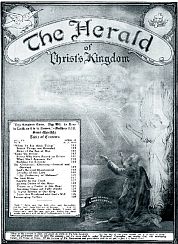
THE HERALD
of Christ's Kingdom
VOL. XV. July 1-15,
1932 Nos. 13-14
Table of Contents
Working
Together with God
The
Signs of the Times
''IT
HASTETH GREATLY"
The
Pathway of Life
Effectual
Prayer
Half
Hour Meditations on Romans
Report
of Conventions
The
Coming Convention in Toledo, Ohio
Words
of Encouragement
VOL. XV. July 1-15, 1932 Nos. 13-14
"Finally, my brethren, be strong
in the Lord, and in the power of His might."-Eph. 6:14.
GLORIOUS is the privilege of being admitted into
the fellowship of God and of being made a co-worker with Him! How supremely happy must be
the heritage of all the holy ones of the heavenly host, uncontaminated by sin and its
influences and the infirmities of the fallen state, with nothing to mar or hinder the
blessed sunlight of God's presence!
With humanity here upon the earth under the present circumstances all is different. Sin
and selfishness now mar everything; and creation as a race on this planet, separated from
God and holy influences, know nothing of His fellowship and the precious influences of His
love and care; they are entirely oblivious to the sweetness of service as workers together
with Him. But still there is a happy outlook; God has riot abandoned His creation to
corruption and ruin. He has told us of His gracious purpose to once more let in the light
of His favor and to lift from the earth the shroud of darkness that has so long hidden His
face from humanity. The long promised morning is to come -- the age of light and life for
all the willing and obedient coming forth from the tomb at that time. - Psa. 30:5; John
5:28, 29.
Spiritual Joys and Spiritual Conflicts
But even now in advance of the dispelling
of the darkness, and before God visits earth's creation with His favor, He speaks peace to
some through His dear 'Son, and those who respond obediently experience the great
deliverance from the blight of the condemned state. Such may now come to God and enter His
presence. Though still in the world of ruin and death, and though they have not yet
experienced the complete deliverance, they are accorded the privilege of His fellowship
and of becoming workers together with Him. Thus since the Advent of the Savior and the
introduction of the dispensation of the Spirit, a faithful remnant. Of humanity, which is
termed in God's Word, "the elect," have throughout their days from, the time of
coming to Him, enjoyed the unspeakable privilege of communion with God, of walking and
working with Him, and of enlisting all their powers, time, and opportunity in accordance
with His gracious will. Yet on account of the prevailing darkness in the present evil
world and the subtlety of the Adversary, and because God's children now possess the
treasure of light, the blessing of His Spirit, in very imperfect and weak vessels, the
life of fellowship and communion with God is associated with many grave dangers,
difficulties, conflicts.
The calling and election of such as enter the Lord's presence in this Age, being to a
spiritual inheritance, their labors, their experiences and conflicts, as well as their
peace and Joy are those of the inner man, of the Spirit within; they are of a spiritual
character. God's favors to these and His protection are along spiritual lines against
spiritual enemies and spiritual difficulties. Thus the Apostle refers to the conflicts and
struggles of the Spirit when he says: "For we wrestle not against flesh and blood,
but against principalities, against powers, against the rulers of the darkness of this
world, against spiritual; wickedness in high places." (Eph. 6:12.) Again: "For
the flesh lusteth against the Spirit, and the Spirit against the flesh: and these are
contrary the one to the other so that ye cannot do [perfectly] the things that ye
would." (Gal. 5:17.) Referring to the peace and joy of the Spirit, we read again:
"And the peace of God, which passeth all understanding, shall keep your hearts and
mind; through- Christ Jesus." (Phil. 4:4, 7.) The New Testament abounds with messages
setting forth the workings of the Spirit and the spiritual experiences of such as enter
relationship with God and work together with Him.
God's' Special Work with the Church
Having seen in our study of the Divine Plan that God's purpose in this Age is not for
the conversion and the reclaiming of the world now, but is for the choosing out of
humanity a Bride for His Son, and having seen that those who will compose this
distinguished company must be of choice character, there is but the one conclusion, namely
that God's special work in this dispensation is with and for these. This is a most
important work. His Word tells us that, "whom the Lord loveth He, chasteneth, and
scourgeth every son whom He receiveth." (Heb. 12:6.) Comparing Himself to a
fruit-vine and His followers to branches in. the vine, Jesus said: "Herein is My,
Father glorified, that ye bear much fruit; so shall ye be My disciples." "Every
branch that beareth fruit, He purgeth it, that it may bring forth more fruit." - John
15:8, 2.
Under the inspiration of the Holy Spirit all the Apostles dealt comprehensively with
this subject of fruit bearing, of Christian development-the subject of growing in the
grace and knowledge of our Lord Jesus Christ. The Christian Church was admonished to add
various qualities; or ingredients that go to build up and strengthen, character: "If
these things be in you and abound, they make you that ye shall neither be barren nor
unfruitful in the knowledge of our Lord and Savior Jesus Christ." (2 Pet. 1:8.)
Everywhere in the Apostolic teaching is the thought of the cleansing of the Church, the
sanctification of the Church and her transformation, that she may be made meet for the
inheritance of the saints in light.
But wherein does the Christian work together with God? Answer, in all this, God's work
mentioned foregoing, every member of the Church has his part. In fact, God does not work
with those who do not cooperate with Him. "Work out your own salvation," says
the Apostle, "for it is God that worketh in you both to will and to do of His good
pleasure." Here then, is our work; it is that of heeding His voice, of heeding
!, the instruction of His Word; that of daily
applying the Word to the life. It is a constant work of faith and of the Spirit by which a
transformation, a change of character is effected, and we become copies of the likeness of
His dear Son. Finally, the work, by His Spirit and grace, is that of developing the New
Creation to be the qualified joint-heirs with Christ for the blessing and deliverance of
humanity in the future Age.
The First Great Step
In order to properly commence such a life there must be the great humbling of the heart
and 'soul before God in the beginning, in turning away from sin and surrendering all to
Him. This is forcefully stated by the Psalmist: "The sacrifices of God are a broken
spirit: a broken and a contrite heart, O God, Thou wilt not despise." (Psa. 51:17.)
If this first step or stage commencing the Christian'' life is thorough, if the surrender-
to God is complete, if self will is broken and the natural pride of the heart humbled in
the, dust, the foundation is well laid for a successful life of working together with God;
the spirit of such as have had this experience is well expressed by the poet:
"Higher than the highest heaven,
Deeper than the deepest sea,
Lord, Thy love at last has conquered
'None of self and all of Thee'.
Yet, as is well known, it is one thing to make the right start, to lay this good
foundation, and another thing to build thereon-to preserve all through life the humble,
broken-hearted attitude and to go forward successfully in the work with God-that work He
wishes us to engage in with Him.
One may indeed have made the full surrender, have made the right start in the first
place, but in the course of the conflicts, cares, trials, and tests of life he has not run
well. The old self in a measure is revived self-will and the old natural pride of heart
little by little crop out; the flesh is indulged; the world has its part in the life,
there is a kind of working "for God, but little of working together "with"
God. Instead of the meekness and lowliness of heart and waiting always to know God's will,
human, fleshly energy, pride and ambition, enter largely into the plans, labor, and
service that are rendered. As a result such an one is not holding fast to the rejoicing of
the hope firm unto, the end. The spiritual life and health are impoverished; the life of
fellowship and communion with God is far from what it ought to be.
Again it is to be observed that in some the effects of the initial experience of
conversion and consecration are not as deep or, as far-reaching as they should be; the
vessel is not as completely broken and emptied of self as it ought to be, and consequently
the dominion of the Spirit of God in such a life is seriously interfered with. The
disposition of such an one is again defined by the poet:
"Yet He found me; I beheld Him
Bleeding on the accursed tree;
And my wistful heart said faintly,
'Some of self and some of Thee'."
It is just as impossible for one of this kind to be satisfactorily working
together with God as the other case mentioned. There is a positive antipathy between the
life of holiness and full-surrender, and the life of partial self-indulgence. As we read:
"A double minded man is unstable in all his ways." (Jas. 1:8.) To such there
comes the solemn admonition: "Purify your hearts ye double minded." - Jas. 4:8.
But no matter which of the above descriptions or examples of attempts to work
together with God may come under our observation,: the results are the same; and such
lives are constantly meeting with problems, trials, and discouragements with which they
well know they have not strength to cope. And how few spiritual Israelites when they get
into spiritual difficulties realize that it must, in some sense of the word, be traceable
to the Lord's providences! How few of them properly look to see to what extent their
spiritual adversities, weaknesses, coldness, alienation from the Lord, etc., are due to
the permission of some kind of idolatry in their hearts! Not an idolatry, probably, that
entirely ignores the Lord; but one which, while thinking favorably of His spiritual
blessings and victories of the past, simply wonders at His disfavor of the present, and
fails to recognize that it is impossible to serve at the same time both God and Mammon;
that God's favor and close communion and protection cannot be expected while we permit in
our hearts a rival reverence for wealth or fame or human institutions and creeds, or self
or family to any degree or extent.
Victories Few, Defeats Many and Disastrous
Another, writing along these lines of the successes and failures, victories' and
defeats of the Christian life, has summed up the experience of a large number of the
Lord's people in the following impressive manner:
"All of God's children, I am convinced, feel instinctively, in their moments of
Divine illumination, that a life of' inward rest and outward' victory_ is their
inalienable birthright. Can you not remember, some of you, the shout of triumph your souls
gave when you first became acquainted with the Lord Jesus, and had a glimpse of His mighty
saving power? How sure you were of victory, then!
How easy it seemed to be more than conquerors, through Him that loved you! Under the
leadership of a Captain, who had never been foiled in battle, how could you dream of
defeat! And yet, to many of you, how different has been your real experience! Your
victories have been few and fleeting, your defeats many and disastrous. You have not lived
as you feel children of God ought to live. You have had perhaps a clear understanding of
doctrinal truths, but you have not come into possession of their life and power. You have
rejoiced in your knowledge of the things revealed in the Scriptures, but have not had a
living realization of the things themselves, consciously felt in the soul. Christ is
believed in, talked about; and served; but He is not known as the soul's actual and very
life, abiding there forever, and revealing Himself there continually in His beauty. You
have found Jesus as your Savior from the penalty of sin, but you have not found Him as
your Savior from its power. You have carefully studied the Holy Scriptures, and have
gathered much precious truth; therefrom, which you have trusted would feed and nourish
your spiritual life, but in spite of it all, your souls are starving and dying within you,
and you cry out in secret, again- and again, for that bread and water of life which you
see promised in the Scriptures to all believers. In the very depths of your hearts, you
know that your experience is not a Scriptural experience; that, as an old writer said,
your religion is but a "talk" to what the early Christians enjoyed, possessed,
and lived in. And your hearts have sunk within you, as day after day, and year after year,
your early visions of triumph have seemed to grow more and more dim, and you have been
forced to settle, down to the conviction, that the best you can expect from your religion
is a life of alternate failure and victory, one hour sinning, and the next repenting, and
then beginning again, only to fail again, and again to repent."
The Promises of Triumph
It is of course not the Scriptural thought that the victorious Christian life is one of
perfection in the flesh; nor one in which there is no uprising nor cravings of natural
fleshly propensities. But surely the triumphant life must, be one in which there is
victory, over' sin in some important sense. There must be a subduing of sin in our
members; there must be that self-mastery, a keeping of the body under, else the admonition
to live the overcoming life were in vain, and the promise to the overcomer is meaningless.
- The above writer continues:
"Did delivering us out of the hand of our enemies,' mean that they should still
have dominion over us? Did 'enabling us always to triumph' mean that we were only to
triumph sometimes? Did being made 'more than conquerors through Him that loved us,' mean
constant defeat and failure? Does being 'saved to the uttermost' mean the meager salvation
we see manifested among us now? Can we dream that the Savior, who was wounded for. our
transgressions and bruised for our iniquities, could possibly see of the travail of His,
soul and be satisfied in such Christian lives a s fill the Church today? "When Paul
was telling to the Ephesian Church the wondrous truth; that' Christ had so loved them as
to give Himself for them, he went on to declare that His purpose in thus doing was, 'that
He might sanctify and cleanse it by the washing of water by the Word, that He might
present it to Himself a glorious Church, not having spot or wrinkle; or any such thing;
but that it" should be holy and without blemish.'
"When Paul was seeking to instruct Titus, his own- son after the common faith,
concerning the grace of God, he declared that the object of that grace was to teach us
'that, denying ungodliness and worldly lusts, we should live soberly, righteously, and
godly in this present world'; and adds, as the reason of this, that Christ 'gave Himself
for us that He might redeem us from all iniquity, and purify unto Himself a peculiar
people, zealous of good works.'
"When Peter was urging upon the Christians, to whom he was writing, a holy and
Christlike walk, he tells them that 'even hereunto were ye called because Christ also
suffered for us, -leaving us an example that ye, should follow His steps: who did no sin,'
neither was guile found in His mouth'; he adds, 'Who His own self bare our sins in His own
body on the tree, that we, being dead to sin, should live unto righteousness: by whose
stripes ye were healed.'
"When Paul was contrasting in the Ephesians, the walk suitable for a' Christian,
with the walk of an unbeliever, he sets before them the truth in Jesus as being this,
'that ye rut off concerning the former conversation the old man, which is corrupt
according to the deceitful lusts; and be renewed in the spirit of your minds and that ye
put on the new man, which after God is created in righteousness and true holiness.
In the Power of His Might
In consideration of the Divine call to live a life of sanctification, and in view of
the promised grace to enable the called one to work together with. God in its
accomplishment, it must be admitted that all failure to attain success is due to the
neglect of the Lord's instruction concerning the secret of working with Him. "Be
strong in the Lord and in the power of His might," is the sum of the Divine counsel
on this subject. Those lacking faith to rest their case with God, those struggling in the
strength of their fleshly energy, cannot triumph in the life of holiness and godliness.
Here again is revealed the all-important office of the Holy Spirit. To be strong in the
Lord surely signifies to be strong in the power of His Spirit: "I can do all things
through Christ which strengtheneth me, says the Apostle, but that strength must be laid
hold of by faith. It is the strength which His Spirit affords. The Lord may permit defeats
and failures for the very purpose of causing us to turn to Him more fully to find out the
secret of success-that it is in self-renunciation and in being filled with His Spirit.
"Repent and Do the First Works"
The Savior's admonition to the Church at Ephesus contains the elements of wisdom that
many today could profitably hear and heed: "Remember therefore from whence thou art
fallen; and repent, and do the first works; or else I will come unto thee quickly and will
remove thy candlestick out of his place, except thou repent." (Rev. 2:5.) This is an
admonition to go back over the life and note what it was in the beginning that drew out
the soul's fervent. love, and led to bring all to the altar and to zealously enter upon a
life of ardent devotion to the will of God. Consider again and know what it was that led
up to this experience. If you find that along through the years faith has grown dim, your
hope of glory is not bright, and you know little or nothing of the promised full_
assurance of faith, "repent," renounce that condition, and in humility seek the
favor of God in His way-"Do the first works." And what were those works? There
can be no doubt that they, were the works of the Spirit, because they are the only works
that are pleasing to God. Christ's advice is to do them again, which means a return to the
former happy attitude of full surrender to God and receive again of the power from on
high, by which alone any are enabled to do His works, or to work together with God.
As in the beginning the light of truth was seen and laid hold of by faith, and as the
truth revealed God's character of love and His gracious purpose to bestow unspeakable
gifts and mercies upon all obedient believers, and as; this revelation of things drew upon
our gratitude and led to the dedication of all to Him, so again let there be a revival of
this condition in the soul and a drawing nigh to God, that the former blessings of peace,
joy, faith, hope, and love may once more be the heritage.
A Life of Watching unto Prayer
The successful working with God is then to be a continual heeding of His word of
counsel; a constant walking with and leaning upon the Lord. It will be found to be a life
of watching unto prayer, for the Spirit of God so instructs,: "Praying always with
all prayer and supplication in the Spirit, and watching thereunto with all perseverance
and supplication for all saints." (Eph. 6:18.) The daily experience will be one of
feeding upon the Divine Word of wisdom and instruction. As the manna was the daily food of
Israel so the heavenly manna of God's truth is the nourishment whereby the
Christian goes from strength to strength. He is enabled to work with God. -Service,
work indeed there will be in behalf of others; especially in behalf of fellow members of
the Christ; and all opportunities will be used to let the light of the knowledge of God
shine out to others, proclaiming the message to all who have ears to hear. But
increasingly through the years the faithful disciple of Christ and child of God will
realize that his special mission at the present time is to work with God in respect to his
own personal- life of devotion, holiness and sanctification, in order'' to a preparation
for membership in the class of whom it will yet be said: "His wife hath made herself
ready."
NOW consider the subject of the signs of the times. Remarks on this subject are too
often made which betray a want of intelligent comprehension of the nature of the signs
that: are according to Scripture to indicate the "time of the end." A careless
reading of our Lord's prophetic discourse on the Mount of Olives seems to be 'the cause of
much of this misapprehension. His predictions of wars and rumors of wars, famines,
pestilences, and earthquakes, are quoted as if they and such like things were to be the
signs of the end of the Age. A little accurate attention to the order of His statements
would at once show that, so far from this being the case, He mentions these as the
characteristic and common events of the entire interval prior to His coming. Wars and
calamities, persecution and apostasy, martyrdom, treachery, abounding iniquity, Gospel
preaching, the fall of Jerusalem, the great tribulation of Israel, which has, as we know,
extended, over 1,800 years; all these things were to fill the: interval, not to be signs
of the immediate proximity of the Second Advent. How could things of common, constant
occurrence be in themselves signs of an .y uncommon and unique crisis? What commoner all
through the ages than wars and rumors of wars, famines, pestilences, and earthquakes?
These, as marking the course of the Age, can never indicate its close. What, then, are the
signs, we should expect?
Even Thus Shall It Be
Many who perceive the folly of thus looking at every great natural calamity as a sign
go to an opposite extreme, and. expect wonderful, unprecedented, supernatural and
impossible signs, basing their expectations on a literal interpretation of the symbolic
hieroglyphics of the Apocalypse. Such signs would be so grotesque and absurd in character
that it is an insult to human intelligence, not to say to Divine revelation, to assert
that they are to be expected. There is one simple and all-sufficient answer; to, this
childish conception of the signs of the last days. Our Lord- and His Apostles alike
furnish the reply.
Our Lord says: "And as it was in the days of Noe, so shall it be also in the days
of the Son of Man. They did eat, they drank, they married wives, they were given in
marriage, until the-day that Noe entered into the ark, and the flood came and destroyed
them all. Likewise also as it was in the days of Lot, they did eat, they drank, they
bought, they sold, they planted, they builded; but the same day that Lot went out of Sodom
it rained fire and brimstone from heaven and destroyed them all. Even thus shall it be in
the day "when the Son of Man is revealed." (Luke 17:26-30) And the Apostle
continues thus: "For yourselves know perfectly that the day of the Lord so cometh as
a thief in the night; for when they shall say,' Peace and safety, then sudden destruction
cometh upon them as travail upon a woman with child, and they shall not escape." - 1
Thess. 5 2, 3.
If any such signs, as are imagined by some, were to precede the advent, the state of
society predicted in these passages could not by any possibility exist. If monstrous,
unheard-of, supernatural, portentous events were to transpire, would they not be
telegraphed the same day all over a startled world, and produce such a sense '\of alarm
and expectation that buying and selling, planting and building, and marrying and giving in
marriage, would all be arrested together, and "peace and safety" would be far
from any one's lips or thoughts? And if one of the Apocalyptical prodigies is to be thus
fulfilled, all of course must be so. Conceive a succession of such supernatural prodigies,
and a world asleep in fancied security, and overtaken by sudden destruction. No, there was
nothing special to alarm the antediluvians before the day that Noah entered the ark;
nothing special to startle the men of Sodom ere the fire from heaven fell; and like as it
was in those days, so will it be in. these. All going on just as usual, no single sign to
attract the world's attention. "None of the wicked shall understand" the true
state of affairs, only the wise enlightened by the word of prophecy.
Chart of the World's' History
It will be objected, perhaps, but if the signs of the times, which we are expected to
recognize, are neither ordinary natural events nor extraordinary unnatural ones, what: are
they? Scripture' abundantly answers this inquiry. They are special, but perfectly natural'
events, occurring in a predicted order and at a predicted time, and various and widely
differing events occurring in combination. They are not sudden, startling, newly produced
phenomena, but definite stages in long progressing movements, whose history was written
twenty-five centuries ago.
As to political signs, allow me to make a few simple suggestions. I met a gentleman who
has long been a Christian, a student of God's Word, a worker in His service, and he said
he had bestowed little time on the subject of prophecy. Now there may be many such: let me
refer, for the sake of such, to a great political chart of. the world's history contained
in Daniel 2, and especially as compared with Daniel 7. There we have the history of the
last twenty-five centuries.
Let me suggest that Daniel is the introduction to John, the Book of John the completion
of the Book of Daniel. Daniel is first John; John. is second Daniel. They, are, two parts
of the same Book, they treat of one subject, use the same symbols, employ the same
hieroglyphics, and speak of the same course of events. These two Books contain a series of
visions in which the same ground is to a certain extent traversed again and again. The
first vision in these two Books is the simplest and most comprehensive. In that well-known
vision, the fourfold image, representing the course of four great world empires, Babylon,
Medo-Persia, Greece, and Rome, we have a chart of Gentile history.
An Apt Illustration
And using, the word chart reminds me of a very simple illustration that may be of value
to some on the question of signs, and the point we have reached in the history of the
world. Suppose you cross the ocean, and traveling for many days or weeks, you reach a
certain point of the voyage still out of sight of land, when one day you hear a rumor that
the ship is approaching the port to which you are bound.. You go to the captain, and
inquire. "Yes, it is; we should sight the land at three o'clock this afternoon."
"How do you know?" The captain unrolls his chart, and says, 'There is the port;
there is our present position." He lays his finger on the exact point reached by the
ship. "How do you know we are there?" "Do you see that line drawn across
the chart? That is our course we have followed it; we are just there, and will sight land
at three o'clock." You ask for evidence to reassure yourself and strengthen your
expectation it shall be as he says. You ask for further light on the subject, for you
cannot understand how he can be so sure; "Well, our voyage has run along such and
such a course, we have come so many miles, the ship has kept the track marked there; on
the way we have passed certain points, certain headlands, indicated there, as Ceylon, Aden
and so forth, just as they are marked in the chart. Now the distance from Ceylon to the
port we are making is so and so many miles; we have just run within twenty miles of it,
and by three o'clock we will make the rest. The chart with the reckoning of time and
distance shows exactly where we are."
It seems to me that in a somewhat similar way God's servants and saints are guided by
His wondrous and infallible Word. He has been pleased in the Book to give us a chart of
history, not merely history still future, but history now past; and it has been unfolded
to us, not in dim light, but in a broad, clear light, and part of the light, a most
important part of it, is prophecy with reference to the political history of the world,
with reference to the political history of the great Gentile powers. What a marvelous
thing it is when we consider that twenty-five centuries ago, when the times of the
Gentiles were beginning, when the Jewish subjection had commenced-for God has cast down
the throne of David for a time, and set up the Gentile powers-that at that time,
twenty-five centuries ago, the course of Gentile power should be clearly foreseen and
distinctly foretold, written and marked out in God's holy Word! It is written and
rewritten, prediction multiplied on prediction, and the whole thing laid bare and
unfolded; and all history, itself has run on these lines exactly as foretold.
History Unveils Prophecy
I can only add on these signs, that each power has run its appointed course: the
Babylonian empire rose, reached a certain point and fell; the Medo-Persian empire
succeeded, and reached a certain development, and also fell; the Grecian empire followed,
and ruled and perished; then rose the Roman empire, passed through the course foretold,
first united, then divided, just as indicated. Compare, I say, the Old Testament and New
Testament predictions with the whole course of recorded history, and what do you see?
History has run on the lines laid down; the predictions have been fulfilled, we know their
fulfillment is sure. Babylon, Persia, Greece, Rome Pagan, and Rome Papal and
persecuting-all have come and gone, and here we are at the close of the last four empires;
the next thing therefore to be expected is the manifestation, the shining forth of the
Kingdom of God.
Of course the history of the Gentile world is a different thing from the history of the
Christian Church. Take then the latter: a great deal is foretold with regard to the
history of the Christian Church. That Church 'was to grow, according to prophecy.
Beginning with small things it was to attain to a wonderful extent. From a- small seed it
was to spring into a great tree, spreading out its branches in which the birds of the air
were to come and build. This wonderful change is foretold by the Lord Himself, by Paul
again and again, and by John in still greater detail all this has taken place.
Now observe, further, the bearing of this on the signs of the times. As the Church in
her infancy was told of her extension; as she at length reached maturity; as she who so
small became a great spreading tree, and as the birds of the air came and built in her
branches; as all this has become history, as all has been fulfilled; so another event
foretold has taken place. In the history of the Church there has been a great falling away
from the faith, and that apostasy was distinctly foretold. I suggest, then, that this word
of Paul to the Thessalonians, "That day shall not come except there come, the falling
away first" (the apostasy), is a most important sentence in connection with the
question of ecclesiastical signs of our times. The subject there is ecclesiastical; the
apostasy was to take place, not in the world, but in the Christian Church. Paul is writing
of what is to take place in the Church, and of that pure and practical hope and he is
writing just there and then' with reference to our gathering together to Him. And Paul
says, "That day shall not come except there come the falling' away first." I
believe that just as I accept any other statement of inspiration. Therefore I am forced
to. take this position if that predicted falling away in the Christian Church has not
taken place, it lies between us and our gathering together to Him.
We Recognize the Portrait
But if, on the other hand; that predicted' falling away has taken place, it does not
lie: between us and the coming of the Lord. If we compare this falling away in the Church
with the passage with which you are familiar, "In the latter times some shall depart
from the faith," the word in the original Greek is the same as in the passage in
Thessalonians. When we compare the two together, surely we cannot evade the conclusion
that they refer to the same thing. Now, the falling away in 1 Tim. 4, is described as
"Giving heed to seducing spirits and doctrines of demons. . . forbidding to marry,
and commanding to abstain from meats." Reading that, we cannot fail to recognize the
portrait.
Time would fail to do more than add this one thought' by way of suggestion, that after
the declaration that. the day shall not come except there come first the apostasy, there
,is added a very solemn declaration indeed, with reference to the one whom the Reformers
recognized as the man of sin, whose manifestation is described.- I rejoice I have learned
to look, as I have done ' for thirty years, on Scripture in-the light of history, and on
history in the light of Scripture. And that doing so I can see the fulfillment of this
prediction in accurate accordance with prophecy, a fulfillment recognized by the
Reformers, though denied by the. Papacy. And this very prophecy led to the Reformation, as
they recognized the necessity of separating from the foretold apostasy. There is no time
for further details, but let us search' and see. Do not let us imagine we have reached a
termination in the study of such things, but let us seek to advance in the understanding
of them.
-H. G. Guinness.
"The time of trouble nears, 'It hasteth a greatly';
Fen now its ripples span the world-wide sea;
O! when its waves are swollen to mountains stately,
Will the resistless billows sweep o'er me?
"Or, terror-stricken, will 'I then discover
A wondrous Presence standing in glory by,
Treading: the waters! -- Earth's Imperial Lover,.
With words of cheer 'Be not afraid. -- 'tis I.'
"Yes, a hand, strong, yet tender as a mother's,
Will from the surging billows lift me out.
With soft rebuke, more loving than a brother's:
'Of little faith! O, wherefore didst thou doubt?"'
"But the word is very nigh unto thee, in thy mouth, and in thy
heart, that thou mayest do it. See, I have set before thee this day life and good, and
death and evil." - Deut. 30:14, 15.
THE revelation that God has given us in His message, His Word, alone deals
satisfactorily in every way with the great question of life and death. Our Father in
heaven, foreseeing the fall of man into sin and the resulting consequences of death, with
all the accompanying trials, suffering, and sorrow, etc., anticipated in advance- the
longings of our race for deliverance out of the hand of the great Enemy, after learning
many valuable lessons under the experiences of the reign of evil. He foresaw the struggle
of humanity to burst asunder the bands of death and to attain that state and heritage that
was originally contemplated in man's creation-eternal life in all the blissful
surroundings of Paradise.
As It Shall Be in Future Times
We have observed in His revelation how, during the various ages of His great Program,
God has repeatedly given forceful reminders of His ultimate design to satisfy the normal
longings of all the willing and obedient of our race for life and for fellowship with Him.
One feature or another of His purpose has been called to our attention in a pictorial way
certain characters and special dealings with these presenting to 'is in types and
illustrations what He purposes to work out on a grand scale in subsequent times and
seasons. Accordingly, Jehovah, as He chose the Jewish nation and separated them from. all
the other families of the earth to be a peculiar people, gave to them what was supposed to
be a message of light, but owing to imperfection and degradation resulting from the fall,
proved to be a way of death-thus none were found to be justified by the deeds of the Law
Covenant. The happy thought about the entire matter is that the infinite wisdom of God
enabled Him to foreknow this result also. And while there was this constant manifestation
of the failure of ancient Israel to secure life by obedience to the Law, God was making
repeated statements, both by picture and prophecy, of another arrangement, of another Age,
and a New Law Covenant by which would surely be made possible the realization of all the
good desires and longings of the righteous.
Belief and Confession
The Apostle declares that this which was prophesied as far back as the time of Moses,
is the Gospel which he preached, which we have received, namely the confession' of the
Lord with' our mouths and faith in Him in our hearts. It is noteworthy that both the
Prophet Moses and the Apostle Paul stated the matter in the same manner:' first, the
confession with the mouth; second, the belief in the heart. This form of statement is
probably not of accident either. The confession of the mouth is the first outward evidence
given of a faith in the heart; and indeed it seems to be a' part of the Divine arrangement
that all confession of the Truth is necessary to a full appreciation of it., True, we
cannot properly confess what we do not believe; hence a belief must have precedence to a
confession,' but the confession is necessary to the expanding, enlarging, and completing,
of faith in the heart. Whoever thinks that the light he has received in his, heart can be
maintained without a public confession of it, is deceived, and hence it is declared,
"With the heart man believeth unto righteousness; and with the mouth confession is
made unto salvation." The righteousness started by faith cannot go on and reach the
completion, which will mean eternal salvation, unless it be accompanied by actual faith,
most prominent of which is the confession of the lips.
In Moses' last message he cautioned his brethren concerning any disposition to leave
the Lord and accept instead other gods. His words are specially applicable to spiritual
Israelites, and we do well to give them earnest heed. We are already by faith in this
blessed condition; we have the words of eternal life. We already have entered the Canaan
rest condition, by faith in our Lord. We therefore are in danger from., the deceptions of
our own flesh and from the besetments of sin abounding, and from the Adversary-in danger
of making other gods and turning our hearts away from the proper center of their
affection, either to the god of wealth, or of fame, or the lesser god of the family circle
and home, or to the most ignoble of all, self. We must not be drawn away by any of these
from our loyalty to God, nor to render worship or service in any sense to any of these. To
do so would mean to turn away from the hopes and joys and blessings now ours. To, resist
these temptations and to abide in the Lord's favor, on the other hand will mean to
continue in the joys and blessings and rest of our present state of grace. Thus the Lord
sets before us the blessings and the curses, the advantages and the disadvantages, the
right course and the wrong course, life and death.
Choosing the Better Part Now
Our choosing of life and blessing and righteousness and God, are not merely the joys of
a moment; the daily trials and testings of life prove whom we love and whom we serve. And
well will it be for all now undergoing trial, to examine their hearts and their daily
course of life and note for what they are spending their energies, what fills their
affections, what "satisfies their longings as nothing else can do." To the
extent that we find the Lord the center of our lives, our hopes, our aims, and His will
the ruling law in every affair of life, in that same proportion we find joy and peace and
blessing and growth spiritually.
It is in vain that we say we love the Lord if we do not seek to do those things
pleasing in His sight. He is not seeking those', who merely give outward allegiance, but
those who at heart love Him and His righteous arrangements. He is satisfied indeed to
accept us at the beginning largely upon our professions of faith, devotion, under the robe
of. Christ's righteousness, knowing that in our imperfect development we could, not. love
perfectly. But He expects us to make progress in the pathway of life, to grow in grace and
in personal- knowledge and acquaintance with Him, and only by so doing can we abide in His
love, and only by abiding in His love, can we hope to attain the glorious things which He
has in reservation only for those who love Him supremely.
Effectual Prayer
OF ALL the duties enjoined by Christianity, none is more essential, and yet more
neglected, than prayer. Most people consider this exercise a fatiguing ceremony, which
they are justified in abridging as much as possible. Even those, whose profession' or
fears lead them to pray, pray with such languor and wanderings of mind, that their
prayers, far from drawing down blessings, only increase their condemnation.
Do not think that it is necessary to pronounce many words. To pray is to say, Let Thy
will be done; it is to form a good purpose: it is to raise your heart to God. It is not
necessary to quit, one's employment; it is a simple movement of the heart towards its
Creator, and a desire, that whatever you are doing, you may do it to His glory. The best
of all prayers is to act with a pure intention and with a continual reference to the will
of God. It is at the foot of the altar, that we must seek for counsel which will aid us.
It is with God, that we must lay our plans of virtue and usefulness; it is He alone, that
can render them successful. Without Him, all our designs, however good they may appear,
are only temerity and delusion. Let us pray then, that we may learn what we are, and what
we ought to be.
Do not devote all your time to action, but reserve a certain portion of it for
meditation upon eternity. We see Jesus Christ inviting His disciples to go apart, in a
desert place and rest awhile, after their return from the cities, where they had been to
announce His religion. How much more necessary, it is for us to approach the Source of all
virtue, that we may revive our failing faith and charity, when we return from the busy
scenes of life, where men speak and act as if they had never known that there is a God.
The necessity we feel that God should bless our labors, is another powerful motive to
prayer. It often happens that all human help is vain. It is God alone that can aid us, and
it does not require much faith to believe, that it is less our exertions, our foresight,
and our industry, than the blessing of the Almighty, that can give success to our wishes.
We must pray with attention. God listens to the voice of the heart, not to that of the
lips. Our whole heart must be engaged in prayer. It must fasten upon what it prays for;
and every human object must disappear from our minds. To whom must we speak with
attention, if not to God? Can He demand less of us, than that we should think of what we
say to Him? Dare we hope that He will listen to us, and think of us, when we forget,
ourselves, in the midst of our prayers? We must also ask with faith; a faith so firm that
it never hesitates. He who prays without confidence, cannot hope that his prayer will be
answered. Will not God love the heart that trusts in Him? Will He reject those who bring
all their treasures to Him, and repose everything upon His goodness? But must we not
confess that this filial confidence is wanting in all our prayers? Is not prayer our
resource only after all others have failed us? If we look into our hearts, shall we not
find that we ask of God as if we had: never before received benefits from Him? Shall we
not discover there a secret infidelity that renders us unworthy of His goodness?
If we pray only from custom, from fear, in the time of tribulation.; if we honor God
only with our lips, whilst our hearts are far from Him; if we do not feel a strong desire
for the success of our prayers; if we feel a, chilling indifference, in approaching Him
who is a consuming fire; if we have no zeal for His glory; if we do not feel hatred for
sin, and a thirst for perfection; we cannot hope for a blessing upon such heartless
prayers.
But what is most important is the persuasion that the simplest, most humble mode of
prayer is the best, and the most acceptable, and the most conformable to the words of the
Son of God and the Apostles. In such prayers we find light and strength to fulfill our
duty with meekness and humility, in whatever condition we may be placed.
How few are there who pray! For how few really wish the true riches, humility,
renunciation of their own will, the reign of God upon the ruins of their self-love. We
must desire these blessings sincerely, and in connection with all the details of life;
else prayer is only an illusion, like a pleasant dream to a wretched sufferer, who thinks
that he possesses a felicity that is far from him.
This union with God in prayer must be the result of faithful obedience to His will; by,
this alone must we measure our love to Him; our meditations ought to become every day more
profound and intimate; Divine truths should enter the substance of our soul, and nourish
and grow with it. - Selected.
No. 29
"Ye know that He was manifested to take away our
sins." - 1 John 3:5.
"To bring in everlasting righteousness." - Daniel 9:24.
IN OUR last "Half Hour" we listened, with responsive hearts, while a devout
"singer in Israel" sang, in dulcet tones, the melodies of Romans 3:21-26. Let us
now consider these verses more closely, both in their details and in relation to their
context. They introduce that section of the Epistle which extends from Romans 3:21 to
Romans 5:11 and in which is expounded God's provision to meet the great need of mankind.
The Apostle has shown that the great need of the world, both of Jew and Gentile, is
righteousness, and that so far from their attaining righteousness by keeping the
requirements of law, the moral law possessed by Gentiles only reveals their sinfulness,
while that same moral law, as expressed in the written law given to Israel, similarly
condemns the Jews-for by law (moral law, of course, not ceremonial law) is knowledge of
sin. -Romans 3:20.
Man's Extremity God's Opportunity
In this section, Romans 3:21 to Romans 5:11, man's extremity is shown to be God's
opportunity. The age-old question, "How can man be just [righteous] with God?"
(Job 9:2 R.V.), is answered. God Himself has revealed the way -- the only way -- in which
this can be. It is a way of faith -- a righteousness (or justification) by faith.
In the exposition of this section three principal ideas are developed:
(1) The great fact of history by which justification (or righteousness) by faith is
made available for mankind, namely, the Ransom-sacrifice of Jesus.. - Romans 3:21-26.
(2) This, God's method of justifying mankind, is not out of harmony with, but, as the
case of Abraham proves, is in agreement with, attested by, the Law. - Romans 3:27 - Romans
4:25.
(3) Man, justified by faith, has a well-grounded hope, not for the present only, but
for all the future, including the final judgment. - Romans 5:1-11.
The careful student will have already noted that verse 21 of chapter 3 (Romans 3:21) is
directly connected in sense with the 17th verse of chapter 1. "In the interval from
Romans 1:18 to Romans 3:20, the Apostle has shown that the wrath of God rests on mankind,
whence it follows that if the world is riot to perish, a Divine manifestation of an
opposite kind, and able to overcome the first, is indispensable. It is this new revelation
which forms the subject of the following passage." It is interesting, too, to observe
"how rigorously the Apostle adheres to order in his work. Our readers will remember
that when,, in chapter 1, he discussed the failure of the Gentiles, he stated in condensed
form, in verse 18, all of. the ideas developed in the remaining verses of that chapter.
They will remember, also, that on turning to a discussion of the Jews, he condensed the
theme of chapter 2 in its first two verses. Now, once more, in the passage before us, we
find a similar procedure obtaining. Verses 21 and 22 (Romans 3:21-22) contain the theme of
the six verses 21-26 as well as of the whole section. (Romans 3:21-5:11.) "Verse 23
once more sums up the thought of the preceding section (Romans 1:18-3:20); and verses
24-26 are the development of the subject, the exposition of the new way of
justification."
But Now
"But now the righteousness_ of God without the law is manifested, being witnessed
by the law and the Prophets:' (Romans 3:21.) The word translated "But" "is
strongly adversative; it contrasts the revelation of righteousness with that of wrath. The
wrath of God is revealed from heaven (1:18), but now the righteousness (by faith) of (or
from) God is manifested. (Romans 3:21.) "We notice, how completely different in tone
from . . [the preceding section] is the section before us. A moment ago we heard, and our
conscience re-echoed within us, the thunders of the Law. Suddenly in the midst of our
self-condemnation the cheerful voice of the Gospel gladdens our ears."
The word translated "now" has been understood by some to have a logical
rather than a temporal import. "Instead of understanding it as having reference to
that 'fulness of the time' which, in the ongoing of the ages, had just been reached,"
they suppose it to have the logical meaning, which,. it must be admitted, it frequently
has in the New Testament, as for, example, "Now then it is no more I that do it, but
sin that dwelleth in me." (Rom. 7:17.) "Now, brethren, if I come unto you
speaking with tongues, what shall I profit you?" (1 Cor. 14:6.) Thus understood the
word would mean "The situation being such." But while we fully agree that the
Apostle is contrasting the condemnation pronounced by law (verse 20) and the new
righteousness acquired without law (verse 21), yet this does not prevent us from
understanding the word "now" to mean "at this time" that is to say,
under the Gospel or New Testament dispensation. This, the temporal, is its usual import,
as for example, 'The mystery which was kept secret since the world began, but now is
manifest." (Rom. 16:25, 26.) T is meaning, moreover, is in harmony with the context:
"to declare, I say, at this time, His righteousness." - Ver. 26.
Apart From Law
God's righteousness has been manifested, says the Apostle, apart from law. In the
Authorized Version the phrase is rendered "without the law," but the Greek does
not indicate the article "the" and scholars tell 'us' that the phrase is better
translated " without law" or "'apart from law."
"The law referred to is not merely the law of nature . . [possessed by the
Gentiles]. Nor is it merely the Jewish law . . It is that same law which is spoken of in
the preceding verse-through which is knowledge of sin, and by obedience o the works of
which no flesh shall be justified." It is the moral law of God which apprises man of
his duty, "whether as explicitly revealed in words to the Jews, or as implicitly
without words to the Gentiles all the world over. Such appears to be the reference of the
Apostle."
Again the phrase "without law or "apart from law" instead of being
affixed is, in the Greek, prefixed to the affirmation, and is so translated in the Revised
Version, Emphatic Diaglott, etc. Rotherham, for example, translates the passage thus
"But, now, apart from law, a righteousness of God has begin manifested;" His
translation, which is of special ',, value in indicating where - the emphasis should be
placed, underscores the words "a righteousness of God" but doubly underscores
the phrase "now, apart from law.." As Morrison observes "This- position of
the phrase, in the foreground of the affirmation, shows, moreover, that it is intended to
bear the burden of a special emphasis. In enunciation it should be betoned. For there is
an antithetic reference to the statement of the preceding verse in relation to the moral
law: -- by works of law there shall nobody be justified before God; for through law is
recognition of sin.' But though it is thus in vain for unrighteous men to have recourse to
law; [the moral law] in order to obtain justification; still their case is not hopeless.
Justification may be obtained in another way. 'But now, apart from law, God's
righteousness has been manifested."
The Righteousness of God
The expression "righteousness of God" in. verse 21, is one we have already
met, in chapter 1, verse 17. The meaning here is the same. In neither place would the
phrase appear' to denote an attribute of God, but in both the reference seems to be to a
righteousness having God for its Author, a righteousness which may become, yea, is
destined by the favor of God to become, an attribute of man, a righteousness of or from
God. Since we have discussed this phrase at some length' in the exposition of Romans 1:17
we will not duplicate the matter here. Those who so desire may review the subject in
Meditations No. 13, "Herald" February 1, 1931.
Has Been Manifested
Again, the word "is manifested reminds us of the word "is revealed" in
Romans 1:17. We read there that God's righteousness is being revealed in the Gospel. Some
suppose "that the Apostle had the same idea present to his mind in writing Romans
3:21; and that he, consequently, means that the righteousness 'has been manifested' in the
Gospel So undoubtedly it has, secondarily. But primarily it was manifested in the facts
which are announced in the Gospel. It was manifested in the career of Christ Jesus; in the
events, inner and outer, of His life and death; in what He voluntarily did and voluntarily
endured. These events constitute the subject matter of the Gospel; and in them there was
exhibited to view . . ["the righteousness wrought out and brought in by
Christ."] God's righteousness for unrighteous men was, in these events, manifested in
actual fact. It had indeed been 'promised afore.' (See Romans 1:2.) But though promised,
it was 'a mystery' in some respects, 'kept secret since the world began.' It could be only
dimly seen. It was obscure. It was veiled. But 'now it is made manifest.' . . . In our
authorized English Version the verb is rendered 'is manifested.' . . But the perfect tense
represents the manifestation as a completed historical fact: and such an idea is
peculiarly appropriate, when we regard the manifestation as accomplished in the life and
death of the Savior. In the expression, again, 'is revealed' as occurring in Romans 1:17,
the present tense as appropriately represents the continuous disclosure which is afforded
in the enduring and indeed, 'everlasting' Gospel."
Being Witnessed by the Law and the Prophets
From the fact that this righteousness for unrighteous men is apart from moral law it
must not be supposed that it is in contradiction to the Old Testament revelation. On the
contrary it is witnessed by the Law and the Prophets. By the expression - "the Law
and the Prophets we are evidently to understand the Old Testament Scriptures, "the
Law" in this case referring to the Pentateuch, and "the Prophets" to the
remainder of the Old Testament, including the Psalms. "These two manifestations of
the Divine will, commandment, and promise, understood in their true sense, contain . . .
the confirmation of the righteousness of faith, as the Apostle will prove in the sequel of
this section. (Romans 3:27 to Romans 4:25): The Law by unveiling sin opens up the void in
the heart, which is filled by the righteousness of faith; prophecy completes the work of
preparation by promising this righteousness. Thus there is no objection to be drawn from
the old revelation against the new. As the new fulfils the old, the latter confirms the
former." As was so happily expressed by an old writer, "The New Testament lies
concealed in the Old; the Old Testament lies revealed in the New."
"It is, of course, impossible for us to know what were the particular testimonies
which elicited his special attention, as his mind flashingly traversed the contents of the
Law and the Prophets. We need not doubt that he thought of Abraham when he glanced at the
Law, for he dwells upon his case, in relation to evangelical righteousness, in the fourth
chapter of this Epistle. We may rest assured too that in turning to the Prophets he
thought of what David says in the 32nd Psalm, for he-quotes from that Psalm in the same
4th chapter. He would also think of the testimony from Habakkuk, which is quoted in Romans
1:17, and which is, indeed, the Old Testament fountain-head of the Apostle's phase of the
New Testament theology. And we may reasonably suppose that his mind took a bird's eye view
of all the prominent passages, both in the Law and in the Prophets, in which the
propitiation of the Messiah is referred to, or the salvation that is bound up in. that
propitiation: for in all these glorious passages, the one great and glorious idea is
either explicitly exhibited or implicitly suggested, that justification-unattainable, as
it is, through the personal righteousness of unrighteous men is attainable through that
work of the Savior which is, in one of the most gracious of its phases, God's
righteousness for the unrighteous. We know that the Apostle was familiar with such
passages, for we read that, on another occasion, 'he expounded' to the Roman Jews 'and
testified the Kingdom of God, persuading them concerning Jesus, both out of the: Law of
Moses, and out of the Prophets, from morning till evening.' (Acts 28:23.) In this matter
he looked as through the eyes of Christ Himself, who, 'beginning at Moses and all the
Prophets, expounded unto His disciples in all the Scriptures the things concerning
Himself.' (Luke 24:27.) 'These are the things,' said He, 'which I spake unto you, while I
was yet with you, that all things must be fulfilled, which are written in the Law of
Moses, and in the Prophets, and in the Psalms, concerning Me.' (Luke 24:44.) And Peter saw
as Paul saw. 'To Christ,' says he, 'give all the Prophets witness, that through His name
whosoever believeth in Him shall receive remission of sins.' - Acts 10:43.
A Present Testimony
"When the Apostle represents God's-righteousness as [witnessed or] attested by the
Law and the Prophets, the word is to be understood in its ordinary acceptation. 'The Law
and the Prophets' bear testimony to the righteousness. They speak of it; and they speak of
it in such a way as to corroborate the announcement or proclamation of the New Testament
Evangelists. The tense of the participle indicates that the attestation of the
righteousness by the Law and the Prophets was viewed by the Apostle as a present thing. It
had been, indeed; and it would be. But the idea to which he gives expression is, that it
is. If the tense had been past, the idea of attestation might have been obscured or
complicated, and must have merged in pure prediction or promise. But even-'now' the Old
Testament continues to bear witness to the New. It bears present witness.
The Gospel No Startling Novelty
"Why did the Apostle specify this fact-that the Old Testament Scriptures bear
testimony to the Evangelical righteousness which is the theme of the great New Testament
annunciation? Why did he . . 'interrupt his proposition' that he might introduce the idea?
Various aims have been suggested. He might "desire to hold up to view the dignity,
worth, and glory of that which was the grand theme of his preaching. It was no crotchet.
It was no minute and unimportant detail. It was the solar centre of Divine revelation, out
of which innumerable rays of light and heat were emanating, and back into which they might
all be traced. The Gospel which he preached, and which exhibited the Evangelical
righteousness, had been 'promised afore by God's Prophets in the Holy Scriptures.' (Chap.
1:2.) It was the mark to which prophetic fingers had pointed in all preceding times. And
thus, too, . . . it was no novelty though 'news.' It was no new-fangled and upstart theory
of things. It was a light that had dawned in the remotest antiquity, though it had only
now reached the zenith of its effulgent glory. It had advanced with the ages, and grown
with the growth of successive epochs; until the 'fulness of the time."'
Wisdom Taught by Love
Again, "there can be little doubt that the Apostle had in view the reconciliation
of the minds of his Jewish brethren to his Evangelical teaching. He wished to show them
that he was not overturning the Jewish faith, but only recalling it to its original
purity, simplicity, and Divine intent. This was one of the means that he wisely put into
operation when he tried and plied all means, if by any means, he might gain some of their
souls. God Himself had set him the example, for . . . [in the vision] Moses and Elias were
both of them sent to the mount, of transfiguration to bear testimony to the Christ."
NOTTINGHAM, ENG.
We have received the following reports of recent conventions:
"The Annual Convention of Bible Students was held in Nottingham during the
Whitsuntide holidays. It had been looked forward to by many, and numerous petitions had
gone up to the Throne of Grace that it might prove to be a time of blessing. All in
attendance seemed to feel that their prayers had been abundantly answered, and their
hearts overflowed with deepest gratitude to God. It .was good to be there! The one pity
being that it was not possible for more to share the rich favors. Probably from three to
four hundred friends were present, having come from all parts of the country, some of them
attending all the sessions.
"As was to be expected, seeing that: it was Whitsuntide, reference was made to
Pentecost, 2nd the fruit of the Spirit-from different standpoints-was a subject
particularly dealt with by several speakers. The importance, too, of having the one
paramount purpose ever before us, so that we might be ready for the consummation of all
our hopes at any time now, was a note which sounded persistently through many of the
discourses. Some of the addresses were outstandingly helpful, and bore manifest evidence
of the power of the Holy Spirit in the message.
"A feature of the Convention which appeared to indicate a coming revival of active
service for the Lord and His Truth, was the interest aroused by the consideration of
various forms of public witness, and the orders placed for tracts. The Committee expressed
their preparedness to cooperate to the utmost of their ability in any work of the kind.
"Some nine friends symbolized their consecration to the Lord by water immersion,
and prayers that this experience might be a means of great spiritual inspiration and
blessing to them, ascended to the heavenly Father from those who witnessed their good
confession.
"A brother from Canada gave an interesting account of his experiences amongst the
friends in that country, from which it appeared that God's people there, as well as here
and in various other parts of the world, are passing through a severe time.
"The Convention commenced with a Devotional Meeting on the Friday evening, and was
closed in similar manner but with a Love Feast added, on the Monday night. The strain upon
the body involved by two and a half days of high tension was much more than outweighed by
the abundance of spiritual help and comfort received, and this was the united and
prevailing testimony of all gathered.
"A message for sick and absent friends was asked for, and with hearty response the
assembled brethren sent their love and warmest greetings, together with the Scripture Rom.
15:13 and Hymn 8."
BROOKLYN
"We find words but feeble vehicles of expression when trying to describe the
blessed season of fellowship and communion enjoyed by the brethren in Brooklyn, May 28, 29
and 30 at the convention held under the joint auspices of the Associated Bible Students of
Greater New York and the Pastoral Bible Institute. Our earnest prayers for the success of
this convention were indeed answered.
"In addition to the, business meeting of the Institute, Saturday afternoon, the
program provided for over four hours of Praise, Prayer and Testimony, and eight
discourses. The testimonies came straight from the hearts of the friends and showed their
desire to glorify our Lord and give thanks for His manifold 'blessings. The service of
praise in hymns and spiritual songs and anthems found a hearty response in the hearts of
the friends.
"Very briefly, the burden of the first three discourses was our relationship to
Christ our Head. The first from the viewpoint of our being 'partakers of Christ's
sufferings,' the second inn connection with our doing all for Christ, through Christ, and
in and by Him-as the Apostle says, 'for me to live is Christ.' The third talk was
regarding our progress as maturing Christians, onward and upward; ever to greater heights
of joy and fellowship with our Father 'that we may win Christ.'
"Sunday afternoon the public address was heard by something over two hundred, a
few of whom heard for the first time how 'Christ's return solves the world's problem.' The
four remaining messages brought out the following truths: First, that the great 'present
object of the Christian's life' is that we may always glorify the Lord, even as the lamps
of the golden candlestick were set so that their lights shone toward the central
lampstand, so our lives should always call attention to that One upon whom we depend, and
never to ourselves. The next brother called attention to the three strand cord that binds
us to things above, without any one of which we would not be secure: 'faith, hope and
love.' In the following talk some of the marvelous lessons of 'trusting in God as taught
by the Psalmist' were vividly brought to mind and practically applied to our every-day
Christian living. The, final message was regarding 'love's constraining.' May our love
constrain one another even as Christ's love constraineth us.
"There was also considerable opportunity between sessions for sweet fellowship one
with another and this was enjoyed to the full by both visiting and local friends and the
spirit of loving kindness was very manifest. The friends were indeed loath to part, and
although, all felt that their cups were indeed full to the brim, additional opportunity
for fellowship was provided' for by two 'over-flow' meetings after the scheduled program
was ended. About sixty friends were thus able to feel that their cups. were made to
'overflow.' In the New York meeting one of the convention speakers gave a helpful talk on
'doing the will of God.' In Brooklyn six or eight brethren gave brief talks bringing out
the following thoughts: The ministry of suffering; the blessedness of peace and of the
peacemakers; some interesting chronological points; and the unity of the service of the
Lord-that all of God's truth, whether the simpler things of His Plan or the deeper lessons
for the Christian -- all are one unit -- all things pertaining to God are spiritual and
very sacred."
COLUMBUS
"Greetings in Jesus' dear name.
"First of all we wish to tell you of the continued blessings coming to us all
through the regular visits of the 'Herald.' It is truly 'Bread from Heaven,' and 'Water of
Life.' May the dear Lord continue to bless the minds and hearts of those who are being
used to prepare these precious messages. The article 'Living Waters' is truly wonderful,
and emphasizes again the admonition for us to 'search the Scriptures' as it is all too
apparent that even 'Bible Students' have been too content to accept doctrines, opinions,
and inferences, without proper Scriptural proof.
"Brother Blackburn's visit was a wonderful spiritual uplift, and made the
"unseen things' more' real and tangible to us all. The Master is truly blessing his
ministry of love.
"Our little convention over May 28, 29, and 30, proved to be a rich feast of happy
fellowship and instruction and admonition. In fact it seemed to find and fill a real
spiritual -need in each one privileged to attend. We 'had a choice ' -collection of
speakers . . who discoursed to us on very' helpful and' inspiring themes, also a number of
splendid-testimony meetings, an 'immersion service in which four symbolized, and a public
meeting with an attendance of about 200-about 60 strangers among that number. Altogether
it was a season of refreshing and seemed to more definitely crystallize the thought that
each little' =company constitutes an independent, unit, and yet inseparably united by the
bond of love with all others of like precious faith. God bless and keep you."
SAGINAW
"The convention held in Saginaw May 28, 29, and .30, sponsored by the Classes of
Flint, Saginaw and Bay City, was characterized by a spirit of loving cooperation and
fellowship.
"Each day dinner was provided by the Classes in charge,_ increasing the
opportunity for sweet fellowship in the-Lord.. Three brethren from distant points, in
"addition, to local, brethren, ministered to the spiritual needs. of the friends in a
manner that was edifying and uplifting. It is hoped that the helpful influences of this
season of fellowship will; abide with all." .
In harmony with an announcement appearing in an earlier' issue of the
"Herald" this year, March 15th, arrangements are under way by the Associated
Bible Students of Toledo, assisted by the Pastoral Bible Institute, for a General
Convention to be held in Toledo over Labor Day season, Saturday, 'Sunday and Monday,
September 3, 4, and 5. Toledo, as is well known, is very favorably located in that it is
central' for a considerable number of Classes.
The brethren having charge of the arrangements of this convention earnestly desire that
the occasion maybe 'made' one of much spiritual uplift and refreshment to all who may
attend in these days, of general commotion and distress the brethren everywhere realize
increasingly the need for drawing closer together in the spirit of prayer and fellowship
in holy things. It is hoped therefore that a goodly number of brethren especially in the
central States may have it on their hearts and find the way open to join this assembly and
assist by their prayers and presence to encourage others of like precious faith to be
strong in the Lord and in the power of His might.
The program that is being prepared for this convention; will contain a list of names of
representative brethren who will address the convention and who it is believed will
minister in the things of the Spirit to the edification of those who hear. Let the prayers
of the brethren be united to the intent that the rich blessing of the Lord may be in
evidence at all the sessions of this assembly of God's people. For, information as to
lodging or otherwise, please address the Class secretary, Mr. C. F. Moser, 2217 Franklin
Avenue, -- Toledo, Ohio.
Dear' Brethren in Christ:
Greetings! Once again I drop you a line and forward remittance for the renewal of the
"Herald" for another twelve months. Several of the dear ones here are undergoing
such hardships that they are unable to remit; others are ill and away, and I have not been
able to obtain their renewal, I feel it will not be long before one fear sister twill be
called Home. She has been of great service to our little Class, and since she has been
unable to attend Class meetings, we have missed her very much.
Our numbers are very small -- very seldom more than five at a Class meeting, but we
have sweet fellowship, even with our small number, and feel that we are having the
Master's presence with us every time we meet. We are always happy to meet, and we know
that where there are-'two or three gathered together 'in spirit and in truth, with their
hearts open and yearning for the good things provided, we will always receive His
blessing.
Truly, dear brethren, we are living in very strenuous times, and the unemployment is
becoming more severe every month. . . . Many are the questions asked by the man in the
street; and we that know of the fast approaching time of trouble should look up with
thanksgiving in our hearts. We can see the nations groaning and travailing in pain, and
men's hearts failing them for fear of what next is going to happen. . . . We reverently
pray that we may be counted worthy to escape the great time of trouble and attain the
Kingdom, and be given our allotted positions in blessing the families of the earth and in
restoring peace and goodwill among men.
We hope, dear brethren, that you will pray for our little Class, and that the Heavenly
Father will continue to bless your efforts to build us up through the pages of this
beautiful paper. We will continue to remember you before the Throne of Grace. -- May the
peace and blessing' that passeth all understanding be yours now and forever.
With Christian love,
Your brother by His grace,
W. G. - South Africa.
1932 Index |