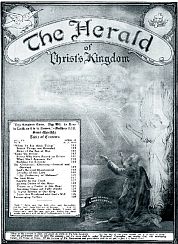
THE HERALD
of Christ's Kingdom
VOL. XVI January 1, 1933 No. 1
Table of Contents
Divine
Solace for the Troubled and Tried
''The
Morning Cometh''
Consolidation
of Pastoral Bible Institute with New York Radio Committee Not Considered Advisable
Half
Hour Meditations on Romans
"WE
THANK THEE"
Walking,
With, God
Encouraging
Letters
VOL. XVI January 1,
1933 No. 1
"FEAR THOU NOT; FOR I AM WITH THEE: BE NOT DISMAYED;
FOR I AM THY GOD: I WILL STRENGTHEN THEE; YEA, I WILL HELP THEE; YEA, I WILL UPHOLD THEE
WITH THE RIGHT HAND OF MY RIGHTEOUSNESS." - Isaiah 41:10.
LONG ago the Lord God caused to be written words of assurance and of sweetest
consolation for the support and strengthening of His faithful children. He well knew that
in this present evil world, with the powers of darkness and of evil in control, those who
would choose the course of loyalty to the Divine will at all hazards, would find
themselves in a difficult and narrow way, with various sore trials and besetments all
along the line. In such circumstances, faithful and obedient children of God have realized
the need for messages of comfort and solace from above, to confirm their faith and to buoy
them up in the midst of their sorrows and distresses.
In no more convincing and assuring manner could the Lord have stated the fact of
His loving care, interest, and protection over His loyal children than in the words at the
head of this article. Surrounded by many adversaries, there would often be the natural
tendency to fear, to be afraid; seemingly overcome and defeated at times, the Lord's
people might easily succumb to discouragement and be dismayed; and in their weariness and
weakness often they would naturally feel their strength was well nigh gone. But this
message so definite and explicit is one of the many precious promises that becomes a
challenge to fear, no matter who the adversaries are-"Fear thou not; for I am with
thee." There is nothing to fear if our Heavenly Father is for us, for none greater or
none His equal could possibly come against us. Nor is there any room for being dismayed or
discouraged, for He is present at all times and in all places, to give the needed succor,
and He will uphold all the faithful with the right hand of His righteousness, and cause
all things to work together for their highest good spiritually and eternally.
Though we live at a time of special advantage over the past, a time of wide
diffusion of knowledge along many lines amongst many of earth's people, yet these facts do
not change the circumstances so far as faithful children of God are concerned, because it
is still the present evil world, with the powers of darkness and of selfishness in the
ascendancy. Indeed, the present days in which we live were long ago declared to be days of
special testing and trial on all true disciples of Christ, and therefore all such today
have much need to exercise great faith and to claim a share in this promise of the Lord,
that He will be with them all the way, and be greater and more powerful than all their
adversaries combined, and will cause His grace and strength to be sufficient for them no
matter how difficult or perilous the circumstances may be through which they will be
called to pass.
Our Year Motto for 1933
In line with the foregoing, from our ' contact with brethren in all quarters of
the earth, particularly through correspondence, there is no doubt that the true children
of God everywhere today are feeling keenly the pressure of the trials and depressing
circumstances of these last times; and realizing that it is as in the past-the faith of
God's children that is on trial and being tested-we are recommending as the motto text for
the new year, 1933, the words of the Prophet Isaiah used at the beginning of this article.
We submit this message in the confidence that it is a most timely word of counsel and of
spiritual advice, and we believe if it is carefully considered daily in the spirit of
prayer and full surrender to God, it will be a source of real comfort and strength to the
consecrated everywhere.
Recalling the words of St. Paul, that it behooved God in bringing many sons to
glory to make the Captain of their salvation perfect through suffering, it is recognized
that followers of Jesus like their Captain are being made perfect through various
experiences of suffering, in which their loyalty to the will of God is being tested. It is
not sufficient that we shall have solemnly declared our purpose to walk in the footsteps
of Christ; God desires that we shall prove our sincerity by obediently carrying out His
will in all the affairs of life. And so it becomes a question daily, What are we willing
to endure for Christ's sake? How fully are we submitted? How deep does our submission go?
Are we wholly in harmony with the will of the Lord? Is our interest merely superficial, or
does it enter fully into our hearts?
The Divine message explains that God puts His faithful children to these tests
because He has called them to a station of high honor and responsibility, and hence He
declares that He will bestow such honors only on the overcomers; and the Apostle assures
us that it is only after we have proved our loyalty to the very last, that we shall
receive the promise-that is, its fulfilment.
Recalling an example of God's providential dealing and supervision in ancient
times we observe the case of job who was very rich and prosperous; God tested him by
taking from him all his family, all his wealth, his health, and even his wife turned
against him. Yet in all this Job did not turn against God. He did indeed express wonder,
but he looked to the Lord in faith and said, "Though worms shall destroy this body,
yet in my flesh shall I see God." I shall yet receive the manifestation of His favor
and learn what He means by these experiences, these afflictions coming upon me.
"Though He slay me, yet will I trust in Him." Surely if those who are now
suffering affliction because of their loyalty to the will of God, because of their trust
in His providential leadings, will take their sufferings and distresses joyfully, they
will without doubt work out good to them-"A far more exceeding and eternal weight of
glory."
Love that Never Grows Cold
Again referring to our text, which emphatically sets forth the promise that God
will strengthen, help, and uphold the faithful with the right hand of His righteousness,
we are assured of the most valuable and precious friendship conceivable-a Friend that
sticketh closer than a brother. Jesus urged upon His followers to lay up treasures in
heaven, and surely chiefest of all such treasures is the personal friendship of God and
the Lord Jesus Himself, "the fairest among ten thousand, and the One altogether
lovely." If we have gained this treasure, we have gained One that never changes, One
whose love never grows cold and from which nothing can separate us "Neither
tribulation, nor distress, nor famine, nor persecution, nor nakedness, nor peril, nor
sword"; for His love and friendship are not like those of this world, which forsake
us in the hour of need. Neither can "death," which often consigns to
forgetfulness the friendships of this life; "nor angels," even with all the
superior charms of their purity and glory; nor the "principalities and powers"
of darkness -that are arrayed against us to separate the betrothed virgin of Christ from
her beloved Bridegroom; nor any of the "things present or to come";
"neither heights" of temporary exaltation, nor "depths" of trouble and
sorrow, "nor any other creature [thing]" in heaven or earth, separates from His
special love, the Lord's elect who have found in Him their chief treasure.
What the new year 1933 holds in store for the Lord's people, none may know, for
"He kindly veils our eyes," but we can be certain that those who are walking
loyally and obediently in the footsteps of the Savior, can know no real disappointment and
can never be dismayed, for He is with them and will uphold them by the right hand of His
righteousness. "Faith can firmly trust Him, come what may."
"The watchman said, The morning cometh, and also the night:
if ye will inquire, inquire ye: return, come." - Isaiah 21:12.
"We are living, we are dwelling,
In a grand and awful time;
In an age on ages telling,
To be living is sublime."
SO WROTE the poet expressing something of those lofty emotions that are deeply stirred
in the hearts of those who in these days humbly and soberly reflect upon the marvelous
changes, circumstances, and events peculiar to our day. Indeed, during the past fifty
years in particular, the signs and evidences have multiplied indicating that we are living
in the close of the reign of evil, that we are drawing near to the great change due to
take place in connection with the, fall of the empire of evil and the rise and
establishment of the Kingdom of God. There is general harmony among prophetic students on
this point. The sum of this matter was briefly and well expressed by Mr. Guinness some
years ago:
"The lapse of six thousand years of history, and the science arising from four
thousand years of astronomical observations, as well as the light afforded by the
fulfillment of nine-tenths of the predictions 'of Scripture as to historical events,
enable 'the wise,' or the godly students of the works and Word of God, to understand in
these days His revealed purposes as regards the times and seasons of the redemption of our
race, as earlier students could not do. To encourage us to such studies we have the
definite promise that 'the wise shall understand' in the time of the end much that was,
for kind and wise purposes, hidden from earlier generations."
Striking Evidence of Declining Days of the Age
As we have seen in our study of chronology and prophecy, especially that contained in
the Book of Daniel and the Apocalypse, nearly all of the prophetic time periods relating
to the reign of evil, have run their course and have reached fulfillment. The great
fourfold metallic image of Nebuchadnezzar's dream and the fourfold beastly empires of
Daniel's vision are substantially in the past. Only the dissolution of the last fragments
remain. In both of these prophetic pictures there are presented the rise, decline, and
fall of the two great overshadowing apostasies that have exercised such a wide influence
in the affairs of mankind during the past sixteen centuries. They are those of
Mohammedanism and the Papacy. In the light of history fulfilling prophecy, it is
discovered that the rise and decline of both of these great systems are now-facts of
history, and in consideration of all that is going on in our day, their complete overthrow
and destruction must surely be matters of but a comparatively brief time. Another
interesting word from Mr. Guinness is to the point here:
"The great week of 'the [seven] times of the Gentiles' is the life -- time
of the fourfold image, and of the four wild-beast empires of Daniel-Babylon, Persia,
Greece, and Rome; the last in its two stages, first Pagan, and secondly Papal. The four
pagan empires did actually, as a matter of fact, last half 'seven times' (lunar), i.e.,
1260 lunar years; and the second half of the great week has been occupied by the rise,
culmination, and decay of the Papal empire of Rome."
No more striking evidence can there be that we are living in the declining days
of the Age than this which is derived from a careful comparison of prophecy and history
together with the progress of events of the present time. No marvel that in connection
with these unusual events and occurrences, devout Bible -students have been led to look
carefully on the testimony of the Bible as it relates to the second visitation of Christ
to this earth, associated in prophecy as that visitation frequently is, with those
stirring scenes that close the dispensation of evil and that introduce the long promised
era of righteousness. And no marvel either, that a careful survey of all the facts has led
to the conclusion that those signs that mark the present as "the last days," are
synonymous with those scenes that mark the Second Presence of Christ and His assumption of
kingly power.
The Jews Overlooked Signs of Jesus' First Advent
While earnest Bible students have realized most interesting results in tracing
various chronological lines bearing upon the last days and our Lord's Second Presence, it
would seem that those events and occurrences in our midst today that meet the prophetic
description of His Presence, should be regarded by far as the most satisfactory basis for
belief in that important event being an accomplished fact.
We are reminded here of how after John the Baptist had been in prison for a time,
he sent messages to Jesus inquiring: "Art thou He that should come, or look we for
another?" The reply that Jesus sent to John contains the very essence of wisdom:
"Go your way and tell John what things ye have seen and heard; how that the blind
see, the lame walk, the lepers are cleansed, the deaf hear, the dead are raised, to the
poor the Gospel is preached." (Luke 7:22.) It is noticeable that Jesus did not
attempt to go into the details of chronology in reply, nor attempt to expound any
prophecies that would locate an exact date when His first presence as the Messiah began.
From one standpoint, it might seem reasonable that He should have done so. He could have
pointed out how the exact date of His presence was indicated in the beginning of the last
or seventieth week of Daniel's prophecy; He could have traced matters further and shown
just when His death and resurrection would occur and that for three and one-half years
subsequent thereto special favor would be extended to the Jews, and that about
thirty-three years later, A.D. 70, the great tribulation would befall Jerusalem and their
city be destroyed: None of these things did the Master attempt to explain. Then what is
the lesson to us? Answer, Jesus cited the outward signs and manifestations represented in
His wonderful works. These He wished John to regard as the evidences of the presence of
Messiah then.
I Have Told You Before
May we not from this draw the general lesson that the Lord would not have us be
so much concerned about exact dates when this or that may occur, nor be curious with
regard to the precise time when His Presence began, nor even concerning the exact moment
when the last members of the Church will pass beyond? And may we not further draw the
conclusion, that in the end of this Age, at the Second Presence of our Lord, He would once
more call our attention to the signs all about us plainly indicating the end of the Age
and the fact of His Presence? Again He said, "Now I have told you before it come to
pass, that, when it is come to pass, ye might believe." (John 14:29.) On this point
Mr. Guinness goes on to say:
"Our blessed Master, when reproving the Jews for not recognizing Him as
their Messiah, blamed them for not understanding the signs o f the times. They wished Him
to give them a sign from Heaven, something wonderful, something supernatural, something
miraculous. He refused and said: 'O ye hypocrites, ye can discern the face of the sky; but
can ye not discern the signs of the times? A wicked and adulterous generation seeketh
after a sign; and there shall no sign be given unto it but the sign of the Prophet Jonas.
And He left them, and departed.'
"Did He object to their wishing for signs? No; for He gave such in abundance
to His disciples and to the multitude, and He appealed to the witness borne by these signs
to His Messiahship. He objected to their refusal to discern the signs that abounded on
every hand in the shape of fulfilled prophecy, chronologic and otherwise, gracious
miracle, and moral and spiritual revelations. He objected to their craving for the
supernatural, the sensational, instead of taking to heart the abounding signs that were
actually present.
"He subsequently gave signs of His Second Advent in glory to His disciples,
and charged them, saying, 'When ye see these things begin to come to pass lift up your
heads; for your redemption draweth nigh.' After His resurrection He upbraided the two
disciples on the road to Emmaus for not believing all that the Prophets had spoken of the
Christ -- His sufferings as well as His glory. It is evident therefore that He wishes His
people to study and comprehend prophecy, and to be alive to every true sign of the
times."
One of the Great Signs
In reply to the great question of the disciples: "What shall be the sign of
Thy Presence?" Jesus stated in the following language what may be regarded as one of
the most if not the most significant sign of His Presence, "And upon the earth
distress of nations, with perplexity; the sea and the waves roaring; men's hearts failing
them for fear, and for looking after those things which are coming on the earth; for the
powers of heaven shall be shaken."
Here Jesus calls attention to what is so generally to be observed on the pages of
prophecy, namely that the present order of things, is to pass away during a time of
general tumult, confusion, and trouble upon the nations of the world, otherwise referred
to symbolically as the day of God's wrath. The deduction seems a most reasonable one, that
our Lord Jesus is to be God's active agent in the administration of these judgments upon
the present order of things just prior to the establishment of His Kingdom. In the Book of
Revelation our Lord is pictured upon a white horse, going forth as a victorious conqueror;
and the results of the conquest are presented-the complete overthrow of the empire of
evil.* (Rev. 19:11-21.) That this is the last great struggle between light and darkness,
truth and error, and that it will result in the complete collapse of evil in every form is
evidenced by the fact that immediately following this great conflict the Revelator, in his
Apocalyptic vision, sees the new Conqueror enthroned and the Kingdom established. (Rev.
20:1-4.) The conclusion of the whole matter is that earth's new Ruler will have been
officially present for a time mustering the hosts of this battle of the great day.
-------------------------------------------------
*See "The Revelation of Jesus Christ," Vol. II.
Looking about us for indications of this prophecy in process of
fulfillment, there is what we believe to be substantial evidence. The unhappy state of the
governments of earth at the present time, surely fulfils before our eyes the Master's
description, "the distress of nations with perplexity." It is true of course
that all along in the past there have been those times when the nations have been in
distress and in perplexity, but there is nothing in the history of the world that could at
all compare with what is in evidence at this time. It has taken the circumstances of the
last days to fulfill this prophecy of Jesus. It is akin to the one by Zephaniah:
"Wait ye upon Me, saith the Lord, until the day I rise up to the prey; for My
determination is to gather the nations, that I may assemble the kingdoms, to pour upon
them Mine indignation, even all My fierce anger; for all the earth shall be devoured with
the fire of My jealousy." - Zeph. 3:8.
The Nations Assembled in Last Days
Another, writing upon this matter, has very ably summed up the above prophecy of
these last days:
"The gathering of the nations in these last days, in fulfillment of the
above prophecy [of Zephaniah] is very notable. Modern discovery and invention have indeed
made the remotest ends of the earth neighbors to each other. Travel, mailing facilities,
the telegraph, the telephone, commerce, the multiplication of books and newspapers, etc.,
have brought all the world to a considerable extent into a community of thought and action
hitherto unknown. This condition of things has already made necessary international laws
and regulations that each of the nations must respect. Their representatives meet in
councils, and each nation has in every other nation its ministers or representatives.
International Exhibitions have also been called forth as results of this neighboring of
nations. There can no more be that exclusiveness on the part of any nation which would bar
every other nation from its ports. The gates of all are necessarily thrown open, and must
remain so; and even the barriers of diverse languages are being easily surmounted.
"The civilized peoples are no longer strangers in any part of the earth.
Their splendid sea equipments carry their business representatives, their political envoys
and their curious pleasure-seekers to the remotest quarters with ease and comfort.
Magnificent railway coaches introduce them to the interior lands, and they return home
laden with information, and with new ideas, and awakened to new projects and enterprises.
Even the dull heathen nations are arousing themselves from the dreams of centuries and
looking with wonder and amazement at their visitors from abroad and learning of their
marvelous achievements. And they in turn are now sending their representatives abroad that
they may profit by their new acquaintances.
"In the days of Solomon it was thought a marvelous thing that the queen of
Sheba should come about five hundred miles to hear the wisdom and behold the grandeur of
Solomon; but now numbers even of the untitled travel over the whole world, a great portion
of which was then unknown, to see its accumulated wealth and to learn of its progress; and
the circuit of the world can now be made with comfort and even luxury in less than eighty
days.
Preparing for Retribution
"Truly, the nations are 'assembled' in a manner not expected, yet in the
only manner in which they could be assembled; namely in common interest and activity; but
alas! not in brotherly love, for selfishness marks every step of this progress. The spirit
of enterprise, of which selfishness is the motive power, has prompted the construction of
the railways, the steamships, the telegraphs, the cables, the telephones; selfishness
regulates the commerce and the international comity, and every other energy and
enterprise, except the preaching of the Gospel and the establishment of benevolent
institutions; and even in these it is to be feared that much that is done is inspired by
motives other than pure love for God and humanity. Selfishness has gathered the nations
and has been steadily preparing them for the predicted, and now fast approaching
retribution-anarchy-which is so graphically described as the 'fire of God's jealousy' or
anger, which is about to consume utterly the present social order-the world that now is.
(2 Pet. 3:7.) Yet this is only speaking from the human standpoint; for the Prophet
ascribes-this gathering of the nations to God. But both are true; for while man is
permitted the exercise of his free agency, God, by His overruling providence, is shaping
human affairs for the accomplishment of His own wise purposes. And therefore, while men
and their works and ways are the agents and agencies, God is the great Commander who now
gathers the nations and assembles the kingdoms from one end of the earth to the other,
preparatory to the transfer of earth's dominion to Him 'whose right it
is.'-Immanuel."
Men's Hearts Failing Them
This gathering of the nations referred to by Zephaniah and the distress of
nations which Jesus indicated to be one of the signs of His presence have come about
simultaneously; the distress being more or less a result of the gathering. Increase of
knowledge combined with selfishness has brought about this great distress of the nations
in modern times. Financial, social, and political troubles are greatly distressing every
nation of the earth, and as they are assembled together and their interests more or less
commingle and interlock, what affects one great nation in these times affects the other.
The result is great and many international disorders and complications, which, as the
public press reveals, are baffling the skill and wisdom of the world's wisest statesmen.
Hence the fulfillment of Jesus' words: "Men's hearts failing them for fear, and for
looking after those things which are coming on the earth."
Almost any day one may read the words of some prominent editor or statesman
expressing his apprehension and fear at what appears imminent on the world's horizon
today. Not long since, Mr. David Lloyd George, wartime Prime Minister, said in an address
before the International Peace Society: "There are more quarrels among the nations of
the world now than any one can recall in human history. There are quarrels going on now in
Europe which may end in war unless there is a greater courage determination and readiness
to take risks on the part of rulers than I can see among those in command. The worst of it
is, disarmament has been left to the pacifists and peace has been left to the
militarists."
Again, Mr. Montagu Norman, Governor of the Bank of England, made one of his rare
public appearances, and in the course of his speech said, "I -wonder if any one in
the world can really direct the affairs of the world or of this country with any assurance
as to what result his action will have.
"In spite of every attempt that has been made-mostly in isolation to a large
extent-the vast forces of the world, the herd instinct, the desperation of the people who
have neither work nor market, have brought about a series of events and a general tendency
which appear to me at the present time to be outside the control of any man, of any
government, of any country.
"I believe that if every country and every Government could look together
and act together it would be different.
"But that we do not seem to be able to get, and therefore I am driven to the
conclusion that we must take for the moment a short view, but we must plan long.
"For most of us, 'One step enough for me.' This is as far as, on the whole,
I can see. The difficulties are so vast, the forces so unlimited, so novel; precedents are
so lacking that I approach this whole subject not only in ignorance, but in humility. It
is too great for me. I am willing to do my best."
Fulfilled in these Days
Jesus spoke of the "sea and the waves roaring" in connection with this
sign, and Brother Russell has well oh, served in this connection that the language is of
course symbolical and surely relates to "the restless masses of humanity, curbed, but
not fully restrained, by the laws and regulations of society. Every one has heard
something of this 'roaring' for the past twenty years, with occasional stormy outbreaks
dashing like tidal-waves against the earth (social order) and seeking to swallow it up.
Restrained for a time, these waves are gathering weight and force; and, as prophetically
'shown, it is only a question of a few years until all the mountains (kingdoms) are
'removed and carried into the midst of the sea,' in anarchy. - Psa. 46:1,2. . . .
"And it is as men begin to realize that the sea-roar and unrest is due
largely to the wane of superstition and of ecclesiastical influence, and as they more and
more see the powers of heaven (sectarian creeds and systems) shaken, that their hearts are
failing them for fear -- in apprehension of the things coming upon the earth (society);
but the strenuous efforts now being made to reestablish and unify sectarian power and
influence, will be in great measure successful only for a short time; for it will surely
disintegrate completely."
At our Lord's First Advent He said to His faithful disciples-true Israelites
indeed, "Blessed are your eyes for they see; and your ears for they hear; for verily
I say unto you that many prophets and righteous men have desired to see those things which
ye see, and have not seen them; and to hear those things which ye hear, and have not heard
them." (Matt. 13:17.) Even so now as we approach very nearly to the end of the
dominion of evil, the eyes and ears of saints may see and hear marvelous things that have
been looked forward to for ages; and once more we should hear that same blessed Master
saying, "Blessed are your eyes for they see, and your ears for they hear." As a
result of this seeing and hearing, these faithful watchers now recognize that the Kingdom
of God is at the door in the final sense-in power and great glory, and all creation is
soon to be delivered from the slavery of sin and death. To the watchers themselves the
Savior says, "Lift up your heads and rejoice, for your deliverance draweth
nigh"; and all such whose eyes are anointed answer back with the beloved John,
"Even so, come, Lord Jesus."
Our Special Offer of the Exposition of the Revelation and the Prophecies of
Daniel
In the issue of this journal of May 15, 1932, there appeared an article under the
caption, "The Church's Inheritance in the Apocalypse," which gave a general
review of the Apocalypse and the Prophecy of Daniel; and their importance to the Church
especially at the present time was considered. In that connection attention was called to
the two volumes containing the exposition of the Apocalypse, of 1200 pages, and the volume
of the Book of Daniel, of about 500 pages, that had been for some time supplied by our
Institute; and we stated at that time that the price of these volumes would hereafter be
90 cents per copy postpaid.
The response from the publication of that article has been most gratifying; a
goodly number of the friends sent to us for the volumes at once. Still others while
expressing their deep interest in these expositions, stated that their circumstances would
not permit them to possess the volumes. This has led to a fresh consideration of what
additional steps might be taken to make it possible for a still larger number of the
brethren to have these volumes in their possession. The results of this consideration are
that arrangements have been made to reduce the price still further, namely that the two
volumes of "The Revelation of Jesus Christ" may now be had for 75 cents each, or
$1.50 for the set; and the volume, "Daniel the Beloved of Jehovah" for 75 cents
per copy. It is our hope that this arrangement will bring the price within reach of all,
and we trust that many more of the friends will in the near future avail themselves of the
privilege of these expositions and be permitted at this time to enjoy with others the
study of. these very important portions of the Divine revelation.
IN VIEW of the resolution adopted at the recent convention in Pittsburgh,
it would appear to be necessary for us to state our views on the proposition, which as
briefly as possible, we submit hereunder.
It will be recalled that the resolution referred to read, in part, as follows:
"Resolved, that in our opinion the work of the two service agencies referred
to (namely the Pastoral Bible Institute and the New York Radio Committee) might well be
consolidated in the interests of Christian unity, economy and efficiency; and that in any
case their respective activities should be carries on with the highest degree of mutual
cordiality and brotherly cooperation, and me it further
"Resolved, that we urge the Pastoral Bible Institute and the Associated
Bible Students Radio Committee to arrange a Conference or Conferences of their accredited
representatives at the earliest possible date to consider the ways and means to contribute
to and accomplish these highly desirable objectives."
Consolidation
In harmony with the suggestion of the last paragraph, an informal conference was held
on the evening of November 25th, 1932, at which Brothers H. E. Hollister, I. F. Hoskins,
Margeson, P. L. Read, and W. N. Woodworth, were present. While the meeting was not
official but quite informal, we believe all will agree that it was representative of the
two organizations. Our readers will be interested in learning that at this conference
which lasted perhaps four hours, during which the fullest opportunity for exchange of
viewpoint was afforded each of the brethren present, the conclusion was unanimous that the
consolidation recommended in the Pittsburgh Resolution would not be in the best interests
of the friends at this time, a conclusion which is shared by all the members of the
present Board of Directors of the Pastoral Bible Institute, without exception.
Realizing that this conclusion may prove disappointing to some, we take this
opportunity of again pointing out to our members that we have no desire to retain office
except at the wish of the majority, and that those who believe our decision is unwise have
every right to nominate and elect other brethren to serve as directors in our stead. In
agreement with our past custom, we shall call the attention of the brethren again, very
pointedly to this privilege and responsibility, in plenty of time for them to exercise
same at the next annual meeting due to be held June 4, 1933.
Cooperation
In regard to the question of "cooperation" we are happy to advise that
our viewpoint is unchanged from that which we have consistently held throughout the
history of our movement. This Institute is glad to cooperate with the New York Ecclesia
and its Radio Committee in the same manner and to the same extent as with any other
ecclesia, whenever such cooperation is desired.
Cordiality
We cannot, of course, regulate the degree of cordiality which may or may not be
manifested between the members of the two organizations, as that is a matter which in its
very nature is dependent on the maturity of Christian growth, and possession of the Holy
Spirit of the Master. We shall, indeed, seek to be more and more on our guard to promote
this growth both in ourselves and in others, and wherein we lack in this respect, make
earnest application to the Fount of all grace to supply our need. But, cordiality, from
the Christian standpoint, is very much akin to Christian fellowship, and concerning that
important quality, perhaps we cannot do better than quote from an article which appeared
in this journal September 1, 1931. We quote:
"Sometimes we hear the expression: 'May we have fellowship with thus and so?' Or
'Do you think we ought to have fellowship with so and so?' To a Christian of experience,
such questions indicate that those who ask then do not full understand what the word
fellowship means Let us suppose the reply were 'Yes, you may have fellowship with thus and
so,' would that reply bring fellowship into 'existence where before there was none? Or
suppose the reply were, 'No, you ought not to have fellowship with so and so,' would that
reply hinder in any way a fellowship which really existed? Fellowship is an effect, not a
cause; a condition, not a theory; a condition which either exists or does not exist, and
which no amount of discussion can bring about or can hinder. We see this everywhere
exemplified in nature. Birds of a feather do not go into a conference as to whether or not
they shall flock together, but by nature they actually do so. A man who is of a generous
mind never, under any circumstances, seeks out the fellowship of a miser. The humble man
never by any chance longs after or seeks an intimate acquaintance with one that is proud
of heart. It is just one of those things that do not happen. If a magnet is passed over a
heap in which are both steel filings and saw dust, the 'fellowship' shall we say, or the
affinity which exists between the steel filings and magnet manifests itself, and the
absence of such fellowship or affinity between the saw dust and the magnet is also
manifest. Jesus said 'Wheresoever the carcass is there will the eagles be gathered
together,' and as a natural corollary it follows that wheresoever the carcass is not,
there the eagles will not gather."
Conclusion
In conclusion we earnestly urge on the brethren everywhere not under any circumstances
to allow the question of support of our Institute or of that of any other organization or
movement to hinder in any way the free flow of Christian love and fellowship between
brethren whose "Hopes are built on nothing less than Jesus' blood and
righteousness." Whether or not they engage in the same outward activities, so long as
the same spirit is possessed of love for the Lord, the truth and the brethren, and the
same desire to do good unto all men as opportunity presents itself, let this suffice to
answer all questions of fellowship, and what we here commend to all, we, ourselves, shall
earnestly strive to practice. Brethren pray for us. The Lord be with you all. Amen.
"We would see Jesus! for the shadows lengthen
Across this little landscape of our life
We would see Jesus! our weak faith to strengthen
For the last weariness, the final strife!
"We would see Jesus-the great Rock Foundation
Whereon our feet were set by sovereign grace;
Not life nor death, with all their agitation
Can thence remove us, if we see His face."
No. 33
"Christ Jesus, whom God set forth to be propitiatory,
through faith, in His blood, to show His righteousness because of the passing over of the
sins done aforetime, in the forbearance of God; for the showing, I say, of His
righteousness at this present season; that He might Himself be just, and the justifier of
him that hath faith in Jesus." - Rom. 3:25, 26. R. V. (Margin).
IN THIS half-hour we continue our study of these two most instructive and
devotion-producing verses. In our last Meditation we noted that on the one condition of
faith God's free gift of righteousness, both imputed and imparted, was made possible by
the atonement sacrifice of Christ. Here this at-one-ment sacrifice is shown to have both
an immediate and an ultimate object.
The Immediate Object of Christ's Atonement Sacrifice
When God set forth, or established beforehand, Christ Jesus to be propitiatory, by His
blood, through faith, His immediate object, the Apostle here informs us, was "to show
His righteousness because o f the passing over o f the sins done aforetime." The
meaning of this statement is obscured in the Authorized Version where it is rendered
"for the remission of sins that are past." Scholars tell us that the word is not
aphesis (remission) but paresis (passing over, or praetermission). As one of them remarks:
"The sins of former times were neither forgiven nor punished; they were simply passed
over; and for this reason there was need for a vindication of the righteousness of God. .
. . This signal manifestation of God's righteousness (in setting forth Christ to be a
propitiation, through faith, by His blood) was vouchsafed, not because the sins of the
past were forgiven, but because they were only overlooked for the time being without being
forgiven. . . It was because the sins had been passed over, and had not been forgiven,
that the exhibition of God's righteousness . . . was necessary."
A somewhat related expression appears in Acts 14:16, where Paul speaks of the living
God, "Who in times past suffered all nations to walk in their own ways"; and
again, in Acts 17:30, where the Apostle tells us that "The times of ignorance God
winked at" ("overlooked" R. V.). In the words of another: "For four
thousand years the spectacle presented by mankind to the whole moral universe was, so to
speak, a continual scandal. With the exception of some great examples of judgments, Divine
righteousness seemed to be asleep; one might even have asked if it existed. Men sinned
here below, and yet they lived. They sinned on, and yet reached in safety a hoary old age!
Where were the wages of sin? It was this relative impunity which rendered a solemn
manifestation of righteousness necessary."
To Declare His Righteousness
Obviously the word "righteousness in this passage, denotes not a gift from God to
man, but an attribute of God Himself, an attribute, which, long veiled, was put in the
light of day by the death of Jesus. By God's righteousness we understand the Apostle to
mean here God's retributive justice-that "mode of action whereby. He maintains the
right of every being, and consequently order throughout the whole moral universe, blessing
him who has respect to this order, visiting with punishment him who violates it." Now
"the attribute of righteousness, eternally latent in holiness, passed into the active
state with the first appearance of the free creature. For in the fact of freedom there was
included the possibility of disorder, and this possibility soon passed into reality.'
God's horror at evil, His holiness, thus displays itself in the form of righteousness
preserving order and maintaining right. Now to maintain order without suppressing liberty
there is but one means, and that is punishment. Punishment is order in disorder. It is the
revelation of disorder to the sinner's conscience by means of suffering. It is
consequently, or at least may be, the point of departure for the re-establishment of
order, of the normal relation of free beings." Now in the passage under consideration
the Apostle is explaining that "God judged it necessary, on account of the impunity
so long enjoyed by those myriads of sinners who succeeded one another on the earth, at
length to manifest His righteousness by a striking act; and He did so by realizing in the
death of Jesus the punishment which each of those sinners would have deserved to
undergo."
How did the Sacrifice of Jesus Manifest God's Righteousness?
But it may be asked: In what sense can the death of Jesus be said to manifest or
demonstrate the righteousness of God? Moreover they are not always railing infidels but
frequently sincere Christians who are puzzled on this question. Surely, the latter reason,
our sense of right and wrong, our consciences, are from God; -- how then, in all good
conscience, we ask, are we to understand as righteous something which seems to offend our
sense of right? How can the punishment of the innocent in the stead of the guilty be
considered a righteous act, much less serve to vindicate God in His failure to adequately
punish sins committed throughout the previous forty centuries? Do we not have here in a
matter of tremendous importance, an instance of that injustice, (we speak as men), which
in smaller matters would at once provoke our indignation?
It is not sufficient to reply to such honest inquirers: Your doubts and questionings of
this central theme of the Scriptures border on blasphemy! Such puzzled ones may have as
deep a reverence for God and as great a longing after righteousness as those who hide
their own lack of understanding by such unenlightening response. Their doubts and
questionings are not against God's righteousness, in which they have every confidence, but
their conscience rebels at the false reasoning and philosophy which for centuries has
permeated and falsified the true teaching concerning the ransom sacrifice of Christ. The
idea of injustice has been introduced into the doctrine of the Atonement, and it is this
that has occasioned their difficulty.
There is a story told that when Edward the Sixth was a young prince, and deserved for
his misdeeds to be punished, another boy was taken and whipped in his place. He was guilty
of idleness, another was required to suffer the consequences; he neglected his tasks,
another was chastised; he played the truant, another was required to smart for it. This
monstrously unjust transaction has been taken by Christian teachers as an illustration of
the Atonement; and it is truly an illustration of the Atonement as they misconceived it.
But the misconception is gratuitous; there is no real resemblance in the case presented.
The case is most decidedly not in point, but since the story has been so often told, it
might be well to make it in point, and then to consider whether it presents itself in any
aspect so monstrous and absurd. To make it in point, the parts played in the story by the
young prince and the other boy must first be reversed. It is the young prince who suffers
for his humbler truant companions, not one of them for him. He does it too, not of
constraint or compulsion, but of his own free will only such an act as this would overcome
their perversity, their wrong mindedness and conduct; moreover he offers himself to this
chastisement, knowing that nothing else would overcome it, and knowing, blessed be God,
that this would be effectual to do so. What is represented in the New Testament to us is
not that Jesus Christ, an innocent person, was punished, without reference to His own
will, by a God who thus showed Himself indifferent as to whom He punished so long as some
one suffered. But He, being one in purpose and spirit with the Father, being indeed- the
worthy Son of such a Father, and in harmony with the Father's heart of love, o f His own
will became man and suffered what the sin of the world laid upon Him, in order that He
might lift the world out of sin. With this in view, His submission to the punishment of
their faults and negligences and shortcomings might seem strange, even as all acts of
condescending self-offering love seem strange in a world of selfishness and pride; but
surely there would be nothing in it that should offend our sense of right. Voluntary
self-sacrifice for others is at least not to be described as injustice. At least we
rejoice that God accepts such self-sacrifice. It is to vicarious self-sacrifice like our
Lord's that the human race owes the greater part of whatever moral progress it has
hitherto made.
The Principle of Vicarious Sacrifice not Unjust
"Vicarious suffering, it is strange to hear the mighty uproar which is made about
it;-when indeed in lower forms-not low in themselves, though low as compared with the
highest-it is everywhere, where love is at all. For indeed is not this, one freely taking
on himself the consequences of others' faults, and thus averting from those at least in
part the penalties of the same, building what others have thrown down, gathering what
others have scattered, bearing the burdens which others have wrapped together, healing the
wounds which others have inflicted, paying the things which he never took, smarting for
sins which he never committed; is not this, I say, the law and condition of all highest
nobleness in the world? -- is it not that which God is continually demanding of His elect,
they approving themselves His elect, as they do not shrink from this demand, as they
freely own themselves debtors of love to the last penny of the requirements which it
makes? And if these things are so, shall we question the right of God Himself to display
this nobleness which He demands of His creatures? Shall we wish to rob Him of the
opportunity, or think to honor Him who is highest love, by denying Him the right to
display it?"
Which do You Seek? Righteousness? or Exemption from Punishment?
"To a Jew, and to almost all races when -St. Paul wrote, the idea of an expiatory
sacrifice for sin seemed natural and obvious. But for the special Christian doctrine of
expiation the basis is to be found in the memorable chapter 53 of Isaiah. That great
Prophet of the captivity is assuring Israel of their restoration to their own land. This
restoration is to follow on the due punishment of her sins-'She hath received of the
Lord's hands double for all her sins.' And the restored people is to be, before all else,
a righteous people-'all righteous'-a people of God's favor, because they are living
according to God. But there is so much sin still remaining in them as to make it necessary
that the new life o f the recovered people should be based on a great act of propitiation.
The Righteous Servant . . . offers His life a willing sacrifice for their sins., The
chastisement of their iniquities falls on him, and he accepts the burden, and is obedient
unto death. Dying He makes His soul a guilt offering and, living through death exalted and
powerful, He becomes an intercessor accepted with God, the head of a new seed whom He
'justifies' before God by the intimate knowledge of God's mind and character which in His
voluntary humiliation He has won. This wonderful prophetic picture represents a vast
advance in moral teaching on what had gone before. It is not only that the self-sacrifice
of a perfect human will is substituted for the animal victims to which the enlightened
conscience of God's people already refused to allow any real efficacy; but also that the
idea of propitiation is put in a context where it is made plain that it can be only the
prelude to a state o f actual righteousness in those who are to be justified by it. It
occurs as part of the answer to the question, not-How is Israel to escape punishment? but,
How is Israel to become the really righteous nation, living in the likeness of God? . . .
"All conceptions of propitiation may be distinguished into true or false according
as righteousness or exemption from punishment is the end which is specially in view.
The Immoral Notion of Caiaphas
"Thus when we pass on into the New Testament we find in Caiaphas' saying,
'It is expedient for you that one man should die for the people, and that the whole nation
perish not,' the typical expression of the quite immoral notion* of the forcible sacrifice
of an innocent person in order to exempt a guilty race from punishment. In our Lord's
teaching, on the other hand, we find the doctrine of atonement raised to its highest moral
power. As the Forerunner had revived the teaching of Isaiah by pointing to Him as the
'Lamb of God who taketh away' (i.e. taketh up and expiateth) the sin of the world, so
Christ Himself spoke of the covenant which He came to inaugurate, as to be based upon the
sacrificial offering of His body and the outpouring of His blood; spoke also of the
'remission of sins' as the benefit to be expected from His expiation." The ransom
sacrifice of Christ, His, "sacrifice of propitiation, to which we contribute nothing,
and in which we do not share, remains a necessary prelude to the establishment of the new
life. It is in virtue of this that we are justified and accepted and allowed to start
afresh." "But no teacher in the world ever made it so plain that God can be
satisfied with nothing that any other can do for us-with nothing but actual likeness to
Him in ourselves. No teacher ever made it so plain that what we are to desire is not to be
let off punishment, but to be actually freed from sin: He left no room for doubting that
only by following His steps, even to the cross, and surrender of our lives, can we share
His fellowship."
--------------------------------------------
*None the less immoral as Caiaphas intended it, because, as St. John - perceives, a
Divine truth uttered itself through his lips. - John 11:51.
God's Righteousness Doubly Manifested by the Sacrifice of Christ
In the light of the foregoing discussion we are prepared to answer the question
previously propounded: "In what sense can the death of Christ be said to demonstrate
the righteousness of God?" To that question we reply: In two ways, so closely
connected that either of them separated from the other would lose its value. First, in the
very fact of His death, and second in the mental attitude which Christ maintained
throughout this ordeal.
In the death of Christ, the Just for the unjust, God is revealed as One against
whom no creature can revolt without meriting death. This demonstration, however, striking
though it was, would have been incomplete without the moral manifestation which
accompanied it-the mental attitude maintained throughout by our Lord. Instead of realizing
in the death of Jesus the punishment deserved by us, God might have permitted us to endure
our own punishment. But had He done so, how many of us would have undergone it, as Jesus
did, accepting it as deserved? This is what He alone could do, by virtue of His holiness.
("O, righteous Father, the world hath not known Thee."-John 17:25). "The
calm and mute resignation with which He allowed Himself to be led to the slaughter
manifested the idea which He Himself had formed of the majesty of God and the judgment He
was passing on the sin of the world; from His cross there rose the most perfect homage
rendered to the righteousness of God. In this death the sin of mankind was therefore
doubly judged, and the righteousness of God doubly manifested-by the external fact of this
painful and ignominious punishment, and by the inward act of Christ's conscience, which
ratified this dealing of which sin was the object in His person."
It Satisfies Our Longings as Nothing Else Can Do
If the doctrine of atonement has involved intellectual difficulty, because of the
false views with which its clear light has been obscured, "on the other hand it has
proved itself, as the popular Christian literature of all ages sufficiently shows, widely
and deeply welcome to the human heart. This wide welcome which it has received shows that
it contains a deep truth. And from this point of view, from the point o f view o f our
practical spiritual needs, we do well to meditate much and deeply upon this doctrine. We
can depend upon it, that if we are to go on patiently doing good, in a world like this, so
full of disappointments and anxieties and moral failures and torturing scruples, we must
have peace at the heart. And this is what the really evangelical doctrine is capable of
giving us. It bids us continually look out of ourselves up to God, and assures us that His
love, manifested in the sacrifice of His Son, is there continually, unchangeably. It is
there, waiting till first we turn to Him, to give us the assurance of entire absolution
and admission into the Divine fellowship, wholly irrespective of what we have been or
done; and it is there continually, however often we fall, with the same large and liberal
hand to pour out continual forgivenesses, and never wearies of restoring us again and
again to the solid foundation of the peace and grace which are by Jesus Christ. We are not
meant to be miserably anxious or morbidly introspective. We must confess our sins, and
that with exactness, without self-sparing, without self-excusing, in utter humility and
truth; but 'if we confess our sins, he is faithful and just to forgive us our sins, and to
cleanse us from all unrighteousness."'
Behold the Lamb of God
And if perchance this page should meet the eye of one who has not yet learned to
look by faith on Him, the "Lamb of God, that taketh away the sin of the world,"
let it here be said that you may find your peace, nay, you will find it, when you turn to
Him. "You will carry, it may be, the scars of those wounds which you have inflicted
upon yourself to your grave; but the wounds themselves He can heal them, and heal them
altogether. He can give you back the years the cankerworm has eaten, the peace which your
sin had chased away, and, as it seemed to you, for ever. He can do so, and will. 'Purge me
with hyssop, and I shall be clean, wash me, and I shall be whiter than snow'-this will be
then your prayer, and this your prayer shall be fulfilled. The blood of sprinkling will
purge, and you will feel yourself clean. Your sin will no longer be yourself; you will be
able to look upon it as separated from you, as laid upon another, upon One so strong that
He did but for a moment stagger under the weight of a world's sin, and then so bore, that
bearing He has borne it away forever."
"We thank Thee, O Father of all, for the power
Of aiding each other in life's darkest hour;
The generous heart and the bountiful hand,
And all the soul help that sad souls understand.
"We thank thee, O Father, for days yet to be
For hopes that our future will call us to Thee;
That all our eternity form, through Thy love,
One Thanksgiving Day in the mansions above."
"Whoso looketh into the perfect law of liberty, and
continueth therein, he being not a forgetful hearer, but a doer of the work, this man
shall be blessed in his deed." - James 1:25.
A PROPER adjustment of the mind toward God, properly thinking of Him, and a true
appraisal of His favors, especially the great favor of His approval and of eternal life,
is most needful in the very beginning and throughout the entire experience of every
Christian life. Such a proper regulation of the soul in relationship to God is
accomplished only by the aid of the Holy Spirit; and this power is given to those only who
obediently surrender themselves in consecration to do His will. The true and earnest
seeker after God soon learns from the Divine Message that the thoughts, the meditations of
the heart must be properly centered upon the Lord and upon those things that appertain to
Him and the securing of His everlasting approval. Such also soon learn that in order to
succeed in stemming the tide of evil in the world, the flesh and the Evil One, and in
order to make progress in the life of piety and to advance in Divine favor, one must live
a life of close touch and communion with God. Thus the individual who is earnestly
desirous of the Divine blessing is, admonished to "draw nigh to God" and is
assured that God will draw nigh to him in return.
Life Eternal to Know God
Of all the high and distinctive favors enjoyed by the children of God, none is
greater than that of the privilege of dwelling in His presence and of holding communion
with Him. Indeed, the exercise of this exalted privilege is most vital and necessary to
spiritual health and to the preservation of a proper and holy relationship with God.
"This is life eternal," said Jesus, to "know Thee and Jesus Christ whom
Thou hast sent." The entering of sin into the world in the beginning of human history
interrupted and took away the privilege of personal fellowship with God. A measure of that
favor and fellowship however, was accorded certain servants of God in ancient times, in
view of the great redemptive program that was then in prospect; but since the advent of
the Son of God, a proper acceptance of the redemption through Christ fully restores the
privilege of entering God's presence and of holding communion with Him. Faith and
obedience on the part of the penitent effects the lifting of the condemnation and the
establishing of the state of peace with God: "There is, therefore, now no
condemnation to them which are in Christ Jesus, who walk not after the flesh, but after
the Spirit." Such a one thus in right relationship with God is in a position to think
of. Him intelligently and acceptably. Revelations of knowledge are given in order to
facilitate the work of grace and help the devout believer to think of God as he should and
to assist him to approach very close to the heart of the great Eternal. It must be
recognized that at least a measure of knowledge and intelligent conception of God 'are
necessary in order to a consciousness of that sacred presence. Our thoughts of God growing
out of His revelation to us, form the basis of our communion with Him and indeed the
foundation of the life of fellowship and prayer. .
It is in connection with the exercise of this privilege of communion with God, of
approaching very near to Him, that multitudes have experienced much difficulty.
Insufficiency of faith, failure to believe fully would seem to be at the bottom of their
trouble. They seem to fail to realize the depth of mercy and compassion that are in store
for all those who properly apply for them. The truth is that they seem not to know the
Lord sufficiently; they think of Him as moved by like passions with themselves, more or
less controlled by animosity. It is an evidence of growth in grace when we come to that
place in our experience where, admitting our guilt and unworthiness of Divine favor we
have, nevertheless, become so intimately acquainted with the Lord as to have a full
assurance of faith in His declaration that our sins are forgiven. It is probably to such a
development of grace that the Lord Jesus refers when He said, "This is life eternal,
that they might know Thee."
Influence of Thought upon the Character
But such a knowledge is not to be obtained instantaneously, but rather, is to be
the result of a growth in grace; one grows in grace as he grows in knowledge, and
reversely, he grows in knowledge as he grows in grace; the two keeping pace the one with
the other as do our feet in walking. It is because many who have named the name of Christ
do not grow in grace and knowledge that they fail to attain that grand condition of which
the Apostle speaks as "full assurance of faith"-full confidence in the Lord, in
His goodness, in His wisdom, in His love, in His providential care over all their affairs.
And the lack of such growth is owing to their failure to obediently offer sacrifice unto
the Lord-to commit all their ways to Him. Evidently such do not give themselves over
sufficiently to a contemplation of the things of the Spirit of God. The Divine will is not
as earnestly and reverently studied as it should be.'
It would seem that St. James was speaking from this standpoint when he tells us
that the one who looks into the perfect law of liberty and continues therein as a doer of
the work, who obediently performs what he sees to be God's will, shall be blessed in his
deed. How manifest it is that we are to think of God and earnestly contemplate His
messages in order that we may understand what He would have us do, and how He would have
us live. An eminent writer who has evidently thought clearly and well upon this subject
makes the following interesting statement
"Now what the Apostle means is clear, and what he here urges upon us is that
very duty, to the neglect of which more than anything else is due the shallowness and
imperfection of our lives. He means that a man's nature is insensibly but inevitably
molded by that which is in his thoughts, and that the lives, even of Christians, are often
earthly and sensual because their thoughts are not with things above. Tell me about what
you think most frequently and most earnestly, and I will tell you what you are. For your
thoughts are the invisible influences which give its complexion to your life, even as the
insect is colored by the leaf on which it feeds. 'Abeunt studia in mores.' What a man
desires to be, that he will be. If his thoughts are ever of sin he will be possessed of
sin, he will be the slave, of sin; but if his thoughts are ever of God. and the things of
God then 'with open face, beholding, as in a glass, the glory of the Lord, he will be
changed into the same image from glory to glory.'
"If, then, you would live good or worthy lives, you must not only not suffer
your thoughts to become guilty thoughts, but you must not even allow them to be vacant
thoughts. You must fill them with all things true, pure, honorable, lovely, of good
report. How can we best do this? Best by forgetting ourselves, best by obliterating our
own selfish will and pleasure, best by thinking wholly of others and of God; for in the
true life there are three factors-God, the soul and our fellow men; and our duty to
ourselves, our duty to our own souls is best summed up in our duty to God and our duty to
our fellow men."
The Power of Holy Fellowship
It would seem that all could give hearty assent to the foregoing observations.
And when the Wise Man admonished "Keep thy heart with all diligence; for out of it
are the issues of life," he is telling us to guard carefully the thoughts of our
hearts; to watch our meditations; to carefully consider what motives and purposes control
and guide us in the course we are pursuing in life. Thoughts about God and contemplations
of His character and the great qualities thereof cannot but have an elevating effect upon
every soul that is really consecrated to Him. The same writer goes on to say further:
"Very few of us, I fear-very few even of the best of us-think enough of God.
That He is our Creator, Preserver, Redeemer, that He has the sole and absolute claim upon
our love and obedience we all know; but Oh! if we all knew this in a true and living
sense, how different our lives might be. By not thinking of it often enough, or deeply
enough, how mighty a safeguard do we lose! 'Hear these three things,' said a Jewish Rabbi,
'and thou shalt eschew transgression: the All-seeing eye, and the All hearing ear, and
that all thy actions are written in a book.' How many a life has been kept humble, and
happy, and pure, and sweet, by the living realization of that one truth, 'Thou, God, seest
me.' You know how you 'are affected and made better in all your hearts, by the mere
presence of some one to whom you can look up to as good and true. You know that there are
some even among your fellows so upright, so innocent, so single-hearted, that to be with
them is to breathe a holier and more wholesome atmosphere. Their influence, something
which seems to emanate from them and flow in upon your hearts, surrounds you with the air
of heaven as with the perfume from the waving of angels' wings. Their Divine superiority
to all that is impure or sordid seems to run liquid through your soul, so that you feel
that, could you always be with them, you, too, would grow like them. But these, alas! are
rare in this world, nor can you often be with them; nor even, were this possible, could
they save your souls, or pay ,your debt to God. No; but there is a Presence which not only
may be always near you, but which you cannot escape; there is a Love always over you,
which you may reject, but cannot alienate; there is -a Friend always with you, who, even
in your loneliest moments, leaves you not alone. He is a Friend living and true; nor is He
weak as we are, nor is He, as we are, ignorant of all the secrets of your hearts. That
Presence, that Love, that Friend is God in Christ. Oh that you would all cling to His
hand! Oh that now and ever you would listen to His voice! What would I not give to impress
upon you, as I feel it, that life without God is not life, but death; so impress it upon
you, by the aid of God's Holy Spirit, that every one who hears me might feel, for all his
after days, 'Much that I learned I have forgotten: by much that I might have learned I
never profited; but this, at least, I did learn, and this lesson, I trust, has so
permeated my soul, so interpenetrated my whole being, that I cannot forget it if I would,
that life without God is life without joy, without peace, without happiness, without hope;
and that if I would live a life which shall come to anything a life which shall not be
cast as rubbish in the void, when God has made the pile complete-then I ought daily to
offer unto God myself, my soul and body, 'a reasonable, holy, and lively sacrifice."'
Feeding upon the Words of God
But from whence cometh those aspirations and impulses toward God, His service,
and fellowship? The answer is, from a sober and reverent contemplation of the Divine
messages of truth and grace, a contemplation of those truths that reveal the Heavenly
Father to us, His greatness, His majesty, His loving kindness. Jesus said, "Man shall
not live by bread alone, but by every word that proceedeth out of the mouth of God."
The words that come from God are words of life in the sense that they explain to us His
way, His will, and how eternal life may be secured. The words that proceed out of the
mouth of God are words of life too, in the sense that they give light to the soul, in the
sense that they impart faith and strengthen and nourish that love and affection for God
that impels to obedient service and that prompts one to daily bring all the life,
thoughts, words, and doings into full conformity to the will and good pleasure of God.
Those who thus feed upon the Word of God, the manna from heaven, and whose souls
are nourished thereby, are prepared for the journey of life. In this journey or pilgrimage
toward the city of God, the heavenly inheritance, the traveler may truly be said ' to be
walking with God. When St. Paul states that we as Christians "walk by faith and not
by sight, and when he admonishes that we ''walk as children of light," he is
referring to this mystical walk or journey in which we are assured of God's presence and
company all the way.
Walking with God
We find this thought of journeying together and walking with God, suggested in
the Old Testament records with regard to certain faithful and devout servants of God,
though they possessed much less information and knowledge of God than His children do
today. Significant and full of meaning are the words of the sacred record, that Enoch, the
seventh from Adam, exercised great faith in God and was translated that he should not see
death, because -"he walked with God." In other words, his faith in God was such
that his thoughts, purposes and activities of life were distinctly separate and of a
different character from everything that he saw around him. And so must it ever be with
the soul that would really enjoy God's communion and fellowship. "Be not conformed to
this world," says St. Paul, "but be ye transformed by the renewing of your
mind," by the heavenly aspirations and impulses, by the contemplation of those things
that give strength and power to faith and enable the believer to rise to exalted
conceptions and appreciation of God and unity with Him. Another has very ably commented
upon the record of Enoch's faithfulness to God:
"To walk with God must, necessarily, put one outside the sphere of this
world's thoughts. Enoch realized this; for, in his day, the spirit of the world was
manifested; and then, too, as now, it was opposed to all that was of God. The man of faith
felt he had naught to do with the world, save to be a patient witness therein of the grace
of God and of coming judgment. The sons of Cain might spend their energies in the vain
attempt to improve a cursed world but Enoch found a better world, and lived in the power
of it. His faith was not given him to improve the world, but to walk with God. "And
oh, how much is involved in these three words, 'walked with God'! What separation and
self-denial! what holiness and moral purity! what grace and gentleness! what humility and
tenderness! and yet, what zeal and energy! What patience and longsuffering! and yet what
faithfulness and uncompromising decision!
The Cross and the Coming of the Lord
"To walk with God comprehends everything within the range of the Divine
life, whether active or passive. It involves the knowledge of God's character as He has
revealed it. It involves, too, the intelligence of the relationship in which we stand to
Him. It is not a mere living by rules and regulations; nor laying down plans of action;
nor in resolutions to go hither and thither, to do this or that. To walk with God is far
more than any or all of these things. Moreover, it will sometimes carry us right athwart
the thoughts of men, and even of our brethren, if they are not themselves walking with
God. It may, sometimes, bring against us the charge of doing too much; at other times, of
doing too little; but the faith that enables one to 'walk with God,' enables him also to
attach the proper value to the thoughts of man.
"Thus we have, in Abel and Enoch, most valuable instruction as to the
sacrifice on which faith rests; and, as to the prospect which hope now anticipates; while,
at the same time, 'the walk with God' takes in all the details of actual life which lie
between those two points. 'The Lord will give grace and glory'; and between the grace that
has been, and the glory that is to be revealed, there is the happy assurance, that 'no
good thing will He withhold from them that walk uprightly.' - Psalm 84:11.
"It has been remarked that 'the cross and the coming of the Lord form the
termini of the Church's existence,' and these termini are prefigured in the sacrifice of
Abel and the translation of Enoch. The Church knows her entire justification through the
death and resurrection of Christ, and she waits for the day when He shall come and receive
her to Himself. She, 'through the Spirit, waits for the hope of righteousness by faith.'
(Gal. 5:5.) She does not wait for righteousness, inasmuch as she, by grace, has that
already; but she waits for the hope which properly belongs to the condition into which she
has been introduced."
Heart-Searching Questions
If it was Enoch's privilege with his limited knowledge, to have that intimate
fellowship and companionship with God by faith, in those far off days, it surely is no
less our privilege in these days. This being true, is it not to the point to ask ourselves
the question, Have we thus come to walk with God? Have we that fellowship and communion
with Him that He was so pleased to grant Enoch? Has there come into our lives such a
manifestation of God's presence? Have we partaken of such a measure of the spirit, mind,
disposition of our Master, Christ, that it is said of us as it was of the Apostles Peter
and John, that "all men took knowledge of them that they had been with Jesus"?
Do the lives we live before our fellow men bear the Divine stamp and reveal to -others the
Divine presence? How pertinent and yet how searching is the question, Has God's presence
become such a reality to us that our desires, our affections, our longings, instinctively
turn to God, wherever we are? Are we always found in that kind of company, in those scenes
and circumstances in which we may be sure that He is with us? or do we sometimes find
ourselves in places in which we instinctively feel that we would prefer He did not know we
were there?
Again, this figure of "walking with God" is most expressive, and
suggests a characteristic that is very well represented in the term devoutness. One has
described this as "the flavor, the fragrance, the finer quality of piety -that
something that makes the rose a rose, the diamond a diamond, and gives to some of music's
tones a touch of sacredness and selectness that no language could explain. In this Age of
intense practical tendencies there is need of a revival of the spirit of devoutness. We
see it in the fervid, 'Religious Letters' of Samuel Rutherford, which read like messages
from the heavenly land. We are told that it so covered the face of Robert Murray McCheyne
with chastened glory, that sometimes to look at him broke his audience into tenderness,
and his simplest tones brought tears. It is that fine quality of sacredness which comes
from close association with the Divine Being, and which left upon the faces of Peter and
John, in the council of old, such a depth of supernatural glory, that even the magistrates
that hated them 'took knowledge that they had been with Jesus.' It is the spirit of Mary
sitting at the feet of Jesus', absorbing and reflecting His spirit. It can have no
counterfeit or imitation. It bears its own credentials, and those who have it are quickly
recognized as having been with Jesus, and still bearing on their faces the halo of His
presence. God give us the spirit of heavenly mindedness, this touch of God, that we may
better represent Him in the godless Age and world."
The Life of Prayer
Such a walk with God is not an impractical ideal. Indeed, to a greater or less
extent-it describes every truly consecrated one. It is expressed most forcefully in the
words of our Divine Master: "How is it," said one of Jesus' disciples,
"that Thou wilt manifest Thyself to. us and not unto the world? Jesus answered and
said unto him, If a man love Me, he will keep My words; and My Father will love him, and
We will come unto him, and make Our abode with him." (John 14:22-24.) This walk with
God, with Christ, is a walk that is marked by many a silent prayer, many an utterance of
praise, of thanksgiving, and many an hour of close and intimate communion with our Savior
that cannot be described by words. It may become a habit with us, and so real will become
our sense of dependence upon Him and submission to His will in the daily, even the hourly
circumstances and conditions of life, that we need no voice to tell us that He is near. It
is, however, a walk of faith, even as it was said of Enoch that "by faith" he
walked with God; for "the just shall live by faith." Were it not that we are
made conscious of our continual acceptance in Him, "in whom we have redemption
through His blood"; were it not that we have the full assurance that we are made
acceptable in Him, the blessed realization of walking with God would not be possible. The
Christian poet has expressed this walk of faith in the beautiful words:
"We walk by faith, He wills it so,
And marks the path that we should go,
And when at times, our sky is dim,
He gently draws us close to Him.
"We walk by faith, but not alone,
Our Shepherd's tender voice we hear,
And feel His hand within our own,
And know that He is always near."
The Reality of God's Presence
It is said of Abraham that when he was, called to go into a land which he should
afterward receive for an inheritance, he obeyed, not knowing whither he went. It was with
him a walk of faith and not of sight. However, faith has the Word of God to rest upon; let
it be remembered too, that real faith obeys that Word. When we can see and feel with our
physical senses, then it is not faith, but sight. In. crossing the ocean one has a good
illustration of this principle of faith in God's presence. As the vessel glides swiftly
along, there is seen ahead no path upon the sea, nor sign of the shore. And yet at noon
time, day by day, the one who is guiding the vessel, marks our path upon the chart as
accurately as if there had followed us a great chalk line upon the sea. Always at noon
time we know just where we are. And when we come within twenty miles of the land, we know
where we are as exactly as if we had seen it all three thousand miles ahead. How had our
pilot measured and marked out our course? How did he know where we were with nothing
visible on the sea to guide the vessel? Day by day he had taken his instruments, and
looking up to the sky had fixed his position and course by the sun. In this way he knew
the particular point on the sea, toward which to steer his vessel. In order that he might
keep a straight course, he watched closely the compass. "He was sailing by the
heavenly and not the earthly lights."
We have a chart, God's Word, that not only locates, but describes the place to
which we are sailing; we have the compass, the precepts of that Word, that enables us to
steer a straight course. There are the heavenly lights, that enable us day by day to take
observations, and thus to discover just where we are, and what progress we are making in
our course over the sea of life, which sometimes is calm and sometimes tempestuous. To the
intelligent believer the presence of God, in the sense of His Word, His Spirit, His
providences, becomes as real and useful to him, as though God were walking before, beside,
and behind him. His Word becomes a lamp to guide our feet and a light to show us the path
that we should walk in; indeed, it is His voice, saying, "I will instruct thee, and
teach thee in the way which thou shalt go: I will guide thee with Mine eye." (Psa.
32:8.) We learn in this most wonderful promise that God sees the path, although it is
invisible to us. He tells us that He looks out over the path, speaks words of instruction,
and points out the way. Again the poet has well expressed the attitude of those living in
God's presence:
"To me remains nor place nor time;
My country is in every clime;
I can be calm and free from care
On any shore, since Thou art there.
"While place we seek, or place we shun,
The soul finds happiness in none;
But with a God to guide our way,
'Tis equal joy to go or stay."
"I Will Go before Thee"
Another promise is, "The steps of a good man are ordered by the Lord; and he
delighteth in His way." (Psa. 37:23.) In this promise we are told that not only will
He guide us in a general way, but in each successive step. The Psalmist, who had learned
by long experience the lesson of walking with God, thus expresses himself "Truly God
is good to Israel, even to such as are of a clean heart." However, he goes on to
relate a previous experience which warns us of the necessity of keeping our eyes on
our Heavenly Companion and off others: "But as for me," he says, "my feet
were almost gone; my steps had well nigh slipped. For I was envious at the foolish, when I
saw the prosperity of the wicked. For there are no bands in their death; but their
strength is firm. They are not in trouble as other men; neither are they plagued like
other men. . . . Thus my heart was grieved, and I was pricked in my reins. So foolish was
I and ignorant: I was as a beast before Thee." When, however, he got his eyes back
where they should be he said: "Nevertheless, I am continually with Thee: Thou hast
holden me by my right hand. Thou shalt guide me with Thy counsel, and afterward receive me
to glory. Whom have I in heaven but Thee? and there is none upon earth that I desire
beside Thee. My flesh and my heart faileth; but God is the strength of my heart, and my
portion forever. . . But it is good for me to draw near to God: I have put my trust in the
Lord God, that I may declare all Thy works." - Psa. 73: 1-5, 21-28.
God's promises to His trusting ones go even further than those already: quoted.
It is good to know that He sees our-path; it is good to, hear His voice speaking to us in
His Word; it is good to have His counsel. The pathway at times may seem to be blocked, and
He has, promised to go before us and remove the obstructions; if they are seen to be a
hindrance to the new life. We believe that the words addressed to one of old may be laid
hold of by us today: "I will go before thee, and make the crooked places
straight." - Isa. 45:2.
Again we, are told by St. James who had experienced the blessedness of walking
with God that "If any of you lack wisdom let him ask of God, who giveth to all men
liberally, and unbraideth not; . . but let him ask in faith, nothing wavering. (James 1:5,
6.) This promise covers every need of God's people. It not only promises wisdom, but it
enables us also to distinguish between the wisdom of God and the wisdom of men, thus
causing us to know whether we are possessors of this heavenly wisdom and exhibiting it in
all our dealing with our fellow men. "The wisdom' that is from above, is first pure,
then peaceable, gentle, and easy to be entreated, full of mercy and good fruits, without
partiality, and without hypocrisy." - James 3:17.
If Any Man Will Do His Will
These promises, however, as also all others contained in God's Word, are
conditional.. It will be to our profit that we carefully observe these conditions. First,
there is required firm confidence in God's desire and willingness to guide us; and a full
committal, not only of the matter desired, but of ourselves, of all we have, into His
hands. In other words, it is to the truly consecrated that these promises belong. We read:
"Trust in the Lord with all thine heart, and lean not unto thine own understanding.
In all thy ways acknowledge Him, and He shall direct thy paths." (Prov. 3:5,6:) This
will mean a full submission to God's will and providences; that we believe His Word, which
assures us that "all things work ' together for good to them that love God, who are
the called according to His purpose." And again, "If any man will do His will,
he shall know of the doctrine." In this we have Jesus' example. "Not My will,
but Thine be done." A mistrust of self and a consciousness of entire dependence upon
our Divine Master are vitally important. Concerning this Jesus said, "I am the vine,
ye are the branches. He that abideth in Me and I in him, the same bringeth forth much
fruit; for without [margin, severed from] Me ye can do nothing." - John 15:5.
Again obedience is one of the important conditions on which God's .promises are
made good to us: "And this is the confidence .that we have in Him, that, if we ask
anything according to His will, He heareth us: and if we know that He hear us, whatsoever
we ask, we know that we have the petitions that we desired of Him." (1 John 5:14,
15.) "Beloved, if our heart condemn us not, then have we confidence toward God. And
whatsoever we ask, we receive of Him, because we keep His commandments, and do those
things that are pleasing in His sight. And this is His commandment, that we should believe
on the name of His Son Jesus Christ, and love one another, as He gave us
commandment." - 1 John 3:21-23.
Those who are. truly living the life of oneness with God, who are in deed and in
truth walking with God, will desire that in all things and in all their, experiences, His
dealings and providences shall be of a kind, whether painful or pleasant, bitter or sweet
according to the flesh, to work out their spiritual good and advantage, realizing that the
great inheritance of the heavenly nature and Kingdom of the future, is dependent upon the
development of that spiritual image and likeness to Christ, that purity of heart, that
holiness of life and purpose without which no man shall see the Lord.
Dear Brethren:
It is with a mingling of joy and sorrow that I write you to report the passing of one
of God's little ones, Sister F. A. Bird, of Oak Lake, Stirling, Ontario. Sister Bird was
eighty years old last July, and though frail physically, her clear mind and loving heart
were fixed on the Lord and in His truth. It is this knowledge of her steadfastness that
causes our joy to predominate. We believe she faithfully finished her course and is with
the Master whom she loved so well.
The funeral service was very ably conducted by Brother A. I. Ritchie of Chicago,
before a large gathering of friends and neighbors. Though the Truth is not accepted nor
appreciated by the majority, it is a remarkable fact that wherever a true Christian
character has bloomed, such a one commands the esteem and respect of all, despite their
disbelief of and general- antipathy to the Truth. Such, in brief, was the life and
experience of Sister Bird respected by all, loved by the 'brethren, and precious we are,
sure to our Heavenly Father and His dear Son. . . .
Your brother in Christ,
G. C. M. - Ont.
Dear Brethren:
Greetings in our dear Redeemer.
Enclosed find a clipping from our local paper. . . It helps to my mind to confirm
our glorious faith and the "very closeness" of our deliverance from the
"god of this world." We see behind the movement the Satanic mind, consolidating
those forces to attack regathered Israel and to attempt to frustrate the Divine Plan, as
we are not "ignorant of his devices." Dear hearts, these are days of wonderful
events, of severe trial, but yet, Oh blessed thought of blissful expectation, "Our
union with the Bridegroom draweth nigh." See that ye obtain a "full"
reward. - 2 John 8.
The trip through Palestine as recorded in the "Herald" is beautiful and
also the articles contained therein. May the dear Lord keep us together in that close bond
of mutual love which is so necessary, in contrast to the selfish conditions ruling in the
world. Let us "sink" our wills daily, yea, hourly, into and merge with the wills
of our great Father and His glorious Son.
Your brother and sister in the service of Christ, W. and E. M.-Aus.
1933 Index |