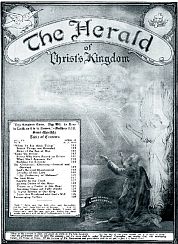
VOL. XVI February 1, 1933 No. 2 The
Apostle Paul and "His'' Gospel VOL. XVI February 1, 1933 No. 2 Life's Empty Victories
The following article was written, just prior to his death, by a regular contributor to a secular newspaper, namely "The Minneapolis Tribune" (December 19, 1932). It is commended to the thoughtful consideration of our readers as full of heavenly counsel. AS A MAN grows older, yet has not reached extreme old age, when, presumably, all his past is mellowed and softened in the pleasant, tranquil light of sunset and both mistakes and right acts are equally overspread by the thought that nothing has mattered much, since the whole thing will be soon over; when he arrives at the stage in life's journey where he reviews the past, not alone for the gentle pleasure of reminiscence, but also to seek guidance for his remaining future, and while he still imagines that it is possible for him to mold his character into the secret ideal which he has all along vainly struggled to perfect, there comes, at least to the man of the average temperament, in this pause of review, this moment of rest before he completes his destiny, the thought of how much happier, and better and altogether pleasanter his life might have been had he avoided as he might easily have done, certain complications and conflicts which, at the time, seemed to him mightily important. When they occurred, he was absolutely certain that the triumph of his opinion was a matter of tremendous consequence; it was essential that he should override the opposition and impress upon his opponent the pre-eminent truth and right of his position; and so he went at him, hard and strong, and in the heat of the controversy, which ripened into a feud and perhaps ended in the permanent estrangement of one who might once have been counted a friend, he said or did things which were hard and bitter, and better left unsaid or undone. Perhaps he gained his point; beat down his antagonist and sent him, humbled and mortified, from the contest, to nurse his grievance ever after, and nourish to the end of his days a smouldering hate of the man who got the better of him; or worse, to cherish the feeling that he had been hardly used. Strange it should be that, in his later years, the outcome does not seem to have been of very great consequence. What remains permanently is the memory of the incident, and a regret that it should have occurred. Looking back, he realizes the exact moment when he might have refrained from pressing his man to the limit, have perhaps sufficiently satisfied his self-respect and vindicated the justness of his contention without sacrificing a possible friend. Probably it would puzzle him now to' state exactly what it was all about then, this famous victory, but he remembers it was a great fight and he was in it and he is sorry. Not sorry that he stood up stoutly in defense of his positive convictions; no man ever regrets that, but sorry that he should have esteemed it necessary to go to such lengths in pursuit of his ends that it put reconciliation and ultimate restoration of friendship beyond the bounds of the possible. He remembers these incidents with a vague discomfort. No matter which of the two was in the wrong, he holds himself responsible for the outcome. Did he convince the other of his error? Scarcely. "He that complies against his will is of his own opinion still." Did the encounter seriously contribute to the upbuilding of his own character? Hardly, unless it was desirable to encourage in himself the love of fighting for the fight's sake. His later calm and deliberate conviction is that it was not worth while, and he grudges the vitality and energy he put into it, which might well have been conserved to later, more mature and far better use. The thing the man remembers at this particular point in his life with the most satisfaction is not such a fruitless contest, but rather the time when, by conceding a point, by some exercise of forbearance in pressing an advantage, he made a friend of his opponent, although they differed irreconcilably. Touching these other encounters, which at the moment it seemed so necessary to win, but which in the end were so barren of real gain, he says, somewhat sorely, "Let them be forgotten and forgiven." He recalls with secret gratification not his paltry and vainglorious victories, but his flabby and perhaps sentimental concessions: the small foolish, kindly things that he did, rare enough, he admits, but fruitful in pleasing memories. For, after all, we are men tarred with the same stick; more or less good, bad or indifferent, as the case may be, yet all capable of doing something kind for each other. He draws from his past the lesson of tolerance, for the future that is left to him, and resolves, perhaps vainly, but at least, for the moment, sincerely, that henceforth, while he may never falter in defense of a principle, he will try hard to so moderate his attacks upon the other man as to leave no sting past healing. The assets he counts up with the most satisfaction are the friends he finds about him. What they may expect of him is the animus of his future. He will endeavor to be true to them and to his own convictions, but he will avoid the useless multiplication of enemies. This is his hope, as he takes stock of what lies before him. Perhaps the writer could offer no suggestion to his readers, touching the form which good resolves, customary at this season of the year, should take, that would be better for ourselves and for the world we live in, than that we will lead kindlier lives; that we will be less sure and less harsh in our judgments; that we will refrain as far as in us lies from giving the other man "a piece of our minds;" that we will leave room for him to be convinced of his error, if he be wrong and we right, not through the might of our pounding, but rather through the gradual change in his own convictions; that we will finally try to, proceed on the way that we esteem the right and only one with less friction, believing that which is true and right will prevail anyhow, and the surer and swifter if it be not enforced by contention. In a word, to resolve to make friends, not at the sacrifice of conviction or principle, but by conceding to others the simple right of learning the truth in their own time and in their own way, helped perhaps by our, of course, pre-eminently wise suggestion and example, if truly they be such, but at least not hindered by our overemphatic dictum. . .
The Apostle Paul and "His'' Gospel"He is a chosen vessel unto Me."-Acts 9:15. IF ANY one word more than another could be used to describe St. Paul's influence in the Church and in the world it would be the word progress, and we shall not do wrong if we think of him as the Apostle of Progress. Indeed our Lord Himself indicated this at the time of his selection to the Apostolic office, when He said "He is a chosen vessel unto Me, to bear My name before the Gentiles, and kings, and the children of Israel." To him was allotted not only the stupendous task of freeing the Church of Christ from the Jewish wrapping which had served as its cradle, but also of extending the witness to the uttermost parts of the earth. Through his preaching men turned not only from Moses to Christ but also from Pagan idolatry to the worship of the one true God. Another has said of him: "He was the traveled ambassador of Christ who snatched Christianity from the hands of a local faction and turned it into a universal faith, whose powerful word shook all the gods from Cyprus to Gibraltar, who turned the tide of history and thought." It is to his epistles we must turn, if we would really know St. Paul. While we might from other sources, especially the Book of the Acts, have learned what he did and suffered', yet apart from his epistles we should have very little idea of what he was. But in his epistles Paul himself is present with us. In them we find his inner life laid bare-lived over again for us, and brought before our mind's eye in a word picture. We have in them not merely instruction from the Apostle on how to live the Christ-life; we have what is of still more value to us-a cross section of the Christ-life as he lived it. Powerful Intellect and Heart It is not uncommon for people to think and speak as if the other eleven Apostles, by reason of their close association with our Lord, and because of the affection in which they held Him, went forth to tell, the world the simple story of His life and death; but that St. Paul, because of his powerful intellectual make-up, which they think made him necessarily of a colder nature, drew the Gospel away from the person of Jesus, and transmuted it into a hard, intellectual system. This is a totally mistaken impression which does the Apostle to the Gentiles great injustice. None of the Apostles, not even John, was more filled with the glow of personal attachment to Christ. Being of the intellectual type St. Paul could not help thinking clear through to their logical conclusions, the doctrine Christ taught, but Christ entered into every thought he had about them. True, his intellectual superiority is universally acknowledged, and to those who know him only from a distance this is his outstanding peculiarity. But the close student of his life and character knows that great as he was in intellect he was equally great in heart, perhaps greater. "His" Gospel Paul, a servant of Jesus Christ, a divinely commissioned apostle, was, he tells us, separated unto the Gospel. With him the preaching of the Gospel was not incidental to other matters more important. It was not even one important thing among others that held place in his life. No! it was the business of his life, to which all else was incidental, to which all else was held subservient. And in this, in the complete, whole-hearted abandonment to the Gospel, to which, from his conversion and call he devoted his life, his strength lay. The fullest exposition of "his" Gospel is found in the Epistle to the Romans. To see the Gospel in all the fulness that St. Paul preached it, one must read, and not only read, but study that Epistle. Here we must content ourselves with very brief observations on the twofold work of Christ his Gospel unfolds, namely, First: Christ's work or us, or the ground of our justification; and, second: Christ's work in us, or our sanctification by His Spirit. Christ's Work for Us From first to last the Gospel of St. Paul has to do with a Person. Let no man by any means deceive you. The sum and substance of "his" Gospel is Jesus. The one purpose of his preaching, never at any time lost sight of, even in the midst of his most involved doctrinal discussions, is to put the individual hearer and believer of his message in personal and vital touch with his own risen and living Lord. How shall he do this most effectively? His own experience tells him. He who had spent the' years prior to his conversion in seeking to establish his own righteousness, well knows that the first essential to salvation is a righteousness which may be possible for man to secure as a gift, for to merit same, he has found from his own personal experience, is an impossibility. Ah! no wonder he is not ashamed of the Gospel, for therein is revealed a righteousness which all may have as a gift, a righteousness which may be procured by faith, a righteousness which has its origin, and which is therefore entirely acceptable, with God. Any sincere seeker after righteousness-all who hunger and thirst after it, will undoubtedly be intensely interested in his message, and since the offer of this righteousness as a free gift to all who will accept it is made possible by the redemptive work of Christ, small wonder that he says: "I delivered unto you first of all that which, [in my own personal experience] I also received first of all, how that Christ died for our sins. Christ's Work "in" Us But if by His death on Calvary's Cross, our Lord performed a work for us which constitutes the basis of our righteousness or justification, He is today, in His risen and glorified condition, carrying on by His Spirit a no less important work in us. "For," says the Apostle, "if, when we were enemies, we were reconciled to God by the death of His Son, much more, being reconciled, we shall be saved by His life" (His resurrection life, of course). It is a blessed experience to have the peace with God which comes from being justified by faith in the precious blood of Christ, but a true lover of righteousness could never be satisfied with an imputed or reckoned righteousness only. His ardent desire is to be saved not only from the guilt and punishment of sin, but also from its power. The words of the Psalmist express the sentiment of the - true believer's heart: "I shall be satisfied when I awake in Thy likeness." And he will not be satisfied until then. By faith in Christ's work for us righteousness is imputed or reckoned to us; and when, by His Spirit, Christ dwells in our hearts by faith, righteousness begins to be, praise be to God, imparted, to us. Christ in us, therefore, that is to say, the Christ-spirit or the' Christ mind in us, is indeed, as the Apostle says, the Hope of Glory. Though, therefore, our outward man perish, the inward man is renewed. When, does one ask? Daily, replies the Apostle. "Give us day by day, we pray, not our temporal bread only, but the Living Bread from heaven. "If any man would come after Me let him deny himself and take up his cross daily and follow Me," said our Lord. In harmony therewith the Apostle writes: "Though, therefore our outward man perish, the inward man is renewed day by day." Under the gracious influence of the Spirit of Christ, the blessed promise of the Father, we are to be no longer conformed to the spirit of this Age, but are to be gradually, day by day, transformed by the renewing of our minds. Concerning Christ's work for us, the All-sufficient ground of our acceptance with God, our Lord cried from the cross,- "It is finished." In regard to Christ's work in us, the Apostle writes: "Being confident of this very thing, that He who hath begun a good work in you will continue to complete it until the day of Jesus Christ." A Faithful Minister Such, briefly told, is the Gospel according to Paul. Let us now turn to some of the lessons his life has for us. Out of many we will mention only two. First-his faithfulness. He who taught others that "It is required in stewards that a man be found faithful," had learned this lesson well himself. Oh! surely if his practice kept pace with his preaching anywhere it did so here. He was entrusted by God and by Jesus with the Gospel, and he guarded it, dear brethren, for you and for us. He kept watch over it as of a sacred treasure, as the keeper of a holy fire, which must never be stamped out. His faithfulness is easily seen in his fearless defense of the truth before the Jews, before Festus and Agrippa and numerous others in high places, but to our mind it is still better demonstrated when he withstood Peter face to face; when, lest the glorious Gospel which had been committed to his trust should be jeopardized, he separated from such a friend as Barnabas had proved himself to be. Our Lord had said, "I will show him how great things he must suffer for My Name's sake," and of all the things he suffered, none could have cost him more. To defend the truth against its enemies -- that were easy -- but oh! what agony it must have been to his heart of gold when his loyalty to Christ compelled him to take issue with his friends! A Beloved Brother Then, too, he was a beloved brother, as well as a faithful minister. Such a combination of qualities is rare. We wonder if all realize fully just how difficult it is to attain this combination of character quality and development. It is so easy to be beloved-to be lovable, easy-going, gentle, agreeable, at the expense of faithfulness. On the other hand, to be faithful is little more than an attainment of the flesh when such faithful adherence to and defense of the truth of the Gospel is maintained in a rough, uncouth, unloving, contentious spirit of strife. It is possible for a brother to be a very faithful minister, he may be able to pick out our faults to a "T," but we would hardly call him a beloved brother, would we? But if the Apostle John was one who taught us to love in the truth, it is not less certain that it was the Apostle Paul who taught us to speak the truth in love. In concluding these brief remarks on our beloved Brother Paul, perhaps we cannot do better than refer to a picture in Bunyan's Pilgrim's Progress. You will remember that early in his journey to the Celestial City Christian was taken into the Interpreter's house and there shown the picture of a man. "And this," says Bunyan, "was the fashion of it. It had eyes lifted up to heaven, the best of books was in its hand, the law of truth was written upon its lips; the world was behind its back; it stood as if it pleaded with men; and a crown of gold did hang over its head. "Then said Christian: What meaneth this? The Interpreter replied: The man whose picture this is, is one of a thousand. He can say in the words of the Apostle: 'Though ye have ten thousand instructors in Christ, yet have ye not many fathers; for in Christ Jesus I have begotten you through the. Gospel."' Kept by the Power of God "To an inheritance incorruptible, and undefiled, and that fadeth not away, reserved in heaven for you, who are kept by the power of God through faith unto salvation ready to be revealed in the last time."-1 Peter 1:4, 5. HOW wonderfully sweet and assuring are the Master's repeated statements of His faithfulness toward those who are His own! And what a depth of interest in each individual is revealed in His words when He says: "And this is the Father's will which hath sent Me, that of all which He hath given Me, I should lose nothing, but should raise it up at the last day." (John 6:39.) Here we see not only the greatness of His love for us in a personal way, but we are also given a vision of His deep sense of responsibility to God for the safe-keeping of all that has been entrusted to His care. As our Shepherd, He assumes this charge over us, counting every sheep precious to the Father, and through all the vicissitudes surrounding the life of each one He can never be unfaithful to the trust. What an assurance all this is to us who are being kept beneath this overshadowing solicitation! Think of the love that dwells in the heart of Jesus for His Father, and then remember to what lengths that love would lead Him. in His delight to demonstrate its reality. It is that love that is pledged to undying devotion to keep us, because it is God's will that He should do so. Think again of the love that He personally has for us, and of which He has not left us in doubt, for has He not said, "He that loveth Me shall be loved of My Father, and I will love him, and will manifest Myself to him." "As the Father hath loved Me, so have I loved you."-John 14:21; 15:9. Are these not, then, two most powerful influences operating in our Lord's heart in our behalf? Do they not afford us "strong consolation" in every cloudy and dark day, as well as assurance when "-life flows on in endless song" that He will never leave us nor forsake us? On the one hand there is His delight in supreme obedience to the Father's will, and on the other hand His love, "all love excelling," for those whom that Father has given Him. Truly! what more can He say than to us He has said, to us who are being kept by the power of God. But to enjoy this keeping power of which Peter in our text is writing, there are, as always, certain antecedent requirements to be recognized and appreciated. This keeping is the privilege only of such as are marked out "through sanctification of the Spirit, unto obedience and sprinkling of the blood of Jesus Christ." The limitations are definitely fixed in the foreknowledge of God, and the only door of entrance is the narrow one of sanctification, setting apart, separation. Then, when that door has been entered and the "lively hope" operates "by the power of God through faith" to carry forward the foreordained purpose of Divine love, there comes a more and more blessed faith appropriation of the "inheritance incorruptible, and undefiled, and that fadeth not away." As the love of Jesus operating 'to keep us for the Father and to keep us for Himself mingles in our affections with the deepening love wherewith we increasingly love them, how eager and active our powers of appropriation will become. Then, blessed result! there comes increasing longings for separation, and increasing assurances of being kept in the secret place of the Most High. In the Furnace God may Prove Thee After reminding us of all that God has made possible to us in calling us into this inheritance, Peter is quick to forewarn us of impending trials of faith. Manifold temptations are to be expected-yea, there will be seasons of heaviness because of the weight of trials to be borne. And that these will be unusually severe at times he is also faithful to warn us, for if we are unacquainted with God's purpose in such experiences, there would be a danger of considering them strange and inconsistent with the pledge of our safe-keeping in His love and care. But we of today cannot get away from the innumerable witnesses of God's faithfulness, unless in unbelief and hardness of heart we close our eyes to the record of ages past, and deliberately forget the goodness and mercy that has followed us all our lifetime. Is not our experience a most favored one, in that we are so far down the stream of time that we may look back over ages of God's operations? Contrast our advantages with those of Abraham when he was called out into a life of separation wholly on faith. What records did he have of exploits of faith to strengthen him? How limited were the examples before Daniel and his faithful friends when they were called upon to believe that a fiery furnace and death in a den of lions were wholly compatible with a belief in God's love and care. With so great a cloud of witnesses surrounding us, can we do aught than fervently pray that we may not fail to prove strong in faith? How unthinkable it is that we of today should be less strong in the Lord and in the power of His might than those who so gloriously triumphed in an Age of much less revelation, and whose rewards are to be immeasurably inferior to that of even the least in the Kingdom of Heaven. Turning back, then, to note some of the noble characters of the past, whose records furnish us with indubitable proof that God will keep His own under all circumstances, we may learn much that will be a profitable "instruction in righteousness," and greatly strengthen our faith today. By observing in these examples of obedient faith the relationship existing between the trials of today and the opportunities of yesterday, we will be helped thereby to understand much that may otherwise seem so inexplicable. For, though it be seldom remembered at the time, it is our reactions to certain heaven provided preparatory opportunities granted to us in the present hour, which will in all probability determine our course of action under the tests of tomorrow -- yes, even if that tomorrow of test be months or years yet before us. The revolving wheel may turn slowly at times, but turn it will as long as character registers with precision the thoughts of the heart, and the acts of life. This, of course, it will always do, for the law of cause and effect is God's fixed law. Preparing for Coming Tests From early days we may have sung "Dare to be a Daniel, dare to stand alone," but have we always remembered how it came about that Daniel stood alone? Not only Daniel, but his three loyal companions likewise were faithful under equally crucial tests, and therefore they too become outstanding examples for us to follow. The underlying secret of the fortitude and faithfulness of these men, is unquestionably related to their positive course of action at an earlier date. We recall that after the captivity of Israel began, Nebuchadnezzer had taken these four young captives and placed them under special tuition for places of responsibility in his kingdom. Immediately, these true Israelities revealed themselves possessed of admirable strength of character. And so we read, "And the king appointed them a daily provision of the king's meat, and of the wine which he drank: so nourishing them three years, that at the end thereof they might stand before the king. . . . But Daniel purposed in his heart that he would not defile himself with the portion of the king's meat, nor with the wine which he drank: there fore he requested of the prince of the eunuchs that he might not defile himself." (Dan. 1:5, 8.) And while Daniel alone is mentioned in the text just quoted, the narrative clearly shows that his companions were sharers with him in this determination to remain undefiled. Apparently these men had not permitted their plight as captives to swerve them from their devotion to God's law, and hence they did not reason that their changed circumstances would be ample justification for indulging in all the king might place before them. Rather, they determined that those very conditions were such as to make it imperative that they separate themselves from defilement. Remembering the customs of those days, and the despatch with which the king's displeasure was executed when his will was crossed, we can see that this was no small matter to have determined on such a course. But freedom from defilement was the real issue, and the approval of God they placed above life itself. And with what gratifying results: "As for these four children, God gave them knowledge and skill in all learning and wisdom: and Daniel had understanding in all visions and dreams." This is always God's way with those who honor Him. "Touch not the unclean thing, and I will receive you, and will be a Father unto you, and ye shall be My sons and daughters, saith the Lord Almighty." "What man is he that feareth the Lord? him shall He teach in the way that He shall choose." (2 Cor. 6:17, 18; Psa. 25:12.) In the time of trouble, the time of final testing, He will hide such in His pavilion: "In the secret of His tabernacle shall He hide them; He shall set them up upon a rock." They shall be kept by the power of God unto salvation ready to be revealed in the last time. As with Daniel, so with these of a later day, the character formed in the tuition period has everything to do with determining the course of action when subsequently brought face to face with issues involving life and death. He is Able to Keep You from Falling Peter, in our text, reminds us that we are kept by the power of God, and it is so important that we remember this. Oh, how many have boasted while putting the armor on in calmer days, only to subsequently provide another painful illustration of instability, over-confidence in self, and a failure to remember that only those who are "strong in the Lord" can possibly escape the wiles of the Adversary. Let our natural powers of mind be what they may, and let our efficiency as exponents of the Truth by tongue or pen be ever so great, yet how unfit for service we are until the power of the Holy Spirit comes upon us to sanctify our own lives, and thereby fortify us against the pitfalls spread before our feet. The measure of our spiritual power-God's power in our lives-will be in exact proportion to our cleansing from all filthiness of the flesh and spirit, and this must include a proper estimate of the utter unprofitableness of our own works aside from a true abiding in Christ. Indeed, it is not until the Divine power can work in a fully consecrated and Spirit guided life that there is any power to endure under trial, or to do any spiritual work. "Our sufficiency is from Him," is the Scriptural reminder; therefore, all dependence on our own wisdom, our own talents, or our own intellectual abilities, our own powers of argument or persuasion or appeal, is an ignoring of the fundamental truth, and some ignoble fall may be necessary to awaken us to that fact. Paul writing to Timothy reminds him that "In a great house there are not only vessels of gold and of silver, but also of wood and of earth; and some to honor, and some to dishonor. If a man therefore purge himself from these, he shall be a vessel unto honor, sanctified, and meet for the Master's use, and prepared unto every good work." (2 Tim. 2:20, 21.) This is but a repetition of the same fact, and is meant to teach that unmortified lust, fleshly or spiritual defilement tolerated in the life, will constitute an effectual hindrance to spiritual vision, and to the kind of service bearing fruit unto eternal life. It was a law in ancient Israel that they must "bring an offering in a clean vessel into the house of the Lord." Should the vessel be unclean, it must be rejected as one in "which is no pleasure," and the offering would not be accepted by the Lord. That same law remains unrepealed in the statute book of Christ. Long before it was elaborated on by the Apostle, these same principles were anticipated in the lives of four young captives in Babylon who had determined to keep themselves undefiled, and the story has been written for our admonition upon whom the end of the Ages has come. Shall we not heed it? The Wise shall Understand and Shine as Lights In support of the thought previously advanced, namely that the heaven-provided opportunities enjoyed today for attaining character are meant to be accepted as preparatory experiences looking forward to the tests of tomorrow, we may find strong corroboration in the lives of Daniel and his companions. As we have just seen, they were placed in circumstances where it would have been so easy to compromise and gravitate to the level of their environment, but this they did not do. They were doubtless considered extreme and foolish by their immediate associates for so doing; and since human nature changes little in matters of this kind, they probably suffered the disapproval of some of their brethren whose policy would be the less distinctive one, the one of compromise. But refusing "the king's meat" and avoiding defilement, prepared Daniel for a day when "the king's dream" would create a crisis in his own life, and that of his fellows. Yes, and a crisis it was, from which the only way of escape was in being in unhindered fellowship with God. Enjoying that, it was an event in which he experienced a blessed assurance of Divine love and keeping power, and in which his clearness of vision constituted him a savior of others. "The secret of the Lord is with them that fear Him." How beautifully this is exemplified in the incident we are now considering. The king was troubled over a strange dream, which, though forgotten, greatly disturbed his peace of mind. As usual under such circumstances he summoned all his wise men and placed before them the task of recalling his dream and supplying its interpretation. This, of course, they could not do, and consequently were dismissed from the royal presence under sentence of death. Then it was that one who had not been thought o f at all as competent to contribute help, was discovered. Daniel was brought before the king, and at once honored his God by making it known that whatever wisdom he might have was due to his relationship to the God of Israel. Securing a season of respite, he returned to his companions and asked "that they would desire mercies of the God of heaven concerning this secret; that Daniel and his fellows should not perish with the rest of the wise men of Babylon." Daniel, the beloved, had learned where to look for the solution of his problems. His appeal was to the only source of true enlightenment and help. He had learned to "cease from man, whose breath is in his nostrils," and to go to the only place where God's will may be surely understood the closet of prayer. There is a God in heaven who knows all about our problems, and who is working out His grand designs midst all the perplexities surrounding our pathway. True, He could have relieved us of any responsibility in connection with the progress of His cause in the world, and perhaps He could have so arranged His Plan that it would be simply a matter of fate when error's baneful fruitage thinned the ranks of His separated people. But God's Plan involves the recognition on our part of some very important responsibilities. We are, all of us, in some measure, our brother's keeper, and in Daniel, and also in Paul, we have outstanding examples of how burdened our hearts should properly be on behalf of those walking with us the same Narrow Way. May it not be, however, that, as is often the case, we have overlooked a very important feature of God's provision for His people. When problems confront the Church, how possible it is to forget the very lesson this bit of Daniel's history can teach us. When clear vision is needed, we may depend upon it that God has not left Himself without a witness in the earth. Somewhere there will be found a Daniel, a Hananiah, a Mishael, an Azariah, whose" names will be interpreted in lives that excel in the virtues they represent. To these, who have faith enough, and devotion enough, and self-denial enough, and holiness enough, to separate themselves from all compromising expediencies, God will show His covenant promises fulfilled. Such shall have the Light of Life through all the maze. God will certainly direct the path of all who walk with Him in the sanctity of His presence, yea, He will guide them with His eye. And what a saving influence in the Church such characters may be. The Prayers of the Righteous Availeth Much Doubtless, when all knowledge is ours, and Church history is all spread out before us, we will discover that on more than one occasion when the enemy was preparing some subtle snare, or actually sweeping in like a flood, it was not some strong magnetic powers of exhortation that saved the day and sent the wily foe away defeated and disappointed, but the strong crying and tears of some unthought of heroic Daniel had been heard from some closed closet of prayer. Ah, yes, perhaps it will then be seen that many of our advances in fruitful ministry were simply God's answer to some importunate prayer for Zion's sake. Then, too,-we will doubtless find that many of our fine schemes whereby we had thought to accomplish much, were not brought to naught so much by a wicked enemy of the Church, but because some burdened souls sensed the special need of the call to prayer. For it cannot be questioned that when the enemy is most active, it will be those who have walked closest to God who will first detect his presence. When the Lord has judged His people, and the "day" which "will declare every man's work of what sort it is," has come-and it is here even now-then who will be most competent to understand the complex situation? Ah, it will be those who have put prayer, sanctification, and fidelity to truth, before all else. When the Spirit must write over any, work or movement, "Ichabod"-"The glory has departed"-then, only the prayerful, separated, undefiled Daniel-like characters, will be ready to interpret with accuracy the "cause and effect." And it is just here that such characters will act for God and for His people, as He desires they should. Men of spiritual vision must necessarily be men of prayer, and men of prayer must certainly be men of humble mind, deeply conscious of personal unworthiness and weakness. True, they will not always be judged as such by others, but God must know them as such, and He will surely know how constantly they confess their imperfections at His feet. Such a character was Daniel. His life of separation made possible a clearness of vision, and the revelation made him pray, and in prayer he was humble, not only for himself but for his brethren. How beautifully this is revealed in his intercessory prayer preserved for us in chapter 9. At its close we read, "And whilst I was speaking, and praying, and confessing my sin and the sin of my people Israel, and presenting my supplication before the Lord my God for the holy mountain of my God"-a true patriot surely, and one greatly needed at a time like that. But how much would Daniel's contemporary brethren enter into his contrition? Might it not be hoped that many of them would rally to his side and join with him in his prayer for Israel's sake? Surely so! "But then, how little are the judgments and actings of faith understood or valued, when things get low amongst the people of God! This is very apparent on every page of Israel's history, and, we may say, on every page of the Church's history also. The path of simple child-like faith is far removed from human sight; and if the Lord's servants sink into a low carnal state, they can never understand the principle of power in the soul of one really acting by faith. He will be misunderstood in various ways, and have wrong motives attributed to him; he will be accused of setting himself up, or acting willfully. All these things must be expected by one who stands in the breach, at a time when things are low. Through lack of faith in the majority, a man is left alone, and then, when he is led to act for God, he is sure to be misinterpreted." Nevertheless, when crisis hours come, the clearest vision, the deepest perception, the calmest judgment, the most spiritual diagnosis, will be found where there has been most of the bended knee, and most of honest confession, and most of real sincere longing for an undefiled and separated life. Our God Whom We Serve Continuing our study of these exemplary characters of long ago, we are impressed with the suggestive sequence with which lesson follows lesson. As the determination to avoid defilement by eating the "king's meat" prepared Daniel and his fellows to face the test introduced by "the king's dream," so both in turn are strengthening influences preparing them for the coming test of "the king's image." That next test will have to do with the character of their worship and service of God. It will afford an opportunity to reveal the ideals, motives, and principles, by which they are influenced. It will also constitute them witnesses for God on a very much larger scale than they could otherwise have been-yes, the kind of witnesses whose testimony is always most effective--lives which witness "in demonstration of the Spirit and of power." And here again there was ample opportunity for compromise. It would have been an easy matter to have found a way out of really bowing and worshiping the image before them. Expediency, mental reservations, and other subterfuges might have been brought forth as arguments in favor of less than an out and out protest. But once again we see the value of a background of positive determination to settle questions of right or wrong with "God first" before the mind. This was David's way also, according to his testimony: "I have set the Lord always before me: because He is at my right hand, I shall not be moved." A well known writer, commenting on the positive action of these faithful young men, and the many lessons which this record teaches, has given the following: "On the whole front of it there flames in letters of blazing gold that there is an almighty, living, and independent God, unbound by Nature's laws and unlimited to natural forces, whose word is written in His Book, whose eye is upon His confiding servants, and who will never leave nor forsake them that put their trust in Him! "From the innermost spirit of it there comes the proclamation that if kings or dignitaries or commands of church or state go against Jehovah's laws, or demand obedience against His Word, or undertake to keep conscience for the human soul, no true man of God dare obey them, nor shall he be the loser for his fidelity, no matter what penalties he may incur.... And in the whole make-up of it there stands memorialized for ever that the only true expediency is inflexible principle. It matters not for immediate consequences. God will make all right in the end to them that stand fast to truth and duty. They are, after all, the true heroes, and shall not fail of their rewards." This writer has given emphasis to several points worth noting. How true it is that "no true man of God" can give the keeping of his conscience to another. When that is done, deflection from the principles of pure worship must inevitably follow; for no substitute can be found for personal responsibility to God. And such deflection is treason against the Holy Spirit, against the Bible, against those we stumble and against our own' eternal interests. How much better the example of Shadrach, Meshach, and Abednego. How much better to be fortified against such "fear of man," and instability, by having the principles of righteousness so woven into the texture of the character, that obedience would be spontaneous. "Dare to be a Daniel, dare to stand alone!" Another point well emphasized by the writer just quoted is in the statement that, "the only true expediency is inflexible principle." If we forget this, we are very likely to be deflected and turned aside by compromising influences about us. Just as the compass of a ship can be deranged by the iron which enters into the structure of the vessel, so with the Christian, his service and worship may easily become misdirected, and become a sad violation of his Lord's searching test of love and obedience. "If ye love Me, keep My commandments." "My sheep hear My voice, and ,a stranger will they, not follow." In order therefore to keep our worship and service pointing in the right direction, we need to keep our eye upon the Lord, and let Him alone be our fear. Yes, to ever remember that "to obey is better than sacrifice, and to hearken than the fat of rams." The True Spirit of Devotion It will be observed that in the foregoing we have not been attempting any application of possible typical features to be found in the image which our heroes refused to worship. Rather, our present purpose is to review certain facts of Christian experience and gather lessons to supply present needs. And referring to our-opening text wherein Peter is reminding us of some who are being kept by the power of God, we are finding in our study, we trust, some suggestions calculated to quicken our understanding of what God may properly expect of us. No feature of truth seems more in need of emphasis today than such lessons as these things "written aforetime" may now teach us. Promptness of obedience to God, then, was the outstanding character of the Hebrew captives in our study, and since spontaneous obedience is the only real demonstration of loving devotion, is it not seasonable to examine ourselves by the standards inspiration affords us? Surely so! For it cannot be denied that both by precept and by the history of exemplary characters, the Scriptures are constantly teaching us that nothing can be more dangerous than to hesitate when Divine light is thrown on the path of duty and fidelity. To fail to act then, once the light has come, is to run the risk of meriting some serious and perhaps very unexpected results. As another has said, "Never go before your faith, nor lag behind your conscience," for to do so, is to trifle with one's eternal possibilities. No one who has given careful attention to "all Scripture" can have failed to note the constant repetition of one outstanding fact, namely that in God's dealings with His people of the Jewish and Gospel Ages, there has first been a recognition of the mass, or general "mixed multitude," and then a distinct dealing with individuals. Passing by the various illustrations of this fact that Jewish history reveals, let us note that there are three stages marked out in their probation: For centuries God dealt with the whole nation. Then, with the appearance of Jesus "whose fan was in His hand," it was still in a measure general, but in a stricter sense narrowed down to "the lost sheep of the house of Israel." And Jesus Himself put forth that narrowing limit, for He repeatedly emphasized that He "came not to call the righteous [self-righteous, unrepentant Jews at that time], but sinners to repentance." Then came the end of all forms of national recognition, and an extension in a definite way to individuals for three and a half years. Similarly, in this Age. There is first the command, "Go ye into all the world, and preach the Gospel to every creature." Then; "Let both [wheat and tares] grow together until the Harvest." And when the end of the Age comes, "Then shall the Kingdom of Heaven be likened unto ten virgins, which took their lamps, and went forth to meet the Bridegroom, and five of them were wise, and five were foolish." Here we have first the general extension of favor to the entire field; then the introduction of that which will separate virgins from others; and finally the examination narrowed down to these alone. On this point we cannot do better than quote from Vol. III, of Scripture Studies, page 190. "The parable of the Ten Virgins, while it shows the entire virgin or consecrated class being separated from Babylon, marks distinctly a testing and separation to take place in this class also-a separation of wise virgins, full o f faith and fervent love and the spirit of prompt obedience, from foolish virgins, who allow their first love and fervency of spirit to cool, and their faith and promptness of obedience consequently to abate." To the individual saint then, these are crucial examination days. While the Lord is thus occupied with the judgment which must begin at the house of God, it is well for us to examine ourselves to make sure that we possess the faith and love that knows no expediency other than that of principle, and to make positively sure that prompt obedience has characterized our service and worship hitherto. Crisis periods are doubtless coming to each of us as the days go by, and some of these particular periods will, in all probability, be the crisis moment for us. Some day the period of probation will have gone far enough to determine our standing. Some day, by taking the wrong turn, by failing to separate from the dross, or by a failure to render prompt obedience, we will be set aside from the number of His Elect if we do not keep our heart with all diligence. Then, since these things are so, how shall we be assured of Divine approval? To that question the Scriptures make reply. "Who shall ascend into the hill of the Lord? or who shall stand in His holy place? He that hath clean hands, and a pure heart; who hath not lifted up his soul unto vanity, nor sworn deceitfully. He shall receive the blessing from the Lord, and righteousness from the God of his salvation." (Psa. 24:3.5.) He shall be "kept by the power of God through faith unto salvation ready to be revealed in the last time" - very soon we believe. Ready for the King's Furnace We follow our Hebrew heroes yet one step further. They are yet to be cast into the seven-times-heated furnace, and experience the distinct approval of God. As to what this may point to as a type of what the Church might expect ere its complete change has come, we are not concerned here in our present study. For the present, we have considered the various trials the true saint will have in his contact with opposing influences; and in considering "the king's furnace," and its results to Shadrack, Meshach, and Abednego, we will call to mind the blessed results which God wills shall come to us through the fiery trial already here, or yet to come. It is so much easier for us to think of the furnace of trial, than to rejoice in what the furnace experience may make possible. The great Refiner's purpose in permitting fiery trials is twofold: He wants to destroy the dross, and He wants to purify and brighten the metal. Whatever therefore may be the character of our peculiar testings today, God has but one special purpose, and that purpose the Scriptures tell us is to the end "that the approved may be made manifest." And, what would we not be willing to bear up under, just to have a record of victory like that of these men! How inspiring it is! "Then Shadrach, Meshach, and Abednego, came forth of the midst of the fire. And the princes, governors, and captains, and the' king's counselors being gathered together, saw these men, upon whose bodies the fire had no power, nor was an hair o f their head singed, ,neither were their coats changed, nor the smell of fire had passed on them." Glorious triumph! In all these things they were "more than conquerors." They had walked in separation with God before the furnace came, and God walked with them within its flame, "to show Himself strong in the behalf of them whose heart is perfect toward Him."-2 Chron. 16:9. So, whatever form our individual trials may take-and .God knows how hearts are burdened with sorrows; no one fully understands but Him-let us take comfort from the lesson before us. It will be with us as with the Hebrew captives in their furnace experience. "God was there!-there, in His power, to write contempt upon all man's opposition--there, in His deep and tender sympathy with His tried and faithful servants-there, in His matchless grace, to set the captives free, and to lead the hearts of His Nazarites into that deep fellowship with Himself for which they so ardently thirsted. "And, my beloved reader, is it not worth passing through a fiery furnace to enjoy a little more of the presence of Christ, and the sympathy of His loving heart? Are not fetters, with Christ, better than jewels without Him? Is not a furnace where He is, better than a palace where He is not? Nature says, 'No!' Faith says, 'Yes!' . . . Here, then, was a noble testimony-such a testimony as would never have been rendered, had the Lord, by a mere act of power, preserved His servants from being cast into the furnace. Nebuchadnezzer was furnished with a striking proof that his furnace was no more to be dreaded than his image was to be worshiped by 'the servants of the Most High God.' In a word, the enemy was confounded; God was glorified; and His dear servants brought forth unscathed from 'the burning fiery furnace.' Precious fruits, these, of a faithful Nazariteship!" Oh, to be kept unscathed, unharmed today! And can we too hope to so fully overcome, that God will thus "manifest" us as His approved ones? Surely so! "Now unto Him that is able to keep you from falling, and to present you faultless before the presence of His glory with exceeding joy, to the only wise God our Savior, be glory and majesty, dominion and power, both now and ever." "I am persuaded that He is able to keep that which I have committed unto Him against that day. (Jude 24, 25; 2 Tim. 1:12.) If we seek the inner circle of close communion with God, and shun the defilements He frowns upon, and keep our wave offering of acceptable service lifted up, we will be kept from falling, and ere long be forever separated from all the limitations experienced in a world like this. Meantime, "Beloved, think it not strange concerning the fiery trial which is to try you, as though some strange thing happened unto you; but rejoice, inasmuch as ye are partakers of Christ's sufferings; that, when His glory shall be revealed, ye may be glad also with exceeding joy."--l Pet. 4:12, 13.
THE Emphatic Diaglott renders the above text, "Therefore, for me to live is for Christ." Either expression would seem to convey practically the same thought, as one could not live the Christ-life without living for Christ, nor could one live for Christ without living the Christ-life. The same Apostle says in Phil. 2:5, "Let this mind be in you which was also in Christ Jesus.'' The word "mind," in its broad sense, covers the entire mental field-will, desire, disposition. Thus, to really live the Christ-life, we must have the Christ-mind. Let us, then, note as briefly as possible what was the mind of Christ; and, as His mind unfolds to us more and more, may we by His grace be enabled to more fully copy the perfect pattern set before us. His Perfect Obedience The Psalmist, speaking prophetically of our Lord, says: "Then said I, Lo, I come: in the volume of the book it is written of Me. I delight to do Thy will, O My God: yea, Thy law is written within My heart." (Psa. 40:7, 8.) What a wonderful example is here set before us. It was not only our Lord's delight to do the Father's will, but it was His meat, His sustenance-the very essence of His life. (John 4:34.) It was because of His whole-hearted obedience that He was able to successfully meet every issue. Nothing but the most thorough consecration and the fullest acquiescence in the Father's arrangement would have enabled Him to successfully pass every test. We can almost hear our Lord's agonizing cry, "O, My Father, if it be possible, let this cup pass from Me." By "this cup" He could not have referred to physical death because He had come for the very purpose of giving His life a ransom for all; but He knew that He was to die as a malefactor as one accused of blaspheming the Father whom He loved with all His heart. That was probably the "cup" to which He referred; but here again His perfect obedience is manifested, for He said, "Not as I will, but as Thou wilt." His Compassion and Mercy While our Lord was "holy, harmless, undefiled, separate from sinners" (Heb. 7:26),. He had compassion on sinners. The very purpose of His coming was to save sinners, and His constant message was that of compassion and forgiveness. Wherever men have heard the name of Jesus, they have associated with it the qualities of tenderness and mercy. His Humility Though the Son of God-the only begotten of the Father-the greatness of His humility has never been equaled in heaven or in earth. His own words were, "I can of mine own self do nothing." (John 5:30.) The perfection of His humility is most glowingly described by the Apostle Paul in Phil. 2:6-8: "Who, though being in God's form, yet did not meditate a usurpation to be like God; but divested Himself, taking a bondman's form, having been made in the likeness of men; and being in condition as a man, He humbled Himself, becoming obedient unto death, even the death of the cross."-Diaglott. His Steadfast Love "Having loved His own which were in the world, He loved them unto the end." (John 13:1.) How frail and weak is the human love as compared to His. Though our intentions may be the very best, we frequently fail each other in time of need, but Jesus loved His own to the end. Jesus has never failed and never will fail-"Behold, I am with you all the days till the consummation of the Age." - Matt. 28:20, Diaglott. The Christ Life in Us "For as many of you as have been baptized into Christ have put on Christ." (Gal. 3:27.) To "put on Christ" means more than to put on the insignia of Christ, to bear His name; it means to adopt the Christ-life, the Christ-spirit. "If any man have not the Spirit of Christ, he is none of His."-Rom. 8:9. The Church is spoken of as the epistle or letter of Christ. (2 Cor. 3:3.) Again the Church is spoken of as the light of the world (Matt. 5.14); and again as living epistles or letters known and read of all men. (2 Cor. 3:2.) By the word "known" is not meant that they are understood, but rather that cognizance is taken of them and they are examined to see whether their lives correspond with their professions. Jesus said, "He that hath seen Me hath seen the Father." (John 14:9.) May our associates be able to say of us, "These people have been with Jesus and have learned of Him, for we see the spirit of Jesus manifested in their lives." Living the Christ Life We learn to live the Christ-life by "looking unto Jesus, the author and finisher of our faith," and copying His consecration, His humility, His holiness, His compassion and mercy, and His steadfast love and faithfulness. Paul said to King Agrippa that he was not disobedient to the heavenly vision. (Acts 26:19.) We, too, have received a heavenly vision of our high calling in Christ. May we always be obedient to that vision, and "may no earth-born cloud arise to hide Thee from thy servant's eyes." One has well said, "Herein lies the meaning of those words of the Lord, 'If any man will come after Me, let him deny himself and take up his cross and follow Me.' (Matt. 16:24.) We must follow Jesus Christ, -step by step, and not open up a path for ourselves. We can only follow Him by denying ourselves; and what is this but unreservedly abandoning every right over ourselves? And so St. Paul tells us: 'Ye are not your own.' (1 Cor. 6:19.) No, not a thing remains that belongs to us! Alas for him that resumes possession of anything after once abandoning it. The conclusion, consummation or end of our consecration is when our humanity shall have been consumed in death." "He desires to be nearer to me by His pure love than I am to myself. He would have me look upon this 'me' as a stranger; He would have me escape from its walls, sacrifice it wholly to Him, return it absolutely and unconditionally to Him from whom I have received it.... What I am ought certainly to be less precious to me than He by whom I am. "God is a jealous God; and if in the recesses of your soul you are attached to any creature, your heart is not worthy of Him: He must reject it as a spouse that divides her affection between her bridegroom and a stranger. "In the sacrifices which we made when we devoted ourselves wholly to God, we reserved nothing and felt happy in so doing, while we were looking at things with a general view and at a distance; but when God takes us at our word and accepts our offer in detail, we are made aware of a thousand repugnances, the existence of which we had not so much as suspected before. Our courage fails; frivolous excuses are suggested to flatter our feeble and tempted souls; then we hesitate and doubt whether it is our duty to obey; we do only the half of what God requires of us, and we mix with the Divine influence a something of self, trying still to secure some nutriment for that corrupt interior which will not die. "We desire that God would give us the death-stroke; but we long to die without pain; we would die to our own will by the power of the will itself; we want to lose all and still hold all. "They say they are attached to nothing, and are overwhelmed by the smallest losses. "What God requires of us is a will which is no longer divided between Him and any creature." Humility "Be clothed with humility; for God resisteth the proud, and giveth grace to the humble. Humble yourselves, therefore, under the mighty hand of God that He may exalt you in due time." (1 Pet. 5:5, 6.) Jesus said: "Learn of Me, for I am meek and lowly of heart." He humbled himself, even to the death of the cross; how appropriate then that we who are but dust should humble ourselves, not only before our great Heavenly Father and our elder Brother, but also before one another. "Let each esteem other better than themselves." - Phil. 2:3. One, speaking on humility, says that "We are intoxicated with the pleasure of not being intoxicated with pleasure." Again we read: "We sometimes are grieved because we cannot behold our own progress towards perfection, and this sentiment is mistaken for humility. We long, from self-love, to behold ourselves perfect. Discouragement is not a fruit of humility, but of pride. God never makes us sensible of our weakness except to give us of His strength. "Men judge our deeds by their outward appearance: with God that which is most dazzling in the eyes of man is of no account. What He desires is a pure intention, a will ready for anything, and ever pliable in His hands, and an honest abandonment of self; and all this can be much more frequently manifested on small than on extraordinary occasions." Holiness Jesus was perfect "holy, harmless, undefiled, separate from sinners"-and it would be impossible for us to attain that degree of holiness in the flesh, but we are urged to follow after holiness-walk in that direction. Thus the Apostle Paul admonishes: "Follow peace with all men, and holiness, without which no man shall see the Lord." (Heb. 12:14.) This means whole-heartedness-an undivided love -- a will that wills the will of God-a following after holiness; it does not mean perfection in the flesh; God never asks of His children more than they can do, but He does expect them to strive in the direction of holiness. Infinite Compassion The promise to the Lord's followers is that if faithful unto death they shall reign with Him for the blessing of all the families of the earth. We are now in the school of Christ where we are being prepared for our future work. One of the important lessons which we must learn is that of compassion and mercy. Jesus laid down the rule of conduct for us when He said, "But if ye forgive not men their trespasses, neither will your Father forgive your trespasses." (Matt. 6:15.) If we fail to show mercy to others now, it is an evidence that we are not fit for the work which the great Jehovah has assigned to the Christ in the Age to come-the "times of restitution of all things." There will be in that Age millions upon millions coming back from the grave with just the same characters which they had developed in this life. Oh, what infinite compassion and mercy will be required in dealing with these, in having their blindness and lameness removed, and restoring them to the image and likeness of God! These qualities of compassion and mercy are developed through trials, and that is the reason why our Heavenly Father permits us to go through bitter and trying experiences; that is why He often permits us to bear crosses that at times seem so very heavy. These crosses, however, are not designed to crush us, but rather to build us up, to strengthen us. It is said that "able as He was to save us without crosses, He has not chosen to do it, as He has not seen fit to create men at once in the full vigor of manhood, but has suffered them to grow up by degrees amid all the perils and weaknesses of infancy and youth. It would be as great a wonder to see a person full of self become in a moment dead to all self-interest and all sensitiveness as it would be to see a slumbering infant awake in the morning a fully developed man. "We should like to be consumed at once by the flame of pure rove, but such an end would scarce cost us anything: it is only an excessive self-love that desires thus to become perfect in a moment and at so cheap a rate." Faithful Love We have already referred to our Lord's faithfulness; that "having loved His own, He loved them unto the end." We are enjoined to be likewise faithful in our love and attachment to the Lord, "whom having not seen, ye love: in whom, though now ye see Him not, yet believing, ye rejoice with joy unspeakable and full of glory." (1 Pet. 1:8.) It is not enough to have made a good start; it is not enough to be faithful for a while. The faithfulness that will be rewarded with a place in the Kingdom and that will have the Lord's final approval is the faithfulness that continues even unto death-"Be thou faithful unto death, and I will give thee a crown of life."-Rev. 2:10. We all have an earnest desire to demonstrate to the Lord that we love Him and that as He loved His own even unto the end, so we also would love Him personally, and all the righteous principles for which He stands, even unto the end. But how are we to demonstrate this to Him seeing that He is now clothed upon with the Divine nature, seated at the right hand of the Father and possessed of all power in heaven and in earth? Dear brethren, there is a way in which this may be done, based upon the words of our Lord: "Inasmuch as ye have done it unto one of the least of these My, brethren, ye have done it unto Me." (Matt. 25:40.) While it is true that the parable in which these words of our Lord have their setting is applicable in the Millennial Age, nevertheless the principle involved is just as true in the Gospel Age, for have not the consecrated followers of Christ during this Gospel Age been Christ in the flesh-members of His Body? (Eph. 5:30; 1 Cor. 12:27.) Let us, therefore, dear brethren, be faithful in our love for one another. Sometimes, through the inherited weaknesses of his own human flesh, or of others, a brother may stumble and even fall. Here is where we may demonstrate our love for the Lord by lending a helping hand. "Let him know, that he which converteth the sinner from the error of his way shall save a soul from death, and shall hide a multitude of sins." (James 5:20.) The sinner herein referred to is one in covenant relationship with God through Christ, and who has been over-, taken, for such only could be spoken of as being saved from death-the Second Death. How shall we exercise our faithful love toward such? Shall we pass him by, and say in our heart, "I thank God that I am not like this man"? God forbid! Rather let us follow the injunction of the Apostle Paul: "Brethren, if a man be overtaken in a fault, ye which are spiritual, restore such an one in the spirit of meekness; considering thyself, lest thou also be tempted." - Gal. 6:1. Our Lord gave us a very beautiful lesson along this line. Peter, in fulfillment of the Lord's declaration, had denied Him thrice; but as the Lord turned and looked upon him, he remembered His words and went out and wept bitter tears of repentance. How did our Lord treat Peter thereafter? Did He thenceforth love him at arm's length? Did He say, "Now, Peter, you failed Me in My hour of greatest need, and you even denied Me; from now on I am going to keep a sharp eye on you; and while I will let you associate with the rest of My disciples, you will have to take a back seat, for I can't take you back into my confidence for a long time"? We know that this is not what He said. Just as Peter had denied the Lord three times, the Lord gave him an opportunity to reaffirm his love three times; but in fulfillment of His promise made to Peter before his denial, He gave to Peter the keys of the Kingdom of Heaven, one of which he was privileged to use at Pentecost, and the other at the time of the conversion of Cornelius when the door to the privileges of the Gospel was opened for the Gentiles. So, then, beloved brethren, let us remember that our brethren are Christ in the flesh, and that all the little services which we may render to them will be counted by our Lord as done unto Him. Very shortly, we hope, all the members of the Body of Christ will be gathered with Him on the other side the veil. When so gathered, they will no longer need our help and encouragement. Let us, therefore, use the present opportunities to strengthen and encourage our brethren along the way; and, having loved them, let us love them even unto the end. Report of Western Pilgrimage Report of Western Pilgrimage IT IS with no little pleasure that I may now review the many exceptional opportunities I have enjoyed during the past four and a half months. During that time I have been privileged to undertake my fourth pilgrimage to the Pacific Coast. And as these various trips have embraced a period of a little over twelve years, I have therefore had considerable opportunity to cover the territory and make observations during a time full of special significance to the Church, and quite naturally I found myself on this occasion making some interesting and pleasing contrasts. Recalling my first trip in 1920, and remembering how very few I then met who were holding fast to sound doctrine and maintaining their liberty in Christ, and suffering much as a consequence, and contrasting those circumstances with the greatly changed conditions awaiting me this time, I found much cause for rejoicing in this another verification of the fact, that while error may at times seem to carry all before it, yet God is in His Heaven, and "truth is mighty and shall prevail." It has been a special pleasure to meet once more some of the dear ones whose loving welcome made that pioneer visit a happy one, and an added joy to find them still holding fast the beginning of their confidence by an anchorage firmly fixed on Christ ' alone. Today these brethren are now reaping in some measure a present reward for their faithfulness in perplexing days when their devotion to love and truth meant the severing of some of the most tender ties they had ever known. Broken fellowships cannot be other than temporary in the Church of Christ if the heart is pure, and where love of truth, righteousness, and obedience to His name and principles control the life. It is therefore a joy to some of these dear friends to find themselves vindicated, and united again with others "loved long since, but lost awhile." At different points some familiar faces were missed this time. The passing years have brought "the end of the way" to one here and there, and personal contact with some of these in former years encourages the confidence that they did indeed "cling to the old rugged cross," faithful unto death, and by grace have been counted worthy to exchange it for a crown. Since a detailed report embracing the numerous features of this long journey would be impossible here, I will content myself with some general observations concerning those matters of greatest interest to the saints at this time. Surveying the situation in a comprehensive way I am glad to say that there seems to be a very general and substantial evidence of a growing conviction among the friends, that our real need today is a fresh emphasis on personal relationship to the Lord, and transformation into His likeness. By many, the present circumstances surrounding the saints, are being interpreted as the sure token of a speedy deliverance for those whose "robes are white and clean." And while there is little disposition among those visited to spend time in trying to wrest from the Lord secrets which "neither piety nor learning can find out" respecting just when or how the last members of the Church will go Home, the conviction that the hour of deliverance is near is sufficiently strong to give fervency to the prayer, "Prepare me, dear Savior, for glory, my Home." And as must inevitably follow, the will of God, which over and above everything else, is our sanctification, is being stressed by many in a determination to keep that "will of God" unbeclouded by either other truths or by errors. It was therefore one of the very special joys experienced at almost every point visited to find the desire strong for a rehearsal of these deeper features of the "old, old story." This, of course, must not be taken as meaning a universal condition. We all remember a beloved brother whose wide contact with the friends in former days forced a conviction on him that none then thought to gainsay, and his words are even more true today than then:
There is a very commendable desire to learn the will of the Lord regarding our individual and collective responsibility in the way of service, since all recognize that "he that reapeth receiveth wages and gathereth fruit unto eternal life." It is generally recognized that conditions in the world are such as to suggest the thought that it will not be long before the "dark night" will have settled down, and the Bride made ready. So while there is a readiness to do with one's might what may be found to do, the fact that few are so situated today as to be financially able to accomplish much in the way of a public witness, as compared with former years, there is also a quite general opinion abroad that the Lord's providences indicate a definite call to 'separation on the part of such as are His -- a separation such as is emphasized in His Word, and its importance made the more impressive for our benefit today by indisputable fulfillments of that prophetic Word, which is none other than, "Gather together My saints unto Me, those that have made a covenant with Me by sacrifice." I found many of the brethren quite seriously affected by the general depression, and unemployment has brought some of them into trials of faith that are really severe. But it has been a joy to observe that nearly all such tried ones are demonstrating much of that faith which firmly trusts come what may, and viewing present discomforts and privations as a further evidence that the early morning deliverance of the faithful is near at hand. The ministry of the "Herald" continues to be a boon to many, and everywhere I heard comments upon the outstanding character of its general spirit and contents. Frequent expressions of regret were made that it had seemed necessary to discontinue the semi-monthly arrangement, but all recognize the inevitable results of the present scarcity of finances, and therefore willingly adjust themselves to whatever seems best for all concerned. Here and there I found some dear ones who have been able heretofore to pay for the "Herald" and who have appreciated its visits, but who now feel a little averse to asking for its renewal until such time as they may be able to forward the price, or to have it sent under their present circumstances, without money and without price., I have taken occasion to urge them to feel perfectly free to write us to this effect, assuring them of our desire that all should have the help we believe the "Herald" contains. And so the pilgrimage is over, its happy contacts are now memories to be recalled in coming days, but may we meet again, if not on earth, then, "Before the great white Throne." Encouraging LettersDear Brethren: I have just come home from the most blessed of meetings and must write to you about it before doing another thing. It was just like a little convention. There were only seven of us, but a large convention couldn't have brought us any greater joy. Brother Thomson gave us three talks, each better than the last, so that we were overwhelmed with the spiritual vision he unfolded to us. We were all of one mind and heart in our expressions of appreciation, and said we had indeed proved the Lord and He did open the windows of heaven and pour out a blessing 'upon us. Our little Class of only a few weeks has indeed been showered with blessings. We all do thank you for sending Brother Thomson to us. We realize better than ever our relationship to the Lord and are encouraged to look up and to strive for the glories in reservation for those who love His appearing. The things we have heard make us realize that the Lord is indeed caring for His own. With prayers for you all and for all of His own, that we may understand better what is the hope of His calling, and what are the riches of the glory of His inheritance in the saints. Your sister in our loving Lord, L. O. -- N. Y.
Dear Friends How I have enjoyed the last two days! Mrs. B. is visiting her mother and as I am unemployed I am keeping house for my four children. A man dropped in for a social chat and left me some pamphlets which he said had been handed to him and which he evidently did not care to read. God bless that man! I have spent two wonderful days in reading and studying these pamphlets. One is "Where Are the Dead?" . . also your pamphlet "Dawn of the Morning." A veritable gold mine of knowledge opens to me in the last two paragraphs of your pamphlet referring to "The Divine Plan of the Ages." I need that 360-page book and wish to take advantage of your offer to loan it. I will care for and treasure it and will return it postpaid if I am not able to send you the fifty cents while I still have it. I am sorry I cannot send postage for it but I know I can buy it at a later date and discharge my obligation to you in full. I shall look forward to receipt of the book with a happiness I have never before known and any other instructive pamphlets will surely be studied and appreciated. I hope you can act favorably in my case, as never before have I wanted a book so badly as I do the one you refer to. Most sincerely, H. A. B. -- Wash.
Dear Brethren in Christ I do not know how to express what the "Herald" has been to me. It is certainly full of spiritual food that I have been so hungry for. I took the Watch Tower for many years, and while Pastor Russell lived with us, it was food that satisfied. Sister M- first gave me the "Herald," and loaned me the two books on Revelation and the one on Daniel the Beloved. I read them with pleasure and profit. I have the "Studies in the Scriptures," and they are just as precious to me as ever. I have been in the Truth since 1902, and have been in the I. B. S. A. Class here ever since I knew the Truth. I have many dear friends in it yet, but have not met with them much of late, for I had no one to go with me, and not able to go alone. I can see the Lord's hand in that as well as in all-my affairs. While I met with them I could not accept all they taught of late. I am alone most of the time. . . A government pension is all my fortune. The Lord has provided that and He will take care of the rest.
May I intrude on your time to tell you how hungry I was in the M. E. Church. I was hungering and thirsting after righteousness and was certainly filled, as the promise is. When I read the First Volume every truth that I learned and found in God's Word, seemed to fill a hungry place that was so empty and longing, unsatisfied. I could scarcely sleep or eat till I had finished reading Vol. I; and how it hurt when the precious Volumes were laid aside. I am so glad that it is being put on the press again, and to be put into circulation. May God bless you. My memory is getting very poor which has served me for 84 years, but the dear Lord helps me to remember the main part of the "Divine Plan." Bless His holy name Please pardon me for taking so much of your time, but the fellowship is scarce. When I read of the wonderful scene on the shore of Tiberias, as our dear Savior prepared breakfast for the l hungry fishermen, how near it brings Him in our earthly toils. . . . I love the Revelation as well as all the Word, but it seems as if, revelation has always had a peculiar attraction to me. I studied it over and over, parts of it before I came into the Truth. . . . I thank you for your care and patience in preparing the "Herald." May the Lord bless and direct you is the prayer of Mrs. A. M. L.-N. Y.
Dear Brethren The enclosed Money Order for two dollars is for two renewal subscriptions to the "Herald" as follows . . . I cannot find words that justly express my deep and special appreciation of the last three issues of the "Herald." Never have I felt a stronger appeal or urge to all that is within me to "so walk in Him" to be "so rooted and grounded in love," that I might be able to comprehend with all saints, what is the breadth and length and depth and height, by knowing the love of Christ which passeth all knowledge, and that I might be filled with all the fulness of God. So thus you see, I feel sure that God's Spirit is speaking through the "Herald," and my heart is warm with thanks and praise. The suggestion to have but one issue a month now seems to me to be a favorable one, for the reason that thus more time is allowed, for a real absorption of God's designed blessing with a consequent effectual outworking' in the life. May God bless you, every one. Yours in His love and service, W. B. G.-Mass.
Dear Sirs: Enclosed please find money order for $ for which please send the two volumes of "The Revelation of Jesus Christ" and "Daniel the Beloved of Jehovah." And if you can supply them, please send me the issues of May 1 and 15 and June 1, 1932, containing "Living Waters." I had not subscribed for "The Herald of Christ's Kingdom" then. I have been fortunate enough to borrow the six volumes of Brother Russell's works from a neighbor, which have supplied me with sufficient to keep me employed the most of the past year. But as I have gone over part of them two or three times, I feel now that I want to read the above books I am now ordering. I do not know how to put in words the benefit I have received. I can read my Bible. with so much better understanding, and see so much more of God's love for us all in it now. I like to go over the Bible prophecies, and look forward to Christ's Kingdom. It is my prayer that it is near at hand. . . I have had a great deal of trouble in my life, and a little over a year ago the worst came to me. My faith in Jesus and His saving grace has helped me to bear up, but this last trouble seemed to crush me, until I got some of your literature and Brother Russell's books and came to a better understanding of the Bible. I feel they almost saved my reason. May the Lord be with you in your work is my earnest prayer. Mrs. L. E. S.-Ala.
Dear Brethren: Another year has gone and we are thinking of you and realizing afresh that it has been a. year of marvelous blessings for us-the richest and sweetest in all our Christian experience. In the Lord's providence these blessings have come to us through the ministry of the Institute. Our hearts overflow with love and gratitude as we look back over the past months since we heard the call, "Awake thou that sleepest and arise from the dead, and Christ shall give thee light. The passing days have brought their trials too, and in them also we are rejoicing, realizing that "even hereunto we are called. The little Class here send greeting and warmest love to all. We sympathize with you in the trials that you are meeting, and remember you continually at the Throne of Grace. I enclose check for the general fund. Yours in the One Hope, Mrs. A. W. A. - Kans.
Dear Brethren It is time once more to renew the "Herald for another year. It seems to me it has been full this year with rich spiritual food. I remember specially certain issues ... which contained wonderful articles, things that have stayed with me and refreshed my mind again and again through the trying times which we are passing.... So dear friends, my heart is filled with thanksgiving to the Giver of all good, for His care over me. May the dear Lord bless you as you still strive to speak forth "these things" "that our joy may be full." I am enclosing $ Please renew the "Herald, and the remainder use any way you see best to the glory of our dear Lord. I miss the semi-monthly visits, but it is all right. The greatest good for the greatest number is my desire. Yours in patient waiting for the Kingdom, Mrs. A. P. - Calif. |