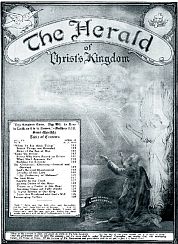
VOL. XVI April 1, 1933 No. 4 VOL. XVI April 1, 1933 No. 4 The Last Supper"For as often as ye eat this bread, and drink this cup, ye do shew the Lord's death till He come."-1 Corinthians 11:26. TO ALL true disciples of Christ, Israelites indeed, the anniversary of our Lord's death recalls the most sacred and hallowed memories. The sacrificial death of the Son of God occupies the center of God's redemptive purposes. Its commemoration in the observance of the Lord's Supper, is not only eminently proper, but most refreshing and uplifting spiritually, as the mind contemplates afresh those blessed truths related to this most sacred occasion. The Passover was and yet is amongst natural Israelites, one of the most important of their religious observances. It was the first feature of the Mosaic Law given them as a typical people. Thus redemption by blood is seen to occupy a prominent place comparatively early in the history of our race; and the philosophy of the Atonement characterizes the entire Book of the Divine Revelation. As another has remarked: "God's many mercies to His redeemed, in the display of His power, the patience of His love, and the riches of His grace, flow from it. The great question of Israel's relationship to God is settled by the blood of the Lamb. It changes their condition entirely. Israel within the blood-sprinkled door-posts was God's redeemed, blood-bought people. "God being holy, and Israel guilty, no happy relationship could exist between them till judgment had been accomplished. Sin must be judged. A happy friendship once existed between God and man, on the ground of innocence; but sin having entered and snapped the link asunder, there can be no reconciliation, but through the full expression of the moral judgment of God against sin. We can only have 'life through death.' God is the God of holiness, and He must judge sin. In saving the sinner, He condemns his sin. The cross is the full and perfect expression of this." Christ Our Passover The ceremony of the Passover as originally instituted, is described in the twelfth chapter of the Book of Exodus. A lamb without blemish was slain, its blood was sprinkled on the door-posts and lintels of the house, while the family within ate the flesh of the lamb with unleavened bread and bitter herbs. On that night (the fourteenth of the first month, Jewish time) because of the sprinkled blood and the eating of the lamb, the first-born of Israel were passed over, or spared from the plague of death which visited the first-born of the Egyptians. On this account and because on the next day Israel marched out of Egyptian bondage-free-therefore, by God's command (Exod. 12:14) they commemorated it every year. Evident it is that the natural Israelite saw only the letter of this ceremony and not its typical significance or the spiritual truth represented in this prefiguration. So too, might we have been in similar darkness had not God given us the key to its meaning by inspiring the Apostle to write: "Christ our Passover is sacrificed for us, therefore let us keep the feast." (1 Cor. 5:7.) Our attention being thus called to this important truth, we find other Scriptures which clearly show that Jesus, "the Lamb of God," was the antitype of Israel's Passover Lamb and that His death was as essential to the deliverance of the Church of the First-born from death, as was the death of the typical lamb to the first-born of Israel. Thus guided by the illumination of the Spirit we come to the words and acts of Jesus at the last Passover which He ate with His disciples. It need hardly be said that God is an exact time-keeper; and the slaying of the typical lamb on the fourteenth day of the first month, foreshadowed or prefigured the fact that in the Divine Plan Jesus was to die at that time; and God, so arranged the directing of the time amongst the Jews, that it was possible for Jesus to commemorate the Passover with His disciples and Himself be displayed as the real Lamb of God on the same day. Our Lord indeed knew the import of the Passover, but His disciples knew not. He was therefore alone; none could sympathize, none could encourage Him. Even had He explained to the disciples, they could not have understood or appreciated His explanation, because they were not begotten of the Holy Spirit. Nor could they be thus begotten until they were delivered from Adamic condemnation-set free from sin by virtue of the slain Lamb, whose shed blood was to ransom them from the power of the destroyer, death. In Remembrance of Our Savior Thus alone treading the Narrow Way which none before had trod, and in which He is our Forerunner and Leader, what wonder that His heart at times was exceedingly sorrowful, even unto death. When the hour had come they sat down to eat the Passover and Jesus said unto His disciples: "With desire I have desired to eat this Passover with you before I suffer. For I say unto you, I will not any more eat thereof, until it be fulfilled in the Kingdom of God." (Luke 22:15, 16.) Doubtless He longed to have them understand how it would begin to be fulfilled a little later on that very day, by the slaying of the real Lamb. Very probably one reason why He specially desired to eat this Passover with them was, that He there designed breaking the truth of its significance to them, to the extent that they could receive it; for, "As they did eat, Jesus took bread, and blessed, and break it, and gave to them, and said, Take, eat; this is My body." (Mark 14:22.) "This is My body which is given for you: this do in remembrance of Me." "And He took the cup and gave thanks, and said, Take this, and divide it among yourselves. . . . This cup is the new testament in My blood, which is shed for you."-Luke 22:17-20. It is obvious that the design of the Master was to call their minds from the typical lamb to Himself, the Antitype, and to show them that it would be no longer proper to observe a feature of the Law which He was about to fulfill. The bread and fruit of the vine were to be to them thereafter the elements which as remembrancers of Him, would take the place of the typical lamb. Thus considered, there is force in the Master's words, "This do in remembrance of Me." No longer kill a literal lamb in remembrance of a typical deliverance, but instead, use bread and fruit of the vine, representatives of My flesh and blood, the basis of the real deliverance, the real passing over. Hence, let as many as receive Me and My words henceforth "do this in remembrance of Me." Thus our Lord instituted His Supper as the remembrances of His death and as a substitute for that pictorial Passover Supper as observed by the ancient Israelites. Is it asked why Jesus ate of the typical lamb first? The answer would be that He was born under the Law, and must observe its every requirement. Since He at Calvary fulfilled the Law, that Covenant is therefore no longer in force to any who are in Christ and who are thus inducted into the new order, namely the call to joint-heirship with Christ that has been in operation throughout this Gospel Age. Until He Come Perhaps it would be difficult to determine just when or why this impressive season for the commemoration of our Lord's death began to be ignored. But it was doubtless as a matter of expediency, resulting from that compromising spirit which early began to mark the great apostasy or falling away which the Apostle Paul foretold. Christian people generally, judging mostly from the varied practice of the popular churches with regard to it, suppose that it really makes little or no difference when the Lord's Supper is celebrated; and under this impression, without much thought or examination, they interpret the words of the Apostle in 1 Cor. 11:26, "As often," to mean an indefinite time. A careful study of the context, however, gives conclusive evidence that this was not the case, but that a definite time was referred to. He tells the brethren (verse 23) that he delivered to them that which he also received of the Lord: "That the Lord Jesus the same night in which He was betrayed took bread," etc. Here we notice not only that the time selected by Jesus seemed the most appropriate, but that it was so appropriate that the Apostle was informed by special revelation of the Lord that this was. instituted the night He was betrayed. The seeming custom of breaking bread on the first day, perhaps had its rise in the fact that the disciples were few and came sometimes long distances to meet together, and -socially ate their meal together. Perhaps too a blessed association- of thought and interest lingered round the breaking of bread on the first day, when they remembered how repeatedly Jesus manifested Himself to them after His resurrection, on that day, and how it was while they were eating that He made Himself known. (Luke 24:35, 43: John 20:19; 21:12.) Yet even the faint traces of this once established custom in the Church of celebrating the anniversary of the Lord's death and resurrection,. which the Roman Catholic and Episcopal Churches still observe, after an accommodated fashion, on Good Friday and Easter Sunday, has been almost lost sight of by others. It has been the custom of a goodly number of devout and earnest disciples of Christ in modern times, to "do this" in remembrance of our blessed Master's death on its anniversary. Since it properly takes the place of the Jewish type, we reckon it according to the Jewish or Lunar time; and hence generally on a different date from "Good Friday," and Easter, which, following the same method of reckoning, but not exactly, commemorates the Friday and Sunday near the actual Lunar date. The Lord's Supper anniversary this year according to the reckoning of the Jewish calendar, will be on Sunday evening, April 9th. Monday afternoon following being the anniversary of the crucifixion; and the Passover festival week as observed by Hebrews commencing six p.m. of that date, which would mark the beginning of Nisan 15. The teaching of the Apostle Paul in 1 Car. 11:26, is not that we should discontinue this simple and impressive ordinance as soon as we learn of His glorious Advent. Since it is a calling to mind of these facts and an annual reminder and renewal of our covenant of sacrifice with Him, it is eminently proper that it should be observed until "He come," in the sense of the complete glorification of the entire Christ, until in this time of His presence we are changed to His glorious likeness -- until we drink the new wine of joy with Him in the Kingdom of God. - Matt. 26:29. The Import of the Emblems Concerning the bread Jesus said, "It is My flesh"; that is, it represents His flesh, His humanity which was broken or sacrificed for us. Had He not sacrificed Himself for us, we could never have had a resurrection from death, to future life; as He said, "Except ye eat the flesh of the Son of Man . . . ye have no life in you." (John 6:53.) Not only was the breaking of Jesus' body thus to provide the Bread of Life, of which if a man eat he shall never die, but it also opened the Narrow Way to life and broke or unsealed and gave us access to the truth, as an aid to walk the Narrow Way which leads to life. And thus we see that it was the breaking of Him who said, "I am the way, the truth, and the life; no man cometh unto the Father but by Me." Hence, when we eat of the broken loaf, we should realize that had He not died-been broken for us-we should never have been able to come to the Father, but would have remained forever under the curse of Adamic sin and in the bondage of death. Furthermore, the bread was unleavened. Leaven is corruption, an element of decay, hence a type -of sin, and the decay and death which sin works in mankind. This symbol then declares that Jesus was free from sin, a Lamb without spot or blemish, "holy, harmless, undefiled." May we then appreciate the bread as pure, unleavened, and so eat of Him; eating and digesting truth and especially this truth; appropriating by faith His righteousness to ourselves we realize Him as both the way and the life. In our showing forth the Lord's death in this, the way appointed (1 Cor. 11:26), we may not improperly associate in our minds two additional thoughts of great beauty and solemnity: (1) Our consecration to be "dead with Him" (Col. 2:20), even as we remember the Apostle's words, "if we be dead with Him, we shall also live with Him" (2 Tim. 2:12), and (2) the oneness of spirit which obtains between fellow-members of the Christ company. On Our Way to God The fruit of the vine fitly represents the life given by Jesus, the sacrifice-the death-"this is My blood [symbol of life given up in death} of the New Covenant, shed for many for the remission of sin"; "Drink ye all of it." (Matt. 26:27 28.) It is by the giving up of His life as a ransom for the life of the Adamic race, which sin had forfeited, that a right to life comes to men. (Rom. 5:18, 19.) Jesus' shed blood is the "ransom for all"; and the dominant idea of our "feast" is this fact and the benefits which as consecrated believers we derive therefrom; but in addition we may remember also and rejoice in the fact that we may (indeed we have covenanted, have we not? to) drink of His cup, even as (though beyond their then understanding) He spake to His close disciples: "Ye shall indeed drink of My cup." (Matt. 20:23.) Verily this is a "high calling" (Phil. 3:14), and well might we question our ability to drink (unaided) of His cup. But our sufficiency is of God, and so with the Apostle we too count all things loss, that we may know the power of His resurrection, the fellowship of His sufferings (Phil. 3:10), not repining, but all the more rejoicing at any evidence which may come to us that the sufferings of Christ may be abounding in us.-2 Cor. 1: 5. With regard to our second additional thought-that of the oneness of spirit possessed by fellow-members of "His Body," the Church (Eph. 1:23), how close to the heart of our Lord does this thought bring us when we recall that it was just about the time when He instituted this "remembrancer" that he offered that matchless intercessory prayer on our behalf, that is recorded in the 17th chapter of John: "That they all may be one." (Not His close disciples only, but us also, who have since believed.) "As Thou, Father, art in Me, and I in Thee, that they also may be one in us." (John 17:20, 21.) What thoughts are these, which just before His passion our Lord entertained with regard to His consecrated followers! What grand and noble hopes respecting the mutual love, the sympathy, affection, and interest which should prevail amongst the members of this "one Body" of our Lord! Let us then, beloved in Christ, as we surround the table to commemorate our Lord's death, call to mind the meaning of what we do; and being invigorated with His life, and strengthened by the Living Bread, let us drink with Him into His death and be broken in feeding others. "For if we be dead with Him we shall live with Him; if we suffer we shall' also reign with Him."-2 Tim. 2:11, 12. Dwelling upon this scene the words of another are appropriate here: "We have tasted, through grace, the cleansing efficacy of the blood of Jesus; as such it is our privilege to feed upon His adorable Person and delight ourselves in His 'unsearchable riches'; to have fellowship in His sufferings and be made conformable to His death. Oh! let us, therefore, be seen with the unleavened bread and bitter herbs, the girded loins, the shoes and staff. In a word, let us be marked as a holy people, a crucified people, a watchful and diligent people-a people manifestly 'on our way to God'-on our way to glory-'bound for the Kingdom.' May God grant us to enter into the depth and power of all these things; so that they may not be mere theories in our intellects-mere principles of Scriptural knowledge and interpretation; but living, Divine realities, known by experience, and exhibited in the life, to the glory of God." Those Privileged to Partake It is left open for each to decide for himself whether. he has or has not the right to partake of this bread and this cup. "But let a man examine himself," says the Apostle, let him see to it that in partaking of the emblems he realizes them as the ransom-price of his life and privileges; and furthermore, that he by partaking of this is pledging himself to share in the sufferings of Christ and to be broken for others; else, otherwise, his act of commemoration will be a condemnation to daily life before his own conscience-"condemnation to himself." Through lack of proper appreciation of this remembrances and the profound truths which it so beautifully symbolizes, the Apostle says, "Many are weak and sickly among you and many sleep." (1 Cor. 11:30.) The truth and logic of this remark are most obvious: a failure to appreciate and a losing sight of the sacred truths represented in the Supper are the cause of the weak, sickly and sleepy condition that is often to be observed in the Church. Nothing so fully awakens and strengthens the saints spiritually as a clear appreciation of what their Master has done for them, of His ransom sacrifice and of their share with their Lord in His sufferings and sacrificial experience. May we all then realize afresh the solemn import of the Apostle's admonition, "Let a man examine himself, and so let him eat of that bread and drink of that cup." The Great Unselfishness"For their sakes I sanctify Myself, that they themselves also may be sanctified in truth."-John 17:19, R. V. CHRIST'S great unselfishness and the super, abounding power of His love, impress and inspire the true disciple perhaps above everything else to be found in the sacred narrative of the Savior's life. Throughout His ministry He was constantly giving the most convincing evidences of His own self-renunciation and of His love for men. "I came not to be ministered unto," He said, "but to minister unto others and to give My life a ransom for many." He made use of the closing hours of His life, not in bemoaning the fact of the seeming misfortune and defeat that were so soon to overtake Him, but, in deep and compassionate consideration for His disciples and their welfare. In His prayer to the Father He affirms again and again His harmony with the Divine will and His solicitude for those whom the Father had given Him. "For their sakes I sanctify Myself, that they themselves also may be sanctified in truth." Some one has declared this to be "the most precious fragment of the past." "The R. V. margin substitutes the word consecrate for sanctify; and it probably conveys a better meaning, because devotion to the will of God is prominent, rather than the holiness of personal character. Devotion to God's will is the primary thought suggested by the word; but of course it involves a blameless and spotless character. Thus we might read the words, 'For their sakes I consecrate Myself, that they also may be consecrated in truth.' Through the dim twilight the Lord clearly foresaw what was awaiting Him-the agony and bloody sweat, the cross and passion, the forsakenness and travail of His soul. The cross with outstretched arms waited to receive Him; the midnight darkness to engulf Him; the murderous band to wreak their hate on the unresisting Lamb-and yet He flinched not, but went right forward, consecrating Himself.
The Subjects of Christ's Solicitude "In the earlier verses the Lord speaks of Himself, of His finished work, of the glory which He had left, of that to which He went; asking only that He might be able to glorify the Father in every moment of His coming sorrow (1-5). "Then He launches Himself on the full current of intercession, and pleads for those who had been given to Him, as distinguished from the world of men out of which they had come. Evidently the same thought was in His mind as inspired His words in John 10, when He spoke of the sheep whom the Father had given to Him, that He might give them eternal life (27-29). And it may be that each of these two utterances was inspired by older words yet, that Zechariah had addressed to the poor of the flock when he cut asunder his two staves, Beauty and Bands. (Zech. 11:7-14.) "The underlying conception in all these passages seems to be that the Father has entrusted to the special keeping of Jesus certain elect spirits having an affinity to His nature, and who should stand in the inner circle to Him because associated with Him from high redemptive purpose. All souls are God's by right of creation, and all are included in the redemption wrought on the cross; but not all had been included in the Divine gift of which Jesus speaks, 'Thine they were, and Thou gayest them Me. .. . "What are the marks, then, that we belong to the inner circle of the given ones? They are these -- "l. That we have come to Him (John 6:37). "2. That we hear His voice, listening for the slightest indication of His will (John 10:27). "3. That we follow His steps through the world. "4. That we receive His words and believe that the Father sent the Son to be our Savior. "5. That the world hates us (Ver. 14). "Wheresoever these marks are present, they indicate the hand of the Great Shepherd and Bishop of souls; and though we be amongst the most timid and worthless of the flock, He is pledged to keep us so that none shall snatch us from His hand, and to conduct us through the valley of the shadow to those dewy upland lawns over which He will lead us for evermore." That They Might be Consecrated And what was the burden of the Master's great solicitude? Not that His disciples should be spared the pains, sorrows, and distresses of the present life; not that their way should be made easy and free from adversity now. All consideration for temporalities "pales in the presence of His intense desire that they should be consecrated, that is, inspired by the same consuming passion as was burning in His heart. He knew that He was no more in the world. High business connected with its interests summoned Him to the far country, whither He went to receive the Kingdom and return. But He desired that the passion which filled His soul, His tears, His prayers, and to some degree, His sufferings, might always be represented amongst the sons of men, might be embodied in human lives, might find utterance through human lips. He could not Himself perpetuate His corporeal, visible ministry among men; and therefore desired with a great desire that those whom the Father had given Him should evermore show the Lord's death till He come'-not simply by gathering at His table, but by going forth to live His life, and to fill up that which is behind of His suffering.... "For all those whom the Father had given Him He pleaded with His dying breath that they should be consecrated; and if you are not consecrated-if there are extensive reserves in your life, if you are holding back part of the price, if you are saying of aught that you have, It is my own, I shall do as I choose-then understand that you are in direct conflict with Christ's purpose and prayer. He asked that you might be consecrated; and you have chosen to regard consecration as the craze of the fervid enthusiast." The method employed by the Savior to secure the complete consecration of His servants was that of the constraining power of His own example-"Leaving us an example, that ye should follow in His steps." "He that saith he abideth in Him ought himself also so to walk, even as He walked." Earlier in His ministry the unselfishness and simplicity of the Master's prayers had deeply impressed the disciples and appealed to them. They longed to be able to pray as He prayed and so made the request, "Lord, teach us to pray." The example of the Great Teacher had its constraining influence. "They had come within the powerful attraction of His Spirit. Like a swift current it had caught them, and they were eager to emulate Him. The Father had Consecrated the Son "It is impossible for the saint to gaze long on the stigmata without becoming branded with the marks of Jesus; impossible to see Him hastening to the cross without being stirred to follow Him; impossible to behold the intensity of His purpose for a world's redemption without becoming imbued with it; impossible to see Him in love with the cross without feeling a similar infatuation. And it is impossible to behold Him plunging into the dark floods of death that He might emerge in the sunlit ocean, without the consciousness of the uprising of an insatiable desire to be like Him, to drink of His cup, and be baptized with His baptism, to fall into the ground to die that He may not abide alone, to know the fellowship of His sufferings and conformity to His death, that He may appoint unto us a Kingdom, as the Father bath appointed to Him.... "Consider for a moment a remarkable expression that casts light on this whole subject. In that memorable discussion with the Jews in Solomon's porch, which practically closed our Lord's public ministry, He said that the Father had sanctified and consecrated Him and sent Him into the world (John 10:36) . . . . Was it the same moment, think you, as that in which Jesus said, 'Sacrifice and offering Thou wouldest not, but a body Thou hast prepared Me [or, Mine ears hast Thou pierced]. I delight to do Thy will, O My God'? If so, what an august scene that must have been when, in the presence of the assembled hierarchies of heaven, the Father solemnly set apart the Son for His redemption work; consecrating Him to bring in everlasting salvation, to destroy the works of the Devil, and to bring together in one the children of God that are scattered abroad! All the Members Included "In that solemn consecration of the Head all the members were included. The King stood for His Kingdom; the Shepherd for His flock. Any who refuse to be consecrated contravene and contradict that momentous decision. "When Christ approached His death, in these words [John 17:19} He renewed His act of consecration, and again implicated those who belong to Him; bearing us with Him, He went to the cross; involving us by His action, He yielded Himself up to death. In His holy purpose we, were quickened together with Him, and raised up together, and made to sit together in the heavenly places; and by the same emphasis with which we declare ourselves to be. His, we confess that we are amongst those who are bound to a life of consecration. We are pledged to it by union with our Lord. We can-' not draw back from the doorpost to which He was nailed without proving that we are deficient in appreciating the purpose which brought Him to our world, the surrender that withheld not His face from spitting, His soul from the shadow of death." Finally, back of the Master's great solicitude for the consecration of His followers, was the deep desire that they might secure the imperishable riches of the heavenly court and that they might be ultimately fitted to be the bearers of unspeakable mercy and grace to the multitudes of men. If Jesus thought, cared, and prayed so much for those whom the Father had given Him, His deep and ulterior thought was that the world might believe that the Father had sent Him and that it might also share, though to a lesser degree, in the results and benefits that center in the great redemptive purpose that He came to work out.
The Christian's Conflict"Set your affection on things above, not on things on the earth. For ye are dead, and your life is hid with Christ in God." - Col. 3:2, 3 NO MORE important instructions in the Word of the Lord for the Christian, are there than those that relate to the proper directing and setting of the heart, its desires, affections, and purposes on the Lord and upon the things that appertain to the future eternal inheritance. "Keep thy heart with all diligence," says the Word of Wisdom, "for out of it are the issues of life." And experience confirms the saying of Jesus, "Out of the abundance of the heart the mouth speaketh." St. Paul, addressing those who have accepted the Master's call to forsake all and follow Him, and such as have experienced the power and blessing of the Spirit and have realized its begetting influence, admonishes, "Set your affection on things above." It is of course understood that none could really be expected to exercise an interest in the things above or set his affections upon things that are beyond the present life, unless he already has some definite understanding and knowledge of, as well as faith in those things. Because the Lord has called out of the world those who are to constitute the New Creation, His "Body," His "Bride," to share with Him His spiritual, heavenly glories and honors, they should ever keep in mind what they are living for, and what their obligations are, and should strive for those things that are above and are eternal. Invited to run the Christian race course and seek for the crown of life. immortality, the follower of Christ recognizes that it remains for him to make his calling and election sure. Again the Apostle reminds us, "Let us fear lest a promise being left us of entering into His rest [the heavenly rest] any of you should seem to come short of it. The Natural Man and His Heritage It is important to have continually in mind the sharp distinction which the Scriptures draw between the natural man, the earthly creature, and the heavenly, minded new creature. The natural man, however well intentioned and disposed, is of the earth earthy. This, however, does not signify that he must be sensual, degraded and devilish; for to the contrary, some natural men have what are in some respects very fine characters indeed, considering that they are sharers with all mankind in the degradation of the fall. It is remembered that the first man was a natural man in his perfection, in the image of God. He could not set his affections on things above, for he had no revelation respecting them, no hope or prospect centering there, and no invitation to look in the direction of a heavenly inheritance. His interests, in harmony with his perfect nature were earthly. So it will be with humanity in the future Age. While the human race under the blessings of restitution will experience the full lifting up to the perfection of manhood, and while all the willing and obedient will be reverencing the heavenly laws, messages, authorities, etc., they will properly enough be giving their thought and attention largely to earthly things-appreciating especially all the glory and grandeur of Paradise restored which will then become their permanent inheritance. Our Hope-the House not made with Hands How different it is with those who share the heavenly call and privileges of this dispensation! We read nothing in the New Testament messages, which were given under the influence of the Spirit, of the Church entertaining the hope of an earthly paradise or home. Ever and always the thoughts and affections of those walking in the footsteps of Christ are directed upward and toward a higher heritage than anything that the natural man can conceive of. Truly, as Jesus recognized that He was to be given a portion with the great, even to be seated with the Father in His throne, so He assures His disciples that they were not to be of the human plane and nature, that they were not of the world, even as He was not of the world. He spoke of the Father's house of many mansions and of the place that H. was going to prepare for those who would be faithful to Him; that He would return again for the purpose of claiming these and of taking them to be with Him as His intimate and very close associates throughout eternity. Hence it was this, doubtless, that the Apostle had in mind as he exhorted Christians to whom he ministered that they earnestly endeavor to set their affections upon those things that appertain to their relationship with the Lord and the blessed home that He has gone to prepare for His followers. It is in connection with the carrying out of his consecration vows to be dead to earthly things and to be alive to spiritual or heavenly things that the Christian realizes his warfare and conflict in the Narrow Way. And in order that he may wage a successful warfare, he is exhorted to fight a good fight of faith; that is, to exercise faith in connection with all his efforts and strivings, ever believing that He who has promised is faithful and will bring to pass all that He has agreed to in His Holy Word. The Apostle forewarns the Christian that he must not be unmindful of the fact that though he is regarded by the Lord and by himself and by the brethren as dead according to the flesh and alive according to the Spirit, he has nevertheless this treasure of the new life in the earthen vessel, which is to be reckoned or considered dead, but which actually is very much alive and constitutes his chief enemy. Not that there are really two egos or two wills in those who are properly following Christ; for as another Apostle warns, "the double minded man is unstable in all his ways." Those who are acceptable to the Lord in their consecration and who have surrendered all to Him, have only one will and it is fully devoted to the Lord, according to the terms of their consecration. But this one new will cannot have the new and glorious body suitable to it, until it is proved worthy of it; and then it will gain it as a reward in the resurrection. Meantime, the conflict is on between the new will (which has no body of its own kind) and the old flesh (which has no will of its own kind). In order to be a conqueror or overcomer the new will must struggle with the old flesh and by the Lord's assisting grace keep it under, in subjection, until the end of the course, until literally dead. He is Able to Give Us the Victory The Apostle instructs the Church that in proportion as the heavenly or spiritual mind grows on the spiritual food, the promises of the Lord's Word-in proportion as it affiliates with others of like spiritual mind and is thus strengthened and sustained by the Holy Spirit granted to all such, they grow stronger and stronger for their conflict with the various adverse elements, the world, the flesh, and the Evil One. New Creatures in Christ cannot hope to conquer the Adversary nor the world, even though they may resist them, but they are encouraged to hope for victory in their combat with the flesh. So the assurance along this line is that "if the Spirit of Him that raised up Jesus dwell in you, He that raised up Christ from the dead shall also quicken your mortal bodies by His Spirit that dwelleth in you." In other words, if the power of God was sufficient to quicken and bring back from the dead our Lord Jesus, surely He is able as well as willing to make it sufficient for us-to give us the victory over our flesh to the extent that sin need not reign in (dominate) our mortal bodies, but instead, we as New Creatures will be able to use them more and more efficiently in the service of our Lord, to whom we have rendered our all. It is evident that the new heavenly mind or will has no way of expressing itself but through the instrumentality of the mortal body; and since the latter is marked with imperfection and weakness by reason of its inheritance from the fall, the new mind has a difficult task before it to rise from the groveling things of sin and the sordidly selfish conditions surrounding everything at the present time, to the grand heights of perfect love and unselfishness inculcated by the Spirit of the Lord by which we have been begotten. Those who would truly fulfill the obligations of the Christian life realize the necessity for making heroic effort to overcome the tendencies of the flesh and the mind of the world in order that they may live in the world as not of it, but on the contrary, as spiritual, heavenly-minded ones, merely tabernacling for awhile with men in a body of flesh, far from perfect or acceptable to themselves. In view of the fact then that the tendency of the present natural body is downward and in opposition to the spiritual mind, it follows that even those who have already consecrated to the Lord need to reset or reestablish their affection on the heavenly things continually. If this were not so, the Apostle under inspiration would not have admonished the consecrated brethren of his time to set their affection on things above. For if it be true, as some have maintained, that the fight is over with and the real victory won at the time full surrender was made, and if at that time the affections and the heart were permanently and fully set upon heavenly things, there would be no need for the Apostle to admonish these to do that which had already been fully accomplished. My Soul be on Thy Guard How true it is that a little carelessness or indifference, a little looking away from the things which God has in reservation for them that love Him, a little putting of our minds and affections on earthly things, earthly hopes, earthly ambitions, earthly prospects, would readily mean great loss to us-the revival, the strengthening of the old nature and a proportionate weakening of the new, and correspondingly a great backset as respects the race we are running for the heavenly crown, the prize of the high calling in Christ Jesus. It is not any wonder then that the Apostle urges the Lord's faithful people to set their affection on the things above and not on things on earth. He was only fulfilling a Christian service in reminding the brethren of their solemn obligations along this line, and of their duty to warn others continually of the necessity for setting, fixing their affections, their minds, their hearts, more and more firmly on the heavenly things. It is with this end in view that the Scriptures have been provided as a guide to our minds, and the Throne of Grace has been opened to us that we may come there too, and obtain mercy and find grace to help in every time of need. The same gracious Provider has in these days, the last days of the Age we believe, given to the household of faith an increase of knowledge that is properly termed meat in due season whereby they may be strong in the Lord and in the power of His might. At a time when earthly things are more attractive, more alluring and seductive than ever before in the world's history, the Lord opens before His faithful ones a still clearer view of the heavenly crown, heavenly glories, honors and privileges and blessings that they thus may give the strength to the new spiritual life which will offset the seductive influences affecting them through the flesh. Helps or Hindrances-Which? There has been before us in modern times, in the advancement of art, in the increase of wealth, in the better homes and their better furnishment, in improved roads and landscape, in pictures, music, and in wider business prospects and opportunities, in the conveniences of mail, telegraph, and telephone, and in the broadcasting and receiving radio devices-in all these things there is a hundred fold more to attract our minds and visions and desires to the earth and earthly things than had our forefathers of even a century ago. How needful it has seemed to be that the Lord should open simultaneously to His faithful, a clearer understanding of His Word and purpose-of the riches of His grace and His loving kindness toward us, His wonderful provisions which eye hath not seen nor ear heard, neither hath it entered into the heart of the natural man, but which God hath revealed unto us by His Spirit. More than this, by this same word of revelation we are permitted to see that these heavenly glories are nigh, even at the door, and that the earthly joys, ambitions, and prospects under present conditions can be only transitory, and must end in connection with the great disaster that closes this Age, which will blight every earthly prospect and at the same time mean the realization of our heavenly hopes and prospects and the ushering in 'of the glorious Kingdom of God's dear Son. It is evident that indecision and lack of positiveness of will, of intention, are responsible for the majority of failures and defeats in the Christian life. Even the natural man knows something of the value of definite resolutions and positive intentions if he would accomplish any good or noble results. As Christians-as disciples of Jesus, as soldiers of the cross, followers of the Lamb, we need to have this important fact well fixed in our hearts. Jesus admonished that those who would be His disciples indeed should sit down first and count the cost. Those who delight in sin and its fruitage would not be acceptable to the Lord as members of His Bride class. He desires only those who after counting the cost-the renouncement of earthly things and ambitions, etc., in favor of the heavenly riches, do with full purpose of heart, surrender themselves wholly to the Lord, to be His henceforth at any cost, that they may win Christ and be found in Him-members of His Body. Importance of full Surrender and Self-Judgment Those who take this step of full surrender to the Lord surely do what is proper and wise, and realize a blessing; and that blessing will continue and increase in proportion as the same spirit continues to guide and control in their experiences. If one is a Christian at all his will is fixed so far as its general purpose and direction are concerned; nevertheless, this is not sufficient-for there may be a firmness, a positiveness of the will as respects the great fact of consecration, yet a general slackness as respects the details of the every-day life. The suggestion is a proper one therefore that this fixity of purpose should be extended to all the ways of life, that the words of our mouths, the meditations of our hearts, and so far as possible the acts of life may speak forth the praises of Him who has called us out of darkness into His marvelous light. Surely whoever takes this position is setting, fixing, establishing his affections, his mind, his heart on things above, and loosening them as respects things of earth. All such will grow the more rapidly, the more thriftily. But those who, even with fixity of will, rule their mortal bodies slackly, too leniently, are in danger of failing to come off more than conquerors and may receive some very severe chastening of the Lord. How much better it is that we develop this character in harmony with the Lord's Word, without the bitter experiences that come with the rod of correction; to have, on the contrary, the continued assurance of the Lord's favor and smile, encouragement and blessing upon our endeavors to set our affection on things above, to cut loose from the earthly things, and to take a firm stand in even the small affairs of life for the Lord and His cause in harmony with the directions of His Word.
The Church of GodTHE CHURCH of God on earth is not what she seems; nay, is what she seems not. She is not a beggar; yet she seems one; she is a King's bride, yet she seems not. It was so with her Lord while here. He was not what men thought Him; He was what they, thought Him not. It is in this way that the world is put to shame, its thoughts confounded, its greatness abased before God. And it is in this way that Divine wisdom gets large space over which to spread itself, step by step, and to open out its infinite resources slowly and with care (like one exhibiting his treasures), that no part, no turn in all its windings may be left unobserved. It is not the result only that God desires that we should see and wonder at, but the process by which it is reached, so unlikely to effect it, yet so steadily moving forward to its end, and so strangely successful in bringing about that end. God is showing us most minutely how "fearfully and wonderfully" all things are made, and we among the rest, in our first birth and in our second, in our natural and in our spiritual growth. In this Age of Wintry Night The tree, in winter, is not what it appears-dead; nay, it is what it appears not-alive; full in every part, root and branch, of vigorous though hidden vitality, which frosts and storms are maturing, not quenching. All summer-life is there; all fruitfulness is there; though neither visible. It wraps up within itself the germs of future verdure, and awaits the coming spring. So is it with the Church, in this age of wintry night; for it is both night and winter with her. Her present condition ill accords with her prospects. No one, in looking at her, could guess what she either is or is to be; could conceive what God has in store for her. For eye has nothing to do with the seeing of it, nor ear with the hearing of it. No one, in observing her garb or her deportment, or the treatment she meets with at the hands of men, or the sharp, heavy discipline through which she is passing, could take the measure of her hopes. Faith finds difficulty in realizing her prospects, and she can hardly at times credit the greatness of her heritage, when thinking of what she is and remembering what she has been. It often seems strange to us, and it must seem much more so to unfallen beings, that saints should be found at all in such a world-a world of atheists-a world that from the days of Cain has been the rejector of God's Son, both as the sacrifice for sin and as the heir of all things. It is not on such a spot that we should naturally expect to find sons of God. If a stranger, traversing the universe in search of God's Little Flock, His chosen ones, were to put to us the question, "Where are they to be found?" certainly he would be astonished when told that they were in that very world where Satan reigned. Would he not say, "Either this is a mistake and a chance, or else it is the very depth of unfathomable wisdom." For we do not go to the crater's slope for verdure; nor for flowers to the desert. Yet it is so with the Church. It is strange, perhaps, to find a Joseph in Egypt, or a Rahab in Jericho, or an Obadiah in the house of Ahab, but it is more amazing to find saints in the world. Yet they are here. In spite of everything ungenial in soil and air, they are here. They never seem to become acclimatized, yet they do not die out, but are ever renewed. The enemy labors to uproot them, but they are ineradicable. Nay, they thrive and bear fruit. It is a miracle; but yet so it is. Here the great Husbandman is rearing his plants from generation to generation. Here the great Potter fashions His vessels. Here the great Master-builder hews and polishes the stones for His eternal temple. Thus, then, one characteristic of the Church is the unlikeness of her present to her future condition. It is this that marks her out, that isolates her, as a gem in the heart of a rock, as a vein of gold in a mine. Originally she belonged to the mass, but she was drawn apart from it, or it fell from her and left her alone, like a pillar among ruins. Outwardly she retains much of her former self; but inwardly she has undergone a change that has assimilated her to "the world to come." Thus her affinities and her sympathies are all with that better world. Her dwelling is still here, and in her external appearance she is much as she used to be; but the internal transformation has made her feel that this is not her home, and filled her with anticipations of the City and the Kingdom to come, of which she has been made the heir. Her kindred according to the flesh are here, but she is now allied to Jehovah, and this draws her soul upwards. Cut off from home and a heritage here, yet assured of both hereafter, she of necessity lives a life of anticipation. Giving credit to the message of grace, and resting on the blood of Him through whose cross that grace came to her, she anticipates her judgment. Realizing her oneness with the risen and ascended Christ, she feels as if already seated with Him in heavenly places. Looking forward to the arrival of the King, she anticipates the Kingdom. In darkness she anticipates the light; in sorrow she anticipates the joy; in the night she anticipates the morning; in shame she anticipates the glory. "'All are mine," she says, "whether Paul, or Apollos, or Cephas, or the world, or life, or death, or things present, or things to come; all are mine; for I am Christ's, and Christ is God's." In these anticipations she lives. They make up a large portion of her daily being. They cheer her onward in spite of the rough waste she has to pass through. They comfort her; or when they do not quite succeed in this, they 'at least calm and soothe her. They do not turn midnight into noon, but they make it less oppressive, and take off "the night side of nature." "I am not what I seem," she says to herself; "and this is joy. I am not the beggered outcast that the world takes me for. I am richer far than they. I live in the future; my treasure is in heaven, and my heart has gone up to be where my treasure is. I shall soon be seen to be what I now seem not. My Kingdom is at hand; my sun is about to rise; I shall soon see the King in His beauty; I shall soon be keeping festival, and the joy of my promised morning will make me forget that I ever wept." Thus she lives in the morning ere the morning has come. She takes a wide sweep of vision, round and round, without a limit; for faith has no horizon; it looks beyond life, and earth, and the ages, into eternity. Beyond the death-bed and beyond the grave, she sees resurrection. Beyond the broken hearts and severed bonds of time, she realizes and clasps the eternal lovelinks; beyond the troubles of the hour, and beyond the storm that is to wreck the world, she casts her eye, and feels as if transported into the Kingdom that cannot be moved, as if already she had taken up her abode in the New Salem, the city of peace and righteousness. Beyond the region of the falling leaf she passes on to the green pastures and sits under the branches of the tree of life which is in the midst of the paradise of God. Losing sight of the bitterness of absence from the Beloved of her heart, she enters the bridal chamber and tastes the bridal joy; keeping- festival even in the desert, and enjoying the Sabbath rest amid the tumult of a stormy world.-H. Bonar. ''Acquaint Thyself with Him''
Our Living Lord"I am He that liveth, and was dead; and behold, I am alive for evermore, Amen; and have the keys of hell and of death."-Rev. 1:18. NO WORDS have fallen on mortal ear, of equal tenderness and consolation, to those uttered by our Savior as He approached the home bereft of a loved one in Bethany: "I am the resurrection and the life, he that believeth in Me though he were dead yet shall he live; and he that liveth and believeth in Me shall never die." Indeed the kernel of the entire message to our race is contained in this all comprehensive statement of the Son of God; and, this good tidings of the hope of life by a resurrection of the dead, constitutes the all inspiring theme of the Bible. The message in other words is that our Father in heaven has vested in His well beloved and only begotten Son, the power of the resurrection, giving Him as He said in His last message to St. John, "the keys of death and hades," symbolical of the power and authority to unlock the prison-house of death and to set free all its captives. The Savior's words as He walked amongst men, are in full confirmation: "The hour cometh in which all that are in the graves shall hear the voice of the Son of God and come forth." Our Strong Consolation The Apostle Peter speaking under inspiration on the day of Pentecost affirmed that it was not possible that Christ should be holden of death, the reason being that He had fulfilled to the complete satisfaction of His Father, all requirements up to the time of His death. Accordingly, He had provided the price of man's redemption, and there was at the same time the attestation of His own fidelity, and of His worthiness oL so high and so great exaltation and glory as that which He now enjoys, "in the express image of the Father's person." The same Justice which had operated for four thousand years against creation on earth because of transgression, was now operating on behalf of Jesus for His deliverance from death into which He had voluntarily gone as man's ransom price. We are mindful in this connection of the Apostle's affirmation that we have a strong consolation, who have fled unto Jesus for refuge and we realize in Him an anchor to the soul, both sure and steadfast. The basis for this sweet consolation furthermore is found in the fact that the Father's character .is unchangeable; and that our Savior's resurrection becomes an evidence, or as the Apostle says, an assurance of the carrying out of every feature of the Divine program, all of which centered in Him and was made dependent upon His faithfulness unto death, even the death of the cross. As we turn back the great clock of the ages and take our position with those disciples who had witnessed the tragic scenes associated with our Lord's last 'hours, as we behold them disheartened and crushed in spirit, we can yet understand that they realized great events were transpiring, though how great and momentous was their character they but slightly comprehended. They realized truly that their hope as respected an earthly kingdom and their Master as the earthly Lord, had failed. Doubtless however, they had a vague, indefinite hope that all He had said to them would in some manner have a fulfillment, but how or when or where, was beyond their conception, as they knew nothing as yet about spiritual things, not having had the anointing of the Holy Spirit to sonship and to the knowledge of things to come, for Jesus had not yet shed forth upon them that Spirit from above. The Risen Lord Carefully observing and at the same time connecting the various accounts of the morning of Jesus' resurrection, it appears from Mark 16:1, that Mary Magdalene was one of the first at the sepulchre while it was yet dark; and with her were Mary, the mother of James, and Salome, and Joanna, the wife of Chuza, Herod's steward. (Luke 24:10.) On their way they had been wondering who would roll away the stone from the mouth of the sepulchre that they might enter with their spices to complete the embalming work which was discontinued two evenings before, because of the Jewish Sabbath then beginning. To their surprise, the stone was already rolled away. They tarried awhile, wondering, and then in the dim light they perceived that the Lord's body was not there. Perplexed by their further loss, Mary hastened to the home of John, with whom Peter was lodging and related these facts. The two Apostles ran to the sepulchre, John the younger outrunning Peter, arrived there first. But by this time the other women had departed to communicate the news to the other disciples. Awe-stricken, John had stooped down and looked in, but Peter, on arrival, still more courageous, went in, followed by John. They found things as Mary had described them, the body gone, the linen clothes there. Troubled and perplexed they went their way. Although the indication is that they both believed, their belief was not that the Lord had risen, but that Mary's story was true, that His body had been removed, "for as yet they knew not the Scripture that He must rise again from the dead." Mary returned to the tomb, filled with sorrow; she was weeping and saying in her heart, They might at least have left us the body of our Lord. She looked again into the sepulchre. Ah, now she saw something different. Two angels were present, who said, "Why weepest thou?" intimating that there was no cause for weeping, and thus no doubt helping to prepare Mary for the next step of our Lord's revealment. A noise, or perhaps a shadow, called her attention backward and she saw a man who she supposed was the gardener. She appealed to him: Sir, if you have borne Him hence, tell me where you have laid Him and I will see that you are not further troubled in the matter, for myself and His other friends will care for His remains. Then Jesus who had hidden His identity by appearing in another form, like a gardener, in different clothing from that which was counted amongst the soldiers, and different also from that in which He had been shrouded, revealed Himself through the tone of His voice, which she so well knew, uttering her name only-"Mary." In a moment the truth flashed upon her mind and she cried, "Rabboni," my Master, my Lord! With us as with Mary, sorrow sometimes fills our hearts and we see not the streams of joy and everlasting blessings which the Lord has for us; not until we hear His voice, His words, do we appreciate the truth. But all who know the Master truly know His voice, know His message, know His spirit, His disposition; as He Himself expressed it, "My sheep hear My voice and they follow Me, they recognize not the voice of strangers." John 10:5. "I am not yet Ascended" In her ecstasy and overjoyed state of mind, Mary was apparently about to grasp the Lord. Her thought evidently was, This is a vision, which will pass away and I will see my Lord no more; I will hold Him tight; where He is I must be. But Jesus taught her otherwise and the lesson is a good one for us also. He would have her remember that He had already said, "It is expedient for you that I go away." Why then, should she detain Him? Besides she was not ready to go with Him, she had lessons to learn, experiences which were to still further develop her character, to fit and prepare her for the Kingdom blessings. He must go, she must stay; she must learn submission, confidence in Him, and have a realization that He is able to make all things work together for good to those who trust Him. Our Lord gave Mary a message for the Apostles, a service she could render Him and them, and intimated that He would have her engaged in that service, that she should be exercising faith and accepting Divine providence and hastening to spread the good tidings of His resurrection to others. The spiritual lesson to us seems obvious; we too have heard of the death and resurrection of Jesus and additionally have learned of God's grace through Him, and it is our privilege to carry the Message to all the brethren wherever they may be, to all who have the hearing ear. Our Lord's declaration, I have not yet ascended to My Father and your Father, to My God and your God, emphasizes the fact that He went not to heaven when He died, but into the tomb, into the state of death, even as the Prophet had declared of Him that He should pour out His soul unto death, that He should go into the great prison-house Himself, in order to accomplish the great redemption and to burst asunder the bars of death. The Master's words to Mary further emphasize also the fact that He is our Elder Brother, our Forerunner into the Father's presence and into the glories which God has in reservation for all those that love Him, and whose loving devotion prompts them to follow in the footsteps of Jesus at any cost, along the rugged Narrow Way. Resurrection Joys The lessons that were to be learned by the Lord's immediate followers were necessarily much more difficult to them than to those who now come under the spiritual illumination and are thereby enabled to appreciate things from the standpoint of the Spirit. To meet the exigency it was necessary that our Lord as a spirit being should be present with them for forty days, invisible, as spirit beings are always invisible to men unless through the operation of a miracle they assume physical or material bodies. It was necessary for them to know of His resurrection in order that they should have faith in His Message and act accordingly as He desired. Yet had He appeared to them in the glory of His Spirit, opening their eyes to see the supernatural splendor as He showed Himself in vision to the Apostle Paul on the way to Damascus, when the glory of His person shone above that of the noonday sun, its effect would have been to terrorize them, and their natural minds would have been unable to link such manifestations with their Lord, recently crucified. Neither would He have had opportunity under the circumstances to give them instructions for they could not have received them by reason of terror. It was necessary therefore that our Lord, a spirit being, should manifest Himself as He had in the long past revealed Himself to Abraham and Sarah, and as angels under Divine commission had done on sundry occasions as a man. (Gen. 18:1.) He must lead their minds step by step and their thoughts link by link, from the cross and tomb to an appreciation of His present exaltation as a spirit being, respecting which He Himself explained to them, contrasting it with His previous condition, "All power in heaven and in earth is given unto Me." And this leading of their minds must be such as would gradually force upon them the conviction that He was "changed," that He was no longer a man and no longer subject to things terrestrial as before His death. The unfolding of the Divine purposes in connection with the death and resurrection of Christ makes manifest indeed that He is the greater Seed of Abraham, of whom Isaac was but the type; that He is the antitypical Seed approved of God through whom all the families of the earth, all humanity, are to be blessed. Now it becomes most clearly manifest that the Church of this dispensation is invited to be the Bride, the Lamb's Wife, just as Rebecca was called to be the bride of typical Isaac, and to be His joint-heir in the Kingdom and joint participator with Him in fulfilling the promises and the oath of God made to Abraham. The First-fruits of Redemption Thus the words of inspiration assure us that Christ is the "First-fruits of them that slept," which signifies that none preceded Him in the resurrection power and blessing. He was the first to experience the complete lifting out of the death condition. It was eminently logical and proper that He should be the first to experience the completeness of the resurrection in view of the fact that all others were condemned and must wait to receive their resurrection through Him. Further, ever since His ascension our Lord has been seated on the right hand of the Majesty on High, which signifies that He there entered into a glory of office-with the Father in His throne, according to the Divine promise. Those who shall be found worthy to be of the faithful Church of Christ, His Body, will be given a share with Him in His resurrection; in other words, they will be of the "First Resurrection," together with Christ. This "First Resurrection" in which the Church shares, is to be a complete and instantaneous lifting out of the state of death, into the perfection and completeness of the life and glory of the Divine nature, even as this is the reward promised to them who follow in the footsteps of Jesus, His joint-heirs. In what high and exalted terms are these referred to in the closing passages of the Revelation: "Blessed and holy is he that hath part in the First Resurrection." They shall be kings and priests unto God, "the called, chosen, and faithful" unto death. Thus the resurrection of the Christ began with the resurrection of our Lord and will be consummated with the change of the last member of the Church which is His Body. "Christ, the First-fruits," will then be complete. But this will not consummate the Divine Plan, for it is God's intention to have the after-fruits, a great harvest which will be gathered during the victorious reign of Messiah's Kingdom. To this the Apostle refers saying, "Afterwards they that are Christ's during His parousia." Our Lord's presence will continue for a thousand years; He will be present in the world for the purpose of ascertaining how many of the human family upon earth under favorable conditions of knowledge and opportunity and assistance, will be glad to go up on the highway of holiness to perfection, to full recovery out of sin and death. Then earth as well as heaven will be filled with the glory of God, when all evil-doers shall have been cut off. When Death is Swallowed up in Victory It is in connection with this grand family reunion that is to take place in the coming dispensation, as a result of the operation of resurrection power, that we are given the assurance that all mourning and sorrow and tears shall forever cease and pass away. The dreaded monsters, sin and death, are responsible for the havoc that has been wrought; responsible for all the sights of wretchedness and sorrow; for the voice of weeping that has so long been heard. But in that coming blessed time we are given assurance that there will be complete victory over the grave through the resurrection power and that He will wipe away tears from off all faces. From the remotest parts of the earth, from every land and clime, and from out the seas, the dead shall come forth, even as the poet has graphically presented:
The closing message of the Revelation declares, God shall wipe away tears from off all faces; and another has aptly remarked, "He who dries them off is God Himself. Human hands are poor at drying tears. If they succeed in removing one set, others come which they cannot wipe away. Earthly power, however good and kind, cannot go far in the binding up of broken hearts. Only the hand that made the spirit can reach the deep sources of its sorrows, or dry up the streams that issue from them. The springs of grief yield to no other potency. But then His loving Almightiness shall wipe every tear. 'As one whom his mother comforteth, so will I comfort you, and ye shall be comforted,' saith the Lord. 'Every tear,' for they be many;-tears of misfortune and poverty such as Job and Lazarus wept;-tears of bereaved affection, such as Mary, and Martha, and the widow of Nain shed;-tears of sympathy and mercy, such as Jeremiah and Jesus wept over the sins and calamities of Jerusalem;-tears of persecuted innocence, tears of contrition and penitence for faults and crimes against the goodness and majesty of heaven; tears of disappointment and neglect;-tears of yearning for what cannot now be ours;-these, and whatever others ever course the cheeks of mortals, shall then be dried forever... . The time will be when death itself shall die; not by the power of man, not by mortal skill or earthly medicines, but by the great redemption of God. When the sunlight of the new Genesis dawns upon this stricken world, the grand thanksgiving shall ring out over every zone, from the equator to the poles, that 'Death is swallowed up in victory.' Never another dying-bed shall then be seen again. Never another grave shall then be dug. For 'death shall no longer be."' Such will be the glorious finish of that blessed dominion of Him who said, "I am the resurrection and the life," for it is none other than He that will bring to pass the saying that was long ago written, "O death where is thy sting? O grave where is thy victory?" Surely the sweetest story ever told is contained in that blessed resurrection anthem, the strains of which were first heard by the shepherds on Judea's plains, and will at last constitute the grand hallelujah chorus wherein all voices in heaven and in earth will be heard ascribing glory and honor and power and dominion unto Him that sitteth upon the throne and to the Lamb forever. The Epistle of ChristALL ARE familiar with the fact that we have in our Bible, epistles or letters, by various ones of the Apostles-St. Paul, St. Peter, St. John, St. James, St. Jude. But not many perhaps, have heard of the Epistle of Christ. St. Paul tells us that it was written in his day. He describes the writing of it, how it was done, and declares that he was one of the instruments used by the Lord in connection with the writing of the Epistle. Here are his words: "Ye are manifestly declared to be the Epistle of Christ, ministered {written] by us; written not with ink, but with the Spirit of the living God; not in tables of stone, but in fleshy tables of the heart."-2 Cor. 3:3. How beautiful and poetical is the thought here expressed! It is a compliment to the Apostle as the Lord's faithful servant and also to the Lord's people at Corinth. It is in line with the Apostle's statement elsewhere, "We are God's workmanship." (Eph. 2:10.) Wherever there is a true Christian-not merely spirit begotten, but spirit-developed in the character-likeness of the Savior in meekness, gentleness, patience, longsuffering, brotherly kindness, and love-we have the evidence of the power of God at work in him to will 'and to do His good pleasure, not arbitrarily, but in cooperation with the will of the individual. And wherever there is a Church, an Ecclesia, a Class of Bible students who show these evidences of the Lord's Holy Spirit working in them and developing them, we have the Epistle of Christ, declaring and showing forth the praises of Him who called them out of darkness into His marvelous light. In the context, the Apostle gives the same-thought-in words a little different, declaring the Lord's true people to be living epistles, "known and read of all men." (2 Cor. 3:2.) Bibles are invaluable, indispensable. So are books that are really helpful in Biblical interpretation; so are hymn books and tracts. All of these show forth the Lord's praises, and assist in pointing in the right direction those of the world who are feeling after God if haply they might find Him. But the best Epistle even more valuable than the Bible, as respects reaching the hearts of men-is the life of a true Christian, a New Creature in Christ Jesus, to whom "old things are passed away, and all things are become new."-2 Cor. 5:17. The Elder brethren in the Church have in St. Paul a noble example of faithfulness and loyalty. He did not preach himself; he did not preach enticing words of man's wisdom and science, falsely so called. (1 Cor. 2:1-5; 1 Tim. 6:20.) Giving himself up to the Lord's service, and seeking not his own glory, but to do the Lord's will, the Apostle became more and more an able and qualified minister, or servant of the Lord. The Lord used him increasingly in the presentation of the glorious Message of God's love, as revealed in the great Divine Plan of the Ages. St. Paul's faithfulness is manifest to us in the words, "This one thing I do, forgetting' those things which are behind, and reaching forth unto those things which are before [in the promises of God's Word], I press toward the mark for the prize of the High Calling of God in Christ Jesus." (Phil. 3:13, 14.) That was the secret of the Apostle's power. That is the reason why the Lord, by His Holy Spirit, has used him so much and so efficiently in the blessing of the Church since that time -- through the streams of Truth which have come down through his Epistles. This should be the spirit, not only of the Elders of the Church of Christ, but the spirit of every member of it; for in a large sense each one of us is privileged to be a minister, or servant, in writing the Message of God's grace in the hearts of others. But let us not forget that we shall not know how to write in the hearts of others what we have not already had written in our own hearts. And what is the Message, what is the Epistle, that is written in our hearts by the Holy Spirit through the various agencies? Is it the knowledge of chronology? Is it the unraveling of types and- shadows? Is it the cracking of hard theological nuts in respect to differently understood passages of Scripture? Is it the knowledge of the history of the Jews, the history of the world, the history of the Church? Is it the understanding and appreciation of the different Covenants, past, present, and to come? No, it is none of these. All of these subjects have more or less of value, and are more or less used of the Lord in connection with this writing that is to be done in the hearts of His people. But writing the Epistle of Christ is different -- the writing, the tracing of the character-likeness of the Master in the hearts of His people-His meekness, His gentleness, His patience, His longsuffering, His brotherly kindness, His love, His joy, His peace. We might have all knowledge respecting chronology and history, might be able to quote every text in the Bible and cite it, too; and yet not have the Epistle of Christ written in our hearts. It is the Epistle of which the Apostle Peter says, "For if these things be in you, and abound, they make you that ye shall neither be barren [idle, inactive] nor unfruitful in the knowledge of our Lord Jesus Christ"; for knowledge will have its place. And thus with these characteristics of the Master deeply engraved upon our hearts, we shall be granted an abundant entrance "into the everlasting Kingdom of our Lord and Savior Jesus Christ."-2 Pet. 1:8, 11. The three great lessons which will be required of those who will be heirs of the Kingdom are: (1) A proper, thorough appreciation of Justice and a manifestation of that appreciation of justice by an endeavor to comply with the requirements of the Golden Rule to love our neighbor as ourselves. (2) A further lesson is that of love, sympathy, compassion, mercy. However exacting we may be respecting ourselves, our own thoughts, words and deeds, we are not to exact from others, but be willing to take from them whatever they are pleased to give-as did our Savior. This will mean (3) suffering with Christ, having fellowship in His sufferings. It will mean the learning of valuable lessons to fit and qualify us for the work of being kings, priests and judges with our Lord in His coming Kingdom. St. Paul emphasized the importance of having the Christ character engraved on our hearts when he wrote that God's predestination is that all who will be of the Church in glory must be copies of His dear Son-must have the Epistle of Christ written in their hearts. (Rom. 8:28.30.) No matter how imperfect their bodies, how imperfect their attainment of their ideals, those ideals must be according to the Divine standard. And they must be so in sympathy with those ideals as to be glad to suffer for their attainment. Encouraging LettersDear Friends Greetings in the name of our King. I feel I ought to let you know again how helpful the "Heralds" are to me. Especially would I mention October number, the article "Satisfaction with Divine Guidance." This arrived just at a time when I was passing through a perplexing trial, not knowing what course to take and this subject seemed to be just what I needed. So much a help did it prove, that our Elder at our Class took it for his address one Sunday. How plainly the reading showed if completely in God's will how much easier the daily walk becomes. The chief points still with me are the sounding. of the silver trumpets-never to move until they sound, whatever the circumstances or apparent necessity to move on. Then the fact that God moved the ark three days ahead to find a resting place for His Israel, shows me He has all our tomorrows well in hand, if we will only leave it all to Him. Another point-we cannot say, we will do this or that, or go here or there, without saying, If it is His will. How much suffering and trial I would have been saved in the past years had I followed this rule. One other point was Moses' faulty faith when asking Hobab to show him the way through the wilderness after God had proved to Moses He would lead them. What a Father of mighty patience and compassion we have in our God. How these characters of early Bible days show us we are just the same faulty folk as they. Perhaps all the Lord's followers at some time during their experience have had to acknowledge that their failures have been due to what one writer says: "Causes of our insufficiency are, first, we are not still enough for God to come to us; second, not empty enough for God to fill us; third, we are not sanctified enough for God to honor and use us." We thank our dear Father, however, that many of our weak points have been overcome and we can say, giving Him the praise, we know no will but His now. There have been too many "Herald" articles at different times to mention in detail those that have helped me through and strengthened me in the days of trial and sorrow, and I can say have helped me to get the victory. I always remember those who toil to give us the spiritual food. . How we need comfort and to review God's promises! Thank you for the Daniel reading in the last "Herald." I pray I may not in the coming days defile myself with any false meat and drink that some are offering today as spiritual food. I was helped by remembering that these children of Israel had purposed in their hearts not to defile themselves. (Daniel 1:2.) Surely that is the secret of victory. One writer has said that we must win our victories before entering the battlefield, and with Daniel this seemed to be always so and always by prayer. We read with interest all the events across the water, and wonder how our dear brethren are faring. Though scattered, we have one dear Father and one dear Elder Brother, who know just where we are. Can we doubt, dear friends, we are on the threshold of our new Home. The evening has deepened into night for the Church. Praise God, morning is nearly here. (Psa. 46, verse 5, margin says when the morning appeareth.) I love to think of the gathering together the other side, to be introduced to those we feel we have known here, yet never seen with the natural eye. I have the assurance from within that soon I shall look up, and in the twinkling of the eye see Him for whom I have learned to count all else as dross. I am glad I can .humbly testify that I know of nothing between me and my Father God and Jesus. I am daily striving to win that triumphant entrance into the Kingdom, and enjoying to the full the privileges of sonship. Several have expressed their appreciation of the "Heralds." One sister said they have sent her to her knees in prayer and self-examination. May His presence be felt and experienced by all as never before, and may Psalm 46 be our experience till we rest, with Him from our labors here and take up our work for the poor groaning creation. God bless and reward you. Yours by His grace and favor, M. G.-Eng.
Dear Friends: Thank you so much for the bundle of "Heralds" received yesterday. I have just finished reading in the March number the article entitled, "Living Where the Fruits of the Spirit Grow." I just cannot tell you how much it means to me. There are many of the friends unable on account of lack of employment to subscribe to the "Herald." The Lord has been good to me, and while I cannot subscribe for each of, these I know, I can see that they get some of the food that is being so bounteously provided. So I am enclosing fifty cents and will appreciate it if you will send me a half dozen copies of the March number for distribution. It would have been such a joy had I learned of your publication sooner. For at least eight years it has seemed there was nothing to offer any who might be interested in the Lord's Word. A few of us here in Baltimore met together week by week but we had only our own sets of the "Studies in the Scriptures." Surely I am thankful to have something I can lend or give to those who seem to have a hearing ear. May our dear Lord reward, you bountifully. Sincerely in Him, E. E. M.-Md. Of General InterestAN ITALIAN PUBLICATION We are advised by the Italian brethren in Hartford, Conn., that they are making preparation to publish the truth in their language, and their plan at present is to issue a periodical entitled, "L'Aurora Millenniale," which will probably be sent forth monthly. This will surely be to the advantage of the brethren of this tongue who are unable to read English. The price of the paper will be $1.00 per year, foreign countries $1.50. One or more sample copies of this Italian publication will be furnished free upon request. Communications and orders should be sent to the following address: Associated Bible Students, 30 Blake Street, Hartford, Conn. |