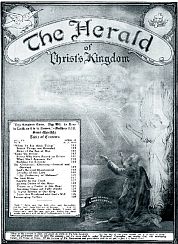
THE HERALD
of Christ's Kingdom
VOL. XVIII January 1, 1935 No. 1
Table of Contents
A
Happy New Year
Fellowship
Meetings with Jesus Present
The
Parable of the Laborers in the Vineyard
Sanctification
and its Relation to Faith
VOL. XVIII January 1, 1935 No. 1(b)
(Special Extra Edition)
Table of Contents
EDITOR's
PREFACE
WHAT
SAY THE SCRIPTURES ABOUT OUR LORD'S RETURN?
CHRIST'S
SECOND COMING AND THE SIGNS OF THE TIMES
WHAT
SAY THE SCRIPTURES CONCERNING HELL?
PARABLE
OF THE SHEEP AND GOATS
EVERLASTING
PUN I S H M E N T
FORGIVABLE
AND UNPARDONABLE SINS
VOL. XVIII January 1,
1935 No. 1
Our Year Text for 1935
"THE FRUIT OF THE SPIRIT IS ... JOY" - Gal. 5:22.
BACK OF us lies the traveled road; before us the uncharted pathway of a New Year. As
the strokes of the bell sound out the hour of transition, we wish one another a Happy New
Year. It is a good wish, a proper greeting. There should be increasing happiness in every
year that comes, if we know the true meaning of happiness, and go the right way about
securing it. If we have found the real meaning of life, then living should be a sweet and
worthwhile thing to the last moment, even though it be marked by pain and disappointment,
by loss and sorrow, as for most of us it must be. If for us happiness be a fruit of the
Spirit rather than a chance result of circumstance, the passing of time can only enhance
it, and no change or mishap can rob us of it. Happiness thus deepens into joy, and joy
depends on other sources than those which time affects.
Reflection rather than revelry is the mood for this space between the years. If we have
learned to discern the real values, we will not need to hide from ourselves the fact that
we are growing older by the count of days and weeks and months, for the real values are
eternal. We are not hurrying toward an hour when everything must be dropped, but rather do
we move with expectant hearts toward the hour when hope may be realized, when faith may
lay hold of its richest treasures, when love can come into its full inheritance. This is
the meaning which the Christian message gives to life. It is thus that we who have
embraced that message may think about the passing of the years. For us life is not
narrowing toward the grave; it is broadening toward eternity. As the flesh weakens, the
spirit achieves strength. It approaches its birth day. Not night, but the dawn lies ahead.
The revelry of the thoughtless as the Old Year passes is not the revelry of joy. Break
through the garish surface and you will find minds that dare not think, hearts hungry and
dissatisfied, souls afraid to be alone in the dark. But reflection may be joyous. There
are songs for the thoughtful with which farewell may be said to the Old Year, with which
greeting may be given the New. They are songs which will remember God's leadings in the
Old Year, which will lay triumphant hold upon His promises for the New Year. They are
songs of the New Creature's youth, which knows that just beyond lies Beulah Land. Dimming
eyes which' need the aid of glasses to see the things of the senses -- these are a small
occasion for regret, when compared with that stronger, clearer vision of the spirit, which
now perceives, as never before, the marvels of the spiritual. Growing older? Nay! we may
be growing younger, if we will. Time should bring us detachment from things. Alas for him
of whom this is not true. Alas for him who, as the days hasten, clings more tenaciously to
things. He has missed the meaning of life. He has given himself to externals. Things are
not meant to cling to, but as aids by which to climb. If the man on yonder mountain side,
hanging by his hands to. a projecting crag, desperately afraid to let go, could but get
his foot upon it, he would be nearer the summit. Under our feet things help us. In our
hands they hinder. Let go, let go and climb. "Your life," says the Apostle,
"is hid with Christ in God." That is the goal.
How, then, shall we estimate the worth of the passing year to us? Surely not in things
-- not in material possessions, but in spiritual values. Surely not by a quantitative
scale, but a qualitative test which we may each apply to our own heart. Let us each ask
ourselves: Have we grown wiser in the knowledge of the spiritual? Have we grown richer in
the fruit of the Spirit? Do we know Christ better than we did a year ago? Does He mean
more to us, and do things mean less? And what of the New Year? What do we plan for it as
the chief end of all its effort? Are we consciously determined that we shall make it a
year that brings us into closer accord with the purpose of God? that gives us a greater
intimacy with the Master? that lifts life above the level of self-regard to the joyous
plane on which He lived and gave Himself for others? So, indeed, it will be a Happy New
Year.
Thinking of the way in which Christ lived and gave Himself for others reminds us of a
story about General Booth, the grand old man who .founded the Salvation Army. At one time
he desired to send a New Year's greeting, by cablegram and telegram, to all Salvation Army
posts in the world. Cablegrams are expensive and have to be short. General Booth boiled
his message down to a single word, but he was great enough to choose one of the biggest
words in the dictionary. He cabled the one word "OTHERS." This message inspired
another to write the following lines
"Lord help me live from day to day
In such a self-forgetful way
That even when I kneel to pray
My prayer shall be for others.
"Help me in all the work I do
To ever be sincere and true
And know that all I'd do for you
Must needs be done for others.
"Let 'self' be crucified and slain
And buried deep; and all in vain
May efforts be to rise again
Unless to live for others.
"And when my work on earth is done
And my new work in heaven's begun
May I forget the crown I've won
While thinking still of others.
"Others, Lord, yes, others,
Let this my motto be
Help me to live for others
That I may live like Thee. "
With such thoughts as these in mind, and with the determination by God's grace to make
our lives happy and joyous in the true Christian sense of the word, let us note that joy
is a fruit, and like all other fruits must be grown. None of the Christian experiences and
graces are the work of magic. They come under the law of cause and effect. They are not to
be obtained even by prayer, although prayer may contribute to their growth. But no one can
get joy merely by asking for it. It is one of the ripest fruits of the Christian life and
like all fruits must be grown. An able writer, in illustration of this point remarks
"There is a very clever trick in India called the mango-trick. A seed is put in
the ground and covered up, and after divers incantations a full-blown mango-bush appears
within' five minutes. I never met any one who knew how the thing was done, but I never met
any one who believed it to be anything else than a conjuring trick. The world is pretty
unanimous now in its belief in the orderliness of Nature. Men may not know how fruits
grow, but they do know that they cannot grow in five minutes. Some lives have not even a
stalk on which fruits could hang, even if they did grow in five minutes. Some have never
planted one sound seed of joy in all their lives; and others who may have planted a germ
or two have lived so little in the sunshine that they never could come to maturity."
Is not this writer in agreement with the inspired Apostle's words: "God is not
mocked, for whatsoever a man soweth, that shall he also reap." (Gal. 6:7.) As the
poet has said:
"Sow flowers and flowers will follow
You whithersoever you go;
Sow weeds and of weeds reap a harvest.
You'll reap whatsoever you sow."
How then is joy to be secured? How shall we make the New Year happy? The writer already
quoted makes reply:
"Christ put His teaching upon this subject into one of the most exquisite of His
parables. It is the parable of the Vine. Did you ever think why Christ spoke that parable?
He did not merely throw it into space as a fine illustration of general truths. It was not
simply a statement of the mystical union, and the doctrine of an indwelling Christ. It was
that; but it was more. After He had said it, He did what was not an unusual thing when He
was teaching His greatest lessons. He turned to the disciples and said He would tell them
why He had spoken it. It was to tell them how too get joy. 'These things have I spoken
unto you,' He said, 'that My joy might remain in you and that your joy might be full.' It
was a purposed and deliberate communication of His secret of happiness.
"Go back over these verses, then, and you will find the Causes of this Effect, the
Spring, and the only Spring, out of which true happiness comes. . . . . Remember, in the
first place, that the Vine was the Eastern symbol of joy. It was its fruit that made glad
the heart of man. Yet, however innocent that gladness-for the expressed juice of the grape
was the common drink at every peasant's board-the gladness was only a gross and passing
thing. This was not true happiness, and the vine of the Palestine vineyards was not the
true vine. Christ was 'the true Vine.' Here, then, is the ultimate source of joy. Through
whatever media it reaches us, all true joy and Gladness find their source in Christ. By
this, of course, is not meant that the actual joy experienced is transferred from Christ's
nature, or is something passed on from Him to us. What is passed on is His method of
getting it. There is, indeed, a sense in which we can share another's joy or another's
sorrow. But that is another matter. Christ is the source of Joy to men in the sense in
which He is the source of Rest. His people share His life, and therefore share its
consequences, and one of these is joy. His method of living is one that in the nature of
things produces joy. When He spoke of His joy remaining with us, He meant in part that the
causes which produced it should continue to act. His followers, that is to say, by
repeating His life would experience its accompaniments. His Joy, His kind of joy, would
remain with them."
Long years ago another described the life and growth of the vine and its branches, in
the following choice language:
"'I am the true Vine' said our Lord, 'and ye
My brethren, are the branches.'
"Let us consider now this life of the Vine,
Whereof we are partakers; we shall see
Its way is not of pleasure nor of ease.
It groweth not like the wild trailing weeds
Whither it willeth, flowering here and there;
Or lifting up proud blossoms to the sun,
Kissed by the butterflies, and glad for life,
And glorious in their beautiful array;
Or running into lovely labyrinths
Of many forms and many fantasies,
Rejoicing in its own luxuriant life.
"The flower of the Vine is but a little thing,
The least part of its life;--you scarce could tell
It ever had a flower; the fruit begins
Almost before the flower has had its day.
And as it grows, it is not free to heaven,
But tied to a stake; and if its arms stretch out,
It is but crosswise, also forced and bound;
And so it draws out of the hard hillside,
Fixed in its own place, its own food of life;
And quickens with it, breaking forth in bud,
Joyous and green, and exquisite of form,
Wreathed lightly into tendril, leaf, and bloom.
Yea, the grace of the green vine makes all the land
Lovely in springtime; and it still grows on
Faster, in lavishness of its own life;
Till the fair shoots begin to wind and wave
In the blue air, and feel how sweet it is.
But so they leave it not; the husbandman
Comes early, with the pruning-hooks and shears,
And strips it bare of all its innocent pride
And wandering garlands, and cuts deep and sure,
Unsparing for its tenderness and joy.
And in its loss and pain it wasteth not;
But yields itself with unabated life,
More perfect under the despoiling hand.
The bleeding limbs are hardened into wood;
The thinned-out bunches ripen into fruit
More full and precious, to the purple prime.
"And still the more it grows, the straitlier bound
Are all its branches; and as rounds the fruit,
And the heart's crimson comes to show in it,
And it advances to its hour,--its leaves
Begin to droop and wither in the sun;
But still the life-blood flows, and does not fail,
All into fruitfulness, all into form.
"Then comes the vintage, for the days are ripe.
And surely now its perfected bloom,
It may rejoice a little in its crown,
Though it bend low beneath the weight of it,
Wrought out of the long striving of its heart.
But ah! the hands are ready to tear down
The treasures of the grapes; the feet are there
To tread them in the wine-press, gathered in;
Until the blood-red rivers of the wine
Run over, and the land is full of joy.
But the vine standeth stripped and desolate,
Having given all; and now its own dark time
Is come, and no man payeth back to it
The comfort and the glory of its gift;
But rather, now most merciless, all pain
And loss are piled together, as its days
Decline, and the spring sap has ceased to flow.
Now is it cut back to the very stem;
Despoiled, disfigured, left a leafless stock,
Alone through all the dark days that shall come.
And all the winter-time the wine gives joy
To those who else were dismal in the cold;
But the vine standeth out amid the frost;
And after all, hath only this grace left,
That it endures in long, lone steadfastness
The winter through;--and next year blooms again
Not bitter for the torment undergone,
Not barren for the fulness yielded up;
As fair and fruitful towards the sacrifice,
As if no touch had ever come to it,
But the soft airs of heaven and dews of earth;
And so fulfils itself in love once more.
"And now, what more shall I say?
Do I need here To draw the lesson of this life; or say
More than these few words, following up the text:
The Vine from every living limb bleeds wine;
Is it the poorer for that spirit shed?
The drunkard and the wanton drink thereof;
Are they the richer for that gift's excess?
Measure thy life by loss instead of gain;
Not by the wine drunk, but by the wine poured forth
For love's strength standeth in love's sacrifice;
And whoso suffers most hath most to give."
When at the close of our life we look back, as we come to lay our head on the pillow
for the last time, we shall want to measure our life that way. Then we shall not be
interested in what wealth we have accumulated, or what pleasures we have enjoyed, or what
burdens we may have escaped, but we shall delight to call to mind those times in our
experience when we were most like Christ. And we shall wish that the minutes we had spent
in the service of Christ had been months and the cents dollars. But instead of wishing
this, let us plan it by His grace for 1935, or for whatever portion of the year He gives
us. We may do so, if we will.
Now that we have briefly considered the life of the Vine, let us go back to the point
previously noted, namely that the reason Jesus told His disciples this parable was that
their joy might be full. Every one wants to be joyful, and Jesus in effect says: In what I
am telling you now, in this parable of the Vine is My secret of happiness. Yet in the
parable there is not a word said about happiness or joy, but a great deal about fruit. The
evident meaning of our Lord therefore is that joy will be ours in proportion to our
fruit-bearing; and with regard to fruit-'bearing He goes on to say "He that abideth
in Me, the same bringeth forth much fruit." On these words the writer quoted earlier
in this article observes:
"Fruit first, joy next; the one the cause or medium of the other. Fruit-bearing is
the necessary antecedent; Joy both the necessary consequent and the necessary
accompaniment. It lay partly in the bearing fruit, partly in the fellowship which made
that possible. Partly, that is to say, joy lay in mere constant living in Christ's
presence, with all that that implied of peace, of shelter, and of love; partly in the
influence of that Life upon mind and character and will; and partly in the inspiration to
live and work for others, with all that that brings of self-riddance and joy in others'
gain. All these, in different ways and at different times, are sources of pure happiness.
Even the simplest of them to do good to other people-is an instant and infallible
specific. There is no mystery about happiness whatever. He that abideth in Him will bring
forth much fruit; and bringing forth much fruit is happiness. The infallible receipt for
happiness then, is to do good; and the infallible receipt for doing good is to abide in
Christ. The surest proof that all this is a plain matter of cause and effect is that men
may try every other conceivable way of finding happiness and they will fail." The sad
thing is that we usually do try every other conceivable way first.
But some one doubtless is ready with the question: "I thought it :was the Lord's
work to develop the Christian graces in me. Are they then, after all, of my own
making?" "Yes," we reply; "but do not misunderstand us. They are of
your own making, only in the sense that grapes are of your own making, and in no other
sense. Can you make a grape?" "All fruits grow-whether they grow in the soil or
in the soul; whether they are the fruits of the wild grape or of the true Vine. No man can
make things grow. He can get them to grow by arranging all the circumstances and
fulfilling all the conditions. But the growing is done by God. Causes and effects are
eternal arrangements, set in the constitution of the world; fixed beyond man's ordering.
What man can do is to place himself in the midst of a chain of sequences. Thus he can get
things to grow; thus he can himself grow. But the Grower is the Spirit of God."
What more need we add but this: If any man doubt the matter let him test the method by
experiment. Let us not imagine that we are in possession of the Holy Spirit, (the Holy
Spirit of joy) merely because we have learned where we may get it. As well try to feed
upon a cookery book. The time we might otherwise spend in sighing for fruits, let us spend
in fulfilling the conditions of their growth. The fruits will come, must come. Hitherto,
perhaps, we have paid more especial attention to the effects, to the fruits themselves; to
securing peace, joy, love, etc. We have described them, extolled them, advised them,
prayed for them-done everything perhaps, but find out what caused them. Henceforth let us
deal with causes. About every other method of living the Christian life there is
uncertainty. About every other method of acquiring the Christian graces and experiences
there is doubt. But this method, as we have seen, is the way of Christ. Therefore it
cannot fail.
One writer from whom we have more than once quoted in these pages reminds us that one
"element of weakness in many of our desires for better life and larger usefulness is
that we think of great and perhaps impossible attainments, and overlook the simple things
that lie within our reach. No violent, over-strained exertions are necessary to a noble
life, no super-human efforts and achievements, nothing but everyday duty faithfully done.
The most of us must be content to live what are regarded as commonplace lives, without
attracting the attention of the world, or winning the laurels of fame. We must for the
greater part devote ourselves to the duties that spring out of our ordinary business,
social and domestic relationships. The pressure of life's necessities is so great that we
cannot often turn aside to do things that lie outside of our common calling. Most of the
service we render to Christ must be rendered in and along the line of these relations, and
while we are busied in the imperative duties which every day brings to our hands. It is
just at this point that many fail. They spend all their lives seeking for the place in
this world which they think they were intended to fill; they never settle down to anything
with any sort of restful or contented feeling. They have a lofty, though possibly a very
nebulous ideal, of a wondrously brilliant life to which they would like to attain, in
which they think their powers would find full and adequate scope, and where they could
achieve great things; but in their present condition, with its limitations, they can
accomplish nothing worthy of their powers. So they go on, discontented with their lot, and
sighing for another, and while they sigh the years glide away, and soon they will come to
an end, to find that they have missed every opportunity of doing anything worthy.
"The truth is that one's vocation is never some far-off possibility, it is always
for the present the simple round of duties that the passing hour brings. Some one has
pictured the days as coming to us with their faces veiled, 'but when they have passed
beyond recall the draped figures become radiant, and the gifts we rejected are seen to be
treasures fit for kings' houses. No day is commonplace, if only we had eyes to see the
veiled splendors that lie in its opportunities, and in its plain and dull routine. There
is no duty that comes to our hand but brings to us the possibility of kingly service with
Divine reward. We greatly mistake therefore, if we think there is no opportunity for
ordinary people to make their years radiant and beautiful simply by filling them with
acceptable Christian service. There is room in the commonest relations of life, not only
for fidelity, but for heroism. No ministry is more pleasing to the Master than that of a
cheery and hearty faithfulness to lowly duty, when there is no pen to write its history,
nor any voice to proclaim its praise. To be a good husband, loving, tender, unselfish,
cherishing; or a good wife, thoughtful, helpful, uncomplaining, and inspiring, is most
acceptable service. To live well in one's place in the world, adorning one's calling,
however lowly, doing one's most prosaic work diligently and honestly, and dwelling in love
and unselfishness with all men, is to live grandly. To fight well the battle with one's
own lusts and tempers, and to be victorious in the midst of countless temptations and
provocations of everyday experience, is to be a Christian hero. There is a field for
better living very close at home. It is in these common things that most of us must make
our progress and win our distinction, or fail, and be defeated. And there is room enough
in these prosaic duties and opportunities for very noble and beautiful lives." As the
poet has said:
"The trivial round, the common task,
Will furnish all we need to ask;
Room to deny ourselves, a road
To bring us daily nearer God.
"If on our daily course our mind
Be set to hallow all we find,
New treasures still of countless price
God will provide for sacrifice."
"There is nothing possible to a human soul nobler or greater than simple
faithfulness. 'She bath done what she could' was the highest commendation that ever fell
from the Master's lips. An angel could do no more. When we are resolving to live more
grandly in the future than in the past, it will help us to bring our eyes down from the
far off mountain peaks, and from among the stars, where there is nothing whatever for us
to do, and to look close about our feet where lie many neglected duties, and many
unimproved opportunities, and many possibilities of higher attainment in spirit, in
temper, in speech, in heart." As another deep thinker once said: "Our grand
business undoubtedly is, not to see what lies dimly at a distance, but to do what lies
clearly at hand." Do you remember these fine lines:
"What must I do to be forever known?
Thy duty ever.
This did full many who sleep unknown.
Oh! never, never!
Thinkest thou perchance that they remain unknown
Whom thou knowest not?
By angel trumps in heaven their praise is blown
Divine their lot."
One thing more; -- in seeking to lose our lives in the service of Christ, which, as we
have seen, means, from the practical standpoint to live for others, let us live by the
day. Some of us try to grasp too much of life at a time. Perhaps all of us are liable to
this temptation to a greater or lesser degree. To quote again:
"We think of life as a whole, instead of taking the days one by one. Life is a
mosaic, and each tiny piece must be cut with skill. The only way to make a perfect chain
is to fashion each separate link with skill and care as it passes through our hands. The
only way to make a radiant day is to make its each and every hour bright with the lustre
of approved fidelity. The only way to have a year at its close stainless and beautiful is
to keep the days, as they pass, all pure and lovely with the loveliness of holy, useful,
living. It is thus in little days that our years come to us, and we have but the one small
fragment to fill and beautify at a time. The year is a book, and for each day one fair
white page is opened before us; and we are artists, whose duty it is to put something
beautiful on the page; or we are poets, and are to write some lovely thought, some radiant
sentence on each leaf as it lies open before us; or we are historians, and must give to
the page some record of work done, or duty or victory to enshrine and carry away. It ought
not to be hard to live well one day. Any one should be able to remember God, and keep his
heart open toward heaven, and to remember others in need and suffering, about him, and
keep his hand outstretched in helpfulness for just one day. Yet that is all there is to
do. We never have more than one day to live. We have no tomorrows. God never gives us
years, or even weeks. He gives us only days. If we live each day well, all our life will,
in the end, be radiant and beautiful."
"We should fill the hours with the sweetest things
If we had but a day;
We should drink alone at the purest springs
In our upward way;
We should love with a life-time's love in an hour
If the hours were few;
We should rest, not for dreams but for fresher power
To be and to do.
We should guide our wayward or wearied wills
By the clearest light;
We should keep our eyes on the heavenly hills
If they lay in sight;
We should trample the pride and the discontent
Beneath our feet;
We should take whatever a good God sent
With a trust complete.
We should waste no moments in weak regret
If the days were but one;
If what we remember and what we forget
Went out with the sun;
We should be from our clamorous selves set free
To work or to pray;
And to be what the Father would have us be
If we had but a day."
In conclusion, then, let us seek to make our lives happy and joyous throughout the
coming year, first, by abiding in Christ; second, by bringing forth fruit, with its
resultant joy; third, by living for and on behalf of others; fourth, by being contented
with the commonplace routine of everyday duty; and fifth, by living our life a day at a
time.
"Not for one single day
Can I discover my way
But this I surely know
Who gives the day
Will show the way
So I securely go."
"For where two or three are gathered together in My name,
there am
I in the midst of them."--Matt. 18:20.
WHILE IT is true that the Christian is not under a code of laws such as natural Israel
were, and therefore not constantly being told, "Thou shalt not do," or
"Thou shalt do," yet how true it is that even under grace there is a law,
obedience to which is necessary, if the rich blessing of the Lord is to be experienced.
When Jesus says, "He that hath My commandments, and keepeth them, he it is that
loveth Me," it is quite evident that He is not referring to any particular code of
such commands laid down for our guidance; rather, He is referring to His general teachings
in which He set forth principles and suggestions revealing His will and desire. The
expectation is that responsive hearts such as He is now looking for will be quick to
perceive and prompt to follow these. Indeed we remember that He said on one occasion that
He had but one new commandment to give, and in this "new commandment" there is
little of the commanding aspect of law, but very much of the appealing language of grace.
"That ye love one another; as I have loved you, that ye also love one another."
(John 13:34.) Such is this new commandment, and how absent is the cold aspect of command
in this rule of conduct. The whole matter is 'beautifully expressed in His statement,
"Ye are My friends, if ye do whatsoever I command you." This expression covers
all He has spoken bearing upon our many, many privileges of relationship to Him and to one
another.
This also is the nature of the suggestion in our text above. We may well observe that
He is not commanding any to meet together in His name, but the inference is clear enough
that He desires all who love Him to thus gather for fellowship with one another. In other
statements He has comforted our hearts with the assurance that He will not confine the
blessing resulting from His presence to such times as when two or three or more can gather
together in this way; but He is very clearly teaching that there are special blessings
secured by those who forsake not the assembling of themselves together, which blessings
must inevitably be forfeited by those who are not present, provided of course that their
absence is not due to circumstances over which they have no control. In such circumstance
how glad we are to know that blessings in unstinted measure are specially designed to
comfort and strengthen the isolated or incapacitated saints. God is faithful, and if in
His wise and loving care for us it is better that our lot in life be set in the wilderness
of isolation far away from others of like precious faith, or if it be confined to the
narrow limits of our home because of physical inabilities, then how comforting it is to
remember that patient and happy contentment with our lot, can, and will, make our walk
alone with Him a constant realization of His abiding presence. So then even in such
circumstances, with such companionship, there really need be no isolation for any one. The
physical frame is limited in its movements, and hedged about with its infirmities, but the
spirit and heart, the love and unity, the real ego of the saint, need know no such
limitations. Saints known and unknown to us are still in the earth, one here, one there,
and how wonderful is that spiritual affinity which binds all such hearts together at the
throne of grace, and gives to loving hearts a strengthening sense of companionship with
other kindred spirits heavenward bound.
A Book of Remembrance being Written
Perhaps it is given to some to understand the full import of Malachi's reference to a
"book of remembrance" being written for those who feared the Lord and thought
upon His name. But to most of us, no doubt, such a statement seems so full of
possibilities that we feel incapable of fully comprehending its depth. We are sure there
is no reference to a literal book in which the times and places and circumstances of such
meetings are carefully recorded, and our names listed as among the present or absent. Such
crude conceptions of God's method of keeping a record of our words and actions, may seem
satisfactory enough to a superficial mind but with our greater knowledge of His laws we
are now permitted to see that in such texts as this in Malachi, there is a reference to
human forms and ways in order to teach us the lesson desired. Therefore in some very
wonderful way a "book of remembrance" is being written, filled with large
chapters devoted to the love and fellowship of those who "thought upon His
name," and who were drawn together to talk of Him, not by commands, but by the
stronger cords of loving devotion to Him and His. Only let it be really understood from
this promise of Malachi's prophecy, and from the promise of Jesus set forth in our text,
that in some special manner His blessing will come to those who meet together "in His
name," in His spirit, and that these blessings are lost to those who "forsake
the assembling of themselves together as the manner of some is." Here we have a
principle or condition set forth which love and gratitude will very quickly perceive and
gladly follow, and which lukewarmness can never disannul, or escape.
Thomas Absent from a Testimony Meeting
As an illustration of the ways in which Jesus can bless such gatherings as He is
encouraging in our text, let us go again to those inexhaustible Gospel records where
"this same Jesus" teaches us so wonderfully. How often we may hear some one -say
with reference to some point not clearly seen -or believed, "O I'm a doubting Thomas
you know," and such statement is usually made with all the inference of
self-gratulation possible. In this there seems to be a serious disregard for the facts
surrounding the incident which gave Thomas an opportunity to show, not his "noble
Berean" qualities, but his skepticism-two vastly different characteristics. The
"noble Berean" says, "Let us search and see." The "doubting
Thomas" says, "I cannot believe." The reason given for the unbelief of
Thomas is clear-he was not within the range of the blessing which came to his fellow
disciples. "But," says the record, "Thomas, one of the twelve, called
Didymus, was not with them when Jesus came." He was absent from the first fellowship
meeting at which Jesus was present according to His promise. He was therefore not
permitted to have the evidence and renewal of hope and joy which the others received, and
which had so completely satisfied them. And it is perhaps worthy of notice to observe that
those present at this meeting could not transmute any ,of their joy and happiness to the
absent Thomas. Their report conveyed no assurance to his doubt-filled mind, and he
steadfastly affirmed his unbelief in the truthfulness of their story until his own sight
and touch had been satisfied. Furthermore, the evidence is clear that had he been present,
he would have received and believed exactly as the others had done, for after all, he
finally accepted the facts on much less of word and .action on the part of Jesus, than
were given to those at the first meeting. Yes, there is a world ,of meaning in those
words, "Thomas, was not with them when Jesus came." He was not where our Lord
had stipulated He would come to bless His own.
It will be both interesting and profitable for us to just note a few of the details of
this account of Thomas and his conduct at this time. There are lessons for us in it if we
study the record with the desire to learn therefrom our own need of being in obedient line
with our Lord's promises. And what lesson is more needed than that all should remember
that it is only when our love and faith are both fervently active, producing obedience and
insight, only then can we be in line for the special blessing assured to those who act out
of true love, and not because of a definite command. The Lord's dealings with Thomas
clearly show this. The faith of this doubter is revived and brought into operation again
by a second similar fellowship meeting, but he is given no additional evidences on which
to stand. He must accept eventually the very evidence, testimony of which he had so
stoutly refused before when it was told him by his brethren. And coming as it did from
competent witnesses he should have hoped it was true. Thus it is never meant to be,
"Lord increase the evidence on which we may believe," but it is always,
"Lord increase our faith."
Be not Faithless but Believing
"And after eight days again His disciples were within, and Thomas with them: then
came Jesus, the doors being shut, and stood in the midst, and said, Peace be unto you.
Then saith He to Thomas, reach hither thy finger, and behold My hands; and reach hither
thy hand, and thrust it into My side: and be not faithless, but 'believing. And Thomas
answered and said unto Him, My Lord and My God."
On the first occasion Jesus showed His hands and side; pronounced His benediction of
"peace be unto you"; for the second time gave them their commission: "As My
Father hath sent Me, even so send I you." He breathed on them and said, "Receive
ye the Holy Spirit," and invested them with prerogatives to bind and loose on earth
with the assurance that their rulings would have ratification in heaven. All of this at
the meeting Thomas missed, and the report of which meant nothing to his doubting spirit.
Now in contrast to all of this evidence, let us note the very limited action and message
recorded of the second meeting. At this latter time Jesus showed His hands and side and
pronounced His blessing once, then omitted all the other communications of the former
occasion, and immediately calls on Thomas to declare the evidence satisfactory, and
assures him that while he is blessed by believing under the conditions he had demanded,
yet his -blessing was less by far than it would have been had he been more of a Berean and
much less of a doubter. Therefore all he needed was the same evidence he had previously
discounted, and as we have seen, he really got less of proof than the others. And it is
proper enough to conclude that he did not even attempt to put his fingers into the wounds,
but immediately cried out, in a greater demonstration than is recorded of any 'of the
others, "My Lord and my God."
And this is all that many need today. They need only to be brought within the range of
our Lord's requirements in order to experience the blessing He waits to give, which
blessing He has already communicated to others. There must necessarily be plenty of doubt
and uncertainty until faith is strong to believe that Jesus is really present at the
fellowship meetings which He gave assurance He would be glad to attend. Our fidelity to
the word He has spoken, and our abounding faith in His promise to bless our use of the
means of grace
He has provided, means everything in Christian life. Thomas was absent, and to his
disadvantage, from a meeting where Jesus came with unexpected revelations, and so may it
The with us if we neglect His clearly revealed will in the matter of fellowship in this
way. And with us there may not even be the partial restoration of blessings lost by our
absence from the rendezvous appointed by Him.
Let the Redeemed of the Lord Say So
We should note that in the statement of Jesus respecting the kind of fellowship
meetings He will attend, and also the similar stipulation in the words of Malachi's
prophecy, that it is where the gathering is in His name, and when it is composed of those
who love the Lord, and think upon His name. These requirements are every one of them
sufficiently important to make such gatherings rather exclusive. Certainly the meeting in
His name means much more than just the mere name of Christ. All sorts of religious
meetings convene in His name in this sense, but it is doubtful if anything of the promised
presence of Christ could be recognized there. Here, as in so many other instances, the
meaning of our Lord's words is, in My spirit, with My devotion to God, My love for the
brethren, in My character.
Again when the Prophet says it is such as love the Lord and think on His name, the same
thing holds good. It must be a coming together caused by a real love for God, and
therefore a delight to come into His presence in order to be with and near Him. To think
on His name means that He is first in all our thoughts; the conversations, testimonies,
and discourse will all be pleasing to Him, and conducive to the enriching of our spiritual
life. Yes, these meetings should be such in character that even if the "book of
remembrance" were a literal book containing a record of ;all we thought or spoke at
such gatherings, we would never be ashamed to read it in heaven.
Real testimony is spontaneous, springing from a heart full of overflowing gratitude.
"With the heart man believeth, and with the tongue confession is made unto
salvation." "If thou wilt believe in thine heart and confess with thy mouth''
does indeed seem to be the only condition of acceptable worship. If there is a realization
of salvation, then the lips must bear testimony thereto. Certainly the grateful heart
rejoices to tell out what great things the Lord has done. Such a one is in the spirit
Jesus delights to find, not waiting for cold commands, but eager to follow even the little
indications revealed in expressions such as our opening text. And so the good word is,
"Let the redeemed of the Lord say so."
0 Sing unto the Lord a New Song
And what kind of testimonies will be appropriate with Jesus present? This is quite an
important matter also. He of course reads every heart present on such occasions, and He
knows how much of formality there may be in our words. He knows just what lukewarmness or
listlessness there may be in our expressed thankfulness for what we know and experience of
His favor. Yes, He knows whether there is any real testimony in the heart at all. And He
can see whether we have been living in a day by day enjoyment of Him, or whether we are
looking backward rather than forward. All these things are factors in the fellowship
meetings He wants to attend. There must be a background of several things in the life
before we can realize the promised presence and blessing. There can never The any
consciousness of that presence if the days preceding have been full of careless walk,
unguarded conversation about things too close to earth, indiscretion in the character of
what we read, when we should be redeeming the time because the days are evil, or if we
have been neglectful in our devotional exercises, in prayer and meditation, and other
means of grace. Under such circumstances even if one should attend a meeting where Jesus
was present, it is extremely doubtful if he would have any realization that the Lord was
so wonderfully near. If He can go with us to the meeting we will know that He is blessedly
present, but if we have to go there to find Him, there will, hardly be the kind of
testimony He loves to hear. What then is the best state of mind in order to enjoy this
promise fulfilled? In answer we might just take the statement of the Psalmist as
sufficiently clear: "O sing unto the Lord a new song." Have we been enjoying Him
enough that we can always sing a new song about His goodness? Has He never shown us any
fresh visions of what those pierced hands and that spear-wounded side reveal of His love?
Have there been no freshly spoken words of peace to our hearts in which we have rejoiced,
and no new conceptions given us of the power we may have in heaven because He has clothed
us with prerogatives in prayer such as He gave us in repeated promises? Are none of these
in our experience, or are we more likely to sing an old song of "good old days"
enjoyed long since, and seemingly gone forever?
Surely there are new discoveries of His matchless grace to tell about, gladsome
manifestations of His goodness in which to glorify Him by relating to others, and many
impulses constraining us to say, "Come, hear what the Lord hath done for me."
Then indeed we can report to the absent ones, as the assembled disciples said to Thomas,
"We have seen the Lord," and it will surely never be said of us, "He was
not present when Jesus came" to the fellowship meeting. Then, dear brethren,
"Let us consider one another to provoke unto love and to good works: not forsaking
the assembling of ourselves together, as the manner of some is; but exhorting one another:
and so much the more, as ye see the day approaching." - Heb. 10:24, 25.
"But many shall be
last that are first; and first that are last." "So the last shall be first, and
the first last." - Matt. 19:30; 20:16. Am. R. V.
IN our last issue we endeavored to view this parable in proper relationship to its
context; let us now see how it may be applied. In doing so we must remember that with this
parable, as with all parables, it is not possible to make every little detail fit
precisely. Thus, for example, we have no difficulty in recognizing the relationship of our
Lord to His people, as indicated in the parable of the Shepherd and His sheep. When we
think of the leadership, the guidance, the love and protection which a shepherd affords
his sheep, and of the unquestioning obedience to and reliance on the shepherd 'which the
sheep manifest,. we are impressed with the appropriateness of the. picture. However, if we
were to press the illustration beyond its proper limits, we should run into difficulty,
for the main interest that a shepherd has in tending sheep is the amount of wool he is
likely to get from their backs, or how much a pound lamb chops will bring in the market.
So, also, in seeking to apply the parable before us. We shall experience difficulty in
trying to make each little feature count, but its main lesson should not be difficult to
apply.
The Rich Young Man Whom Jesus Loved
Out of many possible applications which the parable may have there are three which
especially appeal to us as having merit. In the first place, there is one possible, and
even likely, application of this warning and parable which cannot fail to be very welcome
to us all. We are thinking now of the young man whom Jesus loved. We love him, too, do we
not? A rich man, yet not spoiled by his wealth; a zealot for the law, and yet bent on
learning more than the law could teach; a young man, and yet modest and teachable. We do
not think it strange that he found it hard to give up "great possessions" all at
once, and to become a penniless, homeless, wanderer, even that he might become perfect. It
irks and grieves us to think that he should have gone away from Christ. We cannot easily
persuade ourselves that he never came 'back. Nor need we try, for in our Lord's rebuke to
Peter, "But there are last who shall yet be first," we have at least a hint that
he who went sorrowfully away came joyfully back. For, surely, he was one of the last who
became one of the first in Christ's regard; or why, as he went away, should Christ begin
to speak of late-comers, who would 'be as dear as those who came early, and to tell a
story of certain laborers, who, though they entered the vineyard at the evening hour, took
as high a wage as those who came in the early morning hours? To us it seems that our Lord
Jesus, yearning with love and pity for the sorrowful young ruler, was comforting Himself
with the thought that he would come back by and by. That seems to us the reason why He
harps and lingers on the thought so long. First, as the ruler departs, He says,
"Well, well, there are last who will yet be first." Then He tells the story of
the laborers in the vineyard. And again when He has told it, He reverts to the thought
with which He had started: "So shall the last be first, and the first last." Let
us cherish a good hope for that young man. There is much reason to believe that he now
stands very near the Throne.
The First-called Jews became Last
As a second illustration of the main, the essential, teaching of the parable, let us
take the case of the Jews and Gentiles. And here it will be helpful to notice a point in
the parable to which we have not yet alluded. We refer to the contract into which the
householder entered with the first-called laborers. With them, we are told, He agreed for
a denarius for the day. Scholars tell us that the word here translated "agreed"
suggests that a certain amount of bargaining went on and it was only when an agreement had
been reached for a certain stipulated wage that these particular laborers commenced work.
This is a point -of no little interest, for, as we read on, we find that no bargain of the
sort is made afterwards. At the third hour, nine o'clock, the householder takes on more
men; but to them he simply promises: "Whatsoever is right I will give you," and
they go their way into the vineyard without demur, not haggling for terms, trusting simply
to his justice and his generosity. At twelve o'clock, at three o'clock, even at five
o'clock in the evening he takes more men on; but in no case have we any hint of a bargain,
nor does he even promise: "I will give you whatsoever is right." The laborers
are eager for work on any terms; and there is something, we suppose, in the householder's
face, and in his tone of voice, which is a promise in itself.
Well, now, let us see how this may apply, at least in part, to the Jews, and have
constituted both a warning to them and a prophecy of the causes which would lead to their
rejection. Their nation was the first to be called into God's service, centuries before
the Gentiles were invited to labor in His vineyard. Moreover when the Jews engaged in
God's service it was not without an agreement as to wages. They would keep so many laws,
offer so many sacrifices, say so many prayers, on condition that God would bless them
above all other nations of earth. And, taking them as a whole, excepting only a few choice
souls, a few men and women among them of faith and vision, the Jews, who, before entering
His vineyard, had contracted, covenanted, agreed with their Householder for a definite
wage, did their work in the spirit of hirelings. The ruling motive of their service was
the reward. So long as they got their wage they were therewith content. But when they
heard that God had shown His grace to the Gentiles also, they were offended. They murmured
and complained: "We have borne the heat of noon, and the weight, the burden, of the
toil. These have wrought but one hour, and that in the cool of the evening, yet Thou hast
made them equal to us."
They had all that was stipulated in the contract, but with this they were not content.
God kept, and more than kept, His agreement with them. He blessed them in basket and in
store when they sought to walk in His counsels; He graciously chastised them when they
deflected from the paths of truth and righteousness, so that their national conscience
might - be kept tender; although they were most unprofitable servants to Him, God acted
towards them as a Father and a Husband combined. But it was intolerable to them that the
uncovenanted Gentiles should be placed on an equality of privilege and favor with them,
and rather than continue to work with the late called Gentiles they left the vineyard.
Here, then, were first who became last. Was it unjust that they should be among the
last? Was it God who put them last, or themselves? Surely it was themselves, for they
might have remained among the first. Did not St. Paul, although a Hebrew of the Hebrews,
become the foremost Apostle of the Christian Church?
The Last-called Gentiles became First
Compare with theirs the case of the Gentiles. They were not permitted to even enter the
vineyard until the seventy weeks of special covenant favor which God had made with the
Jews had expired. They stood idle in the market-place. If any should ask them why they
remained unemployed so long they might truthfully reply: "Because no man bath hired
us. We were there in the market-place, at least a good many of us were, blindly groping
after God, if haply we might find Him. Christ Jesus, He whom Israel rejected, was our
desire, although we did not then know even His Name. But how could we find Him, till He
revealed Himself to us ? or enter His service until He taught us what His service was, and
bade us enter it?" We may plead for them, as St. Paul does plead: "How should
they call on Him in whom they have not believed? And how should they believe on Him of
whom they have not heard? And how should they hear without a preacher? And how should the
preachers preach, effectively, until their minds were illuminated by the Holy Spirit of
truth, and they were divinely commissioned, or sent?" - Rom. 10:14, 15.
Here, then, in the Gentiles, we have last who became first, just as in the Jews we have
first who became last. Was there any injustice in calling the Gentiles from the
market-place in which they waited with longing hearts, into the vineyard in which they
rejoiced to work? If now that they are in the vineyard they serve as sons and not as
slaves, from love and not for hire; if they love their fellow-laborers and grudge them no
good that befalls them; if they love even the Jews who have left the vineyard and try to
win them back,-is it not meet and right that though the last called, they should be ranked
among the first in God's service, and before those who were first, but have become last?
In this application of the parable does not much of its difficulty disappear? Can we not
see the Divine equity which animates it, and rejoice that even unto these last God grants
the same grace as unto those who were earlier called?
By Love Serve
"Yes" it may be said, "in the light of the foregoing explanation the
meaning of the parable is plain; we see that God is just in putting first last and last
first." But we have yet one more application of this parable to suggest, brethren-an
application that we trust will be of even more value to us than either of the two already
considered. And in this we shall no more seek to make every little detail fit than we have
in the first two applications. That would be to waste your time and ours. But is there not
one special lesson in this parable which we may apply to ourselves, a lesson which each of
us may remember long after every other word in these two articles has faded from our
minds? We think you will agree with us that there is, and that it has been very aptly
stated by the Apostle Paul in three short. words found in Gal. 5:13, "By love
serve."
Yes, it is not the amount of service we accomplish in our Lord's vineyard that matters
in His sight, but the spirit in which that service is performed, the motive that underlies
our activities in His cause. Here, then, we come on a thought which solves many of the
difficulties of the parable. To 'be called into the vineyard is to be called into the
service of God. What is the main purpose of that service? It is that we learn to trust in
the love of God, to respond to it, and from love to God to show love to man. Now we may
have given ourselves early in life to the religious duties and tasks in which this love
for God and man is commonly expressed. We may have been diligent, steadfast, faithful, in
discharging them. Moreover when the light of "Present Truth" came our way we may
have eagerly embraced it, and, rejoicing in the special message of the "Harvest
Time," been very active in its various ministries. Not only so, but when our dear
Brother Russell was taken from us, and another apostasy began to set in, we, like the
Church in Ephesus of old, may have tried those who called themselves Apostles, and were
not, and have found them false, and we may have been amongst the very earliest to do so,
and our voices raised the loudest in protest. But while giving good heed to our tasks and
duties we may have failed to cultivate the spirit of loving dependence on God, and of
fervent love towards our brethren. Like Peter, we may have thought too much of our
contract, and have discharged our duty mainly with an eye to reward. And like him, besides
being very ready to ask "What shall we have therefore?" we may be both hasty and
harsh in our judgment of others who perhaps have had more difficulties to encounter than
we, had to meet, and perhaps a great deal more to sacrifice. Like the first-called
laborers of the parable we may agree with the Master for so much for the day; and when
pay-time comes, we may be very forward to complain, although the contract on which we used
to lay such stress has been very faithfully kept, that some of our brethren have received
a great deal more than we think they have earned. And if we are of this spirit, mark what
it is that we have done. We have discharged, perhaps, every duty that we know; we may not
have shirked our tasks even in the heat of the day; nevertheless, we have failed in our
main work. For all these tasks and duties were appointed to us mainly that we might grow
in love to God and man; and we love God so little that we complain of His dealings with
us; we love men so little that we grudge them what God gives them.
As a matter of fact our very best labors in God's vineyard must appear but child's play
to His abler servants, and these, in their turn, having done their all, confess themselves
with true humility to be but unprofitable servants. Instead of receiving a wage for
working in His vineyard, we ought, like the apprentices of old, to be paying a substantial
premium to the Master who has so graciously taken us into His employ. Ah! dear reader, if,
as we trust, our hearts are really in tune with Him, if we have entered sympathetically
into His plans and purposes, it will not be difficult for us to make the truest and best
application of this parable.
God's Service is Its Own Reward
Is not the service of God its own reward, that we should be unduly concerned about how
we are to be paid for it? or that we should spend any time comparing our wage with our
brother's, or grudge that he should have as much as or more than we? If we recall the
greatest happiness we have ever known, the purest and deepest, do we not find that it came
in connection with our very labors for God? that it sprang from denying ourselves that we
might do His will and minister to the wants of others? What is the main purpose of God in
permitting us to labor in His vineyard at all? Surely not for any gain He may derive from
our labors. From His standpoint our labors, could be readily dispensed with. Who that has
spent any time at all in the service of the Master but does not realize this? We look back
today upon our earlier labors, and blush to recall their futility, and awkwardness. Indeed
we have a strong suspicion that He found it necessary to send some of His expert gardners
after us to repair the damage we did in our childish attempts at service. And while, we
trust, our present efforts are not quite so immature as formerly, we doubt not but that,
if we are privileged to continue our labors, a few more years, we shall look back on those
of today, and wonder that so much imperfection still characterized them. It is possible
that by some miraculous working of His power others may profit from our labors, just as we
ourselves have had our own faith strengthened, our hope renewed, our love made deeper and
broader, through the ministry of others; indeed we are all conscious of the mutual
advantages which have been ours as the result of each other's labor of love; but it is
nevertheless a solemn truth that the one who derives the chief gain from any service
rendered is the one who labors, the one who performs the service. The laborer in the
vineyard loses some of his awkwardness in handling his spade and other gardening tools;
his puny muscles grow strong; he fills his lungs with the fresh, invigorating, sweet,
wholesome, air of the vineyard; and thus, as a result of his labor, he promotes, retains,
and enjoys good health.
But if the work be itself a reward, if it be our highest good and blessedness, if it
would still be the best thing we could have even though there were no payment coming-would
it not be both absurd and mean of us if we were to lay much stress on our wage? Ah! the
parable should not puzzle us. It could not puzzle us if our minds were habitually
illuminated by the truths we most surely believe. The first-called laborers had the
longest spell of work; that was their true dignity, and blessedness, and reward, had they
but known it; and that they should complain because those who had less work got an equal
wage only proves that they were selfish, and greedy, and- unspiritual. And if we are not
unspiritual, we shall be able to say, when the problem oL the parable is put before us:
"Why, the work, of course, was a wage in itself; and it was but fair that those who
had least of the work should have most of the pay." We shall be able to say:
"Instead of grumbling that the late-called were put on equal terms with them, those
who had spent the whole day of life in the Divine service, if they had known their true
blessedness, would have made request on behalf of their fellow-laborers who came in later,
'Lord, as these have had less of Thy service, let them have more of Thy favor, and a
larger reward than we who have already enjoyed so much of Thy favor and fellowship. For
ourselves we desire no other reward save to serve Thee still and better.'"
Love never Faileth
If, then, the main teaching of the parable is clear; and if, while recognizing that it
has many applications, we realize that its best and most practical application is to our
own present-day labors for our Lord, let us beware of the leaven of the Pharisees, of the
spirit which inspired Peter's demand: "We have followed Thee, what shall we have
therefore?" of the selfishness and envy which moved the laborers in the vineyard to
complain of the "goodman's" grace to those who had waited so long for work in
vain. Whether we be early called or late called, so soon as we begin to boast of our
superior privileges or our superior fidelity, even though the boasting be not aloud, but
merely in our thoughts, so long as we are not content with rendering any service to God or
man unless it be seen and approved both of men and of God; so long as our service is
mainly animated by the hope of reward, or we grudge any reward or distinction vouchsafed
to our brethren, we are like the Jews who objected to favor being extended to the
Gentiles, we are like Peter in his worst mood instead of his best; we are in danger of
being among the very last in the household and ministry of faith. So soon as we begin to
look with suspicion on and to depreciate, to criticize and condemn our fellow-servants; so
soon as we fail in the love that thinketh no evil, but which hopeth all things, and
especially the very best things, of them, although we may be among the servants of Christ,
we lack the Spirit of Christ; and although among the first in the Church on earth, we are
putting ourselves last in the Kingdom of heaven. The true lesson of the parable is not a
new one; it is the lesson which we have met many times before in the school of Christ;-the
old lesson of faith and hope and love. By love, therefore, let us serve both God and man.
Instead of being conscious of any service we have rendered, instead of boasting how much
we have done, and dwelling in our thoughts on the recognition and reward we ought to
receive for it, let us trust that, whatever man may do, God will do "whatsoever is
right" by us, and rejoice that whatever our wage may be hereafter, here and now we
have had the honor and reward of being called into His service. Let us love all men,
especially the household of faith, and by sympathy in their joy become partakers of their
reward.
"One more day's work for Jesus!
How glorious is my King!
'Tis joy, not duty,
'To show His beauty;
My soul mounts on the wing
At the mere thought
How Christ my life has bought.
"O blessed work for Jesus!
O rest at Jesus' feet!
There toil seems pleasure,
My wants are treasure,
And pain for Him is sweet. Lord, if I may,
I'll serve another day!"
-- P. L. READ
(Continued from last issue)
"Christ Jesus, who of God is made unto us wisdom, and
righteousness, and sanctification, and redemption." - 1 Cor. 1:30.
FAITH IN God's ability to accomplish the miracle of holiness of heart while still in
the flesh has been stated as an essential, but there must also be absolute faith in His
willingness and certainty to perform the things He has promised. Against all the arguments
of the flesh faith must accept God's assurance that the blood of Jesus has made even so
poor an offering as ours, a "reasonable sacrifice, holy and acceptable,"
"well pleasing" to Him. This is not an easy thing to do with the flesh hourly
reminding us of its imperfections. It is a thing impossible of accomplishment to him who
is more aware of the frailties of his flesh than of the power of his Savior. It is strange
indeed that Satan should thus be able to use our hatred of sin to discourage us and turn
us from our struggle for holiness.
It is this degree of faith which seems to 'be the transition point from justification
to the beginning of the processes of sanctification. Justifying faith recognizes and hates
the sin from which it cannot escape, but it is the sanctifying faith that lays hold on the
"sure Word of promise" that we can indeed, as far as our hearts are concerned,
attain that "holiness without which no man shall see the Lord," being, by his
acceptance of "these promises made partakers of the divine nature." This great
reward is the Father's mark of appreciation for the childlike simplicity that has placed
our all unreservedly in His hands. Since this includes an acknowledgment of our own
insufficiency, it is perhaps the greatest act possible to us. And what event in this life
could be of greater importance than this sinking out of self into God?
One of the prime interferences with the attaining of this degree of faith is the
extreme simplicity of the thing to be done. If some monumental task were imposed upon us,
the flesh would wholeheartedly enter into it. But to acknowledge that "it is God that
worketh in us to will and to do of His good pleasure" is to strip the flesh of all
glory, and that the flesh would forever refuse to permit. The extreme goodness of God in
making the process so simple is thus the means of holding many back from the advanced
steps of sanctification. Resignation alone is not sufficient, but of each individual is
demanded perseverance in this course of self-resignation for "no man having put his
hand to the plow, and looking back, is fit for the Kingdom of God." This the great
Teacher said to one who had expressed his desire to follow Him who had "not where to
lay His head." No doubt there never was the time when there was not the pillow of
some friend ready for His use, but the head that lay on those pillows never once forgot
that His burial in the waters of Jordan had pictured the resigning of His all to the
Father. "All things are yours," was as true of Him as of us, but only as a
steward to use for the service of His Father. The hand that has set itself to the task of
plowing can not relax until every weed is plowed under, every suggestion of self-will
vanquished, and for all eternity.
Doubting the Veracity of God
There are many willing to sacrifice something that they may acquire righteousness, but
not many who eagerly sacrifice much for Him who gave His all for them; and few indeed who
joyfully lay their all even for a time on the appointed altar; but only one here, one
there, who gladly all resigns to never again take up the self once laid at His feet. Only
such "continuance in well doing" will be crowned with victory. To will for
righteousness is to do it, for the same God who works in us to will has appointed Jesus to
be our strength, and we, the new creatures, can confidently say, "I can do all things
through Christ which strengtheneth me." Our "Prince-leader" (Heb. 6:20,
Weymouth) was our forerunner in no failures, for He though perfect attempted no victory in
human strength, but could always say, "the Father that dwelleth in Me, He doeth the
works." - John 14:10.
It would seem then that sanctification is dependent upon two things: a full and
constant consecration and a confidence that the consecration has been accepted. Because of
the extreme importance of this confidence and because of the difficulty of maintaining it
without waver,-periods in which development ceases or is retarded-it would be well to
consider it more fully. It should be manifest to all that to willfully doubt the promises
of God's sanctifying power and the evidences which He has granted us of the acceptance of
our consecration would be a doubting of His veracity and therefore place us beyond the
reach of His sanctifying power; first, because He gives this power as well as reckoned
righteousness only to those who exercise faith, and, second, because one without faith
would make no use of God's graces even if they were 'bestowed upon him. There is not one
of God's special favors that can be properly hoped for without this degree of faith, for
the promise of the Savior is, "What things soever ye desire when ye pray, believe
that ye receive them and ye shall have them." (Mark 11:24.) "And this is the
confidence that we 'have in Him, that, if we ask anything according to His will, He
heareth us. And if we know [by the confidence of a faith that anchors our all within the
veil] that He hear us, whatsoever we ask, we know that we have the petitions that we
desired of Him." (1 John 5:14, 15.) Since this is true of every trifling need, it
must be eminently true of so tremendous a thing as sanctification.
The doctrine imparted by these passages is not merely that we may receive, but that we
should know we have received-know not by perfect works such as God will require of the
restored human race, but by the assurance of faith in His unfailing Word. To have such
confidence without first having taken the steps divinely required of us, unless it is the
result of ignorance, is egotism. The lack of such confidence after these steps -are once
known to have been taken, would be nothing short of doubting God's veracity, unless one's
physical condition enters in and prevents this full assurance. Note that this degree of
faith is a very different thing from a mere belief in some or all of those teachings which
by common consent have become known as doctrines. It was not lack of faith in the
"doctrinal" features that kept Israel of old from entering into His rest. Their
faith in God's plan for them was magnificently demonstrated the night they marched out of
Egypt. But of this brave company God says that they "saw My works forty years.
Wherefore I was grieved with that generation, and said, They do always err in heart, and
they have not known My ways. So [for this reason] I sware in My wrath, They shall not
enter into My rest." (Heb. 3:9-11.) They had failed to believe God, they 'had failed
to believe His definite promise of His overruling providence in their daily lives and that
those providences would eventually make of them "a holy nation, a peculiar
people." (Exod. 19:5, 6.) "They entered not in because of unbelief."
Holding Fast the Confidence and Rejoicing
Though our beginning to walk in the way of faith should be just as noble as that of the
children of Israel, we too will fail to become the "holy nation, a peculiar
people," sanctified by His all-conquering power unless we "hold the beginning of
our confidence steadfast unto the end"-yes, unless we "hold fast the confidence
and the rejoicing of the hope firm unto the end." "As many as received Him, to
them gave He power to become the sons of God, even to them that believe on His name."
From the moment we "are careful for nothing," but have cast all our care upon
Him, from the moment we can sing from the heart "wheresoe'er He leads me I will
follow," from that moment the purifying power is at work in us, and we know that He
will finish the good work He has begun in us, if we hold fast the confidence and the
rejoicing of our "hope firm unto the end." It may be only after a long inward
strife that this degree of faith may be firmly established, and from there to the end of
the "fight of faith" there must be a holding fast. This faith will not pass
through a sea of water dry shod to emerge complaining of the lack of a cup of water; will
not begin its journey with its enemies wiped out under that flood, to turn back in despair
because there are a few giants in the land; will not long to wreak again of the vegetation
of Egypt, when once it has fattened on heavenly Manna. Who could hope for sanctification
in a people on whom the "mighty Hand" had been most stupendously revealed, from
the first plague on their taskmasters to the last miraculous defeat of their enemies
without moving them to a grain of faith in their Deliverer?
Lay Our Poverty on His Altar
With what faithfulness God has painted the picture in all its disgusting ugliness, and
how easily we recognize ourselves in the portrait. Greater miracles can never be performed
than have 'been necessary for our deliverance from the world and its "deceitful
desires," and yet what a record the last two thousand years has left of doubt of our
Deliverer and of trust in man. And the end is not yet.
But there has always been and there still is the "one here, one there." Most
of these can testify to fruitless years of fastings, of groanings, and of mournings over
their failure to attain to the will-othe-wisp holiness for which they had struggled
through the bog of despair, until one day they learned that none nor all of these outward
efforts could bring them to that blessed state. No, it is accomplished only by "the
power that worketh in us"-in those who "think upon His name." "Now
unto Him that is able to do exceeding abundantly above all that we ask or think, according
to the power that worketh in us, unto Him be glory in the Church by Christ Jesus
throughout -all ages, world without end."-Eph. 3:20, 21.
Before we can be partakers of His abundance in its fulness, we must lay our poverty on
His altar -our poverty graciously made by Him a sacrifice acceptable to Him because we
have come to the altar with faith in the blood of His precious Son previously shed there.
But as long as any degree of our faith is in our own works, past or present, we cannot
receive of His fulness. Our vessels are not large enough to :find space for "some of
self" and "all of Thee." Sighings and fastings need not hinder, but may
help toward sanctification of spirit, if the trust is in God and not in these things.
Works are an essential demonstration of our justifying and sanctifying faith, but only if
our trust is not in them.
Though it is often present, there is no reason for discouragement because one does not
have the same evidence of sanctification that another has. There are different kinds and
degrees of evil to be overcome and each member is being prepared for his special place in
the Body of Christ. Hence the difference in our experiences. To one naturally of a quiet
disposition, the exercise of patience might be little or no evidence of growth, while in
another it may be the final demonstration of an overcoming faith.
Faith Proclaims Its Exultation
In no instance should the Christian demand any visible sign of the Lord's favor with
him. Faith must rather believe that it has received because it has presented the petition.
But to pray for sanctification, the sum of all graces, is to proclaim our willingness to
receive our development without choice as to the providences by which it shall come. Less
than sanctifying faith will demand signs to trust in or that the development shall be
along the lines and by the means of its own planning.
The answer to the prayer of faith may have little resemblance to our anticipation, but
knowing that the answer must surely come, whatever the circumstance that follows, faith
will recognize the divine power of sanctification in it. Because the answer must always be
in harmony with God's unlimited goodness and never-failing knowledge, much training of our
short-sighted vision is necessary to enable us to recognize it. It is evident then that it
is of the utmost importance to possess a faith that is confident of having received the
answer to its petitions for sanctification, though the period of waiting without visible
evidence of the reply may be long.
When thee flesh discovers the lofty standard of holiness set by the inspired Word, it
must invariably declare it "too high" and discouragement must result. But faith
proclaims its exultation in such phrases as, "Now thanks be unto God which always
causeth us to triumph in Christ." "Strengthened with all might, according to His
glorious power, unto all patience and longsuffering with joyfulness." "And too
know the love of Christ, which passeth knowledge, that ye might be filled with all the
fulness of God." - 2 Cor. 2:14; Col. 1:11; Eph. 3:19.
VOL. XVIII January 1,
1935 No. 1(b)
(Special Extra Edition)
THIS ISSUE IS A DOUBLE ONE - 32 PAGES
To all the Truth hungry we desire to be of assistance. We have given an unusual
amount of space to the themes taken up in this issue -- those of our Lord's Return, its
Object, its Purpose, and the Divine arrangement for dealing with sin, its penalty, etc.,
believing that a correct understanding of these subjects is of great inportance to all the
Lord's people. We have herein endeavored to lay bare the Scripture teaching on these most
vital themes, that thereby faith in God and in His Word may be re-established on a better,
a reasonable foundatoin. Indeed it is our opiion that whoever shall hereby find that his
false view rests upon human conception and misrepresentation will, at that same time,
learn to trust less to his own and other men's imaginings, and by faith to more firmly
grasp the Word of God, which is able to make wise unto salvation. If a deveoloped child of
God, you are interested in Bible study, and if so you cannot afford to deprive yourself of
the helping hand God has provided for all such through the monthly visits of this Journal.
THE DIVINE PURPOSE THE
RESTITUTION OF ALL THINGS
COMFORT FOR THE
BEREAVED
"And He shall send Jesus Christ, which [who] before
was preached unto you; whom the heaven must retain until the times of restitution of all
things, which God hath spoken by the mouth of all His holy prophets since the world
began." - Acts. 3:20, 21.
FOR centuries past, a considerable number of professed Christian people, in
reading the Scriptures on the Second Coming of Christ, have failed to find there, the
comfort intended for the truth-hungry. Instead of seeing in our Lord's return the dawn of
hope for the groaning creation --the restitution of all the willing and obedient to
Paradise-they have seemed to read only a dreadful doom for the masses of humanity, and the
destruction of all things mundane. According to this conception, the Plan of God is seen
to end in disaster and defeat so far as the vast majority of our race is concerned, and in
an overwhelming victory for Satan.
Consequently many of God's people have been offended, "stumbled," as
respects the doctrine of the Second Coming of our dear Redeemer, by reason of peculiar,
extravagant, unreasonable, illogical, and unscriptural views on the subject, presented by
some, who professedly love the Lord's appearing. The doctrine of our Lord's return, as a
glorious gem, should be given the first place among the precious jewels of Divine truth,
where it can cast its halo and splendor and brilliancy over all connected and related
promises and blessings. It should not he left in the imperfect setting which hides its
glory and beauty, but should be recovered, remounted, set in its true place, to the glory
of God and the blessing of all who are sincerely and truly His people.
We need offer no apology for the interest which we feel in this grand subject,
which is, the center upon which all the testimony of Divine grace through all the holy
prophets, is focused. Rather do they need to apologize who, knowing that the Second Coming
of the Lord and the resurrection of the dead hold the most important places in the
Scriptures, next to the doctrine of the atonement for sin, have, nevertheless, neglected
these while they have quarreled, skirmished, fought and bled over trifling things of no
real importance, doctrinally or otherwise.
St. John, the beloved, in his wonderful revelation was given a glimpse of future
events, and in marvelous vision was borne across this dispensation with the powers of evil
still in control; he saw its changing scenes of Church and State and witnessed the final
culmination. He saw a great change take place on earth -- Satan was bound, the forces of
evil overthrown; Christ and the saints reigning in glorious triumph. He saw the world of
mankind liberated from the prison-house of death, and their return to their home in
Eden-Paradise restored. No wonder the 'beloved John, as he beheld this heavenly vision of
the future blessing of the world, out of the depths of his soul, cried, "Even so,
come, Lord Jesus."
As one of the Twelve who walked with Jesus while upon the earth, St. John
remembered the prayer that the Savior taught His followers: "Thy Kingdom come, Thy
will be done in earth as in heaven." The Apostle knew there could be no more sure
guarantee of the lifting of the curse from the earth, and the restoration of humanity,
than this promise of the Kingdom at the Second Coining of the Lord.
Thank God, with the clearer light of our day shining upon the pages of His holy
revelation, the sincere student reads in fairer lines the Plan of God with regard to our
Lord's return and the consummation of all things in the ultimate and everlasting defeat of
Satan and in the recovery of a sorrowing and ruined world. - Rev. 21:3-5; 22:3, 17.
We presume that it is admitted and believed by all familiar with the Scriptures,
that our Lord intended His disciples to understand that for some purpose, in some manner,
and at some time, He would come again. True, Jesus said, "Lo, I am with you alway,
even unto the end of the Age" (Matt. 28:20), and by His Spirit and by His Word He has
been with the Church continually, guiding, directing, comforting, and sustaining His
saints, and cheering them in the midst of all their afflictions. But though the Church has
been blessedly conscious of the Lord's knowledge of all her ways and of His constant care
and love, yet she longs for His promised personal return; for when He said, "If I go,
I will come again" (John 14:3), He certainly referred to a second personal coming.
Some think He referred to the descent of the Holy Spirit at Pentecost; others, to
the destruction of Jerusalem, etc.; but these apparently overlook the fact that in the
last book of the Bible, written some sixty years after Pentecost, and twenty-six years
after Jerusalem's destruction, He that was dead and is alive-the risen Christ-in living
tones speaks of the event as yet future, saying "Behold I come quickly and My reward
is with Me," and the inspired John replies, "Even so, come, Lord Jesus." -
Rev. 22:12, 20.
Quite a number think the conversion of a sinner forms a part of the coming of
Christ, and that so He will continue coming until all the world is converted. Then, say
they, He will have fully come.
These evidently forget the Scriptures on the subject, which declare the reverse
of their expectation: (1) that at the time of our Lord's Second Coming the world will be
far from converted to God; (2) that "in the last days perilous times shall come, for
men shall be lovers of pleasure more than lovers of God" (2 Tim. 3:1-4); (3) that
"evil men and seducers shall wax worse and worse, deceiving, and being
deceived." - Ver. 13.
They forget the Master's special warning to His Little Flock- "Take heed to
yourselves lest that day come upon you unawares, for as a snare shall it come on all them
[not taking heed] that dwell on the face of the whole earth." (Luke 21:34, 35.)
Again, "All kindreds of the earth shall wail because of Him," when they see Him
coming (Rev. 1:7) -- no reference is made to the conversion of sinners. Do all men wail
because of the conversion of sinners? On the contrary, if this passage refers, as almost
all admit, to Christ's presence on earth, it teaches that all on earth will not love His
appearing, as they certainly would do if all were converted.
Christ's Reign to Accomplish World's Conversion
Some expect an actual coming and presence of the Lord, but set the time of the
event a long way off. It is their thought that when the world has been converted by their
efforts, and Satan bound, and the knowledge of the Lord caused to fill the whole earth,
and when the nations learn war no more, then the work of the Church in her present
condition will be ended; and that when she has accomplished this great and difficult task,
the Lord will come to wind up earthly affairs, reward believers and condemn sinners.
Some Scriptures, taken disconnectedly, seem to favor this view; but God's Word
and Plan viewed as a whole, will be found to favor the view that Christ -comes before the
conversion of the world, and reigns for the purpose of converting the world; that the
Church is now being tried, and that the reward promised the overcomers is that after being
glorified they shall share with the Lord in that reign, which is God's appointed means of
blessing the world and causing the knowledge of the Lord to come to every creature. Such
are the Lord's special promises: "To him that overcometh will I grant to sit with Me
in My throne." (Rev. 3:21.) "And they lived and reigned with Christ a thousand
years." - Rev. 20:4.
Only the Church Called in This Age
There are two texts chiefly relied upon by those who claim the Lord will not come
until after the Millennium, to which we would here call attention. One is, "This
Gospel of the Kingdom shall be preached in all the world for a witness unto all nations;
and then shall the end come." (Matt. 24:14.) They claim this has reference to the
conversion of the world before the end of the Gospel Age. But "witnessing" to
the world does not imply the conversion of the world. The text says nothing about how the
testimony will be received. This witness has already been given. In 1861 the reports of
the Bible Societies showed that the Gospel had been published in every language of the
earth, though not all earth's millions had received it. No, not one-half of the sixteen
hundred millions living have ever heard the name of Jesus. Yet the condition of the text
is fulfilled-the Gospel has been preached in all the world for a "witness" -- to
every nation.
The Apostle (Acts 15:14) tells that the main object of the Gospel in the present
Age "is to take out a people" for Christ's name-the overcoming Church which, at
His Second Advent, will be united to Him and receive His name. The witnessing to the world
during this Age is a secondary object.
The other text is, "Sit Thou at My right hand until I make Thine enemies Thy
footstool." (Psa. 110:1.) The vague, indefinite idea regarding this text seems to be
that Christ sits on a material throne somewhere in the heavens until the work of subduing
all things is accomplished for Him through the Church, and that then He comes to reign.
This is a misconception. The throne of God referred to is not a material one, but refers
to His supreme authority and rulership; and the Lord Jesus has been exalted to a share in
that rulership.
St. Paul declares, "God hath highly exalted Him [Jesus] and given Him a name
above every name, "authority" above every other, next to the Father. If Christ
sits upon a material throne until His enemies are made His footstool (all subdued) then,
of course, He cannot come until all things are subdued. But if "right hand" in
this text refers, not to a fixed bench or locality, but, as we claim, to power, authority,
rulership, it follows that the text under consideration would in nowise conflict with the
other Scripture which teaches that He comes to "subdue all things unto Himself"
(Phil. 3:21), by virtue of the power vested in Him.
Jesus' First Advent to Redeem Men-His Second Advent
to Restore the Redeemed
A further examination of God's revealed Plan shows a broader view of the object
of both the First and Second Advents; and we should remember that both events stand
related as parts of one Plan. The specific work of the First Advent was to redeem men; and
that of the Second is to restore and bless, and liberate the redeemed. Having given His
life a ransom for all, our Savior ascended to present that sacrifice to the Father, thus
making reconciliation for man's iniquity. He tarries and permits "the prince of this
world" to continue the rule of evil, until after the selection of "the Bride,
the Lamb's Wife" who, to be accounted worthy of such honor, must overcome the
influences of the present evil world. Then the work of giving to the world of mankind the
great blessings secured to them by His sacrifice will be due to commence, and He will come
forth to bless all the families of the earth.
The Apostle informs us that Jesus has been absent from earth -- in the heaven --
during all the intervening time from His ascension to the beginning of the Times of
Restitution, or the Millennial Age" Whom the heaven must retain until the times of
restitution of all things," etc. (Acts 3:21.) Since the Scriptures thus teach that
the object of our Lord's Second Advent is the restitution of all things, and that at the
time of His appearing the nations are so far from being converted as to be angry (Rev.
11:18) and in opposition, it must be admitted either that the Church will fail to
accomplish her mission, and that the Plan of God will be thus far frustrated, or else, as
we claim and have shown, that the conversion of the world in the present Age was not
expected of the Church, but that her mission has been to preach the Gospel in all the
world for a "witness," and to prepare herself, under Divine direction, for her
great future work, God has not yet by any means exhausted His power for the world's
conversion. Nay, more -- He has not yet even attempted the world's conversion.
This may seem a strange statement to some, but let such reflect that if God has
attempted such a work He has signally failed; for, as we have seen, only a small fraction
of earth's billions have ever intelligently heard of the "only name" whereby
they must be saved. We have stated the views and teachings of only some of the leading
sects- Baptists, Presbyterians, and others -- viz., that God is electing or selecting out
of the world a "little flock," a Church. They believe that God will do no more
than choose this Church, while we find the Scriptures teaching a further step in the
Divine Plan -- RESTITUTION for the world, to he accomplished through the elect Church,
when completed and glorified. The "little flock," the overcomers, of this Gospel
Age, are only the Body of the "Seed" in or by whom all the families of the earth
are to be blessed.
The Election and Free Grace of the Bible
Those who claim that for six thousand years Jehovah has been trying to convert
the world, and failing all the time, must find it difficult to reconcile such views with
the Bible assurance that all God's purposes shall be accomplished, and that His Word shall
not return unto Him void, but shall prosper in the thing whereto it was sent. (Isa.
55:11.) The world has not been converted nor the knowledge of the Lord filled the earth;
therefore the Word has not yet, been "sent'- on that mission.
Two lines of thought have divided Christians for centuries, namely, Election and
Free Grace. That both of these apparently opposite doctrines, have Scriptural support, no
Bible student will deny. This fact should lead us at once to surmise that in some way both
must be true; but in no way can they be reconciled except by observing heaven's law-order,
and "rightly dividing the Word of Truth" on the subject. This order, as
represented in the Plan of the Ages, if observed, will clearly show us that while an
Election has been in progress during the present and past Ages, what is by way of
distinction designated Free Grace, is God's gracious provision for the world in general
during the Millennial Age. If the distinctive features of the Epochs and Dispensations
indicated in the Bible be kept in mind, and all the passages relating to Election and Free
Grace be examined and located, it will be found that all which treat of Election apply to
the present and past Ages, while those which teach Free Grace are fully applicable to the
next Age only.
However, Election as taught in the Bible, is not the arbitrary coercion, or
fatalism, usually believed and taught by its advocates, but a selection according to
fitness and adaptability to, the end God has in view, during the period appointed for that
purpose.
The doctrine of Free Grace, advocated by our Methodist friends, is also a much
grander display of God's abounding favor than its most earnest advocates have ever taught.
God's grace or favor in Christ is ever free, in the sense of being unmerited; ,but since
the fall of man into sin, to the present time, certain of God's favors have been
restricted to certain individuals, nations and classes, while in the next Age all the
world, including the dead who will then be awakened, will be invited to share the favors
then offered, on the conditions then made known to all, and whosoever will may come and
drink at life's fountain freely. - Rev. 22:17.
Both the Living and the Dead Share in the Benefits of
Messiah's Reign
Some who can see something of the blessings due at the Second Advent, and who
appreciate in some measure the fact that the Lord comes to bestow the grand blessing
purchased by His death, fail to see the vast scope of that blessing as applicable to all
,mankind, and that all those in their graves have as much interest in the glorious reign
of Messiah as those living at the time of His return. Is it not because of God's Plan for
their release that those in the tomb are called "prisoners of hope"?
We read that Jesus Christ by the grace of God, tasted death "for every
man." (Heb. 2:9.) But if He tasted for all humanity, both the living and the dead,
and from any cause that sacrifice becomes efficacious to only a small fraction of earth's
billions, was not the redemption comparatively a failure? And in that case, is not the
Apostle's statement too broad? When again we read, "Behold, I bring you good tidings
of great joy, which shall be to ALL PEOPLE" (Luke 2:10), and, looking about us, see
that it is only to a "little flock" that it has been good tidings, and not to
all people, we would be compelled to wonder whether the, angels had not overstated the
goodness and breadth of their message, and overrated the importance of the work to be
accomplished by the Messiah whom they announced. Again, "there is one God, and one
Mediator between God and men, the man Christ Jesus, who gave Himself a ransom for
all." (1 Tim. 2:5, 6.) A ransom for all? Then why should not all for whom the ransom
has been provided have some benefit from Christ's death? Why should not all come to a
knowledge of the truth, that they may believe?
A Ransom to be Testified "In Due Time"
Without the key how dark, how inconsistent these statements appear; but when we
find the key to God's Plan, these texts all declare with one voice, "God is
Love." This key is found in the latter part of the text "a ransom for all, 'To
BE TESTIFIED IN DUE TIME." God has a due time for everything he could have testified
it to these in their past lifetime; but since He did not, except to a small minority, it
proves that their due time must be future. For those who will be of the Church, the Bride
of Christ, and share the Kingdom honors, the present is the "due time" to hear;
and whosoever now has an ear to hear, let him hear and heed, and he will be blessed
accordingly. Though Jesus secured our ransom before we were born, it was not our "due
time" to hear of it for long years afterward, and only the appreciation of it brought
responsibility; and this, only to the extent of our ability and appreciation. The same
principle applies to all: in God's due time it will be testified to all, and all will then
have opportunity to believe and be blessed by it.
The prevailing opinion is that death ends all probation, but no Scripture so
teaches; and all the above, and many more Scriptures, would be meaningless, or worse, if
death ends all hope for the ignorant masses of the world. The one Scripture quoted to
prove this generally entertained view is, "Where the tree falleth, there it shall
be." (Eccl. 11:3.) If this has any relation to man's future, it indicates that
whatever his condition when he enters the tomb, no change takes place until he is awakened
out of it. All Scripture bearing on the subject uniformly teaches this.
All to be Brought to a Knowledge of the Truth
Since God does not propose to save men on occount of ignorance, but "will
have all men to come unto the knowledge of the truth" (1 Tim. 2:4); and since the
masses of mankind have died in ignorance; and since "there is no work, nor device,
nor knowledge, nor wisdom, in the grave" (Eccl. 9:10); therefore, God has prepared
for the awakening of the dead, in order to knowledge, faith and salvation. Hence His Plan
is, that "as all in Adam die, even so all in Christ shall be made alive, but each one
in his own order" -- The Gospel Church, the Bride, the Body of Christ, first;
afterward, during the Millennial Age, all who become His during the thousand years of His
"presence" (mistranslated coming), the Lord's due time for all to know, Him,
from the least to the greatest. (1 Cor. 15:22.) Thus the hope of the world lies beyond the
Lord's return.
As death came by the first Adam, so life comes by Christ, the Second Adam.
Everything that mankind lost through being in the first Adam is to be restored to those
who believe in the Second Adam. When awakened, ,with the advantage of experience with
evil, which Adam lacked, those who thankfully accept redemption as God's gift may continue
to live everlastingly on the original condition of obedience. Perfect obedience will be
required, and perfect ability to obey will be given, under the righteous reign of the
Prince of Peace. Here is the salvation offered to the world. This will not mean that God
will coerce the world into a state of salvation in the future Age. In. that Day of full
knowledge and opportunity, only those who accept the Message and reform and become
obedient thereto, will be restored to everlasting life. Others who wilfully reject the way
of righteousness under the reign of Christ, will be judged incorrigible and will be
ultimately destroyed in the "Second Death" from which there will be no recovery.
- Acts 3:23; Rom. 6:23.
The Jews Will be Brought Out of Their Graves
and Put in Their Own Land - Ezek. 37:12-14
St. Peter tells us that this restitution is spoken of by the mouth of all the
holy Prophets. (Acts 3:19-21.) They do all teach it. Ezekiel says of the valley of dry
bones, "These bones are the whole house of Israel." And God says to Israel,
"Behold, O My people, I will open your graves, and cause you to come up out of your
graves, and bring you into the land of Israel. And ye shall know that I am the Lord, when
I . . . shall put My spirit in you, and I shall place you in your own land; then shall ye
know that I the Lord have spoken it, and performed it, saith the Lord." - Ezek.
37:11-14.
To this, the words of St. Paul agree (Rom. 11:25, 26)- "Blindness in part is
happened to Israel until the fulness of the Gentiles [the elect company, the Bride of
Christ] be come in; and so all Israel shall be saved," or brought back from their
cast-off condition; for "God hath not cast off His people which He foreknew."
(Verse 2.) They were cast off from His favor while the Bride of Christ was being selected,
but will be reinstated when that work is accomplished. (Verses 28-33.) The prophecies are
full of statements of how God will plant them again, and they shall be no more plucked up.
"Thus saith the Lord, the God of Israel, . . . I will set mine eyes upon them for
good, and I will bring them again to this land; and I will build them and not pull them
down, and I will plant them and not pluck them up. And I will give them an heart to know
Me, that I am the Lord; and they shall be My people, and I will be their God, for they
shall return unto Me with their whole heart." (Jer. 24:5-7; 31:28; 32:40-42;
33:6-16.) These cannot refer merely to restorations from former captivities in Babylon,
Syria, etc., for they have since been plucked: up.
Every Man Who Dies Then Shall Die for His Own Sins
Furthermore, the Lord says, "In those days they shall say no more, The fathers
have eaten a sour grape, and the children's teeth are set on edge, but every one [who
dies] shall die for his own iniquity." (Jer. 31:29, 30.) This is not the case now.
Each does not die now for his own sin, but for Adam's sin- "In Adam all die." He
ate the sour grape of sin, and our fathers continued to eat them, entailing further
sickness and misery upon the children, thus hastening the penalty, death. The day in which
"every man [who dies] shall die for his own sin," only, is the Millennial or
Restitution Day.
Though many of the prophecies and promises of the future blessing seem to apply
to Israel only, it must be remembered that they were a typical people and hence the
promises made to them, while sometimes having a special application to themselves,
generally have also a wider application to the whole world of mankind which that nation
typified. While Israel as a nation was typical of the world, its priesthood was typical of
the "little flock," the Head and Body of Christ, the "royal
priesthood"; and the sacrifices; cleansings, and atonements made for Israel typified
the "better sacrifices," fuller cleansings and real atonement "for the sins
of the whole world," of which they are a part.
Seeing, then, that so many of the great and glorious features of God's Plan for
human salvation lie in the future, and that the Second Advent of our Lord Jesus is the
designed first step in the accomplishment of those long promised and long expected
blessings, shall we not even more earnestly long for the time of His Second Advent than
the less informed Jew longed for the First Advent?
"Watch, therefore; for ye know not the day* your Lord doth
come." "What I say unto you, I say unto all [believers], Watch!"
- Matt. 24:42; Mark 13:37.
---------------------------------------
*Thus read the oldest Greek MSS.
IN VIEW of the foregoing Scripture testimony as to the object and purpose
of our Lord's return, we are prepared to recognize the great importance that logically
attaches to the time as as well as the signs or indications which mark the appearing and
presence of earth's new King and the exercise of His power in the affairs of men.
The exhortation to watch for an event whose precise time is not stated implies
that the watching ones will know when the event does take place. Watch, because ye know
not, in order that at the proper time ye may know, is the thought; and the intimation
clearly is, that those .who do not watch will not know; that the events which are to be
known in due time to the Watchers will be recognized by them, and not recognized by
others, at the time of accomplishment.
The Apostle Paul urges us, saying: "Yourselves know perfectly that the day
of the Lord so cometh as a thief in the night, and when they [the world, unbelievers]
shall say, Peace and safety, then sudden destruction cometh upon them as travail upon a
woman with child; and they shall not escape. But ye, brethren, are not in darkness, that
that day should overtake you as a thief" (1 Thess. 5:2-4); because, being children of
the light, ye brethren will be watching and be enlightened and taught of the Lord. The
Apostle Peter suggests the means by which the Lord will teach us and inform us respecting
our location upon the path of the just which shineth more and more unto the perfect day.
He shows that it will not be by miraculous revelations, nor by dreams, but through the
Word of testimony, the Bible. He says, "We Gave a more sure word of prophecy, to
which ye do well that ye take heed, as unto a light which shineth in a dark place, until
the Day dawn and the Day-star arise in your hearts." - 2 Pet. 1:19.
The united testimony of these Scriptures teaches us that, although it was not
proper nor possible for the Lord's people to know anything definite in advance, respecting
the exact time of the Second Presence of the Lord Jesus and the establishment of His
Kingdom, yet when the due time would come, the faithful ones, the Watchers would be
informed. It is in vain to urge, as contradicting this, our Lord's statement, "Of
that clay and hour knoweth no man, no, not the angels in heaven, neither the Son, but My
Father only." Those who use this Scripture to prove to themselves and to others that
no man will ever know anything respecting the time of the Second Advent find it to prove
too much, and thus spoil their own argument; for if it means that no man will ever know,
it must similarly mean that no angel will ever know, and that the Son Himself will never
know. This evidently would be an absurd construction to place upon the passage. The Son
did not know at the time He uttered this statement, the angels did not know then, and no
man knew then; but the Son certainly must know of the time of His own Second Advent, and
at least a little while before it takes place; the angels also must know a little while
before it takes place, and the true children of God, the Watchers, as we have seen above,
are to watch in order that they also may know at the proper season, and not be in
darkness, in ignorance, with the world; and that their watching shall be rewarded is
guaranteed: "None of the wicked shall understand; but the wise [in heavenly wisdom]
shall understand." - Dan. 12:10.
How Are We to Watch?
Our watching consists not in looking up into the sky "stargazing;" for
those who study the Lord's Word to any purpose soon learn that "the day of the Lord
so cometh as [like] a thief in the night," and that its dawning cannot be discerned
with the natural eye. If the Lord's people would discern anything by watching the sky with
their natural eyes, could not the world discern the same thing? If the Second Advent of
our Lord were to be an open, outward manifestation, would not the world know of it as soon
as the saints, the Watchers? In such event it could not be true that the day of the Lord
should come as a thief, as a snare, unawares, upon the world, while the Church would have
foreknowledge thereof-not to be left in darkness.
We are to watch the signs of the times, in the light of the Lord's Word. As the
Apostle declares, "We have a more sure word of prophecy, . . . as a light shining in
a dark place, until the Day dawn."
Those who have taken heed to the landmarks, pointed out by the Lord through
Daniel and Isaiah and Jeremiah, and all the holy Prophets, realize that we have come
already a much longer journey than was expected by the Church when first she started out;
but we realize also from these landmarks that we have approached very close to the end of
the journey, very near to the time when the great blessing, for which God's people have so
long waited and prayed, is at hand. For instance, the Watchers have noted the Lord's
testimony through the Prophet Daniel that "the time of the end" would be a
period of time (more than a century), and that in this "time of the end" there
would be a great increase of travel, running to and fro throughout the earth, and a great
increase of general intelligence, increased knowledge, as it is written, "In the time
of the end many shall run to and fro, and knowledge shall be increased." - Dan. 12:4.
Those carefully watching see the lifting of the curtain of ignorance, and the
letting in of the light, making ready in a natural way for "the times of restitution
of all things, spoken by the mouth of all the holy prophets since the world began." -
Acts. 3:21.
Watching intently, earnestly, interestedly, because they knew of the good things
God hath in reservation (1 Cor. 2:10-13), the Watchers note that Daniel's prophecy further
points out that, as the increase of travel brings the increase of knowledge, so the
increase of knowledge will bring an increase of discontent to the world of mankind in
general; and the result will be as prophetically stated that "there shall be a time
of trouble such as never was since there was a nation." The Watchers, seeking to note
whether these things have yet a fulfillment or not, look about them and behold on every
hand discontent, unhappiness; far more than when the world enjoyed far fewer of the
mercies and blessings of heaven. These latter day gifts of Providence, instead of
provoking thankfulness, gratitude and love to God and generosity to man, produce in
unregenerate hearts ambition, greater avarice, selfishness, envy, hatred, strife and other
works of the flesh and of the Devil, Yes; the Watchers can clearly discern the great
approaching climax of human trouble in which the Scriptures distinctly declare that all
the present human institutions will go down in anarchy, in confusion, in chaos. But the
Watchers do not lose sight of God and His providence. They see that, while the approaching
social and ecclesiastical catastrophe will be the natural result of the operation of
selfishness under highly favored conditions, nevertheless they remember that God is at the
helm, and that He is able to cause the wrath of man to praise Him and the remainder of
man's wrath (which would not praise Him) He will restrain.
Parousia, Epiphania, Apokalupsis
Because not heedless, careless, indifferent servants of the King, but faithful
and earnest, the Watchers discriminating carefully, discern that there are three words of
distinctly different signification used in respect to the Lord's Second Advent, namely
parousia, and epiphania, and apokalupsis. Parousia is used in respect to the earliest
stage of the Second Advent, while epiphanies and apokalupsis relate to the same Advent
later-not that apokalupsis and epiphania relate to another or a third advent, but merely
to a later feature of the Second Advent. These Greek words, it is true, are somewhat
obscured or hidden in the Common Version of the Bible, and probably for a purpose. The
Lord's purpose evidently was to keep the world and the wicked in ignorance of His gracious
Plan until His due time; nor did He wish the particulars to be understood by the Watchers
until nearly the time of the fulfillment. But now we are "in the time of the
end." in "the day of His preparation," in the time in which it was foretold
that then "the wise [not the worldly-wise but the humble Watchers who are wise enough
to take heed to the Word of the Lord] shall understand." (Dan. 12:10.) And hence,
since many of the Watchers are not Greek scholars, God has made gracious provision through
valuable helps, such as critical translations and concordances, so that the very humblest
of His people may have a clear and discriminating understanding of the meaning of certain
features of His Word which hitherto have been kept hidden under imperfect translations:
and these matters God Himself has been bringing to the attention of His people, through
special helps in the way of Scripture Studies. These "Helping Hands for Bible
Students" have reached many of the faithful Watchers all over the world.
By these helps, the Watchers are rapidly coming to see that the word
"parousia," translated in our Common Version "coming," does not mean
what our English word signifies -- to be on the way, approaching; but on the contrary it
signifies "presence," as of -one who has already arrived. The Greek ,word
epiphania signifies bright shining or manifestation. It is rendered "appearing"
and "brightness." The Greek word apokalupsis signifies revealment, uncovering,
unveiling. Thus these words epiphanies and apokalupsis signify "appearing" and
"revealing," as of a thing previously present but hidden. The Watchers note also
that the Scriptures predicate certain things respecting the Lord and respecting His
parousia (His presence), which clearly intimate that He will be present and doing His
work, His great work (of setting up His Kingdom and smiting the nations with the sword of
His mouth) wholly unknown to the world -- "as a thief in the night." The
Watchers also notice that the Scriptures clearly indicate that after the Lord has done
certain things during His presence (parousia) and unknown to the world, He will later make
a manifestation of His presence-a manifestation which will be discerned by all mankind;
and the outward manifestation is designated His "epiphania" and
"apokalupsis"- which signify "shining forth." "bright
shining," and "uncovering," and "unveiling."
During the period of the parousia (presence) preceding the epiphania (shining
forth) a certain work will be accomplished, unknown to the world, unknown to the nominal
Church, known only to the Watchers. The ignorance of the impending trouble in the end of
this Age will be similar to that of the people who lived in the days of Noah. "As it
was in the days of Noah, so also shall it be in the days of the Son of Man." - Luke
17:26.
As "the days of Noah" were not days before Noah's time, neither are
"the days of the Son of Man" days before the Son of Man's presence. The days of
the Son of Man are the days of His parousia or presence-invisible and unknown to the
world, known only to the Watchers and seen by them only with the eye of faith. "As in
the days that were before the flood they were eating, drinking, marrying.... and knew not,
. . . so shall also the presence [parousia] of the Son of Man be"-the world will go
on about its usual affairs and know not of the Lord's presence. - Matt. 24:38.
"In the Days of These Kings"
We have a number of general prophecies indicating that we are living in about the
time of the Master's Second Presence. We have already referred to Daniel's testimony
respecting "the time of the end," in which many will run to and fro, knowledge
be increased, the wise understand, the time of trouble following. Then we have the
inspired dream of Nebuchadnezzar, and its inspired interpretation by Daniel, showing the
earthly governments which would bear rule over the earth-during the interim between the
overthrow of the typical Kingdom of God, whose last king sitting upon the throne of David
was Zedekiah, and the installation of the true King, Immanuel, in His Millennial Kingdom
glory. These different governments of earth are here pictured as a great image;
Nebuchadnezzar's government, the first universal empire of earth, being represented by the
head of gold; the Medo-Persian Empire, which, according to history, was the second
universal empire, is here shown as the breast and arms of silver; the Grecian Empire,
which overthrew the Persian, and became the third universal empire, is represented by the
belly and thighs of brass; the Roman Empire, which succeeded the Grecian, and constituted
itself the fourth universal empire of earth, was represented in the image by the legs of
iron-strong exceedingly; and the later development of the same Roman Empire with the
intermixture of Papal influence is represented in the image by the feet, which were partly
iron (civil government), and partly of clay (ecclesiastical government-Papacy). These were
to constitute the sum total of Gentile dominion; and "in the days of these
kings" (represented by the ten toes of the image), Jehovah Himself would establish
His Kingdom for which we pray, "Thy Kingdom come!"
We are all witnesses that the Heavenly Kingdom has not yet come -- that we are
still under the dominion of the "prince of this world"-the prince of darkness.
All the efforts to prove to us that the greedy and unholy governments of Christendom,
so-called, are the Kingdom for which we were taught to pray, could not prevail: we could
never recognize these as Immanuel's Kingdom: they are only the kingdoms established and
recognized by Antichrist, and named by Antichrist "Christendom." The true
Kingdom waits for establishment at the hands of Him whose right it is. He has promised
that, when He sits upon His throne, all His faithful ones, the "little flock" of
the Gospel Age, shall sit in that throne with Him, and be associates in the work and in
the honor of blessing the world.
The Church is not neglected in the picture of earthly dominion given to
Nebuchadnezzar, and interpreted by the Prophet Daniel. She is shown therein as a stone
taken out of the mountain without hands (by Divine power). This stone represents God's
Kingdom (Christ and the Church), and the inspired dream and explanation show that the
disaster which shall come to the kingdoms of this world, represented in the image and in
the toes, would come through the impact or smiting of the image by the stone. Daniel says:
"A stone was cut out which, without being in hands, smote the image upon his feet. .
. . Then was the iron, the clay, the brass, the silver, and the gold broken to pieces
together, and became like the chaff of the summer threshing floor, and the wind carried
them away that no place was found for them: and the stone that smote the image became a
great mountain [kingdom], and filled the whole earth."
The Stone Cut out of the Mountain
The explanation is that "The great God hath made known to the king [and.
indirectly more particularly to the Watchers] what shall come to pass hereafter"
"in the days of these kings shall the God of Heaven set up a kingdom which shall
never be destroyed, and the kingdom shall not be left to other people; [it shall have no
successors] for it shall break in pieces and consume all these kingdoms, and it shall
stand forever." Here is a prophecy which gives a full delineation of the empires of
earth, to which God granted dominion during the interim between the removal of the typical
crown from His typical kingdom, and the institution of the crown of righteousness and
glory upon the true King in the inauguration of the Kingdom of Heaven. Even the surface
evidences are that human empire has nearly run its course, and that heavenly empire is
needed to deliver the world from its own selfishness; this next universal empire will be
the Kingdom of God's dear Son.
But the scrutinizing Watcher will readily perceive that it is one thing to know
the time when earthly dominion shall cease, and give place to the completed Kingdom of
God, while it would be a totally different matter to know when the "stone"
Kingdom would begin to smite the image upon its feet, preparatory to its destruction. This
smiting period is the period of the parousia; the period in which Christ is present,
gathering His "jewels," His "elect," and in which He will smite the
nations with the rod of iron and with the two-edged sword of His mouth, dashing them in
pieces as a potter's vessel, and preparing mankind for the royal majesty of the heavens.
Let the Watchers note critically the Prophet Daniel's explanation that it will be "in
the days of these kings" (the kingdoms represented in the feet and toes of the
image-the divisions of Papal Rome) the God of heaven will "set up" His Kingdom.
God began the selection of His Kingdom class in the days of Civil Rome represented by the
legs of iron; He has continued the selection ever since, and the setting up or bringing of
His Church (Kingdom) into power comes toward the close of Gentile dominion, but before it
ends; for it is to be "in the days of these kings" and not after. Now note the
similarity of the expressions, "in the days of the Son of Man" and "in the
days of these kings," and give both the same significance and remember that, as we
have proved, they will be the same days -- days before the lease of Gentile power expires,
in which the Son of Man will be present to "set up" His Kingdom, which shall a
little later destroy all these Gentile kingdoms.
His Presence Invisible
One point which more than any other seems to confuse students of this subject is
our Lord's resurrection. They note the fact that He appeared in a body of flesh and bones,
after His resurrection, and they therefore conclude that He still has a body of flesh and
bones bearing all the scars of. Calvary; hence, in thinking of His Second Advent they
invariably expect it to be another advent as a human being (in flesh and bones), "a
little lower than the angels." These expectations are wrong, as the Scriptures show.
Our Lord after His resurrection was a spirit being, and His manifestations of Himself to
His disciples in various fleshly bodies, then, were similar to manifestations made before
He became the man Christ Jesus, while He still possessed the glory which He had with the
Father before the world was-the glory of a spirit being. For instance, are we not
particularly told that the Lord and two angels appeared as men in bodies of flesh and
blood and bones, and in ordinary human garb, to Abraham and Sarah? And the record is that
"they did eat and talk with Abraham." On another occasion the Lord appeared to
Moses, not in a body of flesh, but "as a flame of fire" in a bush which
apparently burned, and from which He spoke to Moses. We contend that such a power to
appear in any kind of a body is a power which in the past was considerably used in
communicating the Divine will to mankind, and that it is only discontinued now because the
canon of Divine revelation is complete, so that in it the man of God is thoroughly
furnished unto every good word and work, and needs no special message or revelations. - 2
Tim. 3:17.
In reading the narrative of our Lord's appearance to His disciples after His
resurrection, the fact seems generally to be overlooked that He appeared only a few times,
in all, and that between these visits, which were always brief, there were long periods of
days and weeks in which the disciples saw nothing of Him. It is generally overlooked also,
that He appeared in various forms, one of which was identical with the body that was
crucified, because Thomas had said he would not believe unless he could have such a
demonstration. Even then our Lord rather upbraided Thomas, assuring him that there was a
still greater blessing in store for those who ask not for such ocular demonstration. None
of the world ever saw our Lord after His resurrection, but merely His disciples, to whom
it is said, He "showed Himself." This was in harmony with His statement made
before His death, "Yet a little while and the world seeth Me no more." - John
14:19.
The Scripture declaration is that our Lord was "made flesh," took upon
Him our nature "for the suffering of death;" and not to be encumbered with
fleshly conditions to all eternity. Besides, if our Lord must bear the scars of His wounds
to all eternity, the implication would be that His people would also bear all their
blemishes and scars to all eternity. Surely, if such were the Divine arrangement, that
which is perfect would never come, for we should be encumbered with the imperfect forever.
- 1 Cor. 13:10.
When we get the correct view of this matter, every difficulty and objection
ceases. As the Scriptures declare, so it was, "He was put to death in flesh. He was
quickened in spirit." "Though we have known Christ after the flesh yet now
henceforth know we Him no more [so]." (2 Cor. 5:16.) It was at His resurrection that
He became the Second Adam- "the last Adam, a quickening spirit." (1 Cor. 15:45.)
"Now the Lord is that spirit." (2 Cor. 3:17.) After appearing to His disciples
under various peculiar conditions after His resurrection, in various bodies, the Lord
invariably vanished-as soon as He had communicated to them the appropriate lessons,
causing, as they declared, their hearts to burn within them. He appeared in these various
forms for two reasons
(1) They could best receive His instructions under such conditions, whereas, if
He had appeared to them in the glory of His spirit being, and had performed a miracle upon
their eyes by which they could have discerned His spiritual glory, they would have been
too much affrighted to have benefited by what He would have said.
(2) They were still natural men, not fully begotten of the Holy Spirit, because
Pentecost was not yet come (John 7:39), and hence they were unprepared to understand
spiritual things: "for the natural man receiveth not the things of the spirit of God,
neither can he know [appreciate] them, because they are spiritually discerned."
The Apostle Paul was the only one of the disciples who saw the Lord "as He
is." He tells us that the Lord's real spiritual presence, so far from being fleshly
or human-like, shone with a brightness "above the brightness of the sun at
noonday." The effect upon St. Paul's eyes was serious and, we may readily believe the
effects remained with him to his dying day, notwithstanding the miraculous removal of the
callous scales, which permitted him to see, though indistinctly. Very evidently our Lord's
design was to educate His Apostles up to the thought of His resurrection, and also to the
thought of His resurrection being not to former conditions, limited by the flesh, but to
new conditions, in which He (as He had already explained to Nicodemus) could come and go
like the wind, and none could know whence He came nor whither He went; He could appear in
one body or in another body, or be present with them without their being aware of it, just
as "the angel of the Lord encampeth round about them that fear Him," yet
invisible to them, because a spirit being.
Looking about us today for evidence of a change of dispensation and of the
Kingdom approaching, we find that many even who are not of the Watchers, are noting the
signs of our times and are startled, and led to exclaim, What do these things mean? --
This remarkable latter-day advance in science, art, and mechanical invention? -- This
latter-day unsettling of all the social and economic relations of mankind? -- This
discontent and general unrest in the midst of plenty and luxury? -- This latter-day growth
of millionaires and paupers? This growth of giant corporations of world-wide power and
influence? -- Why are national policies and public men and their utterances and doings
criticized (judged) by the masses as never before? -- And what means it that with an
apparent growth in wealth in all denominations of Christians there is a growing
dissatisfaction, discontent in them all: a growing tendency to criticize the creeds and
the preaching and everything? -- How comes it that nine-tenths of the preachers in all
denominations know that their hearers desire a change, and would gladly "move
on," if they knew how to better themselves even at smaller salaries?
The Scriptural answer is, The hour of God's judgment is come; the time when
"Christendom," political, financial, social and ecclesiastical is being tried in
the Divine balances. And the Scriptures declare that she will be found wanting and will be
adjudged unworthy to further administer the affairs of earth, which will be turned over to
Messiah and His Bride, the elect "little flock," according to the Divine
promise. - Luke 12:32.
WHERE ARE THE DEAD?
OUR FRIENDS, OUR NEIGHBORS; THE HOLY, THE UNHOLY; THE
CIVILIZED, THE VILE?
"Men and brethren, let me freely speak to you of the
patriarch David; that he is both dead and buried, and his sepulcher is with us unto this
day. For David is not ascended into the heavens." (Acts 2:29,34.)
"And no man hath ascended up to Heaven, but He that came
down from Heaven, even the Son of Man." - John 3:13.
A CORRECT understanding of this subject has become almost a necessity to
Christian steadfastness. For centuries it has been the teaching of "orthodoxy,"
of all shades, that God, before creating man, had created a great abyss of fire and
terrors, capable of containing all the billions of the human family which He purposed to
bring into being; that this abyss He had named "hell;" and that all of the
promises and threatenings of the Bible were designed to deter as many as possible (a
"little flock") from such wrong-doing as would make this awful place their
perpetual home.
As knowledge increases and superstitions fade, this monstrous view of the Divine
arrangement and character is losing its force; and thinking people cannot but disbelieve
the legend, which used to be illustrated on church walls in the highest degree of art and
realism, samples of which are still to be seen in Europe. Some now claim that the place is
literal, but the fire symbolic, etc., while others repudiate the doctrine of
"hell" in every sense and degree. While glad to see superstitions fall, and
truer ideas of the great, and wise, and just, and loving Creator prevail, we are alarmed
to notice that the tendency with all who abandon this long revered doctrine is toward
doubt, skepticism, infidelity.
Why should this be the case, when the mind is merely being delivered from an
error-do you ask? Because Christian people have so long been taught that the foundation
for this awful blasphemy against God's character and government is deep laid and firmly
fixed, in the Word of God -- the Bible -- and, consequently, to whatever degree that
belief in "hell" is shaken, to that extent their faith in the Bible, as the
revelation of the true God, is shaken also; so that those who have dropped their belief in
a "hell" of some kind of endless torment, are often open infidels, and scoffers
at God's Word.
That the advocates of the doctrine of eternal torment have little or no faith in
it is very manifest from the fact that it has no power over their course of action. While
nearly all the denominations of Christendom have sustained the doctrine that eternal
torment and endless, hopeless despair will constitute the punishment of the wicked, they
(are mostly quite at ease in allowing the wicked to take their course, while they pursue
the even tenor of their way. Chiming bells and pealing organs, artistic choirs and costly
edifices, upholstered pews and polished oratory which more and more (avoid any reference
to this alarming theme, afford rest and entertainment to fashionable congregations that
gather on the Lord's day. and are known to the world as churches of Christ and
representatives of His doctrines. One would naturally presume that with such awful
possibilities in view they would be almost frantic in their efforts to rescue the
perishing.
The plain inference would seem to be that they do not believe it. We cannot
imagine how sincere believers of this terrible doctrine go from day to day about the
ordinary affairs of life, or meet quietly in elegance every Sunday to hear an essay from
the pulpit on the peculiar subjects often advertised. Could they do so while really
believing all the time that fellow mortals are dying at the rate of one hundred a minute,
and entering
"That lone land of deep despair, where
No God regards their bitter prayer?"
f they really believed this, few saints could complacently sit there and think of
those hurrying every moment into that awful state described by that good, well-meaning,
but greatly deluded man, Isaac Watts (whose own heart was immeasurably warmer and larger
than that he ascribed to the great Jehovah), when he wrote the hymn: --
"Tempests of angry fire shall roll
To blast the rebel worm,
And beat upon the naked soul
In one eternal storm."
People often become frantic with grief when friends have been caught in some
terrible catastrophe, as a fire, or a wreck, though they know they will soon be relieved
by death; yet they pretend to believe that God is less loving than themselves, and that He
can look with indifference, if not with delight, at billions of His creatures enduring an
eternity of torture far more terrible, which He prepares for them and prevents any escape
from forever. Not only so, but they expect that they will get literally into Abraham's
bosom, and will then look across the gulf and see and hear the agonies of the multitudes
(some of whom they now love and weep over); and they imagine that they will be so changed,
and become so like their present idea of God, so hardened against all pity, and so barren
of love and sympathy, that they will delight in such a God and in such a plan.
ft is wonderful that otherwise sensible men and women who love their fellows, and
who establish hospitals, 'orphanages, asylums, and societies for the prevention of cruelty
even to the brute creation, are so unbalanced 'mentally that they can believe and
subscribe to such a doctrine, and yet be so indifferent about investigating its authority!
Only one exception can we think of-those who hold the ultra-Calvanistic doctrine;
who believe that God has decreed it thus, that all the efforts they could put forth could
not alter the result with a single person; land that all the prayers they could offer
would not change one iota of the awful plan they believe God has marked out for His and
their eternal pleasure. These indeed could sit still, so far as effort for their fellows
is concerned; but why sing the praises of such a scheme for the damnation of their
neighbors whom God has told them to love as themselves?
Why not rather 'begin to doubt this "doctrine of devils," this
blasphemy against God, hatched in the "Dark Ages," when a crafty priesthood
taught that it is right to do evil that good may result?
The doctrine of eternal torment was undoubtedly introduced by Papacy to induce
pagans to join her and support her system. It flourished at the same time when "bull
fights" and gladiatorial contests were the public amusements most enjoyed; when the
Crusades were called "holy wars," and when men land women were called
"heretics" and were often slaughtered for thinking or speaking contrary to the
teachings of Papacy; at a time when the sun of Gospel Truth was obscure; when the Word of
God had fallen into disuse and was prohibited to be read by any but the clergy, whose love
of their neighbors was often shown in torturing "heretics" to induce them to
recant and deny their faith and their Bibles-to save them, if possible, they explained,
from the more lawful future of "heretics"-eternal torture. They did not borrow
this doctrine from the heathen, for no heathen people in the world have a doctrine so
cruel, so fiendish and so unjust. Find it, whoever can, and show it up in all its
blackness, that, if possible, it may be shown that the essence of barbarism, malice, hate,
and ungodliness has not been exclusively appropriated by those whom God has most highly
favored with light from every quarter, and to whom He has committed the only oracle-His
Word. Oh the shame land confusion that will cover the faces of many, even good men, who
verily thought that they did God service while propagating this blasphemous doctrine, when
they awake in the resurrection, to learn of the love and justice of God, and when they
come to know that the Bible does not teach this God-dishonoring, love-extinguishing, truth
beclouding, saint-hindering, sinner-hardening, "damnable heresy" of eternal
torment. - 2 Pet. 2:1.
But, says one, Has not the error done some good? Have not many been brought into
the churches by the preaching of this doctrine in the past?
No error, we answer, ever did real good, but always harm. Those whom error brings
into a church, and whom the truth would not move, are an injury to the Church. The
thousands terrorized, but not at heart converted, which this doctrine forced into Papacy,
and which swelled her numbers and her wealth, diluted what little truth was held before,
and mingled it with their unholy sentiments and errors so that, to meet the changed
condition of things, the "clergy" found it needful to add error to error, and
resorted to methods, forms, etc., not taught in the Scriptures and useless to the truly
converted whom the truth controls. Among these were pictures, images beads, vestments,
candles, grand cathedrals, altars, etc., to help the unconverted heathen to a form of
godliness more nearly corresponding to their former heathen worship, but lacking all the
power of vital godliness.
The heathen were not benefited, for they were still heathen in God's sight, but
deluded into accepting what they did not understand or do from the heart. They were added
"tares", to choke the "wheat," without being profited themselves. The
Lord tells who sowed the seed of this enormous crop. (Matt. 13:39.) The same is true of
those who assume the name "Christian" today, who are not really at heart
converted by the truth, but merely frightened by the error or allured by promised earthly
advantages of a social or business kind. Such add nothing to the true Church; by their
ideas and manners they become stumbling blocks to the truly consecrated, and by their
inability to digest the truth, the real food of the saints, they lead even the few true
pastors to defraud the true "sheep" in order to satisfy the demands of these
"goats" for something pleasing to their unconverted tastes.
Seeing, then, the unreasonableness of man's view, let us lay aside human opinions
and theories and come to the Word of God, the only authority on the subject, remembering
that "God is His own interpreter, and He will make it plain."
HELL AN ENGLISH WORD
In the first place, bear in mind that the Old Testament was written in Hebrew,
and the New Testament in Greek. The word "hell" is an English word sometimes
selected by the translators of the English Bible to express the sense of the Hebrew word
sheol and the Greek words hordes, tartaroo and gehenna -sometimes rendered
"grave" and "pit."
The word "hell' in old English usage, before Papal theologians picked it up
and gave it a new and special significance to suit their own purposes, simply meant to
conceal, to hide, to cover; hence the concealed, hidden or covered place. In old English
literature records may be found of the helling of potatoes-putting potatoes into -pits;
and of the helling of a house -- covering or thatching it. The word "hell" was
therefore properly used synonymously with the words "grave" and "pit,"
to translate the 'words sheol and hades as signifying the secret or hidden condition of
death. However, the-, same spirit which was willing to twist the word to terrorize the
ignorant is willing still-to perpetuate the error-presumably saying, "Let us do evil
that good may follow."
If the translators of the Revised Version Bible had been thoroughly disentangled
from the Papal error, and thoroughly honest, they would have done more to help the English
student than merely to substitute the Hebrew word sheol and the Greek word hades as they
have done. They should have translated the words. But they were evidently afraid to tell
the truth, and ashamed to tell the lie; and so gave us sheol and hades un translated, and
permitted the inference that these words mean the same as the word "hell" has
become perverted to mean. Their course, while it for a time shields themselves, dishonors
God and the Bible, which the common people still suppose teaches a "hell" of
torment in the words sheol and hades. Yet any one can see that if it was proper to
translate the word sheol thirty-one times "grave" and three times
"pit," it could not have been improper to so translate it in every other
instance.
A peculiarity to be observed in comparing these cases, as we will do shortly, is
that in those texts where the torment idea would be an absurdity the translators of the
King James Version have used the words "grave" or "pit;" while in all
other cases they have used the word "hell," and the reader, long schooled in the
Papal idea of torment, reads the word "hell" and thinks of it as signifying a
place of torment, instead of the grave, the hidden or covered place or condition. For
example, compare job 14:13 with Psa. 86:13. The former reads,
"Oh, that Thou wouldst hide me in the grave [sheol], etc., while the latter
reads, "Thou hast delivered my soul from the lowest hell [sheol]." The Hebrew
word being the same in both cases, there is no reason why the same word "grave"
should not be used in both. But how absurd it would have been for job to pray to God to
hide him in a hell of eternal torture! The English reader would have asked questions and
the secret would have gotten out speedily.
While the translators of the Reformation times, just breaking away from the old
Papal system, are somewhat excusable for their mental bias in this matter, our modern
translators, specially those of the recent Revised Version, are not entitled to any such
consideration. Theological professors and pastors consider that they are justified in
following the course of the revisers in not explaining the meaning of either the Hebrew or
Greek words sheol or hades and by their use of the words they also give their confiding
flocks to understand that a place of torture, a lake of fire, is meant. While attributing
to the ignorant only the best of motives, it is manifestly only duplicity and cowardice
which induces educated men, who know the truth on this subject, to prefer to continue to
teach the error inferentially.
But not all ministers know of the errors of the translators and deliberately
cover and hide those errors from the people. Many, indeed, do not know of them, having
merely accepted, without investigation the theories of their seminary professors. It is
the learned ones who are most blameworthy. These have kept back the truth about
"hell" for several reasons. First, there is evidently a sort of understanding or
etiquette among them, that if they wish to maintain their standing in the
"profession" they "must not tell tales out of school"; i. e., they
must not divulge professional secrets to the "common people, the "laity."
Second, they all fear that to let it be known that they have been teaching an unscriptural
doctrine for years would break down the popular respect and reverence for the clergy, the
denominations, and the theological schools, and unsettle confidence in their wisdom. And,
oh, how much depends upon confidence and reverence for men, when God's Word is so
generally ignored! Third, they know that many of the members of their sects are not
constrained by "the love of Christ" (2 Cor. 5:14), but merely by the fear of
hell, and they see clearly, therefore, that to let the truth be known now would soon cut
loose the names and the dollars 'of many in their flocks; and this, to those who
"desire to make a fair show in the flesh" (Gal. 6:12) would seem to he a great
calamity.
But what will be the judgment of God, (whose character and plan are traduced by
the blasphemous doctrine which these untranslated words help to support? Will He commend
these unfaithful servants? Will He justify their course? Will the Chief Shepherd call
these His beloved friends, and make known to them His further plans (John 15:15) that they
may misrepresent them also to preserve their own dignity and reverence? Will He continue
to send forth "things new and old," "meat in due season," to the
household of faith, by the hand of the unfaithful servants? No, such shall not continue to
be his mouthpieces or to shepherd His flock. (Ezek. 34:9, 10.) He will choose instead, as
at the First Advent, from among the laity -- "the common people" -- mouthpieces,
and will give them words which none of the chief priests shall be able to gainsay or
resist. (Luke 21:15.) And, as foretold, "the wisdom of their wise men shall perish,
and the understanding of their prudent men shall be hid." - Isa. 29:9-19.
"HELL" IN THE OLD TESTAMENT
The word "hell" occurs thirty-one times in the Old Testament, and in
every instance it is sheol in the Hebrew. It does not mean a lake of fire and brimstone,
nor anything at all resembling that thought; not in the slightest degree! Quite the
reverse: instead of a place of 'blazing fire it is described in the context as a state of
"darkness" (Job 10:21); instead of a place where shrieks and groans are heard,
it is described in the context as a place of "silence" (Psa. 115:17); instead of
representing in any sense pain and suffering, or remorse, the context describes it as a
place or condition of forgetfulness. (Psa. 88:11, 12.) "There is no work, nor device,
nor knowledge, in the grave [sheol] whither thou goest." - Eccl. 9:10.
The meaning of sheol is "the hidden state," as applied to man's
condition in death, in and beyond which all is hidden, except to the eye of faith; hence,
by proper and close association, the word was often used in the sense of
"grave"-the "tomb," the hidden place, or place beyond which only those
who have the enlightened eye of the understanding can see resurrection, restitution of
being. And be it particularly noted that this identical word sheol is translated
"grave" thirty-one times and "pit" three times in our common version
by the same translators-more times than it is translated "hell"; and twice where
it is translated "hell," it seemed so absurd, according to the present accepted
meaning of the English word "hell" that scholars have felt it necessary to
explain in the margin of modern Bibles, that it means "grave." (Isa. 14:9 and
Jonah 2:2.) In the latter case, the hidden state, or grave, was the belly of the fish in
which Jonah was buried alive, and from which he cried to God.
All Texts in which "Sheol" is Translated
"Hell"
(1) Amos 9:2. - "Though they dig into hell, thence shall Mine hand take
them." [A figurative expression; but certainly pits of the earth are the only hells
men can dig into.]
(2) Psa. 16:10. - "Thou wilt not leave My soul in hell; neither wilt Thou
suffer Thine holy One to see corruption." [This refers to our Lord's three days in
the tomb. -Acts 2:31; 3:15,1
(3, 4) Psa. 18:5 and 2 Sam. 22:6. - margin -- "The cords of hell compassed
me -about." [A, figure in which trouble is represented as hastening one to the tomb.]
(5) Psa. 55:15. - "Let them go down quick into hell"-margin, "the
grave."
(6) Psa. 9:17. - "The wicked shall be turned into hell, and all the nations
that forget God." This text will be treated later, under a separate heading.
(7) Psa. 86:13 -- "Thou hast delivered my soul from the lowest
hell"-margin, "the grave."
(8) Psa. 116:3 - "The sorrows of death compassed me, and the pains of hell
gat hold upon me." [Sickness and trouble are the figurative hands of the grave to
grasp us.]
(9) Psa.; 139:8. - "If I make my bed in hell, behold, Thou art there."
[God's power is unlimited; even over those in the tomb He can and will exert it and bring
forth all that are in the graves. - John 5:28.1
(10) Deut. 32:22. - "For a fire is kindled in Mine anger, and shall burn in
the lowest hell." [A figurative representation of the destruction, the utter ruin, of
Israel as a nation- "wrath to the uttermost," as the Apostle called it, God's
anger burning that nation to the "lowest deep," as Leeser here translates the
word sheol. - 1 Thess. 2:16.]
(11) Job 11:18. - "It [God's wisdom] is as high as heaven; what canst thou
do? deeper than hell [than any pit]; what canst thou know?"
(12) Job 26:6. - "Hell [the tomb] is naked before Him, and destruction hath
no covering."
(13) Prov. 5:5. - "Her feet go down to death; her steps take hold on hell
[i. e., lead to the gravel."
(14) Prov. 7:27. - "Her house is the way to hell [the grave], going down to
the chambers of death."
(15) Prov. 9:18. - "He knoweth not that the dead are there, and that her
guests are in the depths of hell." [The harlot's guests are represented as dead,
diseased or dying, and many of the victims of sensuality in premature graves from diseases
which all hasten their posterity to the tomb.]
(16) Prov. 15:11. - "Hell and destruction are before the Lord." [Here
the "grave" is associated with destruction and not with a life of torment.]
(17) Prov. 15:24. - "The path of life (leadeth) upward for the wise, that he
may depart from hell beneath." [This illustrates the hope of resurrection from the
tomb.]
(18) Prov. 23:14. - "Thou shalt beat him with the rod, and shall deliver his
soul from hell." [i. e., wise correction will save a child from vicious ways which
lead to premature death, and may also possibly prepare him to escape the "Second
Death".]
(19) Prov. 27:20. - "Hell [the grave] and destruction are never full: so the
eyes of man are never satisfied."
(20) Isa. 5:14. - "Therefore hell hath enlarged herself and opened her mouth
without measure." [Here the "grave" is a symbol of destruction.]
(21, 22) Isa. 14:9, 15: "Hell [margin, grave] from beneath is moved for
thee, to meet thee at thy coming." . . . "Thou shalt be brought down to
hell" [the grave-so rendered in verse 11].
(23) Isa. 57:9. - "And didst debase thyself even unto hell." [Here
figurative of deep degradation.]
(24, 25) Ezek. 31:15-17. - "In the day when he went down to the grave. .. .
I made the nations to shake at the sound of his fall, when I cast him clown to hell with
them that descend into the pit. . . . They also went down into hell with him, unto them
that be slain with the sword." [Figurative and prophetic description of the fall of
Babylon into destruction, silence, the grave.]
(26) Ezek. 32:21. - "The strong among the mighty shall speak to him out of
the midst of hell with them that help him." [A continuation of the same figure
representing Egypt's overthrow as a nation to join Babylon in destruction-buried.]
(27) Ezek. 32:27. - "And they shall not lie with the mighty that are fallen
of the uncircumcised, which are gone down to hell with their weapons of war: and they have
laid their swords under their heads; but their iniquities shall be upon their bones,
though they were the terror of the mighty in the land of the living." [The grave is
the only "hell" where fallen ones are buried and lie with their weapons of war
under their heads.]
(28) Hab. 2:5. - "Who enlargeth his desire as hell [the grave] and as death,
and cannot be satisfied."
(29) Jonah 2:1, 2. - "Then Jonah prayed unto the Lord his God, out of the
fish's belly, and said, I cried by reason of mine affliction unto the Lord, and He heard
me; out of the belly of hell cried I, and Thou heardest my voice." [The belly of the
fish was for a time his grave-see margin.]
(30, 31) Isa. 28:15-18. - "Because ye have said, We have made a covenant
with death, and with hell [the grave] are we at agreement; when the overflowing scourge
shall pass through, it shall not come unto us, for we have made lies our refuge, and under
falsehood have we hid ourselves: Therefore, saith the Lord, . . Your covenant with death
shall be disannulled, and your agreement with hell [the grave] shall not stand." [God
thus declares that the present prevalent idea, by which death and the grave are
represented as friends, rather than enemies, shall cease; and men shall learn that death
is the wages of sin, and that it is in Satan's power (Rom. 6:23; Heb. 2:14) and not an
angel sent by God.]
All Other Texts Where "Sheol" Occurs Rendered
"Grave" and "Pit"
Gen. 37:35 - ''I will go down into the grave unto my son."
Gen. 42:38 "Then shall ye bring down my gray hairs with sorrow to the
grave." [See also the same expression in Gen. 44:29, 31. The translators did not like
to send God's servant, Jacob, to "hell" simply because his sons were evil.]
1 Sam. 2:6 - "The Lord killeth, and maketh alive He bringeth down to the
grave, and bringeth up."
1 Kings 2:6, 9 - "Let not his hoar head go down to the grave with peace. . .
. His hoar head bring thou down to the grave with blood."
Job 7:9 - "He that goeth down to the grave."
Job 14:13 - "Oh, that Thou wouldst hide me in the grave, that Thou wouldst
keep me secret until Thy wrath be past, that Thou wouldst appoint me a set time, and
remember me [resurrect me]!"
Job 17:13 - "If I wait, the grave is mine house I have made my bed in the
darkness." [Job waits for resurrection- "in the morning."]
Job 17:16 - "They shall go down to the bars of the pit [grave] when our rest
together is in the dust."
Job 21:13 - "They spend their days in mirth, and in a moment go down to the
grave."
Job 24:19, 20 - "Drought and heat consume the snow waters: so doth the grave
those which have sinned." [All have sinned, hence "Death passed upon all
men," and all go down to the grave. But all have been redeemed by "the precious
blood of Christ;" hence all shall be awakened and come forth again in God's due time-
"in the morning," Rom. 5:12, 18, 19.]
Psa. 6:5 - "In death there is no remembrance of Thee; in the grave who shall
give Thee thanks?"
Psa. 30:3 - "O Lord, Thou hast' brought up my soul from the grave: Thou hast
kept me alive, that I should not go down to the pit." [This passage expresses
gratitude for recovery from danger of death.]
Psa. 31:17 - "Let the wicked be ashamed; let them be silent in the
grave."
Psa. 49:14, 15, margin - "Like sheep they are laid in the grave: death shall
feed on them; and the upright [the saints - Dan. 7:27] shall have dominion over them in
the morning [the Millennial morning]; and their beauty shall consume, the grave being an
habitation to every one of them. But God will redeem my soul from the power of the
grave."
Psa. 88:3 - "My life draweth nigh unto the grave."
Psa. 89:48 "Shall he deliver his soul from the hand of the grave?"
Psa. 141:7 - "Our bones are scattered at the grave's mouth."
Prov. 1:12 - "Let us swallow them up alive as the grave; and whole, as those
that go down into the pit." [i. e., as of an earthquake, as in Num. 16:30-33.]
Prov. 30:15, 16 "Four things say not, it is enough: the grave," etc.
Eccl. 9:10 - "Whatsoever thy hand findeth to do, do it with thy might; for
there is no work, nor device, nor knowledge, nor wisdom, in the grave, whither thou
goest."
Song of Solomon 8:6 "Jealousy is cruel as the grave."
Isa. 14:11 - "Thy pomp is brought down to the grave."
Isa. 38:10 - "I shall go to the gates of the grave: I am deprived of the
residue of my years."
Isa. 38:18 - "The grave cannot praise Thee, death cannot celebrate Thee:
they that go down into the pit cannot hope for Thy truth."
Num. 16:30-33 - "If . . . they go down quick into the pit, then shall ye
understand. . . . The ground slave asunder that was under them, and the earth opened her
mouth and swallowed them up, and their houses, and all the men that appertained unto
Korah, and all their goods. They and all that appertained to them went down alive into the
pit, and the earth closed upon them; and they perished from among the
congregation."
Ezek. 31:15 - "In the day when he went down to the grave."
Hosea 13:14 - "I will ransom them from the power of the grave; I will redeem
them from death. O death, I will be thy plagues; O grave, I will be thy destruction.
Repentance shall be hid from Mine eyes." [The Lord did not ransom any from a place of
fire and torment, for there is no such place; but He did ransom all mankind from the
grave, from death, the penalty brought upon all by Adam's sin, as this verse
declares.]
The above list includes every instance of the use of the English word "hell"
and the Hebrew word sheol in the Old Testament. From this examination it must be evident
to all readers that God's revelations for four thousand years contain not a single hint of
a "hell," such as the word is now understood to signify.
"HELL" IN THE NEW TESTAMENT
In the New Testament, the Greek word hades corresponds exactly to the Hebrew word
sheol. As proof see the quotations of the Apostles from the Old Testament, in which they
render it hades. For instance, Acts 2:27, "Thou wilt not leave my soul in
hades," is a quotation from Psa. 16:10, "Thou wilt not leave my soul in
sheol." And in 1 Cor. 15:54, 55, "Death is swallowed up in victory. 0 death,
where is thy sting? 0 grave [hades], where is thy victory?" is an allusion to Isa.
25:8, "He will swallow up death in victory," and to Hos. 13:14, "O death I
will be thy plagues; O sheol, I will be thy destruction."
"Hell" from the Greek Word "Hades"
Matt. 11:23 - "And thou, Capernaum, which art exalted unto 'heaven, shalt be
brought down to hell." Luke 10:15: "Shalt be thrust down to hell." [In
privileges of knowledge and opportunity the city was highly favored, or, figuratively,
"exalted unto heaven;" but because of misuse of God's favors, it would be
debased, or, figuratively cast down to hades, overthrown, destroyed. It is now so
thoroughly buried in oblivion, that even the site where it stood is a matter of dispute.
Capernaum is certainly destroyed, thrust down to hades.]
Luke 16:23. - "In hell he lifted up his eyes, being in torments." [A
parabolic figure explained further along, under a separate heading.]
Rev. 6:8 - "And behold a pale horse: and his name that sat on him was Death,
and Hell followed with him." [Symbol of destruction or the grave.]
Matt. 16:18. - "Upon this rock I will build My Church; and the gates of hell
shall not prevail against it." [Although bitter and relentless persecution, even unto
death, should afflict the Church during the Gospel Age, it should never prevail to her
utter extermination; and eventually, by her resurrection, accomplished by the Lord, the
Church will prevail over hades -- the tomb.]
Christ in "Hell" (Hades) and Resurrected from "Hell" (Hades)
- Acts 2:1, 14, 22-31
"And when the day of Pentecost was fully come, . . . Peter . . . lifted up
his voice and said, . . . Ye men of Israel, hear these words; Jesus of Nazareth, a man
approved of God among you,,, . . . being delivered by the determinate counsel and
foreknowledge of God ['He was delivered for our offenses'], ye' have taken and by wicked
hands have crucified and slain: whom God hath raised up, having loosed the pains [or
bands] of death, because it was not possible that He should be holden of it [for the Word
of Jehovah had previously declared His resurrection]: for David speaketh concerning Him
[personating or speaking for Him], 'I [Christ] foresaw the Lord [Jehovah] always before My
face; for He is on My right hand, that I should not be moved. Therefore did My heart
rejoice, and My tongue was glad; moreover also My flesh shall rest in hope, because Thou
wilt not leave My soul in hell [hades, the tomb, the state of death], neither wilt Thou
suffer Thine Holy One to see corruption. Thou [Jehovah] hast made known to Me [Christ] the
ways of life."' Here our Lord, as personified by the Prophet David, expresses His
faith -in Jehovah's promise of a resurrection and in the full and glorious accomplishment
of Jehovah's plan through Him, and rejoices in the prospect.
St. Peter proceeds: "Men and brethren, let me freely speak unto you of the
patriarch David, that he is both dead and buried, and his sepulcher is with us unto this
day [so that this prophecy could not have referred to himself personally; for David's soul
was left in "hell" -- [hades], the tomb, the state of death -- and his flesh did
see corruption]: Therefore being a prophet, and knowing that God had sworn with an oath to
him, that of the fruit of his loins according to the flesh, He would raise up Christ to
sit on his throne; he, seeing this before [prophetically] spake of the resurrection of
Christ [out of "hell" -- hades, the tomb -- to which He must go for our
offenses], that His soul was not left in hell [hades -- the death state], neither His
flesh did see corruption." Thus St. Peter presents a strong, logical argument based
on the words of the Prophet David-showing first, that Christ, who was delivered by God for
our offenses, went to "hell," the grave, the condition of death, destruction.
(Psa. 16:10); and, second, that according to promise He had been delivered from hell, the
grave, death, destruction by a resurrection-a raising up to life; being created again, the
same identical being, yet more glorious and exalted even to "the express image of the
Father's person." (Heb. 1:3.) And now "this same Jesus" (Acts 2:36), in His
subsequent revelation to the Church declares
Rev. 1:18 "I am He that liveth and was dead, and, behold, I am alive for
evermore, Amen; and have the keys of hell [hades, the grave] and death."
Amen! Amen! our hearts respond; for in His resurrection we see the glorious
outcome of the whole Plan of Jehovah to be accomplished through the power of the
Resurrected One who now holds the keys of the tomb and of death and in due time will
release all the prisoners who are, therefore, called the "prisoners of hope."
(Zech. 9:12; Luke 4:18.) No craft or cunning can by any possible device wrest these
Scriptures entire and pervert them to the support of that monstrous and blasphemous Papal
condition of eternal torment. Had that been our penalty, Christ, to be our vicarious
sacrifice, must still, and to all eternity, endure such torment, which no one will claim.
But death was our penalty, and "Christ died for our sins," and "also for
the sins of the whole world." - 1 Cor. 15:3; 1 John 2:2.
Rev. 20:13, 14. - "And the sea gave up the dead which were in it; and death
and hell [the grave] delivered up the dead which were in them: and they were judged, every
man, according to their works. And death and hell [the grave] were cast into the lake of
fire: this is the Second Death." The lake of fire is the symbol of final, everlasting
destruction. Death and hell [the grave] go into it. There shall be no more death;
"the last enemy that shall be destroyed is death." - 1 Cor. 15:26; Rev. 21:4.
OTHER OCCURRENCES OF THE WORD "HELL"
Having examined the word sheol, the only word in the Old Testament rendered
"hell," and the word hades, most frequently in the New Testament rendered
"hell" we now notice every remaining instance in Scripture of the English word
"hell." In the New Testament two other words are rendered "hell";
namely, gehenna and tartaroo, which we will consider in the order named.
"Gehenna" Rendered "Hell"
This word occurs in the following passages-in all twelve times: - Matt. 5:22, 29,
30; 10:28; 18:9; 23:15, 33; Mark 9:43-47; Luke 12:5; James 3:6. It is the Grecian mode of
spelling the Hebrew words which are translated "Valley of Hinnom." This valley
lay just outside the city of Jerusalem, and served the purpose of sewer and garbage burner
to that city. The offal, garbage, etc., were emptied there, and fires were kept
continually burning to consume utterly all things deposited therein, brimstone being added
to assist combustion and insure complete destruction. But no living thing was ever
permitted to be cast into Gehenna. The Jews were not allowed to torture any creature.
When we consider that in the people of Israel God was giving us object lessons
illustrating His dealings and plans, present and future, we should expect that this Valley
of Hinnom, or Gehenna, would also play its part in illustrating things future. We know
that Israel's priesthood and temple illustrated the Royal Priesthood, the Christian Church
as it will be, the true Temple of God; and we know that their chief city was a figure of
the New Jerusalem, the seat of kingdom power and center of authority-the City (government)
of the Great King, Immanuel. We remember, too, that Christ's government is represented in
the book of Revelation (Rev. 21:10-27) under the figure of a city-the New Jerusalem.
There, after describing the class permitted to enter the privileges and blessings of that
Kingdom-the honorable and glorious, and all who have right to the trees of life-we find it
also declared that there shall not enter into it anything that defileth, or that worketh
abomination, or maketh a lie; but only such as the Lamb shall write as worthy of life.
This City, which thus will represent the entire saved world in the end of the Millennium,
was typified in the earthly city, Jerusalem; and the defiling, the abominable, etc., the
class unworthy of life everlasting, who do not enter in, were represented by the refuse
and the filthy, lifeless carcasses cast into Gehenna outside the city, whose utter
destruction thus symbolized the Second Death. Accordingly, we find it stated that those
not found worthy of life are to be cast into the "lake of fire" (Rev. 20:15) --
fire here, as everywhere, being used as a symbol of destruction, and the symbol, lake of
fire, being drawn from this same Gehenna, or Valley of Hinnom.
Therefore, while Gehenna served a useful purpose to the city of Jerusalem as a
place for garbage burning, it, like the city itself, was typical, and illustrated the
future dealings of God in refusing and committing to destruction all the impure elements,
thus preventing them from defiling the Holy City, the New Jerusalem, after the trial of
the Millennial Age of judgment shall have fully proved them and separated with unerring
accuracy the "sheep" from the "goats."
So, then, Gehenna was the type or illustration of the Second Death-final and
complete destruction, from which there can be no recovery; for after that, "there
remaineth no more sacrifice for sins," but only "fiery indignation which shall
devour the adversaries."-Heb. 10:26.
Let us remember that Israel, for the purpose of being used as types of God's
future dealing with the race, was typically treated as though the ransom had been given
before they left Egypt, though only a typical lamb had been slain. When Jerusalem was
built, and the temple -- representative of the true Temple, the Church and the true
Kingdom as it will be established by Christ in the Millennium -- that people typified the
world in the Millennial Age. Their priests represented the glorified Royal Priesthood, and
their Law and its demands of perfect obedience represented the law and conditions under
the New Covenant, to be brought into operation for the blessing of all the obedient, and
for the condemnation of all who, when granted fullest opportunity, will not heartily
submit to the righteous ruling and laws of the Great King.
Seeing, then, that Israel's polity, condition, etc., prefigured those of the
world in the coming Age, how appropriate that we should find the valley or abyss, Gehenna,
a figure of the Second Death, the utter destruction in the coming Age of all that is
unworthy of preservation; and how aptly, too, is the symbol, "lake of fire burning
with brimstone" (Rev. 19:20), drawn from this same Gehenna, or Valley of Hinnom,
continually "burning with brimstone." The expression adds force to the symbol,
"fire," to express the utter and irrevocable destructiveness of the Second
Death; for burning, brimstone is the most deadly agent known. How reasonable, too, to
expect that Israel would have courts and judges resembling or prefiguring the judgments of
the next Age; and that the sentence of those (figurative) courts of that (figurative)
people under those (figurative) laws to that (figurative) abyss, outside that (figurative)
city, would largely correspond to the (real) sentences of the (real) court and judges in
the next Age. If these points are kept in mind, they will greatly assist us in
understanding the words of our Lord in reference to Gehenna; for though the literal valley
just at hand was named and referred to, yet His words carry with them lessons concerning
the future Age and the antitypical Gehenna -- the Second Death.
Shall be in Danger of Gehenna, Matthew 5:21, 22
"Ye have heard that it was said by them of old time, 'Thou shalt not kill;
and whosoever shall kill shall be amenable to the judges'; but I say unto you, that
whosoever is angry with his brother without a cause shall [future-under the regulations of
the real Kingdom] be amenable to the judges; and whosoever shall say to his brother, 'Rata
[villain]' shall be in danger -of the high council; but whosoever shall say, 'Thou fool,'
shall be in danger of hell [Gehenna] fire.
To understand these references to council and judges and Gehenna, all should know
something of Jewish regulations. The "Court of Judges" consisted of seven men
(or twenty three-the number is in dispute), who had power to judge some classes of crimes.
The High Council, or Sanhedrin, consisted of seventy-one men of recognized learning and
ability. This constituted the highest court of the Jews, and its supervision was over the
gravest offenses. The most serious sentence was death; but certain very obnoxious
criminals were subjected to an indignity after death, being refused burial and cast with
the carcasses of dogs, the city refuse, etc., into Gehenna, there to be consumed. The
object of this burning in Gehenna was to make the crime and the criminal detestable in the
eyes of the people, and signified that the culprit was a hopeless case. It must be
remembered that Israel hoped for a resurrection from the tomb, and hence they were
particular in caring for the corpses of their dead. Not realizing fully God's power, they
apparently thought He needed their assistance to that extent. (Exod. 13:19; Heb. 11:22;
Acts 7:15, 16.) Hence the destruction of the body in Gehenna after death (figuratively)
implied the loss of hope of future life by a resurrection. Thus to such, Gehenna
represented the Second Death in the same figurative way that they as a people illustrated
a future order of things under the New Covenant.
Notice that our Lord, in the above words, pointed put to them that their construction
of the Law, severe though it was, was far below the real import of that Law, as it shall
be interpreted under the real Kingdom and judges, which theirs only typified. Re shows
that the command of their Law, "Thou shalt not kill," reached much farther than
they supposed; that malicious anger and vituperation "shall be" considered a
violation of God's Law, under the New Covenant; and that such as, under the favorable
conditions of that new Age, will not reform so thoroughly as to fully observe God's Law
will be counted worthy of that which the Gehenna near them typified-the Second Death.
However, the strict severity of that Law will be enforced only in proportion as the
discipline, advantages, and assistance of that Age, enabling each to comply with its laws,
shall be disregarded.
The same thought is continued in Matthew 5:22-30: "Ye have heard,"
etc., "but I say unto you ... it is better for thee to lose one of thy members, than
that thy whole body should be cast into Gehenna."
Here again the operation of God's Law under the New Covenant is contrasted with
its operation under the Old or Jewish Covenant, and the lesson of self-control is urged by
the statement that it is far more profitable that men should refuse to gratify depraved
desires (though they be dear to them as a right eye, and apparently indispensable as a
right hand) than that they should gratify these, and lose, in the Second Death, the future
life provided through the atonement for all who will return to perfection, holiness and
God.
These expressions of our Lord not only serve to show the perfection (Rom. 7:12)
of God's Law, and how fully it will be defined and enforced in the Millennium, but they
served as a lesson to the Jews also, who previously saw through Moses' commands only the
crude exterior of the Law of God. Since they found it difficult in their fallen state to
keep inviolate even the surface significance of the Law, they must now see the
impossibility of their keeping the finer meaning of the Law revealed by Christ. Had they
understood and received His teaching fully, they would have cried out, Alas! if God judges
us thus, by the very thoughts and intents of the heart, we are all unclean, all undone,
and can hope for naught but condemnation to Gehenna (to utter destruction, as brute
beasts). They would have cried, "Show us a greater priesthood than that of Aaron, a
High Priest and Teacher able fully to appreciate the Law, and able to fully appreciate and
sympathize with our fallen state and inherited weaknesses, and let him offer for us
'better sacrifices,' and apply to us the needed greater forgiveness of sin, and let him as
a great physician heal us and restore us, so that we can obey the perfect Law of God from
our hearts." Then they would have found Christ.
The point, however, to be specially noticed here is that Gehenna, which the Jews
knew, and of which our Lord spoke to them, was not a lake of fire to be kept burning to
all eternity, into which all would be cast who get "angry with a brother" and,
call him a "fool." No; the Jews gathered no such extreme idea from the Lord's
words. The eternal' torment theory was unknown to them. It had no place in their theology,
as will be shown. It is a comparatively modern invention, coming down from Papacy-the
great Apostasy. The point is that Gehenna symbolizes the Second Death -utter, complete and
everlasting destruction. This is clearly shown by its being contrasted with life as its
opposite. "It is better for thee to enter into life halt, or maimed, than otherwise
to be cast into Gehenna." It is better that you should deny yourselves sinful
gratifications than that you should lose all future life, and perish in the Second Death.
Able to Destroy Both Soul and Body in Gehenna - Matthew
10:28; Luke 12:5
"Fear not them which kill the 'body, but are not able to kill the soul; but
rather fear Him which is able to destroy both soul and body in hell [Gehenna]." See
also another account of the same discourse by Luke 12:4, 5.
Here our Lord pointed out to His followers the great cause they had for courage
and bravery under the most trying circumstances. They were to expect persecution, and to
have all manner of evil spoken against them falsely, for His sake, and for the sake of the
"Good Tidings" of which He made them the ministers and heralds; yea, the time
would come, that whosoever would kill them would think he did God a service. Their
consolation or reward for this was to be received, not in the present life, but in the
life to come. They were assured, and they believed, that He had come to give His life a
ransom for many, and that all in their graves must in consequence, in due time, hear the
Deliverer's voice and come forth, either to reward (if their trial had been passed in this
life successfully), or future trial (judgment), as must be the case with the great
majority who do not, in this present life, come to the necessary knowledge and opportunity
essential to a complete trial.
Under present conditions men are able to kill our bodies, but nothing that they
can do will affect our future being (soul), which God has promised shall be revived or
restored by His power in the resurrection day-the Millennial Age. Our revived souls will
have new bodies (spiritual or natural - "to each 'seed' his own [kind of]
'body"), and these none will have liberty to kill. God alone has power to destroy
utterly-soul and body. He alone, therefore, should be feared, and the opposition of men
even to the death is not to be feared, if thereby we gain Divine approval. Our Lord's
bidding then is, Fear not them which can terminate the present (dying) life in these poor,
dying bodies. Care little for it, its food, its clothing, its pleasures, in comparison
with that future existence or being which God has provided for you, and which, if secured
may be your portion forever. Fear not the threats, or looks, or acts of men, whose power
can extend no farther than the present existence; who can harm and kill these bodies, but
can do no more. Rather have respect and deference to God, with whom are the issues of life
everlasting -- fear Him who is able to destroy in Gehenna, the Second Death, both the
present dying existence and all hope of future existence.
Undying Worms and Quenchless Fires - Matthew 18:8,
9; Mark 9:43-48
Here it is conclusively shown that Gehenna as a figure represented the Second
Death-the utter destruction which must ensue in the case of all who, after having fully
received the opportunities of a future being or existence through our Lord's sacrifice,
prove themselves unworthy of God's gift, and refuse to accept it, by refusing obedience to
His just requirements. For it does not say that God will preserve soul or body in Gehenna,
but that in it He can and will "destroy" both. Thus we see that any who are
condemned to the Second Death are hopelessly and forever blotted out of existence.
[Since these two passages refer to the same discourse, we quote from
Mark-remarking that verses 44 and 46, and part of 45, are not found in the oldest Greek
MSS., though verse 48, which reads the same, is in all manuscripts. We quote the text as
found in these ancient and reliable MSS.] "If thy hand offend thee, cut it off: it is
better for thee to enter into life maimed, than having two hands to go into Gehenna, into
the fire that never shall be quenched. And if thy foot offend thee, cut it off: it is
'better for thee to enter halt into life, than having two feet to be cast into Gehenna.
And if thine eye offend thee, pluck it out: it is 'better for thee to enter into the
Kingdom of God with one eye, than having two eyes to be cast into Gehenna, where the worm
dies not and the fire is not quenched."
After reading the above, all must agree with the Prophet that our Lord opened His
mouth in figures and obscure sayings. (Psa. 78:2; Matt. 13:35.) No one for a moment
supposes that -our Lord advised the people to mutilate their bodies by cutting off their
limbs, or gouging out their eyes. Nor does He mean us to understand that the injuries and
disfigurements of the present life will continue beyond the grave, when we shall
"enter into life." The Jews, whom the Lord addressed, having no conception of a
place of everlasting torment, and who knew the word Gehenna to refer to the valley outside
their city, which was not a place of torment, nor a place where any living thing was cast,
but a place for the utter destruction of whatever might 'be cast into it, recognizing the
Lord's expression regarding limbs and eyes to be figurative, knew that Gehenna also was
used in the same figurative sense, to symbolize utter destruction.
The Lord meant simply this: The future life, which God has provided for redeemed
man, is of inestimable value, and it will richly. pay you to make any sacrifice to receive
and enjoy that life. Should it even cost an eye, a hand, or a foot, so that to all
eternity you would be obliged to endure the loss of these, yet life would be cheap at even
such a cost. That would be better far than to retain your members and lose all in Gehenna.
Doubtless, too, the hearers drew the lesson as applicable to all the affairs of life, and
understood the Master to mean that it would richly repay them to deny themselves many
comforts, pleasures, and tastes, dear to them as a right hand, precious as an eye, and
serviceable as a foot, rather than by gratification to forfeit the life to come and be
utterly destroyed in Gehenna - the Second Death.
But what about the undying worms, and the unquenchable
fire?
We answer, in the literal Gehenna, which is the basis of our Lord's illustration,
the bodies of animals, etc., frequently fell upon ledges of rocks and not into the fire
kept burning below. Thus exposed, these would breed worms and be destroyed by them, as
completely and as surely as those which burned. No one was allowed to disturb the contents
of this valley; hence the worm and the fire together completed the work of destruction-the
fire was not quenched and the worms died not. This would not imply a never-ending fire,
nor everlasting worms. The thought is that the worms did not die off and leave the
carcasses there, but continued and completed the work of destruction. So with the fire: it
was not quenched, it burned on until all was consumed. Just so if a house were ablaze and
the fire could not be quenched, but burned until the building was destroyed, we might
properly call such an "unquenchable fire."
Our Lord wished to impress the thought of the completeness and finality of the
Second Death, symbolized in Gehenna. All who go into the Second Death will be thoroughly
and completely and forever destroyed; no ransom will ever again be given for any (Rom.
6:9); for none worthy of life will be cast into the Second Death, or lake of fire, but
only those who love unrighteousness after coming to the knowledge of the truth.
Not only in the above instances is the Second Death pointedly illustrated by
Gehenna, but it is evident that the same Teacher used the same figure to represent the
same thing in the symbols of Revelation-though there it is not called Gehenna, but a
"lake of fire."
The same valley was once before used as a basis of a discourse by the Prophet
Isaiah. (Isa. 66:24.) Though he gives it no name, he describes it; and all should notice
that he speaks, not as some with false ideas might expect, of billions alive in flames and
torture, but of the carcasses of those who transgressed against the Lord, who are thus
represented as utterly destroyed in the Second Death.
The two preceding verses show the time when this prophecy will be fulfilled, and
it is in perfect harmony with the symbols of Revelation: it appertains to the new
dispensation, the Millennium, the "new heavens and new earth" condition of
things. Then all the righteous will see the justice as well as the wisdom of the utter
destruction of the incorrigible, willful enemies of righteousness, as it is written:
"They shall be an abhorring unto all flesh."
Matthew 23:15, 33
The class here addressed was not the heathen who had no knowledge of the truth,
nor the lowest and most ignorant of the Jewish nation, but the Scribes and Pharisees,
outwardly the most religious, and the leaders and teachers of the people. To these our
Lord said, "How can ye escape the judgment of Gehenna?" These men were
hypocritical; they were not true to their convictions. Abundant testimony of the truth had
been borne to them, but they refused to accept it, and endeavored to counteract its
influence and to discourage the people from accepting it. And in thus resisting the Holy
Spirit of light and truth, they were hardening their hearts against the very agency which
God designed for their blessing. Hence they were wickedly resisting His grace, and such a
course, if pursued, must eventually end in condemnation to the Second Death, Gehenna.
Every step in the direction of willful blindness and opposition to the truth makes return
more difficult, and makes the wrongdoer more and more of the character which God abhors,
and which the Second Death is intended to utterly destroy. The Scribes and Pharisees were
progressing rapidly in that course: hence the warning inquiry of our Lord, "How can
ye escape?" etc. The sense is this-Although you boast of your piety, you will surely
be destroyed in Gehenna, unless you change your course.
Set on Fire of Gehenna, James 3:6.
"So [important] is the tongue among our members, that it defileth the whole
body, and setteth on fire the course of nature, and [or when] it is set on fire of
Gehenna."
Here, in strong, symbolic language, the Apostle points out the great and bad
influence of an evil tongue-a tongue set on fire (figuratively) by Gehenna (figuratively).
For a tongue to be set on fire of Gehenna signifies that it is set going in evil by a
perverse disposition, self-willed, selfish, hateful, malicious, the sort of disposition
which, in spite of knowledge and opportunity, unless controlled and reformed, will be
counted worthy to be destroyed -the class for whom the "Second Death," the real
"lake of fire," the real Gehenna, is intended. One in that attitude may by his
tongue kindle a great fire, a destructive disturbance, which, wherever it has contact,
will work evil in the entire course of nature. A few malicious words often arouse all the
evil passions of the speaker, and engender the same in others. And continuance in such an
evil course finally corrupts the entire man, and brings him under sentence as utterly
unworthy of life.
"Tartaroo" Rendered "Hell"
The Greek word tartaroo occurs but once in the Scriptures, and is translated
"hell." It is found in 2 Pet. 2:4, which reads thus:
"God spared not the angels who sinned, but cast [them] down to hell
[tartaroo], and delivered them into chains of darkness, to be reserved unto
judgment."
Having examined all other words rendered "hell," in the Bible, and all
the texts in which they occur, we conclude the examination with this text, which is the
only one in which the word tartaroo occurs. In the above quotation, the words "cast
down to hell," are translated from the one Greek word tartaroo. Evidently the
translators were at a loss to know how to translate the word, but concluded they knew
where the evil angels ought to be, and so they made bold to put them into
"hell," though it took six words to twist the idea into shape they had
pre-determined it must take.
The word tartaroo, used by St. Peter, very closely resembles tartarus, a word
used in Grecian mythology as the name for' a dark abyss or prison. But tartaroo seems to
refer more to an act than to a place. The fall of the angels who sinned was from honor and
dignity, into dishonor and condemnation, and the thought seems to be - "God
spared not the angels who sinned, but degraded them, and delivered them into chains of
darkness."
This certainly agrees with the facts known to us through other Scriptures; for
these fallen spirits frequented the earth in the days of our Lord and the Apostles. Hence
they were not down in some place, but "down" in the sense of being degraded from
former honor and liberty, and restrained under darkness, as by a chain. Whenever these
fallen spirits, in spiritualistic seances, manifest their powers through mediums,
pretending to be certain, dead human beings, they must always do their work in the dark,
because darkness is the chain by which they are bound until the great Millennial Day of
judgment. Whether this implies that in the immediate future they will be able to
materialize in daylight is difficult to determine. If so, it would greatly increase
Satan's power to blind and deceive for a short season-until the Sun 'of Righteousness has
fully risen and Satan is fully bound.
Thus we close our investigation of the Bible use of the word "hell."
Thank God, we find no such place of everlasting torture as the creeds and hymn books, and
many pulpits erroneously teach. Yet we have found a "hell," sheol, hades, to
which all our race were condemned on account of Adam's sin, and from which all are
redeemed by our Lord's death; and that "hell" is the tomb-the death condition.
And we find another "hell" (Gehenna -- the Second Death -- utter destruction)
brought to our attention as the final penalty upon all who, after being redeemed and
brought to the full knowledge of the truth and to full ability to obey it, shall yet
choose death by choosing a course of opposition to God and righteousness. And our hearts
say, Amen! True and righteous are Thy ways, Thou King of nations! Who shall not venerate
Thee, O Lord, and glorify Thy name? For Thou art entirely holy. And all nations shall come
and worship before Thee, because Thy righteous dealings are made manifest. - Rev. 15:3, 4.
PARABLE OF THE RICH MAN AND LAZARUS - Luke 16:19-31
The great difficulty with many in reading this Scripture is that, though they
regard it as a parable, they reason on it and draw conclusions from it as though it were a
literal statement. To so regard it involves several absurdities; for instance, that the
rich man went to "hell" because he had enjoyed many earthly blessings and gave
nothing but crumbs -to Lazarus. Not a word is said about his wickedness. Again, Lazarus
was blessed, not because he was a sincere child of God, full of faith and trust, not
because he was good, but simply because he was poor and sick. If this 'be interpreted
literally, the only logical lesson to be drawn from it is, that unless we are poor beggars
full of sores, we will never enter into future bliss; and that if now we wear any fine
linen and purple, and have plenty to eat every day, we are sure of future torment. Again,
the coveted place of favor is "Abraham's bosom;" and if the whole statement be
literal, the bosom must also be literal, and it surely would not hold many of earth's
millions of sick and poor.
But why consider absurdities? As a parable, it is easy of interpretation. In a
parable the thing said is never the thing meant. We know this from our Lord's own
explanations of His parables. He said "wheat," meant "children of the
kingdom "tares," "the children of the devil"; "reapers," His
servants, etc. (Matt. 13.) The same classes were represented by different symbols in
different parables. Thus the "wheat" of -one parable correspond to the
"faithful servants," and the "wise virgins" of others. So, in this
parable, the "rich man" represents a class, and "Lazarus" represents
another class.
In attempting to expound a parable, an explanation of which the Lord does not
furnish us, modesty in expressing our opinion is certainly appropriate. We therefore offer
the following explanation without any attempt to force our views upon the reader, except
so far as his own truth enlightened judgment may commend them as in accord with God's Word
and Plan. To our understanding, Abraham represented God, and the "rich man"
represented the Jewish nation. At the time of the utterance of the parable, and for a long
time previous, the Jews had "fared sumptuously every day" 'being the especial
recipients of God's favors. As St. Paul says: "What advantage, then, bath the Jew?
Much every way: chiefly, because to them were committed the oracles of God [Law and
Prophecy]." The promises to Abraham and David and their organization as a typical
Kingdom of God invested that people with royalty, as represented by the rich man's
"purple." The typical sacrifices of the Law constituted them, in a typical
sense, a holy (righteous) nation, represented by the rich man's "fine
linen,"-symbolic of righteousness. - Rev. 19.8.
Lazarus represented the outcasts from Divine favor under the Law, who, sin-sick,
hungered and thirsted after righteousness. "Publicans and sinners" of Israel,
seeking a better life, and truth hungry Gentiles who were "feeling after God"
constituted the Lazarus class. These, at the time of the utterance of this parable, were
entirely destitute of those special Divine blessings which Israel enjoyed. They lay at the
gate of the rich man. No rich promises of royalty were theirs; not even typically were
they cleansed; but, in moral sickness, pollution and sin, they were companions of
"dogs." Dogs were regarded as detestable creatures in those days, and the
typically clean Jew called the outsiders "heathen" and "dogs," and
would never eat with them, nor marry, nor have any dealings with them. - John 4:9.
As to how these ate of the "crumbs" of Divine favor which fell from
Israel's table of bounties, the Lord's words to the Syro-Phoenician woman give us a key.
He said to this Gentile woman- "It is not meet [proper] to take the children's
[Israelites'] bread and to cast it to dogs [Gentiles];" and she answered,
"Truth, Lord, but the dogs eat. of the crumbs that fall from their master's
table." (Matt. 15:26, 27.) Jesus healed her daughter, thus giving the desired crumb
of favor.
But there came a great dispensational change in Israel's history when as a nation
they rejected and crucified the Son of God. Then their typical righteousness ceased-then
the promise of royalty ceased to be theirs, and the kingdom was taken from them to be
given to a nation bringing forth the fruits thereof-the Gospel Church. "a holy
nation, a peculiar people." (Titus 2:14; 1 Pet. 2:7, 9; Matt. 21:43.) Thus the
"rich man" died to all these special advantages, and soon he (the Jewish nation)
found himself in a cast-off condition-in tribulation and affliction. In such condition
that nation has suffered from that day to this.
Lazarus also died; the condition of the humble Gentiles and the God-seeking
"outcasts" of Israel underwent a great change, being carried by the angels
(messengers-Apostles, etc.) to Abraham's bosom. Abraham is represented as the father of
the faithful and receives all the children of faith, who are thus recognized as the heirs
of all the promises made to Abraham; for the children of the flesh are not the children of
God, "but the children of the promise are counted for the seed" (children of
Abraham); "which seed is Christ;"-and "if ye be Christ's, then are ye
[believers] Abraham's seed [children], and heirs according to the [Abrahamic]
promise." - Gal. 3:29.
Yes, the termination of the condition of things then existing was well
illustrated by the figure, death-the dissolution of the Jewish polity and the withdrawal
of the favors which Israel had so long enjoyed. There they were cast off and have since
been shown "no favor," while the poor Gentiles, who before had been "aliens
from the commonwealth [the polity] of Israel and strangers from the covenant of promise
[up to this time given to Israel only] having no hope and without God in the world"
were then "made nigh !by the blood of Christ" and reconciled to God. - Eph.
2:1.2, 13.
To the symbolisms of death and burial used to illustrate the dissolution of
Israel and their burial or hiding among the other nations, our Lord added a further figure
"In hell [hades, the grave] he lifted up his eyes, being in torments, and seeth
Abraham afar off," etc. The dead cannot lift up their eyes, nor see either near -or
far, nor converse; for it is distinctly stated, "There is no work, nor device, nor
knowledge, nor wisdom, in the grave"; and the dead are described as those who
"go down into silence." - (Eccl. 9:10; Psa. 115:17.) The Lord wished to show
that great sufferings or "torments" would be added to the Jewish nation after
their national dissolution and burial amongst the other peoples dead in trespasses and
sins; and that they would plead in vain for release and comfort at the hand of the
formerly despised Lazarus class.
And history has borne out this parabolic prophecy. For eighteen hundred years the
Jews have not only been in distress of mind over their casting out from the favor of God
and the loss of their temple and other necessaries to the offerings -of their sacrifices,
but they have been relentlessly persecuted by all classes, including professed Christians.
From the latter the Jews have expected mercy, as expressed in the parable- "Send
Lazarus, that he may dip the tip of his finger in water and cool my tongue;" but the
great gulf fixed between them hinders that. Nevertheless, God still recognizes the
relationship established in His covenant with them, and addresses them as children of the
covenant. (Verse 25.) These "torments" have been the penalties attached to the
violation of their covenant, and were as certain to be visited upon them as the blessings
promised for obedience. - See Lev. 26.
The "great gulf fixed" represents the wide difference between the
Gospel Church and the Jew-the former enjoying free grace, joy, comfort, and peace, as true
sons of God, and the latter holding to the Law, which condemns and torments. Prejudice,
pride, and error, from the Jewish side, form the bulwarks of this gulf which hinder the
Jew from coming into the condition of true sons of God by accepting Christ and the gospel
of His grace. The bulwark of this gulf which hinders true sons of God going to the
Jew-under the bondage of the Law-is their knowledge that by the deeds of the Law none can
be justified before God, and that if any man keep the Law (put himself under it to try to
commend himself to God by reason of obedience to it), Christ shall profit him nothing.
(Gal. 5:2-4.) So, then, we who are of the Lazarus class should not attempt to mix the Law
and the Gospel, knowing that they cannot be mixed, and that we can do no good to those who
still cling to the Law and reject the sacrifice for sins given by our Lord. And they, not
seeing the change of dispensation which took place, argue that to deny the Law as the
power to save would be to deny all the past history of their race, and to deny all of
God's special dealings with the "fathers" (promises and dealings which through
pride and selfishness they failed rightly to apprehend and use); hence they cannot come
over to the bosom of Abraham, into the true rest and peace-the portion of all the true
children of faith. - John 8:39; Rom. 4:16; Gal. 3:29.
True, a few Jews probably came into the Christian faith all the way down the
Gospel Age, but so few as to be ignored in a parable which represented the Jewish people
as a whole. As at the first, Dives represented the orthodox Jews, and not the
"outcasts of Israel," so down to the close of the parable he continues to
represent a similar class, and hence does not represent such Jews as have renounced the
Law Covenant and embraced Christianity or such as have become infidels.
The plea of the "rich man" that "Lazarus" be sent to his five
brethren we interpret as follows:
The people of Judea, at the time of our Lord's utterance of this parable, were
repeatedly referred to as "Israel," "the lost sheep of the house of
Israel," "'cities of Israel," etc., because all of the tribes were
represented there; but actually the majority of the people were of the two tribes, Judah
and Benjamin, but few .of the ten tribes having returned from Babylon under Cyrus' general
permission. If the nation of the Jews (chiefly two tribes) were represented in the one
"rich man," it would be a harmony of numbers to understand the "five
brethren" to represent the ten tribes chiefly scattered abroad. The request relative
to them was doubtless introduced to show that all special favor of God ceased to all
Israel (the ten tribes, as well as to the two more directly addressed). It seems to us
evident that Israel only was meant, for no other nation than Israel had "Moses and
the Prophets" as instructors. (Verse 29.) The majority of the ten tribes had so far
disregarded Moses and the Prophets that they did not return to the land of promise, but
preferred to dwell among idolaters; and hence it would be useless to attempt further
communication with them, even by one from the dead-the figuratively dead, but now
figuratively risen, Lazarus class. - Eph. 2:5.
Though the parable mentions no -bridging of this "great gulf," other
portions of Scripture indicate it was to be "fixed" only throughout the Gospel
Age, and that at its close the "rich' man," having received the measurement of
punishment for his sins, will walk out of his fiery troubles over the bridge of God's
promises yet unfulfilled to that nation.
Though for centuries the Jews have been bitterly persecuted by Pagans,
Mohammedans and professed Christians, they are now gradually rising to political freedom
and influence; and although much of "Jacob's trouble" is just at hand, yet as a
people they will be very prominent among the nations in the beginning of the Millennium.
The "wail" (2 Cor. 3:13-16) of prejudice still exists, but it will be gradually
taken away as the light of the Millennial morning dawns; nor should we be surprised to
hear of great awakenings among the Jews, and many coming to acknowledge Christ. They will
thus leave their hadean state (national death) and torment, and come, the first of the
nations, to be blessed by the true Seed of Abraham-Christ, Head and Body. Their bulwark of
race prejudice and pride is falling in some places, and the humble, the poor in spirit,
are beginning already to look upon Him whom they have pierced, and to inquire, Is not this
the Christ? And as they look the Lord pours upon them the spirit of favor and
supplication. (Zech. 12:10.) Therefore, "Speak ye comfortably to Jerusalem, and cry
unto her that her appointed time is accomplished."-Isa. 40:1, 2, margin.
In a word, this parable seems to teach precisely what St. Paul explained in Rom.
11:19-33. Because of unbelief the natural branches were broken off, and the wild branches
grafted into the Abrahamic root-promise. The parable leaves the Jews in their trouble, and
does not refer to their final restoration to favor-doubtless because it was not pertinent
to the feature of the subject treated; but St. Paul assures us that when the fulness of
the Gentiles-the full number from among the Gentiles necessary to make up the Bride of
Christ-is come in, "they [natural Israel] shall obtain mercy through your [the
Church's] mercy." He assures us that this is God's covenant with fleshly Israel (who
lost the higher, spiritual promises, but are still the possessors of certain earthly
promises), to become the chief nation •of earth, etc. In proof of this statement, he
quotes from the Prophets, saying: "The deliverer shall come out of Zion [the
glorified Church], and shall turn away ungodliness from Jacob [the fleshly seed]."
"As concerning the Gospel [High Calling], they are enemies [cast off] for your sake;
but as touching the election they are beloved for the fathers' sake." "For God
hath concluded them all in unbelief, that He might have mercy upon all. 0 the depth of the
riches, both of the wisdom and knowledge of God!"
PARABLE OF THE SHEEP AND GOATS
"These shall go away into everlasting punishment, but the
righteous into life eternal." - Matt. 25:31-46.
WHILE the Scriptures, as we have shown, do not teach the blasphemous
doctrine of everlasting torment, they do most emphatically teach the everlasting
punishment of the wicked, the class represented in the parable as "goats." Let
us examine the parable, and then the sentence pronounced at its close.
It has been truly said that "Order is Heaven's first law"; yet few, we
think, have realized how emphatically this is true. In glancing back over the Plan of the
Ages there is nothing which gives such conclusive evidence of a Divine Director as the
order observed in all its parts.
God has had definite and stated times and seasons for every part of His work; and
in the end of each of these seasons there has been a finishing up of its work and a
clearing off of the rubbish, preparatory to the beginning of the new work of the
•dispensation to follow. Thus in the end of the Jewish Age order is observed-a
harvesting and complete separation of the "wheat" class from the
"chaff," and an -entire rejection of the latter class from God's favor. With a
few judged worthy in the end of that Age, a new Age-the Gospel Age-began. And now we find
ourselves amidst the closing scenes, the "harvest," of this Age: the
"wheat" and the "tares," which have grown together during this Age,
are being separated. With the former class, of which our Lord Jesus is the Head, a new Age
is about to be inaugurated, and these "wheat" are to reign as kings and priests
in that new dispensation, while the "tare" element is judged as utterly unworthy
of that favor. Our Lord informs us through the parable under consideration that the same
order will be observed with reference to the Age to follow this Gospel Age.
The Harvest of the Jewish Age was likened to the separation of wheat from chaff;
the Harvest of this Age to the separation of wheat from tares; and the Harvest of the
Millennial Age to the separation of sheep from goats.
That this parable refers to the Millennial Age is clearly indicated in verses 31
and 32 - "When the Son of Man shall come in His glory, and all the holy angels with
Him, then shall He sit upon the throne of His glory, and before Him shall be gathered 01
nations; and He shall separate them one from another, as a shepherd divideth His sheep
from the goats." As in the present Age every act of those on trial (the Church) goes
to make a part of that character which, in' due time, will determine the final decision of
the Judge in our case, so will it be with the world (the "nations") in the Age
to come. As in the present Age the trial of the majority of the individual members of the
Church ends, and the decision of their case is reached, long before the end of the Age (2
Tim. 4:7,8), so under the Millennial reign the decision of some individual cases will be
reached long before the end of the Age (Isa. 65:20); but in each Age there is a
"harvest" or general separating time in the end of the Age.
In the dawn of the Millennial Age, after the "time of trouble," there
will be a gathering of the living nations before Christ, and, in their appointed time and
order, the dead of all nations shall be called to appear before the judgment seat of
Christ-not to receive an immediate sentence, but to receive a fair and impartial,
individual trial (Ezek. 18:2-4, 19, 20) under the most favorable circumstances, the result
of which trial will be a final sentence, as worthy or unworthy of everlasting life.
The scene of this parable, therefore, is laid after the time of trouble, when the
nations shall have been subdued, Satan bound (Rev. 20:1, 2) and the authority of Christ's
Kingdom established. Ere this, the Bride of Christ (the overcoming Church) will have been
seated with Him in His throne of spiritual power and will have taken part in executing the
judgments of the great day of wrath. Then the Son of Man and His Bride, the glorified
Church, will be revealed and be seen by men, with the eyes of their understanding, and
shall "shine forth as the sun in the Kingdom of their Father." - Matt. 13:43.
Here is the New Jerusalem as St. John saw it (Rev. 21), "That holy city
[symbol of government] . . . coming down from God out of heaven." During the
time of trouble it will be coming down, and before the end of it, it will have touched the
earth. This is the stone cut out of the mountain without hands (but by the power of God),
and it will then have become a great mountain (kingdom), filling the whole earth (Dan.
2:35), its coming having broken to pieces the evil kingdoms of the prince of darkness. -
Dan. 2:34, 35.
Here is that glorious City (government), prepared as a bride adorned for her
husband (Rev. 21:2), and early in the dawn of the Millennium the nations will begin to
walk in the light of it. (Verse 24.) These may bring their glory and honor into it, but
"there shall in no wise enter into it [or become a part of it] anything that
defileth, etc. (Verse 27.) Here, from the midst of the Throne, proceeds a pure river of
water of life (truth' unmixed with error), and the Spirit and the Bride say, Come, and
take it freely. (Rev. 22:17.) Here begins the world's probation, the world's great
Judgment Day -- a thousand years.*
-------------------------------------------
*See "The Divine Plan of the Ages," Vol. I, chapter viii, "The Day of
Judgment."
But even in this favored time of blessing and healing of the nations, when
Satan is bound, evil restrained, mankind in process of release from the grasp of death,
and when the knowledge of the Lord fills the earth, two classes will be developed, which
our Lord here likens to sheep and goats. These, He tells us, He will separate. The sheep
class-those who are meek, teachable and willing to be led, shall, during the Millennial
Age, be gathered at the Judge's right hand-symbol of His approval and favor; but the goat
class, self-willed and stubborn, always climbing on the rocks-seeking prominence and
approval among men-and feeding on miserable refuse, while the sheep graze in the rich
pastures of the truth furnished by the Good Shepherd-these are gathered to the Judge's
left hand, the opposite of the position of favor-as subjects of His disfavor and
condemnation.
This work of separating sheep and goats will require all of the Millennial Age
for its accomplishment. During that Age, each individual, as he comes gradually to a
knowledge of God and His will, takes his place at the right hand of favor or the left hand
of disfavor, according as he improves or misimproves the opportunities of that Golden Age.
By the end of that Age, all the world of mankind will have arranged themselves, as shown
in the parable, into two classes.
The end of that Age will be the end of the world's trial or judgment, and then
final disposition will be made of the two classes. The reward of this "sheep"
class will be granted them because, during the Age of trial and discipline, they
cultivated and manifested the beautiful character of love, which St. Paul describes as the
fulfilling of the Law of God. (Rom. 13:10.) They will have manifested it to each other in
their times of sorest need; and what they will have done for one another, the Lord will
count as done unto Him, counting them all as His brethren-children of God, though they
will be of the human nature, while He is of the Divine.
The condemnation of the "goat" class is shown to be for the lack of
this spirit of love. Under the same favorable circumstances as the "sheep," they
willfully resist the molding influence of the Lord's discipline, and harden their hearts.
The goodness of God does not lead them to true repentance, but, like Pharaoh, they take
advantage of His goodness and do evil. The "goats," who will not have developed
the element of love, the law of God's being and Kingdom, will be counted unworthy of
everlasting life, and will be destroyed; while the "sheep," who will have
developed God-likeness (love), and who will have exhibited it in their characters, are to
be installed as the subordinate rulers of earth for future Ages.
In the end of the Millennial Age, in the final adjustment of human affairs,
Christ thus addresses His sheep "Come, ye blessed, . . . inherit the kingdom prepared
for you from the foundation of the world."
It is manifest the "sheep" here addressed, at the close of the
Millennium, are not the sheep of the Gospel Age, the Gospel Church, but those "other
sheep" to whom the Lord referred in John 10:16. And the kingdom prepared for them in
the Divine Plan, from the foundation of the world, is not the kingdom prepared for the
Gospel Church. The Church will receive her kingdom at the beginning of the Millennium; but
this is the kingdom prepared for the "sheep" of the Millennial Age. Their
kingdom will be the dominion of earth which was originally given to Adam, but which was
lost through sin, and which is again to be restored when man is brought to perfection, and
so made fit to receive and enjoy it. That dominion will not be a dominion of some of the
race over others, but a joint dominion, ' in which every man will be a king, and all will
have equal rights and privileges in appropriating and enjoying every earthly good. It will
be a sovereign people a great and grand republic on a basis of perfect righteousness,
wherein the rights of every man will be conserved; because the golden rule will be
inscribed on every heart, and every man will love his neighbor as himself. The dominion of
all will be over the whole earth, and all its rich and bountiful stores of blessing. (Gen.
1:28; Psa. 8:5-8.) The kingdom of the world to be given to the perfected and worthy ones
of the redeemed race at the close of the Millennium, is clearly distinguished from all
others by being called the kingdom prepared for them "from the foundation of the
world," the earth having been made to be the everlasting home and kingdom of perfect
men. But the kingdom bestowed upon Christ, of which the Church, His "Bride,"
becomes joint-heir, is a spiritual kingdom, "far above angels, principalities, and
powers," and it also shall "have no end" - Christ's Millennial Kingdom,
which will end, being merely a beginning of Christ's power and rule. (1 Cor. 15:25-28.)
This endless heavenly, spiritual kingdom was prepared long before the earth was
founded-its inception being recognized in Christ, "the beginning of the creation of
God." It was intended for Christ Jesus, the First Begotten; but even the Church, His
Bride and Joint-heir, was chosen or designed also, in Him, before the foundation of the
world. - Eph. 1:4.
The kingdom or rule of earth, is the kingdom that has been in preparation for
mankind from the foundation of the world. It was expedient that man should suffer six
thousand years under the dominion of evil, to learn its inevitable results of misery and
death, in order by contrast to prove the justice, wisdom and goodness of God's law of
love. Then it will require the seventh thousand-years under the reign of Christ, to
restore him from ruin and death, to the perfect condition, thereby fitting him to
"inherit the kingdom prepared for him from the foundation of the world."
That kingdom, in which all will be kings, will be one grand, universal republic,
whose stability and blessed influence will be assured by the perfection of its every
citizen, a result now much desired, but an impossibility because of sin. The Kingdom of
Christ during the Millennium will be, on the contrary, a theocracy, which will rule the
world (during the period of its imperfection and restoration) without regard to its
consent or approval.
The brethren of the Gospel Church are not the only "brethren" of
Christ. All who at that time will have been restored to perfection will be recognized as
sons of God -- sons in the same sense that Adam was a son of God (Luke 3:38) -- human
sons. And all of God's sons, whether on the human, the angelic or the Divine plane, are
brethren. Our Lord's love for these, His human brethren, is here expressed. As the world
now has the opportunity to minister to those who are shortly to be the Divine sons of God,
and brethren of Christ, so they will have abundant opportunity during the Age to come to
minister to (each other) the human brethren.
The dead nations when again brought into existence will need food, raiment, and
shelter. However great may have been their possessions in this life, death will have
brought all to a common level; the infant and the man of mature years, the millionaire and
the pauper, the learned and the unlearned, the cultured and the ignorant and degraded: all
will have an abundant opportunity for the exercise of benevolence, and thus they will be
privileged to be co-workers with God. We are here reminded of the illustration given in
the case of Lazarus: Jesus only awakened him from death, and then were the rejoicing
friends permitted to loose him from his grave clothes and to clothe and feed him.
Further, these are said to be "sick and in prison" (more properly,
under ward or watch). The grave is the great prison where the millions of humanity 'have
been held in unconscious captivity; but when released from the grave, the restoration to
perfection is not to be an instantaneous work. Being not yet perfect, they may properly be
termed sick and under ward; not dead, neither are they yet perfected in life: and any
condition between those two may be properly symbolized by sickness. And they will continue
to be under watch or ward until made well -physically, mentally, and morally perfect.
During that time there will be abundant opportunity for mutual helpfulness, sympathy,
instruction, and encouragement, and any failure to assist will mark a lack of the Lord's
spirit of love.
Since all mankind will not be raised at once, but gradually, during the thousand
years, each new group will find an army of helpers in those who will have preceded it. The
love and benevolence which men will then show to each other (the brethren of Christ) the
King will count as shown to Him. No great deeds are assigned as the ground for the honors
and favors conferred upon the righteous; they will have simply come into harmony with
God's law of love and proved it by their works. "Love is the fulfilling of the
law" (Rom. 13:10), and "God is love." So, when man is restored again to the
image of God "very good" -- man also will be a living expression of love.
"Inherit the kingdom prepared for you from the foundation of the
world," does not signify a rule independent of the Divine law and supremacy: for
although God gave earth's dominion to man at first, and designs restoring it to him when
He has prepared him for the great trust, we are not to suppose that God intends man to
rule it, otherwise than as under, or in harmony with, His supreme law. "Thy will be
done in earth as in heaven," must forever be the principle of government. Man
thenceforth will rule his dominion in harmony with the law of heaven-delighting
continually to do His will in whose favor is life, and at whose "right hand
[condition of favor] there are pleasures forevermore." (Psa. 16:11.) Oh! who would
not say, "Haste ye along, ages of glory!" and give glory and honor to Him whose
loving plans are blossoming into such fulness of blessing?
Let us now examine the message to those on the left -- "Depart from Me, ye
cursed" (condemned) -- condemned as unfit vessels for the glory and honor of life,
who would not yield to the molding and shaping influences of Divine love. When these,
"brethren," were hungry and thirsty, or naked, sick, and in prison, ye
ministered not to their necessities, thus continually proving yourselves out of harmony
with the Heavenly City (Kingdom); for "there shall in no case enter into it anything
that defileth." The decision or sentence regarding this class is- "Depart from
Me into everlasting fire [symbol of destruction], prepared for the devil and his
angels." Elsewhere (Heb. 2:14) we read without symbol that Christ "will destroy
. . . him that had the power of death, that is, the devil."
"And these [the "goats"] shall go away into everlasting [Greek,
aionios-lasting punishment, but the righteous into life eternal [Greek,
aionios-lasting]." The punishment will be as lasting as the reward. Both will be
everlasting.
THE EVERLASTINGNESS of the punishment being thus established, only one point is
left open for discussion, namely the nature of the punishment. Take your Concordance and
search out what saith the great Judge regarding the punishment of willful sinners who
despise and reject all His blessed provisions for them through Christ. What do you find?
Does God there say -- All sinners shall live in torture forever? No; we find not a single
text where life in any condition is promised to that class.
God's declarations assure us that ultimately He will have a clean universe, free
from the blight of sin and sinners -- because "all the wicked will He destroy."
- Psa. 145:20.
But while we do not find one verse of the Bible saying that this class can have
life in torment, or in any other condition, we do find numerous passages teaching the
reverse. Of these we give a few merely as samples -- "the wages of sin is
death." (Rom. 6:23.) "The soul that sinneth, it shall die." (Ezek. 18:4,
20.) "The wicked shall perish." (Psa. 37:20.) "Yet a little while and the
wicked shall not be." (Psa. 37:10.) Thus God has told us plainly the nature of the
everlasting punishment of the wicked -- that it will be death, destruction.
'The false ideas of God's Plan of dealing with the incorrigible, taught ever
since the great "falling away," which culminated in Papacy, and instilled into
our minds from childhood, are alone responsible for the view generally held, that the
everlasting punishment provided for willful sinners is a life of torment. This view is
held, notwithstanding the many clear statements of God's Word that their punishment is to
be death. Here St. Paul states very explicitly what the punishment is to be. Speaking of
the same Millennial Day, and of the same class, who, despite all the favorable
opportunities and the fulness of knowledge then, will not come into harmony with Christ,
and hence will "know not God," in the true sense and "obey not," he
says- "Who shall be punished." Ah, yes! but how punished? He tells us how: They
"shall be punished with everlasting destruction [a destruction from which there shall
be no recovery, no redemption or resurrection-[Heb. 10:26-29] from the presence of the
Lord and from the glory of His power." (2 Thess. 1:9.) This destruction is
represented in the parable as the everlasting "fire" prepared for the -devil and
his angels; it is "the lake of fire and brimstone," which is the Second Death
(Rev. 20:14), into which the "goat" class of this parable are sent. - Matt.
25:41.
Thus the meaning and reasonableness of this statement concerning everlasting
punishment are readily seen when looked at from the correct standpoint. The fire of the
parable, by which the punishment (destruction) is to be accomplished, will not be literal
fire, for the "fire" is as much a symbol as the "sheep" and
"goats" are symbols. Fire here, as elsewhere, symbolizes destruction, and not in
any sense preservation.
We might well leave this subject here, and consider that we have fully shown that
the everlasting punishment of the "goat" class will be destruction; but we
direct attention to one other point which clinches the truth upon this subject. We refer
to the Greek word kolasin, translated "punishment," in verse 46. This word has
not in it the remotest idea of torment. Its primary significance is to cut off, or prune,
or lop off, as in the pruning of trees; and a secondary meaning is to restrain. The wicked
will be everlastingly restrained, cut off from life in the Second Death. Illustrations of
the use of kolasin can easily be had from Greek classical writings. The Greek word for
"torment" is basinos, a word totally unrelated to the world kolasin.
Kolasin, the word used in Matt. 25:46, occurs in but one other place in the
Bible, viz., 1 John 4:18, where it is improperly rendered "torment" in the
Common Version, whereas it should read, "Fear hath restraint." Those who possess
a copy of Young's Analytical Concordance will see from it (page 995) that the definition
of the word kolasin is "pruning, restraining, restraint." And the author of the
"Emphatic Diaglott, after translating kolasin in Matt. 25:46 by the words
"cutting off" says in a footnote:
"The common version and many modern ones render kolasin aionion 'everlasting
punishment,' conveying the idea, as generally interpreted, of basinos, torment. Kolasin in
its various forms occurs in only three other places in the New Testament: Acts 4:21; 2
Pet. 2:9; 1 John 4:18. It is derived from kolazoo, which signifies, 1. To cut off; as
lopping off branches of trees, to prune. 2. To restrain, to repress. The Greeks write-'The
charioteer restrains [kalazeil his fiery steeds.' 3. To chastise, to punish. To cut off an
individual from life, or from society, or even to restrain, is esteemed as a punishment;
hence has arisen this third or metaphorical use of the word. The primary signification has
been adopted [in the Diaglott], because it agrees better with the second member of the
sentence, thus preserving the force and beauty of the antithesis. The righteous go to
life, the wicked to the cutting off from life, death. - 2 Thess. 1:9."
Now consider carefully the text, and note the antithesis, the contrast, shown
between the reward of the "sheep" and the reward of the "goats," which
the correct idea of kolasin gives -- the one class goes into everlasting life, while the
other is everlastingly cut off from lifeforever restrained in death. And this exactly
agrees with what the Scriptures everywhere else declare concerning the wages or penalty of
willful sin.
Consider for a moment the words of verse 41: "Depart from Me, ye cursed
[once redeemed by Christ from the Adamic curse or condemnation to death, but now,
condemned or cursed, as worthy of the Second Death, by the One who redeemed them from the
first curse], into everlasting fire [symbol of everlasting destruction, prepared for the
devil and his messengers (servants) ]."
Remember that this is the final sentence at the close of the final trial -- at
the close of the Millennium; and that none will then be servants of Satan ignorantly or
unwillingly, as so many now are; for the great Deliverer, Christ, will remove outside
temptations, and provide assistance toward self-improvement, which will enable all who
will to overcome inherent weaknesses and to attain perfection. These "goats,"
who love evil and serve Satan, are the messengers ("angels") of Satan. For these
and Satan, and for no others, God has prepared the Second Death -- the everlasting
destruction. Fire will come from God out of heaven and consume them. Consuming fire and
devouring fire all can appreciate, unless their eyes are holden by false doctrine and
prejudice. No one ever knew of a preserving fire; and as fire always consumes, God uses it
as a symbol of utter destruction. - Rev. 20:9.
"THE LAKE OF FIRE AND BRIMSTONE WHICH
IS THE SECOND DEATH"
REV. 19:20; 20:10, 14, 15; 21:8
"The lake of fire and brimstone" is several times mentioned in the Book
of Revelation, which all Christians admit to be a book of symbols. However, they generally
think and speak of this particular symbol is a literal statement giving strong support to
the torment doctrine, notwithstanding the fact that the symbol is clearly defined as
meaning the Second Death: "And death and hell were cast into the lake of fire. This
is the' Second Death," etc. (Rev. 20:14.) It is sometimes spoken of as "a lake
of fire burning with brimstone" (Rev. 19:20), the element brimstone being mentioned
to intensify the symbol of destruction, the Second Death; burning brimstone being one of
the most deadly elements known. It is destructive to all forms of life.
The symbolism of this lake of fire is further shown by the fact that the symbolic
"beast" and the symbolic "false prophet," and death and hell [hades],
as well as the devil and his followers, are destroyed in it. - Rev. 19:20; 20:10, 14, 15;
21:8.
This destruction or death is called the Second Death in contradistinction to the
first or Adamic death, and not to signify that everything which goes into it dies a second
time. For instance, death (the first or Adamic death), and hades, the grave, are to be
cast into it:-this work will require the entire Millennium to accomplish it; and in no
sense will they ever have been destroyed before. So also "the devil," "the
beast," and "the false prophet," will never have been destroyed before.
From the first, or Adamic death, a resurrection has been provided. All that are
in their graves shall therefore come forth. The Revelator prophetically declares:
"The sea gave up the dead which were in it, and death and hell [hades, the gravel
gave up the dead which were in them. . .. And I saw the dead, small and great, stand
before God, and the books were opened." (Rev. 20:13, 12.) It was in view of God's
Plan for redeeming the race from Adamic death that in both the Old and New Testaments it
is called a "sleep." In Israel's history of the good and the wicked it is
repeatedly stated that they "slept with their fathers." The Apostles used the
same symbol, and our Lord also. But no such symbol is used in reference to the Second
Death. On the contrary, the strongest figures of total and utter destruction are used to
symbolize it, namely "fire and brimstone"; because that will be a destruction
from which there will be no recovery.
Blessed thought! the Adamic death (which claimed the whole race for the sin of
their progenitor) shall be forever swallowed up, and shall cease in this Second Death into
which it is to be cast by the great Redeemer who bought the whole world with the sacrifice
of Himself. Thus God tells us through the Prophet, "I will ransom them from the power
of the grave [sheol]. I will redeem them from death. . . . O grave [sheol] I will be thy
destruction." (Hos. 13:14.) The first or Adamic death shall no longer have liberty or
power over men, as it has had for the past six thousand years; no longer shall any die for
Adam's sin. (Rom. 5:12; Jer. 31:29; Ezek. 18:2.) Thenceforth the New Covenant, sealed with
the precious blood, shall be in force, and only willful transgressions will be counted as
sin and punished with the wages of sin -- death -- the Second Death. Thus will the Adamic
death be cast into and swallowed up by the Second Death.
And hades and sheol -- the dark, secret condition, the grave, which in the
present time speaks to us of a hope of future life by God's resurrection power in Christ
shall be no more; for the Second Death will devour no being fit for life-none for whom
there remains a shadow of hope, but such only as, by the unerring Judge, have been fully,
impartially and individually found worthy of destruction. And Satan, that lying tempter
who deceived and ruined the race and who, with persistent energy and cunning, has sought
to thwart the purpose of God for our salvation through Christ, and with him ail who are of
his spirit, "his angels," shall be destroyed, never to awake from death to
trouble the world again. Here he is said to be cast into "the lake of fire,"-the
Second Death; and St. Paul in Heb. 2:14, referring to the same thing, calls it
destruction- "that He might destroy death, and him that had the power of death, that
is the devil." And "the beast and the false prophet," the great false
systems which have long oppressed and misled nominal Christendom, shall never escape from
it. These systems are said to be cast "alive" (that is, while they are still
organized and operative) into the lake of fire burning with brimstone. - Rev. 19:20.
The great time of trouble, the Lord's judgment, which will utterly destroy these
systems, will undoubtedly cause great social, financial, and religious difficulty and pain
to all those identified with these deceived and deceiving systems, before they are utterly
destroyed. These systems will be cast in, destroyed, at the beginning of the Millennium,
while Satan's destruction is reserved until its close, when all the "goats"
shall have been separated from the "sheep," and they shall perish with Satan in
the Second Death as "this angels," messengers, or servants. None of those
abominable characters among men, who, knowing the truth, yet love unrighteousness-none of
"the fearful and unbelieving"-those who will not trust God after all the
manifestations of His grace afforded during the Millennial reign of Christ; nor the
abominable, who at heart are murderers and whoremongers and sorcerers and idolaters and
liars-none of these shall escape from the Second Death, to defile the earth again. All
such after a full and abundant opportunity for reformation will be judged unworthy of
life, and will be forever cut off in the Second Death, symbolized by the lake of fire and
brimstone.
Several prophetic pen pictures of the Millennial Age and its work, in chapters 20
and 21 of Revelation, clearly show the object and result of that Age of trial, in harmony
with the remainder of the Scriptures already noted.
The beginning of that Age of Judgment, and the restraining of blinding errors and
misleading systems is shown in Rev. 20:2, 4, 11; 21:1, 2, 10, 11. The "beast"
and the "false prophet" are the chief symbols, and represent the organizations
or systems of error which, together, constitute "Babylon." This judgment against
the "thrones" of the present time, and against "the beast and the false
prophet" systems, follows speedily upon the introduction of this Millennial judgment
reign. The thrones of the present dominion of earth will be "cast down," and the
dominion transferred to the great Prophet, Priest, King and Judge, "whose right it
is." (Compare Dan. 7:14, 22; Ezek. 21:27.) Then the systems of error will be speedily
judged worthy of destruction, "the lake of fire," "the Second Death."
- Rev. 19:20.
Thus the second destruction (or death) begins quite early in the new judgment: it
begins with the false systems symbolized by the beast, false prophet, etc., but it will
not reach the world of mankind, as individuals, until they have first had full trial, with
full opportunity to choose life and live forever. Revelation 20:12, 13, and Rev. 21:3-7
indicate the blessed, favorable trial in which all, both dead and living (except the
Church, who, with Jesus Christ, are kings, priests, joint-heirs and judges), will be
brought to a full knowledge of the truth, relieved from sorrow and pain, and freed from
every blinding error and prejudice, and tried "according to their works."
The grand outcome of that trial will be a clean universe. As the Revelator
expresses it, "every creature which is in heaven and on the, earth ... heard I
saying, blessing and honor and glory and power be unto Him that sitteth upon the throne,
and unto the Lamb forever." But this result will be accomplished in harmony with all
God's dealings past and present, which have always recognized man's freedom of will to
choose good or evil, life or death.
We cannot doubt then that in the close of the Millennial Age, God will again for
a "little season" permit evil to triumph, in order thereby to test His creatures
(who will by that time have become thoroughly acquainted with both good and evil, and the
consequence of each, and will have His justice and love fully demonstrated to them), that
those who finally prefer and choose evil may be cut off-destroyed. Thus God will for all
eternity remove all who do not love righteousness and hate iniquity.
We read, regarding that testing, that Satan will endeavor to lead astray all
mankind, whose numbers will then be as the sand of the sea for multitude; but that many of
them will follow Satan's evil example and choose evil and disobedience, with past
experience before them, and unhampered by present weaknesses and blinding influences, we
need not suppose. However, when God does not tell us either the number or the proportion
of those to be found worthy of life, and those to be judged worthy of death (the Second
Death), we may not dogmatize. Of one thing we may be confident, God willeth not the death
of the wicked, but would that all should turn to Him and live; and no one will be
destroyed in that "lake of fire and brimstone" (figurative of utter destruction
- Gehenna) who is worthy of life, whose living longer would be a blessing to himself or to
others in harmony with righteousness.
Utter and hopeless destruction is intended only for willful evil doers, who, like
Satan, in pride of heart and rebellion against God, will love and do evil notwithstanding
the manifestations of God's disapproval, and notwithstanding their experience with its
penalties. Seemingly the goodness and love of God in the provision of a ransom, a
restitution, and another opportunity of life for man, instead of leading all to an
abhorrence of sin, will lead some to suppose that God is too loving to cut them off in the
Second Death, or that if He did so He would give them other, and yet other future
opportunities. Building thus upon a supposed weakness in the Divine character, these may
be led to try to take advantage of the grace (favor) of God, as a license for willful sin.
But they shall go no further, for their folly shall be made manifest. Their utter
destruction will prove to the righteous the harmony and perfect balance of Justice,
Wisdom, Love and Power in the Divine Ruler.
Revelation 21:8
The true character of the goat class is portrayed. The fearful and unbelieving
[who will not trust God], the abominable, murderers [brother-haters,] whoremongers,
sorcerers, idolaters [such as misappropriate and misuse Divine favors, who give to self or
any other creature or thing that service and honor which belong to God] and all
"liars"- "whosoever loveth and maketh a lie" [in a word, all who do
not love the truth and seek it, and at any cost defend and hold it] "shall have their
part in the lake which burneth with fire and brimstone [Gehenna, symbol of utter
destruction], which is the Second Death." Such company would be repulsive to any
honest, upright being., It is hard to tolerate them now, when we can sympathize with them,
knowing that such dispositions are now in great measure the result of inherited weakness
of the flesh. We are moved 'to a measure of sympathy by the remembrance that in our own
cases, often when we would do good evil is present with us. But in the close of the
Millennial judgment when the Lord, the righteous Judge, shall have given every advantage
and opportunity )f knowledge and ability, this class will be an abhorrence and detestation
to all who are in harmony with the King of Glory. And the righteous will be glad when, the
trial being ended, the gift of life of which these shall have proved themselves unworthy,
shall be taken from them, and when the corrupters of the earth, and all their work and
influence shall be destroyed.
THE DEVIL, THE BEAST AND THE
FALSE PROPHET TORMENTED
Rev. 20:9 tells of the destruction of those individuals who join with Satan in
the last rebellion; and verse 15 tells of that same destruction in other words, using the
symbol "lake of fire." They are devoured or consumed in fire. This being the
case, the torment of verse 10 cannot refer to these human beings who are consumed,
destroyed. Hence the question narrows down to this, Will Satan and a false prophet and a
beast be tortured forever? and does this verse so teach?
We answer in God's own words, "All the wicked will He destroy."
Concerning Satan, the arch enemy of God and man, God expressly advises us that he will be
destroyed, and not preserved in any sense or condition. - Heb. 2:14.
The beast and false prophet systems, which during the Gospel Age have deceived
and led astray, will be cast into a great, consuming trouble in the close of this Gospel
Age. The torment of those systems will be aionion, i. e., lasting. It will continue as
long as they last, until they are utterly consumed. So also the system of error, which
will suddenly manifest itself at the end of the Millennial Age and lead the
"goats" to destruction, will be consumed. (Rev. 20:7-10.) That deceiving system
(not specified as to kind, but merely called Satan, after its instigator) will be cast
into the same sort of trouble and destruction, in the end of the Millennial Age, as the
beast and false prophet systems- are now being cast into, in the end of the Gospel Age.
Rev. 19:3, speaking of one of these systems, says: "Her smoke rose up
forever and ever." That is to say, the remembrance ("smoke") of the
destruction of these systems of deception and error will be lasting, the lesson will never
be forgotten -- as smoke, which continues to ascend after a destructive fire, is testimony
that the fire has done its work.* - See also Isa. 34:8-10.
--------------------------------------------
*For an exhaustive treatise of the symbols of the Apocalypse see "The Revelation
of Jesus Christ," in two volumes.
Of Rev. 14:9-11 we remark incidentally that if a literal worshiping of a
beast and image were meant in verse 9, then few, if any, in civilized lands are liable to
the penalty of verse 11; and if the beast and his image and worship and wine and cup are
symbols, so also are the torments and smoke and fire and brimstone.
The casting of death and the grave into utter destruction, the Second Death,
during the Millennial Age, is a part of the utter destruction which will include every
improper, injurious, and useless thing. (Isa. 11:9; Psa. 101:5-8.) The Second Death, the
sentence of that individual trial, will be final; it will never be destroyed. And let all
the lovers of righteousness say, Amen; for to destroy the Second Death, to remove the
sentence of that just and impartial trial, would be to let loose again not only Satan, but
all who love and practise wrong and deception, and who dishonor the Lord with their evil
institutions-to oppose, offend and endeavor to overthrow those who love and desire to
serve Him and enjoy His favor. We rejoice that there is no danger of this, but that Divine
justice unites with Divine wisdom, love, and power, to bring in everlasting righteousness
on a permanent basis.
TURNED INTO HELL
"The wicked shall be turned into hell, and the nations that forget
God." - Psa. 9:17.
This statement of the Lord recorded by the Psalmist we find without any
qualification whatever, and we must accept it as a positive fact. If the claims of
"Orthodoxy" respecting hell were true, this would be, indeed, a fearful message.
But let us substitute the true meaning of the word sheol, and our text will read:
"The wicked shall be turned into the condition of death, and all the nations that
forget God." This we believe; but next, who are the wicked? In one sense all men are
wicked, in that all are violators of God's law; but in the fullest sense the wicked are
those who, with full knowledge of the exceeding sinfulness of sin, and the remedy provided
for their recovery from its baneful effect, willfully persist in sin.
As yet few -- only consecrated believers-have come to a true knowledge of God.
The world knows Him not, and the nations cannot forget God until they are first brought to
a knowledge of Him. The consecrated have been enlightened, led of the Spirit through faith
to understand the deep and hidden things of God, which reveal the glory of God's
character, but which, though expressed in His Word, appear only as foolishness to the
world.
As we have hitherto seen, this will not be so in the Age to come when "The
earth shall be full of the knowledge of the Lord as the waters cover the sea." (Isa
11:9.) Much now received by faith will then be demonstrated to the world. When He who has
ransomed man from the power of the grave (Hos. 13:14) begins to gather His purchased
possession back from the prison-house of death (Isa. 61:1), awakening the sleepers under
the genial rays of the Sun of Righteousness, they will not be slow to realize the truth of
the hitherto seemingly idle tale that "Jesus Christ, by the grace of God, tasted
death for every man."
We have also seen that the gradual ascent of the King's Highway of Holiness in
that Age will be possible to all, and comparatively easy, because all the stones-stumbling
blocks, errors, etc. -will have been gathered out, and straight paths made for their feet.
It is in that Age that this text applies. Those who ignore the favoring circumstances of
that Age, and will not be obedient to the righteous Judge or Ruler-Christ-will truly be
the wicked. And every loyal subject of the Kingdom of God will approve the righteous
judgment which turns such an one again into sheol -- the condition of death. Such an one
would be unworthy of life; and, were he permitted to live, his life would be a curse to
himself and to the rest of mankind, and a blemish on the work of God.
This will be the Second Death, from which there will be no resurrection. Having
been ransomed from the grave (sheol) by the sacrifice of Christ, if they die again on
account of their own sin, "there remaineth no more sacrifice for sin." (Heb.
10:26.) "Christ dieth no more; death hath no more dominion over Him." (Rom.
6:9.) The Second Death should be dreaded and shunned by all, since it is to be the end of
existence to all those deemed unworthy of life. But in it there can be no suffering. Like
Adamic death, it is the extinction of life.
It is because through sin mankind had become subject to death (sheol, hades) that
Christ Jesus came to deliver us and save us from death. (1 John 3:8; Heb. 2:14.) Death is
a cessation of existence, the absence of life. There is no difference between the
conditions in the Adamic and Second deaths, but there is hope of a release from the first,
while from the second there will be no release, no return to life. The first death
sentence passed upon all on account of Adam's sin, while the Second Death can be incurred
only by willful, individual sin.
That the application of our text belongs to the coming Age is evident, for both
saints and sinners go into sheol or hades now. This Scripture indicates that, in the time
when it applies, only the wicked shall go there. And the nations that forget God must be
nations that have known Him, else they could not forget Him; and never yet have the
nations been brought to that knowledge, nor will they be until the coming time, when the
knowledge of the Lord shall fill the whole earth, and none shall need to say unto his
neighbor, Know thou the Lord, for all shall know Him, from the least to the greatest of
them. - Isa. 11:9; Jer. 31:34.
The Hebrew word goi, rendered "nations" in this verse, is elsewhere
used by the same writer and rendered "heathen," "Gentiles" and people.
The thought seems to be-any who do not become God's covenant people, even though they be
not openly wicked. The nations (Gentiles, all who under that full knowledge do not become
Israelites indeed) who are forgetful or negligent of God's favors enjoyed, and of their
duties and obligations to Him, shall share the fate of the willfully "wicked,"
and be cast into the Second Death.
In further proof of this, we find that the Hebrew word shub, which in our text is
translated "turned," signifies turned back, as to a previous place or condition.
Those referred to in this text either have been in sheol or are liable to enter it, but
being redeemed by the precious blood of Christ, will be brought out of sheol. If then they
are wicked, they, and all who forget God, shall be turned back or returned to sheol.
DID THE JEWS BELIEVE IN EVERLASTING TORMENT?
Noting that we teach that the doctrine of everlasting torment was engrafted upon
the doctrines of the Christian Church during the period of the Apostasy, the great falling
away which culminated in Papacy, some have inquired whether it does not seem, according to
the work of Josephus, that this doctrine was firmly held by the Jews; and if so, they ask,
does it not seem evident that the early Christians, being largely converts from Judaism,
brought this doctrine with them, in the very outstart of Christianity?
We answer, No; the doctrine of everlasting torment sprang naturally from the
doctrine of human immortality, which as a philosophic question was first promulgated in
something like the present form, by the Platonic school of Grecian philosophy. These first
affirmed that each man contained a fragment of deity, and that this would prevent him from
ever dying. This foundation laid, it was as easy to describe a place for evil-doers as for
well-doers. But to the credit of those heathen philosophers be, it recorded that they
failed to develop or at least to manifest, that depth of degradation from benevolence and
reason and pity, necessary to paint, by word and pen and brush, such details of horrors
and agonies as were soon incorporated into their doctrine, and a belief thereof declared
"necessary to salvation" in the professed Church of Christ.
To appreciate the case its necessary to remember that when the Christian Church
was established, Greece stood at the head of intelligence and civilization. Alexander the
Great had conquered the world, and had spread respect for Greece everywhere; and though,
from a military point of view, Rome had taken her place, it was otherwise in literature.
For centuries, Grecian philosophers and philosophies led the intellectual world, and
impregnated and affected everything. It became customary for philosophers and teachers of
other theories to claim that their systems and theories were nearly the same as those of
the Grecians, and to endeavor to remove differences between their old theories and the
popular Grecian views. And some sought to make capital by claiming that their system
embraced all the good points of Platonism with others which Plato did not see.
Of this class were the teachers in the Christian Church in the second, third, and
fourth centuries. Conceding the popularly accepted correctness of the philosophers, they
claimed that the same good features of philosophy were found in Christ's teachings, and
that He was one of the greatest philosophers, etc. Thus a blending of Platonism and
Christianity took place. This became the more pronounced as kings and emperors began to
scrutinize religious teachings, and to favor those most likely to awe the people and make
them law-abiding. While heathen teachers were truckling to such imperial scrutiny, and
teaching an everlasting punishment for those who violated the laws of the emperors
(who• ruled as divinely appointed), we cannot suppose otherwise than •that the
ambitious, characters in the Church at that time, who were seeking to displace heathenism
and to become the dominant religious power instead, would make prominent such doctrines as
would in the eyes of the emperors seem to have an equal hold upon the fears and prejudices
of the people. And what could be more to the purpose than the doctrine of the endless
torment of the refractory?
The same motives evidently operated with Josephus when writing concerning the
belief of the Jews. His works should be read as apologies for Judaism, and as efforts to
exalt that nation in the eyes of Rome and the world. It should be remembered that the Jews
had the reputation of being a very rebellious people, very unwilling to be ruled even by
the Caesars. They were hoping, in harmony with
God's promises, to become the chief nation. Many rebellious outbreaks had
occurred among them, and their peculiar religion, different from all others, came in for
its share of blame for favoring too much the spirit of liberty.
Josephus had an object in writing his two principal works,
"Antiquities" and "Wars of the Jews." He wrote them in the Greek
language while living at Rome, where he was the friend and guest successively of the Roman
Emperors Vespasian, Titus, and Domitian and where he was in constant contact with the
Grecian philosophers. These books were written for the purpose of showing off the Jewish
people, their courage, laws, ethics, etc., to the best advantage before the Grecian
philosophers and Roman dignitaries. This object is covertly admitted in his preface to his
"Antiquities," in which he says:
"I have undertaken the present work as thinking it will appear to all the
Greeks worthy of their study... . Those that read my book may wonder that my discourse of
laws and historical facts contains so much of philosophy. . . . However, those that have a
mind to know the reasons of everything may find here a very curious philosophical
theory."
In a word, as a shrewd man who himself had become imbued with the spirit of the
Grecian philosophers then prevailing, Josephus drew from the Law and the Prophets, and
from the traditions of the elders and the theories of the various sects of the Jews, all
he could find that in the most remote degree would tend to show: --
First, that the Jewish religion was not far behind popular Grecian philosophy;
but that somewhat analogous theories had been drawn from Moses' Law, and held by some
Jews, long' before the Grecian philosophers broached them.
Secondly, that it was not their religious ideas which made the Jews as a people
hard to control or "rebellious," as all liberty-lovers were esteemed by the
Caesars. Hence he attempts to prove, at a time when virtue was esteemed to consist mainly
in submission, that Moses' Law "taught first of all that God is the Father and Lord
of all things, and bestows a happy life upon those that follow Him, but plunges such as do
not walk in the paths of virtue into inevitable miseries." And it is in support of
this idea, and for such purposes, evidently, that Josephus, after saying: "There are
three philosophical sects among the Jews; first, the Pharisees; second the Sadducees; and
third, the Essenes," proceeds to give an account of their three theories, especially
detailing any features which resembled Grecian philosophy. And because the last and least,
the Essenes, most resembled the doctrines of the Stoics and leading Grecian theories,
Josephus devotes nearly ten times as much space to their views as to the views of both
Sadducees and Pharisees combined. And yet the Essenes were so insignificant a sect that
the New Testament does not even mention them, while Josephus himself admits they were few.
Whatever views they held, therefore, on any subject, cannot be claimed as having Jewish
sanction, when the vast majority of Jews held contrary opinions. The very fact that our
Lord and the Apostles did not refer to them is good evidence that the Essenes' philosophy
by no means represented the Jewish ideas. This small sect probably grew up later and
probably absorbed from Grecian 'philosophy its ideas concerning immortality and the
everlasting torment of the non-virtuous. It should be remembered that Josephus was not
born until three years after our Lord's crucifixion, and that he published his
"Wars" A. D. 75 and "Antiquities" A. D. 913 -- at a time when he and
other Jews, like all the rest of the world, were eagerly swallowing Grecian philosophy and
science falsely so called, against which St. Paul warned the Church. - Col. 2:8; 1 Tim.
6:20.
Josephus directed special attention to the Essenes because it suited his object
to do so. He admits that the Sadducees, next to the largest body of Jewish people, did not
believe in human immortality. And of the Pharisees' views he makes a blind statement,
calculated to mislead, as follows: "They also believe that souls have an immortal
vigor in them [This might be understood to mean that the Pharisees did not believe as the
Sadducees that death ended all existence, but believed in a vigor or life beyond the grave
by a resurrection of the dead], and that under the earth there will be rewards and
punishments, according as they have lived virtuously or viciously in this life; and that
the latter :are to be detained in an everlasting prison [death-not torture], but that the
former [the virtuous] shall have power to revive and live again."
Is it not apparent that Josephus has whittled and stretched the views of the
Pharisees, as much as his elastic conscience would allow, to show a harmony between them
and the philosophies of Greece? St. Paul who had been a Pharisee, contradicts Josephus.
While Josephus says they believed "that only the virtuous would revive and live again
[Does not this imply a resurrection, and imply also that the others would not live again,
but remain dead, in the .great prison-the tomb?] St. Paul on the contrary, says: "I
have hope toward God, which they themselves also allow, that there shall be a resurrection
of the dead, both of the just and unjust." - Acts 24:15.
We have no hesitancy about accepting the testimony of the inspired Apostle Paul,
not only in regard to what the Jews believed, but also as to what he and the early Church
believed; and we repeat, that the theory of the everlasting torment of the wicked, based
upon the theory that the human soul (cannot die, is contrary to both the Old and the New
Testament teachings, and was introduced among Jews and Christians by Grecian philosophers.
Thank God for the purer philosophy of 'the Scriptures, which teaches that the death of the
soul (being) is the penalty of sin (Ezek. 18:20); that all souls condemned through Adam's
sin were redeemed by Christ's soul (Isa. 53:10); 'and that only for willful, individual
sin will any die the Second Death-an everlasting punishment, but not an everlasting
torment.
CHOOSE LIFE THAT YE MAY LIVE
"I have set before thee this dray life and good, death and evil."
"I have set before thee life and death, blessing and cursing; therefore choose life
that both thou and thy seed may live." -- Deut. 30:15, 19.
We come now to the consideration of other Scripture statements in harmony with
the conclusions set forth in the preceding articles.
The words here quoted are from Moses to Israel. To appreciate them we must
remember that Israel as a people, and all their covenants, sacrifices, etc., had a typical
significance.
God knew that they could not obtain life by keeping the Law, no matter how much
they would choose to do so because they, like all others of the fallen race, were tweak,
depraved through the effect of the "sour grape" of sin which Adam had eaten, and
which his children had continued to eat. (Jer. 31:29.) Thus, as St. Paul declares, the Law
given to Israel could not give them life because of the weaknesses or depravity of their
fallen nature. - Rom. 8:3; Heb. 7:19; 10:1-10.
Nevertheless, God foresaw a benefit to them from even an unsuccessful attempt to
live perfectly, namely that it would develop them, as well as show them the need of the
better sacrifice (the ransom which our Lord Jesus (gave) and a greater deliverer than
Moses. And with all this their trial furnished a pattern or shadow of the individual trial
insured to the whole world (which Israel typified) and secured by the better sacrifices
for sin, which were there prefigured, to be accomplished by the great Prophet of whom
Moses was but a type.
Thus seeing that the trial for life or death presented to Israel was but typical
of the individual trial of the whole world, and its issues of life and death (of eternal
life or the Second Death), may help some to see that the great thousand-year day of trial,
of which our Lord Jesus has been appointed the Judge, contains the two issues, life and
death. All will then be called upon to decide, under that most favorable opportunity, for
righteousness and life or sin and death, and a choice must be made. And although there
will be rewards and "stripes" according to the deeds of the present life, as
well as according to their conduct under that trial (John 3:19; Matt. 10:42; 11:20-24),
the verdict in the end will be in harmony with the choice expressed by the conduct of each
during that Age of trial.
The second trial, its sentence and its result, are also shown in the words of
Moses quoted by St. Peter (Acts 3:22, 23): "A Prophet shall the Lord your God raise
up unto you of your brethren, like unto me. Him shall ye hear in all things whatsoever He
shall say unto you. And it shall come to pass that every soul [being] which will not hear
[obey] that Prophet [and thus choose life] shall be destroyed from among the people."
In few words this calls attention to the world's great trial, yet future. It shows the
great Prophet or Teacher raised up by God to give a new judgment or trial to the condemned
race which He has redeemed from the condemnation which came upon it through its
progenitor, Adam. It shows, too, the conditions of eternal life to be righteous obedience,
and that with the close of that trial some will be judged worthy of that life, and some
worthy of destruction-the Second Death.
Our Lord Jesus, having redeemed all by His perfect and precious sacrifice, is the
Head of this great Prophet; and during the Gospel Age God has been selecting the members
of His Body, who, with Christ Jesus, shall be God's agents In judging the world. Together
they will be that Great Prophet or Teacher promised. "Do ye not know that the saints
shall judge the world?" - 1 Cor. 6:2.
The first trial was of mankind only, and hence its penalty or curse, the first
death, was only upon man. But the second trial is to be much more comprehensive. It will
not only be the trial of fallen and imperfect mankind, but it will include every other
thing and principle and being out of harmony with Jehovah. "God will bring every work
into judgment, with every secret thing."
The "judgment to come" will include the judgment to condemnation of all
false systems-civil, social, and religious. These will be judged, condemned, and banished
early in the Millennial Day, the light of truth causing them to come into disrepute and
therefore to pass away. This judgment comes first, in order that the trial of man may
proceed unhindered by error, prejudice, etc. It will also include the trial of "the
angels which sinned" - those angels "which kept not their first estate" of
purity and obedience to God. Thus it is written by the Apostle of the members of the Body
of the great Prophet and High Priest, who is to be Judge of all - "Know ye not that
the saints shall judge angels?" - 1 Cor. 6:3.
This being the case, the condemnation of the Millennial trial (destruction,
Second Death) will cover a wider range of offenders than the penalty or curse for the sin
of Adam, which "passed upon all men. In a word, the destruction at the close of the
trial will be the utter destruction of every being and every thing which will not glorify
God and be of use and blessing to His' general creation.
IN THE preceding pages we briefly show the extreme penalty for willful sin. Adam's
penalty, which involved his entire race, was of this sort; and only as the result of
Christ's death as our ransom from that penalty of that willful sin, is any forgiveness of
it or subsequent sins possible.
Forgivable sins are those which result from weaknesses incurred through that one
Adamic sin which Christ settled once for all. They are such as are not willful, but are
committed through ignorance or weaknesses of the flesh. God stands pledged to forgive all
such sins upon our repentance, in the name and merit of. Christ's sacrifice.
Unpardonable sins, sins which cannot be forgiven, are such as are willfully done.
As the penalty of the first willful sin was death-extinction of being-so death is the
penalty of every willful sin against full knowledge and ability to choose and to do the
right. This is called Second Death, in distinction from the first or Adamic penalty, from
which Christ's ransom sacrifice will release all mankind.
The "sin unto [Second] Death," for the forgiveness of which the Apostle
declares it is useless to pray (1 John 5:16), is not only a willful sin, but a sin against
clear knowledge; a sin for which no adequate excuse can be found. Because it is a sin
against clear knowledge, or enlightenment in holiness, it is called the "sin against
the Holy Spirit" (Matt. 12:31, 32), for which there is no forgiveness.
But there are other partly-willful sins, which are, therefore, partially
unpardonable. In such the temptations within and without (all of which are directly or
indirectly results of the fall) have a share-the will consenting under the pressure of the
temptation or because of the weakness. The Lord alone knows how to properly estimate our
responsibilities and guilt in such cases. But to the true child of God there is but one
proper course to take-repentance and an appeal for mercy in the name and merit of Christ,
the great sacrifice for sin. The Lord will forgive such a penitent, in the sense of
restoring him to His favor; but he will be made to suffer "stripes" (Luke 12:47,
48) for the sin, in proportion as Gad sees it to have been willfully committed.
Not infrequently a conscientious person realizes that he has committed sin, and
that it had some willfulness in it. He properly feels condemned, guilty before God;
realizing his own guilt, and forgetting the fountain for sin and uncleanness, opened by
God for our weak, fallen race, he falls into a state of sadness, believing that he has
committed the sin unto death: Such wander in deserts drear until they find the cleansing
fountain. Let such remember, however, that the very facts of their sorrow for sin and
their desire to return to Divine favor are proofs that they have not committed the sin
unto death; for the Apostle declares that those who commit sin of this sort cannot be
renewed unto repentance. (Heb. 6:6.) Penitents, then, may always feel confident that their
sins were in part, at least, results of the fall, and hence not unto death, but requiring
forgiveness and stripes.
Such is the wonderful provision of God, through Christ, for the acceptance of
every ;soul which, forsaking sin and the love of it, seeks righteousness and life -through
Him who is the Way, as well as the Truth and the Life. Thus all, whether naturally
stronger or weaker, have an equal opportunity to gain everlasting life as well 'as to gain
the great prize of joint-heirship with Christ.
FUTURE RETRIBUTION
While the Scriptures teach that the present Gospel Age is the Church's
Judgment-Day or period of trial, and that the world's Judgment-Day or time of trial will
be the Millennial Age, it is, nevertheless, a reasonable question to ask 'To what extent
will those who are not of the consecrated Church be held responsible, in, the Millennial
Age, for their misdeeds of cruelty, dishonesty, and immorality, of the present time? And
to what extent will those of the same class then be rewarded for present efforts to live
moral and benevolent lives?
These are important questions especially to the world; and well would it be for
them if they could realize their importance and profit thereby. They are important also to
the Church, 'because of our interest in the world, and because of our desire to understand
and teach correctly our Father's plans.
We have learned that the sacrifice of Christ secures for all mankind, however
vile, an awakening from death, and the privilege of thereafter coming to perfection, and,
if they will, of living forever. "There shall be a resurrection of the dead, both of
the just and the unjust." (Acts 14:15.) The object of their being again brought into
existence will be to give them a favorable opportunity to secure everlasting life, on the
conditions which God requires -obedience to His righteous will. We have no intimation
whatever in the Scriptures that when awakened, the moral condition of men will have
changed, (but we have much, in both reason and revelation, to show that as they went (into
death weak and depraved, so they will come out of it. As there is "no work, nor
device, nor knowledge, nor wisdom in the grave" (Eccl. 9:10), they will have learned
nothing; and since they were sinners, and unworthy of life and Divine favor when they
died, they will still be unworthy; and as they have received neither full rewards nor full
punishments for the deeds of the present life, it is evident that just such a time of
awakening as God has promised during the Millennium is necessary-for rewarding, and
punishing, and giving to all mankind the opportunity for eternal life secured by Christ's
great ransom sacrifice.
While, strictly speaking, the world is not now on trial, that is the present is
not the time for its full and complete trial, yet men are not now, nor have they ever
been, entirely without light and ability, for the use of which they are accountable. In
the darkest days of the world's history, and in the deepest degradation of savage life,
there has always been at least a measure of the light of conscience pointing more or less
directly to righteousness and virtue. That the deeds of the present life have much to ado
with the future, St. Paul taught very clearly, when, before Felix, he reasoned of justice
and self-government, in view of the judgment to come, so that Felix trembled. - Acts
24:25, Diaglott translation.
At the First Advent of our Lord, an increased measure of light came to men, and
to that extent increased their responsibility, as He said: "This is the condemnation,
that light is come into the world, and men loved darkness rather than light, because their
deeds we're evil." (John 3:19.) For those evil deeds committed against the light
possessed, whether of conscience or of revelation, men will have to give an account, and
will receive, in their day of judgment, a just recompense of reward. And, likewise, to
-the extent of their effort to live righteously, they will receive their reward in the day
of trial. - Matt. 10:42.
If men would consider what even reason discerns, that a time of reckoning, of
judgment, is coming, that God will not forever permit evil to triumph, and that in some
way He will punish evil-doers, it would undoubtedly save them many sorrows and
chastisements in the Age to come. Said the Prophet, "Woe unto them that seek deep to
hide their counsel from the Lord, and their works are in the dark, and they say, Who seeth
us? and who knoweth us?" (Isaiah 29:15.) Behold, "The eyes of the Lord are inn
every place, beholding the evil and the good" (Prov. 15:3); and "God shall bring
every work into judgment, with every secret thing, whether it be 'good, or whether it be
evil." (Eccl. 12:14.) He "will bring to light the hidden things of darkness, and
will make manifest the counsels of the hearts." - 1 Cor. 4:5.
The Age of Christ's reign will be a time of just judgment; and though it will be
an Age of golden opportunities to all, it will be a time of severe discipline, trial, and
punishment to many. That the, judgment will be fair and impartial, and with due
consideration for the circumstances and the opportunities of each individual is also
assured, by the character of the Judge (the Christ - John 5:22; 1 Cor. 6:2), by His
perfect knowledge, by His unwavering justice and goodness, by His Divine power and by His
great love as shown, in His sacrifice to redeem men from death, that they might enjoy the
privilege of this favorable, individual trial.
The varied circumstances and opportunities of men, in this and past Ages,
indicate that a just judgment will recognize differences in the degree of individual
responsibility, which will also necessitate differences in the Lord's future dealings with
them. And this reasonable deduction we find clearly confirmed by the Scriptures. The Judge
has been, and still is, taking minute cognizance of men's actions and words (Prov. 5:21),
although they have been entirely unaware of it; and He declares that "Every idle
["pernicious," injurious, or malicious] word that men shall speak, they shall
give account thereof in the day of judgment" (Matt. 12:36); and that even a cup of
cold water, given to ,one of His little ones, because he is 'Christ's, shell in no wise
lose its reward. (Matt. 10:42.) The context shows that the "pernicious" words to
which Jesus referred were swords of willful and malicious opposition spoken against
manifest light. (Matt. 12:24, 31, 32.) He also affirmed that it would be more tolerable
for Tyre, Sidon, and Sodom in .the day of judgment than for Chorazin, Bethsaida, and
Capernaum, which had misimproved greater advantages of light and opportunity. - Matt.
11:20-24.
In the very nature of things, we can see that the punishments of that Age will be
in proportion to past guilt. Every sin indulged, and every evil propensity cultivated,
hardens the heart and makes the way back to purity and virtue more difficult.
Consequently, sins willfully indulged now, will require punishment and discipline in the
Age to come; and the more deeply the soul is dyed in swilling sin, the more ,severe will
be the measures required to correct it. As a wise parent would punish a wayward child, so
Christ will punish the wicked for their good.
His punishments will always be administered in justice, tempered with mercy, and
relieved by His approval and reward to those who are rightly exercised thereby. And it
'will be only when punishments, 'instructions, and encouragements fail, in short, when
love and mercy have done all that wisdom can approve ('which is all that could be asked),
that any will meet the final punishment which his case demands - the Second Death.
None of the world will meet that penalty until they have first had all the
blessed opportunities of the Age to come. And while this is true of the world, the same
principle applies now to the consecrated children of God in this our judgment (trial) day.
We now receive God's favors (through faith), while the world will receive them in the next
Age, viz., instruction, assistance, encouragement, discipline and punishment. "For
what son is he whom the Father chasteneth not? But if ye be without chastisement, whereof
all are partakers, then are ye bastards and not sons." Therefore, when we receive
grievous chastisement, we should accept it as from a loving Father for our correction, not
forgetting "the exhortation which speaketh unto us as unto children, My son, despise
not thou the chastening of the Lord, nor faint when thou art rebuked of Him; for whom the
Lord loveth He chasteneth, and scourgeth every son whom He receiveth." - Heb.
12:4-13.
How just and equal are God's ways! Read carefully the rules of the coming Age -
Jer. 31:29-34 and Ezek. 18:20-32. They prove to us, beyond the possibility of a doubt, the
sincerity and reality of all His professions of love to men: "As I live, saith the
Lord God, I have no pleasure in the death of the wicked; but that the wicked turn from his
way and live: Turn ye, turn ye from your ,evil ways; for why will ye die?" - Ezek.
33:11.
All who in this life repent of sin, and, as the term repentance implies, begin
and continue the work of reformation to the [best of their ability, will form character
which will be a benefit to ahem in the Age to come; when awakened in the resurrection Age,
they will be to that extent advanced towards perfection, and their progress will be more
rapid 'and easy; while with others it will be more slow, tedious, and difficult. This is
implied in -the words of our Lord (John 5:28, 29 - Diaglott): "The hour is coming in
the which all that are in their graves shall hear His voice, and shall come forth; they
that have done good unto the resurrection of life [those whose trial is past, and who were
judged worthy of life, will be raised perfect-the faithful of past Ages to perfect human
life, the overcomers of the Gospel Age to perfect life as Divine beings], and they that
have done evil, unto the resurrection of judgment." These are awakened to judgment --
to receive a course of discipline and correction -- as the necessary means for their
perfecting, or, otherwise, the condemnation to the Second Death.
The man who, in this life, by fraud and injustice, accumulated and hoarded great
wealth, which was scattered to the winds when he was laid in the dust, will doubtless
awake to lament his loss, and bewail his poverty and utter inability under the new order
'of things to repeat unlawful measures to accumulate a fortune. With many it will be a
severe chastisement and a bitter experience to overcome the propensities to avarice,
selfishness, pride 'ambition and idleness, fostered and pampered for years in the present
life. Occasionally we see an illustration of this form of punishment now, when a man of
great wealth suddenly loses all, and the haughty spirit of himself and family must fall.
We are told (Dan. 12:2) that some shall awake to shame and age-lashing contempt.
And who can doubt that, when every 'secret thing is brought into judgment (Eccl. 12:14),
and the dark side of many a character that now stands measurably approved among men is
then made known, many a face Will (blush and hide itself in confusion? When the man who
steals as required to refund the stolen property to its rightful owner, with the addition
of 'twenty per cent interest, and the man who deceives, falsely accuses or otherwise
wrongs his neighbor, is required to acknowledge his crimes and so far as possible to
repair damages, on peril of an eternal loss of life, 'will not this be retributive
justice? Note the clear statement of this in Gods typical dealings with Israel, whom He
'made -to represent the world. - 1 Cor. 10:11; Lev. 6:1-7. See also "Tabernacle
Shadows," page 99.
As we are thus permitted to look into the perfect Plan of God, how forcibly we
are reminded of His word through the Prophet Isaiah, "Judgment also will I lay to the
line, and righteousness to the plummet." (Isa. 28:17.) We also see the wholesome
influence of such discipline. Parents, in disciplining their children, realize the
imperative necessity of making their punishments proportionate to the character of the
offenses; and so in God's government: great punishments following great offenses are not
greater than is necessary to establish justice and to effect great moral reforms.
Seeing that the Lord will thus equitably adjust human affairs in His own due
time, we can afford to endure hardness for the present, and resist evil "with good,
even at the cost of present disadvantages. Therefore, "Recompense to no man evil for
evil." "Let this mind be in you, which was also in Christ Jesus our Lord."
- Rom. 12:17-19; Phil. 2:5.
The present order of things will not always continue: a time of reckoning is
coming. The just Judge of all the earth says, "Vengeance is mine, I will repay;"
and the Apostle Peter adds, "The Lord knoweth how to deliver the godly out of
temptation and to reserve the unjust unto the day of judgment to be punished." (2
Pet. 2:9.) And, as we have seen, those punishments will be adapted to the nature of the
offenses, and the benevolent object in view -- man's permanent establishment in
righteousness.
Other Scriptures corroborative -of this view of future rewards and punishments
are as follows:
2 Sam. 3:39; Matt. 16:27; 1 Pet. 3:12; Psa. 19:11; 91:8; Prov. 11:18; Isa. 40:10;
49:4; Matt. 5:12; 10:41, 42; Luke 6:35; Rev. 22:12; Rom. 14:11, 12.
LET HONESTY AND TRUTH PREVAIL
Having demonstrated that neither the Bible nor reason offers the slightest
support to the doctrine that eternal torment is the penalty for sin, we note the fact that
the various Church creeds, and confessions, and hymn books, and theological treatises, are
its only supports; and that under the increasing light of our day, and the consequent
emancipation of reason, belief in this horrible, fiendish doctrine of the Dark Ages is
dying out. But alas! this is not because Christian people generally are zealous for the
truth of God's Word, and for His character, and willing to destroy their grim creed-idols.
Ah no! they still bow before their admitted falsities; they still pledge themselves to
their defense, and spend time and money for their support, though at heart ashamed of
them, and privately denying them.
The general influence of all this is to cause many of the honest hearted of the
world to despise Christianity and the Bible; and to make hypocrites and semi-infidels of
nominal Christians; because the nominal Church clings to this old blasphemy, and falsely
presents its own error as the teaching of the Bible, the Word of God, which is still
nominally reverenced, but is being practically repudiated. Thus the Bible, the great
anchor of truth and liberty, is being cut loose from, by the very ones who if not deceived
regarding its teachings, would be held and blessed by it.
The general effect of this situation today is open infidelity, which is paving
the way for anarchy. For much, very much of this lukewarm Christians, both in pulpits and
pews, who know or ought to know better, are responsible. Many such are willing to
compromise the truth, to slander God's character, and to stultify and deceive themselves
for the sake of (peace, or ease, for present earthly advantage. And any minister, who, by
uttering a word for an unpopular truth, will risk the loss of his stipend and his
reputation for being "established" in the bog of error, is considered a bold
man, even though he ignominiously withhold his name from his published protests.
If professed Christians would be honest with themselves and true to God, they
would soon learn that "their fear toward God is taught by the precepts of men."
(Isa. 29:13.) If all would decide to let God be true, though it should prove every man a
liar (Rom. 3:4), and show all human creeds to be imperfect and misleading, there would be
a great creed-smashing very shortly. Then the Bible would be studied and appreciated as
never before; and its testimony that the wages of sin is death (extinction), would be
recognized as a "just recompense of reward."
We have given foregoing but a mere suggestion of the light: now shining in
"due season" for the "household of faith." We invite correspondence
from all who "hunger and thirst after right." We have free tracts, and books to
lend to the poor in spirit who are poor also in purse.
1935 Index |