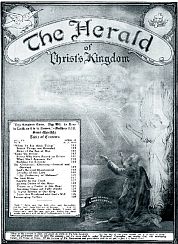
VOL. XVIII November 1, 1935 No. 11 How
We Attain Development as New Creatures "The
Touch of the Master's Hand" The
Life of Faith not Dependent on Signs Timely
Lessons from an Early Convention VOL. XVIII November 1, 1935 No. 11 How We Attain Development as New CreaturesFrom The Watch Tower, August 1, 1916 "If ye live after the flesh, ye shall die; but if ye through the Spirit do mortify the deeds of the body, ye shall live." - Rom. 8:13. MORTIFICATION of the deeds of the body through the Holy Spirit of God is here declared by the Apostle Paul to be essential to the attainment of everlasting life. But to some who had become His disciples, the Lord said, "He that believeth on the Son hath everlasting life." Again, "Verily, verily, I say unto you, He that heareth My Word, and believeth on Him that sent Me, hath everlasting life, and shall not come into condemnation, but is passed from death unto life." (John 3:36; 5:24.) The Apostle John in his first Epistle says, "We know that we have passed from death unto life, because we love the brethren"; and "He that hath the Son hath life." - 1 John 3:14; 5-12. We must not understand St. Paul to contradict our Lord and the Apostle John. Our Lord Jesus and St. John were speaking from the standpoint of God's reckoning-from the legal standpoint. Those who have accepted Christ, and have received of His atoning merit, have come out from under the Adamic death condemnation. Their present imperfections, as well as their past sins, are covered by this merit. Through consecration and begetting of the Holy Spirit they have become New Creatures in Christ. Hence the everlasting life provided for such is already considered as theirs, while they abide under the robe of Christ's righteousness. They are now "saved by hope." The Apostle' Paul is here speaking of the matter from the standpoint of its full accomplishment, when the Church shall have obtained' their spiritual body and are absolutely perfect, and, have received the actual fulness of unending life. This will be attained only in our resurrection. No life can be everlasting, in the strict sense, unless it is to last forever; and this is not determined until we have made our calling and election sure. But it is reckoned to us so long as we are faithfully meeting God's terms and conditions. Life could not last forever under present earthly 'conditions, even though the -penalty of death were entirely removed; for these conditions are not favorable thereto. Conditions and environments must be radically changed before life - could last eternally and be enjoyed in its fulness. The embryo, of life that we have received from our begetting as new creatures is perfect so far as it has progressed, but it must continue to grow and develop, to make progress, until we are finally born perfect, complete, new creatures in the First Resurrection. "Blessed and holy are they that have part in the First [chief] Resurrection. On them the Second Death hath no power." Operation of the Holy Spirit in Us The many exhortations addressed to this class of spirit-begotten ones would not be at all applicable to the world in general. The Apostle Paul is telling us as God's spiritually begotten, sons how we are to make ourselves ready for our birth in due time. He says that we are to accomplish this great preparatory work through the Spirit, through the power of God. The Spirit, or power of God, operates in various ways. For instance, God's message of truth is given to us, embodying the different features of God's great Plan, showing us what is the will of the Lord for us. - The more we study and understand this Plan, the greater will be the operation of this holy power of God in our hearts. The deeper our consecration, the more sympathy shall we have with all the purposes of the Lord and the more fervently shall we desire to do the Divine good pleasure. God through His Holy Spirit is not operating at, present upon any but this special class. Whatever there is in the world of nature is all the result of the operation of God's power; His Spirit, in a general way; but the Apostle in our text is referring only to the influence of the..-Spirit of God upon the soul. In the New Testament writings the work of the Holy Spirit refers only to those who have become God's people under the terms laid down by our Lord Jesus Christ. All such are under the Lord's special care. God began this good work in us. It is not of men nor by men. Therefore we must look to God to complete this work which He has begun, and must give Him our full and hearty cooperation. We are to go to God's Word, and are to study it prayerfully, using all the helps which His providence has furnished thereto, seeking thus to learn the meaning of that Word, seeking to put it into expression in our lives. Just as it is necessary to partake of natural food that we may have our bodies strengthened and sustained, so God has given us spiritual food, that we may get spiritual sustenance and strength and may understand His will. This operation of God upon us and in us through His Holy Spirit is a gradual work; that is, after we have been begotten. Many of us have been so beclouded with the errors of our former beliefs that we are unable to see the deep things of God at the first glance. Therefore we need to study, and to meet together with those of like precious faith. If this is not possible for some, because of isolation, they can at least meet with the brethren by means of the printed page. The Significance of Consecration As we come to understand more clearly all that full consecration to God signifies, our thought on the subject gradually changes. When first we came to God, many of us had the thought that God's will for us was to accept Christ as our Savior, and then to -live a good, decent, moral life, to enjoy ourselves in any legitimate, ways, to take good care of our bodies, and to attend church on Sunday, and perhaps other meetings. We thought that all who did not do this would be lost, that there would be no future hope for them. But this is not God's Plan at all. We have learned better now. God has shown us that the only way by which the Church of Christ can' ever attain to the heavenly inheritance is by the destruction of the human nature and its interests, by the relinquishing of all earthly hopes and ambitions. At first this is a new thought to us, and the, question presents itself, "Does God wish me really to mortify, kill, my human nature? Am I not to seek to cultivate all my natural talents and make the most of them? Am I not to live a natural life, so long as I do not sin?" One not begotten of God's Holy Spirit would say, "Why, certainly; follow the cravings of your nature, so long as you,. keep within bounds. If you would enjoy a good theatre, or a game of baseball, go; and have a good time. If a glass of liquor does not hurt you, take it. If you have a natural talent for music or painting or whatever, it is your duty to make the most of it." This is worldly counsel. In Jesus' parable of the talents, the talents given by a certain lord to his several servants represented opportunities of service for that master. The master placed an opportunity in the hands of each servant and expected him to improve it. So our heavenly Lord and Master places before His servants certain opportunities to be improved to His glory, and to be used as each has ability. These opportunities are given in harmony with natural ability. and not in violation of it; but this does not mean that every ability we may possess, whether its use would glorify God or not, must be improved and employed. As new creatures we are to employ all our powers to God's glory. If, they cannot be so used, we are to sacrifice them and spend ourselves in directions that would be in harmony with our covenant of sacrifice. How the Husbandman Deals with His Vine To each consecrated one who has entered upon this heavenly way we would say, You have placed yourself in God's hands. You have asked the Lord to transform you, to renew your mind, to make you entirely over, that you may be fitted and prepared for the glorious position He has promised. So all your powers are to be turned in the direction toward which you are to be trained by your Master. If the grape-vine under the husbandman could reason and speak, it would probably say, "It is natural for me to develop an abundant supply of foliage and to throw out branches and tendrils in every direction to support me." But the wise husbandman vigorously prunes off these superfluous branches and tendrils that dissipate the strength of the sap, that develop only wood and leaves, and that cause the vine to cling to -improper supports. The husbandman seeks for fruit, rich, abundant fruit; and everything which would hinder this attainment must be sacrificed. The vine would tend downward. The husbandman trains it to grow upward. So does our great heavenly husbandman train His spiritual vine, that we may bring forth abundant fruitage to His praise. We no longer belong to the world. Our course now is to be that which God -has marked out for us in the Scriptures. If, we do not mortify, kill. the deeds, of, the body, we shall never gain the eternal life promised to the faithful overcomers alone. In order to attain eternal life, the life now held out to us -- glory, honor, immortality-we must conform ourselves to the instructions given us by our great Training Master. We are not to do this in our own unaided strength. This would be impossible. But our heavenly Father has promised to work in us while we work out our salvation with fear and trembling. Mortification of the Deeds of the Body The real thought of the words, "Mortify the deeds of the body," is not what some have thought -to mortify our body. According to history, and according to some present practices, we learn that some have imagined that they must torture and punish their body. They use whips upon their flesh until they draw blood. Then they wear hair jackets. Sometimes their bodies fester from the pricking hairs that torture the raw flesh. Some mortify their bodies by actually lying down for others to walk upon them and to wipe their feet upon them. We cannot question that those who do these things have a motive in so doing; and we could not think it a bad motive. But they have entirely misapprehended what is the Scriptural mortification. The Apostle tells is that it is the deeds of the body we are to mortify-the natural practices of the fleshly nature. "It is my nature to do so and so," says one. But the Bible says we are not to go in the way in which we were born; for we were all born sinners. We now have the Spirit of. God, the Holy Spirit, to guide us in the way in which we should go. We are to mortify everything in us which is not fully endorsed by our new mind, everything that would hinder the death of the old creature-already reckoned dead-and hinder the growth of the new creature. Certain elements of the mortal body are to be destroyed, warred against at all times. Other qualities of the human body are to be utilized in the service of righteousness. We were once sold under sin. But we have been purchased back, and now 'we have the mind of Christ. We are now to treat our human body as an earthen vessel to be used to the glory of God. Under the direction of the Holy Spirit we are to know how to use this human vessel.. We are to remember, first, that it is reckoned dead as a human body, having been sacrificed with Christ when we made our consecration to be dead with Him; second, that while reckoned, dead, this body has actually been stimulated, quickened, revivified, to serve the new creature, as its property, its servant, in lieu of the spirit body which we are to have, but have not yet obtained. Every property ' of this body which can be used in the interests of the new creature, is to be utilized. We are not to say, "If I use a certain natural talent which I possess, I can bring comfort or pleasure to others, or can promote some work of reform." The question for us is, "Will the use of this natural talent or power assist me as a new creature or assist in the work of gathering out and preparing the Bride of Christ for her future work?" This is our present mission.- There are those who can do the other things. So we find that the process of developing ourselves as new creatures and of assisting in the building up of the brethren in the most holy faith requires our undivided attention, and means a continual warfare of the new nature against the old. The Apostle calls it the warring of the spirit against the flesh. Our development into the likeness of Christ requires that we do good unto all men as we have opportunity where it will not interfere with our consecration vows-'but especially to the household of faith, as the Apostle tells us. As our flesh is only reckonedly dead, and not actually, we are to be continually on guard. Our tongues are liable, unless carefully and prayerfully guarded, to speak slanderously or perhaps to make cutting remarks. All of our members are to be brought into harmony with God and His will. We are to have the sentiment of the hymn we often sing: "Let Mine Eyes see Jesus only." We are to continually look to Him to be directed. We are, by thus seeing Him, to become more and more conformed to His glorious likeness. We are to endeavor to see everything from the Divine standpoint. We shall never become perfect in the flesh; but so long as we are tabernacling in this body, it is our duty and privilege to compel the body to do the will of the new creature. Our human body was once a slave to sin, a slave to the things, of this present evil world. Now we are to say, "This body belongs to the Lord. I must control it to His glory. I am determined to increase day by day my power over this body, that I may use it more and more fully in the service of my King. I am not to do foolish things. I am not to leap from the pinnacle of a temple to see if God will not protect me while I am trying to show that I am a special favorite of heaven. But under the guidance of the Holy Spirit, I am to get the most out of this body that I can, in the service of Him whom I have accepted as my new Master." All this is necessary to our development of the character required for our great future work, not only for the coming Age, but for all eternity. We are called to joint-heirship with Christ. We can scarcely grasp what this means. We would never be prepared for such an exaltation if we did not prove overcomers. And this means that there is something real to overcome. Overcoming means the development of character; growing strong in the Lord. He declares that He is calling for only such as do thus overcome. Divine Recompense to Those Who Sacrifice The world will have a thousand years to bring their bodies into perfect harmony with the Lord's will, and they will not be required to sacrifice the legitimate desires of their flesh. But we are required, after we have accepted the present call, to sacrifice the interests of the flesh; and we have but a very limited time in which to develop the necessary character. God is now selecting and directing those only who of their own will wish to lay down their lives with Christ. They love Him supremely; and He is pleased, to call these holy ones His jewels. No good thing will He withhold from these. "Eye bath not seen, nor ear heard what God has in reservation for these who love Him." These are going on from grace to grace, living not after the flesh, but after the Spirit. To the world it looks as if these are having a hard time. Moreover, the Bible says, "Through much tribulation shall ye enter into the Kingdom." And again, "Yea, and all that will live godly in Christ Jesus shall suffer persecution." (2 Timothy 3:12.) Unless a man deny himself and take up his cross and follow Jesus, he cannot be His disciple. But, on the other hand, all true Christians will agree with the Apostle that it is possible to reach that degree of development where they will rejoice in all these experiences, rejoice while the flesh is being mortified, deadened, It is not that we are naturally so different from other people that we would enjoy what they dislike, but that we see a reason why we should rejoice. We know that this is God's plan for us; and that by this mortification of the will of the flesh, of the things of the flesh, we are growing in God's favor. "Great peace have they which love Thy Law, and nothing shall offend [stumble] them." So these have the peace of God ruling in their hearts. They have the knowledge that all of their affairs are under Divine supervision. The world have their troubles and fears. Some who are rich in this .world's goods worry for fear they will die in the poorhouse. Many misers have been found dead with a large amount of money secreted about them, having feared all their lives that they would come to poverty and want. Some have had various other forebodings. But those who have put their trust in the Lord have a peace that the world cannot know and cannot take away. It is superior to anything the world can offer. But we cannot explain this to the world. They would be unable to comprehend it. The world sometimes say of the Lord's consecrated people, "Is he a fool?" They cannot understand our hopes, which are so blessedly real, to us. Those who have entered the school of Christ, and who have learned of Him,. know. We all know that for everything which we deny ourselves now our God gives us abundant compensations in our spiritual blessings and joys even here; and then we have all the unspeakable glories promised to His saints awaiting us just beyond the veil.
"The Touch of the Master's Hand"
The Life of Faith not Dependent on Signs"But faith is a basis of things hoped for, a conviction of things unseen." - Heb. 11:1, Diaglott. MANIFESTATIONS or signs seem to have had a part in all Christian lives, and an especially important part usually in the opening years. It is to be seriously doubted if there has ever been a Christian who was required to live the life of faith entirely apart from these outward evidences; and in some lives they have been outstanding. Who could think of the complete change in Saul of Tarsus that gave us our fearless and *yet submissive Paul, apart from the most astonishing of all apparitions-that of the risen Lord Himself r This experience was probably necessary that he might have undying faith in the Lamb slain from the foundation of the world. What proportion of his many later visions were for the strengthening of his own faith it would be impossible to say, for their purpose seems largely to have been that the Apostle might have his share in imparting to the Church those things which Jesus said He could not tell His disciples while with them in the flesh because they could not bear them then. A proper appreciation of the signs which the Father gave him was manifested by the Apostle, in that he did not substitute them for faith, but accepted them as an assistance in developing faith and as an adjunct to it. There can be no outward nor any inward substitute for the life of faith, the life that depends moment by moment upon the favor and guidance of God, the indwelling of His spirit to such an all pervasive extent that "to live is Christ." To this statement perhaps most Christians may agree, but its application to the life is more difficult. Since the life of faith is the true life, and since everything that is true, good, and lovely in the characters and actions of the noble examples of the past, is by the transforming power of faith, it would seem to be a matter of course that everything else making claim to religious value, independent of faith as its basis, must be regarded as false and as setting forth unfounded pretensions. But it must be borne in mind that the error consists not in desiring outward evidences of, the Lord's blessings, but in having or desiring to have them independent of faith. Three Stages of Faith "At one stage of Christian experience we cannot believe unless we have some sign or some great manifestation of feeling. We feel our fleece, like Gideon, and if it is wet we are willing to trust God. This may be true faith, 'but it is imperfect. It always looks for feeling or some token besides the Word of God. It marks quite an advance in faith when we trust God without [humanly inspired] feelings [taking precedence over faith]. It is blessed to believe without having any emotion. "There is a third stage of faith which even transcends that of Gideon and his fleece. The first phase of faith believes when there are favorable emotions, the second believes when there is the absence of feeling, but this third form of faith believes God and His Word when circumstances,, emotions, appearances, people, and human reason all urge to the contrary. Paul exercised this faith in Acts 27:20, 25: 'And when neither sun nor stars in many days appeared, and no small tempest lay on us, all hope that we should be saved was then taken away.' Notwithstanding all this Paul said, 'Wherefore, sirs, be of good cheer; for I believe God, that it shall be even as it was told me.' " When the flesh has not one thing it can point to as an evidence of God's favor, if faith is still unwavering, we can rejoice in the blessed assurance that we are demonstrating to our God that it is Himself and not His signs or His creatures that we are trusting in. Ecclesiastical history furnishes evidence, which is as conclusive as it is melancholy, that in every century since the time of the Apostles there were examples of those who apparently had more faith in supposed signs and revelations than in the Word of God. In view of what is known of the life of faith, one may say with assurance that those things, whether experienced in a greater or in a less degree which are of the nature of visions or trances-revelations of the unknown, do not, and in themselves considered cannot constitute religion. From almost any decade of the nominal church's history one would no-doubt-be able to select examples of this type of deflection from the true faith. Special Revelations not Evidence of Divine Favor In almost all Christian denominations there have been and perhaps still are individuals who consider themselves the subjects of special divine revelations. The reference here is not to a more complete and exact knowledge of God, either theoretically or experimentally, nor to a genuine religious experience, but to supernatural communications to the intellect. Such unusual manifestations are not indications of special favor from God nor of nearness to Him. In fact, as greater light from the inspired Word has been thrown upon our times, Bible students are made aware that visions and other like manifestations, which have been of value only as they have corroborated the "more sure Word of prophecy, to which we do well to take heed as unto a lamp that shineth in a dark place," are no longer a necessity since the divine revelation is complete. Finding that nearly all so-called visions are in violent opposition to the teachings of the sacred Word, all sincere students have been thoroughly warned against them, noting that even a measure of truth in the message would by no means indicate faithfulness either in the message or in the messenger. Was not King Saul at one time numbered among the prophets, and did not Balaam, the son of Beor, fall "into a trance having his eyes open." As with many others, their end indicated the lack of God's favor, though His message, as in these instances, had been on their lips. Even the truth of their predictions could be taken as no evidence of their own personal worth. The miraculous, however, so appeals to the flesh that usually though a long series -of failures has thoroughly demonstrated one to be a false prophet, both the prophet and his followers refuse to accept the evidence of his falsity. Since this is the case where the evidence is so convincing, there is no reason for surprise if more cunning devices of Satan should deceive great numbers. Substitutes for the Life of Faith Before entering upon a discussion of these more subtle substitutes for the life of faith, it is perhaps wise to remark again that it is not necessary to think of these signs and manifestations as being wrong in themselves. In fact, because of the fulness of the devotion to righteousness and to the will of God of those whom Satan seeks to influence, it is necessary that his effort should be, in the beginning at least, not to introduce some evil practice, but to crowd out some good and necessary things by other good and less important things. His greatest skill is brought to 'bear on the task of thus depriving the Lord's people of the two essentials, love for and faith in God. As he would encourage substituting love of fellowship, works, and doctrine, for love for the brethren and for God; so he will surely find other good things which he would encourage the consecrated -to substitute for the life of faith. That his preference would be to lead to acts antagonistic to the will of God rather than to these good works will probably be evident enough before his dealings are finished with those who are willing to listen to his first suggestions. Among the more obvious things which might take the place of true faith in God are, first, confidence in our great attainments, either exterior or interior; second, strong and satisfying religious ,emotions; and third, marked evidences of the Lord's favor in the providences that surround usall good in themselves, but very damaging to our -eternal interests if permitted to take the place -of true Christian living, which may have all of these . in it, but must have as its center the walk of faith. The danger of over-confidence in our own attainments has been so abundantly demonstrated throughout the history of the Church that no further time need be devoted to that feature of our subject, but the two latter suggestions might well be considered. Emotions an Unsafe Guide The existence of specific emotions and affections of a peculiar kind, such as the experience of sorrow in a very intense degree, or a peculiar fulness of joy, or a deep awe; or an indefinable melting of the heart in rapturous ecstasies, is all that is necessary to satisfy the religious cravings of some minds. Not infrequently this is a mere matter of imitation, seeking certain emotions as testimony of great Christian advancement, because of its likeness to the experiences of some religious acquaintances. It is the peculiarity of the sign rather than the experience itself that in most instances is considered the evidence of acceptableness with the Father. "Whatever the specific thing may be, there can be no doubt as to the general fact, that a special experience of some kind; either inward or outward, either in the perceptions or the feelings, is often desired and sought after, and is sometimes made an absolute condition, both by those who are seeking religion in the first instance, and by those who are seeking the additional grace of sanctification, before they are willing to trust themselves in the hands of God, to be wholly and unreservedly His." Undoubtedly one's emotions may vary greatly because of changing circumstances or because of physical differences. If then dependence is placed upon these as the evidence of our acceptableness to God, it is but natural that there should be no stability in the Christian experience but great joy when the desired emotions are present, and depths of despair when they are withdrawn for any reason; for then a mental reaction must almost invariably take place and the misguided one be exceedingly miserable as a result. To this may perhaps be traced the cause of the familiar Christian lives of alternate elevation and depression, of the joyful and of the terrific-of rapture and of wretchedness. It is in these times of mental depression that unexpected and almost unbelievable temptations may be experienced. Even the very existence of God may be doubted because the expected signs are not present; in fact, the very depths of sin may be reached merely because one has desired to walk by special and extraordinary manifestations and illuminations rather than by the simple and self crucifying, the humbling and purifying way of faith. When we arrive at the true and fundamental requisite of the holy life, it will invariably be that one same way of faith; and we may be sure God will honor and reward only His own method of holy living. Faith the only True Basis Memoirs of pious persons are apt to be made up almost wholly of remarkable experiences, considered as special manifestations of divine favor, often accompanied with great joy and even rapture, but only to be almost as certainly followed by intervals of darkness and temptation, and even of sin. Not such exciting reading and therefore not so profitable to the publisher would be the life of simple and childlike faith in God's Word, a faith insured by the unreserved and permanent consecration, a faith keeping the soul in equilibrium, converting darkness into light, removing mountains of distrust and pitfalls of self-gratification. These are lives knowing something of tribulation, but more of transfiguring hope; lives that meet opposition from every source, but always reigned over by the Prince of peace; the lives of those that think little about themselves but much of the Lord, that plan little for their own happiness here but much as to what would give pleasure to their God. Faith and love alone can guide successfully to this goal. "The great design of the Gospel, in its practical and final result on man, seems to be to restore and firmly establish the lost principle of faith, as the true and only available basis of the religious life. And there seems to be a necessity that it should be so. From the nature -of the case, there never can be any true reconciliation and harmony between God and His creatures, until they can so far have confidence in Him as to receive His declarations [with-out reservations], and to draw their life, as it were, from the words which have proceeded out of His mouth. In any other way of living, whatever may be the nature of their inward or outward experiences, they live at variance with the order and the plans of God; out of the line of His precepts, and of course, in the same degree, out of the range of His blessings. And hence it is that we find the remarkable expressions of the Savior to the doubting disciple, 'Because thou hast seen Me, thou hast believed; blessed are they that have not seen, and yet have believed.' " The Self-Renouncing Way Whenever we require a specific experience, before we can exercise faith-an experience either inward or outward, of the intellect or of the affections, in addition to the mere declaration of the Word of God, there is obviously a lingering distrust, a dissatisfaction, with God's arrangement for ,our preparation and perfecting for the Kingdom and its work. "We want to see our own faith," as it has been aptly expressed. "In order to exercise faith in God, we must have something to build upon besides God Himself-a striking proof of the deep distrust and unbelief of the human heart." This life of dependence upon definite manifestations of our personal favor with God is not only evil by being a deviation from the way of faith, but also by nourishing the selfish principle instead of destroying it. It is, indeed, an evidence of a determination to keep self alive. The way of faith is the way of self-renunciation, the humbling way of despised, personal nothingness, the way giving freedom of access to the spirit of God. The way of self develops the spirit of children brought up in unwise self-indulgence. Such will be full of themselves when in possession of the coveted object, but discouraged, peevish, and even hostile, the natural results of the workings of self, when they are disappointed. Such a life, while claiming evidences of special nearness to God, must invariably be very dishonoring to His name. Since sanctification implies union with the will of God, in other words faith, the sanctification process must be retarded, if not entirely stopped, by a desire that providences shall be substituted for faith. "He that is joined to the Lord is one spirit" with Him and will say "Even so, Father, for so it seemeth good in Thy sight," though every indication might be to the flesh a sign that he has been abandoned of the Lord. The spirit will still hear the Master's "I will never leave thee nor forsake thee." A Live Faith Attended with Genuine Emotion Lest we be misunderstood we would say in closing that where there is live faith, it will be quick to note and appreciate all true signs of the Lord's favor, those that God's Word has indicated He will give us, and there will also be appropriate feelings of joy or of sorrow as such an one observes the evidence that he is pleasing or displeasing to the One in whom his faith centers. However, to be reliable, feelings must proceed from a live faith. Faith must precede the feelings, and if the faith is a live one, it cannot fail to be attended with emotions, their depths dependent upon the quality of the faith, but their expression upon the characteristics of the individual. Their value depends not upon the expressiveness of the individual, but upon the genuineness of the emotion, for "God looketh on the heart." Evidently when faith is the guiding principle, all emotions will be tempered with calmness in token of the "peace of God" reigning within. Emotions are a sign of life. It will be the life of God if the emotions have been sent by God, unsought by the individual, but care must be taken lest enthusiastic delusions mix themselves with them. "Remember that your Christian perfection does not so much consist in building a tabernacle upon Mount Tabor, to rest and enjoy rare sights there, as in resolutely taking up the cross, and following Christ to the palace of a proud Caiaphas, to the judgment-hall of an unjust Pilate, and to the top of an ignominious Calvary. You never read in your Bibles, 'Let that glory be upon you which also was upon Stephen, when he looked up steadfastly into heaven, and said, "Behold, I see the heavens opened, and the Son of man standing on the right hand of God."' But ye have frequently read there, 'Let this mind be in-you, which was also in Christ Jesus who made Himself of no reputation, and 'took upon Him the form of a servant, and being found in fashion as a man, He humbled Himself, and became obedient unto death, even the death of the cross.'" Timely Lessons from an Early Convention[Contributed] "There is neither Greek nor Jew, circumcision nor
uncircumcision. Barbarian, Scythian, bond nor free: but Christ is all, and in all." NEARLY two thousand years have now tolled off their count' since the founding of the Church. Many evidences point to the conclusion that the end of the period allotted by God for the completion of the Church is practically at hand. In these last days she is as dependent upon God and His provisions as she ever was, feeding upon His Word, leaning upon the arm of the Bridegroom, guided by the light of the Truth and His providences. And perhaps no less, important in the instruction of the Church are the precedents and experiences of the earliest churches, founded by the Apostles and their co-laborers soon after our Lord's resurrection and departure for heaven. While the situations back there may have differed from present ones in so far as the particular sets of circumstances involved are concerned, the lessons and issues are the same. Vexing questions and erroneous teachings were disturbing the newly founded churches. Confusion and failure were threatening the spiritual progress of those early groups of the Lord's people. Natural prejudices were in the ascendency, and the spirit of mutual forbearance and Christian charity were suffering from these oppositions. Always, from the earliest times to the present, has the Church been assaulted by the Adversary. Always, have forces been brought against her in attempt to defeat her in her great objective-that of keeping Christ as the center of her affections, and being made fit for the Bridegroom, that she may see Him as He is in glory. Christ, All in All Now as the Church is nearing the end of her walk on earth, must she not as much now as in those earlier days, fix her eyes upon Christ? Were not the troublesome problems and the threatened pernicious conditions in those days settled by conviction that salvation was of Christ, that nothing but the grace of Christ was effectual; no circumcision, no keeping of the law, no ceremonies, no human energies, nor in fact anything could add one whit to the believer's standing before God in Christ. What a blessed truth and what a bulwark for the Church all through the centuries! Were these things not settled then by allowing the Holy Spirit to rule instead of the spirit of man? And is it not that experimental appreciation of Christ that is needful today, which comprehends a personal acquaintance with Him that grows and grows with each passing clay? May we ever remember how distinctly He fills every office connected with our salvation-how He is Savior, Redeemer, Advocate, Master, Lord, High Priest, and all else. And. now may our minds be directed to the doings of a. certain convention or assembly far back in the stream of time, as giving us very appropriate and. Timely lessons, meanwhile refreshing our minds along prophetical lines as incidental to the main theme. The account of this momentous gathering is given in Acts 15:1-35. The governing reason for calling this convention is given in the first two verses. An extremely vexatious question had developed amongst the early converts to Christianity, namely certain Jews were going about claiming the necessity of circumcision and the keeping of the law in order to be saved. What made this problem so aggravated was the undoubted fact (as seen from the whole context) that these Jews were Christian converts' themselves; and they were giving no little trouble to the peace of mind of the Gentile Christians in the cities- where Paul and Barnabas had been establishing churches. An Impregnable Barrier It is not difficult to understand how this erroneous teaching had sprung into existence. It was almost an insuperable hurdle for Jews to entertain the idea that Gentiles were invited into the favor of God and that they were entitled' to all the privileges and fellowship on a common plane with the Jews. For centuries the Jews were the elect and. chosen race; the Gentiles were as "dogs." They were strictly enjoined from eating at the same table with Gentiles. For a Jew to sit down to meat with a Gentile was a heinous offense against law and conscience. We observe Peter, the great Apostle himself, in spite of heavenly revelation and conviction by the Holy Spirit, weakening and faltering later and being rebuked and withstood by the Apostle Paul on the subject. (See Gal. 2:11.) Can we not see then that it was only because our Lord was Himself in charge of this new dispensation in a most specific way that it succeeded at all, so far as breaking down Jewish prejudice is concerned? Without this divine aid and the ministration of the Holy Spirit the movement could not 'have amalgamated both parties. The middle wall of partition between Jew and Gentile was too impregnable a barrier to the Jewish mind to be removed without divine supervision. Now as many Jews were becoming Christian believers particularly in Jerusalem and Judea, the centuries old traditions, the customs and practices, the inhibitions impregnating their human constitutions continued to shackle them to their old influences and mental attitudes, and they sought the way of compromise to ease their mental conflict. Maintain the ancient Jewish rites and combine them with the new! Let the Gentile Christians be circumcised, then fellowship might be possible; the middle wall of partition could come down, they thought. Thus confusion and perplexing difficulties were assailing the early Gentile Christian communities because of these teachings. Paul and Barnabas were at the time of these events at Antioch, a Syrian city north of Palestine. This, it will be recalled, was the site where disciples were first called "Christians." (Acts 11:26.) They had returned from their first missionary journey. Hearing of these teachings it was decided that Paul and Barnabas and certain others should go to Jerusalem about this question. We read in the 4th verse 'that they were received of the Church, and of the Apostles and elders. The imagination is prone to delight in ruminating about the events surrounding this reception. Who were the Apostles of the Church at Jerusalem? We know that Peter and James were there, for their discourses at this convention are recorded in this chapter. Besides these two venerable Apostles, there is a third not mentioned in this account who gave his right hand of fellowship to Paul, that disciple whom Jesus so particularly loved -- John. We get this information from Gal. 2:9 where Paul alludes to this particular conference or assembly. Fellowship of Saints The many private conversations and discussion) between these four Apostles and the other individuals attending this convention are, of course, not recorded. We can only conjecture as to what they talked about and how they rejoiced at seeing each other and fellowshiping. It cannot be amiss to say that in many respects the conventions we contemporary Christians attend must 'be much similar to the one in question -- there is the glad reunion of friends united in thought and objective by the Holy Spirit; there are the elders whose care of their respective flocks is their chief concern; there are pilgrims whose lives are being spent and devoted to the welfare of scattered saints; there are those whose service in the Truth can be measured over a long period, and there are younger ones whose zeal looks down the future with hopes that they too will eventually see the same ripened fruits of the Spirit abounding in themselves as are evidenced in many of greater maturity. At the convention in question there is naturally, the undercurrent of great agitation over the problem for which it has been called. The Apostles are mingling with the conventioners. What a hallowed sight! Let us in our imagination transport ourselves back to that convention. There is Peter, once the plain, untutored fisherman, but now one of the solid foundations of the Church, and one carrying weighty responsibilities placed upon him by the Lord. We see that Apostle who "was not a whit behind the very' chiefest Apostle," although so far as having seen the Lord Jesus He was as "one born out of due time." James, we would behold, the brother of our Lord, whose eminent sanctity and dignity induced the early Jews and Christians to call him "James the Just." And lastly, of the Apostles, there is the loving John, as we picture him moving quietly and unassumingly, 'but radiating his well-.known lovable character and deep spirituality toward everybody. Barnabas is there too, a very outstanding character and worker in the early Church, one of the principal missionaries, perhaps older than Paul, with whom he traveled in the early part of Paul's ministry. But now the convention begins. It does not have altogether smooth sailing. There is "much disputing," but in due course Peter rises up to speak. He directs the attention of the listeners to a very important point-the fact that God had chosen him ii an important sense in opening up the Gospel way to the Gentiles, to the end that they should believe. Furthermore (and here was a most telling argument), he reminds them that the Gentiles had the Holy Spirit -bestowed upon them in just the same manner that the Jews had. He no doubt had the case of Cornelius in mind, if he did not actually cite it. Thus Gentiles accordingly had their hearts purified and cleansed by faith the same as 'believing Jews. He introduces to them a question with a very pointed meaning, namely, Why tempt (or provoke) God by laying on the necks of these disciples a yoke which no Jew with "much advantage every way" had ever been able to bear? He concludes his discourse by leaving that sublime truth ringing in their ears, that salvation comes through grace and that Jews and Gentiles alike were saved through the grace of the Lord Jesus Christ. Christ, the Key-note Yea, and may we add, everything pertaining to our salvation, our knowledge, our faith, our works are embraced in Peter's concluding announcement. Throughout every step of our walk, which leads from the first yearnings for divine forgiveness to the ultimate goal within the portals of heaven -- it is Christ -- Redeemer, 'Advocate, High Priest, Bridegroom, Head of the Body, and all else that He is to us, who makes our victory and our attainment certain. All the knowledge that .any human being could absorb, all the charity and all the works in the universe detached from Christ would not serve one iota to further our cause in heavenly matters. Thus our Lord assured His closest and dearest' of friends on earth: "Without Me ye can do nothing." - John 15:5. Peter's remarks must have put a reverent stillness over the assembly, or was it partly due to the anticipation of hearing the next speakers? Peter had unmistakably sounded the key-note of the convention in focusing their minds on Christ, and this without doubt would but quiet their agitated spirits. It resolves all doubts, all fears, and it dissipates all clouds. We read in the 12th verse that "all the multitude kept silence and gave audience to Barnabas and Paul," who were to speak, probably in the order named. What they said at this time is given us only in the briefest form. They pointed to the wonderful works and miracles that had been performed through them by God amongst the Gentiles. We may naturally infer that they dwelt upon two miracles that had been performed -that when Elymas, the magician, was stricken blind at Paphos in the island of Cyprus for withstanding Paul and Barnabas (Acts 13:11); and the one where the lame man at Lystra, who had never been able to walk from birth, was immediately healed. (Acts 14:8-11.) These miracles must have been persuasive arguments to the Jews, because in their long history God had many times worked miracles for them. This must have been proof to many that God's favor was working in and amongst the Gentiles, and that the Apostle Paul was indeed engaged in a divine mission. An Interesting Chain of Events Lastly James gave his discourse. What a Scriptural gem! Here is stated in brief summary form all of God's program concerning the sons of men from his time into eternity. He shows first how God did visit the Gentiles "to take out of them a people for His name, and then referring to a prophecy of Amos, he tells how "after this," He will return and will build the tabernacle of David, which is fallen down, and will build again the ruins thereof, and will set it up. It was in-God's purpose to select a "people for His name" and that out of the Gentiles (though not exclusively) and when that people is completed, then will come the blessings to the Jews as a' people, promised from earliest times. James hereby definitely and emphatically indicated that great and superior privilege, the high calling, to which the Jews as a whole failed, to rise, and because of which failure the "people for His name" would come mostly from the Gentiles. And has not nineteen centuries of time corroborated the accuracy of this prophecy? And now as we look abroad and see signs of God's favor again turning toward the Jews in the Holy Land, can we not well assume that the "people for His name" are about completed, though in no wise would we presume to say that there are none yet to be added. We now see in James' discourse a glorious prospect for the whole world directly connected with the rebuilding and repairing of David's tabernacle. He states that all the residue of men and all the Gentiles (those who did not get into the high calling) will seek after the Lord as a result of the rebuilding of David's tabernacle. The word "that" in the 17th verse clearly supports this conclusion. Thus a most interesting chain of events in the purposes of God is revealed in James' discourse. (1) God visits the Gentiles, with whom He has heretofore had no relation, (2) He takes out a people for His name, (3) He rebuilds the tabernacle of David, (4) as a result, all mankind (except those incorrigibly disobedient) will seek after God. On the Threshold of a New Dispensation The Jews as a whole who were living at the time of this convention were standing at the threshold of the most important time in all their history. No moment had ever been so full of promise; so pregnant with lofty responsibilities; no time would ever come again laden with so much hope. The climax of all their longings was possible of consummation; the great principles of truth which for centuries had been portrayed in types and shadows were now being expressed in the higher terms and mediums of the Gospel dispensation. The former dispensation which had been full of favor to the Jews was now emerging into the next, the favors of which transcended those of the former era so as to beggar description. Under the law dispensation the great principles and truths of God were seen only as in a mist. A just and righteous God was typically cleansing sinners by accepting the sacrifices of animals. Their mediators, priests, and prophets connected them with God. Their psalms were expressions of their life of faith, their devotional attitudes toward God, and they stirred the bosoms of the Jews in all their religious sentiments. But now these grand and sublime principles were finding expression and fulfillment in the higher realms, and the truths which were heretofore only dimly seen, were now emerging into 'bold and certain verities. Now that salvation which formerly had been temporary and conditioned upon the impossible keeping of the law, was free, complete and permanent, and conditional only upon the faith and acceptance of Christ as the great sacrifice. But in the face of all this, the Jews failed. That which they strove for through works, they were too slow of heart to accept as a gift. Now that the high calling was opened up, the Jews (but for exceptional individuals) were blind-bogged in the morass of prejudice, and sunk in the oblivion of rituals and dead works. Sad state for a nation chosen and elected to receive these glorious things! Paul in Romans 9:2, 3, tells how grieved and anguished he is over these, his "kinsmen according to the flesh." Yet, as James points out, so soon as the "people for His name" are completed; so soon as this hiatus in the Jewish favor is bridged; then will the restoration come, the rebuilding of David's tabernacle,; then will come the beginning of the consummation of, all God's promises to Abraham, his seed and all the families of earth. Paul, in Romans 11:1 replies to the question "Hath God cast away His people?" by the vehement denial, "God forbid." From the 25th verse to the end of this chapter he declares that blindness in part is happened to Israel, until the fulness of the Gentiles be come in. And herein Paul gives us an inspirational glance at the operation of that great quality of God-mercy. For he says in verse 32, "God bath concluded them all [both Jews and Gentiles] in unbelief [or, left them for a season to taste the bitter fruits of disobedience], that He might have mercy upon all [to show them eventually by contrast His ineffable kindness and goodness.]" Could human, finite mind ever have conceived that the occasion of disobedience with all' its horrible consequences, was the very field of operation for God's great quality-mercy? "Surely the wrath of man shall praise Thee." (Psa. 76:10.) We may taste the sweet ministrations of mercy because of our very need of it. Instead of sin and Satan thwarting God's glorious Plan it became the-occasion for the display of this part of God's great character. Thus Israel's disobedience has paved the way for God's mercy upon her to be witnessed in a most complete manner shortly. Paul then exultantly exclaims: "For if their exclusion [i.e. their blindness whereby the Gentiles received the call] means that the world is reconciled to God, what will their admission [to God's mercy and favor] mean? Why, it will be life from the dead." (Rom. 11 :15, Moffatt.) And in this same poetic and exultant spirit he concludes, "0, the depth of the riches both of the wisdom and knowledge of God! how unsearchable are His judgments and His ways past finding out!" (Ver. 33.) "Who hath first given to Him?" (Ver. 35.) None indeed, we are the beneficiaries of His mercy and grace always from first to last-it flows in an everlasting stream to usward. "His mercy endureth forever." - Psa. 106:1. Did Paul express these thoughts which we have taken from his letter to the Romans, on the occasion of the convention at Jerusalem? We cannot say, but James' discourse must have either inspired them or at least confirmed them, because they are so similar, in arrangement. A Spirit of Charity and Mutual Forbearance James then concludes this outstanding and momentous prophecy by recommending that the Gentile Christians be not troubled (inflicted) with these Jewish obligations, but that a letter be sent to them advising them to abstain from things polluted by connection with idolatry, from fornication, from flesh of strangled animals, and from blood. But is this not an inconsistency? Why impose any' restrictions, at least those pertaining to eating? Ah, James' judgment emanates from a spirit of charity and mutual forbearance. He knew that nothing is unclean of itself, but to him that esteems anything to be unclean, to him it is unclean. He knew that "an idol is nothing in the world, and there is none other God but one"; but all men have not this knowledge; some could not eat that which had been offered in sacrifice to an idol without defiling the conscience. He knew there were different. degrees of knowledge and spiritual discernment and development amongst those brethren.. It is good to abstain from everything whereby a weaker brother may be led to stumble. Paul treats on this same subject in 1 Cor. 8 - and says that to sin against the brethren is to sin against Christ. Thus in James' recommendations the prejudices of the Jews were taken into consideration and it was not at. all unreasonable to ask the Gentiles to comply with these few exceptional suggestions pending such time as the matter would become clearer to, all. Thus we see forbearance exercised on both sides, the Gentiles in complying with these few considerations, the Jews in exacting no more. The Jewish Christians could look hereafter upon their new Gentile brethren with less or no suspicion. Not for one moment was it implied, and certainly we do not hold, that any Jewish ceremony was necessary to salvation. This, all conceived in a spirit of love, was simply a complete and satisfactory settlement of a problem so serious that had it not been so disposed of, there is no telling how, the history of the Church may have differed from what it is. Then the Apostles and elders (and be it noted) "the whole Church composed a letter to the Gentiles affected by this deliberation. The letter is short and in accordance with James' advice, and is quoted herewith: "The Apostles and Elders and Brethren send greeting unto the brethren which are of the Gentiles in Antioch and Syria and Cilicia: Forasmuch as we have heard, that certain which went, out from us have troubled you with words, subverting your souls, saying, Ye must be circumcised, and keep the law: to whom we gave no such commandment: it seemed good unto us, being assembled with one accord, to send chosen men unto you with our beloved Barnabas and Paul, men that have hazarded their lives for the name of our Lord Jesus Christ. We have sent therefore Judas and Silas, who shall also. tell you the same things by mouth. For it seemed good to the Holy Spirit, and to us, to lay upon you no greater burden than these necessary things; that ye abstain from meats offered to idols, and from blood, and from things strangled, and from fornication: from which if ye keep yourselves, ye shall do well. Fare ye well." - Acts 15:23-29. What effect did it have on the Gentile converts? "When they read, they rejoiced for the consolation." (Ver. 31.) Its effectiveness was vouchsafed. The convention had been tremendously' successful, spiritually speaking, because the Holy Spirit had been permitted to guide and rule it. Otherwise it would have been, a distinct failure. The Jewish and Gospel dispensations had fused. John's Ministry of Love We now profit for a moment to hearken back to one silent but important figure in this convention. We quote a passage from a celebrated writer "One of those who gave the right hand of fellowship to St. Paul, was the beloved disciple 'of that Savior.' This is the only meeting of St. Paul. and St. John recorded in Scripture. It is, moreover, the last notice which we find there of the life of St. John until the time of the Apocalyptic vision in the island of Patmos. For both these reasons the mind eagerly seizes on the incident, though it is only casually mentioned in the Epistle to the Galatians. Like other incidental notices contained in Scripture, it is very suggestive of religious thoughts. St. John had been silent, during the discussion-in the public assembly; but at the close of it, he expressed his cordial union' with St. Paul in 'the truth of the Gospel.' That union has been made visible to all ages by the juxtaposition of their Epistles in the sacred Volume. They stand together among the pillars of the Holy Temple; and the Church of God is thankful to learn how Contemplation may be united with action, and Faith with Love, in the spiritual life." As we exercise our imagination a little more we are permitted assuredly from what we know of the character of this last Apostle, to see him circulating around amongst the conventioners particularly in the beginning when there was "disputing," exuding the perfume of love, doing a ministry which might have differed in some respects from those who resorted to talking more, but indeed equally effective.. We do well to emulate John, who was the contemplative type. And what is contemplation, might we ask? It has been defined as the "act of looking at or thinking over carefully." With this in mind a number of thoughts suggest themselves from this brief quotation. These last days of the Church on earth with the winds of doctrine blowing hither and thither, the world, and in fact, the Church, in a condition of turmoil and confusion seem to require on our part the "thinking over carefully" attitude.' We need to give "earnest heed to the things which we have heard, lest at any time we should let them slip." (Heb. 2:1.) Well will it be with us if we remember and act upon the advice given us in the Word, "Thou wilt keep him in perfect peace, whose mind is stayed on Thee, -because he trusteth in Thee." "If ye then be risen with Christ, seek those things which are above, where Christ sitteth on the right hand of God. Set your mind on things above, not on things on the earth." - Isa. 26:2; Col. 3: 1, 2, Margin. Then too, we recall how our blessed Master warned His people that the trials and testings in the end of the Age would be of such subtle character that "if it were possible, they would deceive the very elect." What vigilance then; what responsiveness to the deep things of God and of the Spirit should we exercise and seek, through prayer, to have increased in us in these perilous times; "contemplating" or "thinking over carefully" the Lord's Word; our development in Christlikeness and all related matters-all of which are vital to us; issues indeed which project themselves beyond the horizon of our pilgrim journey here and become issues of eternity. A Wide Field for Action Action may still be as necessary as Contemplation though it may have many different channels ,in which to spend its energy. We recall that the Christian is spoken of as a warrior (1 Tim. 1:18; 2 Cor. 10:4); as a racer (Heb. 12:1); as a wrestler (Eph. 6:12) as a fighter (1 Tim. 6:12); as a crossbearer (Luke 9:23); as a student (2 Tim. 2:15); as a comforter of the brethren (1 Thess. 3:2); and added to this is the duty of being "living epistles" in the daily life -- being the echo and reflection of Him in whose footsteps we have covenanted to follow. When we appreciate all this and realize all that is involved in acquitting ourselves creditably in all these respects, we can see clearly that to the end of our pilgrim journey it will be blessedly true that "contemplation" may be united with "action," and faith with love. Who of us feels so far developed in Christlikeness as to say that there is not yet much need for further progress in ourselves. And then there is the duty and privilege of comforting and encouraging each other; all of which argues our faithful cooperation with our Head in order to the mutual development of all the Lord's faithful. Wide field for "action" indeed! While the form of action may have changed so far as the outward united action of past days is concerned, does the more quiet style of action we engage in in these last hours, bespeak of lack of spirituality or devotion to God? God forbid! Surely John's failure to be prominent by way of utterance at that early convention cannot in any way be construed as proof that he was lacking in spirituality or approval of the Lord. In fact it is noteworthy that it was this same John in whose heart the great and all-consuming quality of love (which is Godlikeness) found such fertile soil. As a concluding thought, then, let those of us who (either by reason of our own abilities, or as a result of conditions permitted by the Lord) cannot be Peters or Pauls emulate the beloved John. That John's impressionable and responsive spirituality prepared him, under God's' guidance, for receiving the visions from his resurrected Lord and recorded by him in that portion of the Scriptures known as the "Revelation of Jesus Christ" must be evident from the fact that he was so chosen for the particular and honorable task of handing on to the Church of Christ that precious and comforting heritage for which we offer to God our heartfelt thanks and praise. In His Image and Likeness"For whom He did foreknow, He also did predestinate to be conformed to the image of His Son." - Romans 8:29. THE PRIMARY significance of the word character is to make sharp, to cut into furrows, to engrave, thus producing a likeness or image. Time and the processes of growth and development are most important factors in the development of a Christlike character. The tiny rosebud has its beauty, but hope and faith look forward to the perfect, full blown flower; and the bud must swell, develop, and open out its close shut leaves in full blown loveliness, before its grandeur and refreshing fragrance can be realized. Just so it is with character; and therefore, the most beautiful thing on earth, in God's estimation is a tried, disciplined and well developed character. A character which has yielded to the influence of evil is not the development (engraving) of the beautiful tracings found to some extent in every individual in youthful innocence, but a blurring and effacing of those tracings and a substitution of the deformities of evil. The Value of Developed Character "There is nothing in the world so beautiful to me as a little child," said one who fondly contemplated the sweet innocence and awakening mentality of a little grandson, very dear to her heart. The remark awakened a train of thought, and led to the consideration, Does God so view it? And is it really so? Let us see. The charm of childhood is its innocence, its purity, as yet uncontaminated with actual sin, its awakening mental and moral powers, and the freshness and beauty of its new physical life. But viewing the matter from God's standpoint, we see there is something more beautiful still-that disciplined and ripened character whether realized in youth, in middle age, or in ripe old age, is of far greater value and comeliness in His sight. What! is the bent form, the faltering step and the whitened locks of age more beautiful than the freshness, vigor, of youth? No; but under the rude blasts of the present imperfect conditions of human life, which ultimately wreck and ruin . the physical structure, in some cases characters have been developed which far surpassed in grandeur and beauty the innocence and simplicity of childhood. It is character that God most admires and loves; and if we take His standpoint, it is what we will most appreciate. When God originally created man pure and in His own likeness-"very good"-doubtless'' he was worthy of love and admiration; nevertheless, that he and his race might have the greater beauty of matured and disciplined character, and be worthy of still more love, God, during the period of the reign of evil and including the future Age and the reign of Christ, submits them to the rude hand of discipline, with the ultimate design of developing and perfecting character. While the inner flower of character is developing, the -outer leaves that enfolded the bud may be withering and dying; but he who is intent on watching for the flower and waiting for its inner glory and fragrance, has but 'little regard to the outer fading leaves which in its infancy was all that was to any extent visible. Just so may we regard the infirmities of age, the loss of youthful vigor and beauty, the silvered hair, the wrinkled brow, the bent form, the halting steps, and voice, and the trembling lips, if the fragrance and beauty of the ripened character present their charms. In due time God who greatly values it, will trim off the outer leaves and transplant it to a more congenial soil and clime, where it will bloom in eternal beauty. From Childhood to Maturity Let those who would appreciate the developed character, mark carefully the features visible even in the infantile tracings. Mark the baby's dignity -- how sober and thoughtful and inquisitive and anxious to learn; note the first evidences of conscience, how he tries to balance the problems of right and wrong. Mark how he expects truth as a matter of course, and is surprised at falsehood and duplicity. See how love springs up and overflows the baby's heart, and how 'benevolence tries to repay parental affection with smiles and loving caresses; yet each may have its evil counterpart as a possibility, but not as a part of the first tracings of character. These baby, graces and charms are but the first tracings -of character. Under careful discipline and training and favorable conditions these early traits and features of character would develop uninterruptedly. But such conditions do not generally obtain in the present life, and as evil reigns, character is stunted, dwarfed, and the excrescences of evil appear, to disfigure and mar the beauty and pervert its high and noble faculties to ignoble and base uses. But, on the other hand, consider the one who has been wrought upon by the Spirit of God; view the rightly developed character of maturity. See how careful study of the principles of righteousness has dignified the whole countenance; observe the easy quiet grace with which errors are dropped and Truth is gladly and thankfully embraced, because the desire for, and appreciation of Truth has been carefully cultivated. Mark how conscience, skilled in its judgment of right and wrong, and unflinchingly committed to the right, guides the actions with unwavering precision; how truth and equity, love and benevolence, rule and triumph over every temptation to evil. , And with such a character, however inferior the physical form, even it is in a measure glorified. The open countenance accompanies the transparent virtues of the soul; quiet dignity and easy grace are the outward expressions of a soul at peace. and in delightful communion with, God. Studious care in the building of character is expressed in the thoughtful countenance; and the joys of hope and faith add a halo of glory, beautiful in the highest sense to every beholder. The perfume of such ripe and full blown characters, is. a blessing to those about them and precious foretastes of the wealth of blessing in store for the whole world when such shall have 'been exalted to their promised position and privilege of authority and power. Weak and Strong Characters A strong character then is one which by continued resistance and overcoming of evil has become established in righteousness. Righteousness has become the uniform habit of life. Apparently some characters develop and strengthen very early in life, some in middle life, and some later, though every added year will bring its added glory if properly used. And every one whose own character is developing with energy has a keen appreciation of such development in others. Thus it is that the Body of Christ, every member of which is thus by the Lord's Spirit actively engaged in character building, is knit together in love. They see in each other that which actually calls forth their love, however unlovely they may appear to people of the world, who look not upon the heart but merely upon the outward, form and conditions and circumstances. While every child of God is engaged, to a greater or less extent in this work of character building, some grow steadily stronger, while others, through lack of consecrated effort, are weak and vacillating, measurably swayed by the influence of the world, the flesh, or the Devil, yet not entirely so, but still making some effort toward righteousness. Such characters are not willing to be closely identified with the Body of Christ, but would follow "afar off." They are not quite willing to share the reproaches of Christ and so keep at convenient distance. Such have not learned to view character from God's standpoint and to appreciate it and the Truth which develops it. Thus such characters are weak and unworthy of their privileges. If we have taken the Lord's standpoint, which is the only standpoint of actual merit, we should learn to value the Truth and those characters which have been and are being molded and fashioned by it, above all other considerations, and not be in the least ashamed to be identified with it or them. Blessed is He Who Overcomes Such strong characters God loves and honors, while He declares that He is ashamed of the weak, vacillating ones who follow Him afar off. He says, "Whosoever therefore shall be ashamed of Me and of My words,' in this adulterous and sinful generation, of him also shall the Son of Man be ashamed,, when He cometh in the glory of His Father, with the holy angels." There are many ways. of showing ourselves ashamed of Christ. We are ashamed of Him' if -We are ashamed of any member of His Body, however humble or poor or unlearned; if we are ashamed to be identified as their friend and, companion. We are ashamed of Christ if we are ashamed to be recognized by the world and professing -Christians as members of His despised Body which they do not 'recognize, but which they reject and everywhere speak against. We are ashamed of Christ; too, if we are ashamed of His ' doctrines,: either as a whole or in part. To be ashamed of any of these is only to prove that such a character is weak and vacillating and far short of that full development which the Lord desires, and the possessor of which only He will own and exalt as His Bride and Joint-heir. He would rightly be ashamed to take for His Bride one so inferior to the Truth and its moral excellence. Soon Christ's appreciation of those strong; beautiful, symmetrical characters which have followed Him closely in this evil time, from principle, and not for praise of men, will be expressed in their glorious exaltation as His Bride and Joint-heir. These will then shine forth to all the world in the splendor of strong and holy images of Christ. Convention ReportThe St. Louis Convention, September 28, 29, surpassed in every way all expectations of local as well as visiting brethren. Truly the. occasion proved to be a season of joy in the spiritual blessings provided, not the least of which was the fellowship of friends-some. of whom had not met for years. This fellowship was uninterrupted between meetings on Sunday as we enjoyed together the bountiful repast provided by the local brethren: Our hearts were touched, as we listened again- to the expounding of God's precious Word, with its comforting assurances and promises. We were reminded of our privilege of: rendering unto the Lord offerings of thanksgiving, and the importance of faithfulness to our covenant of sacrifice. Thus only can we rely on the power of God to work the promised deliverance "in the day of trouble" and experience rest from our own works. We were encouraged to "labor" or "hasten" to enter into His rest, while He works in us to will and to do of His good pleasure. The importance of working with God in harmony with the Divine Plan of the Ages was emphasized to our profit. Our. interest in the study of the Tabernacle and its services was also revived as we reviewed some of" the beauty and harmony of its typical significance. Close attention was given to a public discourse, and. several strangers left their' names for further information. By the spontaneous and 'enthusiastic 'responses' at the Praise, Prayer, and Testimony Meeting the' friends also gave evidence of much blessing received, which we trust will mean a richer fruitage to the glory of our Father. |