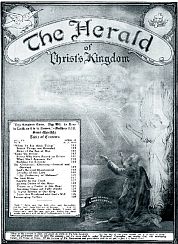
VOL. XXII October, 1939 No. 10 Things Coming to Pass
"When ye see
these things come to pass, know ye that THE INEVITABLE has happened. To a
Europe that for nearly six years had experienced war's alarms, war at last has come.
Insane war, with all its brutal horror. And yet not war as it had been waged in times
past but a new kind of war that could reach beyond the battling armies to the helpless
civilian population, to wreak untold misery on non-combatants. Such is the new kind of war
that has burst upon a long-suffering humanity which, since 1914, has been living in an
atmosphere of hatred and suspicion unparalleled in the annals of history. And yet the
breaking of the long-threatened storm, so fearfully awaited, has paradoxically been
welcomed by many in Europe as preferable to life lived under the constant dread of
impending conflict. The "war of nerves," of
nations mobilizing for days and weeks in full view of their neighbors, of threat piled on
threat, while each side waited for the other to break down, had finally become
unendurable, and war itself, war to the finish, as some have expressed it, was
considered preferable to a continuance of a state of affairs where the activities of one
powerful nation were constantly jeopardizing the peace of a continent. And this, though
thinking men had forewarned that another such cataclysm as the first world war had
precipitated, would result in a crippling of the nations to such an extent that it would
be with difficulty, if at all, that they could recover from it. And yet the dreadful
record of past suffering seems to have had no lesson for the present generation. As has
well beer, said, "We learn from history that we never learn from history.
"Never
Coming to a Knowledge of the Truth"
When the final decision was made by the
British Cabinet, in the words of Arthur Greenwood, Laborite member, the House of Commons
accepted the war announcement in an "atmosphere of relief and composure that the
intolerable agony of suspense is now over." And now war in all its barbaric fury
has burst forth, and though the press reports are still very meager, the horrifying details have begun to
seep through. The details of the engagements on the Western Front do not permit of a
true appraisal of conditions as yet, but those obtaining on the Eastern, though still
obscured by the maze of contradictory reports, suffice to enlighten a sickened world of
the dreadful state of affairs in Poland. At the time of our writing, after only
a few weeks of warfare, Poland has been reduced to a terrible plight. Her armies broken
up, every sizable city half in ruins due to the almost constant bombardment by German
planes, her people disorganized and fleeing everywhere in terror, completely hemmed in
from possible- outside, help. Hers is a condition of black despair. It is necessary to
list the details of the sufferings- of 'her wretched people, practically defenseless from
the rain of death from the skies. Utter demoralization seems to have swept the brave
little nation, and who can read without a sense of numbing horror, the pitiful sufferings
of this people, the roads choked with panic-stricken civilians afoot, fleeing their,
wrecked homes, fleeing to no one knows where, but anywhere from the pursuing death. What
despair must fill the hearts of these poor people, who so bravely a few years ago again
established their nation, so often torn asunder, and now must realize that even with
possible ultimate victory on the Western Front, Poland, as a nation, again may disappear
from existence.
Desperate
Plight of Polish Jews
An added note of misery is the
desperate plight of 3,000,000 Polish Jews, to whom war has come as a new fear that goes
beyond the danger of loss of homes and property. They flee not only the German army, but
the anti-Semitic policies they believe will come with any German occupation. Today they
are crowded into the entire area of south-eastern Poland, but the Rumanian border is
blocked to them, and the Soviet frontiers are also apparently closed to them. The heart is sickened at the record of
these things, and also of the pages yet to be turned in the future. The realization of the
consequences of loosing the forces of destruction and of the ultimate responsibility to a
Higher Tribunal for the sufferings of helpless peoples, has already brought forth the
tragic irony of both major belligerents claiming divine blessing. Great Britain's
monarch, in his address to the empire's subjects after war was declared, said in
conclusion: "We can only do the right as we see the right and reverently commit our
cause to God. If all people do that, then with God's help we shall prevail. May He bless
and keep us all." The German Fuehrer in his appeal to the people of his nation
concluded with these words: "If our people in such a manner fulfils its highest duty,
the Lord God, who always has given His grace to him who was determined to help himself,
will also stand by us." "A House
Divided Against Itself"
And from Rome comes the news that one
of the saddest of hearts in Europe was that of Pope Pius XII. He had been hailed at his
election as a shrewd diplomat who would be an authoritative moral policeman among
Europe's thugs. And now the Nazi Communist pact had brought together the Church'; two
bitterest enemies. And the saddest of all was the thought of his sheep fighting each
other: 37,.900,000 German Catholics (21,000,000 of 67,000,000 pre-Hitler Germans, plus
6,100,000 Austrian souls, plus 10,800,000 in Czecho-Slovakia) pitted against 23,000,000
devout Poles-just about his staunchest followers anywhere. The Pope's ministrations, like
those of all strivers for peace, had failed. And what shall be the outcome of it
all? Have we entered Armageddon, the last phase of earth's tribulation period, or is this
but another spasm with more to follow? It is impossible to read clearly at present the
connection of the present tragedy to the final outcome, the birth of the new order of
things, the Kingdom of God. Of this, however, we are certain: the people of all
nations-all of the world's 1,500,000,000 civilized people with few exceptions-were: (1)
thoroughly sick of and appalled by the idea of war; (2) morally ashamed of it. For these
suffering peoples of earth, poor groaning creation, travailing in pain together, we also
groan, and with renewed zeal pray for God's Kingdom to bring the desire of all nations,
the Prince of Peace and His beneficent reign. For us, as ultimately for all mankind, the
46th Psalm with its glorious message, brings rest of soul: "The nations raged, the
kingdoms were moved: He uttered His voice. the earth melted. The Lord of hosts is with us:
the God of Jacob is our refuge. Come, behold the works of the Lord, what desolations He
hath made in the earth. He maketh wars to cease unto the end of the earth; He breaketh the
bow, and cutteth the spear in sunder; He burneth the chariot in the fire. Be still, and
know that I am God: I will be exalted among the nations, I will be exalted in the earth.
The Lord of hosts is with us, the God of Jacob is our refuge." - Psa. 46:6-11. Our Fellowship
"As iron sharpeneth iron, so
doth the countenance of a man, his friend." - Prov. 27:17. ADAPTING THESE words of the Wise Man to
the needs of the Lord's children today, we might revise it and say, "As iron
sharpeneth iron, so doth the fellowship of a consecrated believer, his brother."
For it is certainly a truth beyond all question that deep heart-to-heart fellowship with
one of like precious faith quickens and sharpens appreciation for the things of the Lord
to more than razor-edge keenness. Under the Holy Spirit's leadings, the words of truth and
comfort which pass from lip to lip and from heart to heart become freighted with a
reviving and rejuvenating power, which spiritually puts strength into feeble limbs and
energy into flaccid muscles, and a new vitality into debilitated hearts, and makes the
weak, depressed saint of God say, "Thank God, my weak ness is gone; I feel strong
in the Lord and in the power of His might." In the hallowed atmosphere of true
Christian fellowship the flash of the eye, the beam of the countenance, the intense thrill
of the voice, and the energetic grip of the hand, bespeak something a thousandfold more
precious than the common cause which brings men of the world together in their 'various
fellowships and associations. Inasmuch as the heavens are higher than
the earth in all things, so must fellowship in heavenly things always be more lofty, more
vital, more comprehensive than any fellowship on mundane things. And when the hearts of
God's elect are "en rapport" in the things of "Love divine, all love
excelling" -- with the sanctifying Spirit of God presiding and pervading every
thought and word, then indeed is the "Joy of heaven, to earth come down." Fellowships and What they Mean
It is no easy task to create a
fellowship. It requires at its rallying center a strong dominating personality, or
perhaps a group of such personalities. And then, further, it demands the existence of a
"common cause. Given these preliminaries, expert oratory may whip up almost any
assembly to a high pitch of emotion and enthusiasm; skilful presentation may show an
audience that they may have many things in common with each other; and thus, in the
glowing heat of the occasion, a kinship or fellowship of interest and outlook may be
created and established between them. For the purposes stated, they become
"fellows"-sharers together common participants in the same cause. "Each for
all -- all for each" becomes their motto, and thus the "common cause"
enlists the services of each to minister to the needs of all. In this way great leaders of men have
accomplished most extraordinary things among their fellows. They have fanned emotion and
resolution to a white heat, and have hammered public opinion (local or general) on the
anvil of their own convictions, into any shape they have desired. But to do this, the man,
or men, who form the nucleus of the fellowship, must themselves carry "the fiery
cross" or follow the "holy gleam. The message he or they utter, must be a
"living fire" in his or their own souls. Otherwise it will fail to enkindle the
enthusiasm necessary to a fellowship. The words of their evangel must come hot and
scorching from the depths of their own souls-as the flow of the lava from the bowels of a
volcano. It must be a burning flame, at which other men can light their torches; or else
the crowd will smile and pass by on the other side. These things being so, it often happens
that when the crusader passes, the crusade dies with him, or at best leaves only a
smoldering warmth. It is not often that a second hand, or a second generation, can carry
forward the torch and continue to blaze the trail like the original pioneer; though, to
the credit of humankind be it said, some fellowships, where idealism and common
necessity join hand in hand, do succeed in carrying the banners to greater heights. But
there are more failures than successes, for most of them outlive their little day, and
become entirely unnecessary. Fellowships thus promoted, by the force of circumstances
and the brevity of life, tend to be and must always be transient. Good and elevating
though they be while they lived, changing times and the evolution of later thought make
them unneeded or unsuitable to the children of their promoters. As time speeds by, they
become obsolete-out of date -- so they fall and wither and die. No "Holy Roman" fellowship of
emperor and pope could possibly survive today. And the fellowships involved in the intense
nationalisms of Fascism or Nazi-ism, as well as the counter internationalism of
Communism or Sovietism, will serve their day and pass. And likewise all the lesser or
greater fellowships within the circumference of enlightened democracy will pass, in
time, to their doom. Nothing save God's fellowship will last -- no kingdom save His
Kingdom will endure. Others, like the wandering Arab, set tip their tents for a night, and
then silently pass on the way at dawn. The Christian's "Fellowship" Different
The Christian's fellowship should be
under no such disability. Its great Leader and promoter is not fallible. Nor is He even
mortal (die-able). Nor is He limited or circumscribed by narrow horizons. Our Leader makes
no mistakes, for He is infallible, omniscient; He will not pass away. He is not insular,
nor hounded by national patriotisms. He is universal. He will not fail for lack of
"drive and power. He is omnipotent! Almighty Eternal! Immortal! Omniscient!
Unchangeable! And "as is the Leader, so is the
cause." It cannot terminate or fail so long as anything comes short of His good
pleasure. It, too, is for tomorrow, as well as of today and yesterday. Ages are
necessary for its accomplishment; the whole sweep of "dated" time for its
setting. It does not feed its enthusiasms on hatreds, nor on the thrills of sectional
loyalties. It, very truly, is for all-"for every man"-and if preferences have
been and still are being made, it is in order that the "preferred one" shall
be the servant of the "residue of men." If He "elects" a special
servant, or class of servants, it is so that the "non-elect" shall be blessed
thereby. If He deigns specially to use a nation or a people, it is to make it a
"via-media" whereby all other nations and peoples may be reached and linked with
His chosen one. When our Leader and Master speaks to
His followers, He does so on a theme of surpassing magnitude and of incomparable
importance. He tells of God the Most High God-and His Plan of the Ages. The burning flame
in His own soul is the deep unfathomable love of God, and by this He creates the
"spell" for His "fellows." His story and evangel is redemption's great
charter. He surveys the estate of man from paradise lost to paradise regained. And
when He tells of His mission, and His Father's purpose, through the pages of Holy Writ, or
through the ministries of His Spiritled fellows and servants, a divine power drives
through the hearts of His "fellows" and creates holy desires and fervent
resolves to hold fast in this fellowship. His words "burn within them" as a
living fire, and purge their dross, and impart to them an "enabling" power,
which assists them to withstand the earthward pull of their natural senses, when acted
on by the lure of this world. He creates a hunger and a thirst for more and still more of
this consecration-producing food-this Bread of Life-this Water of Life-so that they who
have come once to His Banqueting House long to come again and again for this Bread that
never faileth for He gives what the world can never give and can never take away, so long
as their hearts swing true to the magnetism of His love. "Bread of Heaven, Feed Me till I Want no
More"
Dearly beloved, sharers with Christ
Jesus our Lord, and our loving heavenly Father in the most wonderful fellowship of both
time and eternity, of both heaven and earth, consider Him who has called us to be His
yoke-fellows to be associated and linked with Him in the greatest common union ever to be
revealed to angels or men, and let the contemplation of this amazing condescension smooth
out the quibbles and contentions which mar the serenity and blessedness of that fellowship
as it should be known amongst us here and now. Confessedly, we do not at all times
attain to the glorious ideal implied in our association with our dear Lord. Our human
weaknesses and foibles intrude all too often, and spoil the bouquet of the heavenly
wine, even as we raise it to our lips. We need a clearer vision of our inheritance in
Christ. We need to feel the power working within which raised our Lord from the dead. We
need the "spell" of His glorious personality to be cast over us as we
"forsake not the assembling of ourselves together" in His name. Should they
not be radiantly happy who, through Christ, have already entered the heavenlies and dwell
therein with insight and understanding of their wonderful privilege? The Ideal Beautiful
Yea, thrice happy are these
"fellows" who have been made "joint-heirs with Christ" in His divine
inheritance and fellowship! What then should it mean for us today, here and now, as we
experience the joys of this fellowship? Ought we not to be able to come into His presence
with all our heartache and cares, and leave them there? Ought we not to be able to come
before Him in our unwisdom and lack of sight, and find understanding there? Ought we not
to be able to come before Him when the world is cold and our hearts are chilled, and be
warmed there? And when the world and its perplexing problems seem big and overwhelming,
ought we not to find in His presence that heaven is bigger still, and that its firmament
reaches- out far beyond the boundaries of this sac] old earth? Nay, even this cold earth
may glow with radiance in the golden warmth of heaven's health and wealth and beauty. Does some dear harassed soul say,
"Oh, if it could always be so. Are these things really possible, or are you
painting too rosy a picture? Are you not describing merely a grand ideal, too difficult
of attainment?" An ideal it surely is, but not too difficult of attainment if only
our "fellowship is with the Father, and with His Son." But the assembling together of the
brethren does not always reach this ideal. Not always does the heartache find easement
there. Not always is the lack of wisdom and understanding dispelled there. Not always does
the conflict-weary soldier of the cross find courage for his heart, and ointment for his
wounds there. Why? Too often he carries away burdens more weighty still-at times a crushed
and bleeding heart. Too often the display of knowledge and Biblical technique serves only
to intensify the lack of understanding, and makes questing hearts wonder if after all
there is any place in the assembly of the Lord for them. Why is this? It is not a matter that any can charge
against the Lord that fellowship is irksome or unsatisfying or disappointing. He stands
ready to bless, for indeed He is under pledge and promise to bless and comfort and
succor, always providing we seek His presence aright. He has set it before us that the
ideal in fellowship shall not only be attainable, but become the actual, and shall also be
the "regular" and "constant" outcome of our assembling together if we gather in His name! It need never be other
than the ideal, the best -- for the "best" is always needful -- if we realize
that "He is there in the midst." Our gracious Father and our adorable Lord stand
wailing to make it the best --always and only the "best." It need never fall
below the ideal. Meeting Together in His Name
"Behold, how good and how pleasant
it is for brethren to dwell together in unity!" That this pleasantness is not always
attained, both experience and observation will testify. The first and primary object of
our gathering together should be to "worship
God." This is, where the trouble begins. No matter what the occasion may be, the
first and predominating thought must be, "God has promised to be there." If,
then, the flow of some silvery-tongued orator, or the speech of some gifted expositor, or
the company of long-severed friends acts upon us as the primary prompting motive, the
assembling is bound to end in failure. Over and above every other motive and
consideration must be the desire to worship God, and render Him the praise due to His
holy name. Exhortation and explanation, either in oratory or simple speech, may be
enjoyed, but like sauce to the meal it should only be adding zest and zeal to the worship.
If you have nought the fellowship of God by going purposely and d (finitely to meet God
there, you can never be disc pointed. Another necessity is that the
fellowship shall be sought in Jesus' name. He must be the "mercyseat"
interposing between the suppliant and His holy Father. When God gave instructions to Moses
about the building of the Tabernacle, and the Ark of the Covenant in particular, He said.
"And there will meet with thee, and commune with thee from above the mercy-seat, from
between the two cherubim which are upon the Ark of the Testimony." - Exod. 25:22. God has set forth Jesus. to be to us as
a Mercyseat, through whom we may approach before Him and offer our praises and our
sacrifice. For a very long time the public lecture hall and the village schoolroom have
been the place of our gatherings -- especially for public work -- and in those
surroundings it has been far easier to lose than to retain the spirit of reverence. Thrilled, perhaps, at the numbers of
"strangers" who have come out to our lecture, we may have lost sight of the main
objective, and so the vision of our appearing before our God for worship has faded. In
"working for God" (as we have put it) we have failed to "consort with
God." And the effect becomes painfully apparent in seasons of adversity and
distress. In the great temple of God's truth we may be addicted to far greater
irreverence than they who frequent the temples erected by men. This should not be,
brethren beloved in the Lord! If you desire your fellowship with the brethren to reach the
heights of our glorious ideal, then make your fellowship with God -- your reverence,
your adoration, the first item of your assembling. God, and God only, can make your
fellowship a blessing. There will be no less keen appreciation of the expositions and
exhortations, or of the praises, or of recontacting old friends, but everything will then
be in proper order and balance. The Living Word
A further reason for our not reaching
the ideal in fellowship is that we fail to get and to maintain a proper balance between
the letter and the spirit, between the written and the living Word. Here let us emphasize
the need and stress the importance of giving the utmost attention to, and placing- the
most complete reliance upon, the sacred Oracles of God, for we would not wish to be
thought to utter the least trace of disparagement of Bible study, or of the importance
of Scriptural doctrine. But it is so easy for literal-minded and fallible mortals to study
down to the level of the printed page, and to bring our range of thinking down to the
letter of God's Word. We can take our proof-text and oppose it to our brother's
counter-text, and make our attempt at Scriptural interpretation more or less a matter of
words-a thing to contend for and even wrangle over. We can forget that in order to state
"the truth, the whole truth, and nothing but the truth," we must have the proper
sense and harmonious balance of both texts, and all the other texts pertinent to the
subject, and in addition the concurrence of the whole analogy of "the faith."
The point we wish to stress at this stage is that our very attentiveness to the accuracy
of the sacred text can so act upon our hearts and minds as to make us think that that is
all that matters, and that from that sort of effort we shall get all the satisfaction to
our souls that we desire. Fortunately, this does not always yield
its that desirable measure of satisfaction we are seeking for. It is not in the province
of the written or printed Word, harmonized though it may be, to satisfy the deep springs
of the heart, for that is the particular sphere of the living Word. And by that we do not
mean any book, nor even that vast compendium of thought behind our Holy Book, but that
glorious "living Word"-"the Word of life" of whom John speaks. -- 1
John 1:1. We speak of the understanding of the
divine purposes, which by God's grace we have received, as "the truth" -- and
very rightly so; but let us not forget that there was One -- a living, loving
"Aletheia" who said, "I am the . . . Truth." (John 14:6.) Many have
had contact with the written Word who have known but little of the living Word; some may
even now know theoretically much of doctrinal truth who have but little knowledge
experimentally of the "living Truth." May we put it this way--the written Word
of truth is for the head (the reason and intellect), but the living Word and Truth is for
the heart. And the living Word is "Him," not "it"; the living Truth is
personal, not "gnostic" or theoretical. The written Word is the story of a great
Savior, the "living Word" is that Savior Himself. The written truth is the story
about a coming King (John 18:37) and Kingdom; the living Truth is that King Himself. Beloved! such approach makes Scripture
study a thing of the "flesh," or at least predominantly of the flesh, even
though the object of our discussion is the clarification and harmonization of the sacred
text. The whole setting is wrong, the atmosphere is wrong, the method is wrong! Hence it
cannot and does not succeed. Thus did our worthy fathers, away back in the clays when sects multiplied like
mushrooms overnight, and when no language was too strong to brand the opponent as a liar
and a knave and a gross perverter of God's holy Word. Is there any wonder we come short of
the blessings in fellowship of which the Scriptures speak? How often in our assemblies we
have neither had fellowship with our Lord nor with our brother! Do we wonder why? It needs the heart not less but more
than the mind, to make the "truth" alive. It needs the sympathetic atmosphere of
a consecrated heart, as well as the analytical atmosphere of a sanctified brain, to
interpret the truth which the mind and Spirit of God have stored up in His holy Word. When
God's due time comes for His truth to speak, it is always a question of
"atmosphere" rather than of intellect, of affinity rather than ability. To see
"light in His light" is always an exercise of heart as well as of mind, for the
"light enters through more than one window." Most often truth is a
"gift" before it becomes a deduction. It is by the goodness of Him who said
once, and says now again, "Let there be light," that darkness is dispelled.
Hence, till God speaks, man's poor brain struggles and struggles but in vain to probe and
pierce the darkened skies. But when the voice comes across from the heavenly world, those
who are "tuned in" to the heavenly things will be the first to catch the melody
which comes floating across from the heavenly station. Believing the Lord's Promise
Applying these thoughts, then, to our
seasons of fellowship, if only we could believe the dear Lord's promise that where two or
three were met together in His name, there would He be, what a different atmosphere and
tone they would take on. If we believed that the same little room or the same large
auditorium which contained us contained also our Lord, and that we were gathered beneath
His loving but searching eye, how different our deportment would be. Do we take this promise to be merely
metaphorical? Do we think of the limitations imposed by time and distance, and the
numbers of similar ecclesias gathered together at the same hour? Do we say He cannot be at
them all? Minds which reason thus will never know that deeper blessing of the Lord, which
comes of eschewing reason and venturing on all such matters into the realm of faith! Apart
from faith we wot not that there is a world around, above, below, within, in which exist,
a shrine, a Most Holy, within which a throne of grace stands waiting for such as repair
thereunto in their times of need! Let the child of God but assure himself
that He who has promised to be "in the midst" of them, will surely keep His
tryst and fulfill His pledge; and then, though reason spurn and intellect scorn, he shall,
rejoice as seeing Him who is invisible, and shall find himself brought into tune sublime
with the infinite One. How very thrilling it would be if in actual reality our loving and
living Lord did walk visibly into the house of God where we awaited His coming! And as He
took His place amidst the little circle, who among the whole company would dare to wrangle
and fight and dispute contentiously Who would dare to suggest or mention separation or
division? Who would be other than humble and subdued, and look up to Him with awe-inspired
reverence? How long would the dictatorial, self-assertive spirit endure beneath His eyes
of living fire? Would not praying rather than prating be the attitude of each soul? Yes, verily! Then, brethren of the Lord
Jesus believe it. Take His word for it, and assure yourselves, each and all, that He is
as really present with you, as new creatures, as He would be if your fleshly eyes could
see Him there. He is there in that other all-pervading world in which you also live, if
you knew the throne of grace, that throne of grace which goes with you wherever you go,
and which links in solemn and holy fellowship, irrespective of time or distance, all who
come together in every little Bethel, in every land, by night or day, year in, year out.
Oh, if only the eye of faith is keen and heart of trust is alert, how truly we can sense
and contact Him in every little "two or three" as well as in the larger
conventions. Can fellowship like this ever fall
short of the ideal? Not if He is present! Can anything but the best be experienced in such
a place? Not if He is there! Then by will we wrangle and flash our shining swords or swing
our loaded clubs if the light on the text be indistinct? Why dispute over words and
phrases, or even over the formulae of doctrine, to spoil and intercept our entry into the
ideal? Will you retort and say, "Yes, that is all very well, nut are we not commanded
to contend earnestly for the faith! Ought we not to discuss the text, and set forth
all the differences of our doctrine? T lust we ignore the doctrine in order to maintain
the peace of the assembly?" Most decidedly not. It s essentially necessary for you to
take note of the text, but before you fight it out with your visible brother, ask your
invisible Brother what He knows about it. When you have had your respective
"say" ask Him, before the discussion is brought to its close, and before the
tempers rise, and before the wounds are made, to have His "say" on the matter. When differences in the realm of reason
and logic and interpretation tend to become accentuated, pray about it. Yea, pray once
and again, and then in that subdued and quieter atmosphere of prayer, the difference may,
if not at first, then at some later time,, become much easier of solution. One thing will
transpire in very surety -- it will instill a little more tolerance and forbearance till a
more fitting time, when the Spirit has had time to do a little more of the refining and
attuning work within. Give the unseen Brother both opportunity and time to take His part
in the discussion, and all will be well. The Responsibility of the Eldership
How great the responsibility here,
then, for each and every believer to know how to speak and how to be quiet! And should the
little ecclesia possess a brother to preside after this sort, an elder and under-shepherd
truly responsive to the Shepherd of the flock, who knows when to yield the control of the
assembly o the heavenly Guest, happy are they. This, then, is the point of importance
here. Let every brother an, sister, speaker and hearer, chairman and class, impress
severally upon their minds that the exalted Son of God, the Lord and Head of the Church,
is present with His people to participate with them in holy fellowship, and that it is
the privilege of: ach and all to enter into fellowship with Him of the highest and best. In the spirit of true worship and
adoration we may enter into fellowship with our gracious God and loving Father. In the
realization of His glorious presence "in the midst," according to His gracious
promise we may enter into fellowship with our beloved Lord and Master not only "like" but linked to that above. - Contributed. (To be continued) "The
World of Tomorrow"
"The desire of all nations
shall come" - Hag. 2:7. WHEN one visits the New York, World's
Fair he sees embodied in structural picturization "The World of Tomorrow." He
beholds the anticipated advancement of human achievement in multifarious forms. His mind,
after first being satiated with the sight of man's present accomplishments, is directed to
the future, and by the aid of the thrilling spectacle which art and science and
$150,000,000 have combined to produce, he endeavors to visualize an age that shall far
transcend the present one. As his powers of imagination are brought into play, he is led
to wonder if there is to be any limit to the progress and" development which
encompass him on every side. But what of man himself? Will his
ethical progress keep step with discovery and, invention? Will he have the same social,
political, and economic problems that he has today? And will they seem as impossible of
solution then as now? Will unemployment continue to be a menace to human happiness? Will
crime increase, or will it be stamped out? Are wars to cease, or is permanent peace never
to be established? Will disease disappear, will death itself be abolished, or is the Joy
of living always to be marred by pain and disaster, sin and sorrow, ruined prospects,
shattered hopes, crushed hearts -- the grave forever triumphant? Such questions as these
cannot but present themselves, insistently, to every thinking mind. The Age of Tomorrow
In seeking satisfactory solutions to
these admittedly baffling questions, it has been well observed that we shall be greatly
assisted in our search if we note first of all that the "World of Tomorrow" will
be the "Age of Tomorrow." Since the Scriptures declare that "the earth
abideth for ever" (Eccl. 1:4), we look for no dissolution of this planet. Three
"worlds" or "ages" are mentioned in the Bible, each in connection with
this self-same earth, which continues throughout all three. Each of these three
"worlds" or "ages" is referred to as a separate "heavens and
earth." (2 Pet. 3:4-14.) Here the word "heavens" symbolizes the higher or
spiritual controlling powers, and "earth" symbolizes human government and social
arrangements. It is sufficient to note here that the second of these "worlds" or
"ages" or "heavens and earth," namely, the one in which we live
today;' "this' present evil world" (Gal. 1:4), is about to pass away. (2 Pet.
3:7.) It is to be destroyed, not with literal fire, but with the symbolic fire of
judgment. (Zeph. 1:18.) The present order or arrangement of government and society, not
that of the physical sky and earth, will pass away. The present "heavens" must
give place to the "new heavens" -- Christ's spiritual control. The present
"earth" (human society as now organized) must (symbolically) melt and be
dissolved. It will be succeeded by "a new earth," that is, society reorganized
in harmony with earth's new Prince -- Christ. Righteousness, peace, and love will rule,
among men when present arrangements have given place to the" new and better Kingdom,
the basis, of which will be the strictest justice. In harmony with this symbolic use of
the words "world" and "fire" many will recall the graphic description
of affairs by Woodrow Wilson just before the United States entered the World War.
"The whole world's on fire," said he, "and happy shall we be if a spark
does not set us on fire also." Armageddon
Before Woodrow Wilson came into office
another president, Theodore Roosevelt, had used a word which today is well known, but
which, when he uttered it, sounded strange and unfamiliar to the reporters -- a word which
sent them searching not their dictionaries only, but their Bibles. It was the word
"Armageddon." Armageddon was the name given to the
plain of Esdraelon, the scene of many battles recorded in the Old Testament; and hence the
prophetic scene of the great battle between truth and error, right and wrong, love and
hatred, with which this present "world" or "age" is to close. (Rev.
16:16.) The Battle of Armageddon, which even in Theodore Roosevelt's time seemed imminent,
and to which the World War undoubtedly led, is fast approaching -- if indeed it is not
already waging. Wise men of the world recognize this. For years they have seen the
elements of this social conflagration in preparation. Selfishness, increase of knowledge,
concentration of wealth, wrong ambition, fear and despair are the ingredients whose
friction has set the angry, passions of the world aflame, causing its various social
"elements" to melt in the "fervent heat." (2 Pet. 3:10.)
Notwithstanding the multiplication of temporal blessings, the satisfied contentment
which was measurably enjoyed' by all a century ago, is rarely to be found today. All are
dissatisfied. As another has well observed "All are selfishly and
increasingly grasping for 'rights' or bemoaning 'wrongs.' True, there are wrongs, grievous
wrongs, which should be righted, and rights that should be enjoyed and respected; Nit the
tendency' of our time, with its increase of knowledge and independence, is to look only at
the side of questions closest to self-interest, and to fail to appreciate the opposite
side. The effect foretold by the Prophets will be ultimately to set every man's hand
against his neighbor, which will be the immediate cause of the great final catastrophe.
God's Word and providence and the lessons of the past are forgotten under the strong
convictions of personal rights, etc., which hinder people of every class from choosing the
wiser, moderate course, which they cannot even see because selfishness blinds them to
everything out of accord with their own prejudices. Each class fails to consider with
impartiality the welfare and rights of others. The golden rule is generally ignored; and
the lack of wisdom as well as the injustice of this course will soon be made manifest to all classes (rich and poor, male and female,
educated and ignorant), for all classes will suffer terribly in this trouble. This outlook, which statesmen are at
their wits end to avert, would occasion us only sorrow and anguish were it not for the
assurance of the Scriptures that the results shall work good to the people, overthrowing
the reign of selfishness, and establishing, through Christ's Mediatorial Kingdom, the,
reign of righteousness. Yes, after the destructive forces of this titanic struggle shall
have spent themselves, "nation shall not lift up sword against nation, neither shall
they learn war any more" (Isa. 2:4), and the white banner of peace shall float over
all the lands of earth. Mankind will have learned the titter futility of seeking to live
apart from God, and in their extremity will call upon Him to save them. When in such
contrition. and humility of heart they do turn to Him -- they will find Him waiting to be
gracious. He will put His wondrous laws of truth and justice, of righteousness and love,
in their minds; He will write them, not again on hard tables of stone, but in the softened
tablets of their hearts; He will be to them their God, and they shall be to Him His
people. No more will it be necessary for a few enlightened ones to instruct the others in
regard to the gracious character and purposes of God, for all shall know Him from the
least to the greatest. - Heb. 8:10, 11. The "Lost Horizon" to be Found
In time, man's social and economic
problems will all be solved. The only aristocracy recognized will be that of character,
and each will be assisted to develop into the character-likeness of the Master. The
"Lost Horizon," as envisioned in the book of that title, and as portrayed in the
motion picture based thereon, will have been found. The spirit of brotherly-kindness,
which in that artistic work was shown to be so conducive to longevity, peace, and
unfailing youth, will displace all opposing influences, and prove to be more effective
than the author dreamed. In the genial atmosphere then prevailing, crime, bribery,
corruption -- selfishness in all its many forms -- will be unknown; for they could no more
live amidst the conditions which will then, obtain than ice could live in a burning sun,
or darkness coexist with noon. Something of this spirit exists even
now, perhaps more than most of us are aware. As an illustration we cite the case of Dr.
William J. Mayo. Just as we are going to press the news reaches us of his death, an event
that will be chronicled all over the world. As we reflect on his passing, with a sense of
personal loss, knowing that a great, good, and kindly man has irrevocably gone from us, we
are reminded of the philosophy of life he inherited from his father, which was
succinctly set forth in 1935 on the occasion of an additional gift to the Mayo Foundation,
when, speaking for his brother and. himself, he said: "We are the oral custodians of the
people's money, which is being irrevocably returned to the people, from whom it came. The
fund which we had built up came from the sick and we believed it ought to be returned in
the form of advanced medical education, which would develop better trained physicians and
of research, which would reduce the amount of sickness. "Our father believed that any man
who had better opportunities than others, greater strength of mind, body, or character,
owed something to those who had not been so endowed; that is, that the important thing n
life was not to accomplish for one's self alone, but for each to carry his share of
collective responsibility." Commenting o this the "Minneapolis
Tribune" of July 29, 1939 observes: "Here, without cant or affectation, is
stated with a noble simplicity of language, a rule of life that contains the solution of
most of the problems that have always faced the world." In this we heartily concur,
and while this "rule of life" is not yet the rule, we rejoice at each fresh
evidence that some have sought, and others are seeking to make it their own. That it will
be the rule without exception in "The World of Tomorrow" the Scriptures make
abundantly clear. No more Disease-Death itself Abolished
In regard to health, the future Age is
radiant with promise. But disease and pain being the natural concomitant of death, we
must go back to the beginning of earth's troubles if we would fully comprehend what is
involved in their elimination. Our first parent, because of willful transgression of God's
law, was cut off from the source of life. In Eden was the Tree of Life, to which, but for
his disobedience, lie would have had continual access, and lived forever. (Gen. 2:16;
3:22-24.) Expelled, with his life, from this perfect home, he was compelled to live in
the unfinished earth, and so the sentence his Creator had passed upon him, "Dying
thou shall die," went gradually into effect. (Gen. 2:17, margin.) Within the
thousand-year day in which he 'ate of the tree of knowledge of good and evil," Adam
died -- nine hundred and thirty years old. It would have been entirely just of God
to have inflicted the death penalty suddenly, as by a lightning stroke or some other
speedy method, instead of permitting it to take effect gradually, as He did, by the
exhaustion of Adam's vitality through conflict with the unfavorable conditions (of
climate, sterility of soil, storms, thorns, weeds, etc.) of the unprepared earth. And
this, indeed, He doubtless would have done, and none of Adam's race would have been
permitted to come into existence at all had He not had it in His heart to grant Adam (and
the unborn race in him) a further opportunity, under still more favorable conditions, of
choosing righteousness and life. Because of this gracious purpose, He saw that by allowing
the death penalty to take gradual effect, Adam would receive a valuable lesson on the
exceeding sinfulness of sin and its baneful results; such a lesson, indeed, as would
never need to be repeated. There is a depth of meaning in the Creator's words as He sent
forth His fairly tried and justly condemned creatures amongst thorns and briars; to labor,
and pain, and sorrow, and disease; and to subjection to the casualties and calamities of
nature's unfinished work. He said, "Cursed is the ground for thy sake" (Gen. 3:17-19); that is, the earth in
general is in its present imperfect condition for your profit and experience; even
though you may not esteem it so. The children of the condemned pair
inherited their fall, imperfections, and weaknesses, and shared likewise in the death
sentence imposed upon them, and as convict laborers, so to speak, have not only been
learning what sin is, and its undesirable results, but by their labor and skill have for
six thousand years been preparing the earth and bringing it as a whole to the full
perfection designed -- illustrated in the specially prepared Garden of Eden -- getting it
ready, although they little realize it, for their everlasting habitation, if, when the
offer is presented to them under the favorable conditions of Messiah's Kingdom, they shall
choose righteousness and life. Nor will this offer be made to those
only who have not actually entered the tomb. No! In order to give Adam and all his family
this favorable opportunity above described, there is to be an awakening of all the dead,
as we read: "There shall be a resurrection of the, dead, both of the just and
unjust"; in harmony also with the Master's words, "All that are in the graves
shall hear His voice [the voice of the Son of God], and shall come forth," (Acts
24:15; John 5:28, 29.) We thank God for the wideness of His mercy, "like the
wideness of the sea"-that God is no respecter of persons, that every member of the
race, condemned through Adam's disobedience, redeemed from that condemnation by the death
of Jesus, shall have a full opportunity of coming to a knowledge of the truth and of using
that knowledge for his own recovery from sin, sickness, sorrow, pain, and death -- the
ultimate attainment of human perfection and everlasting life in Paradise-the restored
earth. - 1 Tim. 2:4; Acts 3:21. And what a portion it is which God has
elected to give the human race! "Close your eyes for a moment to the scenes of misery
and woe, degradation and sorrow that yet prevail on account of sin, and picture before
your mental vision the glory of the perfect earth. Not a stain of sin mars the harmony and
peace of a perfect society; not a bitter thought, not an unkind look or word; love,
welling up from every heart, meets a kindred response in every other heart, and
benevolence marks every act. There sickness shall be no more; not an ache nor, a pain, nor
any evidence of decay -- not even the fear of such things. Think of all the pictures of
comparative health and beauty of human form and. feature that you have ever seen, and know
that perfect humanity will be of still surpassing loveliness. The inward purity and
mental and moral perfection will stamp and glorify every radiant countenance. Such will
earth's society be; and weeping bereaved ones will have their tears all wiped away, when
thus they realize the resurrection work complete." - Rev. 21:3, 4. The Desire of All Nations Shall Come
The "World of Tomorrow" will
fulfill "the desire of all nations." (Hag. 2:7.) And what is that desire,
above all else? Oh! surely it is for peace. Yes, amidst all the clanging and the clashing
of a world in arms, most men of every nation earnestly desire nothing so much as peace.
Peculiarly in point, it seems to us, are some observations made by the great
industrialist, Henry Ford, in his recent address delivered at "The World of
Tomorrow" itself. Of the various nations' exhibits he said: "These exhibits and not their
wars, show their real character. The nations of the world have sent to this Fair the
things they are really proud of the things they want to be judged by. They haven't sent
their bombs and poison gas and samples of their concentration camps -- they're not really
proud of those things; they wouldn't want to exhibit them. Anyway, most of the nations
represented here are so sick of war that, if it only rested with them, there would never
be another one. Commenting on Mr. Ford's speech, the
"Minneapolis Tribune" of June 17, 1939 observes "There is something
striking in that simple thought about what it is that nations put on display when a big
exposition gives them a chance. The handiwork we're proud of is the kind that shows
inventive genius applied to the performance of constructive tasks. As each nation puts its
'best foot forward' in international displays, we're just a bit ashamed of our 'weapons of
death and destruction. Needless to say, we should be." Ah! did they but know it, the ''desire
of all nations" is Jesus. That which will satisfy them as nothing else ever could is
His Kingdom -- that Kingdom for which Christians have long prayed "Thy Kingdom
come." How rejoiced we are to know that shortly that Kingdom is to be ushered in. It
will shine with such a splendor as we have not hitherto dreamed. Hail to that Kingdom. Hail to "The
World of Tomorrow." In all its plenitude of gladness let it come, and let it clothe
the world in the radiance of righteousness, and in the beauteous garments of happiness,
contentment, and peace.
------------------------------------ In the belief that the subject considered in the foregoing
article is timely, we are having it printed in separate Pamphlet form, slightly abridged,
for distribution to all who may seem to have a "hearing ear." Readers and Class
Secretaries are invited to order freely as many copes as can be judiciously used. In
ordering, please specify the number desired. "What
Must I Do to be Saved?"
ALL SANE persons desire to live forever
in peace and happiness, yet most of them recognize they will be lost if something is not
done for them. There is, however, a diversity of opinion as to what should be done. Even
among Christians who see alike the plan of salvation in its outline, there is often a
difference as to the details. Our Lord promised the Holy Spirit to "guide us into all
truth," but still this difference of interpretation exists among His people.
"All Scripture that is given by inspiration of God is profitable for doctrine, for
reproof, for correction, for instruction in righteousness: That the man of God may be
perfect, thoroughly furnished unto all good works," and yet much of this Scripture
is given in parables, dark sayings, types, and prophecies that are difficult to
understand, and the Lord's people often place different interpretations on these
Scriptures. The Holy Spirit does not lead us to a proper understanding unless we use our
minds to "search the Scriptures," and different minds often reach different
conclusions. Some try to eliminate the human element in their reasoning and to take only
the plain statements of Scripture, but that is impossible to do. Words are only
expressions of thought, and the same words often produce different thoughts in different
minds. However, our reasoning should be on the
Scriptures, and not apart, from them. Our study should not he, to conceive; some plan,
doctrine, or theory of our own and then, try to find Scripture to support it. We should
study God's Word to find out what His will or plan is. Then, too, we, will find some rather
plain statements of what we should do to be saved, and we will also find a philosophy of
the plan of salvation. In the first instance we are told what we must do to, be saved, and
in the second we are given the reason why such things should be done. The Apostle probably
referred to the philosophy of the plan of salvation when he spoke of "strong
meat." (Heb. 5:14.) It is one thing to know Christ Jesus died for the sinner, and
another thing to understand the principles of righteousness and justice involved in such a
transaction. We will perhaps find that most of our differences of interpretation arise
from our efforts to understand the philosophy of the plan. "Sanctify them through Thy truth;
Thy Word is truth." There is no salvation without a proper understanding if at least
such Scriptures as apply to our particular case, for "they are they which testify of
Me (John 5:39); but "how shall they believe in Him of whom they have not
heard?" (Rom. 10:14.) Some in their endeavor to arrive at an accurate knowledge of
the truth forget that we are not saved by knowledge alone, for though I may understand all
mysteries, and all knowledge, I may still be nothing. (1 Cor. 13:2.) "Be ye doers of
the Word, and not hearers only, deceiving your own selves." (James 1:22.) It requires
no proof when we say none of the Lord's people down through the age have accurately
understood all Scriptures. How much knowledge then is necessary for each individual? Can
you determine? Can I determine? I do not feel that I can answer that question, but leave
the matter in the hands of the Lord, while I diligently search the Scriptures to know all
I can about His Wore of truth. I seek to be fully persuaded in my own mind as to the
proper interpretation of all Scriptures; and it is my privilege and duty to help my
brother to an accurate knowledge of the truth. But I must allow him the same privilege
of being fully persuaded in his own mind. The effort of some to determine exactly how much
knowledge his brother should have, leads to divisions, sects, and. reeds, which the
Apostle says are wrong. Character
God's Word o truth is a means to an
end, and that end is a transformed and strengthened character. But what is character? We
use the word to mean our fixed disposition in regard to God's laws of righteousness, as
determined by our mental faculties. Our character determines how we will act when
confronted with various temptations. A strong character is one which resists strong and
subtle temptation is. Character determines our action in relation to God and to our
fellow-man. Adam when created had a righteous
character, but it seems that it needed development. He would remain righteous under
ordinary conditions but could not stand more subtle testings. Hence he was put on trial
for the purpose of developing character. The thing that brought about his fall was his
failure to exercise proper faith in God; for "God is faithful, who will not permit
you to be tried beyond your ability; but with the trial, will also direct the issue,
that you may be able to bear it." (1 Cor. 10:13.) But if we do not properly trust
God, He cannot so direct the operation of our minds that our characters will be
strengthened. Hence, "the just shall live by his faith" (Hab. 2:4) and not
because of his inherent ability to resist temptations. Adam did not have that inherent
ability in its highest degree, but if we understand the Scriptures aright, it was God's
purpose to so develop his character that he would have this inherent ability. When he
sinned his ability to live a righteous life was still further weakened. However, God
continued to exercise a restraining influence' on the human race, except in some instances
where they became so faithless that He gave them up to uncleanness and vile affections.
(Rom. 1:21, 24, 26.) God said to Israel, "I am the Lord thy God, which brought thee
out of the land of Egypt: open thy mouth wide, and I will fill it [with ability to live a
righteous. life]. But My people would not hearken to My voice; and Israel would none of
Me. [They trusted in their own ability.] So I give them up [no longer exercising a
restraining influence] unto their own hearts' lust: and they walked in their own
counsels." - Psalm 81:10-12. Since Adam when created needed the
Father's help to develop a stronger character, and seeing that all mankind are now in a
fallen condition, defiled in character, the question continues to arise, "What must
I do to be saved?" Some would answer, "Believe on the Lord Jesus Christ, and
thou shall he saved" (Acts 16:31), and they are content to let the matter rest there.
Well, that correctly answers the question; that is the plan of salvation but it is like
the oak tree in the acorn-it is very condensed. If Adam had properly believed in God, he
would not have fallen; and now our Lord Jesus has been given the task of leading man out
of the fallen condition. The work will be a process of character development, and faith in
His leadership is vitally important, for "he that believeth not the Son shall not see
life" (John 3:36); "for therein is the righteousness of God revealed from faith
to faith: as it is written, The just shall live by faith." (Rom. 1:17.) If we have
faith in the power and work of our Lord, He will so "direct the issue" that our
characters will be transformed and the principles of righteousness so fixed in our minds
that we ultimately will have the inherent ability to resist all temptations that may
come to us. This work of our Lord will involve many
different but essential lessons. Faith is very important, but not of itself sufficient,
for "faith without works is dead." (James 2:20.) The law covenant with its types
and commandments was valuable, but not of itself sufficient; for "that no man is
justified by the law in the sight of God, it is evident: for, The just shall live by
faith." (Gal. 3:11.) Affliction, too, is necessary; "if ye be without
chastisement, whereof all are partakers, then are ye bastards, and not sons." (Heb.
12:8.) But affliction alone is not sufficient, for "though I give my body to be
burned; and have not charity, it profiteth me nothing." (1 Cor. 13:3.) Service in the
cause of the Lord is certainly essential, for "woe is unto me, if I preach not the
gospel" (1 Cor. 9:16); but service alone will not transform our characters, for
"Though I speak with the tongues of men and of angels, and have not charity, I am
become as sounding brass, or a tinkling cymbal." Love is the main objective in the
transformation of a character, but it is beyond the ability of man alone to attain. Our
Lord must "direct the issue." Seeing then that so many thins are
involved in the development of a righteous" character, and being mindful of the many
different types of mind to be dealt with should lead us to refrain from judging our
brother. How can we know how much knowledge he should have, and how can we know what
experiences will best round out his character? It is better to leave the matter in the
hands of the Lord, while we seek to let our light so shine at our brother may see our good
works and glorify our Father which is in heaven - Contributed. Recently Deceased
During recent months we have noted with
interest the large number of brethren who are finishing their course. Both that our
readers may share in this knowledge and that they may be informed regarding their former
acquaintances who have completed their course of probation occasional lists of the
deceased will be published. Your assistance in supplying us with names and addresses for
this list will be appreciated. Recently we have learned of the deaths of the following:
"The Lord will perfect that
which concerneth me: Thy mercy, O Lord, endureth forever: forsake not the works of Thine
own hands." - Psalm 138:8. THE BEAUTIFUL rest possible to the
Christian in his life of faith has been well expressed in the lines, "For O, the
rest of faith is bliss, The bliss of rest in Thee." These words are abundantly
confirmed in the Scriptures, and testified to as true by such as have put them to the
test. It was of such rest the Apostle thought when saying, "We which have believed do
enter into rest." And the character of this rest he further assures us is none other
than God's own measure of rest, "For," he writes, "he that bath entered
into His rest, he also hath ceased from his own works, as God did from His." (Heb.
4:3, 10.) God rested "from His own works" by committing all the work of human
redemption to the Son. Our rest, these texts tell us, is a similar committal of all our
interests in that redemptive plan to Jesus, the Author and the Finisher of our faith. To
recognize fully His power to save to the uttermost all who come to God by Him, therefore
to save us in whom He has begun the good work, is to know the blessed rest of faith. As many Scriptures show, the believer's
rest of faith depends upon the degree of faith exercised in the promises and character of
God. How finely and forcefully this thought is expressed in a favorite text, "Wherein
God, willing more abundantly to show unto the heirs of promise the immutability of His
counsel, confirmed it by an oath: That by two immutable things, in which it was impossible
for God to lie, we might have a strong consolation, who have fled for refuge to lay hold
upon the hope set, before us: Which hope we have as an anchor of the soul, both sure and
steadfast, and which entereth into that within the veil." (Heb. 6:17-19.) Again the
word is, "Faith is the basis of things hoped for, the evidence of things not
seen." (Heb. 11:1.) It is of this basis we sing, "How firm a foundation, ye
saints of the Lord, Is laid for your faith in His excellent Word!" And what more can He say than therein He has said? As a background for our faith in God's
purposes concerning our own particular hopes, what solid pillars are such statements as
these, "By the word of the Lord were the heavens made, and all the host -of them by
the breath of His mouth. For He spake, and it was done; He commanded and it stood
fast." And again, "I am God, and there is none like Me, declaring the end from
the beginning, and from ancient times the things that are not yet done, saying, My counsel
shall stand, and I will do all My pleasure." (Psa. 33:6-9.) To have this word from
the omnipotent Creator, "I will do all My pleasure," distinctly heard in a heart
where faith abides, how much it means. How much of reality it gives to those words of
Jesus to us, "It is your Father's good pleasure to give you the Kingdom." (Luke
12:32.) And what weight is given to Paul's reference to this good pleasure of our God. You who have received
"the adoption of children by Jesus Christ to Himself, according to the good pleasure
of His will," and "according to His good pleasure which He bath purposed in
Himself." (Eph. 1:5, 9.) Possessed, then, with a faith begotten by the Word of truth,
reinforced by consistent affirmations such as, "We are not of them who draw back unto
perdition; but of them that believe to "the saving of the soul," may we not
appropriate to ourselves the language of our opening text, "The Lord will perfect
that which concerneth me"? Does faith survey the havoc of six
thousand years of Satan's destructive work, visualize the appalling depths of degeneration
into which masses of the human family have fallen, and stagger not over God's promise of a
"restitution of all things" in the time of Christ's glorious reign? Yes indeed!
Does faith remember that millions upon millions of Adam's children have gone to dust again
in the sleep of death, and yet believe that for these "there shall be a resurrection
of the dead, both of the just and the unjust"? Surely so! The answer of faith to all
that might seem impossible in things pertaining to the race the Son of God redeemed by
His blood on Calvary is, "It is written"-"My counsel shall stand, and I will do all My pleasure." With the telescope
of "His excellent Word" focused upon the great arch of man's past, present,
and future, that same Word anticipates our need of appropriate language wherewith to
clothe our faith's expressions, and so we say, "Great and marvelous are Thy works,
Lord God Almighty; just and trite are Thy ways, Thou King of saints. Who shall not fear
Thee, O Lord, and glorify Thy name?" "O the depth of the riches both of the
wisdom and knowledge of God! how unsearchable are His judgments, and His ways past finding
out!" - Rev. 15:3, 4; Rom. 1:33. Saints are His Peculiar Care
If, then, our faith can rest in
quietness and full assurance regarding the certain fulfillment of all God's purposes for
mankind in general, why should there not be as complete a sense of rest and confidence
enjoyed by us as we contemplate the consummation of our own blessed hope? If to us there
has been given a "strong consolation," "which hope we have as an anchor of
the soul, both sure and steadfast," 'hen the weakest saint may indeed "look to
the hole of the pit" from whence divine mercy has lifted him, then look also to the
height of glory and perfection to which he is called, even to "be holy and without
blame before Him," and in undiscouraged faith say, " 'Tis mine!" For
"The Lord will perfect that which concerneth me." Out of the riches of His grace, and to
the end that the blissful rest of faith may be the portion of every pilgrim heavenward
bent, our gracious God, whose mercy the Psalmist in our text tells us "endureth
forever," has strewn "exceeding great and precious promises" all along that
way. Never a "Slough of Despond" into which the traveler perchance will slip,
nor a "Hill Difficult" to scale, nor lions seen besetting the upward path; never
a "Doubting Castle" struggle, but divine love has anticipated the needs and
furnished the word of assurance therefor. No deep waters permitted to flood over that
way, no scorching fires allowed to burn with seven-fold heat, but in their midst will be
found the saints' rendezvous with God. Has He not said of these very same deep waters and
fiery trials, "When thou passest through ... I will be with thee"? God has not
forgotten to speak to us words of comfort always in their appropriate season, and how
"like apples of gold in pictures of silver" these words proceeding out of the
mouth of God are to the ear of faith. Such a word is our text taken from the 138th Psalm,
particularly so as it is rendered in Moffatt's translation, in which it reads, "The
Eternal intervenes on my behalf; Eternal One, Thy kindness never fails, Thou wilt not drop
the work Thou hast begun." How similar to this is the word of the Apostle Paul,
"I thank my God upon every remembrance of you, . . . Being confident of this very
thing, that He which hath begun a good work in you will perform it until the day of Jesus
Christ." (Phil. 1:3, 6.) Not, however, to encourage any false confidence are we given
such statements as these, for of a truth Trust in Self is Weakness; Faith in God is Strength
In this connection it is interesting to
note a few of the confident affirmations spoken by different men of faith, and which we
can believe are recorded for our benefit. Hearken to Job, "I know that my Redeemer
liveth, and that He shall stand at the latter day upon the earth": "Whom I shall
see for myself, and mine eyes shall behold, and not another." (Job 19:25, 27.) Listen
again to the Psalmist's tone of confidence, "Thou shalt guide me with Thy counsel,
and afterward receive me to glory.... My flesh and my heart faileth: but God is the
strength of my heart, and my portion forever." (Psa. 73:24-26.) In one grouping
together of faith heroes looking forward with confidence into the future fulfilment of
faith's expectations, we read, "These all died in faith, not having received the
promises, but having seen them afar off, and were persuaded of them.... and confessed that
they were strangers and pilgrims on the earth." (Heb. 11:13.) With all of these it
was faith in the Promiser by which they triumphed. The language of all was, "I have
set the Lord always before me: because He is at my right hand, I shall not be moved.
Therefore my heart is glad, and my glory rejoiceth: my flesh also shall rest in
hope." (Psa. 16:8, 9.) The true balance of mind is thus made clear to us in the Word
of God. There must ever be a full recognition of our own frailties present with us,
trembling, yes, as we think of self, but having a consciousness of unfailing strength as
we look to the Lord. Joshua and Caleb made no effort to minimize the difficulties to be
encountered by going up to take the inheritance God offered Israel. Their very different
viewpoint from that of the other ten spies was due to an assurance they so confidently
expressed in the words, "Let us go up at once, and possess it; for we are well able
to overcome it." "If the Lord delight in us, then He will bring us into this
land, and give it us." (Numbers 13:30; 14:8.) Faith in God is strength. Let us not,
therefore, be of the "fearful and unbelieving," but strong in the faith of
Christ, "whose house are we, if we hold fast the confidence and the rejoicing of the
hope firm unto the end." - Heb. 3:6. Faith Changes Things
Having found the place of blissful rest
through faith as respects the matter of our present assured relationship to God, and a
good foundation. for a confident expectation of finally triumphing through His power to
keep us, let us think of the rest of faith to be enjoyed now. That life for the true
Christianis to be filled with many and ofttimes exceptionally severe trials of faith,
the Word faithfully forewarns us. Through much tribulation ye shall enter the Kingdom,
was the true word of Jesus to all undertaking discipleship. "Unto you," writes
the Apostle„ "it is given in the behalf of Christ, not only to believe on Him,
but also to suffer for His sake." (Phil. 1:29.) Thus we may think of our Lord
saying in some measure of each of us, "I will show him how great things he must
suffer for My sake," but "My grace will be sufficient" for all the trials
permitted to be the portion of each. It is therefore the knowledge of the fact that tests
of faith are to be expected, and that at times deep perplexities will seem to darken our
"heavenly places," that so much of comfort comes to us from the assurance that
"all things work together for good to them that love God, to them that are the
called according to His purpose." (Rom. 8:28.) This is the magic promise by which
faith changes things. And how mightily changed many things become before this promise.
Miracles are wrapped up within it. We remember the lament of Israel
languishing in Babylon, "How shall we sing the Lord's songs in a strange land?"
And too often we seem to feel similarly depressed in the midst of heavy trial, forgetting
that "songs in the night he giveth". But we speak of miracles hidden in that
"carry-all", text (as one dear saint happily termed it), "All things work
together for good."- There have been such miraculous things in the lives of other
Christians, and such there can be in ours now. Think of Paul and Silas in prison, with
backs bleeding and feet in the stocks. Great things came to pass in the darkness that
night. An earthquake shook the prison doors open, and, more remarkable still, it loosed
the chains from the feet and hands of the imprisoned men within its walls. A miracle?
Surely so! But a much greater display of power
had already been witnessed in that dark midnight hour. Two men with bruised bodies and
bleeding wounds, unjustly punished victims of religious intolerance, had filled their
dismal prison with the melody of songs in the night. Far from their spirit was the
question, " 'How can we sing the Lord's songs' iii this environment?" Strong in
faith to believe iii God's overruling power, they found restful visions in so strange a
place. In all of this they testify to the verity of another precious word, "When He
giveth quietness, who then can make. trouble?' (Job 34:29.) The beautiful faith which
filled the prison with songs in the night, and while their flesh was smarting from the
painful beating administered to them, tells us of a powerful inworking of God's grace in
these men. Who of us can ponder over their story without feeling constrained to pray,
"Lord, lead me to a faith like this, Through trial though it be. The faith that changes things is
heaven-born. And the thing that gives birth to such a faith in God is love. Love surveys
the revelations of God's grace, the greatness of His "love divine, all love
excelling," the sacrifice of His beloved Son, and the hope set before us in the
Gospel, and exclaims --
How beautifully Paul links up the
thought of how love operates in one of our present-day trials -that of waiting for the
consummation of, our hope. This is indeed the test of our patient endurance, a real part
of that very experience, suggested. in the warning, "He that endureth unto the end,
the same shall be saved." In 2 Thess. 3:5 we read, "And the. Lord direct your.
hearts into the love of God, and into the patient waiting for Christ." Yes, love can
wait patiently, albeit with an ever increasing yearning. We turn back the pages to read
again that sweet love story which ends with these words, "And Jacob served seven
years for. Rachel; and they seemed unto him but a few days, for the love he had to
her." (Gen. 29:20.) Seven long years of waiting shortened by the power of love to
what seemed "but a few days." O may it be so with us toward the One who holds
the supreme place in our affections. In the time appointed by a divine wisdom the
longed-for consummation will come. We acknowledge it within our yearning hearts, saying
to ourselves, "Thou knowest well, the time thy God appoints for thee is best."
While knowing this, we may, nevertheless, have the consistent longing so often breathed
out in the prayer:
But He asks us to wait and watch. A
full knowledge of the exact hour of our deliverance is withheld from us for reasons
eminently wise and loving. To "the souls under the altar" the word was given,
"rest yet: for a little season," and such is the word to us also, "Rest in
the Lord, and wait patiently for Him." Rest in His love. Rest in faith, and rest in
the blessed confidence that "The Lord will perfect that which concerneth me."
Ere long, on His own likeness in us He will smile. Cast not Away your Confidence
"Cast not away therefore your
confidence, which hath great recompense of reward"-so says the Apostle. (Heb. 10:35.)
This confidence we have seen must have its foundations firmly laid in the Word of God. It
must not be any false or sand foundation, the kind on which they build who hear, -but do
not what the Word has commanded. It is a foundation wherein love is the principle thing.
It is a confidence begotten by a faith that comes "with boldness to claim from the
hand of God the treasured blessings ever ready to be poured out from that hand. This is
the faith which spontaneously acts on the premise suggested in Paul's logical argument,
"He that spared not His-own Son, but delivered Him up for us all, how shall He not
with Him also freely give us all things?" (Rom. 8:32.) Then with our hearts possessed
by that "faith which worketh by love," and the "work of faith, , and labor
of love, and patience of hope in our Lord Jesus Christ," likewise wrought into our
inner being, surely we may with becoming humility and true gratitude appropriate to
ourselves the words of our opening text, and in the preferred rendering of Moffatt,
rejoicingly affirm, "The Eternal One intervenes on my behalf: Eternal One, Thy
kindness never fails, Thou wilt not drop the work Thou hast begun." If there be in
our hearts the fervent longing and prayer, "Perfect that which concerneth me; forsake
not the work of Thine own hands," there, will be for us also the assuring word by
which God in loving-kindness encouraged the sleeper at the. foot of a ladder long ago,
"I will not leave thee, until. I have done that which I have spoken to thee of."
- Gen. 28:15. - Contributed. |