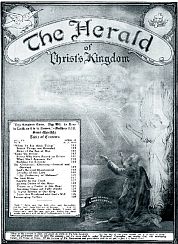
THE HERALD
of Christ's Kingdom
VOL. XXII December, 1939 No. 12
Table of Contents
Things
Coming to Pass
A Christmas Message
from Long Ago
History of the Church
Melchisedec
"Called to Be
Saints"
The True Church
Encouraging
Messages and Items of Interest
Recently Deceased
Things Coming to Pass
"When ye see these things come to pass, know ye
that
the Kingdom of God is nigh at hand." - Luke 21:31
WITH the advent of the Christmas season
comes again the echo of the heavenly host praising God and saying, "Glory to God in
the highest, and on earth peace among men in whom He is well pleased." (Luke 2:14, R.
V.) And though these beautiful words which echoed centuries ago throughout the Judean
hills found their reecho in the hearts of the astonished and wondering shepherds who
hurried to "see this thing which is come to pass"; today, to a world sick,
distressed, and overwhelmed with a sense of impending catastrophe, they seem but to ring
in notes of tragic irony. "On earth peace"! The ascending prayers of millions
bear witness to humanity's longing for existence unharassed by the dreadful recurrence of
wholesale slaughter, and the present generation but repeats the cry of countless others
down through the ages. "For we know that the whole creation groaneth and travaileth
in pain together until now." (Rom. 8:22.) And though heaven seems deaf to the
world-wide cry of longing for an era of peace and justice, and though as yet to humanity
has not been vouchsafed a glimpse beyond the clouds of trouble; the Lord's people, the
"men in whom He is well pleased," have seen the glory of God, and in their
hearts reigns peace; yea, "the peace of God, which passeth all understanding."
In the midst of "a time of trouble, such as never was since there was a nation"
("upon the earth distress of nations, with perplexity; the sea and the waves roaring;
men's hearts failing them for fear, and for looking after those things which are coming on
the earth: for the powers of heaven shall be shaken"); they are heeding the
admonition of their Master: "And when these things begin to come to pass, then look
up, and lift up your heads; for your redemption [deliverance] draweth nigh." - Luke
21:28.
To such belong the blessed consolations
of Psalm 46, and with the Psalmist they repeat: "God is our refuge and strength, a
very present help in trouble. Therefore will not we fear, though the earth be removed, and
though the mountains be carried into the midst of the sea; Though the waters thereof roar
and be troubled, though the mountains shake with the swelling thereof."-Ver. 1-3.
This firm and trusting confidence in
God by His people of this day is well exemplified in a letter recently received from a
dear saint living in one of the belligerent countries. The tone of confident faith is
stimulating and encouraging to us who, as yet, are blessed with more fortunate
circumstances. The letter follows:
"What a vortex we have been
plunged into during the last few weeks, and how we now prove not only our great need,
but our Father's great resources of power, and His faithfulness in all that He has
promised. Truly,: from a natural standpoint things are very black here in England, and one
wonders what it will mean of illness and mental suffering to thousands before the winter
is through.
"It is literal blackness, blacking
out God's glorious sunshine and even the light itself. Buses, trains, homes, and all
business houses working even in the daytime by artificial light, or in pale blueness,
because the light has been partly or wholly obscured too assist in the black-out. House
windows, with parts pasted over altogether, and then decorated with strips to prevent
the splintering of glass. Some windows covered with badly fitting cellophane paper, and
many with h black-lined curtains which look like the deepest mourning.
"The children can go to school
only where they are within five minutes'~ radius, and then with labels tied round their
necks, and a gas-mask on their backs. This latter little box is carried by all, whether
going to worship, to shop, or for a walk. Already many articles cannot be bought, and
everything is ready for rationing. Very few buses are to be left on the services, and we
shall have to use our feet to get over the mile or two to town. All public workers,
policemen, engine drivers, etc., wear a black, tin hat, and the streets are so dark at
night that road fatalities have been trebled. One of the saddest sights I saw was from a
blue dimly lit carriage coming through part of London just at twilight; and in the narrow
streets below were a few shadowy figures, sitting on front door steps or pavements,
talking to one another across the road, their children having been taken away and
scattered all over the country -- dirty children in clean homes and vice versa.
"It all sounds very bad, doesn't
it, and yet here we are rejoicing at our little, darkened, early meetings, realizing the
marvel of our Father's Word, which has enabled us to be forewarned, and thus forearmed
against this very day and hour. In spite of all the warning it seems to have taken the
people entirely by surprise, in the sense that they have refused to believe, although it
is quite evident that the government and those in authority have understood the situation
and have been preparing very fast.
"We ourselves came home from
holidays prematurely to find Sister and her children installed in our home, it having
been previously arranged that they should come to us in case of evacuation. So you see,
dear brother, we are now eight in number and a very happy family, if the quarters are a
little small. It is very good for us to be occupied with the little ones and have Sunday
schools, etc. Even [a young son] thinks it is good to do without little luxuries and
conveniencies for the sake of others, which is a miracle only his consecration could have
brought about. All those dear ones here who took the step of immersion this year feel so
thankful that they did not delay their action, and are now rejoicing that the Lord is
indeed their 'Shepherd' and guide, and that they in their turn as they have been blessed
may be able to pass on that blessing to others.
"Well, now I must close, though it
is difficult at this time to express those feelings which are deeper than just expressed
thoughts. Maybe the time is very near when we shall 'know as we are known.' and all the
difficulties of time and sense will be changed for the 'realities.'
"With our united love to you and
all those who labor with you, and the Lord's people everywhere,
"Your sister by grace and favor,
"E. C."
While rejoicing to have this word from
our English sister, our longings for news from our brethren in other countries is thereby
intensified. Particularly those: in Poland, of whom no information has now been
forthcoming for over two months. In recent years there has been a great increase in the
number of Polish brethren particularly since Brother left America to labor amongst the
Lord's sheep in. Poland. Much encouraging news regarding their steady growth in spirit
and knowledge, as. well as numbers, had been received.
Some conventions found hundreds of
friends present, many walking ten to twenty miles to attend. Their zeal was unabated by
the occasional persecution stirred up by local ecclesiastical authorities, and many
interesting letters had been received testifying to love for God and the truth that have
warmed the hearts of the brethren in America. And now all is silence. But though for a
time God has veiled from our eyes the conditions obtaining amongst our brethren in
Poland, Germany, and elsewhere, we cannot but believe that when "we know even as we
are known," we shall hear the record of their steadfast perseverance in the Christian
principles which they have learned through contact with Present Truth.
For them now, we pray unceasingly
before the throne of grace and are willing to leave them to the care of Him who
"careth for them"; who has promised that "not a hair of your head shall
perish." And into whose hands they may safely commit their spirits, knowing in whom
they have believed.
And to them and to us there is a
special meaning and comfort in the words of the Lord: "Come. My people, enter thou
into thy chambers, and shut thy doors about thee: hide thyself as it were for a little
moment, until the indignation be overpast For, behold, the Lord cometh out of His place tc
punish the inhabitants of the earth for their iniquity: the earth also shall disclose
her blood, and shall no more cover her slain." - Isa. 26:20, 21,
B. C. 760 - A. D. 33 - A. D. 1939
ALTHOUGH HE was probably born in the
autumn, at the beginning of the Jewish year, it is singularly appropriate that the
birthday of the great Light-giver should be celebrated about the time of the Winter
Solstice, when, in our northern latitudes, the nights are longest, the cold strongest.
After Christmas each year the days grow longer and the light increases-slowly at first,
then rapidly.
At the time of the birth of Jesus
Christ the Jewish nation, long the recipient and custodian of the divine revelation, was
fast nearing its end. That revelation as a whole is symbolized in the Scriptures by the
moon; and that luminary was setting in a sea of blood. The cruel and ruthless power of the
Roman Empire was at its zenith. Not only Judah, but nearly all the known world, was
crushed under the heel of the conqueror. The large majority of mankind verily believed
that might made right; and that Rome was irresistible and "eternal."
"Darkness covered the earth, and gross darkness the 'people."
But a Light appeared in this hour of
deepest darkness and anguish. It was the beginning of the Gospel light, which shone from
the face of Jesus Christ, the Son of man and Son of God. "He is the true Light which
lighteth every man that cometh into the world."-John 1:9.
This Christmas Message, from "The
Vision of Isaiah the son of Amoz," was written nearly twenty-seven centuries ago.
The background of the message is black, indeed. It pictures a world ruled by ruthless
ambition, violence, cruelty, warfare and bloodshed-of bitter persecution and suffering
impending on the people of God.
Against this dark background the Vision
places the birth of a Child; and because of that ''"'girth, the message declares,
"the yoke of the burden, the lash of the taskmaster, the goad of the driver"
shall be removed from mankind; the plans, the boastings, the rage of the opposers and
oppressors shall be frustrated and overthrown.
The Child is Born
Isaiah's Christmas message began to be
fulfilled at the first advent. The Child was born to God's people, Israel, of, a virgin,
as had been foretold by Isaiah; and a contemporary prophet, seeing the Babe in the
Temple, in exultation hailed him as "a Light to lighten the Gentiles, and the glory
of Thy people Israel." Upon that Child, grown to manhood, the Spirit of God descended
"without measure," in bodily form. The Son of God was then given, as a sacrifice
for Israel, for mankind and for earth, over a period of three and a half years ending at
Calvary.
The offering completed, the Son was
called forth from death and the decree was uttered by the All highest: "Ask of Me
and I will give Thee the nations for Thine inheritance and the uttermost parts of the
earth for Thy possession." - Psalm 2:8.
The future government of earth was thus
placed like an accolade upon His shoulder by His Father; but the consummation of the
decree and the prophecy was postponed, awaiting certain preliminaries, principally the
selection of the King's Consort.
The mystery, spoken of by the Apostle
Paul, was the fact that the Consort or Bride of Christ was to be composite, of a definite
number, in the formation of which Jews and Gentiles were to participate on a basis of
equality.
The great majority of Israel at His
first advent rejected the Son that was given them, even as it had been foretold in the
context of the message: "For though thy people, 0 Israel, shall be as the sand of the
sea, a mere remnant shall return of them . . . unto the mighty God." So the Apostle
Paul, speaking in the synagogue at Antioch (Acts 13:46), said: "Unto you was it
necessary that the Word of God should first be spoken. Seeing ye are thrusting it from you
and unworthy are judging yourselves of the age-abiding life, lo! we turn unto the
nations [Gentiles]; for so hath the Lord commanded us. . . ." The failure of Israel
to furnish the required number (see Revelation 14) to constitute the companion Body, made
necessary the nineteen centuries of the Gospel Age to gather it from the Gentiles.
In harmony with this the Apostle James,
speaking under inspiration, in his brief address of less than two hundred words (Acts
15:13-21) gives us the key to the understanding of many prophecies. It is to be
"after these things"-after the "first" visitation of the Gentiles for
the purpose of "taking out of them a people for His Name"-that there is to be a
second visitation to accomplish a "common" or general salvation, as Jude
refers to it in his epistle. Then the Kingdom of God, typically established in the
"tabernacle of David," shall be reestablished in power and great glory,
"that the residues of men may seek out the Lord, and all the nations upon whom My
name hath been invoked, saith the Lord that doeth these things, known [through the
prophets - Isa. 45:21] from age-past times."
The Invocation
The basic prophecy and invocation of
God's Name upon all mankind is to be found in the great oath-bound covenant given by
Jehovah to Abram, or Abraham (Gen. chap. 12,15 and 17), in which He promised: "In
thee and in thy Seed shall all the families of the earth
be blessed." No doubt is left by the inspired writers of the New Testament as to
the identity of that Seed, as Paul declares (Gal. 3:16): "Now to Abraham were the
promises spoken, and to his Seed. He saith not, And to seeds, as of many; but as of one,
And to thy Seed, which is Christ." Equally explicit is the Apostle as to the Consort
of the Anointed King; in the twenty-eighth and twenty-ninth verses of the same chapter he
adds: "Ye are all one in Christ Jesus. And if ye are Christ's [Bride], then are ye
Abraham's seed, heirs according to promise." Thus when the "people for His
name" have all been gathered out, the promised Kingdom of life and blessing is to be
inaugurated, as proclaimed in the concluding verses of the Revelation: "The Spirit
and the Bride say, Come. . . . Whosoever will may come and partake of the water of life
freely."
Isaiah's vision foretells the transfer
of earth's government, after the birth of the Child, without touching upon the
intervening, parenthetical period of the Gospel Age, except to picture its closing events.
In the context of the message we find
reference to another kingdom of an entirely different character. Under the pseudonym of
the "King of Assyria" is symbolized a power that stands in. the way of the
Son's Kingdom of universal righteousness and prosperity, and that must first be removed.
The
Antitypical King of Assyria
The informed student of the Scriptures
has no difficulty in recognizing under this symbol the "god of this world,"
"the spirit that now worketh and ruleth in the hearts of the children of
disobedience," namely, Satan, the adversary of God and of God's people. He is thus
characterized by the prophet
"For to destroy is in his heart,
and to cut off nations not a few;
for he saith: Are not my generals like Kings?"
The visible representations and agents
of Satan's empire are to be identified by their conformity to his purposes and methods. To
destroy is in their hearts, to cut off nations not a few. The names of an equal number of
modern nations which have been subjugated might with propriety be substituted for those
listed as conquered by the King of Assyria, in the verses following those just quoted, and
the prophetic meaning would be :ma-de clear. To the Evil One and his "generals"
the ideals, the religious faith, the democratic institutions of Christendom are
"idols" and "images" --"opiates of the people."
A deliberate and determined effort to
establish world rulership through military power, in frank imitation of Ancient Rome, is
being made by these "Assyrian generals." The garments of mankind are
"rolled in blood"; the energies of millions of those who are not actually
engaged in warfare are devoted to producing its weapons. "The rod hath blossomed,
pride hath budded. Violence is risen up into a rod of wickedness." (Ezek. 7:10, 11.)
The background of the prophetic picture is vaster and more lurid today than it was
nineteen centuries ago.
The King of Assyria is represented by
the prophet as saying:
"As my hand hath reached unto the
kingdoms of idols, whose images did excel them of Jerusalem and Samaria, Shall I not, as
I have done to Samaria and her idols, so do to Jerusalem and her images?"
The irony of this reference to idols
and images by the King of Assyria lies in the fact that the religion of Assyria was the
most cruel and bloodthirsty of all ancient peoples, involving multitudes of human
sacrifices, including frequently the slaughter of infants upon its altars.
The prophet continues his
characterization-how apt in its application to Assyria's modern prototypes:
"For he hath said --
By the strength of mine own hand have I
effectually wrought,
And by my wisdom-for I have discernment,--
That I might remove the bounds of peoples,
Yea, their treasure have I plundered.
That I might lay prostrate as a mighty one the inhabitants;
And my hand hath found as a nest the wealth of the peoples,
And as the gathering of eggs that are forsaken all
the earth have I gathered,
And there was none to flap a wing, or open a mouth
or chirp."
But to these arrogant and blasphemous
boasts Jehovah replies:
"Shall the axe boast itself against him that heweth therewith?
Or the saw magnify itself against him that
wieldeth' it?
As if a rod could wield them who lift it up!
As if a staff could raise what is not wood [i.e., the one who wields it]!"
Jehovah warns through His prophet that
this fearful scourge, let loose upon His professed people, now called Christendom, as
also upon His ancient people the Jews (whom the Apostle says "are not cast off, but
beloved for the fathers' sake") is in punishment for their unfaithfulness to Him. He
says:
"Alas! because of Assyria, the rod
of Mine anger,
Yea, the very staff in their hands is My
displeasure.
Against an irreligious nation will I send
him,
Yea, against the people with whom I am wroth will
I command him,-
To capture spoil, and lay hold on prey,
And cause them to be trodden down as the mire of
the lanes.
But as for him, not so doth he deem,
And in his heart not so doth he think,-
For to destroy is in his heart."
Indeed, God's prophets unitedly declare
that this world-wide devastation and suffering at the hands of demon-inspired men is to
bring an unfaithful and inconsistent Christendom to its knees, in preparation for the
new government of the Son. When mankind turns to their Creator with a whole heart and
cries for rescue, then, the prophet declares:
"Wherefore, it shall come to
pass--When My Lord shall finish His whole work upon Mt. Zion [Christendom] and upon
Jerusalem [all Jewry]
I will bring punishment
Upon the fruit of the greatness of heart of the King of Assyria,
And upon the vainglory of his uplifted eyes .
A full end decreed bringeth in justice like a flood;
For a full end and a decreed one is My Lord Jehovah of hosts executing in the midst of all
the earth."
One great Hebrew scholar says this
means: "Annihilation, strictly decided."
The New Government of Earth
With what relief we turn to the
brighter side of the picture! How comforting to have the assurance of God's prophet that
that which is truly "civilization" is not to be utterly destroyed, but that
the pride and arrogance and power of His enemies shall be properly punished, His people
rescued, and that a righteous and beneficent world-wide government shall be established by
Him to whom it has belonged by right of conquest, for nineteen hundred years!
For the first time in history mankind
is to enjoy a perfect government, under One whose rightful titles are Wonderful
Counsellor, Mighty God, Father of Permanence, Prince of Prosperity. "Of the increase
of dominion and of prosperity there shall be no end-. . . upon His Kingdom, by
establishing and by sustaining it with justice and righteousness from henceforth until
times ageabiding."
To the Victor Belong the Spoils
No Christmas would be complete without
the distribution of Christmas presents. The promise of gifts from the great Giver of all
good is recorded in the Old Testament and confirmed in the New. "Thou [Jehovah]
openest Thy hand, and satisfiest the desire of every living thing." "When He
[Christ] ascended on high, He led captivity captive and gave gifts unto men" --
"yea, for the rebellious also, that Jehovah God might dwell among them." - Psa.
68:18; 145:16; Eph. 4:8.
Even the rebellious race of mankind are
to receive precious gifts through the sacrifice of the Son; real "life, liberty, and the pursuit of
happiness." Eternal life-if they prove worthy of it; liberty, from the bondage of
sin; the happiness, "To know God, and to enjoy Him forever." But our Christmas
Message tells of certain special gifts-the spoils of victory-which the conquering Son will
distribute to His "footstep followers"-those who "follow the Lamb
whithersoever He goeth"; the ones who were inspired and energized by the King's
promise: "He that overcometh I will give to him to sit down with Me in My throne, as
I also overcame, and sat down with My Father in His throne." - Rev. 3:21.
Isaiah makes three references to this
division of the spoils:
"Therefore will I divide Him a
portion with the great and He shall divide the spoil with the strong." - Isa. 53:12.
"Then was the prey of a great
spoil divided, -the lame took the prey." - Isa. 33:23.
"Thou hast increased the
exultation,
Thou hast made great the joy;
They joy before Thee according to the joy of harvest;
As men exult when they distribute spoils." - Isa. 9:3.
To worldly minds the followers of Jesus
have appeared "lame"-in their heads: "Fools for Christ's sake." To
God, they are the "strong," the ''overcomers."
What are these "spoils"? They
are the emoluments, perquisites, honors, benefits, and enjoyment appertaining to the government of earth, long illicitly
monopolized by Satan and the wicked spirits, and the usually selfish and self-seeking
men who have been agents and beneficiaries of the usurper. Not, however, the tinsel,
shoddy, and short-lived returns of the oppressive and grafting offices and powers of the
administration now to be brought to an end. Jesus made plain to His followers the
difference between His coming reign and that of His predecessors among the conquerors of
earth (Luke 22:25, 26): "He said unto them, The Kings of the nations lord it over
them; and they that have rulership over them Benefactors are called. But ye not so! On the
contrary, the greater among you, let him be as the junior, and he that governeth as he
that serveth.
The emoluments, perquisites, and honors
of a government with such a policy and inspiration may be expected to be:
(1) The happiness inherent in unselfish
service of others: "Remember the words of the Lord Jesus, how He said, It is more
blessed to give than to receive."
(2) The consummation of that joy of
close unity with the King and the fellow-servants in their high enterprise of Restoration:
"Well done, good and faithful servant; enter-thou into the joy of thy Lord."
"Whom not having seen, ye love; on whom, though now ye see Him not, yet believing ye
rejoice greatly with joy unspeakable and full of glory." - Matt. 25:21: 1 Pet. 1:8.
(3) Sharing the gratitude of those
blessed and uplifted by the Kingdom rule: "Of Zion . . . they that sing as well as
they that dance shall say, All my fountains [i.e., all sources of my delight] are in
thee." - Psa. 87:7.
(4) The Kingdom honors "Jehovah
will record when He enroleth the peoples, This one was born there [in Zion -- the
spiritual Kingdom]."
"Then shall every man have his
praise from God." - Psa. 87:6; 1 Cor. 4:5.
This is the "spoil" to be
divided; these are the emoluments of office under the new government of the great King.
"Let The Field Be Joyful"
How joyful and glorious a Christmas
Message! If all mankind could hear and believe it, how it would change the course of human
events! What a holocaust would take place now, instead of later, of "every boot
tramping in tumult, and the warcloaks rolled in blood!" What an infinity of
suffering of humanity-the millions of dead and wounded, the grief and poverty of their
families and fellow citizens would all be made unnecessary! What a collapse of arrogance,
pride, egotism, and empty pretensions would ensue in those "lording it over the
nations" and "serving themselves" of the peoples.
Ah, that all mankind might at once turn
to the One upon whose worthy shoulders the Government has been placed by the
All-highest, with the acclamation that will eventually, after bitter chastisement, be
given Him by all the earth! But this Christmas wish is vain; mankind must have its
lesson, and then turn to its Deliverer,. as
is anticipated by the same prophet in these words:
"O Jehovah, though Thy hand be
lifted up, yet do they not see;
Would they might see -- and turn pale at a people's zeal;
Surely the fire of Thine enemies must consume
them!
O Jehovah, Thou wilt insure prosperity for us,
For even all our works hast Thou wrought for us.
O Jehovah our God!
Lords other than Thee have owned us,
By Thyself alone will we call upon Thy Name.
Dead. They shall not live
Shades. They shall not rise
Justly Thou hast visited and destroyed them,
And caused to perish every memorial of them." - Isa. 26:11-14.
And so -- a joyful Christmas to you,
and "Mercy and peace upon all the Israel of God." Amen.
(Note: The Scriptural quotations in
this article are from the 8th, 9th and 10th chapters of Isaiah, unless otherwise noted.
The translations of Rotherham and the American Revised Version have been used, with
occasional verbal modifications from Dr. Strong's definitions.)
----------------------------------------
Rage, O ye peoples-and be overthrown,
And give ear, all ye distant parts of the earth,
Gird yourselves and be overthrown,
Gird yourselves and be overthrown:
Determine a plan-and it shall be frustrated;
Speak a word, and it shall not stand:
For With-us-is-GOD!
Therefore shall they pass through it hard pressed and hungry;
And it shall be when they hunger then will they
revile their king and their god, and turn their faces upwards;
And unto the land shall they look hard,
And lo! distress and darkness, the gloom of anguish driven away!
For there is no gloom to her who had been in anguish,
In the former time He brought into dishonor
The land of Zebulun and the land of Naphtali,
In the latter time hath He brought into honor
The lake-way over the Jordan,
Galilee of the nations.
The people who were walking in darkness
Have seen a great light;
The dwellers in a land death-shadowed,
A light hath shined upon them.
Thou hast increased the exultation,
Thou hast made great the joy;
They joy before Thee according to the joy of harvest,
As men exult when they distribute spoil.
For the yoke of their burden,
The cross-bar of their shoulder,
The goad of their driver,
Hast Thou broken as in the day of Midian.
Surely every boot of one tramping in tumult,
and the war-cloak rolled in blood,
Then shall serve for burning, food for fire;
For a Child hath been born to us,
A Son hath been given to us,
And the dominion is upon His shoulder;
And His Name hath been called
Wonderful Counsellor,
Mighty God,
Father of Permanence,
Prince of Prosperity.
Of the increase of dominion and of prosperity
There shall be no end --
Upon the throne of David and
Upon his kingdom,
By establishing it and by sustaining it,
With justice and with righteousness,
From henceforth even unto times age-abiding:
The zeal of Jehovah of hosts will perform this!
- Isa. 8:9, 10, 21, 22; 9:1-7,
(Rotherham).
No.
12 - "Behold the Bridegroom" - Conclusion
(Continued from August issue)
Dwight L.
Moody (1837-1899)
I LOOK UPON him as one of God's
choicest I gifts to the church and the world, during this century now drawing to a close.
His value will never be rightly appreciated here, where the view is partial and transient.
Yonder in the perfect light we shall know." So spoke Campbell Morgan when Dwight
L. Moody, the great American evangelist, had ended his earthly pilgrimage. One of nine
children, he had known in childhood all the privations that widowhood often brings to the
mother of a family of little ones. But that home, poor in material things, was rich in
faith, the faith of a parent whose brief creed seems to have been summed up in the three
words, "Trust in God." Strict in discipline, as had been the mother of Wesley,
she too gave to the world another beacon light to show to men the way to God.
A pious upbringing may bring forth a
religious man, but such a life, regulated by the external authority of "thou shalt
and "thou shalt not," is a thing apart from that of a sincere Christian, who no
longer needs the outward law, for the fountain within has become sweet, love for God and
for man has there found a throne, and the Holy Spirit shed abroad in the heart reaches
forth and subdues all things unto itself. Formality and the outward adornment of the
Pharisee may mark the religious man, but the true Christian ever radiates love and joy
from an illumined center and gives himself unselfishly and without reservation to the
service of men. Dwight Moody and John Wesley both had found this to be true in their own
life experience. "Before my conversion," Moody often said, "I worked toward
the Cross, but since then I have worked from the Cross; then I worked to be saved, now I
work because I am saved." He had found when the Holy Spirit had entered his heart
that the sun shone more brightly and the birds sang more sweetly-"Do you know, I fell
in love with the birds. I had never cared for them before. It seemed to me that I was in
love with all creation. I had not a bitter feeling against any man, and I was ready to
take all men to my heart. If a man has not the love of God shed abroad in. his heart, he
has never been regenerated. . . . The impulse of a converted soul is to love, and not to
be . . . complaining of every one else and finding fault."
And so Dwight Moody in manhood gave
himself without reservation to the service of God and mankind at a time when a religious
awakening was already sweeping over the land. Successful in business, all that was in
him that made that success was to be used now in a long labor of love for his Lord.
"The greatest struggle I ever had in my life was when I gave up business," he
often said. His first start in the long act he was to play as a "fisher of men"
began with iris gathering up of some eighteen little "hoodlums" from the streets
to form a class of his own in a mission where he had asked to be a teacher but had been
told there were already sixteen instructors and but twelve pupils. His future wife, then
a girl of fifteen, was one of these teachers. In the fall, of 1858 he began another
mission in another part of the city which by degrees increased to 1500 -- pupils and
teachers having but one text-book, the Bible, denominational lines not being recognized.
The Civil War came, but he could not
conscientiously enlist. His explanation was, "There never has been a time in my
life when I felt I could take a gun and shoot down a fellow-being. In this respect I am
a Quaker." So he worked instead as a Christian minister amongst the soldiers,,
appealing to the living and pointing the eyes of the dying to One bleeding on Calvary.
In 1871 came the great fire in Chicago,
after which he started east to raise money for the homeless and for a new church. But
his heart was not in "the work of begging," as he termed it, "I was crying
all the time that God would fill me with His Spirit. Well, one day, in the city of New
York -- oh, what a day! -- I cannot describe it. I seldom refer to it; it is almost
too sacred an experience to name. Paul had an experience of which he never spoke for
fourteen years. I can only say that God revealed Himself to me, and I had such an
experience of His love that I had to .ask Him to stay His hand. I went to preaching
again. The sermons were not different: I did not present any new truths, and yet hundreds
were converted. I would not now be placed back where I was before that blessed experience
if you should give me all the world -- it would be as the small dust of the
balance."
A deep impression on his religious life
and work came about through a young preacher, "the Boy Preacher," as he was
known, whom he had casually met in Dublin, and who had arrived in Chicago on a visit. Not
being acquainted with his way and method, Moody was uncertain as to the wisdom of inviting
him to speak to his congregation but decided to try him out for a couple of nights,
letting him continue for a space if he found all was well. The first night the young man
ascended into the pulpit, he took for his text that sweetest of all declarations of love
-- "For God so loved the world, that He gave His only-begotten Son, that whosoever
believeth in Him should not perish, but have everlasting life." Night after night he
preached to the people always from the same text. The seventh day came, and again he
ascended the platform. "Beloved friends," he began, "I have been hunting
all day for a new text, but I cannot find anything so good as the old one," and again
he preached the old, old story of redeeming love. "And he just beat that truth down
into my heart," Mr. Moody often related, "and I've never doubted it since. I
used to preach that God was behind the sinner with a double-edged sword ready to hew him
down. I have got done with that. I preach now that God is behind him with love, and he is
running away from the God of love." Our hearts rejoice when we find that the most
enduring evangelism of the age was brought about by such ministry as this; the sinner
being drawn to the foot of the Cross by the soft cadences of a voice of love, not
frightened there by the breath of the threat of vengeance. Gladly, not fearfully, they
could sing
"Oh what love, what wondrous love,
The love of God to me:
It brought my Savior from above
To die on Calvary."
In the year of 1873 Mr. Moody carried
his campaign to the British Isles -- Edinburgh, Dublin, and then the city of London.
"What is the magic power," asked one writer at this time, "which draws
together these mighty multitudes and holds them spellbound? Is it the worldly rank or
wealth of learning or oratory of the preacher? No, for he is possessed of little of these.
It is the simple lifting up of the Cross of Christ-the holding forth the Lord Jesus before
the eyes of the people." Even some not entirely in sympathy with his evangelism
admitted that it seemed to be entirely the work of God. "He could never speak of a
lost soul," remarked such an one, "without tears in his eyes."
Associated with him at this time was
Sankey, the sweet gospel singer, and the Moody-Sankey hymn book was issued. More than two
years he had labored in London. Before he came there, one fearful questioner had suggested
that he print his creed before coming. "My creed is in print," Moody replied,
"It is found in the 53rd chapter of Isaiah." At the closing service he said,
"I have sought to bring Christ before you and to tell you of His beauty. It is true I
have done it with stammering tongue. . . I do not want to close this meeting until I see
you in the ark of refuge. . You that are willing to take Christ now, will you rise?"
One of his dearest friends was Henry
Drummond, who had helped him in his campaign in Scotland, he who was the author of that
beautiful exposition entitled, "The Greatest Thing in the World." Moody found he
could not follow him in all his theories but loved him devotedly and stood by when
criticism assailed, speaking of him as a Christian "who lived continually in the 13th
chapter of lst Corinthians." Each had declared of the other, "He is the
sweetest-tempered Christian I ever knew," within the same hour to a mutual friend.
We can sense something of the tender
appeal, the touching pathos, in the preaching of Moody in the following quotation from a
public discourse "I can imagine that when Christ said to the little band around Him,
'Go ye into all the world and preach the Gospel,' Peter said, 'Lord, do You really mean
that we are to go back to Jerusalem and preach the Gospel to those men that murdered You?'
'Yes,' said Christ, 'go hunt up that man that spat in My face; tell him that he may have a
seat in My Kingdom yet. Yes, Peter, go find that man that made that cruel crown of thorns
and placed it on My brow, and tell him I will have a crown ready for him when he comes
into My Kingdom, and there will be no thorns in it. Hunt up that man that took a reed and
brought it down over the cruel thorns, driving them into My brow, and tell him I will put
a scepter in his hand, and he shall rule over the nations of the earth, if he will accept
salvation. Search for the man that drove the spear into My side, and tell him there is a
nearer way into My heart: than that. Tell him I forgive him freely, and that he can be
saved if he will accept salvation as a gift.'"
His success in London, due, he
believed, entirely to God's power and nothing of himself, may be seen in the following
figures -- 285 meetings with a total attendance of two and a half millions of people. But
this was only the sowing -- God Himself added the increase, and how great only eternity
can declare.
At the death of Moody, whose labor for
the Church had been so great, and whose home life surrounded by a devoted, helpful wife,
children, and grandchildren had been so sweet, there was, at his request, little outward
mourning. After a simple service he was lowered to rest on the top of a quiet hill, his
grave quietly marked. The beautiful word-tributes given at the time by his friends
manifested the tenderness and compassion of his own heart, which, touching others, had
left so deep an impress. "That Word," said one, "he hid in his heart: as
the seed there ready for use on every occasion and in every emergency. It was sweeter to
him than honey and the honeycomb. His mind and heart were given to the Word of God. But
his life, like Christ's, was for others. He did not search the Bible to add to his
knowledge but to save men from sin. His first and dominate purpose was to have every man
receive that life of which he had been made a partaker. To this his sermons were devoted;
he counted everything but loss unless this were attained."
In the death of Dwight Moody again the
Lord had buried His workman but carried on His work, "in this case literally so in
the school which the evangelist had established to send forth into the world trained and
devoted Christians to turn men to Christ, to carry the Bible to the far corners of the
earth, to preach the acceptable day of the Lord. Men live and preach; men die and
sometimes are forgotten, but the great center truth of the Gospel that Jesus Christ by
the grace of God tasted death for every man, goes on and on until, having accomplished its
purpose, it will still shine forth, the greatest truth of all eternity."
C. T. Russell
It was in the year 1879 that a small
publication appeared in Pennsylvania, its outer page bearing the name, "Zion's
Watch Tower and Herald of Christ's Presence." Its Editor, Charles Taze Russell, who
had been disappointed in orthodoxy to the point, of infidelity, had turned to the Bible to
find it a pure fountain, and, untouched with the streams that had flowed from it to be so
muddied by man's false reasoning and traditions, a mine of unsullied truth, deeper than
any human heart and mind could go, inexhaustible and never ending in its fresh supplies of
comfort and cleansing. Every failure of the visible Church adown the Gospel Age, every
failure in the individual spiritual lives of God's children, every God-dishonoring
doctrine that had polluted the Sanctuary, had come it seemed in the turning away from the
Book of books to the interpretations and handed-down traditions of well-meaning but
imperfect men. Then followed a season of great activity after a prosperous business had
been sold that he might give all his time to the service of his Lord and His Word.
"Come," and the cry went out to all who would hear, "Come, let us reason
together."
Over a large part of the world went six
volumes entitled, "Studies in the Scriptures." Weekly sermons found their way
into many newspapers. Millions of tracts were published and scattered abroad. Ministers
known as "Pilgrims" traveled about continuously, visiting the groups gathered
in every city several times a week for the study of the Word, much the same as they did in
Wesley's day, or, as the noble Bereans once met in the early morning of the Church's
history. Their hearing ears had caught something of the breadth and length and depth and
height of the love of God -- a love which even the poet in his own inspiration often saw
dimly, shaming the very theologian who stood for the expositor of that divine compassion
"O, yet we trust that somehow good
Will be the final goal of ill,
To pangs of nature, sins of will,
Defects of doubt, and taints of blood; . . .
Behold, we know not anything;
I can but trust that good shall fall
At last -- far off -- at last to all,
And every winter change to spring."
So sang Tennyson in the anguish of
bereavement, and in contrast we hear the words of Jonathan Edwards as he leaned earnestly
over his congregation, trying to impress upon their minds some comprehension of the
awful state of the unsaved "Imagine yourself," said he, "cast into a fiery
oven, all of a glowing heat, or into the midst of a glowing brick-kiln, or of a great
furnace . . . what horror would you feel at the entrance of such a furnace . . . what
would be the effect on your soul, if you knew you must lie there enduring that torment to
the full of twenty-four hours! And how much greater would be the effect, if you knew you
must endure it for a whole year . . . O then, how would your heart sink, if you thought,
if you knew, that you must bear it forever and ever! That there would be no end! That
after millions of millions of ages, your torment would be no nearer an end than it ever
was; and that you never, never should be delivered!"
Frederick Farrar, Dean of Westminster
Abbey in London, scholarly and consecrated ambassador for Christ as he was, had given a
series of sermons against the God-dishonoring doctrine, pleading the love of the Father,
the unreasonableness of such a teaching, and presenting the real meaning of
misunderstood words in the original languages. A storm of denunciation fell upon him
from many of his colleagues, but there were also many who secretly wrote him that such
had been their views personally but they had feared to voice them. Charles T. Russell
occupied no pulpit of honor and dignity on earth, 'but he knew himself to be by all the
sanction of Holy Writ, an ambassador for his Lord. He was, in the phraseology of the
theologians, but a layman and therefore unqualified and unordained of man. But he felt
it his mission to publish from the very housetops, as it were, the love and not the hatred
of God for the human race. Back and forth he went, demonstrating by the Word itself that
the Creator's gracious Plan for His creatures was restoration to all that had been lost in
Adam, with the tears wiped from off all faces throughout the glorious and unending stretch
of an eternity-through the all-embracing merit of an offering for sin upon the brow of
Calvary. Other earnest, consecrated students of the Word had seen a David's throne
restored, a happy race on earth at one with God; others had pictured from prophetic lines
a kingdom filling all the earth, a tabernacle of God with men, the long-prayed-for reign
of Christ as Lord. But of the races asleep in the dust of the earth, the majority of whom
had never heard the one Name given whereby they might be saved -- there was no part in
this for them. Their fate, already sealed, lay in some vague condition in the spirit
world-good, as a reward for good; evil, unbounded evil, as a fit recompense for sin or
indifference. Such was the view of the large part of so-called Christendom. Such was the
conception of the tidings of great joy to all people in the birth of a Savior for a lost
world.
In the message of Pastor Russell the
vision of a saved Church pausing at times in their glorified eternal bliss, as preached by
Edwards, to gaze over the parapet of heaven to complacently view their former fellow
mortals in all the agony of unsatisfied thirst and spiritualized human pain and
misery, became instead a class predestined before the foundation of the world to suffer
with their Lord on earth that they might be with Him in glory and assist in blessing all
the families of earth. Now they could understand why the Savior saw the travail of His
soul and was satisfied. The transaction of the Cross was to benefit not alone the mere
handful of saved of the Gospel Age, but all who had died in Adam. Strange indeed did it
seem to listening ears that the doctrine of the restoration of all things had lain a
golden thread entwined from Genesis to Revelation beside the scarlet cord of shed blood
for the remission of earth's sins. Strange it seemed that their eyes as well as the eyes
of other believers down throughout the Age had been holden to the glory of the vision as
were the eyes of the discouraged disciples on the road to Emmaus to their Lord.
The year 1914, which Pastor Russell had
believed to be the time pointed out by prophecy as the fulfillment of the Church's hope of
completed glorification and the setting up of the earthly Kingdom, came and went with
such expectations unfulfilled, but in the fall of that year a great war broke out over a
surprised world. Bruised were the heads over many countries and in its wake there followed
a train of avarice, violence and crime, with social in security increasing from day to
day. But like a message of hope the sprouting leaves of the blasted fig-tree of prophecy
grew firmer and greener as powers arose, predestined it seemed to drive the chosen nation
of Israel nearer home with weeping and supplication.
On October 31, 1916, Pastor Russell
died on a moving train, attended only by a devoted friend and follower. Up to the last
hours of his life he had not wavered in his purpose, speaking under the severe strain of
human pain and weakness to a large audience from a lecture platform. "I have fought a
good fight, I have kept the faith," he might have declared as did Paul. Humanly
speaking, the carving of his name on the world's pages of history has been all but
obliterated by the feverish events, the gathering clouds of trouble, the fear gripping
all hearts, the blackness settling on all faces. But those who still live and might in the
phraseology of the world be termed his followers, though differing somewhat here and there
in minor point and minute interpretation, as human minds must always differ where there is
granted the liberty of thought and conscience compatible with the indwelling of Christ,
have basically the same thought, the same hope of their calling, the same hope of the
Kingdom-one faith, one Lord, one baptism. What manner of persons ought we therefore to
be, perfected in love, without which none shall be associated with the Lord in the work of
the Kingdom, grateful to our God for His unspeakable kindness in the granting of such a
message to us in an otherwise puzzling world.
"When all Thy mercies, O my God,
My rising soul surveys,
Transported with the view, I'm lost
In wonder, love and praise."
Surely the lot of those who have heard
the message of the Kingdom in its clearly revealed beauty has fallen in pleasant places.
In faith they have beheld the tabernacle of God with men, they His people and He their
God. The tears are wiped from off all faces, and there is no more curse, for the former
things have passed away. Behold, He has made all things new! So saw John on the Isle of
Patmos; and clearly was the vision made known to us by the faithful witnessing of one of
the Lord's most zealous servants. - Contributed.
"And Melchisedec King of Salem
brought forth bread and wine, and he was priest of God Most High." - Gen. 14:18.
THREE verse in Genesis (14:18-20)
contain all that the Spirit of God has seen fit
to record historically of this remarkable personage. Melchisedec, the king of
righteousness, ruler of Salem, "priest of the Most High God," who appears in
this incident for a moment and then suddenly vanishes, in all ages, alike from his name,
which in itself commands respectful awe, and the silence observed respecting his origin or
history, has been a favorite subject for speculation. Around this personage tradition has
gathered many legends which have no credibility in themselves and no foundation in
history. The words of our record are these; "And Melchisedec King of Salem brought
forth bread and wine, and he was priest of God Most High. And he blessed him and said,
Blessed be Abram of God Most High possessor of heaven and earth, and blessed be God Most
High, who hath delivered thine enemies into thy hand. And he gave him a tenth of
all."
There are difficulties in this
narrative the 'solution of which has never been successfully attained. The presence of
Melchisedec, "priest of the Most High God, in the midst of the probably heathen
population of Salem, is perplexing. We are scarcely prepared for the sudden appearance
of this priest (Cohen), offering bread and wine in connection with the first-fruits of the
spoil, blessing Abram, and receiving tithes from the patriarch, who had seemed to be the
one witness to Monotheism among an idolatrous people. To see him now holding a position
inferior to this hitherto unknown chieftain is an unexpected difficulty. Who he was, of
what family or nation, is left in utter obscurity. This illustrious personage comes forth
in the page of history for one brief moment, and then his name is heard no more for a
thousand years, when it is found in the Book of Psalms (Psa. 110); a thousand years more
pass before it occurs in the Epistle to the Hebrews; so that there is a mystery
connected therewith, which gives to it a preponderating interest and charm.
The True God Known to
Others
That this king of a Canaanite city
should be "a priest of the Most High God" is a peculiar circumstance. Attempts
have been made to explain it away. The Hebrew phrase for the Most High God is El Elion, and it appears that the Phoenicians
also had a god to whom they gave the title of Elion, or the Highest. Nothing, however,
can be clearer than that Moses, the sacred historian, intended the words to be understood
in their fullest sense of the true God. Nor is there any excuse for being incredulous
about the fact, for, when we remember the longevity of the patriarchs, it is probable that
the worship of God would have been preserved in some families. Melchisedec's pure and holy
faith in the "Most High God" was doubtless a relic of the anciently universal
recognition of the one Creator, and is one of the proofs incidentally afforded in such
other cases as that of Abimelech. King of Gerar; Jethro, the Midianite; Balaam, from the
mountains of Assyria- and Job, the Arab; that God has at no time left Himself without a
witness even in lands secluded from the direct privileges of His people. It must not be
overlooked, however, that while Melchisedec uses the general expression "the Most
High God," Abram, in repeating it, when he answers Bera, the King of Sodom, prefixes
the personal name Jehovah or Yahweh; as if to
claim for Him exclusive right to supreme divinity. With this weighty addition, though not
without it, he recognizes the God of Melchisedec as Him whom he himself worshiped.
Identity of Melchisedec
As to the identity of the personage
himself, speculation has been rife. Melchisedec has been regarded as the divine angel of
the Lord; again, as the Holy Spirit; the Jews, in order to account for his acknowledged
superiority to Abraham, identified him with Shem, the most pious of Noah's sons, who
according to their genealogies lived till Isaac's time; others suppose that he was Ham.
Seiss, in his work, "A Miracle in Stone," ingeniously argues Melchisedec's
identity with the great patriarch Job, near the end of those one hundred and forty years
of glory which succeeded his sore affliction; and in fact connects both characters with a
third, the mysterious shepherd prince "Philition," associated with the
building of the Great Pyramid and the subsequent building of the city of Jerusalem as
mentioned in the writings of Herodotus and Manetho. Some Christians, both in early and
later times, have maintained that Melchisedec was the Son of God appearing in human form,
which of course would nullify his typical character on which such stress is laid in the
Epistle to the Hebrews. He could not be a type of himself; nor would it have been said
(Heb. 7:3) that he was made "like unto the
Son of God," if he had been the Son of God Himself. Christ was not made like
Melchisedec; but Melchisedec like Christ.
But though the historic account of this
remarkable personage is very brief and attempts to identify him have so far proved
fruitless, it is not in the literal history, but rather in the inspired commentary upon
the three verses in Genesis referred to previously, that much richness of detail in
spiritual wisdom has been set before us; proving this meager account to have been divinely
recorded to preserve just the salient facts purposed, and even teach wonderful lessons in
the deliberate omission of some details which otherwise would have been naturally
included.
In the Epistle to the Hebrews, one
great subject is the priestly office of the Lord Jesus. Chapters 4, 8, 9, and 10 are
mainly occupied with showing Him to be the great Antitype of the Aaronic Priesthood. But
even it, with all its details and ceremonies, fails to show fully the glory of the
priesthood of Christ. Therefore the prophetic allusion of Psalm 110 is taken up and used
as a text, so toy speak, of a discourse, the burden of which is to exalt yet further the
official glory of Christ by showing the superiority of the Melchisedec to the Aaronic
Priesthood, and that Christ is a Priest forever, after the order of Melchisedec as well
as after the pattern, or type, of Aaron.
The Unnamed, Exalted One
This Psalm, where next we find
Melchisedec mentioned, is wonderfully dramatic and impressive. From beginning to end it
celebrates a single mysterious Hero. The Psalmist portrays Jehovah Himself as
addressing this great unnamed One, bidding Him to be seated at His right hand until He
shall put His foes beneath His feet. That this Psalm is Messianic is of course a foregone
conclusion by reason of the solemn quotation of it as such by Jesus Himself. But, apart
from this, its very terms make it impossible to imagine such an honor as being invited
to, sit on. Jehovah's right hand, attributed to any other person known in sacred story or
song. And it is here in the description of the exaltation of God's Son and His subsequent
triumph over all enemies, that the significant statement is made in verse 4: "The
Lord hath sworn, and will not repent, Thou art a Priest forever after the order of
Melchisedec." At once, the brief history of Abraham's superior assumes a new
importance; so much so, in fact, that we find the entire 7th chapter of the Epistle to the
Hebrews devoted to an exegesis of Abraham's mysterious contemporary. Through the
inspired and eloquent writer of this epistle our attention is called not only to the
general resemblance between Melchisedec and Messiah, but to see in the likeness a
verification in a number of details. From the 4th to the 10th verses, the argument is
devoted to proving the superiority of Melchisedec's priesthood to that of Aaron in seven
particulars
(1) Because even Abraham paid him
tithes.
(2) Because even the yet unborn Levi
may be said to have paid tithes in the person of Abraham.
(3) Because it is the superior who
gives the blessing, and Abraham was blessed by Melchisedec.
(4) Because the Aaronic priests die,
but Melehisedec stands as a type of undying priesthood.
(5) Because the permanence of his
priesthood implied the abrogation of the whole Law, on which the Levitic Priesthood was
grounded.
(6) It was superior because it was
founded on the swearing of an oath (Psa. 110:4), which was not the case with the Levitic
priests.
(7) It was superior because the Levitic
priests were necessarily many, requiring to be constantly replenished to fill up the
ravages made in their ranks by death; but His priesthood, because of His eternal
permanence, is intransmissable; whence also "He is able to save to the uttermost
those who through Him approach to God, seeing that He ever liveth to intercede for
them."
And having thus shown by these many
particulars the immeasurable superiority of the Melchisedec Priesthood of Christ to
the Levitic Priesthood and thus teaching the important truth that this tranference of
priesthood involved the entire abrogation of the Mosaic system in due time, the inspired
writer adds a weighty summary in the concluding words of the chapter: "For such an
High Priest became us, who is holy, harmless, undefiled, separate from sinners, and made
higher than the heavens; who needeth not daily, as those high priests, to offer up
sacrifice, first for his own sins, and then for the people's: for this He did once, when
He offered up Himself. For the law maketh men high priests which have infirmity; but the
word of the oath, which was since the law, maketh
the Son, who is consecrated for evermore." - Heb. 7:26-28.
Melchisedec Both Priest and King
In the second verse of this wonderful
chapter, the name Melchisedec is shown to be more properly a title conveying two meanings,
"King of Righteousness," and also "King of Salem," which is King of
Peace. Thus in the combination in one person of the two offices of priest and king is
shown the most prominent superiority of the Melchisedec over the Aaronic Priesthood. His
was a "Royal Priesthood." In Israel, the priest was of the tribe of Levi, the
king was of the tribe of Judah, Hence, so long as our Lord was upon the earth, He could
not be a priest. (Heb. 8 r His priesthood began in resurrection. Death could not come in
to interrupt even for a day this new order of priesthood; it is "after the power of
an endless life." Thus in heaven, Jesus, the risen Son of God, is invested-with the
new and surpassingly glorious order of priesthood, "a Priest upon His throne."
(Zech. 6:13.) He shall one day be revealed as the "King of kings" to sway the
scepter of universal dominion, whilst as the great Melchisedec, He shall come forth with
all the blessings of the New Covenant -- shadowed forth in the "bread and wine"
-- to comfort and to strengthen Abraham's ultimate seed, restored humanity.
And this being the character of the
priesthood of the Lord Jesus, the same applies to the saints. As it is written, "He
hath made us kings] and priests unto God" (Rev. 1:6), and again, "Ye are a Royal
Priesthood." - l Pet. 2:9.
That which appears most prominently in
the Aaronic Priesthood is the offering of gifts to God;
that which is presented in the Melchisedec Priesthood is the bringing forth of gifts from God. In both these
characters our Lord Jesus appears. He is the true Aaron appearing before God in all the
acceptance of the one offering, which He accomplished on Calvary; but He is also the true
Melchisedec bringing forth and dispensing to His people the fruits of His death and
resurrection. He breaks the bread; He pours the wine. Ascended up on high, He received
gifts for men, even for those now rebellious, and freely and gloriously did He lavish
those gifts at Pentecost and a after it, and will do so during His Millennial reign.
Dual Significance of His Name
It is significant, and attention is
directed to the fact in Heb. 7:2, that Melchisedec is first King of Righteousness arid "after that
also King of Peace." This is always the divine order. It could not be otherwise, for
"peace at any price" is not God's principle. Righteousness must first be
considered, and all the claims of perfect righteousness owned and honored before peace
could be proclaimed. Thus the Gospel of Peace is based upon the righteousness of God.
The Lord Jesus, the true Melchisedec, in securing peace for guilty and condemned
sinners, first "suffered for sins, the just for the unjust." He "made peace
by the blood of His cross." On the day of His resurrection, He greeted His trembling
disciples with the glad salutation, "Peace be unto you," and having so said, as
if to show the righteous ground of peace, as if to declare that first He was "King of
Righteousness," "He showed them His hands, and His side." And thus it is
written, "the work of righteousness shall be peace, and the effect of righteousness,
quietness and assurance forever." (Isa. 32:17.) "Righteousness and peace kissed
each other" at the cross of Christ, and are eternally united for us in His glorious
person as our Melchisedec Priest. "Justice and judgment are the habitation of Thy
throne: Mercy and truth shall go before Thy face." (Psa. 89:14.) In accordance with this great divine
principle of righteousness being first, it is written: "The Kingdom of God is . . .
righteousness and peace and joy in the Holy Spirit." (Rom. 14:17.) So also "the
wisdom that cometh down from above is first pure, then peaceable." - James 3:17.
Personal Spiritual Lessons
The saint of today feels quite at home,
if we may so speak, in Genesis 14. The symbols of bread and wine are much more familiar to
us than the sacrificial types and shadows of Leviticus. And surely there is much for our
hearts to learn from the occasion upon which these familiar emblems were brought forth.
Abram had gained a great victory; it was an hour of prosperity. Little is a saint aware,
ofttimes, of his deepest need. "We know not what we should pray for as we
ought." But there was an eye upon him that
knew and anticipated the temptation that was coming, and fortified him for the further
victory that followed. First, Abram gives to Melchisedec tithes of all, owning him thus as
the servant of God, who is "Possessor of heaven and earth." He then meets the
offered bounty of the King of Sodom in the strength of the blessing received. He had
lifted up his hand to the Most High God, Possessor of heaven and earth; therefore would he
not take from a thread to a shoelatchet, nor anything that pertained to the King of
Sodom, lest he should say, "I have made Abram rich." Who can tell how the heart
of Abram might have yielded to the temptation, had he not thus ,been met and strengthened
with might through the blessing he had received at the hand of Melchisedec? Thus Abram
repeats to the King of Sodom the very words of the blessing he had received. He had
treasured them in his heart.
The King of Salem yet lives, "a
Priest forever after the order of Melchisedec"; and the believer who has striven with
the rulers of the darkness of this world, will yet meet Him with His bread and wine in the
pilgrimage.
"As we have heard, so have we
seen, in the City of the Lord of Hosts, in the City of our God." - Psa. 48:8. - Contributed by W. J. Siekman
Romans 1:7
WE ARE very apt to regard the apostolic
saints as if they were "saints" in a more especial manner than the other
children of God. All are "saints" whom God has called by His grace, and
sanctified by His Spirit; but we are apt to look upon the Apostles as extraordinary
beings, scarcely subject to the same weaknesses and temptations as ourselves. Yet in so
doing we are forgetful of this truth, that the nearer a man lives to God the more
intensely has he to mourn over his own evil heart: and the more his Master honors him in
His service, the more also doth the evil of the flesh vex and tease him day by day. The
fact is, if we had seen the Apostle Paul, we should have thought him remarkably like the
rest of the chosen family: and if we had talked with him, we should have said, "We
find that his experiences and ours are much the same. He is more faithful, more holy, and
more-deeply taught than we are, but he has the self-same trials to endure. Nay, in some
respects he is more sorely tried than ourselves." Do not, then, look upon the ancient
saints as being exempt either. from infirmities or sins; and do not regard them with that
mystic reverence which will almost make us idolaters. Their holiness is attainable even
by us. We are "called to be saints" by that same voice which constrained their
to their high vocation. It is a Christian's duty to force his way into the inner circle of
saintship; and if these saints were superior to us in their attainments, as they certainly
were, let us follow them; let us emulate their ardor and holiness. We have the same
light that they had, the same grace is accessible to us, and why should we rest satisfied
until we have equaled them in heavenly character? They lived with Jesus, they lived for
Jesus. therefore they grew like Jesus. Let us live by the same spirit as they did,
"looking unto Jesus," and our saintship will soon be apparent. -- C. H. Spurgeon.
"O Bringer of salvation
Who wondrously hast wrought,
Thyself the revelation
Of love beyond our thought!
"We worship Thee! we bless Thee!
To Thee alone we sing!
We praise Thee and confess Thee,
Our Savior and our King."
I've found the church for which I'll
stand.
It has no nave, no transept grand,
No sculptured frame by hand,
No pews, no bells to rouse the land
And call to service the devout,
No stained-glass windows round about
No preacher suave and surpliced fine
To tell men of the wrath divine.
The strangest church that one could know.
The Master caused this church to
grow
Some nineteen centuries ago.
He laid the corner-stone-His life
He gave to lift men out of strife
And death and sin and grief and pain.
In love the Mighty One was slain.
And this foundation-stone was set
In temple not completed yet.
This church is one, it owns one Lord,
It takes its power from His Word;
Church that He ransomed from the sod,
Church of the ever-living God.
KINGDOM MESSAGE MEETS FAVORABLE RECEPTION IN WINNIPEG
Dear Brethren:
You might be interested in my
experiences in Winnipeg. There is a large Ukranian class here, also an English class of
about forty. I have held six meetings here, one of them being for the public. The friends
had secured one of the finest halls I was ever, in, with seats for five hundred persons,
and that hall was packed to the doors. I did not see a vacant seat. Several hundred tracts
were given out, so the friends think the meeting was quite a success. It was just an
experiment to see how many would come. There was at least one reporter present, and he
took down some notes, and told me he liked the lecture very much.
Yours in our one hope,
Walter Sargeant.
Dear Brethren:
Enclosed you will find .. for my
subscription to the "Herald." I like the "Herald." Two weeks ago I
sent a post card asking for twenty-five of the leaflet, "The World of Tomorrow,"
but up to the present I have not received them. Feeling sure that the card did not show
up, I again make the request. About every Sunday I write to a shut-in, and I know of no
better way of telling others of -our hopes than by enclosing a "World of
Tomorrow."
Christian love to all the family from,
J. W. MeL. -- Mass.
[This brother is also a shut-in,
faithfully using what strength the Lord has given him that others may be blessed.
The delay in the printing of the new
tract, "The World of Tomorrow," is regretted, but all orders have now been
filled. If any have requested these tractss and have not received them, will they please
notify us.-Editors.]
Mr. S. A. Summers, Cortland, N. Y. -
(March).
Mrs. E. K. Snyder, Reading, Pa. - (Sept.).
Mrs. R. Irvine - Jordan, Santa Monica, Calif. - (Sept.).
Mrs. Sarah Overguard, Galveston, Tex. - (Oct..).
Mrs. Harvey Whitaker, Millville, N. J. - (Oct.).
Mrs. Christine Andrews, San Rafael, Calif. - (Nov.).
Mr. J. A. Wagner, Dayton, Ohio - (Nov.).
|