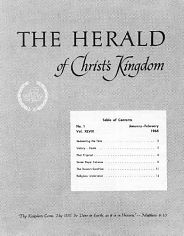
VOL.
XLVIII January/February 1965 No. 1 Redeeming the TimeA New Year Meditation"So teach us to number
our days, IN
the December Herald we raised our Ebenezer, pausing at the close of the ear to
praise the way he had led us Pay by day. Now we set our faces toward the road
which lies ahead. We are nearing the Homeland, aid the road before us is not
nearly so long as the road behind. Indeed, the end of the road is almost in
view! If the great Apostle Paul was able to declare: "Now is our
salvation nearer than when we believed. The night is far spent, the day is at
hand," what shall be said when all the prophecies have found their
focus at the point of time in which we are privileged to live? How urgent and
full of meaning is the exhortation: "Walk in wisdom . . . REDEEMING THE TIME" (Col.
4:5); 'See that ye walk circumspectly not as fools, but as wise, REDEEMING
THE TIME, because the days are evil." (Eph. 5:16.) In the two
foregoing quotations "Redeeming the time" is associated with the need
for wisdom. Wisdom describes "the right use of knowledge," and directs
that an understanding and knowledge of "the times and seasons" shall
urge us to the most effective use of the time remaining to us. Le us not spend
our time in vain regrets for lost opportunities and for misspent time in the past. "If we confess
our sins, he is faithful and just to forgive." Rather shall we render thanks to the heavenly
Father that he has brought us on to the road marked "Henceforth,"
short though it may be, and appropriate to ourselves the words of the Apostle
James -- "If any of you lack Wisdom, let him ask of God, that giveth to
all liberally, and upbraideth not; and it shall be given him." -
James 1:5. The Analytical
Concordance (Prof. Young) defines the Greek word translated
"redeeming" in the above quotations from Colossians and Ephesians as,
"to acquire out of the form. " Dr. Strong supplies the meaning as,
"to buy up,
i.e. ransom; to
rescue from loss (improve opportunity)." There must be sacrifice; cost is involved if we are to
"rescue from loss" the time which can be used in the service of God.
The child of God has but a few short years at most in which to be conformed to
the image and likeness of his dear Son, during which the affections must be
weaned from all that is earthly. "We are his [God's] workmanship";
it is he "who has begun the good work in us" and will complete
it; but he has called us to be co-workers with him. He has not placed upon us a
responsibility we cannot fulfill, nevertheless it is a task which requires all
our effort and every moment of our consecrated life. How MUCH TIME ARE WE PREPARED
To PUT INTO IT?
The Christian
life more than any other vocation is "a full-time job," requiring
every moment of every twenty-four hours of every day. The intensity of our love
for God; the strength of our determination to do his will; our love for the
heavenly Bridegroom, and our desire to "enter with him to the
Marriage" -- all are determined by our use of the time which has been
placed in our charge. "REDEEMING THE TIME, BECAUSE THE DAYS ARE EVIL"
There
is a sense of urgency in those words of the Apostle, yet how appropriate
in these closing days of this dispensation. These are "evil days";
evil because there are so many delusions and deceptions in the world, and so
many "harmless pastimes" to occupy time and attention and to sap
spiritual vitality. Do not we need to ask ourselves repeatedly whether "all
our days and all our hours" are being spent in accordance with
the will of God? Daily work and
nightly sleep occupy a large part of every twenty-four hours, yet even these
can be used either to help or hinder our Christian walk. But what about the
time over which we have some measure of control? That "social hour"
-- the time we spend reading "that book" or the newspaper, listening
to the radio, or looking at the television? Do we question whether these are
conducive to our
Christian
development? It
may be "just for a few minutes," and "quite harmless," but
do they accord with the exhortation to "redeem the time," to
"buy back" the moments? Failure to attain to the "prize of the
high calling of God" will be the responsibility of one person only --
OURSELF. The commandments of God are his enablings, for he has promised to
provide every need, to strengthen in weakness; but of us it is expected that
everything we have shall be put into this greatest of all enterprises. And is
that not what we promised to do when we surrendered our lives to God?
Henceforth we would "live, and speak, and toil for him." How
then shall we use the moments, the hours and the days which our Father may
mercifully loan to us during 1965? Shall we linger along the road marked
"Henceforth," or shall we "run with patience the race set
before us"? Shall we give to God the time we can spare, or shall we
"redeem the time"? Let us in the remaining portion of this
meditation be devoted to a consideration of the things which are essential to
the growth and development of every true child of God. PRAYERThe
first and most important essential in the Christian life is prayer.
How
often that has been said, and how true it is; but "how much time do I devote each day to prayer and communion
at the throne of grace?" One thing is certain -- unless prayer has
priority in the life, the hope to be "partakers of the Divine nature"
can never be realized. In the world in which we live,' it is "a bit of a
rush" in the morning, and at night there is tiredness and inability to
concentrate, but the habit of frequent and regular prayer must be
cultivated. Are we spending more time with our friends than with our heavenly
Father? The Lord Jesus
spent much time in prayer and communion with his Father; he found it necessary
that "the soul's sincere desire" should find expression in secret and
intimate communion with God. "WHEN YOU PRAY" said Jesus, "go into your own room, and shut the
door, and pray to your Father who is unseen, and your Father who sees what is
secret will reward you." - Matt. 6: 6. How
reassuring to know that our swift petitions to God are always heard, when we
are faced with a sudden assault from our Adversary, or with the need for a
swift decision, "HIS EAR IS EVER OPEN TO OUR CRY." But, for every
child of God there must be those deliberate "prayer sessions," times
of quiet and unhurried communion, when the heart's devotion to God is poured
out, when we can tell him of our love and of our inmost longings to know and to
do his will. Such sessions need time and
preparation in order that there might be a right attitude of heart and mind in
our approach to "THE KING OF KINGS" at the Throne of Grace. O how
needful is preparation for a reverent approach to God! Yet how frequently we
rush into his presence, hastily utter our requests, and rush away! Our time is
"so fully occupied"; hence the necessity to "redeem the time," to buy up the moments, to sacrifice
time spent on less important matters, to put "first things first." Is
it hard to pray? Like so much else, effort and determination are required to
cultivate the habit of prayer, yet with sincere desire and perseverance it will
become a joy to be anticipated, to leave the world with its turmoil and care,
and to shut ourselves away to "where none but God can hear."
"They that wait upon the Lord shall
renew their strength." Prayer should embrace every aspect and activity of
the life -- little things and big things. "In everything, by prayer and supplication . . . let your requests be
made known unto God." (Phil. 4:6.) It has been truly said that "If
there be anything in our lives that cannot be prayed about, we may be quite
sure that that thing has no business to be there at all." Therefore, time for prayer is as essential as the
air we breathe. To be spiritually healthy we must find time for prayer. Let it be regular, a specified time each
day, a season set apart as a time to meet and talk with God, for "any
time" so frequently be-comes "no time." Shall this be our
resolve for 1965? STUDY AND MEDITATIONHardly
less important than prayer is the need for study and meditation. If prayer is
"the Christian's native air," the Word of God is his meat and drink,
and time must be found for "our
daily bread." Time to eat is
essential to physical well-being. Jesus said: "Man shall not live by bread alone, but by every word of
God." (Luke 4:4.) Are we sometimes "too busy to eat"? Are we
so "cumbered with much serving" in the things of earth, or even in
things which concern the Lord, his Truth and the brethren, that we find no time
for quiet study and meditation? Much of the usefulness of prayer is lost when
there is a failure to apply oneself to the study of our Father's Word. It is in
and through His Word that the answers to many prayers are to be found. To
Timothy Paul wrote: "STUDY to show thyself approved unto God, a workman
that needeth not to be ashamed, rightly dividing the word of truth." (2
Tim. 2:15.) To read the Bible brings much blessing, but is not enough. To
listen to the Word of God being expounded is not sufficient to maintain
spiritual health and strength. There must be study. Of the Bereans of old it is written: (1) "They received the
word with all readiness o f mind," that is, they gladly heard God's Good News. (2) "They searched the Scriptures," but
even more than that (3) "They
searched the Scriptures daily, whether those things were so." (Acts
17:11.) "They searched the Scriptures daily" -- in those days of
toil and slavery, that required time each
day, a season set apart for the Word of God! How necessary for them to
"redeem the time"; how necessary for God's people today to cut off
the less essential things! We
pray that our appreciation of God's purposes might become more clear; the
answer can come only through God's Word. Our prayer is that we might know his
will for us; it is revealed in his Word. Never a day should pass without some
time spent with God's Holy Word; upon it depends our growth in grace and
knowledge. This then is a habit which must be cultivated and will require
sacrifice and perseverance. Hear
the words of Jeremiah, the Prophet -- "Thy
words were found, AND I DID EAT THEM; and
thy word was unto me the joy and rejoicing of my heart." (Jer. 15:16.)
Such is the testimony of all who have developed the habit of private study with
God's Word. A great musician once testified-that if he ceased his practice of
music for one day, he became conscious of his loss of skill; if for two days,
his friends became aware of it; and if for three days he neglected his hours of
practice, the public would know it. There is a parable for the Lord's people. FELLOWSHIPThe
third essential to spiritual development is fellowship. To many, there is
something more congenial about this aspect: it brings us into contact with
others whom we can see and with whom we can speak. Yet true Christian
fellowship can be only on the basis of what has taken place behind the closed
doors of private prayer and study. Fellowship is "a sharing
together." The Greek word, "koinonia,"
is translated variously communication, communion, contribution,
distribution, fellowship, to communicate. Each of those words suggests the
thought of giving out rather than of
merely receiving. To "give out," communicate, contribute, or
distribute, there must be a "taking in"; hence the need and
importance of previous prayer and study. "It is more blessed to give than
to receive," and in gathering with the people of God, whether in
"ones or twos," or in conventions and larger gatherings, there should
be the intention to give. By giving we receive. That is fellowship. But
true fellowship demands that we shall
"redeem the time." Our Adversary is expert at finding "harmless
occupations which so fill the time that fellowship is restricted. All need
exhortation-the strongest with the weakest of saints; so much in the
circumstances and conditions of life today tend to drag us down to "the
lower levels." "Let us hold the
Hope we avow without wavering; . . . and let us consider how to stir one
another to love and good deeds. NOT CEASING TO MEET TOGETHER, as is the habit o f some, but admonishing
one another -- ALL THE MORE SO, as
you see the Day drawing near." (Heb. 10:23-25 Moffatt.) Another
rendering of the foregoing quotation is -- "By observing one another, let us arouse ourselves to rival
one another's love and good deeds.' What a happy rivalry that is! "Let us not neglect
meeting together is some do, but let us encourage on, another, ALL THE MORE as you can see the great Day
is coming nearer.' Are you "isolated" and unable to gather with others in true
fellowship? Then neglect not that fellowship through "the written
word"; the Lord will richly bless your correspondence with others. SERVICEOne
further necessity remains for those who would" redeem the time." Food
and air alone will not produce a healthy human frame; neither will prayer,
study, and fellowship of themselves result in a healthy "new
creation." The athlete is particular about the air he breathes and the
food he eats, but if he would pass "the winning post" he must also
find time for exercise. If those who run in the race for the high calling of
God would reach the goal there must also be activity and service. If fellowship
and service are to be acceptable to God and profitable to those who serve, it can be only on the
basis of the unseen "prayer-life" and the spent in private study and
meditation. They are the outward expressions of an inward experience. By
prayer and study, the will of God is learned; by fellowship and service, the
revealed will of God is worked out in the character and toward those about us.
Fellowship and service without prayer and meditation on God's Word will result
in an exercise of "zeal, not according to knowledge." Prayer and
study without fellowship and service will result in "spiritual pride."
Thus each must find its proper and essential place in the life of every true
Christian. There
are two kinds of service which should engage the time of those who would seek
to obtain the "Well done, thou good and faithful servant." (1) That
which concerns our individual lives, involving the discipline of self and the
subjection of our whole being, even the thoughts of the mind, to the will of
God. The will of God dictates that the desires of the flesh must be
"crucified," and the affections "set" on things above. The
"New Creation" can be fed only on spiritual things; fleshly appetite
can be mortified only by ceasing to gratify earthly desires. How deliberate and
persistent is the effort required! (2) The more positive aspect of service is
manifested in the "laying down of our lives for the brethren," and in
the proclamation of the Gospel message to those about us. A true appreciation
of God's great and loving provision for men will so fill the heart that our
great desire will be to tell it forth to others. All are not called to
prominent service, and it is not the quantity and prominence of service which
receives God's approval and blessing. The "cup of cold water" is of
great value in his sight. A word spoken for the Lord; a letter of encouragement
and cheer; a visit to some lonely brother or sister in Christ; and sometimes,
perhaps just a word of prayer for another -- all these are forms of service
pleasing to our Father, yet, how sweet is the savour if it represents the doing
with our
might what our
hands find to do, and if our service, whether small or large, is rendered, not
during the "time we have to spare," but in the time we have bought or
redeemed. Yes, we must make time for the things which are vital to our spiritual welfare and eternal destiny. Our
meditation draws to a close. At the entrance to another year we have together
searched our hearts. Is
there room for some improvement? How deep is the longing to share with our glorified
Lord in the work of blessing "all the families of the earth," and to
"see him face to face"? The use of our time from henceforth will
decide the answer. Dearly beloved, the time is short. Let us offer the prayer of
Moses "So
teach us to number our days, that we may apply our hearts unto wisdom." -
Psalm 90:12. -
Edwin Allbon,
Eng. Victory(Author Unknown)
That Prophet
"Moses verily was faithful in all his house, as a
servant, ONE
remarkable MESSIANIC prediction stands out prominently on the pages of
Deuteronomy: "A prophet shall the Lord your God raise up unto you of your
brethren like unto me," said the great lawgiver and mediator of "Israel.
He was urging the people never to resort to necromancy and divination,
familiar spirits or wizards, superstitious vices common among the Canaanites
whose land they were going to possess; and he enforces the prohibition by this
promise, as though he would say, you
shall riot need to resort to such means of ascertaining the mind of God, for
he will give you another mediator and legislator like myself. He tells them
that he had received this promise from God Himself at the time of the giving of
the law forty years before, at Sinai. The terrified people had exclaimed,
"Speak thou with us, and we will hear; but let not God speak with us, lest we die." They had
realized their need of a human mediator, "in the days of the assembly in Horeb"; and God had responded to their desire by saying to Moses,
"They have well spoken. I will raise up unto them a Prophet from among
their brethren, like unto thee, and will put my words in his mouth; and he
shall speak unto them all that I command him. And whosoever will not hearken
unto my words which he shall speak in my name, I will require it of him. "Deut.
18:15-19. Now
God raised up many prophets in Israel in after-years, but of them all we may
say, "there arose not a prophet since in Israel like unto Moses." So
fully were the Jews in Christ's day convinced that the promised prophet had
never yet appeared, that they naturally put the question to John, "Art
thou that prophet?" alluding to
this very prediction. When subsequently they ate of the food miraculously provided
by Christ for the five thousand, the thought was again suggested to them by the
remembrance of the manna sent through Moses, and the people exclaim, "This
is of a truth that
prophet that
should come into the world. " - John 6:14. The
rich depth of meaning that lies concealed in those words, "like unto
me," was little understood by Moses, and is often little perceived among
ourselves through deficient meditation. The following are some of the points
that should be noted in the resemblance.
b. So also did Christ.
There
is also a resemblance in some points between the death of Moses and the death
of Christ, though imperfect and associated with contrasts. Moses died in some
sense because of the iniquities of the people; it was their rebellion which led
to the fault on his part which drew down the
displeasure of God on them and on him. He went up in the sight of the people to
the top of Mount Nebo, and there he died, when he was in perfect vigor, his eye
not dim or his natural force abated. Christ suffered for the sins of men and
was led up to Calvary in the presence of the people, in the flower of his age
and in his full natural strength. Moses was buried, and no man knew where his
body lay; nor could the Jews find the body of Christ. Just before his death
Moses promised the people another prophet like himself; Christ promised
"another comforter." Eusebius
long ago noted many particulars of the resemblance between Moses and Christ.
He says:
Never
was there a prophet so like unto Moses as Jesus Christ! Isaiah wrought no
miracle; Jeremiah promulgated no new law; Daniel instituted no new system of
worship. We may search over the sacred and profane historical portrait
galleries of the past, during the fifteen hundred years that elapsed between
the appearance of these two great deliverers in Israel, but not till we come
to the Prophet of Nazareth do we meet with the predicted "like unto
me." And it should be noted that the emphatic "him shall ye
hear" of Moses is rendered by Peter in the third of Acts, "Every
soul that will not hear that prophet shall be destroyed from among the
people." This
settles the question that it was of Christ that Moses spoke. Previous
generations had rejected previous prophets without perishing in consequence.
But the generation that rejected Jesus were, according to his own prediction,
"miserably destroyed"; and the total excision of the Jewish people
for a time from their own olive tree, was the consequence of their refusal to
hear the prophet like unto Moses. Seventy years of captivity in Babylon was inflicted
on them on account of their iniquities and idolatries in the days of the kings,
but eighteen hundred years of dispersion and misery have followed their
rejection of Christ. Could Moses have foreseen this? Were not his words weighty
with a mournful meaning he little imagined? Were not the mind and purpose of
God expressed in the simple yet solemn and sublime prediction "A prophet
shall the Lord your God raise up unto you of your brethren, like unto me. And
it shall come to pass, that every soul, which will not hear that prophet, shall
be destroyed from among the people?" If
the long and detailed prophecies of Lev. 26 and Deut. 33 were a program of the
future of Israel, may we not say that this brief but frequent utterance about
the prophet that should come into the world illustrates that program with a portrait? Not only was a long and
complete history foretold, but an individual character was delineated in the words,
"like unto me." The sketch is held up to the gaze of generation
after generation; fifteen hundred years pass by, and no one at all like it
appears. Judges and deliverers arise in Israel, David the man after God's own
heart orders and instructs the people, a line of kings and a line of prophets pass
over the stage of Jewish history, but no one appears answering to the prophetic
sketch, "like unto me." After
the lapse of fifteen centuries, however, Jesus of Nazareth appears, and, lo!
every feature of the portrait can be recognized, and we need not inquire,
"Art thou that prophet that should come into the world?" His likeness
to Moses makes the question needless! Deliverer, leader, Savior, lawgiver, mediator,
ruler, judge, prophet, priest, king; God's servant, God's representative,
God's reflection, God's ambassador among men, illustrious founder of a new
order of things; mighty yet meek, patient yet inflexible, tender yet stern
against sin, loving, even to tears and agony, and self sacrifice, yet
denouncing sore judgments to come, -- was any one ever so like Moses as Christ,
and so like Christ as Moses? When they beheld these two stand side by side in
glory in the transfiguration on the Mount, did Peter, James, and John perceive
any likeness between them? We know not! There is something far deeper than face
or form; when illuminated by the spirit in after days, the Apostles perceived
and expounded this deeper likeness between the great prophet of the old
covenant and the greater Prophet of the new, and called on all to obey the
voice from the excellent glory which had fallen on their ears, "Hear
him." Most
marvelously did the Lord Jesus Christ answer to this description, "a
prophet like unto me"; and some of the points of resemblance are brought
out by God's own words as to Moses, as distinguished from other prophets. "Were
ye not afraid to speak against my servant Moses?" demanded the Lord of
Aaron and Miriam when they spake against their brother. "Hear now my
words: If there be a prophet among you, I the Lord will make myself known unto
him in a vision, and will speak unto him in a dream. My servant Moses is not
so, who is faithful in all mine house. With him will I speak mouth to mouth,
even apparently, and not in dark speeches; and the similitude of the Lord shall
he behold." To other prophets God revealed his message by visions and
dreams; to Moses, face to face. Superior fidelity characterized the man;
greater intimacy with God was his portion. Now "Moses verily was faithful
in all God's house as a servant, but Christ as a son." How much more
intimate the Son with the Father than Moses with Jehovah! Did not God put his
words into the lips of Christ? "The words that I speak unto you, I speak
not of myself," he said; and again, "I have given unto them the words
that Thou gayest me ." "I have given them Thy words." "He
shall speak unto them all that I shall command him," said God of the
prophet like unto Moses. "I have not spoken of myself," said Christ;
"but my Father which sent me, he gave me a commandment, what I should say,
and what I should speak. And I know that his commandment is life everlasting ,
whatsoever I speak therefore, even as the Father said unto me, so I speak.
" The
incredulous twentieth century, the age of the scoffers of the last days, is
still confronted with an existing fact, a world-wide and well known fact --
the fact of a Jewish dispersion foretold in the days of Moses, accomplished
sixteen hundred years later in the days of Titus, Vespasian, and Adrian, just
after their crucifixion of Jesus of Nazareth, a prophet like Moses, whom to
reject would, he foretold them, be fatal, but whom they nevertheless did
reject. If in the face of such evidence men refuse to own the finger of God,
are they not without excuse? -
H. Grattan Guinness. Seven Royal Failures"Keep thy heart with
all diligence; THE
kings of Israel [the ten tribes] were, without exception, depraved and ungodly
men, wholly given over to idolatry and licentiousness. And it is a striking
fact, worthy of our most thoughtful consideration, that their evil characters
and deeds are stated in the Scriptures, without any attempt at concealment or
palliation. Never were the annals of any kingdom so written by a human chronicler. Wherefore we
have in this remarkable feature of Bible history a further proof of the Divine
Authorship of the Holy Scriptures. 'The
history of the line of the kings of Judah [the two tribes] is characterized by
the same outspoken truthfulness, notwithstanding that there would be every
incentive humanly speaking, to glorify the house of David by concealing the
faults and extolling the virtues of his descendants. Of some of the kings of
Judah, it is stated in the boldest terms that they were wicked men; and of others,
who did follow the Lord, their failures and departures are recorded quite as
impartially as are their virtues. Taking
a rapid survey of the career of the most prominent kings of David's line, we
may read therein some valuable lessons, and receive therefrom some wholesome
and impressive warnings. David,
in his "last words" (2 Sam. 23:1-7), had declared by inspiration
what God requires in those who rule over men, saying, "The God of Israel
said, the Rock of Israel spake to me, He that ruleth over men must be just, ruling in the
fear of
God";
and, being a prophet, David foresaw and foretold the failure of his own line,
for he went on to say, "Although my house be not so with God, yet He hath made with me an
everlasting covenant, ordered in all things and sure." The
subsequent history of David's line fully confirms this prophecy, making it
quite clear that his house was "not so with God." Again and again we
read of a king who began well, and continued for a longer or shorter time to
walk "in the first ways of his father David," that is to say, in the
fear of God, and according to the law of God, but who, later on, departed from
those ways, some after one manner, some after another. It will be a profitable
exercise to pass briefly in review the most prominent of those instances of
departure from the right ways of the Lord. KING SOLOMONSolomon,
who was beloved of God, made a good start; and God blessed him with riches and
honours in abundance, so that his kingdom is famed above all the kingdoms of
the world for its glory and magnificence. For "King Solomon exceeded all
the kings of the earth for riches and for wisdom." "And the king made
silver to be in Jerusalem as stones, and cedars made he to be as the sycamore
tries that are in the vale for abundance" (1 Kings 10:23, 27). "And
al King Solomon's drinking vessels were of gold, and all the vessels of the
house of the forest of Lebanon were of pure gold; none were of silver, it was
nothing accounted of in the days of Solomon" (1 Kings 10:21). But
Solomon failed in the vital matter o obedience to the law of the Lord. Moses had expressly said,
concerning the one who should be chosen for a king: "But he shall not multiply horses to himself, nor cause the
people to go down to Egypt, to the end that he should multiply horses ... Neither shall he multiply wives to himself, that his heart turn not away, neither shall he greatly multiply to himself
silver and gold. And it shall be, when he sitteth upon the throne of his kingdom, that
he shall write him a copy of this law in a book, out of that which is before
the priests the Levites; and it shall be with him, and he shall read therein
all the days of his life; that he may learn to fear the Lord his God, and to
keep all the words of this law and these statutes to do them" (Deut.
17:14-20). Solomon
violated the law in the most flag ant manner, in each of the three particulars
expressly stipulated in the above Scripture. We have already quoted the
passages which record how he greatly multiplied to himself silver and gold; and we further
read that "Solomon loved many strange women (together with the daughter of
Pharaoh) ... And he had seven hundred wives, princesses, and three hundred
concubines; and his wives turned away his heart. For it came to pass, when Solomon was old, that his wives turned away his
heart after other gods" (1 Kings 11:1-8). Further it is written that "Solomon had forty thousand stalls of
horses for his chariots, and twelve thousand horsemen" (1 Kings 4: 26).
"And Solomon gathered together chariots and horsemen; and he had a
thousand and four hundred chariots and twelve thousand horsemen, whom he
bestowed in the cities for chariots, and with the king at Jerusalem. And a
chariot came up, and went out of Egypt for six hundred shekels of silver, and
an horse for an hundred and fifty" (1 Kings 10:26-29). Because of this
flagrant disobedience, the Lord rent away the ten tribes from the Kingdom of
David. KING ASAKing
Asa also began well. He ''did that which was right in the sight of the Lord, as
did David his father. He took away the sodomites out of the land, and removed
all the idols that his fathers had made" (1 Kings 15:11-15). Moreover, he
"commanded Judah to seek the Lord God of their fathers, and to do the law
and the commandment. Also he took away, out of all the cities of Judah, the
high places and the images; and the kingdom was quiet before him" (2 Ch.
14:3-5). "And he brought into the house of God the things that his father
had dedicated, and that he himself had dedicated, silver, and gold, and vessels"
(2 Ch. 15:18). Thus Asa avoided the sin of multiplying gold and silver unto himself, and devoted those precious
things to the Lord. Therefore, the Lord greatly prospered him, and gave him
rest on every side. Moreover, when the Ethiopians and the Lubims came against
him with a huge host, and Asa cried to the Lord for help, He smote his enemies
before him, insomuch that they were destroyed before the men of Judah; and they
carried away very much spoil (2 Ch. 14:7-15). Nevertheless,
afterwards, when Baasha came against Asa with a relatively small army, Asa brought out the silver and the gold out
of the treasury of the Lord, in order to hire aid from the king of Syria, thus
not only turning to man for help, but actually bartering away the precious
things of the Lord in order to procure it. And not only so, but when God sent a prophet
to reprove him, he flew into a rage, and put him in prison. And finally, when
God chastened him by sending a disease upon him, Asa, in his sickness, sought
not to the Lord, but to the physicians (2 Ch. 16:1-14). Thus in Asa we have the
example of one who knew the Lord, and who "yet," in difficulty and
sickness, turned
to man for help. KING JEHOSHAPHATAgain
in the history of King Jehoshaphat we find one who began well, and went on
well for a time. Jehoshaphat's error was of a different character from that of
his forefathers, Asa and Solomon. It consisted in "joining
affinity" with Ahab, the utterly corrupt king of Israel, even going so
far as to say to him "I am as thou art, and my people as thy people, and
we will be with thee in the war" (2 Ch. 18:1-3). That friendship with his
ungodly neighbor caused far more damage to the house of David and to the
people of Judah than the worst that Ahab could have inflicted by waging
incessant warfare against them. Thus we learn from the career of Jehoshaphat
the vital importance to the people of God of separation from the world; for "the friendship of
the world is enmity against God" (James 4:4). Jehoshaphat did not, like
Solomon, multiply wives to himself, or horses, or silver and gold. Nor did he,
like Asa, fail to seek the Lord in time of need (see 2 Ch. 18: 4.) But he
became "unequally yoked together with unbelievers"; he had fellowship
with unrighteousness, and joined himself in a common cause with men of Belial
(2 Cor. 6:14-17); and thereby he brought disaster upon himself and his
posterity for four generations (Ex. 20:4). KING JOASHJoash
was a king who enjoyed from his infancy the great benefit of godly restraint
and tuition under the care of Jehoiada, the priest. So it is recorded that
"Joash did that which was right in the sight of the Lord all the days of
Jehoiada the priest" (2 Ch. 24:2). But it appears that the commendable
deeds of Joash were due to the strong influence of Jehoiada. There is no evidence
that the heart of Joash was ever changed, but the contrary appears. For,
"after the death of Jehoiada came the princes of Judah, and made
obeisance to the king. Then the king hearkened unto them; and they left the house
of the Lord God of their fathers, and served groves and idols; and wrath came
upon Judah and Jerusalem for this their trespass" (2 Ch. 24:17, 18).
Moreover, the people under Joash stoned the prophet whom God sent to reprove
them; and Joash manifested the basest ingratitude toward the house of his
benefactor, Jehoiada, by slaying his son. Therefore he was afflicted with
"great disease," and "his own servants conspired against him for
the blood of the sons of Jehoiada the priest, and slew him on his bed, and he died and they
buried him in the city of David; but they buried him not in the sepulchres of
the kings" (2 Ch. 24: 20-25). From
the career of Joash we may learn the immensely important fact that a good
bringing up, and the restraints of good
moral influences, though of very great value, are but external in their action,
and do not avail for salvation and a new heart without personal faith and the inward work of "the washing of
regeneration and renewing of the Holy Spirit" (Titus 3:5). Without personal
faith and regenerating work of the Spirit of God it will surely happen
"according to the true proverb, the dog is turned to his own vomit again
and the sow that was washed to her wallowing in the mire" (2 Pet. 2:22). KING AMAZIAHAmaziah,
the son of Joash, was one who "did that which was right in the sight of
the Lord, but
not with a perfect heart" (2 Ch. 25:2). He obeyed the voice of the prophet in
dismissing the army of Israel which he had hired to help him; and God thereupon
gave him victory over the Edomites. Yet, when he returned from the slaughter
of the Edomites, he brought their gods with him, "and set them up to be his gods, and bowed down
himself before them, and burned incense unto them. Wherefore the anger of the
Lord was kindled against Amaziah, and He sent unto him a prophet which said
unto him, Why hast thou sought after the gods of the people which could not deliver
their own people out of thine hand?" (2 Ch. 25:6-15). Amaziah would not,
however, receive this reproof, but silenced the messenger of God; and when he
essayed to go to war against the king of Israel, he was defeated. The end of
his career is told in these words: "Now after the time that Amaziah did
turn away from following the Lord, they made a conspiracy against him in
Jerusalem; and he fled to Lachish; but they sent to Lachish after him, and
slew him there" (2 Ch. 25:27). From
the history of this king we may learn the inveterate disposition of the natural
heart of man to turn to idols, and to trust in any creature rather than in the
living God. The folly of trusting in the gods of a nation who could not deliver
that nation is apparent. Yet such was the folly of this descendant of the wise
King Solomon, and such were the gods chosen by this degenerate scion of the house
of David. KING UZZIAHUzziah's
reign was the next to the longest of all the kings, fifty-two years. (Mannasseh
reigned fifty five.) "And he did right in the sight of the Lord,
according to all that Amaziah his father did. And he sought God in the days of
Zechariah, who had knowledge of the visions of God, and as long as he sought
the Lord, God made him to prosper" (2 Ch. 26:4, 5). "But when he was
strong, his
heart was lifted up to his destruction; for he transgressed against the Lord, and went into the
temple of the Lord to burn incense upon the altar of incense" (2 Ch.
26:16). This was the sin of pride and presumption. For Uzziah was not content with the honours of the throne, but desired
those of the priesthood as well. But "no man taketh this honour to himself, but he
that is called
of God as
was Aaron" (Heb. 5:4). God had strictly separated the offices of king and
priest. Only in Jesus Christ are they united. Hence, of all the characters in
the Old Testament none was both a king and a priest, save Melchisedec, in whom
the two offices were united only that he might stand as a type of Christ in his
royal and eternal priesthood. (Heb. 7:1-3.) Therefore was Uzziah smitten with
leprosy for
his presumption,
and had to
live apart "in a several house" until the day of his death (2 Ch.
26:17-21). Hence Uzziah stands before us as a warning against the pride of the
natural heart. Man is a sinner; and leprosy is a type of sin. He may
effectually conceal the corruption of his heart from his fellow-men; "but
God looketh upon the heart;" and all things are naked and open unto the
eyes of him with whom we have to do. None can approach unto the presence of a
holy God, except such as are "called," and are made fit for his
presence by the Atonement which he has provided. When Uzziah transgressed this
rule, which guards the sanctity of God's presence, the corruption that was in
his heart was allowed to come to the surface, where all could see it; and then, in bitter humiliation, "he
himself hasted to go out" (2 Ch. 26:21). If others could see what is in
our hearts we would shun the light of day, and much more the light of God's
holy Presence. KING HEZEKIAHFinally,
in Hezekiah we have doubtless the best of all the kings of David's line-after
David himself; for it is written that "he did that which was right in the
sight of the Lord according to all that David his father had done" (2 Ch. 29:2).
"He trusted in the Lord God of Israel; so that after him was none like
him among all the kings of Judah; nor any that were before him. For he clave to
the Lord, and departed not from following him, but kept his commandments, which
the Lord commanded Moses. And the Lord was with him, and he prospered whithersoever
he went forth" (2 K. 18:5-7). Of the chief incidents of his reign we would
only call attention to his conduct in the incident of the ambassadors from
Babylon, who came to bring the congratulations of their king after that
Hezekiah had been healed from a deadly sickness by the direct action of God in
answer to prayer. The incident is related three times (2 K. 20:12-19; 2 Ch.
32:24-31; Isa. 39:1-8). In the account in 2 Chronicles 32 it is stated that
Hezekiah, after his miraculous recovery when sick unto death, "rendered
not again according to the benefit done unto him; for his heart was lifted up, therefore there was wrath
upon Judah and Jerusalem" (2 Ch. 32:25). His ingratitude and failure
consisted in this, that when those heathen ambassadors of high rank and station
came and paid their respects to him, he did not glorify the Lord, who had
healed him, but, with puerile vanity, he displayed the baubles and showy
trumpery, which constituted his own regal glory. For "he showed them all
the house of his
precious
things, the silver and the gold, and the spices and the precious ointment, and
all the house of his armor, and all that was found in his treasures; there was
nothing in his
house, nor
in all his dominion that Hezekiah showed them not" (2 K. 20:13). In all
this there was not one word to the praise and glory of God. Wherefore, in 2
Chronicles 32:31 we have this comment: "Howbeit, in the business of the
ambassadors of the princes of Babylon, who sent unto him to inquire of the wonder
that as done in the land, God left
him to try him, that he might
know all that was in his heart." Ingratitude and vanity were "in his
heart, " but he was unaware of it. Such sins, however, are very grievous
in one on whom God has lavished the riches of his grace and mercy. Therefore
God "left him," so that what was in the heart might come out, as in
the case of Uzziah. How earnestly then ought we to pray continually,
"lead us not into temptation! " EPILOGUEHere
we have before us a complete sheaf of seven typical kings of Judah, illustrating the various ways in
which one who "did run well" may falter, or stumble, or turn aside.
We can make no better or more apt comment upon these inspired records, which
have been written for our admonition, than that of the Apostle Paul, who,
speaking of the lessons which are to be found in the Old Testament types, said:
"Wherefore, let him that thinketh he standeth take heed lest he
fall" (1 Cor. 10:12). In
the case of all these kings it was prosperity and ease that led to their
downfall. We may well, therefore, contrast with them the case of their father
David, whose life was one of hardships, persecutions and afflictions, during
the entire reign of Saul, and of conflicts and domestic troubles after he
himself came to the throne. But in all that befell him he was humble, lowly
minded, tender-hearted, submissive to the will of God, and always full of
thanksgiving and praise to the Rock of his Salvation. Hence David made a good ending; for "he died in a good
old age, full of days, riches and honour" (1 Ch. 29:28). Let such of us,
therefore, as are advanced in years, seek grace continually that we may end
well; and let our ambition be that of the Apostle who said, "Neither
count I my life dear unto myself, that I might finish my course with joy" (Acts 20:24). -
The Wonders of Bible Chronology - P. Mauro The Ransom Sacrifice"Behold the Lamb of
God!" - John 1:36. Jesus
was unapproachably distant from all that ever were honored with a divine
mission, with no predecessor and no successor in the multitude and harmony of
his spiritual revelations. The Hebrews epistle opens thus: "God, who at
sundry times and in divers manners spake in time past unto the fathers by the
Prophets, bath in these last days spoken unto us by his Son"; a
fulfillment of a promise which waited fourteen centuries for its accomplishment,
given in he days of Moses to Israel -- "I will raise them up a Prophet
from among their brethren, like unto thee, and will put my words in his mouth;
and he shall speak unto them all that I shall command him." (Deut. 1:18.)
This the Son confirmed: "I have not spoken of myself; but the Father
which sent me, he gave me a commandment, what I should say, and what I should
speak." (John 12:49.) Again " I have given unto them the words which
thou gavest me." (John 17:8.) Those who heard and saw testified,
"This is of a truth that Prophet that should come into the world." -
John 6:14. For
"never man spake as this man!" "His lips like lilies, dropped
sweet: smelling myrrh." His hearers, enthralled, "wondered at the gracious
words which proceeded forth from his mouth" as he appropriated to himself
the divine commission recorded by Isaiah eight centuries before: "The
spirit of the Lord is upon me, because he hath anointed me to preach the
Gospel to the poor; he hath sent me to heal the broken-hearted, to preach
deliverance to the captives, and recovering of sight to the blind, to set at
liberty them that are bruised, to preach the acceptable year of the Lord."
(Mark 4:17-22.) A wondrous light burst upon sin-sick and weary humanity. He
spoke forth doctrines strange for their searching character and revolutionary
for their boldness, and always with the air of authority: I am the Way -- the
Truth -- the Life -- the Door -- the Bread from Heaven -- the Light of the
World; no man cometh unto the Father except by me. A most astounding message, a
message of salvation "which at the first began to be spoken by the
Lord" . . . "a hope of eternal life which God, that cannot
lie, promised before the world began." (Heb. 2:3; Tit. 1:2.) It was
"the word," said Peter to Cornelius, "which God sent unto the
children of Israel, preaching peace by Jesus Christ: (he is Lord of all;) that
word, ye know, which was published throughout all Judea, and began from
Galilee, after the baptism which John preached; how God anointed Jesus of
Nazareth with the holy spirit and with power; who went about doing good, and
healing all that were oppressed of the devil for God was with him." - Acts
10:36-38. His
deeds attracted attention and enforced awe at the mysterious power which lay
in his hand and voice. He defended the weak, forgave the sinners, fed the
thousands, healed the sick, raised the dead. "The people were amazed and
said, Is not this the son of David?" (Matt. 12:23.) Here was a
transcendent character and a Teacher without parallel, who could instruct in
truth higher than man had conceived, opening vast and pure reaches of the
unseen realms of knowledge. The light of the knowledge of the glory of God
shone forth from his face. The ruler Nicodemus confessed, "Rabbi, we know
that thou art a teacher come from God: for no man can do these miracles that
thou doest, except God be with him." (John 3:2.) "The common people
heard him gladly," and would have made him king. - Mark 12:37; John 6:15. But
resolutely rejecting all human exaltation, he "stedfastly set his face to
go to Jerusalem," in marvelous obedience to a greater commission
entrusted him by the Father. This commission he revealed to his inner circle
of disciples in words perplexing and strange: "The Son of Man must be
lifted up." (John 3:14.) "The Son of Man came to give his life for
many." (Mark 10:45.) "My flesh I will give for the life of the
world." (John 6:51.) "I lay down my life for the sheep. " (John
10:15.) "This is my body, broken for you. This is my blood, shed for
you." (Matt. 26:26-28.) But they fell on unbelieving ears for they were
incompatible with the disciples' expectation of an immediate establishment of
God's Kingdom. They were not to comprehend until after his resurrection when he
spoke to them again: "O foolish men, and slow of heart to believe all that
the Prophets have spoken! Was it not necessary that the Christ should suffer
these things and enter into his glory?" And beginning with Moses and all
the Prophets, he interpreted to them in all the Scriptures the things
concerning himself. Then he said to them, "These are my words which I
spoke to you, while I was still with you, that everything written about me in
the law of Moses and the Prophets and the Psalms must be fulfilled." Then
he opened their minds to understand the Scriptures, and said to them,
"Thus it is written, that the Christ should suffer and on the third day
rise from the dead, and that repentance and forgiveness of sins should be preached in his
name to all nations, beginning at Jerusalem. " - Luke 24 25-27; 44-47,
R.S.V. In
these plain words explicitly and unqualifiedly does Christ, the central and
supreme theme of all Old Testament disclosure, affirm his atoning death to be the one fact that gives
vital significance, substance, and value to the entire body of the Inspired and
Written Scriptures of that time. For God has made the Death of Christ the
procuring means of Human Salvation. This, the central and cardinal fact of
divine revelation found its concentrated expression in the heralding
Baptist's sublime announcement when, pointing to the approaching Christ, he
exclaimed: "BEHOLD
THE LAMB OF GOD, WHO TAKETH AWAY THE SIN OF THE WORLD!" - John 1:29. GODS ANOINTED PRIESTWe
are thus brought directly to the ultimate objective in Jesus' earthly ministry.
He who had existed before the world was -- who had made all things -- who had
left the glories of a higher nature and been made lower than the angels-whose
birth, supernaturally of a virgin, was heralded by the spirit host -- dedicated
his life to the will of his Father, and in perfect submission to that will
"emptied himself, and became obedient unto death, even the death of the
cross." (Phil. 2:8.) He became a man for the very purpose of
"tasting death for every man. " He took on him the human nature
"for the suffering of death" -- the very penalty that was against our
race. "God was in Christ reconciling the world unto himself." (2
Cor. 5:19.) "The law was given by Moses, but grace and truth came by Jesus
Christ." (John 1:17.) The revelation of God through the Mosaic Law
resulted only in proving Jews and Gentiles as all under sin; stopping every
mouth and making the world subject to divine judgment, for all have sinned and
come short of the glory of God. But the revelation of God through Jesus Christ
brought justification freely by his grace through the redemption that is in
Christ Jesus. For though "the wages of sin is death, the gift of God is
eternal life through Jesus Christ our Lord. " - See Rom. 3:9-24; Rom. 11:32;
Rom. 6:25; Gal. 3:22. Great
(worthy of all acceptance) is the inner doctrine of the religion of Christ:
This
doctrine of the atonement effected by Jesus in the sacrifice of himself, is the
grand touchstone by which we may determine what is Truth and what is not Truth.
For in the great Plan of God for human salvation the Ransom constitutes the
very central feature from which radiates all the doctrines which end in the
fullness and completion of that Divine Plan. The vicarious aspect of Jesus'
death is the definite teaching of many Scriptures, for example:
Typically,
also, the elaborate sacrificial system of the ceremonial Law of Sinai revealed
the same truth. The substitution of an unoffending animal for the human offender-where
nothing less than the lifeblood (Lev. 17:11 - "Blood maketh atonement by
reason of the life.") of the substituted victim sufficed for the
remission of deserved penalty, with the offerer's act of laying his hand on
the animal, an exercise of faith in the transfer of guilt -conveyed the fact
and meaning of Atonement. These sacrifices of Israel were intended and adapted
to point onward to Him in whose death a real sacrifice was offered, in whose
death a real want of mankind was met. This truth is forcefully expounded in
the Book of Hebrews, particularly chapters 9 and 10 -- the key thought itself
in Heb. 9:22 - "Without shedding of blood, there is no forgiveness of
sins." - R.S.V. Jesus'
atonement work must not however be crudely construed as simply shedding literal
blood to placate an angry Deity. We may be certain the Philosophy of the
Ransom is commensurate with the lofty attributes of God. In seeking to understand
the workings of Him, "whose thoughts are not our thoughts, and whose ways
are not our ways," we may accept the theologian Hooker's dictum: "Let
us not think that, as long as the world doth endure, the wit of man shall be
able to sound the bottom of that which may be concluded out of the Scriptures."
This question as to the ability of the human minds to comprehend absolute
truth need not, however, diminish our appreciation of the boundless love
of God for his human creatures; in whose Plan on our behalf the "Lamb was
slain from the foundation of the world"; and who "gave his only
Begotten Son, that whosoever believeth in him should not perish, but have
everlasting life." Students of the Scriptures are generally agreed in a
Philosophy of the Ransom, which magnifies the Creator; an interpretation whose
pivotal truth is expressed by the Apostle in 1 Cor. 15:21, 22: "As by a
man came death, by a man also came the resurrection of the
dead. For as in Adam all die, even so in Christ shall all be made alive." This
interpretation has been briefly stated thus: "The ransom views the matter
of man's recovery from sin and death as a purchase -- a redemption The basis
of this thought is the divine law, 'an eye for an eye, a tooth for a tooth, a
man's life for a man's life.' (Deut. 19:21.) Adam and his entire race of
thousands of millions are in dire distress through sin and it penalty. God has
provided a recovery by a ransom process -- purchasing back from their fallen
condition. "Our
first thought naturally would be that to redeem, or purchase back, the right
of humanity to life, would mean that each member of Adam's race must be
purchased by the life of another person, holy, harmless, unsentenced. But
looking deeply into God's Plan we find that only one man was tried before the
divine court -- namely, Father Adam; that only Adam was sentenced to death;
and that all of his children go into death, not because of their individual
trial and death, but simply because Adam failed to maintain his perfection, was
unable to give is children more life or rights then he possessed. And so it has
been throughout the entire period of six thousand years from the time of
Father Adam's sentence until now. "Here
we see a wonderful economic feature connected with the Divine Plan. God would
not permit more than one member of the human race to be tried and sentenced to
death; for his purpose from the beginning was that the sacrifice of one life
should redeem the entire human race. By one man the whole trouble came; by
another Man the whole trouble will be rectified. "Thus
we see the value of Jesus' death -- that it was not merely for Adam, but
included all his posterity. We see, too, how necessary it was that Jesus should
be 'holy, harmless, undefiled and separate from sinners'; otherwise, he, like
the remainder of the race, would have been under a divine death sentence.
Because all of Adam's race were involved in sin and its penalty, it was
necessary to find an outsider to be the world's Redeemer; and that outsider,
whether angel, cherub, or the great Michael himself, the Logos, must exchange
the spirit nature for the human nature in order to be a corresponding price --
a ransom for the first man. "It
was not a god that sinned; hence the death of a god could not redeem. It was
not a cherub that sinned; hence the death of a cherub could not redeem. It was
a [perfect] man who sinned, and the ransom for him must be furnished by the
death of a [perfect] man. It was for this cause that the great Logos, in carrying
out the divine plan for human redemption, left the glory which he had with the
Father before the world was, humbled himself and became a man, 'was made a
little lower than the angels, for the suffering of death, crowned with glory
and honor; that he, by the grace of God, should taste death for every
man.'" To
this agree the words of Jesus himself: "The Son of Man came ... to give
his life a ransom (lutronanti -- a price to correspond) for many. " - Mark 10:45. In
Romans 5:15-21, we read St. Paul's contrast between Adam and Christ. The two
great heads of the race are introduced, Adam in the Fall, Christ in the Redemption;
and the results of the Fall and the results of the Redemption are shown in
strong and pointed contrast. In brief, this remarkable passage teaches that
Adam, the progenitor of the race, carried all his descendants with him into corruption,
condemnation, and death; that Christ, the Second Adam, and constructive Head of
the race, carried, potentially, all the race redeemed by his vicarious death, with him into
regeneration, justification, and life. The
Scriptures are thus explicit in their assurance that our Redeemer bought the
world with his own life, "his own precious blood." Here is also
assurance of the unchangeableness of divine law, which could not be broken, but instead provided
redemption at so great a cost. The remission of the death penalty is not a
violation of God's justice, but its satisfaction by his love; "that he
might be just, and the justifier of him which believeth in Jesus." (Rom.
3:26.) We may be grateful and satisfied that the Truth of the Atonement
stands as a Fact, clear, immovable, and supreme among the stupendous verities of Divine
Disclosure, and that it is unchangeably interwoven with them all. "Mercy
glorieth against judgment." "Mercy and truth are met together;
righteousness and peace have kissed each other." - James 2:13; Psa. 85:10. This
sovereignty over all will be realized in the glorious Millennium. For "God
hath appointed a day in the which he will judge the world in righteousness by
that man whom he hath ordained; whereof he hath given assurance unto all men,
in that he hath raised him from the dead." (Acts 17:31.) "For there
is one God, and one mediator between God and men, the man Christ Jesus; who
gave himself a ransom [anti-lutron [anti-lutron -- corresponding price] for all, to be testified in
due time." (1 Tim. 2:6,) This will be the "times of restitution"
which will see the original purpose of God in the creation of man accomplished
in the peopling of earth with perfect human beings, restored thus and to
eternal life through Christ's Ransom Work. Of the result of that ransom, and of the work of
redemption as it shall finally be accomplished by the close of the Millennial
Age, the Prophet speaking of our Lord says, "He shall see of the travail
of his soul, and shall be satisfied. " - Isa. 53:11. We conclude by
adding, in spirit, our voice to that of the "ten thousand times ten
thousand, and thousands of thousands" of angels as they rapturously
proclaim "WORTHY
IS THE LAMB THAT WAS SLAIN TO RECEIVE POWER AND RICHES, AND WISDOM, AND
STRENGTH, AND HONOR, AND GLORY, AND BLESSING.' -
W. J. Siekman. Religious Intolerance
"If there come any unto you, and bring not this
doctrine, IT
WILL be seen at a glance that Truth and Love are keynotes of the Epistle, and
that the conceptions which prevail throughout are those with which we have been
made familiar by the previous Epistle. And yet one passage of the Epistle has
again and again been belauded, and is again and again adduced as a stronghold
of intolerance, an excuse for pitiless hostility against all who differ with
ourselves. There is something distressing in the swift instinct with which an
unchristian egotism has first assumed its own infallibility on subjects which
are often no part of Christian faith, and then has sped as on vulture's wings to this passage as a
consecration of the feelings with which the "odium theologicum"
disgraces and ruins the divinest interests of the cause of Christ. It must be
said -- though I say it with the deepest sorrow -- that the cold exclusiveness
of the Pharisee, the bitter ignorance of the self styled theologian, the
usurped infallibility of the half-educated religionist, have ever been the
curse of Christianity. They have imposed "the senses of men upon the words
of God, the special senses of men on the general words of God," and have
tried to enforce them on all men's consciences with all kinds of burnings and
anathemas, under equal threats of death and damnation. And thus they have
incurred the terrible responsibility of presenting religion to mankind in a
false and repellant guise. Is theological hatred still to be a proverb for the
world's just contempt? Is such hatred-hatred in its bitterest and most ruthless
form -- to be regarded as the
legitimate and normal outcome of the religion of love? Is the spirit of peace
never to be brought to bear on religious
opinions? Are such questions always to excite the most intense animosities and
the most terrible divisions? Is the Diotrephes of each little religious clique
to be the ideal of a Christian character? Is it in religious discussions alone
that impartiality is to be set down as weakness, and courtesy as treason? Is
it among those only who pride themselves on being "orthodox" that
there is to be the completest absence
of humility and of justice? Is the world to be forever confirmed in its opinion
that theological partisans are less truthful, less candid, less high minded,
less honorable even than the partisans of political and social causes who make
no profession as to the duty of love? Are the so-called "religious"
champions to be for ever, as they now are, in many instances, the most unscrupulously
bitter and the most conspicuously unfair? Alas! they might be so with far less
danger to the cause of religion if they would forego the luxury of
"quoting Scripture for their purpose." The harm which has thus been
done is incredible:
If
this passage of St. John had indeed authorized such errors and excesses -- if
it had indeed been a proof, as has been said, of "the deplorable growth of
dogmatic intolerance" -- it would have been hard to separate it from the
old spirit of rigorism and passion which led the Apostle, in his most
undeveloped days, to incur his Lord's rebuke, by proclaiming his jealousy of
those who worked on different lines from his own, and by wishing to call down
fire to consume the rude villagers of Samaria. It would have required some ingenuity
not to see in it the same sort of impatient
and unworthy intolerance which once marked his impetuous outbursts. . . . In
that case also the spirit of his advice would have been widely different from
the spirit which actuated the merciful tolerance of the Lord to Heathens, to
Samaritans, to Sadducees, and even to Pharisees. It would have been in direct
antagonism to our Lord's command to the Twelve to salute with their blessing
every house to which they came, because if it were not worthy their peace would return to them again. It
would have been alien from many of the noblest lessons of the New Testament.
It would practically have excluded from the bosom of Christianity, and of
Christianity alone, the highest workings of the universal law of love. It would
have been in glaring disaccord with the gentleness and moderation which is now
shown, even towards absolute unbelievers, by the wisest, gentlest, and most
Christlike of God's saints. If it really bore the sense which has been assigned
to it, it would be a grave reason for sharing the ancient doubts respecting the
genuineness of the little letter in which it occurs, and for coming to the
conclusion that, while its general sentiments were borrowed from the authentic
works of St. John, they had only been thrown together for the purpose of
introducing, under the sanction of his name, a precept of unchristian
harshness and religious intolerance. But
there is too much reason to fear that to the end of time the conceit of
orthodoxism will claim inspired authority for its own conclusions, even when
they are most antichristian, and will build up systems of exclusive hatred out
of inferences purely unwarrantable. It is certain, too, that each sect is
always tempted to be proudest of its most sectarian peculiarities; that each
form of dissent, whether in or out of the body of the Established Churches,
most idolizes its own dissidence. The aim of religious opinionativeness
always has been, and always will be, to regard its narrowest conclusions as
matters of faith, and to exclude or excommunicate all those who reject or
modify them. The sort of syllogisms used by these enemies of the love of Christ
are much as follows "My
opinions are
founded on interpretations of Scripture. Scripture is infallible. My views of its meaning are
infallible, too. Your opinions
and inferences differ with mine, therefore you must be in the wrong. All wrong
opinions are capable of so many ramifications that any one who differs with me
in minor points must be unsound in vital matters also. Therefore, all who differ
with me and my clique are 'heretics.' All heresy is wicked. All heretics are
necessarily wicked men. It is my religious duty to hate, calumniate, and abuse
you." Those
who have gone thus far in elevating Hatred into a Christian virtue ought
logically to go a little farther. They generally do so when they have the
power. They do not openly say, "Let us venerate the examples of Arnold of
Citeaux, and of Torquemada. Let us glorify the Crusaders at Beziers. Let us
revive the racks and thumbscrews of the Inquisition Let us, with the Pope,
strike medals in honor of the massacre of St. Bartholomew. Let us reestablish
the Star Chamber, and entrust those ecclesiastics who hold our opinions with
powers of torture." But, since they are robbed of these means of securing
unanimity -- since they can no longer even imprison "dissenting thinkers" like Bunyan
and "regicide Arians" like Milton -- they are too apt to indulge in
the party spirit which can employ slander though it is robbed of the thumbscrew,
and revel in depreciation though it may no longer avail itself of the fagot and
the rack. The
tinder mercies of contending religionists are exceptionally cruel. The men who,
in the Corinthian party sense, boast "I am of Christ," do not often,
in these days, formulate the defense of their lack of charity so clearly as
this. But they continually act and write in this spirit. Long experience has
made mankind familiar with the base ingenuity which frames charges of constructive
heresy out of the most innocent of opinions; which insinuates that variations from the vulgar exegesis
furnish a sufficient excuse for banding anathemas, under the plea that they are
an implicit denial of Christ! Had there been in Scripture any sanction for this
execrable spirit of heresy-hunting Pharisaism, Christian theology would only
become anther name for the collisions of wrangling sects, all cordially hating
each other, and only kept together
by common repulsion against external enmity. But, to me at least, it seems that
the world has never developed a more unchristian and antichristian phenomenon
than the conduct of those who encourage the bitterest excesses of hatred under
the profession of Christian love. (1 John 3:10, 11.) I know nothing so
profoundly irreligious as the narrow intolerance of an ignorant dogmatism. Had
there been anything in this passage which sanctioned so odious a spirit, I
could not have believed that it emanated from St. John. A good tree does not
bring forth corrupt fruit. The sweet fountain of Christianity cannot send
forth the salt and bitter water of fierceness and hate. The Apostle of love
would have belied all that is best in his own teaching if he had consciously
given an absolution, nay, an incentive, to furious intolerance. The last words
of Christian revelation could never have meant what these words have been
interpreted to mean-namely, "Hate, exclude, anathematize, persecute, treat
as enemies and opponents to be crushed and insulted, those who differ with you
in religious opinions." Those who have pretended a Scriptural sanction for
such Cain like religionism have generally put their theories into practice
against men who have been infinitely more in the right, and transcendently
nearer God, than those who, in killing or injuring them, ignorantly thought
that they were doing God service. Meanwhile
this incidental expression of St. John's brief letter will not lend itself to
these gross perversions. What St. John really says and really means,
is something wholly different. False teachers were rife, who, professing to
be Christians, robbed the nature of Christ of all which gave its efficacy to
the Atonement.... These teachers, like other Christian missionaries, traveled
from city to city, and, in the absence of public inns, were received into the
houses of Christian converts. The Christian lady to whom St. John writes is
warned that, if she offers her hospitality to these dangerous emissaries who
were subverting the central truth of Christianity, she is expressing a public
sanction of them; and, by doing this and offering them her best wishes, she is
taking a direct share in the harm they do. This is common sense; nor is there
anything uncharitable in it. No one is bound to help forward the dissemination
of teaching what he regards as erroneous respecting the most essential
doctrines of his own faith. Still less would it have been right to do this in
the days when Christian communities were so small and weak. But to interpret
this as it has in all ages been practically interpreted-to pervert it into a
sort of command to exaggerate the minor variations between religious opinions,
and to persecute those whose views differ with our own-to make our own opinion
the exclusive test of heresy, and to say, with Cornelius a Lapide, that this
verse reprobates "all conversation, all intercourse, all dealings with
heretics" -- is to interpret Scripture by the glare of partisanship and
spiritual self-satisfaction, not to read it under the light of holy love. Alas!
churchmen and theologians have found it a far more easy and agreeable matter to
obey their distortion of this supposed command, and even to push its
stringency to the very farthest limits, than to obey the command that we should
love one another! From the Tree of delusive knowledge they pluck the poisonous
and inflating fruits of pride and hatred, while they suffer the fruits of love
and meekness to fall neglected from the Tree of Life. The popularity which
these verses still enjoy, and the exaggerated misinterpretation still attached
to them, are due to the fact that they are so acceptable to the arrogance and
selfishness, the dishonesty and tyranny, the sloth and obstinacy, of that bitter
spirit of religious discord which has been the disgrace of the Church and the
scandal of the world. -
F. W. Farrar in Early Days of Christianity. Recently Deceased
|