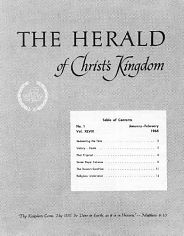
THE HERALD
of Christ's Kingdom
VOL.
XLIX May/June 1966 No. 3
Table of Contents
"If a Man Die Shall He Live Again?"
A Meditation for Whitsuntide
The Program of Redemption
World Population, Food Problems and the Hope of Mankind
The Question Box
Notice of Annual Meeting
RECENTLY DECEASED
"Now is Christ risen
from the dead, and become the
first-fruits of them that slept." - 1 Cor. 15:20
THIS
question appears in one of the oldest books of the Bible, the Book of Job,
chapter 14, verse 14 (Job 14:14), and today it has lost none of its interest to
the intelligent mind. Its proper answer stands related to our own destiny,
colors and influences our theology, and the entire trend of our lives. Its
correct answer gives strength, confidence, courage, and assists towards the
spirit of a sound mind.
Of
course so important a question has had the most profound study ever since the
reign of sin and death began. By this time the subject should be threadbare.
The entire world should be so thoroughly informed respecting this question that
there would be nothing new to say, and nobody curious to hear. But the number
of intelligent, thoughtful people who come to our meetings, and the number who
write to us, requesting our literature, indicate that after all the study the
subject has had, very few are satisfied with their conclusions.
It
is only a few years ago since a canvass was made of public personages whose
opinions are highly regarded, with a view to securing a satisfactory answer to
this question. An answer was sought from ministers of religion, scientists,
authors, doctors, lawyers, statesmen, business executives, social workers --
men and women whose opinions carry weight, and whose records entitle them to be
heard with respectful attention. One of these was the famous inventor, Edison.
While
a number of them expressed a belief in life beyond the grave, this
belief was, admittedly, based only upon hope. From the purely scientific
standpoint, no evidence was advanced to prove that the life we now live has any
continuance after death.
The
more one ponders the question, the more evident it appears that its true answer
must lie in the power and purpose of God. If the Creator has the power, it may
be so; and if it is his purpose, it will be so.
Concerning
his power we do not doubt. That which we may see in his handiwork, in
the physical universe, and in our own wonderfully made bodies, abundantly attests
his power to perform all his will.
But
is it his purpose to restore the dead to life again? It would be good
news indeed to learn that this is God's purpose, would it not? Well, the word gospel
means good news, and the gospel or good news of God -- the glad tidings of
great joy announced by the angels at the birth of Jesus -- is that God has
provided for the race of mankind an opportunity whereby all may have and enjoy
everlasting life.
Through
the prophet Hosea God declares: "I will ransom them from the power of the
grave" (Hos. 13:14).
Jesus
said: "The hour is coming . . when the dead shall hear the voice of the
Son of God: and they that hear [or hearken] shall live" (John 5:25).
Again
he said: "The hour is coming, in the which all that are in the graves
shall hear his voice, and shall come forth; they that have done good, . . . and
they that have done evil" (John 5:28, 29).
NOTES ON IMMORTALITY
Some
years ago, at the request of the president of one of our Middle-West colleges,
the following "Notes on Immortality" were submitted to him by the
writer. They are presented here with the thought that they may be of some
interest to our readers, particularly to the several hundred new subscribers to
our Journal, whom it has recently been our privilege to welcome. (Readers
acquainted with the six volumes of Scriptures Studies will recognize the large debt
these notes owe to those volumes, especially Vols. I and V.)
It
will be found convenient to consider the matter under nine main headings,
which may first be stated, and then discussed, in the following order:
1.
The Terms Mortality and Immortality Examined
2.
The Terms Immortality and Everlasting Life Distinguished
3.
What Is Man?
4.
What Is the Soul?
5.
The Church Distinguished From the Remainder of Mankind
6.
Athanasia
7.
The Hope of the Church
8.
The World's Hope
9.
Summary
(1) THE TERMS "MORTALITY" AND
"IMMORTALITY" EXAMINED
Immortality
signifies a
state or condition in which death is an impossibility. Most people limit the word to mean everlasting
life. Immortality, however, means inherent life, a condition in which death
could not occur. This point will be more fully developed later in these notes.
To
the word mortality, however, more often than not, an entirely false meaning
is assigned. The common idea is that it signifies a condition in which death is
unavoidable. This understanding is erroneous. The word signifies a
state in which death is a possibility,
but by no
means a certainty.
With
these points recognized we are prepared to consider the creation of Adam. Adam
was created mortal; created in a condition in which death was a
possibility or everlasting life was a possibility; according as he pleased or
displeased his wise, just, and loving Creator. Had he remained obedient, he
would have continued living until now -- and forever -- and yet all the time he
would have remained mortal, liable to death if disobedient. Nor would such a
condition be one of uncertainty; for God, with whom he had to do, is unchangeable;
hence Adam would have had full assurance of everlasting life so long as he
continued loyal and obedient to the Creator. More than this could not
reasonably be asked.
Previous
to his disobedience Adam enjoyed life in full measure, but not inherent life
-- not immortality. His was a life sustained by "every tree of the
garden" save the one tree forbidden; and so long as he continued in
obedience and in harmony with his Maker, his life was secure - the sustaining
elements would not be denied. Thus seen, Adam had life; and death was entirely avoidable;
yet he was in such a condition that death was possible -- he was mortal.
(2) THE TERMS
"IMMORTALITY" AND "EVERLASTING LIFE" DISTINGUISHED
Everlasting
life and immortality
are not synonymous terms, although such a view is commonly held. The word immortal
means more than power to live everlastingly; and, according to the
scriptures, while millions may ultimately enjoy everlasting life, only a very
few will be made possessors of immortality -- sharers of the divine nature.
This
quality of immortality originally inhered in Jehovah alone, as it is written: "the
Father hath life in himself (John 5:26); that is to say, his existence
is not a derived one, nor a sustained one. Any being whose existence depends in
any manner upon another, or upon conditions such as food, air, light, etc., is
not immortal.
To
any who suppose that the Bible abounds with such expressions as immortal soul, undying soul,
never-dying soul, etc., no better advice could be offered than that they take
a Bible concordance and look for these words and others of similar import. They
will find none.
According
to the scriptures the holy angels are enjoying life-everlasting, but are
nevertheless only mortal; that is to say, the everlastingness of their angelic existence is not because they are immortal (or death-proof) and so
could not be destroyed by their Creator; but because he desires that they
shall live as long as they will use their lives in accord with his just and
loving arrangements. Not only are they not now immortal, but there is no
intimation that they ever will be. Proof that they are mortal may be seen from
the fact that Satan, who was once a chief of their number, is to be destroyed
(Heb. 2:14). The fact that he can be destroyed proves that angels, as a class
of beings, are mortal.
(3) WHAT IS MAN?
The
answer to this question, if given from the so-called orthodox theological
standpoint would be about as follows: Man is a composite being of three parts,
body, spirit, and soul. The body is born after the usual manner of animal
birth, except that at the time of birth God interposes, and in some inscrutable
manner implants in the body a spirit and a soul which are parts of himself,
and which, being parts of God, are indestructible, and therefore can never
die. These two parts, spirit and soul, orthodoxy is unable to distinguish, and
hence uses the terms interchangeably at convenience.
Both
terms (spirit and soul) are understood to mean the real man, while the
flesh is considered to be merely the outward clothing of the real man, in
which he dwells for the years of his earthly life, as in a house. At death,
orthodoxy says, the real man is let out of this prisonhouse of flesh, and
finds himself in a condition much more congenial.
In
other words, orthodoxy claims that the real man is not an earthly being, but a
spirit being wholly unadapted to the earth, except through its experiences in
the fleshly body. When set free from the body by death, it is argued that a
great blessing has been experienced, although the man, while he lived, made
every effort to continue to live in the fleshly house, using surgery,
medicines, and every hygienic appliance and invention to prolong the life in
the flesh which, it is claimed, is poorly adapted to his uses and enjoyment.
Nor
is this view confined to people of civilized lands; in a general way all
heathen people have practically the same thought respecting man; the viewpoint
finds support in all their philosophies.
To
the question, What is man? the scientific answer, stated in simple language,
would be: Man is an animal of the highest type yet developed and known. He has
a body which differs from the bodies of other animals, in that it is the
highest and noblest development. His brain structure corresponds to that of
the lower animals, but is of a better developed and more refined order, with
added and larger capacities, which constitute man by nature the lord, the king
of the lower creation. Man's breath or spirit of life is like that of other
animals. Man's organism and spark of life are from his progenitors, in the same
manner that the beasts receive their life and bodies from their progenitors.
Science
recognizes every man as a sentient being; but as to the future, beyond the
grave, science has no suggestion to offer, finding nothing whereon to base a
conclusion, or even a reasonable hypothesis.
When
we return to the Bible for an answer to our question we find that the
scriptures, while agreeing with both the orthodox and the scientific viewpoints
in some respects, contradict both along some of their most important lines.
King
Solomon, it is well known, was famous for his wisdom and learning. When to him
it was suggested that, whereas the life of the lower orders of creation ceased
at death, that of human beings continued on the other side of the grave, his
comment was: "Who can prove it?" While he knew that human beings were
endowed with moral attributes not possessed by the lower animals, yet, so far
as the kind of life they possessed, his observation was: "That
which befalleth the sons of men befalleth beasts; even one [the same] thing befalleth
them: as the one dieth, so dieth the other; yea, they have all one [kind of]
breath; so that a man [in this respect] hath no preeminence above a beast . .
. all are of the dust, and all turn to dust again" (Eccles. 3:19-20).
Nor
was this conclusion which Solomon reached different from that of other
scripture writers. The thought which he expressed in another place, namely,
that "there is no work, nor device, nor knowledge, nor wisdom, in the
grave" (Ecc. 9:10), is their united testimony. David, in the Psalms,
declares that in the very day one dies, his thoughts perish (Ps. 146:4). Job,
discussing the same question, says: The dead man's "sons come to honor,
and he knoweth it not; they come to dishonor, but he perceiveth it not of
them" (Job 14:21).
(4) WHAT IS THE SOUL?
What,
then, is the soul? The Bible account of the creation of man reads as follows:
"And the Lord God formed man of the dust of the ground, and breathed [or
blew] into his nostrils the breath [or wind] of life; and man became a living
soul" (Gen. 2:7). From this account it appears that the body was formed
first, but it was not a man, it was not a soul or being until animated. It had
eyes, but saw nothing; a mouth, but no taste; nostrils, but no sense of smell;
a heart, but it pulsated not; blood, but it was cold, lifeless; lungs, but they
moved not. It was not a man, but an inanimate body.
The
second step in the process of man's creation was to give vitality to the properly
formed, and in every way prepared body, and this is described by the words:
"blew into his nostrils the breath of life." As the vitalizing breath
entered, the lungs expanded, the blood corpuscles were oxygenized and passed
to the heart, which organ in turn propelled them to every part of the body, awakening
all the prepared, but hitherto dormant, nerves to sensation and energy. In an
instant the energy reached the brain, and thinking, perceiving, reasoning,
looking, touching, smelling, feeling, and tasting commenced. That which was a
lifeless human organism had become a man, a sentient being; the "living
soul" condition mentioned in Genesis 2:7 had been reached.
This
has been illustrated by the candle. For instance, the candle, unlighted, would
correspond to an inanimate human body; the lighting of the candle would
correspond to the spark of life originally implanted by the Creator; the flame,
or light, corresponds to the sentient being, or intelligence; the oxygenized
atmosphere which unites with the carbon of the candle in supporting the flame
corresponds to the breath of life or spirit of life which unites with the
physical organism in producing soul or intelligent existence.
If
an accident should destroy the candle, the flame, of course, would cease; so, if the human body be
destroyed, the soul, the life, the intelligence, ceases; or, if the supply of
air were cut off from the candle flame, as by an extinguisher or snuffer, or by
submerging the candle in water, the light would be extinguished, even though
the candle remained unimpaired; so the soul, the life or existence of man
would cease if the breath of life were cut off by drowning, or asphyxiation,
while the body might be comparatively sound.
As
the lighted candle might be used under favorable conditions to light other
candles, but the flame, once extinguished could neither relight itself nor
other candles, so the human body, while alive, as a living soul or being, can
start or propagate other souls or beings -- offspring; but so soon as the
spark of life is gone, soul or being has ceased, and all power to think, feel,
or propagate, has ceased.
A
candle might be relighted by any one having the ability; but the human body,
bereft of the spark of life, wasteth away, returneth to the dust from which it
was taken, and the spark of life cannot be rekindled except by a miracle.
(5) THE CHURCH DISTINGUISHED
FROM
THE REMAINDER OF MANKIND
A
fruitful source of confusion in the minds of Christian people, when attempting
to obtain the scriptural views as to the nature of man, is their failure to
distinguish between mankind in general and the church, the little flock, which
during the Gospel Age (the past 2,000 years) God has been selecting from
amongst men, fitting and preparing them for new and superhuman conditions --
spiritual conditions. Failing to "rightly divide the word of truth,"
they apply to all men the statements and promises of the scriptures, especially
of the New Testament, which are addressed only to the church, and which have
no bearing whatever upon the hopes of restitution to human perfection, held out to all
others of mankind. These great and precious promises are proportionately as
untrue of the world as they are true of the church.
There
are literally scores of New Testament statements which are not applicable to
mankind in general, but only to the church, begotten again by the holy spirit
to a new spirit nature. To realize this it is only necessary to notice
carefully the salutations by which the apostles introduce their various
epistles. They are not addressed, as is supposed by many, to mankind in
general, but to the church, "the saints," "the household of
faith"; to those who will attain
unto the "first resurrection" as distinguished from the general
resurrection which is to follow theirs.
(6) ATHANASIA
Scholars
tell us that immortality is the
correct translation of only one Greek word, the word athanasia (deathlessness). It appears
only three times in the New Testament, as follows:
"This
mortal must put on immortality" (1 Cor. 15:53);
"When
this mortal shall have put on immortality" (1 Cor. 15:54);
"Who
only hath immortality" (1 Tim. 6:16).
Evidently
the first two of these scriptures relate to the individual members of the glorified church, and the third to our glorified Lord Jesus (the Father here,
as elsewhere in the scriptures, being excepted from comparison; see 1 Cor.
15:27).
(7) THE HOPE OF THE CHURCH
The hope of the church is that she may
be like her Lord, "see him as he is," be made "partaker of the divine nature" (immortality),
and share his glory as his joint-heir (1 John 3:2; John 17:24; Rom. 8:17; 2
Pet. 1:4).
The present mission of the church is the
perfecting of its members for their future work of service; to develop in herself every grace;
to be God's witness to the world; and to prepare to be kings and priests in the
next age (Eph. 4:12; Matt. 24:14; Rev. 1:6; 20:6).
(8) THE WORLD'S HOPE
The
hope for the world lies in the
blessings of knowledge and opportunity to be brought to all by Christ's Millennial
Kingdom--the restitution of all that was lost in Adam, to all the willing and
obedient, at the hands of their Redeemer and his glorified church - when all
the willfully wicked will be destroyed (Acts 3:19-23; Isa. 35).
(9) SUMMARY
To
sum up then: The proper recognition of the meaning of the terms mortal and
immortal, and their use in the scriptures, destroys the very foundation of the
doctrine of eternal torment. That doctrine is based upon the unscriptural
theory that God created man immortal, that he cannot cease to exist, and that
God cannot destroy him; hence. the argument is that the incorrigible must live
on somewhere, somehow, and the conclusion is that since they are out of
harmony with God their eternity must be one of misery. But God's Word assures
us that he has provided against such a perpetuation of sin and sinners; that
man is mortal, and that the full penalty of willful sin against full light and
knowledge will not be a life in torment, but a second death. "The soul
that sinneth, it shall die."
When
incorrigible sinners have been destroyed (not continued alive in any sense of
the word, anywhere, but destroyed, Ps. 145:20), both immortal and mortal
beings will live forever in joy and happiness and love; the first class
possessing a nature incapable of death, having inherent life-life in themselves
(John 5:26); and the latter having a nature susceptible to death, yet, because
of perfection of being, and knowledge of the evil and sinfulness of sin, giving
no cause for death. They, being approved by God's law, will be everlastingly
supplied with those elements necessary to sustain them in perfection, and will
never die.
- P. L. Read
"If by
any means I may advance to the earlier resurrection
which is from among the
dead." - Phil 3:11 (Rotherham)
WHITSUNTIDE
has been observed for many centuries by many Christians as the memorial of the
day of Pentecost, which occurred fifty days after the resurrection of our
Lord.
On
that day the Holy Spirit descended upon the early disciples in "tongues of
fire," as a visible sign of their setting apart to the service of God, and
of the beginning of a new life within them, wherein they should "walk, not
after the flesh, but after the Spirit."
Not
since that day has the Spirit been visibly bestowed; yet every true child of
God is aware that he has received the same begetting. "You have an
anointing from the Holy One, and ye all know it." - (l John 2:20).
What
is the purpose of this begetting? What is the meaning of the gift, and what is
the intent of Him who bestows it? Is it that the recipient might "speak
with tongues," or that he should thenceforth have an accessor an excess
of emotional religious fervor? Nay; it is of far greater significance and
consequences.
Jesus,
in His patient effort to make clear to the Jewish ruler Nicodemus some of the
things of the spirit world, told him that "that which is born of the flesh
is flesh, and that which is born of the Spirit is spirit." This statement
seems basic and clear. It may be logically expanded to say: "That which is
begotten of the flesh will be born [if not stillborn] a being of flesh; that
which is begotten of the Spirit will be born [if it comes to birth] a
spirit-being," The birth follows the begetting, and partakes of its
nature.
In
the same conversation Jesus explained that those "born of the Spirit"
have powers of action and of invisibility to human perception totally unknown
to man. "The wind blows where it chooses, and you hear its sound, but you
do not know where it comes from or where it is going. So it is with every one
who has been born of the Spirit."
"God is a spirit"; "heaven is His throne and
the earth is His footstool. The nature, laws, and conditions of the spirit
world are vastly different from those of the earth. In the one particular of
temperature the physicists and astronomers tell us that the universe has a
range of tens of thousands of degrees Fahrenheit; our human life can endure a
variation of "barely' one hundred fifty degrees. We cannot conceive of
life existing at four hundred degrees below zero, or at ten thousand degrees
above; yet the spirit world has joyful existence under these and other
inconceivable conditions,
If
we were planning to move our residence to, say, Africa or Australia, we should
try to learn all we could about life there-in fact to go there in our minds and so prepare ourselves for our new
environment. We would commence our new life there in anticipation; and that is exactly what the pentecostal begetting
of the Spirit is-the mental seed-planting of a new spirit-life; a "lively
hope," or new hope of life. To this embryonic spirit-life such various
Scriptures refer as: "a new creature"; "the renewing [literally,
up-newing] of your mind"; "walking in newness of life";
"set your affections on things above"; etc.
"There
is a physical body, and there is a spirit body." The change from one to
the other, tremendous as it is, is a mere detail to the power with which the
begotten one has to do. The actual operation is dismissed in the Scriptures in
a few sentences. "He giveth it a body as it pleaseth Him." "He
will change the body of our humiliation into the likeness of His own glorious
body." Moreover, this change will be accomplished instantaneously,
"in a moment, in a twinkling of an eye."
But
the mental, moral, and emotional transformation from the human to the spirit
nature is a far more complicated and lengthy process, and requires the
candidate's full, continuous, and careful cooperation. Practically the whole of
the New testament is devoted to describing, facilitating, and inspiring this
process. It requires rigid self-abnegation, self-discipline, and
self-sacrifice, that is, of the human self. "The flesh-desires oppose the
spirit, and the spirit-desires oppose the flesh, for these are contrary to each
other; that not whatsoever things ye may be wishing,
these ye should be doing." Every
sincere candidate for spirit-birth knows this to be true.
What
does it mean to us? Are we carefully cherishing and cultivating that flame of
life that we have received, or are we permitting "the cares of this world
and the deceitfulness of riches" to "quench the Spirit"? Are we
"putting to death the deeds of the body" that we may live; or are we
"living after the flesh," which is mortal-"death-doomed"?
Are we "giving ourselves wholly to these things, that our profit may be
manifest to all," as the Apostle advised his "beloved son"
Timothy? Are we cultivating and bringing forth in our lives the ripening
"fruit of the Spirit, which is love, joy, peace, long-suffering," etc.;
or are the "works of the flesh" still all too manifest in our
relationships-family, church, business? Is our love like God's sunshine and
rain, universal and impartial-"perfect," as Jesus admonished us it
should be; or is it sectional (sectional) -- only for those who agree with us?
These
are practical questions, of supreme importance. They should be addressed, in
all seriousness, to ourselves. "Examine yourselves, whether ye be, in the
faith"-not a creed, but the confidence and reliance in and upon the Lord,
with reason on your part for Him to have faith in you. "Prove ye yourselves. Or do ye not know yourselves that
Jesus Christ is in you, unless you are disapproved?"
For
"if we examine ourselves, we should not be judged. But when we are judged
by the Lord, we are corrected, that we may not be condemned with the
world."
"Quench
not the Spirit."
-
H. E. Hollister
------------------------------------------
(Note:
Scriptural quotations in the foregoing article follow the text of the three
oldest Greek MSS., and the literal renderings of the Emphatic Diaglott,
Rotherham, and Strong's Greek Dictionary.)
"After this I will
return, and will build again the tabernacle of David, which is fallen down; and
I will build again the ruins thereof, and I will set it up: that the residue of
men might seek after the Lord, and all the Gentiles, upon whom my name is
called, saith the Lord, who doeth all these things." -
Acts 15:16-17.
IT
IS remarkable to observe that the first council of the Christian church ever
convened should have outlined the whole scheme of redemption from Pentecost to
the consummation of the ages. And whatever we may hold as to the binding authority of later councils, we must accept
the deliverances of this at Jerusalem as final, since from the testimony of
inspired scripture we know that the Spirit so truly presided and guided in the
assembly that in publishing its decisions it was written, "It seemed good to the
Holy Spirit and to us" (Acts 15:28). Jesus Christ is the architect of the
ages. Not only "all things were made by him" -- all worlds and
systems of the material universe -- but all the dispensations were planned and
predestined by him: "By whom also he made the ages" (Heb. 1:2). His
church was not set upon her course until a complete program of her mission had
been placed in her hands, the working plan by which all her operations were to
be directed. "Known
unto God are all his works from the beginning of the world" (Acts 15:18) is the
significant declaration which accompanies the publication of this program. And,
instead of being day laborers working in ignorance, God would have us, as
laborers together with him, to understand the entire divine scheme by which our
efforts are to be directed, that we may be saved from presumption and despair.
"Simeon
hath declared how God at the first did visit the Gentiles, to take out of them
a people for his name" (Acts 15:14). Here is the first act of the great program. Because of
the citation from the Old Testament which immediately follows - "And to
this agree the words of the prophets, as it is written: After this I will
return, and will build again the tabernacle of David, which is fallen
down" -- it has been inferred that this Gentile outgathering and the
tabernacle upbuilding mean the same thing; in other words, that the rearing of
the tabernacle of David is a figurative expression for the building of the
church of Christ. By this superficial
though not altogether unnatural explanation of the passage, the whole program has
been reduced to a single act, and the inference drawn that the preaching of the
Gospel in this dispensation is to
issue in the conversion of "all the Gentiles."
A CLEAR PREDICTION OF
ISRAEL'S RESTORATION
But
it is only necessary to observe three things in order to correct this
misapprehension: First, that the citation here made from the closing chapter of
the Book of Amos is clearly a prediction of the literal restoration of literal
Israel, and their reinhabitance of their land; for the words quoted are part of
a passage which ends with this decisive language: "And I will plant them upon their land,
and they shall no more be pulled up out of their land which I have given them,
saith the Lord thy God" (Amos 9:15). Observe again that in making this citation
the Holy Spirit inserts the words, not found in the original text, "After this I will
return," and
will build again, thus making the restoration of the Davidic tabernacle subsequent
to the gathering out of the church from the Gentiles, and connecting it
directly with the personal return of the Lord. And, lastly, we are to notice
that in announcing this election from among the Gentiles, it is not added,
"in this are fulfilled the words of the prophets," but "with this harmonize [Greek, symphonize] the words of the
prophets."
It
is but saying that the parts of the great oratorio of redemption perfectly accord,
though centuries lie between its different measures; and then, to show us how they accord, the Holy Spirit
sounds all the octaves thereof with a single sweep, and lets us listen to their grand unison.
This, then, is the program of redemption by which we are to work in
evangelizing the world:
"First,
God did
visit the Gentiles to take out of them a people for his name, And to this agree
the words of the prophets, as it is written:
"After
this I will return
and will build again the tabernacle of David which is fallen down; and I will
build again the ruins thereof, and I will set it up:
"In
order that the
residue of men might seek after the Lord, and all the Gentiles, upon whom my
name is called, saith the Lord who doeth all these things."
The
three great stages of redemption are thus outlined in their order.
ACT I
The
gathering of the church is the first act,
and this, having begun at Pentecost, is still going on. All the descriptions of
it contained in scripture mark it as elective. From the word of Christ to his
first disciples, "I have chosen you out of the world," to the triumph-song of the saved
heard by the seer in Patmos, "Thou hast redeemed us to God by thy blood out of every kindred and tongue and
people and nation," the Bride of Christ is always the Ecclesia, the called out. Nowhere is
universal redemption predicted as the result of preaching the Gospel in this
dispensation. If in the minds of those who are accustomed to speak of the world's conversion there
is a violent revulsion from this saying, we remind them that we are simply
affirming the truth of the doctrine of election, and its application to this
entire age. After eighteen centuries of Christian conquest the vast proportion
of the world still "lieth in the Wicked One," and Christ's true
church is but a "little flock" in comparison. Only with pathetic sympathy
for our fallen race in its ruin and helplessness can we contemplate this fact.
And yet we must be reminded that all attempts to violate this decree by making
the church a multitudinous collection, instead of a gracious election, have
only issued in apostasy. Sacramentarianism would take the world into the
church by instituting a baptized paganism instead of taking the church out of
the world by preaching spiritual regeneration; and behold the result in a
half-heathenized Christendom. Latitudinarianism would make the church
coextensive with the world by preaching the gospel of universal salvation-all
men by nature the sons of God -- and thus, by crowding the Lord's house with
"the children of the Wicked One," turn it into "the synagogue of Satan." Though it be in
mystery, and sorrow and tears, we had best work on, therefore, by the divine
schedule, preaching the Gospel among all nations for a witness that we may
gather out for Christ a chosen and sanctified people, calmly answering those
who say that God's ways are partial, with his own words: "When that which
is perfect is come, then that which is in part shall be done away."
And
yet, lest we should take too narrow a view of this theme, other considerations
should not be overlooked. Christ is called "The Light of the World."
The beams of sunlight both elect and irradiate; taking out here and there from
muddy pool or acrid dead sea a pure, crystalline drop and lifting it
heavenward; but also lighting and warming all the atmosphere by their radiance.
So Christ, preached among the Gentiles, elects from them a holy flock, a regenerate
church; but besides this, he changes the moral climate of the world so that
such noxious growths as cannibalism, slavery, polygamy, and infanticide
disappear. These two results inevitably attend the proclamation of the Gospel:
regeneration saving some out of the world, and civilization putting something
of Christianity into the world; but by neither process as now going on is the
Millennium destined to be ushered in.
Moreover,
let us reflect that an election is never an end in itself; it is rather a means and
preparation for some vastly larger accomplishment. The body of the elect is
really Christ's army, gathered by a divine conscription from every kindred and people, that they may attend
him as he goes forth to his final conquest of the world. "And they that
are with him are called and elect and faithful" (Rev. 17:14). Of this,
however, we shall speak later.
ACT II
The
second act of the divine program now comes into view. "After this I will
return and build again the tabernacle of David which is fallen down." By Christ's personal coming in
glory, the conversion and restoration of Israel are to be accomplished. The
reader has only to compare this order with the redemption schedule drawn out
in the eleventh chapter of Romans to see how perfectly they agree. St. Paul,
indeed, begins with the Jewish election, as St. James does with the Gentile
election. And we must remember that the choosing out that is going on in this
dispensation touches both: "not out of the Jews only, but also out of the
Gentiles" (Rom. 9:24). But each apostle takes up the same succession of
events; first the Gentile outgathering, and then the Hebrew regathering. The
hardening of the Jews which we now behold is declared by Paul to continue "until the fullness of the Gentiles be come in. And so all Israel
shall be saved. As it is written: There shall come out of Zion the Deliverer, and shall turn away
ungodliness from Jacob" (Rom. 11:25, 26). By the "fullness of the
Gentiles" we understand the predestined number, the elect company gathered
through the entire period of this dispensation to form the Bride of Christ.
When this number shall have been accomplished, then the conversion of Israel
will occur and their national restoration to God's favor. The two parts of the
aged Simeon's prophecy are strictly consecutive: "A light to lighten the Gentiles and
the glory of thy people Israel"
(Luke 2:31, 32). He will be
the supreme glory of his people Israel, when he shall at last be owned as theirMessiah
and reign in the midst of them as King.
ACT III
These
two stages of redemption -- the Gentile election and the Hebrew
restoration-are to be accomplished "in order" to a third, namely,
"that the residue of men might seek after the Lord, and all the Gentiles
upon whom my name is called."
Without
enlarging upon the thought, what a profound hint of this does Paul give in Romans 11:12, 15 where, speaking
concerning his rejected people, he says: "Now if the fall of them be the
riches of the world, and the diminishing of them the riches of the Gentiles, how much more their fullness .
. . For if the
casting away of them be the reconciling of the world, what shall the receiving of
them be, but life from the dead?"
"It
is clear," says Lange, "that the apostle awaits a boundless effect of
blessing on the world from the future conversion of Israel." Then shall
the word of Joel concerning the effusion 'of the spirit have a complete
fulfillment, as it had a partial and prefigurative accomplishment on the day of
Pentecost. For if we
turn to the
prophet, we find it said: "And ye shall know that I am in the midst of Israel, and that I am the Lord your
God, and none else. And it shall come to pass afterward, that I will pour out my spirit upon
all flesh" (Joel 2:27, 28). And with this agree the words of Isaiah where he
predicts the desolation of Zion as continuing "till the spirit be poured upon us from
on high" (Isa.
32:15). When the Lord shall shed forth the holy spirit abundantly upon his
covenant people, through them will come unspeakable blessings to the Gentiles.
The modern postmillennial interpretation completely deranges the program of
prophecy at this point by making redemption terminate with its first scene.
"The end of the age," brought in by the second coming of Christ,
misleadingly translated "the end of the world" in our common version,
is supposed by many to close the probation of the race, winding up the present
earthly scene, and bringing in the final judgment and the eternal state,
instead of opening into the triumphs of the age to come. Is it possible that
the first Christians could have had this idea? If so, how could they have so
ardently desired, and earnestly looked for, the speedy return of the Lord,
since his coming would end the work of Gentile ingathering, while as yet only a
handful had been saved? On the contrary, take the words of Peter to the Jewish
rejecters of Christ, and observe how clearly they teach the very opposite:
"Repent ye therefore, and turn again, that your sins may be blotted out,
that so there may come seasons of refreshing from the presence of the Lord; and
that he may send the Christ who hath been appointed for you, even Jesus; whom
the heaven must receive until the times of the restoration of all things"
(Acts 3:19-21, R.V.). Here we have, as constantly throughout the scripture,
the repentance of Israel directly connected with the return of Christ from
heaven, and their conversion and the Lord's appearing resulting, not in their
cutting off from the presence of the Lord, but in times of "refreshing from the
presence of the Lord"; not in the winding up of all things, but in the "restoration of all
things." Three
acts of the divine program appear again in this declaration of Peter-the
coming of Christ, the conversion of Israel, and worldwide redemption --
corresponding exactly with those revealed in the texts from James and Paul
already considered.
CONCLUSION
It
is thus seen that the redemption of the world comes at last, following (1) the
glorification of the church at our Lord's return, and (2) the conversion and
restoration of Israel. If it be said that this is a Jewish conception, borrowed
from the Old Testament, we will answer: "Yes, and reiterated and more
explicitly unfolded in the New Testament." For nowhere is the order of
events so distinctly revealed as in the Acts and Epistles.
"Election,
partial and opposed to worldwide redemption," has been the verdict of
thousands who have replied against God, knowing little of the range of his
eternal plan. "Election, gracious, and preparatory to worldwide redemption,"
is the discovery which a deep pondering of the holy scripture reveals. The
elect church transfigured with her risen Savior, and the chosen nation, Israel,
restored and made glorious on earth- - these are his appointed agents, trained
by long discipline and trial for bringing all peoples and tribes into obedience
to God. As to the Gentile election, so to the Hebrew restoration, objectors may
be reconciled when it appears that this, too, is instrumental and preparatory
to worldwide salvation. "Arise, shine, for thy light is come, and the
glory of the Lord is risen upon thee," is the summons which the long
captive daughter of Zion shall hear, and then the blessed result: "And the Gentiles shall
come to thy light, and kings to the brightness of thy rising" (Isa. 60:3).
-
Condensed from Ecce
Venit (Behold He Cometh)
- A. J. Gordon, Boston, Mass. 1889.
"Marvel not at this: for
the hour is coming, in the which all that are in the graves shall hear his
voice, and shall come forth." - John 5:28, 29.
(In
a recent issue of
Harper's
magazine, "Population Explosion" is seen to
be no longer an academic question, the solution of which may be deferred to the
dim and distant future, but to be a very practical matter of great urgency.
According to Editor John Fischer:
"In the future the chief
danger of war seems likely to come, not from an arms race or even from the
classic causes, but from an element new in history: the pressure of population.
Indeed, if the earth's population continues to rise at the present rate for
another forty years, major wars appear to be inevitable."
There is no longer any doubt
in the minds of intelligent men and women, whatever their beliefs on other
matters. Population control rivals the problem of controlling deadly nuclear
weapons.
In the November 23, 1959 issue
of the weekly magazine,
U.S. News & World Report, an
interview is related with Sir Charles Darwin, distinguished British scientist
and grandson of the nineteenth century naturalist who originated the Darwinian
theory of evolution. Under the caption, "Standing Room Only," this
leading expert expresses his views on the effect of population growth. He
makes it clear that, in his judgment, in a much shorter period than
two hundred years,
there will be on this earth standing room
only.
Moreover, in response to an inquiry as to whether we
might find any place in space to put our surplus population, he replied in the
negative. According to his understanding, there are three essentials to human
life: (1) a reasonable temperature, (2) plenty of water, and, (3) oxygen, and
that not all three are present on other planets. The world food problem, in his
view, is even now, with more than half the world starving, very serious, and in
considerably less than
fifty years will have become increasingly
so, and be urgently demanding solution.
In view of the timeliness of
these questions, we reprint below an article published in these pages in
October 1950. It not only discusses population and food problems, but indicates
their scriptural solution, and offers some observations on the "hope of
mankind."Ed.
Com. )
ONE
OF the propositions which "to us the Scriptures teach" is stated on
the second page* of this journal in the following words:
"The
hope for the world lies in the blessings of knowledge and opportunity to be
brought to all by Christ's Millennial Kingdom -- the restitution of all that
was lost in Adam, to all the
willing and obedient, at the hands of their Redeemer and His glorified Church
-- when all the willfully wicked will be destroyed. - Acts 3:19-23; Isa.
35."
-------------------------
* In
recent years transferred to back page.
Our
older readers are aware that nearly fifty years ago, in the celebrated
Eaton-Russell debates, these Millennial hopes were criticized by Dr. Eaton on
the grounds 'that there was not sufficient land surface on the earth to
accommodate all the people who had lived from Adam's day to ours, so that a literal resurrection,
as human beings on this earth, was an impossibility. His words, in part, were
as follows:
"This
Millennial doctrine encounters a very serious difficulty. If the
world's population had doubled each century for the past sixty--which seems a
very reasonable estimate -- the present population of the earth would be two
and one-third quintillions of people. That would cover over the fifty millions
of square miles of land surface on (this globe with people as thickly as they
could stand, four thousand deep. If each were five feet high, they would reach
up into the sky nearly four miles. No doubt enough people have been born to
make that number."
It
will also be recalled that Pastor C. T. Russell, in debate with Dr. Eaton,
thoroughly examined this criticism and showed:
(1)
That Dr. Eaton's estimate of two and onethird quintillions of people was a
gross exaggeration -- seventy million times too large -- that a figure
somewhere between ten and thirty billions would be much closer and
(2)
That the ability of the earth to furnish all those with habitation and food was
ample; and that this was especially true when Making into consideration the
Lord's promise that in the coming Millennial day the earth would yield her
increase, and her desert and wilderness places become like Eden, the garden of
the Lord. - Ezek. 34:27; Isa. 51:3; 35:1.
However,
it will also be recalled that after proving the position of Anti-millennialists
to be untenable, Pastor Russell extended the discussion to show not only that
the Millennium, must come, but that it must come soon; that if it were to be delayed
(not fifty thousand years, as Dr. Eaton expected, but only one thousand, it
would be literally impossible;** and that even if it were delayed only three hundred years, "there would be
room for an argument on the possibility of God's promise of restitution of all
things spoken." - Acts 3:19-21.
-------------------------------
** In
this he was in agreement with the celebrated naturalist Charles Darwin, who, in
his "Origin of Species," wrote: "In less than one thousand
years, there would literally not be standing room for his [man's]
progeny."
Consequently,
since God's promise is sure, the result of the examination of the question was
to strengthen faith in the belief that its fulfillment, due to commence at the
Second Advent of Christ, could not be long delayed. The time was, indeed, at
hand.
Pastor
Russell's defense of the Bible doctrine of the World's Millennial Hope took
place nearly fifty years ago -- October 29, 1903 to be exact. What is the
outlook today? Today it seems that his 300 year computation is confirmed by
competent writers on the subject, as witness the following:
Guy
Irving Burch, in the Population Bulletin *** states that "in 1940 the
population of the earth was a little over two billion."
-----------------------------------
***
Published by the Population Reference Bureau, a non-profit scientific
educational organization located in Washington, D. C., founded in 1929 for the
purposes of gathering, correlating, and distributing population data.
Kingsley
Davis, of the Office of Population Research, Princeton University, is quoted
by Burch as saying: "Should the present global population continue to
increase at the same rate that prevailed between 1900 and 1940, the earth would
hold over twenty-one billion by the year 2240"; -- that is to say, by
approximately 300 years from now. (Pastor Russell's estimate was sixteen
billion in 300 years from 1903.)
Warren
S. Thompson, in his book "Danger Spots in World Population" tells us:
"China might send forth six million emigrants each year and still increase
in population at home."
The
Red Cross Commission to China in 1928-29 said: "It is estimated that if
all the ships in the world now engaged in passenger traffic on, the seven seas
were withdrawn from their usual routes and were devoted solely to transporting
Chinese from their native land to other countries, they could not keep up with
the growth of population."
Guy
Irving Burch, commenting on the last two items quoted, says: "The above
statements may be applied also to India, and if the high death rate of Russia
were lowered to the level of that of the United States, the statement might be
applied in a decade or so to that country." And again: "We have
mentioned before . . . that if India's death rate were lowered to the level of that
of the United States, with her present birth rate India could populate at least
five earths as large as ours, in a single century. The same statement applies
to China." Elsewhere he writes: "In India, according to British
official records, the population increased fifty million between the 1930 and
1940 census periods, notwithstanding that one out of four die on or before
their second birthday."
WORLD POPULATION AND THE "FOUR FREEDOMS"
"Today
the whole world is divided between human slavery and human freedom-between
pagan brutality and the Christian ideal. We choose human freedom -- which is
the Christian ideal."
Thus
spake the late President Roosevelt in his historic address on the evening of
May 28, 1941. Then, after observing that it was possible for the seeds of the
present menace to human. liberty to be planted and allowed to grow only in a
world such as the post-war world of the 1920's, which "we will not (again)
accept," he went on to say, "We will accept only a world consecrated
to freedom of speech and expression -- freedom of every person to worship God
in his own way-freedom from want and freedom from terrorism."
The
next day Foreign Secretary Anthony Eden stated Britain's war aims. He called
for permanent guarantee of the "four freedoms" mentioned by President
Roosevelt. He spoke of "a new moral order" in the world, in which
there will be no starving peoples, in which nations will trade
at will and to mutual advantage, in which there will be work for all and
assurances that chaos must not come again 'to this world. He envisioned the
establishment of social security in all lands.
Unfortunately
details as to how this "new moral order" is to be secured and the
"four freedoms" established do not appear in either speech. Nor are
'we ourselves able to furnish these details, much as we can and do sympathize
with their objectives. We know only that God has, indeed, promised a world such
as these statesmen hoped to see -- one even better than they hoped, and that
His promise is certain of fulfillment. Meantime we are determined not to think
or speak
or do anything
that might tend to discourage in the slightest degree, those who, in high
places, are filled with such ideals, and who are laboring to accomplish them in
the earth. On the contrary let us pray
for such, and, to the extent of our ability, cooperate with them to those
ends. - 1 Tim. 2:1-3.
We
must not, however, indulge in wishful thinking; and that is what millions of
people do engage in, when they suppose that good will and technology alone, or
even with the aid of a strong international police force, can free all the
people of the world from want. Certainly they are not free from want now, as
was pointed out by Clinton P. Anderson, who, as Secretary of Agriculture, in
his radio address June 15, 1946 said:
"The
present food crisis isn't an unusual situation--it's only unusually severe. There's never enough food in
the world to give every one what he needs to eat, at any given moment.
Two-thirds of the world's people are chronically undernourished."
During
the Second World War the U. S. Office of War Information issued a pamphlet
entitled "The United Nations Fight for the Four Freedoms," which
says:
"
. . . beyond any doubt, men now possess the technical ability to produce in
great abundance the necessities of daily life-enough for every one. This is a
revolutionary and quite unprecedented condition on earth, which stimulates the
imagination, and quickens the blood. . . . In the short space of a few decades we have changed scarcity to abundance and are now engaged in
the experiment of trying to live with our new and as yet unmanageable riches.
The problem becomes one not of production, but of distribution and consumption."
Characterizing
this statement as "a typical example of wishful thinking," Burch and
Pendell, in their book "Human Breeding and Survival" further comment:
"That
men now possess the technical ability to produce in great abundance the
necessities of daily life is true. But that men can produce enough for 'every
one' is certainly not 'beyond any doubt.' The huge death rates of two-thirds of
the earth's people indicate that man is not producing enough for healthful
living; and this fact suggests how much more is needed to provide for even the
present population of the world. Yet population is very much on the move, and
'every one' fifty years from now will mean something quite different from what
it means today. In 1900, 'every one' meant some 1,600,000,000 people. Today,
notwithstanding two world wars and very high death rates in Asia and parts of
Europe, it means about 2,500,000,000; and by the end of this century, at recent
rates of increase, it may mean as many as 3,300,000,000 people."
It
has been estimated that, with our present ability to produce, we could
probably care adequately for a world population of three quarters of a billion
people. H. G. Wells once said that one-half a billion was probably closer to a
"right-sized" world population, under present-day conditions. Others
who have carefully studied the subject are in agreement with Wells. Note the
following:
"If
each family in the world had a fair-sized house with its own yard; had meat to
eat at least once a day and an adequate supply of fruits and milk; had proper
medical care and lived in a healthful and stimulating climate; it is doubtful
whether all these good things of life could be spread over more than
500,000,000 people at the present time." (Population Bulletin, December,
1948.)
In
further support of this view we quote Colin Clark, the authority on international
levels of living. In his book, "The Conditions of Economic Progress,"
he shows that:
"The
oft-repeated phrases about poverty in the midst of plenty, and the problems of
production having already been solved if only we understood the problems of distribution,
turn out to be the most untruthful of all modern cliches."
BRITAIN'S POPULATION PROBLEM
Some
idea of the vastness of this "population" problem -- and the urgency
with which its solution must be found, may be seen from a study of the situation
in Great Britain today. In the book by Colin Clark above referred to, figures
are given showing the relative levels of living of thirty-four nations. The
first seven are listed in the following order: United States, Canada, New
Zealand, Great Britain, Switzerland, Argentina, Australia. Included in these
it will be noted are five New World countries, where the ratio of population to
land and natural resources is relatively low. Switzerland, of course,
maintains its high level of living largely because of the rich tourist trade it
enjoys.
Britain
owes her place in this fortunate list because of her empire, on which "the
sun never sets." But this list was prepared in 1940. It may be questioned
if it would remain unchanged today. According to the June, 1949 Report of the
Royal Commission on Population, Great Britain has more than two and one-half
times as many people per square mile as Europe, and more than eleven times as
many as the United States.
During
the nineteenth century Britain was supreme in industrialization, trade, naval
force, and investments abroad. Today this is no longer true, and the trend in
her vital coal production, her exports and foreign investments has been
decidedly downward. This trend was inevitable, but it has been hastened, since
1913, by two world wars. As a result she is caught with a surplus population;
that is to say, a population larger than she can support from the combined
yields of her land, industry, and foreign trade.
This
large surplus population, estimated to be at least fifteen million, is almost
certain to continue Britain's chronic crisis. Britain, of course, has other
problems. One which is perhaps better known is her acute "dollar"
shortage-coming as the aftermath to World War II. However, this surplus population
is not her acute
problem; it
threatens to be her chronic problem.
In
the St. Louis Globe Democrat for December 26, 1949 there appeared an article
containing a solution to this problem. It was captioned:
"FIFTEEN MILLION MUST EMIGRATE
IF ENGLAND IS TO SURVIVE"
This
solution was the suggestion of Dr. Burch, from whom we have already several
times quoted. According to Burch, the emigration of some fifteen million, or
approximately one-third of Britain's present population, to more thinly
inhabited British areas, such as Australia, Canada, and parts of Africa, would
not only prove advantageous to the emigrants themselves, but would help to make
the United Kingdom self-supporting. The suggested mass migration, of some
half-million a year for thirty years, would not be an easy job, Dr. Burch
admits, and it would doubtless be at :the expense of the United States. It is
nevertheless his contention that it would be cheaper to move a 140 pound
person once, than to move some 1,400
pounds of food, plus other raw materials, every year, to support that person if he remains in
Britain.
The
case of Britain, which has statesmen "at their wit's end" to solve,
is not mentioned here because it is the world's foremost population and living
problem. Quite to the contrary. It is intended to show that if in the case of
such a country these problems have become so grave as to defy solution, what
must they be in the rest of the world? How much we need to continue, and never
to cease, to pray: "Thy Kingdom come, Thy will be done, on earth."
"MAN'S EXTREMITY GOD'S OPPORTUNITY"
Just
how ,the Almighty will bring Order out of this chaos we know not. That he will
do so we are sure. This earth is his footstool (Isa. 66:1; Matt. 5:35; Acts 7:49), and he has
declared it to be his intention to make the place of his feet glorious. (Isa.
60:13.) With us this would be impossible --not so with him.
The
food question will be solved-miraculously if need be, but more than likely it
will be, done naturally. If a miracle is necessary our faith will not falter.
Did not our Lord Jesus show us, in the feeding of the five thousand with five
loaves and two fishes, that to the power of the Creator, in his hands or in his
Father's, it could be no greater difficulty to produce bread for a few thousand people, in an
extraordinary (supernatural) way, than it is to produce, by ordinary (natural)
methods, food for the supply of the teeming millions who daily feast at God's
bountiful table. - Matt. 14:15-21.
But
we doubt if such miracles will prove necessary. Under the new government shortly to be established
when out of Zion shall go forth the law and the word of the Lord
from Jerusalem, the nations shall beat their swords into ploughshares and
their spears into pruning-hooks. That is to say, the money now spent on the
armies and navies of the world will be channeled into agricultural pursuits. That miracle
will be enough, we think. - Isa. 2:2-4.
The
population question will be
solved-and that in a manner clearly stated by our Lord Jesus. Our readers will
recall his answer to the Sadducees. (Luke 20:34-36.) At the close of the
Millennium, when perfection shall have been reached, mankind will have become
sexless -- in that respect they will then be like unto the angels. The marriage
relationship, instituted (with the human family only) for the special purpose
of producing a race, will have accomplished its purpose. The earth will be
filled -- not over crowded with holy, happy, human beings, all doing right,
not from compulsion, but from choice. Then he, our Lord Jesus Christ, having
put down all rule, and authority, and power, having reigned until all enemies
are under his feet, with death itself destroyed, shall deliver up the Kingdom
to God, even the Father, that God may be all in all. - l Cor. 15:24-28.
"No
place shall be in that new earth
For
all that blights this universe;
No
evil taint the second birth --
There
shall be no more curse.
Ye
broken hearted, cease your moan;
The
day of promise dawns for you;
For
He who sits upon the throne
Says,
'I make all things new.'
"We
mourn the dead, but they shall wake
The
lost, but they shall be restored!
O!
well our human hearts might break
Without
that sacred word!
Dim
eyes, look up! sad hearts, rejoice!
Seeing
God's bow of promise through,
At
sound of that prophetic voice:
'I
will make all things new."'
-
P. L. Read.
Question:
What
is the meaning of St. Peter's statement that "No :prophecy of the
Scripture is of any private interpretation." - 2 Peter 1:20?
Answer:
Strange
as it may seem, this text is usually misunderstood to mean that any one
presenting an exposition of Scripture different from that generally held by
the Bible study group with which he associates must evidently be in error. His
exposition, being at variance with that of the Class (or its leaders), is quite
obviously a "private" interpretation. As such it must be rejected.
Such
reasoning, of course, is quite wrong, but also, alas, quite common.
The
right of private judgment -- private interpretation -- is claimed by all good
Protestants. Unfortunately though, it is claimed by them as though it were
their exclusive possession. Few of
them ever, think of exercising the right for themselves, but too many deny it
to their brethren. An exposition of Scripture comes their way which clashes with
their preconceived ideas -- clashes with the ideas of their group. It is,
therefore, unwelcome, and so, instead of investigating, and, if the
circumstances warrant, embracing the new teaching, they reject it, rebuke the
expositor, and refer to St. Peter's words in support of their position.
Let
us turn to the text itself and seek to understand it in the light of its
context.
In
2 Peter 1:16, 17, and 18, St. Peter had been speaking of our Lord's
Transfiguration, and had insisted that he had been an eye-witness on that
occasion, and had himself heard the voice from heaven which said: "This is
my beloved Son, in whom I am well pleased." Nevertheless, sure as he was
of these things which he had both seen and heard, there was something even
"more sure." It was, he tells us, "The Word of Prophecy."
In
a previous Question Box ("Herald," November 1949, page 159) we have
been cautioned against a common misconception. Too often we conceive of
"prophecy" as though it meant only "prediction." The
"Word of Prophecy" is a term that includes all the moral teaching of
the Bible, as well as its predictive utterances. Indeed the expression points
rather to the moral than to the predictive element. And this body of moral
teaching, broken only occasionally by predictions --the whole Bible indeed,
insofar as it was known to him, the Apostle Peter affirms to be a safer guide
to, faith than even that message from heaven which they who were eye-witnesses
of the Transfiguration had made known. No doubt, as they stood on the Mount of
Transfiguration and witnessed the honor and glory which Jesus received from the
Father, the Apostles understood that the Son of Man was indeed the Son of God,
but the very voice which pronounced him God's beloved Son bade them "hear him." (Matt. 17:5.) The
Transfiguration was a wonderful thing for them to have witnessed; indeed it was
a miracle. And all, of our Lord's miracles are full of tender and wise instruction.
Yet should we have learned their true meaning save for the words he spake?
Miracles
are "wonders" that arrest our attention; but when our attention has
been arrested, we still need to have it engaged and instructed. What the
Apostles needed, what we all need, indeed, is not to see an occasional miracle,
dazzling in its splendor, but a little light on the dark and troubled path we
have to tread, a lamp that will burn steadfastly and helpfully over the work we
have to do. Stars are more sublime, meteors more superb and dazzling, but the
lamp shining in a dark place is infinitely closer to our practical needs. Plain
rules of life that commend themselves to our conscience, in obedience to which
we rise above "the world, the flesh, and the devil," and become
better, happier mien-these, with some bright hope in the future to attract and
draw us on, to assure us that if we do God's will, we shall enter into God's
rest -- these rules and this hope are worth far more to us in the conduct of
our daily life than all the signs and wonders ever wrought. These are as the lamp by which we can
walk and work; miracles are but as the distant stars or occasional flashing
comets. And this lamp of rules for daily conduct is given us in the Word of
Prophecy.
And
here we come to the point of the question with which this discussion began.
This wonderful "lamp," which shines so helpfully on the activities of
our everyday lives, does so because it
has been lit and is fed by God himself. Not one single statement in it is
the private thought -- the best opinion or counsel -- of the Prophet uttering
it. Those Ancient Worthies were no doubt capable of reaching sound conclusions
as to the various problems of human life and conduct. Trained in the principles
of truth and righteousness they might well be supposed to be able and willing
to give wise and wholesome counsel. But the Word of Prophecy did not come that
way, says St. Peter. It "came not in old time by the will of man; but holy
men of God spake as they were moved by the holy spirit."
No
prophecy of Scripture is a private interpretation of the Prophet. That is to
say, the Word of Prophecy is not a mere logical deduction from the facts of
life and nature, by the Prophet uttering it; nor is it a mere guess at things
to come, based on a knowledge of what has taken place in the past. A Prophet
was not simply a man who, after studying a multitude of various facts,
discovered the law which was common to them all, or inferred a maxim on which
men would do well to act. Nor was he simply a man who, having studied the
ethical forces Which were at work in his age, arrived at a probable conjecture
as to the results that would flow from them and give its form and pressure to
the succeeding age. There was something higher than human wisdom in his
utterances, something safer than the forecasts of human reason; for prophecy
did not come from the will of man, but holy men, borne along by the holy spirit
as the ship is borne before the wind, spake the words that were given them by
God. Their prophecies -- their forthtellings -- were not their private
interpretations of the moral facts and enigmas of human life; they were the
authoritative interpretations of God, himself. There is a Divine Wisdom,
therefore an infallible wisdom; -- there is a Divine Power, an Almighty Power
in the inspired Word, even when it is most human and imperfect in outward
form. And it is this Divine Wisdom and Power which make that Word a sure and
certain guide to our feet. The lamp itself may be only an earthen vessel,
unskilfully molded, by the hand of man; but else treasured splendor of the
light, and the oil that feeds the light, are the gift of God.
The
foregoing, we think, is the truth which St Peter is emphasizing. However, two
other related truths should not be overlooked:
(1)
The meaning of a Scripture cannot be clearly discerned except by such as are
guided by the selfsame spirit as that which inspired the Prophet. - 1 Cor.
2:14.
(2)
Since all Scripture given by
inspiration of God is profitable (2 Tim. 3:16), it follows that any interpretation
given to a single passage of Scripture, which conflicts with the general tenor
of Scripture, cannot be the true interpretation.
In
closing we submit a few translations of the Greek word translated in our
Authorized Version "interpretation." According to the Diaglott a
prophecy "is snot of its own solution." Rotherham translates:
"No prophecy of Scripture becometh self-solving." As J. Rawson Lumby
says, it is not of its own "untying." There are hard knots in 'the
utterances which God puts in the mouths of his Prophets, which they themselves
had not the power of untying. The same word appears in Mark 4:34, in reference
to our Lord -only in his case the power to "untie" was possessed. We
quote: "When they were alone he expounded [literally, untied] all things
'to his disciples."
Question:
Does
Habakkuk 2:2 teach that the vision was to be written so plainly that it could
be read easily by a man running by, or does it teach that the import of the
vision, when grasped by an attentive reader, would enable him to run--and that,
moreover, in the right direction?
Answer:
Certainly
the prophecy contained in the vision Habakkuk was commissioned to write was
given with the intention of revealing, not obscuring, God's purposes.
"Make it plain," the prophet was instructed.
However,
it would be a mistake to understand that a mere passing glance would enable a
careless, disinterested runner to grasp its meaning. Rather we must believe, as
in the case of all scripture, that the vision was for those only who had eyes
to see. In Proverbs 20:12 we are told that "the hearing ear, and the seeing
eye, the Lord hath made even both of them." Centuries later, the Master
himself spoke of some in his day as being those in whom the prophecy of Isaiah
was fulfilled, who had ears to hear, but did not understand, and eyes to see,
but did not perceive (Isa. 6:9, 10; Matt. 13:14, 15). While, therefore,
recognizing that the prophet's commission was to "make it plain," the
conviction is strong with us that its chief purpose was to enable those who did
read and grasp the import of its message, to run in the direction indicated by
the vision. (In the time of Habakkuk this meant running from the invading
Chaldeans, whose capital city was Babylon. In our day it means fleeing from
symbolic Babylon and from all who partake of its spirit.)
Is
not this conviction confirmed in the experience of our readers? When the vision
of God's eternal purpose came our way, unfolded for us in The Divine
Plan of the Ages, that vision was "made plain" to us. But it did
not "make plain" God's plans and purposes to everyone. No! -- it was
not for the casual reader. However, for him "that readeth it" with
purpose and thought, with diligence and determination, with an open Bible and
constant reference to it, it marked out a plain course and gave clear
directions, by which even simple souls have been, and yet shall be, enabled to
run confidently to the end.
-
P.
L. Read
As
announced in our March-April issue, the Annual Meeting of the Pastoral Bible
Institute, Inc., is scheduled to be held on Saturday, June 4, at 2:00 p.m. in
the auditorium of the Berean Bible Students Church, 5930 West 28th Street,
Cicero, Illinois 60650.
While
only members of the Institute may vote (in person or by proxy), all those who
love our Lord Jesus and his appearing are welcome to attend.
The
Agenda will include a report by the Chairman, reviewing the activities of the
Institute for the preceding period. Following his report, the election of
directors for the coming year will take place. Opportunity will also be given
for the consideration of such other matters as may properly come before the
meeting.
The
seven brethren now serving as directors are candidates for reelection. Up to
the time of going to press no other nominations had been received.
Alice
Aplin, Pen Argyl, Pa.
W.
Wesley Boutilier, Burlington, Vt.
LeRoy
D. Burleigh, Royal Oak, Mich.
John
Connolly, New York, N. Y.
Alice
Cooper, West Covina, Cal.
Faye Crum, Pekin, Ill.
Roy Dorris, Sharon Grove, Ky.
Charlotte Johnson, Coloma, Mich.
Mary Matlasz, Chicopee, Mass.
Lewis F. Morris, Montreal, Que.
Hilda Pateman, Nottingham, Eng.
Benjamin Payne, Brooklyn, N. Y.
1966
Index
|