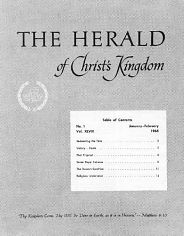
THE HERALD
of Christ's Kingdom
VOL.
LII. July/August 1969 No. 4
Table of Contents
God's Anointed Son His Work
Kalos or Kakos
Israel Today
The Death and Resurrection of Israel
The Levitical Prophetical System of Weeks
The Beatitudes
Notice of Annual Meeting
Entered Into Rest
"Jesus, when he came out, saw much people, and
was moved with compassion toward them, because they were as sheep not having a
shepherd:
and he began to teach them many things." - Mark
6:34.
Twenty-seven
centuries ago, the Prophet Isaiah (Isa. 61:1-3) described the mission of the
Messiah and the manner in which he becomes a light to the nations; of his
condescension and compassion in ministering to the humble, the lowly, the
sin-bound and the heartbroken. Some of these magnificently expressive words
were chosen by our Lord at Nazareth for the solemn introduction of his public
ministry (Luke 4:16, 17). He opened the scroll of Isaiah, found this passage,
read the first six clauses, and then added: "'This day is this Scripture
fulfilled in your ears.' And all bare him witness, and wondered at the gracious
words which proceeded out of his mouth."
Let
us linger over these words so fittingly chosen by our Master that thus we may
have a fuller vision of the glorious work of Christ, for in it we too, if
faithful, shall share. Let us consider each clause, its partial fulfillment at
his first Advent, and the future complete fulfillment at his second.
THE WORK OF CHRIST
We
hear him say: "The
spirit of
the Lord
God is upon me." Why, Lord, is the spirit of God upon thee? "Because Jehovah hath
anointed me to preach good tidings unto the meek." And what tidings the Master
did preach! Were sweeter words ever uttered than those we find in John 3:16,
the "little Bible"? "For God so loved the world, that he gave
his only begotten Son, that whosoever believeth in him should not perish, but
have everlasting life." A message of hope and of love such as was never
heard before. "Never man spake like this man." That message will yet
reach into the hearts of all mankind for he has promised to draw all men unto
himself (John 12:32).
Again
the Master speaks: "The spirit of the Lord God is upon me." And again we ask. Why, Lord,
is the spirit of God upon thee? "Because He hath sent me to bind up the
broken-hearted." The Polish rendering is, "to bind up the wounds of the
contrite-hearted." How wonderfully did Jesus reveal his commission in this
respect! One has but to recall the account in Luke 7:37-50 to appreciate this.
The despised woman creeps into the Pharisee's home to kneel at Jesus' feet, to
wash them with her tears. Here was broken-heartedness that required the touch
of the Master Healer. Who knows how many wayward souls have since read this
touching record and been moved to the same contrition and received the same
blessing from Him who is "the same yesterday, today, and forever"?
For it is still true that "the sacrifices of God are a broken spirit: a
broken and a contrite heart, O God, thou wilt not despise" (Ps. 51:17).
And still is the voice of the Anointed One heard, as it will also be throughout
his Millennial reign: "Come unto me, all ye that labor and are heavy
laden, and I will give you rest" (Matt. 11:28).
We
continue. "The
spirit of
the Lord
God is upon me." Why, Lord? "Because He hath anointed me to proclaim liberty to the
captives." Prisoners
in the great prison house of death! Who can proclaim to them liberty but He who
has the "keys of death and hell"! (Rev. 1:18). How marvelous were his
demonstrations of this God-given power in the awakening of Lazarus and others!
Only Christ can say, "I am the resurrection, and the life: he that
believeth in me, though he were dead, yet shall he live" (John 11:25). The
near future awaits the glorious fulfillment of his promise to raise all from
their graves (John 5:25-29). Then indeed will liberty be proclaimed "throughout the land unto
all the inhabitants thereof" (Lev. 25:10).
The
Master speaks: "The
spirit of the Lord God is upon me because He bath anointed me to proclaim the
opening of the eyes to them that are bound" (A.R.V.). Blessed were the literal
blind eyes that felt that healing touch, but far more blessed were and are and
shall be those whose blind "eyes of the heart" are restored to sight.
"Darkness covers the earth and gross darkness the people" (Isa. 60:2)
but here is One who can say "I am the light of the world: he that
followeth me shall not walk in darkness, but shall have the light of
life" (John 8:12). Ah, yes! Not only light (illumination of mind to dispel
the darkness of ignorance) but a special light, the light of life; the knowledge which
illumines the mind and simultaneously invigorates to life and growth. Christ
alone possesses such "light," and therefore God's Word has termed him
"the Sun of righteousness who shall arise with healing in his wings"
to bless all the nations (Mal. 4:2).
Again,
"The
spirit of the Lord God is upon me because He hath anointed me to proclaim the year of Jehovah's
favor" (A.R.V.). And so it is written: "As many as received him, to them gave he
power [authority] to become the sons of God, to them that believe on his
name" (John 1:12). Now is the Gospel Age of favor, during which "by a
new and living way [a "narrow" way] which he hath consecrated for
us," the followers of Christ have "boldness to enter into the
holiest," even the presence of God. (See 2 Cor. 6:1, 2; Heb. 9:8; 10:19,
20.) Such are "elect according to the foreknowledge of God-the called
according to his purpose -- holy brethren, partakers of the heavenly
calling" (1 Pet. 1:2; Rom. 8:28; Heb. 3:1). Unspeakable grace! Hidden
until revealed by the Son of God! "Of his fullness have all we received, and
grace for grace" (John 1:16). Wherefore, brethren, "walk worthy of
God, who hath called you unto his Kingdom and glory" (1 Thess. 2:12).
Having
read thus far from Isaiah's prophecy, our Lord ceased, and only later added the
warning of "the day of vengeance." (See Matt. 24, Luke 21, Mark 13.)
We also pass by this clause with the one remark that there is a year of
favor but only a day of vengeance. Thank God that "His anger
endureth not forever."
Returning
to the prophecy we read, "The spirit of the Lord God is upon me because
Jehovah hath anointed me to comfort all that mourn." Christ, the
Comforter! What a glorious title and work! How well exemplified in the record
of the three raisings from the dead. They were those of the only son of a
widowed mother, the only daughter of two fond parents, the only brother of two
affectionate sisters. And in each case there was something singular in the
tenderness of our Lord's conduct toward the mourners. He knew beforehand how
speedily the anxiety would be relieved, the sorrow chased away, but the
"Weep not" to the mother before he touched the bier; the "Fear
not, only believe," to the agitated father; the tears that fell before
the grave of Lazarus -- what a testimony do they bear to the exquisite
susceptibility of the Savior's spirit -- to the quickness, the fullness of his
sympathy with human grief! Hallelujah! What a Savior! He shall yet wipe the
tears from every eye.
Yet
once again the Master speaks: "The spirit of the Lord God is upon me-to
appoint unto them that mourn in Zion, to give unto them beauty for ashes, the
oil of joy for mourning, the garment of praise for the spirit of heaviness;
that they might be called the trees of righteousness, the planting of Jehovah,
that he might be glorified." Here we have summed up the work of Christ
on behalf of his faithful footstep followers, they who shall share the throne
of the Kingdom. Who, shall
measure what Christ has done for each true Christian?
"I
stand all astonished with wonder
And
gaze on the ocean of love."
Read
with glowing heart these old familiar Scriptures in this order - Isa. 64:6; 1
Cor. 6:11; 1 Pet. 2:9, 10; Isa. 61:10; John 15:11. Then let us sing anew that
song of joy and thanksiving: "I love the Lord, because he bath heard my
voice and my supplications. Because he hath inclined his ear unto me,
therefore will I call upon him as long as I live. The sorrows of death
compassed me, and the pains of hell gat hold upon me: I found trouble and
sorrow. Then called I upon the name of the Lord; O Lord, I beseech thee,
deliver my soul. Gracious is the Lord, and righteous; yea, our God is merciful.
The Lord preserveth the simple: I was brought low, and he helped me. Return
unto thy rest, O my soul; for the Lord bath dealt bountifully with thee. For
thou hast delivered my soul from death, mine eyes from tears, and my feet from
falling. I will walk before the Lord in the land of the living" (Psa.
116:1-9).
THE EFFECTS OF CHRIST'S WORK
Thus
worked God's Anointed Son and "manifested forth his glory." But the
"greater works than these" remain to be done, and the "time is at hand." Already the
effects of Christ's work begun in Galilee long ago are even to the unbeliever
indisputable and historical. Farrar has well said: "It expelled cruelty;
it curbed passion; it branded suicide; it punished and repressed an execrable
infanticide; it drove the shameless impurities of heathendom into a congenial
darkness. There was hardly a class whose wrongs it did not remedy. It rescued
the gladiator; it freed the slave; it protected the captive; it nursed the
sick; it sheltered the orphan; it elevated the woman; it shrouded as with a
halo of sacred innocence the tender years of the child. In every region of life
its ameliorating influence was felt. It changed pity from a vice into a virtue.
It elevated poverty from a curse to a beatitude. It ennobled labor from a
vulgarity into a dignity and a duty. It sanctified marriage. It revealed for
the first time the angelic beauty of a Purity of which men had despaired and of
a Meekness at which they had utterly scoffed. It created the very conception of
charity, and broadened the limits of its obligation from the narrow circle of
a neighborhood to the widest horizons of a race. And while it thus evolved the
idea of humanity as a common brotherhood, even where its tidings were not believed
-- all over the world, wherever its tidings were believed, it cleansed the
life, and elevated the soul of each individual man."
The
living life-giving Christ! That is our sole and sufficient theme. Christ, the
Sacrifice for sinners; Christ, the Teacher of the ignorant; Christ, the King of
faithful souls; the Emancipator of moral slaves; the Consoler of the sorrowing;
the sure Hope of the multitudes of earth; my Christ, your Christ, humanity's
Christ! In his devotional spirit, in his holiness, in his exertions to promote
the divine glory, in his tenderness for sorrowing souls, in his zeal to do
those around him good, in his self-denying perseverance, in his tender
charity, his generous love, his meekness, his patience, his forgiveness of
injuries-in these and all other moral excellencies of his character, he stands
before us for our study, our admiration, our imitation. Though we cannot work
miracles as he did, we may imitate his acts of mercy, his prodigies of benevolence;
though we cannot prophesy, we may yet proclaim his truth and make known his
salvation; though we cannot forgive sins, we may yet pardon affronts and
injuries; though we cannot die a ransom sacrifice for the sins of those around us, we
may yet make many sacrifices for their sakes; and we may imitate his patience,
his meekness, and suffer what befalls us for his sake, in the spirit in which
he suffered.
EARTH'S COMING GLORY
Now
we stand in the "latter days." The Kingdom of Christ is soon to be
established, in which he shall finish the wonderful work for which he has been
anointed. The nations know not the day of their visitation -- that there stands
One at the door able and willing to take charge of the affairs of earth, with a
salvation greater than men have dreamed of. God is hastening the time when not
only the doctrine of popular liberty, but the greater and inclusive doctrine of
a divine redemption, enunciated through a purely taught Gospel, shall become
the open faith of mankind. And for the furtherance of this blessed result, how
wondrous the work of God's providence, wrought through these later years in
compacting the nations of the world, in multiplying the facilities for their
mutual intercourse, and in the transmission of thought in common to all. Into
how few centers is He concentrating political power, and into what close relations
and sympathies is He bringing all nations! Through the marvelous communication
means of this day, not only are the doings of men in every nation, the
transactions of government and commerce, instantly known in every other, but
what is of vaster moment far, the world itself has become a great whispering
gallery for the interchange of thought and opinion among its varied peoples.
And for what purpose are these facilities of intercourse, this exchange of
thought, to what end this binding of the nations together, this making the
world one, save that predicted by the Prophet concerning the time of the end,
"that many should run to and fro, and knowledge," the knowledge of a
Redeeming God, "shall be increased"; "that the knowledge of the
Lord may cover the earth as the waters the seas"; nay more, that all flesh
may glory in the coming of the Lord, and all nations accept his sovereign sway!
- W. J. Siekman
"Examine yourselves,
whether ye be in the faith;
prove your own selves." - 2 Corinthians 13:5.
It
is often extremely difficult to discriminate between good and evil, or to
decide whether a course of conduct opened before us would be pleasing to the
Lord or not.
Some
may be inclined to question this statement; but the writer of the Epistle to
the Hebrews declares it to be true. He says (Heb. 5:7-14), "When by reason of the
time ye ought to be teachers, ye have need again that some one teach you the
rudiments of
the first
principles of
the
oracles of God; and ... have need of milk ["for babes"] and not of
solid food . . . [which is] for full grown men ... who by reason of use have
their senses exercised to discern good and evil."
This
writer emphasizes his point here by a play on words -- paronomasia, which is the use of two
words of similar sound in juxtaposition, commonly for emphasizing antithesis,
or contrary meaning. Out of more than a dozen Greek words meaning
"good," and eight meaning "evil," the writer selects two
which look and sound almost exactly alike -- "Kalos" and
"Kakos." It requires good eyesight to: "discern" between
Kalos and Kakos, and equally good and experienced spiritual eyesight always to
discern between good and evil, in our conclusions drawn from the Word of God.
A neat turn of language to impress a great truth!
Discernment
-- discrimination -- is a rare and advanced fruit of true Wisdom. Kalos or Kakos! Good or evil! The
fundamental error is in expecting that the Church will reign in the flesh, and
that its ministers have earthly authority. The Scriptures are so written that
the erroneous conclusion may be drawn by those who do not love the truth
concerning the Church in the flesh -- that her course is to be one of humility,
poverty, self sacrifice, suffering; her exaltation to be consequent upon her
death in following her Lord. This is distasteful to those who love power,
place, pride, authority. God sends a "zeal of error" to such -- that
their hearts may be manifested, their condemnation justified.
Strange
it is that Bible students can see clearly how wrong was the course of some who
made these great and swelling claims in past centuries, yet fail to recognize
the same claims of over-lordship and authority when advanced by others today.
Plausible arguments based upon texts and interpretations of God's Word are presented
in support of these claims; but the Apostle's solemn and portentous words apply
today as ever: "God shall send them a zeal of error-because they loved not
the truth -- that they may be judged."
This
particular self-deception is the most serious and dangerous of any into which
we may fall. It is denounced by the risen Christ in his Revelation (Rev. 2:6,
15) as "the
doctrine and works of the Nicolaitanes, which I also hate." Nicolaus means "he who
overcomes the people"; it is a cryptic reference to those who seek to
become "lords over God's heritage" -who are "not holding the
Head." "The vicegerent of Christ on earth"; "the Channel
of the Truth"; these and similar claims are all direct offenses against
him who has been appointed by God the Father to be "head over all things
unto his body, which is the Church" (Eph. 1:22), and inevitably will bring on the
condemnation forewarned, if persisted in.
Next
in heinousness to the offense against the Head is the offense against his Body,
the Church, in fomenting divisions among her members. The Apostle writes, "There must be schisms
among you that they that are approved may be made manifest among you" (1 Cor. 11:19). "Now the works of the
flesh are manifest, which are these; . . . enmities, strife, jealousies,
wraths, factions, divisions, parties . . . which I forewarn you, even as I did
in time past, that they which do such things shall not inherit the Kingdom of
God" (Gal.
5:19-21). The divisions must come, in order that those who love and practice
divisions may be manifested and condemned.
On
the contrary, the same Apostle as clearly declares that those who practice
unity shall inherit the Kingdom. He gives us a basis for the unity of the
Church so clear, simple, and yet comprehensive as to leave no room for
question, no danger of being either too exclusive or too inclusive if we
adhere to it. It is indeed an authoritative "Apostles' Creed" for the
Church. It is found in Ephesians 4:1-16, which may be paraphrased with some
freedom as follows (note the play on the word "one"):
"I
urge you to live worthy of the Call that you have received; always humble and
gentle, patient, loving one another, and striving to maintain in the bond of
peace the one-ness given by the Spirit [for there are seven "one"
things upon which this "oneness" is built]
One
Body,
One
Spirit,
One
Hope of our Calling,
One
Lord,
One
Faith, One Baptism,
One
God and Father over all."
"To
this unified Body God has given gifts -- Apostles, Prophets, Evangelists,
Pastors, and Teachers, to fit his people for the work of the ministry, for the
building up of the Body of Christ. And [provided unity is maintained] this
shall continue until we all attain unto --
(1)
The oneness of the faith;
(2)
The full knowledge of the Son of God;
(3)
Full-grown manhood -the full standard of the perfection of Christ;
(4)
Complete union with him who is our Head--Christ himself. But only if we are closely joined
and knit together and so are being built up in a spirit of love."
The
Apostle's extreme care in choosing words exactly to express his meaning is
notable in the fact that in referring to five of the seven essential things he
uses the cardinal "one"; in the cases of the other two, he uses the
ordinal "first." The five cardinal "ones" are given to
us--complete, perfect, the plan and workmanship of the Father and the Son, in
which our part is only to receive, to occupy, to share, or to recognize and obey. These
are: One Body, One Spirit, One Lord, One Baptism, One God and Father." The
other two are: "First Hope of Our Calling, First Faith." These are
our contributions to the fellowship of the Body; while both are gifts from God
in a sense, because the things which call them forth or incite them are from
him, yet in another sense they originate and grow in our minds in response to
God's invitation and gracious promises.
Yet
in stating these two requirements for membership in the Body he implies that
we are not to expect or demand a fully developed hope or faith in those seeking
our fellowship. This he puts in so many words in Romans 14:1: "Him that is weak in the
faith receive ye, but not to doubtful disputations." Presently, as a result of
the unity and fellowship of the Body, his faith will grow, "until we all attain
unto the unity [perfection] of the faith."
How
beautifully this platform covers every point--justification, consecration,
sanctification, holy living, a sacrificial death! Anyone who professes these
Seven Things, and gives no contrary evidence (such as living in open sin -- 1
Cor. 5:11;
2 Thess. 3:6) is accepted and fellowshipped as a brother in Christ.
But,
says one, any sectarian would accept this platform provided he is allowed to
define the "One Faith"! To this we reply, the Apostle does not leave
this requirement to our individual opinions and preferences, but himself
defines in unmistakable simplicity and completeness, the "Faith once
delivered unto the saints": "Now faith is the assurance of things
hoped for, a conviction of things not seen." "The word is nigh thee,
in thy mouth, and in thy heart: that is, the word of faith which we preach: because
if thou shalt confess with thy mouth Jesus as Lord, and believe in thy heart
that God raised him from the dead, thou shalt be saved" (Heb. 11:6; Rom.
10:8, 9). Is that all? Yes, according to Paul; but mistakenly zealous
sectarians from the earliest age of the Church have been expanding and
dilating and doctoring and patching their conceptions of "The Faith,"
to include this, that, and the other doctrinal requirements, true or false; and
they are still busy at it!
In
fact, it has become so much a matter of course to confuse "faith"
with doctrine or belief, that when the facts come to our attention we are
astonished, and sometimes find it difficult to adjust our minds to their
implications.
The
Greek word "pistis,"
the word
usually translated "faith," carries no implication of a creed or
system of belief. Strong's Greek Dictionary in his Concordance, after defining
this word, adds: "By extension, the system of religious [Gospel] truth
itself."
It
is truly by an "extension" not authorized by the inspired writers nor
justified by the meaning or usage of the Greek word, that it so extended. And this "extension" has
undoubtedly
been the cause of more fanaticism, persecution, hatred, warfare, and bloodshed,
in the name of Christ, than all other fundamental errors combined.
As
compared to the seven fundamental things stated by the Apostle as essential to
membership in the Church, and the plain statements of Scripture directly
concerning these seven, all other doctrinal statements of Scripture are of
secondary importance. And yet, the things that Christians dispute -- yea,
quarrel, and divide about, are almost invariably the doctrinal questions of
secondary importance.
Kalos
or Kakos
-- good or evil -- discern, O Israel! The great things should unite us all. Shall we permit the lesser
things to continue to separate us?
Paul
places life and death before us -- a theorem in spiritual proportion
Unity Life :: Divisions : Death.
Unity
is to Life as Divisions are to Death.
Unity
-- and a
"completing of our course with joy"; an "ascertaining what is
the good and acceptable and complete will of God concerning us"; an
"abundant entrance ministered unto us into his Everlasting Kingdom."
Divisions
-- and loss;
lost time, lost efficiency, lost opportunities, a lost crown and Kingdom.
Why
is this subject of the Unity of the Body of such supreme importance?
(1)
Because Jesus came into the world to establish unity (John 11:52).
(2) He commanded and prayed that his followers should be
one (united) (John 15:12, 17; 17:11, 2123).
(3) We lose our liberty in Christ if we practice
divisions.
"What,"
says one, "I thought we gained liberty by standing apart?"
The
most important feature of our liberty in Christ is that spoken of in John 1:12:
"As many
as received him, to them gave he power [margin, the right or privilege - i.e.,
liberty] to become the sons of God." "He that saith he abideth in him
ought himself also so to walk, even as he walked. Hereby perceive we love, because
he laid down his life for us; and we ought to lay down our lives for the brethren ... Beloved, if God so
loved us, we ought also to, love one another" (1 John 2:6;
3:16; 4:11).
How
can we love and lay down our lives for the brethren if we are divided--if we do
not fellowship with them--assemble ourselves together with them? Only
"with all saints" can we come to know "what is the breadth
and length and height and depth . . . of the love of Christ, which passeth
[individual or human] knowledge" (Eph. 3:14-19).
We can attain
the perfection of this knowledge only when we are finally united with our Head
and the members of his Body beyond the Veil; but our fitness for that ultimate
and perfect unity will certainly be measured and judged by the earnestness,
sincerity, and self-sacrifice we display in seeking the fullest possible
measure of it during this, our trial time.
We
have considered the great Apostle's solemn admonitions and warnings; it remains
for us only to examine their applicability to ourselves; to determine our own
position and trend in the light of their significance; for "if we judge
ourselves we shall not be judged."
Kalos
or Kakos
-- good or evil -- life or death!
The
Laodicean Church has a high and holy mission. In most particulars it is
identical with, in some it differs somewhat from, the mission of previous
stages of the Church. It may be stated thus
(1)
To "give diligence to make our own calling and election sure" (2
Pet. 1:3-11).
(2) To "lay down our lives for the brethren"
in assisting them to do likewise (1 John 3:16).
(3) To discharge our ambassadorship to mankind:
"As though God did beseech by us: we pray in Christ's stead, be ye
reconciled to God" (2 Cor. 5:20).
(4) To witness to the world of the end of the Age, and the
nearness of the Kingdom (Matt. 24:14).
This
Mission can be accomplished only by Unity--or rather, those who practice unity
will achieve personal success in this enterprise.
It
requires both Faith and Works -- but not specialists in Faith and specialists
in Works, acting separately. We must get together, because our Head
commands it, and because we need each other.
Kalos
or Kakos -- good or evil -- discern, O
Israel!
Shall
we say unity is impossible? Then we do not love sufficiently, for "Love
hopeth ALL things"!
Unity
impossible? Then we contradict the Prophet, who declares (Isa. 52:8)
"Thy
watchmen . . . together shall sing: for they shall see eye to eye when the
Lord shall bring again Zion." Does this mean that if we are of the true watchmen
we will agree on everything? Or, in other words, do we think that those who do
not agree with us are not watchmen?
Ah,
no, brethren -- let us not be so narrow or so foolish!
If
we see eye to eye that opinions do not matter-that unity on the basis of the
Apostle's seven great essentials
(upon which we all agree) is the all-important thing-then the prophecy is
fulfilled--we can all get together, forget differences, practice unity, reap
its blessed fruits "unto life eternal," and be ready to face our Lord
and Head without the shame, confusion, and regret we shall surely experience
when we see him if we have "practiced divisions."
Kalos
or Kakos
-- good or evil -- discern, O Israel!
Surely
the movement to "gather into unity the children of God who are scattered
abroad," inaugurated by our Lord nineteen hundred years ago, is one worthy
of our most earnest efforts as his followers. Surely it deserves our careful
thought and planning, our time, our talents, the sacrifice of our human life
itself! Surely it is a Holy Crusade to which we will do well to devote
ourselves! Surely such a life and death would be wellpleasing to the Father
and to our Head!
"We
are a spectacle to angels and men." Are we giving a good witness, dear
brethren-of Christian love, of unity, of zeal and devotion, of holy living?
Kalos
or Kakos
-- good or evil. Discern, O Israel!
-
H. E. Hollister
'In the latter years you
[Gog, of the land of Magog
- Ezek. 38:2] will go against the
land that is restored from war, the land where people were gathered from many
nations upon the mountains of Israel, which had been a continual waste; its
people were brought out from the nations and now dwell securely, all of them. .
. . and you will devise an evil scheme and say, 'I will go up against the land
of unwalled villages; I will fall upon the quiet people who dwell securely, all
of them dwelling without walls, and having no bars or gates'; to seize spoil
and carry off plunder; to assail the waste places which are now inhabited, and
the people who were gathered from the nations, who have gotten cattle and
goods, who dwell at the center of the earth." - Ezekiel 38:8-12,
R.S.V.
In
the January-February issue of The Herald, page 7, we condensed some
paragraphs from a recent issue of the Bible Study Monthly. Relying on
the text at the head of this article, the author of those paragraphs stated
that "The invasion of the Holy Land by the hosts of 'Gog and Magog' is the
last great event of this Age. The overthrow of that great host is the signal
for the establishment and announcement of the Kingdom of God upon earth. From
that point of time Restitution processes will commence, and the work of world
conversion, the restoration of the earth and rehabilitation of the human race,
go forward. A clear understanding of the prophecy in the light both of Biblical
lore and of contemporary knowledge is an essential for those who desire to keep
abreast with the outworking of the Divine Plan.
"The
central feature of the prophecy is the land and its people, and a question
immediately arises, 'Where is the land and who are the people?' The old-time
theology, inspired mainly by St. Augustine, declared that the whole passage is
symbolic, that it depicts the final triumph of Christ and his Church over the
forces of evil. Such explanation will not satisfy students of the Bible who
understand and look for the coming of Christ's Kingdom upon earth. Quite
clearly, this passage is directly related to the Divine destiny for the ideal
Israel of the End Time and to the establishment of the Kingdom, and must
therefore be understood in a dispensational sense and in an earthly setting.
Putting it briefly, the time of the prophecy is at the end of this Age and the
place of its fulfillment is upon this earth."
In a
footnote to page 7, our Editorial Committee expressed the hope that this
question might be discussed in more detail in a future issue of The Herald. This we propose to do now.
The
subject, then, to be considered here is: "Where is the land to, which
Ezekiel refers, and who are the people?"
There
are several methods of interpretation adopted by commentators. One is that of
so-called "spiritualizing" the prophecies -- making Israel and Zion
to mean the Church, and The Land to signify Heaven. However, when we attempt to
apply this system of interpretation its inconsistency becomes apparent. For
example, in Jeremiah 30:3 we read: "For, lo, the days come, saith the
Lord, that I will bring again the captivity of my people Israel and Judah,
saith the Lord: and I will cause them to return to the land that I gave to
their fathers, and they shall possess it."
As
far back as 1890, David Baron, a well-known Hebrew-Christian (who, for many
years, edited The Scattered Nation remarked on this verse: "If
Israel be the Church, who is Judah? If Judah be the Church, who is Israel?
What
is the 'captivity' the Church has endured? and where is 'the land' from which
the Church has been driven out, and to. which it will return? . . If Israel
does not mean Israel, and 'the land God gave to the fathers' does not mean
Palestine, then I do not know what is meant."
Again,
in Jeremiah 31:10 the announcement is: "He that scattered Israel will
gather him."
Commentators
are in general agreement that the "scattering" refers to literal
Israel (a nation scattered and peeled, Isaiah 18:2); but when, in the same
sentence (Jeremiah 31:10) a gathering of the same people is
mentioned, this, we are told, must have reference to spiritual Israel!!
Here, surely, is inconsistency.
Another
method of dealing with these prophecies of a Restoration is to interpret them
to mean a gathering of the Jews into the Church. But this interpretation, too,
is untenable. The Jews will not be gathered, nationally, into the
Church; for even in the New Testament we have the Jews, as well as the
Gentiles, as nations, running parallel with, and continuing separate
from, the Church, throughout all the period of its history on earth. Note how
the Apostle Paul distinguishes them in 1 Corinthians 10:32: "Give none
offence, neither to the Jews, nor to the Gentiles, nor to the Church of
God."
"He
that scattered Israel" -- From whence? from the Church, or from gospel
blessings? Not so -- He scattered Israel from Palestine. "Will gather him" -- Where to?
Why, surely, to the land which he gave to their fathers, from which Israel, on
account of disobedience, was banished and scattered.
But
a third, and perhaps the most plausible, way of explaining the prophecies of a
Restoration is to represent them as having had their fulfillment at the
restoration from Babylon.

Below
we submit three of the reasons which compel us to reject this interpretation,
also. To us it seems that any fulfillment of the prophecies at the restoration
immediately following the Babylonish captivity must be considered, at most, as
partial; quite inadequate to represent the complete fulfillment.
(1) THE RESTORATION PROMISED WAS
TO INCLUDE THE ENTIRE TWELVE
TRIBES, REUNITED IN ONE KINGDOM
This
is quite clearly predicted in Ezekiel 37:21, 22, as follows: "Thus
saith the Lord God; Behold, I will take the children of Israel from among the
heathen, whither they be gone, and will gather them on every side, and bring
them into their own land: And I will make them [Judah and Israel - Eze.
37:15-19] one nation in the land upon the mountains of Israel; and one king
shall be king to them all: and they shall be no more two nations, neither shall
they be divided into two kingdoms any more at all."
So
also in that remarkable prophecy of Isaiah 11 (Isa. 11:12), which, on whatever
system of interpretation, is admittedly future in its application: "He shall . . . assemble the
outcasts of Israel, and gather together the dispersed of Judah from the four corners
of the earth:'
These
scriptures speak of a complete restoration of the entire nation. Such
prophecies could not be said to have received their fulfillment in the
(comparatively speaking) mere handful who returned from Babylon.
(2) AFTER THE RESTORATION
PREDICTED, ISRAEL IS TO ENJOY, NOT
ONLY NATIONAL INDEPENDENCE
BUT, NATIONAL SUPREMACY
Backsliding
Israel, because he served not Jehovah with joyfulness and with gladness of
heart for the abundance of all things, was to be taught a lesson by comparison;
and was given over by God to be in servitude for a time to the Gentiles.
"Therefore
shalt thou serve thine enemies which the Lord shall send against thee, in
hunger, and in thirst, and in nakedness, and in want of all things: and he
shall put a yoke of iron upon thy neck" (Deut. 28:48).
But
this iron yoke of Gentile oppression was not to last forever. It was to be
only until the times of the Gentiles be fulfilled, as Jesus stated in Luke
21:24.
We
have already referred to Jeremiah 30:3. In Jer. 30:8 of that chapter, the Lord
declares: "I will break his yoke from off thy neck, and will burst thy
bonds, and strangers shall no more serve themselves of him."
However,
this national independence did not occur when the Babylonian captivity
terminated. As Dr. Kac has noted on page 40 of his Rebirth of the State of
Israel, "Politically the Jewish community in Palestine in the era of
the Second Commonwealth was an appendage of one of the great powers in that
era: first of Persia, then of Alexander the Great, and finally of Rome."
Let
those who think otherwise ponder the words to be found in Nehemiah 9:36, 37
which describe the actual condition of the people after their restoration in
Nehemiah's day: "Behold, we are servants this day, and for the land
that thou gayest unto our fathers to eat the fruit thereof and the good
thereof, behold, we are servants in it: And it yieldeth much increase unto the
kings whom thou hast set over us because of our sins: also they have dominion
over our bodies, and over our cattle, at their pleasure, and we are in great
distress."
It
is not possible to compare, but only to contrast the actual
conditions described in the Nehemiah passage above cited with the conditions
which will obtain when a prophecy such as is found in Isaiah 14:1-3 meets
fulfillment. Then, not merely national independence (wholly
lacking in Nehemiah's day as we have seen) but national supremacy will be
Israel's happy portion:
"The
Lord will have mercy on Jacob, and will yet choose Israel, and set them in
their own land: and the strangers shall be joined with them, and they shall
cleave to the house of Jacob. And the people shall take them, and bring them to
their place: and the house of Israel shall possess them in the land of the Lord
for servants and handmaids: and they shall take them captives, whose captives
they were; and they shall rule over their oppressors" (Isa. 14:1, 2).
(3) THE RESTORATION PROMISED IS
TO BE A "SECOND" RESTORATION.
ITS EXTENT IS TO BE WORLDWIDE.
IT IS TO BE FOLLOWED BY NO FURTHER DISPERSIONS,
AND IS, THEREFORE, TO BE PERMANENT
Foregoing
we cited Isaiah 11:12 as indicating the extent-the universality-of the
gathering "from the four corners of the earth" in contrast with the
mere handful who returned from Babylon. If we turn to the previous verse
(Isaiah 11:11) we note that this is declared to be a "second"
restoration: "And it shall come to pass in that day, that the Lord
shall set his hand again the second time to recover the remnant of his
people."
There
was no "second" restoration in Nehemiah's time. It must, therefore, be
future from his day.
Again,
in chapter 31 of Jeremiah's prophecy, after describing the rebuilding of the
Holy City, the chapter closes with the declaration: 'It shall not be plucked
up, nor thrown down any more for ever."
Amos,
too, speaks in a similar strain, in the closing verses of his prophecy (Amos
9:14, 15): "1 will bring again the captivity of my people of Israel,
and they shall build the waste cities, and inhabit them; and they shall plant
vineyards, and drink the wine thereof; they shall also make gardens, and eat
the fruit of them. And I will plant them upon their land, and they shall no
more be pulled up out of their land which I have given them, saith the Lord thy
God."
It
is, of course, a matter of history, which none would dispute, that the
restoration from Babylon was followed by another dispersion of the people
into all the four corners of the earth. Evidently, therefore, the restoration
from Babylon could not have been the fulfillment of prophecies which stipulate
"they shall no more be plucked up out of their land."
A Message of Hope for a Time of Trouble
By Arthur W. Kac, M.D.
It
is a pleasure to announce the publication of another "Israel" book by
our esteemed friend and brother in Christ, Dr. Arthur W. Kac. The following
lines are taken from its Foreword.
"In
1948 the Jewish people reestablished their national home in the Land of Israel
after the lapse of nineteen centuries. In all of world history there is no
other instance of a people which, though dispersed from its native land for
some two thousand years, managed to survive and at the end of this long period
returned to the country of its origin to resume its national existence. An
attempt to explain the significance of this unique and unparalleled phenomenon
was made by this author in a book entitled The Rebirth of the State of
Israel: Is It of God or of Men? . . . In the present work the author seeks
to complete the story begun in The Rebirth of the State of Israel."
The
book is priced at $3.95. Orders should be sent to Pastoral Bible Institute,
Inc., P.O. Box 15031 - Chouteau Station, St. Louis, Missouri 63110.
"The times and the
seasons.... " - 1 Thessalonians 5:1.
Five
forms of weeks were employed under the law of Moses, adjusted to individual
and national interests:
I.
The week of days (Ex. 20)
II.
The week of weeks (Lev. 23)
III.
The week of months (Lev. 23)
IV.
The week of years (Lev. 25)
V.
The week of weeks of years (Lev. 25)
I. The Week of Days
For
three thousand five hundred years the Jews as a nation have observed the week
of days, resting every Sabbath from secular toils, according to Divine command.
(See also Ex. 12:15; Ex. 22:27, 30; Ex. 29:35, 37; Lev. 12:2; Lev. 15:13-19;
Lev. 23:36,39; Num. 12:14; Num. 19:11; Num. 31:19; Josh. 6:4.)
The
week, with its concluding Sabbath, is therefore deeply engraven in a variety
of ways on the whole Jewish ritual and history. Not on Jewish history alone. Although
in the Christian dispensation the eighth day, or first day of a new week, is
substituted for the creation Sabbath, indicating that rest is to be found only
in a new creation, only in resurrection, - yet still the weekly division of
time, and the weekly day of holy rest, continue, witnessing as ever to the rest
that remaineth for the people of God. For, like the Lord's supper, which shows
forth his death till he come, the Sabbath and the Lord's day which has taken
its place glance both backward and onward. The first day of the week recalls
the glad morning of the resurrection, the completion of the redeeming work of
Christ (just as the Sabbath recalled the conclusion of the creation work of
God), and it foretells the remaining rest, when they that are Christ's shall
rise at his coming. Thus we may say, that three hundred thousand earthly
Sabbaths line the road that lies behind the people of God, pointing with
outstretched hand, like so many guideposts, in the same direction, and agreeing
with overwhelming unanimity in their testimony to the blessed fact, that
"there remaineth a Sabbatism" for the people of God.
II. The Week of Weeks
Next
in order to the week of days came the week of weeks. This was a period
appointed to elapse between the first two of the great annual gatherings of the
Jewish sacred year, Passover and Pentecost. "And ye shall count unto you
from the morrow after the sabbath, from the day that ye brought the sheaf of
the wave offering; seven sabbaths shall be complete: Even unto the morrow
after the seventh sabbath shall ye number fifty days; and ye shall offer a new
meat offering unto the Lord" (Lev. 23:15).
Thus,
in every Jewish year there occurred not only a series of weeks of days, each
with its concluding Sabbath, but a week of weeks, with its closing Pentecostal
celebrations, full of hidden hopes of resurrection experiences.
III. The Week of Months
The
entire series of the feasts of the Lord, ordained in Leviticus, is comprised
within the first seven months of the year. The sacred portion of the Jewish
year, therefore, or its complete calendar of divinely ordained religious
ceremonies, prefiguring the history of redemption, occupied a week of
months. It commenced with the month Abib or Nisan, on the fourteenth day of which
the Exodus took place, in memory of which the annual feast of Passover was
instituted. There followed, each in its appointed season, the feast of
Unleavened bread, and the First-fruit sheaf, the feast of Weeks or Pentecost,
the feast of Trumpets, the great day of Atonement, and the feast of
Tabernacles. This last was held in the seventh month, and with it closed for
the year the special "feasts of the Lord." Thus the period marked off
for holy convocations, from the Jewish year, was septiform in character; a week
whose days contained, by Divine direction, the observances of Israel's
ecclesiastical year; while the feasts themselves, and the order in which they
occurred, had undoubted reference to antitypical events, on the scale of ages.
IV. The Week of Years
It
was the will of God that not only the people but the land of Israel should keep
sabbath. "The Lord spake unto Moses in Mount Sinai, saying, Speak unto the
children of Israel, and say unto them, When ye come into the land which I give
unto you, then shall the land keep a sabbath unto the Lord. Six years thou
shalt sow thy field, and six years thou shalt prune thy vineyard, and gather in
the fruit thereof; but in the seventh year shall be a sabbath of rest unto the
land, a sabbath for the Lord: thou shalt neither sow thy field, nor prune thy
vineyard. That which groweth of its own accord of thy harvest thou shalt not
reap, neither gather the grapes of thy vine undressed: for it is a year of rest
unto the land" (Lev. 25:1-5). The Hebrew servant, similarly, was to serve
six years, and go out free in the seventh (Exod. 21:2).
The
period thus marked off had exactly the same character as the week with its six
days of toil and seventh of rest; it is simply the week on the scale of years.
And it is worthy of notice that the observance of the ordinances respecting the
land during the sabbatic years was possible only by means of a stupendous
miracle, to be repeated every seven years. "If ye shall say, What shall we
eat the seventh year? behold, we shall not sow, nor gather in our increase:
then I will command my blessing upon you in the sixth year, and it shall bring forth fruit for three years"
(Lev. 25:20, 21).
Here
was a law perfectly harmonious, as we have seen, and shall yet see more fully,
with the order of sacred seasons observed by the Jews; a law in which there was
nothing foreign to their whole system, but which was on the contrary an integral
part of it, and yet it was made to depend, for the possibility of its
fulfillment, upon a special periodical interposition of Divine power, as wide
in its range as the necessities of an entire nation. No merely human
legislation would ever have originated such a law, on account of its incapacity
to provide the conditions needful for its observance. This miracle in the land
was, on the scale of years, what the doubling of the manna in the wilderness was on the
scale of days; a miraculous arrangement, to render possible the keeping of the
prescribed sabbath. There, the gift of manna was doubled every sixth day; while
in the land of promise the produce was trebled every sixth year, the object in
each case being to secure the sabbath rest.
V. The Week of Weeks of Years
The
largest week ordained in the Mosaic ritual was the week of weeks of years, the
period including, therefore, seven sabbatic years, with their intervening
years of toil: forty-nine years.
"Thou
shalt number seven sabbaths of years unto thee, seven times seven years; and
the space of the seven sabbaths of years shall be unto thee forty and nine
years. Then shalt thou cause the trumpet of the jubilee to sound on the tenth
day of the seventh month, in the day of atonement shall ye make the trumpet sound throughout all your land.
And ye shall hallow the fiftieth year, and proclaim liberty throughout all the
land unto all the inhabitants thereof: it shall be a jubilee unto you; and ye
shall return every man unto his pos. session, and ye shall return -- every man
unto his family. A jubilee shall that fiftieth year be unto you: ye shall not
sow, neither reap that which groweth of itself in it, nor gather the grapes in
it of thy vine undressed. For it is the jubilee; it shall be holy unto you: ye
shall eat the increase thereof out of the field. In the year of this jubilee ye
shall return every man unto his possession" (Lev. 25:813).
This
larger week is perfectly harmonious in character with all the previous ones;
during its earlier portion, bondage, debt, and poverty lasted; at its close
they passed away and disappeared. The jubilee was a year of rest and joy and
liberty, that foreshadowed more than any preceding Sabbath the full and varied
blessedness of the rest that remaineth for the people of God. Once, at least,
in every ordinary lifetime would this great prophetic ordinance arrive, laden
with its wealth of joy and peace, and glowing with its beams of hope and
promise.
THE PROPHETIC TIMES
The
Levitical and Prophetic Times form a continuous septenary series. The range of
the Levitical Times is from seven days to seven times seven years. The range of
the Prophetic Times is from seventy years to seven millenaries.
VI. The Week of Decades
The
prophetic period of seventy years is one which measures the ordinary life of
man. "The days of our years are threescore years and ten; and if by reason
of strength they be fourscore years, yet is their strength labor and sorrow;
for it is soon cut off, and we fly away" (Ps. 90:10). The harmony here
between the time order of Nature and that of Revelation is evident.
The
period of seventy years measured the duration of the captivity of Judah in
Babylon. It was predicted by Jeremiah, that in consequence of their inveterate
idolatry Israel should be carried captive by Nebuchadnezzar: "The whole
land shall be a desolation, and an astonishment; and these nations shall serve
the king of Babylon seventy years" (Jer. 25:11). And, subsequently, a
second time the same limit was assigned: "For thus saith the Lord, That
after seventy years be accomplished at Babylon, I will visit you, and perform my good word
toward you, in causing you to return to this place" (Jer. 29:10). A dark
and terrible week to Judah were those seven decades; the daughters of Israel
hung their harps upon the willows by the rivers of Babylon, and wept as they
remembered Zion. The desolate land enjoyed her sabbaths, while her sons
languished in exile. But this week also closed with restoration and liberty,
when the Lord turned again the captivity of Zion, and her children felt like
those that dream, as
they sang,
"The Lord bath done great things for us; whereof we are glad" (Ps.
126:3).
VII. The Week of Weeks of Decades
It
was toward the close of this long and dark week of the captivity that there was
revealed to Daniel a still larger week -- a week each of whose days was to
equal the captivity week, a week of seven times "seventy years," or "seventy weeks" of
years -- a period of 490 years. This may be termed the restoration week; it was
the time that elapsed between Artaxerxes' decree to restore and to build
Jerusalem, and the days of "Messiah the Prince"; indeed, it was
revealed as measuring the interval. "Seventy weeks are determined upon
thy', people and upon thy holy city, to finish the transgression, and to make
an end of sins, and to make reconciliation for iniquity, and to bring in
everlasting righteousness, and to seal up the vision and prophecy, and to
anoint the Most Holy" (Dan. 9:24).
Had
Israel known the day of her visitation, and received her Messiah when he
appeared, what a glorious sabbath would have closed this week! Its seventh day
did actually include the birth and life of the Lord Jesus Christ, and -- since,
when he came unto his own, his own received him not -- it included also his
atoning death, his triumphant resurrection, and the descent of the Holy Spirit,
the rejection of Israel, the destruction of their temple, and the first gathering
-- in of the Gentiles. So that, even on this scale of centuries, God has
adhered to the law we have noted above, and brought in the day of the greatest
blessings the world has ever known as the seventh stage of a course of history.
The period is, however, designated as "seventy weeks" rather than as
one week -- and it is, therefore, still more conspicuously an instance of the
prevalence even in long stretches of history of the law of weeks.
VIII. The Week of Years of Years
Scripture
presents us, in symbolic prophecy, with a week on a scale of greater magnitude
than any of these, in the "seven times" of Daniel. It is a week of
years, whose days are years, in other words a week each of whose days consists
of 360 solar years. Its second half is frequently mentioned in symbolic
prophecy, under various designations, which all indicate one and the same
period, 1260 natural years. This gigantic week includes the entire "Times
of the Gentiles," the times during which supreme power on earth is by God
committed to Gentile instead of Jewish rulers. It dates from the captivities,
and is still running its course, though rapidly nearing its close.
IX. The Week of Millenaries
And
all these various weeks are included in a sublime week of millenaries, which is
clearly intimated, if not distinctly revealed, in the Word of God. In the
closing vision of the Apocalypse, the glorious reign of Christ and his saints,
which is to be the world's real sabbath, and Israel's real jubilee, the
antitype and fulfillment of the types and shadows of the all-embracing
sabbatic law we have traced through Scripture-the great sabbatism -- is six
times over spoken of as a period of "a thousand years." This
millennial age being the true sabbath of the world, must be regarded as a
seventh day -- the seventh day of a week, whose six preceding unsabbatic days
were of equal duration with this its sabbath.
So
that the last page of the Bible shows that the creation week, whose occurrences
are narrated on its first page, was the germ and type of the world's
chronology, and foreshadowed the whole course of time; that the sabbath of
Paradise pointed to a great sabbath of a thousand years, with which God -- to
whom a thousand years are as one day -- has from the beginning purposed to
bless mankind; the seventh day of the great week of time, which is to introduce
the eternal state -- the new creation.
- H. Grattan Guinness - (Creation
Centred in Christ).
"Happy is
that people, that is in such a case yea,
happy is that people, whose God is the
Lord." - Psalm 144:15.
Generally,
when speaking of the Beatitudes, we think of the nine that are recorded in
Matthew's Gospel, where Jesus discloses the very blessed state of those who
manifest the characteristics of which he speaks. However, the Bible contains
over sixty beatitudes, which are found recorded from Psalms to the book of
Revelation, most of them being fully as worthy of consideration as are the
nine.
The
word beatitude is said to have originated with Cicero, to express a
condition of happiness wanting in nothing. It has also been defined as meaning
"felicity of the highest kind; consummate bliss; supreme happiness."
We have no English word that fully conveys such a meaning. The King James
translators used the word blessed; others have used the word happy; but neither
word is of itself adequate to express the depth of meaning found in the Greek
word makarios or the Hebrew word ehsher. And so when the word
blessed is used in a beatitudinal sense, we need to prefix it, in our minds at
least, with the word most or the word supreme to accurately
convey its true meaning.
One
thing very noticeable in the beatitudes is that they convey godly instruction
and precept indirectly, rather than by direct command. In the time of Moses,
the house of servants was given commandments with penalties attached for
disobedience; but to the house of sons, Jesus, although making no promises for
the doing of that which is approved, reveals that God's awards to all who love
him and devote themselves to the doing of his will are indicated by the supreme
blessedness that is to be the lot of those who possess the virtues here set
forth. Those who have minds and hearts inclined to obedience are found more
amenable to the method of instruction employed in the beatitudes, than are
those who do not have hearing ears, or hearts and minds submissive to
authority. In this age, God is not compelling the blind to see or the deaf to
hear; this is a work reserved for the reign of Christ, for it is those who
have hearing ears that are now called, if they respond to the drawing of the
Father.
The
Church has been under a process of judgment and schooling from its beginning.
Peter said: "For the time is come that judgment must begin at the house of
God" (1 Peter 4:17). These judgments are as varied as are the individual
needs of those who constitute this house, and range all the way from
experiences of encouragement to severe stripes and spiritual disfellowship.
But this judgment concerns only those who have received a real knowledge of
the truth.
In
answer to the question as to why he spake unto the people in parables, Jesus
said to his disciples: "Unto you it is
given to know
the mysteries of the kingdom of heaven, but to them it is not given. . . . For
whosoever hath [an ear or condition of heart and mind to receive the truth], to
him shall be given" the opportunity that comes with the understanding and
heeding of the message of the kingdom (Matt. 13:11-12). Whereas the message of
the kingdom was to be preached in all the world for a witness, yet it has been
for the purpose of "gathering out a people for his name," a bride for
Christ (Acts 15:14). There has been no intention on God's part to save everyone
in this age; the "whosoever will may come" period is reserved for the
time when "the spirit and the bride say come," and there is no bride
as yet (Rev. 19:7; Rev. 22:17).
The
Gospel age is the time pictured when Abraham sent his trusted servant to
Mesopotamia to select a bride for Isaac from among his own kinfolk. Eliezer
was not instructed to bring back all the maidens he would contact; his
commission was to bring back one virgin suitable to become the wife of his son.
And it was not an invitation that was open to any or all; she had to measure up
to certain revealing predetermined requirements.
Water
is a wonderful symbol of truth and life and one of the requirements was that
she be found bringing her vessel to a well of water. Then she had to show that
she was courteous and kindly by responding to a stranger's request for drink.
Also she had to show consideration for the needs of others, in that she must
volunteer to draw water for the camels. It would not be an easy task to draw
water for ten thirsty camels capable of storing a supply of water for days of
desert travel.
The
Canaanites were idolaters, but Abraham's kin were believers in God, for the
greeting of Rebekah's brother Laban was: "Come in, thou blessed of the
Lord," and both Laban and Rebekah's father recognized God's leadings in
what was occurring by saying, "It is the Lord, we have no say in the
matter." Then, too, Rebekah had to be hospitable. When she had manifested
all the predetermined requirements, she was given the golden earring, a symbol
of the divine blessing upon those who have ears to hear, and the golden
bracelets, divine recognition of her willingness to serve. Although
acceptance of the offer to become the wife of Isaac whom she had never seen
required the abandonment of her home and kindred and a long arduous journey
upon camels to new surroundings and untried associations (except as belief and
trust made them real to her), she did not hesitate but was willing to begin the
journey at once.
It
is a beautiful picture that the Lord has given us in this episode of the
seeking of a bride for Isaac, in which Rebekah so wonderfully exemplified the
characteristics of those who, through the leadings of the holy spirit, give up
all hope of earthly inheritance in order to be made fit for association with
their Lord and Head, Christ Jesus. It is these for whom the beatitudes are
primarily designed.
The
first beatitudinal use of the word blessed is found in Psalm 1 which reads: "Blessed is the
man that walketh not in the counsel of the ungodly, nor standeth in the way of
sinners, nor sitteth in the seat of the scornful."
The
word "ungodly" indicates willful disregard of God and his will.
Those who are termed ungodly are sinners by choice, over and above their
inherited weaknesses. They scoff at morality and righteousness and at those who
let conscience and reverence for God direct their path in life. Whereas the
true Christian does not disregard the laws established by nations, his real
concern is that the law of the Lord be first in his life regardless of what it
may cost in self-denial or in scorn and persecution from the ungodly. As the
Psalm states: "His delight is in the law of the Lord; and in his law doth
he meditate day and night," that he may be found in full accord with the
Father's will concerning him.
The
true follower of Christ, having forsaken all hope of earthly inheritance that
he may be schooled for joint-heirship with his Lord, does not expect the
abundant earthly blessings of physical health and prosperity that will
eventually accompany earthly inheritance, as this may not be conducive to his
spiritual growth while undergoing the transforming process of God's workmanship
upon his character. Having the necessities of life, he is counseled to be
content therewith; he finds himself richly blessed while following in the
footsteps of his Lord, and would not exchange this experience for all that this
world has to offer.
The
blessings experienced by those who conduct their lives in accord with the
beatitudes, like all that comes to us in our Christian walk, are blessings of
faith not evidenced to the physical senses. This is very obvious in the
multiple beatitude of Psalm 32 where David says: "Blessed is he whose
transgression is forgiven, whose sin is covered. Blessed is the man unto whom
the Lord imputeth not iniquity, and in whose spirit there is no guile."
The only way we can partake of these blessings is by faith -- by belief that is
vitalized by works (Phil. 2:12; James 2:17-22).
"Blessed
is he whose transgression is forgiven." David truly had cause to think
himself blessed, for his sin had been most reprehensible. But here (as in Psalm
16:8-10 where his words were concerning our Lord rather than himself), he is
uttering a prophecy relating to this age. David was given direct word from
God through the prophet Nathan that his sin was forgiven, but we are under the
necessity of realizing this blessedness by faith. It requires faith to
walk contrary to the course of this world, and if we succeed in overcoming, the
victory will belong to faith.
When
the Millennial kingdom is established, the process of attaining salvation will
be greatly changed; for then in contrast to the present time, every possible
help will be given to uplift and restore mankind to perfection of being. Satan
will be bound and restrained from deceiving the nations; all eyes will be
opened; all ears unstopped. The knowledge of the Lord will cover the earth as
the waters cover the great deep; no man shall need say to his neighbor, know the
Lord: for all shall know him from the least unto the greatest of them. He will
judge the people with equity and truth; his mercy shall be over all his works,
for when his judgments are abroad in the earth, then will the inhabitants of
the world learn righteousness; but the soul that will not heed that prophet
shall be destroyed from among the people.
A
highway shall be there, called the Way of Holiness; on it the unclean will
learn righteousness, and even the foolish will not err therein. No lion shall
be there (Satan being bound), nor shall any ravenous beast (cruel earthly
government) be found there. But the redeemed shall walk there, and the ransomed
of the Lord shall return, and come to Zion with songs and everlasting joy upon
their heads.. No one will be allowed to hurt or destroy in that holy kingdom.
But
now, none of this is true; the world is full of injustice, sorrow, suffering
and death. The wicked flourish like the green bay tree; the Devil as a roaring
lion stalketh about, seeking whom he may devour. No highway of holiness now,
but a narrow, difficult way and few there be that find it. No promise of escape
from sorrow, suffering, persecution, and death, but the assurance that if we
seek to follow Christ, we may expect to endure these things.
The
salvation we hope for can be obtained only by faith; its revealing is reserved
for "the last time" (1 Peter 1:5). The promises of life and immortality
are assured us if we are faithful unto death. We could multiply the contrasts
between the salvation now obtainable, and that to be had under the kingdom of
Christ.
Why
is the attaining of the high calling of God in Christ Jesus so difficult, so
contrary to natural expectations and methods; why so exclusively a matter of
faith, of belief and reliance upon God through a spiritual guidance that has
to be sought for in the Word of truth and Divine providences affecting our
lives?
It
is due to the tremendous differences that result from these two salvations.
Those of this age who follow their Lord in his earthly experiences will share
with him the first resurrection -- first not only in time but also in degree.
They also share his change of nature, made possible by their development in
character likeness to God while in these bodies of flesh, before they are given
spirit bodies in the resurrection (Rom. 8:29; Rev. 3:21).
In
the Divine Plan it was predestinated that the head of this new creation, whom
God raised from the dead and placed at his own right hand in the exercise of
supreme power and authority, was to be one among many brethren; who would be
seated with him on his throne as he had been seated with the Father upon his
throne. This association with Christ in glory will not be as flesh and blood
beings but as a new creation bearing the heavenly image of their divine Lord.
And so we read: "This corruptible must put on incorruption, and this
mortal must put on immortality" (1 Cor. 15:49-53).
Paul
also says: "Eye hath not seen, nor ear heard, neither have entered into
the heart of man, the things which God hath prepared for them that love
him" (1 Cor. 2:9). John adds: "It doth not yet appear what we shall
be [like]: but we know that, when he shall appear, we shall be like him; for we
shall see him as he is" (1 John 3:2). Peter points out that "through
the knowledge of him that hath called us to glory and virtue: . . . are given
exceeding great and precious promises: that by these ye might be partakers of
the divine nature" (2 Peter 1:3, 4).
James,
in a very revealing beatitude, likewise adds: "Blessed is the man that
endureth temptation: for when he is tried [proven faithful], he shall receive
the crown of life [divine nature], which the Lord hath promised to them that
love him" (James 1:12). And, finally, Jesus says: "Blessed and holy
is he that hath part in the first resurrection: on such the second death hath
no power, but they shall be priests of God and of Christ, and shall reign with
him a thousand years" (Rev. 20:6).
-
J. T. Read
As
announced in our May-June issue, the Annual Meeting of the Pastoral Bible
Institute, Inc., is scheduled to be held on Saturday, September 20, at 10:00
a.m., in the Y.W.C.A., North Carolina and Pacific Avenues, Atlantic City, New
Jersey 08401.
While
only members of the Institute may vote (in person or by proxy), all those who
love our Lord Jesus and his appearing are welcome to attend.
The
agenda will include a report by the chairman, reviewing the activities of the
Institute for the preceding period. Following his report, the election of
directors for the coming year will take place. Opportunity will also be given
for the consideration of such other matters as may properly come before the
meeting.
Henry
Hograve, Plano, Ill.
Milton
H. Joynes, Virginia Beach, Va.
Elizabeth Lenfesty, Montreal, Que.
Margaret Leoliadis, Milwaukee, Wis.
Floss
M. Melluish, England
Herman
Raven, Newman, Cal.
1969
Index
|